Statistical Parsing by Machine Learning
from a Classical Arabic Treebank
Kais Dukes
Submitted in accordance with the requirements for the degree of Doctor of Philosophy
The University of Leeds
School of Computing
September, 2013
The candidate confirms that the work submitted is his own, except where work which has formed part of jointly-authored publications has been included. The contribution of the candidate and the other authors to this work has been explicitly indicated overleaf. The appropriate credit has been given where reference has been made to the work of others.
This copy has been supplied on the understanding that it is copyright material and that no quotation from the thesis may be published without proper acknowledgement.
Publications
Chapters 4 to 10 in parts II, III and IV of this thesis are based on jointly-authored publications. I was the lead author and the co-authors acted in an advisory capacity, providing supervision and review. All original contributions presented here are my own.
Part II - Modelling Classical Arabic
The formal representations of Classical Arabic orthography, morphology and syntax presented in Chapters 4 to 6 are based on the following papers:
Kais Dukes and Nizar Habash (2010a). Morphological Annotation of Quranic Arabic. In Proceedings of the Language Resources and Evaluation Conference (LREC) (2530-2536). Valletta, Malta.
Kais Dukes, Eric Atwell and Abdul-Baquee Sharaf (2010b). Syntactic Annotation Guidelines for the Quranic Arabic Dependency Treebank. In
Proceedings of the Language Resources and Evaluation Conference (LREC) (1822-1827). Valletta, Malta.
Kais Dukes and Timothy Buckwalter (2010c). A Dependency Treebank of the Quran using Traditional Arabic Grammar. In Proceedings of the International Conference on Informatics and Systems (INFOS). Cairo, Egypt.
Part III – Developing the Quranic Arabic Corpus
The descriptions of the collaborative annotation methodology and online software platform in Chapters 7 and 8 are based on the following publications:
Kais Dukes, Eric Atwell and Nizar Habash (2013). Supervised Collaboration for Syntactic Annotation of Quranic Arabic. Language Resources and Evaluation Journal (LREJ): Special Issue on Collaboratively Constructed Language Resources, 47:1 (33-62).
Kais Dukes and Eric Atwell (2012). LAMP: A Multimodal Web Platform for Collaborative Linguistic Analysis. In Proceedings of the Language Resources and Evaluation Conference (LREC) (3268-3275). Istanbul. Kais Dukes, Eric Atwell and Abdul-Baquee Sharaf (2010d). Online
Visualization of Traditional Quranic Grammar using Dependency Graphs. In Proceedings of the Foundations of Arabic Linguistics Conference. Cambridge.
Part IV – Statistical Parsing
Chapters 9 and 10 discuss statistical parsing and machine learning experiments. These chapters form an expanded description of the work summarized in the following paper:
Kais Dukes and Nizar Habash (2011). One-step Statistical Parsing of Hybrid Dependency-Constituency Syntactic Representations. In Proceedings of the International Conference on Parsing Technologies (IWPT) (92-103). Dublin, Ireland.
Acknowledgments
First and foremost, my sincere gratitude is owed to my two PhD supervisors, Eric Atwell at the University of Leeds and Nizar Habash at Columbia University in the City of New York.
During my work on this thesis over the last four years, I benefited immensely from Eric‟s expert advice on corpus annotation and computational linguistics. I am also deeply indebted to Eric for his encouragement to complete the parts of my work that led to peer-reviewed papers. He allowed me the level of intellectual freedom that I needed to make original contributions to new areas of research.
I owe my deepest appreciation to Nizar, who acted as an external supervisor. He provided expert guidance on Arabic morphological and syntactic theory and how best to approach the problem of Arabic statistical parsing using machine learning. His belief in the direction and quality of my work helped provide the motivation I needed to see my research through to completion.
My sincere gratitude and thanks are also directed to members of the research community who gave me invaluable advice, encouragement and support. Abdul-Rahman Adnan, Imran Alawiye, Mohammed Alyousef, Tim Buckwalter, Michael Carter, Teuku Edward, Lydia Lau, Katja Markert, Mazhar Nurani, Jonathan Owens, Fatma Said, Hind Salhi, Majdi Sawalha, Abdul-Baquee Sharaf, Wajdi Zaghouani and Mai Zaki deserve special mention.
I owe my gratitude to Ahmed El-Helw and Nour Sharabash for kindly donating and administrating the web servers used to host the Quranic Arabic Corpus. I would also like to acknowledge the hard work of the numerous volunteers who contributed their time and effort to continuously improve the annotations online.
Finally, I will be forever grateful for the love, kindness and support shown by my wife, Imen. Without her tireless patience and calming presence, our attempt to combine my part-time PhD with full-time work while raising two young happy children would never have been possible. From the bottom of my heart Imen, thank you for supporting me every step of the way.
Abstract
Research into statistical parsing for English has enjoyed over a decade of successful results. However, adapting these models to other languages has met with difficulties. Previous comparative work has shown that Modern Arabic is one of the most difficult languages to parse due to rich morphology and free word order. Classical Arabic is the ancient form of Arabic, and is understudied in computational linguistics, relative to its worldwide reach as the language of the Quran. The thesis is based on seven publications that make significant contributions to knowledge relating to annotating and parsing Classical Arabic.
Classical Arabic has been studied in depth by grammarians for over a thousand years using a traditional grammar known as i’rāb (ةاغعإ). Using this grammar to develop a representation for parsing is challenging, as it describes syntax using a hybrid of phrase-structure and dependency relations. This work aims to advance the state-of-the-art for hybrid parsing by introducing a formal representation for annotation and a resource for machine learning. The main contributions are the first treebank for Classical Arabic and the first statistical dependency-based parser in any language for ellipsis, dropped pronouns and hybrid representations.
A central argument of this thesis is that using a hybrid representation closely aligned to traditional grammar leads to improved parsing for Arabic. To test this hypothesis, two approaches are compared. As a reference, a pure dependency parser is adapted using graph transformations, resulting in an 87.47% F1-score. This is compared to an integrated parsing model with an F1-score of 89.03%, demonstrating that joint dependency-constituency parsing is better suited to Classical Arabic.
The Quran was chosen for annotation as a large body of work exists providing detailed syntactic analysis. Volunteer crowdsourcing is used for annotation in combination with expert supervision. A practical result of the annotation effort is the corpus website: http://corpus.quran.com, an educational resource with over two million users per year.
ِيِحهرم
ٱ ِنٰػَ ْحْهرم ٱ ِ هللَّ ٱ ِم ْسِب
ُيِكَحْمإ ُيِلَعْمإ َتهَٱ َمهه
إ اَنَتْمهلَع اَم هلَ
ِ
إ اَنَم َ ْلِْع َلَ َمَهاَحْب ُ س
ِ
„Glory be to thee! We have no knowledge except what you have taught us. Indeed it is you who is the all-knowing, the all-wise.‟
A prayer of the angels –The Quran, verse (2:32)
vii
Contents
Part I: Introduction and Background 1
1 Introduction 2
1.1 Motivation ... 2
1.2 Research Questions ... 4
1.2.1 Is Statistical Parsing Viable for Classical Arabic? ... 4
1.2.2 Is a Hybrid Representation Suitable for Parsing?... 5
1.2.3 Can Crowdsourcing be used for Annotating Arabic?... 9
1.3 Original Contributions of the Thesis ... 10
1.3.1 Theoretical Contributions ... 10
1.3.2 Practical Contributions ... 10
1.4 Thesis Outline ... 11
2 Literature Review 13 2.1 Introduction ... 13
2.2 Arabic Morphological Analysis ... 14
2.2.1 The Buckwalter Arabic Morphological Analyzer ... 14
2.2.2 Lexeme and Feature Representations ... 15
2.2.3 Fine-Grained Morphological Analysis ... 18
2.2.4 Finite State Morphological Analysis of the Quran ... 19
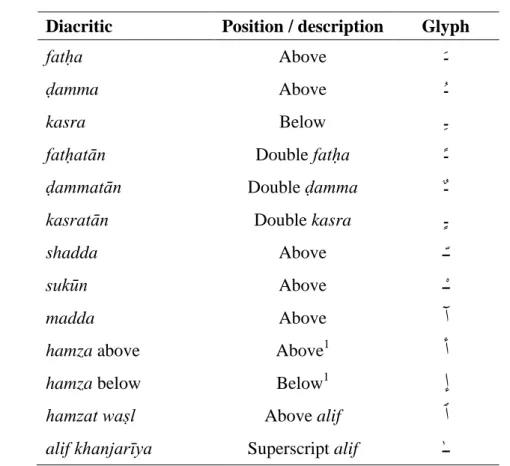
2.3 Arabic Syntactic Treebanks ... 21
2.3.1 The Penn Arabic Treebank ... 21
2.3.2 The Prague Arabic Treebank ... 24
2.3.3 The Columbia Arabic Treebank ... 28
2.4 Statistical Parsing Models ... 32
2.4.1 Classical Arabic Parsing ... 32
2.4.2 Arabic Constituency Parsing ... 32
2.4.3 Arabic Dependency Parsing ... 34
2.4.4 Dual Dependency-Constituency Parsing ... 36
2.4.5 Parsing Models for Ellipsis ... 38
2.4.6 Hebrew Parsing Models ... 40
Contents
viii
2.5.1 Expert Annotation ... 42
2.5.2 Crowdsourcing, Voting and Averaging ... 43
2.5.3 Supervised Collaboration ... 45
2.6 Conclusion ... 47
3 Historical Background 49 3.1 Introduction ... 49
3.2 Motivations of the Early Arabic Grammarians ... 49
3.3 Analytical Methods in Traditional Grammar ... 52
3.3.1 Analogical Deduction(qiyās) and Causation (ta’līl). ... 52
3.3.2 The Basran and Kufan Schools ... 53
3.3.3 Al-Khalil and Sibawayh ... 54
3.4 Further Developments ... 56
3.5 Conclusion ... 57
Part II: Modelling Classical Arabic 58 4 Orthographic Representation 59 4.1 Introduction ... 59
4.2 Quranic Orthography ... 61
4.2.1 The Uthmani Script ... 61
4.2.2 The Tanzil Project ... 62
4.3 Formal Representation ... 63
4.4 Computational Model ... 67
4.4.1 Java Object Model ... 67
4.4.2 Location Notation ... 68
4.4.3 Internal Representation ... 68
4.4.4 Unicode Conversion ... 70
4.4.5 Extended Buckwalter Transliteration ... 72
4.4.6 Orthographic Search ... 73
4.5 Conclusion ... 74
5 Morphological Representation 75 5.1 Introduction ... 75
5.2 Classical Arabic Morphology ... 76
Contents
ix
5.2.2 Roots and Patterns ... 77
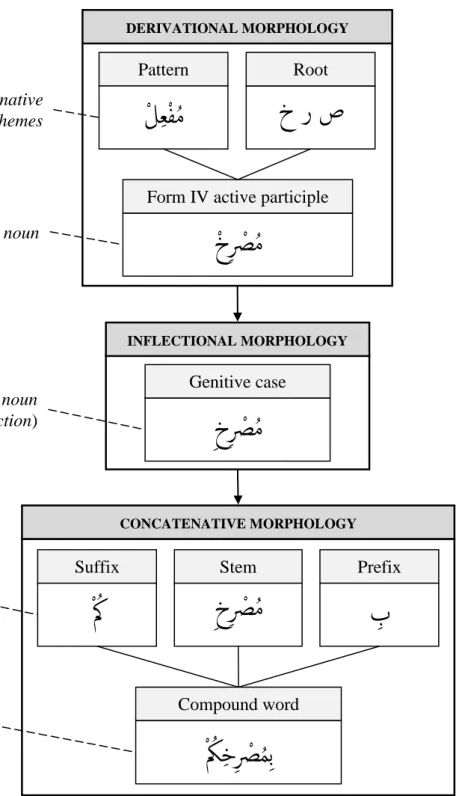
5.2.3 Inflection and Concatenation ... 78
5.2.4 Lemmas ... 81 5.3 Formal Representation ... 81 5.3.1 Segmentation ... 81 5.3.2 Feature-Value Pairs ... 82 5.3.3 Feature Notation ... 83 5.4 Parts of Speech ... 84
5.4.1 The Part-of-Speech Hierarchy in Arabic Grammar ... 84
5.4.2 Part-of-Speech Analysis in al-i’rābal-mufaṣṣal ... 85
5.4.3 Part-of-Speech Tags for Classical Arabic ... 87
5.5 Nominals ... 89 5.5.1 Nouns ... 90 5.5.2 Proper Nouns ... 90 5.5.3 Personal Pronouns ... 91 5.5.4 Demonstrative Pronouns ... 91 5.5.5 Relative Pronouns ... 92 5.5.6 Adjectives ... 93 5.5.7 Adverbs... 93
5.5.8 Imperative Verbal Nouns ... 93
5.6 Verbs ... 94
5.7 Particles ... 94
5.7.1 Quranic Initials ... 94
5.7.2 Prepositions ... 95
5.7.3 Prefixed lām Particles ... 95
5.7.4 Coordinating and Subordinating Conjunctions ... 95
5.7.5 Other Particles ... 96 5.8 Morphological Features ... 97 5.8.1 Prefixes ... 97 5.8.2 Suffixes ... 97 5.8.3 Classification Features... 97 5.8.4 Phi Features ... 99
Contents x 5.8.5 Verbal Features ... 99 5.8.6 Nominal Features... 99 5.9 Segmentation Rules ... 100 5.10 Morphological Structures ... 102
5.10.1 Prefix and Suffix Concatenation ... 102
5.10.2 Diptote Inflectional Case ... 103
5.11 Conclusion ... 104
6 Syntactic Representation 105 6.1 Introduction ... 105
6.2 Classical Arabic Syntax ... 106
6.2.1 Syntactic Position ... 106
6.2.2 Dependencies ... 107
6.2.3 Phrase Structure ... 108
6.2.4 Ellipsis (ḥadhf) and Reconstruction (taqdīr) ... 109
6.3 The Representation Problem ... 110
6.3.1 Constituency Representations ... 111 6.3.2 Dependency Representations... 113 6.3.3 Hybrid Representation ... 115 6.4 Formal Representation ... 120 6.5 Dependency Relations ... 122 6.5.1 Nominal Dependencies ... 122 6.5.2 Verbal Dependencies ... 124 6.5.3 Phrasal Dependencies ... 124 6.5.4 Particle Dependencies ... 125 6.5.5 Adverbial Dependencies ... 125
6.6 Phrase Structure Tags ... 126
6.6.1 Nominal and Verbal Sentences ... 126
6.6.2 Conditional and Subordinate Clauses ... 127
6.7 Syntactic Structures ... 128
6.7.1 Non-Projective Dependencies ... 128
6.7.2 Ellipsis ... 130
Contents
xi
6.7.4 The Accusative Case ... 134
6.7.5 Prepositional Phrase Attachment ... 137
6.8 Conclusion ... 140
Part III: Developing the Quranic Arabic Corpus 141 7 Annotation Methodology 142 7.1 Introduction ... 142 7.2 Methodology Overview ... 144 7.2.1 Annotation Stages ... 144 7.2.2 Corpus Size ... 145 7.3 Automatic Annotation ... 145 7.4 Offline Correction ... 148
7.5 Supervised Collaborative Annotation ... 151
7.5.1 Role-Based Collaboration ... 151
7.5.2 Resolving Disagreement ... 153
7.5.3 Online Annotation Accuracy ... 156
7.5.4 Unsupervised Crowdsourcing Comparison ... 159
7.6 Conclusion ... 160 8 Annotation Platform 161 8.1 Introduction ... 161 8.2 Platform Architecture ... 162 8.2.1 Modular Design ... 162 8.2.2 Linguistic Database ... 164
8.2.3 Computational Linguistic Components ... 165
8.3 The Quranic Arabic Corpus Website ... 167
8.3.1 User Interface Design ... 167
8.3.2 Morphological Annotation ... 168
8.3.3 Syntactic Treebank ... 172
8.3.4 Discussion Forum ... 173
8.4 Supplementary Resources ... 173
8.4.1 Reference Material ... 173
8.4.2 Dictionary and Morphological Search ... 174
Contents
xii
8.4.4 Published Datasets ... 177
8.4.5 Mailing List ... 178
8.5 Conclusion ... 179
Part IV: Statistical Parsing 180 9 Hybrid Parsing Algorithms 181 9.1 Introduction ... 181
9.2 Transition Parsing Systems ... 183
9.2.1 Background... 183
9.2.2 Transition Constituency Parsing... 186
9.2.3 Transition Dependency Parsing ... 188
9.2.4 Dependency Parsing Example ... 190
9.3 Hybrid Representation ... 192
9.3.1 Pure Dependency Graphs ... 193
9.3.2 Hybrid Dependency-Constituency Graphs ... 193
9.4 Algorithm I: Multi-Step Hybrid Parsing ... 194
9.4.1 Phrase Structure Conversion ... 195
9.4.2 Conversion of Ellipsis ... 197
9.4.3 Multi-Step Parsing Example... 200
9.5 Algorithm II: Integrated Hybrid Parsing ... 203
9.5.1 Extended Transition Set ... 203
9.5.2 Elliptical Transitions ... 204
9.5.3 Subgraphs and Phrase Structure ... 205
9.5.4 Integrated Parsing Example ... 206
9.6 Conclusion ... 210
10 Machine Learning Experiments 211 10.1 Introduction ... 211
10.2 Parser Implementation ... 212
10.3 Model Construction ... 214
10.3.1 Discriminative Probabilistic Models ... 214
10.3.2 The Oracle ... 215
10.4 Machine Learning ... 216
Contents
xiii
10.4.2 Feature Binarization ... 217
10.4.3 Kernel Selection and Parameters ... 218
10.4.4 Reducing Learning Time ... 218
10.5 Experiments ... 219
10.5.1 Parsing Algorithms ... 219
10.5.2 Graph Features... 220
10.5.3 Morphological Features ... 221
10.6 Evaluation Metrics and Methodology ... 223
10.6.1 Labelled Attachment Score and Parseval ... 223
10.6.2 Extended Labelled Attachment Score ... 225
10.6.3 Cross-Validation ... 226
10.7 Parsing Results ... 226
10.7.1 Multi-Step and Integrated Parsing ... 226
10.7.2 Effect of Different Feature Sets ... 227
10.7.3 Comparison with Modern Arabic ... 228
10.7.4 Effect of the Conversion Process ... 229
10.8 Conclusion ... 231
Part V: Further Work and Conclusion 232 11 Uses of the Quranic Arabic Corpus 233 11.1 Introduction ... 233
11.2 Part-of-Speech Tagging ... 233
11.3 Syntactic Annotation ... 236
11.4 Quranic Pronominal Anaphora ... 237
11.5 Prosodic Analysis ... 237
11.6 Knowledge Representation ... 238
11.7 Supervised Collaboration ... 240
11.8 Translation Studies ... 240
11.9 Conclusion ... 241
12 Contributions and Future Work 242 12.1 Introduction ... 242
12.2 Summary of Contributions ... 243
Contents
xiv
12.4 Implications ... 247
12.4.1 Syntax and Semantics ... 247
12.4.2 Computational Resources ... 249
12.5 Future Work ... 250
12.5.1 Annotation and Parsing ... 250
12.5.2 Understanding the Quran ... 251
12.6 Closing Remarks ... 251
Appendix A: Syntactic Visualization 252 Appendix B: Phonetic Transcription 255 Appendix C: Language Generation 257
xv
List of Figures
Figure 1.1: Verse (6:76) from the Quran. ... 3
Figure 1.2: Phrase-structure parse tree using a simple grammar. ... 5
Figure 1.3: Pure dependency graph for an English sentence. ... 6
Figure 1.4: Extract from verse (6:76). ... 7
Figure 1.5: Hybrid dependency-constituency graph. ... 8
Figure 1.6: Organization of thesis chapters. ... 11
Figure 2.1: Lexeme-plus-feature representation for an Arabic word. ... 17
Figure 2.2: Constituency tree from the Penn Arabic Treebank. ... 23
Figure 2.3: Dependency tree from the Prague Arabic Treebank. ... 27
Figure 2.4: Constituency tree from the Penn Arabic Treebank (upper tree) and a dependency tree from the Columbia Arabic Treebank (lower tree). ... 30
Figure 2.5: Constituency and dependency representations for Swedish. ... 37
Figure 2.6: Dual dependency-constituency representation for Swedish. ... 37
Figure 2.7: Empty categories in a Penn English Treebank constituency tree... 39
Figure 3.1: Timeline of key developments in Classical Arabic grammar. ... 50
Figure 4.1: Structure of Quranic script for verse (6:76) in the madīnah musḥaf. .. 62
Figure 4.2: Incorrect Google results for verse (68:38), as of January 21, 2008. ... 62
Figure 4.3: Character-plus-diacritic representation for Arabic script. ... 66
Figure 4.4: Class hierarchy for orthography in JQuranTree. ... 67
Figure 4.5: Internal orthographic encoding. ... 69
Figure 4.6: Unicode encoding algorithm. ... 71
Figure 4.7: Example JQuranTree program for Buckwalter transliteration. ... 72
Figure 4.8: Orthographic search using Buckwalter transliteration. ... 74
Figure 5.1: A compound Classical Arabic word-form in verse (14:22). ... 79
Figure 5.2: Derivational and inflectional morphology with form and function. ... 80
Figure 5.3: Salih‟s grammatical analysis for verse (77:21). ... 86
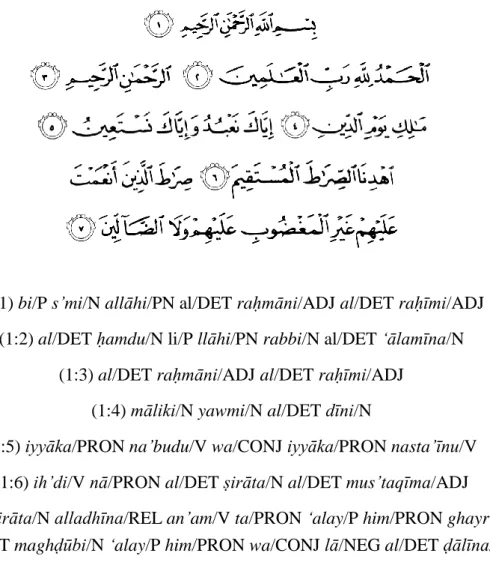
Figure 5.4: Uthmani script and part-of-speech tagging for verses (1:1-7). ... 89
Figure 5.5: Morphological annotation for verse (4:68). ... 102
Figure 5.6: Morphological annotation for verse (74:42). ... 103
List of Figures
xvi
Figure 6.2: Dependency relations in verse (3:130). ... 107
Figure 6.3: An embedded sentence as a direct object in verse (3:52). ... 108
Figure 6.4: Carter‟s constituency representation based on Sibawayh‟s analysis. 111 Figure 6.5: Owens‟ dependency representation based on traditional grammar. .. 114
Figure 6.6: Subject, object and prepositional dependencies. ... 116
Figure 6.7: Dependency between a prepositional phrase and a verb. ... 117
Figure 6.8: Conjunctive dependency between two verbal sentences. ... 118
Figure 6.9: Dependency of a prepositional phrase on a reconstructed verb. ... 119
Figure 6.10: Hybrid dependency-constituency graph for verse (63:10). ... 120
Figure 6.11: Nominal dependencies in verse (3:45). ... 122
Figure 6.12: Verbal and phrasal dependencies in verse (5:87). ... 124
Figure 6.13: Accusative adverbial dependencies in verse (3:13). ... 125
Figure 6.14: Embedded conditional clause in verse (83:2). ... 127
Figure 6.15: Non-projective dependencies in verse (2:127). ... 129
Figure 6.16: Dropped subject pronoun in verse (3:199). ... 130
Figure 6.17: Syntactic ellipsis in verse (7:186). ... 131
Figure 6.18: Reconstructed pronoun with Salih‟s analysis for verse (2:18). ... 132
Figure 6.19: Coordinating conjunction as a disconnected node in verse (8:40). . 133
Figure 6.20: The word rasūlan („a messenger‟) as a circumstantial accusative in verse (4:79) and as a direct object in verse (73:15). ... 136
Figure 6.21: Prepositional phrase attachment in verse (100:6:1). ... 138
Figure 6.22: Elliptical PP-attachment to a reconstructed circumstantial accusative in verse (4:141) and to a reconstructed adjective in verse (4:98). ... 139
Figure 7.1: Multi-stage annotation process. ... 144
Figure 7.2: Custom Java application used for offline morphological correction. 149 Figure 7.3: Website visitors and message board posts per week over a year. ... 156
Figure 8.1: LAMP architecture diagram. ... 163
Figure 8.2: The Quranic Arabic Corpus website. ... 168
Figure 8.3: Drill-down interface. ... 169
Figure 8.4: Morphological annotation with generated summaries. ... 170
Figure 8.5: Concept nodes in the Quranic ontology. ... 176
List of Figures
xvii
Figure 9.2: Example English dependency graph. ... 190
Figure 9.3: Example dependency transition sequence. ... 191
Figure 9.4: Conversion of phrase structure in verse (19:62). ... 196
Figure 9.5: Conversion of dropped subject pronouns in verse (82:7). ... 198
Figure 9.6: Conversion of syntactic ellipsis in verse (2:153). ... 199
Figure 9.7: Converted graph encoding ellipsis and phrase structure. ... 200
Figure 9.8: Transition sequence for multi-step dependency parsing. ... 201
Figure 9.9: Post-processing transformations for verse (4:141). ... 202
Figure 9.10: Phrase structure transition using a rooted subgraph. ... 205
Figure 9.11: Hybrid dependency-constituency graph for verse (7:186). ... 206
Figure 9.12: Hybrid transition sequence (first part). ... 207
Figure 9.13: Hybrid transition sequence (second part). ... 208
Figure 10.1: Java user interface for HSP with a hybrid transition sequence. ... 212
Figure 10.2: Architecture diagram for HSP showing component interaction. .... 213
Figure 10.3: Maximum margins in SVM classification. ... 217
Figure A1: Visual dependency graph with and without bounding boxes. ... 253
Figure B1: Phonetic transcription for Arabic letters. ... 255
xviii
List of Tables
Table 2.1: Features used in ALMORGEANA‟s morphological representation. ... 16
Table 2.2: Part-of-speech tags in the Columbia Arabic Treebank. ... 28
Table 2.3: Dependency tags in the Columbia Arabic Treebank. ... 29
Table 2.4: Top five statistical parsers for Arabic in the CoNLL shared task. ... 35
Table 2.5: Errors for automatic part-of-speech tagging for the Penn Treebank. ... 43
Table 4.1: Base characters in the orthographic representation. ... 64
Table 4.2: Attached diacritics with their positions relative to base characters. ... 65
Table 4.3: Additional characters in extended Buckwalter transliteration. ... 73
Table 5.1: Part-of-speech tags for Classical Arabic. ... 88
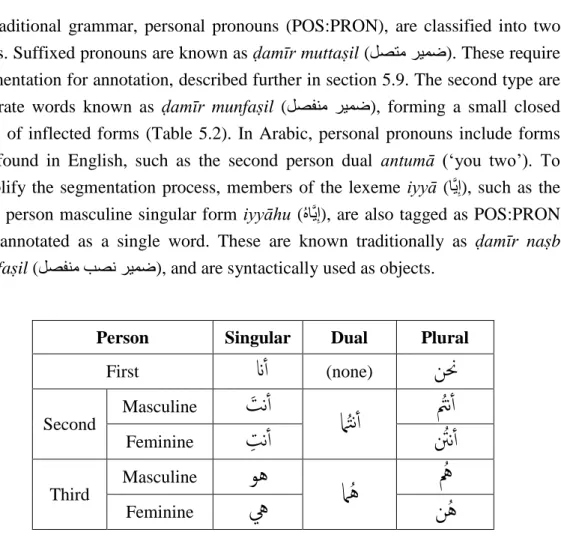
Table 5.2: Independent personal pronouns. ... 91
Table 5.3: Main inflection forms for demonstrative pronouns. ... 92
Table 5.4: Morphological feature tags for Classical Arabic. ... 98
Table 5.5: Morphological segmentation rules for Classical Arabic. ... 100
Table 6.1: Dependency relations for Classical Arabic based on Salih (2007) and Darwish (1996). ... 123
Table 6.2: Phrase-structure tags for Classical Arabic. ... 126
Table 6.3: Accusative syntactic roles in Classical Arabic. ... 135
Table 7.1: Number of modifications during morphological annotation. ... 150
Table 7.2: Estimated accuracy scores for automatic annotation. ... 150
Table 7.3: Suggestions per random sample. ... 157
Table 7.4: Accuracy of morphological annotation. ... 158
Table 8.1: Extract from the morphological annotation table. ... 164
Table 8.2: Hybrid dependency graph in extended CoNLL-X format. ... 164
Table 10.1: Contextual rules used by the hybrid oracle. ... 215
Table 10.2: Morphological feature sets for parsing Classical Arabic. ... 221
Table 10.3: Accuracy scores for hybrid parsing using different feature sets. ... 227
xix
List of Abbreviations
The following table lists the meanings of the abbreviations used in this thesis. The page on which each abbreviation is defined is also given.
Abbreviation Meaning Page
ATB Arabic Treebank 33
BAMA Buckwalter Arabic Morphological Analyzer 14
CATiB Columbia Arabic Treebank 28
CoNLL Computational Natural Language Learning Conference 34
ELAS Extended Labelled Attachment Score 223
FSM Finite State Machine 19
HMM Hidden Markov Model 233
HSP Hybrid Statistical Parser 181
JSP Java Server Pages 162
LAMP Linguistic Analysis Multimodal Platform 161
LAS Labelled Attachment Score 35
LDC Linguistic Data Consortium 24
MSA Modern Standard Arabic 2
NLG Natural Language Generation 166
NLP Natural Language Processing 45
NLTK Natural Language Toolkit 233
NS Nominal Sentence 118
OOP Object Oriented Programming 67
POS Part of Speech 5
SALMA Standard Arabic Language Morphological Analysis 18
SVM Support Vector Machine 4
SVO Subject-Verb-Object 34
The worthwhile problems are the ones you can really solve or help solve, the ones you can really contribute something to... No problem is too small or too trivial if we can really do something about it.
– Richard Feynman
2
1
Introduction
1.1
Motivation
The topic of this thesis is statistical parsing for Classical Arabic using machine learning. This work includes constructing a formal grammatical representation and developing the Quranic Arabic Corpus as a dataset to test parsing algorithms.
Parsing is the process of determining the syntactic structure of a sentence. Algorithms for parsing are researched in computational linguistics, an interdisciplinary field that combines computer science, statistical modelling and mathematical logic to process natural language. Analyzing the syntactic structure of a sentence through parsing can be a prerequisite step for deeper processing tasks such as machine translation (Huang et al., 2006; Zollmann and Venugopal, 2006), semantic analysis (Carreras and Màrquez, 2005) and task execution, in which machines execute physical tasks using natural language commands (Kuhlmann et al., 2004).
My own motivation for developing a parser for Classical Arabic is that it is a less-studied language in computational linguistics. Classical Arabic is a 1,600 year-old ancient language that is the direct ancestor of Modern Standard Arabic (MSA) spoken today. Although a variety of parsers exist for Modern Arabic, almost no previous work has been done for statistical parsing of Classical Arabic, the original language of the Quran.
1 – Introduction
3
Figure 1.1 shows an example verse (āyah) from the Quran, written in Classical Arabic from right-to-left using a connected cursive script. Arabic, together with Hebrew, Turkish and Finnish are examples of languages that are morphologically rich and highly inflected. The complexity of these morphologically rich languages poses special challenges to parsing work.
Figure 1.1: Verse (6:76) from the Quran.
(6:76) When the night covered him, he saw a star. He said, ‘This is my
Lord.’ But when it set, he said, ‘I do not love those that disappear.’
The grammatical system explored in this thesis is i’rāb (ةاغعإ), a 1,000 year-old comprehensive linguistic theory that describes Classical Arabic‟s phonology (the interaction of the units of sound that make up speech), morphology (the study of the substructure of words), syntax (the structure of sentences) and discourse analysis (the study of the discourse structures used in communication). This linguistic theory developed independently of Western thought and has influenced modern theories of syntax (Versteegh, 1997b; Baalbaki, 2008). For example, along with Panini‟s Ashtadhyayi for Classical Sanskrit, i’rāb is considered to be one of the origins of modern dependency grammar (Kruijff, 2006; Owens, 1988).
My motivation for this thesis originated in a personal interest in the linguistic structure of the Quran. Classical Arabic grammar is widely studied in the Islamic world due to the importance of the Quran, and several grammatical works exist that provide detailed analysis of its syntax (Salih, 2007; Darwish, 1996). I have often wondered if this analysis could be derived through statistical models using machine learning. Could algorithms learn from example data and reproduce the historical analyses of traditional grammarians? My interest in this idea led me to research statistical methods for parsing Classical Arabic, inspired by Arabic‟s long and rich grammatical tradition.
1 – Introduction
4
1.2
Research Questions
1.2.1 Is Statistical Parsing Viable for Classical Arabic?
Over the last two decades, statistical parsers have been used as an alternative to, and in combination with, previous rule-based parsers (Marcus et al., 1993; Abney, 1996). In contrast to rule-based parsers, statistical parsers learn a grammatical model from a treebank – a syntactically annotated corpus of example sentences. A variety of methods are used for statistical parsing, ranging from maximum entropy techniques for phrase-structure representations (Charniak, 2000) to support vector machines (SVMs) for dependency grammar (Nivre et al., 2007b).
Most research into statistical parsing has focused on English, with the best models achieving up to 92% accuracy (McClosky, Charniak and Johnson, 2006). Adapting these parsing models to other languages has been less successful. For example, adapting Bikel‟s parser to Chinese has resulted in an F1-score of 79.9% (Chiang and Bikel, 2002). Similarly, results from the CoNLL shared task on multilingual dependency parsing show that Modern Arabic is one of the most challenging languages to parse (Nivre et al., 2007a). This is in part due to Arabic‟s complex morphology. As noted by Soudi et al. (2007):
The morphology of Arabic poses special challenges to computational natural language processing systems. The exceptional degree of ambiguity in the writing system, the rich morphology, and the highly complex word formation process of roots and patterns all contribute to making computational approaches to Arabic very challenging.
It is thus not immediately obvious if parsing Classical Arabic is tractable using purely statistical methods. The primary research question that will be answered in this thesis is to determine whether or not statistical parsing for Classical Arabic is a viable approach for achieving state-of-the-art parsing accuracy.
1 – Introduction
5
1.2.2 Is a Hybrid Representation Suitable for Parsing?
In modern linguistics, there is no universally accepted grammatical theory for representing syntactic information. Examples of different theories include transformational grammar (Chomsky, 1970), dependency grammar (Mel‟čuk, 1988), functional grammar (Halliday and Matthiessen, 2006) and combinatory categorial grammar (Steedman, 2000). For annotation, multiple representations can be used. The two main representations used by treebanks are constituency phrase-structure (using relations between clauses and their constituents), and dependency grammar (using dependency relations between words). This thesis describes a novel hybrid representation, combining aspects of both dependency and constituency syntax. The motivation for using a hybrid approach for Classical Arabic is to remain closely aligned to traditional analyses of Quranic grammar.
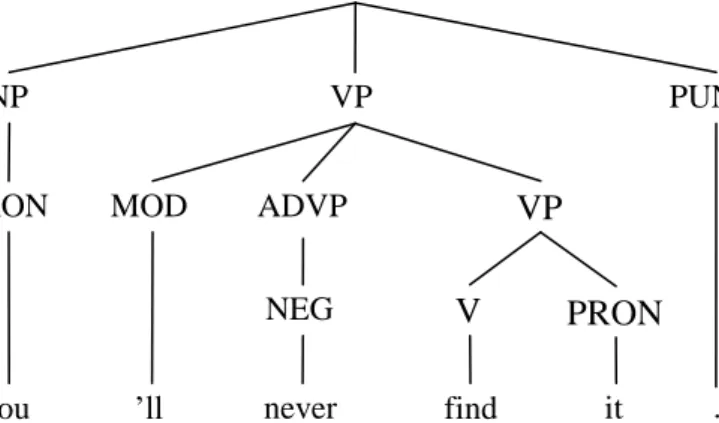
This section introduces the hybrid representation by comparing to two existing representations. The following two diagrams annotate the same English sentence. Figure 1.2 is a constituency tree, with preterminal nodes annotated using an example POS (part-of-speech) tagset (PRON = pronoun, MOD = modal, NEG = negative particle, V = verb, PUNC = punctuation). Non-terminals are phrase tags (NP = noun phrase, VP = verb phrase, ADVP = adverb phrase, S = sentence).
Figure 1.2: Phrase-structure parse tree using a simple grammar. ‟ll
You never find it
PRON MOD NEG V PRON ADVP VP NP VP S . PUNC
1 – Introduction
6
In contrast to the constituency approach, dependency theory represents sentence structure using binary dependencies between pairs of words. In Figure 1.3, the example sentence has been annotated using the same part-of-speech tags as Figure 1.2, but using an alternative dependency tagset for syntax (subj = subject, obj = object, mod = modal, neg = negation). Unless otherwise stated, dependency diagrams in this thesis follow the convention of dependent nodes pointing to head nodes, the same convention used to annotate Classical Arabic in the Quranic Arabic Corpus.1
Although these two diagrams annotate an English sentence, they illustrate a task that is more challenging in Arabic – morphological segmentation. In the diagrams, terminal nodes are not words but segments of words. For example, the word „you‟ll‟ has been segmented into the pronoun „you‟ and the modal „will‟. In English, only a minority of words such as contractions require segmentation for treebank construction. This contrasts with Arabic, where morphological analysis is complex, as many words require segmentation into multiple morphemes that each have different syntactic roles in sentence structure.
Figure 1.3: Pure dependency graph for an English sentence.
1 Appendix A describes the graph layout algorithm used to produce syntax diagrams in this
thesis and for the online Quranic Treebank (http://corpus.quran.com/treebank.jsp).
‟ll
You never find it
PRON MOD NEG V PRON
neg punc subj . PUNC mod obj
1 – Introduction
7
The previous diagrams illustrated two different representations for syntactic annotation. For parsing, the choice of representation used to model a language is fundamental to the operation of a parser. It constrains possible parsing algorithms and has a direct effect on parsing accuracy. This is highlighted by the recent use of model adaptation, where existing statistical parsers designed for English have been retrained for Modern Arabic (Green and Manning, 2010). Because Arabic contains linguistic constructions not found in English, this has resulted in parsing underperformance (described further in section 2.4).
ِّب َر إَذٰـَى َلاَك
He said, „This is my Lord.‟Figure 1.4: Extract from verse (6:76).
In this thesis, Classical Arabic syntax will be described using an alternative representation based on Arabic‟s grammatical tradition. However, despite its prominence in Arabic linguistic works, the grammatical rules of i’rāb have previously lacked a formal representation, making computational modelling of Classical Arabic grammar challenging. In contrast to formal methods, traditional analysis is described by grammarians through prose. For example, the syntax of verse (6:76) shown in Figure 1.4 is described by Salih (2007) using the following analysis (translated from Arabic):
In this verse, „said‟ is a perfective verb, whose subject is a dropped pronoun of the form „he‟. The noun „lord‟ is in the nominative case and is the predicate of the demonstrative pronoun „this‟. The suffixed pronoun „my‟ attached to the noun is a possessive clitic. The nominal sentence, headed by the demonstrative pronoun, is governed by the verb „said‟ as a direct object.
1 – Introduction
8 Figure 1.5: Hybrid
dependency-constituency graph.
A hybrid representation can be used to formalize this analysis. For example, Salih analyses the phrase „This is my Lord‟ as a dependency of the verb „said‟. Although i’rāb describes dependencies between morphological segments, this shows that the grammar also describes dependencies between words and phrases. Arabic grammatical theory could be interpreted as either a pure dependency or constituency representation, but a hybrid representation more closely aligns to traditional analysis. Figure 1.5 annotates verse (6:76) of the Quran using the hybrid formalism that will be presented in Chapter 6. The diagram shows a graph with nodes that are either morphological segments with part-of-speech tags (V = Verb, PRON = Pronoun, DEM = Demonstrative, N = Noun) or phrase nodes (NS = Nominal Sentence). Edges are tagged with dependency relations such as object, subject and predicate, shown in Arabic using traditional terminology.
The second research question addressed in this thesis is to determine if a hybrid dependency-constituency representation is better suited to parsing Classical Arabic compared to a pure dependency representation. This question will be answered by annotating the Quran using the hybrid representation and comparing the two approaches to parsing.
DEM PRON V N NS PRON
(
َوُى
)
َلاَك
إَذٰـَى
ِّب َر
معبف غجس ّٛنإ فبؼي لٕعفي ّث (6:76:7) qāla (He) said, (6:76:8) hādhā „This (6:76:9) rabbī (is) my Lord.‟1 – Introduction
9
1.2.3 Can Crowdsourcing be used for Annotating Arabic?
Of potential wider interest beyond Classical Arabic parsing is the use of crowdsourcing to construct the annotated treebank which will be used to train a statistical parser. Statistical parsers require high-quality training data in the form of sentences annotated according to a chosen syntactic representation. A typical annotation methodology involves paid experts who perform offline annotation. However, the alternative of online collaboration has recently emerged as a viable alternative to more conventional approaches for developing tagged corpora (Chamberlain et al., 2009). Online collaboration has been used for a wide variety of linguistic tagging tasks ranging from named-entity resolution of international hotels (Su et al., 2007) to syntactic annotation of Latin and Ancient Greek texts (Bamman et al., 2009).
In this thesis, crowdsourcing will be used to develop the first treebank for Classical Arabic. Following initial automatic tagging, the main task that volunteer annotators are asked to perform is to proofread morphological and syntactic annotation. Annotators verify this against gold standard analyses from Arabic reference works of Quranic grammar. Although the reference material contains equivalent grammatical information, because its content is unstructured prose that is not easily machine readable, a manual cross-checking stage is required.
The third research question to be investigated in this thesis is to determine if a form of crowdsourcing can be used as an annotation methodology for producing high-quality tagging of Classical Arabic. Volunteer crowdsourcing can be cost effective, but consistency and accuracy need to be ensured if the data is to be used for statistical modelling. In the Quranic Arabic Corpus, expert annotators are promoted to a supervisory role, reviewing and discussing the work of others online using an interactive message board forum. In this thesis, the collaborative annotation methodology will be compared to the alternative of crowdsourcing without expert supervision, and evaluated for accuracy.
1 – Introduction
10
1.3
Original Contributions of the Thesis
1.3.1 Theoretical Contributions
The main theoretical contributions that will be presented in the thesis are:
The first formalism of i’rāb and the first morphosyntactic annotation scheme for Classical Arabic. This includes a novel hybrid dependency-constituency representation, with a fine-grained tagset for parts-of-speech and phrases, morphological features and dependency relations.
The first evaluation of a methodology for online supervised collaboration for Arabic annotation. This methodology combines crowdsourcing with expert supervision to produce highly-quality annotation for Arabic text.
1.3.2 Practical Contributions
The main practical contributions to be presented are:
The first treebank for Classical Arabic. This includes manually-verified morphological annotation for 77.4K words tagged with 783K feature-values together with syntactic tagging for 37.6K words. Supplementary annotation includes named-entity tagging, an ontology of concepts, a word-by-word English translation and a morphological lexicon.
The first web-based platform for capturing, editing and visualizing Arabic morphosyntactic annotations online. This includes a comprehensive set of supplementary linguistic tools to access and search corpus annotations. The first statistical parser for Classical Arabic. In addition, this is also the
first dependency-based statistical parser in any language that handles elliptical structures, dropped pronouns and a hybrid representation.
1 – Introduction
11
1.4
Thesis Outline
This thesis is divided into five parts with 12 chapters, shown in Figure 1.6 below:
Part I: Introduction and Background
1 Introduction 2 Literature Review 3 Historical Background
Part II: Modelling Classical Arabic
4 Orthographic Representation 5 Morphological Representation 6 Syntactic Representation
Part III: Developing the Quranic Arabic Corpus
7 Annotation Methodology 8 Annotation Platform
Part IV: Statistical Parsing
9 Hybrid Parsing Algorithms 10 Machine Learning Experiments
Part V: Further Work and Conclusion
11 Uses of the Quranic Arabic Corpus 12 Contributions and Future Work
Figure 1.6: Organization of thesis chapters.
Part I provides relevant background information. Following this introductory chapter, Chapter 2 contains the literature review, discussing Arabic treebanks and annotation methodologies. Recent morphological analyzers and statistical parsers for Arabic are also compared. Relevant historical background on the Arabic linguistic tradition is provided in Chapter 3.
1 – Introduction
12
Part II presents a formal model of Classical Arabic, with a representation for orthography (Chapter 4), morphology (Chapter 5) and syntax (Chapter 6). The representation is presented both as a well-defined set-theoretic description and as an annotation scheme.
Part III describes the development of the Quranic Arabic Corpus. Chapter 7 discusses the annotation methodology of supervised collaboration. Chapter 8 describes the web-based software platform used to capture annotations online and the supplementary linguistic tools developed for annotators.
Part IV focuses on statistical parsing. In Chapter 9, two algorithms for hybrid parsing are compared: a multi-step process using graph transformations and a novel one-step algorithm without post-processing. Chapter 10 evaluates the parser using statistical models induced from the treebank by machine learning. A series of experiments consider the effect of using different morphological features for parsing and the results are compared to recent parsing work for Modern Arabic.
Part V concludes the thesis. Chapter 11 describes recent research that has made use of the annotations in the Quranic Arabic Corpus and Chapter 12 summarizes the main contributions and presents recommendations for future research. The last chapter concludes with a discussion of the challenges and limitations of the work as well as its implications for theoretical and computational linguistics.
Perhaps the central problem we face in all of computer science is how we are to get to the situation where we build on top of the work of others... Science is supposed to be cumulative.
– Richard Hamming
13
2
Literature Review
2.1
Introduction
Arabic is a major world language. Together with Chinese, English, French, Russian and Spanish, it is one of the six official languages of the United Nations. Including its literary form and its various dialects, it is the first language for 280 million native speakers across the Middle East and North Africa (Procházka, 2006). Classical Arabic is the liturgical language of prayer and worship for the world‟s Muslim population, estimated at between 1.57 billion (Lugo, 2009) and 1.65 billion people (Kettani, 2010), up to a quarter of the world‟s population.
Arabic has recently become the focus of an increasing number of natural language processing projects (Habash, 2010). This review describes relevant work in four areas: morphology, syntax, parsing and annotation methodologies. The first part of the review describes recent work for Arabic morphology, including an analysis of the limitations of previous morphological work for the Quran. To provide context for the syntactic representation developed for the Quranic Arabic Corpus, the review compares the Penn, Prague and Columbia Arabic treebanks, focusing on the approaches used to formalize Arabic syntax.
Following the description of morphological and syntactic projects, parsing work for Arabic is reviewed, describing how different syntactic representations affect accuracy. Attention is also given to dual dependency-constituency parsing work for German and Swedish, as these methods are relevant to the hybrid parsing work
2 – Literature Review
14
described in Chapter 9. Models for ellipsis are also reviewed, which are often ignored in parsing work but are developed in this thesis. The review of parsing work concludes with a discussion of recent work for Hebrew. This related Semitic language presents similar challenges to statistical parsing, and illustrates recent trends in parsing that are also applicable to Arabic.
Methodologies for other relevant annotation projects beyond Arabic are also reviewed, comparing offline expert annotation to collaborative online annotation and crowdsourcing. Finally, the conclusion summarizes the implications of the reviewed work in relation to the thesis research questions.
2.2
Arabic Morphological Analysis
This section of the review discusses different approaches to Arabic computational morphology. Morphological analysis tasks for Arabic include segmentation (the division of compound word-forms into prefixes, stems and suffixes), part-of-speech tagging (assigning a tag to each morphological segment), lemmatization (assigning lemmas to stems) and the identification of the roots and patterns used in inflected Arabic word-forms.
2.2.1 The Buckwalter Arabic Morphological Analyzer
The Buckwalter Arabic Morphological Analyzer (BAMA) is a freely available rule-based morphological analyzer, developed to perform initial tagging of Penn Arabic Treebank (Buckwalter, 2002). This previous work is relevant because an analyzer based on BAMA‟s algorithm will be used in Chapter 7 to perform initial morphological tagging for the Quranic Arabic Corpus.
BAMA‟s analysis algorithm depends on its lexicon. Version 2.0 of the analyzer contains 78,839 lexical entries representing 40,219 lemmas. This data is organized into segment tables with entries for prefixes, stems and suffixes, and compatibility tables listing permitted combinations of segments. The part-of-speech tagset used in these dictionary files is the same as that used for the Penn Arabic Treebank.
2 – Literature Review
15
The morphological analyzer processes undiacritized Arabic text, returning several possible analyses for each word. Its analysis algorithm generates all possible segmentations into prefixes, stems and suffixes. For each combination, the segment tables are checked to determine if the analysis is linguistically plausible. The resulting filtered analyses are output with full diacritization and morphological annotation, augmented by features from the lexicon.
BAMA is widely used by the Arabic computational research community for a variety of tasks including diacritic restoration (Ananthakrishnan et al., 2005), automatic speech recognition and machine translation (Soltau et al., 2007) and named entity recognition (Farber et al., 2008). Its lexicon has also been used as one source of data for the Arabic version of Google‟s online translation service. However, BAMA is limited by producing multiple analyses for each word. To overcome this limitation, BAMA‟s lexicon has been used as the basis for more sophisticated statistical disambiguation systems, described in the next section.
2.2.2 Lexeme and Feature Representations
Habash (2007a) notes that Arabic morphological resources use different, often incompatible, representations to model morphology. Electronic dictionaries and lexicons are based around headwords and lemmas. Stemmers focus on extracting the stems of word-forms and deeper analyzers extract roots and patterns. Habash proposes a lexeme-plus-feature representation to relate these different resources. This work is relevant to Classical Arabic because the Quranic Arabic Corpus uses a similar representation for morphological annotation, as described in Chapter 5.
For morphologically-rich languages such as Arabic, the term lexeme is used to denote an abstract grouping of words that share the same base meaning, but differ through inflection. A lemma, also known as a citation form, is a conventional choice of one word that represents a lexeme. Dictionary entries are usually organized by lemma. For example, in English the set of words „eat‟, „eats‟, „ate‟ and „eating‟ form a lexeme, with „eat‟ as the lemma.
2 – Literature Review
16
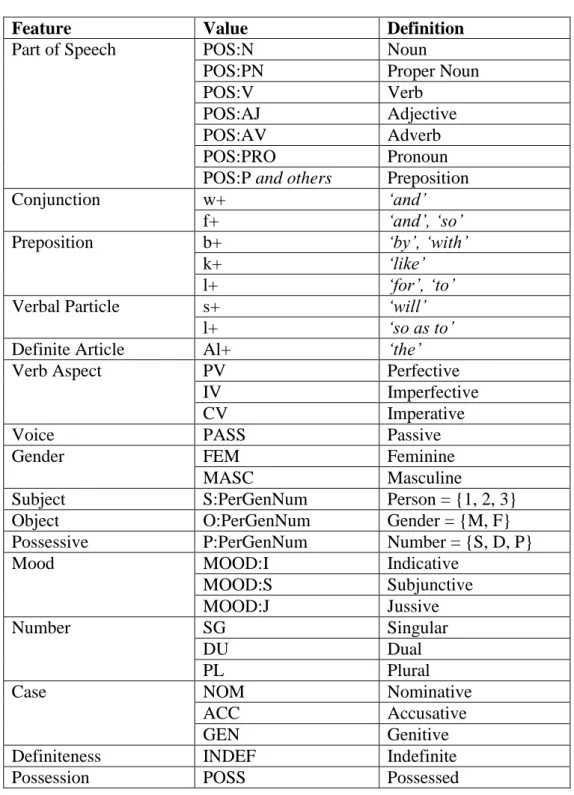
Feature Value Definition
Part of Speech POS:N Noun
POS:PN Proper Noun
POS:V Verb
POS:AJ Adjective
POS:AV Adverb
POS:PRO Pronoun
POS:P and others Preposition
Conjunction w+ ‘and’
f+ ‘and’, ‘so’
Preposition b+ ‘by’, ‘with’
k+ ‘like’
l+ ‘for’, ‘to’
Verbal Particle s+ ‘will’
l+ ‘so as to’
Definite Article Al+ ‘the’
Verb Aspect PV Perfective
IV Imperfective
CV Imperative
Voice PASS Passive
Gender FEM Feminine
MASC Masculine
Subject S:PerGenNum Person = {1, 2, 3}
Object O:PerGenNum Gender = {M, F}
Possessive P:PerGenNum Number = {S, D, P}
Mood MOOD:I Indicative
MOOD:S Subjunctive
MOOD:J Jussive
Number SG Singular
DU Dual
PL Plural
Case NOM Nominative
ACC Accusative
GEN Genitive
Definiteness INDEF Indefinite
Possession POSS Possessed
2 – Literature Review
17
The ALMORGEANA system described by Habash (2007a) uses lexemes and features to provide bidirectional morphological analysis and generation, suitable for a variety of processing tasks, such as machine translation. The system utilizes a lexicon based on dictionary data from BAMA, but applies a different algorithm to perform morphological processing. In ALMORGEANA, the BAMA segment tables are converted to the lexeme-plus-feature representation. Table 2.1 (page 16) lists the converted morphological features. Figure 2.1 below illustrates how these features are used to represent the morphology of the compound Arabic word-form
lilkutubi (translated as „for the books‟).
[kitAb_1 POS:N PL Al+ l+]
تزكهن
„for the books‟
Figure 2.1: Lexeme-plus-feature representation for an Arabic word.
The lexeme for this surface form is represented by the lemma kitāb, displayed using Buckwalter transliteration as kitAb_1. The suffix _1 is part of a numbering scheme used to distinguish word senses with the same name. Four features follow the lemma. POS:N is the part-of-speech tag for nouns, and PL denotes a plural word. Al+ indicates that the word-form has the Arabic al- prefix to denote definiteness („the‟), and l+ indicates the lām prefixed preposition („for‟).
Like the Buckwalter analyzer, ALMORGEANA outputs several possible morphological analyses for each input Arabic word. Habash and Rambow (2005) extend the system to select a statistically most-probable analysis. Using data from the Penn Arabic Treebank converted to the lexeme-plus-feature representation, they build a statistical model to rank possible analyses using support vector machines trained to recognize individual morphological features. Testing against
2 – Literature Review
18
the Penn Treebank, they report high accuracy scores of 99.3% for morphological segmentation at word-level, and 98.1% for part-of-speech tagging over all tokens, using a reduced tagset.
Based on this work, Habash, Rambow and Roth (2009b) describe a toolkit consisting of two Arabic morphological systems, MADA and TOKAN. Like ALMORGEANA, the toolkit utilizes the BAMA lexicon. MADA (Morphological Analysis and Disambiguation for Arabic) is a statistical morphological analyzer that selects the best possible BAMA analysis using weighted predicted features. TOKAN is a flexible Arabic tokenizer that provides morphological segmentation of Arabic words according to a number of possible tokenization schemes. The toolkit has been used for a variety of further work including English-to-Arabic machine translation (Badr et al., 2008) and named entity recognition (Farber et al., 2008; Benajiba et al., 2008).
Compared to the Buckwalter Analyzer, this toolkit is attractive because it produces a single morphological analysis for each Arabic word. The use of a lexeme-plus-feature representation is notable for providing a computational model of Arabic morphology that is flexible enough to support different processing tasks. This representation will be extended to Classical Arabic morphology in Chapter 5.
2.2.3 Fine-Grained Morphological Analysis
In contrast to previous work, the SALMA tagger (Standard Arabic Language Morphological Analysis) uses a more fine-grained morphological tagset based on concepts from the Arabic linguistic tradition (Sawalha and Atwell, 2010; Sawalha, Atwell and Abushariah, 2013). This work compares to the annotation presented in this thesis, which is also fine-grained.
The SALMA tagger utilizes a lexicon of inflected surface forms containing 2.7 million vowelized word-root pairs, built by combining 23 Arabic dictionaries. Arabic text is annotated using a set of 22 morphological features that include part-of-speech, gender, number, person, case, mood, definiteness, voice, emphasis,
2 – Literature Review
19
transitivity, variability, roots and verb structure. The tagging algorithm segments words by applying a sequence of regular expressions to produce a list of candidate analyses. Segmented stems are matched to the lexicon to extract possible roots. A pattern database consisting of 2,730 patterns for verbs and 985 for nouns is used to search for appropriate root-pattern pairs. Morphological features are then annotated using the lexicon.
Sawalha et al. (2013) measure the tagger‟s accuracy by manually annotating a gold-standard dataset of 2,000 words using samples from two corpora. For Classical Arabic, they annotate the morphological analysis of the Quran by Dror et al. (2004), described in the next section. For Modern Arabic they use data from the Corpus of Contemporary Arabic (Al-Sulaiti and Atwell, 2006). For a set of 15 morphological features, they report an estimated accuracy score of 98.53% for tagging Modern Arabic and 90.1% for Classical Arabic.
This work demonstrates that automatic fine-grained morphological analysis of Arabic is possible. The morphological representation in Chapter 5 will also use a fine-grained tagset based on traditional grammar. It differs by using an alternative set of tags with morphological features developed specifically for Classical Arabic and designed to integrate with a syntactic representation.
2.2.4 Finite State Morphological Analysis of the Quran
This section describes the use of Finite State Machines (FSMs) to annotate the Arabic morphology of the Quran (Dror et al., 2004). To the best of the author‟s knowledge, this work is the only other wide-coverage computational analysis of Classical Arabic morphology, before the new work presented in this thesis. However, unlike the Quranic Arabic Corpus, the FSM analysis has not been manually verified by expert annotators. Dror et al. provide several different possible analyses for each word in the Quran, but do not disambiguate these to bring their annotations up to gold-standard level.
Their approach uses finite state computing using FSMs. These are abstract mathematical models of computation that consist of multiple states, together with
2 – Literature Review
20
rules that determine transitions between states. They have been applied to a wide variety of morphologically-rich languages, for which lexicons and morphological rules are developed manually by linguistic experts and encoded as state transition (Roche and Schabes, 1997; Beesley and Karttunen, 2002). The output of FSM systems are typically in a lexeme-plus-feature representation. In the description of their system for Classical Arabic, Dror et al. note that the language of the Quran remains relatively unexplored in contrast to Modern Arabic:
Except for isolated efforts, little has been done with computer-assisted analysis of the text. Thus, for the present, computer-assisted analysis of the Quran remains an intriguing but unexplored field.
Their FSM analysis utilizes a new morphological lexicon based on the Quranic concordance by Abdalbaqi (1987). The lexicon associates lexemes with roots and patterns, and consists of 2,500 noun-forms, 100,000 possible verb bases and several hundred closed-class words. The verb bases were generated automatically by applying a list of Arabic word patterns to the roots in the Quran. As a result, most of the verbs bases in the lexicon do not occur in the text. To perform morphological analysis, an FSM consisting of approximately 300 hand-written rules for verbs and 50 rules for nouns are used to generate a list of possible analyses for each word in the Quran. In their evaluation, Dror et al. note that they do not perform full morphological disambiguation to select a single analysis for each word. However, by performing manual verification on a 1,250 word sample of the Quran, they estimate that 86% of words have a correct morphological analysis in the list of possible outputs produced by their analyzer.
This work is notable for being the first automatic morphological analysis of the Quranic text. However, their analysis has three limitations. Without manual correction, the annotations cannot be considered to be of gold-standard. Secondly, the Classical Arabic script of the Quran is not used, which makes it difficult to relate their work to other Arabic computational resources. Instead a phonetic
2 – Literature Review
21
transcription into the English alphabet is used as their orthographic representation. Thirdly, they do not publish a well-defined annotation scheme. Although they provide example output for their analyzer, they do not fully describe their tagset or list their set of morphological features. However, this could be inferred by processing their annotations to build up a list of possible tags. These limitations will be addressed in this thesis by providing manually-verified annotation using a well-defined morphosyntactic representation. To address the limitations with their approach to orthography, a new orthographic representation for Classical Arabic script that is convertible to Unicode will be presented in Chapter 4.
2.3
Arabic Syntactic Treebanks
Over the last several decades, the development and use of annotated corpora has grown to become a major focus of research for both linguistics and computational natural language processing. Corpora provide the empirical evidence that is used to advance various theories of language (Sampson and McCarthy, 2005). They are also used by computational linguists to engineer state-of-the-art natural language systems and resources such as electronic lexicons (Hajič et al., 2003; Kucera and Francis, 1967) and part-of-speech taggers (Brants, 2000a; Spoustová et al., 2009; Søgaard, 2011). Treebanks are annotated corpora that include morphological and syntactic annotation. This section reviews previous work for developing the three major treebanks for Arabic: The Penn, Prague and Columbia Arabic treebanks.
2.3.1 The Penn Arabic Treebank
The Penn English Treebank (Marcus, Santorini and Marcinkiewicz, 1993) was the first large-scale syntactic annotation project in any language, and helped introduce an alternative methodology for parser construction. Parsers that had previously been developed using hand-written grammatical rules were supplemented by parsers using statistical models induced from treebank data (Collins, 1999; Charniak, 2000; Nivre et al., 2007b). Over the last two decades, the Penn Treebank has remained one of the standard datasets for benchmarking English
2 – Literature Review
22
parsing, with state-of-the-art statistical parsers achieving F1-scores of 90-92% against Penn Treebank data.
For Modern Arabic, The Penn Arabic Treebank (Maamouri et al., 2004) is a related project designed to support the development of data-driven morphological analyzers and syntactic parsers. This project is important as it is the first treebank for the Arabic language. It uses the same constituency representation as the English Treebank, with the same tags used to annotate phrase structure. Maamouri et al. (2004) argue that using the English tagset for Arabic makes it easier to train annotators and that existing linguistic tools for English can be reused, simplifying the annotation process.
However, after the initial release of the treebank several constituency parsers previously developed for English were adapted to Arabic. Compared to English, the Arabic Treebank has been found to be more challenging to parse, with parsers achieving lower F1-scores of 74-83%. Recent work has shown that the treebank‟s choice of constituency representation has affected both parsing accuracy and annotation consistency (Kulick et al., 2006; Green and Manning, 2010). Section 2.4 reviews this parsing work and describes the causes of underperformance.
Figure 2.2 (overleaf) shows an example tree from the Penn Arabic Treebank annotated using constituency syntax. As per the annotation guidelines (Bies and Maamouri, 2003), this tree is shown in bracketed form and annotates a sentence that is a single Arabic verb stem with attached clitics. The word-form has been segmented into four morphemes shown both in Arabic script and Buckwalter Transliteration. In the parse tree, the tags are the same as that used for the Penn English Treebank (S = sentence, VP = verb phrase, PRT = particle, NP-SBJ = noun phrase / subject, NP-OBJ = noun phrase / object). The tree also contains an empty category denoted by an asterisk (*). In Arabic, the subjects of verbs are often dropped pronouns and are implied by the verb‟s morphological inflection features. In comparison to the work in this thesis, the Penn Arabic Treebank is the only other Arabic resource to annotate elliptical structure.
2 – Literature Review 23 (S wa- ٔ (VP (PRT -sa- ؽ -tu+$Ahid+uwna- ٌُٔضِْبشُر (NP-SBJ *) (NP-OBJ –hA بْ))) بَٓٔضْبشزؿٔ
„and you will observe her‟
Figure 2.2: Constituency tree from the Penn Arabic Treebank.
The first version of the Penn Arabic Treebank was annotated over a three year period using a two-stage process. The first stage is morphological annotation, where each sentence is processed using BAMA (described previously in section 2.2.1), to produce a list of possible morphological segmentations with part-of-speech tags, lemmas and morphological features for each word. Following automatic tagging, morphological annotation is manually corrected by paid linguistic experts who select the most suitable analysis from the list of available possibilities. The second stage is syntactic annotation. Bikel‟s parser is used to generate a constituency tree for each sentence using the reviewed morphological annotation (Bikel, 2004a). The constituency trees are then reviewed and corrected by annotators. Using this two-stage process, the initial release of the treebank contained morphosyntactic annotation for approximately half a million words of Arabic (Maamouri et al., 2004).
For newer versions of the Penn Arabic Treebank, Maamouri et al. (2008) have suggested changes to the annotation scheme to improve parsing accuracy. They note that annotation inconsistencies in the Arabic treebank arise when expert annotators, who are familiar with traditional Arabic grammar and concepts from
i’rāb, attempt to interpret their analyses using an annotation scheme originally designed for English. They propose a revised set of guidelines that include new
2 – Literature Review
24
tags to better represent the fine-grained distinctions of Arabic syntax. These changes align the tagset more closely to traditional concepts already familiar to annotators, such as the traditional categorization of nominals and particles. This compares to the work presented in this thesis, which uses a tagging scheme based on traditional grammar, but using an alternative hybrid syntactic representation. In contrast, the new guidelines for the Penn Arabic Treebank fall short of suggesting any changes to the syntactic representation, which remains constituency-based, despite the accuracy limitations this imposes on Arabic parsing.
2.3.2 The Prague Arabic Treebank
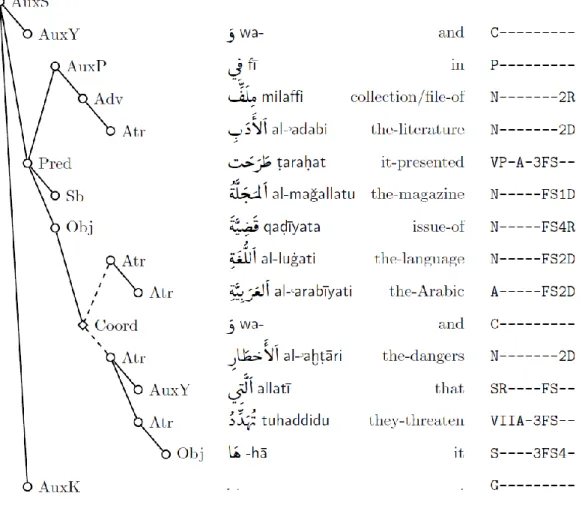
The syntactic representation to be presented in Chapter 6 is a dependency-based hybrid that includes aspects of constituency syntax. This compares to the second major Arabic treebank to be released after the Penn Treebank, the Prague Arabic Treebank (Hajič et al., 2004; Smrž and Hajič, 2006). This treebank uses a pure dependency representation and annotates the same source text as the Penn Treebank – collections of Arabic news articles distributed by the Linguistic Data Consortium (LDC).
The Prague Arabic Treebank shares its grammatical framework with the Prague Czech Treebank (Hajič, Hladká and Pajas, 2001), and focuses on three levels of annotation: morphological, analytical (surface syntax) and tectogrammatical (deep syntax and linguistic meaning). The first version of the treebank, published in 2004, contains morphological annotation for 148,000 words and syntactic annotation for 113,500 words, with tectogrammatical annotation still under development at the time of its publication.
The grammatical framework used for the Prague Treebank is the Functional Generative Description (Sgall, Hajičová and Panevová, 1986; Hajičová and Sgall, 2003). This is a dependency-based representation that emphasizes the difference between form (including word-forms and morphological realizations) and function (such as the syntactic roles of subject, object and predicate). This grammatical description was originally designed for Czech, a language that is