The trickledown effect of psychosocial
constructs and knowledge deficiencies as
organizational barriers to cost
performance on highway projects
Amadi, AI and Higham, AP
http://dx.doi.org/10.1108/JFMPC0320170009
Title
The trickledown effect of psychosocial constructs and knowledge
deficiencies as organizational barriers to cost performance on highway
projects
Authors
Amadi, AI and Higham, AP
Type
Article
URL
This version is available at: http://usir.salford.ac.uk/42343/
Published Date
2018
USIR is a digital collection of the research output of the University of Salford. Where copyright
permits, full text material held in the repository is made freely available online and can be read,
downloaded and copied for noncommercial private study or research purposes. Please check the
manuscript for any further copyright restrictions.
For more information, including our policy and submission procedure, please
contact the Repository Team at:
[email protected]
.
Journal of Financial Management of Property and Construction
The Trickle-down Effect of Psycho-Social Constructs and
Knowledge Deficiencies as Organizational Barriers to Cost
Performance on Highway Projects
Journal: Journal of Financial Management of Property and Construction
Manuscript ID JFMPC-03-2017-0009.R2 Manuscript Type: Research Paper
Keywords: Public Works, Psycho-social constructs, Cost growth, Developing countries, highway Infrastructure
Journal of Financial Management of Property and Construction
The Trickle-Down Effect of Psycho-Social Constructs and Knowledge Deficiencies as Organizational Barriers to Cost Performance on Highway Projects
Abstract
Purpose
The study aims to proffers a theoretical narrative explaining the poor financial performance of public highway agencies in Nigeria. This study critically spotlights seminal works in the literature offering theoretical narratives on the poor financial performance of public infrastructure projects, as to discuss whether they adequately capture the relationship between
the psychological factors, project governance/leadership issues, ands well as knowledge/skill deficiencies related to the cost performance of infrastructure projects in the developing world. The evaluation reveals the predominant contextual exclusivity of these theoretical narratives to the developed world, which tend to under-representis mostly not reflective developing countries, such as those on the African continent.
Design/methodology/approach
Using athe case study research strategy, longitudinal dDocumentary/aArchival data for 61 highway projects were analyzedas carried. Sixteen16 interviews were also conducted with highway officials from the three highway agencies responsible for the execution of the projects. A two2-stage deductive-inductive thematic analysis of the collated data wais carried out to identify barriers to the financial management of public highway projects, the result of which is cognitively mapped out.
Findings
The study showcases empirical insight on cost overruns experienced in Nigerian public projects, due toas the trickle-down effect of the human and organizational environment, as well as due to workers’ knowledge/skill deficiencies.
Research limitations/implications
The developed theory is contextual to Nigeria, as such there is scope for testing its generalisability to other developing nations.
Formatted: Line spacing: 1.5 lines
Page 1 of 29 Journal of Financial Management of Property and Construction
1 2 3 4 5 6 7 8 9 10 11 12 13 14 15 16 17 18 19 20 21 22 23 24 25 26 27 28 29 30 31 32 33 34 35 36 37 38 39 40 41 42 43 44 45 46 47 48 49 50 51 52 53 54 55
Journal of Financial Management of Property and Construction
Originality/value
The in-depth trajectory provided, uncovers an intricate web of technical and psycho-social, organizational and institutional issues, which have not been identified and explained by previous theoretical narratives.
Key Words: Psycho-social Constructs; Cost Growth; Developing country; Public Infrastructure projects
Introduction
Traditional schools of thought insist the root sources of poor financial performance in infrastructure projects, lie principally within the domains of technical issues and poor project shaping at the front-end. However, an emerging body of research, have begun to uncover organizational, governance and leadership issues, which can trigger psycho-social dysfunctionalities in infrastructure projects, leading to cost overruns in public projects. This is considering the dynamics in public infrastructure projects, which requires managing uncertainty with limitedsmall time, and cost buffers as well as handling a lot of foreseen and unforeseen uncertainties in a complex environment, with various stakeholders with different expectations and demands. (Johansson, 2015).
Acknowledging human factors and professional limitations, as well as the unbalanced pressures that foil good engineering practicse, thus constitute an emerging strand in the research domain of the cost performance of public infrastructure projects. A limited number of studies in the literature have explored the ‘trickle-down effect of the human and governance factors on the financial performance of public projects. The literature, however evidences that although cost overruns, present a malignant tumour in public construction projects executed in both the developed and developing world, they areit is relatively higher in the developing world, particularly on the African continent (Transportation and Road
Research Laboratory, 1998; AICD, 2008). Thise study evaluates the extant literature offering theoretical narratives on psychological, project governance and leadership issues in public projects, along with relationship of knowledge/ skill deficiencies to cost performance, as to whether they are adequate to explain the poor cost performance of public projects in the developing world. In view of a skills gap, as well as the socio-cultural differences, between
Formatted: Not Highlight
Page 2 of 29 Journal of Financial Management of Property and Construction
1 2 3 4 5 6 7 8 9 10 11 12 13 14 15 16 17 18 19 20 21 22 23 24 25 26 27 28 29 30 31 32 33 34 35 36 37 38 39 40 41 42 43 44 45 46 47 48 49 50 51 52 53 54 55
Journal of Financial Management of Property and Construction
the developed and the developing world, the study aims to proffers a theoretical narrative explaining the poor financial performance of public highway agencies in Nigeria.
Cost Overrun in Public Infrastructure Projects
A large body of research has focused on cost overruns (Hall 1980; Wachs, 1987; Morris 1990; Mansfield et al.,1994; Baccarani, 2004; Bordat et al., 2004; Odeck, 2004; Kaliba et al.,; 2008; Akoa, 2011; Ubani, 2015) andhas collectively espoused a range of explanations, as to why public iInfrastructure projects appear predisposed to cost overrun. The first proposition espouses cost overrun are simply a consequence of technical errors made by the project team. Cantarelli et al (2010) and later Allahahium and Liu (2012) suggest cost overruns are a collective term for a diverse range of technical failings including inter alia: inaccurate estimates, lack of awareness of geotechnical factors and other technical omissions on behalf of the project team that ultimately translate into post-contract change and ultimately increased expenditure.
Other, more sophisticated explanations offered in the literature relate to theoretical, politico-economic and psychological aspectsexplanations of overrun underpinned by the Nobel winning work of Kahneman and Tversky (1979), who explained exploring the impact of professional judgment during decision making.Similarly,alongside the pioneering work of Wachs (1989) exploreding conflicting aspects of professional decision making, whereby planners discard contradictory scientific evidence in the hope of making a decisions in high levels of uncertainty that please their employer or clients. These theories are rooted in the cognitive dynamics of estimation, planning, decision and policy making by people in institutional settings under high levels of uncertainty, and how this leads to the various successes and failures of projects (Cantarelli et al., 2010). Consequently, these theories have formed the building blocks for the theoretical narratives and descriptive trajectories that shape theoretical discourse in cost overrun literature.
Psychological explanations for cost overrun
Page 3 of 29 Journal of Financial Management of Property and Construction
1 2 3 4 5 6 7 8 9 10 11 12 13 14 15 16 17 18 19 20 21 22 23 24 25 26 27 28 29 30 31 32 33 34 35 36 37 38 39 40 41 42 43 44 45 46 47 48 49 50 51 52 53 54 55
Journal of Financial Management of Property and Construction
Focused primarily on disproving the technical failings argument that advocates knowledge and skills deficiencies lie at the route of financial overrun,. Flyvbjerg et al (2002) are of the opinion that cost overrun results from failures in professionalism and ethical practice within the project team. TheyusFlyvberg contends, “optimism bias and strategic misrepresentation are . . . deception, but where the latter is intentional, the first is not, as optimism bias is self-deception” (Flyvbjerg, 2008:3). This form of self-deception, Wachs (1987) and Flyvbjerg et al (2002) insinuate, emanates from unethical practice, deception, delusion and the attitude of public officials. These traits combine to create an organisational culture whereby financial reports are designed to fit the financial constraints of the client (Wachs, 1987, Flyvbjerg et al, 2002).
Flyvbjerg et al (2002) and later Flyvbjerg (2008) challenged consistent underestimation within public infrastructure projects, especially those forming part of larger programmes of work, where continuous improvements in estimating accuracy would be expected. Flyvbjerg et al’s (2002) analysis of 254 projects led them to conclude consistent underestimation of cost was not influenced by project duration, type or location. This they advocate suggests cost overrun must be the consequence of premeditated acts of deception rather than factors such as inter alia errors, knowledge and skill deficiencies or unforeseen geologic risk. Reinforcing this position, Flyvbjerg et al (2002) contendt that any combination of technical failings would be eliminated by either experiential learning; with failures and knowledge deficiencies corrected in future project planning (Lowe and Skitmore, 2007) or enhanced risk analysis whereby cost overruns would be significantly reduced or eradicated. In consequence, cost overruns could only be attributed to blatant lies by the project team and government officials who, it was suggested, strategically misrepresented financial data in their project proposals to gain approval. As a result, only the most unfit projects were, by implication approved, resulting in the significant cost overruns observed by in the wider literature (Flyvbjerg et al., 2004).
Cantarelli et al (2010) advocate the problems of cost overrun are rooted in the project team’s inadequate planning that in-turnin turn leads to sub-optimal decisions made under both uncertainty and political pressure, a behavioural form of lock- in. Defined by Cantarelli et al (2010:793) as “a form of psychological coping associated with the inability to withdraw from obligations made in the decision-making process”. In the case of major infrastructure projects, lock-in is evident within the project team when they are placed under extreme
Formatted: Font: Italic
Page 4 of 29 Journal of Financial Management of Property and Construction
1 2 3 4 5 6 7 8 9 10 11 12 13 14 15 16 17 18 19 20 21 22 23 24 25 26 27 28 29 30 31 32 33 34 35 36 37 38 39 40 41 42 43 44 45 46 47 48 49 50 51 52 53 54 55
Journal of Financial Management of Property and Construction
political pressure from the public sectorpublic-sector client to commence work as quickly as possible and to then evidence continuous progress. Under this situation, the client has in
-effect set the pace for path dependency that means progress is demanded on whatever option the project team feel is appropriate.Aat this stage in the project’s evolution, irrespective of whether a more optimal alternative is subsequently identified that could possibly respond to identified risk more appropriately avoiding costly change later but also delaying the completion of the project (Cantarelli et al. 2010). As a result, the project team are forced to adopt sub-optimal decisions (Woerdman, 2004).
Cantarelli et al’s (2010) research exploring two major European infrastructure projects reveals, in this situation, project actors will experience either conscious or unconscious lock-in. In the former, project proponents will become trapped in their decisions, as there are no viable alternatives, and therefore irreversibly committed to seeing the project through to completion, even with evidence of escalating cost. Whilst those experiencing unconscious lock-in will seek to deliberately justify earlier project approval decisions, without attempting to explore the option of reversing that decision, in the face of escalating cost. Whilst Cantarelli’s work builds the case for a psychologically orientated theoretical framework for cost-overrun, it also dismisses Flyvbjerg et al’s (2002) assertions that technical explanations are the least likely cause of cost overrun, as Cantarelli advocates lock-in can span the four classically identified causes of cost overrun including technical explanations.
Project and Organisational Governance as a Trigger of Cost Overruns
In the main, cost overrun literature identifies four fundamental silos when explaining the causes of cost overrun: political, economic, psychological and technical into which every study is intrinsically categorised. However, a developing body of work (Morris, 1990, Love et al, 2012, Gil and Lundriganm, 2012; 2013) identifies a fifth explanation for cost overrun linked to failings in governance and leadership, both within the project team and periphery stakeholder organisations.
Morris (1990), one of the few researchers to explore overrun in developing rather than developed nations, first put forward the governance argument in ahis seminal work in the early 1990s. Noting the unusually very high cost (92%) and time (192%) overruns in public sector projects in India, Morris observed that a vicious cycle of events outside the control of the project team accounted for the majority of project cost overruns in publicly funded Page 5 of 29 Journal of Financial Management of Property and Construction
1 2 3 4 5 6 7 8 9 10 11 12 13 14 15 16 17 18 19 20 21 22 23 24 25 26 27 28 29 30 31 32 33 34 35 36 37 38 39 40 41 42 43 44 45 46 47 48 49 50 51 52 53 54 55
Journal of Financial Management of Property and Construction
infrastructure projects. This cycle of events Morris noted starts with the financial model applied by the Indian government, which adopts short funding for all public-sector infrastructure projects, except the ones accorded the highest priority. Analysis of the sectorial pattern of capital outlay in annual budgets for different sectors revealed the Indian Government spread financial resources thinly across multiple projects. Resulting in funds, adequate for the full and timely completion of three or potentially four projects, to be spread-out to accommodate six or seven projects. Consequently, completion times for committed projects would stretch beyond anticipated completion dates, a period over which inflation would creep in. Even with the huge backlog of uncompleted projects, further projects would still be initiated. However, Morris (1990) concedes that ineffective project teams had a role in exacerbating these governance failings. Detailed analysis of 94% of available project reports revealed inadequate preparation, planning and implementation, with estimates developed based on minimal project information, no appraisal of potential risk and with a complete disregard for preliminary analysis.Despite revelations about the inadequacy of the project team, Morris’ arguments about project governance nonetheless retained credibility. Despite revelations about the inadequacy of the project team, Morris’ arguments about project governance nonetheless retained credibility. Albeit, researchers are theorising that failings in governance and leadership influencing cost overrun cannot be seen as single point events, but they represent a continuous evolution of failure, that culminates in cost overrun and delay (Love et al, 2012, Gil and Lundrigan 2012, Lundrigan and Gil 2013). Adapting an overall process-oriented framework, Gil and Lundriganm (2012) conceptualised a ‘relay race’ model for understanding cost growth, founded in the dynamics of project governance, amidst conflicting stakeholder interest and competitive strive for leadership in mega projects, which fosters design changes. This was explained as a characteristic of three UK based mega projects (Cross Rail, 2012 Olympic Games, and Heathrow T2) analysed, where ‘the client is a multi-headed organization because the different clients may feel entitled to be in control’
(Gil and Lundriganm 2012:4). Gil and Lundriganm’s (2012) comprehensive cross-case analysis of three UK based mega projects, Cross Rail, 2012 Olympic Games and Heathrow T2 once again reveals the importance of governance, and the impacts of leadership on financial control. Qualitative data collected from each project team revealed a series of relay based leadership processes within each mega project, where the transitory phases of each project representedphases represented a stage, in the relay culminating in a baton handover,,
Page 6 of 29 Journal of Financial Management of Property and Construction
1 2 3 4 5 6 7 8 9 10 11 12 13 14 15 16 17 18 19 20 21 22 23 24 25 26 27 28 29 30 31 32 33 34 35 36 37 38 39 40 41 42 43 44 45 46 47 48 49 50 51 52 53 54 55
Journal of Financial Management of Property and Construction
however, for the mega project, the baton became an analogy for project leadership, which transferred between key stakeholders. Typically, decision makers with lower levels of technical competence, invariably determine changes to the scope of projects and approve budget outlays, while under the managerial jurisdiction of the public agency, contractors often re-negotiate the initially approved outlay, in the light of their perception of risks inherent in the project, as well as new information which may have emerged over the period of gestation.As such over this period of multiple re-negotiations and design evolution, with differences in skills and competence of the race team (leaders), inconsistencies are generated, posing a critical managerial challenge which culminate in significant cost growth over the project phases.
Adapting this overall process oriented relay framework, Gil and Lundriganm (2012) conceptualised a ‘relay race’ model for understanding cost growth, founded in the dynamics of project governance, amidst conflicting stakeholder interest and competitive strive for leadership in mega projects, which fosters design changes. This was explained as a characteristic of mega projects, where ‘the client is a multi-headed organization because the different clients may feel entitled to be in control’ (Gil and Lundriganm 2012:4). As such differences in skills and competence of the race team (leaders) and the inconsistencies generated posed a critical managerial challenge culminating in cost overruns, over the project phases.
The concept of the relay race is such that at the initial inception phase of a project, the proposal tendered by a scheme promoter, may have been initially rejected, but later gains acceptance and momentum within a sponsoring public agency (the principal). The idea now must be developed, and presented to decision makers, who are conceptualised as having limited in-house technical knowledge, for approval. This then implies that specialists are commissioned to develop a compelling case for the proposal to be approved. Aside from this technical requirement, the views of various stakeholders, future financial sponsors, and the public, has to be incorporated, to facilitate the lobbying process. Thus, shifting the emphasis away from the project’s technical challenges. Accordingly, the project significantly evolves in design and scope as trade-offs are agreed and simultaneous negotiations necessary to gain political will impact on the project’s evolution. This thus sets the stage for elasticity in the project cost profile, as decision makers with lower levels of technical competence, invariably
Formatted: Line spacing: 1.5 lines
Page 7 of 29 Journal of Financial Management of Property and Construction
1 2 3 4 5 6 7 8 9 10 11 12 13 14 15 16 17 18 19 20 21 22 23 24 25 26 27 28 29 30 31 32 33 34 35 36 37 38 39 40 41 42 43 44 45 46 47 48 49 50 51 52 53 54 55
Journal of Financial Management of Property and Construction
determine changes to the scope of projects and approve budget outlays, while under the managerial jurisdiction of the public agency, contractors often re-negotiate the initially approved outlay, in the light of their perception of risks inherent in the project, as well as new information which may have emerged over the period of gestation. Gil and Lundriganm (2012) thus concluded that over this period of multiple re-negotiations and design evolution, projects experience significant cost growth, with the three projects appraised experiencing strikingly similar relay race narratives, that in turn accounted for the significant disparity between their initial budget and the final account.
Lundriganm and Gil’s (2013) later work based on the same set of projects, further defined megaprojects as hybrid forms of meta-organization, with cost overruns intricately dependent on its hierarchical technical decision making core, enveloped in a permeable membrane, which allows for osmotic diffusion from peripheral actors to exert influence over designing and building activities. They Lundriganm and Gil (2013: 1), thus described public agencies as open systems, where by the organisations must adapt and align their product (projects) to the environment (stakeholders and political) they are designing for, and which they cannot control. Adopting this position, and using the same three projects (2012 Olympics, Crossrail and Heathrow T2) Lundriganm and Gil Cconceptualised two distinct developmental pathways (Parading and The Hard Way) for the delivery of any mega project,. Whilst these pathways make mega projects distinctive, Lundriganm and Gil assert they also account for observed cost overruns, whereby: . Longitudinal analysis of the three case study projects revealed that whilst
Tthe 2012 Olympics adopted the parading route adopted by the 2012 Olympics. iIn which lobbying and informal pledges between the core (technical actors) and the periphery (stakeholders), led to speedy approval, but. However, this strategy also resulted in significantly renegotiated designs and escalating financial commitments.
The Hard Way, a far more structured and regimented process, that requires the project team to stick strictly to initial technical proposals, was adopted by the other two projects,. Yet this also resulted in similar cost growth,. due to lengthier gestation periods.
Formatted: Font: (Default) Times New Roman, 12 pt
Formatted: List Paragraph, Line spacing: 1.5 lines, Bulleted + Level: 1 + Aligned at: 0.25" + Indent at: 0.5"
Formatted: Font: (Default) Times New Roman, 12 pt
Formatted: Font: (Default) Times New Roman, 12 pt
Formatted: Font: Not Italic
Formatted: List Paragraph, Line spacing: 1.5 lines
Formatted: Font: (Default) Times New Roman, 12 pt
Formatted: List Paragraph, Line spacing: 1.5 lines, Bulleted + Level: 1 + Aligned at: 0.25" + Indent at: 0.5"
Formatted: Font: (Default) Times New Roman, 12 pt
Formatted: Font: (Default) Times New Roman, 12 pt
Formatted: Font: (Default) Times New Roman, 12 pt
Formatted: Left, Indent: Left: 0.5", Space After: 8 pt, Line spacing: Multiple 1.08 li, No bullets or numbering, Adjust space between Latin and Asian text, Adjust space between Asian text and numbers, Tab stops: Not at 0.89"
Page 8 of 29 Journal of Financial Management of Property and Construction
1 2 3 4 5 6 7 8 9 10 11 12 13 14 15 16 17 18 19 20 21 22 23 24 25 26 27 28 29 30 31 32 33 34 35 36 37 38 39 40 41 42 43 44 45 46 47 48 49 50 51 52 53 54 55
Journal of Financial Management of Property and Construction
This raisesing important questions about the impact of the developmental pathway on cost overrun. However, this is not resolved in the research, as Lundriganm and Gil fail to provide evidence of causation within their hypothesis testing.
Whilst leadership and management failings can have an influence of cost overrun, Love et al. (2012), argue that often a mixture of leadership and governance failings are reinforced by strategic actions, driven by the free-market commercialised model of consultancy practice. Working in Australia, Love et al. (2012) carried out a qualitative case study to explain cost overruns, Uusing a narrative, specific to the design of three publicly financed social infrastructure projects,. On all projects Love et al observed that the design consultants would often proceed with highly optimistic intent of producing error-free design documentation. However, the initial design revisions are subject to frequent revision as project stakeholders exert influence on the proposals and the project is refined and amended. Whilst this is standard practice, Love et al. (2012) observed that the management of the practice demanded that design quality was reconciled against commercial return. Consequently, practice managers adopt circumstantial market-driven strategies that define the quality of consultancy service offered relative to fees, to stay afloat in the competitive environment. Thus, design quality offered by practice would be conceptualized as a function of how fees are negotiated, with competitively procured services, yielding restricted consultancy services, in the face of the disproportionate and impracticable demands often imposed by the public sector.
This latent condition, termed ‘organisational and circumstantial Pathogens’, combined with the limited time frame available during the initial conceptual phases, activates trade-offs during the performance of tasks: design shortcuts against fee maximization, thereby setting off an additive chain of concomitant errors which creates significant ‘error traps’. Such significant errors when discovered latter during the construction phase, which may necessitate rework and variations, with the resultant resolution of conflicts and contractual disputes, leading to cost overruns. Pathogens as represented in the framework thus represent “the latent conditions that lay dormant within a system until an error comes to light” (Love
et al., 2012:3). Love et al (2012) concluded that Ssuch pathogens may thus be considered part and parcel of the everyday functioning in an organization, which are consideredpathogens, considered normal practice but which , because they have been in existence over a considerable period of time. But in actuality, such practices negate or
significantly deviate from best practice,. are the primary triggers which foster a dysfunctional contractual climate on projects, leading to cost overruns.Love et al.’s framework thus maps
Formatted: Line spacing: 1.5 lines Formatted: Font: (Default) Times New Roman, 12 pt
Formatted: Font: (Default) Times New Roman, 12 pt
Formatted: Font: Italic
Page 9 of 29 Journal of Financial Management of Property and Construction
1 2 3 4 5 6 7 8 9 10 11 12 13 14 15 16 17 18 19 20 21 22 23 24 25 26 27 28 29 30 31 32 33 34 35 36 37 38 39 40 41 42 43 44 45 46 47 48 49 50 51 52 53 54 55
Journal of Financial Management of Property and Construction
out the practices within design organizations that constitute the latent issues, which combine with errors to result in active failures. Love et al. (2012: 3) identified several triggers (pathogens) for design error including:
“The recycling of design details, specifications, and other contract documentation to reduce time and save money, without giving due consideration to the project’s bespoke nature”
Love et al. (2012:3) thus concluded that unintentional design errors in the original contract documentation prepared by consultants, termed ‘Latent organisational and circumstantial Pathogens’, are the primary trigger which fosters a dysfunctional contractual climate on projects leading to cost overruns.
Following the explanations reviewed, an easily identifiable loophole in the generalisability of the conclusions reached by four out of the five seminal works reviewed, namely they are based on case studies appraisals of projects executed within developed nations. Flyvbjerg et al.’s (2002) conclusions were drawn based on sample data for highway projects mainly in developed nations, located in the Northern Hemisphere., with the Mmajority of the projects
were selected from Europe and North America, with little focus on developing nations such as those on the African continent. Cantarelli et al. (2010) theory was contextualized for high speed rail projects in the Netherlands, Love et al’s analogy related to latent pathogens was contextualized based on a limited sample of social infrastructure projects in Australia, whilst Gil and Lundrigan (2012) and Lundrigan and Gil (2013) theories were drawn from the longitudinal study of three mega projects in the UK. This limits their generalisability to the distinctive settings of highway development in developing countries, a fundamental argument further posed by the researcher: That the contextual settings of highway project delivery, in the developed and developing world, are very different, and that existing theories on cost overruns do not adequately relay the intrinsic technical limitations of the developing world. This, is with the exception of the study by Morris (1990).
Despite a comprehensive literature search by the researchers, this older study by Morris (1990), carried out 26 years ago, is the only theoretical narrative contextualised in a developing country., Hhowever, whilst infrastructure development in developed nations has mostly reached its peak, in developing countries, it is still in its formative stages (TRL, 1978; Millard, 1993). Consequently, the 75 years span of project data typically collated by
Formatted: Indent: Left: 0", Add space between paragraphs of the same style, Line spacing: 1.5 lines
Formatted: Line spacing: 1.5 lines
Page 10 of 29 Journal of Financial Management of Property and Construction
1 2 3 4 5 6 7 8 9 10 11 12 13 14 15 16 17 18 19 20 21 22 23 24 25 26 27 28 29 30 31 32 33 34 35 36 37 38 39 40 41 42 43 44 45 46 47 48 49 50 51 52 53 54 55
Journal of Financial Management of Property and Construction
Flyvbjerg and co-authors based on which findings were made, is not practically tenable for most developing nations on the African continent. Nigeria, for instance is a country whose documented history of road infrastructure development, dates back less than 57 years. The low-level of technical know-how by developing nations, is noted by the researchers, as contextualized by Morris (1990). Morris (1990) argued the macro-economic concept tagged a
‘“vicious cycle of delays and short-funding’” by government agencies, amidst low levels of technical capacity and highly bureaucratic styles of functioning, mostly explained cost overruns in Indian public projects. However, Morris (1990) study is specifically contextualised to explain cost overruns for Indian public sector projects, as such cannot be directly applicable to other developing nations. As a result, this study resolved to appraise the extent and potential triggers of cost overruns in Nigerian infrastructure projects to enhance the literature related to cost overruns for infrastructure projects in developing nations, that has thus far been limited to the work of Morris (1990).
The Nigerian Context: Geography and Highway Project Cost Performance
Nigeria is a country of physical contrast, owing mainly to the vastness of its landmass. The delineation of physical regions defining the geographic belts of Nigeria based on climatic conditions that in turn determines vegetation and soils. The highest lands are along the north-eastern border of the country, which rise to a maximum of 240m above sea level, and areis
characterized by a broad expanse of level sandy plains, interspersed by rocky outcrops. The relief declines steadily from the Northern highlands southwards to the coastal lowlands at the Niger Delta, of less than 80m above sea level, stretching inland from the coast for over 250 meters.
The Niger Delta region is an archetypal tropical wetland, crisscrossed by a myriad of streams, rivers and inland water channels. Its terrain consists of varying geological formations, with a significant proportion consisting of difficult expansive clayey sub-soils (Teme, 2002). Due to this peculiar geologic configuration, several authors (Oguara, 2002; Teme, 2002; Youdoewei, 2013; Ngerebara et al., 2014) have emphasizsed the need to manage and analyze uncertainties associated with the difficult geology to curb cost escalation. This is against the backdrop of cost overruns of extreme proportions, significantly higher than in other parts of Nigeria. With most, if not all, completed highway projects recording exceedingly high cost overrun figures, a concern currently being investigated by the Nigerian Senate.
Formatted: Font: Italic
Formatted: Font: Font color: Black, English (U.S.)
Page 11 of 29 Journal of Financial Management of Property and Construction
1 2 3 4 5 6 7 8 9 10 11 12 13 14 15 16 17 18 19 20 21 22 23 24 25 26 27 28 29 30 31 32 33 34 35 36 37 38 39 40 41 42 43 44 45 46 47 48 49 50 51 52 53 54 55
Journal of Financial Management of Property and Construction
.
Research Strategy
Due to the extreme cost escalation associated with highway delivery in the Niger Delta, the study purposively sampleds the region. In view of the peculiar geologic setting of the Niger Delta region of Nigeria, the initial case study narrative wais framed within the lenses of the geotechnical difficulties, experienced by public highway agencies in the delivery of highway infrastructure, which may trigger cost overruns, juxtaposed against the backdrop of the setting of Nigeria as a developing nation. Therefore, although other triggers to cost overruns are acknowledged as present in highway projects, the study primarily sets off using a geotechnical trajectory, specific to the wetland geologic setting of the region, to explain cost overrun in the Niger Delta.
As previous studies examining cost overrun in both developed and developing nations (Morris 1990, Flyvbjerg et al 2002, Flyvbjerg 2008, Cantarelli et al 2010, Love et al, 2012, Gil and Lundrigan 2012, Lundrigan and Gil 2013) made clear, the research methodology adopted needed to be one in which the context was paramount. The narrative provided in this study is thus contextualised in the real-life institutional and organisational setting of highway agencies responsible for commissioning highway projects in the region, using the case study research strategy (Fellows and Liu, 2008;. Yin (2014:24))..
As the Literature related to case study research espouses, the adoption of multiple case designs, is assertied to be arguably more robust than single case studies, as they allow generalisations to be strengthened and broadened within the research design (Stake, 2005; Proverbs and Gameson, 2008; Yin, 2014). It was therefore resolved to adopt an embedded multiple case design using a literal replication logic, whereby the cases are designed to corroborate each other (Yin, 2014). Each case study focused on one of the three highway agencies operating in the Niger Delta.
Data Collection and Analysis
Data wereas collected bBased on longitudinal dDocumentary/aArchival analysis of 61 highway projects triangulated with 16 interviews conducted with professionals within the three highway agencies responsible for their execution. In the conduct of the interviews,
Page 12 of 29 Journal of Financial Management of Property and Construction
1 2 3 4 5 6 7 8 9 10 11 12 13 14 15 16 17 18 19 20 21 22 23 24 25 26 27 28 29 30 31 32 33 34 35 36 37 38 39 40 41 42 43 44 45 46 47 48 49 50 51 52 53 54 55
Journal of Financial Management of Property and Construction
measures of validity and reliability posited by Yin (2014) were further ensured, to establish the credibility of the study’s contribution to knowledge, that is:
Preparation of ethical consent and introduction letters as part of case study protocol;
Piloting of draft interview questions;
Use of multiple key informants with multi-disciplinary perspectives.
A semi-structured interview format was used to draft the questions in the interview guide
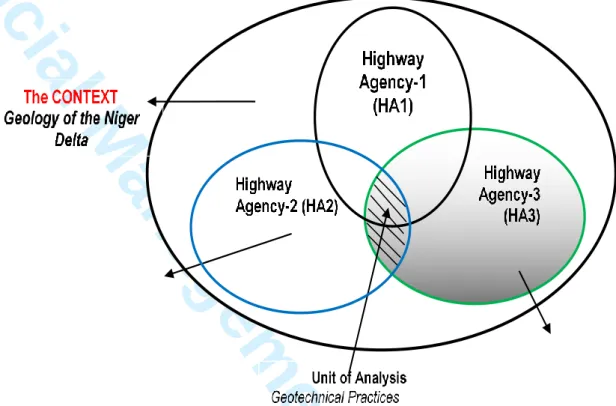
used, based on its flexibility. As such, additional questions not originally part of the interview protocol were introduced to probe unanticipated issues that occurred during the interview, and which the researcher considered crucial to the study. As Figure 1 shows,that the unit of analysis, towards which all data collection was targeted, was the ‘geotechnical practicses of highway agencies in the geologic setting of the Niger Delta’.
INSERT FIGURE 1 HERE
To investigate the practicses of three highway agencies, within their distinct organisational settings a two2-stage deductive-inductive thematic analysis, was used to analyse both the documentary records and the primary interview data. As King (2004:21) espouses, when using thematic analysis:
“… the researcher produces a list of codes (‘template’) representing themes which will usually be defined a priori, but are modified and added to as the researcher reads and interprets the texts. The template is organized in a way which represents the relationships between themes, as defined by the researcher”.
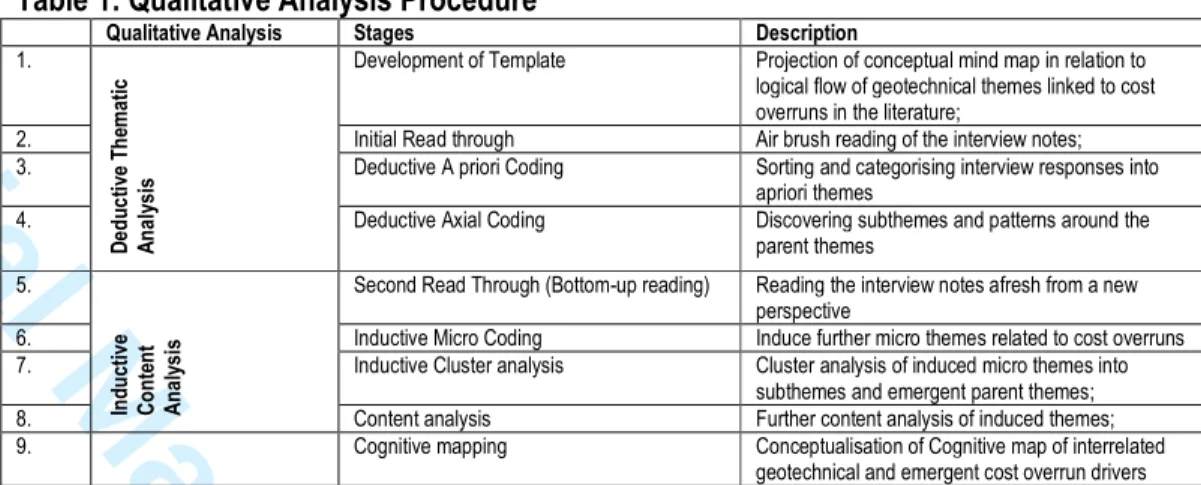
Reflexivity during the coding process, offered the added advantage of flexibility, afforded by the use of both deductive and inductive coding. Inductive analysis was thus carried out as the second phase of the analysis, following the deductive phase. The inductive phase, thus identified emergent themes which act to impact on the cost performance of highway projects. Using the NVivo-10 software, the following logical steps outlined in Table 1 were used in the deductive/inductive analysis of the interviews.
INSERT TABLE 1 HERE
Formatted: Not Highlight
Formatted: Not Highlight
Page 13 of 29 Journal of Financial Management of Property and Construction
1 2 3 4 5 6 7 8 9 10 11 12 13 14 15 16 17 18 19 20 21 22 23 24 25 26 27 28 29 30 31 32 33 34 35 36 37 38 39 40 41 42 43 44 45 46 47 48 49 50 51 52 53 54 55
Journal of Financial Management of Property and Construction
The use of NVvivo allows the researcher to arrange the data to be arranged using a hierarchical tree structure (King 2008). The central phenomenon (cost overrun) formed the roots of the tree from which sub-categories or nodes were generated.
Results
Following a geotechnical narrative applicable to highway projects, an array of factors was identified from the deductive analysis of the interview data, as contributing to the unusually high level of cost overruns evidenced in the sample of 61 highway projects. The deductive analysis identified the geotechnical practicses of the highway organisations, which constitute the latent pathogens, that mostly lie dormant and have gone undetected, as they form part of the everyday practices of the highway organisations:
The iInconsistency in the phase configuration of highway project development in the Niger Delta;
The lLack of adequate geotechnical evaluation for the planning of highway projects;
The lLack of in-house geotechnical presence in some of the highway agencies, throughout the phases of highway development;
The uUse of non-differentiated costing platforms in budgetary provision for proposed highway projects at the preliminary phases of highway development;
The nNon-adherence of highway designs to the appropriate engineering sections, as recommended by the nationally adopted highway design standard in Nigeria, the TRRL (1993), despite the heterogeneous sub-soil profile of the Niger Delta region;
The pPredominant lack of preparation of adequate and comprehensive designs for community highway projects;
The lLack of adequate geotechnical risk containment measures, in contracts awarded by the highway agencies, necessary to lessen the magnitude of geotechnical risk borne by contractors in bidding for highway contracts; and
The pPrimarily subjectively and politically driven mode of contractor selection during the award of highway contracts, which is not based on any form of geotechnical criteria requisite to ensure efficiency of project execution.
Page 14 of 29 Journal of Financial Management of Property and Construction
1 2 3 4 5 6 7 8 9 10 11 12 13 14 15 16 17 18 19 20 21 22 23 24 25 26 27 28 29 30 31 32 33 34 35 36 37 38 39 40 41 42 43 44 45 46 47 48 49 50 51 52 53 54 55
Journal of Financial Management of Property and Construction
All of these technical shortcomings, latent in the everyday practices of the highway agencies, revolve around inadequate management of the high level of geotechnical risks associated with ground conditions in the Niger Delta. These latent pathogens occur, however, amidst the wide array of pPsycho-socio-cultural issues concomitantly identified from further inductive analysis as contextual to highway delivery in the Niger Delta (Table 2).
Insert Table 2 here
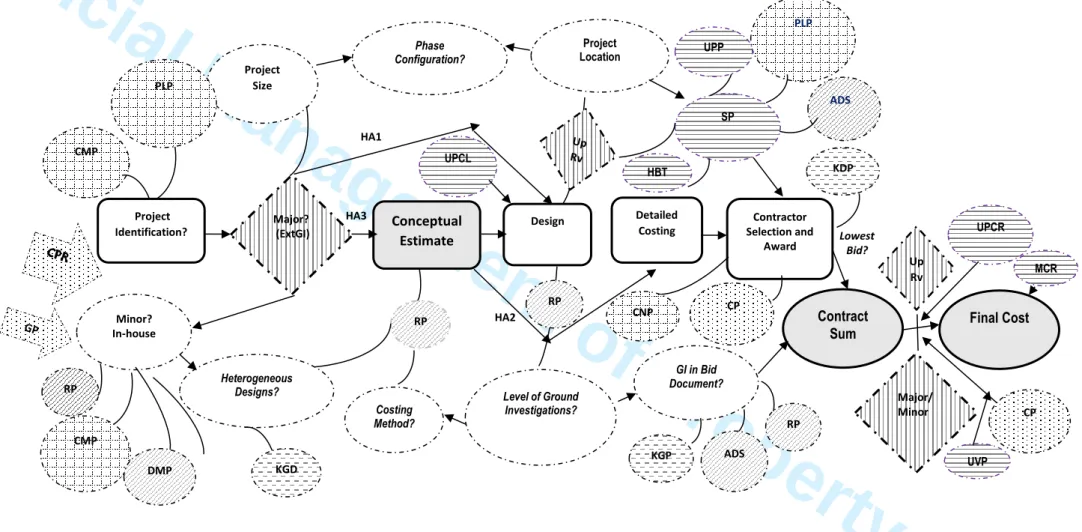
These underlying contextual drivers, actively facilitate geotechnical factors and trigger a ‘vicious cycle of delays and short funding’, which Morris (1990) conceptualises as leading to cost overruns in public projects in the developing world. Table 3 is a coded clustering of the induced themes based on the researchers’ conceptualisation, as barriers to adequate Ggeotechnical Input (GI) in therisk management of risks in the highway projects, which also serves as a key to the cognitive mapping, presented in Figure 23.
Insert Table 23Here
As conceptualised in Table 3:,
Psychological Traps, refer to those subconscious attitudes of client’s and contractors, largely defined by their level of enlightenment on the financial implications of geotechnical risks containment as well as social conditioning, which may effectively serve as mental traps, and impede the realisation of the evident ‘Value for Money’ benefits of adequate geotechnical risk management in highway projects. Typically, as noted from the interview responses, these include: level of ‘Risk Perception (RP), relating to the lack of knowledge and understanding of the need for geo-risk management.
Pressure Emitters refer to those external elements/stakeholders in the institutional set up of highway agencies, which radiate compressive pressure on professional obligations, thereby constricting the potentials for ensuring technical requirements of geotechnical best practice. Typically, in the context of the Niger Delta, these include Political Pressures (PP), Community Pressures (CP), and all other forms of unethical
pPressures, such as from contractors.
Formatted: Not Highlight
Formatted: Not Highlight
Formatted: Not Highlight
Formatted: Not Highlight
Formatted: Not Highlight
Formatted: Not Highlight
Formatted: Font: (Default) Times New Roman, 12 pt
Formatted: List Paragraph, Add space between paragraphs of the same style, Line spacing: 1.5 lines, Bulleted + Level: 1 + Aligned at: 0.25" + Indent at: 0.5" Formatted: Font: (Default) Times New Roman, 12 pt
Formatted: List Paragraph, Add space between paragraphs of the same style, Line spacing: 1.5 lines
Formatted: Font: (Default) Times New Roman, 12 pt
Formatted: List Paragraph, Add space between paragraphs of the same style, Line spacing: 1.5 lines, Bulleted + Level: 1 + Aligned at: 0.25" + Indent at: 0.5" Formatted: Font: (Default) Times New Roman, 12 pt
Formatted: Font: (Default) Times New Roman, 12 pt
Formatted: Left, Indent: Left: 0.5", Space After: 8 pt, Line spacing: Multiple 1.08 li, No bullets or numbering, Adjust space between Latin and Asian text, Adjust space between Asian text and numbers
Formatted: List Paragraph, Add space between paragraphs of the same style, Line spacing: 1.5 lines
Page 15 of 29 Journal of Financial Management of Property and Construction
1 2 3 4 5 6 7 8 9 10 11 12 13 14 15 16 17 18 19 20 21 22 23 24 25 26 27 28 29 30 31 32 33 34 35 36 37 38 39 40 41 42 43 44 45 46 47 48 49 50 51 52 53 54 55
Journal of Financial Management of Property and Construction
Organisational Catalysts are the adverse non-project specific ‘Organisations’ and ‘people’ related variables in the highway agencies which represent the deficient institutional arrangements within the highway agencies, such as issues of ‘Mismatched Qualifications and Roles (MQR), which can serve to foster mismanagement of geotechnical risks.
Skills Gap refer to the individual specific knowledge deficiencies of professionals working on highway projects, such as low level of technical competence in design, and low level of enlightenment about issues related to the financial risk management of geotechnical issues in highway projects, which can be overcome by adequate training and enlightenment.
Dichotomies, are those inequalities and preferential practices of highway agencies, which result in uneven management of risks in projects, such as the negligence of smaller community projects located in remote areas in favour of major ones, in the face of funding shortfalls.
Unethical Facilitators represent those subtle unprofessional and unethical practices of the key actors in highway projects, primarily geared towards personal gains, such as those by contractors, consultants and highway officials, as well as other forms of organisational and institutional irregularities in the procurement of highway projects.
The intricate complexity of the interplay between the deduced and induced themes has been conceptualised by the researchers, the results of this process, which is presented in Figure 2, as a cognitive map. Thise developed cognitive map is an intricately interwoven representation of causality, between the core geotechnical themes, with the emergent organisational and human related themes arrayed as influences, whose node sizes were proportionally assigned, based on the frequency of references made during the coding process. The cognitive map depicts that cost overruns experienced in Niger Delta’s highway projects, is a function of the trickle-down effect of the human and organizational environment, as well as due to knowledge deficiencies in geotechnical risk management, which inherently escalate budgeted cost, over the lifespan of projects.
Formatted: Font: (Default) Times New Roman, 12 pt
Formatted: List Paragraph, Add space between paragraphs of the same style, Line spacing: 1.5 lines, Bulleted + Level: 1 + Aligned at: 0.25" + Indent at: 0.5"
Formatted: List Paragraph, Add space between paragraphs of the same style, Line spacing: 1.5 lines
Formatted: Font: (Default) Times New Roman, 12 pt
Formatted: List Paragraph, Add space between paragraphs of the same style, Line spacing: 1.5 lines, Bulleted + Level: 1 + Aligned at: 0.25" + Indent at: 0.5"
Formatted: Font: (Default) Times New Roman, 12 pt
Formatted: Left, Indent: Left: 0.5", Space After: 8 pt, Line spacing: Multiple 1.08 li, No bullets or numbering, Adjust space between Latin and Asian text, Adjust space between Asian text and numbers
Formatted: List Paragraph, Add space between paragraphs of the same style, Line spacing: 1.5 lines
Formatted: Font: (Default) Times New Roman, 12 pt
Formatted: List Paragraph, Add space between paragraphs of the same style, Line spacing: 1.5 lines, Bulleted + Level: 1 + Aligned at: 0.25" + Indent at: 0.5" Formatted: List Paragraph, Add space between paragraphs of the same style, Line spacing: 1.5 lines
Formatted: Font: (Default) Times New Roman, 12 pt
Formatted: List Paragraph, Add space between paragraphs of the same style, Line spacing: 1.5 lines, Bulleted + Level: 1 + Aligned at: 0.25" + Indent at: 0.5" Formatted: Line spacing: 1.5 lines Formatted: Not Highlight
Page 16 of 29 Journal of Financial Management of Property and Construction
1 2 3 4 5 6 7 8 9 10 11 12 13 14 15 16 17 18 19 20 21 22 23 24 25 26 27 28 29 30 31 32 33 34 35 36 37 38 39 40 41 42 43 44 45 46 47 48 49 50 51 52 53 54 55
Journal of Financial Management of Property and Construction
INSERT FIGURE 2 HERE
The cognitive map thus portrays the connectivity between the technical and psycho-social organisational and institutional issues, driving the high level of cost overruns experienced on highway project development in the Niger Delta. The core geotechnical themes thus interplay with bulbs of Oorganisational catalyst’, ‘Pressure Emitters’, ‘Psychological Traps’, ‘Skills Gaps’, ‘Dichotomies’ and ‘Unethical Facilitators’ of various scales (as ranked), entrenched within the wider macro social value system and geo-political climate of highway development in the region.
Discussion
The series of evidence from the analysis has thus provided context- specific qualitative explanations, about how the prevailing poor levels of geotechnical input constitute latent pathogens, which have triggered a chain reaction effect, right from the conceptual phase, and contributed to the increasing the levels of claims and variations, at the post-contract phase. This has consequently escalated cost and impacted on project delivery in the Niger Delta, leading to lengthy project delays and abandonments in highway projects. Poor geotechnical risk management by the highway agencies, has created a propensity for highway projects to run over budget, considering the financial risks inherent in the wetland geologic setting of the Niger Delta. The study findings have thus reinforced the generalisability of Love et al. (2012) latent pathogen theory, from the Australian context of building infrastructure, to highway projects in the Nigerian context.
The findings from the study also reinforces to various extents, some of the existing theories on cost overrun. Typically, the study findings corroborate Gil and Lundriganm (2012; 2013) Relay Race versus Core and Periphery theories, in emphasizing the multiplicity of unforeseeable risks and often competing/clashing interest groups in public projects, as accounting for cost overruns. This is evident in the multiplicity of political and community stakeholders in the Niger Delta region. Political pressure at upper levelshelms of the hierarchy of power dictate to the highway agencies;, while community stakeholders exert
Formatted: Not Highlight
Formatted: Line spacing: 1.5 lines, Tab stops: 0.25", Left
Formatted: Line spacing: 1.5 lines
Page 17 of 29 Journal of Financial Management of Property and Construction
1 2 3 4 5 6 7 8 9 10 11 12 13 14 15 16 17 18 19 20 21 22 23 24 25 26 27 28 29 30 31 32 33 34 35 36 37 38 39 40 41 42 43 44 45 46 47 48 49 50 51 52 53 54 55
Journal of Financial Management of Property and Construction
their influence at the grass root level, which exerts clashing socio-political pressure on the highway officials.
However, irrespective of the case study findings upholding the validity of some of previous narratives, it has also shown that several others are not adequate to holistically explain the scenario of poor financial performance in highway project delivery in the developing world. Typically, in the Netherlands, Cantarelli et al. (2010:793) tested the theory of lock-in as “a form of psychological coping associated with the inability to withdraw from obligations made during the decision-making process”. From the findings of this research, the theory of lock-in reported in the Netherlands does not necessarily apply to the Nigerian setting. Additionally, tThe findings also do not uphold the theory of strategic misrepresentation, but rather.The findings show that in reality, no apparent form of Cost Benefit Analysis (CBA), which should mandatorily form the basis of approval in choosing from competing alternatives, is even carried out. This finding is similar to the assertion of Morris (1990) who stated: “… Appraisal by the Government very often is devoid of meaning when the emphasis is only on the form of the project proposal rather than on its content- a tendency quite usual in bureaucracies”. Therefore, the elaborate theory of strategic misrepresentation by planners and highway officials posited in developed countries, is not evident in the data studied here, and fundamentally may not connote any significance in explaining cost overruns in the developing world.
Another feature of the narrative offered in this study, in commonality with Morris (1990), is the preferential treatment of projects. As Morris (1990) concludes: “The politically expedient tendency to take up large numbers of projects and short fund them all, except those with the very highest priority, is perhaps the most important factor in delays. The Government's ad hoc approach in according high priority to certain sectors…while perhaps overcoming the problem in these sectors have compounded the problem elsewhere…” This narrative in the case of the Niger delta is evident in the: pPlanned versus adhoc procurement practices for major versus smaller community projects; pPolitically motivated selective project management practices; and uUnequal priority status in the post contract management of projects located in remote riverine areas relative to more visible upland projects. These dichotomous practices stand in sharp contrast to the assumptions of equality in the efforts and approach to managing approved public projects in the developed world.
Page 18 of 29 Journal of Financial Management of Property and Construction
1 2 3 4 5 6 7 8 9 10 11 12 13 14 15 16 17 18 19 20 21 22 23 24 25 26 27 28 29 30 31 32 33 34 35 36 37 38 39 40 41 42 43 44 45 46 47 48 49 50 51 52 53 54 55
Journal of Financial Management of Property and Construction
The findings from this research has also validated the researchers’ preconceived notion, of the wide knowledge and skills gap between the developed and developing world, in the management of technical organisations. The study has revealed that at presently times, apparent knowledge deficiencies still exist, with respect to geotechnical risk management principles. This was evident from the responses of the agencies’ in-house design professionals, who exhibited very low levels of familiarity with the basic technical terminology of highway pavement designs and standards. These significant knowledge deficiencies demonstrated the worryingly low levels of awareness amongst in-house civil engineers, of the fundamental tools of their profession, or other internationally recognised best practice design standards.
Conclusion
The study findings provide strong empirical evidence on the current state of practice, as accounting for the poor financial performance of highway projects delivery in the Niger Delta region of Nigeria. In addition to the issues in geotechnical practice, an emergent theory from the data, is that project approval and execution for highway projects executed in the Niger Delta have no definite criteria, and are largely determined by the urgency induced from political and community quarters. The theory of: Pressure induced urgency, due to political and community emitters, which creates psychological traps and a repressive atmosphere for highway officials, leading to an adhoc, preferentially dichotomised and dictatorial type of project planning, with evidence of unethical practices in project execution and governance, seems to be an emergent strand of theoretical explanation to cost performance of highway projects, specific to the developing world. This is suspected as possibly the strongest theoretical explanation holding in the wider context of Nigeria, which complements the presence of geotechnical pathogens, triggered by a predominantly low level of technical-know how. The combination of these technical and psycho-social vices, leads to a vicious cycle of short funding and delays, a theory earlier forwarded by Morris (1990) in the Indian setting. This advances the analytical generalisability of Morris (1990) study, in the developing world. The reality of the situation in highway project delivery in the developing world, as deduced from the findings of the study, show that cost overruns experienced in public projects, can be accounted for by a multiplicity of contextual variables, which have not been identified and explained by the theoretical discourse dominant in the developed world.
Formatted: Font: Not Italic
Page 19 of 29 Journal of Financial Management of Property and Construction
1 2 3 4 5 6 7 8 9 10 11 12 13 14 15 16 17 18 19 20 21 22 23 24 25 26 27 28 29 30 31 32 33 34 35 36 37 38 39 40 41 42 43 44 45 46 47 48 49 50 51 52 53 54 55
Journal of Financial Management of Property and Construction
The study has thus shown that to better manage the risks inherent in the wetland conditions of the Niger Delta, the highway agencies need technical capacity in geotechnical risk management. To complement the specification of the financial risks, evident in the geotechnical shortcomings of Niger Delta’s highway projects, the following recommendations are suggested:
o Highway agencies and relevant authorities in the Niger Delta, need to be enlightened
about the general objective of geotechnical evaluation, and the need for geotechnical professionals to be employed in-house.
o Cost projections made during the budgeting should reflect the likely variability along proposed highway routes. Emphasis should therefore be placed by the highway agencies, on getting geotechnical information via desk studies, carried out on time, as a basis of getting the project scope defined to the best possible degree.
o There is a need to enforce the adoption of the TRRL (1993) design guide as required
by the Federal Ministry of Works, by professionals in state and regional highway agencies, in the design of community road projects.
o Ground Investigation Reports, with a further provision for Differing Site Condition
clauses, should form an integral part of the standard contract documentation provided for tenderers. Furthermore, Contractor selection criteria should be objectively defined, including specific geotechnical assessment algorithms.
Geotechnical aspects of highway delivery must therefore be strengthened, and the poor risk perception and attitude surrounding the procurement of highway projects, need to be changed, to give geotechnical concerns a higher priority status. Also, implicit in the findings of this research, is the need to tackle the social vices plaguing the procurement system for highway infrastructure in the Niger Delta, which necessitates a major psycho-social culture shift.
References
Formatted: Font: (Default) Times New Roman, 12 pt
Formatted: Font: (Default) Times New Roman, 12 pt, Font color: Auto
Formatted: Font: (Default) Times New Roman, 12 pt
Formatted: List Paragraph, Space After: 10 pt, Add space between paragraphs of the same style, Line spacing: 1.5 lines, Bulleted + Level: 1 + Aligned at: 0.25" + Indent at: 0.5", Adjust space between Latin and Asian text, Adjust space between Asian text and numbers
Formatted: Line spacing: 1.5 lines Formatted: List Paragraph, Add space between paragraphs of the same style, Line spacing: 1.5 lines, Bulleted + Level: 1 + Aligned at: 0.25" + Indent at: 0.5"
Formatted: Line spacing: 1.5 lines Formatted: List Paragraph, Add space between paragraphs of the same style, Line spacing: 1.5 lines, Bulleted + Level: 1 + Aligned at: 0.25" + Indent at: 0.5"
Formatted: Line spacing: 1.5 lines Formatted: List Paragraph, Add space between paragraphs of the same style, Line spacing: 1.5 lines, Bulleted + Level: 1 + Aligned at: 0.25" + Indent at: 0.5"
Formatted: Line spacing: 1.5 lines
Formatted: Font: (Default) Times New Roman, 12 pt
Page 20 of 29 Journal of Financial Management of Property and Construction
1 2 3 4 5 6 7 8 9 10 11 12 13 14 15 16 17 18 19 20 21 22 23 24 25 26 27 28 29 30 31 32 33 34 35 36 37 38 39 40 41 42 43 44 45 46 47 48 49 50 51 52 53 54 55
Journal of Financial Management of Property and Construction
African Infrastructure Country Diagnostic. (2008). Unit Costs of Infrastructure Projects in Sub-Saharan Africa, Africon
Allahaim, F. D and Liu, L. (2013). Understanding Major Causes Cost Overrun for Infrastructure Projects; A Typology Approach. Annual Conference of the Australasian Universities Building Educators Association (AUBEA)The University of New South Wales, Australia.
Cantarelli, C.C., Flyvbjerg, B., Molin, E.J.E and Van Wee, B. (2010). “Lock-in and Its Influence on the Project Performance of Large-Scale Transportation Infrastructure Projects. Investigating the Way in Which Lock-in Can Emerge and Affect Cost Overruns,” Environment, Planning and Design, 37 (5): 792-807.
Fellows, R. and Liu, A. (2008) Research Methods for Construction, 3rd Ed. Oxford: Wiley-Blackwell.
Flyvbjerg, B., Skamris Holm, M.K. and Buhl, S.L. (2002). ‘Underestimating cost in public works. Error or Lie?’, Journal of the American Planning Association, 68(3), 279–295.
Flyvbjerg, B. (2008). “Curbing optimism and strategic misrepresentation in planning: Reference class forecasting in practice,” European Planning Studies, 16(1), 1-21.
Gil and Lundriganm (2012)Gil, N and Lundriganm, C. (2012). The Leadership and governance of megaprojects, Centre for Infrastructure Development (CID), The University of Manchester. Report No.3
Johansen, A. (2015). Project Uncertainty Management: A New Approach. A Thesis submitted for the Award of a Doctor of Philosophy, Norwegian University of Science and Technology. Trondheim
Formatted: Space After: 8 pt, Line spacing: 1.5 lines, Adjust space between Latin and Asian text, Adjust space between Asian text and numbers
Formatted: Line spacing: 1.5 lines
Page 21 of 29 Journal of Financial Management of Property and Construction
1 2 3 4 5 6 7 8 9 10 11 12 13 14 15 16 17 18 19 20 21 22 23 24 25 26 27 28 29 30 31 32 33 34 35 36 37 38 39 40 41 42 43 44 45 46 47 48 49 50 51 52 53 54 55
Journal of Financial Management of Property and Construction
Kahneman, D and Tversky, A. (1979) Intuitive prediction: Biases and corrective procedures, in: S. Makridakis & S. C. Wheelwright (Eds) Studies in the Management Sciences:
Forecasting, 12-18, Amsterdam: North Holland.
King, N. (2004). Interviews in Qualitative Research. The Modern Language Journal, 2011, Vol.95(4), pp.670-671
King, A. (2008). Using Software to analyse Qualitative data. In Advanced Mmethods in the Built Environment, A. Knight and L. Ruddock Eds, West Sussex, Wiley-Blackwell: 75-84
Love, P.E.D., Edwards, D.J, and Irani, Z. (2012) Moving Beyond Optimism Bias and Strategic Misrepresentation: An Explanation for Social Infrastructure Overruns. IEEE Transactions on Engineering Management 59(4):560-571
Lowe, D.J. and Skitmore, M. (2007) The learning climate of an organisation and practitioner competence. Journal of Financial Management of Property and Construction. 12(3): 151-164.
Lundrigan, C and Gil, N. (2013). Megaprojects: An Evolving Hybrid Meta-Organisation. Centre for Infrastructure Development, The University of Manchester. Working Paper 14/1
Millard, R.S. (1993). Road Building in the tropics: State of the art review. Transportation research Laboratory, Department of transport.
Morris, S. (1990). “Cost and Time Overruns in Public Sector Projects”. Economic and Political Weekly, 47,154 to 168. Indian Institute of Management, Ahmedabad
PPAC. (2012). Report on NDDC projects. Presidential Projects Assessment Committee.
Proverbs, D. & Gameson, R. (2008) Case Study Research. In: Knight, A and Ruddock, L (eds) (2008) Advanced Research Methods in the Built Environment. Oxford: Wiley-Blackwell.
Stake, R.E. (2005) Qualitative Case Studies. In: Denzin, N.K. and Lincoln, Y.S. (Eds) The Sage Handbook of Qualitative research, 3rd Ed. London: Sage Publications.
Teme, S.C. (2002). The physical environment, Engineering and water resources in Rivers state. Ministry of environment and water Resources (RSMEMR) Interim Guidelines and standards, 1-23.
Page 22 of 29 Journal of Financial Management of Property and Construction
1 2 3 4 5 6 7 8 9 10 11 12 13 14 15 16 17 18 19 20 21 22 23 24 25 26 27 28 29 30 31 32 33 34 35 36 37 38 39 40 41 42 43 44 45 46 47 48 49 50 51 52 53 54 55
Journal of Financial Management of Property and Construction
Transport and Road Research Laboratory. (1978). Terrain evaluation for highway engineering and transport planning. A technique with particular value for developing countries. Department of Transport, TRRL Report SR 448. Crowthorne
TRL. (1998). Department for International Development Project Report Guidelines on the selection and use of road construction materials by Transport Research Laboratory
Wachs, M. (1989). “When planners lie with numbers”. Journal of the American Planning Association, 55, 476-479
Yin, R.K. (2014) Case Study Research Design and Methods. 5th Ed. London: Sage Publications Ltd
Youdeowei, P.O. (2013). Engineering Assessment of South-Eastern Niger Delta Soils Utilized for Highway Pavement. Journal of Earth Science Research, 1(3), 106-112.
Page 23 of 29 Journal of Financial Management of Property and Construction
1 2 3 4 5 6 7 8 9 10 11 12 13 14 15 16 17 18 19 20 21 22 23 24 25 26 27 28 29 30 31 32 33 34 35 36 37 38 39 40 41 42 43 44 45 46 47 48 49 50 51 52 53 54 55
Journal of Financial Management of Property and Construction
Table 1: Qualitative Analysis Procedure
Qualitative Analysis Stages Description
1. D ed u c ti ve T h em at ic A n al ys is
Development of Template Projection of conceptual mind map in relation to logical flow of geotechnical themes linked to cost overruns in the literature;
2. Initial Read through Air brush reading of the interview notes;
3. Deductive A priori Coding Sorting and categorising interview responses into apriori themes
4. Deductive Axial Coding Discovering subthemes and patterns around the
parent themes 5. In d u ct iv e C o n te n t A n al ys is
Second Read Through (Bottom-up reading) Reading the interview notes afresh from a new perspective
6. Inductive Micro Coding Induce further micro themes related to cost overruns 7. Inductive Cluster analysis Cluster analysis of induced micro themes into
subthemes and emergent parent themes;
8. Content analysis Further content analysis of induced themes;
9. Cognitive mapping Conceptualisation of Cognitive map of interrelated
geotechnical and emergent cost overrun drivers
Page 24 of 29 Journal of Financial Management of Property and Construction
1 2 3 4 5 6 7 8 9 10 11 12 13 14 15 16 17 18 19 20 21 22 23 24 25 26 27 28 29 30 31 32 33 34 35 36 37 38 39 40 41 42 43 44 45 46 47 48 49 50 51 52 53 54 55