Guidance and standards for drying flood damaged
buildings
Signposting current guidance – BD2760
Guidance and standards for drying flood
damaged buildings
Signposting current guidance – BD2760
Ben Kidd CIRIA, Construction Industry Research and Information Association
Andrew Tagg, Manuela Escarameia, Birgitte von Christierson HR Wallingford Jessica Lamond, David Proverbs University of Wolverhampton
November 2010 Department for Communities and Local Government
Department for Communities and Local Government Eland House Bressenden Place London SW1E 5DU Telephone: 030 3444 0000 Website: www.communities.gov.uk
© Queen’s Printer and Controller of Her Majesty’s Stationery Office, 2010 Copyright in the typographical arrangement rests with the Crown.
This publication, excluding logos, may be reproduced free of charge in any format or medium for research, private study or for internal circulation within an organisation. This is subject to it being reproduced accurately and not used in a misleading context. The material must be acknowledged as Crown
copyright and the title of the publication specified.
You may re-use this information (not including logos) free of charge in any format or medium, under the terms of the Open Government Licence. To view this licence, visit http://www.nationalarchives.gov.uk/doc/open-government-licence/ or write to the Information Policy Team, The National Archives, Kew, London TW9 4DU, or e-mail: [email protected].
If you require this publication in an alternative format please email
DCLG Publications Tel: 030 0123 1124 Fax: 030 0123 1125
Email: [email protected]
Online via the website: www.communities.gov.uk
November 2010
Executive summary
The aim of this research was to address recommendations in the Pitt review to examine the processes involved in drying flooded buildings and the guidance available. These recommendations were based on the belief that the drying process was a major contributor to the delay in reinstating flooded properties following the summer 2007 floods.
Specific objectives of the project were to identify and examine existing guidance on the drying of flooded properties and the current use of such guidance; to produce generic guidance and establish how it could be made more widely available; and to identify areas where knowledge gaps exist.
The research consisted of three elements: an extensive desk based study of existing guidance and other literature related to drying of properties including previous surveys of restoration professionals; interviews with practitioners on the availability and use of guidance; and a workshop of stakeholders in the drying process. The research was overseen by a stakeholder steering group.
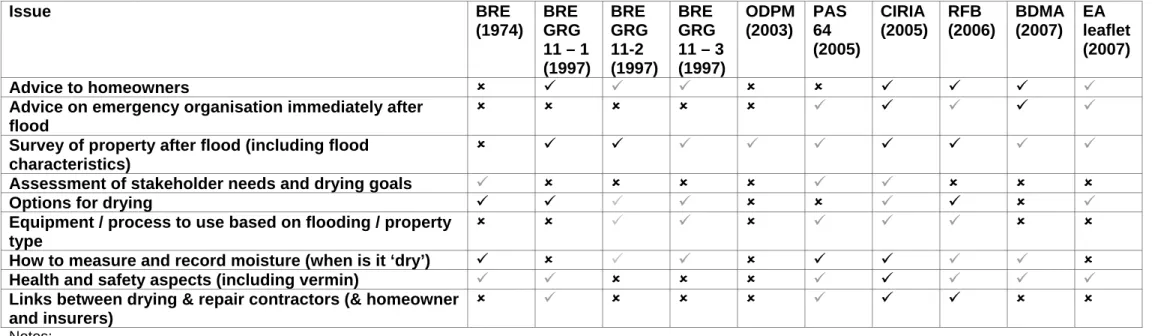
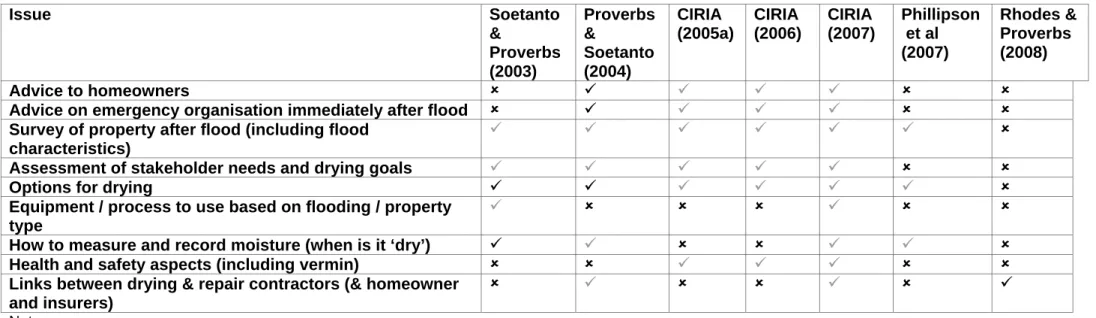
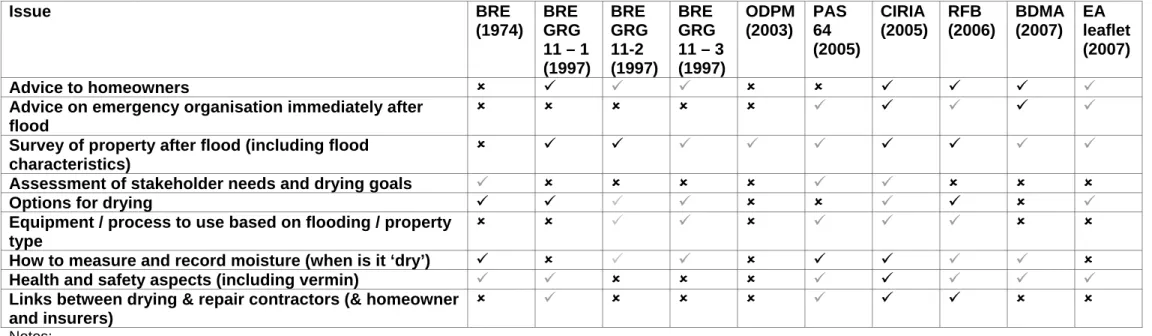
The results of the research demonstrate that there is a great deal of guidance available on common methods for drying buildings and on managing and monitoring the drying process. Some of this guidance is available in the public domain free of charge and more is available to buy, but some is proprietary to particular damage management companies. The study has identified the stages in drying (see Figure 1.1) and the key issues associated with the process. A summary of the best guidance to address each issue has been a key output of this study, and can be found in Table 1.1 and 1.2.
There were also gaps identified in currently available guidance in relation to: Initial assessment reports including initial moisture measurement; impacts of speed drying; environmental impact of drying choices; mapping of drying method and time to building type; guidance on factors affecting drying times; improved monitoring methods; drying reports and certificates; health and safety issues during the drying process; communication of the process and protocols between professional partners and between restorers and flooded households. It was also shown that the advice available to householders is sometimes contradictory, particularly in terms of drying times. Current information on ideal drying times provided by restoration professionals is summarised in Appendix 2.
Use of the guidance is generally widespread in the industry. However, during a major emergency the guidance is less widely adhered to, particularly by
companies not usually engaged in this type of activity. Therefore a new guidance document would be welcomed by the industry, which if developed, should be readily accessible, should signpost more detailed information where necessary and should address some of the gaps identified in the existing guidance.
Alongside this was a need for clear and consistent guidance for the public which would allow them more quickly to take the right actions in the immediate
aftermath and to know what to expect from the reinstatement process. A detailed summary of current guidance by topic can be found in Section 6.2 of Appendix 1.
Addressing the identified gaps in the existing guidance is outside the scope of this project, which has found that lack of adequate drying guidance should not in itself cause the delays in re-occupying homes. This report, therefore, addresses the objective of signposting existing guidance while recommending that the identified gaps be addressed by further work, and that new guidance is prepared once these issues have been addressed.
Contents
1 Introduction ... 6
2 Property surveys ... 11
3 Methods of drying buildings ... 13
4 Equipment used for drying ... 16
4.1 Pumps ... 16
4.2 Dehumidifiers... 16
4.3 Heaters ... 16
4.4 Air movers ... 16
4.5 Combined models... 17
4.6 Software and digital calculators ... 17
5 Determination of target drying times ... 18
5.1 Evidence from research... 18
5.2 Evidence from flood events ... 19
5.3 Setting the target ... 19
6 Monitoring the drying process ... 21
6.1 Monitoring the drying conditions ... 21
6.2 Monitoring the moisture content of materials ... 21
7 Health and safety issues during the drying process... 23
8 Keeping the customer informed ... 24
9 References ... 25
Figures Figure 1.1 Stages in restoration of flooded buildings ...8
Figure 3.1 The process of drying and decontaminating a building following flooding (after Garvin et al (2005)) ...13
Figure 5.1 Drying times from 2007 floods (from National Flood School)...19
Appendices
Appendix 1 Guidance and Standards for drying flood damaged buildings 27 Deliverable 1 - Review of existing guidance
Appendix 2 Workshop summary report, February 2009 103 Appendix 3 Guidance and standards for drying flood damaged buildings: 125
1 Introduction
This project has been concerned with a review of the issues associated with the drying of buildings following a major flood, and whether new guidance would improve the perceived problem of delays in householders re-occupying their homes. The project came about as a result of the Pitt Review into the summer 2007 floods, and the recommendation for Government, Insurers and other stakeholders to investigate the apparent problems in the drying and re-occupation process. This project has therefore undertaken a comprehensive review of guidance and other technical documents on the restoration of flooded buildings (see Appendix 1), and together with views from stakeholders (via
consultations and a workshop – see Appendix 2) has reached a view on what are the substantive issues. In summary (see the Stage Report in Appendix 3), the delays in re-occupation that have occurred after major flooding are not just the result of problems in the drying process. A general shortage of competent damage management contractors and other key stakeholders (including loss adjusters, chartered surveyors and specialist drying firms) following a major event also contribute to delays. The responsiveness of the different participants (insurers, loss adjusters, surveyors, contractors, etc.) as well as the time needed for the repair and redecoration phases following drying are other factors that need to be considered.
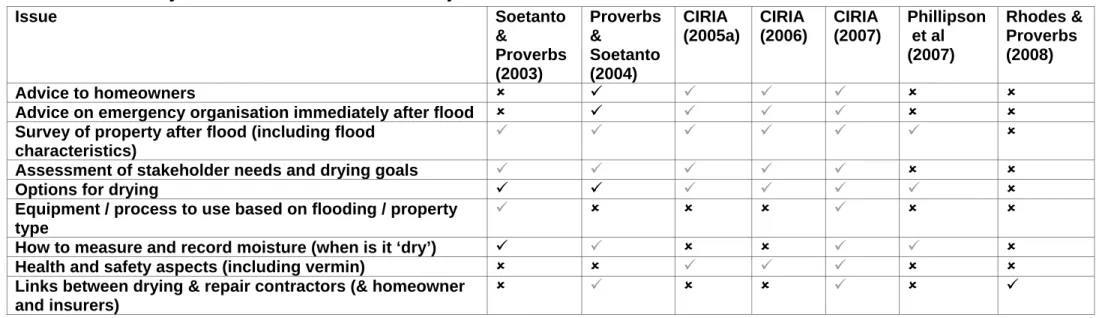
Figure 1.1 shows the various stages that occur following a flood and before properties can be re-occupied, and where different organisations play a role. We have shown local authorities as having a role throughout the whole process, but this only applies where they are the property owner. For private dwellings, they may only have an advisory role in the immediate aftermath of the flood (in addition to their regulatory role through the Building Regulations). The literature review showed in general that existing documents do provide much of the guidance needed for an effective drying and restoration process, covering the phases in Figure 1.1, although the most useful information is not in one single document. Tables 1.1 and 1.2 summarise the main issues covered by the key documents reviewed in this study (taken from Appendix 1). The stakeholder workshop endorsed the view that new guidance would be welcomed if it provided this collation function, and also addressed the perceived weaknesses of poor communication between organisations and with the householder. There also exists some debate among members of the damage management sector with regard to the level of strip-out needed following the drying phase with some firms preferring to attempt careful drying of flood affected materials and elements and others preferring to remove (and therefore replace) these. Some definitive and well-founded guidance in this respect, acknowledging that each property needs to be considered on an individual basis and that no one solution fits all, would really serve the industry well.
However, following an extended break in the project between March 2009 and January 2010, DCLG and Defra have now confirmed that it would be premature to develop new guidance, given what already exists, and that instead a final report should be produced to summarise the work undertaken and possible
future research needs. Therefore this report provides a short summary for each of the main stages involved in drying and restoring buildings, and a review of existing guidance and practice. The report also provides clear ‘signposting’ of the key documents for each stage and also the areas where further work or guidance could/should be considered. It therefore provides a clear summary for the type of guidance document envisaged by the key representatives who attended the stakeholder workshop.
Figure 1.1 Stages in restoration of flooded buildings Flood occurs
Organisation
Event
Homeowner contacts Insurer / Local AuthorityLoss Adjustor / Damage Management Contractor contacts/visits Homeowner
Overview report on initial survey:
• H&S assessment
• Flood damage assessment
• How to remove remaining water and possible strip-out
• Flooding characteristics and future flood risk
Decontaminate building and
Sanitation Certificate issued
Agree schedule and methods for drying
Dry building until appropriate moisture level reached Issue Drying Certificate Audit of drying Sanitation Inspection Certificate issued Repair, re-fit, decoration of building Homeowner re-occupies building
Insurers
Damage Management Contractors
Loss Adj
ustors
Agree repair strategy (‘new for old’ vs. resilient)
Local Authoriti
es (particul
arl
y
for publi
c
housing)
Table 1.1 Summary of how documents address major issues – Guidance Documents Issue BRE (1974) BRE GRG 11 – 1 (1997) BRE GRG 11-2 (1997) BRE GRG 11 – 3 (1997) ODPM (2003) PAS 64 (2005) CIRIA (2005) RFB (2006) BDMA (2007) EA leaflet (2007) Advice to homeowners 8 9 9 9 8 8 9 9 9 9
Advice on emergency organisation immediately after flood
8 8 8 8 8 9 9 9 9 9
Survey of property after flood (including flood characteristics)
8 9 9 9 9 9 9 9 9 9
Assessment of stakeholder needs and drying goals 9 8 8 8 8 9 9 8 8 8
Options for drying 9 9 9 9 8 8 9 9 8 9
Equipment / process to use based on flooding / property type
8 8 9 9 8 9 9 9 8 8
How to measure and record moisture (when is it ‘dry’) 9 8 9 9 8 9 9 9 9 8
Health and safety aspects (including vermin) 9 9 8 8 8 9 9 9 9 9
Links between drying & repair contractors (& homeowner and insurers)
8 9 8 8 8 9 9 9 8 8
Notes:
Symbol in bold black denotes guidance is given that fully addresses the issues Symbol in grey denotes some but insufficient guidance
Legend: BRE (1974) -
BRE GRG 11 – 1 (1997) – BRE Good Repair Guide 11 Part 1 BRE GRG 11 – 1 (1997) – BRE Good Repair Guide 11 Part 2 BRE GRG 11 – 3 (1997) - BRE Good Repair Guide 11 Part 3
ODPM (2003) - Preparing for floods. Interim guidance for improving the flood resistance of domestic and small business properties PAS 64 (2005) – Professional Water damage mitigation and initial restoration of domestic buildings
CIRIA (2005) – Standards for the repair of buildings following flooding RFB (2006) – Repairing flooded buildings
BDMA (2007) – “Self help for victims of flooding, what you can do” and “Understanding basic flood recovery procedures” EA leaflet (2007) - After a flood: practical advice on recovering from a flood
Table 1.2 Summary of how documents address major issues – Technical Publications Issue Soetanto & Proverbs (2003) Proverbs & Soetanto (2004) CIRIA (2005a) CIRIA (2006) CIRIA (2007) Phillipson et al (2007) Rhodes & Proverbs (2008) Advice to homeowners 8 9 9 9 9 8 8
Advice on emergency organisation immediately after flood 8 9 9 9 9 8 8
Survey of property after flood (including flood characteristics)
9 9 9 9 9 9 8
Assessment of stakeholder needs and drying goals 9 9 9 9 9 8 8
Options for drying 9 9 9 9 9 9 8
Equipment / process to use based on flooding / property type
9 8 8 8 9 8 8
How to measure and record moisture (when is it ‘dry’) 9 9 8 8 9 9 8
Health and safety aspects (including vermin) 8 8 9 9 9 8 8
Links between drying & repair contractors (& homeowner and insurers)
8 9 8 8 9 8 9
Notes:
Symbol in bold black denotes guidance is given that fully addresses the issues Symbol in grey denotes some but insufficient guidance
Legend:
Soetanto & Proverbs (2003) - Methods of drying flooded domestic properties: the perceptions of UK building surveyors Proverbs & Soetanto (2004) – Flood Damaged Property. A Guide to Repair
CIRIA (2005a) – Improving the flood resilience of buildings through improved materials, methods and details Report no. WP2C Review of existing information and experience
CIRIA (2006) – Improving the flood resilience of buildings through improved materials, methods and details. Report no. WP5C Final Report – Laboratory tests CIRIA (2007) – Improving the flood resilience of buildings through improved materials, methods and details, Report WP6 - Collation and analysis of post-flood observational data
Phillipson et al (2007) – Moisture measurement in building materials: an overview of current methods and new approaches
Rhodes & Proverbs (2008) - An investigation of the current state of preparedness of the flood damage management sector in the UK: what lessons have been learnt?
2 Property surveys
The PAS 64 - Professional water damage mitigation and initial restoration of domestic dwellings provides guidance and recommendations for the restoration of water-damaged buildings and contents. The role of an initial survey is
stressed, to assess the type of property (age, materials), the type of flooding (depth, duration) and the setting of a method statement and drying goals based on the degree of damage. This Code of Practice establishes Categories of Water Damage, from Category One (water from a clean source) to Category Four (water from a source that carries significant quantities of pathogenic agents and/or toxic elements). Categories of Risk are also established ranging from Minor (up to 3 rooms) to Major (if 4 or more rooms are affected); subdivisions within the Minor risk category are based on the presence of structural damage or health risk.
Several sample forms are included in the Annex of this code to help the
management of the recovery from flood damage. The one that is most relevant to the property survey is the loss assessment form, which contains several useful features but should be revised to include the enhancements given below:
• Loss assessment form
In this form the characteristics of the room being assessed are summarised, including dimensions, temperature and relative humidity, construction
materials and coverings. Moisture readings and drying goals are also recorded, as well as the cause of the claim and actions taken by both the home occupier and the loss assessor. Although the PAS 64 recommends that moisture readings are taken on unaffected components to obtain base
readings as well as on affected components, the exact nature/location of the moisture readings in the form is not given, apart from whether it is on the floor, ceiling, wall, etc. The form is therefore not entirely clear.
Recommended enhancements: include the date of the event, the type of
flood (river, pluvial, groundwater, etc), the level of the flood water and to specifically include moisture readings on unaffected components as well as on affected ones for comparison purposes and to help set appropriate drying goals; include the category of water damage and categories of risk, as per Annex E.
In “Repairing Flooded Buildings” (Flood Repair Forum 2006) several forms are included. Among them the two following ones, which relate to the property survey, are summarised below together with suggested improvements:
• Building condition report in respect of flood damage
This form collates important information on the building and building services including general descriptions of the walls and floors and existing condition and defects. The form also requests other information which is considered to be very relevant to the definition of the drying measures required; this is the height of flood level and the date of the event.
Recommended enhancement: explicitly request information on the building materials used for the walls and ground floor (rather than a general
description). This would aid the estimation of likely drying times based on findings from recent laboratory work (CIRIA, 2006).
• Report of flooding event
This form is used to identify the issues involved, to summarise the work carried out and to highlight any problems likely to arise. Once the repairs are completed, this report should be presented to the owner and for inclusion in the building user’s manual (if available).
Recommended enhancement: indicate the duration of the flood event in the
section “Details of the flooding event”.
At the property survey stage it is necessary to consider historic or older buildings as a separate category, as they are likely to require specialist advice such as historic preservation experts (Tagg et al 2009, National Trust for Historic Preservation 1993).
Key publications:
British Standards Institution (2005) PAS 64; Flood Repair Forum (2006) National Trust for Historic Preservation (1993)
Areas for further study:
Production of guidance on what to include in the initial assessment of the flooded property report, with recommended recording templates
3 Methods of drying buildings
The process of drying a building (i.e. the removal of floodwater from the fabric of the building) can start at the moment that safe access to the building is possible after a flood. Choices are immediately made regarding whether to assist the natural process via pumping out, assisted drying and stripping out or to let natural processes take precedence. Figure 3.1, taken from Garvin et al (2005) illustrates the whole process of drying and decontaminating the building. It is not possible to separate the drying process from making safe the building. This section on drying methods concentrates on part 6 “Drying the building” until the moisture content of the materials reaches an appropriate level.
Figure 3.1 The process of drying and decontaminating a building following flooding (after Garvin et al (2005))
Once the water is extracted and wet materials stripped out, the drying of the building and remaining in situ fixtures and fittings can begin. Fundamentally drying is a process which involves evaporation from the surface of wet materials into air which is at a lower relative humidity than the material itself. Relative humidity is a concept which is central to the drying process and is described in (Building Research Establishment 1990) where an example of a psychrometic chart is also presented. Differences in relative humidity determine the speed of evaporation. There are three basic methods available:
• Naturally with ventilation and possibly fan assisted. This is the slowest method of drying a building and can be severely affected by the prevailing ambient conditions.
• Convection drying using heat and ventilation. This method includes high temperature “speed drying” methods and traditional fan heaters but could also encompass use of the in situ heating system and open windows. • Use of dehumidifiers. Dehumidifiers should be used in a closed
environment as they rely on creating an unnaturally dry atmosphere; the speed of drying is largely dependent on the capacity of the equipment relative to the space to be dried.
Drying methods are described in BRE publications (Building Research
Establishment 1974, Building Research Establishment 1997) and in the Flood Repair Forum guide (Flood Repair Forum 2006). Technical guidance and method statements are also available from various in-house and propriety training
courses and manuals. Methods for cleaning and drying some materials are available in various publications, for example the CIRIA guide (Garvin et al.
2005). Some guidance on types (Building Research Establishment 1997) and ideal methods (Proverbs and Soetanto 2004) is given. However there is no adequate technical guidance available which recommends a particular drying method based on building or flooding characteristics. The choice of drying method is usually dependant on a variety of factors such as the building type, tolerance to further building damage, resources available and building occupancy (Soetanto and Proverbs 2003). The National Flood School have identified 23 different types of construction which affect the drying decision (Tagg et al. 2009). It seems clear that certain drying goals may be more easily achieved with
particular methods; if speed of drying is the overriding consideration then there seems no doubt that the application of high heat with powerful ventilation and heat exchangers will be faster than other methods. However, there is still some doubt as to the possibility of damage to building contents (Lambert 2006) and this method is not recommended for historic buildings (National Trust for Historic Preservation 1993, Fidler et al. 2004, Cassar and Hawkings 2007). It is also clearly inappropriate in buildings which are partially occupied or which are attached with adjacent buildings occupied (Farrington et al. 2009). The environmental issues surrounding the choice of methods may also have an influence. It may be appropriate to balance energy used during drying against embedded energy in building materials stripped out and replaced (Tagg et al.
2009). Drying methods may also be varied during the drying process as different phases are reached (Building Research Establishment 1974, Soetanto and Proverb 2003, Garvin et al. 2005).
Key publications:
Building Research Establishment (1997), Proverbs and Soetanto (2004).
Areas for further study:
Impacts of speed drying on vulnerable building elements Environmental and sustainability impact of drying choices Mapping of appropriate drying method to building type
4 Equipment used for drying
The choice of drying method should determine the type of equipment to be employed, although in some circumstances availability of equipment may
determine the method, especially likely following major flood events. No specific guidance is available that recommends particular drying equipment. From the consultations and discussions at the workshop the following commonly applied drying equipment was identified.
4.1 Pumps
To extract standing water pumps are used. Vacuum pumps can be fitted to a variety of delivery mechanisms. These include mats and wheeled devices which will extract moisture from floor coverings. Absorbent material can also be used to remove surface water.
4.2 Dehumidifiers
There are two types of dehumidifier: refrigerant and desiccant. Refrigerant dehumidifiers cool down the air and extract water through condensation. This type of equipment operates best between 15-28oC and at 60-98% relative humidity. Desiccant dehumidifiers use chemicals which can attract water
(desiccants) to draw water from the air. They operate best between 0-25oC and 40-90% relative humidity. Thus desiccant dehumidifiers have a greater range of operation and can be used to push dry air into closed spaces.
4.3 Heaters
When using heat to dry flooded buildings it is essential to also ensure adequate ventilation and air movement. Heat allows greater moisture absorption by the air and so increases evaporation from wet building elements. This warm saturated air needs to be evacuated, usually to the outside of the building. Drier air
replaces it allowing more moisture to be absorbed. Fan heaters are often used or heaters accompanied by separate fans. Fuel based heaters should not be used as they add moisture and increase drying times (Tagg et al. 2009). Heat
exchangers may also be used. The available heaters vary by their power output and therefore by the temperature of air they supply and the speed in which moisture can be evaporated from building elements. They may vary from
domestic sized fan heaters sited in each room to superheating trailers designed to heat multiple rooms over 60oC. Superheating trailers can dry very quickly but may damage vulnerable elements (Tagg et al. 2009). Alternatively it is possible to use the in situ heating, such as the central heating system (Proverbs and Soetanto 2004).
4.4 Air movers
Moving air with or without heat assists drying. Air movers can be generalised fans which create wide circulation or can be directed to cover particular areas. Pipes can be attached which can be directed through drill holes or vents to access voids, for example cavity walls. This is sometimes called injection drying.
4.5 Combined models
Some products are now available which combine methods, for example the use of dehumidifiers with heating and dehumidifiers which blow or suck dry air through voids.
4.6 Software and digital calculators
In order to decide on the level of drying equipment appropriate to install in flooded properties, a series of calculations involving moisture load and room dimensions are necessary. Skilled operatives can carry out these calculations using tables and drying equipment specifications but there are more automatic procedures available. Some tools/software are available, for example the
National Flood School Moisture Wizard; hand held digital calculator type devices are also available.
5 Determination of target drying times
The time taken to dry flooded buildings is a central subject of this report and indeed a crucial parameter in flood damage restoration. It is important to realise that defining dryness as a percentage of moisture content for a building is not possible since the various materials that form a building have varying levels of moisture in their dry state. Rather than stating that a building is dry, the surveyor needs to decide when it is suitable for re-occupation (PCA, 2009). It is
recommended that the desired moisture condition(s) should be set out before any drying takes place and communicated to the homeowner.
Natural drying of buildings can take months (Garvin et al. 2005) and the desire to dry quickly usually means some form of assisted drying is preferred. It is possible to dry many properties very quickly using “speed drying” techniques and yet there are reports of properties which are not dry after 12 months. The Publicly Available Specification PAS64 suggests that drying can take place in 3 weeks and practitioners concur that this is possible under ideal conditions (British
Standards Institution 2005, Tagg et al. 2009, Farrington et al. 2009). Conversely, the Association of British Insurers guidance says that several months may need to be allowed for drying (Association of British Insurers 2007).
These facts are hard to reconcile but once again the answer is that target drying times must be seen within the context of the type of drying method used, the ambient conditions and the aims of the repair process in general. Restorers may decide there is little point in investing money and energy in drying a property quickly if the reinstatement cannot commence immediately after the property is dry. This may ensue if property owners are unsure about the type of
reinstatement or there are lead times on the supply of replacement fixtures and fittings. It is also true that average drying times from major events are longer than for stand-alone property flooding because of the availability of experts and
equipment (Association of British Insurers 2009). The setting of drying goals is crucial and the target should be recorded on the restoration plan (British
Standards Institution 2005, The Flood Repairs Forum 2006) 5.1 Evidence from research
Evidence presented to the project in consultations and the workshop undertaken in 2009 suggested that using traditional techniques, all other things being equal, in standard construction houses under ideal conditions it is possible to dry a property in 3 weeks. However in reality a good target to dry a property for reinstatement would be 4-8 weeks (Farrington et al. 2009, Tagg et al. 2009). However there are no guidelines available that detail these generalised rules. Estimates of typical drying times were available from research data which suggested that thick walls with masonry infill can take up to four months to dry (Cassar and Hawkings 2007) and that the presence of insulation can delay drying for 10-12 weeks (Escarameia et al. 2006). The National Flood School estimates showed speed drying reduced drying times to an eighth of traditional methods while Lambert found that the system was effective at drying building materials within 42 hours and caused no damage during drying, only during
wetting (Lambert 2006). A conclusion supported by the National Flood School (Tagg et al. 2009).
5.2 Evidence from flood events
There were also actual measurements of drying time from properties affected in the 2007 floods taken from two practitioner sources. The National Flood School showed drying times averaging 30 days for the drying process alone (see Figure 5.1). Average duration for clean up and drying from the ABI resilience report showed around 115 days and from the Pitt Review, 50% had dried out within 3 months and 82% within six months. Drying times can be affected by non standard construction, weather issues, pre-existing conditions, duration of flooding, surface treatments (Proverbs and Soetanto 2004) and even the action of property owners switching off or moving equipment (Tagg et al. 2009).
Professionals employ rules of thumb and rely on their experience to judge likely drying times. Monitoring of the drying conditions clearly assists them in this task. However, there is no guidance available which details these factors and new guidance in this area was identified as a worthwhile goal (Farrington et al. 2009). The provision of minimum or target drying times for varied construction types, methods and conditions would require a significant research effort.
Distribution of drying times from 2007 floods
0 50 100 150 200 250 300 350 0-10 11-20 21-30 31-40 41-50 51-60 61-70 71-80 81-90 91-100 Days N o . of prope rtie s 0 10 20 30 40 50 60 70 80 90 100 % of properties
Figure 5.1 Drying times from 2007 floods (from National Flood School) 5.3 Setting the target
The target should be set in consultation with the property owners and occupiers with reference to the above considerations. The use of forms similar to the loss assessment form presented in PAS64 (British Standards Institution 2005) can aid in recording this process. Pre existing conditions should be included in the report. It is also recommended that moisture measurements of unaffected parts of the building (or adjacent buildings) are explicitly recorded and final finishes to be applied are established in order to provide dryness goals for specific materials. Although British Standards are available for some materials they may not always
be appropriate dependent on final finishes required (Tagg et al. 2009). Target drying time can then be based on the dryness goal, available methods,
cost/environmental benefit and other factors mentioned above. Pre-existing defects that can impact on the moisture level of building components need to be identified, as well as any previous repairs. These include: insufficient ventilation leading to mould growth due to condensation, defects in external drainage and internal plumbing, penetrating or rising damp (PCA, 2009). The Code of Practice for the Recovery of Flood Damaged Buildings from the Property Care
Association also provides useful advice on reasons for the appearance of water marks and damp patches following a flood and a restoration process, which if not understood can lead to overly extended drying periods.
Key publications:
British Standards Institution (2005) PAS 64, Flood Repair Forum (2006) Areas for further study:
Mapping of average drying times against types of building and method used Investigation of other factors affecting the speed of drying
6 Monitoring the drying process
Monitoring the drying process is necessary for two main reasons: during the drying process, monitoring enables better control of the environment and allows the perfect drying chamber to be maintained more easily. Monitoring is also used to signal the end of the drying process. In order to get meaningful results, the initial condition of the various elements of the building should be established and photographic records should be taken.
It is important not to over-dry; this wastes energy and time and increases the risk of damage to building components. Equally important is to restore the moisture level to the appropriate level for reinstatement and to be sure that restored components are not damaged by trapped moisture or high humidity levels. As with the drying process it may be that more than one moisture measurement technique will be used to test moisture in different materials and at different drying stages. In the first phase the drying conditions are most crucial and as drying progresses towards phase 3 the moisture measurement of building components becomes more critical. Different monitoring equipment is available to achieve both these aims. When drying goals have been reached a drying certificate may be issued. Currently this is usually issued on hand-over between drying company and reinstatement company. However, given that reinstatement may reintroduce moisture to the building it may be more appropriate to issue this at the end of the process with interim statements at hand-over (Tagg et al. 2009). 6.1 Monitoring the drying conditions
It is important to monitor the drying conditions in the chamber, the temperature and relative humidity, to ensure optimum drying times and prevent secondary damage. This can be done by inspection but another common method for
achieving this is to use humidity sensors. Humidity sensors rely on measuring the relative humidity of air next to materials. Some drying equipment will include sensors and may have automatic control of drying conditions. Continuous monitors are available but most often the control will rely on operatives taking measurements at regular intervals. The frequency of these measurements may therefore affect the speed of drying as optimum drying conditions may not be maintained. During the workshop it was suggested that monitoring reports should be issued at least weekly. Forms for monitoring the drying process are included in PAS64 (British Standards Institution 2005).
6.2 Monitoring the moisture content of materials
All moisture measurement techniques have advantages and disadvantages and require some level of skill in the operator. Not least because measures of
moisture are expressed in different ways depending on the method used and to some extent the equipment chosen (Tagg et al. 2009). Most moisture
measurement methods do not directly measure water content - they use material properties, such as electrical conductivity, which vary with moisture level. Most indirect methods are inaccurate at very high levels of moisture (Tesarek et al.
2005, Farrington et al. 2009). In order to directly measure moisture content it is necessary to remove samples of the material from the building element and use
oven drying or chemical reaction to remove the water. Taking samples in itself requires care in the method and siting of samples and is destructive of the material tested. Whatever method is used the operator will need to be aware of the possibility of trapped moisture and be cognisant that some areas are likely to be wetter than others, ensuring that all necessary readings are taken. This may be particularly important if heat is used in drying as the elements may take some time to reach equilibrium once heat is removed.
Guidance on moisture measurement is available from a CIRIA publication C538 (Dill, 2000), A review of testing for moisture in building elements. This publication lists the usual and some more unusual methods of testing for moisture in
materials. A useful set of selection tables gives some indication of which test method may be appropriate for a given situation and building material.
Moisture detecting equipment is available at a vast range of sophistication and cost. Monitoring equipment which can download stored results to laptops, or can transmit wirelessly via weblinks, can help to control the drying process. Many probes feature combinations of test methods, for example temperature with humidity or resistance with capacitance. Kits with a suite of methods are also available. In theory it is possible to monitor all facets of the drying process and take remedial action when conditions change. Practitioners believe that current methods are adequate for testing dryness in the hands of skilled technicians but most of these techniques require expertise, training and investment in
equipment. Problems may also occur in estimating initial wetness and therefore drying time. New methods are also currently being researched (Phillipson et al.
2007, Tagg et al. 2009). Key publications:
British Standards Institution (2005) PAS 64 Dill (2000)
Areas for further study:
Methods for assessing initial moisture content of flooded buildings Non-invasive monitoring methods
Automatic methods and methods requiring less skill
Production of requirements for monitoring and auditing the drying including information that should be provided on a drying certificate
7 Health and safety issues during the drying process
Health and safety issues in drying out of buildings can be grouped into main concerns: Concerns for the safety of those carrying out the drying anddecontamination process during the course of their duties; and concern for the present and future health of the buildings occupants.
For those carrying out the drying a complete health and safety assessment should be carried out before drying commences. These processes are detailed in (Garvin et al. 2005) and (Building Research Establishment 1997) as well as in Flood Repair Forum (2006) where the relevant health and safety at work legislation is signposted.
The health of occupants may also be affected, particularly if they are resident during the drying process, but also in the long term if drying is inadequate. There is recognition that health problems associated with damp conditions or with the presence of contaminants may arise (Building Research Establishment 1974, National centre for healthy housing and enterprise community partners 2006, Ashley et al. 2009, Klintberg et al. 2008, Akpinar-Elci et al. 2008). A concern about long term toxic mould growth is prevalent in research material from the US but practitioners in the UK regard this as a low risk in properly controlled drying procedures. If it is possible to vacate the premises this will significantly reduce any health risks and simultaneously allow a greater range of drying options to be considered, possibly speeding up the drying process. Practitioners also seemed to be confident that, if sensible precautions are taken, health, safety and security impacts within the building may be reduced to a minimum (Tagg et al. 2009, Farrington et al. 2009). Proper and prompt removal of disposed contents, silt and debris is also necessary to prevent a public health nuisance and this may be expedited by efficient waste removal practices. Clear guidance for property owners and occupiers would be appropriate to allay the concerns of residents regarding health and safety; current leaflets are contradictory and confusing. In addition, the use of a sanitation certificate with appropriate standards would reassure occupants that their home was safe to return to (Farrington et al. 2009). Key publications:
Garvin et al. (2005)
Flood Repair Forum (2006) Areas for further study:
Prevalence of increased illness during the drying process linked to occupancy, drying method, speed of drying
Clear guidance for operatives and occupants on the appropriate health and safety measures to be implemented
8 Keeping the customer informed
Throughout all the stages of the flood damage repair process the importance of good communication cannot be overstated. In an independent analysis of the work of building contractors involved in the recovery from recent UK floods, Paul Hendy (2009) highlights the fact that flood victims have a reduced ability to give and receive information which necessarily impacts on relationships with
contractors, and for that matter, any other professionals involved.
Communication was found to be at the root of all complaints, with unrealistically short times for restoration given by the insurance industry leading to false expectations.
It is suggested in the above report that it is the responsibility of all
professionals/organisations/companies involved in flood damage restoration to ascertain the most suitable way of communicating with the client as early as possible, to ensure that the project manager updates the client weekly and that a backup team manager is appointed to cover when the project manager is absent. In the specific case of building contractors (but easily extended to other
professionals) this can be aided by: creating and updating a Work Flow Chart every two weeks to keep client informed on progress; setting up a local
telephone number to reduce telephone bills; and prioritising properties, (i.e.
vulnerable people and the elderly) while explaining to others why there is a delay, Key publications:
Flood Repair Forum (2006) Repairing flooded buildings; an insurance industry guide to investigation and repair. BRE Press
Paul Hendy (2009). An independent analysis of the Flood Repair Programme – Jan 2005 to May 2009
Areas for further study:
Development of protocols for dealing with access to properties when home owners/occupiers are not contactable
More detailed advice to homeowners regarding the whole flood damage
restoration process – this is envisaged to be part of the management hierarchy and process flow chart, and could be posted on a national website
Greater clarity on the roles and responsibilities involved in the drying and
restoration process, particularly the role of project manager who would manage the whole process
9 References
Akpinar-Elci, M., Siegel, P. D., Cox-Ganser, J. M., Stemple, K. J., White, S. K., Hilsbos, K. and Weismann, D. N. (2008) Respiratory inflammatory responses among occupants of a water-damaged office building. Indoor Air, 18, pp. 125-130.
Ashley, N. A., Valsaraj, K. T. and Thibodeaux, L. J. (2009) Multiphase contaminant distributions inside flooded homes in New Orleans, Louisiana, after Hurricane Katrina: a modelling study. Environmental Engineering Science, 28(3).
Association of British Insurers (2007) Summer floods 2007: learning the lessons.
(London: Association of British Insurers).
Association of British Insurers (2009) Resilient reinstatement - the cost of flood resilient reinstatement of domestic properties. Research Paper, 14-09, (London: Association of British Insurers).
British Standards Institution (2005) PAS 64 - Professional water damage mitigation and initial restoration of domestic dwellings.
Building Research Establishment (1974) Drying out buildings. Digest 163, (Building Research Establishment).
Building Research Establishment (1990) Surface condensation and mould growth in traditional built dwellings. Digest, 297, (Watford: Building research establishment).
Building Research Establishment (1997) Repairing flood damage : immediate action. Good repair guide, 11, (Watford: BRE).
Cassar, M. and Hawkings, C. (2007) Engineering historic futures: stakeholders dissemination and scientific research report. (UCL centre for sustainable heritage).
CIRIA (2006)Improving the flood resilience of buildings through improved materials, methods and details. Report no. WP5C Final Report –
Laboratory tests (Final Report), July 2006. By Escarameia, M. Karanxha, A. and Tagg, A., Construction Industry Research and Information
Association (CIRIA)
Dill, M. J. (2000) A review of testing for moisture in building elements. C538, (Construction Industry Research and Information Association).
Escarameia, M., Karanxha, A. and Tagg, A. (2006) Improving the flood resilience of buildings through improved materials methods and details. Report no. WP5C Final Report, laboratory tests. (CIRIA).
Farrington, R., Kidd, B., Tagg, A., Escarameia, M., Christierson, B. V., Lamond, J. and Proverbs, D. (2009) Guidance and Standards for drying flood damaged buildings: workshop summary report. CLG Building regulations research programme, lot 13 water management, (London: Communities and Local Government (unpublished)).
Fidler, J., Wood, C. and Ridout, B. (2004) Flooding and Historic Buildings, technical advice note. (English Heritage).
Flood Repair Forum (2006) Repairing flooded buildings; an insurance industry guide to investigation and repair. (BRE Press).
Garvin, S., Reid, J. and Scott, M. (2005) Standards for the repair of buildings following flooding. C623, (London: Construction Industry Research and Information Association).
Paul Hendy (2009). An independent analysis of the Flood Repair Programme – Jan 2005 to May 2009.
Klintberg, T., Johannesson, G. and Bjork, F. (2008) Air gaps in building construction avoiding dampness and mould. Structural Survey, 26(3). Lambert, P. (2006) Research on the impacts of speed drying, Workshop on
identification and facilitation of flood damage research, FloodRepairNet, Sheffield.
National Centre for Healthy Housing and Enterprise Community Partners (2006)
Creating a healthy home, a field guide for clean-up of flooded homes. National Trust for Historic Preservation (1993) Treatment of flood-damaged older
and historic buildings. Information booklet, 82, (National Trust for Historic Preservation).
Phillipson, M. C., Baker, P. H., Davies, M., Ye, Z., Mcnaughtan, A., Galbraith, G. H. and Mclean, R. C. (2007) Moisture measurement in building materials: an overview of current methods and new approaches. Building Services Engineering Research Technology, 28(4), pp. 303-316.
Property Care Association (2009). Code of practice For the Recovery of Flood Damaged Buildings. www.property-care.org.
Proverbs, D. and Soetanto, R. (2004) Flood damaged property: A guide to repair. (Blackwell).
Soetanto, R. and Proverb, D. (2003) Methods of drying flooded domestic properties: the perceptions of UK building surveyors, RICS foundation, University of Wolverhampton.
Tagg, A., Escarameia, M., Christierson, B. V., Lamond, J. and Proverbs, D. (2009) Guidance and Standards for drying flood damaged buildings: Deliverable 1 Review of existing guidance. CLG Building regulations research programme, lot 13 water management, (London: Communities and Local Government (unpublished)).
Tesarek, P., Pavlik, J. and Cerny, R. (2005) Comparison of the capacitance method and the microwave impulse method for determination of moisture profiles in building materials. Acta Polytechnica, 45(1), pp. 42-47.
Appendix 1
Guidance and Standards for drying flood damaged
buildings. Deliverable 1 - Review of existing guidance
HR Wallingford:Andrew Tagg
Manuela Escarameia Birgitte von Christierson University of Wolverhampton: Jessica Lamond
Contents
1 Introduction ... 31 2 History of available guidance ... 33 3 Overview of drying equipment and moisture measurement ... 36 3.1 Drying ... 36 3.1.1 Pumps ... 36 3.1.2 Dehumidifiers... 36 3.1.3 Heaters ... 36 3.1.4 Air movers ... 37 3.1.5 Combined models... 37 3.1.6 Software and digital calculators ... 37 3.2 Overview of moisture measurement ... 37 3.3 Common methods of testing... 38
3.3.1 Calcium carbide testing (speedy moisture meter, CM tester, carbide bomb)... 38 3.3.2 Gravimetric (oven drying) ... 38 3.3.3 Capacitance meter (radio frequency, impedance, dielectric,
electromagnetic wave, permittivity)... 38 3.3.4 Resistance meter (conductance moisture meters, pin meters, probe meters) ... 39 3.3.5 Humidity sensors (hygrometer, hygrosticks)... 39 3.3.6 Microwave (higher frequency power absorption method) ... 39 3.3.7 Radar (impulse radar, ground penetrating radar, sub-surface
radar) ... 39 3.3.8 Thermographic (thermal imaging, infrared thermography) . 39 3.4 Emerging methods ... 40 3.4.1 Thermal Heat Probe ... 40 3.4.2 Time Domain Reflectometry (TDR) ... 40 3.4.3 Nuclear Magnetic Resonance (NMR) ... 40 3.4.4 Sophisticated electrical techniques... 40 4 Review of existing guidance ... 41 4.1 Guidance documents... 41 4.1.1 Drying out buildings ... 41 4.1.2 Repairing flood damage: immediate action... 42 4.1.3 Repairing flood damage: ground floors and basements ... 42 4.1.4 Repairing flood damage: foundations and walls ... 43 4.1.5 Preparing for floods. Interim guidance for improving the flood
resistance of domestic and small business properties. 2003 Reprint ... 44 4.1.6 PAS 64 Professional water damage mitigation and initial
restoration of domestic buildings. Code of Practice... 45 4.1.7 Standards for the repair of buildings following flooding ... 46 4.1.8 Repairing Flooded Buildings; an insurance industry guide to
investigation and repair ... 47 4.1.9 Understanding basic flood recovery procedures... 48 4.1.10 After a flood: practical advice on recovering from a flood .... 48 4.2 Technical publications ... 49
4.2.1 Methods of drying flooded domestic properties: the
4.2.2 Flood Damaged Property. A Guide to Repair ... 50 4.2.3 Improving the flood resilience of buildings through improved
materials, methods and details Report no. WP2C Review of existing information and experience ... 51 4.2.4 Improving the flood resilience of buildings through improved
materials, methods and details. Report no. WP5C Final Report – Laboratory tests ... 52 4.2.5 Improving the flood resilience of buildings through improved
materials, methods and details, report WP6 - collation and analysis of post-flood observational data... 54 4.2.6 Moisture measurement in building materials: an overview of
current methods and new approaches ... 55 4.2.7 An investigation of the current state of preparedness of the
flood damage management sector in the UK: what lessons have been learnt?... 56 4.3 International sources ... 57 4.3.1 Repairing your flooded home... 57 4.3.2 Moisture measurement guide for building envelope
applications... 57 4.3.3 Creating a healthy home, a field guide for clean-up of
flooded homes ... 58 4.3.4 Research on the impacts of speed drying... 59 4.3.5 A portable NMR device for the evaluation of water presence
in building materials ... 60 4.3.6 The optimisation of a thermal dual probe instrument for the
measurement of the moisture content of building envelopes60 4.3.7 Time-domain reflectometry method and its application for
measuring moisture content in porous materials: a review . 61 4.3.8 Suitability of time domain reflectometry for monitoring
moisture in building materials ... 61 4.3.9 Air gaps in building construction avoiding dampness and
mould... 61 4.4 Historic buildings ... 62 4.4.1 Treatment of flood-damaged older and historic buildings ... 62 4.4.2 Flood damage in historic buildings ... 63 4.4.3 Natural disasters and urban cultural heritage ... 63 4.4.4 Flooding and Historic Buildings, technical advice note ... 64 4.4.5 How wet are these walls? Testing a novel technique for
measuring moisture in ruined walls ... 64 4.4.6 An operative protocol for reliable measurement of moisture
in porous materials of ancient buildings... 64 4.4.7 Engineering historic futures: stakeholders dissemination and
scientific research report... 65 4.4.8 Summary of advice for historic buildings ... 66 5 Outcome of consultations ... 68 6 Findings ... 69 6.1 How documents address major issues ... 69 6.2 Summary of findings by issue... 72 6.2.1 Advice to homeowners on drying... 72 6.2.2 Advice on emergency organisation immediately after flood 73
6.2.3 Survey of property after flood (including flood
characteristics) ... 74 6.2.4 Assessment of stakeholder needs and drying goals... 75 6.2.5 Options for drying ... 76 6.2.6 Equipment / process to use based on flooding/property
type... 77 6.2.7 How to measure and record moisture (when is it ‘dry’) ... 78 6.2.8 Health and safety aspects (including vermin) ... 80 6.2.9 Links between drying & repair contractors (& homeowner
and insurers)... 81 7 Outline of proposed guidance on drying ... 82 8 Conclusions and recommendations ... 83 8.1 Conclusions ... 83 8.2 Recommendations... 85 9 References ... 86
Appendices
Appendix I Tables from CIRIA (2006) and Escarameia et al (2007) 89
1 Introduction
Over the past decade there have been several major flooding events that have affected widespread areas of the UK. This includes the Easter 1998 flood which particularly affected the Midlands, the widespread winter 2000 floods, the January 2005 Carlisle flood, and the summer 2007 floods that resulted from intense rainfall which caused major disruption in Yorkshire, Humberside and large areas of the Midlands and Southwest. These events were accompanied by increased media and public interest, partly driven by the emerging acceptance of climate change. As a result, there is improved knowledge of what causes floods, what it is like to be affected, and how the response and recovery processes work.
Against this backdrop of increased interest in flooding and its management, many reports, guidance and advice have been produced over the last 10 years, specifically on repair and restoration of buildings damaged by flood water. In spite of this, there continues to be dissatisfaction over the recovery process, with many families unable to return to their homes for several months, or some cases for more than a year. Whether this is related to problems with the drying or repair phases is not clear, and certainly for major flooding events there may be a shortage of competent organisations who can undertake such work. Many of these issues have been highlighted by the extensive Pitt Review into the 2007 floods (Pitt, 2008), which found there was
“significant dissatisfaction with the time it took to dry out and stabilise properties”, and that “cases of undue delay may be due to the absence of definitive guidance about drying methods.” Pitt also noted the conflicting and limited advice on when it was suitable to return to a damp property and other health aspects. In recognition of the impact that the drying phase could have on communities and long-term health problems for families, together with the costs of insurance and temporary accommodation, Pitt produced
Recommendation 73:
“The Government, the Association of British Insurers and other relevant organisations should work together to explore any technological or process improvements that can be made to speed up the drying out and stabilising process of building recovery after a flood.”
Of course there are likely to be several suitable drying scenarios for any property and the choice of method must be considered in the context of managing the whole repair process, repair of neighbouring property and the availability of suitable equipment and power sources. Currently there is little evidence to demonstrate the rationale behind different drying strategies. Given this experience from recent flooding, there is clearly a need to revisit the existing guidance on drying and repairing flooded properties, and to see to what extent the industry is using it and whether there are new approaches that need to be considered in light of recent events. New drying technologies have also been trialled in recent years, and again there is a need to determine how widely these are now being used. Finally, the industry and other stakeholders
need to be consulted as to the desirability for new guidance to improve the drying out and restoration of flooded buildings, and the form and content of such guidance.
In response to the comments from Pitt, DCLG has commissioned this study to assess the current situation regarding the drying of flood-damaged properties, and to propose improved guidance that addresses the shortfalls in the use of the existing advice. These overall aims will be delivered by specific project objectives, as follows:
• Identify and examine existing guidance, information and practices on the drying of flooded properties, and the current use of such guidance. • Produce generic guidance for the drying of flooded properties based on
existing knowledge.
• Establish how this guidance could be made more widely available and taken up by the industry.
• Identify areas where knowledge gaps exist and to recommend subjects for further research.
2 History of available guidance
Advice and guidance for the drying of flood damaged buildings has become increasingly available over the past decades and takes many forms. Early publications include the 1973 Building Research Establishment (BRE, 1973)
Repair and renovation of flood-damaged buildings and the 1974 Drying out buildings (BRE, 1974). Much of the guidance is embedded in publications aimed at the wider field of repair and restoration of flooded buildings and some is specific to the drying process. Advice of different kinds is available: “how to” guides and manuals aimed at flood repair professionals, such as the British Damage Management Association (BDMA) and National Flood School (NFS) training manuals; standards and specifications such as PAS64 and British Standards relating to workmanship on building sites which may be adhered to with regard to specified moisture contents; and advice of a more general nature aimed at homeowners such as the English Heritage technical advice note.
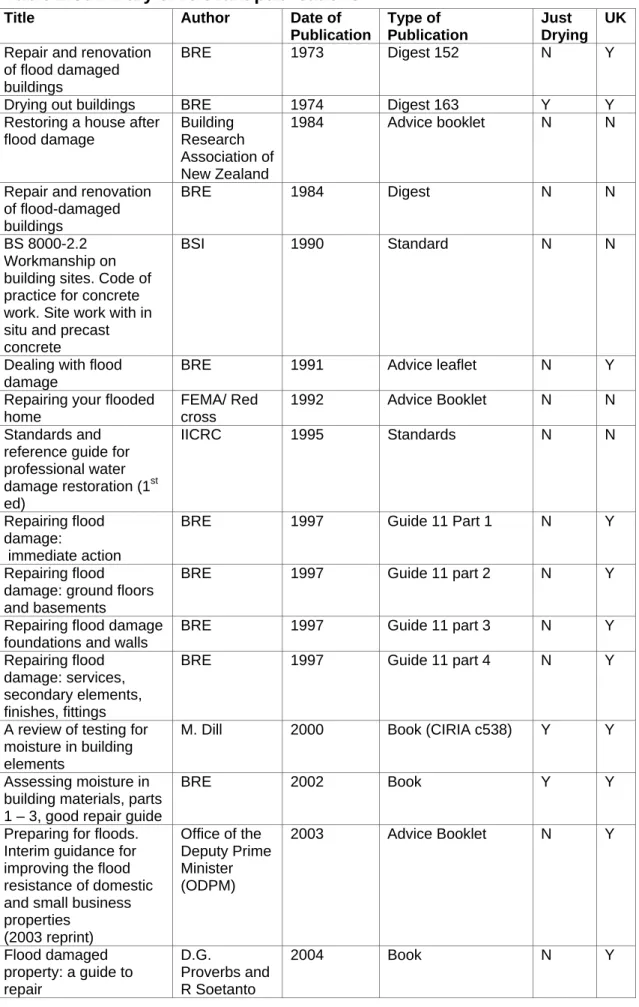
The following table (Table 1) lists some of the guidance available, the authors and the year of publication. It is not exhaustive, but rather indicative of
typology. In addition to the leaflets and books listed there are: professional training courses (such as offered by the NFS, the BDMA and the Property Care Association (PCA); online resources (e.g. the National Flood Forum (NFF) and Association of British Insurers (ABI) websites); which are too numerous to mention and phone advice helplines.
Some of this guidance (marked in bold in Table 1) has formed the basis of the literature review under existing guidance (Section 4) and some has been discussed with consultees (Section 5).
Much of the advice given by all these sources and guides is similar as they may be recycling information from the same source. However, there are conflicts in some cases, particularly in advice given to homeowners; this may be due to attempts to summarise complex information. Often it is unclear whether the advice is backed up by scientific or professional sources. Advice and guidance from overseas sources contains much relevant material but specific building element, humidity and temperature advice may have to be tempered by knowledge of differing construction techniques and prevailing ambient conditions.
Table 1 Summary of relevant publications
Title Author Date of
Publication Type of Publication Just Drying UK
Repair and renovation of flood damaged buildings
BRE 1973 Digest 152 N Y
Drying out buildings BRE 1974 Digest 163 Y Y Restoring a house after
flood damage Building Research Association of New Zealand 1984 Advice booklet N N
Repair and renovation of flood-damaged buildings
BRE 1984 Digest N N
BS 8000-2.2 Workmanship on building sites. Code of practice for concrete work. Site work with in situ and precast concrete
BSI 1990 Standard N N
Dealing with flood damage
BRE 1991 Advice leaflet N Y
Repairing your flooded home
FEMA/ Red cross
1992 Advice Booklet N N
Standards and reference guide for professional water damage restoration (1st ed) IICRC 1995 Standards N N Repairing flood damage: immediate action
BRE 1997 Guide 11 Part 1 N Y
Repairing flood damage: ground floors and basements
BRE 1997 Guide 11 part 2 N Y
Repairing flood damage foundations and walls
BRE 1997 Guide 11 part 3 N Y Repairing flood
damage: services, secondary elements, finishes, fittings
BRE 1997 Guide 11 part 4 N Y
A review of testing for moisture in building elements
M. Dill 2000 Book (CIRIA c538) Y Y
Assessing moisture in building materials, parts 1 – 3, good repair guide
BRE 2002 Book Y Y
Preparing for floods. Interim guidance for improving the flood resistance of domestic and small business properties (2003 reprint) Office of the Deputy Prime Minister (ODPM) 2003 Advice Booklet N Y Flood damaged property: a guide to repair D.G. Proverbs and R Soetanto 2004 Book N Y
Title Author Date of Publication Type of Publication Just Drying UK
Flooding and historic buildings English Heritage J. Fidler, C. Wood and B. Ridout 2004 Technical advice note N Y Moisture measurement guide for building envelope applications Institute for research in construction (Canada) 2004 Technical guidance Y N
Standards for the repair of buildings following flooding S. Garvin, J Reid & M Scott 2005 Book (CIRIA c673) N Y Repairing flooded buildings: an industry guide to investigation and repair Flood repairs forum / BRE 2006 Book N Y PAS64 BSI/Chris Netherton 2006 Standard Y N Creating a healthy home, a field guide for clean-up of flooded homes National centre for Healthy housing and Enterprise community partners (US) 2006 Advice Booklet N N Standards and reference guide for professional water damage restoration (3rd ed) IICRC 2006 Standards N N New guide to restorative drying
Dri –eaz (US) 2006 Technical manual Y N Flood damage restoration Part 2: technical procedures IICRC (revised) 2006 Technical guidance N N
Flood clean up advice Newark and Sherwood District Council 2006 Advice leaflet N Y Repairing flood damaged buildings Australian Red Cross 2007 Information leaflet N N Condensation and dampness pack
BRE 2007 Collection of Good repair guides, digests and information papers. (contains some of above) N Y Understanding basic flood recovery procedures
BDMA 2007 Advice leaflet N Y
Self help for victims of flooding, what you can do
BDMA 2007 Advice leaflet N Y
After a flood Environment Agency
2007 Advice leaflet N Y
Damage management, Official training and reference manual
3 Overview of drying equipment and moisture
measurement
In this section a brief overview of drying and measuring methods and equipment is presented.
3.1 Drying
Once standing water, mud, silt and wet contents are removed there are basically three ways of removing retained moisture from buildings:
• Naturally with ventilation possibly fan assisted. • Convection drying using heat and ventilation. • Using dehumidifiers.
These methods are not mutually exclusive: accepted wisdom is that there is not one right way for all situations. In many cases a combination of methods may be appropriate as building conditions change and drying passes through phases.
Within each category there are many variations in application of the basic principles and many proprietary products with differing specifications available to assist the drying process.
3.1.1 PUMPS
To extract standing water pumps are used. Vacuum pumps can be fitted to a variety of delivery mechanism including mats and wheeled devices which will extract moisture from floor coverings. Absorbent material can also be used to remove surface water.
3.1.2 DEHUMIDIFIERS
There are two types of dehumidifier: refrigerant and desiccant. Refrigerant dehumidifiers cool down the air and extract water through condensation. This type of equipment operates best between 15-28oC and at 60-98% relative humidity. Desiccant dehumidifiers use chemicals which can attract water (desiccants) to draw water from the air. They operate best between 0-25oC and 40-90% relative humidity. Thus desiccant dehumidifiers have a greater range of operation.
3.1.3 HEATERS
When using heat to dry flooded buildings it is essential to also ensure adequate ventilation and air movement. Heat allows greater moisture absorption by the air and so increases evaporation from wet building elements. This warm saturated air needs to be evacuated, usually to the outside of the building. Drier air replaces it allowing more moisture to be absorbed. Fan heaters are often used or heaters accompanied by separate fans. Heat exchangers may also be used. The available heaters vary by their power output and therefore by the temperature of air they supply and the
speed in which moisture can be evaporated from building elements. They may vary from domestic sized fan heaters sited in each room to superheating trailers designed to heat multiple rooms over 60oC. Alternatively it is possible to use the in situ heating, such as the central heating system.
3.1.4 AIR MOVERS
Moving air with or without heat, air movers can be generalised fans which create wide circulation or can be directed to cover particular areas. Pipes can be attached which can be directed through drill holes or vents to access voids, for example cavity walls. This is sometimes called injection drying.
3.1.5 COMBINED MODELS
Some products are now available which combine methods, for example the use of dehumidifiers with heating and dehumidifiers which blow or suck dry air through voids.
3.1.6 SOFTWARE AND DIGITAL CALCULATORS
In order to decide on the level of drying equipment appropriate to install in flooded properties, a series of calculations involving moisture load and room dimensions are necessary. Skilled operatives can carry out these calculations using tables and drying equipment specifications but there are more automatic procedures available. Some tools/software are available, for example the National Flood School Moisture Wizard; hand held digital calculator type devices are also available.
3.2 Overview of moisture measurement
Monitoring the drying process is necessary for two main reasons: during the drying process, measurement enables better control of the environment and allows the perfect drying chamber to be maintained more easily. Moisture measurement is also used to signal the end of the drying process. It is
important not to over-dry - this wastes energy and time and increases the risk of damage to building components. Equally important is to restore the
moisture level to the appropriate level for reinstatement and to be sure that restored components are not damaged by trapped moisture or high humidity levels. Whatever the drying goal, moisture measurement tests whether it has been achieved.
As with the drying process it may be that more than one moisture
measurement technique will be used to test moisture in different materials and at different drying stages. There are standards available for some building elements for certificating final levels of dryness but these methods may not be the best for monitoring and controlling the process of reaching drying goals. All moisture measurement techniques have advantages and disadvantages and require some level of skill in the operator. Not least because measures of moisture are expressed in different ways depending on the method used and to some extent the equipment chosen. Most moisture measurement methods do not directly measure water content - they use material properties, such as electrical conductivity, which vary with moisture level. In order to directly measure moisture content it is necessary to remove samples of the material