Annales UMCS Informatica AI 2 (2004) 435-444
Annales UMCS
Informatica
Lublin-Polonia Sectio AI http://www.annales.umcs.lublin.pl/The use of Macromedia MX architecture in projecting
the educational rates of exchange
Dariusz Dobrowolski
∗Institute of Physics, Maria Curie-Skłodowska University, pl. M.Curie-Skłodowskiej 1, 20-031 Lublin, Poland
Abstract
In this paper the Macromedia MX software application for training and lectures preparation is presented. On the basis of earlier experiences short characteristics and new possibilities of this tool kit are also discussed. Macromedia MX software is used all over the word coming up to current standards and specifications.
1. Introduction
The MX architectures have been developed in order to utilize fully advantages of the dynamic technology of WWW. The dynamic technologies of WWW – understood as the manifold systems and data base of information are more frequently applied in secondary school and university education. Additionally, this software is very useful and effective in professional training and development of management qualification in many companies. At the static sides, where server static is used only as “the device of memory”. With the dynamic WWW sides model logical content, data and presentation layers are separated. Finally this system could be applied by many users at the same time. The other products e.g. Flash MX and Dreamweaver MX support the development of dynamic environment and allow the programmers for active participation in the e-learning types of professional training.
2. Standards
E-learning is a comparatively “young” field. The first standards (IMS and ADL) were developed in 1999. The process of e-learning standardization is in progress. Some project teams are involved and draft version of new documents is presented on their www pages.
∗E-mail address: [email protected]
The existing LMS platforms operate within the standardized form so the training programmers could be used. The standards have been worked out in order to enable the owner of LMS system independence of an actual training material deliverer.
Organizations dealing with the standard e-learning area:
– AICC (Aviation Industry CBT Community) – the standard defining data transfer protocol between the LMS platform (www.aicc.org),
– IEEE (Institute of Electrical and Electronics Engineers) – LOM (Learning Object Metadata) (
www.ieee.org
),– IMS (Instructional Management Systems Global Learning Consortium) – based on XML standard (www.imsproject.org),
– ARIADNE – Alliance of Remote Instructional Authoring & Distribution Networks for Europe (ARIADNE) – the LOM standard developed under the auspices of IEEE. (www.ariadne-eu.org).
The implementations of standards in systems the LMS:
– Microsoft LRN (Learning Resource iNterchange) – implementation of the IMS standard: Content Packaging 1.1 as well as metadata 1.2 – Microsoft product LRN 3.0 Toolkit standard supports also SCORM (www.microsoft.com/elearn/support.asp),
– SCORM (Sharable Content Object Reference the pattern) – worked out by ADL – applied in creating the training content: Click2Learn, NETg, Macromedia companies (www.adlnet.org),
– files in format XML – based on the specification IMS 1.0 Content Packaging and SCORM 1.0/1.1 standards (applied in Oracle the e-learning in the import /export - function).
At present SCORM (Sharable Content Object Reference Model) and ADL technologies become the standard tools for creating a Web-based learning environment and are most frequently applied for training content development [1] and exchange of learning objects.
3. Training model
According to the designers’ foundations from Macromedia Inc basic unit of the individual teaching is the Learning Object (LO – the Object of Teaching, Pill of Knowledge). At the beginning of the LO looked as follows:
Fig. 1. Lattice of Learning Object [2]
The pattern of LO Object Teaching consisted of the nuclei which included the object shell (text files, video recording, animation, graphs and speech sound), teaching shells (content), the practical acquaintance of training content (practice) and assessing tests. Additionally, there were so called Metadata. The architecture of internet applications with development of internet technology also changed together with.
An example of architecture is presented in Fig. 2. Development of the internet technology influenced strongly changes of the architecture and application:
Logiczna warstwa pośrednia
Zasoby danych Warstwa klienta XML XML XML Przeglądarka WWW Przeglądarka WWW Przeglądarka WWW Przeglądarka WWW Przeglądarka WWW Przeglądarka WWW Narzędzia wspomagające XML :
system autorski, itd.
Serwer Web Serwer aplikacji
Baza danych w XML (strukturalizowana) Interakcja z aplikacjami poprzez
protokoły oparte na XML Obiektowo-relacyjna baza danych wspomagająca XML Obiektowa baza danych wspomagająca XML Zasoby danych pod OLE/DB Inne dokumenty na Webie: HTML Word,... Inne dokumenty na Webie: HTML Word,... Dokumenty XML na Webie Dokumenty XML na Webie Inne dokumenty na Webie: HTML Word,... Inne dokumenty na Webie: HTML Word,... Dokumenty XML na Webie Dokumenty XML na Webie Serwer integrujący XML, serwer zapytań, serwer hurtowni danych Translatory formatów
z/do XML, pomosty
XML XML XML
Fig. 2. Future architecture of internet applications [3]
Such changes forced Macromedia to apply a different approach in creating the educational professional training content. Recently a new LO model has been introduced (Fig. 3).
Fig. 3. Lattice of Learning Object taking the change into account [4]
New technologies generate new applications and new tools, particularly – new opportunities in e-learning education and WWW papers construction. Macromedia with their leading products on the market, e.g. Dreamweaver and Flash, did not lag behind. The new product named MX was brought onto the market at the end of 2003 projecting (Authorware), editing (Dreamweaver, Flash, Fireworks) and exploitation (Coldfusion, Flash Communication Server) as well as e-learning (Fig. 4).
Fig. 4. Architecture Macromedia MX [5]
Two ways of creating LO are available now. The first is based on Dreamweaver and the other one on Flash. Both methods lead to other final similar products. Somehow these products depend on each other. The
macromedia example of the training development template is presented in (Fig. 5). The product MX is very helpful for the e-learning application.
Fig. 5. Interface ColdFusion / the HTML (Dreamweaver) [4]
Fig. 6. Interface Flash MX [4]
This worksheet allows the designer for customization and following screen arrangement. Text, clip arts, animation object could be readily blended into the training contents.
Fig. 7. View sheet of projecting in Macromedia Dreamweaver MX
Editorial port permits us to follow the prepared content as well as to attribute already prepared elements and units to different groups.
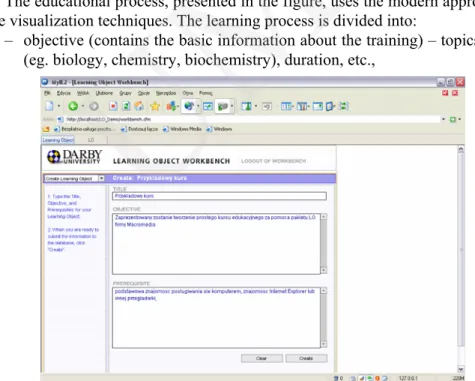
The educational process, presented in the figure, uses the modern approach to the visualization techniques. The learning process is divided into:
– objective (contains the basic information about the training) – topics name (eg. biology, chemistry, biochemistry), duration, etc.,
Fig. 8. Training example – the objective – learn – view of the training content,
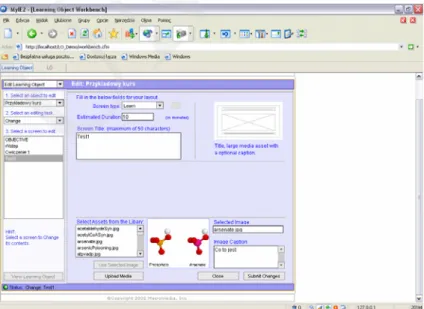
Fig. 9. Port view of the training example – the screen of port choice
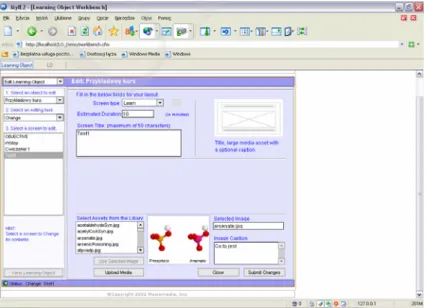
Fig. 10. Port view of the training example – the edition of port learn – practice – this port contains material for practices,
Fig. 11. Port view of the training example – the edition of port practice
– assessment – checking tests and assimilated knowledge learning checking.
Fig. 12. Port view of the training example – the edition of port assessement
SCORM targets the Web as a primary medium for delivering instruction. It does so under the assumption that anything that can be delivered by the Web can be easily used in other instructional settings that make fewer demands on accessibility and network communications. This strategy eliminates much of the
development work once needed to adapt to the latest technology platform because the Web itself is becoming a universal delivery medium. By building upon existing Web standards and infrastructures, SCORM frees developers to focus on effective learning strategies.
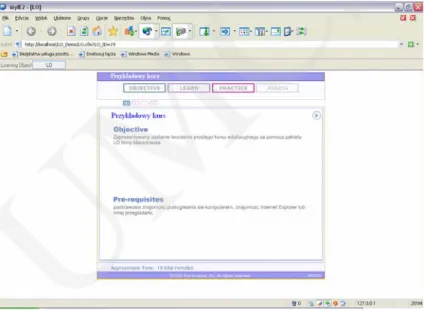
The following assumption: anything that can be delivered by the Web should be easily used and accessible, was the main idea during all stages of development. Therefore this technique facilitates creating and supports effective learning. The attributed content, which is addressed to suitable topics, as well as following parts of the training stages, exercises, test are well visible.
Fig. 13. Port view of the training example
4. Conclusions
E-learning project development, training and learning process construction are very complicated and difficult. Therefore team of experts, IT specialists, teachers, graphic artists, psychologists etc., have been working together for a long time. According to the recent studies of e-learning experts, preparation for one hour long training is about 200 h. Specific standards and specification must be respected. The knowledge of very specific software, toolkits, net administration, database are absolutely necessary. All of these leads to a very high investment and costs of e-learning training, even if they are very short.
Macromedia MX architecture is a universal medium, which reduces significantly not only efforts of experts in the preparation phase, but also time and final costs of the training. Additionally, the final product looks very professional and visualization techniques speed up the learning process.
References
[1] The Institute of Mathematical Machine engines – Technical specification, Part 1 the Analysis of Existing Media’s Developers the Trainings/the Tests As well as Standards In Range the Creating And Management the Trainings/Tests, (2002).
[2] Cuthbert A., Himes F., Creating Learning Objects with Macromedia Dreamweaver MX, (2002).
[3] Subieta K., The Distracted and federational bases of data the Materials to lectures in Poland, The Japanese Higher School the Technician Computer in Warsaw.
[4] Heins T., Himes F., Creating Learning Objects With Macromedia Flash MX, (2002). [5] Heins T., Himes F., Macromedia MX: Strategies and Architectures for eLearning Content,
(2002).
![Fig. 2. Future architecture of internet applications [3]](https://thumb-us.123doks.com/thumbv2/123dok_us/10994315.2987105/3.748.145.653.577.889/fig-future-architecture-internet-applications.webp)
![Fig. 3. Lattice of Learning Object taking the change into account [4]](https://thumb-us.123doks.com/thumbv2/123dok_us/10994315.2987105/4.748.188.507.206.399/fig-lattice-learning-object-taking-change-account.webp)
![Fig. 6. Interface Flash MX [4]](https://thumb-us.123doks.com/thumbv2/123dok_us/10994315.2987105/5.748.218.577.515.824/fig-interface-flash-mx.webp)