IMPROVING COMPUTER-ASSISTED LANGUAGE
LEARNING THROUGH HIERARCHICAL
KNOWLEDGE STRUCTURES
A Dissertation
Presented to the Faculty of the Graduate School of Cornell University
in Partial Fulfillment of the Requirements for the Degree of Doctor of Philosophy
by Shuhan Wang
c
2019 Shuhan Wang ALL RIGHTS RESERVED
IMPROVING COMPUTER-ASSISTED LANGUAGE LEARNING THROUGH HIERARCHICAL KNOWLEDGE STRUCTURES
Shuhan Wang, Ph.D. Cornell University 2019
A common drawback in traditional language education is that all students in the same class use the same content. Since students may have different backgrounds such as prior knowledge and learning speed, one single curriculum may not be able to accom-modate every student. Unfortunately, most students cannot afford personalized language learning, since preparing personalized learning content can be very time-consuming and potentially requires a significant amount of expert labor. Recently, researchers have pro-posed automatic systems to assist language education, such as Computer-based Assess-ment Systems (CAT) and Intelligent Tutoring Systems (ITS). However, previous work usually characterizes the student’s knowledge and the difficulty of learning content using numeric scores, which may not be comprehensive.
To improve on this, this thesis introduces hierarchical knowledge structures to as-sist in multiple tasks in language education. First, this structure multidimensionally characterizes the difficulty of each learning material by its relative difficulty to other materials and models the whole corpus with a graph structure. Additionally, we can utilize the hierarchical knowledge structure to multidimensionally assess a student’s prior knowledge, predict the student’s future performance on a specific task, and recom-mend learning content that is appropriate for each student. Furthermore, the hierarchical knowledge structure enables us to build a framework to characterize existing learning curricula extracted from textbooks and online learning tools, and apply expert wisdom that we have discovered to automatically design learning curricula. The hierarchical
knowledge structure reduces the cost of expert labor and potentially makes language education more affordable and more engaging.
BIOGRAPHICAL SKETCH
Shuhan Wang completed his Bachelor of Science at Peking University in 2014. During his time at Peking, he took a course about the cultural geography of the world, which later became the source of his interest in natural languages. While at Cornell Univer-sity, he minored in Linguistics and primarily worked on Syntax. His Ph.D. research on Computer-Assisted Language Education was greatly inspired by his own experience of learning foreign languages. In addition to Chinese and English, he also speaks Japanese, German and Spanish. He plans to learn more languages in the future.
Dedication
ACKNOWLEDGEMENTS
I would like to express my sincere gratitude to my advisor Erik Andersen for numer-ous ideas regarding my research projects and the guidance of writing research papers. I’m also very grateful to my committee members: John Whitman and Dexter Kozen.
I would also like to thank the collaborators and developers who assisted me with my papers and projects: Fang He, Hao Wu, Ji Hun Kim, Brandon Cohen, Sixian Yi, Jung Yun Park, Nicholas Teo, Liye Zhong, Tong Mu, and Emma Brunskill. I could never finish all of this work without your help.
Special thanks to my best friend Xiang Long for his great help in writing good papers, as well as on living a good life throughout my Ph. D.
This material is based upon work supported by the National Science Foundation under Grant No. IIS-1657176.
TABLE OF CONTENTS
Biographical Sketch . . . iii
Dedication . . . iv
Acknowledgements . . . v
Table of Contents . . . vi
List of Tables . . . viii
List of Figures . . . x
1 Introduction 1 2 Related Work 10 2.1 Intelligent tutoring systems . . . 10
2.2 Difficulty evaluation of reading texts . . . 11
2.3 Trace-based partial orderings . . . 13
2.4 Knowledge assessment: IRT, KST, and CAT . . . 13
2.5 Educational recommender systems . . . 15
2.6 Practice problem ordering and progression synthesis . . . 16
2.7 Forgetting curves and reinforcement scheduling . . . 17
2.8 Student engagement in educational games . . . 17
3 Organizing Learning Materials 18 3.1 Conceptual units in grammar learning . . . 19
3.1.1 Grammatical template analysis . . . 20
3.1.2 Statistics of grammatical templates . . . 25
3.1.3 Difficulty level prediction . . . 26
3.2 Hierarchical knowledge structure . . . 31
3.2.1 Partial ordering graph . . . 31
3.3 Scaling to vocabulary learning . . . 35
3.3.1 Fuzzy partial orderings . . . 36
3.4 Conclusion . . . 40
4 Student Assessment and Adaptive Recommendation 42 4.1 Knowledge assessment . . . 43
4.1.1 The knowledge boundary . . . 43
4.1.2 Calculating the knowledge boundary . . . 44
4.1.3 Predicting performance on specific problems . . . 46
4.1.4 Evaluation . . . 50
4.2 Incorporating assessment into recommendation . . . 55
4.2.1 Adaptive assessment heuristic . . . 56
4.2.2 ZPD-based recommendation heuristic . . . 57
4.2.3 Balancing assessment and recommendation . . . 58
4.2.4 Evaluation . . . 59
5 Learning Progression Analysis and Design 64
5.1 Progression analysis of expert-designed curricula . . . 65
5.1.1 Composition: the balance of learning and review . . . 65
5.1.2 Pace: the growth rate of knowledge . . . 67
5.1.3 Studies on textbooks . . . 68
5.1.4 Studies on online language learning tools . . . 71
5.2 Parameter-based progression synthesis . . . 73
5.3 Goal-based progression design . . . 75
5.3.1 The two-step heuristic approach . . . 78
5.3.2 Evaluation . . . 83
5.4 Conclusion . . . 92
6 Conclusion 94 6.1 Future work . . . 96
LIST OF TABLES
3.1 Grammatical Templates in Japanese, with hyphens denoting words to be filled in. Note that some grammatical templates may impose require-ments of some properties (e.g. part of speech or form) on the missing words. . . 22 3.2 Identified grammatical templates of Japanese sentences. In sentences,
pronunciations and translations, grammatical templates are in bold. The wordtoukyouin the first sentence is a noun (Tokyo,東京), as char-acterized by template E. The wordmi(to see,見) in the second sentence is the i-form (動詞連用形) of a verb, as required by template F. . . 22 3.3 Distribution of grammatical templates of level N1(hard)-N5(easy) . . . 25 3.4 Number of templates of level N1(hard)-N5(easy) per 100 sentences . . 26 3.5 Accuracies of classifying N1-N5 texts . . . 30 3.6 Traces of Integer Addition Problems . . . 32 3.7 Japanese Sentences and Their Grammatical Templates . . . 33 3.8 Sample Sentence Pairs in the fuzzy partial orderings with the fuzzy
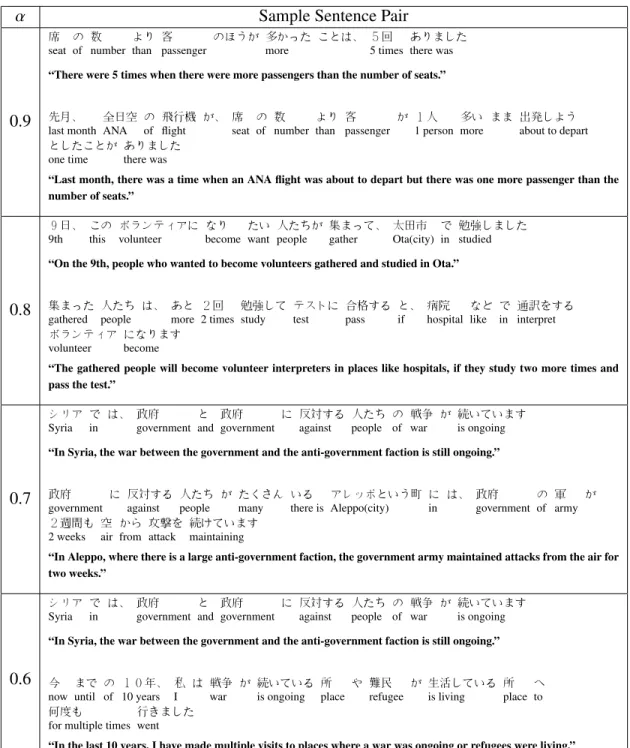
pa-rameter α = 0.9/0.8/0.7/0.6. For each fuzzy parameterα, the second sentence is α-fuzzily harder than the first sentence. As the fuzzy pa-rameterαdecreases, our confidence in the fuzzy partial orderings (the likelihood for a student to understand the first sentence if he/she under-stands the second one) also drops. Text source: NHK Easy [63]. . . 39 4.1 Scoring User Responses in the Assessment Stage of J100 . . . 52 4.2 The average and standard deviation of J100 user responses, grouped
by the calculated distance from the knowledge boundary. Note that the standard deviation of the user responses is maximized where the distance is at some point between -2 and -3, indicating that users are most unsure of their ability at this distance. . . 53 4.3 We ran Wilcoxon Rank-sum tests for all pairs of our four groups:
Adap-tive Recommendation (A.R.), Non-adapAdap-tive Recommendation (N.R.), Assessment-Only (A.O.) and Random (Rand.). The difference between adaptive recommendation and non-adaptive recommendation was sta-tistically significant (p=.035). . . 61 5.1 Synthesized progressions with desired parameters. The ‘Genki
Simu-lation’ progression is synthesized with parameters extracted from the textbook. The other three progressions are generated with specific pa-rameter settings. This demonstrates the potential of our progression synthesis framework to map characteristics of one progression onto an-other, and to create progressions that are tailored to the needs of an individual student. . . 75 5.2 First eight tasks of Language Zen [111], an online Spanish learning
5.3 Sample Results of Algorithm 2, which scales a reinforcement-free pro-gression into longer and slower propro-gressions given the minimum mem-ory retention parameterminR. Levels in italics are added by the algo-rithm to help student review. The parameterminRcontrols the progres-sion length (learning pace): the larger the parameter minR, the longer the target progression. . . 82 5.4 Expert progression and synthesized progression inKatchi. Goal levels
are in bold. Note that the expert progression puts all goal levels at its end whereas synthesized progression introduces goal levels starting at level 15 and reinforces them afterwards. . . 87
LIST OF FIGURES
3.1 Grammatical difficulty in the N1/N2 texts . . . 27 3.2 Grammatical difficulty in the N4/N5 texts . . . 28 3.3 Multilevel Linear Classification (MLC). ‘>N5?’ represents the linear
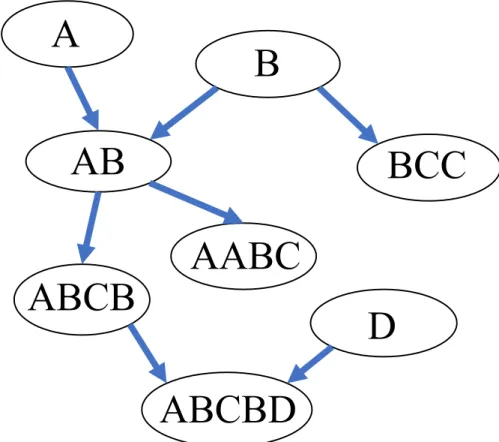
classifier judging whether a text is harder than N5. The classifiers are similar for the other levels. . . 28 3.4 A sample partial ordering graph. Uppercase letters represent concepts
and the nodes with strings represent problems. Each directed edge from problemsi tosj representssjis directly harder thansi. . . 35
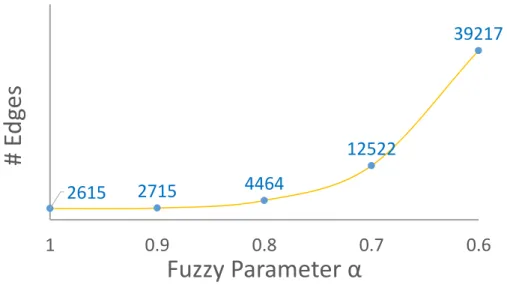
3.5 Number of edges in the fuzzy partial ordering graph over different fuzzy parameters, in our corpus of 4,269 texts. Decreasing the fuzzy parameter will increase the graph density exponentially. . . 38 4.1 A Student’s Knowledge boundary in the partial ordering graph.
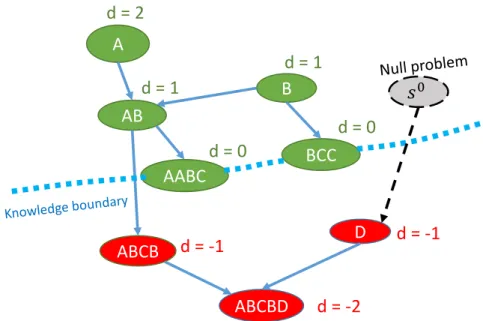
Up-percase letters represent concepts and the nodes with strings repre-sent problems. The student can solve the green problems but cannot solve the red ones. The distances form each problem to the knowledge boundary are indicated asd. The null problem s0is an auxiliary prob-lem that is added to help us compute the distances. . . 44 4.2 Coloring the partial ordering graph based on the student’s response.
If the student solves s∗, all the nodes that are at most as hard as s∗
(including s∗ itself) will be colored ‘solvable’ (green); if the student fails to solve s∗, all the nodes that are at least as hard as s∗ (including
s∗it self) will be colored ‘unsolvable’ (red). . . 45 4.3 Screenshot of J100 Platform (Assessment Stage) . . . 51 4.4 The adapted Rasch model nicely fits the J100 user data. The blue data
points show the average user response to problems with the same dis-tance from the knowledge boundary, and the red curve is theItem Char-acteristic Curve(ICC) calculated based on the adapted Rasch model. . 54 4.5 Screenshot of JRec, a Japanese reading text recommendation tool.
When using this tool, users are directed to an NHK Easy webpage [63], read a recommended text, and respond whether or not they understand it. Our tool highlights the recommended text and grays out the rest of the webpage. . . 60 4.6 Proportion of users remaining after reading certain amount of texts.
We observed that users in the adaptive recommendation group read 62.5% more texts than those in the non-adaptive recommendation group, which indicates that incorporating adaptive assessment signif-icantly improved student engagement in learning material recommen-dation. . . 61 5.1 Progression composition of two Japanese textbooks: Standard
Japanese and Genki. The proportions are fairly similar. Note that it usually takes a student 2 semesters to learn units 1-6. . . 68
5.2 Proportion of reinforcement(RI), recombination(RC) and Introduc-tion(IN) in two series of Japanese textbooks: Standard Japanese (SJ) andGenki(GK). Here x-axis represents the learning progress: unit 1-6, and y-axis demonstrates the proportions. . . 69 5.3 Paces of various progressions. Here, the x-axis represents the
nor-malized learning time (namely, the nornor-malized number of sentences learned), and the y-axis corresponds to the normalized knowledge size. (a) shows that both textbooks introduce the same amount of knowledge over the same period of time, which indicates that they use a steady pace. (b) and (c) compare the textbook progression to other baseline progressions. When compared with the textbook progression, random progressions are too difficult at the beginning, and progressions gener-ated by a topological sort are too easy at the beginning. . . 70 5.4 Progression composition of two online Spanish learning tools:
Duolingo and Language Zen. Compared with Duolingo, Language Zen has less reinforcement and less introduction, but much more recombi-nation. Note that it usually takes a student a couple of days to learn 30 problems. . . 72 5.5 A sample partial ordering graph in goal-based progression synthesis.
Each node represents a level containing a specific set of required con-cepts. Each directed edge represents a “harder than” relation between two levels. The red numbers next to each node denote the traversal or-der of each level in the post-oror-der DFS, namely the oror-der of each level in the reinforcement-free progression. . . 79 5.6 Screenshots ofKatchi, a Korean learning puzzle game that teaches
ba-sic vocabulary such as colors, numbers, shapes and conjunctions. There are two types of game levels inKatchi: selection levels, in which play-ers need to either select the correct graphic object based on the given Korean word(s);construction levels, in which players need to drag-and-drop the correct Korean word(s) to describe the target objects. . . 84 5.7 Proportion of users remaining after playing our game for certain
amounts of time. We did not find a statistically significant difference between the two progressions. It appears that the synthesized progres-sion engaged players slightly less than the expert progresprogres-sion, but they are quite comparable. The median player in the synthesized progres-sion played for 42 seconds and the median player in the expert-designed progression played for 45 seconds. . . 88
5.8 Proportion of users remaining after learning certain amounts of knowl-edge. We use knowledge size, number of levels that either have been completed or are easier than some completed levels, to measure the amount of knowledge learned. There is no statistically significant dif-ference between the two progressions. The proportion of players with knowledge size between 10 and 20 is higher for the expert progression, while the two curves are quite similar otherwise. The median knowl-edge size is 5.5 for the synthesized progression and 5 for the expert-designed progression. . . 90 5.9 Total game progress over different average times spent on each level.
Each blue plot represents a player. Typically, players who finished at least 90% of the game (green zone) spent 7-12 seconds on each level. Players who spent less than 7 seconds (red zone) or more than 12 sec-onds (orange zone) tended to leave early before 90% of the game, which probably indicates that we should generate a shorter/longer progression to accommodate their faster/slower learning pace respectively. . . 92
CHAPTER 1 INTRODUCTION
A common drawback of traditional classroom education is that all students in the same class use the same content, but a single series of curricula cannot accommodate students of different backgrounds, such as different prior knowledge or different pre-ferred learning speed. Although most textbooks are carefully designed by experienced teachers and experts in order to fit most students’ needs (the “general” learning content), some students may still find that the textbooks introduce too much content in a certain period of time (too fast) or the textbooks are far beyond their current level (too hard). If these students do not receive help promptly, they may lose interest in learning, or even quit school, which I believe is not a rare case around us. Unfortunately, most schools, especially in developing countries and areas, typically do not have enough teachers ded-icated to each student.
Ideally, we would have computers do some of the work for teachers, such as col-lecting materials, assessing students, and select appropriate content for each student. The most important advantage of computer-assisted education is “automatic”: the entire pipeline of traditional education is streamlined and integrated into a unified computer system, in which much of the expert labor is saved, the time and monetary costs are reduced, and thus personalized education can be affordable for everyone. By learning personalized content that is highly adapted to individual needs, students can achieve better learning effectiveness and be more engaged. Spending the same amount of time and money, people can potentially explore a wider range of topics or dive deeper in the direction they are interested in with the help of computer-aided education. In short, computer science techniques have a good potential of boosting traditional education in various perspectives.
Although most models and algorithms in this thesis can be naturally applied to other educational domains, my Ph.D. work mainly focused on learning natural languages. I believe learning a foreign language is important because as an international student, I can see a variety of people around me want or need to learn a second language: students who want to study abroad, kids who like watching Japanese animations, or people like me who simply enjoy learning multiple languages. Although my knowledge of foreign languages (other than English) may not necessarily contribute significantly to my future career (it did help while curating source data or interim results in some Natural Language Processing projects), learning a foreign language brings a lot of joy to me and many of my friends. In fact, many people may not have enough time or money to go to a professional language class. Instead, they rely more on online language learning. Therefore, I would hope to improve computer-assisted language learning, in theory and in practice, to provide them with a better experience of learning a foreign language.
Researchers have developed many theories and frameworks to help language stu-dents. Krashen’sInput Hypothesisproposes that students gain the knowledge of a lan-guage when they try to understand the content that is slightly beyond his/her current level (this is also known as “i+1 theory”) [48]. Vygotsky’sZone of Proximal Develop-ment(ZPD) suggests that students are able to finish the tasks that are just beyond their ability with external assistance [94]. Both of these well-established theories suggest that Computer-Assistant Language Learning (CALL) systems need to target the content that is one step beyond a student’s current knowledge. To do this, a CALL system needs to organize the corpus of available learning materials based on their difficulty and evaluate the prior knowledge of each student.
Item Response Theory (IRT) is one of the most widely-used tools for student as-sessment. IRT stipulates that a student’s performance on a specific problem (item)
is a function of the difference between the student’s ability and the problem’s diffi-culty [25, 27, 72]. This function typically has one to three parameters that need to be calculated based on a large amount of data of the student’s previous performance on the problems in the library (For example, the 3PL model [56] and the Rasch model [71]).
Knowledge Tracing(KT) is also an important theory that has been applied to many in-telligent tutors [19, 45]. KT models the process of a student’s learning a new concept with a Hidden Markov Model, and the probability of the student’s transitioning from the “unmastered” state to the “mastered” state is a parameter specified by the content that needs to be calculated based on previous student data. However, these two theo-ries may encounter significant issues when applied to online language education, since students favor authentic and up-to-date materials yet the data of the student’s previous performance on those materials is often missing. As a result, they are not able to com-pute their required parameters in order to characterize those materials. In addition, these two theories normally use unidimensional numeric scores to characterize the difficulty of learning materials and the ability of students. However, knowledge is not unidimen-sional: materials with difficulty level 8 may require different sets of knowledge, students with competency level 7 may understand different sets of knowledge too, and we cannot be sure that any level-8 material is “just-beyond” the knowledge of any level-7 student. Therefore, we need a more comprehensive way to characterize learning materials and assess students. Ideally, we would build ahierarchical knowledge structurethat records all the information of which materials are harder (or even “just harder”) than some other materials (namely, the relative difficulty between materials), and characterize a student’s knowledge within this hierarchical knowledge structure using the set of materials that he/she understands. By doing this, we can easily recommend each student with the appropriate materials that are slightly harder than his/her ability.
period and monitor how they forget things throughout the learning process. Ebbing-haus’Forgetting Curveis an old but very famous theory that models memory and for-getting. It stipulates that a student’s memory decays exponentially over time [26]. More recently, researchers have presented a series of work on scheduling reinforcement: Leit-ner introduced a flashcard system in which previously learned knowledge is reviewed at increasing intervals [31]. Pavlik and Anderson examined different strategies to opti-mize schedules of reinforcement [66, 67]. Wozniak proposed theSuperMemoalgorithm to calculate intervals of time between multiple repetitions of the same learning con-tent [104], which has been applied to several computer-assisted learning tools such as Anki [7] and Mnemosyne [59]. However, a common drawback of these learning tools is that they are flashcard-based, which means students can only learn a vocabulary word or a phrase at a time without any context, and students may quickly get bored of this. Ide-ally, a good CALL system should recommend a sequence of authentic articles instead of a series of individual words/phrases in order to better engage students, and my work seeks to do this based on existing theories of forgetting.
This thesis aims to improve existing computer-assisted language learning systems in three aspects: materials, students, and curricula. The first research problem I would like to tackle is how to comprehensively characterize and organize a corpus of learning ma-terials. Language learners want to read authentic and up-to-date texts with a variety of topics, but it is prohibitively expensive to ask experts to evaluate the difficulty of a large number of texts, and existing data-driven approaches (such as IRT [92, 96, 101, 109]) will also fail to work when we do not have sufficient student data. Moreover, previous automatic approaches usually measure the difficulty of learning materials using unidi-mensional numeric scores [34, 56, 71], which is not comprehensive [28]. In Chapter 3, I will propose a novel way to organize a corpus of learning materials: we build the
is measured based on its relative difficulty to other materials. This structure is also based on the decomposition of vocabulary and grammatical knowledge and determines whether one material is harder than another by decomposing them into sets of concep-tual units and then comparing them. Specifically, we model the hierarchical knowledge structure for a given corpus using thepartial ordering graph, and this graph can be gen-erated automatically without requiring expert labor or student data. This graph will also be a powerful tool for the assessment of a student’s knowledge and the synthesis of a curriculum, which I will show in the following two chapters.
The second problem I want to address is how to recommend learning materials to stu-dents based on their current language levels. Although we have already seen some ma-terial recommendation systems that proved to be very useful in classrooms [17, 39, 41], it can be very different for the adults who are only able to spend their spare time learning a foreign language online: in formal learning scenarios such as schools and universities, we can assess a student’s current language level using a standardized language place-ment test, yet in informal learning scenarios such as online learning, those tests are usu-ally not feasible, and self-assessment results are often inaccurate and standardized [57]. In Chapter 4, I will present an interactive assessment algorithm to comprehensively eval-uate a student’s prior knowledge within the hierarchical knowledge structure (partial or-dering graphs), as well as an evaluation demonstrating that this framework can produce accurate assessment results. I will also show that this algorithm can be incorporated into our text recommendation algorithm in order to make adaptive recommendations and increase student engagement.
The third research problem I worked on is how to synthesize and optimize a sequence of learning materials, namely, thelearning progression. Since it is reported that prepar-ing even an hour of learnprepar-ing content can take experts hundreds of hours [2, 3], we hope
to find automatic approaches to designing curricula in order to make language learning more affordable. Although previous researchers have proposed several principles to de-cide in which order we should present practice problems to students [4, 48, 51, 76, 94], yet it is still unclear how to apply these principles in practice. In Chapter 5, I will try to bridge this gap by introducing a framework to characterize existing expert-designed learning progressions extracted from both traditional textbooks and online language learning tools, as well as automatic approaches to synthesize progressions that are sim-ilar and comparable to the progressions created by experts.
Thesis Statement:
By building hierarchical knowledge structures of language learning content, auto-matic techniques can assist in multiple critical tasks in language education. Specifically, we can i) multidimensionally measure the difficulty of learning materials and organize a corpus of learning content with a graph structure; ii) comprehensively assess a stu-dent’s knowledge and accordingly recommend content of appropriate difficulty; and iii) discover general principles of how experts design curricula by analyzing existing text-books and learning tools, and apply those principles to synthesize sequences of learning materials for students to learn gradually. This will potentially reduce the cost of expert labor and make language learning more affordable and more engaging.
In Chapter 3, I will propose the partial ordering graph to model the hierarchi-cal structure of grammatihierarchi-cal and vocabulary knowledge within a corpus. Based on knowledge decomposition, this model characterizes each learning material as a set of its required conceptual units, and then measures the difficulty of a material based on its relative difficulty to other materials in the corpus, rather than unidimensional nu-meric scores. Moreover, this chapter will provide more technical details about how to apply this model to grammar and vocabulary learning. I will introduce grammatical
templates(units of grammar that professional language instructors identified and specif-ically teach in language classes) as the conceptual units in grammar learning such that grammatical knowledge can be decomposed. The experiment on the Japanese Language Placement Test (JLPT1) corpus demonstrates that these templates can be important
sig-nals to predict text difficulty. I will also present the fuzzy partial ordering graph, a modification of the partial ordering graph, in order to model the vocabulary knowledge within a large online corpus without requiring any expert labor or student data. The modified model relaxes the constraints that specify whether one material is harder than another (relative difficulty) and increases the density of vocabulary knowledge structure while retaining reasonably high confidence in those “harder-than” relations.
In Chapter 4, I will demonstrate how (fuzzy) partial ordering graphs enable an ac-curate assessment of the student’s prior knowledge and an adaptive learning material recommendation approach that is more engaging. I will propose theKnowledge Bound-ary, the set of hardest solvable problems, to model a student’s knowledge and present an interactive algorithm to calculate a student’s knowledge boundary within a partial ordering graph. The user data of J100, an online Japanese knowledge assessment tool, verifies that this algorithm can produce accurate assessment results, and a student’s fu-ture performance on a problem can be estimated based on the distance from that prob-lem to the knowledge boundary in the partial ordering graph. I will also introduce an adaptive learning material recommendation approach that incorporates this assessment algorithm. This approach uses a probabilistic function that balances assessment and recommendation in order to avoid an excessive amount of assessment or too much inap-propriate recommendation. The experimental results of JRec, an online Japanese read-ing text recommendation tool, demonstrate that the adaptive recommendation approach is more engaging than the non-adaptive version, indicating that adding assessment can
significantly improve student engagement in learning material recommendation.
In Chapter 5, I will present how to analyze existing curricula and automatically syn-thesize curricula within the partial ordering graph. We specify a curriculum as aleaning progression, an optimal sequence of learning materials that students can learn gradually and smoothly. By analyzing expert-designed progressions from texts and online lan-guage learning tools, we found that a good progression should have a steady pace, a good balance of introducing new knowledge and reviewing previously learned knowl-edge, and should build up to some harder tasks as soon as possible (“goal-driven”) in order for students to feel a sense of accomplishment. I will also demonstrate the pos-sibility of synthesizing a learning progression given pacing/proportion parameters, by presenting a simple, greedy-based algorithm. Finally, I will propose a goal-based pro-gression synthesize algorithm that builds up to harder tasks as soon as possible while helping students to review as well. The user study of Katchi, a video game that teaches basic Korean vocabulary, demonstrates that the synthesized progression is comparable to an expert-created progression in terms of both engagement and learning effectiveness.
Some of this work was originally presented in the following papers:
• Grammatical Templates: Improving Text Difficulty Evaluation for Language Learners [97] (in collaboration with Erik Andersen, published at The 26th In-ternational Conference on Computational Linguistics (COLING), 2016);
• A Unified Framework for Knowledge Assessment and Progression Analysis and Design[99] (in collaboration with Fang He and Erik Andersen, published at The ACM Conference on Human Factors in Computing Systems (CHI), 2017);
• Adaptive Learning Material Recommendation in Online Language Educa-tion [100] (in collaboration with Hao Wu, Ji Hun Kim and Erik Andersen, to appear at The 20th International Conference on Artificial Intelligence in
Educa-tion (AIED), 2019);
• Goal-based Progression Synthesis in a Korean Learning Game [98] (in collab-oration with Brandon Cohen, Sixian Yi, Jung Yun Park, Nicholas Teo and Erik Andersen, to appear at The 14th International Conference on the Foundations of Digital Games (FDG), 2019).
CHAPTER 2 RELATED WORK
In this section, I will present related work on educational technology and language learning. I will first discuss previous studies on intelligent tutoring systems (section 2.1), then introduce the existing work on text difficulty evaluation (section 2.2) and the mea-surement of task difficulty in other educational domains such as Mathematics based on partial orderings (section 2.3). Subsequently, I will introduce several existing the-ories and ideas of knowledge assessment (section 2.4) and educational recommender systems (section 2.5). Finally, I will present previous work regarding curriculum de-sign: practice problem ordering and progression synthesis (section 2.6), reinforcement scheduling (section 2.7), and engaging students in educational games (section 2.8).
2.1
Intelligent tutoring systems
There are successful adaptive learning systems such as Cognitive Tutors [6]. Some of this work has focused on language learning specifically [105, 112]. Cognitive Tu-tors utilize knowledge tracing [19] to track knowledge acquisition and provide tai-lored instruction, by tracking performance on individual production rules in a cognitive model [19, 45]. This model has been extended in several ways, including estimation of the initial probability that the student knows a skill [64], estimation of the impact of help features on probability of acquisition [9], and integrating with models of item difficulty [65]. Another method is logistic regression, which is particularly efficient for tasks involving multiple skills [108]. However, these approaches typically do not con-sider pacing. Instead, they continually give problems that exercise a specific production
This chapter was re-organized and rewritten based on the “related work” sections of the four papers mentioned at the end of Chapter 1.
rule until a Hidden Markov Model has achieved 95% confidence that the student has learned that rule, and then move on to the next concept. Furthermore, Cognitive Tutors are difficult to construct. It has been estimated that as much as 200-300 hours of expert design effort are required to design a single hour of content [2], although newer design techniques have reduced this to 50-100 hours [3]. To reduce the expert labor further, this thesis seeks to develop automatic ways of analyzing and recommending learning materials, and optimizing learning progressions (sequences of learning content).
2.2
Difficulty evaluation of reading texts
Text difficulty evaluation has been widely studied over the past few decades [32, 35, 42, 61, 83, 84]. Researchers have developed over 200 metrics of text difficulty [18]. For example,Lexilemeasures text complexity and readability with word frequency and sentence length [85]. ATOS [78] includes two formulas for texts and books, both of which take into account three variables to predict text difficulty: word length, word grade level and sentence length.TextEvaluatoris a comprehensive text analysis system designed to help teachers and test developers evaluate the complexity characteristics of reading materials [82]. It incorporates more vocabulary features, such as meaning and word type, as well as some sentence and paragraph-level features.
Nevertheless, most of these methods provide limited consideration of grammatical difficulty, which is a major challenge for foreign language learners [14]. In fact, text readability not only depends on sentence lengths or word counts, but on ‘the grammati-cal complexity of the language used’ as well [79]. Based on this fact, recent readability evaluation systems improved performance by incorporating syntactic features like parse tree depth [81] and subtree patterns [36] to measure grammatical complexity. Moreover,
researchers have developed an unified framework of text readability evaluation, which combines lexical, syntactic and discourse features, and predicts readability with out-standing accuracy [70]. The relationship between text readability and reading devices was also studied in the past two years [44]. However, most of these approaches are in-tended for native speakers and use texts from daily news, economic journals or scientific publications, which are too hard to read for beginning and intermediate language learn-ers. Ideally, we would have specific features and approaches for text difficulty evaluation for language learners.
Recently, language educational researchers conducted a bunch of studies on text readability evaluation for language learners in different languages, such as English, German, Portuguese and French [10, 29, 58, 91, 95, 106]. However, they use traditional syntactic features such as sentence length, part of speech ratios, number of clauses and average parse tree height, which differ from the grammatical knowledge that students actually learn in language lessons. For example, Curto et al. measured text difficulty using traditional vocabulary and syntactic features, to predict text difficulty levels for Portuguese language learners [20]. Unfortunately, 75% accuracy in 5-level classifi-cation with 52 features is not satisfactory. Instead, we extract grammatical features fromgrammatical templates, the knowledge units that language students actually learn in classes and that expert language instructors have identified and highlighted in text-books. We also propose a novel technique that has a simpler and human-interpretable structure, uses only 5 grammatical template features, and predicts text difficulty with 87.7% accuracy in 5-level classification (section 3.1).
2.3
Trace-based partial orderings
Andersen et al. proposed a technique for automatically exploring the space of task progressions through static analysis of the procedure to be learned [4]. This technique characterizes tasks by analyzing theexecution traceobtained by running the procedure on that task. By characterizing each task as a sequence of basic operations, one can specify a partial ordering that ranks the difficulty of problems. This partial ordering has been experimentally confirmed to match well with users’ perceptions of difficulty in an educational algebra game [4]. The trace-based framework has been applied to math [4], video game level design [12], and teaching the Thai alphabet [5]. This work also used test-input generation tools like Pex [89] and FShell [38], which systematically create test case suites with high code coverage, to generate problems for all possible traces (within certain bounds). However, this framework cannot be applied to non-procedural topics. For example, it is unclear how to analyze the execution trace of how a human understands natural language. We build on this work by proposing a general framework of problem decomposition and organization, which can be applied to non-procedural educational domains such as language learning (Chapter 3). Within this framework, we can measure a student’s ability and predict the student’s performance on new problems (section 4.1).
2.4
Knowledge assessment: IRT, KST, and CAT
Item Response Theory (IRT) provides a framework for knowledge assessment [25, 27, 72]. IRT argues that the probability of a correct response to an item is a function of item parameters and individual ability [34]. Lord et al. proposed the 3PL model [56], which takes three item parameters into consideration: item difficulty, item
discrimina-tion, and the probability of guessing. A simpler model was proposed by Rasch [71], which stipulates that the probability of a correct response is determined only by the dif-ference between the student’s ability and the difficulty of the item. However, a common drawback of IRT models is that they measure student ability and item difficulty with uni-dimensional numeric scores [28], which does not reflect that students may find varying subsets of problems to be difficult depending on what they have mastered. We propose a novel way of measuring the difference between a student’s ability and the difficulty of a problem that captures such variations (Chapter 3). We validate this model with user data collected from an online knowledge assessment platform (section 4.1).
IRT is also a crucial tool in Computerized Adaptive Testing (CAT) [92,96,101,109]. CAT uses IRT to select the items that can best discriminate examinees and updates the estimate of exaiminee abilities according to their responses. Both IRT and CAT charac-terize an item by statistically analyzing large amounts of student responses. However, this does not apply to the fresh materials in online learning due to the lack of sufficient student data. In contrast, our work measures the difficulty of online learning materials by studying the compositionality of domain knowledge and building the hierarchical knowledge structure within the corpus. By doing this, our system is able to leverage fresh learning materials from the Internet, and make appropriate recommendations for each student (Chapter 4).
Knowledge Space Theory (KST) is a well-established perspective for studying the hierarchical structure of knowledge and a powerful tool for knowledge assess-ment [23, 24]. There are several tutoring systems based on KST, such as Alexs [28], RATH [37] and one for learning organic chemistry [88]. According to KST, a student’s knowledge is represented as a knowledge state, the set of the problems that the stu-dent can solve. Problems are organized into a knowledge structure, which contains all
possible knowledge states as well as the connections between these states [1,46,47]. Re-searchers have proposed approaches for building knowledge structures, such as query-ing experts [47] and Bayesian inference [22]. Due to the complexity of representquery-ing a knowledge state, Falmagne et al. introduced the idea of a “fringe” to characterize a student’s knowledge, which can be calculated by an “entropy”-based approach [28]. We build on this work by proposing an automatic framework that can decompose a problem into its prerequisite basic skills and builds the hierarchical structure for a set of prob-lems. Then, our framework can predict a student’s performance on new problems by measuring the relationship of the student’s ability to the problem within this structure.
2.5
Educational recommender systems
Researchers have developed many Educational Recommender Systems (ERS) based on students’ prior knowledge [17], topics of interest [39] and learning styles (e.g. ver-bal/visual, active/reflective) [41, 50], However, most of these ERS systems are designed for formal learning scenarios, such as learning in universities. In formal learning, mate-rials are measured and organized with well-defined structure or metadata by experts [50], and students are characterized with standard pre-assessments (for prior knowledge) [17] or pre-questionnaires (for learning preferences such as topics of interest and learning style) [39, 41]. However, in informal scenarios such as online learning, a huge amount of learning materials cannot be manually structured and indexed with domain concepts and metadata (the “open corpus problem”) [11], and the modeling of students is either lacking or unstandardized [57]. This work seeks to address these issues in online learn-ing. Our recommender system automatically organizes the learning content from the Internet into a hierarchical model and incorporates adaptive assessment into the recom-mender system in order to improve student engagement (section 4.2).
2.6
Practice problem ordering and progression synthesis
Researchers have discovered several principles to order practice problems or domain knowledge to introduce to students. Krashen’s Natural Order hypothesis and Input hy-pothesis propose that language acquisition occurs when a learner receives a language input that is ”one step beyond” his/her current competency [48]. Vygotsky’s Zone of Proximal Development (ZPD) suggests that students can complete the tasks that are slightly harder than what they can finish alone with guidance [94]. Reigeluth and Stein’s Elaboration Theory stipulates that students should experience the easiest problem first, followed by gradually harder problems [76]. Li et al. conducted a case study with a machine learning agent and argues that interleaved problem orderings are more efficient than blocked orderings [51]. However, we still lack pragmatic approaches that can apply these principles in educational practice, and our work seeks to do this.
There are also studies on automatically synthesizing level progressions for educa-tional games. Andersen et al. created hundreds of level progressions for an algebra learning game using software testing tools to generate execution traces [4]. However, the synthesized progressions were not practically tested by human players. Butler et al. proposed an automatic approach of designing game level progressions for mathematics education [12,13]. This work characterizes each problem (game level) by the n-grams in the execution trace of its solution procedure, assigns a cost to each n-gram, and selects the level with the smallest total cost as the next level. However, it fails to consider the re-lationship between problems or the hierarchical knowledge structure within the corpus. Additionally, it does not help students review what they have learned in the progres-sion. We build on this work by proposing a two-step heuristic algorithm for progression synthesis. It runs a post-order Depth-First Search (DFS) in the hierarchical knowledge structure in order to introduce new problems with increasing difficulties. It also adds an
appropriate amount of reinforcement into the synthesized progression to help students review and accommodate to their desired learning pace (Chapter 5).
2.7
Forgetting curves and reinforcement scheduling
Researchers have also studied how students forget the knowledge they have learned and how to help them review appropriately. Ebbinghauss’ Forgetting Curve stipulates that memory retention is exponential to the ratio between the negative of time and memory strength [26]. The Leitner System suggests that previously learned knowledge should be reviewed at increasing intervals [31]. Pavlik and Anderson examined different strategies of spaced repetition and successfully optimized schedules of reinforcement [66,67]. We build on this work by incorporating reinforcement into the synthesis of progressions of gradually increasing difficulty. We leverage these ideas to decide which problems to reinforce and when to reinforce them in our synthesized progressions.
2.8
Student engagement in educational games
Generally, people are less obliged to learn in informal learning scenarios such as playing educational games. Therefore, game designers and researchers have paid close attention to increasing student engagement and studied on multiple factors that lead students to player longer, such as the difficulty of the tasks [53, 54] and the novelty of game con-tent [55]. Some have worked on synthesizing level progressions that better engage stu-dents [12]. This thesis builds on the former work by using student engagement, such as the number of texts read and the time played, as the primary metric to evaluate the material recommender system and the synthesized progression in user studies.
CHAPTER 3
ORGANIZING LEARNING MATERIALS
A student gains the knowledge of a language while experiencing content that is slightly more advanced than his/her current level (Krashen’sInput Hypothesis[48], also known as “i+1” theory), and that student is also able to understand those slightly harder content with external assistance (Vogotsky’sZone of Proximal Development[94]). Both of these two well-established theories suggest Computer-Assisted Language Learn-ing (CALL) systems should target those learnLearn-ing materials that are just beyond a stu-dent’s prior knowledge. Based on this idea, a CALL system needs to first compare the relative difficulty of learning materials and judge which materials are harder (or even “just harder”) than some other materials in order to organize a corpus. Previous intelli-gent tutoring systems normally use numeric scores to evaluate the difficulty of learning content (such as [56, 71]), and the relative difficulty can be simply judged by compar-ing two numbers. However, this is usually not comprehensive [28], since knowledge is not unidimensional. For example, texts of difficulty 3.1 may contain different sets of vocabulary and grammatical knowledge, and numeric scores are not able to capture this difference.
To improve on this, I will propose that the knowledge of a language is decom-posable: vocabulary knowledge can be decomposed into a set of vocabulary words, and grammatical knowledge can also be decomposed into a set of grammatical tem-plates (section 3.1). Based on knowledge decomposition, the difficulty of a text can be characterized as a set of its prerequisite conceptual units(vocabulary words or gram-matical templates) and the relative difficulty of two texts can be judged by comparing their conceptual units. I will then introduce thepartial ordering graphto organize the graph structure of a corpus that records all the information of relative difficulty between
materials and models the hierarchy for grammatical knowledge (section 3.2). To extend this model to vocabulary knowledge, I will relax the constraints that specify the relative difficulty and introduce thefuzzy partial ordering graph in order to improve the qual-ity of the hierarchical knowledge structure (section 3.3). The (fuzzy) partial ordering graphs can be automatically created to organize a large corpus of authentic and up-to-date learning materials collected from the Internet without requiring any expert labor or student data.
Most of the work in this chapter was originally presented inGrammatical Templates: Improving Text Difficulty Evaluation for Language Learners(in collaboration with Erik Andersen, published at COLING’16) [97], A Unified Framework for Knowledge As-sessment and Progression Analysis and Design(in collaboration with Fang He and Erik Andersen, published at CHI’17) [99], andAdaptive Learning Material Recommenda-tion in Online Language EducaRecommenda-tion (in collaboration with Hao Wu, Ji Hun Kim and Erik Andersen).
3.1
Conceptual units in grammar learning
Evaluating text difficulty, ortext readability, is an important topic in natural language processing and applied linguistics [30,70,110]. A key challenge of text difficulty evalua-tion is that linguistic difficulty arises from both vocabulary and grammar [79]. However, most existing tools either do not sufficiently take the impact of grammatical difficulty into account [82, 85], or use traditional syntactic features, which differ from what lan-guage students actually learn, to estimate grammatical complexity [29, 36, 81]. In fact, language courses introduce grammar constructs together with vocabulary, and grammar constructs vary in frequency and difficulty just like vocabulary [10, 58, 95]. Ideally, we would like to have better ways of estimating the grammatical complexity of a sentence.
To make progress in this direction, I will introducegrammatical templatesas an im-portant feature in text difficulty evaluation. These templates are what language teachers and linguists have identified as the most important units of grammatical understand-ing at different levels, and what students actually learn in language lessons. I will also demonstrate that grammatical templates can be automatically extracted from the dependency-based parse tree of a sentence.
To evaluate, I will compare the difficulty prediction accuracy of grammatical tem-plates with existing readability features in Japanese language placement tests and text-books. The results show that grammatical template features slightly outperform existing readability features. Moreover, adding grammatical template features into existing read-ability features significantly improves the accuracy by 7.4%. I will also propose a multi-level linear classification algorithm using only 5 grammatical features, and demonstrate that this simple and human-understandable algorithm effectively predicts the difficulty level of Japanese texts with 87.7% accuracy.
3.1.1
Grammatical template analysis
A key challenge in modeling text difficulty is to specify all prerequisite knowledge re-quired for understanding a certain sentence. Traditional methods measure text difficulty mostly by evaluating the complexity of vocabulary (word count, word frequency, word type, etc.). This is effective for native speakers, who typically understand the grammar of their language but vary in mastery of vocabulary. However, these vocabulary-based methods underperform for language learners who have limited knowledge of gram-mar [14, 20].
idea ofgrammatical templates, units of grammar that expert language instructors and linguists have identified as the most important grammatical knowledge, and are typically emphasized as key points in every textbook lesson [8, 68]. Since these grammatical templates are taught explicitly in language lessons and learned directly by language students, we believe they reflect the conceptual units of grammar more closely than parse trees.
Grammatical templates play an important role in language understanding because:
• Many grammatical templates suggest sentence structure. For example, “hardly ... when ...” in English, “nicht nur ..., sondern auch ...” (not only ... but also ...) in German, and “必ずしも... とはいえない” (it is not necessarily the case that ...) in Japanese;
• For languages like Chinese and Japanese, lacking knowledge of some grammat-ical templates will cause difficulties in segmentation. For example, consider the Japanese template “...つ...つ” (two opposite behaviors occuring alternately) in the phrase “行きつ戻りつ” (to walk back and forth), and the Chinese template “越...越好” (the more ... the better) in “越早越好”(the earlier the better);
• Some grammatical templates may refer to special meanings that cannot be under-stood as the combination of individual words. For example, “in terms of”, “such that” in English, “mit etwas zu tun haben” (have something to do with ...) in German, and “...ことはない” (no need to ...) in Japanese.
We show some simple examples of grammatical templates for Japanese in Table 3.11. Line 2 shows the pronunciation of the templates, line 3 shows the translations, and
1A long list of Japanese grammatical templates with English translations can be accessed at the JGram
website: http://www.jgram.org/pages/viewList.php. There is also a nice and comprehensive book of Japanese grammatical templates, written by Japanese linguists, with English, Korean and Chinese trans-lations: [90].
Template –は –の –を –では ない –(名詞)に –(動詞連用形)に Pronunciation –wa –no –o –dewa nai –(noun)ni –(verb, i-form)ni
Translation (topic) (genitive) (object) is not to (location) for (purpose)
Notation A B C D E F
Table 3.1: Grammatical Templates in Japanese, with hyphens denoting words to be filled in. Note that some grammatical templates may impose require-ments of some properties (e.g. part of speech or form) on the missing words.
Sentence 彼 ははは すぐ 東京 ににに 到着する
Pronunciation kare wa sugu toukyou ni touchakusuru Translation he (topic) soon Tokyo to (location) arrive
Templates A E
“ he will soon arrive in Tokyo ”
Sentence 僕 ののの 彼女 ををを 見 ににに 行く Pronunciation boku no kanojo o mi ni iku Translation I (genitive) girlfriend (object) see for (purpose) go
Templates B C F
“ I go to see my girlfriend ”
Sentence これ ははは 君 ののの 本 でででははは ななないいい Pronunciation kore wa kimi no hon dewa nai
Translation this (topic) you (genitive) book is not
Templates A B D
“ this is not your book ”
Table 3.2: Identified grammatical templates of Japanese sentences. In sentences, pronunciations and translations, grammatical templates are in bold. The wordtoukyouin the first sentence is a noun (Tokyo,東京), as char-acterized by template E. The wordmi(to see,見) in the second sentence is the i-form (動詞連用形) of a verb, as required by template F.
the uppercase letters in line 4 are provided for notation. We also provide examples of how the grammar of a sentence can be described as combinations of these grammatical templates in Table 3.2.
Difficulty evaluation standard
To evaluate the difficulty of texts and grammatical templates, we follow the standard of the Japanese-Language Proficiency Test (JLPT). The JLPT is the most widely used test
for measuring proficiency of non-native speakers, with approximately 610,000 exami-nees in 62 countries and areas worldwide in 20112. It has five different levels, ranging
from from N5 (beginner) to N1 (advanced). A summary of the levels can be found at JLPT website3.
Grammatical template library
Due to their significance in Japanese education, grammatical templates are well-studied by Japanese teachers and researches. Grammatical templates are summarized and col-lected for both Japanese learners (common templates) and native speakers (templates used in very formal Japanese or old Japanese). We referenced 3 books about grammati-cal templates for Japanese learners [52, 80, 107], all of which divide their templates into N1-N5 levels, for generating our template library at each corresponding level.
Although not common, books may have different opinions on the difficulty of the same template. For example, an N1 template in book A may be recognized as an N2 template in book B. In order to conduct our experiments on a reliable template library, we only pick the templates recognized as the same level by at least two of the three books. For example, if both book A and C recognized templatetas an N3 template, we can incorporate templatetinto our N3 template library. Ultimately, we collected 147 N1 templates, 122 N2 templates, 74 N3 templates, 95 N4 templates and 128 N5 templates in our library. All selected grammatical templates are stored in the format of regular expressions for easy matching in parse trees.
2http://www.jlpt.jp/e/about/message.html 3http://www.jlpt.jp/e/about/levelsummary.html
Grammatical template extraction
The framework of grammatical template extraction is shown in Algorithm 1. The pro-gram requires the dependency-based parse tree of a sentence as input, runs from bottom to top and returns a set of all identified grammatical templatesT(node0). Line 7 extracts
the templates in the children ofnode0(and ignores the descendants of the children), by
matching the phrase associated with the child nodes [node1,node2,· · ·] to all templates
stored in terms of regular expressions in our library. The matching is based on both the structure of the phrases and the properties of the words. Line 8 showsT(node0) covers
all templates identified in subtrees rooted atnode0’s children and the templates extracted
in the phrase associated with the child nodes [node1,node2,· · ·].
Require: A dependency-based parse tree of the sentence
Ensure: T(node0) = set of identified grammatical templates in (sub)parse tree rooted
atnote0.
1: ifnode0is leaf nodethen
2: returnT(node0)={}
3: end if
4: node1,node2,· · · ←children ofnode0
5: Calculate: T(node1),T(node1),· · · // templates identified in subtrees rooted at node0’s children
6: T1(node0)←T(node1)∪T(node2)∪ · · ·
7: T2(node0)←identified templates in phrase [node1,node2,· · ·]
8: returnT(node0)=T1(node0)∪T2(node0)
Algorithm 1: Grammatical Progression Extraction
We use Cabocha [49] for parsing Japanese sentences. This tool generates the hier-archical structure of the sentence as well as some properties (e.g. base form, pronunci-ation, part of speech, etc.) of each word. We execute Algorithm 1 on the parse tree to extract all identified templates of a Japanese sentence.
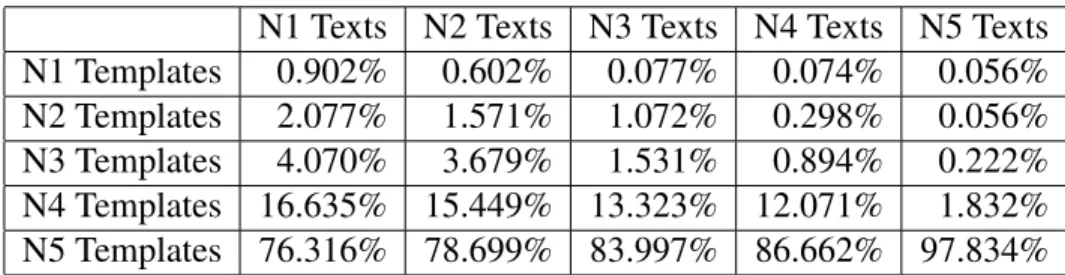
N1 Texts N2 Texts N3 Texts N4 Texts N5 Texts N1 Templates 0.902% 0.602% 0.077% 0.074% 0.056% N2 Templates 2.077% 1.571% 1.072% 0.298% 0.056% N3 Templates 4.070% 3.679% 1.531% 0.894% 0.222% N4 Templates 16.635% 15.449% 13.323% 12.071% 1.832% N5 Templates 76.316% 78.699% 83.997% 86.662% 97.834% Table 3.3: Distribution of grammatical templates of level N1(hard)-N5(easy)
3.1.2
Statistics of grammatical templates
Corpus
We build our corpus from two sources: past JLPT exams and textbooks. The reading texts from JLPT exams are ideal for difficulty evaluation experiments since all of them are tagged authoritatively with difficulty levels, and JLPT problem sets before 2010 are publicly released4. We also collected reading texts from two popular series of Japanese
textbooks: Standard Japanese[68] andGenki[8]. Standard Japanese I andGenki Iare designed for the N5 level (the first semester) andStandard Japanese II andGenki IIare designed for the N4 level (the second semester). Ultimately, our corpus consists of 220 texts (150 from past JLPT exams and 70 from textbooks), totaling 167,292 words after segmentation.
Results
For texts with different difficulties, we calculate the distribution of N1-N5 grammatical templates, which are shown in Table 3.3. We can see that N1 texts have higher portion of N1 and N2 templates than N2 texts, implying that the difficulty boosts from N2 to N1 are derived from increasing usage of advanced grammar. It is also clear that even in
N1 Texts N2 Texts N3 Texts N4 Texts N5 Texts N1 Templates 3.536 2.342 0.295 0.230 0.146 N2 Templates 8.141 6.110 4.130 0.922 0.146 N3 Templates 15.954 14.308 5.900 2.765 0.582 N4 Templates 65.214 60.081 51.327 37.327 4.803 N5 Templates 299.178 306.059 323.599 267.972 256.477 Table 3.4: Number of templates of level N1(hard)-N5(easy) per 100 sentences
the texts of advanced levels, the majority of the sentences are organized by elementary grammatical templates, and the advanced ones are only used occasionally for formality or preciseness.
We also calculate the per-100-sentence number of templates at each level, which are shown in Table 3.4. When comparing any two adjacent levels (e.g. N2 and N3), the templates at those levels or above seem to be the most significant. For instance, N1/N2 texts differ in numbers of N1 and N2 templates while they have similar numbers of N3-N5 templates, and the numbers of N1, N2 and N3 templates differentiate the N2/N3 texts while the numbers of N4 and N5 templates seem relatively similar. This phenomenon inspires us to build a simple and effective approach to differentiate the texts of two adjacent levels.
3.1.3
Difficulty level prediction
Multilevel linear classification
We differentiate two adjacent levels by looking at the knowledge ‘on the boundary’ and ‘outside the boundary’. Concretely, when judging whether a text is harder than levelNi,
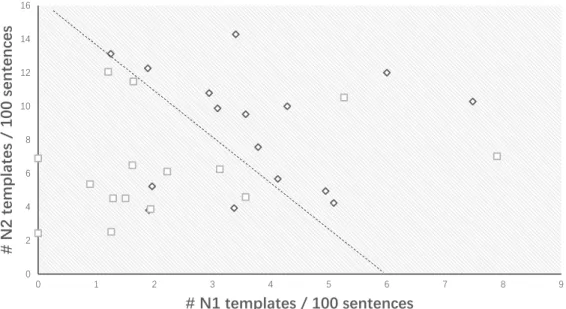
0 2 4 6 8 10 12 14 16 0 1 2 3 4 5 6 7 8 9 # N2 templates / 100 sentences # N1 templates / 100 sentences N1 texts N2 texts
Figure 3.1: Grammatical difficulty in the N1/N2 texts
• within the boundary, if the template is easier thanNi(Ni+1toN5);
• on the boundary, if the template is exactly at Nilevel;
• outside the boundary, if the template is harder thanNi(N1toNi−1).
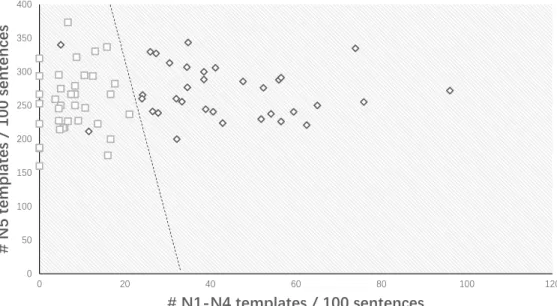
We found that texts of adjacent levels are nearly linear-separable with two features: templates ‘on the boundary’ and templates ‘outside the boundary’. For example, Figure 3.1 shows how N1 and N2 texts are linearly separated based on the numbers of N1 and N2 templates: we can easily obtain a two-dimensional linear classifier separating N1 and N2 texts with 83.4% accuracy. This phenomenon is even more obvious at lower levels. Figure 3.2 shows N4 and N5 texts are almost perfectly linearly separated with two fea-tures: ‘number of N5 templates per 100 sentences’ (on the boundary) and ‘number of N1-N4 templates per 100 sentences’ (outside the boundary).
Taking advantage of this phenomenon, we build 4 linear classifiers for 4 pairs of adjacent levels. For example, the N4 classifier judges whether a text is harder than
0 50 100 150 200 250 300 350 400 0 20 40 60 80 100 120 # N5 templates / 100 sentences # N1-N4 templates / 100 sentences N4 texts N5 texts
Figure 3.2: Grammatical difficulty in the N4/N5 texts
Text
>
N5?
N5
>
N4?
N4
>
N3?
N3
>
N2?
N2
N1
no
yes
no
yes
no
yes
no
yes
Figure 3.3: Multilevel Linear Classification (MLC). ‘>N5?’ represents the linear classifier judging whether a text is harder than N5. The classifiers are similar for the other levels.
N4 (N1-N3). Our Multilevel Linear Classification (MLC) algorithm combines all 4 linear classifiers: A text is judged by the N5 classifier first. If it is no harder than N5, it will be labeled as an N5 text; otherwise, it will be passed to the N4 classifier in order to decide if it is harder than N4. The process continues similarly, until if it is judged to be harder than N2, it will be labeled as an N1 text. Figure 3.3 shows how the algorithm works.
Features
We conduct our experiments on the following 4 feature sets:
First, ourgrammatical template feature sethas only 5 features:
• Average number of N1-N5 grammatical templates per sentence
We compare our work with recent readability evaluation studies [44, 70]. In our experiments, thebaseline readability feature setconsists of the following 12 features:
• Number of words in a text
• Number of sentences in a text
• Average number of words per sentence
• Average parse tree depths per sentence
• Average number of noun phrases per sentence
• Average number of verb phrases per sentence
• Average number of pronouns per sentence
• Average number of clauses per sentence
• Average cosine similarity between adjacent sentences
• Average word overlap between adjacent sentences
• Average word overlap over noun and pronoun only
• Article likelihood estimated by language model
Moreover, we combine these 12 traditional readability features with our 5 grammatical template features, forming a‘hybrid’ feature set, since we would like to see if grammat-ical template features are really able to improve text difficulty evaluation.
classifica-Feature Set (number of features) Algorithm Accuracy
TF-IDF Features (5100) kNN 69.1%
SVM 80.5%
Baseline Readability Features (12) kNN 72.3%
SVM 80.9%
Grammatical Template Features (5)
kNN 78.0%
SVM 81.1%
MLC 87.7%
Hybrid Features (17) kNN 85.7%
SVM 88.5%
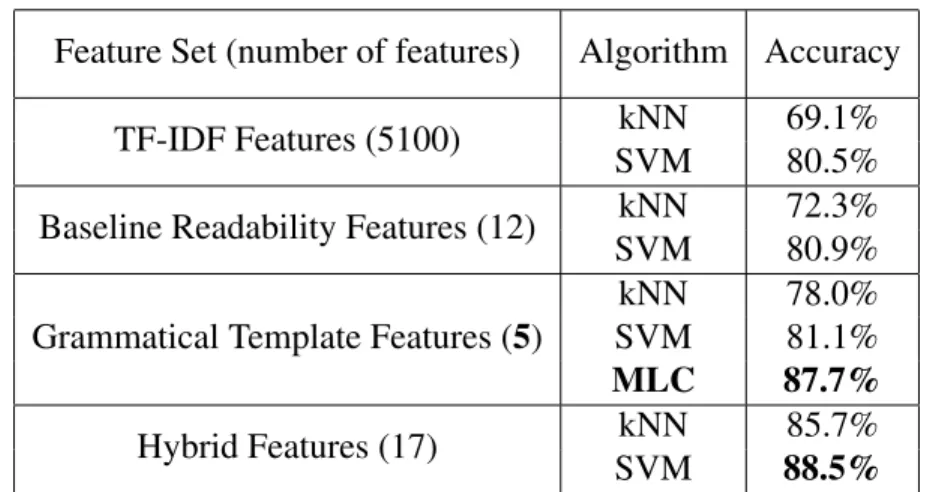
Table 3.5: Accuracies of classifying N1-N5 texts
tion problem, we also extractTF-IDF features[61, 86] as an extra baseline, in order to see how general text classification techniques work on text difficulty evaluation.
Result
We test k-Nearest Neighbor and Support Vector Machines for each feature set. The im-plementations of these two popular classification algorithms are provided by the WEKA toolkit [33] and LibSVM [15]. The SVMs use RBF kernels [16]. We also test our Mul-tilevel Linear Classification (MLC) algorithm on the grammatical template feature set. We use 5-fold cross validation to avoid overfitting. Table 3.5 shows the results.
Comparing the results of kNN and SVM across the four different feature sets in Ta-ble 3.5, it is clear that TF-IDF features have the largest feature set yet lowest accuracy, indicating the general word-based text classification techniques do not work well on text difficulty level prediction. Compared with baseline readability features, our gram-matical template features have smaller number of features but higher accuracy (slightly higher with SVM but significantly higher with kNN). Moreover, the hybrid features, which combine baseline readability features with grammatical template features,
deci-sively outperform baseline readability features, confirming our expectation that adding grammatical template features to existing readability techniques improves text difficulty evaluation for language learners.
Additionally, our Multilevel Linear Classification algorithm achieves excellent ac-curacy with only 5 grammatical template features. An acac-curacy of 87.7%, although slightly lower than hybrid features + SVM (more features, more complexity), still sig-nificantly outperforms baseline readability techniques. In conclusion, the Multilevel Linear Classification algorithm has high accuracy, a small number of features, and a simple, human-understandable structure.
3.2
Hierarchical knowledge structure
Given that grammatical knowledge can be decomposed into a set of grammatical tem-plates, this section will discuss how to build the hierarchical structure for grammar knowledge based on this decomposition.
3.2.1
Partial ordering graph
In order to select practice problems at an appropriate difficult level for each student, we need a hierarchical structure that encodes difficulty relationships between problems. One straightforward way to do this is to ask experts to specify these relationships. How-ever, this becomes prohibitively difficult as the size of the problem set grows larger. Ideally, we would have automatic methods of problem organization.
tasks. This work used procedural execution traces to organize content and partial or-derings over those traces to create hierarchical content structures. For example, one can identify at least four basic skills that may be required to solve an integer addition problem: one-digit addition without a carry (A), one-digit addition with a carry (B), writing a carry (C), and bringing down a final carry (D). As an example, problems can be decomposed into basic skills as in Table 3.6:
Problem
2+3
15+18
93+15
298+865
Trace
A
ACB
AACD
ACBCBD
Table 3.6: Traces of Integer Addition Problems
However, in some domains, such as language learning, the target knowledge cannot easily be modeled as a single procedure. To induce hierarchical knowledge structures in such domains, we need to generalize beyond procedural domains. To do this, our frame-work takes advantage ofcompositionality, the idea that problems can be broken down into smaller conceptual units. This is well-studied in some semi-procedural domains such as math and language learning [4, 97].
For instance, a Japanese sentence can be decomposed intogrammatical templates, units of grammar that expert language instructors and linguists have identified as the most important grammatical knowledge, and that students actually study in language lessons. These templates have proved to be beneficial for text difficulty evaluation for language learners (section 3.1, [97]). We found that the specific task of grammatically understanding a Japanese sentence can be decomposed into a (multi)set of grammatical templates. For example, Table 3.7 shows three Japanese sentences and their grammatical templates.
We can see that S1 has only one grammatical template: (– の). For a Japanese learner, S2 is harder than S1 since it has not only (– の), but also another template (–