An Emotion and Memory Model for Social
Robots: A Long-term Interaction
by
Muneeb Imtiaz Ahmad
A dissertation submitted in partial fulfillment of the requirements for the
degree of Doctor of Philosophy (Human-Robot Interaction) at the MARCS Institute
in Western Sydney University 2018
Doctoral Committee:
Dr Omar Mubin - Senior Lecture, School of Computing, Western Sydney University Dr Joanne Orlando - Senior Lecture, School of Education, Western Sydney University
Special thanks to all the beautiful children who participated in my studies during the past few years.
keywords: Adaptive Social Robot, Children Robot Interaction, Educational Robots, Social Engagement, Personalisation
c
Muneeb Imtiaz Ahmad 2019
STATEMENT OF ORIGINALITY
It is to hereby declare that the work presented in this thesis has not been previously submitted towards the fulfillment of any degree to any educational institute. To the best of Knowledge and belief, this thesis does not contain material written by another person except where due references are made.
This work is dedicated to my father Dr. Imtiaz Ahmad and my mother Naila Imtiaz without whom i would not have been able to fulfill my dreams.
ACKNOWLEDGEMENTS
It’s a commencement of a long journey when you ride on to the road of your PhD study. Consequently, It was no different for me. As I begin to write the acknowl-edgement section of my dissertation, I continue to recall all the wonderful people who made it possible for me to finish my PhD.
I would first thank my supervisor Dr Omar Mubin for his continuous and generous support throughout my PhD Candidature. Thank you for accepting my ideas and enabling me to implement them. Dr Mubin has played an instrumental role through-out my candidature and helped me understand the true value of academic life. I cannot recollect the number of occurrences he has helped me in both personal and professional capacities beginning from my first day in Australia until today. In par-ticular, thank you for providing an opportunity to lecture on the Human-Computer Interaction and Advanced Topics in User-System Interaction. I need to confess that it has helped me immensely to broaden my knowledge and clear my understanding of the Subjects. Additionally, it also helped me gain most valuable teaching experience. Moreover, thank you for also encouraging me to take part in a variety of research projects outside of my PhD research. It aided me in improving and enhancing my research skills and abilities.
I would also like to thank Dr Suleman Shahid for motivating me to continue my career in Academia. It was him who convinced me to leave Germany and move to Australia to continue my PhD. It would not be incorrect to highlight that he has been a constant source of advice and encouragement throughout my academic life.
Thank you for your continuous support beginning from providing guidance during my bachelor, master as well as PhD thesis in Pakistan, Germany and Australia. I guess we must have created a record in terms of working together while residing in entirely different parts of the world. Once again, Thank you, Suleman (Bhai), for everything. In the future, I wish to collaborate with you from another destination of the world.
I would also like to thank Dr Joanne Orlando for helping me and providing me guidance during my PhD. In particular, many thanks for helping me understand the field of education and educational technologies. I highly appreciate your guidance with conducting the qualitative data analysis during my candidature.
A bundle of thanks goes to the girls (Mona, Sarah, Valeria, and Nhung) at the MARCS Institute. I have really enjoyed our late evening conversations on a number of things, especially on the Friday Evenings. Special thanks for organising my surprise birthday and my CoC completion celebrations at the MARCS Institute. Many thanks to Yassine Frej, my roommate at the MARCS Institute for helping me with a number of things. To say the least, I highly appreciate and acknowledge your help in finding a nice place for myself and my wife. I would most certainly cherish the time spent with everyone at the MARCS Institute.
Special Thanks to Michele Balogh-Caristo from the St Margaret Mary’s School for helping me and also convincing the school authorities to allow me to conduct my studies at the school. A bundle of thanks to all the teachers, children who participated in my studies. All of you are my rock stars. Your willingness to provide feedback helped me complete my thesis.
I cannot stop thanking my beautiful sisters, Ghazia Ahmad and Mehreen Zeeshan and my brother in Law Zeeshan Junaid due to countless reasons. In particular, all of you have given me a peace of mind because all of you are there with our parents to take care of them. You guys have also fulfilled my part of responsibilities towards them. Thank you guys for enabling me to follow my dreams without worrying about
my lovely parents.
This thesis acknowledgement cannot be complete without thanking my beautiful wife, Sunbul Muneeb Ahmad. Special thank goes to my wife for her consistent support during my PhD candidature. Most importantly, I appreciate you for letting me enter the house once it was over 7 PM every day and also later feeding me with delicious dinner. Thank you Sunbul for your love, help and support and with our little baby boy on the way, you have filled my life with countless joy and happiness.
In the end, Shukar Alhamdulillah (Thanks to Allah Jee) for giving me the ability to achieve this accord and recognition in my life.
TABLE OF CONTENTS
DEDICATION . . . iii
ACKNOWLEDGEMENTS . . . iv
LIST OF FIGURES . . . xi
LIST OF TABLES . . . xiii
LIST OF APPENDICES . . . xv
LIST OF ABBREVIATIONS . . . xvi
ABSTRACT . . . xvii CHAPTER I. Introduction . . . 1 1.1 Motivation . . . 2 1.2 Research Goals . . . 4 1.3 Expected Contributions . . . 6 1.4 Outline . . . 8
II. A Systematic Review of Adaptivity in Human-Robot Inter-action. . . 11
2.1 Introduction . . . 11
2.2 Methodology . . . 14
2.2.1 Inclusion and Exclusion Criteria . . . 14
2.2.2 Coding Scheme . . . 15
2.3 State of the Art Social Adaptive Robots . . . 15
2.3.1 Health care and therapy domain. . . 15
2.3.2 Education . . . 24
2.3.3 Work Environments and Public Spaces . . . 34
2.4 Adaptivity in Virtual Agents . . . 53
2.5 Summary and Conclusion . . . 55
III. Understanding behaviours and roles for social and adaptive robots in education: Teacher’s and Children’s views . . . 56
3.1 Introduction . . . 57
3.2 Method - Study with Teachers . . . 59
3.2.1 Participant . . . 59
3.2.2 Procedure . . . 59
3.2.3 Setup and Materials . . . 61
3.2.4 Data Analysis . . . 63
3.3 Method - Study with Children . . . 63
3.3.1 Participants . . . 64
3.3.2 Procedure . . . 64
3.3.3 Interaction Scenario . . . 65
3.3.4 Setup and Materials . . . 66
3.4 Results . . . 67
3.4.1 Teacher’s View . . . 67
3.4.2 Children’s View . . . 74
3.5 Discussion . . . 78
3.6 Conclusions and Limitations . . . 82
IV. Understanding the Effect of Different User-based Adapta-tion; A Long-term Study. . . 84
4.1 Introduction . . . 84
4.2 Background . . . 88
4.2.1 Measuring Engagement . . . 88
4.2.2 Long-term Children-Robot Interaction . . . 89
4.3 Study . . . 91
4.3.1 System Description . . . 92
4.3.2 Interaction Scenarios . . . 98
4.3.3 Setup and Materials . . . 100
4.3.4 Participants . . . 101 4.3.5 Procedure . . . 102 4.4 Video Analysis . . . 103 4.4.1 Gaze: . . . 104 4.4.2 Facial Expressions: . . . 104 4.4.3 Verbal Response: . . . 105 4.4.4 Gesture: . . . 105
4.5 Video Analysis Results . . . 106
4.5.1 Introduction-Greetings . . . 106
4.5.2 Game-play . . . 107
4.5.4 Complete Session . . . 115
4.6 Qualitative Results . . . 116
4.7 Discussion . . . 122
4.8 Limitations . . . 126
4.9 Conclusions . . . 127
V. Emotion and Memory Model - Long-term User based Evalu-ation . . . 128
5.1 Introduction . . . 128
5.2 Background . . . 133
5.2.1 Significance of interaction and play in Education . . 133
5.2.2 Role of Emotions in Memory . . . 133
5.2.3 Adaptive Social Robots in Education . . . 134
5.2.4 Memory Systems In Human-Robot Interaction . . . 136
5.3 Emotion and Memory Model . . . 139
5.3.1 Inputs and Pre-Conditions . . . 142
5.3.2 Emotional Event Calculation . . . 142
5.3.3 Memory Mechanism Generation . . . 144
5.3.4 Behaviour Selection Unit . . . 144
5.4 Research Method . . . 145
5.4.1 System Description . . . 147
5.4.2 Interaction Scenario . . . 152
5.4.3 Setup and Materials . . . 155
5.4.4 Participants . . . 155
5.4.5 Procedure . . . 156
5.4.6 Measurements . . . 158
5.5 Results . . . 160
5.5.1 Emotion and Memory Model Results . . . 160
5.5.2 Effects of Robot’s Emotional Feedback . . . 163
5.6 General Discussion . . . 167
5.6.1 Discussion on Emotion and Memory Model Results 167 5.6.2 Discussion on Effects of Emotional Feedback Results 171 5.7 Conclusion . . . 172
5.8 Limitations . . . 173
VI. Automating the behaviour selection for the Emotion and Memory Model. . . 175 6.1 Introduction . . . 175 6.2 Research Method . . . 178 6.2.1 System Description . . . 179 6.2.2 Study . . . 186 6.3 Results . . . 188
6.3.2 Vocabulary Learning During Game Phase . . . 190
6.3.3 Vocabulary Learning During Post-test . . . 191
6.4 Discussion . . . 191
6.5 Conclusion . . . 193
6.6 Limitations . . . 194
VII. Emotion and Memory Model to Promote Mathematics Learn-ing - An Exploratory Long-term Study . . . 195
7.1 Research Method . . . 195
7.1.1 System Description . . . 196
7.1.2 Study . . . 200
7.2 Results . . . 204
7.2.1 Social Engagement Results . . . 205
7.2.2 Maths Learning Results . . . 205
7.3 Discussion . . . 206
7.4 Conclusion and Future Work . . . 208
VIII. Conclusions . . . 210
8.1 Theoretical Refection of the Results . . . 213
8.2 Guidelines for Designing Adaptations in Future Robots . . . . 215
8.2.1 Open Challenges and Future Work . . . 218
8.3 Selected Publications . . . 222
APPENDICES . . . 224
LIST OF FIGURES
Figure
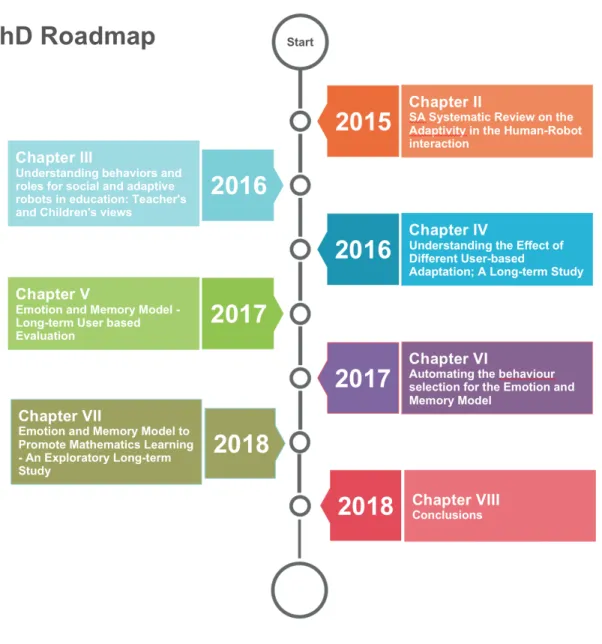
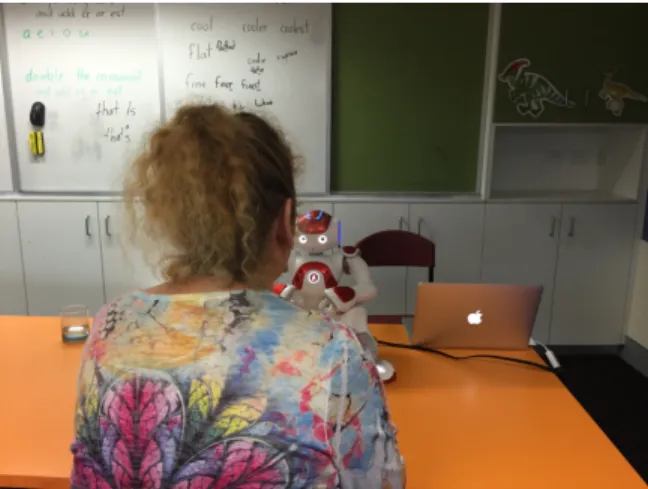
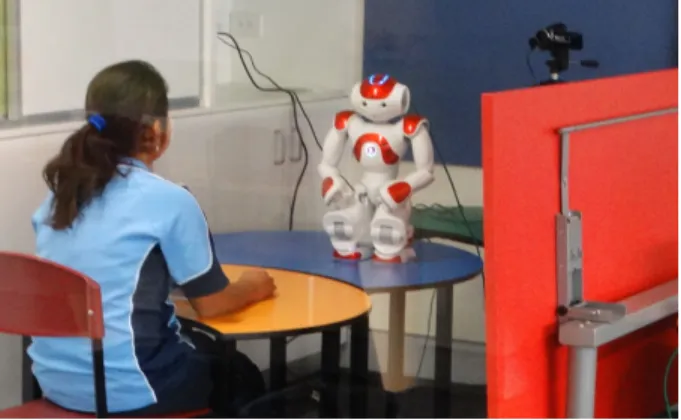
1.1 Thesis Road-map . . . 10 3.1 Setup: A teacher interacting with NAO. . . 61 3.2 Setup: A child interacting with NAO (left) and the focus group
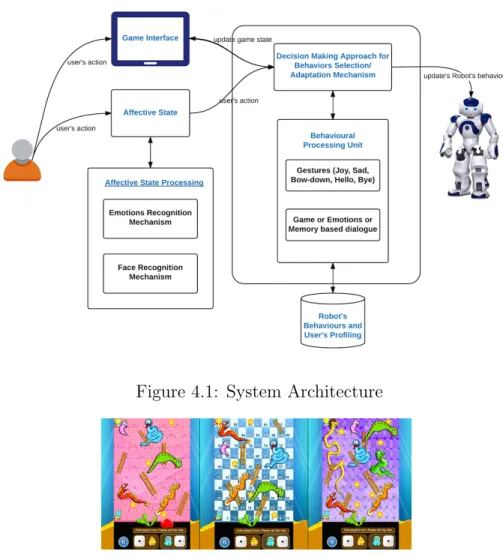
(right). . . 67 4.1 System Architecture . . . 94 4.2 Snakes and Ladders game . . . 94 4.3 Setup: A Child playing snakes and ladders with NAO (front view)
-Permission has been taken to use the picture with child’s face. . . . 100 4.4 Setup: A Child playing snakes and ladders with NAO (back view) . 100 4.5 Different types of smiles - Permission has been taken to use the
pic-ture with child’s face. . . 104 4.6 Means and 95 % confidence interval for facial expressions frequencies
during introduction-greeting interval. . . 107 4.7 Means and 95 % confidence interval for facial expressions durations
(msec) during introduction-greeting interval. . . 108 4.8 Means and 95 % confidence interval for gaze frequencies during
game-play interval. . . 109 4.9 Means and 95 % confidence interval for facial expression frequencies
during game-play interval. . . 109 4.10 Means and 95 % confidence interval for verbal response frequencies
during game-play interval. . . 110 4.11 Means and 95 % confidence interval for gestures frequencies during
game-play interval. . . 110 4.12 Means and 95 % confidence interval for facial expression duration
(msec) during game-play interval. . . 111 4.13 Means and 95 % confidence interval for verbal response duration
(msec) during game-play interval. . . 111 4.14 Means and 95 % confidence interval for facial expression frequencies
during end-greetings interval. . . 112 4.15 Means and 95 % confidence interval for verbal response frequencies
4.16 Means and 95 % confidence interval for gaze durations(msec)during
end-greetings interval. . . 114
4.17 Means and 95 % confidence interval for facial expression durations (msec) during end-greetings interval. . . 114
4.18 Means and 95 % confidence interval for verbal response durations (msec) during end-greetings interval. . . 115
4.19 Means and 95 % confidence interval for gaze frequencies during com-plete session. . . 116
4.20 Means and 95 % confidence interval for facial expression frequencies during complete session. . . 117
4.21 Means and 95 % confidence interval for verbal response frequencies during complete session. . . 117
4.22 Means and 95 % confidence interval for gesture frequencies during complete session. . . 118
4.23 Means and 95 % confidence interval for gaze durations(msec)during complete session. . . 118
4.24 Means and 95 % confidence interval for facial expression durations (msec) during complete session. . . 119
4.25 Means and 95 % confidence interval for verbal response durations (msec) during complete session. . . 119
4.26 Means and 95 % confidence interval for gesture durations (msec) during complete session. . . 120
5.1 Formation and Retrieval of Emotional Memories; Image taken from (LeDoux, 2007) . . . 140
5.2 Emotion and Memory model . . . 145
5.3 Snakes and Ladders . . . 147
5.4 Different words from ROILA appearing on the screen. . . 148
5.5 A Wizard of OZ to control NAO’s Speech Recognition. . . 154
5.6 Setup (Left); A Child playing snakes and ladders with NAO (Right). 156 5.7 A Word ”Jabami” is asked and four options are displayed on the screen. . . 158
6.1 Emotion and Memory model (Behaviour Selection Unit Updated). 181 6.2 A Child playing snakes and ladders with NAO. . . 187
7.1 Maths Test . . . 198
7.2 Children participating in the lesson before the interaction with the robot. . . 203
LIST OF TABLES
Table
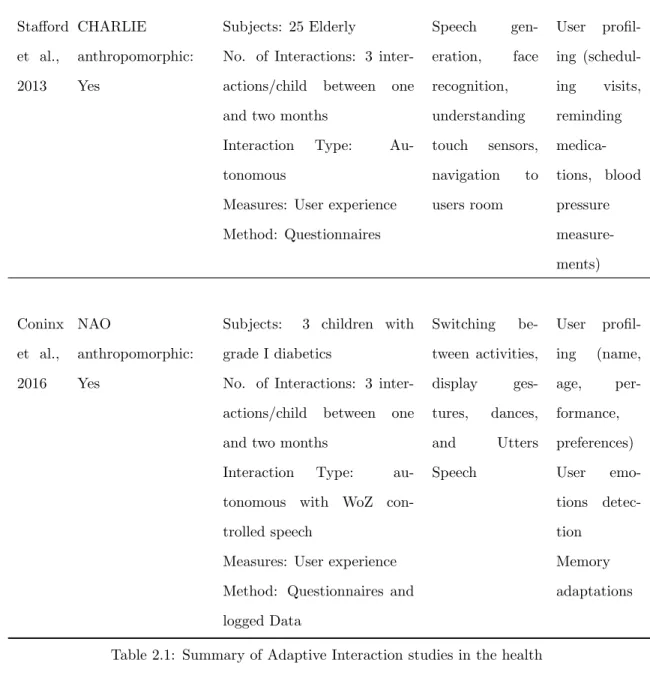
2.1 Summary of Adaptive Interaction studies in the health care and
ther-apy domain. . . 22
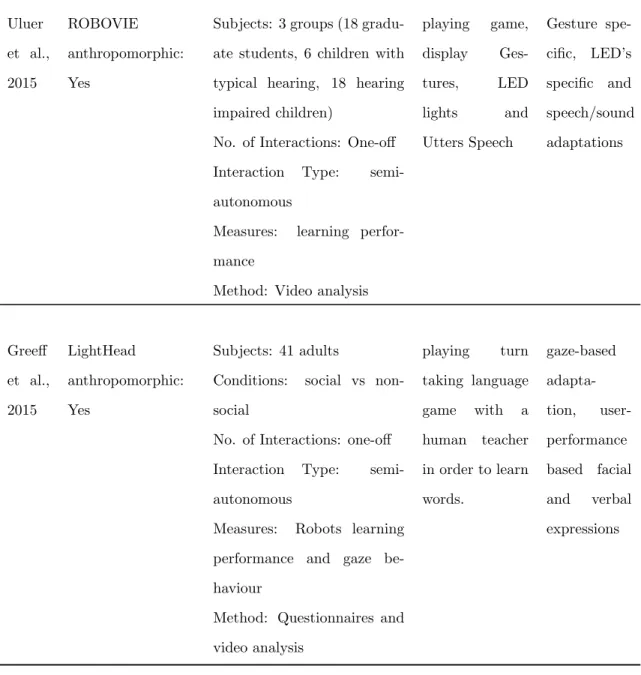
2.2 Summary of Adaptive Interaction studies in Education domain. . . 32
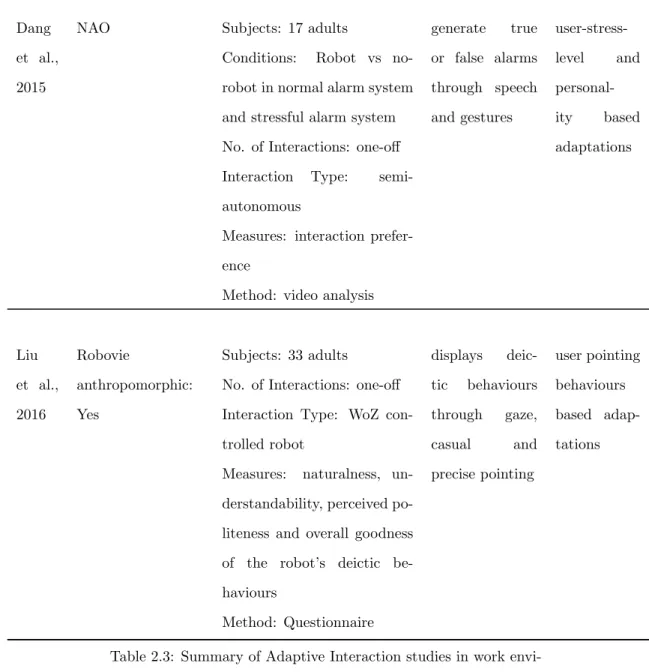
2.3 Summary of Adaptive Interaction studies in work environment and public spaces. . . 46
2.4 Summary of Adaptive Interaction studies in Home. . . 51
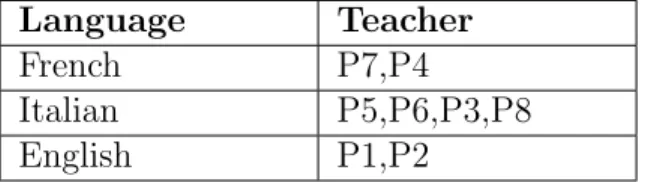
3.1 Teachers and Corresponding Languages . . . 68
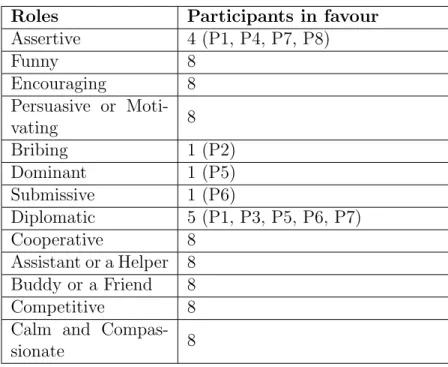
3.2 Roles for a Robot in Language Learning . . . 73
4.1 Interview Questionnaires . . . 101
4.2 Participant’s average age and gender per adaptation type . . . 102
4.3 Coding Scheme used to measure social engagement . . . 105
5.1 General rule for the type of Information stored during positive and negative Emotional Situations; taken from (Levine 2004). . . 141
5.2 Taxonomy for the exemplar Robot’s Behaviour during Game sessions based on Emotion and Memory Model . . . 151
5.3 Taxonomy for the exemplar Robot’s Behaviour during Post-test ses-sions based on Emotion and Memory Model . . . 153
5.4 Coding Scheme used to measure social engagement (Ahmad et al., 2017). . . 160
5.5 Mean and Standard Deviation for the duration of eye-gaze, facial expressions, verbal responses and gestures across first, second, third and fourth sessions for each type of robot’s emotional feedback. . . 165
5.6 Mean and Standard Deviation for the retention of words during Ses-sion 1 words across second, third and fourth sesSes-sions. . . 166
5.7 Mean and Standard Deviation for the retention of words during Ses-sion 2 words across third and fourth sesSes-sions. . . 167
5.8 Mean and Standard Deviation for the retention of words during Ses-sion 3 words across the fourth sesSes-sions. . . 167
6.1 Results trends for Eye-gaze, facial expressions, verbal responses and gestures during Chapter V and VI studies . . . 193
7.1 Taxonomy for the exemplar Robot’s Behaviour during maths-test based on Emotion and Memory Model . . . 199
7.2 Duration of the session during the mathematics test . . . 202 7.3 Mean and Standard Deviation for the children’s eye gazes facing robot
during first, second, and third sessions (in percentage). . . 205 7.4 Mean and Standard Deviation for the children’s learning performance
during first, second, and third sessions (the scores are out of 10). . . 206 A.1 Frequency and duration Results of the effect of session during
introduction-greetings and game-play on the DVs . . . 226 A.2 Frequency and duration results of the effect of session * adaptation
type during introduction-greetings and game-play on the DVs . . . 227 A.3 Frequency and duration results of the effect of adaptation type during
introduction-greetings and game-play on the DVs . . . 228 A.4 Frequency and duration Results of the effect of session during
end-greetings and complete-session on the DVs . . . 229 A.5 Frequency and duration results of the effect of session * adaptation
type during end-greetings and complete-session on the DVs . . . 229 A.6 Frequency and duration results of the effect of adaptation type during
end-greetings and complete-session on the DVs . . . 230 B.1 Words from ROILA Language Omar Mubin (2015). . . 232
LIST OF APPENDICES
Appendix
1 Exp3 Algorithm to select behaviours183
A. Tables for the p-values of the Frequencies and Duration Results of Chap-ter IV . . . 225
B. List of ROILA Words . . . 231
LIST OF ABBREVIATIONS
HCI - Human-Computer Interaction cHCI - Children-Computer Interaction HRI - Human-Robot Interaction cHRI - Children-Robot Interaction ADSOR - Adaptive Social Robot AUI - Adaptive User Interface WoZ - Wizard of Oz
SAR - Socially Assistive Robots SR - Social Robotics
AVA - Adaptive Virtual Agent H - Hypothesis
RQ - Research Question RL - Reinforcement Learning
GIFT - Generalized Intelligent Framework for Tutoring API - Application Programmable Interface
ABSTRACT
An Emotion and Memory Model for Social Robots: A Long-term Interaction by
Muneeb Imtiaz Ahmad
Supervisor(s): Omar Mubin and Joanne Orlando
In this thesis, we investigate the role of emotions and memory in social robotic companions. In particular, our aim is to study the effect of an emotion and memory model towards sustaining engagement and promoting learning in a long-term inter-action. Our Emotion and Memory model was based on how humans create memory under various emotional events/states. The model enabled the robot to create a mem-ory account of user’s emotional events during a long-term child-robot interaction. The robot later adapted its behaviour through employing the developed memory in the following interactions with the users. The model also had an autonomous decision-making mechanism based on reinforcement learning to select behaviour according to the user preference measured through user’s engagement and learning during the task. The model was implemented on the NAO robot in two different educational setups. Firstly, to promote user’s vocabulary learning and secondly, to inform how to calculate area and perimeter of regular and irregular shapes. We also conducted multiple long-term evaluations of our model with children at the primary schools to verify its impact on their social engagement and learning. Our results showed that the behaviour
generated based on our model was able to sustain social engagement. Additionally, it also helped children to improve their learning. Overall, the results highlighted the benefits of incorporating memory during child-Robot Interaction for extended periods of time. It promoted personalisation and reflected towards creating a child-robot social relationship in a long-term interaction.
CHAPTER I
Introduction
The use of social robots is becoming more widespread in our everyday lives and our encounters with them in different domain areas (education, industry, telecommu-nication) are increasing.
A social robot can be defined as an embodied semi autonomous entity capable of performing social interaction after perceiving information from the given environment (Nwana, 1996; Outtagarts, 2009). A social robot may have some of the following capabilities: understanding and displaying emotions, communication with high-level dialogue, learn/adapt according to user responses, establishing a social relationship, react according to different social situations and have varying social characteristics and roles (Dautenhahn, 2014).
It is a common finding in the field of Human-Robot Interaction (HRI) that robots possessing social skills result in establishing human-robot social relationships. Several studies performed in the past showed that robots with social capabilities, including displaying gestures, emotions, and turn-taking were preferred over the robot without having such socio-emotional capabilities (Heerink et al., 2007, 2010). For example, in one study, it has been shown that that humans developed the social association with Roomba, an autonomous vacuum cleaner robot, by calling it with a name or sometimes talking to it (Forlizzi,2007). In addition, many research studies conducted
with robots that possessed human-like adaptation capabilities have also reported in a range of positive findings of the long-term effective integration of robots in various social settings such as education, and health (M. Ahmad, Mubin, & Orlando,2017b). Furthermore, the use of emotions is an integral part of a social interaction and robots are supposed to make the user believe that they are capable of caring about its environment (Bates et al.,1994) as well as involving the user in engaging interactions (Bartneck, 2003).
1.1
Motivation
The applications of the social robots possessing afore-mentioned capabilities across various social domains are growing. It has been observed that in the recent past, most research with social robots has been performed in the following areas: social robots capable of helping aged-adults at homes (Matari´c, 2014), creating robots as social companions (Beer et al.,2017), and utilisation of robots in education (Mubin, Stevens, Shahid, Al Mahmud, & Dong,2013;M. Ahmad, Mubin, & Orlando,2017b). One rapidly growing category of application is found in learning or educational settings. Robots have been previously utilised as tools to facilitate basic program-ming skills and computer engineering concepts learning (Williams,2003;Kay & Moss,
2012), gymnastics (G¨orer et al.,2013), music (Gifford et al.,2011) and other relevant educational fields (Tanaka & Kimura, 2009; Fagin & Merkle, 2002). Most recently, researchers are interested in implementing an intelligent or autonomous robot takes different facilitation roles to engage with children or adults. Many researchers have conducted studies with robots possessing different social capabilities in the educa-tional settings or learning environment where users indulged with the robots in vari-ous interactions over time (Kanda et al.,2004;Komatsubara et al.,2014). One of the common findings of these studies were the loss of interest towards interacting with the robot due to the loss of novelty effect. The conjectured reasons for this loss of
interest were due to robot’s repetitive behaviour and non-flexible design.
Mubin et al. (2013) has identified four different research challenges in the domain of educational robots. One of the challenges is building an adaptive, reactive and proactive pedagogical social robot that is capable of effectively adapting itself based on the user actions in a working (educational) scenario. The need for designing such a social robot has been highlighted by various researchers across different social domains (Matari´c, 2014; Dautenhahn, 2014; Wuttke, 2014). Additionally, the significance of designing an interface that can adapt based on the user actions can be witnessed in the field of Human-Computer Interaction (HCI) (WU, 2010; J. Liu, Wong, & Hui,
2003). It has been conjectured that the design of such a social robot may be able to mitigate the problem of the loss in user interest due to the loss of the novelty effect (Kanda et al., 2004).
The design of such an adaptation mechanism for the social robot can be based on various categories of user actions during a Human-Robot interaction. It can be based on the user’s emotion, personality, or on the history of previous user actions in a certain situation. Leite et al. (2013) reported a survey on the social robots for long-term interactions and highlighted the use of adaptation based on memory and emotions. They conjectured that such adaptations will lead to personalisation and this will be helpful to address the problem of the loss of interest during HRI for an extended period of time and will also promote engagement and learning during educational interactions. The survey also reflected on the limited research on the use of social robots that can be employed in education domain for repeated interactions in schools. Similarly, They highlighted the need of incrementally implementing novel behaviours in social robots. In general, the mechanism for a machine (a robot, agent, computing device) to adapt based on different user characteristics and then apply it in a real-setting is one of the major challenges in the field of HRI and HCI (Tapus et al.,2007b).
1.2
Research Goals
In this thesis, we propose to implement and evaluate a mechanism for a social robot to perform various adaptations based on the user’s memory and emotions. We intend to investigate the effect of these adaptations on the user’s social engagement and learning performance during long-term learning or educational HRI. We expect that robots adapting based on the user’s emotions and memory will result in creating a social relationship with humans and this will result in sustaining social engagement during long-term interactions. Additionally, we also reflect on the positive effect of the level of student’s engagement on their learning as widely reported in the edu-cation literature (Carini et al., 2006). We therefore believe that a robot performing aforementioned adaptations will result in promoting learning of the individuals.
Our aim is to implement a computational model for social robots that enables them to perform adaptation based on the users memory and emotions. We later want to study the effect of such a model towards sustaining user social engagement and promoting learning during a long-term interaction. To achieve our aims, we expect to find answers to the following research questions (RQs):
• RQ1 - What are the views of teachers and children on the effect of a social robot adapting its behaviour based on their emotions, memory or personality during a educational interaction? [Chapter III]
• RQ2 - Should social robot’s behaviour adaptation based on user emotions or memory result in sustaining user’s (children) social engagement in a long-term interaction? [Chapter IV]
• RQ3 -Does users (children) prefer a social robot adapting its behaviour based on user emotions over a robot adapting its behaviour on the user memory in terms of social engagement during long-term interactions? [Chapter IV]
• RQ4 - Does a robot creating memories of user’s emotional situations effect their social engagement and learning during long-term interaction? [Chapter V]
• RQ5 - How does the positive, negative and neutral behaviour or role of the social robot impacts the learning performance during a long-term interaction? [Chapter V]
• RQ6 - Does the process of the selection of the robot’s behaviour effect the social engagement and learning during long-term interaction? [Chapter VI]
• RQ7 -Whether the proposed model/selection/robot behaviour can apply across different learning context? [Chapter VII]
To address the research questions, we began the study that is the focus of this thesis, by conducting user-studies with teachers and children to understand their perspective on the social robot performing various adaptations. We also conducted a long-term study with children to observe the effect of the robot adapting its behaviour based on the user’s emotions and memory of the previous interaction on children’s engagement. Based on our findings, we devised a model for a social robot that enabled the social robot to create the memory of different emotional events during a long-term interaction. We later used this memory to create an adaptive dialogue for the robot. The use of memory to inform adaptations has been under-studied in the field of HRI and social robotics. In addition, the effects of such an adaptive social robot on the learning outcomes of individuals during an educational setting in a long-term interaction has also been under-studied (Leite et al., 2013). Moreover, it has been also conjectured that the future of the social HRI lies in the past (Baxter, 2016). Therefore, in this thesis, we attempted to create a mechanism for the robot to create the memory of the user’s emotional events and later used it to inform user-specific memory based adaptation. We evaluated the model during a long-term interaction
to validate its effect on the social engagement and learning of the individuals. The robot was evaluated in schools with children aged between 9-10 years. To evaluate the model, we first implemented the model on the social robot in two different ed-ucational scenario where it was enabled to play the updated version of the Snakes and Ladders game and complete a mathematics challenge with children. The snakes and ladders game was modified to promote children’s vocabulary learning whereas the mathematics challenge was designed to learn to calculate area and perimeter of different shapes in a playful manner.
1.3
Expected Contributions
In this thesis, we expect to make the following contributions in the area of HRI and social robotics through addressing the aforementioned research questions:
Contribution 1: Researchers have emphasized the implementation of the mech-anism for the robots based on memory and emotions however, there is limited un-derstanding of the comparison on how these different adaptations by the social robot may effect the social engagement of the children in a long-term interaction scenario (M. Ahmad, Mubin, & Orlando, 2017b). Our first contribution addressing RQ2 and RQ3 lies in studying the effect of a Social Robot capable of adapting its behaviour based on the memory and emotions of the user on maintaining children long-term engagement. To the best of our knowledge, research that focuses on understanding the impact of different adaptations on the social engagement during long-term cHRI is not available and is needed.
Contribution 2: The need for a computational model for the social robot that enables it to perform adaptations based on the user emotions and memory is high-lighted in the literature (Beer et al.,2017). Our secondcontribution addressing RQ4 lies in the creation of a computational model for the social robot. This model directed the robot to create a memory of the information stored by users under different
emo-tional states and later also enabled it to generate dialogue through combining both verbal and nonverbal behaviours based on the memory during a long-term interaction. We also evaluated our model to study the effects of this dialogue towards sustaining the children-robot social engagement and promoting vocabulary learning during a long-term interaction.
Contribution 3: Our computational model enables the robot to provide feed-back (positive, negative, and neutral) through combining the memory of emotional events during an educational scenario. We also understand the significance of provid-ing feedback on learnprovid-ing outcome durprovid-ing an education scenario as it can have positive effect on student’s learning (Butler & Winne, 1995). In addition, we also find dif-ferent claims with respect to the effect of emotions on human memory. A body of research shows that emotions enhance human memory in tone, while another claims that emotions enhance central information at the cost of peripheral details (Levine & Pizarro,2004). Moreover, the impact of robot’s feedback during an educational long-term interaction has been under-studied. Considering these claims on the relationship between emotions and memory and the relationship between memory and learning, we believe, it is intriguing to analyse about the impact of robot’s emotional feed-back on the human’s memory. Consequently, our third contribution addressing RQ5 lies in studying the effect of the positive (emphatic, encouraging), negative (critical, competitive) and neutral emotional feedback of the robot on children’s vocabulary learning during long-term interactions.
Contribution 4: Our findings highlighted the need for robotic tutoring systems where the robot takes a balanced yet positive role and appreciate children’s learning efforts. In addition, we also found some evidence of the benefits of using negative feed-back such as displaying sadness during feedfeed-back results in improved learning (Butler & Winne, 1995;M. Ahmad, Mubin, Shahid, & Orlando, 2017). Based on these find-ings, we used a reinforcement learning mechanism for the social robot to select an
appropriate role (positive, negative and neutral) for each child based on their level of social engagement and learning performance during the interaction as a part of our model’s behaviour selection mechanism. To study the effect of this learning mech-anism towards maintaining children’s social engagement and promoting children’s learning performance, we conducted two long-term evaluation studies towards pro-moting language learning and mathematics learning. In both studies, we compared our findings with the scenario where no learning mechanism was implemented on the robot. The purpose of conducting two different long-term studies was to highlight the scalability of our model across different education scenarios. Therefore, the final
contribution of our work addressing RQ6 and RQ7 lies in understanding that if the process of the selection of the robot’s behaviour effects the social engagement and learning during long-term interaction. Another aspect of our final contribution lies in evaluating our model in the educational scenario that was based off a real life curriculum in a real setting.
1.4
Outline
In the following chapters, we define adaptivity and report on the systematic review on the adaptivity in the Human-Robot interaction [Chapter II]. We also report our findings on the teachers and children’s perspective on different adaptations portrayed by the social robots in the domain of education [Chapter III]. In [Chapter IV], we compare our findings on the effect of emotion and memory adaptations by the robot on children’s level of social engagement during a long-term interaction [Chapter IV]. Based on the findings, we created our emotion and memory model for the social robot that enables the robot to create memory of the past user’s emotional events. We also report the results of the effect of our model towards sustaining social engagement and promoting children vocabulary learning during a long-term interaction [Chapter V]. Based on the initial positive findings of our model, we refine the desicion making
process of our model. We present a reinforcement learning mechanism for the social robot to select one of the three feedback behaviours (positive, negative and neutral) based on the learning outcome and social engagement of the user. We also present the evaluation results of our refined model during a long-term interaction [Chapter VI]. In [Chapter VII], we also present results of another exploratory long-term evaluation of our Emotion and Memory model during a mathematics learning task in the wild to further show the value of our model. Lastly, we conclude our results, their implications in the field of social HRI and social robotics [Chapter VIII]. The outline can also be seen in figure 1.1.
CHAPTER II
A Systematic Review of Adaptivity in
Human-Robot Interaction
This chapter 1 presents a survey on adaptive interactions displayed by differ-ent robots reported in the literature. We have limited the scope of our survey on autonomous or semi-autonomous social robots displaying various adaptive character-istics. Additionally, they have also been involved in various field trials and user-based studies conducted in both controlled and real-world settings. Furthermore, we dont consider industrial robots as part of our sampling strategy. Lastly, we also discuss literature on how has adaptivity been used in non-HRI contexts, in particular with Virtual agents.
2.1
Introduction
An Adaptive User Interface (AUI) can be defined as an agent that monitors user interactions, analyses the interactions to determine usage patterns, stores these pat-terns, and based on these patpat-terns, presents a personalised interface to the user (WU,
2010).
1This Chapter has been published as a journal article - Ahmad, M., Mubin, O. and Orlando, J.,
2017. A systematic review of adaptivity in human-robot interaction. Multimodal Technologies and Interaction, 1(3), p.14.
The need for implementing an AUI has also been widely emphasised in the Human-Computer Interaction (HCI) literature (Fischer, 2001). To understand the definition of an AUI in the context of social robotics, it is important to distinguish between an autonomous robot and an adaptive robot. A robot can be categorised as autonomous based on its level of automation such as manually controlled with human-intervention, artificially intelligent or fully autonomous as presented by (Endsley, 1999). A fully autonomous robot however can be defined as a robot that can perform the action without human intervention. An Adaptive Social Robots (AdSoR) is an autonomous or semi-autonomous robot, where speech may or may not be controlled by a human operator through a Wizard of Oz (WoZ), capable of making decisions through per-ceiving the user information from the given environment. The user information may include their profile, emotions, personality and past interactions (Beer et al., 2014).
Despite an immense amount of emphasis on the need of AdSoRs (Fong et al.,
2003), it still remains one of the open issues to implement such robots due to various technical challenges such as mapping of user’s emotions and user’s personality and keeping track memory of previous interactions in a real-time environment (Tapus et al., 2007a). To overcome these challenges, research is currently utilising various techniques and tools to simulate and portray adaptivity in various social domains. These social domains includes education (Benitti,2012), public places (Shiomi et al.,
2013), domestic and work environments, health care and therapy (Robinson et al.,
2014).
We also find a number of research studies that have been conducted on under-standing how a user interacts with a robot, or the effect of a robot’s social behaviour (Saerbeck et al., 2010), role (Bruce et al., 2002), anthropomorphism, animacy, like-ability, perceived intelligence and perceived safety on user’s perception Bartneck et al.(2009) in various settings. The applications of robots in various social domains are an evolving phenomenon (Fortunati et al., 2015) and recent research has resulted in
positive findings. But, the majority of these interactions are mainly one-off interac-tions. We witness a handful of applications where their integration is in a long-term or longitudinal setup. Researchers foresee these adaptive robotic interface more applica-ble for long-term interaction with humans in various social settings (Mubin, Stevens, Shahid, Al Mahmud, & Dong, 2013; Leite, Martinho, & Paiva, 2013). We, unfortu-nately, also find lesser research on the implementation of AdSoRs that can be utilised in real life settings.
Our research aims are to design, implement and evaluate a mechanism for an AdSoR in a real life setting to challenge the issue of saturation during HRI. We be-lieve that an adaptive robot will help towards overcoming the problem of maintaining long-term social engagement and establishing a social relationship with humans ( Ko-matsubara, Shiomi, Kanda, Ishiguro, & Hagita,2014;Jimenez, Yoshikawa, Furuhashi, & Kanoh, 2015). Therefore, in order to understand the field of adaptive robots and what can be considered an adaptive feature or interaction, we took on the task of con-ducting a systematic review on various types of robots adaptive interactions research in the field of HRI. We as a community find a range of studies where robots have been used in various interactions for various purposes, however; we are unsure what can be classified as adaptive behaviour in robots. Although, previously, researchers have reported systematic reviews on the applicability of robots in education (Mubin, Stevens, Shahid, Al Mahmud, & Dong, 2013; Benitti,2012), long-term utilisation of robots work environments and public places (Leite et al., 2013), domestic settings (Leite et al., 2013), and healthcare (Robinson et al., 2014). But, unfortunately, to the best of our knowledge, we do not find a review based on adaptive interactions in HRI.
2.2
Methodology
We conducted an in-depth literature review on the applications of social robots reported in past research in the following manner. Firstly, we performed an elec-tronic search on the digital platforms such as Google Scholar and Microsoft Academic Scholar. Secondly, we manually searched archives of the top journals and premium conferences in Human-Robot Interaction and Social Robotics as ranked by the Google scholar (Scholar, 2017) from the year 2006 to 2015. We searched keywords that in-cluded ’Adaptive social robots’, ’Autonomous Robots’, ’Adaptation and Robot’, ’Ap-plications of Adaptive Robots’ and ’Adaptive Robotics Systems’. The search was limited from the year 2005 to the year 2015. Our search resulted in retrieval of arti-cles from a number of venues such as the International Conference on Human-Robot Interaction, and social robotics, International Conference on Humanoid Robots, and Ro-Man. We also found articles published in the international Journal of Human-Robot Interaction and International Journal of Social Human-Robotics. The rationale for choosing Google Scholar was due to the finding that the coverage and reach provided by Google Scholar was more extensive than other similar academic repositories (Meho & Yang,2007).
2.2.1 Inclusion and Exclusion Criteria
Our criteria for selecting a research article was based on the definition of an adaptive robot as discussed in the introduction section. We did not include articles reported on robots that did not possess user specific adaptation capabilities (Fong et al., 2003) in our review. We read the paper to understand the robot’s capabilities before excluding it. We also ignored articles that did not incorporate a user study or a field trial. In addition, we did not review studies that reported qualitative assessments only. Lastly, we did not review research on industrial and commercial robots. After applying all these criteria, we found 37 articles that are reported in this survey.
2.2.2 Coding Scheme
We followed the organisation as reported by Leite et al. to review all of these research papers. We divided the papers based on their social application domain. We are reporting four different domains: 1) Healthcare and Therapy, 2) Education, 3) Public domains and work environments, and 4) homes. Another rationale for choosing these four domains was based on their popularity and usage (Beer et al., 2017). We also find an overlap for some reported articles on adaptive social robots in the case of health care and in-home social domains. For instance, a case where a robot has been used with elderly for assistance at home or at a therapy centre. In such a case, we selected the domain where the study was conducted.
We reviewed articles on robots being applied in various domains on the basis of following criteria. The criteria involved looking for the adaptation features (context, emotion, personality, or memory) and the capabilities (displaying gesture and gestures or communicating through dialogue) of the robot. We present our discussion on the existing adaptive strategies and types of robots used in the research along with a summary of the studies conducted with these robots.
2.3
State of the Art Social Adaptive Robots
In this section, we present the state of the art on the way adaptation is imple-mented in HRI, organized by application domains.
2.3.1 Health care and therapy domain.
Socially Assistive Robots (SARs) is a commonly used term as introduced byTapus et al.in the field of HRI and SR. It revolves around all types of robots that can be used to assist people with special needs. In the last decade, we find a number of applications of SARs where they have used with children suffering from autism (Miyamoto et al.,
2005), and elderly with Alzheimer’s and dementia (Huschilt & Clune, 2012). We are here, particularly interested in reviewing such applications where these SAR’s have been designed with a user-specific adaptation mechanism. In this section, we present our results on the existing user studies on these robots where they displaying various adaptive capabilities.
Fran¸cois et al.(2008) presented a conceptual model for a robot capable of adapting its behaviour based on the detected playing styles of an autistic individual in real-time. The interactions with a robot were classified into two classes: gentle and strong depending on the amount of force with which a participant touches the robot. An experimental study was conducted with 5 children to assess the effectiveness of the in-teraction styles through checking the criteria of both gentle and strong touches. They also measured the number of interactions correctly recognised by an Aibo robot. Ex-periments performed with the conceptual model showed that the Aibo robot was able to classify the interaction in the real-time. It was also able to adapt to the interaction through changing its own behaviour and therefore, also changing the interaction with the user.
Tapus et al. (2008) and colleagues designed a socially assistive adaptive robot capable of engaging post-stroke users in rehabilitation exercises. A behaviour adap-tation system was designed for the ActiveMedia Pioneer 2-DX mobile robot that enabled it to select a behaviour after taking information about user’s personality and sensory data. The sensory data involved user detection, navigation and speech recog-nition. The robot detected speech from the microphone and human user movement was captured through the use of a motion capture device. An experimental study was later conducted with 12 adults to test the system. It was one of the first experimental studies that showed that personality adaptation by a social robot can have a positive effect towards improving user’s task performance.
Robins et al. (2008) and colleagues tested the temporal behaviour-matching hy-pothesis, which predicts that a child will adapt and match robots behaviour during children robot interaction. They used the KASPER robot controlled by Wizard of Oz to play Drumming Call and Response and Gesture Imitation games with 18 children. During both game playing sessions, they measured the effect of the robots response to child’s behaviour through controlling the timings and gestures on an interaction of the child with a robot. Results supported the temporal behaviour-matching hypothesis during HRI. As the child adapted according to the robots behaviour in both tested conditions. The conditions included introducing timing delays between a childs and a robots turn taking activity, and when robot displayed various non-verbal behaviours.
Tapus (2009) proposed an adaptive SAR that was able to provide assistance to people suffering from Alzheimers disease. A novel adaptation mechanism that enabled the robot to maximise user’s task performance on a cognitive task was presented. The robot was capable of praising or motivating the user based on the user performance that included user reaction time and a total number of correct answers. It was also able to adapt its dialogue based on the updates in the game difficulty levels. A within-subject experimental study was conducted with 9 participants for 6 months in which each participant played the Song Discovery or Name That Tune game in the presence of the Torso robot and a music therapist. The results of the study showed that the adaptation mechanism based on the task performance was successful as the participants recognised the songs with the same probability in both conditions. In addition, a robot was also able to encourage task performance and attention training.
Boccanfuso & OKane (2011) contributed a low-cost social robot, CHARLIE, ca-pable of playing turn-taking imitation game and was also able to also perform face and hand tracking after adapting to a childs non-verbal actions during game play. The authors trained hand and face classifiers through collecting data from children aged 4 to 11. A proof of concept experiment was also performed to check the face
and hand tracking during the gameplay. Results showed that hand detector averaged 86% and face detector averaged 92% across all sessions and users.
McColl & Nejat (2013) programmed Brian robot to autonomously provide feed-back on user’s meal eating behaviours. The robot was capable of selecting an appro-priate behaviour based on the following sensory inputs. These inputs include meal tray, utensil tracking, and user state. Meal tray and utensil tracking provided infor-mation about meal consumption and position or movement of the utensil on the tray. The user state performed user recognition. Based on these inputs, the robot adapted its dialogue according to user meal consumption or other aforementioned inputs. An experimental study was later conducted with eight individuals to investigate user en-gagement during meal time. The results showed that participants enjoyed interacting with the robot during the meal.
Wainer et al. (2014) and colleagues programmed an autonomous KASPER robot capable of playing the video game with children diagnosed with autism. KASPER-bot was capable of sensing based on the events within the game, planning on different responses based on the sensory data, and acting through gesture, facial expressions, and speech. The authors conducted an evaluation with six autistic children in order to measure children enjoyment and collaboration during the human child and robot-child game-play. Results showed that robot-children were happily willing to play the game with the robot. However, they enjoyed and collaborated more when playing with the human. The authors conjectured that the results might have been influenced due to the novelty factor.
R. Q. Stafford et al. (2014) programmed an autonomous Charlie robot capable of responding to touch, recognising faces, generate speech, and navigating from one room to another in order to manage the health care of elderly people. An adaptation mechanism was implemented that enabled the robot to adapt according to the user profile. The robot scheduled visits, reminded about medications, and also measured
blood pressure. The authors conducted a technology acceptance based study with 25 elderly people. Results showed that participant reacted positively towards the use of an assistive robot.
Coninx et al.(2016) and colleagues presented an adaptive robot capable of switch-ing between multiple activities durswitch-ing a sswitch-ingle interaction. The adaptive NAO played turn-taking quiz, creative dance and collaborative sorting games on a tablet with the child. Three children diagnosed with grade I diabetes participated in the user-based evaluation. The objective of the evaluation was to access the effect of an adap-tive NAO towards richer and more personalised user experience and potential conse-quences of such an interaction on childrens self-management skills. Results showed children employed the activity switching mechanism actively to customise their in-teraction with a robot. However, due to limited no of subjects, quantitative findings can be regarded as of preliminary nature.
Ref. Robot Study Design Robot
Capa-bilities Adaptive Features Francois et al., 2008 Aibo Anthro: Yes
Subjects: 5 autistic children No. of Interactions: 1 Interaction Type: au-tonomous
Measures: interaction style recognition
Method: video analysis
provides feed-back after detecting the interaction style user-interaction style based dialogue adaptation
Tapus et al., 2008 ActiveMedia Pio-neer 2-DX mobile robot anthropomorphic: No Subjects: 19 adults
No. of Interactions: One-off Interaction Type: au-tonomous
Conditions: (robot vs. Hu-man)
Measures: task performance Method: Video analysis
updates di-alogue, and human user movement User’s task performance-based adap-tations Robins et al., 2008 KASPER anthropomorphic: Yes Subjects: 18 children No. of Interactions: one-off Interaction Type: WoZ con-trolled robot
Measures: 1) Duration of the turn taking pause between a child and robot during both games. 2) Child imitating re-actions duration.
Method: video analysis
plays the game and display ges-tures and facial expressions. game-based adaptations Tapus et al., 2009 Torso anthropomorphic: Yes Subjects: 9 adults
No. of Interactions: once every week for six months Interaction Type: au-tonomous
Conditions: (robot vs. Hu-man)
Measures: task performance Method: Video analysis
Display Ges-tures, Facial expressions, and Utters Speech User’s personality-based adap-tations
Boccanfuso et al., 2011 CHARLIE anthropomorphic: Yes
Subjects: 3 children with grade I diabetics
No. of Interactions: one-off Interaction Type: au-tonomous
Measures: Speed and accu-racy of robot’s hand and face detection abilities
Method: Video analysis
playing an imi-tation game and perform face tracking
Detecting faces and im-itating hand movements McColl et al., 2013 Brian anthropomorphic: Yes
Subjects: 8 elderly people No. of Interactions: One-off Interaction Type: au-tonomous
Measures: user engagement Method: Questionnaires
updates
di-alogue and
gesture based on the users eat-ing behaviour Dialogue and gesture-based adap-tations Wainer et al., 2013 KASPER anthropomorphic: Yes
Subjects: 6 autistic children No. of Interactions: One-off Interaction Type: au-tonomous
Conditions: (robot vs. Hu-man)
Measures: Enjoyment, col-laboration
Method: Video analysis
Display Ges-tures, Facial expressions, and Utters Speech Game event-based adap-tations
Stafford et al., 2013 CHARLIE anthropomorphic: Yes Subjects: 25 Elderly
No. of Interactions: 3 inter-actions/child between one and two months
Interaction Type: Au-tonomous
Measures: User experience Method: Questionnaires Speech gen-eration, face recognition, understanding touch sensors, navigation to users room User profil-ing (schedul-ing visits, reminding medica-tions, blood pressure measure-ments) Coninx et al., 2016 NAO anthropomorphic: Yes
Subjects: 3 children with grade I diabetics
No. of Interactions: 3 inter-actions/child between one and two months
Interaction Type: au-tonomous with WoZ con-trolled speech
Measures: User experience Method: Questionnaires and logged Data Switching be-tween activities, display ges-tures, dances, and Utters Speech User profil-ing (name, age, per-formance, preferences) User emo-tions detec-tion Memory adaptations
Table 2.1: Summary of Adaptive Interaction studies in the health care and therapy domain.
2.3.1.1 Discussion
All of the reported studies as shown in Table 2.1 resulted in positive results based on their measures such as technology acceptance, user experience, social engagement and task performance. However, it is evident that the diverse user groups from children to adults to elderly in all of these studies points towards more research with these robots to consolidate these results because the effect of age and gender on users
attitudes has been highlighted in the past research (Kuo et al., 2009). In addition, limited users have been used in all of these studies. The reasons for the limited number of users is understandable as it is may be difficult to find participants with special needs. Still, we see that adaptive robotic interactions have yielded results that point towards implementing more interactions of this kind such as user profiling (R. Q. Stafford et al., 2014), user emotions (Coninx et al., 2016) and personality (Tapus, 2009).
Another important aspect is that all of these studies except one have used anthro-pomorphic robots to implement adaptive interactions for this domain. This aspect might be related to the type of adaptation presented in these articles. As most of these adaptations revolve around user’s game or task performance, gestures and personality, therefore, we conjecture that anthropomorphic robots might have been considered as the best possible choice for such adaptations due to their social dimen-sions. In addition, such robots have full capabilities to interact with human users in a holistic way. All of these adaptations have had a positive effect on user’s per-ception however, it is yet to find that how these adaptations will respond when they are tested with a larger number of users and during long-term interactions, once the novelty factor wears off. We must also acknowledge that high levels of humanlike appearance can create expectations on behalf of the user that remain unfulfilled. A review of healthcare robots (Broadbent et al., 2009) asserts that the embodiment of an assistive robot is a delicate issue. The review also suggested that a humanoid-like appearance may not necessarily be the most appropriate one for health care robots as in one of the past studies, participants preferred a robot without a face (Cesta et al.,2007). Conversely, there is also a relationship between the embodiment of a robot and its adaptive behaviour as the humanoid embodiment could drive more human-like behaviours in the robots.
Robins, & Amirabdollahian,2014;Boccanfuso & OKane,2011; Robins, Dautenhahn, Te Boekhorst, & Nehaniv, 2008) have utilised video analysis to measure user experi-ence during the interaction. However, we need to consider a general scheme for coding such interactions so that future studies may be compared with each other. The nature of these empirical studies was such that due to the lower number of participants, a control group (such as interaction with humans or proxies) was not used to compare interaction with the robot.
The significance of sensory data used by the robot to adapt is another important issue. The sensory user data capturing mechanism used in the afore-listed studies has been taken from the robot’s built-in cameras or cameras located somewhere inside the experimental setup. The data has been mainly used to calculate 1) user emotions, 2) facial recognition, and 3) hand movements. We understand that in case of user emotions, researchers need to focus on the loss of data during interaction. The data loss could occur due to user’s moving head during the interaction. Similarly, the data to understand user personality has been taken from the pre-questionnaires conducted before the user study. However, research needs to be focused on more dynamic ways on collecting information of such kind. One of the ways could be enabling the robot to ask questions and perceive their personality traits.
2.3.2 Education
Educational robots have been utilised successfully as a tool to teach programming in schools in the developed world (Williams, 2003). In the future, researchers have envisioned robots to be not just used as a tool to make students understand certain concepts, but help teachers in different ways (Mubin et al.,2013). The usage of robots who will help teachers perform repetitive tasks such as replying to repetitive questions and also act in various social roles (friend, buddy, companion) in an educational setting is a growing phenomenon. In this section, we are interested in reviewing
existing AdSoRs that have been utilised in education.
Salter et al. (2007) conducted a trail using Roball, a spherical mobile toy robot, capable of recognising sensory data patterns and later adapting to individuals be-haviour patterns during the interaction. The robot was initially programmed to display two behaviours: wandering, and obstacle avoidance. Two different studies were conducted at the laboratory without children before taking Roball in a real life setting. Following the first two studies, three adaptive behaviours were added to the robot and later were tested in a real time environment with children. Results showed that human interaction perceived through proprioceptive sensor has the ability to inform behavioural adaption. However, in order to devise well-informed adaptive robotic systems, we need to consider several other adaption strategies.
Gonzalez-Pacheco et al. (2011) presented an autonomous Maggie robot that was programmed to play different games (Peekaboo, Guessing the character, Hangman, Tic tac toe, and Animal Quiz) with children in order to promote edutainment. Maggie robot constitutes Voice System (ASR, TTS), Vision System (Object Identification), Radio Frequency Identification (RFID), Touch Sensors, built-in tablet screens along with interactions via smart phones, and engagement gestures. The robot was capable of adapting its interaction based on the game scenarios presented to it. A series of experiments were conducted where children participated and played various games such as Peekaboo, Guessing a Character, Tic-tac-toe, Hangman, and Animal Quiz with the Maggie robot. Preliminary findings show that children got more involved and comfortable with the robot as it displayed more interaction capabilities.
J. B. Janssen et al. (2011) presented a study in which children played an adaptive game to learn arithmetic with the NAO robot. The robot was capable of adapting its behaviour based on the mistakes performed by the user during the game. It was a between-subject study design in which NAO was able to change its behaviour in two different conditions. In condition 1, when the user made a mistake, the game
complexity was maintained while in condition 2, the game complexity was reduced. Children played the game for three times with the robot and their intrinsic motivation was measured. Results showed that in condition 2, participants showed the higher level of motivation.
Szafir & Mutlu (2012) presented a design of an adaptive robot that was capa-ble of monitoring and improving user involvement during the interaction. The robot acted as an educational assistant using eye gazing, head nodding and gestures as its behavioural features. The agent voice control was also used to gain attention during the interaction. The task of the robot was to narrate the story to the user. The robot capable of adapting based on the user engagement levels and the information about the engagement level was taken from the EEG device. A between subject evaluation study was performed with 30 participants, where three groups, each consisting of 10 participants interacted with a robot capable of reacting in one of the three different ways: 1) low immediacy, 2) random immediacy and 3) adaptive behaviour. These behaviours were calculated based on engagement level of the users. Results showed that the use of adaptive agent was able to significantly improve attention and perfor-mance in a narrative task. In addition, they also found the gender difference in terms of motivation during the interaction with the adaptive version of the robot. Females motivation was significantly higher than of males.
K¨uhnlenz et al. (2013) developed an adaption mechanism in which an EDDIE robot adapts according to users mood and then portrays a similar emotional state. The adaption mechanism involves two different ways of expressing an emotion: implic-itly, or explicitly. In explicit scenario, the robot asks the user questions and responds me too, whereas in implicit, the robot generate facial or verbal emotions based on the mood of user measured through questionnaire before the interaction. A 5-step (pre-questionnaire, social sub-dialog, bonding game, picture labelling and post ques-tionnaires) experimental evaluation was conducted later with 84 participants where a
robot displayed emotional adaption in four different conditions (Full Emotion Adap-tion (FEA), Implicit AdapAdap-tion (IEA), Explicit AdapAdap-tion (EEA) or no adapAdap-tion) to measure helpfulness. Results showed that participants ranked FEA highest followed by EEA, IEA and no adaption in order.
Brown et al. (2013) conducted a study with the DARWIN robot that was able to adapt its behaviour during a mathematics test conducted on the tablet device. The robot was capable of adapting both verbal (positive and supportive feedback) and non-verbal (gestures) behaviours during the interaction based on user game per-formance. A total of 24 students participated during the study to test whether the use of an adaptive educational robot can increase test performance through perform-ing aforementioned adaptations. Results showed that the test completion time was recorded lesser in the case where robot provided supportive feedback, gestures as compared to the no robot interacting with the user during the study.
Ros et al.(2014) implemented a mechanism for the NAO robot that enabled it to adapt according to children dance moves in a long-term interaction study. The NAO robot was capable of updating both of its verbal and non-verbal behaviour based on the current and previous user-state during the interaction. The user-state involved the history of user’s dance movement, its profile (ID, name, age, gender) and also current body configuration. The authors conduct a long-term study that involved 18 sessions with 12 children in which the robot taught different dance movements to the children. Results reported a high level of engagement during the interaction and also emphasised on the need of implementing new ways of adaptations to impact the long-term social engagement.
Leite et al. (2014) addressed the problem of sustaining engagement long-term interaction during children robot interaction. She presented an emphatic model for an iCAT social robot capable of understanding and sharing the feelings of the user and later evaluated the model during a chess game. The iCAT robot was capable
of emphasising with the children through providing positive reinforcements in terms of facial expressions and dialogue. They conducted an experimental study with 16 children who played the Chess game with iCAT for five times during five weeks. Results showed that iCAT was able to sustain engagement throughout all five sessions.
Uluer et al. (2015) presented a semi-autonomous Robovie-3 (R3) tutor capable of teaching Turkish sign language. R3 was controlled through WoZ while the vi-sion module was functioning autonomously to recognise different signs. The authors conducted an evaluation across three groups (18 graduate students, 6 children with typical hearing, 18 hearing impaired children) to measure robots recognition ability and its effect on users learning performance. The recognition rates for each sign showed by Robovie were consistent (higher than 90%) for all the three groups. In addition, robots has a positive influence on users performances through all groups.
de Greeff & Belpaeme(2015) presented a human teacher and robot social learning scenario in which a robot learns different words by playing a word meaning associa-tion game on a surface table. The human teachers begin with choosing the topic and uttering a word, in response, the robot finds the category that strongly associates with the uttered word and communicates the information back to the teacher. The teacher in response provides feedback and the robot adjusts category of the word accordingly. Robots social learning was evaluated through a user study in which 41 subjects participated and played the role of a human teacher and robot displayed two different conditions. In the social condition, the robot showed non-verbal social behaviours (fixating gaze) to inform about learning preference and followed the script whereas in a non-social condition the robot only followed a script. The purpose of the study was to measure robot’s learning performance, participant’s choice of topic to teach, participant’s gaze behaviour and overall user experience. Robot showed better learning performance in a social condition. The gender difference was observed for robots learning performance for both social and non-social conditions. Male
partic-ipants didnt differ in terms of learning performance in both conditions while female participants were more engaged in the social condition.
Ref. Robot Study Design Robot
Capa-bilities Adaptive Features Salter et al., 2007 ROBALL anthropomorphic: No Subjects: 12 children No. of Interactions: one-off Interaction Type: Au-tonomous
Measures: Accelerometers, Tilt sensors.
Method: video analysis
moving and avoiding ab-stavles user-playing patterns based adap-tation Janssen et al,. 2011 NAO anthropomorphic: Yes Subjects: 20 children Conditions: between-subject (Personalized vs Group level versions)
No. of Interactions: 3 Interaction Type: semi-autonomous Measures: motivation Method: Questionnaires generate context-aware dialogue during game. game-event-based adap-tation
Szafir et al., 2012
Virtual Agent Subjects: 30 children - 10 per group
Conditions: between-subject (low immediacy vs random immediacy vs adaptive be-haviours )
No. of Interactions: one-off Interaction Type: Au-tonomous
Measures: user attention and task performance
Method: Questionnaires
updates dia-logue, controls voice and dis-plays gestures. user- interaction-engagement based adap-tation Kuehnlenz et al., 2013 EDDIE anthropomorphic: Yes Subjects: 84 adults
Condition: Full Emotion Adaption vs Implicit Adap-tion, Explicit Adaption vs or no adaption
No. of Interactions: one-off Interaction Type: au-tonomous
Measures: robot’s helpfulness Method: Questionnaires displays emo-tional verbal and facial expressions emotion-based adap-tations
Brown et al., 2013 DARWIN anthropomorphic: Yes Subjects: 24 children Conditions: between-subject (verbally interactive robot vs non-verbally interactive robot vs verbally and non-verbally interactive robot vs no-robot)
No. of Interactions: one-off Interaction Type: semi-autonomous
Measures: user engagement Method: Questionnaires displayed sup-portive dia-logue, gestures during the game. game-event-based adap-tation Ros et al., 2014 NAO anthropomorphic: Yes Subjects: 12 children No. of Interactions: 18 Interaction Type: Au-tonomous
Measures: social engagement Method: video analysis, Questionnaires updates both verbal (text-to-speech) and non-verbal (LED’s, head, poses, and dance moves) user-profiling, memory based adap-tation Liete et al., 2014 iCAT anthropomorphic: Yes Subjects: 16 children No. of Interactions: 5 Interaction Type: Au-tonomous
Measures: engagement, per-ceived support and social co-presence Method: Questionnaires Emphatic di-alogue, facial expressions user profil-ing (name, perfor-mance), user emotions-based Adap-tation