Mobile Multimodal Serious Games Analytics
Shoukry, Laila(2020)
DOI (TUprints): https://doi.org/10.25534/tuprints-00013539 Lizenz:
CC-BY 4.0 International - Creative Commons, Attribution Publikationstyp: Ph.D. Thesis
Fachbereich: 18 Department of Electrical Engineering and Information Technology Quelle des Originals: https://tuprints.ulb.tu-darmstadt.de/13539
Mobile Multimodal Serious Games Analytics
The Impact of Using Mobile Multimodal Data on Serious Games Evaluation
Vom Fachbereich
Elektrotechnik und Informationstechnik
der Technischen Universität Darmstadt
zur Erlangung des Grades eines
Doktor-Ingenieurs (Dr.-Ing.)
Dissertation
von Laila Shoukry, M.Sc.
Geboren am 23. Januar 1986 in Kairo, Ägypten
Referent: Prof. Dr.-Ing. Ralf Steinmetz
Referent: PD Dr.-Ing. Stefan Göbel
Referentin: Prof. Dr. Regina Bruder
Darmstadt, 2020
Hochschulkennziffer D17
Mobile Multimodal Serious Games Analytics
The Impact of Using Mobile Multimodal Data on Serious Games Evaluation Vorgelegte Dissertation von Laila Shoukry, M.Sc.
Referent: Prof. Dr.-Ing. Ralf Steinmetz Referent: PD Dr.-Ing. Stefan Göbel Referentin: Prof. Dr. Regina Bruder Tag der Einreichung: 17. September 2019 Tag der Disputation: 18. Dezember 2019 Darmstadt, Technische Universität Darmstadt
Bitte zitieren Sie dieses Dokument als: URN: urn:nbn:de:tuda-tuprints-135399
URL: http://tuprints.ulb.tu-darmstadt.de/13539 Dieses Dokument wird bereitgestellt von tuprints, E-Publishing-Service der TU Darmstadt
http://tuprints.ulb.tu-darmstadt.de [email protected]
Die Veröffentlichung steht unter folgender Creative Commons Lizenz: CC BY 4.0 International
Erklärung zur Dissertation
Hiermit versichere ich, die vorliegende Dissertation ohne Hilfe Dritter nur mit den
an-gegebenen Quellen und Hilfsmitteln angefertigt zu haben. Alle Stellen, die aus Quellen
entnommen wurden, sind als solche kenntlich gemacht. Diese Arbeit hat in gleicher oder
ähnlicher Form noch keiner Prüfungsbehörde vorgelegen.
Darmstadt, den 7. September 2019
Zusammenfassung
Lernspiele sind eine bekannte Art von Serious Games, die für Bildungszwecke entwickelt werden. Ein Ziel bei der Bewertung ihres Nutzens besteht darin, sicherzustellen, dass sie diese Lernzwecke erfüllen. Geeignete Bewertungsmaße werden in Forschungsbereichen wie Learning Analytics und Technology En-hanced Learning definiert. Im Gegensatz zu anderen Lernmethoden ist das Erreichen von Lernzielen jedoch nicht das einzige Erfolgsmaß für Serious Games. Vielmehr sollen Serious Games wie auch Unter-haltungsspiele Spaß machen und die Anwender motivieren. Dieses Thema wird in Forschungsbereichen wie Game User Research und Game Analytics adressiert.
In dieser Arbeit wird untersucht, wie die Nutzung neuer Datenerfassungsmöglichkeiten durch Smart-phones der Forschung auf dem Gebiet der Evaluierung von Serious Games zugute kommen kann. Unauffällige, integrierte Sensoren werden zur Beobachtung von Benutzerinteraktionen in natürlichen Kontexten verwendet. Dies kann dazu beitragen, ein Serious Game aus mehreren Perspektiven und mit tieferen Einsichten zu bewerten. Angesichts des Fehlens theoretischer Rahmenbedingungen für diesen Forschungsbereich werden in dieser Arbeit Grundlagen für die Erfassung und Verwendung von Daten aus verschiedenen Modalitäten für die Bewertung von Serious Games gelegt.
Zunächst wird ein Modell erstellt, das die verschiedenen Bewertungsaspekte von einem Serious Game
und deren Zusammenhänge beschreibt. Basierend auf einer Studie von verfügbaren theoretischen
Frameworks werden die vier Dimensionen Lernen, Spielen, Usability und Kontext klassifiziert. Zusät-zlich werden mögliche Parameter definiert, die sich auf diese Dimensionen beziehen und während der Auswertung beobachtet werden können. Diese werden insbesondere benötigt, wenn herkömmliche Pro-tokollierungstechniken nicht ausreichen und zusätzliche Datenmodalitäten von Smartphone-Sensoren
erforderlich sind. Basierend auf einer Anforderungsanalyse wird eine multimodale
Evaluierungs-plattform für Serious Games, die eine mobile Datenerfassung unterstützt, als Proof of Concept imple-mentiert. Herausforderungen bei der multimodalen Synchronisation, der Verknüpfung quantitativer und qualitativer Daten sowie der Qualität von Daten, die in mobilen Umgebungen aufgenommen werden, werden diskutiert. Mögliche Lösungen werden bereitgestellt. Schließlich werden Studien durchgeführt, in denen diese Plattform bewertet und zur Evaluation von Lernspielen verwendet wird, um das Potenzial solcher Techniken für die Evaluation von Serious Games aufzuzeigen.
Abstract
Educational games are one prominent type of Serious Games that are designed for educational purposes. One goal of evaluating their benefits is ensuring that they meet these objectives. Some measures for this purpose are defined in fields like Learning Analytics and Technology-enhanced Learning. However, unlike other educational methods, meeting learning goals is not the only success measure of Serious Games. Contrary, complex requirements arise from their nature as games which are discussed in fields like Game User Research and Game Analytics and need to be considered.
This thesis investigates how the use of new data collection opportunities enabled by smartphones as an interaction platform can benefit research in the field of Serious Games evaluation. Unobtrusive inte-grated sensors are used for observing user interactions in natural contexts. This can be vital for capturing factors that can help evaluate a Serious Game from multiple perspectives and with deeper insights. With the lack of theoretical frameworks covering this area of research, a need for establishing foundations regarding the capturing and use of data from different modalities for Serious Games evaluation was found.
First, a model describing the different evaluation aspects of Serious Games and their relations is laid down. Based on a study of available frameworks, it classifies the four dimensions learning, gaming, using and context. Additionally, sets of feature states related to these dimensions, observable during evaluation, are defined. These are needed to examine aspects when traditional logging techniques are insufficient, and when additional data modalities from smartphone sensors are required. Based on a requirement analysis, a multimodal evaluation platform for Serious Games that supports remote mobile data collection is implemented as a proof of concept. Challenges in multimodal synchronization, linking of quantitative and qualitative data, and quality of data obtained in mobile settings are discussed. Possi-ble solutions are provided. Finally, studies evaluating this platform and using it to evaluate educational games are carried out and demonstrate the potential of such techniques for Serious Games evaluation.
Contents
1 Introduction 1
1.1 Motivation . . . 1
1.2 Research Challenges and Goal . . . 2
1.3 Context . . . 3 1.4 Research Questions . . . 4 1.5 Contributions . . . 4 1.6 Thesis Structure . . . 5 2 Foundations 7 2.1 Learning Analytics . . . 8 2.2 Game Analytics . . . 8
2.3 Serious Game Analytics and the Serious Game Evaluation Process . . . 9
2.3.1 Serious Games Evaluation . . . 9
2.3.2 Serious Games Analytics . . . 11
2.4 Multimodal Recognition . . . 16
2.5 Mobile Sensing . . . 17
2.6 Conclusion . . . 18
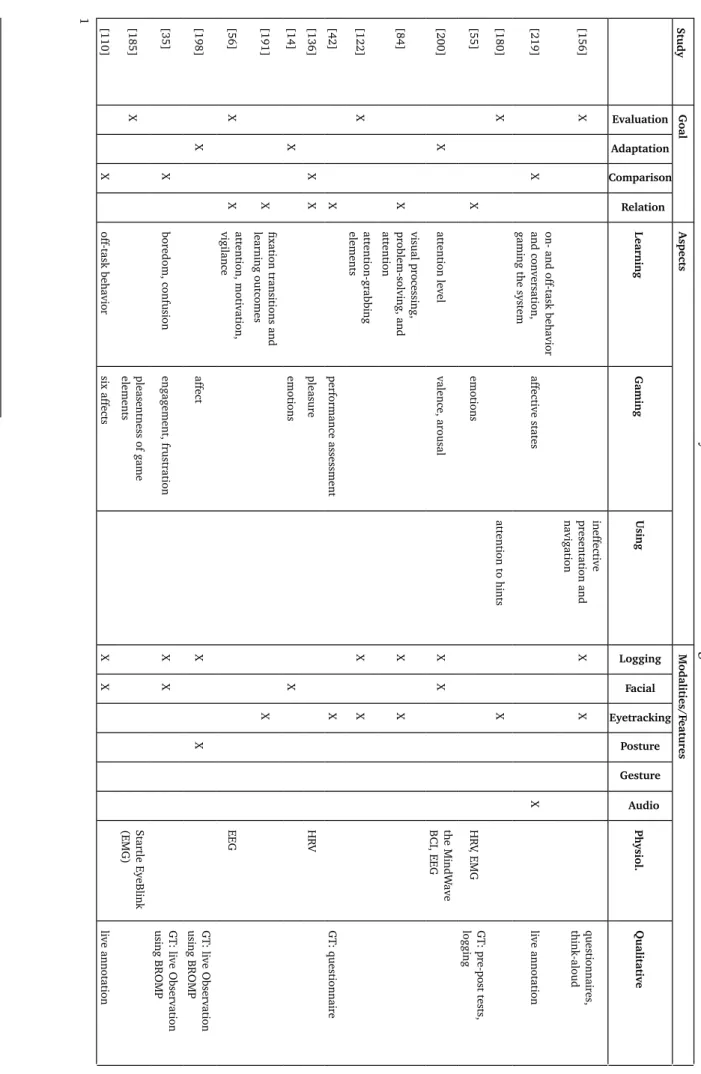
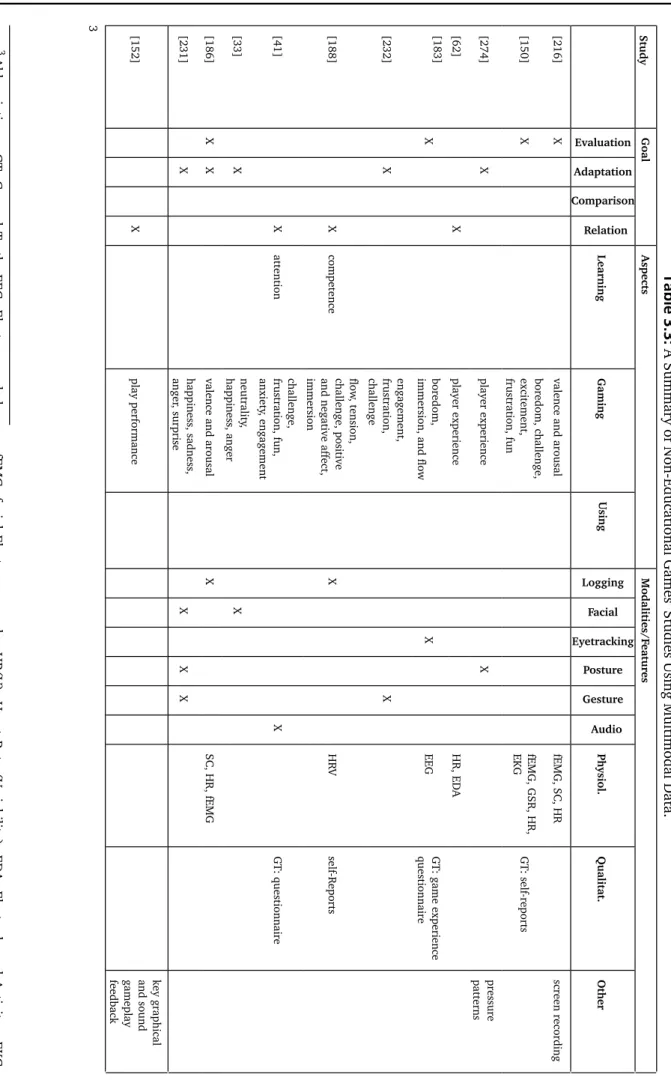
3 Related Work 21 3.1 The Use of Multimodal Data for Serious Games Analytics . . . 21
3.2 Challenges of Multimodal Evaluation . . . 26
3.3 Multimodal Sensing on Smartphones . . . 27
3.3.1 Smartphone Sensors and Analytics . . . 27
3.3.2 App Use and Phone Interactions . . . 30
3.3.3 Applications . . . 30
3.3.4 Overcoming Smartphone Limitations . . . 31
3.3.5 Privacy Concerns . . . 32
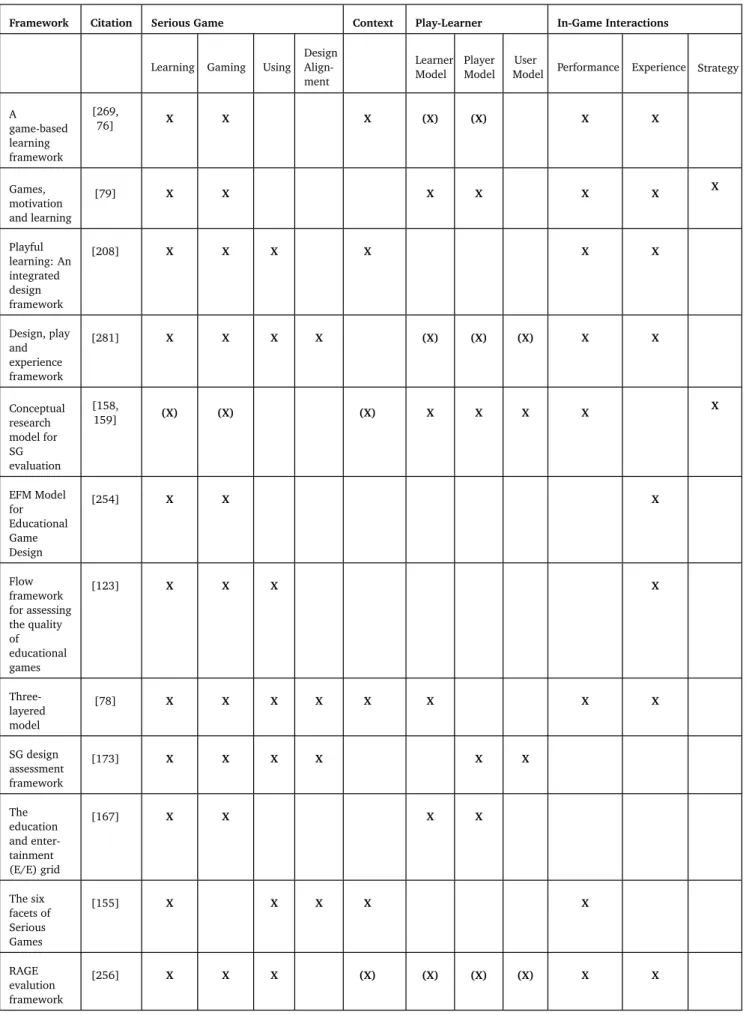
3.4 Theoretical Frameworks for Serious Games Evaluation . . . 33
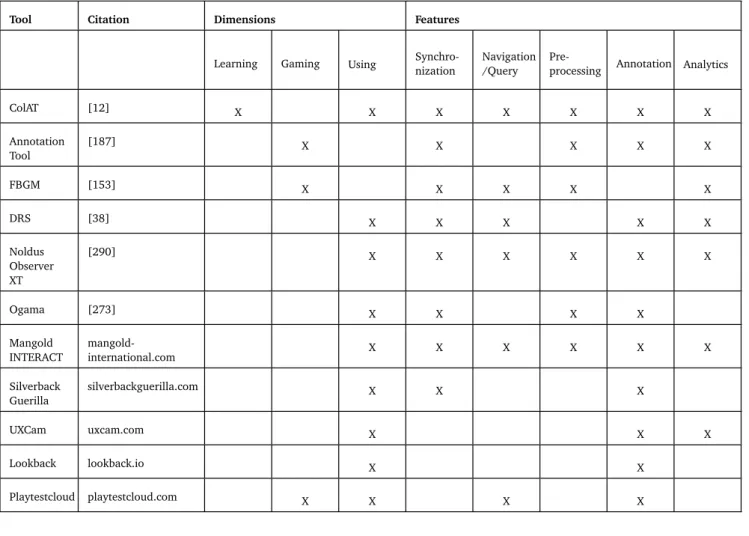
3.5 Evaluation Platforms . . . 35
3.5.1 Serious Game Analytics Platforms . . . 35
3.5.2 Game Analytics Platforms . . . 35
3.5.3 Interaction Analysis Platforms . . . 36
3.5.4 Playtesting Platforms for Mobile Games . . . 37
3.6 Conclusion . . . 39
4 LeGUC Serious Games Analytics Model 41 4.1 Model: Dimensions of Serious Games Evaluation . . . 41
4.2 Augmenting Event Logs with Multimodal Data: The Reasons and Responses Model . . . . 43
4.2.1 Model: Reasons and Responses . . . 44
4.2.2 Application of the Reasons and Responses Model on Evaluation Dimensions . . . . 44
4.3 Choosing Suitable Data . . . 46
4.4 From Event Logs to Multimodal Data . . . 47
4.5 LeGUC States in Serious Games Evaluation Sessions . . . 48
5 StoryPlay Multimodal: A Research Platform for the Mutimodal Evaluation of Serious
Games 53
5.1 Design Requirements for Mobile Multimodal Serious Games Analytics . . . 53
5.1.1 Underlying Architecture . . . 53
5.1.2 Design Goals and Requirements . . . 54
5.2 Design and Implementation . . . 56
5.2.1 Capturer App . . . 56
5.2.2 Observer App . . . 58
5.2.3 Replayer Component . . . 59
5.3 Challenges . . . 64
5.3.1 Synchronization . . . 64
5.3.2 Interoperability and the Heterogenity of Devices . . . 65
5.3.3 Data Quality . . . 66
5.3.4 Data Granularity and the Heterogenity of Scenes and Games . . . 66
5.3.5 Privacy . . . 67
5.3.6 Other Challenges . . . 67
5.4 Conclusion and Future Work . . . 68
6 Evaluation 69 6.1 LeGUC Framework Application on Serious Game Evaluation Data . . . 69
6.2 Field Study on LeGUC States . . . 71
6.3 Evaluation of StoryPlay Multimodal Platform . . . 73
6.3.1 Playtesting with Children by the Researcher . . . 73
6.3.2 Evaluation by Students . . . 78
6.3.3 Evaluation by a Teacher . . . 79
6.4 Conclusion and Limitations . . . 79
7 Conclusion and Future Work 81 References 83 List of Figures 107 List of Tables 109 Abbreviations 111 A List of Papers Arising from this Thesis 115 B Online Evaluation Forms with Instructions and Responses 117 B.1 Online Evaluation Form for the Capturer App . . . 117
B.2 Some Evaluation Form Results of the Capturer App . . . 124
B.3 Online Evaluation Form for the Observer App . . . 126
B.4 Some Evaluation Form Results of the Observer App . . . 131
B.5 Online Evaluation Form for Game Testing . . . 133
B.6 Online Evaluation Form for ArtikelGame Testing . . . 135
C Biography 139
1 Introduction
Educators are increasingly recognizing the potential of using digital games to engage students in interac-tive learning environments. Multimedia elements, storytelling, challenge, competition, random access, parallel processing, immediate reward and low level of threat are all features which make many people prefer them to traditional learning media [212]. In general, games that have a certain positive goal beside entertainment (education, health promotion, etc.) are referred to asSerious Games. Game-based learning is becoming a more and more acknowledged learning field and the use of digital educational games is on the rise. Some learning game revenues even outperform pure entertainment games [80].
However, it is difficult to predict or reproduce the success of an educational game without having well-established methods for its design assessment. Evaluation plays an important role in the field of digital game-based learning: The decision for a time-consuming and expensive design process instead of traditional media needs to be based on an expected increase in learner’s engagement and long-term motivation. It is true that the effectiveness of achieving a learning outcome is the major evaluation goal of any learning platform. However, specifically for educational games, the fun gaming aspect as well as the user experience play an equally important role in design assessment [7, 240]. And when designed for younger ages, edugames should be able to compete with other available games which children would rather play for pure entertainment.
Designing and evaluating a fun and motivating learning game is not an easy task [173]. There is a lack of consensus regarding the best approach to combining gaming and educational theories as well as methods to fully capture and analyze the rich and deep interaction experience with this interdisciplinary software. This makes it challenging to link certain design elements to its success or failure to improve it in further development cycles [117]. Traditional evaluation techniques of non-gaming learning envi-ronments or non-educational games do not provide tailored methods which can be directly applied to evaluate the aspects which distinguish learning games from both product categories [142].
The need for more insight into the serious gameplay experience is further intensified with the emer-gence of novel interaction paradigms which make classical evaluation methods insufficient [171, 241, 35]. Evaluating the whole experience from different dimensions is difficult when relying only on logging mechanisms or traditional testing sessions, due to the multimodal, fast and highly interactive nature of gameplay interactions [171, 241, 35]. This is why more and more studies are using multimodal data (video, audio, screen capture, physiological sensors, mobile sensors, ..) for evaluation [246].
Capturing multimodal data unobtrusively in a naturalistic setting is essential for getting ’real’ inter-action, affect and context data. As this is difficult to achieve in traditional lab settings, many tools supporting this process are used for testing sessions, especially remote testing of mobile applications. To develop such a system for Serious Games, it is important to establish theoretical foundations for multimodal evaluation covering the dimensions of learning, gaming, usability and context.
1.1 Motivation
Affect and cognition have been found to be strongly connected to learner engagement and learning outcomes [31, 113, 202, 213, 168, 214, 222, 89] and exploring them is getting more and more attention in Serious Games research [185, 221]. Examining recorded in-game log events alone cannot fully convey how a player felt or what a learner was thinking. In several studies, it was pointed out that there is a need for multimodal data to fully capture in-game interactions for the evaluation of Serious Games and get accurate results [15, 7].
However, when comparing educational games evaluation studies using in-game data collection for evaluation, it was concluded in [142] that a relatively small percentage of these studies used multimodal data. The authors assumed that this can be due to the costly and time-intensive process which can be
difficult for small research teams to carry out. Not only recording but also understanding and establishing relations across different data streams for the evaluation of Serious Games is a topic which is not fully researched yet.
Another point also raised in the results of the aforementioned study [142] is that most observation data collected during gameplay are not collected in the field but in a controlled environment such as a computer laboratory.Serious Games are played on various devices, platforms and contexts. With the rise in the use of mobile educational games [1] where play is often interrupted with external stimuli, the need for mobile and naturalistic evaluation settings increases as isolated laboratory experiments do not offer the same conditions [118, 8]. Not only does laboratory testing offer an artificial testing setting, but also the obtrusive, difficult to set up and expensive hardware required makes it not suitable for serious games research teams. In addition, the number of playtesters will be limited as they are required to be co-located.
This is why remote testing is gaining more and more popularity in the field of mobile application test-ing. The user can perform the test comfortably on their own devices and in natural settings and data is sent (even asynchronously) to the researcher who might not be co-located, with no additional hardware cost or expertise needed. Not only does this help in increasing the number and heterogenity of testers, but the different capabilities of smartphones can also be used to provide rich contextual data. Adding multimodal context information will provide valuable insight for Serious Games evaluation by helping researchers understand why an event occurred during the process of playing and learning [141, 88]. As known from the field of multimodal recognition, adding more modalities helps in disambeguating the results of other modalities and, in the current case, the results of examining text logs. Without this additional data, some interesting behaviors and intentions of the user can get masked when just aggre-gating log statistics. For instance, when classifying student dialogue acts, adding gesture and posture information were found to be useful and helped researchers recognize the intentions of utterances [72]. Another advantage of using more than one modality for observations is that this might help detecting interesting correlations between different modalities which support or negate certain research claims.
The main motivation for this research was thus the need for (mobile) multimodal frameworks for the evaluation of Serious Games and the chance of exploiting the new technological landscape for capturing valuable information about a Serious Games session unobtrusively. While there are a number of mul-timodal evaluation platforms available for testing interactive systems in general (see a comparison of features in Chapter 2), none of them is especially tailored for testing mobile educational games.
During the initial phases of this research, it was found that the absence of comprehensive theoretical frameworks and concepts tackling the multimdoal evaluation of Serious Games, especially on mobile devices and thus in mobile settings, made even the first step difficult for many researchers. Although this is increasingly being researched in other disciplines, there is surprisingly almost no research on this in the field of serious games. This is an attempt to compensate this gap and help Serious Games research advance and adapt to the changing technology and research landscape.
1.2 Research Challenges and Goal
Although remote testing in the field offers many chances for Serious Games evaluation which motivated this research, tests in real environments suffer from dynamic factors affecting recorded data quality such as variations of illumination, exposure, orientation, distance, stability and noise. Such factors are more difficult to control than in laboratory settings and result in missing or noisy data [35]. Thus this is one challenge which has to be addressed by the current research.
Even the advantage of scalability and an increased participation in remote testing comes with its own limitations. Having more testers means having more data, which can be desirable when applying statistical methods but maybe difficult to analyze when doing so manually. Even if applied only on a smaller scale in earlier design stages, making sense of data needs observing a session from multiple modalities at the same time [96]. Thus to make use of captured multimodal data, researchers need tools
to facilitate this process by pre-processing and synchronizing data, making it ready and easy to navigate. This will be a very important requirement in the current work.
Another important issue worth considering is concerned with the data analysis phase. After captur-ing and pre-processcaptur-ing the data, will researchers more probably use automatic or manual ways to make sense of and draw conclusions from the data? Although there is lots of research on using fully automated methods in affect recognition, it is still found to be very challenging. This is due to the heterogenity of users, expressions, contexts [185] and for the current case also the heterogenity of serious games, inter-action paradigms and design goals making it difficult to obtain accurate and generalized results [221]. In fact, even among close populations, small age differences were found to have considerable effects on test results. For instance, one study [89] showed how facial expressions related to learning experiences and self-efficacy differed between middle school and college students. Thus automatic recognition, de-spite eliminating the need and risk of manual annotation, cannot yet be relied upon alone when it comes to using multimodal data for evaluation. Observation by an expert, if done in an effective way and using efficient analytics tools, can yield more reliable and applicable results, especially spotting significant be-haviors in a field where there is still a lack of standard corpora or generalizable methods and definitions. Serious Game researchers and developers (also teachers), with limited time and budget for their evalu-ation and who need a theoretical framework and user-friendly platform for multimodal evaluevalu-ation, will thus be the main target audience for the current research. Nevertheless, the use of automatic analysis modules should be easy to integrate into the framework and used on captured and pre-processed data. In addition, the platform can be used to capture a large dataset for training different detection systems.
As an added value, applying multimodal evaluation techniques on a large set of heterogeneous games in different settings and with different users can yield aggregated results which can help create a per-sonalized content- and context-based Serious Games retrieval or recommender system, which is another motivation and application field for the current research.
Research focus isnoton the following aspects as they are out of the scope of this work: • affect recognition and its accuracy
• networking, off-loading etc.
• (cost-)effectiveness of the applied games from the perspective of game development, benefits and costs for educational institutions
• feedback loop for Serious Game design (needs subject matter experts)
• long-term learning evaluation (enhancing performance or loosing interest over time), transfer of learning, etc., as the focus is only on a certain playtesting session
1.3 Context
The start of this research direction was influenced by the Serious Games authoring environment StoryTec [166] which was built by the Digital Storytelling group at the Center for Computer Graphics in Darmstadt and further cultivated by the Serious Games group at the Multimedia Communications Lab (KOM) at the Technical University of Darmstadt. StoryTec is built upon an internal model considering updates in the learner and player model during play as well as the storyline based on the Narrative Game-Based Learning Object (NGLOB) Model [81, 82], another earlier contribution of the same research group. In addition to authoring, considerable research is done on the monitoring and evaluation of Serious Games experience, be it in games for health or education. A rapid prototyping tool for the StoryTec authoring environment displaying updates in the internal models was one of the group’s earlier attempts in helping researchers evaluate educational games created with StoryTec [217]. Continuing to adapt to recent research needs, it is the goal of the current research to investigate ways in which more multimodal data, in addition to traditional text-logs, can enrich the Serious Games evaluation process by capturing more elements of the play-learning experience. Hence not only do the theoretical models of this research contribute to the body of research at KOM and address an identified research need, but, through the
prototypical implementation, StoryPlay is extended by multimodal features, encouraging more applied research in this field. The requirements for this work arise from a real need identified by the group in various research projects and not on mere speculations.
1.4 Research Questions
Based on the needs identified in the Serious Games Analytics research field, the main goal of this research is to investigate the impact of using (mobile) multimodal data on Serious Games evaluation. This leads to the following research questions:
Research Question 1:
Which parameters constitute a conceptual research model for Serious Game evaluation?
Research Question 2:
Why and when do we need to add multimodal data to interpret log events in Serious Game evaluation?
Research Question 3:
Which information do we need from multimodal data for Serious Game evaluation and how can it be captured?
Research Question 4:
How can this information be linked to recorded log events for Serious Game evaluation and what are the associated challenges?
SG Evaluation Parameters
MM Data: Why & When?
RQ2 RQ1
Info from MM Data & How?
RQ3
Linking to Log Events
RQ4 The Impact of Using (Mobile) Multimodal (MM) Data
on Serious Games Evaluation
Figure 1.1:Research Goal and Questions.
1.5 Contributions
The initial research analysis carried out revealed a need for defining concepts and mechanisms for non-invasive multimodal capturing in natural settings to support Serious Game evaluation. Thus as a first step, a theoretical framework for multimodal Serious Games evaluation based on a review of relevant research is proposed. TheLeGUC framework(Learning, Gaming, Using and Context) describes the differ-ent aspects of a Serious Game which are to be evaluated and classifying the four dimensions: Learning, Gaming, Using and Context. Under each of these dimensions, different requirements need to be met to increase the quality of a Serious Game. These evaluation aspects are further categorized into features that can be evaluated without real users and others which need testing sessions with participants to be investigated, as they depend on traits, abilities and preferences of different users. These include aspects which need capturing and analyzing affective and cognitive states as well as context parameters. The Reasons and Responses Modeldemonstrates when and why more multimodal data is needed for Serious
Game evaluation. Finally, as a proof-of-concept, a platform for supporting remote and asynchronous replay and analysis of recorded Serious Game testing sessions was developed based on the outlined conceptual framework. Parts of this thesis have been published in papers which are listed in Appendix A.
Implementation
Evaluation
Concept LeGUC Model
Reasons & Responses
Model
LeGUC States
MM Benefits: What & When
Sensor-based Video Quality Platform Evaluation Requirements and Mockup Implementing
Modules Overcoming Challenges Research Analysis Identify Gap Serious Games Analytics MM Evaluation Platforms SG Evaluation Models Novel Settings and Modalities Tailoring to SG Evaluation Covering All Dimensions
Figure 1.2:Research Contributions.
1.6 Thesis Structure
The remainder of this thesis is structured as follows:
Chapter Two: Foundations
A foundation for the next chapters is first laid out explaining research terms and fields directly related to our topic. Areas like Learning Analytics, Educational Data Mining, Game Analytics, Serious Games Analytics, Affective Computing and their intersections and differences are presented. The different steps of Serious Games Evaluation are discussed. This will help establish understanding paving the way for the following chapters.
Chapter Three: Related Work
In this chapter, a review of related research is presented. First, a survey of user evaluation studies using multimodal data then investigates why and in which areas and contexts these methods are used. Also, the topic multimodal data capturing on mobile phones is researched and different related studies in this field are discussed. Next, different theoretical frameworks on Serious Games Evaluation are compared to determine which dimensions they cover. Finally, available evaluation tools and platforms are then presented to help in gathering requirements for creating such a platform tailored for Serious Games.
Chapter Four: LeGUC Serious Games Analytics Model
Based on the related research in Chapter Three, the LeGUC Serious Games Analytics Model is pre-sented for Serious Games Evluation as an attempt to fill the identified research gap and as a foundation for a Multimodal theoretical framework. After determining what is to be evaluated in a Serious Game, we need to determine how these aspects will be measured and where multimodal data can add more value to the evaluation. So the LeGUC Model serves as a foundation for the more in-depth model aimed at multimodal data which will is presented in this Chapter: The Reasons and Responses Model. These
theroetical frameworks are then applied on a case study to explain them on real data. Finally, challenges of using multimodal data are discussed to suggest requirements for this project.
Chapter Five: StoryPlay Multimodal: Mobile Multimodal Serious Games Analytics Platform
In this chapter the design requirement for a Mobile Multimodal Serious Games Analytics Platform are presented based on the previous chapters. This is used as a foundation for the design and implementation for StoryPlay Multimodal platform. Then, Implementation aspects of our platform are presented as well as challenges and solutions.
Chapter Six: Evaluation
The evaluation process and results of the implemented platform are presented in this chapter as well as an application with different serious games and testers.
Chapter Seven: Conclusions and Future Work
The work is concluded in this chapter, answering our research questions and giving an outlook on future research which can benefit from our results and analysis.
2 Foundations
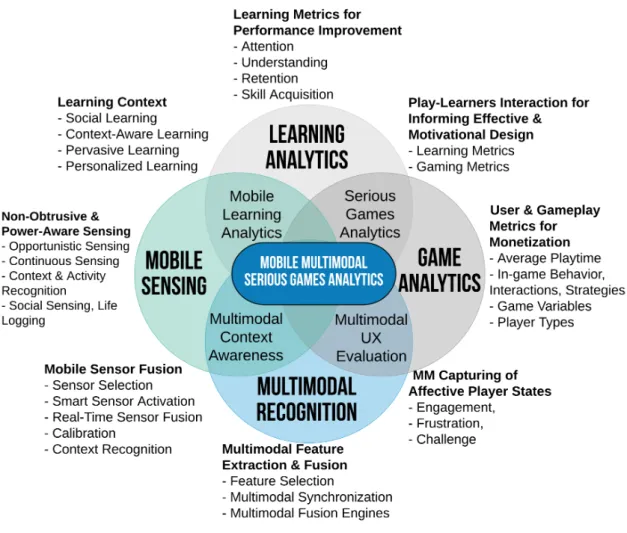
Serious Games apply concepts of game technology in a broad application spectrum ranging from educa-tional, training and simulation to persuasive and social impact games or games for health. In this thesis the term Serious Games is used to refer to digital educational games, although this is one application area of Serious Games. Because of its interdisciplinarity, the evaluation of Serious Games lies in the inter-section of and benefits from metrics and strategies from several different fields. Hence, it is important to review some important fields which are considerably related to this topic. This chapter gives an overview over relevant areas and terminology which will be referred to in the rest of the thesis. A main problem in providing such an overview is the variation in terminology, research background and objectives among different researchers when discussing similar topics. This can be facilitated by starting with locating this interdisciplinary research area and related terminology in the research landscape. Figure 2.1 shows an overview of research areas to be discussed in this chapter and their intersections. The focus of the current research, the topic of multimodal evaluation of Serious Games, lies in the intersection of all four discussed research fields. It can be called “Mobile Multimodal Serious Games Analytics”.
2.1 Learning Analytics
With the digital evolution in education comes a necessity for improving assessment strategies accordingly which are integral to any learning process. As educational data volumes increase and learning practices get more and more diverse, finding appropriate evaluation techniques becomes a challenging task. Al-though technological advances also enable advanced tools for gathering and analyzing data, research on how to best utilize this for enhancing learning and assessment in novel educational settings still has many open questions [17].
The emerging fields of Learning Analytics (LA) and Educational Data Mining (EDM) attempt to address these issues by exploring models and techniques for making efficient and effective use of educational data. This includes capturing, tracking, aggregating, analyzing, and visualizing/utilizing information about learners’ interactions with learning content and their learning progress. Both disciplines have the common goal of using these traces to improve learning but their methodologies for exploring and using data are slightly different. While EDM is more concerned with analyzing and feeding data into automatic adaptation, prediction and recommendation algorithms, LA directs more emphasis to appro-priately visualizing these mechanisms for the user (instructor, instructional designer, institution, parent and/or learner) and empowering him/her to interpret and intervene in the process [249]. Its learn-ing benefits have been manifested in many studies where they were implemented in different contexts [147, 251, 9, 60].
The field of Learning Analytics describes the “measurement, collection, analysis and reporting of data about learners and their contexts” to improve learning [250]. It establishes conceptual foundations as well as application-specific recommendations for making efficient and effective use of “information about learners’ interactions with learning content and their learning progress”. Metrics typically extracted in Learning Analytics include information about the learners (independent of their interaction with the learning environment) in addition to context-specific data extracted during interaction [142].
As the learning aspect is what distinguishes Serious Games (here digital educational games) from regular games, the evaluation of Serious Games uses methods from the field of Learning Analytics. The assessment of learning in Serious Games, as in any other learning environment, can take place before, during and/or after the interaction with the game. Assessment of learning before using the game can inform the design of the game, help personalizing the game or serve as a pre-test for performance comparison. Assessment of learning during the game can be used to adapt the game on-line, to monitor learning progress by teachers or institutions, as self-assessment for learners to reflect on their learning and understanding, as part of the learning process to improve their memory recall or as a means to evaluate the design and effectiveness of a game level or module. Assessment of learning after finishing a game helps evaluate the effectiveness of the game, help learners know what they need to improve or, if used (merely) as an assessment tool, to assist instructors/institutions to assess learner achievements against intended outcomes.
Thus, for the evaluation of Serious Games, Learning Analytics provide an objective and cost-effective approach for justifying the expense of using them in learning contexts. Hereby, the critical question is how to best collect academically meaningful information from learners without disrupting their game-flow. In addition, interacting with a Serious Game is usually more complex and produces larger datasets than interacting with a regular learning environment. In this regard, the field of Game Analytics and, more so, Serious Games Analytics provide suitable solutions.
2.2 Game Analytics
While Learning Analytics focuses on learning-relevant information, Game Analytics, as the term implies, focuses on gameplay interactions and gives enjoyment of the game experience the highest priority [142]. Metrics used in Game Analytics are also typically more profit-oriented and are used to inform business-intelligent decision-making and improve game development cycles [142]. Monitoring the effect of design
updates on players is crucial for continuously improving and thus increasing revenue. These insights into real and dynamic data in huge amounts (also called game telemetry) has been made possible with the digital advances and thus the field of Game Analytics is relatively young. The term Game User Research also describes a research field investigating the interaction between players and games [228]. In addition to general business data, Game Analytics trace players’ actions inside the gaming environment in order to gain a better understanding of their preferences, detect crucial design flaws as well as identify best-gamers. However, although games offer rich information about players’ progress, the game industry is not focusing on assessing competencies gained through the game as the games are not designed with this purpose [142]. Thus, pure Game Analytics cannot be directly applied to Serious Games which were not created for mere entertainment.
Telemetry
The term telemetry has been traditionally used in association with data collection in different fields and is applied for remote mobile app data collection to a server [141]. In the field of game analytics, this technology is used for (educational) games so that players’ interactions can be remotely traced for analysis [108, 139].
2.3 Serious Game Analytics and the Serious Game Evaluation Process
It would appear reasonable that combining metrics from the fields of Learning Analytics and Game Analytics would enable an effective way of evaluating Serious Games considering both their learning goals and their highly interactive nature. However, some metrics of the two fields are actually conflicting. For instance, failure associated with exploration inside a gaming environment contributes to the flow needed to stay captivated inside the game whereas failure is not typically a desired experience inside a learning environment and subsequently can be treated as a conceptual error. Another example is the time to complete a certain task: While in games it is desired to make fast decisions and complete tasks in a short time, learning needs more time to allow reflecting and critical thinking. Users of Serious Games are players as well as learners, are thus referred to as play-learners [142] and need special metrics to measure their performance as well as evaluate the quality of their playing experience. This is where the field of Serious Games Analytics comes into play, tracing play-learners actions and behaviors and assessing their performance with the purpose of improving Serious Game Design. Thus, to be able to apply Serious Games Analytics, the broader research topic of Serious Games Evaluation needs first to be explored.
2.3.1 Serious Games Evaluation
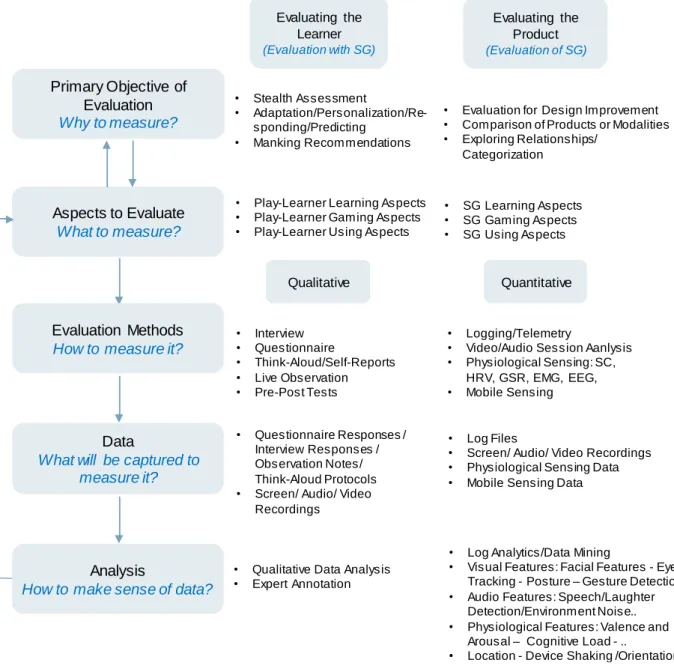
Primary Objective of Evaluation: Why to measure?
When reviewing research dealing with assessment in Serious Games, it becomes evident that, depending on the primary purpose and context of the studies, they are either directed towards assessing the learner or assessing the Serious Game. Assessing the learner online can help in adapting the game or making predictions. This is also referred to as in-game analysis [97]. Assessing the learner can also be useful, together with purchasing habits, for making recommendations. Integrated assessment in Serious Games, also referred to as “Stealth Assessment” [247], can serve teachers, institutions or the learner himself for monitoring learning. Using games as assessment tools in academic contexts is becoming more and more popular due to their interactive, non-invasive and engaging nature and the big amount of gameplay data they can offer [134]. Assessing the Serious Game is typically done off-line, also referred to as posterior analysis [97] and has the aim of proving the fun and effectiveness of the game or uncovering possible shortcomings to be fed into further development cycles or new games. As there is no common agreement
on the best method to evaluate and improve the design of Serious Games, this topic will be addressed in more detail in the next chapters.
Aspects to Evaluate: What to measure?
By inspecting the name “Serious (or, in this case more precisely, Educational) Games”, one can already derive two main dimensions of parameters which need to be considered in Serious Games evaluation: Learning and Gaming. However, by reviewing literature on Serious Games evaluation, a third dimen-sion was found to also play an important role, even more for Serious Games than for other software categories: the dimension of Usability and User Experience. This is because usability issues can greatly hinder interactions with serious games, which directly has a negative effect on both learning and gam-ing, and may thus make all design and development efforts on the other two dimensions go in vain [207, 28, 192, 175, 205]. As serious games development teams typically have a much lower budget than the entertainment game industry, not much is usually left for ensuring good usability which can explain the mostly inferior quality of experience. In addition, many users of Serious Games are not reg-ular gamers and may thus need special measures concerning usability. The main difference to regreg-ular usability testing in Serious Games evaluation is that some obstacles to proceeding introduced in a game are necessary components for adding challenge while these could be considered as negative issues in a normal usability setting.
Evaluation Methods: How to measure it?
After determining what aspects about the serious game are required to be evaluated, it is time to decide for the appropriate evaluation procedure. For that, the evaluators, the time and place of the evaluation as well as the tools used are to be planned. Evaluators of a serious game can be real users or surrogate users who perform expert evaluation [193]. These can be educational, game design, interaction design and/or content experts. According to the time and place of the evaluation, different types of mechanisms can be differentiated. Ex-situ evaluation refers to remote data collection without the need for co-location [142]. In this case telemetry refers to remotely tracing the in-situ generated gameplay data from a gam-ing environment [242]. In synchronous evaluation, the users and their actions are traced/analyzed in real-time whereas in asynchronous evaluation, gameplay data is reviewed any time after the evalua-tion session. Laboratory-based evaluaevalua-tion needs testers to be co-located which limits participaevalua-tion and the testing environment is controlled but artificial. Remote or mobile evaluation gives the possibility of employing testers from all over the world in their natural environments, without the need for special, expensive and obtrusive equipments but has the downside of having an uncontrolled and dynamic envi-ronment and may suffer hardware limitations. Thus, if the serious game to be tested is mobile and needs to be tested in a naturalistic setting, a remote evaluation may be appropriate. [211] reviews different elicitation methods for studying learners’ affect in intelligent tutoring systems. Similarly, [83] discusses different methods and modalities used in the evaluation of serious games. Static (user-independent) product aspects can be evaluated just by inspection or expert heuristic evaluation without the need for real users to do the testing [245]. With real users, qualitative or quantitative methods can be used. Qualitative or manual evaluation methods include observation, think-alouds, pre-post-tests, self-reports, video analysis or surveys based on heuristic rules. Quantitative methods usually rely on game telemetry or automatic capture and analysis of multimodal data.
Data: What will be captured to measure it?
According to the aspects to be evaluated and the evaluation methods applied, the data to be captured will differ. Qualitative studies will result in questionnaire/interview responses, observation notes,
think-aloud protocols and/or screen/video/audio recordings. Data from quantitative studies will most prob-ably include log files but can also include video and audio recordings which are commonly used for detecting visual and audio features and nowadays also frequently rely on physiological and/or mobile sensing. For recording in-game interactions, log files are mostly used, while for detecting affective and cognitive states, visual and physiological features are mostly extracted, although many studies also at-tempt to do this using pure logging alone. For context, mobile sensors are usually used. In many evaluation studies, data from multiple modalities is used.
Analysis: How to make sense of data?
According to evaluation method and data captured, different analysis methods can be used. Qualitative data can be explored and annotated by experts manually to make conclusions [240]. Quantitative or automated evaluation methods can use data mining or unsupervised machine learning on logging and multimodal data. Hybrid methods use supervised machine learning or fuses self-reports with logging.
Analytics are often seen to be a relatively objective and cost-effective evaluation approach compared to relying solely on self-reports and pre-/post-tests. It also has the ability to give real-time insight into possible shortcomings of an educational game. In addition to assessing games, the interactions of play-ers during gameplay sessions can provide a lot of data which can be used for identifying play-learner attributes, strengths and weaknesses as well as measuring learning progress where they can even out-perform traditional tests.
Integrated into Serious Games, analytics could thus perfectly fit as a tool providing implicit insight into a learner’s knowledge state within the game. The wide variety of educational games poses a significant challenge for defining a general methodology for integrating learning analytics into serious games in an effective way [230]. We will therefore in the next section present several suggested solutions to this problem covering different aspects like modeling decisions, data collection, reduction, aggregation and analysis as well as effective use of results.
Figure 2.2 summarizes steps in planning and conducting serious games evaluation.
2.3.2 Serious Games Analytics
Modelling for Analytics
To successfully assess learning using learning analytics, the learning domain, the application concept as well as the learner should be modelled in a way which facilitates data extraction and analysis. These models should preferably also be stored in separate files in an easy-to-process format [230]. In this regard existing models like the Competence-Based Knowledge Space Theory (CbKST) are usually used as a foundation [128, 73]. This theoretical framework requires learning domains to be modelled as a prerequisite competency structure to make the process of inferring knowledge states more efficient. Open Learner Model (OLM) [40] is becoming a popular term among LA researchers as it requires presenting to the learner an understandable visualization of his/her current knowledge state. Several studies have shown how the OLM approach improves learning outcomes [288, 174]. In some studies, the learner
model was even made directly editable by learners. Using the Mobile Open Leaner Model the learner
can also “carry” his/her learner model with him/her and exchange it with other students to facilitate peer tutoring [39]. Adaptive learning games, like adaptive tutoring systems, already need to employ a learner model for their adaptation mechanism. One suitable model for this kind of games which considers not only the knowledge state but also the player type and the narrative aspects of the game is the concept of Narrative Game-Based Learning Objects (NGLOB) [82]. Here the representation of context information consists of a triple vector for each scene containing information about the narrative context (how appropriate a scene is for which step in which story model), the gaming context (how
appropriate a gaming situation is for which player type) as well as the learning context (all associated and prerequisite skills of a learning situation). Dependencies between skills are modeled as a graph based on the CbKST [128]. Before being able to apply such an approach, relevant information should exist and be appropriately structured to provide the following models: A Competency Model, an Evidence Model and a Task/Action Model [248]. The Competency Model should present a fine-grained specification of competencies which should be assessed. The Evidence model should relate different actions and behaviors of a player within a learning game to the different competencies. In this regard, Domain Structure Discovery refers to the problem of mapping tasks to knowledge components or skills [264]. Conceptualizing how a certain gaming context should be best designed so that player actions required will result in measurable inference about their competency level constitutes the Action Model. This approach in designing learning environments is referred to as Evidence-Centered Design (ECD) [172]. As discussed before, in addition to modelling learning, other aspects like engagement are worth modeling in the case of evaluating educational games. Therefore it is suggested in [119] to not only collect evidence
Primary Objective of Evaluation Why to measure? Aspects to Evaluate What to measure? Evaluation Methods
How to measure it?
Data
What will be captured to measure it?
• Evaluation for Design Improvement • Comparison of Products or Modalities • Exploring Relationships/ Categorization Evaluating the Learner (Evaluation with SG) Evaluating the Product (Evaluation of SG)
• Play-Learner Learning Aspects • Play-Learner Gaming Aspects • Play-Learner Using Aspects
• Log Analytics/Data Mining
• Visual Features: Facial Features - Eye-Tracking - Posture – Gesture Detection • Audio Features: Speech/Laughter
Detection/Environment Noise.. • Physiological Features: Valence and
Arousal – Cognitive Load - ..
• Location - Device Shaking /Orientation • Interview • Questionnaire • Think-Aloud/Self-Reports • Live Observation • Pre-Post Tests • Questionnaire Responses / Interview Responses / Observation Notes/ Think-Aloud Protocols • Screen/ Audio/ Video
Recordings
Quantitative Qualitative
Analysis
How to make sense of data?
• Logging/Telemetry
• Video/Audio Session Aanlysis • Physiological Sensing: SC,
HRV, GSR, EMG, EEG, • Mobile Sensing
• Qualitative Data Analysis • Expert Annotation
• Log Files
• Screen/ Audio/ Video Recordings • Physiological Sensing Data • Mobile Sensing Data • SG Learning Aspects • SG Gaming Aspects • SG Using Aspects • Stealth Assessment • Adaptation/Personalization/Re-sponding/Predicting • Manking Recommendations
on the player’s state of knowledge using a so-called Skill Assessment Engine (SAE) but also considering his/her motivation level through a Motivation Assessment Engine (MAE) as well.
Choosing Data
Determining which information needs to be extracted is an essential step for using learning analytics. This depends not only on the learning goals, setting and tasks but also on the game genre, mechanic and platform.
Intensive vs. Extensive Data
One possible classification of data to be collected using learning analytics depends on whether quantity or quality is desired. Collecting data from a large number of users with only few information gathered about each user results in extensive data while focusing on a limited number of participants to make deeper and more-detailed observation produces intensive data [209]. Extensive data is primarily for Educational Data Mining where patterns are recognized across large data sets while intensive data per-forms better at recognizing patterns across multiple different data streams of one and the same user over time. In some cases an approach combining both intensive and extensive data may be best as both complement each other ensuring that no significant patterns are overlooked.
Single-Player vs. Multiplayer
Collecting data from multiplayer games poses its own challenges arising from the additional social component. Learners’ interactions in a collaborative learning environment, within a Learning Manage-ment System (LMS) or a multiplayer Serious Game, are a rich source of data which can be exploited using LA. Data extracted from similar environments can be fed into a social network analysis pro-cess to identify aspects of collaborative learning through relations and structures [189]. A diagnostic tool is presented in [126], where social networking principles are used for in-class peer assessment of-fering teachers a teacher supervision panel allowing monitoring task solutions and filtering collected information according to their diagnostic or instructional interest.
Generic vs. Game-Specific Traces
In [230] the authors define a set of generic traces which can be extracted within learning game ex-periences for learning analytics. The set consists of game traces (starting, quitting and ending a game), phase traces (starting and ending phases), meaningful variable traces (update of variables) and input traces (clicks and key presses). TheGame Start trace not only contains information about the time the game was started but also basic information identifying the user and describing context and
demogra-phy through technical data. TheGame Endtrace records when the game was finished and, if the game
has many endings, which ending was reached. If the game is quit before reaching the end, the Game
Quit captures the context in which the session was interrupted. Phase changes can also be mapped to
storytelling elements and are linked to sub-games or learning chapters in a game. Here, thePhase Start and Phase End traces can be used to identify when a phase has started/ended and whether or not it was completed with success. Information contained in input traces can be input source, type of action and associated data. Similarly, the traces collected and visualized in StoryPlay [230] are based on the theoretical framework of the NGLOB framework described earlier [82]. In addition to logging all user inputs, active variables, and the time taken for each scene, the system records updates to the internal state in all three adaptation dimensions: storytelling, gaming and learning. This consists of a history of visited scenes with their respective adaptation algorithm parameters based on associated and prereq-uisite skills, the narrative context as indicated by appropriateness values, player attributes describing the player model and the player’s skill state. Generic game logs provide valuable information which can be used to assess learning games and identify strengths and weaknesses in their design. It also makes comparing different games possible. However, not all information is equally meaningful in all
types of games. In addition, games can produce huge amounts of partially irrelevant data which must be filtered for analysis. For a detailed exploration and yet efficient analysis, it is thus recommendable to additionally tailor analytics to the specific game design features and evaluation requirements. Ideally, the game should be designed with analytics in mind. In other words, all major game mechanics in an “analytics-efficient” design are chosen in such a way as to directly reflect a learner’s skill or behavior interesting in terms of evaluation [272] . An example of such a game isSave Patch presented in [116] where all player actions are tied to mathematical operations. The logging structure for this game was also designed to ensure no key information gets lost and no data significant to evaluation is overlooked. In [50], the authors suggest logging data at the “finest usable grain size”, i.e. recording clearly defined, unambiguous events sufficient for understanding the context.
Capturing Data
To allow the integration of learning analytics, the game platforms should be able to record game traces and are usually also required to allow sending them to external servers for collection [230]. However, data useful for learning analytics is not limited to activity logs created by the game engine. Measuring engagement and learning can be done by combining data from different sources.
Aggregating Data
After capturing extensive data from different users and different sources, datasets should be merged for statistical processing or data mining to be able to extract information from it. For intensive data, aggregation is also required to combine multiple streams of data captured by different devices about one and the same user. A key challenge for this process is the current lack of interoperability [54].
Aggregation across Users
Logs typically contain a large amount of data and thus usually undergo preprocessing before they are ready for analysis. Structuring, segmenting, filtering and normalizing raw data is done according to the application at hand. Using session identifiers, data from different users can then be joined into one central database. To enable this, the log files generated on all machines should be using the same data format. There have been several attempts to standardize xml-based formats of log files for ed-ucational data mining applications. In [125], a data format for logging interactions of learners with tutoring systems is presented. Similarly, a format for encoding interactions within Computer Supported Collaborative Learning (CSCL) environments was introduced in [66]. An example of aggregating logs of multiple players in learning games was implemented for the tool StoryPlay described earlier where playtraces from individual sessions are combined into one comprehensive spreadsheet [217]. In [229],
the use of aggregation models is proposed which use semantic rules to map game actions or states to
meaningful expressions under which similar events are grouped.
Aggregation across Modalities
When gathering multimodal data to enrich the interpretation of log files, researchers are faced with many challenges during the aggregation phase [32, 66, 133]. Synchronizing data captured in parallel using different devices is necessary for observing behaviors at specific timestamps across data streams and for analyzing situations, confirming claims and drawing conclusions. Tools likeReplayerare available which enable synchronized play of streams they captured and proved useful in such cases [176, 66]. In [32] the authors describe their time synchronization process for coordinating the encoding of several
video streams on different machines. Digital ink files were hand synchronized using the ChronoViz
multimodal analysis tool with their corresponding audio-visual files. An approach for synchronizing eye-tracking data and log events with EEG signals was presented in [133], where they were imported as hits at significant timestamps of the EEG traces to find correlations across channels.
Analyzing Data
After the aggregation stage, data can directly be used for reporting, i.e. statistics and abstracted overviews can be provided to the instructor/game designer or the play-learner whose task would be to extract useful patterns from the data. If the system is to analyze data automatically, as the case with adaptive educational games, then this stage is the most complicated, especially in games as real-time processing is required for personalization. Expressing it from the learning perspective, the gathered data should help get inferences about general traits and abilities of the learner, his/her general knowledge state, his/her situation-specific state, his/her learning behaviors and his/her learning outcomes [70]. From the gaming perspective, measures to be derived are general game performance, in-game learning and in-game strategies [50].
In the ECD approach described earlier, the Evidence Model describes the rules which govern the inter-pretation of in-game sources of evidence to infer competencies. Usually, algorithms are applied during learning sessions to update the competency model of the learner according to achievements and fail-ures exhibited at runtime or more complex heuristics. Here, Bayesian networks can be used to update associated probability distributions of the different competencies [135]. In the 80Days project [119], the modeled knowledge structure is stored as a binary matrix, parsed at design time and then loaded during gameplay into the runtime component of the Skill Assessment Engine. According to the player’s game interactions propagated by the Game Engine, the Skill Assessment Engine updates probabilities of corresponding skills whereas the Motivation Assessment Engine updates probabilities of aspects related to the learner’s motivation like attention and confidence. In [116], Cluster Analysis was used to identify solution strategies and error patterns of players from learning logs. Error patterns were further classified into errors resulting from mathematical misconceptions and those related to game strategies.
The author of [230] specified rules for interpreting semantic information from his/her gathered generic game traces described earlier. The idea is that by defining conditions on the variables like time spent on tasks or phases, values of in-game-variables or more complicated rules depending on the context, more insight into game experience and learning achievements can be gained. Similarly, it was possible, by focusing on certain intervals of biometric data streams where certain significant events were recorded in log files, to answer semantic questions [133].
Examples are finding out where the attention of the user was directed when a certain event occurred or if certain physiological responses are related to certain interactions. In another study a model based on Markov logic networks was proposed for recognizing player goals through their interaction in non-linear games [92]. Prediction is in this regard also a popular approach for analyzing logs. For example, real-time affect can be predicted in learning games using computational models as described in [132] or [223].
Deploying Results
Using inferences resulting from the interpretation stage can be done in two ways: Either this information is communicated to the instructor or the learner to empower him/her to make decisions on possible measures or interventions, or they are directly fed into adaptation mechanisms implemented in the game-based learning environment. The system can respond by choosing the appropriate next learning object or narrative event (macro-adaptivity) and/or adjusting aspects within a learning task like task difficulty or feedback type (micro-adaptivity) [119].
An example for making use of logs for enhancing learning experience in learning games through adaptation is Leo’s pad, a smartphone application for children offering an early learning curriculum in an interactive playful environment [276]. Along with this application, Parent’s Pad provides parents with useful insight into the learning activities and progress of their children. Zoodles1is another example of
a parent dashboard for mobile educational games. Providing this kind of readable information to guide a learning experience is one of the main goals of LA. This is why a lot of studies were carried out to identify how to best visualize log data and learner models [64]. Hasse Diagrams are a popular way for graphically representing competency structures.
In StoryPlay, visualization of logging information is realized using a replay component as well as different real-time visualizations of narrative structure, player model and skill tree, respectively. In [230] clicks on the screen were aggregated and visualized using heat maps to help identify which objects on the screen received more attention. The learning analytics toolbox eLAT [65] employs several visualization mechanisms which are not specifically targeting games but cover many aspects interesting for visualizing LA in Serious Games like real-time operation, extensibility and interoperability.
Authors of [170] propose a technique for real-time learning analytics visualization for educational games applied on the example of an adventure game teaching computer networks. Two powerful and popular web analytics tools available for free use which can also be incorporated into learning apps and games areGoogle Analytics2andPiwik3.
Virtual worlds likeSecond Life4andOpenSimulator5are increasingly being used for learning by creat-ing immersive learncreat-ing scenarios makcreat-ing use of the natural and rich environments and the multimodal and collaborative interactions as well as logging reports they offer [120]. An example for such a learning scenario is “Chatterdale Mystery”, an English learning adventure game developed for OpenSim, is pre-sented by the authors. Along with this game and as part of the Next-Tell project, a teacher control center software was implemented which offers easy-to-use tools for aggregating, analyzing and visualizing log files generated by OpenSim together with other sources within learning adventures allowing teachers to define and integrate their own evidence rules.
Figure 2.3 depicts the process of applying Analytics in Serious Games as described in [240].
Modelling for LA Learning Domain Application Concept
Learner Modelling
Choosing Data Intensive vs. Extensive Data Single Player vs. Multiplayer Generic vs. Game-Specific Capturing Data Activity Logs Multimodal LA Mobile/Ubiquitous LA Deploying Results Visualization Adaptation Analyzing Data Evidence-Centered Design
Statistical Data Mining
Aggregating Data Aggregation Across Users Aggregation Across Modalities
Figure 2.3:Process of Applying Learning Analytic in Serious Games as Described in [240].
2.4 Multimodal Recognition
Today more advanced technologies and sensors can capture data with different modalities. As Serious Games claim to offer learning content in a more “fun” environment, assessing User Experience is a crucial part of Serious Games Evaluation. As humans display their emotions and cognitive states through dif-ferent channels, also using non-verbal communication elements like facial expressions, eye movements, body movements, tone of voice, posture and physiological reactions, pure textual data is not enough to fully capture the experience. In that context, researchers explore approaches to allow computers to
2 http://www.google.com/analytics (last accessed January 2018) 3 http://piwik.org/(last accessed January 2018)
4 http://secondlife.com (last accessed January 2018) 5 http://opensimulator.org (last accessed January 2018)
detect and recognize changes in a person’s affective state. This is the specialty of the field of Affective Computing which is largely applied in evaluating digital products as one application possibility [206].
Multimodal Learning Analytics
The field of Multimodal Learning Analytics (MMLA) can provide useful techniques for aggregating
and interpreting data captured along several modes. This new research area “emphasizes the analy-sis of natural rich modalities of communication during situated interpersonal and computer-mediated learning activities” [197]. For instance, measuring attention, effort and excitement within learning environments can benefit from biometric data like information about posture, facial expressions, eye tracking, pupil diameter, skin conductance, heart rate, respiration and EEG signals [133]. The author of [32] demonstrated how MMLA can be used for naturalistic assessments and real-time evaluation by analyzing programming snapshots, word counting, behavioral traces and video recordings of students to categorize them according to their programming style and expertise as well as their affect towards the learning subject, even without considering their test performance. A similar study [227] explored the combination of audio, video and digital pen writing signals for the identification of leaders and experts in a group. An approach for synchronizing eye-tracking data and log events with EEG signals was presented in [133], where they were imported as hits at significant timestamps of the EEG traces to help find corre-lations across channels. There are many challenges associated with this information-intensive approach. Not only can these types of data usually only be collected from a small group of people, but combining parallel streams of wireless data also produces complex and noisy results which are difficult to reduce and synchronize for analysis. On the other hand, this approach helps to identify significant events which might be overlooked using only extensive data. In addition, capturing rich modalities of communication using multimodal recordings (e.g. speech, digital pen, images and videos) can also be especially useful for evaluating collaborative learning settings [197]. In fact, traditional analytics based on clicks and keystrokes limit their integration into new technologies which no longer depend on mouse and keyboard for their input. An example of successfully combining multimodal data streams is described in detail in [32].
2.5 Mobile Sensing
Reports of the Serious Games market point to the mobile sector as the dominant future direction, espe-cially location-based learning games and mobile augmented reality games as increasingly used paradigms [1]. Along with new types of user-generated data, the use of smartphones offers new contexts in which learning occurs which should be taken into consideration when evaluating users’ interactions and also have direct effects and pose new challenges on other evaluation aspects such as affect detection [36]. This shift makes testing in traditional laboratory environments not only difficult but also not naturalistic as it ignores a large scope of the experience. As Learning Analytics based purely on logging of traditional interaction patterns becomes insufficient, it needs to be enriched with multimodal mobile sensing data in order to detect, for instance, that a learner is being distracted by environmental or social factors.
The term Mobile Learning Analytics describes “the collection, analysis and reporting of the data of mobile learners, which can be collected from the mobile interactions between learners, mobile devices and available learning materials” [3]. Thus, the field of Mobile Sensing, which is concerned with using mobile sensors to unobtrusively track users and their non-static environment, also started to play a growing role in the evaluation of Serious Games. The following are some smartphone sensors and their potential affective and cognitive measures listed in [235]: Smartphone Cameras can be used for eye-tracking and facial feature recognition which can be useful for inferring information about attention, stress, learning patterns, different skills and emotions. Accelerometer, gyroscope and compass can be used to detect body motion which could be used to measure arousal. Finger pressure on touch screens can be indicators of stress, certainty of response and cognitive load. Voice recorded by the microphone can be analyzed to measure stress and other affective states.
![Figure 2.3 depicts the process of applying Analytics in Serious Games as described in [240].](https://thumb-us.123doks.com/thumbv2/123dok_us/10981030.2985998/27.892.105.763.620.806/figure-depicts-process-applying-analytics-games-described.webp)