Turku Centre
for
Computer Science
TUCS Dissertations
No 258, November 2020
Shohreh Hosseinzadeh
Security and Trust in Cloud
Computing and IoT through
Applying Obfuscation,
Diversification, and Trusted
Computing Technologies
Security and Trust in Cloud Computing and
IoT through Applying Obfuscation,
Diversification, and Trusted Computing
Technologies
Shohreh Hosseinzadeh
To be presented, with the permission of the Faculty of Science and Engineering of the University of Turku, for public criticism in lecture hall
XXII of Agora on November 28th, 2020, at 12 noon.
University of Turku
Department of Future Technologies 20014 Turun Yliopisto Finland
Supervisors
Professor Ville Lepp¨anen
Department of Future Technologies University of Turku
Finland
Associate Professor Seppo Virtanen Department of Future Technologies University of Turku
Finland
Reviewers
Professor Benoit Baudry
Division of Software and Computer System KTH Royal Institute of Technology
Lindstedtsv¨agen 3, Stockholm Sweden
Adjunct Professor Martin Gilje Jaatun Department of Electrical
University of Stavanger
Kjell Arholms gate 41, 4036 Stavanger Norway
Opponent
Professor Valtteri Niemi
Department of Computer Science University of Helsinki
Pietari Kalmin katu 5, 00014 Helsinki Finland
The originality of this thesis has been checked in accordance with the University of Turku quality assurance system using the Turnitin OriginalityCheck service.
ISBN 978-952-12-3992-2 ISSN 1239-1883
Abstract
Cloud computing and Internet of Things (IoT) are very widely spread and commonly used technologies nowadays. The advanced services offered by cloud computing have made it a highly demanded technology.
Enterprises and businesses are more and more relying on the cloud to deliver services to their customers. The prevalent use of cloud means that more data is stored outside the organization’s premises, which raises con-cerns about the security and privacy of the stored and processed data. This highlights the significance of effective security practices to secure the cloud infrastructure.
The number of IoT devices is growing rapidly and the technology is being employed in a wide range of sectors including smart healthcare, industry automation, and smart environments. These devices collect and exchange a great deal of information, some of which may contain critical and personal data of the users of the device. Hence, it is highly significant to protect the collected and shared data over the network; notwithstanding, the studies signify that attacks on these devices are increasing, while a high percentage of IoT devices lack proper security measures to protect the devices, the data, and the privacy of the users.
In this dissertation, we study the security of cloud computing and IoT and propose software-based security approaches supported by the hardware-based technologies to provide robust measures for enhancing the security of these environments. To achieve this goal, we use obfuscation and diversifica-tion as the potential software security techniques. Code obfuscadiversifica-tion protects the software from malicious reverse engineering and diversification mitigates the risk of large-scale exploits. We study trusted computing and Trusted Execution Environments (TEE) as the hardware-based security solutions. Trusted Platform Module (TPM) provides security and trust through a hardware root of trust, and assures the integrity of a platform. We also study Intel SGX which is a TEE solution that guarantees the integrity and confidentiality of the code and data loaded onto its protected container, enclave.
More precisely, through obfuscation and diversification of the operating systems and APIs of the IoT devices, we secure them at the application level,
and by obfuscation and diversification of the communication protocols, we protect the communication of data between them at the network level. For securing the cloud computing, we employ obfuscation and diversification techniques for securing the cloud computing software at the client-side. For an enhanced level of security, we employ hardware-based security solutions, TPM and SGX. These solutions, in addition to security, ensure layered trust in various layers from hardware to the application.
As the result of this PhD research, this dissertation addresses a number of security risks targeting IoT and cloud computing through the delivered publications and presents a brief outlook on the future research directions.
Tiivistelm¨
a
Pilvilaskenta ja esineiden internet ovat nyky¨a¨an hyvin tavallisia ja laajasti sovellettuja tekniikkoja. Pilvilaskennan pitk¨alle kehittyneet palvelut ovat tehneet siit¨a hyvin kysytyn teknologian. Yritykset enenev¨ass¨a m¨a¨arin nojaa-vat pilviteknologiaan toteuttaessaan palveluita asiakkailleen. Vallitsevassa pilviteknologian soveltamistilanteessa yritykset ulkoistavat tietojensa k¨ asitte-ly¨a yrityksen ulkopuolelle, mink¨a voidaan n¨ahd¨a nostavan esiin huolia tal-tioitavan ja k¨asitelt¨av¨an tiedon turvallisuudesta ja yksityisyydest¨a. T¨am¨a korostaa tehokkaiden turvallisuusratkaisujen merkityst¨a osana pilvi-infra-struktuurin turvaamista.
Esineiden internet -laitteiden lukum¨a¨ar¨a on nopeasti kasvanut. Teknolo-giana sit¨a sovelletaan laajasti monilla sektoreilla, kuten ¨alykk¨a¨ass¨a tervey-denhuollossa, teollisuusautomaatiossa ja ¨alytiloissa. Sellaiset laitteet ker¨a¨ a-v¨at ja v¨alitt¨av¨at suuria m¨a¨ari¨a informaatiota, joka voi sis¨alt¨a¨a laitteiden k¨aytt¨ajien kannalta kriittist¨a ja yksityist¨a tietoa. T¨ast¨a syyst¨a johtuen on eritt¨ain merkityksellist¨a suojata verkon yli ker¨att¨av¨a¨a ja jaettavaa tietoa. Monet tutkimukset osoittavat esineiden internet -laitteisiin kohdistuvien tie-toturvahy¨okk¨aysten m¨a¨ar¨an olevan nousussa, ja samaan aikaan suuri osuus n¨aist¨a laitteista ei omaa kunnollisia teknisi¨a ominaisuuksia itse laitteiden tai niiden k¨aytt¨ajien yksityisen tiedon suojaamiseksi.
T¨ass¨a v¨ait¨oskirjassa tutkitaan pilvilaskennan sek¨a esineiden internetin tietoturvaa ja esitet¨a¨an ohjelmistopohjaisia tietoturval¨ahestymistapoja tur-vautumalla osittain laitteistopohjaisiin teknologioihin. Esitetyt l¨ ahestymista-vat tarjoaahestymista-vat vankkoja keinoja tietoturvallisuuden kohentamiseksi n¨aiss¨a konteksteissa. T¨am¨an saavuttamiseksi ty¨oss¨a sovelletaan obfuskaatiota ja diversifiointia potentiaalisiana ohjelmistopohjaisina tietoturvatekniikkoina. Suoritettavan koodin obfuskointi suojaa pahantahtoiselta ohjelmiston takai-sinmallinnukselta ja diversifiointi torjuu tietoturva-aukkojen laaja-alaisen hy¨odynt¨amisen riski¨a. V¨ait¨oskirjaty¨oss¨a tutkitaan luotettua laskentaa ja luotettavan laskennan suoritusalustoja laitteistopohjaisina tietoturvaratkai-suina. TPM (Trusted Platform Module) tarjoaa turvallisuutta ja luottamuk-sellisuutta rakentuen laitteistopohjaiseen luottamukseen. Pyrkimyksen¨a on taata suoritusalustan eheys. Ty¨oss¨a tutkitaan my¨os Intel SGX:¨a¨a yhten¨a luotettavan suorituksen suoritusalustana, joka takaa suoritettavan koodin
ja datan eheyden sek¨a luottamuksellisuuden pohjautuen suojatun s¨aili¨on, saarekkeen, tekniseen toteutukseen.
Tarkemmin ilmaistuna ty¨oss¨a turvataan k¨aytt¨oj¨arjestelm¨a- ja sovellusrajapintatasojen obfuskaation ja diversifioinnin kautta esineiden internet -laitteiden ohjelmistokerrosta. Soveltamalla samoja tekniikoita protokolla-kerrokseen, ty¨oss¨a suojataan laitteiden v¨alist¨a tiedonvaihtoa verkkotasolla. Pilvilaskennan turvaamiseksi ty¨oss¨a sovelletaan obfuskaatio- ja diversifioin-titekniikoita asiakaspuolen ohjelmistoratkaisuihin. Vankemman tietoturval-lisuuden saavuttamiseksi ty¨oss¨a hy¨odynnet¨a¨an laitteistopohjaisia TPM- ja SGX-ratkaisuja. Tietoturvallisuuden lis¨aksi n¨am¨a ratkaisut tarjoavat moni-kerroksisen luottamuksen rakentuen laitteistotasolta ohjelmistokerrokseen asti.
T¨am¨an v¨ait¨oskirjatutkimusty¨on tuloksena, osajulkaisuiden kautta, vas-tataan moniin esineiden internet -laitteisiin ja pilvilaskentaan kohdistuviin tietoturvauhkiin. Ty¨oss¨a esitet¨a¨an my¨os n¨akemyksi¨a jatkotutkimusaiheista.
Acknowledgments
Undertaking this PhD has truly been a life-changing experience to me, and marks a milestone on my personal and professional life. Reaching this mile-stone would not have been possible without the guidance and support of many people.
First and foremost, I would like to express my sincerest gratitude towards my supervisor, Professor Ville Lepp¨anen who gave me the opportunity to conduct my research in his research group. I am grateful for all the sup-ports, encouragements, and inspiration throughout the whole journey. The freedom to choose topic of my interest, the smoothness and flexibility he was offering to the group, made it a joyful place to work for me.
I greatly appreciate the support I received from Associate Professor Seppo Virtanen in the final stage of my PhD with his advice and com-ments that greatly improved my thesis. I would also like to thank Professor Jouni Isoaho for his support and directing my thesis.
I wish to especially thank Professor Benoit Baudry and Adjunct Pro-fessor Martin Gilje Jaatun who kindly reviewed my thesis, and provided fruitful comments and insights. I am as well greatly grateful to Professor Valtteri Niemi, for accepting to act as my opponent.
I would like to warmly express my appreciation towards Professor Asokan for giving me the opportunity of a research visit at the Secure Systems Group in Aalto University. This has been a great chance for my thesis and for me to expand my knowledge, and my professional network. I also would like to thank Dr. Andrew Paverd and Dr. Hans Liljestrand for the very fruitful collaboration we had during this research visit. I also had the chance to meet the amazing people in SSG group and in Aalto University.
I am also very thankful to Professor Pedro In´acio for the research visit opportunity at their research group in Universidade da Beira Interior. This was a great opportunity of collaboration with Professor In´acio and with Bernardo Sequeiros and was a wonderful experience of living in the beautiful city of Covilh˜a, Portugal.
I would like to thank Professor Mauro Conti, Rehana Yasmin and Reza Memarian for the collaboration on our joint publications.
Rauti, Dr. Johannes Holvitie, Jari-Matti M¨akel¨a, Samuel Laur´en, Jukka Ruohonen, Lauri koivunen, and Aki Koivu, very many thanks to all of you for the collaborations, team works, and for making the atmosphere a friendly place to work. I would like to thank Associate Professor Sami Hyrynsalmi, who passed and shared his experiences to me especially when I was in the beginning of the way. His guidance always paved the path for me. Also, my special thanks to Sampsa for reviewing my thesis and very helpful comments, also for all the collaboration we had in the papers we co-authored.
I gratefully acknowledge the funding that I received towards my PhD from Department of Future Technologies, MATTI program, Nokia Founda-tion, and The Finnish Foundation for Technology Promotion.
I cannot forget to acknowledge my very dear friends who always cheered me up, celebrated each accomplishment with me, and stood by me in the hard days. Thanks to each and every one of you.
My very special thanks go to my beloved family in Iran for standing the distance and for your unconditional love that has always been with me. Thank you for selflessly encouraging me to explore new directions in life, and giving me the opportunities to experiences the experiences that have made me who I am. I also would like to thank my family-in-law here in Finland for their heart-warming kindness that made Finland even a warmer home for me.
And last but not least, my dearest husband, Matti, I feel very grateful for your love and unwavering belief in me. Thanks for supporting me to get through the tough days in the most positive way and always reminding me that ”kaikki j¨arjestyy”!
Helsinki, September 2020 Shohreh.
List of original publications
The work discussed in this PhD dissertation is based on the original publi-cations listed below:Paper I
Shohreh Hosseinzadeh, Sampsa Rauti, Samuel Laur`en, Jari-Matti M¨akel¨a, Johannes Holvitie, Sami Hyrynsalmi, and Ville Lepp¨anen: Using Diversification and Obfuscation Techniques for Software Security: A Systematic Literature Review. In Journal of Information and Software Technology (IST). Elsevier, 2018.
Paper II
Shohreh Hosseinzadeh, Samuel Laur´en, Sampsa Rauti, Sami Hyrynsalmi, Mauro Conti, Ville Lepp¨anen, Obfuscation and Diversification for Securing Cloud Computing. In: Victor Chang, Muthu Ramachandran, Robert J. Walters, Gary Wills (Eds.), Enterprise Security, Lecture Notes in Com-puter Science 10131, 179–202. Springer, 2017.
Paper III
Shohreh Hosseinzadeh, Samuel Laur´en, Ville Lepp¨anen, Se-curity in Container-based Virtualization through vTPM. In: 2016 IEEE/ACM 9th International Conference on Util-ity and Cloud Computing (UCC 2016), Pages 214-219. IEEE/ACM 2016.
Paper IV
Shohreh Hosseinzadeh, Sampsa Rauti, Sami Hyrynsalmi, Ville Lepp¨anen, Security in the Internet of Things through Obfuscation and Diversification. In: International Confer-ence on Computing, Communication and Security (ICCCS), 1–5. IEEE, 2015.
Paper V
Petteri M¨aki, Sampsa Rauti, Shohreh Hosseinzadeh, Lauri Koivunen, Ville Lepp¨anen. Interface diversification in IoT operating systems. In Proceedings of the 9th International Conference on Utility and Cloud Computing, pp. 304-309. ACM, 2016.
Paper VI
Shohreh Hosseinzadeh, Hans Liljestrand, Ville Lepp¨anen, Andrew Paverd, Mitigating Branch-Shadowing Attacks on Intel SGX using Control Flow Randomization. In Proceed-ings of the 3rd Workshop on System Software for Trusted Execution (SysTEX ’18), pages 42-47. ACM, 2018.
List of publications not
included in this dissertation
In addition to the 6 original publications this PhD dissertation is composed of, the author has also contributed to the following publications in the topic area of the dissertation:• Sampsa Rauti, Samuel Laur´en, Shohreh Hosseinzadeh, Jari-Matti M¨ ake-l¨a, Sami Hyrynsalmi, and Ville Lepp¨anen (2015). Diversification of System Calls in Linux Binaries. In: Yung M., Zhu L., Yang Y. (eds) Trusted Systems. INTRUST 2014. Lecture Notes in Computer Sci-ence, vol 9473. Springer, Cham.
• Shohreh Hosseinzadeh, Bernardo Sequeiros, Pedro R. M. In´acio, Ville Lepp¨anen, Recent trends in applying TPM to cloud computing. Secu-rity and Privacy 3(1), 1–24, 2020.
• Samuel Laur´en, Petteri M¨aki, Sampsa Rauti, Shohreh Hosseinzadeh, Sami Hyrynsalmi and Ville Lepp¨anen, Symbol diversification of linux binaries, World Congress on Internet Security (WorldCIS-2014), Lon-don, 2014, pp. 74-79.
• Sampsa Rauti, Lauri Koivunen, Petteri M¨aki, Shohreh Hosseinzadeh, Samuel Laur´en, Johannes Holvitie, and Ville Lepp¨anen. Internal inter-face diversification as a security measure in sensor networks. Journal of Sensor and Actuator Networks, 7(1), 2018.
• Shohreh Hosseinzadeh, Sami Hyrynsalmi, Mauro Conti and Ville Lepp¨ a-nen, Security and Privacy in Cloud Computing via Obfuscation and Diversification: A Survey, 2015 IEEE 7th International Conference on Cloud Computing Technology and Science (CloudCom), Vancou-ver, BC, Canada, 2016, pp. 529-535.
• Shohreh Hosseinzadeh, Sami Hyrynsalmi, and Ville Lepp¨anen. Chap-ter 14 - Obfuscation and diversification for securing the InChap-ternet of
Things (IoT). In Rajkumar Buyya and Amir Vahid Dastjerdi, editors, Internet of Things, pages 259–274. Morgan Kaufmann, 2016.
• Aki Koivu, Lauri Koivunen, Shohreh Hosseinzadeh, Samuel Laur´en, Sami Hyrynsalmi, Sampsa Rauti, and Ville Lepp¨anen. Software Secu-rity Considerations for IoT, 2016 IEEE International Conference on Internet of Things (iThings) and IEEE Green Computing and Commu-nications (GreenCom) and IEEE Cyber, Physical and Social Comput-ing (CPSCom) and IEEE Smart Data (SmartData), Chengdu, 2016, pp. 392-397.
• Shohreh Hosseinzadeh, Sampsa Rauti, Samuel Laur`en, Jari-Matti M¨ ake-l¨a, Johannes Holvitie, Sami Hyrynsalmi, and Ville Lepp¨anen. A survey on aims and environments of diversification and obfuscation in soft-ware security. In Proceeding of the 17th International Conference on Computer Systems and Technologies 2016, CompSysTech ’16, pages 113–120, New York, NY, USA, 2016.
• Sampsa Rauti, Samuel Lauren, Joni Uitto, Shohreh Hosseinzadeh, Jukka Ruohonen, Sami Hyrynsalmi, Ville Lepp¨anen (2016) A Sur-vey on Internal Interfaces Used by Exploits and Implications on Inter-face Diversification. In: Brumley B., R¨oning J. (eds) Secure IT Sys-tems. NordSec 2016. Lecture Notes in Computer Science, vol 10014. Springer, Cham.
• Rehana Yasmin, Mohammad Reza Memarian, Shohreh Hosseinzadeh, Mauro Conti, Ville Lepp¨anen (2018) Investigating the Possibility of Data Leakage in Time of Live VM Migration. In: Dehghantanha A., Conti M., Dargahi T. (eds) Cyber Threat Intelligence. Advances in Information Security, vol 70. Springer, Cham.
• Shohreh Hosseinzadeh, Seppo Virtanen, Natalia D´ıaz-Rodr´ıguez, and Johan Lilius. 2016. A semantic security framework and context-aware role-based access control ontology for smart spaces. In Proceedings of the International Workshop on Semantic Big Data (SBD ’16), pages 8:1-8:6, ACM, New York, NY, USA, 2016. ACM.
• Marko Saarela, Shohreh Hosseinzadeh, Sami Hyrynsalmi, and Ville Lepp¨anen. Measuring software security from the design of software. In Proceedings of the 18th International Conference on Computer Sys-tems and Technologies, CompSysTech’17, pages 179–186, New York, NY,USA, 2017. ACM.
Abbreviations
AIKsAttestation Identity Keys
APIApplication Programming Interface BTBBranch Target Buffer
CoAPConstrained Application Protocol EKEndorsement key
JSONJavaScript Object Notation IoTInternet of Things
IPCInter-Process Communication JITJust-in-Time (Compiler) LBRLast Branch Record
MQTTMessage Queuing Telemetry Transport
NISTNational Institute of Standards and Technology HTTPHypertext Transfer Protocol
IETFInternet Engineering Task Force
OWASPOpen Web Application Security Project PCRPlatform Configuration Register
UDPUser Datagram Protocol
RESTfulRepresentational State Transfer ROPReturn-Oriented Programming RQResearch Question
SGXSoftware Guard Extensions SLRSystematic Literature Review TCTrusted Computing
TCGTrusted Computing Group TCPTrusted Computing Platform
TCP/IPTransmission Control Protocol/Internet Protocol TEETrusted Execution Environment
TPMTrusted Platform Module VMVirtual Machine
VMMVirtual Machine Monitor WSNWireless Sensor Network XMLeXtensible Markup Language
Contents
1 Introduction 1 2 Preliminaries 5 2.1 Cloud Computing . . . 5 2.1.1 Definition . . . 5 2.1.2 Deployment Models . . . 62.1.3 Cloud Architecture and Service Models . . . 7
2.1.4 Virtualization Models . . . 8
2.1.5 Status of Security in Cloud Computing . . . 9
2.2 Internet of Things . . . 10
2.2.1 Definition . . . 10
2.2.2 Operating System and Software on IoT Devices . . . . 10
2.2.3 Protocols Used for Connection of IoT Devices . . . 12
2.2.4 Security Status of IoT . . . 12
2.3 Obfuscation . . . 13
2.4 Diversification . . . 15
2.5 Trusted Computing . . . 18
2.6 Trusted Execution Environment . . . 20
3 Contributions of the dissertation 23 3.1 Motivation and Objective of the Research . . . 23
3.2 Research Questions . . . 25
3.3 Research Methodology and Research Approach . . . 27
3.4 Research Process and Publications . . . 29
3.5 Description of the Original Publications Included in the Dis-sertation . . . 31 3.5.1 Publication I . . . 31 3.5.2 Publication II . . . 35 3.5.3 Publication III . . . 36 3.5.4 Publication IV . . . 38 3.5.5 Publication V . . . 39 3.5.6 Publication VI . . . 41
4 Conclusions 45 4.1 Contributions . . . 46 4.2 Challenges . . . 49 4.3 Future Directions . . . 50
Chapter 1
Introduction
The advancement of cloud computing technology has facilitated the busi-nesses and enterprises with the possibility to deliver services to their cus-tomers with lower cost, but higher performance, availability, and scalability. The benefits offered by cloud have made it a highly demanded technology these days. Nonetheless, using cloud services implies that more and more data is stored and processed outside the organization’s perimeters, which in fact, raises concerns about the security and privacy of this data. Ergo, this is highly significant that the cloud service providers employ effective security practices to secure their computing infrastructure, to ensure the integrity and confidentiality of the stored/processed data and code, and to preserve the privacy of its users. Some of the taken security measures consider the cloud provider untrusted or malicious from which the users’ data need to be protected. In contrast, some other security measures protect the cloud infrastructure from the external intrusions and attacks.
IoT is another wide-spreading technology that is used these days in var-ious public and private sectors for providing services ranging from wearable health monitoring, to smart connected cars and smart grids. IoT encom-passes a broad ranges of devices, sensors, actuators, and humans connected to each other through the Internet and exchange data in order to make hu-man lives more intelligent and automated. By the continuous growing trend of this technology, more ”things” are connecting to each other every day, collecting and sharing data. It is estimated that the number of connected devices will reach to 75.44 billion by 2025 [6]. However, in spite of the preva-lent use of IoT, building security in IoT devices has not been the priority in development and distribution of the IoT devices. According to the report of the review conducted by HP Security Research [7] on the most commonly used IoT devices, 70% of the devices are vulnerable with alarming number of vulnerabilities per device.
in-creased the significance of security protection of them, as the leakage of data shared and processed by such technologies could have severe consequences. A cloud infrastructure (e.g., storage and computing units) may contain an organization’s business critical data or the customers’ personal data includ-ing social security numbers, credit card information, and addresses. Leakage of such data harms the business and puts user’s security and privacy at risk. A breach in an IoT device could open a door for an adversary to enter the network and also could result in the breach of a huge number of similar devices, due to their identical design. IoT devices collect and share a great amount of data, the leakage of which could lead to the loss of user’s privacy, security and even safety. Nonetheless, the latest news on the growing num-ber of vulnerabilities, malware, and security attacks on computer systems clearly indicate the current security measures are not sufficient, and there is an urgent need for more robust and sophisticated security approaches.
This dissertation contributes to enhancing the security and trust level in cloud computing and IoT through obfuscation and diversification soft-ware security technologies, backed with hardsoft-ware-based security solutions, trusted computing and Trusted Execution Environment (TEE).
At the application level, we obfuscate and diversify the operating systems and APIs of the IoT devices. Code obfuscation makes the application harder to read and reverse engineer. Software diversification makes the software instances unique which forces the attacker to design individual attack models for each instance. In these ways, conducting a successful attack becomes more challenging, inefficient, and costly from attacker’s point of view, and the risk of a massive scale attacks is mitigated. At the network level, we obfuscate and diversify the communication protocols used between the IoT devices, in order to protect the data that is communicated over the network between the IoT devices. In cloud computing we apply obfuscation and diversification at the client-side application.
Nevertheless, we believe that software security measures might not be sufficient in some cases. Therefore, additional hardware security measures make a more robust system to alleviate the risk of both software and hard-ware attacks. In this regard, in addition to the two discussed softhard-ware se-curity technologies, we also study hardware-based sese-curity solutions, TPM as a trusted computing solution and Intel SGX as a TEE solution. Com-bination of the software and hardware techniques makes a more complete security approach.
Due to the fact that protecting the cloud software on client-side is not a sufficient solution, we study the use of TPM in cloud computing to leverage hardware-based roots of trust to improve computer security and provide pri-vacy protection and trust. We employ the virtual TPM in a container-based virtualization. Virtual TPM emulates the physical TPM that is integrated on the hardware and presents its functionalities to containers.
We also study using Intel SGX that provides security, trust and isolation for the critical applications and data by creating a secure integrity-protected processing area that guarantees the confidentiality and integrity of the code and data that is loaded in it. However, since SGX is prone to some side channel-attacks, we employ obfuscation as a software security technique. We apply control-flow obfuscation on the enclave programs of the SGX ar-chitecture, and mitigate the branch-shadowing side-channel attack on SGX.
The dissertation is organized in five different chapters:
• Chapter 1 presents an introductory note on this PhD dissertation and organization.
• Chapter 2 presents the preliminaries and the background on the concepts discussed in this dissertation. This chapter first focuses on presenting the background on the studied execution environments in this dissertation (cloud computing, IoT) and general status of security in these environ-ments. The chapter then continues with introducing the software and hardware security techniques used in the dissertation (obfuscation, diver-sification, trusted computing, and TEE) to enhance the security and trust level in cloud computing and IoT.
• Chapter 3 describes in detail the contributions that this dissertation has made in enhancing the security and trust for cloud computing and IoT, regarding the background presented in Chapter 2. This chapter, starts with introducing the objectives and motivation of this dissertation, the research questions, the research methodology, and it continues by pre-senting how the dissertation answers the research questions through the original publications included in this dissertation.
• Chapter 4 presents the concluding remarks, contributions made by this PhD dissertation, and the future research direction.
• Chapter 5 presents the original publications included in this PhD disser-tation, Publication I - Publication VI.
Chapter 2
Preliminaries
This chapter presents background preliminaries of the terms, concepts and technologies discussed in this dissertation, including cloud computing, IoT and the general status of security in these environments. The chapter con-tinues with presenting the software security solutions (obfuscation and diver-sification), and the trust assurance solutions (trusted computing and TEE) that are used to improve security and trust in the stated environments, in the original publications and the subsequent chapters of the dissertation.
2.1
Cloud Computing
Cloud computing has become a popular technology through which organi-zations and service providers are delivering services to their customers in a cost-effective and convenient way. This section presents the background on cloud computing: the definition, architecture, deployment models and the discussion on the current security status of cloud computing.
2.1.1 Definition
Cloud computing is the delivery of computing services such as storage, servers, databases, software, and networking over the Internet, on a pay-per-use basis. The following is the definition provided by the National Institute of Standards and Technology (NIST) for cloud computing [47]:
“Cloud computing is a model for enabling ubiquitous, conve-nient, on-demand network access to a shared pool of configurable computing resources (e.g., networks, servers, storage, applica-tions, and services) that can be rapidly provisioned and released with minimal management effort or service provider interaction. This cloud model is composed of five essential characteristics, three service models, and four deployment models.”
In the stated definition five essential characteristics are mentioned for cloud computing. These characteristics are as follows [47]:
1. On-demand self-service: computing capabilities could be provisioned uni-laterally by the consumer when required.
2. Broad network access: computing capabilities are widely available over the network using thick and thin clients. Clients refer to the applications that run on workstations or computers and rely on a server to carry out operations. A thick client is a full-featured computer that often provides rich functionality and does not require continuous communication with the central server. In contrast, a thin client is designed small in size and the main data processing occurs on the server.
3. Resource pooling: using a multi-tenant paradigm, the computing re-sources are pooled to serve a multitude of consumers. In this paradigm, there exists a location independence concept which means that service consumer may not necessarily have knowledge or control over the physi-cal location of the resources (such as processing, storage, and memory). 4. Rapid elasticity refers to scalable provisioning and the ability of providing
scalable services. Rapid elasticity provides users with additional space and resources on the cloud upon their request.
5. Measured service: the cloud service provider monitors, controls, reports and optimizes the offered resources in a transparent manner to both provider and consumer of the services.
2.1.2 Deployment Models
Cloud computing is an evolving technology with new capabilities and ser-vices that have remarkable benefits compared to traditional service provid-ing approaches. The services are delivered with lower cost (in usage as it is pay-for-use, in disaster recovery, in data storage solutions), greater ease, less complexity, higher availability and scalability, and faster deployment. These compelling benefits have motivated the enterprises to adopt cloud solutions in their architectures and deliver their services over cloud. Depending on the need of the enterprise and how large the organization is, four different deployment models are available, including public, private, community, and hybrid clouds [1, 45, 47]. In apublic (or external) cloud, a third party vendor is responsible for hosting, operating, and managing the cloud. A common infrastructure is used to serve multiple customers, which means that the customers are not required to acquire any software, hardware, and network devices. This makes the public cloud a suitable model for the enterprises that wish to invest less and manage the costs efficiently. The security in a
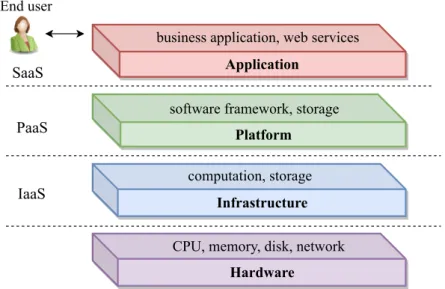
Hardware Infrastructure Platform Application SaaS PaaS IaaS CPU, memory, disk, network computation, storage software framework, storage business application, web services End user
Figure 2.1: Cloud architecture and resource management at each layer
public cloud is managed by the third party, which leaves less control for the organization and its users over the security. The contrary solution is pri-vate (or internal) cloud, where the organization’s customers are in charge of managing the cloud. The storage, computing, and network are dedicated to the customer owning the cloud, and not shared with other customers. This enables the customers to have a higher control on security management and have more insight about logical and physical aspects of the cloud infrastruc-ture. Community cloud refers to the type of clouds that are used exclusively by a community of customers from enterprises with common requirements and concerns (e.g., policies, security requirements, and compliance consid-erations). The last model is hybrid cloud that is the composition of several clouds (private, public, and community). According to the needs and budget of the enterprise and how critical its resources are, a suitable deployment model is chosen that can serve the enterprise’s needs the best way [45].
2.1.3 Cloud Architecture and Service Models
The cloud computing services are offered to the customers in three different models [23, 47], and depending on the need of the consumer/enterprise, a suitable delivery model is deployed and adapted: Infrastructure as a Ser-vice (IaaS), Platform as a SerSer-vice (PaaS), and Software as a SerSer-vice (SaaS). Figure 2.1 illustrates the cloud architecture and the resource management at each layer [23]. TheIaaS model offers storage, network and fundamental computing resources to the consumers, so that they could deploy and run software such as operating systems and applications. The consumers do not
have control over the underlying infrastructure, however, they could manage and control the storage, operating system and deployed applications, and some of the networking components. The PaaS model offers an integrated environment to the consumer for deploying, building, and testing applica-tions using programming languages, tools and libraries supported by the service provider. The consumer has no control over the underlying cloud infrastructure (e.g., server, operating system, storage). In the SaaS model, the main services offered by the service providers to the consumer are the ap-plications that are hosted and executed on the cloud and are available to the customers through the network, typically over the Internet. In this model, the consumer has no control over the underlying infrastructure including servers, operating system, network, and storage.
2.1.4 Virtualization Models
During the past decade various virtualization mechanisms have been devel-oped, including hypervisor-based virtualization and container-based virtu-alization. In hypervisor-based virtualization, a hypervisor (Virtual Machine Monitor (VMM)) is running on top of the server hardware enabling mul-tiple VMs to share virtualized hardware resources. This, in fact, means that different operating systems (e.g., Linux, Windows) can run on top of the hypervisor on the same physical platform. However, in container-based virtualization (also referred to as operating-system-level virtualization), vir-tualization happens at the operating system level rather than the hardware. That is to say, only one operating system can run on top of the platform, and the containers share the kernel of this operating system. In other words, operating system virtualization allows running a multitude of execution en-vironment instances on a single kernel. Figure 2.2 illustrates the architecture of these two virtualization models. A container is considered as a lightweight operating system that runs inside the host system, with the instructions that are native to the core CPU. This, in effect, eliminates the need for just-in-time compilation or instruction level emulation [25].
Containers and VMs are similar in the sense that they offer resource iso-lation and allocation benefits and meanwhile, different in function. In the container-based virtualization the operating system is virtualized, while in the hypervisor-based virtualization the hardware is virtualized. There are advantages and disadvantages associated with each of these virtualization models. Due to the fact that containers are more lightweight in compari-son to VMs, they have lower performance overhead, take less storage, and they boot faster than the guest operating system. On the other hand, the container-based virtualization has lower flexibility considering that the base operating system is shared and the containers are hosted with the same operating system that the hosting platform uses.
Figure 2.2: Hypervisor-based vs. container-based virtualization
2.1.5 Status of Security in Cloud Computing
The convenience and efficiency offered by cloud computing have encouraged more users to turn towards this technology. Cloud service providers have a strong incentive of keeping their software proprietary due to competitive advantages, and as well are reluctant to report bugs and security incidents to maintain the reputation of their business. In addition, in cloud computing where the computing (storage and services) happens outside the organiza-tion’s premises, the customers are neither aware of the location where their data is stored/processed, nor have any knowledge of the way cloud infras-tructure is being managed. The client organizations with more strict data protection policies are unwilling to confide their data to service provider, with the concern that their data might be accessed by an unauthorized party (including cloud provider itself), and might be utilized in an unwanted manner. Furthermore, due to the nature of virtual environment, in order to support the cloud’s multi-tenancy attribute, some additional layers are added to the architecture: the hypervisor that resides between the hardware and the operating system, and the operating system which is running on the VMs on top of the hypervisor. In addition to the risk of security attacks that existed in the traditional computing systems, the added layers have intro-duced new attacks and expanded the attack surface. These concerns on the security, confidentiality and integrity of the data have become the primary issue of trust from clients towards the cloud provider, which therefore has slowed down the pace of cloud computing adoption into the businesses.
The role of security community is to provide strong security measures to firstly secure cloud infrastructure in its all layers so to protect the data being stored or processed on cloud provider side from external threats. Secondly, they should provide and develop security measures to protect the customers’ data from cloud service provider, so to guarantee the confidentiality and integrity of data even if the cloud provider is compromised or malicious.
2.2
Internet of Things
2.2.1 Definition
Decades after the advent of the Internet, the emerging era of ubiquitous computing began and the continuous connectivity is no dream anymore. One of the prominent elements of pervasive computing is Internet of Things (IoT) or Internet of Everything. The term was used for the first time by MIT Auto-ID Labs in 1999 [17]. IoT embeds computational capabilities into the everyday used objects, and enable their connectivity to each other and to the Internet from anywhere at any time. The term Internet of Things is composed of two significant pillars of ”Internet” and ”Things”. The notion ”Things” encompasses any object that is able to connect to the Internet, including sensors, smart devices, and any other element that is capable of communicating with other entities. IoT is regarded as the third revolution in information technology after Internet and mobile communication networks. Today, IoT is used in multitude of public and private sectors in various applications including healthcare, smart spaces, wearable data monitoring systems, smart lighting, and farming.
2.2.2 Operating System and Software on IoT Devices
IoT comprises a wide variety of heterogeneous components with varied func-tionalities and computing capabilities ranging from sensors with lightweight 8-bit micro-controllers, to powerful 32-bit processors (e.g., PCs and smart-phones). On that account, the designed operating system and the software should be adaptable by all ranges of objects participating in the network including the low-powered ones. Moreover, in addition to supporting the functionality of the ubiquitous devices, the software should also be compat-ible with the limitation of these devices, in terms of memory, computational power, and energy capacity. Baccelli et al. [14] discuss that the software de-signed for IoT devices should be a) dede-signed considering the heterogeneous hardware constraints: the IoT software should operate with low complexity and have fairly low memory requirement; b) programmable: the IoT soft-ware should provide a standard application-program interface (API) and support the standard programming languages (such as C, C++) for appli-cation developers; and c) autonomous: for energy efficiency purposes, the software should consider sleeping cycles for energy saving at the times that the hardware is in idle mode. Moreover, due to the fact that IoT is de-ployed in critical systems, it is essential that the operating system functions reliably. These requirements motivated the developers to build operating systems and software that are compatible with all variety of IoT devices with diverse capabilities and capacities, that could both leverage the capa-bilities of the more powerful devices and could also be run on the
power-restricted devices. Table 2.1 lists some of the operating systems designed for such low-end embedded devices. The most widely used operating systems for IoT devices are Contiki [26] and TinyOS [41]. Contiki [26] is an open-source operating system, developed in C language to operate on low-power memory-restricted devices (by requiring only a few kilobytes of memory). Through supporting networking standards (e.g., CoAP, IPV4, and IPV6) Contiki enables the low-power microcontrollers to connect to the Internet. TinyOS [41] is as well an open-source operating system that is developed in nesC [9] language (an extension of C). Similar to Contiki, TinyOS is mul-tithreading, event-driven, and is designed according to a component-based programming model with monolithic structure. TinyOS is specifically de-signed for the sensor network devices with constraint resources (e.g., 512 bytes of RAM and 8Kb of memory).
Table 2.1: Operating systems for embedded devices
OS Overview Characteristic Lang. Open
source Contiki designed for WSN and
memory-efficient embed-ded systems network
Modular structure, multi-tasking, multi-threading, event-driven
C 3
TinyOS Intended for the low-power wireless devices
Monolithic struc-ture, multi-threading, event-driven NesC 3 RIOT OS
Real-time Modular structure,
multi-threading
C, C++
3 Mantis Designed for WSN. It
presents C API with Linux and Windows de-velopment environments.
Threads C 3
Nano-RK
Equipped with a light-weight resource kernel and networking support for WSN.
Threads C 5
LiteOS UNIX-like OS for WSN Threads and Events LiteC++ 3 Free
RTOS
Real-time OS designed for embedded devices
Multi-threading C 3
Linux Various Linux distribu-tions can run on IoT de-vices, e.g. Raspbian and Ubuntu Core Monolithic structure, event-driven C, C++ 3
2.2.3 Protocols Used for Connection of IoT Devices
Considering TCP/IP as the de facto standard for the communication net-works, some are on the opinion that it could also be used in IoT in the future. However, at this point the low capacity of the IoT devices makes the deployment of IPv6 for connecting such devices challenging. Therefore, the Internet Engineering Task Force (IETF) has presented protocols that are adaptable to this environment, with the assistance of which the normal IP-based devices (e.g., PCs and smartphones) can connect to the low-end devices. Since the IoT devices may use different protocols to communicate, the protocols should be translated to a standard protocol using XML, JSON, or RESTful APIs. The following ones are some of the most commonly used protocols for connecting the IoT devices to each other through the Internet: • User Datagram Protocol (UDP) [49] is the most commonly used
pro-tocol at the transport layer for the low power networks.
• Constrained Application Protocol (CoAP) [53] is an application-layer protocol built on UDP and is compatible with resource constrained nodes, and replaces HTTP as it has higher overheard for IoT.
• IPv6 over Low Power Wireless Personal Area Networks (6LoWPAN) [8] is a protocol that comes as an adaptation layer between the link and network layers, and allows transmission of packets over IEEE 802.15.4-based network. It presents packet fragmentation and header compres-sion to decrease datagram size.
• Message Queuing Telemetry Transport (MQTT) [34] is a publish/-subscribe messaging protocol for communication of the devices and servers. It is a many-to-many protocol, i.e., the messages are trans-ferred between clients via a central broker. The protocol is designed on top of TCP/IP, thus the connection can be encrypted with SSL/TLS. • Advanced Message Queuing Protocol (AMQP) [58] is an
application-layer protocol that reuses the underlying transport models (e.g., TCP/IP and UDP) and connects servers together. AMQP offers flexible routing and queuing system.
• Extensible Messaging and Presence Protocol (XMPP) [2] is protocol based on XML that provides instant messaging and presence function-ality services. XMPP is used to connect devices to servers.
2.2.4 Security Status of IoT
From the advent of IoT technology, the focus of the service providers prin-cipally has been on operability and availability of the IoT services. Often,
security of the devices and privacy of their users were afterthoughts. This is while IoT has gained more and more popularity and more sensors, actuators, and devices are connecting to each other and to the Internet. The number of connected devices is projected to reach 75.44 billion by 2025, which is about 5 times increase in 10 years time (2015 - 2025) [6]. These objects/de-vices/sensors collect a great deal of data and share them over the Internet. Some of these data contains sensitive information about users such as per-sonal, financial, and the physical location of the users. Leaking of such data could not only result in violation of the users’ privacy, but could also endan-ger their safety and security. HP Security Research conducted a review on the most commonly used IoT devices, and the report shows that 70% of the devices are vulnerable with very high rate of vulnerabilities per device [7]. These vulnerabilities include Heartbleed, denial of service, weak passwords, and cross-site scripting. Considering the fact that IoT is established on the Internet, it is prone to the traditional security risks for the Internet. In ad-dition to those risks, the dynamic nature of the IoT environment, along with the heterogeneity and large scale of devices, make the traditional security issues more critical and also present new security challenges. OWASP [11] has listed the following as the 10 top vulnerabilities that IoT devices suffer from: easily guessable and brute-forced passwords, insecure network ser-vices, insecure ecosystem interfaces, lack of secure update mechanism, using outdated and insecure components/libraries on the device, lack of sufficient privacy protection mechanism, insecure transmission and storage of data (no encryption and access control mechanism), absence of device management, insecure default setting, and absence of physical hardening measures.
Securing the IoT devices and protecting the collected and shared data is exceedingly significant. However, special characteristics of IoT devices have made securing of them a challenging task compared to the traditional com-puting devices. These special characteristics include low capacity of devices in terms of memory and computational power, heterogeneity of devices with different capabilities, scalability of network, wireless connection of devices to network (via Wi-Fi, ZigBee, Bluetooth), mobility of the devices in the network, and the single-purpose design of the embedded IoT devices. There-fore, it is essential that the security measure that is designed to protect the security and privacy in IoT is lightweight, tolerable by the devices, and is compatible with the limitations of the IoT devices.
2.3
Obfuscation
Code obfuscation is the process of scrambling and transforming the code to an unintelligible form that is more complex, and harder to read and com-prehend. The obfuscated code is syntactically different, but still functional
and semantically equivalent to the original code [20]. With the help of ob-fuscation transformations, even if an adversary obtains the program’s source code, it takes more time and energy to comprehend the code and reverse engineer it. Obfuscation does not guarantee that the program will not be tampered with or reversed engineered, but it advances the level of defense by increasing the effort and cost for the attacker to learn the functionality of the obfuscated program.
Figure 2.3a shows a simple piece of C code and Figure 2.3b shows the obfuscated version of this code using a free online obfuscation tool [10]. The obfuscated version of the code is not easy to read and understand. Certainly, with given resources and time the attacker may be able to comprehend and reverse engineer the code, albeit requiring higher time and energy.
#include <stdio.h> int main(){int o_29fb4af0a1adf7ee01a3b3dd06bbe963,o_c3fc214552f8031f1447db420dff1c96,o_eab5836874947171c8ad490372fe6348= (0x0000000000000000 + 0x0000000000000200 + 0x0000000000000800 0x0000000000000A00),o_31b27256bfe8509585c3676eed39aaca=(0x0000000000000002 + 0x0000000000000201 + 0x0000000000000801 0x0000000000000A03),o_ae6b7175f17dcdedea722a581a2ca6b9;printf("\x45""n\164e\x72"" \164h\x65"" \156u\x6D""b\145r\x20""o\146 \x74""e\162m\x73"":\040");scanf("\x25""d",&o_c3fc214552f8031f1447db420dff1c96);printf("\x46""i\142o\x6E""a\143c\x69"" \123e\x72""i\145s\x3A"" ");for (o_29fb4af0a1adf7ee01a3b3dd06bbe963 = (0x0000000000000002 + 0x0000000000000201 + 0x0000000000000801 0x0000000000000A03);(o_29fb4af0a1adf7ee01a3b3dd06bbe963 <= o_c3fc214552f8031f1447db420dff1c96) & !!(o_29fb4af0a1adf7ee01a3b3dd06bbe963 <= o_c3fc214552f8031f1447db420dff1c96);++o_29fb4af0a1adf7ee01a3b3dd06bbe963){printf("\x25""d\054 ",o_eab5836874947171c8ad490372fe6348);o_ae6b7175f17dcdedea722a581a2ca6b9 = o_eab5836874947171c8ad490372fe6348 + o_31b27256bfe8509585c3676eed39aaca;o_eab5836874947171c8ad490372fe6348 = o_31b27256bfe8509585c3676eed39aaca;o_31b27256bfe8509585c3676eed39aaca = o_ae6b7175f17dcdedea722a581a2ca6b9;};return (0x0000000000000000 + 0x0000000000000200 + 0x0000000000000800 0x0000000000000A00);}; #include <stdio.h> int main() { int i, n, a = 0, b = 1, nextTerm; printf("Enter the number of terms: "); scanf("%d", &n); printf("Fibonacci Series: "); for (i = 1; i <= n; ++i) { printf("%d, ", a); nextTerm = a + b; a = b; b = nextTerm; } return 0; } Obfuscation (a) (b)
Figure 2.3: Excerpt from obfuscated piece of C code: a) original code, b) obfuscated version of the same code
In the literature, there has been a large body of research on the various obfuscation mechanisms [21], each of which has different target for applying obfuscation transformation, and at various phases of the software develop-ment life-cycle [33]. According to the taxonomy presented by Collberg et
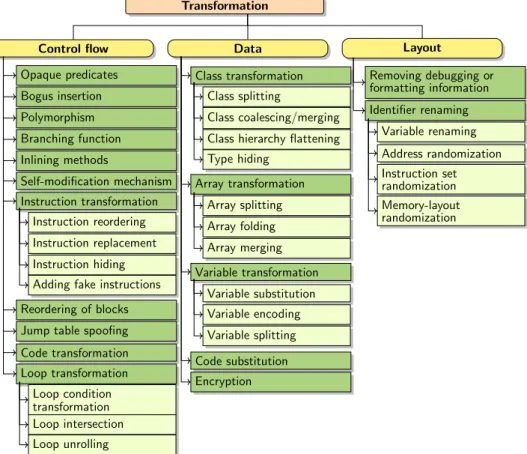
al. [21] the target of obfuscation could be control flow, data, and program layout. For achieving each of these obfuscation transformations, there exist a wide range of mechanisms. Control flow obfuscation is one very common way of concealing the program flow. To obfuscate the program’s control flow, opaque predicates could be used [22]. An opaque predicate is a Boolean ex-pression in a program code that is designed to be executed always the same way. Although the outcome of this execution is always known to the ob-fuscator in a priori, it still is evaluated at execution time to make the code analysis harder and more cumbersome. Bogus (dead/gray/dummy code) insertion [27, 59] is another common control flow obfuscation technique that is used to confuse the code analyzing tools, by adding a piece of code that is never executed. Data obfuscation attempts at obscuring data and concealing data structure of a program. Some of the obfuscation mechanisms that fall in the category of data obfuscation are class transformation [56], and array transformation [24]. The third category is layout transformation which is a type of obfuscation that targets the program’s layout structure, for instance through renaming the identifiers [35], Instruction Set Randomization (ISR) [57], and Address Space Layout Randomization (ASLR) [44].
Code obfuscation has been proposed and used by software developers for various purposes [33], including protecting secrets and data in a program, protecting protocols from spoofing, protecting program from tampering and illegitimate modification, making code analysis difficult, protecting digital watermarks and birthmarks in programs, and protecting mobile agents. Like many other security measures, obfuscation has also been used by malware developers to conceal the malware’s malicious code from being detected by the scanners [64].
2.4
Diversification
Software diversificationis changing the structure andinternal interfaces
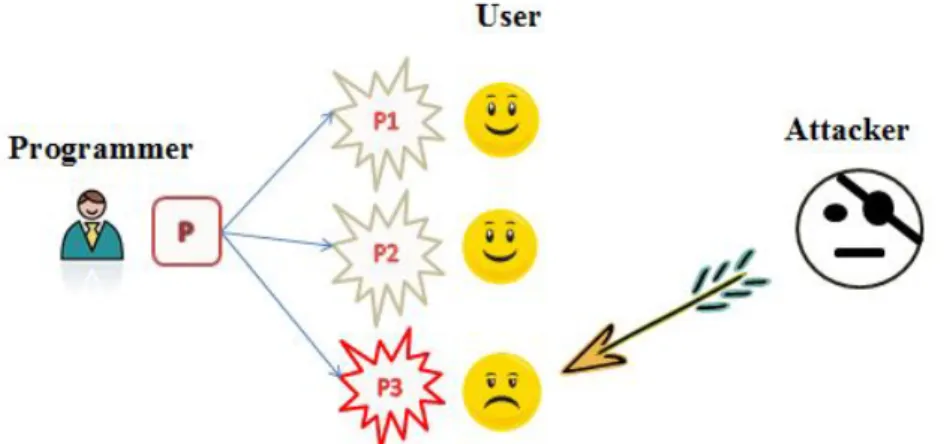
of a program in order to generate unique diversified versions of this program. Unique instances of the software are distributed among the users. These in-stances are all functionally the same, but differently diversified. This means that diversification breaks the monoculture software distribution model and introduces multiculturalism in software deployment process. The security benefit of the multicultural software deployment model is impeding the risk of large-scale attacks. Even supposing that the attacker manages to crack one instance of the software and utilize some non-public internal interface, on account of the fact that software instances are unique, the attacker cannot access other instance. In other words, the attack model must be designed individually for each particular software instance and the same attack model does not work on all software instances. Therefore, diversification is a very
Figure 2.4: Software diversification
effective technique for securing largely distributed systems and also the sys-tems in the current era of operating system and interface monoculture. Fig-ure 2.4 shows the unique design and distribution of the diversified software instances, and how diversification thwarts the risk of large-scale attack.
In order to access the resources of a system, interfaces are used. Di-versification alters the internal interface(s) to secret ones. Diversifying the internal interfaces of the software creates a unique secret that is propagated only between the legal ”clients” of the interface (i.e., they are also diversified to be compatible with inner layers), to maintain their communication be-tween each other. The diversification secret is kept private from illegitimate parties to prevent their access to the diversified resources.
Interface diversification introduces proactive protection against malware, especially when it is applied throughout all the interface layers. Malware (malicious software) is a piece of software that is designed to run its code on a user’s computer to disrupt its operation or manipulate the system in the way that the attacker desires [55]. To do this, malware needs to gain knowl-edge on the system, its environment, and how to interact with it and access its resources. Software diversification modifies the internal interfaces of the software and makes it challenging for the malware to get such knowledge. Consequently, the malware code becomes incompatible with the system’s environment and when not able to interact with it, it becomes ineffective. To achieve this, many different diversification techniques have been pro-posed that each target various parts in software layer. Depending on the need of the system, different diversification mechanisms could be employed. Diversification mechanisms could be as simple as name changing or a more complex technique such as system call diversification.
from the operating system kernel. System calls as part of overflow attacks could be misused by a malware to access the operating system and carry out its malicious intend. Diversification of the system calls could conceal their interface and make them inaccessible by the malware. Symbol diver-sification [39] diversifies the indirect library entry points to the system calls by renaming the symbols in Linux binaries. This makes it difficult for the malware to use these entry points and system’s resources, because it does not know the diversification secret (the function that relates the original and new symbol names). Liang et al. [42] propose a system call randomization approach to counter code injection attacks. This type of attacks uses system calls to inject code. By randomizing these system calls, the attacker who does not know the randomization algorithm key, will inject a code that is not randomized in the same way that the target process has been randomized, so it is not valid for the de-randomized module. Thus, the injected code fails to execute without correctly calling the system calls. Address Space Layout Randomization (ASLR) [44] is another practical and effective diver-sification technique that protects the operating system from buffer overflow by randomizing the location of the executables in the memory [35]. This, randomizes and reshuffles the address space locations of a process (the base of the executable, heap, stack, and library position). Here, the memory could be seen as an interface that after diversifying it, the attacks that rely on the known layout structure are prevented.
Software diversification has many parallels with code obfuscation. Whilst the main goal of these two software security approaches are different, many of the techniques developed for software obfuscation can be parameterized for software diversification purposes. This means that obfuscation could be applied to generate diversified versions of the code, and obfuscation could be applied to make diversified software less understandable and distinguished from equivalent versions. These two techniques do not aim to eliminate software vulnerabilities, but make it difficult for an attacker to exploit these vulnerabilities and conduct a successful attack. In the literature, there exist a wide range of studies on applying these two techniques for securing various execution environments [32] such as cloud computing [37, 50], IoT [29, 30], mobile and embedded systems. The studies show that the two techniques have been successful in mitigating the risk of a wide range of attacks [32] including buffer overflow, injection attacks, Return-Oriented Programming (ROP) attacks, and JIT spraying attacks. Diversification and obfuscation could be applied on different parts of software at different phases of develop-ment process: design and impledevelop-mentation, compilation and linking, loading, installation and update, and execution. The most common phase is compile time (i.e., at the time the program is compiled and linked) [33].
It is worthwhile discussing here how obfuscation and diversification differ from security through obscurity. Security through obscurity protects the
code/secret/asset by concealing it. This means that the asset is safe until it is not discovered. When it is discovered, it is no longer safe, and the system is vulnerable. This is while that obfuscation does not try to hide the program but instead secures the program, even in the case that the source code or the binary code of the program is revealed. This means that even if the attacker gets access to the code, he/she cannot read/understand it, because it is obfuscated in a way that the attacker does not know. For instance, in source code obfuscation the code is not hidden but it is obfuscated in a way that it is difficult to comprehend and reverse engineer.
Diversification removes the knowledge necessary to interact with the environment and access the resources, i.e., the previously publicly known interfaces towards the system resources are removed, and thus, the system is hardened. For instance, in symbol diversification [39] the indirect library entry points to the system calls are renamed. This means that the old names are not hidden, but they do not exist anymore.
Therefore, security through obscurity could be valuable to add a valid layer of security, but it cannot be a sufficient and strong security mechanisms by itself and cannot substitute the security for secrecy.
2.5
Trusted Computing
Trusted computing (TC) is a technology that leverages a hardware-based roots of trust to improve computer security through hardware enhancements and alteration of the associated SW. TC creates a secure environment re-ferred to as Trusted Computing Base (TCB) which provides privacy protec-tion and trust. TCB assures the security of the system and guarantees that it is behaving in the expected manner. Different hardware manufacturers have promoted and developed specifications to protect computer resources from the access of malicious entities. Trusted Platform Module (TPM) [13] is a tamper resilient co-processor chip that is designed by Trusted Com-puting Group consortium [12], to provide security solutions to its hosting platform. These solutions include trusted boot, secure storage, integrity measurement, remote attestation, and cryptographic functionalities. Today, a large number of computing devices are equipped and shipped with TPM and benefit from the security guarantees that it offers. TPM specification version 1.2 was first published in 2011, and a newer version of it, TPM 2.0, was released to the market with stronger cryptographic capabilities and al-gorithm supports. TPM provides Root of Trust for Storage (TRS), Root of Trust for Reporting (RTR), and Root of Trust for Measurement (RTM) [62]. RTS offers a protected and secure repository to store the sensitive data and cryptographic keys. It also contains a cryptographic engine to securely conduct lightweight cryptographic operations. RTR offers a
pro-tected environment and interface that is responsible for managing identities and signing the assertions. It cryptographically binds the information to a specific device, in order to prove the integrity and non-repudiability of the information. RTM provides the measurements on the platform’s trust sta-tus. These services offered by TPM, make the identification, authentication, integrity verification, and encryption of a device feasible.
Remote attestation which is the primary attribute provided by TC tech-nology extends the trust from the lower levels, towards the upper levels and applications. This step-by-step verification of trust is known as the chain of trust, in which all the component are considered untrusted and are measured before they are loaded or executed. A TCB measures the integrity of the platform both at the boot time and at the run time. At the time of system boot, it needs to be assured that the system is being booted correctly, and it is running the appropriate operating system. This is achieved by creat-ing a chain of trust startcreat-ing from the Core Root of Trust for Measurement (CRTM). CTRM is a trusted code in the BIOS boot block that measures the integrity values of other components, and stays unaltered during the whole platform’s lifetime. CRTM is an extension of normal BIOS that is run to measure the integrity of other parts of the BIOS block. The BIOS measures the hardware and the bootloader, and then it passes the control to the bootloader. The bootloader measures the kernel image of the operating system and passes the control to the operating system. Based on the taken measurement values in each of the steps in the boot process, the appropri-ate Platform Configuration Register (PCR) value is updappropri-ated [63]. Storing a new value to the PCR works by extending the existing value with a new value. TPM PCRs are the protected memory locations for storing sensitive information, such as integrity measurement values that attest the system’s integrity. Besides the strong isolated storage that the TPM offers, it also holds a set of keys that assist at the time of attestation, Endorsement key (EK) and Attestation Identity Key (AIK). EK is an RSA key pair that is used for cryptography operations such as digital signature operation. This key is a pair of public and private key that is generated at time that TPM is being manufactured. The private part of the key is tied to TPM and never leaves it. EK is used for signing the information that is generated inside the TPM, such as PCR values. AIKs are the keys that are used at the time of remote attestation, to preserve the privacy of the platform’s identity. When a platform (attester) receives remote attestation request from a verifier, it sends out an integrity report that is composed of PCR values and their dig-ital signature computed with an AIK. Due to the fact that the private part of the AIK’s key pair never was released from TPM, a certified authority can certify the authenticity of it. This is a guarantee for the integrity and authenticity of the report [62].
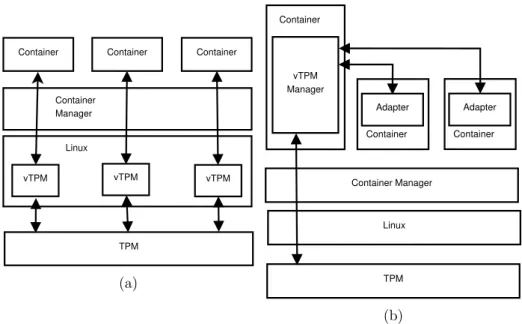
and has reduced the costs associated with the ownership of computer sys-tems. This technology has especially been advantageous for systems that share hardware platform among multitude of software workloads with the aim of cost reduction and utilization improvement. Cloud computing is one of these systems that have benefited from hardware/platform virtualiza-tion. The added benefits have also introduced security concerns due to the shared resources. The software workloads that are sharing the same hard-ware should be kept separate from each other to protect their security and maintain the software integrity. Virtual Machine Monitor (=hypervisor) is a proper solution for isolating these workloads, and TC is a suitable technol-ogy to provide hardware based root of trust, guaranteeing software integrity and mitigating the software attacks. Hence, combination of these technolo-gies is a well-fitting solution in this scenario. Virtualization of the TPM was proposed [16] to make TPM functionalities available to all VMs running on a platform, in a way that there is only one physical TPM per platform which is virtualized. Each VM receives its own virtual TPM (vTPM) instance and these vTPM instances act just as physical TPMs and offer the same func-tionalities as the hardware TPM. Due to the fact that vTPM is software based, it has more flexibility comparing with physical TPM.
2.6
Trusted Execution Environment
A Trusted Execution Environment (TEE) [51] is a secure integrity-protected processing area inside the main processor with memory and storage capabil-ities. It runs in an isolated environment in parallel to the operating system, and guarantees the confidentiality and integrity of the code and data that is loaded in the TEE. The trusted applications that run in TEE have access to the processor and memory of the device. Hardware isolation secures these applications from the other applications installed by the user that run in the operating system. Cryptographic software isolation inside these trusted environments protects different applications from each other. The primary concepts of a TEE are security, trust, and isolation of critical data. TEE enables device identification through root of trust which enables the stake-holders to identify the authenticity of the device that they are interacting with. Also, it cryptographically protects the data that is processed and the applications that are executed in it.
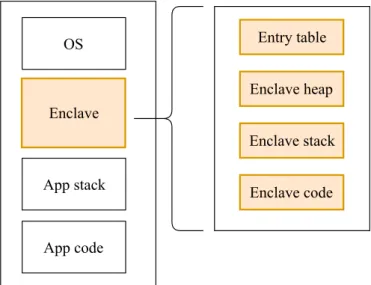
IntelR SGX [4, 5] is a hardware-based TEE solution developed to provide isolated execution. SGX is a set of new instructions and modifications to the memory access, added to the IntelR architecture that enable an application to instantiate a highly protected container called enclave. Enclave is referred to the protected area in the address space of an application that guarantees integrity and confidentiality, even in the presence of malware. This protected
memory area is accessible only by the software that resides in the enclave, and access is prevented for the applications outside it, even for the privileged software such as hypervisor, BIOS, or operating system [46]. The memory area utilized by an enclave is encrypted in order to protect application’s secrets from adversaries with access to the memory. Some instances of the typical use cases of enclave are password managers, password input, and cryptographic operations. Figure 2.5 shows the enclave secure container within the application’s virtual address space [46].
OS Enclave App stack App code Entry table Enclave code Enclave heap Enclave stack
Figure 2.5: Excerpt of an enclave within application’s virtual address space
In the recent years, Intel SGX has received considerable attention by virtue of the fact that it could be a practical solution for various domains including trustworthy public cloud. Confidentiality and integrity assurance have always been a major concern and obstacle on cloud adoption. These concerns could be alleviated through the use of Intel SGX.
Despite of the great advantages that Intel SGX has introduced, it has recently shown to be prone to several side-channel attacks that attempt to extract some information about the program running in an enclave. One of these side-channel attacks is the branch shadowing attack [40] that aims at learning the secret-dependent control flow of the code running inside an enclave. To do this, the attack misuses the Branch Prediction Unit (BPU) of the CPU to identify whether an instruction is executed/taken or not, and also the target of the branch. BPU is a feature in modern processes to improve performance through instructions pipelining before exact branching decisions are known. In other words, based on the recent branch history, BPU speculates whether or not a branch is taken, and also the targets of indirect branches. Similar to branch-shadowing attack that uses BPU
and CPU’s speculative execution feature, Meltdown [43] and Spectre [36] also misuse the critical vulnerabilities of modern CPUs to get hold of the secrets that are stored in the memory of other running applications, such as passwords stored in the browser or password manager, personal emails, photos and business-critical documents stored on the victim’s machine.
Page fault (=control-based) side channel attacks [61] are critical side-channel attacks that allow a malicious operating system to take control over the SGX program’s execution and to extract large amounts of sensitive infor-mation from the protected application. To conduct this type of attack, the malicious operating system interrupts the execution of the enclave, unmaps the target memory pages, and resumes the execution of the enclave. To unmap the memory, the operating system induces page-fault traps through restricting the access to particular data pages or code. At the time when a data object on that particular data page is accessed or a function on that particular code page is called, a page-fault is triggered and the operating system is notified. By observing the pattern and sequence of accessed ad-dresses of data and control transfers, the malicious operating system can infer the sensitive data.
A cache-based side channel attack [19] extracts the secret of an enclave program (e.g., RSA key) through monitoring the access patterns of the caches that are shared between enclave and untrusted software. This moni-toring could be done through Prime+Probe cache monimoni-toring technique [48]. In this technique, the adversary fills up all the cache lines. Then the victim accesses a cache line. The adversary detects whether or not the cache line is used by the victim through checking if its cache entry has been evicted.
Intel has stated that these side-channel attacks are beyond the scope of SGX and it is the responsibility of the developer to mitigate the risk of such attacks [3]. In this regard, researchers and developers have developed several defense mechanisms to mitigate these side-channel attacks, such as T-SGX [54] and SGX-Shield [52] as mitigating solutions to the controlled-channel attack, DR.SGX [18] to mitigate cache attacks on enclave, and mitigating solutions to thwart the branch-shadowing attacks [31].
![Figure 3.4: Attacks that could be thwarted using diversification and obfus- obfus-cation techniques [32, 33]](https://thumb-us.123doks.com/thumbv2/123dok_us/10117024.2912254/50.892.212.669.293.583/figure-attacks-thwarted-using-diversification-obfus-cation-techniques.webp)