D at a a nd M et ad at a R ep o rti ng a nd P re se nt at io n H an d b o o k 2007
Data and Metadata
Reporting and
Presentation Handbook
2007
AVAILABLE ON LINEData and Metadata Reporting and Presentation Handbook
The OECD Data and Metadata Reporting and Presentation Handbook contains guidelines and recommended best practice for the presentation of statistical data and metadata disseminated by national agencies and international organisations in various dissemination media. The Handbook brings together in one publication relevant presentation guidelines embodied in existing international statistical standards where they exist. The Handbook also presents for the first time a standard set of terminologies and guidelines for the presentation of growth rates, indices and seasonally adjusted data developed by the OECD Short-Term Economic Statistics Working Party.
The need for a comprehensive data and metadata presentation Handbook comes from the imperatives to improve the quality of statistics presented to users at both the national and international levels, in particular, with respect to interpretability and coherence (within datasets, across datasets, over time and between countries) and the need to minimise the reporting burden of national agencies in their provision of data and metadata to international organisations.
The Handbook also contains recommendations on a small number of key data presentation
areas that can also have a significant impact on data interpretability and where different approaches currently used by national and international agencies complicate the co-ordination of data collection by different organisations and comparisons of national data, etc.
Such presentation practices involve: • data revision;
• series breaks;
• presentation of sampling and non-sampling errors; • practices for re-basing indices;
• citation practices;
• availability and presentation of metadata; • presentation of administrative data.
ISBN 978-92-64-03032-9
30 2007 02 1
-:HSTCQE=UXUXW^:
The full text of this book is available on line via this link:www.sourceoecd.org/statisticssourcesmethods/9789264030329 Those with access to all OECD books on line should use this link:
www.sourceoecd.org/9789264030329
SourceOECD is the OECD’s online library of books, periodicals and statistical databases.
For more information about this award-winning service and free trials ask your librarian, or write to us at [email protected].
ORGANISATION FOR ECONOMIC CO-OPERATION AND DEVELOPMENT
Data and Metadata
Reporting
and Presentation
Handbook
ORGANISATION FOR ECONOMIC CO-OPERATION
AND DEVELOPMENT
The OECD is a unique forum where the governments of 30 democracies work together to address the economic, social and environmental challenges of globalisation. The OECD is also at the forefront of efforts to understand and to help governments respond to new developments and concerns, such as corporate governance, the information economy and the challenges of an ageing population. The Organisation provides a setting where governments can compare policy experiences, seek answers to common problems, identify good practice and work to co-ordinate domestic and international policies.
The OECD member countries are: Australia, Austria, Belgium, Canada, the Czech Republic, Denmark, Finland, France, Germany, Greece, Hungary, Iceland, Ireland, Italy, Japan, Korea, Luxembourg, Mexico, the Netherlands, New Zealand, Norway, Poland, Portugal, the Slovak Republic, Spain, Sweden, Switzerland, Turkey, the United Kingdom and the United States. The Commission of the European Communities takes part in the work of the OECD.
OECD Publishing disseminates widely the results of the Organisation’s statistics gathering and research on economic, social and environmental issues, as well as the conventions, guidelines and standards agreed by its members.
Also available in French under the title:
Manuel sur la présentation et sur le rapport de données et de métadonnées
© OECD 2007
No reproduction, copy, transmission or translation of this publication may be made without written permission. Applications should be sent to OECD Publishing [email protected] or by fax 33 1 45 24 99 30. Permission to photocopy a portion of this work should be addressed to the Centre français d’exploitation du droit de copie (CFC), 20, rue des Grands-Augustins, 75006 Paris, France, fax 33 1 46 34 67 19, [email protected] or (for US only) to Copyright Clearance Center (CCC), 222 Rosewood Drive Danvers, MA 01923, USA, fax 1 978 646 8600, [email protected].
This work is published on the responsibility of the Secretary-General of the OECD. The opinions expressed and arguments employed herein do not necessarily reflect the official views of the Organisation or of the governments of its member countries.
FOREWORD
The Data and Metadata Reporting and Presentation Handbook provides a single comprehensive reference set of international guidelines and recommendations for the reporting and presentation of statistical data and metadata. Although, the Handbook was prepared primarily for short-term economic statistics, many, if not most of the recommendations presented are also relevant for annual (structural) statistics and for social and population statistics. The Handbook draws heavily on existing international statistical guidelines and recommendations that have been developed over the last twenty years by international organisations and national statistical agencies. These international standards have been developed for implementation by international organisations themselves and by national agencies in both developed and developing economies.
The need for the articulation of a comprehensive set of recommendations on the reporting and presentation of statistical data and metadata is one aspect of the overall demand for improved international comparability and consistency of statistics compiled and published by national agencies and international organisations. This requirement has itself been driven by closer economic and social linkages between both the 30 OECD Member countries and between those countries and large emerging non-member economies. As discussed in the Handbook, the major causes of differences in statistics compiled in different countries flow from the use of different definitions and concepts and differences arising from varying collection and statistical data transformation practices. Even where differences in these areas are minimal the statistics disseminated by different countries may actually look different because of the use of different data reporting and presentation practices. These differences can have considerable impact in an environment where users have ready access to a bewildering amount of statistical information facilitated through the availability of on-line databases and statistics on the Internet at both the national and international levels.
Data and metadata reporting and presentation standards cover a very large number of issues and some subjectivity has been applied in the selection of issues covered in the present Handbook. Following the release of this publication the intention is to locate a more interactive version on the OECD statistics website where existing guidelines can be modified or new issues emerging over time can be incorporated. Such new issues could for example be driven by the continuing impact of new technologies used for the dissemination of statistics to both generalist and specialist users.
It is unreasonable to expect that differences in statistics compiled by national agencies in the context of national social and economic environments to address specific national requirements will disappear overnight, if at all. For this reason, one of the underlying themes throughout the Handbook is the need for both national agencies and international organisations to improve the transparency of methodologies, concepts, etc., they apply in the collection and compilation of statistics. Internet based technologies provide an ideal platform that gives users ready access to such information as well as the statistics they describe.
It is recognised that the implementation of some (though not all) of the recommendations included in this Handbook (which are summarised in Section 1.2.3) will require expenditure of resources. Options to minimise this therefore entail:
DATA AND METADATA REPORTING AND PRESENTATION HANDBOOK - ISBN 92-64-03032-8 - © OECD 2007 4
• selective / co-ordinated implementation through phasing in on the basis of dialogue between national agencies and international organisations; or
• progressive implementation at the time of the revision of the various statistics, etc., according to the specific rates / rhythms of each country.
This Handbook draws heavily on the work of many national statistical institutes, central banks, etc., working in the OECD’s Short-term Economic Statistics Working Party (STESWP) over the last two years and from detailed comments and suggestions from other international organisations, in particular, the European Commission’s Eurostat, the International Monetary Fund, the World Bank and other participants of the Co-ordinating Committee for Statistical Activities (CCSA). The work was coordinated and prepared by Denis Ward, Statistics Directorate, OECD.
Enrico Giovannini Chief Statistician and
Director of the Statistics Directorate OECD
TABLE OF CONTENTS
Foreword... 3
1. Introduction and overview... 9
1.1 Need for data and metadata reporting and presentation standards ... 9
1.1.1 Improved data quality - interpretability and coherence ... 10
1.1.2 Minimisation of reporting burden... 11
1.2 Scope of reporting standards referred to in this Handbook ... 13
1.2.1 Recommendations relevant for different dissemination media ... 15
1.2.2 Future editions of this Handbook ... 16
1.2.3 Summary of recommendations presented in this Handbook ... 17
2. Standards for the reporting and presentation of statistics ... 31
2.1 Overview of relevant existing statistical standards... 31
2.1.1 Need for consistency between different international statistical standards ... 33
2.1.2 Recommended practices to ensure consistency in presentation and reporting practices included in future international statistical guidelines and recommendations ... 33
2.2 National and international publishing manuals and guidelines ... 33
2.2.1 Recommended practices for publication manuals ... 34
2.3 Data and metadata exchange standards ... 34
2.3.1 Overview of data and metadata exchange processes and mechanisms... 34
2.3.2 Statistical Data and Metadata Exchange (SDMX) initiative ... 36
2.3.3 SDMX implementation projects ... 37
3. Importance of use of common terminology ... 39
3.1 Introduction ... 39
3.2 Glossary systems ... 39
3.3 Terminology management ... 42
3.4 Data reporting and presentation terminology ... 43
3.5 Recommended practices to ensure the use of consistent terminology and definitions... 44
4. Guidelines for the reporting of different types of data ... 45
4.1 Introduction ... 45
4.2 Original data ... 45
4.2.1 Recommended practices for original data ... 46
4.3 Indices... 47
4.3.1 Introduction ... 47
4.3.2 Recommended practices for indices ... 47
4.4 Growth rates ... 48
4.4.1 Introduction ... 48
4.4.2 Recommended terminology for growth rates ... 49
4.4.3 Recommended practices for the reporting and presentation of growth rates... 53
4.5 Ratios, proportions, percentages and rates... 54
4.5.1 Introduction ... 54
4.5.2 Recommended practices for the presentation of ratios, proportions, percentages and rates ... 57
DATA AND METADATA REPORTING AND PRESENTATION HANDBOOK - ISBN 92-64-03032-8 - © OECD 2007 6
5. Guidelines for the reporting of different forms of time series data ... 59
5.1 Introduction ... 59
5.2 Terminology ... 60
5.3 Working day adjusted data ... 64
5.4 Seasonally adjusted data ... 64
5.5 Trend-cycle data ... 65
5.6 Recommended practices for the reporting and presentation of different forms of time series data ... 66
5.6.1 Forms of time series data to be presented... 67
5.6.2 Analytical transformations... 68
5.6.3. Information about seasonal adjustment to be provided to users ... 70
6. Guidelines for the reporting and dissemination of metadata ... 73
6.1 Introduction ... 73
6.2 Brief overview of relevant existing metadata standards... 76
6.3 Recommended practices for the reporting and dissemination of metadata ... 78
6.3.1 The need for metadata ... 79
6.3.2 Access to metadata ... 79
6.3.3 Adoption of a set of common metadata items ... 80
6.3.4 Adoption of a common set of terminology for metadata preparation... 82
6.3.5 Unambiguous presentation of similar but not identical statistical data ... 83
6.4 Data Documentation Initiative for Micro-data ... 84
7. Guidelines on key reporting practices ... 87
7.1 Data revision... 88
7.1.1 Typology and terminology ... 88
7.1.2 Context of revisions... 91
7.1.3 Recommended practices for data revision ... 95
7.2 Presentation of series breaks... 104
7.2.1 Introduction ... 104
7.2.2 Approaches to minimising the impact of time series breaks ... 105
7.2.3 Recommended practices for the presentation and reporting of information about series breaks... 105
7.3 Sampling and non-sampling errors... 108
7.3.1 Sampling errors... 108
7.3.2 Non-sampling errors ... 111
7.4 Rebasing indices ... 115
7.4.1 Introduction ... 115
7.4.2 Existing international standards... 115
7.4.3 Compiling rebased (fixed) index numbers ... 116
7.4.4 Presentation and dissemination of rebased indices... 117
7.5 Citation ... 120
7.5.1 Reasons for citation ... 120
7.5.2 Existing citation standards... 121
7.5.3 Data management issues... 122
7.5.4 Recommended practices for citation ... 123
7.6 Administrative data... 125
7.6.1 Introduction ... 125
8. References... 129 Annex ... 139 Glossary of data and metadata reporting and presentation terms... 140
1. INTRODUCTION AND OVERVIEW
1. The purpose of this Handbook is to provide a single comprehensive reference set of international guidelines and recommendations for the reporting and presentation of statistical data and metadata, covering both economic and socio-demographic statistics. The Handbook is designed for use by statistical agencies in both developed and developing countries and by international organisations. To arrive at this set of standards, the Handbook draws heavily from existing guidelines and recommendations on data and metadata reporting and presentation.
2. The benefits of providing such international standards in a single reference source are that it will, among other things, assist in:
• promoting the consistency of methodologies through the standardisation of format, terminology and dissemination of data and metadata used by international and national agencies;
• promoting the comparability of statistical data;
• promoting the use of recommended practice in the presentation of statistics and improve the transparency of such practices to users;
• minimising the reporting burden of providing data and metadata to international organisations; and
• identifying areas where additional guidelines for the reporting and presentation of data and metadata need to be prepared in the future.
3. The remainder of this Section provides an introduction and overview to the Handbook, discussing in Section 1.1 the need for data and metadata reporting and presentation standards and in Section 1.2 the scope of reporting standards covered. Section 1.2.3 contains a summary of all the recommendations provided in the body of the Handbook.
4. The remaining Sections of the Handbook provide: an overview of existing presentation and reporting standards and those currently under development (Section 2); the importance of the use of common terminology (Section 3); guidelines and recommendations for the reporting and presentation of different types and forms of data in time series (Sections 4 and 5 respectively); guidelines for the reporting and dissemination of metadata (Section 6); and finally, recommendations on key reporting practices (Section 7). A comprehensive set of references is provided in Section 8 and, a Glossary of key presentation and reporting terms is located in an Annex at the end of the Handbook.
1.1 Need for data and metadata reporting and presentation standards
5. The need for the articulation of international guidelines and recommendations in this area in one comprehensive document for use by developed and developing countries, and international organisations, has been recognised for some time. The statistics referred to in this Handbook encompass all domains including economic, social and population statistics, and both short-term and structural statistics, together with their associated metadata.
DATA AND METADATA REPORTING AND PRESENTATION HANDBOOK - ISBN 92-64-03032-8 - © OECD 2007 10
6. With the demand for closer integration and co-ordination of the work of the various international organisations, the need for agreement and adoption of a common set of data reporting and presentation practices has become even more pressing. For this demand to be met, agreement on a basic set of practices and guidelines is required not only between international organisations but also by national agencies, the initial source of almost all statistics and metadata entering the international environment.
7. Greater economic integration between the major trading blocs around the globe has also led to further user demand for improved comparability of statistics between countries, and greater data comparability over time for the same time series within the one country. The major causes of real differences in statistics have been identified (Eurostat 2002a, p. 35) as:
• the use of different variable definitions, concepts, units and classifications; and • differences arising from varying collection and processing (transformation) practices.
8. However, even where differences from these factors are minimal, statistics disseminated by different countries, etc. may actually look different because of the use of diverse data reporting and presentation practices. Similarly, statistics for identical statistical domains disseminated by various international organisations, although coming from the same national source, may also appear different due to the application of dissimilar presentation practices and statistical data transformation processes at the international level.
9. There are two broad imperatives relevant at both the national and international levels that justify the need for the articulation of a comprehensive set of standards for the reporting and presentation of statistics and metadata. These concern the need to improve data quality, and to minimise the reporting burden in the provision of statistics (data) and metadata to international organisations.
1.1.1 Improved data quality - interpretability and coherence
10. The first imperative relates to the need to improve the quality of statistics at both the national and international levels. Over the last ten years a number of international organisations and national statistical agencies (such as Eurostat (Eurostat 2003d and Eurostat 2003e1), the IMF (IMF 2003c), OECD (OECD 2003e), Statistics Canada (Statistics Canada 2003), Statistics Denmark (Statistics Denmark 2004), Statistics Finland (Statistics Finland 2002), etc.) have developed quality frameworks as part of initiatives to improve the quality of statistical output disseminated to internal and external users.
11. Each of these frameworks contains a number of common features such as a definition of the “quality” concept, and a list of dimensions that define quality. These dimensions normally include relevance, accuracy, timeliness, interpretability, coherence, etc2. Although each organisation has formulated its own dimension list there is considerable overlap and commonality between them, if not for the actual label applied to the concept, then for meaning. For example, most include “relevance”
1 The quality dimensions outlined in the Eurostat document, Definition of Quality in Statistics (2003e), is used as the basis for
the quality systems and processes implemented by many EU member states.
2 For example, the seven dimensions defined in the OECD’s quality framework are: relevance, accuracy, credibility,
and “consistency”, though a range of labels are applied to the “accuracy” dimension (such as validation, overall accuracy, assessment and validation)3.
12. Most of the dimensions defined in quality frameworks are relevant for data and metadata presentation and reporting, and the quality frameworks cited above contain numerous specific examples of the compilation of quantitative and qualitative indicators to measure the various dimensions for specific statistical output. However, the quality dimensions that are particularly relevant to the need for the articulation of a set of guidelines for data and metadata presentation and reporting are “interpretability” and “coherence”.
13. Interpretability reflects the ease with which the user may understand and appropriately use and analyse statistical information. The adequacy of concept definitions, target populations, variables and terminology included in information describing the possible limitations of the statistics, largely determines the degree of interpretability. Interpretability is assisted through the presentation of metadata which is appropriate to the needs of a range of different users and uses of the statistics, and which is both well structured (readable) and readily accessible.
14. With respect to coherence (i.e. the degree to which different but related statistical data are logically connected and mutually consistent4) users are often confronted by difficulties in comparing statistics compiled over time and / or across data-sets within the one agency, or by agencies in different countries and different international organisations. This Handbook focuses on different practices in the reporting of statistics and discusses the main reporting practices outlined in Section 1.2 below in the context of a framework, together with recommendations and guidelines for use by both international organisations and national agencies in their various forms of disseminated output.
1.1.2 Minimisation of reporting burden
15. The second imperative driving the need for the development of data and metadata presentation and reporting standards refers to the requirement to minimise the reporting burden of national agencies in their provision of statistics and metadata to international organisations. Emphasis here is on the development of more efficient practices and processes for such reporting which are undertaken within the context of the range of processes and mechanisms described in Section 2.3.1 below such as bilateral exchange, data sharing, etc.
16. Discussions at international forums (such as the 2002 Conference of European Statisticians (CES) (OECD/IMF 2002) and the 2003 meeting of the OECD High Level Group for Statistics5
3
An analysis undertaken by the IMF (IMF 2005) that compared high level metadata concepts, identified a number of quality dimensions common across the quality framework initiatives of the IMF, Eurostat, OECD, Statistics Norway, Statistics Sweden, and Statistics Canada. Although not specifically mentioning the impact of recommended data presentation practice on clarity and interpretability, the Fund’s view was that such initiatives could be used to help structure the analyses and assessment of reference metadata content – refer para. 151 below.
4
The terms “coherence”, “consistency”, and “comparability” are often used interchangeably. However, coherence reflects the ability of statistical data to be combined / brought together with other statistical information (in particular, but not only, when derived from different sources) within a common framework of concepts, classifications, methodological standards, etc. Coherence encompasses the internal consistency of a collection and its comparability both over time and with other sources (ABS 2006a, ch. 12). Coherence does not necessarily imply full numerical consistency (Statistics Canada 2003, p. 7). Assessments of comparability seek to measure the impact of differences in applied statistical concepts and definitions on the comparison of statistics between geographical areas, over time and between different domains (such as economic activity, size classes, etc.) (Eurostat 2003c).
5
DATA AND METADATA REPORTING AND PRESENTATION HANDBOOK - ISBN 92-64-03032-8 - © OECD 2007 12
(OECD 2003a)) outlined the benefits of using a data sharing model in the transfer of statistics and its associated metadata between national sources and the various international organisations. Data sharing refers to the sharing of both input files (common questionnaires, etc.) and the output of national and international organisations to help ensure the consistency of published statistics. Such a model envisages the extraction of common data requirements by international organisations from data (input or output files) located on national agency websites. This model is particularly beneficial for either statistical time series that are collected regularly (i.e. daily, weekly, monthly, quarterly) or where the requirements of international organisations collectively are relatively stable over long periods of time (e.g. for annual national accounts).
17. International organisations have also introduced a wide variety of other processes to minimise the reporting burden of national agencies. These include the despatch of common questionnaires (for example by Eurostat and the OECD for research and development (R&D) statistics) and the use of regional organisations’ data (for example, Eurostat and the European Central Bank) in lieu of direct collection by all international organisations from national sources. Such sharing of statistics and metadata often requires the sharing of classifications and the adoption of common statistical units.
18. The introduction of new technologies over the last five years, particularly web-based technologies, has provided the technical possibility for the implementation of the data sharing model and other processes for minimising reporting burden. Prerequisites for implementation involve not only the resolution of a number of information technology and communications (ITC) issues but also agreement between national agencies and international organisations on a number of data “content” issues including:
• Identification of a set of common requirements for key statistical aggregates. A brief list is provided below in Section 2.3.3 below on a number of related initiatives within the context the Statistical Data and Metadata Exchange (SDMX) initiative that are designed to further the co-ordinated collection of statistics and metadata by international organisations from national sources, and which either directly or indirectly contribute to the evolution of the data sharing model referred to above.
• Adoption of common or at least consistent classifications such as International Standard Industrial Classification (ISIC), Harmonised System (HS), International Standard Classification of Occupations (ISCO) and the International Standard Classification of Education (ISCED). These and other international classifications are readily available on Eurostat’s Classification Server (RAMON) (Eurostat 2006b) or on the United Nations Statistical Division website (UNSD 2004). • Agreement on key data reporting and presentation practices that would facilitate both the
identification of identical series disseminated by national agencies and international organisations and the dissemination of consistent statistics, in particular, by different international organisations.
19. The need for further international work on data presentation was also highlighted in a presentation by Eugenio Domingo Solans (Solans 2003), a (then) member of the Governing Council and Executive Board of the European Central Bank, at the 54th Session of the International Statistical Institute in Berlin in 2003. Solans acknowledged the impact of modern website technology in improving timely access to official statistics. However, he also emphasized the need for ITC developments to be accompanied by the development and implementation of standards for data presentation, citing specific issues such as growth rate presentation, revision policy, provision of quality indicators, etc.
20. The development of the required guidelines in these and other areas is the responsibility of international organisations working in co-operation with national agencies. Obviously, the implementation of the data sharing model will only occur with the active participation of national agencies in whose databases the shared statistics and metadata will largely reside. Data sharing implies a fundamental change in data dissemination with respect to co-ordination between international organisations and the role of national agencies in disseminating data to international organisations through their implementation of data and metadata reporting guidelines that are designed not only to improve the interpretability and coherence of statistics but also to facilitate dissemination of data, and ultimately minimise their reporting burden.
21. Finally, the wider range of options now available for the dissemination of statistics further strengthens the need for the development and adoption of data and metadata reporting and presentation standards by national agencies and international organisations. In the past, most users accessed their statistical needs solely via paper publications and although such publications are still an important means of dissemination, access via electronic media, in particular, through the Internet, is now very common. Users frequently identify the availability of the statistics they need in electronic databases through use of search engines, etc. Such searches often involve interrogations across a number of databases prepared by different statistical agencies and the efficiency of this process is enhanced significantly if the statistics are presented in a common format using standardised terminology. This issue is taken up in more detail below in the discussion on terminology (Section 3).
22. The ultimate objectives of the implementation of the recommendations presented in this Handbook are to ensure that all types of users – the general public, informed users and analytical specialists – can access their statistical needs efficiently, and that methodologies used in their compilation are sufficiently transparent for users to assess the relevance of the statistics accessed to their needs.
1.2 Scope of reporting standards referred to in this Handbook
23. The standards outlined in this Handbook (all of which are summarised in Section 1.2.3) are by and large relevant for all domains comprising economic, social and population statistics, and are a prerequisite for clarity and transparency and for statistical comparisons between countries around the world.
24. Data and metadata reporting and presentation covers a very broad range of issues and topics, and before proceeding further it is worthwhile outlining the relatively limited scope of the issues covered in this Handbook. The Handbook makes the distinction between data presentation standards involving table layout, font, type faces, readability, graphical presentation, etc., used by both international organisations and national agencies, and standards for the reporting of data by national agencies to international organisations through submission of data files by national agencies or through international agency access to national agency databases and the use of web query tools, etc. 25. Irrespective of how data are exchanged, the boundary between “presentation” and “reporting” issues is often very fuzzy and although the main focus of this Handbook are standards for data reporting and exchange between organisations it necessarily touches on some issues that could be regarded as presentation.
Recommendations for different types and forms of statistical data
26. This Handbook provides a number of specific recommendations covering the two broad dimensions in which all statistical data may be reported, namely:
DATA AND METADATA REPORTING AND PRESENTATION HANDBOOK - ISBN 92-64-03032-8 - © OECD 2007 14
• Types of data: Refers either to original data6 or original data that has been transformed for presentation as indices, growth rates, ratios, rates, percentages, etc. Original data may be either stock series which are measures at a point in time, or flow series which comprise measures during periods of time. Original data may be presented either in:
− terms of physical units (tonnes, cubic metres, gigajoules, etc.); or − in value terms expressed at current or constant prices.
The dissemination of original data is common for statistics published at annual or less frequent intervals, though such data are also disseminated for some short-term indicators such as monthly or quarterly statistics on motor vehicle registrations, construction permits, employment, etc. It is more common to disseminate short-term statistics in the form of indices or growth rates which highlights more readily changes over time in economic and social phenomena. As will be shown in Section 4.4 below, there are a number of different types of growth rates.
The Handbook provides recommendations for the reporting and presentation of both quantitative and qualitative statistics7, though in most instances the recommendations in this Handbook are relevant to both types of statistics.
In recent years data producers have also been requested to provide users with access to micro-level statistics, in particular, to record-level sample survey datasets. This is particularly the situation for users of social and population statistics derived from household surveys. The proper documentation and dissemination for such statistics is of paramount importance and raises issues of confidentiality and others specific to this type of statistic. Data and metadata standards have been developed for the documentation of micro-level datasets under the Data Documentation Initiative (or DDI)8. Although, the DDI is briefly described below in Section 6.4, the presentation and reporting of micro-data are however outside the scope of this Handbook.
• Form of time series data: Refers to raw (original or non-seasonally adjusted) series, working day adjusted, seasonally adjusted, trend-cycle estimates, etc.
27. The focus of this Handbook is the reporting and presentation of statistical data in tabular form. It is also common practice to present key aggregates disseminated in paper publications, press releases, etc., in graphical form. A detailed discussion of graphical presentation is also currently outside the scope of this Handbook, though a number of national statistical agencies have prepared manuals outlining recommended practice in this area, for example, those presented in the Statistics New Zealand Graphics Guidelines (Statistics New Zealand 2001a) and Statistics Sweden’s, Graphing Statistics and Data (Wallgren et al 1996).
6 Sometimes referred to as “absolute figures” or “absolute data”, though use of these terms in this context should be avoided
due to the specific mathematical meaning of the term “absolute”, i.e. the numeric value of a number without regard to its sign.
7
Information collected in qualitative surveys request respondents to assign qualities, rather than quantities, to the variables of interest (OECD 2003f, p. 7).
8
Recommendations for the presentation and dissemination of metadata
28. Section 6 of this Handbook emphasizes the need for national agencies and international organisations to prepare and disseminate adequate metadata describing concepts, collection and processing processes and data reporting and presentation practices. Such metadata must also be readily accessible and understood by users with different degrees of statistical expertise.
29. The metadata presentation and dissemination guidelines discussed in Section 6 draw heavily on current and previous work of a number of international initiatives, in particular, that of the UNECE – Eurostat – OECD Work Session on Statistical Metadata (METIS). Section 6 focuses on recommendations on where and how metadata should be disseminated. Other Sections of this Handbook also touch on specific metadata issues such as: those required for micro-data (Section 6.4); describing methodology used in seasonal adjustment (Section 5.6.3) and the provision of information on data revisions (Section 7.1); series breaks (Section 7.2); and on sampling and non-sampling errors (Section 7.3).
Importance of use of common terminology
30. Ideally, metadata should be expressed by different organisations in different countries around the globe on the basis of a common terminology. The importance of the use of common terminology is discussed below in Section 3. The Glossary at the end of this Handbook contains a comprehensive set of definitions for concepts related to data and metadata reporting and presentation.
Key data reporting practices
31. In addition, there are a small number of key data reporting practices that also have a significant impact on data interpretability, and where different approaches currently used by national statistical agencies and international agencies complicate comparisons of national statistics. These include the use of different:
• data revision presentation practices;
• reporting practices for the presentation of breaks in time series; • practices for the reporting of sampling and non-sampling errors; • base years in the presentation of indices;
• data and metadata citation practices;
• practices for the reporting of administrative data.
32. This Handbook outlines guidelines and/or recommended practice with regard to each of these. Such practices are consistent with sound governance in statistics encompassed, either implicitly or explicitly, in the UN Fundamental Principles of Official Statistics (UNSC 1994) and the UN Handbook on the Operation and Organisation of a Statistical Agency (UNSD 2001).
1.2.1 Recommendations relevant for different dissemination media
33. Another aspect relevant to the development of data reporting and presentation guidelines and recommendations is the data dissemination medium or format (on-line database, Internet web pages,
DATA AND METADATA REPORTING AND PRESENTATION HANDBOOK - ISBN 92-64-03032-8 - © OECD 2007 16
CD-ROM, paper publication or press release) used to disseminate data. The reality is that different forms of data reporting and presentation are more suited to different means of data dissemination. Where appropriate, such differences are reflected in the recommendations outlined in this Handbook. Also, because of their increased importance in recent years, consideration is particularly given to the presentation of key statistics in press releases, especially with respect to recommendations on the presentation of original (or non-seasonally adjusted) and seasonally adjusted series in Section 5. 1.2.2 Future editions of this Handbook
34. New data and metadata presentation and reporting issues will emerge over time, or existing guidelines will need to be modified to meet the needs of new standards that will be required in future for various statistical domains. Change will also arise through the use of new technologies, etc., for the dissemination of statistics to users. The range of recommended reporting practices outlined initially in this version of the Handbook could be expanded in subsequent versions to include others, in particular, those of specific interest to users in developing countries. Such recommended practices are also outlined in the IMF’s Reports on the Observance of Standards and Codes (ROSC) (IMF 2003a) which summarise the extent to which countries observe internationally recognised standards including those related to data dissemination9.
35. Following the initial publication of this Handbook in paper form it is intended to incorporate emerging issues, etc., in a dynamic web version located on the OECD statistics website. Issues under consideration for inclusion in future include: linking time series, and the graphical presentation of statistics. Other possibilities include: clearly understanding user needs (particularly to ensure the relevance of the information presented); problems related to data confidentiality; and problems associated with the presentation of chained indexes and chain linking.
9 In the main, the recommended practices described in ROSCs relevant to the data reporting practices described in this
1.2.3 Summary of recommendations presented in this Handbook
36. For quick reference, the data and metadata reporting and presentation recommendations provided in the following Sections of this Handbook are presented below. The Section numbers used in the body of the Handbook have been included to facilitate user reference to the complete text in order to obtain background information behind each guideline, etc. For further information, extensive citations are provided in the Handbook (refer References - Section 8), where in most instances web links have been provided to the entire source document.
The Glossary in the Annex of this Handbook contains definitions of key terms and concepts used in the recommendations. Source information are also provided for each entry in the Glossary.
2.1.2 Recommended practices to ensure consistency in presentation and reporting practices included in future international statistical guidelines and recommendations
It is recommended that the authors of future international statistical guidelines and recommendations for various statistical domains take a more modular approach in the preparation of those standards by using, as required, existing international recommendations in key areas such as the reporting and presentation practices outlined in this Handbook and terminology and definitions presented international glossaries such as the Metadata Common Vocabulary (MCV) described in Section 6.3.4. Such use may take the form of either the direct incorporation of text within future guidelines or by reference / link to the recommendations in this Handbook, etc.
2.2.1 National and international publishing manuals and guidelines Recommended practices for publication manuals:
• In the interests ensuring consistency in the presentation of data disseminated across different paper publications and electronic media within an organisation, it is recommended that each statistical agency compile a publishing manual or set of guidelines providing guidance to author areas within the organisation.
• It is also recommended that statistical agencies place such publication manuals and guidelines in the public domain by locating them on their websites. This would give greater transparency and external scrutiny to internal practices and provide a means of disseminating recommended practices to organisations in other parts of the national statistical system.
3.5 Recommended practices to ensure the use of consistent terminology and definitions The recommended practices outlined below are primarily designed to minimise the current common practice of different author areas within national and international organisations developing their own, often inconsistent, sets of terms and related definitions. Even where differences in terminology are appropriate there is still a need to provide users with information about the context / reasons for such differences.
Agencies should therefore:
• Establish a terminology management strategy and associated structures appropriate to their needs, requirements and resource capacity to reduce the use of inconsistent terminology and related concepts by the different author areas in the organisation which in turn are applied in various questionnaires and disseminated output.
DATA AND METADATA REPORTING AND PRESENTATION HANDBOOK - ISBN 92-64-03032-8 - © OECD 2007 18
There are a range of options available to achieve this objective. These include the creation of a corporate thesaurus which can be readily accessed by different parts of the organisation and in which existing inconsistent definitions for the same term are confronted and differences either eliminated or explained. Where possible, definitions applied at the national level should align with international definitions, modified as appropriate to provide further elaboration and / or to meet national circumstances.
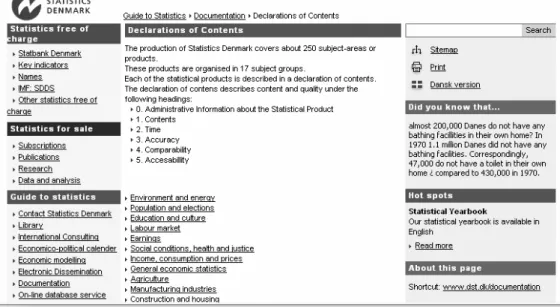
• Irrespective of the tool(s) adopted (glossaries, thesauri), there is still the need for senior management within an organisation to ensure that appropriate practices and principles involving the use consistent terminology are developed and adopted across the organisation.
• Ensure that any thesaurus developed by an agency contains the minimum structures outlined in existing international guidelines such as those formulated by the ISO, OMG and W3C.
Corporate glossaries should contain the following in order to facilitate their interoperability: concept label; definition; detailed source information about where the definition was derived; related terms; and context field providing additional information or highlighting how a definition is used within one statistical domain or geographical context. Finally, the glossary should also be translated into various languages used by the institution in question.
• Provide appropriate cross references or links in domain specific glossaries, on Internet or intranet sites to general glossary databases that have been developed either at the national or international levels, the purpose being to make existing standard terms and definitions more readily available. • Avoid attaching precisely the same label or title for different definitions (for further discussion
refer Section 6.3.5).
4. Guidelines for the reporting of different types of statistical data
4.2.1 For original data
• The availability of original data affords maximum flexibility for users interested in undertaking further analysis or transformation beyond how it is presented in the data source on hand. Therefore, users should have access to at least some of the key aggregates of original data where they exist for a particular series, either directly in the publication or through the provision of references or hyperlinks. The provisions under which access to detailed original, confidentialised data is given would be governed by the organisation’s dissemination policy.
• In situations where original data are known to have significant non-sampling errors, appropriate metadata should be provided to facilitate appropriate use of the data. In such instances consideration should also be given to the presentation and use of other types of data such as percentages in any analyses of main features.
• Original data are frequently transformed into growth rates or indices, for example, in a press release to facilitate interpretation and understanding. Ideally, original data should be presented in addition to the transformed series. However, this may not be possible in some dissemination media due to space considerations and in this situation it would be sufficient to provide a clear indication of their availability and how they could be accessed.
4.3.2 For indices
The Statistics Canada Policy on Informing Users of Data Quality and Methodology (Statistics Canada 2000, Section E.3) states that the provision of an adequate description of characteristics and methodologies specific to indices is as important to users as quality assessments of the data. Statistics Canada therefore recommends the provision of the following metadata:
• precise definitions of the underlying economic concepts the indices are intended to measure. Specific mention should be given to any limitations in the use or application of the index, citing the example of deflation of macro-economic aggregates; and
• descriptions of the methodologies used in the compilation of the index, with particular reference to the:
o index calculation methods entailing the choice of index formula (e.g. Laspeyres, Paasche, Fisher) and the strategy for constructing the index series (i.e. as either fixed base or chain indices);
o weighting system used, weight revision practices and frequency of weight revision; o computation at various aggregation levels;
o selection of base year; o frequency of re-basing; o procedures for linking indices;
o treatment of changes in the composition of commodities in the market as well as changes in quality.
The methodologies applied should be compared with underlying index concepts and the impact of departures described.
Finally, as much of the above information is of specific interest to specialised users, consideration should be given to having differing levels of information targeted to different kinds of users. The guidelines for the reporting and dissemination of metadata provided in Section 6 emphasize the desirability of structuring metadata appropriately for users with differing degrees of expertise and need.
4.4.3 For growth rates
The two key recommendations with respect to growth rate terminology entail the need for statistical agencies to:
• minimise the risk of user misunderstanding of the growth rates being applied through the consistent use of growth rate terminology and the provision of definitions such as those provided in Section 4.4.2 in accompanying metadata; and
• develop a consistent (and unambiguous) set of expressions for use in analytical text to describe changes in annual and infra-annual growth rates and to apply those expressions consistently both within the same press releases and in other press releases disseminated by the same organisation. Recommendations for the presentation of growth rates in the context of different forms of data used in time series analyses are summarised in Section 4.6.
DATA AND METADATA REPORTING AND PRESENTATION HANDBOOK - ISBN 92-64-03032-8 - © OECD 2007 20
4.5.2 For ratios, proportions, percentages and rates
The main issues for the presentation of and ratios centre around the provision of appropriate methodological information (metadata) describing both the actual rates / ratios and, the component series used in their derivation. Precision is required in the provision of information for the user about the time period referred to, the nature of the population being described and the type of occurrence being measured (Palmore and Gardner 1994). More specifically:
• the term “rate”, “percentage”, or “ratio” should be included in the actual label, e.g. maternal mortality rate, crude death rate, etc., to ensure user understanding that the original data has been transformed;
• for rates where the total population is expressed as unity the unit of measurement used in the population should be included in the table heading for the rate, e.g. per 1 000 live births;
• the series labels in the components that make up the rate or ratio should be based where possible on existing international terminology. These are generally outlined in the international guidelines and recommendations for the relevant statistical domain (refer UNSD 2002a) or glossary databases disseminated by international organisations such the OECD’s Glossary of Statistical Terms (OECD 2002a); the Eurostat Concepts and Definitions Database (CODED) (Eurostat 2006a), or UNSD’s Definitions for United Nations Common Database (UNSD 2002b). Departures from international concepts should be documented in the metadata accompanying the rate / ratio; • detailed information about the source(s) of the component series used in the derivation of the rate
or ratio should be provided. Minimum information comprises: type of data source (administrative, household survey or census, business survey or census), reference period, full official title of the series, full name of the source agency or institution;
• users should have access to the original data used in the derivation of the rate / ratio. This could be included in the body of the publication where the rates or ratios are disseminated (e.g. as annex tables) or through the provision of sufficient reference information or hyperlinks that will enable users to access the original data;
• users should be provided with information on methodologies used in the compilation of the component series used in the derivation of the rate / ratio. The quality (in particular, comparability both over time and between countries) of the rate or ratio is only as good as the quality of the series used in its calculation, and appropriate metadata is therefore essential to enable users to form an understanding of quality and relevance of the rate /ratio for a particular need or purpose. The final issue involves the need to standardise extraneous variables used in the compilation of ratios, proportions, rates, etc. As mentioned in Section 4.5.1, such standardisation is necessary to enable the comparison of ratios, etc. between countries, regions, etc., and in some instances over time in the same geographic area.
5.6 Recommended practices for the reporting of different forms of time series data
Forms of time series data to be presented
Recommendation 1: When seasonality is present and can be identified, sub-annual indicators should be made available in seasonally adjusted form. The level of detail of indicators to be adjusted should be chosen taking into account user demand and cost-effectiveness criteria. The adjustment should be applied appropriately using the method chosen as a standard by the agency. The method used should be explicitly mentioned in metadata accompanying the series.
Recommendation 2: When applicable, the focus of press releases (or similar releases to the general public) concerning the main sub-annual indicators should be on their appropriately seasonally adjusted version. Users should also be given access to the original (or raw) series, either in the publication (if space permits) or by reference to it.
Where there is a user demand, the agency may also disseminate intermediate components of the seasonal adjustment process (e.g. series adjusted for calendar effects) and / or trend-cycle estimates but it should be clearly indicated that the focus is on the seasonally adjusted estimate when short-term variation is of interest.
Analytical transformations
Recommendation 3: Press releases presenting seasonally adjusted flow series should at the minimum provide period-to-period growth rates for the latest period and, if space permits, period-to-period (e.g. month-on-previous-month, quarter-on-previous-quarter) change in levels.
Recommendation 4: For month-on-previous-month and quarter-on-previous-quarter rates of change, seasonally adjusted data is the best way of presenting information about a time series (trend-cycle and irregular movements) and for presenting short-term developments, even if the irregular component is relatively large. To deal with irregular movements that blur the trend the rate of change bases on two or three months’ (or quarters) worth of values can be utilised.
Recommendation 5: For rate of change with respect to the same period of previous year the year-on-year changes should be applied to raw data and to data adjusted for calendar effects if the latter are available. Where necessary, special effects contained in the base period should be highlighted when presenting YoY (base effect).
Recommendation 6: Because of the risk of providing misleading signals, especially where series display significant volatility, the presentation of annualised level changes is not recommended, especially as the key headline series.
Where annualised changes are used, users should be provided with information regarding the possibility of misleading signals due to series volatility.
Recommendation 7: Annualized period-to-period growth rates are not recommended for the presentation of quarterly or monthly growth rates.
Preference should be given to the use of year-on-year growth rates.
Information about seasonal adjustment to be provided to users
Recommendation 8: Statistical agencies should disseminate a non-technical explanation of seasonal adjustment and its interpretation for the benefit of, and aimed at, the general public.
Recommendation 9: For the benefit of users requiring information about the appropriateness of the seasonal adjustment method applied, statistical agencies should provide a minimum amount of information that would enable an assessment of the reliability of each seasonally adjusted series. Recommendation 10: Statistical agencies should maintain metadata on seasonal adjustment of sufficient extent to enable outside users to seasonally adjust in a consistent way other series from the same statistical program that may not have been seasonally adjusted.
DATA AND METADATA REPORTING AND PRESENTATION HANDBOOK - ISBN 92-64-03032-8 - © OECD 2007 22
6.3 Recommended practices for the reporting and dissemination of metadata
6.3.1 The need for metadata
All statistical agencies should:
• compile metadata required for users to understand the strengths and limitations of the statistics it describes; and
• keep their metadata up-to-date, incorporating the latest changes in definitions, classifications and methodology, etc.
6.3.2 Access to metadata
Key recommendations in this area include:
• ensuring that users have ready access to such metadata through its dissemination via a range of different media – paper publications, CD-ROMs, etc. However, it is important for all metadata to be available to users on the Internet, given that it provides the most accessible medium for obtaining the most up-to-date metadata. It is also recommended practice for metadata to be structured in such a way as to meet the needs of a range of users with different requirements and/or statistical expertise. This does not necessarily entail the physical presentation of different metadata to each group of users with different statistical expertise. However, a layered presentation of metadata is recommended, progressing from summary metadata to more detailed metadata. Each layer should use clear and precise text;
• dissemination of metadata free of charge on the Internet. There is strong support for the notion that metadata describing statistics has a high public good component and should therefore be disseminated free of charge on the Internet even if the actual economic and social statistics they describe and paper publication versions of the metadata are subject to an organisation’s price regime;
• active linkage of metadata to the statistical tables and graphs they describe and vice versa;
• the availability of metadata not only in the national language but also, where resources permit, in a common language such as English;
• structuring the metadata for different statistical domains on the basis of some hierarchic classification. Consideration could be given to the adoption of the UNECE Classification of International Statistical Activities as the international standard for metadata. The September 2005 version is available at http://www.unece.org/stats/documents/ece/ces/bur/2005/5.e.pdf;
• provision of a local search engine based on free text search;
• implementing recommended practice for ensuring either the stability of URLs (Uniform Resource Locators) or providing links between the old and new URLs that will redirect users to the new address. This is a key issue given the importance of links between websites;
• providing the names of contact persons or email addresses where further information about concepts, definitions and statistical methodologies may be obtained. In some organisations the “contact” would be a generic corporate contact point or referral service for all client enquiries.
6.3.3. Adoption of a set of common metadata items
International agencies should work with national statistical agencies to develop a core set of non-domain specific metadata items (or prompt points) such as those being developed under the Statistical Data and Metadata Exchange (SDMX) initiative – refer para. 175.
6.3.4 Adoption of a common set of terminology for metadata preparation
Considerable resources are often expended by international organisations in verifying text, etc., to ensure that methodological descriptions are as consistent as possible between countries. A mechanism for achieving this would be the rigorous use of terminology imbedded in the various international statistical guidelines and recommendations. This could be facilitated by the use of glossaries published by international organisations which contain definitions derived from those standards, in particular, the Metadata Common Vocabulary (MCV) developed under the umbrella of the SDMX initiative
6.3.5 Unambiguous presentation of similar but not identical statistical data
Five broad recommendations of good practice in this area comprise (Friez 2003):
• Similar but different series should be given different titles to facilitate clear differentiation by users.
• International organisations that disseminate national data should always be aware of and clearly state in their metadata whether or not the precise series they disseminate that are derived from national sources are also disseminated in the country of origin, or compiled and / or transformed by national agencies specifically to meet the requirements of international organisations.
• International organisations should clearly describe in their metadata, specific details of any transformation of national data they perform to make the series more internationally comparable. Data transformed by international organisations should be clearly indicated as such, particularly, but not only where, published alongside different national series for the same statistical domain. The two sets of series must be clearly differentiated in the mind of the user.
• The precise name of the classification used in statistics disseminated by national agencies and international organisations (especially when transformed to an international classification to enhance international comparability) should always be clearly indicated (for instance, NACE Rev. 1, CITI, Main Industrial Grouping (MIG) or national classification) so that when the same denomination is used in various classifications such as intermediate goods, the user clearly knows which classification has been used.
• When a field of activity is only partially covered (such as intermediate goods or MIG-consumer goods in the new orders indicators of the European Commission’s Short-term Statistics Regulation), it should be clearly indicated for instance with an asterisk or a footnote (for example, in the Eurostat’s short-term statistics new orders series, MIG-non durable goods (1) - (1) Partial ; does not include NACE 151-155, 158, 159, 16, 19, 22, 364-366).
DATA AND METADATA REPORTING AND PRESENTATION HANDBOOK - ISBN 92-64-03032-8 - © OECD 2007 24
7.1.3 Recommended practices for data revision
7.1.3.1 Consultations with users elicit views about revisions practices
Preliminary to elaborating a country’s revisions policy, it is important to consult the main users of official statistics to identify needs and priorities specific to individual countries. Their views could be sought, for example, about their particular needs for timeliness of data, problems they experience because of revisions, and their priorities about balancing timeliness with accuracy and consistency.
7.1.3.2 Provision of a clear, short readily accessible summary statements to users of when to expect revisions and why revisions are undertaken
7.1.3.3 Where possible establish a stable revisions cycle from year to year.
7.1.3.4 Balance stability of a time series against the need to revise series because of the need introduce new methodologies, concepts, classifications, etc.
7.1.3.5 Ensure that revisions are carried back several years to give consistent time series
To maintain the serviceability of data following major revisions, data should be revised back as far as is reasonable based on a balancing of user needs, costs, and availability of source data. The revised time series should be released simultaneously with the revised current data or soon thereafter, preferably in easily accessible electronic format. The revised series should be of sufficient detail and not so aggregated that users are not able to detect the sources of the changes.
7.1.3.6 Provide appropriate documentation on revisions
Such documentation should include:
• clear identification of preliminary (or provisional) data and revised data;
• provision of advance notice of major changes in concepts, definitions, and classification and in statistical methods;
• information on the sources of revision are explained when the revised series are released; • information on breaks in series when consistent series cannot be constructed;
• information on the size of possible future revisions based on past history;
7.1.3.7 Users are reminded of the size of the likely revisions based on past history
Users should be provided with information sufficient for them to make an informed judgment about the reliability and accuracy of preliminary or provisional statistics. The following two recommended practices for revision studies have been identified:
• periodic analyses of revisions investigate the sources of revision from earlier estimates and statistical measures of the revisions;
• the analyses are published for major aggregates to facilitate assessment of the reliability of the preliminary estimates.
7.1.3.8 Transparent and timely reporting of errors and mistakes
7.2.3 Recommended practices on the presentation of series breaks Recommended practice with regards to time series breaks entails:
• The compiling agency taking all possible steps to avoid and minimise changes to questionnaires, definitions and classifications used to collect and compile data. Methodologies should be developed to reduce the frequency of revisions.
However, there comes a time when the time series may be disrupted even when outdated classifications, concepts and questionnaires are maintained. In such instances a complete break in series may be preferred to series that continue to be collected on the basis of outmoded classifications and concepts that do not approximate reality. There is clearly a tradeoff between costs imposed by breaking a time series on one hand and the benefits from improving the relevance of the time series on the other (BEA 1993).
• Where significant breaks in a time series are unavoidable, users should be given warning well in advance of the implementation of the series break outlining the timing of implementation and a detailed explanation of the reason(s) for the change. “In advance” is taken to mean not just the time of implemention but sufficient time to enable users to implement modifications to their systems, programmes or databases and to seek further clarification if necessary. A common practice adopted by many statistical agencies is to issue a detailed discussion paper many months in advance of the change.
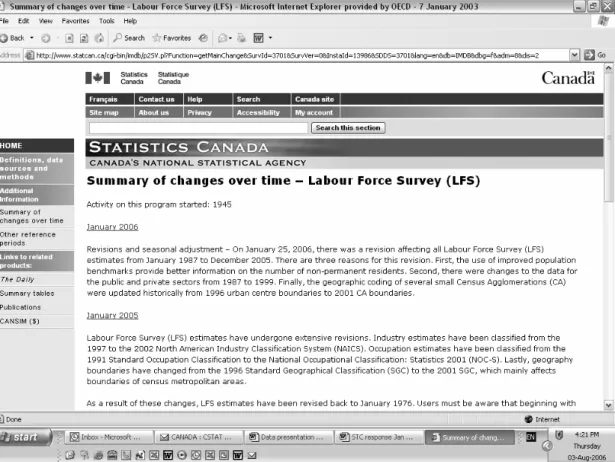
• Actual breaks in the series should be clearly identified in both the statistical table and any accompanying graphs. A variety of methods are commonly used by national agencies and international organisations to highlight in tables that a series break has actually ocurred. These include the insertion of a line in the table at the break point, inclusion of a footnote or tabular presentation as an entirely new series. Whichever method is adopted, the main point is that the break is completely clear to users. Consideration will also need to be given to the identification of series breaks (together with appropriate explanatory information) in data disseminated electronically such as via on-line databases, etc.
The following information drawn directly from Eurostat guidelines should also be provided (Eurostat 2003c, p. 16):
o the reference period of the survey where the break occurred;
o whether or not the difference reported is one-off with limited implications for the time series and / or if the reported change led to harmonisation with any standards;
o a precise outline of the difference in concepts and methods of measurement before and after the series break;
o a description of the cause(s) of the difference, e.g. changes in classification, in statistical methodology, statistical population, methods of data transformation, concepts, administrative procedures with regard to statistical data from administrative sources;
o an assessment of the magnitude of the effect of the change, where possible, with a quantitative measure.
Links and references to more detailed information should also be provided.
• Points in line graphs should not be joined across discontinuities in data. The reason for the series break should be explained in a footnote accompanying the graph with appropriate links or references to more detailed explanations of the causes of the breaks.