Automatic Design of
Dispatching Rules for
Job Shop Scheduling
with Genetic Programming
by
Su Nguyen
A thesis
submitted to the Victoria University of Wellington in fulfilment of the
requirements for the degree of Doctor of Philosophy in Computer Science. Victoria University of Wellington
Abstract
Scheduling is an important planning activity in manufacturing systems to help optimise the usage of scarce resources and improve the customer satisfaction. In the job shop manufacturing environment, scheduling prob-lems are challenging due to the complexity of production flows and prac-tical requirements such as dynamic changes, uncertainty, multiple objec-tives, and multiple scheduling decisions. Also, job shop scheduling (JSS) is very common in small manufacturing businesses and JSS is considered one of the most popular research topics in this domain due to its potential to dramatically decrease the costs and increase the throughput.
Practitioners and researchers have applied different computational tech-niques, from different fields such as operations research and computer sci-ence, to deal with JSS problems. Although optimisation methods usually show their dominance in the literature, applying optimisation techniques in practical situations is not straightforward because of the practical con-straints and conditions in the shop. Dispatching rules are a very useful approach to dealing with these environments because they are easy to im-plement (by computers and shop floor operators) and can cope with dy-namic changes. However, designing an effective dispatching rule is not a trivial task and requires extensive knowledge about the scheduling prob-lem.
The overall goal of this thesis is to develop a genetic programming based hyper-heuristic (GPHH) approach for automatic heuristic design of reusable and competitive dispatching rules in job shop scheduling envi-ronments. This thesis focuses on incorporating special features of JSS in the representations and evolutionary search mechanisms of genetic pro-gramming (GP) to help enhance the quality of dispatching rules obtained.
important factors that significantly influence the performance of GP for evolving dispatching rules. The thesis demonstrates that evolved rules which are trained to adapt their decisions based on the changes in shops are better than conventional rules. Moreover, by applying a new evalu-ation scheme, the evolved rules can effectively learn from the mistakes made in previous completed schedules to construct better scheduling de-cisions. The GP method using the new proposed evaluation scheme shows better performance than the GP method using the conventional scheme.
This thesis proposes a new multi-objective GPHH to evolve a Pareto front of non-dominated dispatching rules. Instead of evolving a single rule with assumed preferences over different objectives, the advantage of this GPHH method is to allow GP to evolve rules to handle multiple conflict-ing objectives simultaneously. The Pareto fronts obtained by the GPHH method can be used as an effective tool to help decision makers select ap-propriate rules based on their knowledge regarding possible trade-offs. The thesis shows that evolved rules can dominate well-known dispatch-ing rules when a sdispatch-ingle objective and multiple objectives are considered. Also, the obtained Pareto fronts show that many evolved rules can lead to favourable trade-offs, which have not been explored in the literature.
This thesis tackles one of the most challenging issues in job shop sched-uling, the interactions between different scheduling decisions. New GPHH methods have been proposed to help evolve scheduling policies contain-ing multiple schedulcontain-ing rules for multiple schedulcontain-ing decisions. The two decisions examined in this thesis are sequencing and due date assignment. The experimental results show that the evolved scheduling rules are sig-nificantly better than scheduling policies in the literature. A cooperative coevolution approach has also been developed to reduce the complexity of evolving sophisticated scheduling policies. A new evolutionary search mechanisms and customised genetic operations are proposed in this ap-proach to improve the diversity of the obtained Pareto fronts.
Through this thesis, following major contributions have been made: (1) the first study comparing different representations of dispatching rules in GP, (2) the development of a novel type of dispatching rules referred to as iterative dispatching rules and a new GPHH for automatic design of these rules, (3) the first multi-objective GPHH method for dynamic JSS problems to find Pareto fronts of non-dominated dispatching rules, (4) two new GP methods to generate reusable due date assignment rules, and (5) a new multi-objective GPHH method for automatic design of scheduling policies to handle multiple scheduling decisions and multiple conflicting objectives.
List of Publications
Nguyen, S., Zhang, M., Johnston, M. and Tan, K. C. “A computational study of representations in genetic programming to evolve dispatching rules for the job shop scheduling problem”. IEEE Transactions on
Evolu-tionary Computation(2012). DOI:10.1109/TEVC.2012. 2227326.
Nguyen, S., Zhang, M., Johnston, M. and Tan, K. C. “Automatic design of scheduling policies for dynamic multi-objective job shop scheduling via cooperative coevolution genetic programming”. IEEE Transactions on
Evo-lutionary Computation(2013). DOI:10.1109/TEVC.2013.2248159.
Nguyen, S., Zhang, M., Johnston, M. and Tan, K. C. “Genetic program-ming for evolving reusable due-date assignment models in job shop envi-ronments”. Evolutionary Computation(2013). DOI:10.1162/EVCO a 00105. Nguyen, S., Zhang, M., Johnston, M. and Tan, K. C. “Hybrid evolutionary computation methods for quay crane scheduling problems”. Computers
and Operations Research(2013), Vol. 40, Issue. 8., pp. 2083-2093.
Nguyen, S., Zhang, M., Johnston, M. and Tan, K. C. “Learning iterative dispatching rules for job shop scheduling with genetic programming”. The
International Journal of Advanced Manufacturing Technology (2012). DOI:10.
1007/s00170-013-4756-9.
Nguyen, S., Zhang, M., Johnston, M. and Tan, K. C. “Dynamic job shop scheduling problems: a MO-GPHH approach”. In Automated Scheduling
(Eds.), Springer. (2012). (accepted).
Nguyen, S., Zhang, M., Johnston, M. and Tan, K. C. “Evolving reusable v
operation-based due-date assignment models for job shop scheduling with genetic programming”. InEuroGP’12: Proceedings of European Conference on
Genetic Programming(2012), pp. 121–133.
Nguyen, S., Zhang, M., Johnston, M. and Tan, K. C. “A coevolution genetic programming method to evolve scheduling policies for dynamic multi-objective job shop scheduling problems”. In CEC ’12: Proceedings of the
IEEE Congress on Evolutionary Computation(2012), pp. 3261–3268.
Nguyen, S., Zhang, M., Johnston, M. and Tan, K. C. “Automatic discovery of optimisation search heuristics for two dimensional strip packing using genetic programming”. InSEAL ’12: Proceedings of International Conference
on Simulated Evolution And Learning(2012), pp. 341–350.
Nguyen, S., Zhang, M., Johnston, M. and Tan, K. C. “Learning reusable initial populations for multi-objective order acceptance and scheduling problems with genetic programming”. In EuroGP’13: Proceedings of
Eu-ropean Conference on Genetic Programming(2013), pp. 157-168.
Nguyen, S., Zhang, M., and Johnston, M.. “A genetic programming based hyper-heuristic approach for combinatorial optimisation”. InGECCO ’11:
Proceedings of Genetic and Evolutionary Computation Conference (2011), pp.
1299-1306.
Park, J.,Nguyen, S., Zhang, M., and Johnston, M. “Genetic programming for order acceptance and scheduling”. InCEC ’13: Proceedings of the IEEE
Congress on Evolutionary Computation(2013), (To appear).
Nguyen, S., Zhang, M., Johnston, M. and Tan, K. C. “A two stage learn-ing/optimising system for multi-objective order acceptance and schedul-ing”. European Journal of Operational Research(2013), (under review).
Acknowledgments
I would like to express my very great appreciation to my supervisors, Prof Mengjie Zhang, Dr Mark Johnston and Prof Kay Chen Tan, for their guid-ance and support during the course of my PhD study. Prof Zhang has spent many dedicated hours reading this thesis and my research articles; his feedback is always full of encouragement but also challenges that help improve my research work. Dr Johnston is always good to talk to, and the discussions with him are a great source for novel ideas. Prof Tan always gave very fast, useful and constructive recommendations on this study, despite the time zone.
I am grateful for the Victoria Doctoral Scholarship, the Marsden Fund of New Zealand (VUW0806 and 12-VUW-134), and the University Re-search Fund (200457/3230) at Victoria University of Wellington for their financial support over the past three years.
I would like to offer my thanks to my friends in the Evolutionary Com-putation Research Group (ECRG) for creating an active and interesting research environment. Thank you to Bing and Bruce for sharing their de-licious food and enjoyable pingpong games.
I wish to thank my family for their constant support and encourage-ment throughout my study. Thank you to my parents who have always been there for me, offering their unconditional love and care. Last, but not least, I would like to thank my beloved wife Hue (and the little Tory) for her love, patience and support. You have always been the source of love that helps me complete this journey.
Contents
List of Publications v
Acknowledgments vii
List of Tables xvii
List of Figures xxii
List of Notations xxiii
List of Abbreviations xxv 1 Introduction 1 1.1 Problem Statement . . . 1 1.2 Motivations . . . 3 1.3 Research Goals . . . 6 1.4 Major Contributions . . . 10 1.5 Organisation of Thesis . . . 14 2 Literature Review 17 2.1 Basic Concepts . . . 17 2.1.1 Sequencing/Scheduling . . . 18 2.1.2 Machine Learning . . . 19 2.1.3 Heuristics/Meta-heuristics/Hyper-heuristics . . . . 20 2.1.4 Evolutionary Computation . . . 21
2.2 Job Shop Scheduling Problems . . . 24
2.2.1 Active schedules and non-delay schedules . . . 26
2.2.2 Job shop scheduling methods . . . 29 ix
2.2.3 Holistic view of job shop scheduling . . . 35 2.3 Genetic Programming . . . 42 2.3.1 Representation . . . 43 2.3.2 Initialisation . . . 44 2.3.3 Evaluation . . . 45 2.3.4 Selection . . . 46 2.3.5 Genetic operators . . . 47 2.3.6 Basic GP algorithm . . . 49 2.3.7 Multi-objective GP . . . 50 2.3.8 Co-evolution with GP . . . 53
2.4 Hyper-Heuristics for Heuristic Generation . . . 54
2.4.1 Genetic programming based hyper-heuristics . . . . 55
2.4.2 GPHH for scheduling problems . . . 57
2.4.3 Other techniques for learning dispatching rules . . . 60
2.5 Chapter Summary . . . 61
3 Program Representations of Dispatching Rules 65 3.1 Representations . . . 66
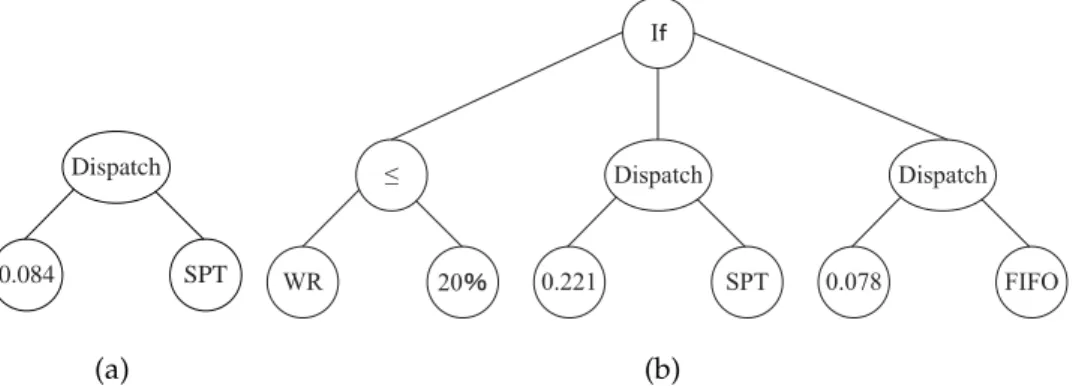
3.1.1 Decision-tree like representation (R1) . . . 66
3.1.2 Arithmetic representation (R2) . . . 71 3.1.3 Mixed representation (R3) . . . 73 3.2 Fitness Evaluation . . . 73 3.3 Proposed GP algorithm . . . 75 3.4 Design of Experiments . . . 75 3.4.1 Parameter setting . . . 75 3.4.2 Data sets . . . 77
3.5 Influence of different representations . . . 79
3.5.1 Makespan . . . 80
3.5.2 Total weighted tardiness . . . 85
3.6 Analysis and Discussions . . . 89
CONTENTS xi
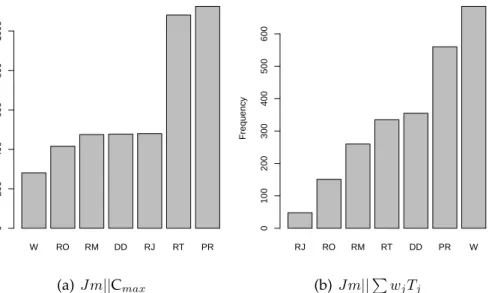
3.6.2 Aggregate view of the evolved rules . . . 95
3.6.3 Performance in a dynamic JSS environment . . . 97
3.6.4 Further Discussion . . . 99
3.7 Chapter Summary . . . 101
4 Iterative Dispatching Rules 103 4.1 Definition of IDR . . . 104
4.2 Evaluation scheme for IDRs . . . 107
4.3 Comparison with other GP methods . . . 108
4.4 Insights into IDRs . . . 110
4.4.1 Initialisation for IDRs . . . 111
4.4.2 Variable neighbourhood search with IDRs . . . 112
4.4.3 Performance of the enhanced IDRs . . . 114
4.5 Look-ahead strategies . . . 116
4.6 Illustration of an evolved IDR-VNS-L rule . . . 119
4.7 Chapter Summary . . . 122
5 Multi-objective GPHH 123 5.1 MO-GPHH for DJSS . . . 124
5.1.1 Representation and Evaluation . . . 124
5.1.2 The proposed MO-GPHH algorithm . . . 126
5.1.3 Simulation models for dynamic job shop . . . 128
5.1.4 Benchmark dispatching rules . . . 132
5.1.5 Statistical Analysis . . . 132
5.2 Results . . . 136
5.2.1 Single Objective . . . 136
5.2.2 Multiple Objectives . . . 142
5.3 Further Analysis . . . 150
5.3.1 Evolved Pareto front . . . 150
5.3.2 Robustness of the evolved dispatching rules . . . 152
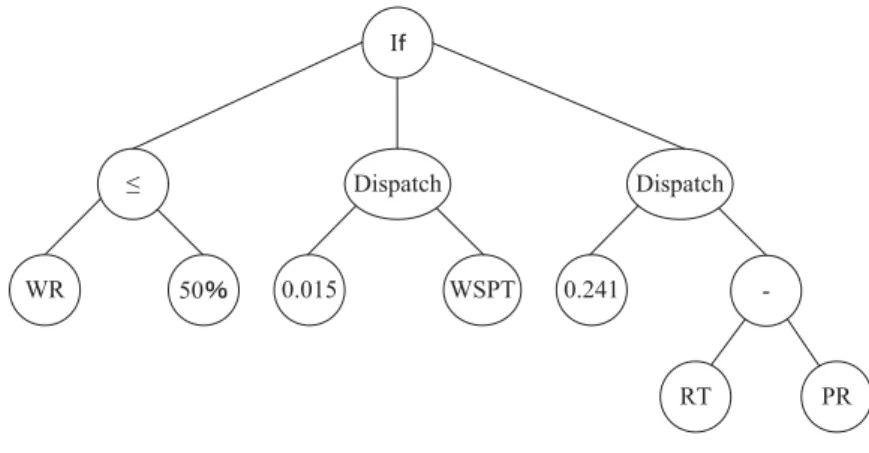
5.3.3 Examples of evolved dispatching rules . . . 154
6 Evolving Due Date Assignment Rules 161
6.1 GP for evolving DDARs . . . 163
6.1.1 Representation . . . 163
6.1.2 Evaluation . . . 164
6.1.3 Fitness Function . . . 166
6.1.4 Evolution of DDARs . . . 167
6.2 Experimental Setting . . . 167
6.2.1 Job Shop Simulation Environment . . . 168
6.2.2 GP parameters . . . 170
6.3 Results . . . 170
6.3.1 Comparison of evolved DDARs with existing DDARs 171 6.3.2 GP-ADDAR vs. GP-ODDAR . . . 172
6.4 Analysis . . . 173
6.4.1 Number of simulation replications for training DDARs173 6.4.2 The choice of simulation scenarios for training DDARs175 6.4.3 Population size of the proposed GP methods . . . 178
6.4.4 Performance of evolved DDARs on shops with a bot-tleneck . . . 179
6.4.5 Evolved DDARs . . . 180
6.5 Further investigation with due date based dispatching rules 184 6.6 Chapter Summary . . . 187
7 Automatic Design of Scheduling Policies 189 7.1 Proposed MO-GPHH methods . . . 191
7.1.1 Representations . . . 192
7.1.2 A Cooperative Coevolution MO-GPHH for DJSS . . . 194
7.1.3 Genetic Operators . . . 197
7.1.4 Parameters . . . 198
7.1.5 Job Shop Simulation Model . . . 199
7.1.6 Performance Measures for MO-GPHH Methods . . . 200
CONTENTS xiii
7.2.1 Pareto Front of the Evolved Scheduling Policies . . . 203
7.2.2 Comparison to Existing DRs and Dynamic DDARs . 205 7.2.3 Comparison to Existing DRs and Regression-based DDARs . . . 207
7.3 Further Analysis . . . 211
7.3.1 Performance of MO-GPHH Methods . . . 211
7.3.2 Complexity of DMOCC . . . 212
7.3.3 Representative Selection . . . 214
7.3.4 Choice of Training Scenarios . . . 215
7.3.5 The Evolved Scheduling Policies . . . 216
7.4 Chapter Summary . . . 220
8 Conclusions 223 8.1 Achieved Objectives . . . 223
8.2 Main Conclusions . . . 225
8.2.1 Representations and Evaluation Schemes . . . 225
8.2.2 Multi-objective GPHH . . . 227
8.2.3 Evolving Comprehensive Scheduling Systems . . . . 229
8.3 Discussion . . . 230
8.3.1 Job Shop Scheduling: Static vs Dynamic . . . 230
8.3.2 Need ”Better” Representations . . . 232
8.3.3 GPHHs and Other Optimisation Techniques . . . 233
8.3.4 Multiple Scheduling Decisions . . . 233
8.4 Future work . . . 234
8.4.1 Feature Selection . . . 234
8.4.2 Advanced Dispatching Rules for Dynamic JSS . . . . 235
8.4.3 Hybrid Hyper-heuristic Methods . . . 235
8.4.4 Benchmarks of Dynamic JSS . . . 235
8.4.5 Two-Stage Learning/Optimising Systems . . . 236
Glossary of Terms 237
List of Tables
2.1 Performance measures for JSS problems . . . 26
2.2 Example of a static JSS problem instance (N = 3,M= 3) . . 28
2.3 Performance measures of DDARs . . . 38
3.1 Terminal set forR2(j =n(σ)andoj,h =σ) . . . 72
3.2 Parameters of the proposed GP system . . . 78
3.3 JSS data sets . . . 78
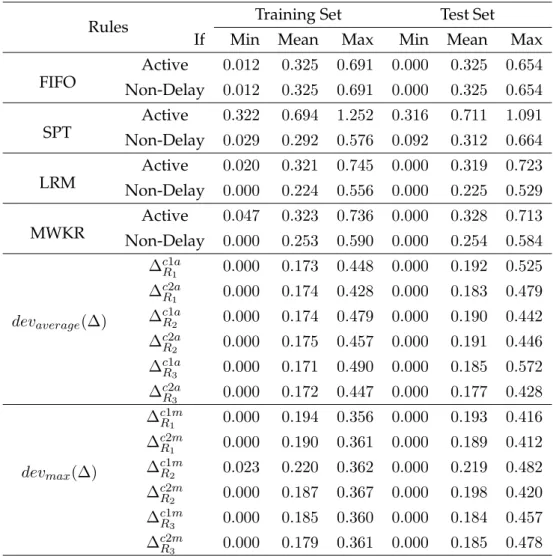
3.4 Performance of evolved rules for J m||Cmax on training set and test set with different settings . . . 81
3.5 Relative deviations obtained by evolved rules and other rules forJ m||Cmax . . . 84
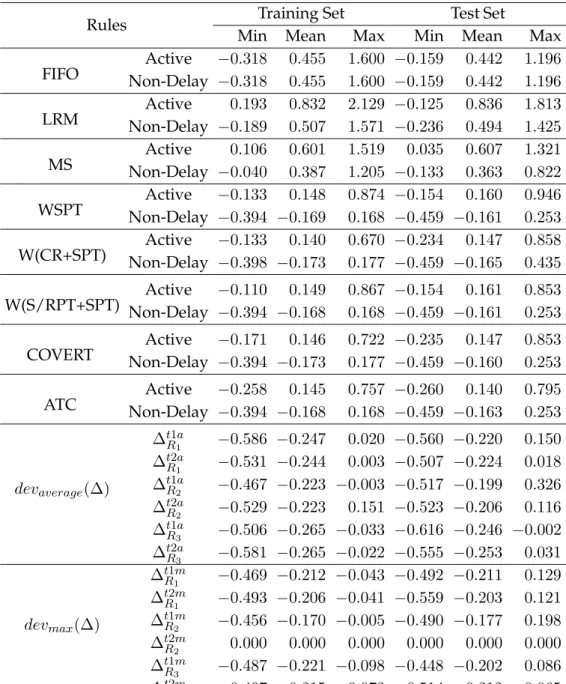
3.6 Performance of evolved rules for J m||wjTj on training set and test set with different settings . . . 86
3.7 Relative deviations obtained by evolved rules and other rules forJ m||wjTj . . . 87
3.8 Parameter setting of the simulation model . . . 98
4.1 Terminal set for IDR . . . 108
4.2 Performance of evolved rules forJ m||Cmax . . . 109
4.3 Performance of evolved rules forJ m||wjTj . . . 110
4.4 Comparison with the multi-pass heuristic . . . 120
5.1 Terminal and function sets for DR . . . 125
5.2 Training and testing scenarios . . . 129 xv
5.3 Benchmark dispatching rules . . . 131 5.4 Performance of evolved rules under different shop conditions141 5.5 Some typical examples of evolved rules . . . 156 5.6 Performance of example evolved rules in50,95,4 . . . 157 5.7 Performance of example evolved rules in50,95,6 . . . 158 6.1 Terminal sets for GP-ADDAR and GP-ODDAR (ψis the new
job, φ is the considered operation in GP-ODDAR, and δ is the machine that process willφ) . . . 165 6.2 Training and testing scenarios . . . 169 6.3 Parameters of the proposed GP systems . . . 170 6.4 Comparing the evolved ADDAR with existing DDARs . . . 172 6.5 Comparing the evolved ODDAR with existing DDARs . . . 172 6.6 GP-ADDAR vs. GP-ODDAR (p-values fromt-tests) . . . 174 6.7 Performance of evolved ADDARs trained with fullsetting . 176 6.8 Performance of evolved ODDARs trained withfullsetting . 176 6.9 Performance of evolved ADDARs trained with full +
miss-ingsetting . . . 177 6.10 Performance of evolved ODDARs trained with full +
miss-ingsetting . . . 177 6.11 Performance of evolved ADDARs on shops with a bottleneck 180 6.12 Performance of evolved ODDARs on shops with a bottleneck 180 6.13 MAPE values obtained by the best evolved DDARs . . . 182 6.14 Performance of DDARs (90% utilisation,missingjobs, 6
ma-chines, processing times follow Erlang-2 distribution) . . . . 183 6.15 Performance of DDARs (90% utilisation,fulljobs, 6 machines,
processing times follow Erlang-2 distribution) . . . 183 6.16 Performance of evolved ODDARs with CR+SPT as the
dis-patching rule . . . 187 7.1 Terminal set for CDR . . . 193 7.2 Parameter settings . . . 199
LIST OF TABLES xvii 7.3 Training and testing scenarios . . . 200 7.4 Performance measures of scheduling policies . . . 201 7.5 Performance of existing scheduling policies for
trainingscenarios (Cmax,TWT,MAPE) . . . 206
7.6 Performance of existing scheduling policies for
testingscenarios (Cmax,TWT,MAPE) . . . 206
7.7 Performance of DRs and regression-based DDARs . . . 209 7.8 Performance of dominatingevolvedscheduling policies . . . 210 7.9 Examples of the evolved scheduling policies . . . 218
List of Figures
2.1 Job Shop Scheduling (shop with 3 machines). . . 25
2.2 A Generic procedure to construct a schedule for JSS. . . 27
2.3 Example of schedules in JSS (N = 3,M= 3). . . 29
2.4 Production planning and control (PPC) decisions [107]. . . . 36
2.5 GP program that representsx+ min(y−3,0). . . 44
2.6 Subtree crossover in GP. . . 48
2.7 Subtree mutation in GP. . . 48
2.8 Basic GP algorithm. . . 50
3.1 Grammar for the proposed GP system withR1. . . 67
3.2 Example program trees based on representationR1. . . 68
3.3 Example program trees based on representationR2. . . 72
3.4 An example program tree based on representationR3. . . 73
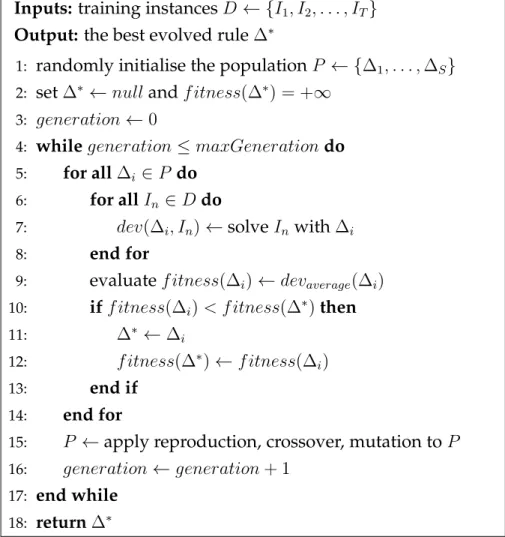
3.5 GP algorithm to evolve dispatching rules for JSS. . . 76
3.6 Selected evolved rules forJ m||Cmax. . . 91
3.7 Selected evolved rules forJ m||wjTj. . . 93
3.8 Frequency of attributes in the evolvedR1 andR3rules. . . . 96
3.9 Frequency of terminals in the evolved R2 and R3 priority function. . . 96
3.10 Performance of the evolved rules in the dynamic environment 99 4.1 Generic procedure to construct a schedule for JSS problems with IDR. . . 106
4.2 Representation and evaluation of an evolved IDR. . . 107 4.3 Illustration of a pseudo terminal. . . 112 4.4 Local search IDR-VNS. . . 113 4.5 Representation of an IDR-VNS. . . 114 4.6 Comparison between evolved DR, IDR, IDR-P, and IDR-VNS.115 4.7 Influence ofkmaxon IDR-VNS. . . 116 4.8 Look-ahead component represented in GP. . . 117 4.9 Influence of the evolved look-ahead component. . . 118 4.10 Example of an evolved IDR-VNS-L withkmax = 2 . . . 119 4.11 The evolved look-ahead strategy. . . 120 4.12 Correlation between problem size and the number of
itera-tions from the evolved IDR. . . 121 4.13 Relationship between problem size and the dominance of
the evolved IDR. . . 121 5.1 Illustration of a dispatching rule in DJSS. . . 126 5.2 MO-GPHH to evolve dispatching rules for DJSS problems. . 127 5.3 Wins, losses and draws in replication-wise procedure. . . 134 5.4 Performance of evolved dispatching rules (processing times
from [1,49] and utilisation of 85%). . . 137 5.5 Performance of evolved dispatching rules (processing times
from [1,49] and utilisation of 95%). . . 138 5.6 Performance of evolved dispatching rules (processing times
from [1,99] and utilisation of 85%). . . 139 5.7 Performance of evolved dispatching rules (processing times
from [1,99] and utilisation of 95%). . . 140 5.8 Average Pareto dominance proportion of evolved
dispatch-ing rules. . . 144 5.9 Pareto dominance proportions of evolved rules. . . 145 5.10 NDER for each existing dispatching rules (processing times
LIST OF FIGURES xxi 5.11 NDER for each existing dispatching rules (processing times
from [1,49] and utilisation of 95%). . . 147 5.12 NDER for each existing dispatching rules (processing times
from [1,99] and utilisation of 85%). . . 148 5.13 NDER for each existing dispatching rules (processing times
from [1,99] and utilisation of 95%). . . 149 5.14 Distribution of rules on the evolved Pareto front for the
sce-nario25,85,4. . . 151 5.15 Robustness of the evolved rules. . . 154 6.1 DDAR evaluation scheme . . . 166 6.2 Influence of the number of simulation replications on the
performance of the proposed GP methods (the horizontal axis shows the number of simulation replications). . . 175 6.3 Influence of training set on the performance of evolved DDARs.178 6.4 Influence of population size on the performance of the
pro-posed GP methods. . . 178 6.5 Best evolved DDARs. . . 181 6.6 Simulation illustration of DDARs (utilisation = 90%,
miss-ing jobs, 6 machines, processmiss-ing times follow Erlang-2 dis-tribution). . . 185 7.1 Operation-based DDAR. . . 192 7.2 Example of GP tree as a CDR. . . 193 7.3 Overview of DMOCC. . . 195 7.4 Pseudo code for DMOCC. . . 198 7.5 Pareto front of non-dominated scheduling policies. . . 204 7.6 DRs and Regression-based DDARs vs. evolved scheduling
policies. . . 208 7.7 Performance of MO-GPHH methods on thetraining
scenar-ios. (HVR to be maximised; and SPREAD and GD to be minimised). . . 212
7.8 Performance of MO-GPHH methods on thetestingscenarios. 213 7.9 Influence of representative selection methods on the
train-ingscenarios. . . 214 7.10 Influence of representative selection methods on the testing
scenarios. . . 215 7.11 Influence of training scenarios on testing performance of
DMOCC. . . 217 7.12 Pareto front and selected evolved scheduling policies. . . 217
List of Notations
pj total processing time of jobj
dj due-date of jobj
wj weight of jobj
mj number of operations of jobj
rj release time of jobj
Cj completion time of jobj
fj flowtime of jobj
ˆ
fj estimated (predicted) flowtime of jobj
ej error in flowtime estimation of jobj
σ considered operation
δ machine that processes operation σ p(σ) processing time of operationσ
ˆ
fo estimated operation flowtime of operationσ
List of Abbreviations
CDR composite dispatching ruleDDAR due-date assignment rule DJSS dynamic job shop scheduling
DMOCC diversified multi-objective cooperative co-evolution DR dispatching rule
EA evolutionary algorithm EC evolutionary computation
EMO evolutionary multi-objective optimisation GA genetic algorithm
GP genetic programming
GPHH genetic programming based hyper-heuristic HaD-MOEA harmonic distance based multi-objective EA HH hyper-heuristic
IDR iterative dispatching rule JSS job shop scheduling
MO-GPHH multi-objective GPHH xxv
MTO make-to-order
NSGA-II non-dominated sorting genetic algorithm II SI swarm intelligence
SPEA2 strength Pareto evolutionary algorithm 2 SP scheduling policy
Chapter 1
Introduction
1.1
Problem Statement
Job Shop Scheduling (JSS)is a hard problem in the scheduling literature and it has received a lot of attention because of its computational chal-lenges for the research community as well as applicability in real world situations. The term job shopis used to indicate companies that produce customer-specific components in small batches [108]. One feature that sets job shops apart from other production environments is the large variety of routings with different operation processing times through a set of ma-chines. As reported by Johns and Rabelo [92], there are thousands of fac-tories with billions of dollars worth of products in the United States that can be classified as job shops and production scheduling in this environ-ment is considered as one of the most popular research topics due to its potential to dramatically decrease costs and increase throughput [92]. In the current highly competitive market, scheduling also plays a crucial role to improve customer satisfaction. It has been shown that consistently high priority has been given to the speedy and on time delivery capabilities of manufacturing managers in Europe, Japan, and the United States [100].
In JSS, given a set of machines and a set of jobs with various pre-determined routes through the machines, the objective is to find a
ule of jobs that minimises certain criteria such as makespan, maximum lateness, and total weighted tardiness [153]. When dealing with a fixed number of jobs with known processing information, the problem is called static. On the other hand, if the processing information of jobs is not known prior to their arrival, the problem is calleddynamic. Different ap-proaches have been proposed to solve these problems and they can be classified into two main categories [145]: (1) theoretical studies of opti-misation methods, which are usually restricted to static problems and (2) experimental studies ofheuristicsordispatching rulesto deal with both static and dynamic problems.
Although dispatching rules are not guaranteed to provide optimal so-lutions for the problems, they have been applied extensively in research and practice because of their simplicity and ability to cope with the dy-namic environment [169]. Different from conventional optimisation meth-ods which represent the scheduling solution in a very sophisticated way in order to employ specialised techniques to solve the scheduling prob-lem, a dispatching rule provides a way to perform the scheduling task which is understandable to shop floor operators. Normally, a dispatching rule is considered as a function that determines theprioritiesof jobs in the queue of a machine and decides which one should be processed next. The popularity of the dispatching rule is derived from the fact that it can be easily modified when real world aspects such as setup time, release time, machine breakdowns or parallel machines are considered. Another aspect that makes dispatching rules attractive to both researchers and practition-ers is that they do not have the scalability problems which are a big issue for almost all optimisation methods. Moreover, effective dispatching rules can also be used to create initial solutions for optimisation procedures to fine-tune. In practice, dispatching rules have been applied in different manufacturing environments such as semiconductor factories [150] and printing companies [149] and shown promising results.
1.2. MOTIVATIONS 3 The process of designing dispatching rules is quite time consuming and complicated because the researchers have to manually synthesise var-ious relevant elements to create the rules and design experiments to eval-uate these rules. Recently, with the improvements of computing power, some machine learning methods [54, 112, 68, 87, 181, 78, 84] have been used to facilitate the design process of new dispatching rules. These meth-ods are referred as hyper-heuristics, which aim at automating the design and tuning of heuristic methods to solve hard computational search prob-lems [30].Genetic Programming (GP)[103] has been shown to be a promis-ing approach for this purpose because GP is capable of evolving com-plex priority functions with its flexible representation. In addition, the rules evolved by GP also provide good potential interpretability which is very useful for scheduling applications. However, many key aspects of GP have not been investigated that may enhance the performance of this method for evolving dispatching rules, such as representations and evo-lutionary search mechanisms. Besides, the past studies only focus on sim-plified JSS problems and practical requirements, e.g., multiple conflicting objectives and multiple scheduling decisions have not yet been explored.
The overall goal of this thesis is to develop a genetic programming based hyper-heuristic approach forautomatic heuristic designofreusable and competitive dispatching rules in job shop machine scheduling envi-ronments by incorporating special features of JSS in the representations and evolutionary search mechanisms.
1.2
Motivations
Previous studies have suggested some approaches to improve the effec-tiveness of dispatching rules. One of the most straightforward ways to improve the performance of dispatching rules, without affecting their sim-plicity, is to use a combination of simple dispatching rules. One way to em-ploy different dispatching rules is to monitor the status of jobs in the
sys-tem and make a change from one dispatching rule to another as planned. For example, FIFO/SPT will apply first-in-first-out (FIFO) when the jobs in the queue of the considered machine have been waiting for more than a specific time and shortest-processing-time (SPT) will be applied other-wise. This combination, even though very simple, can take advantage of each rule at the appropriate decision making moments and is normally better than the application of a single dispatching rule. Another approach to improving the performance of dispatching rules is to create compos-ite dispatching rules (CDR) [88, 89], which provide heuristic combinations of simple rules basically in the form of sophisticated human-made prior-ity functions of various scheduling parameters (processing times, waiting times, etc.).
Existing GP methods [87, 181, 78] for automatic discovery of dispatch-ing rules for JSS only focus on generatdispatch-ing CDRs by evolvdispatch-ing sophisticated priority functions. However, the incorporation of the machine and system status has not been investigated in these GP methods even though it is a key point to create moreadaptivedispatching rules. CDRs may have some implicit adaptive behaviours; however it is very difficult for a GP method to evolve rules with such a property because these adaptive behaviours will require complex arithmetic combinations. For this reason, there is a need to devise a new representation for GP to cope with this problem by making the evolved dispatching rules adaptive to shop changes. In addi-tion, it is important that GP can help evolve rules that overcome the my-opic behaviours of the traditional dispatching rules to improve the quality of the obtained schedules.
The existing research on the automatic design of dispatching rules mainly concentrates on single objective problems while multiple conflicting ob-jectives are a natural feature of most production scheduling environments. Tay and Ho [181] have suggested a GP method to evolve dispatching rules for multi-objective flexible job shop scheduling problems. In their method, the multi-objective problem is transformed into a single objective problem
1.2. MOTIVATIONS 5 by linearly combining the objectives. However, since the scales of objec-tives in scheduling problems are very different (e.g. the scale of tardiness values is different from that of makespan values), it is very difficult to as-sign a suitable weight for each objective in a single fitness function in ad-vance. Even in the case that normalised objective functions are used, the weights still need to be pre-defined by the decision makers even though they do not have good knowledge about the trade-offs among different objective functions. Finding the Pareto front of non-dominated dispatch-ing rules will naturally be a good approach to this multi-objective prob-lem because it does not require the decision makers to pre-determine the weights and will also help decision makers make better choices of dis-patching rules based on the trade-offs represented by the obtained Pareto fronts. However, this research direction has not been explored in the past research.
Another issue with the design of new dispatching rules is the interac-tion of these rules with other scheduling and planning decisions within the scheduling system. This is important in order to ensure that schedul-ing systems perform properly and effectively. Due to the complexity of these decisions, the existing research on these interactions of scheduling decisions [160, 62, 151, 35, 41] is normally performed by examining dif-ferent combinations of well-known rules and trying to find the combi-nations of rules that can achieve the best performance. A limitation of this approach is that it restricts us from exploring new potential combi-nations of rules for all related decisions. One of the advantages of GP is that the GP programs can represent multiple rules to handle multiple scheduling decisions in comprehensive scheduling systems. However, since the search space of GP will be significantly increased, the determi-nation/development of suitable evolutionary search mechanisms in this case will be very important to improve the performance of GP.
1.3
Research Goals
The overall goal of this thesis is to develop Genetic Programming based Hyper-heuristic (GPHH) methods to evolve reusable and competitive dispatching rules forjob shop machine scheduling environments. The focus of this research is to investigate how to utilise genetic programming to learn new dispatching rules for both staticanddynamic JSS problems through the studies of representations and evolutionary search mecha-nisms. This research aims to use GP to evolve new effective dispatching rules that are capable of incorporating machine/system attributes and re-lated scheduling decisions to enhance the productivity of job shops. It is expected that the evolved rules can be effective in unseen situations (reusable) and competitive as compared to other dispatching rules pro-posed in the literature. The research in this thesis will help answer the following research questions:
(i) Which elements of JSS problems are significant/relevant when evolving
ef-fective dispatching rules with GP and how can these elements be represented by GP programs?
Job shop scheduling is known as a very hard problem and many el-ements of the problem are needed to make effective scheduling de-cisions. However, it is not obvious what is a good way to employ these elements in order to improve the performance of dispatching rules. The manual development process is too time consuming to investigate this issue. Therefore, GP as an automatic heuristic gener-ation method is more suitable in this case. Moreover, the flexibility of GP representations provides various ways to synthesise and evaluate complex dispatching rules. Studying GP representations in this case not only helps improve the performance of GP for evolving dispatch-ing rules but also provides important patterns that could be useful in good dispatching rules and helps improve the interpretability of the evolved rules.
1.3. RESEARCH GOALS 7
(ii) How can GP be used to deal with multi-objective job shop scheduling
prob-lems?
One of the challenges when designing dispatching rules for a job shop scheduling environment is to handle multiple conflicting ob-jectives. However, this issue has been mostly ignored in the past research on automatic discovery of dispatching rules. In cases where GP is used, it is important to know which multi-objective evolution-ary search mechanism is most helpful in tackling this issue. It would be also interesting to know how representations help GP explore trade-off (non-dominated) dispatching rules for the multi-objective job shop scheduling problems.
(iii) Which evolutionary search mechanism of GP is effective for evolving a com-plex scheduling system involving different scheduling decisions?
Even though dispatching rules are a key component in a scheduling system, their performance is affected by other planning and ing decisions. Due date assignment is one of the most direct schedul-ing decisions that can influence the performance of a dispatchschedul-ing rule. Creating combined rules to be evolved by GP for both dispatch-ing and due date assignment tasks would be the most straightfor-ward option to deal with this issue. However, it also increases the complexity of the problem. In this case, different evolutionary search mechanisms need to be investigated and evaluated to find the most suitable one for evolving such complex rules.
In order to fulfill the overall goal stated above and to find the answers for these research questions, a set of research objectives have been estab-lished to guide this research.
1. Developing a new GP method that provides adaptive behaviours for the evolved dispatching rules by incorporating the machine and sys-tem attributes; with an expectation of improving the effectiveness of these rules.
There are some existing works [86, 78, 181] using GP to evolve new dispatching rules for different manufacturing environments but the influences of representations of these dispatching rules within the GP population have not been carefully investigated. This thesis aims to evaluate and analyse these representations, which will help gain more understanding of how different representations can influence the performance of GP. New representations which incorporate the machine and system attributes will be proposed and compared with existing representations. Different aspects of representations such as the interpretability, overfitting issue and scalability will also be in-vestigated to point out the advantages and disadvantages of rules evolved by using each representation. The thesis will also compare the performance of the dispatching rules evolved with these repre-sentations with the well-known dispatching rules proposed in the literature as well as existing heuristics and meta-heuristics.
2. Extending and improving the GP method to deal withmulti-objective
job shop scheduling problems.
In practice, job shop scheduling is a multi-objective problem since many objectives are often simultaneously desired and they are nor-mally conflicting. When dealing with multi-objective problems, a study needs to be done in order to know whether the proposed rep-resentations are still effective. This thesis will concentrate on using GP to evolve a Pareto front of evolved solutions which allow the de-cision makers to choose the suitable dispatching rules on the Pareto front that can satisfy their interests. Studying the Pareto front in this case will also help the scheduling researchers understand more about the factors that influence the trade-offs among different ob-jective functions. To carry out this research effectively, evolution-ary search mechanisms to find the Pareto front will need to be in-vestigated. Popular methods such as Nondominated Sorting
Ge-1.3. RESEARCH GOALS 9 netic Algorithm (NSGA-II) [52], Strength Pareto Evolutionary Al-gorithms (SPEA2) [195], Harmonic Distance Based Multi-Objective Evolutionary Algorithm (HaD-MOEA) [187], and a new proposed method based on the special characteristics of JSS will be considered to find the effective strategy for exploring the Pareto front in this case.
3. Developing a hyper-heuristic method that allows relevant factors in-fluencing the performance of dispatching rules to be considered and evolved through the automatic heuristic generation process governed by GP. This is a crucial issue for the development of a comprehensive production planning and control system.
Dispatching rules play an important role in most production plan-ning and control systems. However, there are several factors that can affect the performance of dispatching rules. One of the most impor-tant interactions investigated in the job shop scheduling literature is between due date assignment rules and dispatching rules since these rules can directly influence the performance of the scheduling sys-tem. In this thesis, the proposed GP method will be used to evolve these two rules simultaneously. Since exploring the heuristic search space of these combined rules would be more difficult, a special evo-lutionary search mechanism may need to be used. Cooperative co-evolution [156] seems to be a natural option in this case since each rule, either dispatching rules or due date assignment rules, can be evolved in a subpopulation and then combined with the rules in an-other subpopulation to create comprehensive rules for the schedul-ing system.
In order to evaluate the performance of the proposed GP methods, we will measure the performance of the evolved rules. For the static JSS prob-lems, the evolved rules will be trained and tested on a set of well-known benchmark instances [53, 179, 5]. To deal with the dynamic JSS problem,
stochastic simulation models [94, 176, 81, 88, 78] will be used for both train-ing and testtrain-ing purposes. In this thesis, common criteria (e.g. makespan, mean tardiness, etc.) are used to evaluate the performance of a dispatch-ing rule because of their popularity in both theoretical studies and practi-cal applications. When dealing with the due date assignment rules in the third research objective, mean absolute percentage error (MAPE) between estimated flow times and actual flow times will be used to measure the performance of these rules.
Completing the first and second objectives will address research ques-tions (i) and (ii). Meanwhile, the third research objective is investigated to help tackle the last research question.
1.4
Major Contributions
This thesis makes the following major contributions.
1. The thesis presents the first study that has compared different rep-resentations of dispatching rules used in GP and investigated how representations influence the performance of GP when evolving dis-patching rules for the static JSS problems. Experimental results show that the representation which integrates system and machine attributes can improve the quality of the evolved rules. In addition, the pro-posed representations in this thesis also provide a convenient way to incorporate special system features of real world environments into the dispatching rules. Two fitness functions were also investigated and the rules that are evolved to optimise the average performance across all training instances provide better results than those evolved to optimise worst-case performance.
Part of this contribution has been published in:
Nguyen, S., Zhang, M., Johnston, M. and Tan, K. C. “A computa-tional study of representations in genetic programming to evolve
1.4. MAJOR CONTRIBUTIONS 11 dispatching rules for the job shop scheduling problem”. IEEE
Trans-actions on Evolutionary Computation(2012). DOI:10.1109/TEVC.2012.
2227326.
2. This thesis develops a novel type of dispatching rule for the static JSS problems which can iteratively improve the schedules by utilis-ing the information from completed schedules obtained in previous iterations. A new GP method has been used to help evolve such iterative dispatching rules (IDRs) and the results showed that these evolved rules outperform the existing rules in the literature and com-posite dispatching rules evolved by other existing GP methods. The analysis also showed that the evolved iterative rules are efficient and interpretable. Different aspects of IDRs are also investigated and the insights from these analyses are used to significantly enhance the performance of IDRs.
Part of this contribution has been published in:
Nguyen, S., Zhang, M., Johnston, M. and Tan, K. C. “Learning itera-tive dispatching rules for job shop scheduling with genetic program-ming”.The International Journal of Advanced Manufacturing Technology
(2012). DOI:10.1007/s00170-013-4756-9.
3. This thesis proposes the first multi-objective GPHH method for dy-namic JSS problems to find the Pareto fronts of non-dominated dis-patching rules to deal with multiple conflicting objectives. The ex-tensive computational results have helped confirm the need of us-ing multi-objective approaches to design effective and practical dis-patching rules. The results showed that the Pareto fronts evolved from the proposed method contain rules that outperform existing rules when multiple objectives are considered simultaneously. The analysis of the obtained Pareto front provides much better knowl-edge about the search space of dispatching rules and shows that the proposed method is a good tool to support the decision making
pro-cess. New performance measures are also proposed to help assess the quality of the evolved rules for a simulation scenario and the ro-bustness of the evolved rules across different simulation scenarios. These measures are useful not only for this study but also for future studies on multi-objective GPHH methods.
Part of this contribution has been published in:
Nguyen, S., Zhang, M., Johnston, M. and Tan, K. C. “Dynamic job shop scheduling problems: a MO-GPHH approach”. In Automated
Scheduling (Edited), Springer. (2012). (accepted).
4. This thesis develops two new GP methods to generate reusable due date assignment rules to estimate the due dates of new jobs in dy-namic job shops with a particular dispatching rule. The novelty of these methods are the evaluation scheme employed to estimate flow-times of jobs. Different factors of job shops consisting of utilisations, distributions of operation processing times, etc, are used to evalu-ate the reusability of the evolved rules. The results show that the evolved rules based on detailed information of each operation of a job are better than those that are only based on aggregate information in the shop. It is noted that the training scenarios play an important role on the testing performance of the rules and appropriate choices of trainings scenarios can help reduce the computational times of the proposed GP methods. Meanwhile, the number of simulation replications did not make a large impact on the performance of the evolved rules.
Part of this contribution has been published in:
Nguyen, S., Zhang, M., Johnston, M. and Tan, K. C. “Evolving reusable operation-based due-date assignment models for job shop schedul-ing with genetic programmschedul-ing”. In EuroGP’12: Proceedings of
1.4. MAJOR CONTRIBUTIONS 13 Nguyen, S., Zhang, M., Johnston, M. and Tan, K. C. “Genetic pro-gramming for evolving reusable due-date assignment models in job shop environments”. Evolutionary Computation (2013). DOI:10.11 62/EVCO a 00105.
5. This thesis proposes a new multi-objective GPHH method to gener-ate a Pareto front of scheduling policies for dynamic job shops. This is the first work that focuses on multiple scheduling decisions and multiple objectives in JSS. The evolved Pareto fronts generated by the proposed methods contain scheduling policies that dominate exist-ing schedulexist-ing policies developed manually in the literature. More-over, the scheduling policies are interpretable, which helps explain how the trade-offs between different conflicting objectives can be ob-tained. A new evolutionary search mechanism, diversified multi-objective cooperative coevolution (DMOCC), is proposed based on the cooperative coevolution framework [156] to help find the Pareto front. The novelty of this method, as compared with the existing GPHH methods, is that it allows specific scheduling rules to be evolved in a subpopulation to reduce the complexity of evolving the whole scheduling polices.
Part of this contribution has been published in:
Nguyen, S., Zhang, M., Johnston, M. and Tan, K. C. “A coevolution genetic programming method to evolve scheduling policies for dy-namic multi-objective job shop scheduling problems”. In CEC ’12:
Proceedings of the IEEE Congress on Evolutionary Computation (2012),
pp. 3261–3268.
Nguyen, S., Zhang, M., Johnston, M. and Tan, K. C. “Automatic design of scheduling policies for dynamic multi-objective job shop scheduling via cooperative coevolution genetic programming”. IEEE
Transactions on Evolutionary Computation(2013). DOI:10.1109/TEVC.20
1.5
Organisation of Thesis
The remainder of this thesis is organised as follows. Chapter 2 presents the literature review of related works. Chapters 3 and 4 address the first research objective. Chapters 5–7 presents works to fulfill the second and third research objectives. Chapter 8 concludes the thesis.
Chapter 2 presents detailed descriptions of the JSS problem and the methodologies used for this problem. The basic concepts of genetic pro-gramming are given to provide the essential background for the readers and make this thesis self-contained. This chapter then gives a review of the current research on hyper-heuristics for heuristic generation, with a spe-cial focus on the genetic programming based hyper-heuristics for learning new dispatching rules.
Chapter 3 proposes new representations for dispatching rules which allow them to systematically incorporate useful JSS features. Different rep-resentations and fitness functions of dispatching rules are evaluated and the evolved rules are analysed to show how they can solve the problems.
Chapter 4 presents a new evaluation scheme to help iteratively con-struct better schedules for static JSS problems. Based on this evaluation scheme, a new form of dispatching rule called iterative dispatching rules are proposed which are able to iteratively improve the quality of the sched-ules by learning from the mistakes of the previous or existing schedsched-ules. Different aspects of iterative dispatching rules are investigated to enhance the performance of the evolved rules.
Chapter 5 develops a new multi-objective GPHH method to deal with dynamic job shops. Five popular objectives of job shop scheduling are si-multaneously considered when the proposed method is used to evolve the Pareto front of non-dominated dispatching rules. An extensive compari-son between the evolved rules and a range of rules from the literature is performed. New measures to help assess the Pareto dominance and the robustness of evolved rules are also provided.
1.5. ORGANISATION OF THESIS 15 Chapter 6 develops new GPHH methods to generate due date assign-ment rules for JSS. Two evaluation schemes of due date assignassign-ment rules based on the aggregate information of the shop and detailed information of each operations are proposed. Different factors of dynamic job shops are considered to assess the reusability of evolved rules. The performance of the evolved rules are compared with the analytical dynamic due date assignment rules proposed in the literature. A specialised terminal set is also proposed to enhance the quality of the evolved rules when due date oriented dispatching rules are used in the shop.
Chapter 7 proposes new multi-objective GPHH methods for automatic design of scheduling policies, i.e., combinations between due date assign-ment rules and dispatching rules. Two representation/evaluation con-cepts for scheduling policies are investigated in this chapter. Based on these concepts, four multi-objective GPHH methods are proposed. Reusa-bility of the evolved Pareto fronts and the performance of the proposed methods are provided.
Chapter 8 summarises the key findings and provides the overall con-clusions from this thesis. Key research points and the contributions of this thesis are ascertained. Finally, the opportunities for future works are dis-cussed.
Chapter 2
Literature Review
This chapter starts by introducing basic concepts in scheduling problems and related methodologies used and discussed in this thesis. Then, de-tailed descriptions of the job shop scheduling (JSS) problem including the formal definitions of terminology and notations used by job shop re-searchers are provided. The concepts of active and non-delay schedules in JSS will also be presented. A review of traditional optimisation, heuristic, and hybrid methods to solve the static and dynamic JSS problems is given in this chapter to provide the readers a summary of the research topics in this field. This chapter then reviews key concepts of genetic programming (GP) such as the representation and genetic operators. The rest of this chapter provides an overview of GP based hyper-heuristic (GPHH) meth-ods for heuristic generation with a special focus on heuristic generation methods for scheduling problems.
2.1
Basic Concepts
The purpose of this section is to provide basic concepts of general schedul-ing problems, artificial intelligence (AI), evolutionary computation (EC), and heuristics/meta-heuristics/hyper-heuristics.
2.1.1
Sequencing/Scheduling
Sequencing and scheduling is a research field motivated by practical needs in production planning, in computer control, and in most situations in which scarce resources have to be allocated to jobs/tasks over time [110]. Because of its practical importance, sequencing and scheduling has at-tracted great attention from researchers in operations research and com-puter science in the last few decades. In the literature, sequencing and scheduling are two steps of the process for generating a schedule/plan. In the first step, sequencing decides which jobs should be processed next. Scheduling then specifies the detailed schedules such as the resource (e.g. machine, work centre) to handle each task, the start times, and completion times of each task. Due to the complexity of the scheduling problems and the techniques employed to solve the problems, it is sometimes not easy to separate these two steps. For example, dispatching rules discussed in this thesis perform sequencing and scheduling iteratively at each decision mo-ment. Meanwhile, some heuristics/meta-heuristics decide the processing sequence of jobs before mapping the sequence to a complete schedule.
Scheduling problems are classified based on the resource configura-tions and the nature of the jobs [13]. For instance, scheduling problems concern allocating jobs to a single machine or multiple machines in a man-ufacturing system. Meanwhile, if the set of jobs remain unchanged over time, it is a static scheduling problem. Otherwise, the scheduling problem is dynamic when new jobs arrive over time. Another important aspect to be considered in scheduling problems is the uncertainty of the process-ing information (processprocess-ing times, release times, etc.). If all information is known in advance, we deal with deterministic problems. If uncertainty exists, the scheduling problems are called stochastic.
A wide range of optimisation techniques have been applied to deal with scheduling problems. Optimal solutions are found for some simpli-fied scheduling problems. However, scheduling is considered NP-hard problems in most practical situations [110]. Therefore, approximating
ap-2.1. BASIC CONCEPTS 19 proaches and heuristics/meta-heuristics/hyper-heuristics have been de-veloped to find near optimal solutions for scheduling problems in prac-tical computational times. The descriptions of popular scheduling tech-niques can be found in Baker and Trietsch [13] and Pinedo [153]. A more detailed review of scheduling techniques for job shop scheduling prob-lems is presented in Section 2.2.
2.1.2
Machine Learning
Machine learning can be defined as computational methods using experi-ences to improve performance or to make accurate prediction of specific tasks [126]. The goal of machine learning is to design computer programs which learn to solve problems without explicitly being programmed or instructed [3].
Machine learning methods are classified into three main categories: (1) supervised learning, (2) unsupervised learning, and (3) reinforcement learning [167]. In supervised learning, the actions or desired outputs for a problem are known in advance (e.g. classification, regression). A super-vised learning algorithm tries to create an inferred function to map inputs to desired outputs. On the other hand, unsupervised learning deals with unlabelled training examples (e.g. clustering, dimensionality reduction). Since the correct actions are not provided, it is difficult to quantitatively evaluate the performance of learners [126]. In reinforcement learning, the learner interacts with the environment and receives an immediate reward for each action. The goal of the learner in this case is to maximise its re-ward over the course of actions and interactions with the environment. Different from supervised learning, no long-term reward feedback is pro-vided by the environment and desired outputs are not explicitly propro-vided. Some popular machine learning methods are decision tree, support vector machines, Bayesian learning [3, 126], and genetic programming [103].
2.1.3
Heuristics/Meta-heuristics/Hyper-heuristics
There are a few definitions of heuristics in the literature. In this thesis, heuristics are considered in the scope of optimisation, particularly in the field of scheduling. Heuristics refer to experience-based techniques to find good solutions for computational problems. Usually, heuristics are devel-oped to deal with the cases where exact methods for solving a computa-tional problem are impractical (e.g. too time-consuming) [121, 153]. For example, one of the most famous heuristics in scheduling is the shifting bottleneck for JSS problems. Since JSS is too complicated to be solved to optimality using exact methods such as branch-and-bound, the shifting bottleneck heuristic uses a clever definition of the bottleneck value of a machine to iteratively construct a schedule by solving a number of one machine scheduling problems [164].
Meta-heuristics are optimisation methods designed to deal with hard optimisation problems. Meta-heuristics are search methods containing general low level heuristics that help explore the solution search space to find near-optimal solutions. Different from heuristics, meta-heuristics are more abstract and usually make no or very few assumptions about the problems to be solved. Similar to heuristics, meta-heuristics also do not guarantee to find the global optimal solutions. There are many meta-heuristic techniques developed in the literature and they can be classi-fied into two main categories: (1) local search based or single solution based and (2) population-based. Local search based methods employ local search heuristics and acceptance criteria to explore the search space. Typi-cal examples of these methods are tabu search (TS) [71], simulated anneal-ing (SA) [101] and variable neighbourhood search (VNS) [76]. On the other hand, population-based methods maintain multiple solutions that inter-act with each other to explore the search space. Most population-based methods belong to evolutionary computation, which will be discussed in the next section. When a problem domain knowledge is available, meta-heuristics can be also combined with meta-heuristics to create hybrid methods.
2.1. BASIC CONCEPTS 21 Hyper-heuristics (HH) are a relative new research area which focuses on exploring the “heuristic search space” [30] of the problems instead of the solution search space in the cases with heuristics and meta-heuristics. Currently, there are two main research directions for hyper-heuristics which are (1) HH for heuristic selection and (2) HH for heuristic generation. The first research direction aims to “raising the level of generality” at which optimisation systems can operate [28]. Heuristic selection has mainly fo-cused on developing HH frameworks that are able to adaptively select suitable pre-existing heuristics based on the problem solving states and the historical records obtained from the problem solving process [30, 34]. Many HH frameworks have been developed for heuristic selection such as the choice function [47, 46], tabu search based HH [34], and simulated annealing based HH [57]. Some new powerful HH frameworks for heuris-tic section have also been discovered from the Cross-Domain Heurisheuris-tic Search Competition (CHeSC) [140]. Meanwhile, the objective of heuristic generation methods is to fabricate a new heuristic (or meta-heuristic). The obtained heuristic can be either an improving or constructive heuristic. In order to generate a new heuristic, the hyper-heuristic framework must be able to combine various small components (normally common statis-tics or operations used in pre-existing heurisstatis-tics) and these heurisstatis-tics are trained on a training set and evolved to become more effective [130]. Ge-netic programming and its variants (e.g. linear GP, grammatical evolution) are currently the most popular approaches for this heuristic generation.
2.1.4
Evolutionary Computation
Evolutionary Computation (EC) is a sub-field of artificial intelligence that focuses on nature inspired algorithms and iterative population-based sys-tems to deal with optimisation or machine learning problems. The two main categories in this research area are (1) evolutionary algorithms [93] and (2) swarm intelligence [99].
Evolutionary Algorithms (EAs)
EAs are a subset of EC that imitate Darwinian biological evolution such as natural selection, reproduction, crossover, and mutation. EAs are usually characterised by the use of population(s) of individuals through the course of evolution. Similar to natural evolution, individuals in the population(s) have to compete for survival. The concept of fitness is used extensively in EAs to reflect the ability of an individual to survive and reproduce [93]. EAs work based on the notion of dynamically changing population due to the birth of new individuals inheriting genetic materials from parent in-dividuals with high fitness, and the death of inin-dividuals with low fitness. Some popular EAs in the literatures are:
• Genetic Algorithms (GAs) [80]: is one of the earliest EC techniques. In GAs, each individual or chromosome is represented (encoded) by a fixed-length array of bits, integer numbers, or real numbers. These arrays carry the information that can be decoded to solutions for the problem needed to be solved. New offspring are generated by ex-changing the genetic material between two selected parents or by mutating a selected parent. Parents in GAs are usually randomly se-lected and the individuals with higher fitness are more likely to be chosen.
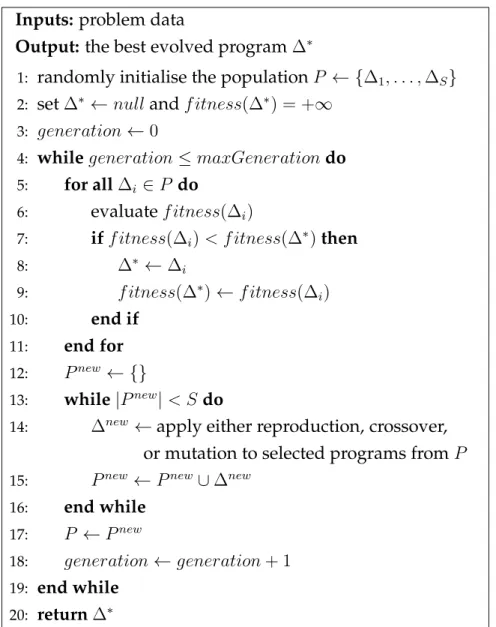
• Genetic Programming (GP) [103]: is an extended form of GAs where individuals are represented as variable length computer programs. Different data structures (e.g. tree, linear, grammar) have been em-ployed to construct computer programs. This provides GP with the flexibility to perform different tasks such as machine learning and optimisation.
• Evolution Strategy (ES) [22]: is an optimisation method which adopts the concept of biological evolution. Different from GAs and GP, ES mainly uses only mutation to generate new individuals and the
indi-2.1. BASIC CONCEPTS 23 vidual selection in ES is deterministic and only based on the fitness rankings.
• Evolution Programming (EP) [60]: is similar to GAs, but focuses more on the behaviour linkage between parents and offspring rather than trying to imitate the genetic operators in nature. In EP, both populations of parents and offspring are placed into the same pool to select individuals for the next generation.
Swarm Intelligence (SI)
SI is a research area that focuses on the emergent collective intelligence of groups of simple agents [21, 26] such as ant colonies, bird flocks, fish schools, and bacterial growth. In SI, the agents follow simple rules, but the interaction between agents can lead to “intelligent” global behaviour by the swarm even though there is no centralized control structure dictating how individual agents should behave. Two typical SI techniques in the literature are:
• Particle Swarm Optimisation (PSO) [99]: is a simple SI technique based on simulated social behaviours. In PSO, a swarm or popu-lation of particles (candidate solutions) moves in the solution search space. Each solution is usually encoded as a vector of real numbers that are treated as the positions of a particle in the swarm. Each particle is assigned a fitness value based on its performance. Then particles update their positions by being accelerated towards refer-enced particles such as global best, and local best (based on certain topologies) with higher fitness. The key idea is that this movement will help guide the swarm towards the global optimal solutions in the search space.
• Ant Colony Optimization (ACO) [55]: is an algorithm that simu-lates the behaviour of ants seeking a path between their colony and a
source of food. In ACO, the artificial ants find the path (solution) to the food source and leave on its path a trail of pheromone. Gradually, the pheromone on the shorter paths (better solutions) are strengthen and become more attractive to the ants. Based on this idea, many extensions of ACO have been developed and shown to provide very good results.
These two techniques have been applied successfully into a wide range of optimisation problems such as vehicle routing [2, 20] and job shop schedul-ing [173, 189]. Other well-known SI techniques include artificial immune system (AIS) [48], and artificial bee colony algorithm (ABC) [96].
2.2
Job Shop Scheduling Problems
A scheduling problem is traditionally described by the tripletβ|γ|δ, where
β represents the machine environment, γprovides the processing charac-teristic (it may contain no entry at all or multiple entries), andδdescribes the objective to be minimised [153]. The general JSS problem could be sim-ply defined as the scheduling of different jobs to be processed on different machines [61] to satisfy certain objectives. In this case, a job is a sequence of operations, each of which is to be performed on a particular machine. In JSS, the routes of jobs are fixed, but not necessarily the same for each job [153]. An example of a job shop studied in this thesis is shown in Figure 2.1. For the static JSS problem, the shop (or the working/manufacturing environment) includes a set of M machines and N jobs that need to be scheduled. Each job j has its own pre-determined route through a se-quence of machines to follow and its own processing time at each machine it visits. In static JSS, processing information of all jobs is available. In the dynamic JSS problem, jobs arrive randomly over time and the processing information of jobs is unknown before their arrival. Some basic definitions and notations in JSS are as follows.
2.2. JOB SHOP SCHEDULING PROBLEMS 25 Machine 1 Machine 2 Machine 3 Job Arrival Assign Due-date Delivery Job/Operation Queue Machine # Machine Route Complete Sequencing/ Scheduling
Figure 2.1: Job Shop Scheduling (shop with 3 machines).
Parameters:
• Oj = {oj,1, . . . , oj,l, . . . , oj,Nj}: the set of all operations of jobj where
oj,l,is thelthoperation of jobj andNj is the number of operations of jobj.
• wj: the weight of jobjin the weighted tardiness objective function. • dj: the due date assigned to jobj.
• p(σ): the processing time of operationσ. • m(σ): the machine that processes operationσ.
• next(σ): the next operation of the job that contains operation σ or
null if σ is the last operation of that job (if σ = oj,l then next(σ) =
oj,l+1).
Variables:
• Uk: the ready time of machinek, which is the time that the machine becomes idle; in this study, all machines are idle at the beginning. • rj: the release time when jobj is available to be processed.
• r(σ): the ready time of operation σ, which is the release time rj of job j for the first operation or the completion time of its preceding operation for other operations.
![Figure 2.4: Production planning and control (PPC) decisions [107].](https://thumb-us.123doks.com/thumbv2/123dok_us/10103201.2910791/64.892.150.717.195.470/figure-production-planning-control-ppc-decisions.webp)