~
'~5
os~~r~
t~
SCo.."""'-
~r-Design and Implementation or the SUD Network Files:ystem
Russel SandbC'"
David Gold"" StnC' XlC'iman
Dan Walsh Bob Lyon Sun Microsystems. Inc.
2550 Garcia Ave. Mountain View, CA. 94110
(415) 96G-7293
Introduction
The Sun Network Fllesystem (NFS) provides transparent, remote access to mesystems. Unlike many other remote rllesystem implementations under UNIXt, the NFS is designed to be easily portable to other operatin& systems and machine architectures. It uses an External Data Representation (XDR) specification to descnoe protocols in a machine and system independent way. The NFS is implemented on top of a Remote Procedure Call package (RPC) to help simplify protocol definition, implementation, and maintenance.
In order to build the NFS into the UNIX 4.2 kernel in a user transparent way, we decided to add a new interface to the kernel which separates generic mesystem operations from specific mesystem implementations. The "mesystem interface" consists of two parts: the Virtual File System (VFS) interface defines the operations that can be done on a rllesystem, while the vnade interface dermes the operations that can be done on a rile within that filesystem. This new interface allows us to implement and install new rllesystems in much the same way as new device drivers are added to the kernel.
In this paper we discuss the design and implementation of the rllesystem interface in the kernel and the NFS virtUal rllesystem. We describe some interesting design issues and how they were resolved, and point out some of the shortcomings of the current implementation. We conclude with some ideas for future enhancements.
Design Goals
The NFS was designed to make sharing of filesystem resources in a network of non-homogeneous machines easier. Our goal was to provide a UNIX-like way of making remote riles available to local programs without having to modify, or even recompile, those programs. In addition, we wanted remote rile access to be comparable in speed to local rtle access.
The overall design goals of the NFS were:
Machine and Operating System Independence
The protocols used should be independent of UNIX so that an NFS server can supply rtles to many diICerent types of clients. The protocols should also be simple enough that they can be implemented on low end machines like the PC. Crash Recovery
When clients can mount remote filesystems from many different servers it is very important that clients be able to recover easily from server crashes. Transparent Access
We want to provide a system which allows programs to access remote mes in exactly the same way as local meso No pathname parsing, no special libraries, no recompiling. Programs should not be able to tell whether a rile is remote or local.
-t
UNIX is a trademark of Bell Laboratories°1
UNIX Semantics Maintained on ClientIn order for transparent access to work on UNIX machines, UNIX rlIesystem semantics have to be maintained for remote rlIes.
Reasonable Performance
People will not want to use the NFS if it is no faster than the existing networking utilities, such as ,cp, even if it is easier to use. Our design goal is to make NFS as fast as the Sun Network Disk protocol (ND1).. or about 80% as fast as a local disk.
Basic Design
The NFS design consists of three major pieces: the protocol, the server side and the client side. NFS Protocol
The NFS protocol uses the Sun Remote Procedure Call (RPC) mechanism [1]. For the same reasons that procedure calls help simplify programs, RPC helps simplify the definition, organization, and implementation of remote services. The NFS protocol is dermed in terms of a set of procedures, their arguments and results, and their effects. Remote procedure calls are synchronous, that is, the client blocks until the server has completed the call and returned the results. This makes RPC very easy to use since it behaves like a local procedure call.
The NFS uses a stateless protocol. The parameters to each procedure call contain all of the information necessary to complete the call, and the server does not keep track of any past requests. This makes crash recovery very easy; when a server crashes, the client resends NFS requests until a response is received, and the server does no crash recovery at all. When a client crashes no recovery is necessary for either the client or the server. When state is maintained on the server, on the other hand, recovery is much harder. Both client and server need to be able to reliably detect crashes. The server nee4s to detect client crashes so that it can discard any state it is holding for the client, and the client must detect server crashes so that it can rebuild the server's state.
Using a stateless protocol allows us to avoid complex crash recovery and simplifies the protocol. If a client just resends requests until a response is received, data will never be lost due to a server crash. In fact the client can not tell the difference between a server that has crashed and recovered, and a server that is slow.
Sun's remote procedure call package is designed to be transport independent. New tranSport protocols can be "plugged in" to the RPC implementation without affecting the higher level protocol code. The NFS uses the ARPA User Datagram Protocol (UDP) and Internet Protocol (IP) for its transport level. Since UDP is an unreliable datagram protocol. packets can get lost, but because the NFS protocol is stateless and the NFS requests are idempotent, the client can recover by retrying the call until the packet gets through.
The most common NFS procedure parameter is a structure called a rlIe handle (fllandle or fh) which is provided by the server and used by the client to reference a rlIe. The fhandle is opaque, that is. the client never looks at the contents of the fhandle, but uses it when operations are done on that file.
An outline of the NFS protocol procedures is given below. For the complete specification see the Sun Network Filesystem Protocol Specification [2J.
nullO returns 0
Do nothing procedure to ping the server and measure round trip time. lookup(dirfh. name) returns (fh, attr)
Returns a new fhandle and attributes for the named rlIe in a directory. create(dirfh, name, attr) returns (newfh, attr)
Creates a new rlIe and returns its fhandle and attributes. remove(dirfh, name) returns (status)
Removes a file from a directory. getattr(fh) returnS (attr)
Returns me attributes. This procedure is like a stat call.
setattr(fh, attr) returns (attr)
Sets the mode, uid, gid, size, access time, and modify time of a me. Setting the size to zero trUncates the rue.
read(fh, offset, count) returns (attr, data)
ReturnS up to count bytes of data from a me starting offset bytes into the file. read also returns the attributes of the me.
write (fh , offset, count, data) returnS (attr)
Writes count bytes of data to a file beginning offset bytes from the beginning of the file. Returns the attributes of the file after the write takes place.
rename(dirfh, name, tofh, toname) returns (status)
Renames the file name in the directory dirfla, to toname in the directory tofla. Unk(dirfh, name, tofh, toname) returns (status)
Creates the file tonam' in the directory tofla, whic;h is a link to the me nam, in the directory dirfla.
symUnk(dirfh, name, string) returns (status)
Creates a symbolic link nam, in the directory dirfla with value string. The server does not interpret the string argument in any way, just saves it and makes an assOC;iation to the new symbolic link file.
readUnk(fh) returnS (string)
Returns the string which is associated with the symbolic link file. mkdir(dirfh, name, attr) returnS (fh, newattr)
Creates a new directory nam, in the directory dirfla and returns the new fhandle and attnoutes.
rmdir(dirfh, name) returns (status)
Removes the empty directory nam, from the parent directory dirfla. readdir(dirfh, cookie, count) returns(entries)
Returns up to count bytes of directory entries from the directory dirfla. Each entry contains a flle name, file id, and an opaque pointer to the next directory entry called a cooki,. The cooki, is used in subsequent readdir calls to start reading at a specific entry in the directory. A readdir call with the cooki, of zero returns entries starting with the first entry in the directory.
statfs(fh) returns (fsstats)
Returns fllesystcm information such as block size, number of free blOC;ks, etc.
New fhandles are returned by the lookup, create, and mkdlr procedures which also take an fhandle as an argument. The flrst remote fhandle, for the root of a fllesystem, is obtained by the client using another RPC based protocol. The MOUNT protoc;ol takes a directory pathname and returns an !handle if the client has access permission to the fllesystem which contains that directory. The reason for making this a separate protocol is that this makes it easier to plug in new fllesystem access checking methods, and it separates out the operating system dependent aspects of the protocol. Note that the MOUNT protocol is the only place that UNIX pathnames are passed to the server. In other operating system implementations the MOUNT protocol can be replaced without having to change the NFS protoc;ol.
The NFS protocol and RPC are built on top of an External Data Representation (XDR) specification [3). XDR defmes the size, bytes order and alignment of basic data types such as string, integer, union, boolean and array. Complex structures can be built from the basic data types. Using XDR not only makes protocols machine and language independent, it also makes them easy to defme. The arguments and results of RPC procedures are defmed using an XDR data defmition language that looks a lot like C declarations.
Server Side
Because the NFS server is stateless, as mentioned above, when servicing an NFS request it must commit any modified data to stable storage before returning results. The implication for UNIX based servers is that requests whic;h modify the fllesystem must flush all modified data to disk before returning from the call. This means that, for example on a write request, not only the data block, but also any modified indirect blocks and the block containing the inode must be flushed if they have been modified.
Another modification to UNIX necessary to make the server work is the addition of a generation number in the inode, and a fllesystem id in the superblock. These extra numbers make it possible for the server to use the inode number, inode generation number, and fllesystem id
J
together as the !handle for a rue. The inode generation number is necessary because the server may hand out an !handle with an inode number of a file that is later removed and the inode reused. When the original fhandle comes back, the server must be able to tell that this inode number now refers to a different rile. The generation number has to be incremented every time the inode is freed.
Client Side
The client side provides the transparent interlace to the NFS. To make transparent access to remote rues work we had to use a method of locating remote files that does not change the structure of path names. Some UNIX based remote rue access schemes use host:path to name remote files. This does not allow real transparent access since existing programs that parse pathnames have to be modified.
Rather than doing a "late binding" of rile address, we decided to do the hostname lookup and rile address binding once per rllesystem by allowing the client to attach a remote ruesystem to a directory using the mount program. This method has the advantage that the client only has to deal with hostnames once, at mount time. It also allows the server to limit access to filesystems by checking client credentials. The disadvantage is that remote files are not available to the client until a mount is done.
Transparent access to different types of rllesystems mounted on a single machine is provided by a new rllesystems interlace in the kernel. Each "filesystem type" supports two sets of operations: the Virtual Fllesystem (VFS) interface dermes the procedures that operate on the filesystem as a whole; and the Virtual Node (vnode) interface dermes the procedures that operate on an individual rue within that filesystem type. Figure 1 is a schematic diagram of the filesystem interface and how the NFS uses it.
~ ~ ~ ~ ~ ~ ~ Figure 1
The Fllesystem Interface
The VFS interface is implemented using a structure that contains the operations that can be done on a whole fllesystem. Ukewise. the vnode interface is a structure that contains the operations that can be done on a node (rIle or directory) within a fllesystem. There is one VFS structure per
mounted filesystem in the kemel and one vnode Stnlcture for each active node. UIiDI this abstract data type implementation allows the kemel to treat all filesystems and nodes in the same way without knowing which underlyina mesystem implementation it is usinl.
Each vnode contains a pointer to its parent VFS and a pointer to a mounted-on VFS. This means that any node in a mesystem tree can be a mount point for another filesystem. A root operation is provided in the VFS to return the root vnode of a mounted mesystem. This is used by the pathname traversal routines in the kernel to bridge mount points. The root operation is used instead of just keeping a pointer so that the root vnode for each mounted fllesystem can be released. The VFS of a mounted ffiesystem also contains a back pointer to the vnode on which it is mounted so that pathnames that include".." can also be traversed across mount points. In addition to the VFS and VDode operations, each ffiesystem type must provide mount and mount_root operations to mount normal and root filesystems. The operations defined for the mesystem interface are:
Fil,sysum O~ratiolls
mount( varies) System can to mount mesystem mount_root( ) Mount mesystem as root
VFS Op,ratiolls
unmount(vfs) Unmount ruesystem
root(vfs) returns(vnode) Return the vnode of the mesystem root statts(vfs) retums( fsstatbuf) Return filesystem statistics
sync (vfs) Flush delayed write blocks Vnod, Op,rations
open(vnode, flags) Mark me open close(vnode, flags) Mark me closed rdwr(vnode, wo, rwflag, flags) Read or write a rue foctl(vnode, cmd, data, rwflag) Do 1/0 control operation select(vnode, rwflas) Do seleet
setattr(vnode ) retums(attr) Return me attnoutes setattr(vnode, attr) Set rIle attributes
access(vnode, mode) Check access permission
lookup(dvnode, name) returns(vnode) Look up me name in a directory create(dvnode, name, attr, excl, mode) returns(vnode) Create a rIle
remove(dvnode, name) Remove a me name from a directory IInk(vnode, todvnode, toname) Unk to a rue
rename (dvnode , name, todvnode, toname) Rename a me mkdfr(dvnode, name, attr) returns(dvnode) Create a directory rmdfr(dvnode, name) Remove a directory readdfr(dvnode) returns (entries) Read directory entries symllnk(dvnode, name, attr, to_name) Create a symbolic link
readllnk(vp) retums(data) Read the value of a symbolic link rsync(vnode) Flush dirty blocks of a me
fnactfve(vnode) Mark vnode inactive and do ~lean up bmap(vnode, blk) returns(devnode, mappedblk) Map block number
strategy(bp) Read and write 'fllesystem blocks bread(vnode, blockno) returns(buf) Read a block
brelse(vnode, but) Release a block buffer
Notice that many of the vnode procedures map one-to-one with NFS protocol procedures, while other, UNIX dependent procedures such as open, close, and foctl do not. The bmap, strategy, bread, and brelse procedures are used to do readins and writing usinS the buffer cache.
Pathname traversal is done in the kernel by breams the path into directory components and doing a lookup call through the vnode for each component. At first glan,c it seems likc a waste
:J
of time to pass only one component with each call instead of passing the whole path and receivingback a target vnode. The main reason for this is that any component of the path could be a mount point for another ffiesystem, and the mount information is kept above the vnode implementation level. In the NFS ffiesystem, passing whole pathnames would force the server to keep track of aU of the mount points of its clients in order to determine where to break the pathname and this would violate server statelessness. The inefficieney of looking up one component at a time is alleviated with a cache of directory vnodes.
Implementation
Implementation of the NFS started in March 1984. The first step in the implementation was modification of the 4.2 kernel to include the filesystem interface. By June we had the first "vnode kernel" running. We did some benchmarks to test the amount of overhead added by the extra interface. It turned out that in most cases the difference was not measurable, and in the worst case the kernel had only slowed down by about 2%. Most of the work in adding the new interface was in fmding and fixing all of the places in the kernel that used inodes directly, and code that contained implicit knowledge of inodes or disk layout.
Only a few of the fllesystem routines in the kernel had to be completely rewritten to use vnodes. Namei, the routine that does pathname lookup, was changed to use the vnode lookup operation, and cleaned up so that it doesn't use global state. The direnter routine, whieh adds new directory entries (used by create, rename, etc.), also had to be fIXed because it depended on the global state from namei. Direnter also had to be modified to do directory locking during directory rename operations because inode loeking is no longer available at this level, and vnodes are never locked.
To avoid having a fIXed upper limit on the number of active vnode and VFS structures we added a memory allocator to the kernel so that these and other structures can be aUoeated and freed dynamically.
A new system call, getdirentries, was added to read directory entries from different types of fllesystems. The 4.2 readdir horary routine was modified to use the new system call so programs would not have to be rewritten. This change does, however, mean that programs that use readdir have to be relinked.
Beginning in March, the user level RPC and XDR libraries were ported to the kernel and we were able to make kernel to user and kernel to kernel RPC calls in June. We worked on RPC performance for about a month until the round trip time for a kernel to kernel null RPC call was 8.8 milliseconds. The performance tuning included several speed ups to the UDP and IP code in the kernel.
Once RPC and the vnode kernel were in place the implementation of NFS was simply a matter of writing the XDR routines to do the NFS protocol, implementing an RPC server for the NFS procedures in the kernel, and implementing a fI1esystem interface which translates vnode operations into NFS remote procedure calls. The fh--st NFS kernel was up and running in mid August. At this point we had to make some modifications to the .vnode interface to allow the NFS server to do synchronous write operations. This was necessary since unwritten bloeks in the server's buffer cache are part of the "client's state".
Our rust implementation of the MOUNT protocol was built into the NFS protoeol. It wasn't until later that we broke the MOUNT protocol into a separate, user level RPC service. The MOUl'-.'T server is a user level daemon that is started automatically when a mount request comes in. It checks the file letc/export.s which contains a list of exported filesystems and the clients that can import them. If the client has import permission, the mount daemon does a getfh system call to convert a pathname into an tbandle which is returned to the client.
On the client side, the mount command was modified to take additional arguments ineluding a ffiesystem type and options string. The fllesystem type allows one mount command to mount any type of fI1esystem. The options string is used to pass optional flags to the different fllesystem mount system ealls. For example, the NFS allows tWo flavors of mount, soft and hard. A hard mounted fI1esystem will retry NFS calls forever if the server goes down, while a soft mount gives up after a while and returns an error. The problem with soft mounts is that most UNIX programs are not very good about ehecking return status from system calls so you un get some strange behavior when servers go down. A hard mounted fllesystem, on the other hand, will never fail due to a server erash; it may cause processes to hang for a while, bu.t data will not be lost.
In addition to the MOUNT server, we have added NFS server daemons. These are user level processes that make an nfsd system call into the kernel, and never return. This provides a user context to the kernel NFS server which allows the server to sleep. Similarly, the block 1/0 daemon, on the client side, is a user level process that lives in the kernel and services asynchronous block I/O requests. Because the RPC requests are blocking, a user context is necessary to wait for read-ahead and write-behind requests to complete. These daemons provide a temporary solution to the problem of handling parallel, synchronous requests in the kernel. In the future we hope to use a light-weight process mechanism in the kernel to handle these requests [4].
The NFS group started using the NFS in September, and spent the next six months working on perfonnance enhancements and administrative tools to make the NFS easier to install and use. One of the advantages of the NFS was immediately obvious; as the df output below shows, a diskless workstation can have access to more than a Gigabyte of disk!
Filesystem
kbytes
used
avail capacity
Kounted on
/dev/ndO 7445 5788 912 86~ / /dev/ndpO 5691 2798 2323 55~ /pub panic:/usr 27487 21398 3340 86~ /usr fiat:/usr/src 345915 220122 91201 71~ /usr/src panic:/usr/panic 148371 116505 17028 87~ /usr/panic galaxy:/usr/galaxy 7429 5150 1538 77' /usr/galaxy mercury:/usr/mercury 301719 215179 56368 7~ /usr/mercury opium:/usr/opium 327599 36392 258447 1~ /usr/opium The Hard Issues
Several hard design issues were resolved during the development of the NFS. One of the toughest was deciding how we wanted to use the NFS. Lots of flexibility can lead to lots of confusion.
Root Filesystems
Our current NFS implementation does not allow shared NFS root ilIesystems. There are many hard problems associated with shared root file systems that we just didn't have time to address. For example, many well-known, machine specific files are on the root ilIesystem, and too many programs use them. Also, sharing a root filesystem implies sharing /tllP and /dev. Sharing /tmp is a problem because programs create temporary flIes using their process id, which is not unique across machines. Sharing /dev requires a remote device access system. We considered allowing shared access to /dev by making operations on device nodes appear local. The problem with this simple solution is that many programs make special use of the ownership and pennissions of device nodes.
Since every client has private storage (either real disk or ND) for the root ilIesystem, we were able to move machine specific illes from shared illesystems into a new directory called
/private, and replace
those files with symbolic links. Things like
/usr/lib/crontaband the
whole directory /usr/adm have been moved. This allows clients to boot with only /etc and /bin executables local. The /usr, and other flIesystems are then remote mounted.
Filesystem Naming
Servers export whole ilIesystems, but clients can mount any sub-directory of a remote filesystem on top of a local filesystem, or on top of another remote filesystem. In fact, a remote flIesystem can be mounted more than once, and can even be mounted on another copy of itself! This means that clients can have different "names" for ilIesystems by mounting them in different places.
To alleviate some of the confusion we use a set of basic mounted ilIesystems on each machine and then let users add other ilIesystems on top of that. Remember though that this is just policy, there is no mechanism in the NFS to enforce this. User home directories are mounted on /usr/servername. This may seem like a violation of our goals because hostnames are now part of pathnames but in fact the directories could have been called /usr/1, /usr/2, etc. Using server names is just a convenience. This scheme makes workstations look more like timesharing tenninals because a user can log in to any workstation and her home directory will be there. It also makes tilde expansion (-username is expanded to the user's home directory) in the C shell work in a network with many workstations.
To aviod the problexns of loop detection and dynamic filesystem access checking, servers do not cross mount points on remote lookup requests. This means that in order to see the same
')
rtIesystem layout as a server, a client has to remote mount each of the server's exported rtIesystems.
Credentials, Authentication and Security
We wanted to use UNIX style penn.ission checking on the server and client so that UNIX users would see very little difference between remote and local files. RPC allows different authentication parameters to be "plugged-in" to the packet header of each call so we were able to make the NFS use a UNIX flavor authenticator to pass uid, gid, and groups on each call. The server uses the authentication parameters to do permission checking as if the user making the call were doing the operation locally.
The problem with this authentication method is that the mapping from uid and lid to user must be the same on the server and client. This implies a flat uid, lid space over a whole local network. This is not acceptable in the long run and we are working on different authentication schemes. In the mean time, we have developed another RPC based service called the Yellow Pages (YP) to .provide a simple, replicated database lookup service [']. By letting YP handle /etc/passwd and /etc/CTouP we make the flat uid space much easier to admini'trate. Another issue related to client authentication is super-user access to remote rtIes. It is not clear that the super-user on a workstation should have root access to files on a server machine through the NFS. To solve this problem the server maps user root (uid 0) to user nobody (uid -2) before checking access permission. This solves the problem but, unfortunately, causes some strange behavior for users logged in as root, since root may have fewer access rights to a file than a normal user.
Remote root access also affects programs which are set-uid root and need access to remote user files, for example Ipr. To make these programs more likely to succeed we check on the client side for RPC calls that fail with EACCES and retry the call with the real-uid instead of the effective-uid. This is only done when the effective-uid is zero and the real-uid is something other than zero so normal users are not affected.
While restricting super-user access helps to protect remote files, the super-user on a client machine can still gain access by using su to change her effective-uid to the uid of the owner of a remote file.
Concurrent
Access and File LockJngThe NFS does not support remote rtIe locking. We purposely did not include this as part of the protocol because we could not rmd a set of locking facilities that everyone agrees is correct. Instead we plan to build separate, RPC based rtIe locking facilities. In this way people can use the locking facility with the flavor of their choice with minimal effort.
Related to the problem of rue locking is concurrent access to remote mes by multiple clients. In the local rtIesystem, me modifications are locked at the inode level. This prevents two processes writing to the same rue from intermixing data on a single write. Since the server maintains no locks between requests, and a write may span several RPC requests, two clients writing to the same remote rile may get intermixed data on long writes.
UNIX Open File Semantics
We tried very hard to make the NFS client obey UNIX rllesystem semantics without modifying the server or the protocol. In some cases this was hard to do. For example, UNIX allows removal of open rtIes. A process can open a rlIe, then remove the directory entry for the me so that it has no name anywhere in the fileSystem, and still read and write the rlIe. This is a disgusting bit of UNIX trivia and at rlfSt we were just not going to support it, but it turns out that all of the programs that we didn't want to have to fix (csJa, stndmail, etc.) use this for temporary rtIes.
What we did to make open rlIe removal work on remote files was check in the client VFS remove operation if the rile is open, and if so rename it in"tead of removing it. This makes it
(sort of) invisible to the client and still allows reading and writing. The client kernel then removes the new name when the mode becomes inactive. We call this the 3/4 solution because
if the client crashes between the
rename
andremove
a garbage file is left on the server. Anentry to cron can be added to clean up on the server.
Another problem associated with remote, open files is that aeeeu permission on the me '4n change while the rtIe is open. In the local case the access permission is only checked when the rtIe is opened, but in the remote case permission is checked on every NFS call. This means that if a client program opens a rIle, then changes the permission bits so that it no longer has read
Initial NFS Performance
Figure 2
In our rust attempt to increase performance we added buffer caching on the client side to decrease the number of read and write requests going to the server. To maintain cache
127
permission, a subsequent read request will fail. To get around this problem we save the client credentials in the ftIe table at open time, and use them in later me access requests.
Not all of the UNIX open me semantics have been preserved because interactions between two clients using the same remote me can not be controlled on a single client. For example, if one client opens a me and another client removes that ftIe, the flISt client's read request will fail even though the ftIe is still open.
Time Skew
Time skew between two clients or a client and a server can cause time asso~iated with a me to be in~onsistent. For example, ranlib saves the current time in a library entry, and ,Id checks the modify time of the library against the time saved in the library. When ran lib is run on a remote me the modify time comes from the server while the current time that gets saved in the library comes from the client. If the server's time is far ahead of the client's it looks to Id like the l1orary is out of date. There were only three programs that we found that were affected by this, ranlib, Is and emacs, so we fIXed them.
This is a potential problem for any program that compares syst~m time to rue modification time. We plan to fIX this by limiting the time skew between machines with a time synchronization protocol.
Performance
The fmal hard issue is the one everyone is most interested in, performance.
Much of the time sin~e the NFS flfSt came up has been spent in improving performance. Our goal was to make NFS faster than the ND in the 1.1 Sun release (about 80% of the speed of a local disk). The speed we are interested in is not raw throughput, but how long it takes to do normal work. To track our improvements we used a set of benchmarks that include a small C compile, tbl, moH, large compile, f77 compile, bubble sort, matrix inversion, make, and pipeline.
The graph below shows the speed of the flfSt NFS kernel compared to various disks on the 1. 1 release of the kernel. The NFS and ND benchmarks were run using a Sun-2 (68010 running at 10 Mhz with no wait states) modell00U for the client machine, and a Sun-2 120 for the server, with Sun 10 Megabit ethernet boards. The disk benchmarks were done on a Fujitsu Eagle with a Xylogics 450 controller, and a Micropolis 42- Megabyte drive with a SCSI controller. Notice that NFS performance is pretty bad, except in the case of matrix inversion, because there is essentially no ftIesystem work going on.
)
consistency, fIles are flushed on close. This helped a lot, but in reading and writing large files there were still too many requests going to the server. We were able to decrease the number of requests by changing the maximum UDP packet size from 2048 bytes to 9000 bytes (8k requests plus some overhead). This allows the NFS to send one large request and let the IP layer fragment and reassemble the packet. With a little work on the IP fragmentation code this turns out to be a big win in terms of raw throughput.
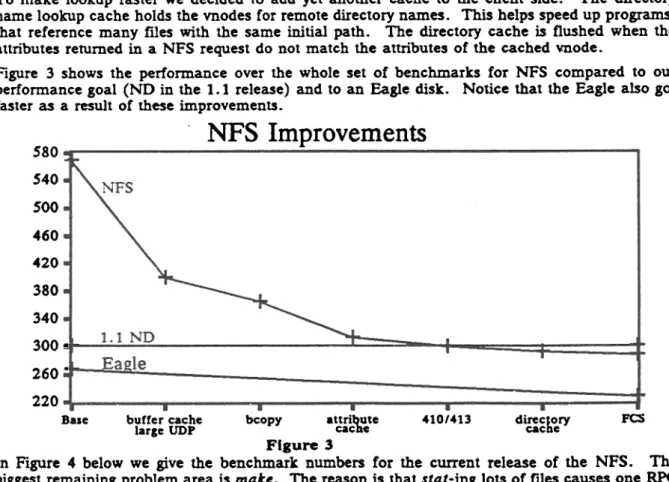
A gprof of the kernel, both client and server sides, showed that bcopy was a big consumer because the NFS and RPC kernel code caused three bcopys on each side. We managed to trim that down to two copies on each side by doing XDR translation directly into, and out of, mbuf chains.
Using statistics gathered on the NFS server, we noticed that gctattr (stat) accounted for 90% of the calls made to the server. In fact, the stat system call itself caused eleven RPC requests, seven of which were getattr requests on the same file. To speed up getattr we added a client side attribute cache. The cache is updated every time new attributes arrive from the server, and entries are discarded after three seconds for fIles or thirty seconds for directories. This caused the number of getattr requests to drop to about 10% of the total calls.
To make sequential read faster we added read-ahead in the server. This helped somewhat but it was noted that most of the read requests being done were in demand-loading executables, and these were not benefiting from read-ahead. To improve loading of executables we use two tricks. F1!St, fill-on-demand clustering is used to group many small page-in requests into one large one. The second trick takes advantage of the fact that most small programs touch all of their pages before exiting. We treat 413 (paged in) programs as 410 (swapped in) if they are smaller than a fixed threshold size. This speeds up both the local and remote fIlesystems because loading a small program happens all at once, which allows read-ahead. This may sound like a hack but it can be thought of as a better initial estimate of the working set of small programs, since small programs are more likely to use all of their pages than none of them.
To make lookup faster we decided to add yet another cache to the client side. The directory name lookup cache holds the vnodes for remote directory names. This helps speed up prograIns that reference many files with the same initial path. The directory cache is flushed when the attnoutes returned in a NFS request do not match the attributes of the cached wode.
Figure 3 shows the performance over the whole set of benchmarks for NFS compared to our performance goal (ND in the 1.1 release) and to an Eagle disk. Notice that the Eagle also got faster as a result of these improvements.
,
NFS Improvements
580 540 500 460 420 380 340 300 ~ 260. 220Base buffer cache bcopy attribute 410/413 directory FCS
larce UDP cache cache
Figure 3
In Figure 4 below we give the benchmark numbers for the current release of the NFS. The biggest ~emaining problem area is mak~. The reason is that stat-ins lots or rues causes one RPC call to the server for each me. In the local case the inodes for the whole directory end up in the buffer cache and then stat is just a memory reference. The other operation that is slow is write because it is synchronous on the server. Fortunately, the number of write calls in normal use is very small (about S% of all calls to the server) so it is not noticeable unless the client does a large
write to a remote file. To speed up make we are eonsidering modifying the getattr operation to return attnoutes for multiple files in one eaU. ~
Sinee many people in the UNIX eommunity base performanee estimates on raw transfer speed we also measured those. The eurrent"numbers on raw transfer speed are: 120 kilobytes/seeond for read (cp big-file /dev /null) and 40 kilobytes/seeond for write. Figure 4, below, shows the same set of benehmarks as in Figure 2, this time run with the eurrent NFS release.
Figure 4
What Next?
These are some of the outstanding issues and new features of NFS that we will be working on in the future:
Full Diskless Operation. One of the biggest problems with the current release is that diskless machines must use both ND and NFS. This makes administration twice as hard as it should be, and also makes our job twice as hard since we must support two protocols. We will be working on TFTP booting and additions to NFS to allow shared root filesystems, shared remote swapping, and remote device access. Together these will allow us to run diskless clients with only one remote file access method.
Remote File Locking
We plan to build remote file locking services that are separate from the NFS service. Since file locking is inherently statet'ul (the server maintains the lock information) it will be built using the Sun status monitor service [6].
Other Filesystem Types
The fllesystem types that we have implemented so far are 4.2, NFS and a MS/DOS filesystem that runs on a floppy. We have barely scratched the surface of the usefulness of the filesystem interface. The interface could be used, for example, to implement fllesystems to a11ow UNIX access to VMS or System V disk packs.
PerformanceWe will continue our work on increasing performance, in particular, we plan to explore hardware enhancements to the server side since the server CPU speed is
the bottleneck in the current implementation. We are currently considering building a low cost, stand-alone NFS server that would use a new fllesystem
type for higher performance and to allow automatic repair without operator intervention.
Better Security .
~:)
progams can be written that impersonate a server. There are also problems in the current implementation of the NFS with clients impersonating other clients. To improve security, we plan to build a better authentication scheme that uses public key encryption.
Automatic Mountina
We are considering buUdina a new filesystem type which would give access to all ot the exponed fllesystems in the network. The root directory would contain a directory for each accusable, remote fllesystem. Addina protocol suppon for automatic redirection would allow a server to advise a client when a mount point has been reached, and the client could then automatically mount that remote fllesystem. With this combination of new teatures clients could have access to an remote ffiesystems without having to explicitly do mounts.
Conclusions
We think that the NFS protocols along with RPC and XDR provide the most flexible method ot remote flle access available today. To encourage others to use NFS, Sun is matina public all ot the protocols associated with NFS. In addition, we have published the source code tor the user level implementation of the RPC and XDR libraries. We are also workins on a user level implementation ot the NFS server which can easily be paned to different architectures.
Acknowledgements
There were many people throughout Sun who were involved in the NFS development efton. Bob Lyon led the NFS group and helped with protocol issues, Steve Kleiman implemented the filesystem interface in the kernel from Bill Joy's original design, Russel Sandberl poned RPC to the kernel and implemented the NFS virtual fllesystem, Tom Lyon designed the protocol and provided far sighted inputs into the overall design, David Goldberg worked on many user level programs, Paul Weiss implemented the Yellow Pages, and finally, Dan Walsh is the one to thank tor the performance ot NFS.
I would like to thank Interleaf tor making it possible tor me to write this paper without using tro!t!
References
[1] B. Lyon, .Sun Remote Procedure Call Specification," Sun Microsystems, Inc. Technical Report, (1984).
[2] R. Sandberg, .Sun Network Fllesystem Protocol Specification," Sun Microsystems, Inc. Technical Report, (1985).
[3] B. Lyon, .Sun External Data Representation Specification," Sun Microsystems, Inc. Technical Report, (1984).
[4] J. Kepecs, .Ughtweight Processes for UNIX Implementation and Applications," Usenix (1985)
[5] P. Weiss, "Yellow Pages Protocol Specification," Sun Microsystems, Inc. Technical Report, (1985).