Philips Regulated
Substances List
Royal Philips NV List of Regulated Substances in
Products and Product Packaging
Table of Contents
1 INTRODUCTION ... 3
1.1 Purpose ... 3
TABLE 0: Substances restricted in product related applications, deviating from BOMcheck ... 4
1.2 Scope ... 4
1.3 Deviations ... 4
1.4 Thresholds ... 4
2 SUPPLIER DECLARATION PROCESS ... 5
2.1 Declaration Tool ... 5
2.2 Demonstrating compliance to the RSL through BOMcheck ... 5
3 PRODUCTS CONTENT RESTRICTIONS AND DECLARATIONS ... 7
TABLE 1: RoHS Substances Restrictions in all product-related applications... 7
TABLE 1.1 Upcoming EU RoHS Restrictions in all product-related applications ... 7
TABLE 2: REACH Article 67 Substance Restrictions which may be found in hardware and electrical and electronic equipment ... 7
TABLE 3: Substances restricted or declarable by other legislation in product related applications ... 9
TABLE 4: Substance Legislative Restrictions in Batteries ... 11
TABLE 5: REACH Candidate List Substances Declaration used in all product and product-packaging related applications (Article 33) ... 12
TABLE 6: Industry Specific Substances Restrictions and Declarations in all product-related applications ... 12
TABLE 7: Restrictions in Product-Packaging ... 13
TABLE 8: Substances restricted in Manufacturing Processes... 14
ANNEX 1 - Definitions and interpretation of certain terms ... 15
1.1. Declaration on homogeneous material (EU RoHS) level ... 15
1.2. Article Definition ... 15
ANNEX 2 - Summary Table of Phthalate Restrictions ... 16
ANNEX 3 –Detailed Requirements for Consumer Product Skin Contact Parts for PAH Compounds ... 17
1
INTRODUCTION
At Philips we have been working to minimize the environmental impacts of our products, processes and services since 1970. Guided by the precautionary principle, Philips’ philosophy is “prevention is better than cure”. This means where there are threats of serious or irreversible harm to the environment and/or human health, the lack of scientific certainty should not be used as a reason for postponing cost-effective preventive measures. Policies can be developed that may go beyond legislative compliance based on scientific evidence and stakeholder consultation. Decisions for alternatives take into account the level of concern, commercial availability and technical feasibility of alternatives.
The above mentioned policies are reflected in the present document, the “Royal Philips NV List of Regulated Substances in Products and Product-Packaging”, referred to herein as the “Philips Regulated Substances List” or RSL.
This or newer versions of the present RSL List can be found at Philips website:
http://www.philips.com/shared/global/assets/sustainability/rsl.pdf
1.1
Purpose
This document contains the Philips Regulated Substances List and its annexes. As part of our commitment to health, safety and the environment, Philips requires that all products or parts and product-packaging delivered to Philips, some manufacturing processes used to make Philips parts and brand license productscomply with all applicable requirements in this list. The list contains minimum requirements related to:
Federal, state, county or municipal law, regulation, ordinance or code, and
Philips own requirements
The RSL is part of Philips global policy and therefore included in Philips general purchasing conditions. Each supplier and brand licenseeis required to ensure product compliance with this list.
Additional specific Philips or legal requirements may apply for certain product categories or applications. Examples are materials that get in contact with food, biocides or materials treated with biocides or products to be used for patients, babies or little children.
In the past, Philips accepted a general confirmation from suppliers that they would comply with the substances restrictions we issued. Due to the changing nature of regulations, and in particular the introduction of the EU REACH regulation, we have had to change the way in which we collect regulatory compliance data for substances. That is why Philips decided to henceforth collect compliance data in accordance with the RSL at the part level for every product or product-packaging delivered to Philips. We will do so through a web-based Declaration Tool called BOMcheck as described in Section 2.1. Philips recommends its brand license partners to use BOMcheck.
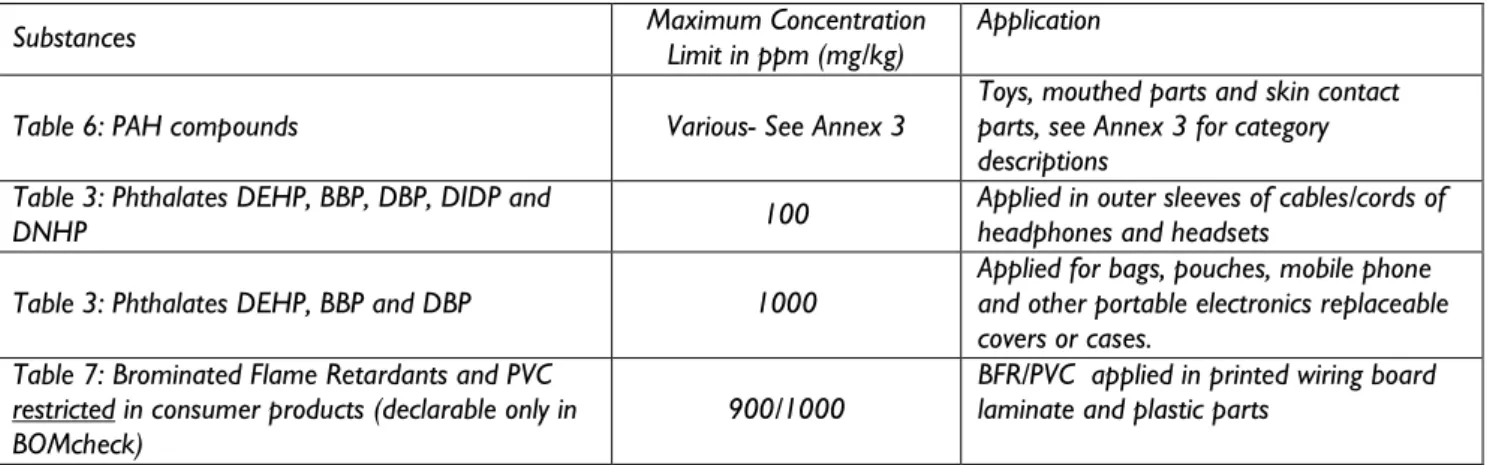
The RSL is aligned with the substances included in the BOMcheck declaration tool where possible. Deviations in the current version of the RSL from BOMcheck are shown in Table 0:
TABLE 0: Substances restricted in product related applications, deviating from
BOMcheck
Substances Maximum Concentration Limit in ppm (mg/kg) Application
Table 6: PAH compounds Various- See Annex 3 Toys, mouthed parts and skin contact parts, see Annex 3 for category descriptions
Table 3: Phthalates DEHP, BBP, DBP, DIDP and
DNHP 100 Applied in outer sleeves of cables/cords of headphones and headsets Table 3: Phthalates DEHP, BBP and DBP 1000
Applied for bags, pouches, mobile phone and other portable electronics replaceable covers or cases.
Table 7: Brominated Flame Retardants and PVC restricted in consumer products (declarable only in
BOMcheck) 900/1000
BFR/PVC applied in printed wiring board laminate and plastic parts
1.2
Scope
The requirements as set up in the Philips Regulated Substances List are a world-wide policy of Philips, even if local regulatory requirement may be less strict. Where there is a difference between the Philips requirements and the local regulatory requirements, the most stringent, i.e., most protective for health, safety and the environment applies. It is the supplier’s responsibility to ensure that these requirements are met.
The scope of this guidance document includes all articles (i.e. materials, components, subassemblies, products, labels attached to products, etc.), product packaging (i.e. wood, paper or card-boxes, plastic material, containers, user manuals, labels, etc.) and some manufacturing processes as described in table 8. The restricted substances cannot be contained in the product or used in the manufacture of the product and its components above the designated thresholds for the controlled applications listed. Declarable substances that are used in articles or packaging materials must be declared according to the limits given in the respective table.
If the supplier needs clarification with respect to Philips’ guidelines and rules presented here, they should discuss with the Philips Representative, which is generally the supplier account manager.
1.3
Deviations
In those cases where the supplier supplies or intends to supply articles to Philips that do not comply with the Philips RSL, the supplier needs to contact the Philips Supply Management organization immediately to resolve the issue and to decide in mutual agreement on corrective actions.
Recycled content
Philips strongly promotes the use of recycled materials, in particular the use of recycled plastics. Philips realizes that the use of recycled materials may cause challenges in terms of guaranteeing compliance to all substances included in the Philips RSL. For issues related to Philips RSL compliance for recycled materials, please contact Philips Supply Management for support. For non-legal obligations, it may be possible to obtain a waiver for presence of certain substances in recycled materials.
1.4
Thresholds
While the substances information for parts, products, and packaging is collected through BOMcheck, suppliers still need to validate that their goods comply with the RSL by comparing their BOMcheck declarations with the RSL. In this respect you need to consider two thresholds:
1. Maximum concentration limit for restricted substances 2. Maximum concentration limit for declarable substances
Maximum concentration limit for restricted substances
Royal Philips NV accepts that certain materials contain a certain amount of naturally occurring restricted substances. However, when a substance is present in products, parts or product packaging at values above the listed maximum concentration limit, the substance is restricted (not allowed to be present) and the good cannot be intentionally used for Philips products. Thresholds can represent legal limits, or refer to currently accepted analysis thresholds. Restricted substances (e.g. RoHS) are measured at homogeneous level, so these thresholds must be declared on homogeneous material level. Use of substances exempted for use in some specific applications, as mentioned in legislation, is allowed. However, it must be declared through BOMcheck accordingly.
Maximum concentration limit for declarable substances
Declarable substances (e.g., REACH SVHCs) are substances which use needs to be monitored due to regulatory requirement or because Philips wants to monitor their use from a precautionary point of view. Use of these substances is permitted, unless otherwise specified, but must be reported above the maximum concentration limit. In this case the maximum concentration limit functions as a threshold above which you must provide the exact concentration of the declarable substance present in the relevant part, article or packaging. Basic understanding and interpretations of definitions like homogeneous material and REACH article definition are presented in Annex 1.
2
SUPPLIER DECLARATION PROCESS
2.1
Declaration Tool
As referred to in Section 1.1., Philips will collect substances information for its parts, products and product packaging because regulations such as RoHS and REACH require us to maintain regulatory compliance evidence at that level. Philips has decided to utilize BOMcheck as a tool to help collect chemical substances information from suppliers (www.bomcheck.net). BOMcheck is an industry platform used by a large number of companies, and represents an efficient tool that helps suppliers follow up on the many legal requirements and provide smooth communication with the customers and in particular with suppliers up the supply chain. BOMcheck is primarily a regulatory compliance tool designed specifically to enable suppliers to provide declarations for RoHS, REACH, and any other restricted and declarable substances legislation through detailed substances reports. BOMcheck also allows suppliers to provide Full Material Declaration (FMD) of their articles. The benefit of FMD is that suppliers have to upload the total chemical composition of their articles only once (unless the formulation of supplied articles changes), while BOMcheck will then automatically update your compliance status every time regulatory changes are introduced.
2.2
Demonstrating compliance to the RSL through BOMcheck
Suppliers are requested to make declarations in BOMcheck for all articles (i.e. materials, components, subassemblies, products, labels attached to products, etc.), packaging materials (i.e., wood, paper or card-boxes, plastic material, containers, user manuals, labels, etc.) and some manufacturing processes. We request suppliers to regularly check for possible updates of the RSL to remain informed on the latest changes in all legislative and policy obligations at
http://www.philips.com/shared/global/assets/sustainability/rsl.pdf.
The BOMcheck substances list which also includes REACH SVHC’s and RoHS exemptions can be found at the following link: https://www.bomcheck.net/suppliers/restricted-and-declarable-substances-list
The table below explains under which conditions BOMcheck declarations are compliant with the RSL. In case there are issues in fulfilling the requirements, contacting Philips Supplier Management is mandatory.
Table number Compliant when above limit?
Table 0 Not allowed; (not included in BOMcheck tool; ensure compliance)
Table 1 Not allowed
Table 1.1 Compliant for declarable substances
Table 2 Not allowed
Table 3 Compliant for declarable substances, not allowed for restricted
substances
Table 4 Not allowed
Table 5 Compliant for declarable substances
Table 6 Compliant for declarable substances, not allowed for restricted
substances
Table 7 Not allowed
3
PRODUCTS CONTENT RESTRICTIONS AND
DECLARATIONS
TABLE 1: RoHS Substances Restrictions in all product-related applications
“Restrictions are derived from EU RoHS Directive. Similar legislation is increasingly adopted in other regions. The restrictions in this Table apply to all Philips articles (both EEE and non-EEE; see remark 2 for exemptions) in all regions.”Substances (remark 1) Concentration Limit Maximum
ppm (mg/kg)
Cadmium and Cadmium compounds 100
Hexavalent Chromium compounds 1000
Lead and Lead compounds 1000
Mercury and Mercury compounds (remark 2) 1000
Polybrominated diphenyl ethers (PBDEs) (remark 3) 1000
Polybrominated biphenyls (PBBs) (remark 3) 1000
1. The restrictions do not apply to the exemption limits in the European Directive RoHS (2011/65/EU),and exemption limits in other RoHS type of regulations like the Canadian CEPA-SOR/2014254.They also do not apply to batteries- and
automotive applications as these are covered by other legislation (see e.g. EU battery directive (2006/66/EU; see also Table 4), the European ELV directive (2000/53/EC and the amendment 2011/37/EU).The list of EU RoHS exemptions, EU battery directives and EU ELV directive can be found in BOMcheck. Heavy metal restrictions for batteries and packaging are given in Tables 4 and 7, respectively.
2. Besides the RoHS obligations, Lighting Products should also comply with the Ecodesign /ERP directive 2009/125/EC (Implementing measure EC No 245/2009), therefore, a declaration via BOMCheck is required including: (1) providing the average amount of Mercury per lamp in x,x mg (ErP); and (2) indicating the relevant ROHS exemption number within the section on RoHS in BOMCheck tool.
3. Polybrominated diphenylethers (PBDE) are the same as polybrominated biphenylethers (PBBE); polybrominated
diphenyloxides (PBDO) are the same as polybrominated biphenyl oxides (PBBO). For requirements concerning other non-RoHS Brominated Flame Retardants, see Tables 3 and 6.
TABLE 1.1 Upcoming EU RoHS Restrictions in all product-related applications
Phthalates, DEHP, BBP, DBP and DiBP are proposed by EU to be part of EU RoHS in July 2019 (medical devices, category 8 in July 2021). To prepare for product compliance, the 4 phthalates are declarable substances as of 2015. The declaration threshold, 1000 ppm, applies to all Philips articles (both EEE and non-EEE), on homogeneous material level.Substances
Maximum
Concentration Limit ppm (mg/kg)
Bis (2-ethylhexyl)phthalate; Di (2-ethylhexyl) phthalate (DEHP), CAS 117-81-7 1000
Dibutyl phthalate; Di-n-butyl phthalate (DBP), CAS 84-74-2 1000
Benzyl butyl phthalate; Butyl benzyl phthalate (BBP), CAS 85-68-7 1000
Diisobutyl phthalate; Di-i-butyl phthalate (DiBP), CAS 84-69-5 1000
TABLE 2: REACH Article 67 Substance Restrictions which may be found in hardware
and electrical and electronic equipment
These substances are equivalent to the relevant restrictions as included in article 67 of the EU REACH regulation. However, Philips enforces these limits worldwide
Substances Maximum Concentration Limit ppm (mg/kg) or as given in the table Application
Asbestos (all types) No intentionally added content All applications
Dibutyltin (DBT) compounds 1000 0.1% by weight of tin in a material
Dioctyltin (DOT) compounds 1000 Application in any textiles or toys and childcare products; 0.1% by weight of tin in a material
Tri-substituted organostannic compounds 1000 0.1% by weight of tin in a material
Benzene 5 Toys
1000 in any substance or preparation (eg, cleaners)
Toys and childcare products
Sum of selected Phthalates Group 1 (BBP, DBP,
DEHP) 1000 Plasticized material when used in toys and childcare articles
Sum of selected Phthalates Group 2 (DIDP,
DINP, DNOP) 1000
Plasticized material when used in toys and childcare articles which can be placed in the mouth
Dielectrics
Monomethyl dibromodiphenyl methane (DBBT) No content permitted Monomethyl dichlorodiphenyl methane (Ugilec
121 or Ugilec 21) No content permitted
Monomethyl tetrachlorodiphenyl methane
(Ugilec 141) No content permitted
Polychlorinated terphenyls (PCTs) No content permitted
Substances which are restricted if part comes into contact with skin
Azo Colourants containing certain amines No content permitted Not permitted in textile and leather articles which may come into direct and prolonged contact with skin
Nickel and nickel alloys (see remark 4) 0,5µg/cm2/week Only in direct and prolonged skin contact
applications
Tris-(1-aziridinyl) phosphinoxide No content permitted Not permitted in textile articles which may come into contact with skin Tri-(2,3-dibromo-propyl) phosphate No content permitted Not permitted in textile articles which may come into contact with skin
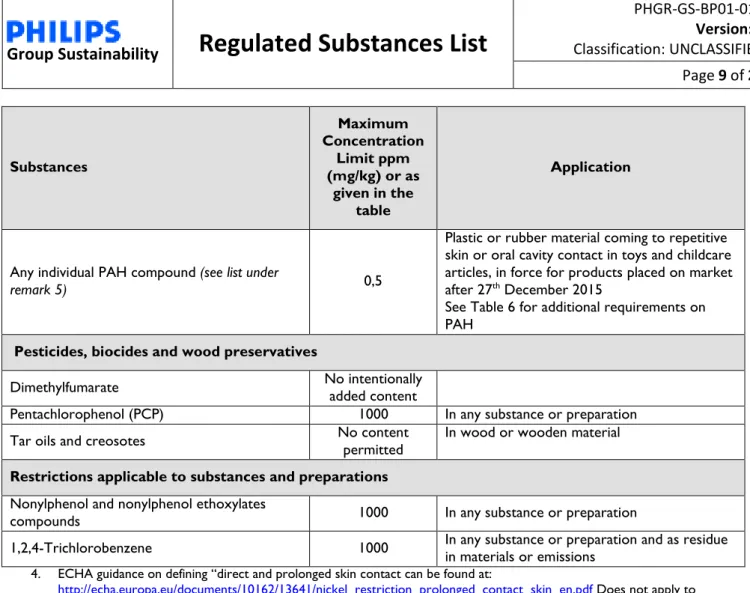
Any individual PAH compound (see list under
remark 5) 1
Plastic or rubber material coming to repetitive skin or oral cavity contact in consumer articles, In force for products placed on market after 27th December 2015
See Table 6 for additional requirements on PAH
Substances Maximum Concentration Limit ppm (mg/kg) or as given in the table Application
Any individual PAH compound (see list under
remark 5) 0,5
Plastic or rubber material coming to repetitive skin or oral cavity contact in toys and childcare articles, in force for products placed on market after 27th December 2015
See Table 6 for additional requirements on PAH
Pesticides, biocides and wood preservatives
Dimethylfumarate No intentionally added content
Pentachlorophenol (PCP) 1000 In any substance or preparation
Tar oils and creosotes No content permitted In wood or wooden material
Restrictions applicable to substances and preparations
Nonylphenol and nonylphenol ethoxylates
compounds 1000 In any substance or preparation
1,2,4-Trichlorobenzene 1000 In any substance or preparation and as residue in materials or emissions
4. ECHA guidance on defining “direct and prolonged skin contact can be found at:
http://echa.europa.eu/documents/10162/13641/nickel_restriction_prolonged_contact_skin_en.pdf Does not apply to Medical devices and associated equipment. Medical device safety standards require biocompatibility testing to ensure that chemical substances, which may contact patients during use per the device's intended use, do not pose a health risk, specifically with respect to biocompatibility.
5. The PAH compounds restricted are: Benzo[a]pyrene CAS 50-32-8, Benzo[e]pyrene CAS 192-97-2, Benzo[a]anthracene CAS 56-55-3, Chrysene CAS 218-01-9, Benzo[b]fluoranthene CAS 205-99-2, Benzo[j]fluoranthene, CAS 205-82-3 Benzo[k]fluoranthene CAS 207-08-9and Dibenzo[a,h]anthracene CAS 53-70-3
TABLE 3: Substances restricted or declarable by other legislation in product
related applications
Substances Maximum concentration limit ppm (mg/kg) or as given in the Table ApplicationBenzenamine, N-phenyl-, reaction products with styrene and 2,4,4-trimethylpentene (BNST)
No intentionally added content Phthalates DEHP, BBP, DBP, DIDP and DNHP
(see remark 6) 100
Applied in outer sleeves of cables/cords of headphones and headsets
Phthalates DEHP, BBP and DBP
(see remark 6) 1000
Applied for bags, pouches, mobile phone and other portable electronics replaceable covers or cases
Formaldehyde No intentionally added content In composite wood products or components (plywood, particle board and MDF) and textiles (see remark 7)
Substances Maximum concentration limit ppm (mg/kg) or as given in the Table Application
Lead and lead compounds 300
Applied in outer sleeves of cables/cords with thermoset or thermoplastic coatings, according to Proposition 65 legislation, USA
Ozone depleting substances No intentionally added content All applications Perfluorooctane sulfonate (PFOS’s) compounds 1000
Perfluorooctanoic acid (PFOA)
1000
Applied in all homogeneous materials in consumer products (adhesive tapes and glues in semiconductors are exempted until 1st January
2016)
1 µg/m2 Applied in textiles
0.001% Applied in chemical preparations for consumers Sulfur Hexafluoride
Specific permission
needed All applications Polychlorinated biphenyls (PCBs) No content permitted
Polychlorinated and polybrominated dioxins and furans
No content permitted Radioactive substances No intentionally added content
Plasticisers, flame retardants, dielectrics
Polychloronaphtalenes No intentionally added content > 3 Cl atoms; applied as stabilizer and flame retardant in plastics Alkanes, C10-13, chloro (SCCP; Short chained
chlorinated paraffins)
No intentionally added content
Applied as plasticizers and flame-retardants; Legislation in The Netherlands: no intentionally added content;
Please note, Restricted by EU regulation 2016/293 on persistent organic pollutants when applied in
preparations in concentrations higher than 1 % by weight or in articles in concentrations higher than 0,15 % by weight.
Hexabromocyclododecane (HBCDD) and its
main diastereoisomers 100 Applied in preparations and articles; EU regulation 2016/293 on persistent organic pollutants.
Parts used in medical devices, food contact or in toys and childcare products
Tris(2-chloroethyl)phosphate (TCEP; CAS 115-96-8)
No content permitted
Applied in all parts in toys and childcare products
(see remark 8) Tris(2-chloro-1-methylethyl) phosphate
(TCPP; CAS 13674-84-5)
Tris(1,3‑dichloro‑2‑propyl)phosphate (TDCPP; CAS 13674-87-8)
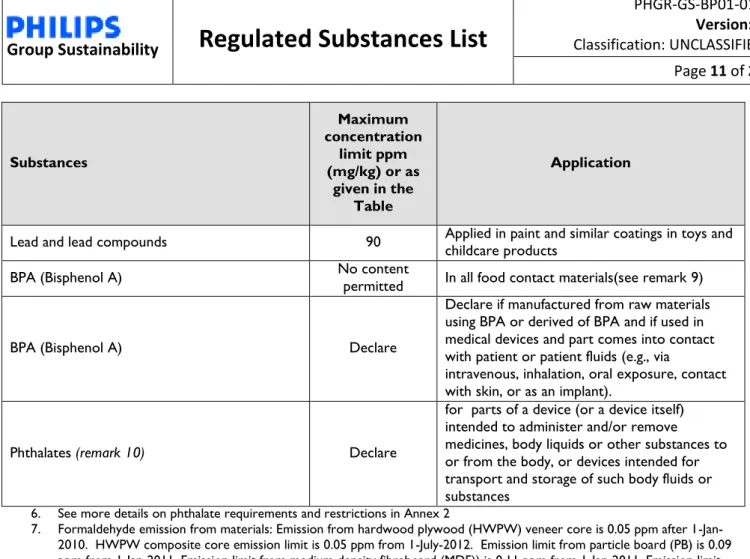
Substances Maximum concentration limit ppm (mg/kg) or as given in the Table Application
Lead and lead compounds 90 Applied in paint and similar coatings in toys and childcare products
BPA (Bisphenol A) No content permitted In all food contact materials(see remark 9)
BPA (Bisphenol A) Declare
Declare if manufactured from raw materials using BPA or derived of BPA and if used in medical devices and part comes into contact with patient or patient fluids (e.g., via
intravenous, inhalation, oral exposure, contact with skin, or as an implant).
Phthalates (remark 10) Declare
for parts of a device (or a device itself) intended to administer and/or remove medicines, body liquids or other substances to or from the body, or devices intended for transport and storage of such body fluids or substances
6. See more details on phthalate requirements and restrictions in Annex 2
7. Formaldehyde emission from materials: Emission from hardwood plywood (HWPW) veneer core is 0.05 ppm after 1-Jan-2010. HWPW composite core emission limit is 0.05 ppm from 1-July-2012. Emission limit from particle board (PB) is 0.09 ppm from 1-Jan-2011. Emission limit from medium density fibreboard (MDF)) is 0.11 ppm from 1-Jan-2011. Emission limit from thin medium density fibreboard (MDF)) is 0.13 ppm from 1-Jan-2012. Composite wood is defined by California Code of Regulations (CCR), Title 17, Section 93120.1. Refer to CCR, Title 17, Section 93120.9 for test methods.
8. TRIS flame retardants are regulated for childcare articles and children´s products in Canada, EU toy directive 2009/48/EC and by US states New York, Maryland, Vermont. See the Bomcheck online guidance for more details on legislation. 9. For Philips consumer products, a policy banning BPA applies to all food contact materials in appliances introduced to
market since 1st January 2012
10. As per the Medical Devices Directive (MDD) 93/42/EEC as amended by Directive 2007/47/EC, Essential Requirement 7.5. See Table in Annex 2 of the declarable phthalates
TABLE 4: Substance Legislative Restrictions in Batteries
Substances concentration limit Maximum
ppm (mg/kg)
Cadmium and cadmium compounds (see remark 11) 10
Mercury and mercury compounds 1
Lead and lead compounds (see remark 11 and 12) in alkaline and non-alkaline) zinc-manganese dioxide batteries
40
11. Cadmium use is exempted for batteries used in emergency lighting (see European Battery directive (2006/66/EU; and for some spare parts for electric vehicles (2000/53/EC and the amendment 2011/37/EU). Additionally, cadmium and lead compounds use is exempted for batteries in some automotive applications (see European ELV directive (2000/53/EC and the amendment 2011/37/EU)
12. The lowest restriction limit for non-alkaline zinc-manganese dioxide batteries is 1000 ppm from Conama 257/99 (Brazil). For zinc chloride zinc manganese batteries, the concentration limit 1000 ppm is applied.
TABLE 5: REACH Candidate List Substances Declaration used in all product and
product-packaging related applications (Article 33)
Due to the fact that the European Chemicals Agency updates this list at least twice a year, we refer to the http://echa.europa.eu/chem_data/candidate_list_table_en.asp for the most recent list of candidate substances. BOMcheck will also contain the most recent list of SVHC and separates between those SVHC which are likely to be found in electronics and those that are not. Please see the lists for substances likely to be present in product and packaging applications in the following link: Link to BOMcheck.
The use of SVHC is allowed (unless otherwise stated in any of the other Tables in the RSL). However, when the concentration on article level is found to be above the limits stated here, declaration is obligatory. For definitions, such as “Article”, please see the Annex 1.
TABLE 6: Industry Specific Substances Restrictions and Declarations in all
product-related applications
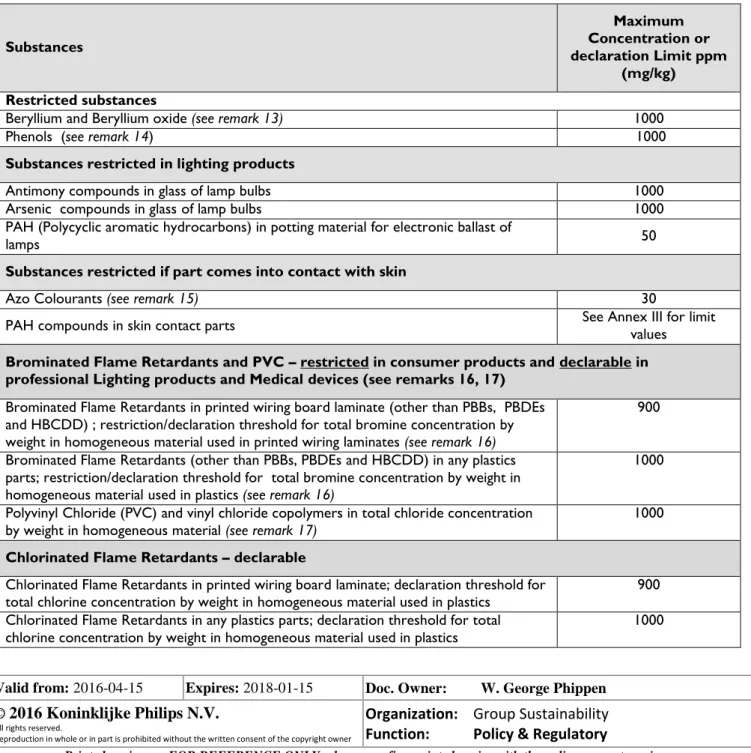
Substances Maximum Concentration or declaration Limit ppm (mg/kg) Restricted substancesBeryllium and Beryllium oxide (see remark 13) 1000
Phenols (see remark 14) 1000
Substances restricted in lighting products
Antimony compounds in glass of lamp bulbs 1000
Arsenic compounds in glass of lamp bulbs 1000
PAH (Polycyclic aromatic hydrocarbons) in potting material for electronic ballast of
lamps 50
Substances restricted if part comes into contact with skin
Azo Colourants (see remark 15) 30
PAH compounds in skin contact parts See Annex III for limit values
Brominated Flame Retardants and PVC – restricted in consumer products and declarable in professional Lighting products and Medical devices (see remarks 16, 17)
Brominated Flame Retardants in printed wiring board laminate (other than PBBs, PBDEs and HBCDD) ; restriction/declaration threshold for total bromine concentration by weight in homogeneous material used in printed wiring laminates (see remark 16)
900 Brominated Flame Retardants (other than PBBs, PBDEs and HBCDD) in any plastics
parts; restriction/declaration threshold for total bromine concentration by weight in homogeneous material used in plastics (see remark 16)
1000 Polyvinyl Chloride (PVC) and vinyl chloride copolymers in total chloride concentration
by weight in homogeneous material (see remark 17)
1000
Chlorinated Flame Retardants – declarable
Chlorinated Flame Retardants in printed wiring board laminate; declaration threshold for
total chlorine concentration by weight in homogeneous material used in plastics 900
Chlorinated Flame Retardants in any plastics parts; declaration threshold for total
Other Substances – declarable
Antimony trioxide in plastic materials; 1000
Phthalates (see remark 18) 1000
13. Beryllium and Beryllium oxide are exempted in the following applications: i) Be metal and BeO used in X-Ray applications, ii) BeO as ceramic heat-resistant in semiconductors, and iii) Be metal alloy (e.g., BeCu), if no feasible technological alternative exist.
14. Increasing number of phenols is becoming regulated under legislation in the EU. In view of the increasing concern and attention focused on phenols, a precautionary approach is taken to restrict the allowable concentration of phenols in parts to < 0.1% w/w. This restriction includes the following phenols:
• 4-(1,1,3,3-tetramethylbutyl)phenol, (4-tert-Octylphenol) • 4-(para)-nonylphenol
• 4-nonylphenol • Nonyl phenol • Octylphenol
15. This restriction of Azo dyes goes beyond the legal restriction under REACH article 67 (see Table 2) as Philips restricts the use of Azo dyes in all applications that come into contact with the skin, and not only for textiles and leather.
16. Philips is pursuing a phase out of the use BFRs in consumer products newly put on the market. Therefore, the use of BFRs needs to be declared to Philips via the BOMcheck tool. For Philips consumer products organobromine compounds in the form of flame retardants should not be used in parts, components, materials, or products in concentrations equal to or greater than 0.09% (900 ppm maximum of Bromine) by weight in any homogeneous material. BFRs are declarable for professional Lighting products and Medical devices
17. Philips is pursuing a phase out of the use of PVC, in consumer products newly put on the market. Therefore, the use of PVC needs to be declared to Philips via the BOMcheck tool. For Philips consumer products organochlorine compounds in the form of polyvinyl chloride or PVC copolymers should not be used in parts, components, materials, or products in concentrations equal to or greater than 0.1% (1000 ppm maximum of Chlorine) by weight in any homogeneous material. PVC is declarable for professional Lighting products and Medical devices.
18. See Table in Annex 2 of the declarable phthalates
TABLE 7: Restrictions in Product-Packaging
Legislative Substances concentration limit Maximum
ppm (mg/kg)
Sum of Heavy metals (Cd, Hg, Cr(6+) and Pb) 100
Dimethyl fumarate (e.g. in silica gel bags) No intentionally added content
Arsenic compounds, applied for wood packaging No intentionally added content
Formaldehyde content in packaging (see remark 7 in Table 3) 1000
Industry substances
Polyvinyl chloride (PVC) and PVC copolymers 1000
Expanded polystyrene (EPS) and other polymeric foam materials (e.g, EPP, EPE, EVA) as shock absorber buffers enclosing the product (excluding thin foam sheets and foam bags inside any consumer product packaging)
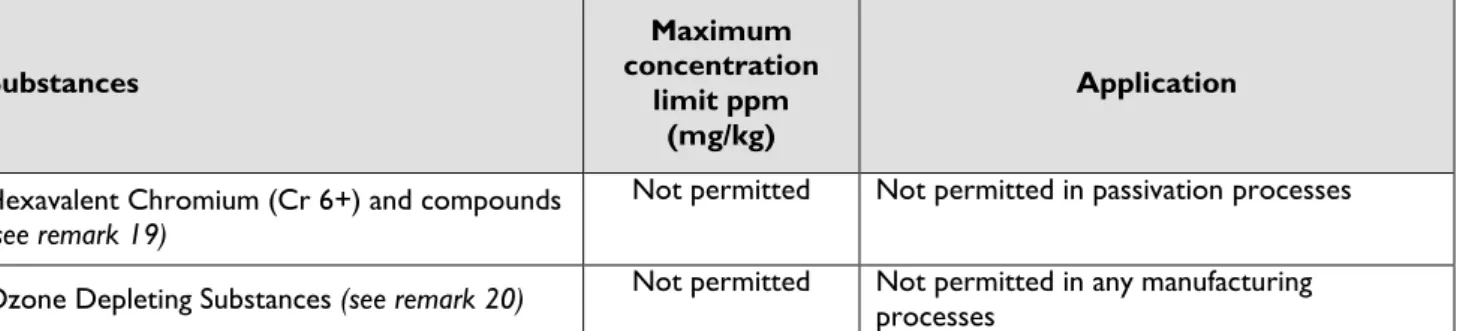
TABLE 8: Substances restricted in Manufacturing Processes
Substances Maximum concentration limit ppm (mg/kg) ApplicationHexavalent Chromium (Cr 6+) and compounds
(see remark 19)
Not permitted Not permitted in passivation processes Ozone Depleting Substances (see remark 20) Not permitted Not permitted in any manufacturing processes
19. Due to the difficulties to control the plating Cr6+ process, posing compliance risks of products brought to the market by Philips; this substance must not be used in any passivation process. Passivation process here means the process where metal surface is getting hexavalent chromium conversion coating, leaving hexavalent chromium residues on the processed surface.
20. Use of Ozone Depleting Substances in processes is subject of federal excise tax law applied to all imported electronics in USA. The substances are also internationally banned under UNEP Montreal Protocol on Substances that Deplete the Ozone Layer and incorporated in the REACH Regulation under article 67.
Valid from: 2016-04-15 Expires: 2018-01-15 Doc. Owner: W. George Phippen
ANNEX 1 - Definitions and interpretation of certain terms
1.1.
Declaration on homogeneous material (EU RoHS) level
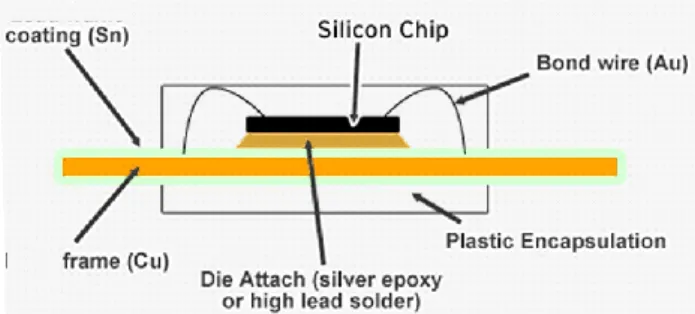
A homogenous material is a single substance such as a thermoplastic, for example the PVC insulation on insulated copper wire. Components such as capacitors, transistors and semiconductor packages are not regarded as "materials" but instead contain several different homogenous materials. For example, a semiconductor package will contain at least six homogenous materials as shown In Figure 1. The RoHS materials restrictions apply to each of these individual homogenous materials.
Figure 1: Material breakdown of an Integrated Circuit (IC) component
Substance ‘X’ < 0.1% at Homogeneous Material level means:
Plastic encapsulation → X < 0.1%
Bond wire → X < 0.1%
Silicon ship → X < 0.1%
“Lead Frame” coating (Cu) → X < 0.1%
“Lead Frame” coating (Sn) → X < 0.1%
Die Attach → X < 0.1%
Etc.1.2.
Article Definition
The European Court of Justice ruled on 10th September 2015, on EU REACH Regulation article definition, that each of the articles, that are assembled or joined together in a complex product, remain as articles and are covered by the relevant duties to notify and provide information when they contain a substance of very high concern in a concentration above 0.1% of their mass.
“Homogeneous material” (EU RoHS) versus
“Article level” (EU REACH)
Figure 1: material break down of a integrated Circuit (IC)
Substance X <0,1% at Homogenous Material level:
• Plastic Encapsulation < 0,1% • Lead frame < 0,1%
• Lead frame coating < 0,1% • Die Attach < 0,1%
• etc.
Substance X <0,1% at Article level:
Lead frame coating + Silicon chip + Bond wire + Die attach + Plastic encapsulation + etc. < 0,1%
Note that some materials within the article may contain higher levels (>0.1%), but the total content of the complete article should be taken into consideration to calculate overall concentration of substance X in this article
“Homogeneous material” (EU RoHS) versus
“Article level” (EU REACH)
Figure 1: material break down of a integrated Circuit (IC)
Substance X <0,1% at Homogenous Material level:
• Plastic Encapsulation < 0,1% • Lead frame < 0,1%
• Lead frame coating < 0,1% • Die Attach < 0,1%
• etc.
Substance X <0,1% at Article level:
Lead frame coating + Silicon chip + Bond wire + Die attach + Plastic encapsulation + etc. < 0,1%
Note that some materials within the article may contain higher levels (>0.1%), but the total content of the complete article should be taken into consideration to calculate overall concentration of substance X in this article
“Homogeneous material” (EU RoHS) versus
“Article level” (EU REACH)
Figure 1: material break down of a integrated Circuit (IC)
Substance X <0,1% at Homogenous
Material level:
• Plastic Encapsulation < 0,1%
• Lead frame < 0,1%
• Lead frame coating < 0,1%
• Die Attach < 0,1%
Substance X <0,1% at Article level:
Lead frame coating + Silicon chip + Bond
wire + Die attach + Plastic encapsulation +
etc. < 0,1%
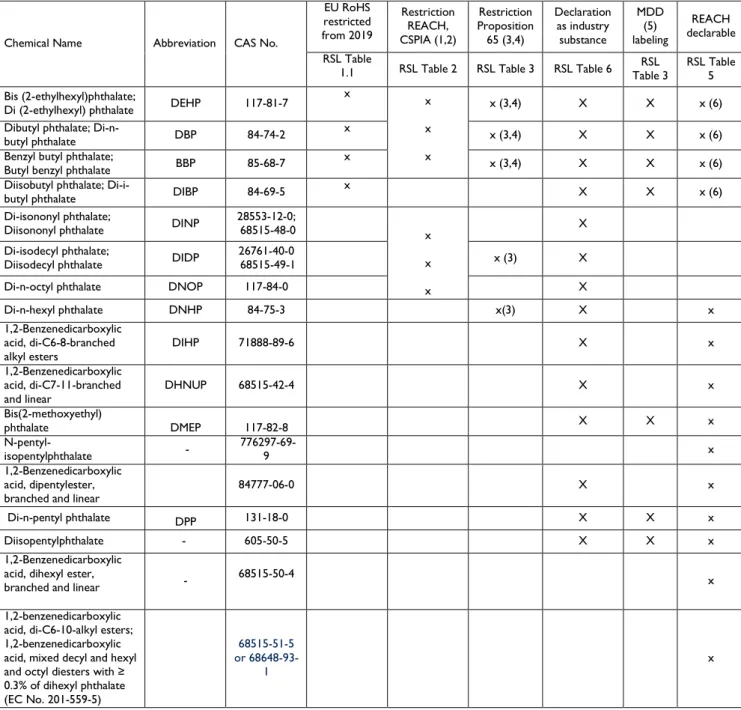
ANNEX 2 - Summary Table of Phthalate Restrictions
Chemical Name Abbreviation CAS No.
EU RoHS restricted from 2019 Restriction REACH, CSPIA (1,2) Restriction Proposition 65 (3,4) Declaration as industry substance MDD (5) labeling REACH declarable RSL Table
1.1 RSL Table 2 RSL Table 3 RSL Table 6 Table 3 RSL RSL Table 5 Bis (2-ethylhexyl)phthalate;
Di (2-ethylhexyl) phthalate DEHP 117-81-7
x x
x x
x (3,4) X X x (6)
Dibutyl phthalate;
Di-n-butyl phthalate DBP 84-74-2 x x (3,4) X X x (6)
Benzyl butyl phthalate;
Butyl benzyl phthalate BBP 85-68-7 x x (3,4) X X x (6)
Diisobutyl phthalate;
Di-i-butyl phthalate DIBP 84-69-5 x X X x (6)
Di-isononyl phthalate;
Diisononyl phthalate DINP 28553-12-0; 68515-48-0 x
x x
X Di-isodecyl phthalate;
Diisodecyl phthalate DIDP 68515-49-1 26761-40-0 x (3) X
Di-n-octyl phthalate DNOP 117-84-0 X
Di-n-hexyl phthalate DNHP 84-75-3 x(3) X x
1,2-Benzenedicarboxylic acid, di-C6-8-branched
alkyl esters DIHP 71888-89-6 X x
1,2-Benzenedicarboxylic acid, di-C7-11-branched
and linear DHNUP 68515-42-4 X x
Bis(2-methoxyethyl) phthalate DMEP 117-82-8 X X x N-pentyl-isopentylphthalate - 776297-69-9 x 1,2-Benzenedicarboxylic acid, dipentylester,
branched and linear 84777-06-0 X x
Di-n-pentyl phthalate DPP 131-18-0 X X x
Diisopentylphthalate - 605-50-5 X X x
1,2-Benzenedicarboxylic acid, dihexyl ester,
branched and linear - 68515-50-4 x
1,2-benzenedicarboxylic acid, di-C6-10-alkyl esters; 1,2-benzenedicarboxylic acid, mixed decyl and hexyl and octyl diesters with ≥ 0.3% of dihexyl phthalate (EC No. 201-559-5)
68515-51-5 or
68648-93-1 x
1) REACH Restriction under article 67: Restriction applies to the sum of the phthalates (the sum of DEHP, DBP, BBP) and (the sum of DINP, DIDP, DNOP).
2) Same substances also restricted in CSPIA, USA: section 108 (see: http://www.cpsc.gov/en/Regulations-Laws--Standards/Statutes/The-Consumer-Product-Safety-Improvement-Act/Phthalates/Phthalates-Information/ ) 3) Proposition 65 Legislation in California, USA: Applied in outer sleeves of cables/cords of headphones and
headsets
4) Proposition 65 Legislation in California, USA: Applied for bags, pouches, mobile phone and other portable electronics replaceable covers or cases
5) MDD: Medical Devices Directive 6) REACH authorization per 21-02-2015
ANNEX 3 –Detailed Requirements for Consumer Product Skin
Contact Parts for PAH Compounds
The German GS-Mark on product safety (“Geprüfte Sicherheit”) has revised their PAH-limits for consumer products. The changed limits will become applicable on 1 July 2015.
Three different product categories have been defined:
1. Material is used in a toy and comes to intended prolonged skin contact or product material is intended to be placed in the mouth
2. During the intended use of the product, material is in prolonged skin contact or in repeated short term skin contact
3. During the intended use of the product, material is only in short term skin contact.
For each category, material needs to fill not only the total maximum allowable sum for all 18 PAHs, but also the individual PAH substance limits described in the table below.
Special attention should also be paid to the new EU REACH annex XVII PAH restriction, entering into force in
December 2015: see the restriction in Table 2. The REACH-restricted PAH-compounds have been marked in the table below.
Substance CAS 1) Materials
intended to be placed in the mouth and toy materials with intended prolonged skin contact (>30 sec.). [mg/kg] 2) Materials which do not fall under Cat.1, with foreseeable prolonged skin contact (>30 sec.) or repeated short term skin contact. [mg/kg]
3) Materials which do not fall under Cat. 1 and 2, with
foreseeable short term skin contact (<30 sec.). [mg/kg] EU REACH restricted PAH (x) Benzo[a]pyrene (BaP) 50-32-8 <0,2 <0,5 <1 x Benzo[a]anthracene 56-55-3 <0,2 <0,5 <1 x Chrysene 218-01-9 <0,2 <0,5 <1 x Benzo[b]fluoranthene 205-99-2 <0,2 <0,5 <1 x Benzo[k]fluoranthene 207-08-9 <0,2 <0,5 <1 x Dibenzo[a,h]anthracene 53-70-3 <0,2 <0,5 <1 x Benzo[j]fluoranthene 205-82-3 <0,2 <0,5 <1 x Benzo[e]pyrene 192-97-2 <0,2 <0,5 <1 x Indeno(1,2,3-c,d)pyrene 193-39-5 <0,2 <0,5 <1 Benzo(g,h,i)perylene 191-24-2 <0,2 <0,5 <1 Acenapthylene 208-96-8 <1 <10 <50 Acenaphthene 83-32-9 Fluorene 86-73-7 Phenanthrene 85-01-08 Anthracene 120-12-7 Fluoranthene 206-44-0 Pyrene 129-00-0 Naphthaline 91-20-3 <1 <2 <10 Sum of 18 PAH <1 <10 <50
ANNEX 4 - Revision History
Date
Revision Short Explanation
April 2016 Version 7
Table 3: Application text and threshold changed for Alkanes, C10-13, chloro (SCCP; Short chained chlorinated paraffins) and Hexabromocyclododecane (HBCDD) and its main diastereoisomers due to EU POP regulations 2015/2030 and 2016/293.
Minor text changes in Chapter 1.3, 2.1 and 2.2. January 2016 Version 6
Edited the Table 0 to reflect the differences between RSL and Bomcheck list of reportable and declarable substances
Table 2, the subheader “Substances which are liquids at room temperature” changed to “Restrictions applicable to substances and preparations”
Table 3, added restriction for hexabromocyclododecane, HBCDD
Table 3, added restriction for Benzenamine, N-phenyl-, reaction products with styrene and 2,4,4-trimethylpentene, BNST
Table 3, restrictions to the use of named phthalates (DEHP, BBP, DBP, DIDP and DNHP for cables in headsets and DEHP, BBP and DBP in bas, pouches and other accessories) from Table 6 to emphasize the obligatory restrictions
Table 3, included the term “food contact” in the subheader “Parts used in medical devices or in toys and childcare products” to correctly reflect the scope of BPA restriction
Table 4, added a remark to the footnote for lead compounds “For zinc chloride zinc manganese batteries, the concentration limit 1000 ppm is applied”
Table 7, foam use in packaging restriction scope clarified
Table 8, Hexavalent chromium passivation term clarified
Annex I, article definition changed due to EU Official Court ruling on 10th September 2015
Annex II, included phthalate 1,2-benzenedicarboxylic acid, di-C6-10-alkyl esters; 1,2-benzenedicarboxylic acid, mixed decyl and hexyl and octyl diesters with ≥ 0.3% of dihexyl phthalate (EC No. 201-559-5) January 2015 Version 5
Edited the Table 0 to reflect the differences between RSL and Bomcheck list of reportable and declarable substances
Added new Table 1.1 describing the RoHS phthalates; now declarable and restricted from 2019 onwards
Corrected Table 2 PAH restriction scope: any PAH compound instead of sum of PAH
Table 2, added a footnote to official guidance on prolonged skin contact for nickel
Table 2, benzene requirement clarified
Table 3, formaldehyde requirement aligned with wording in Bomcheck
Table 3, revised the scope and limit values for TRIS flame retardants and added new TRIS substance Tris(2-chloro-1-methylethyl) phosphate (TCPP; CAS 13674-84-5
Table 3, clarified the scope of lead in paint and similar coatings
Table 3, added a footnote describing the Philips BPA policy
Table 4, lead compounds in batteries limit value updated
Table 6, replaced outdated PAH and Benzo(a)pyrene limits with reference to detailed requirement found in ANNEX 3
Table 6, the scope of PVC restriction clarified; also vinylchloride copolymers belong to the scope (previously mentioned in PVC footnote)
Table 7, included other foam polymeric packaging materials into the scope of EPS ban
Annex 2: Phthalate table updated
Annex 3: Detailed requirements for PAH compounds for German GS mark added February 2014 Version 4, GS-BP01-2014-001 (change to ISO conform version numbering, 4th version RSL)
Added a remark on additional requirements which apply to special products into paragraph 1.1 Purpose
Edited the Table 0 to reflect the differences between RSL and Bomcheck list of reportable and declarable substances
Clarified the restriction for phthalates under REACH Article 67 restrictions, Table 2
Added REACH Article 67 regulation for PAH compounds to Table 2 with footnote listing the restricted substances. Restriction will be in force from 27th Dec 2015
Transferred the Californian Formaldehyde emissions requirement from Table 8 (Transport Emissions) to Table 3
Added the new restriction on PFOA originating from Norway to Table 3
Added the restrictions on TCEP and TDCPP in toys and childcare, and in childrens’products originating from state-level legislation in USA to Table 3
Corrected the restriction of PAH compounds limit for to be taken into the mouth or in contact with the skin of small children to Table 6 parts
Added the list of PAH compounds with their CAS numbers as a footnote to Table 6
Removal of Table 8 (Transport emissions), replaced by internal control document
Added a summary of Phthalate requirements in the RSL to the Annex 2 February 2013 Version C, CSO-BP01-2013-001
Lead and lead compounds in primary alkaline zinc-manganese dioxide batteries to 40 ppm in line with China Standard: GB 24427-2009
Lead and lead compounds in non-alkaline zinc-manganese dioxide batteries to 1000 ppm in line with Brazil Legislation (CONAMA Resolution 401/2008)
Cadmium in batteries to 10 ppm in line with change in Swiss legislation (20 ppm) and Korean legislation (10 ppm)
RSL further aligned with BOMcheck and legislation (addition of antimony trioxide in plastics to Table 6, SF6 to Table 3 (Austrian Legislation), thresholds for dimethylfumurate, organo stannic compounds and arsenic compounds in products and/or packaging
Certain tin compounds (DBT and DOT) moved from table 6to Table 2 (REACH article 67)
Phthalates in some applications moved from Tables 2 and 3 to Table 6 and further specified which phthalates need to be declared if not asked elsewhere in the RSL.
Ozone depleting substances and PFOS moved from Table 2 to Table 6,
Phenols in Table 6 have been further specified.
Philips policy on PVC and Bromine and Chlorine flame retardants has been slightly adapted in Table 6.
Added Diisobutyl phthalate (DIBP) 84-69-5 in footnote 7 to align with the essential requirements of the EU Medical Devices Directive.
15.09.2011 Version B, CSO-BP01-2011-001
Clarified in Section 1.1 where the RSL deviates from BOMcheck
Changed Lead and lead compounds restriction limit from 300 to 100ppm in line with US legislation.
Reorganised sequence of the Tables and a number of substances so it is the same sequence as BOMcheck (www.bomcheck.net)
paragraph explaining different thresholds moved from chapter 2.2 to chapter 1.4
Added clarification that waivers may be obtained to stimulate use of recycled content in chapter 1.3
added chapter 2.3 Demonstrating compliance through BOMcheck
Revision in Chapter 3 moved completely to Annex II
Adjusted the schedule for Medical devices' RoHS compliancy in Chapter 3, Table 1
Added hyperlink to RoHs recast in Official Journal of European Union and to BOMcheck with ELV and RoHS exemptions in Chapter 3, Table 1
Adjusted table sub-header to "toys and childcare products" in Chapter 3, Table 2
Organostannic compounds restriction corrected to "tri-substituted organostannic compounds"in Chapter 3, Table 2
Dioctyltin and Dibutyltin compounds restriction added to Chapter 3, Table 6.
Removed remarks from asbestos, Ozone depleting substances, PFOS exemptions in Chapter 3, Table 2Added new legislation concerning the phthalates use, based on Proposition 65 of California, USA, to Chapter 3, Table 3
Added a remark on the phthalates in the scope of new Proposition 65 regulation in Chapter 3, Table 3
Added CAS-numbers and corrected faulty EC numbers for medical devices phthalates remark in Chapter 3, Table 3
Formaldehyde, radioactive substances and lead advisory remarks removed in Chapter 3, Table 3
Added new batteries regulations to Chapter 3, Table 4
Cadmium remark for Medical devices removed from Chapter 3, Table 4
Added word "declarations" to better describe the contents of Chapter 3, Table 6 contents
Removed explanatory remark for PAH compounds in Chapter 4, Table 5
Arsenic compounds concentration limit changed from 10 ppm to "no content permitted" in Chapter 3, Table 6
Removed the substances table for REACH Candidate list substances and added a reference to BOMcheck as source of information for Chapter 3, Table 7
Old Table 8 contents moved to be part of Chapter 3, Table 3
Annex I on RoHS exemptions removed
Annex II with examples on CAS-names removed 22-3- 2010 Version A, CSO-BP01-2010-001
The Philips Regulated Substances List covers not only restricted, but also declarable substances and, therefore, replaces both the Restricted and Relevant Substances Lists in Products (CSO-BP01-2006-11 and CSO-BP01-2006-12).
The layout of the Philips RSL was aligned with the BOMcheck IT Tool.
Inclusion of BOMcheck substances, such as tars oils, creosotes, and dioxins.
Hg declaration - ErP(2009/125/EC) Implementing measure EC No 245/2009 and Philips policy for Lighting products in anticipation of the revision the EU ROHS exemption list.
List of exemptions of Annex 1 updated (new exemptions added according to Decision 2009/443/EC. Expired exemptions are crossed out).
Updated Annex 1 with exemptions for ROHS Categories 8 and 9 in anticipation of ROHS Recast.
The List has been broadened from Substances in products to other relevant applications like packaging and transport material. Also regulated declarable substances as requested by REACH have been included.
Dimethylfumarate restricted in all applications according to Decision 2009/251/EC.
Restriction of Phenol and Phenolic compounds in PCB’s was removed, as there is no reason to believe it still represents a problem in this application.
SCCP are no longer restricted but declarable, in line with the REACH regulation.
PVC and BFR declaration should comply with Industry guide – IEC 61249-2-21.
Expanded Polystyrene (EPS) restricted when used in consumer products.
Limits for (gas) emissions from products, product-packaging and transport material as to fulfil with Dutch requirements (http://www.vrominspectie.nl/actueel/publicaties/uitvoering-motie-poppe-boelhouwer-containers-met-gevaarlijke-gassen.aspx). Substances being controlled are Carbon monoxide, Carbon dioxide, Cyanide, Ammonia, Sulfurylfluoride, Chloropicrine, Dichloroethane, Benzene, Styrene, Toluene and Xylene and fumigants, Phosphine and Methyl bromide.
1-1-2009 Lead in Childcare products according to USA requirements was added.
Beryllium: exemption Be metal alloy added (where no feasible technological alternative exist).
EU ROHS substances for medical devices were added to the restricted List with a phase-out date of 1-1-2013.
Formaldehyde emission levels from composite wood have been changed according to California legislation
Restriction to Cr6+ in processes limited to passivation processes
EU ROHS exemptions lists is replaced by the December 3 2008 EU Commission proposal
Annex 1.1 is added with an explanation on homogeneous and article product declaration 7-8-2008 Beryllium: few exemptions and possibility for waivers were included.
Cadmium and Mercury declaration obligation above 50 ppm, moved from the footnote to one of the remarks just below the table for more visibility. There was no change on the content.
Perfluoroctane Sulfonates (PFOS’s) compounds were added to the list as they will be restricted as from 27 June 2008 (EU DIRECTIVE 2006/122/ECOF).
Sum of all Polycyclic Aromatic Hydrocarbons (PAHs) (16 mentioned in EPA list) and Benzoapyrene: Those substances are included in the UNECE Protocol to be formalized in Regulation 850/2004/EEC on
Persistent Organic Pollutants (POPs). Furthermore, also the “German Stiftung Warentest” or GS imposes this requirements for consumer products, based on the German transposition of the General Product Safety Directive (2001/95/EC) and the regulation on food contact materials (EC/1935/2004) to justify the legal basis for this requirement.
Formaldehyde: requirements have been split into two categories, namely in products (in e.g. wooden loudspeakers, bread roasters, etc.) and packaging material (incl. transportation material, like pellets). Official requirements exist in many countries, like Germany Chem Verbot V , Denmark statut. order nr 289, Austria, Norway, Poland, Lithuania, Finland, The Netherlands, USA – CA (93120-93120.12, title 17, California Code of Regulations). The limits in CA for HWPW were corrected.
Restricted Substances in Batteries: to follow legislation.
Chlorobenzene: general “chlorobenzene” was replaced by the two hazardous forms, hexachlorobenzene and trichlorobenzene (CMR 1 and 2, respectively).
Chromiun 6+ in plating process: Due to the difficulties to control the plating Cr6+ process, posing compliance risks of products brought to the market by Philips, it is proposed to fully restrict use of this substance in any plating or passivation process.
Ozone Depleting Substances in processes: ODCs are subject of federal excise tax law applied to all imported electronics in USA. As part of federal efforts to implement the Montreal Protocol, the U.S. tax code applies excise taxes on the importation of a range of products – including electronics – based on the
use or presence of banned/restricted ODCs. These taxes apply even if the ODCs were only used as process chemicals in the manufacture of the products and were never intended to be in the finished product. While there is a minimis exception for certain types of products, this exception does not apply to electronics. Prove of non-use must be delivered in order to apply for exemption.
For clarity and help, annexes containing a list with exemptions and more detailed information about the substances of this list (CAS numbers, names, legislation information, use) were added.
1-1-2007 Due to its toxicity (CMR category 1) and to prepare ourselves on REACH, Beryllium is made restricted now.
To solve problems at numerous suppliers, who only guarantee the ROHS limits, the restriction thresholds limits for Cd in plastics and Hg are changed to the ROHS limits (100 and 1000 ppm, respectively). To be sure that these supplied materials have Cd and Hg concentrations well below the legal ROHS limits, declaration above 50 ppm is introduced for these substances. Therefore also the text "declaration threshold" is changed into "restriction threshold" on the restricted substance list.
Some minor text changes are made for phthalates on the restricted list and lead reporting for PMS on the relevant list.