PERPUSTAKAAN UMP
1111 1111111111111
0000092340
THE PERFORMANCE OF EGGSHELL POWDER AS AN ADDITIVE IN CONCRETE MIXED
MUHAMMAD NUR SHAFAIN BIN HUT
Report submitted in partial fulfilment of requirements for the award of the degree of
B. Eng. (Hons.) Civil Engineering
Faculty of Civil Engineering and Earth Resources UNIVERSITI MALAYSIA PAHANG
ABSTRACT
In this developing world, many countries are going to urbanization due to population growth. Since Malaysia is one of developing countries, the construction will grow in the future. Chicken egg is one of the waste materials which generated from the industry and it is contributed to the environmental and disposal problem due to eggshell increase continuously in recent years. Therefore, reuse eggshell as an additive in concrete is a better solution to reduce the environmental problem. The experiments were carried out into four proportions which are 0%, 5%, 10%, and 15%. These eggshells must be grinded into fine powder. The objective of the experiment is to determine the performance of eggshell powder in term of its strength. The experiments were used to investigate the eggshell is slump test, compressive strength test, flexural test and water penetration test respectively. From the results, eggshell powder in 5% additive in concrete has a good compressive strength which is 28.87.N/mm 2 compared with the others proportion. Furthermore, it also improved in flexural strength in all additive proportions. The results show eggshell powder has a best performance in water penetration test which is 11.5 mm in depth. The findings suggested that the suitability of eggshell powder with different proportions is applicable in the structural system of the buildings.
vi
ABSTRAK
Di dalam era dunia pembangunan, terdapat banyak negara yang akan pesat membangun disebabkan perkembangan populasi. Oleh keralia Malaysia menjadi salah satu negara membangun, pembinaan akan berkembang pada masa hadapan. Telur ayam adalah salah satu daripada bahan-bahan buangan yang dihasilkan dari industri dan ia menyumbang kepada masalah alam sekitar dan pelupusan disebabkan oleh peningkatan kulit telur berterusan pada tahun kebelakangan ini. Oleh itu, penggunaan semula kulit telur sebagai bahan tambahan di dalam konkrit adalah menyediakan penyelesaian yang baik untuk mengurangkan masalah alam sekitar. Kajian mi telah dijalankan ke dalam empat bahagian iaitu 0%, 5%, 10%, dan 15%. Kulit telur mi mesti dikisar menjadi serbuk halus. Objektif ujikaji mi pula adalah untuk menentukan prestasi serbuk kulit telur itu dari segi kekuatannya. Kajian mi telah digunakan untuk menyiasat kulit telur itu adalah ujian penurunan konkrik, ujian kekuatan konkrik, ujian lenturan dan ujian pemboleh telapan air. Daripada analisa yang dibuat, serbuk kulit telur dalam 5% bahan tambahan di dalam konkrit mempunyai kekuatan konkrik yang bailc iaitu 28.87 N/mm2 berbanding dengan pekadaran yang lain. Tambahan pula, ianya juga meningkat dari segi kekuatan lenturan di dalam semua pembahagian penambahan dalam konkrik. Keputusan ujikaji juga menunjukkan serbuk telur mempunyai prestasi terbaik di dalam ujikaji pemboleh telapan air iaitu 11.5 mm.
TABLE OF CONTENTS Pages SUPERVISOR'S DECLARATION STUDENT'S DECLARATION DEDICATION . ACKNOWLEDGEMENTS iv.. ABSTRACT ABSTRAK TABLE OF CONTENTS LIST OF TABLES LIST OF FIGURES xi
LIST OF SYMBOLS xii
LIST OF ABBREVIATIONS xiii
CHAPTER 1 INTRODUCTION 1.1 Introduction 1 1.2 Background of Study 2 1.3 Problem Statement 3 1.4 Objectives of Study 4 1.5 Scope of Study 5 1.6 Expected Outcome 5
1.7 Significance of Propose Study 6
1.8 Summary of The Chapter 6
CHAPTER 2 LITERATURE REVIEW
2.1 Introduction 7 2.2 Eggshell . 2.3 Cement 8 2.4 Coarse Aggregate 9 2.5 Fine Aggregate . 9 VII
2.6 Water 9 2.7 Durability and Permeability of Concrete 10
2.8 Slump Test 10
2.9 Compressive Strength Test 11
2.10 Flexural Test 11
2.11 Water Penetration 12
2.12 Coconut Shell Ash as Partial Replacement Of 13 Ordinary Portland Cement
2.13 Soil Stabilization Using Additive 13
2.14 Eggshell On Road Construction 14
2.15 Summary of The Chapter 15
CHAPTER 3 METHODOLOGY
3.1 Introduction 16
3.2 Research Planning 16
3.3 Preparation of Materials
3.3.1 Eggshell Powder 18
3.3.2 Ordinary Portland Cement (OPC) 19
3.3.3 Aggregate 20
3.3.4 Water 21
3.4 Moulding 21
3.5 Flexural Strength Mould 22
3.6 METHOD TO TEST
3.6.1 Concrete Mixed 23
3.6.2 Eggshell Proportion Composition 25
3.6.3 Sieve Analysis 26
3.6.4 Slump Test 27
3.6.5 Compressive Strength Test 28
3.6.6 Flexural Test 29
3.6.7 Water Penetration Test 30
3.7 Summary of The Chapter 30
ix
CHAPTER 4 RESULTS AND. DISCUSSIONS
4.1 Introduction 31
4.2 Determination of Concrete Performance 31
4.3 Trial Mixes 32
4.4 Slump Test 33
4.5 Compressive Strength 35
4.6 Flexural Test 39
4.7 The Ratio Correlation Between Compressive and 42 Flexural Strength
4.8 Determine The Applicableness And Usage of 42 Concrete
4.9 Water Penetration Test 43
4.10 Determination of Suitability 45
CHAPTER 5 CONCLUSION AND RECOMMENDATION
5.1 Introduction 46
5.2 Conclusion 46
5.3 Recommendations and Future Study 47
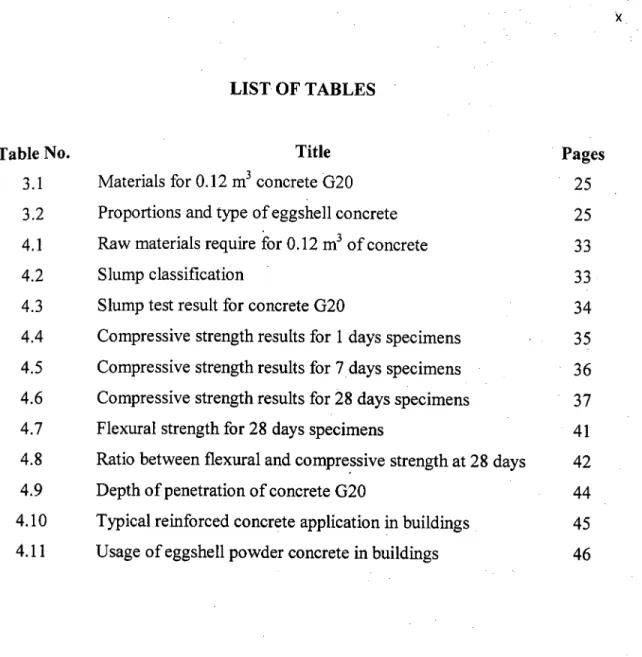
LIST OF TABLES
Table No. Title Pages
3.1 Materials for 0.12 m3 concrete G20 25
3.2 Proportions and type of eggshell concrete 25
4.1 Raw materials require for 0.12 m3 of concrete 33
4.2 Slump classification 33
4.3 Slump test result for concrete G20 34
4.4 Compressive strength results for 1 days specimens 35 4.5 Compressive strength results for 7 days specimens 36 4.6 Compressive strength results for 28 days specimens 37
4.7 Flexural strength for 28 days specimens 41
4.8 Ratio between flexural and compressive strength at 28 days 42
4.9 Depth of penetration of concrete 020 44
4.10 Typical reinforced concrete application in buildings 45 4.11 Usage of eggshell powder concrete in buildings 46
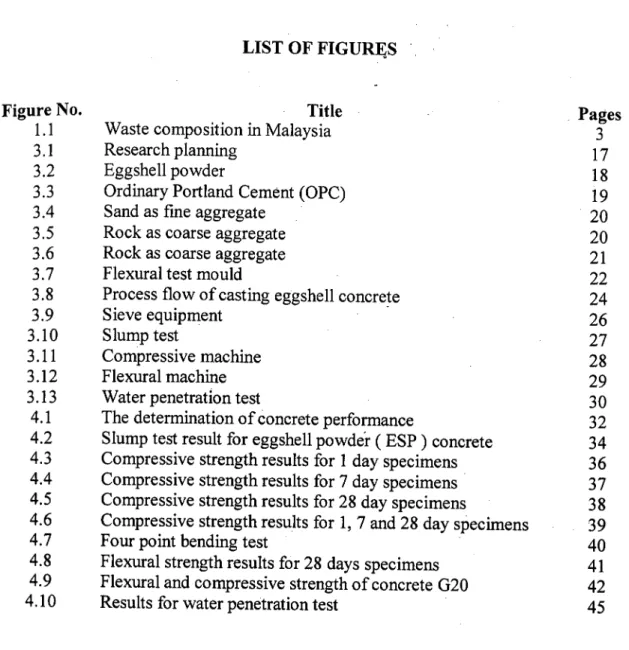
LIST OF FIGURES
Figure No. Title Pages
1.1 Waste composition in Malaysia 3
3.1 Research planning 17
3.2 Eggshell powder 18
3.3 Ordinary Portland Cement (OPC) 19
3.4 Sand as fine aggregate 20
3.5 Rock as coarse aggregate 20
3.6 Rock as coarse aggregate 21
3.7 Flexural test mould 22
3.8 Process flow of casting eggshell concrete 24
3.9 Sieve equipment 26
3.10 Slump test 27
3.11 Compressive machine 28
3.12 Flexural machine 29
3.13 Water penetration test 30
4.1 The determination of concrete performance 32
4.2 Slump test result for eggshell powder (ESP) concrete 34 4.3 Compressive strength results for 1 day specimens 36 4.4 Compressive strength results for 7 day specimens 37
4.5 Compressive strength results for 28 day specimens 38 4.6 Compressive strength results for 1, 7 and 28 day specimens 39
4.7 Four point bending test 40
4.8 Flexural strength results for 28 days specimens 41 4.9 Flexural and compressive strength of concrete G20 42
4.10 Results for water penetration test 45
LIST OF SYMBOL
G Grade
% Percentage
Ac Tolerance to accommodate fixing precision Stress
LIST. OF ABBREVATIONS
ASTM American Society for Testing Materials
b width
BS British Standard
d Depth of beam
ESP Eggshell Proportions
g Gram kg Kilograms. L Litre 1 Span length mm Millimeter Millimeter Square m3 Meter Cubes MPa Megapascal MS Malaysian Standard N Newton
OPC Ordinary Portland Cement
P Maximum Load Failure
pH Power of Hydrogen
UMP Universiti Malaysia Pahang
CHAPTER 1
INTRODUCTION
1.1 INTRODUCTION
Throughout the world, waste products are seriously polluting the environment. There are many types of waste disposal system such as land filling, open burning, drains clogged up with rubbish and river fill definitely indicate solid waste is a major environmental problem in Malaysia. Despite the massive amount and complexity of waste produced, the standards of waste management in Malaysia are still poor. These include outdated documentation of waste generation rates and its composition, inefficient storage and collection systems, disposal of municipal wastes with toxic and hazardous waste, indiscriminate disposal or dumping of wastes and inefficient utilization of disposal site space. (Global Environmental Centre, n.d)
According to The Star (2013), reported that Malaysia not allow any type of development on landfill for the next 25years as there are many gases trapped from the discompose garbage and this will be hazardous to the environmental. Therefore, the ways should be found to utilize the waste efficiently such as through recycling.
Nowadays, waste products such as oil palm shell, fly ash and bottom ash used in construction industry to maximize the profit while reducing the amount of waste. The construction industries are searching for 'alternative products that can reduce the Construction cost. Eggshells are known to have good strength characteristics when mixed with concrete Most of the eggshell waste is commonly disposed in landfills Without any pretreatment because it is traditionally useless.
The use of eggshell ash in concrete production reduced the cost of raw material and contributes to the construction industry.
Eggshell also contribute to construction industry which is it can be reduce in construction budget with high strength durability of the concrete. Thus, eggshells can be applicable to reduced cost of construction material and produced a new raw material for development in the construction industry.
1.2 BACKGROUND OF STUDY
Earlier works on the combination concrete conducted by scholars have led us to the point that the eggshell ash can be used as an additive in concrete production. Eggshells are agricultural waste materials generated from chick hatcheries, bakeries, fast-food restaurant among others which can litter the environment and consequently constituting environmental problems or pollution which would require proper handling. In the ever increasing efforts to convert waste to wealth, the efficacy of converting eggshell to beneficial use becomes an idea worth embracing. The composition of eggshells indicates that the effect of it ash on cement treated materials should be articulated. It is scientifically known that the eggshell is mainly composed of compounds of calcium which is very similar to the cement. Literature has shown that the eggshell ash primarily contains lime, calcium and protein where it can be used as an alternative raw material in the production of wall tile material, concrete, cement paste and others. Eggshell also contribute to construction industry which is it can be reduce in construction cost and landfill which it give good performance in properties in concrete and durability of the concrete. Thus, eggshells can be produced a new raw material for development in the construction industry as an additive in the conventional concrete.
3
1.3 PROBLEM STATEMENT
In Malaysia, waste disposal is one of the factors contributing the environmental problem and increasing dramatically year by year. According to Antara News (2011), In Malaysia, the egg consumption of the Indonesian people which is still low. In Indonesia the per capita egg consumption of the people was recorded at one egg per week while in Malaysia the per capita egg consumption was noted at three per day. Hence, the egg consumption of Malaysians is increasing with high demand for local food industry. Eggshells wastes are seriously affecting the environment and causing pollution to public health. Eggshell is classified as a waste material by the food industry but is in fact a highly sophisticated composite. The ultimate goal is to use the eggshells in packaging to protect egg products giving a second lease of life to the eggshell in the very role it was created for a true case of recycling. Therefore, recycling eggshells into the useful product gives good potential benefit on many levels, both for food manufacturers and a much wider construction industry.
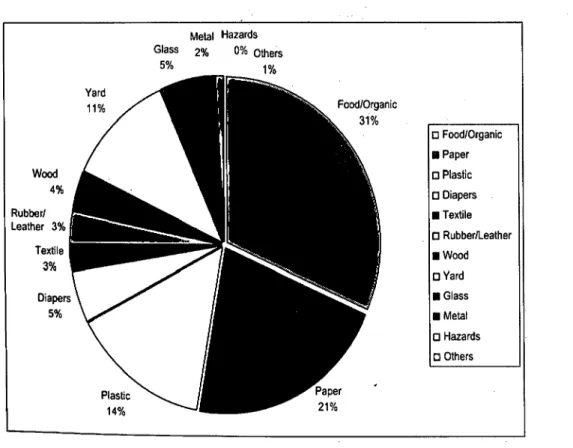
Metal Hazards Glass 2% 0% Others 1% Yard Food/Organic 31% o Food/Organic U Paper Wood [ o Plastic 4% __ o Diapers ___________________ Rubber! I Textile Leather 3% 0 Rubber/Leather Textile_________________________ I Wood 3% 0 Yard Diapers U Glass 5% • Metal E3 Hazards 14%
jI1IIIIIIr
0 Others Plastic 21%4
The chart above shows that the waste composition generated in Malaysia. The highest waste production is from food or organic waste as the main waste component• with 32%, follow by paper and plastic with composition of 21% and 14% respectively (Pariatamby,2005). Thus, waste generate in Malaysia is comes from food organic. Egg is the food that highly consumed by Malaysian therefore it is creating eggshell waste. Eggshell is the waste material from domestic sources such as hatcheries, bakeries, and home fast food. This amount is seriously to environmental pollution. According to Agamuthu et a!, (2006) every year almost 40,000 metric tons of wastes are disposed at landfill. Overall, approximately 60% of the waste are collected and disposed in non-sanitary landfills. The remaining 35 % were illegally burned or dumped while 5 % were
dumped into ocean. All the landfill had waste related aesthetic problem, leachate contamination and landfill gas or odour problems. Disposal method such as landfill is not done in the appropriate way which subsequently gives negative effects to the environment. The landfills will be filled by 2015 if current trends of waste generation and handling continue. Therefore, the ways should be found to utilize the waste efficiently such as through recycling.
1.4 OBJECTIVES OF STUDY
1.4.1 To determine the strength properties of eggshell powder by using compressive strength test.
1.4.2 To determine the water penetration of eggshell concrete by water penetration test.
5
1.5 SCOPE OF STUDY
An investigation the effect on the performance of the eggshell powder as in additive in concrete mixed. In eggshell concrete production, Portland composite cement, coarse aggregate, fine aggregate, water, and eggshell. The experiments will use to investigate are sieve analysis test, slump test, curing, compressive strength, flexural test, water absorption test and water penetration test respectively. Thus, the amount of eggshell waste can be used as additive in concrete production. Besides that, it also will decrease the construction cost and landfill.
Some test and experiments are proposed to be performing to determine the performance concrete strength and eggshell ash. These eggshells must be grinded into fine powder. This test will be tested at 1 day, 7 day and 28 days to get the strength. The test carried out in the investigations are slump test, compressive strength test, flexural test, water absorption test and. Slump test was chosen as the workability test and the compressive strength test will determine the hardened concrete. On the other hand, the flexural test is to test maximum load beam that able to sustain. Water absorption is carried out to determine the durability of concrete. Durability is one of the important characteristic of concrete and is tested for the absorption rate and the water capacity of the concrete.
1.6 EXPECTED OUTCOMES
1.6.1 Improvement of concrete strength properties. 1.6.2 Contribution to our environmental problem. 1.6.3 Reduce landfill problem.
1.7 SIGNIFICANCE OF PROPOSE STUDY
This research is very important because Malaysia is the largest consumers for concrete production and this method will help to contributes to reduce the construction cost. Hence, it resolves arising issues of waste disposal problem including support to our environmental problem that mainly caused pollution to public health. Besides that, it will improve to the properties strength and the durability of concrete characteristic with the certain concrete testing thus helps our economy industries of construction.
1.8 SUMMARY OF THE CHAPTER
This chapter discussed the background of the eggshell as waste material in concrete composition, which also included the properties of eggshell and environment impact on the waste disposal. This chapter also included the problem statement of eggshell, objectives, scope and limitation. For all the above related to eggshell, we can summarize about this research or project need adequate and full commitment to achieve it with the requirement specification needed.
CHAPTER 2
LITERATURE REVIEW
2.1 INTRODUCTION
In this chapter will discuss about the material and the method that used in the past study of the research. They will use as the reference to conduct the research.
2.2 EGGSHELL
Eggshell known as a smooth surface that is desirable compared rough eggshells fracture more easily. Most good quality eggshells from commercial layers contain approximately 2.2 grams of calcium in the form of calcium carbonate. About 95% of the dry eggshell is calcium carbonate weighing 5.5 grams. The average eggshell contains about 0.3% of magnesium, phosphorous, and traces of sodium, zinc,, potassium, iron, copper and manganese. There are many factor influences in quality of eggshell which is nutrient adequacy, flock health problem, environmental condition and breeding. Apart from that, the controlling rate of egg weight also contributes to a good quality of eggshell and it is not depends on the thick eggshell mean strong. Sometimes, thinner eggshell is stronger than thicker eggshell. This fact is due to shape and organization of organic and inorganic component of the shell. (Gary et al. 2004).
8
Eggshell ash has been established to bç good accelerator for cement bound material because of extra calcium oxide by addition of eggshell ash. Okonkwo et al. (2012) concludes that the increase in the eggshell ash content will increase the strength of properties of the cement stabilized matrix up about 35% averagely. That show the usage of eggshell ash as an additive will increase the strength of the concrete. In another hand, according to Mtalib et al. (2009) said that the addition of eggshell ash to the Ordinary Portland Cement decrease the setting time of the cement. So they conclude that the eggshells ash as an accelerator in a concrete because the higher content of the faster rate of setting. But it is different the effect of eggshell to the soil, Amu et. a! (2005) investigated that the eggshell powder could be good replacement in industrial lime because they have similarity in chemical composition. The eggshell can be stabilizing potential of lime on an expansive clay soil. Stabilization is aimed at improving the properties of soil including the increasing the soil density, increase in cohesion, frictional resistance and reduction of plasticity index such as lime, cement and fly ash. So they conclude that eggshell powder can be supplement in lime stabilization.
In the summary, we conclude that the chemical properties of the eggshell ash can be effect in concrete mix properties. So the eggshell properties will increase the strength properties of the concrete. The objective of the research is acceptable to prove the strength of the concrete affected by addition of eggshell ash.
2.3 CEMENT
Portland cement is the most ordinary cement used in the world and it is often used in concrete and mortar respectively. Ordinary Portland cement is specified according to Malaysian Standard MS 522. Mixed proportion of aggregates, sand, water, cement form the concrete which is use in construction development of buildings, bridge, roads, and others structure. The hydration process o pc results in hardening and increase strength gain when mixed with water. Quality of concrete produced depends on the quality of the raw materials used, such as cement, aggregate and water, the mixture, ways and means of transport its compactions. If the raw materials used are of low quality, then the resulting concrete will have low standards and will result in concrete not strong and does not meet their specification.
9
2.4 COARSES AGGREGATE
According to Nawy (2008), aggregates are granular materials such as sand and crushed stones. Most aggregate have a specific gravities in the range of 2.6 to 2.7. The role of aggregate is to provide much better dimensional stability and wear resistance. Without aggregate, large castings of neat cement paste would essentially self-destruct upon drying. Coarse aggregates are particles greater than 4.75 mm, but generally range between 9.5 mm to 37.5 mm in diameter. They can either be from primary, secondary or recycled sources. Aggregate make up about 75% of the volume of concrete, so their properties have a large influence on the properties of the concrete (Alexander et al., 2005). Hence, the selection of aggregate is very important to the concrete mixture as well as it will effects the workability in the concrete.
2.5 FINE AGGREGATE
The finer aggregate have a better positive effect on the properties of fresh concrete and hardened in high performance concrete. Thus, fine aggregate are playing an important role in the concrete mixture (Chang et al., 2001).
2.6 WATER
Water is an essential element to produce a good and quality concrete. Bad quality of water could cause corrosion to the steel reinforcement. Thus it is important to ensure that water used for concrete production should be free from deleterious substances namely oil, acid, alkali, salt, sugar, slit and organic matter. In general rule, if the water is drinkable, it is consider suitable for concrete production. Neville (2005) suggested that the water used for concrete should be clean, free from organic material and having pH ranging from 6 to 8.
2.7 DURABILITY AND PERMEABILITY OF CONCRETE
Durability of cement concrete is defined as its ability to resist weathering action, chemical attack, abrasion, or any other process of deterioration. Durable concrete will retain its original form, quality, and serviceability when exposed to its environment. According to Obla et al. (2006) low permeability and shrinkage are two performance characteristic of concrete that can prolong the structure that is related to severe exposure condition to archive better way quantify durability. However, higher strength of concrete will provide more resistance to cracking due to durability mechanisms and will usually have a lower water cement ratio to give a positive impact of permeability. Others researcher (Sekhar et al., 2012) agree that durability of concrete can fully functional over an extended period under prevailing service conditions for the purpose of designed. The durability of concrete is related to its permeability by the aggressive agents that can penetrate to attack the concrete and the steel reinforcement. Corrosion related to damage to the concrete structure cause a problem associated with high cost of repairs, sometimes replacement of structure.
2.8 SLUMP TEST
Giridhar et al. (2013) stated that the purpose of slump test is to determine the workability of concrete. Workability is important for fresh concrete. If the workability of concrete is low, the concrete mixtures are difficult to compacted and increase the risk of the structure. The method for determination of slump test is according to British Standard 1881: Part 102. Slump cone ensured that the internal surface is clean. The fresh concrete was placed and filled by 3 layers in the slump cone, remove carefully, slowly and ensured the fresh concrete are not touched. Next measured are the difference of
the height of slump cone and the fresh concrete. The different in height is the slump of
the fresh concrete which categories as very low, medium and high.
11
According to Hover (200) the slump can be increase by increasing the amount of water. For some mix that is already been set by a particular of slump and it can been predicted by adding some amount of water that can increase the slump by inch. In relation for the other findings the slump test is use for determining of the workability of concrete with the different of concrete grades. Compatibility, mobility and stability on fresh concrete are related to the workability of concrete.
In our research, we need to do slump test to define the workability of fresh concrete. Even increasing the water can be increase the slump, but the properties in the concrete will be affected by increasing the water. The higher workability does not show the higher properties the concrete. The addition of eggshell ash may affect the properties of concrete. In the same time, they will affect the workability of the fresh concrete mix. The method of slump test that we will do according to British Standard 1881: Part 102.
2.9 COMPRESSIVE STRENGTH TEST
Obafemi et al. (2005) stated that the addition of lime in unconfined compression test and undrained triaxial shear strength raised the properties strength on the stabilizing potential on an expansive Clay Soil. While the increases of eggshells ash content also increased the optimum moisture content but reduced the maximum dry density, thus considerably increased into strength properties of the soil cement eggshell ash. Research investigated proves also on the setting time of cement where the higher content of the eggshell ash, the greater strength of the properties in concrete. As a conclusion, all the additive or admixtures related to eggshell ash in concrete improve performance of strength properties in any materials involved.
2.10 FLEXURAL TEST
According to Keun-Hycok et al.(2013) The flexural test of the concrete beams (40 mm x 40 mm x 160 mm) was tested according to British Standard (1881 :Part
I I 8).The concrete beam were tested by T- Machine Universal Testing Machine. This test is to determine the maximum load that the beam able to sustain. The test was carried out at a fixed loading and the test was end after the concrete beam is broken.
12
When the concrete beam broken, data on the flexural strength results were recorded in the computer. The test for flexural strength of concrete beams under third point loading utilizes which permits the load to be applied normal to the loaded surface of the beam. The specimen is tested on its side with respect to its molded position. The beam is centered on the bearing supports. The dial indicator of the proving ring is placed at the zero reading. The load is applied at a uniform rate and in a way to avoid shock. The load required to cause specimen failure is obtained from the dial indicator's
final reading and the proving ring calibration curve.
2.11 WATER PENETRATION
The purpose of water penetration test is to determine the permeability or durability of the concrete also. According to Sukontasukkul and Boonpradit (n.d.) the permeability of concrete can be improved by reducing the total volume of pores or reducing the volume of larger sized pores. So the test that they use is water penetration test accordance to the DIN 1048 standard. This test is used to measure the penetration of water in the concrete test specimen under pressure. In the other hand, Liu et al. (2012) use carried out the water penetration test according to BS EN 12390-8 with modified conditions including the curing age of 28 days, test duration of 3 days, and a water pressure of 0.5 MPa.
In the summary, this test was carried out according to British Standard (EN-12390). In this test, the concrete cube (100 mm x 100 mm x 100 mm) will coated with five surfaces of epoxy paint to ensure the water penetrate in un-paint surface. After that, the Concrete cube will be place in water with 2-4 mm water for water penetration with 3 days. After the completion of the test, the concrete cube takes out and split into two Part, It used to checking the water penetrated until maximum depth.
13
2.12 COCONUT SHELL ASH AS PARTIAL REPLACEMENT OF ORDINARY PORTLAND CEMENT
According to Utsev (2012) stated that the high cost of construction materials like cement and reinforcement bars, has led to increased cost of construction. This, coupled with the pollution associated with cement production, has necessitated a search for an alternative binder which can be used sorely or in partial replacement of cement in concrete production. More so, disposal of agricultural waste materials such as rice husk, groundnut husk, corn cob and coconut shell have constituted an environmental challenge, hence the need to convert them into useful materials to minimize their negative effect on the environment. Research indicates that most materials that are rich in amorphous silica can be used in partial replacement of cement. It has also been established that amorphous silica found in some pozzolanic materials reacts with lime more readily than those of crystalline form. Use of such pozzolanas can lead to increased compressive and flexural strengths. The American society of testing materials (ASTM) defines Pozzolans as siliceous or aluminous materials which possess little or no cementitious properties but will, in the presence of moisture, react with lime at ordinary temperature to form a compound with pozzolanic properties.
2.13 SOIL STABILIZATION USING ADDITIVE
Kumar et al. (2007) investigated the effect of fly ash, lime and polyester fibers on compaction and strength properties of expansive soils. They reported that cured 7 day, 14 day and 28 day specimens of clay-lime-fly ash mixture showed higher unconfined compressive strength than specimens without fly ash mixture. They also found that polyester fibers significantly increased the strength of soil lime fly ash mixture. Research has shown that eggshell is a rich source of lime, calcium and protein SO that it may be used as an alternative to such soil stabilizers as lime because it contains lime-like ingredients. Used as source of lime in agriculture, eggshell proved to contain a Considerable amount of lime. In the present study, eggshell powder was used as an alternative to stabilize expansive soils. To this end, various laboratory experiments were carried out on soil specimens mixed with different percentages of additives
14
(1-25% weight percent) and the effect of eggshell powder was examined on atterberg
properties of the specimens. (Arash Barazesh et al, 2012).
2.14 EGGSHELLS ON ROAD CONSTRUCTION
Eggshell are seldom used to stabilizing materials in most part of world. However it could be a stabilization of the construction industry. Olarewaju et al.,(2011) revealed that eggshells mixed with lateritic soil can produced the low binding properties and significant to improve strength of the soil which can use as sub grade where have a good performance. The capacities of the stabilization haven't met with the requirement of the base or sub base for road construction.
Stabilizing material was the added to each of the soil sample in certain percentages of 2%, 4 %,6% and 8% of the soil by weight of eggshell after the Atterberg's limit test was carried out as well as the determination of engineering properties of each samples (Olaweraju et al.,201 1) . Addition of the eggshell in percentages to the soil sample caused to changes in plastic limit and liquid limit, which can purposely, affected the plasticity of the soil. Liquid limit for eggshell increased from 30.20% to 37.10% and the plastic limit also increased from 13.48% to 24.14%. Thus the plasticity index of the eggshell in lateritic soil reduced from 17.29% to
12.96%.
It is concluded that eggshell powders can increase the strength of the soil and it can be suitable stabilizing materials. From the investigation, resulted eggshell powders significantly increase the optimum moisture content and maximum dry density of the soil. As 8% eggshell stabilization lateritic soil processes close optimum moisture content and maximum dry density properties. Eggshell can be also used in road construction and not only application in building structure.