Development of high-performance self compacting concrete using
eggshell powder and blast furnace slag as partial cement replacement
Olatokunbo M. Ofuyatan
a,⇑, Adewale George Adeniyi
b, David Ijie
a, Joshua O. Ighalo
b, John Oluwafemi
a aDepartment of Civil Engineering, College of Engineering, Covenant University Ota, Lagos, Nigeria b
Department of Chemical Engineering, Faculty of Engineering and Technology, University of Ilorin, Ilorin P. M. B. 1515, Nigeria
h i g h l i g h t s
Eggshell powder and blast furnace slag was used as partial cement replacement in SSC.
10 wt% partial replacement was optimal for the flow-ability and workability.
20 wt% partial replacement was optimal for the compressive strength and flexural strength.
GGBFS had better fresh, hard and microstructural properties than ESP.
g r a p h i c a l a b s t r a c t
a r t i c l e
i n f o
Article history:Received 12 March 2020
Received in revised form 27 April 2020 Accepted 29 April 2020
Available online 7 May 2020
Keywords:
Cement Eggshell Properties
Self compacting concrete Slag
a b s t r a c t
This study aimed to examine the properties of self-compacting concrete (SCC) developed using eggshell powder (ESP) and granulated ground blast furnace slag (GGBFS) as partial cement replacement. The coarse aggregate impact value was 21.6% and the water absorption of the fine aggregates was 24 wt%. 10 wt% par-tial replacement was optimal for flow-ability and workability. SCC with 20 wt% parpar-tial replacements had the highest compressive strength at 41.34 kN/mm2and 42.4 kN/mm2for ESP and GGBFS respectively after 28 days of curing. SCC with 20 wt% partial replacements had the highest flexural strength at 3.2 kN/mm2 for both ESP and GGBFS after 28 days of curing. From the microstructural analysis, partial replacement with mineral admixtures improved the interfacial interactions between constituents of the concrete and GGBFS SCC gave a better interfacial interaction between the concrete constituents than ESP SCC. In summary, GGBFS had better fresh, hard and microstructural properties than ESP.
Ó2020 Elsevier Ltd. All rights reserved.
1. Introduction
Self-compacting concrete is a special type of concrete that flows under its weight, compacts under its weight and can occupy all the spaces of the formwork without any need for vibration and, at the same time, cohesive enough to be handled without segregation or
bleeding [5,28]. Conventional concrete is usually placed and vibrated in the formwork, but self-compacting concrete is not vibrated; it must easily flow and compact under gravity required
[4,26]. Self-compacting concrete is a composition of cement, aggre-gates, water mineral admixture and chemical admixture. It allows for the use of recycled aggregates without major deterioration in its mechanical properties[20,21].
Cement production and utilisation lead to the release of green-house gases [2]. World production of cement has been on the increase year on year also being a major contributor to carbon dioxide emission[15]. Partial cement replacement is an important aspect of achieving sustainability in the cement industry [8].
https://doi.org/10.1016/j.conbuildmat.2020.119403
0950-0618/Ó2020 Elsevier Ltd. All rights reserved.
⇑ Corresponding author.
E-mail address:[email protected](O.M. Ofuya-tan).
URLs:http://orcid.org/0000-0001-9052-2758(O.M. Ofuyatan),http://orcid.org/ 0000-0001-6615-5361 (A.G. Adeniyi), http://orcid.org/0000-0002-8709-100X
(J. Oluwafemi).
Contents lists available atScienceDirect
Construction and Building Materials
j o u r n a l h o m e p a g e : w w w . e l s e v i e r . c o m / l o c a t e / c o n b u i l d m a tSeveral studies have utilised materials such as pumice powder[3], nano-silica[6,22], fly ash[3,14,31], metakaolin[11], rice husk ash
[29]and palm oil fuel ash[30]as a partial replacement for cement in self-compacting concrete (SCC).
Researchers have investigated the effect of partial replacement on some of the fresh and hard properties for eggshell powder
[12,34]and blast furnace slag[33,35]. However, the physical tests of the aggregates used and the microstructural and compositional properties of the final SSC with eggshell powder and granulated ground blast furnace slag is unreported in the open literature (within the scope of the authors’ exhaustive search). Added to the more thorough analysis of fresh properties which included 3 different types of tests, this study helps not only to present a com-parative investigation for both materials but present key informa-tion on the microstructural and composiinforma-tional transformainforma-tions during these changes. This is an important contribution of the study that also helps to buttress the novelty.
In this study, eggshell powder and granulated ground blast fur-nace slag were used as partial cement replacement. Eggshells, the waste product of eggs consumption, can constitute a nuisance in our environment through indiscriminate disposal[19]. Sources of eggshells include domestic homes, poultry farms, bakeries and restaurants[18]. Grounded granulated blast furnace slag (GGBFS) is an end product of iron manufacturing in the blast furnace[17]
which contains compound including silicates and alumino-silicates of calcium[7]. The aim of this study was to examine the fresh and hardened properties, composition and microstructural properties of self-compacting concrete developed using eggshell powder (ESP) and blast furnace slag (GGBFS) as partial cement replacement. Slump flow test, V-funnel test and L-box test were conducted on the fresh concrete while impact test, water absorp-tion test and sieve analysis was conducted on the aggregates. The compressive strength, flexural strength and microstructural prop-erties of the hardened concrete was also determined.
2. Methodology 2.1. Materials
To achieve good rheological properties in SCC, the total amount of coarse granular materials was kept less than the total amount of fines including sand, cement and mineral admixtures. Granite of size ranging from 10 mm to 12 mm was utilised for this study. For the cement, ordinary Portland cement of grade 43 was used. River sand was used as the fine aggregate in the study. The source of water used was from tap water in Covenant University Ota, Ogun State. Conplast SP430 was used as the super plasticiser.
2.2. Mineral admixtures for partial cement replacement
The mineral admixtures used were eggshell powder (ESP) and ground granulated blast furnace slag (GGBFS). Eggshell waste was gotten from a Cafeteria in Covenant University, Ogun State. The waste had to be sun-dried for 24 h. The eggshell waste was ground into a fine powder and sieved through 150mm sieve to allow for particle size homogeneity. Blast furnace slag is a waste material obtained from the production process of iron in a blast furnace. It was also sieved through 150mm sieve to obtain a fine powder.
2.3. Physical tests on aggregates 2.3.1. Sieve analysis
In sieve analysis, an oven-dried sample of either sand or granite of known mass was poured into a stack of sieves. The sieves of
known mass are arranged in order of the largest size to the small-est; a pan is then placed under to receive the remaining particle which may fall to the pan. After agitating the sieves, the mass of the material retained on the sieve was measured. Also, the percent-age retained on each sieve along with the cumulative percent retained was calculated and recorded.
2.3.2. Aggregate impact test
The significance of the aggregate impact test is to assess the degree of resistance of the aggregate when it is subjected to impact
[16]. The impact test is used to know the measure of the toughness of the aggregate. It was carried out as per IS 2386 Part IV- 1963. Oven-dried aggregate passing through the 12.5 mm IS sieve but retained on the 10 mm sieve was used for the study. The coarse aggregate was dried in the oven for a period of 4 h at 110°C. The cylindrical measure was filled in three layers of aggregate with a layer being rammed with 25 blows. The excess aggregate was trimmed off, weighed and recorded. The test cup was then fixed firmly in the right position on the base of the aggregate impact machine. The measured aggregate sample was then placed in the cup and rammed 25 times. The hammer is let down to impact on the aggregate sample 15 times. The resulting aggregate sample was passed through 2.36 IS sieves. The portion retained on the sieve was weighed and the aggregate impact value calculated.
2.3.3. Water absorption test
The water absorption test allows us to know the amount of moisture that can be absorbed and retained by the aggregate. The weight of the empty container was obtained and recorded. The mass of the empty container and aggregate sample was also measured and recorded. The container having the aggregate sam-ple was filled with water until the samsam-ple was comsam-pletely immersed. The sample was left to soak for 24 h. After soaking, the water was drained and the weight of the saturated sample was measured and recorded. The water absorption value can be calculated by subtracting the weight of unsaturated (dry) sample from the saturated sample, dividing the result by the weight of the unsaturated (dry) sample and multiplying by 100.
2.4. Preparation of self-compacting concrete
The mix proportions for each type of concrete evaluated in the study are shown inTable 1. After the concrete constituents were weighed, the mixing operation was carried out next. The mixing operation was carried out by hand with the use of shovels and head pans. The fines (cement, sand and mineral admixture) were first mixed thoroughly until a colour blend was achieved i.e. until a fine consistency was attained. After mixing the fine materials, the coarse aggregate was also mixed with the fines mixture. The fines were mixed first to achieve homogeneity of fines and a proper mix-ture of fines and coarse granular materials. The measured quantity of superplasticizer was then added to an adequate amount of water. After the addition of the liquid mixture, the concrete was hand-mixed thoroughly with the use of a shovel.
The concrete with the aid of a trowel was placed in moulds to carry out tests on the hardened concrete after curing. The moulds used for this experiment are 150150150 mm cubes for com-pressive test and 100100400 mm mould for the flexural test. The moulds were lubricated before placing concrete to reduce the bond between the mould and concrete for easy removal. For SCC, concrete is placed directly without vibration because the concrete compacts on its weight hence the name. The process of striking off concrete from the mould is known as demoulding. The method of curing is by full immersion in water in a curing tank. The mixes were cured for 7, 14 and 28 days while the flexural mould specimens are cured for 7 and 28 days. ESP10, ESP20 and ESP30
are designations for concrete produced with eggshell powder as partial cement replacement at 10 wt%, 20 wt% and 30 wt% respec-tively. GGBFS10, GGBFS20 and GGBFS30 are designations for con-crete produced with eggshell powder as partial cement replacement at 10 wt%, 20 wt% and 30 wt% respectively.
2.5. Tests on fresh concrete 2.5.1. Slump flow and T50cmtest
The slump flow and T50cm test evaluates the deformability and flowability of SCC in the absence of obstacles. The result is an assessment of the filling capacity of self-consolidating concrete. The fresh concrete was placed (with the aid of a hand trowel) in the cone used for the EN[10] collapse test. The cone was then pulled up; the time was measured from the moment the upward movement began to when the concrete has reached a diameter of 50 cm; this is referred to as the T50 time. Then the largest diam-eter of the concrete flow and the diamdiam-eter of the dispersion is mea-sured at right angles and the average is the slump flow.
2.5.2. V-funnel test
The V-funnel test measures the workability of SCC in terms of flow-ability. About 12 L of SCC was needed for this test. The SCC was placed in the v-funnel apparatus and the time taken to flow through the apparatus was measured. If segregation occurs, it will result in higher flow time. Though the test measures the flow-ability, other properties of the concrete other than flow affect the result of concrete. If there is excess coarse aggregate, excess paste (which leads to low deformability) can result in high flow time. Even with the simplicity of the V-Funnel apparatus, how SCC is affected by the angle of the funnel and the wall is still uncertain.
2.5.3. L-box test
This is a common test conducted both in the laboratory and on-site. The purpose of this test is to evaluate the rheological proper-ties of self-compacting concrete in terms of filling and passing abil-ity while segregation can be observed visually. The apparatus is made of component sections including a vertical and horizontal rectangular-section box to form an ‘L’ shape. The sections are sep-arated by a moveable gate which is lifted to allow SCC to pass through the narrow spaces confined by the reinforcement bars fit-ted to the horizontal rectangular section. SCC was poured into the vertical rectangular section before the separating gate is lifted to allow for flow into the horizontal section. After the SCC flowed into the horizontal section completely, the height of the concrete at the end and beginning of the horizontal section was recorded as H2 and H1 respectively.
2.6. Tests on hardened concrete
2.6.1. Determination of compressive strength
Compressive strength of the hardened concrete was determined after a curing period of 7, 14, and 28 days. Compressive strength of
the developed SCC was determined according to ASTM-C39 using a compression testing machine (Model YES-2000, England). The dimension of the cube was 150 150 150 mm. The sample was placed on the machine in proper order. Care was taken to ensure the idle was on the base plate. The load was increased at 140 kg/cm2 until failure. The highest load was observed and
recorded.
2.6.2. Determination of flexural strength
Flexural strength of the hardened concrete was determined after a curing period of 7 and 28 days. Flexural strength of the developed SCC was determined according to ASTM-C293 using central point load test (Impact engineering, Australia). 100100400 mm samples were used for this test. The speci-men was placed appropriately on the loading points in proper alignment. The dial gauge (loading system) was centred about the applied load. The load was gradually and gently applied until the concrete sample failed. The load needed to cause failure was recorded and the modulus of rupture computed.
2.7. Microstructural and composition analysis
The microstructural analysis of the compositional characteris-tics of the sample was conducted using a Scanning Electron Micro-scope with Energy Dispersive Spectroscopy (EDS). The SEM-EDS (SEM, Phenom ProX, Phenom-World BV, The Netherlands) was used at a microscope acceleration voltage of 15 kV and magni-fication of1500[1].
3. Results and discussion 3.1. Physical tests on aggregates
Sieve analysis gives the gradation of the sand. According to ASTM, the requirement standard for fine aggregate is particles passing 4.75 mm sieve. The result for sand and granite aggregates are shown inTables 2 and 3respectively. From the fine aggregate Table 1
Summary of mix proportions of the concrete.
Mixes ESP (kg) GGBFS (kg) Cement (kg) Fine Aggr (kg) Coarse Aggr (kg) Superplasticizer (kg) w/c ratio
Control – – 15 15 22.5 – 0.3 ESP10 1.5 – 13.5 15 22.5 0.165 0.3 ESP20 3.0 – 12 15 22.5 0.165 0.3 ESP30 4.5 – 10.5 15 22.5 0.165 0.3 GGBFS10 – 1.5 13.5 15 22.5 0.165 0.3 GGBFS20 – 3.0 12 15 22.5 0.165 0.3 GGBFS30 – 4.5 10.5 15 22.5 0.165 0.3 Table 2
Sieve analysis for sand. Sieve (mm) Weight retained (g) %wt retained Cum %wt retained % Passing 4.75 82 8.2 8.2 91.8 2.36 67 6.7 14.9 85.1 2 32 3.2 18.1 81.9 1 192 19.2 37.3 62.7 0.850 57 5.7 43.0 57.0 0.600 132 13.2 56.2 43.8 0.425 147 14.7 70.9 29.1 0.300 67 6.7 77.6 22.4 0.150 177 17.7 95.3 4.7 Pan 47 4.7 100.0 0.0 Total 1000 100 521.5 478.5
sieve analysis results, the dominant particle sizes are less than 1 mm which satisfies the requirement for fine aggregate (less than 4.75 mm) according to ASTM. From the coarse aggregate sieve
analysis results, the dominant particle sizes are above 4.75 mm which also satisfies the requirement for coarse aggregate (greater than 4.75 mm) according to ASTM.
The impact value of granite can be used to measure the strength and suitability of the aggregate batch for a specific purpose. The results obtained for the coarse aggregates shown inTable 4. The coarse aggregate impact value was observed to be 21.6%. This is consistent with the impact value (17–21%) for granite reported in other studies and it is suitable for concrete development [16]. The water absorption test allows us to know the amount of mois-ture that can be absorbed and retained by the aggregate. It also gives us an idea of the quality of the aggregate. Coarse aggregate that has a very high water absorption value tends to be weak in strength and porous. The result of the water absorption test for the fine aggregates is shown inTable 5. The water absorption of the fine aggregates was 24 wt%.
3.2. Fresh concrete properties
The slump flow and T50cmis a test to evaluate the deformability,
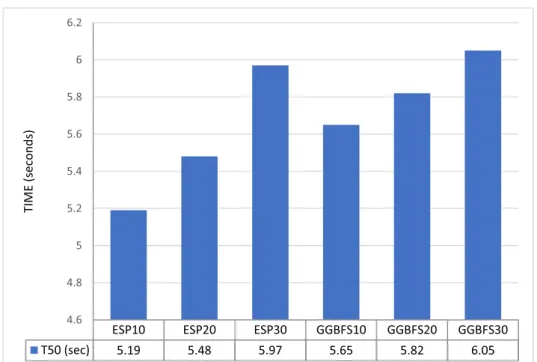
flow-ability and flow velocity of the self-consolidating concrete in the absence of obstacles[23]. The results obtained are within the acceptable limits set by EFNARC. The result of the slump flow and T50cmtests are shown inFigs. 1 and 2respectively. The
accept-able slump spread for SCC according to EFNARC S,[9]is between 550 mm and 800 mm. All results were within acceptable limits. It can be observed the concretes with 10 wt% partial replacements (ESP10 and GGBFS10) had the highest slump flow and least T50cm
time. Furthermore, the samples with blast furnace slag (GGBFS) partial replacement had better flow properties than those with eggshell powder (ESP) partial replacement.
The V-funnel test measures the flow-ability of concrete. The acceptable V-Funnel flow time for SCC according to EFNARC is between 6 s to 8 s. The result of the V-Funnel test is shown in
Fig. 3. ESP10 and GGBFS10 took the shortest time to flow making them the best mixes. It is also worth noting that with the increase in eggshell powder content the flow time increased taking more time to flow and compact. The result of the L-box test is shown Table 3
Sieve analysis for granite. Sieve (mm) Weight retained (g) %wt retained Cum %wt retained % Passing 12.5 300 30 30 70 9.5 240 24 54 46 6.3 365 36.5 90.5 9.5 4.75 65 6.5 97 3 2.36 20 2 99 1 2 5 0.5 99.5 0.5 1 0 0 99.5 0.5 Pan 5 0.5 0.5 99.5 Total 1000 100 570 230 Table 4
Results for aggregate impact test.
Designation Value Standard cup 0.605 kg Mass of crushed granite 0.255 kg Mass of crushed granite passing sieve 0.055 kg
Impact value 21.6 wt%
Table 5
Water absorption data for fine aggregate. Designation Value Sample Weight 297 g Weight of water 582 g Sample + water 879 g Saturated sample 361 g Oven-dried sample 292 g Water absorption 24%
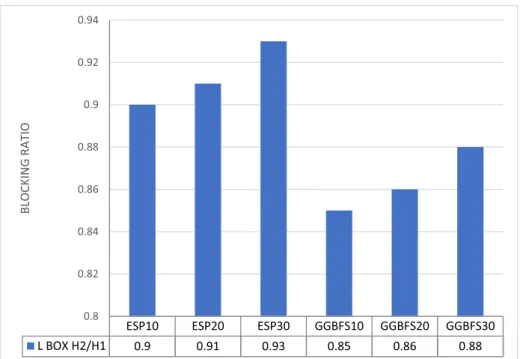
inFig. 4. Concrete with higher values of blocking ratio possesses good passing ability to pass through confined spaces of dense rein-forcement and also good flow-ability to compact on its weight[27]. From the test conducted, ESP30 and GGBFS30 mixes had the high-est blocking ratio and passing-ability for the two series of mixes.
In summary, it was observed that the SCC with 10 wt% replace-ment (ESP10 and GGBFS10) had the best flow-ability and workabil-ity with the GGBFS samples having a greater advantage. It can be inferred that partial cement replacement improved the flowability
and workability of the SCC. Similar observations were also made by Ardalan et al.[3]for pumice and slag and by Rantung et al.[31]for fly ash as partial cement replacement.
3.3. Hardened concrete properties 3.3.1. Compressive strength
The compressive strength of the SCC with different mineral admixtures is shown in Fig. 5. It can be observed the SCC with Fig. 2.T50results for SCC with different mineral admixtures.
20 wt% partial replacements had the highest compressive strength at 41.34 kN/mm2and 42.4 kN/mm2for ESP20 and GGBFS20
respec-tively after 28 days of curing. From the results of the test, GGBFS mix had higher compressive strength than that of ESP. For both admixtures, the compressive strength increased with partial replacement and then decreased. Similar observations were also made by Ofuyatan and Edeki[25], Ranjbar et al.[30]and Ofuyatan and Edeki [24] for SCC with palm oil fuel ash partial cement replacement and by Raisi et al.[29]for rice husk ash partial cement replacement. The decrease in compressive strength is due to a weak interfacial transition zone, the porosity of the mortar during
adhesion to the fine and coarse aggregates and the formation of cracks in the aggregates[13,32].
3.3.2. Flexural strength
Flexural strength is defined as the tension in concrete or any other material just before surrendering in a bending experiment. The flexural strength of the SCC with different mineral admixtures is shown inFig. 6. It can be observed the SCC with 20 wt% partial replacements had the highest flexural strength at 3.2 kN/mm2for
both ESP20 and GGBFS20 after 28 days of curing. For both admix-tures, flexural strength increased with partial replacement and Fig. 4.L-box results for SCC with different mineral admixtures.
then decreased. However, it was still less than the value for control hence partial replacement cannot be said to improve the flexural strength. The negative effect is due to the poor structure of SCC with partial replacement leading to the concentration of stress and the weakening of the interfacial bond between mortar and aggregates[30].
3.4. Microstructural analysis
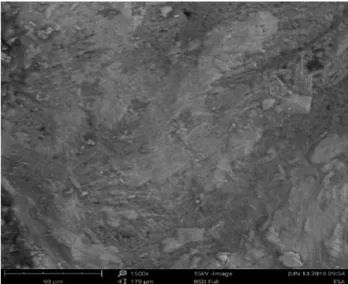
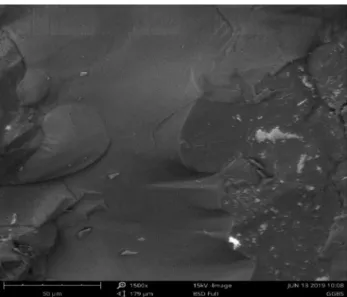
In this section, the microstructural analysis of the SCC with dif-ferent mineral admixtures is discussed. Fig. 7a shows the SEM micrograph of the control sample. It can be observed that there are inconsistencies in the interaction among phases of the materi-als. There are observable ruptures, cracks and interstices on the concrete.Fig. 7bshows the SEM micrograph of the sample with eggshell powder. It can be observed that there is greater consis-tency in the interaction among phases of the materials, unlike
the control specimen.Fig. 7c shows the SEM micrograph of the sample with granulated blast furnace slag. It can be observed that there is a great consistency in the interaction among phases of the materials which is more than the control sample and ESP sample. It can be concluded that partial replacement with mineral admix-tures improves the interfacial interactions between the different constituents of the concrete. Furthermore, GGBFS SCC gave a better interfacial interaction between the concrete constituents than ESP SCC.
3.5. Concrete compositions
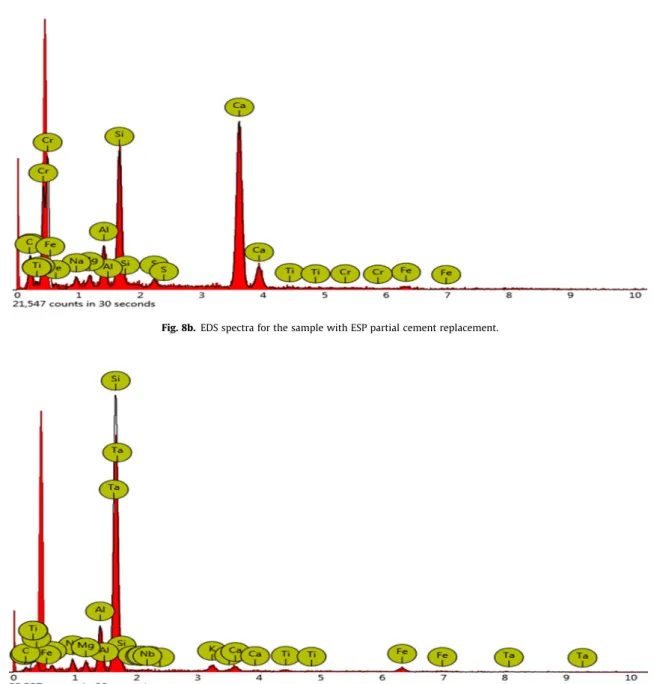
The concrete composition on an oxygen-free and hydrogen-free basis are shown in Table 6 and the associated EDS spectra shown in Figs. 8a–c. The results show that the control sample contains calcium (Ca), carbon (C), nitrogen (N), and silicon (S) as the dominant elements with Calcium (Ca) having the highest Fig. 6.Flexural strength of SCC with different mineral admixtures.
Fig. 7a.SEM micrograph of the control sample (magnification of1500).
Fig. 7b.SEM micrograph of the sample with ESP partial cement replacement (magnification of1500).
weight concentration. The high calcium and silica content is from the major raw materials used in producing cement which is limestone and clay. Limestone is rich in calcium and clay is rich in silica. The control sample also has trace amounts of alu-minium (Al), titanium (Ti), magnesium (Mg) and sulphur (S). The results also show that the ESP concrete sample also con-tains calcium (Ca), carbon (C), nitrogen (N), and silicon (S) as the dominant elements with calcium (Ca) having the highest weight concentration. The sample also has trace amounts of aluminium (Al), iron (Fe), sodium (Na), titanium (Ti), magne-sium (Mg) and sulphur (S). It was observed that the new ele-ments iron (Fe) and sodium (Na) are absent in the elemental composition of the control specimen. The results show that the GGBFS concrete sample has a very unique elemental com-position. It contains a very high amount of silicon (Si). It also has carbon as a major element along with tantalum (Ta) and aluminium (Al). The sample also has calcium (Ca) but in trace amounts. It also contains new trace elements such as phospho-rus (P), niobium (Nb) and potassium (K) which are absent in both control and eggshell concrete. These could be as part of impurities from the iron ore.
Fig. 7c.SEM micrograph of the sample with GGBFS partial cement replacement (magnification of1500).
Table 6
Composition of SCC with different mineral admixtures.
Element Symbol Element Name Weight Conc.
Control ESP GGBFS Ca Calcium 40.08 38.49 2.14 Ta Tantalum – – 10.94 C Carbon 25.49 19.15 11.10 N Nitrogen 16.05 17.38 – Si Silicon 14.32 14.35 51.48 Al Aluminium 2.82 4.64 8.45 Ti Titanium 0.56 0.38 0.98 Mg Magnesium 0.41 1.22 1.73 S Sulphur 0.27 1.00 0.44 Fe Iron – 2.06 5.49 Na Sodium – 1.33 2.39 K Potassium – – 2.31 Nb Niobium – – 1.81 P Phosphorus – – 0.73
4. Conclusion
In this study, the fresh and hardened properties, and composi-tion and microstructural properties of self-compacting concrete developed using eggshell powder (ESP) and blast furnace slag (GGBFS) as partial cement replacement was examined. Sieve anal-ysis revealed that the fine and coarse aggregates were of a suitable size for the intended application based on ASTM standards. The coarse aggregate impact value was 21.6% and the water absorption of the fine aggregates was 24 wt%. It was observed that the SCC with 10 wt% replacement (ESP10 and GGBFS10) had the best flow-ability and workability with the GGBFS samples having a greater advantage. It was inferred that partial cement replacement improved the flowability and workability of the SCC. It was observed the SCC with 20 wt% partial replacements had the highest compressive strength at 41.34 kN/mm2 and 42.4 kN/mm2 for
ESP20 and GGBFS20 respectively after 28 days of curing. SCC with 20 wt% partial replacements had the highest flexural strength at 3.2 kN/mm2for both ESP20 and GGBFS20 after 28 days of curing.
Microstructural analysis revealed that partial replacement with
mineral admixtures improves the interfacial interactions between the different constituents of the concrete. Furthermore, GGBFS SCC gave a better interfacial interaction between the concrete con-stituents than ESP SCC.
5. Compliance with ethical standards
This article does not contain any studies involving human or animal subjects.
Conflict of interest
The authors declare that there are no conflicts of interest.
CRediT authorship contribution statement
Olatokunbo M. Ofuyatan: Conceptualization, Methodology, Investigation, Writing - original draft.Adewale George Adeniyi:
Project administration, Supervision. David Ijie: Investigation, Fig. 8c.EDS spectra for the sample with GGBFS partial cement replacement.
Software. Joshua O. Ighalo: Writing - review & editing. John Oluwafemi:Investigation.
References
[1] A.G. Adeniyi, J.O. Ighalo, D.V. Onifade, Biochar from the thermochemical conversion of orange (Citrus sinensis) peel and albedo: product quality and potential applications, Chem. Africa (2020), doi: 10.1007/s42250-020-00119-6.
[2] U.S. Arachchige, A. Amakm, B. Balasuriya, K. Chathumini, N. Dassanayake, J. Devasurendra, Environmental pollution by cement industry, Int. J. Res. 6 (2019).
[3]R.B. Ardalan, A. Joshaghani, R.D. Hooton, Workability retention and compressive strength of self-compacting concrete incorporating pumice powder and silica fume, Constr. Build. Mater. 134 (2017) 116–122. [4]F. Aslani, G. Ma, D.L.Y. Wan, G. Muselin, Development of high-performance
self-compacting concrete using waste recycled concrete aggregates and rubber granules, J. Cleaner Prod. 182 (2018) 553–566.
[5]S.D. Bauchkar, H.S. Chore, Rheological properties of self consolidating concrete with various mineral admixtures, Struct. Eng. Mech. 51 (2014) 1–13. [6]J. Bernal, E. Reyes, J. Massana, N. León, E. Sánchez, Fresh and mechanical
behavior of a self-compacting concrete with additions of nano-silica, silica fume and ternary mixtures, Constr. Build. Mater. 160 (2018) 196–210. [7]H.-J. Chen, S.-S. Huang, C.-W. Tang, M.A. Malek, L.-W. Ean, Effect of curing
environments on strength, porosity and chloride ingress resistance of blast furnace slag cement concretes: a construction site study, Constr. Build. Mater. 35 (2012) 1063–1070.
[8] U. Dewald, M. Achternbosch, Why more sustainable cements failed so far? Disruptive innovations and their barriers in a basic industry, Environ. Innov. Soc. Transitions 19 (2016) 15–30.
[9] EFNARC S, Guidelines for self-compacting concrete, Association House, London, UK, 32 (2002) 34.
[10] EN 12350-8 B, Testing fresh concrete (2010) 12350–12358.
[11]P. Ghoddousi, L.A. Saadabadi, Study on hydration products by electrical resistivity for self-compacting concrete with silica fume and metakaolin, Constr. Build. Mater. 154 (2017) 219–228.
[12]D. Gowsika, S. Sarankokila, K. Sargunan, Experimental investigation of egg shell powder as partial replacement with cement in concrete, Int. J. Eng. Trends Technol. 14 (2014) 65–68.
[13]Z.J. Grdic, G.A. Toplicic-Curcic, I.M. Despotovic, N.S. Ristic, Properties of self-compacting concrete prepared with coarse recycled concrete aggregate, Constr. Build. Mater. 24 (2010) 1129–1133.
[14]Z. Guo, T. Jiang, J. Zhang, X. Kong, C. Chen, D.E. Lehman, Mechanical and durability properties of sustainable self-compacting concrete with recycled concrete aggregate and fly ash, slag and silica fume, Constr. Build. Mater. 231 (2020) 117115.
[15]P.S. Humbert, J. Castro-Gomes, CO2 activated steel slag-based materials: a review, J. Cleaner Prod. 208 (2019) 448–457.
[16]M.A. Jethro, S.A. Shehu, B. Olaleye, The suitability of some selected granite deposits for aggregate stone production in road construction, Geology 60 (2014) 0011.
[17]H. Kefeng, Application of fine grounded granulated blast-furnace slag in whole tailings cementation filling, Met. Mine 7 (2001) 45–47.
[18]T.E. Köse, B. Kıvanç, Adsorption of phosphate from aqueous solutions using calcined waste eggshell, Chem. Eng. J. 178 (2011) 34–39.
[19]A. Laca, A. Laca, M. Díaz, Eggshell waste as catalyst: a review, J. Environ. Manage. 197 (2017) 351–359.
[20]S. Manzi, C. Mazzotti, M.C. Bignozzi, Self-compacting concrete with recycled concrete aggregate: study of the long-term properties, Constr. Build. Mater. 157 (2017) 582–590.
[21]M. Mastali, A. Dalvand, Use of silica fume and recycled steel fibers in self-compacting concrete (SCC), Constr. Build. Mater. 125 (2016) 196–209. [22]M. Mastali, A. Dalvand, The impact resistance and mechanical properties of
fiber reinforced self-compacting concrete (SCC) containing nano-SiO2 and silica fume, Eur. J. Environ. Civ. Eng. 22 (2018) 1–27.
[23]A.H. Nahhab, A.K. Ketab, Influence of content and maximum size of light expanded clay aggregate on the fresh, strength, and durability properties of self-compacting lightweight concrete reinforced with micro steel fibers, Constr. Build. Mater. 233 (2020) 117922.
[24] O. Ofuyatan, S. Edeki, Dataset on predictive compressive strength model for self-compacting concrete, Data Brief, 17 (2018) 801–806.
[25] O. Ofuyatan, S. Edeki, Dataset on the durability behavior of palm oil fuel ash self compacting concrete, Data Brief, 19 (2018) 853–858.
[26] O.M. Ofuyatan, A.M. Olowofoyeku, S.O Edeki, J. Oluwafemi, A. Ajao, O. David, Incorporation of silica fume and metakaolin on self compacting concrete, J. Phys.: Conf. Ser. 1378 (2019) 042089, https://doi.org/10.1088/1742-6596/ 1378/4/042089.
[27] T. Ofuyatan, F. Olutoge, A. Olowofoyeku, Durability properties of palm oil fuel ash self compacting concrete, Tech. Appl. Sci. Res., 5 (2015) 753–756. [28] H. Okamura, M. Ouchi, Self-compacting concrete, J. Adv. Concr. Technol., 1
(2003) 5–15.
[29]E.M. Raisi, J.V. Amiri, M.R. Davoodi, Mechanical performance of self-compacting concrete incorporating rice husk ash, Constr. Build. Mater. 177 (2018) 148–157.
[30]N. Ranjbar, A. Behnia, B. Alsubari, P.M. Birgani, M.Z. Jumaat, Durability and mechanical properties of self-compacting concrete incorporating palm oil fuel ash, J. Cleaner Prod. 112 (2016) 723–730.
[31]D. Rantung, S.W. Supit, S. Nicolaas, Effects of different size of fly ash as cement replacement on self-compacting concrete properties, J. Sustainable Eng.: Proc. Ser. 1 (2019) 180–186.
[32]Y.F. Silva, R.A. Robayo, P.E. Mattey, S. Delvasto, Properties of self-compacting concrete on fresh and hardened with residue of masonry and recycled concrete, Constr. Build. Mater. 124 (2016) 639–644.
[33]H. Yazıcı, M.Y. Yardımcı, H. Yig˘iter, S. Aydın, S. Türkel, Mechanical properties of reactive powder concrete containing high volumes of ground granulated blast furnace slag, Cem. Concr. Compos. 32 (2010) 639–648.
[34]A. Yerramala, Properties of concrete with eggshell powder as cement replacement, Indian Concr. J. 88 (2014) 94–105.
[35]H. Zhao, W. Sun, X. Wu, B. Gao, The properties of the self-compacting concrete with fly ash and ground granulated blast furnace slag mineral admixtures, J. Cleaner Prod. 95 (2015) 66–74.