1
The Effectiveness of the Use of Practical Work in
Teaching Electric Circuits in Grade 11 Physical
Sciences
by
Busiswa Xongwana
Submitted in fulfilment of the requirements for the degree of
Masters in Science Education
In the Science Learning Centre for Africa
of the Faculty of Education
at the University of the Western Cape
http://etd.uwc.ac.za
http://etd.uwc.ac.za
3
Declaration
I, Busiswa Xongwana, declare that the work The Effectiveness of the Use of Practical Work in Teaching Electric Circuits in Grade 11 Physical Sciences is my own original work and has not been submitted to any other university for a degree. All sources have been fully acknowledged in the text and a list of references have been provided.
_________________________ __________________
http://etd.uwc.ac.za
4
Acknowledgements
Firstly, I would like to thank God Almighty for giving me the strength and sustained me throughout the completion of this study.
My special thanks go to my supervisor Professor Hartley for his encouragement, patience, support, motivation, consistent guidance, advice and for his countless efforts of striving to get funding and resources for this course to be a success. Without his efforts through sacrificing holidays, his constructive criticism and even sacrificing his own money, my dream would have never been fulfilled. I am sincerely grateful to you Professor Hartley.
I would also like to extend word of gratitude to Professor Chetty for his assistance and Melissa Petersen who did all the arrangements in the background.
I also acknowledge the support and funding that I received from the Eastern Cape Department of Education.
I am indebted to the education district and the principal of the school where the study was conducted as well as the teachers, learners and parents that were involved. Lastly, my appreciation goes to my daughter Sibabalwe who never complained when her mommy was always away from home.
http://etd.uwc.ac.za
5
Dedication
This study is dedicated to my family. Firstly, my mother, Thenjiwe Sese, who has been constantly praying for me and for the laying foundation for my education. Secondly, my late husband, Simthembile Mzilikazi, who was always my pillar of strength in everything. Thirdly my daughter, Sibabalwe Mzilikazi, who was understanding when I was unable to spend quality time with her during holidays, my niece Thando Xongwana who assisted me with technical aspects and lastly my younger brother, Khulekani “Mr Cools”, who was always there for me when I needed assistance in making drawings.
http://etd.uwc.ac.za
http://etd.uwc.ac.za
7
Glossary
Abbreviations Explanation
DoE Department of Education SALT South African Large Telescope
CAPS Curriculum and Assessment Policy Statement NDR National Diagnostic Report
ECDoE Eastern Cape Department of Education LO Life Orientation
TIMSS Third International Mathematics and Science Study LAIS Learner Attainment Improvement Strategies
HOD Head of Department
DBE Department of Basic Education
ICT Information, Communication and Technology FET Further Education and Training
http://etd.uwc.ac.za
8
The Effectiveness of the Use of Practical Work in Teaching Electric Circuits in Grade 11 Physical Sciences
Abstract
There is a history of poor results in grade 12 physical sciences in South Africa. This underperformance is particularly evident in the Eastern Cape’s rural areas generally and in previously disadvantaged schools in specific. There are several factors that lead to this problem. One factor that has been identified is the lack of practical work in science teaching due to lack of resources for practical work. This study investigated the effectiveness of the use of practical work to teach electric circuits in grade 11. The researcher was prompted by the National Diagnostic Report for grade 12 for the past four years which showed that learners were not doing well on practical-based questions on electric circuits. The case study was conducted in a rural school where the researcher is employed in Dutywa district in the Eastern Cape Province. Two grade 11 classes participated in the research; one as a control group consisting of 60 learners and the other as an experimental group with a total of 65 learners. This study is underpinned by the theory of constructivism. Data was collected using qualitative and quantitative research methods. Two instruments, questionnaires and interviews, were used in the research. The study found the practical approach to teaching electric circuits resulted in learners achieving higher marks in tests compared to the class where purely theoretical approach was adopted. The study also highlighted that learners expressed a greater appreciation for being hands-on in the physical sciences classroom as they perceived that this activity improved their understanding and achievement in physical sciences tests and examinations. The study proposes a greater integration of practical work during teaching which could lead to a positive effect on physical sciences results in the Eastern Cape. Greater involvement of learners through practical work could help learners to understand better practical-based questions on electric circuits and could also serve as a teaching strategy to improve learning in other areas of the curriculum.
Keywords: Science Education, electric circuits, practical work, rural schools, physical sciences
http://etd.uwc.ac.za
9
Contents
CHAPTER 1 ... 13
Background to the study ... 13
1.1 Introduction... 13
1.2. State of science education in South Africa ... 13
1.3 Challenges in Science Education provincially and at the district level ... 15
1.3.1 Lack of resources ... 15
1.3.2 Under-qualified and unqualified educators ... 16
1.3.3 Absenteeism by both educators and learners... 16
1.3.4 Negative attitude of learners towards physical sciences ... 16
1.3.5 Lack of participation in science activities ... 17
1.3.6 Misconceptions of scientific terms ... 17
1.3.7 Limited time allocation in the Curriculum and Assessment Policy Statement (CAPS) ... 17
1.3.8 Socio-economic factors ... 18
1.3.9 Urban-rural differences ... 18
1.4 Intervention Programmes to improve inadequate performance in physical sciences ... 20
1.5. Context of the study ... 21
1.7 Problem statement ... 25
1.8 Research question ... 25
1.9 Significance of the study ... 26
1.10 Limitations of the study ... 26
1.11 Structure of the thesis ... 26
1.12 Conclusion ... 27
CHAPTER 2 ... 29
Literature review ... 29
2.1 Introduction ... 29
2.2 Theoretical Framework ... 29
2.2.1 Role of an educator in a constructivist classroom ... 30
2.2.2 Limitations of constructivism approach ... 30
2.3 Studies based on constructivism ... 32
2.3.1 International studies based on constructivism ... 32
2.3.2 National studies on constructivism... 33
2.4 Studies of practical work in science education ... 35
2.4.1 What is practical work? ... 35
http://etd.uwc.ac.za
10
2.4.3 Types of practical work ... 40
2.4.4 Learners’ attitude towards practical work ... 43
2.4.5 Integrating Practical Work with Theory ... 44
2.4.6 Learners as critical thinkers ... 44
2.4.7 Learners as constructors of meaning ... 45
2.5 Conclusion ... 45 CHAPTER 3 ... 46 Research Methodology ... 46 3.1 Introduction... 46 3.2 Research design ... 46 3.3 Case study ... 47 3.4 Sample ... 48
3.5 Data collection plan ... 49
3.6 Research instruments ... 51 3.6.1 Questionnaires ... 51 3.6.2 Interviews ... 53 3.7 Pilot study ... 54 3.8 Data analysis ... 54 3.9 Validity (trustworthiness) ... 55 3.10 Reliability ... 56 3.11 Ethical considerations ... 57 3.12 Conclusion ... 58 CHAPTER 4 ... 59
Findings and Discussion... 59
4.1 Introduction ... 59
4.2 Teaching strategies used in both groups ... 59
4.2.1 Talk-and-chalk lesson presentation (teacher-centred approach) in Group C 60 4.2.2 Practical lesson presentation (Learner-centred approach) in Group E ... 65
4.2.3 Findings of test after lesson implementation ... 72
4.2.4 Practical teaching approach in the Control Group... 78
4.2.5 Learners’ achievement after the practical approach in Group C ... 80
4.3 Learners’ perceptions of practical work ... 82
4.3.1 Questionnaire data (closed-ended questions) ... 82
4.4 Questionnaire analysis of open-ended questions ... 87
4.5 Learners’ responses in the focus group interviews ... 88
http://etd.uwc.ac.za
11
4.5.2 Practical approach as a preferable method for teaching physical sciences . 88
4.5.3 Practical approach improves understanding ... 88
4.6 Learners as constructors of meaning ... 89
4.7 Impact of practical work on learner performance in electric circuits ... 90
4.8 Summary ... 91
CHAPTER 5 ... 92
Conclusion and recommendations ... 92
5.1 Introduction ... 92
5.2 Overview of the thesis ... 92
5.3 The main findings of the study ... 93
5.3.1 How were practical and talk-and-chalk lessons implemented to teach electric circuits? ... 93
5.3.2 What were learners’ performance in electric circuits after the practical and talk-and-chalk lessons?... 94
5.3.3 How were the practical lessons implemented to the Control Group after their theoretical lesson? ... 95
5.3.4 To what extent does conducting of practical work impact on grade 11 learners’ performance in electric circuits? ... 95
5.3.5 What were learners’ perception of the practical lesson? ... 96
5.4 Implications of the study ... 96
5.5 Limitations of the study ... 97
5.6 Recommendations for future study ... 97
5.7. Conclusion ... 98
List of tables Table 1: Percentage of learners passed physical sciences on HG between 2005 and 2007 ... 14
Table 2: Overall achievement of grade 12 learners in physical sciences ... 144
Table 3: Table showing grade 12 physical sciences results over the past four years ... 19
Table 4: Intervention programmes to improve poor performance ... 20
Table 5: Table showing steps in the development and evaluation of teaching and learning when planning practical activity lesson ... 388
Table 6: Table showing sampling for the study ... 49
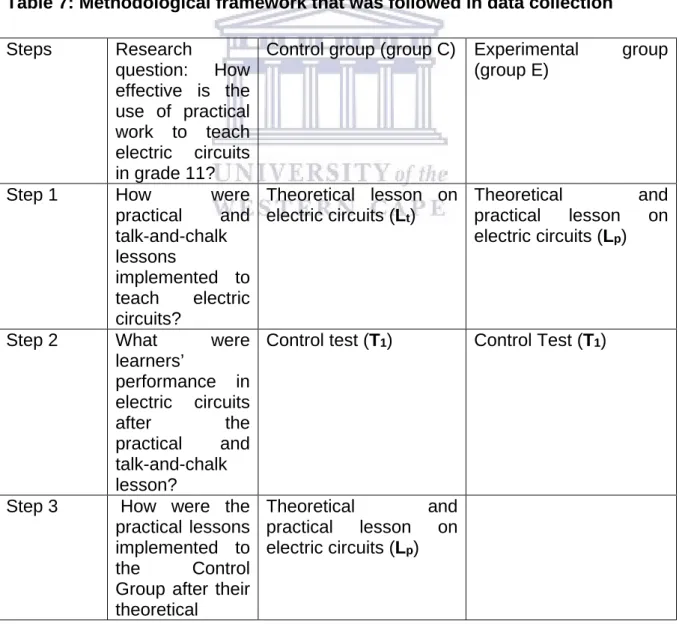
Table 7: Methodological framework that was followed in data collection ... 50
Table 8: Group 3 presentation of findings ... 699
Table 9: Group 6 presentation of findings ... 70
Table 10: Group 2 presentation of results ... 71
Table 11: Readings when both switches were closed ... 71
http://etd.uwc.ac.za
12
Table 13: Learner performance analysis in question 3 (practical-based) ... 766 Table 14: Table showing level categories ... 777 Table 15: Question by question analysis of results in the pre and post-tests . 799 Table 16: Pre and post-test practical based results analysis (question 3)... 81 Table 17: Learners’ perception on doing practical work ... 82 Table 18: Table showing percentage of responses who prefer doing practical work ... 84 Table 19: Responses of learners according to the rating scale……….84
List of figures
Figure 1: Graph showing grade 12 past results on electric circuits……….23 Figure 2: Practical approach lesson on electric circuits……….68 Figure 3: Graphic representation of test results after lesson implementation 78 Figure 4: Group C pre-test and post-test results………..80 Figure 5: Learners learn from practical work……….83 Figure 6: Practical work improves learners' understanding………..83 Figure 7: The use of practical work helps learners to gain confidence……….85 Figure 8: Relating classroom knowledge with everyday knowledge………….86 Figure 9: Science as a useful career after school leaving……….87
http://etd.uwc.ac.za
13
CHAPTER 1
Background to the study
1.1 Introduction
South African education is challenged by underperforming learners. This is especially true in the case of grade 12 physical sciences and mathematics results. Science is an important subject in the world as it focuses on developing learners to investigate physical and chemical phenomenon through scientific enquiry, as can be seen in the South African Large Telescope (SALT) project situated in Sutherland. Through the application of scientific models, theories and laws it seeks to explain and predict events in the physical world. This subject also looks at how society can benefit from the environment, care for it and use it responsibly (DoE, 2001). Through science, governments and scientists worldwide, are working to develop affordable and clean energy technologies. Solar energy will provide a practically inexhaustible resource that will enhance sustainability, reduce pollution and lower the cost of mitigating climate change (Quest magazine, 2015). These scientific enquiries can be explored when learners are exposed to hands-on science activities through the effective use of practical work in teaching and learning. This chapter will provide the context and rationale for the study and will highlight the research problem, research question, significance and limitations of the study.
1.2. State of science education in South Africa
This study emerged because of ever-growing deficient performance in science education in rural South African schools. The mediocre performance of South African learners in physical sciences can be observed both nationally and internationally. In 2001 and 2003 the trends in TIMSS were conducted globally and South Africa was part of this study (Howie, 2003). In 2001, 38 countries participated in the study with the view to determining learner performance in sciences; in 2003, a total of 58 countries participated and in both instances South African learners were placed last (Makgato & Mji, 2006). From 2005 to 2007, the number of learners who passed physical sciences at the higher-grade level gradually decreased and this affected their entry into science based programmes at universities (Kriek & Grayson, 2009).
http://etd.uwc.ac.za
14
Table 1 shows the percentage of South African learners who passed physical sciences between 2005 and 2007 as highlighted by Kriek & Grayson (2009).
Table 1: Percentage of learners passed physical sciences on HG between 2005 and 2007
Year Percentage of learners passed physical sciences on HG
2005 29,97 2006 29,78 2007 28,12
The percentages in Table 1 show the findings of research that was conducted ten years ago, by Kriek and Grayson (2009) which indicated deficient performance in South African learners in physical sciences. Clearly South African learners are not performing well in the science field. South Africa is still faced with challenges of underperformance in physical sciences as it was the case ten years ago; as reflected in Table 2 which indicated the performance of learners in physical sciences in the new curriculum called Curriculum and Assessment Policy Statement (CAPS).
Table 2: Overall achievement of grade 12 learners in physical sciences
Year % achieved at 30% and above % achieved at 40% and above % achieved at 50% and above 2011 53.4 33.8 19.6 2012 61.3 39.1 22.2 2013 67.4 42.7 24.7 2014 61.5 36.9 24.6 2015 58.8 36.1 22.7 2016 62.0 39.5 22.5
http://etd.uwc.ac.za
15
Out of 53.4% of learners that passed physical sciences in 2011, only 33.8% obtained 40% and above with 53.4% obtaining only 30% pass which is a very poor pass rate. The trend of 30% pass, which is a very poor pass (a level 2 pass rate), increased from 2011 to 2013 and this indicates a drop in learner performance in physical sciences. These results clearly reflecting that learners are struggling to pass physical sciences (NDR, 2014).
1.3 Challenges in Science Education provincially and at the district level
In the Eastern Cape, poor results in physical sciences in grade 12 remain a challenge. Several possible factors which were identified thirteen years ago, by Reddy (2004) are currently contributing to underperformance of learners in physical sciences. Based on my own experience as physical sciences educator over the past thirteen years of teaching, learners underperform due to some of the following factors:
1.3.1 Lack of resources
Inaccessibility of resources in schools contributes to the teaching and learning of physical sciences. Learners understand and learn better when they are given the chance to be hands on with the subject matter. As highlighted by a learner in an interview in research conducted by Makgato (2007) that; it is “better when you are taught about something that you can see” (p 260). It is difficult for a learner to understand when theoretical taught that if you react this substance with that substance will give you that than when doing it practical. Science is much better understood when it is done practical.
Makgato (2007) noted that majority of schools that offer mathematics and physical sciences do not have facilities and equipment to promote effective teaching and learning. The teaching of mathematics and physical sciences remain at a theoretical level without any experiments to enhance understanding and application of knowledge. Though the DoE (2001) has highlighted that there is a lack of resources in schools, this situation remains a problem that leads to deficient performance of learners.
http://etd.uwc.ac.za
16
1.3.2 Under-qualified and unqualified educators
Many educators who are teaching mathematics and physical sciences are under qualified to teach these subjects (Makgato, 2007). The findings in the Mathematics and Science Audit in 1999 indicated that more than 50% of mathematics teachers and 68% of science educators had no formal subject training in these subjects (Mangena, 2001). Although they were properly qualified as educators, their training in teaching mathematics and science was insufficient.
1.3.3 Absenteeism by both educators and learners
Researchers reported that some educators and learners especially in remote rural schools were sometimes lazy to attend school. In a few legitimate cases the reasons for absenteeism are that there were no proper access roads to schools, learners had to cross bridges that were not properly built and some were crossing rivers which were not safe during rainy seasons (Musiyoki, Thifhufhelwi & Murungweni, 2016).
1.3.4 Negative attitude of learners towards physical sciences
Some learners have negative attitude towards physical sciences because it is regarded as the most difficult subject. Science seems to be abstract for learners; at times, they find it difficult to understand scientific concepts (Olasimbo & Rotimi, 2012). That is why it is important for educators to do demonstrations when teaching and to involve learners in practical based activities. Science taught at school sometimes contradicts cultural beliefs and backgrounds. For example, in isiXhosa it is believed that lightening can be caused by witch doctors. However, in science at school learners are taught that it is caused by building up of charges in the clouds.
The use of demonstrations and practical work gives a learner the opportunity to understand school knowledge and differentiate between myth and reality. Furthermore, to lessen the negative attitude in learners towards science learners should be introduced to science during their initial stages of development. At Foundation Phase, learners should be given puzzles that could develop their scientific skills like problem solving, observations, identification of variables, data handling and analysis, drawing up conclusions, investigation skills and inquiring skills.
http://etd.uwc.ac.za
17
1.3.5 Lack of participation in science activities
Learning of science should be made fun to learners. When the learners are participating in co-curriculum activities they develop the appreciation of science at the same time learning is taking place. Learners need to be exposed in science activities like reading of science magazines and other science related journals, science expos, science festivals, national science week, science clubs and career exhibition in the field of science so that their attitudes would be changed for better. These activities would help them to develop problem-solving skills and scientific enquiry skills that can be applied in answering higher order questions. Educators are reluctant to expose learners in science activities; they find them to be time consuming (Muhammad, 2017). Exposing learners to these activities could have a supportive effect on learners and could serve to address the high rate of failure in physical sciences.
As evidence to this, my learners at school participated in mini-quiz mathematics and science competition in May 2015 and won the third place in a group competition, one of them won the first place in an individual competition; now he is going to represent the province in national minquiz competition (see appendix J). Hartley (2014) in a study of the role of science clubs reported that rural high school learners who were members of a science club that won a science competition were motivated in such a manner that out of nine science club members, four of them enrolled for engineering studies and the others followed science degrees. Exposing learners to science clubs and science-related activities makes learners appreciate science and the positive attitude produces satisfactory results.
1.3.6 Misconceptions of scientific terms
Learners have misconceptions in scientific terms. It has been repeatedly noted in National Diagnostic Report (2014) that learners have misconceptions in using scientific terminology and this result into answering questions incorrectly.
1.3.7 Limited time allocation in the Curriculum and Assessment Policy Statement (CAPS)
Curriculum and Assessment Policy Statement indicates that practical work must not be separated from theory to strengthen the concept being taught. It is stated in CAPS (2010) that the practical work can be in the form of a practical demonstration, an
http://etd.uwc.ac.za
18
experiment or investigation. This is a proper way of teaching science so that learners could construct meaning in learning. But with the time that is allocated for CAPS in physical sciences, some educators find it difficult to finish the syllabus. And this puts the learners at disadvantage because they will be examined in topics that they did not properly cover (Sibam, 2014).
1.3.8 Socio-economic factors
The background of learners plays a role in deficient performance in physical sciences (DoE, 2001). The impact of violence and HIV/AIDS can also have adverse effects. Some learners are heading their families. Their parents have died due to HIV/AIDS. Inadequacies and inequalities in the education system are most evident in areas which have sustained poverty and notable levels of unemployment. It is difficult for learners to have basic things for learning like calculators and instrument boxes, this contributes negatively to learning. Others come to school with empty stomach; it is gruelling to be taught while you are hungry (DoE, 2001).
1.3.9 Urban-rural differences
There are about 6,239 schools in the Eastern Cape mostly in rural areas compared to Western Cape and Gauteng provinces that have about 1500 schools each (Isaacs, 2007). This gigantic difference contributes to poor service delivery in the Eastern Cape Province. There are ICT projects in Western Cape and Gauteng, projects like Khanya which is based in the Western Cape Province and Gauteng Online Project in Gauteng. The Khanya Project provided almost 24 000 computers in 613 schools and provided infrastructure and training to educators, more than 500 000 learners in the Western Cape are benefiting in this project (Isaacs, 2007). The project is provided with funding by the Western Cape government and other corporate donors. The goal of this project is to have every educator in every school in the Western Cape empowered to use appropriate and available technology to deliver curriculum to each learner. The impact of this project can be associated with the Western Cape grade 12 results which was 82.2% compared to Eastern Cape which obtained the poorest percentage of 65.4 in 2014.
Gauteng Province is also running Gauteng Online Project which is funded by the Department of Education. The programme’s access model involves establishing computer laboratory with 25 work stations, Internet and e-mail access, to be used for
http://etd.uwc.ac.za
19
curriculum delivery in all Gauteng schools (Isaacs, 2007). These intervention programmes also reflect in Gauteng grade 12 results which was the leading province with a percentage of 84.7 in 2014. ICT has a potential to improve the quality of education and training in GET and FET bands when applied effectively as indicated in the outcomes in these intervention programmes. “ICTs have the potential to improve the quality of education and training (Patra, 2014).
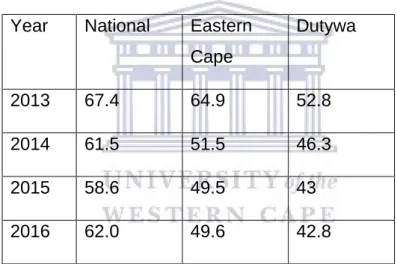
These factors that have been highlighted above are highly perceptible in remote rural and previously disadvantaged schools and they have huge contribution in failure rate in physical sciences. Table 3 displays the grade 12 results in physical sciences nationally, provincially and in the district where the research will be conducted.
Table 3: Table showing grade 12 physical sciences results over the past four years
Year National Eastern Cape Dutywa 2013 67.4 64.9 52.8 2014 61.5 51.5 46.3 2015 58.6 49.5 43 2016 62.0 49.6 42.8
There are 38 high schools in the district; about 82% of the schools are in remote rural areas. In 2014 only seven learners in the district managed to obtain level 7 in physical sciences; three schools attained a zero-percentage pass rate and thirteen schools obtained less than 30%. Most schools achieved less than a 50% pass rate of an inadequate quality. There is a serious challenge in physical sciences in the Eastern Cape.
http://etd.uwc.ac.za
20
1.4 Intervention Programmes to improve inadequate performance in physical sciences
Due to the major challenge faced by the South African education of not producing anticipated results in grade 12 learners, the DoE introduced intervention programmes with the aim of giving supporting teachers to contribute effectively in the teaching and learning. These intervention programmes had variable impact because of limitations due to funding, lack of proper planning and difficulty to provide for Eastern Cape as it is having the largest number of schools. The following table shows interventions programmes with their limitations.
Table 4: Intervention programmes to improve learner performance
Intervention programme Limitation 1. Dinaledi Project
2. Incubation classes
3. Winter and spring schools
4. Science festivals usually attended in
To be part of the project, schools must have registered a minimum of 50 learners on in mathematics and physical sciences or the school must have obtained a minimum of 50% pass rate in matric results in both mathematics and physical sciences. The project also caters for 60 schools per provinces. These requirements forbid other schools for getting this opportunity of being part of this project.
These classes were accommodating a maximum of ten learners per school and learners were selected according to their performance. It was only for learners who are performing well in both mathematics and physical sciences.
Highly dominated by overcrowded classes with little or no individual attention. Educators are rushing to cover all the challenging topics over a short period leaving behind most learners.
Not all learners are able to attend those science festivals. Parents must arrange payments for their children to attend festivals. Eastern Cape as one of the provinces with high rate of poverty, it is difficult for some
http://etd.uwc.ac.za
21
Grahamstown
5. Min quiz and Astro quiz competitions
6. Science Olympiads, SAASTA science debate, Eskom Expo, science weeks
7. NMMU Skills Development Programme for FET mathematics and physical sciences educators
8. Short course for grade 9 natural science educators offered by UWC.
9. UWC programme for physical sciences educators
parents to cater for their children to attend these festivals.
Most schools do not show any interest in motivating learners to attend these competitions. Schools can register maximum of three learners.
Most educators do not show interest in motivating their learners to attend these programmes. In most cases, it is the schools that are already performing that are showing interest in such programmes.
Catered for a limited number of educators. There are about 6500 in Eastern Cape province mostly in rural areas and this makes it difficult for the department to reach out to every educator.
Only limited number of educators was accommodated in the programme due to funding. Not all learning areas were covered because of short period and lack of funds.
A maximum of 50 educators were taken in the programme from ACE now are currently doing Masters in Science Education. It is not easy for these educators to conduct workshop for other educators in their districts because there is money in the Eastern Cape department of education to support these educators to facilitate workshops in their respective districts.
1.5. Context of the study
The study will be conducted at the researcher’s site at Dutywa district in the Eastern Cape. The school is in a rural area that is about 7km from town. The school is named after the mother of one of former presidents of South Africa as she was honoured as
http://etd.uwc.ac.za
22
the founder of the school. As a former educator, she played a very active role in developing the school and the community with her creative thinking skills and her love of the community. Through her efforts, the school has well-structured classrooms, with a science laboratory, a computer laboratory and a temporary structured library. But the challenge is that the science laboratory has limited resources which take longer periods for learners to complete one experiment.
The researcher has been teaching physical sciences at this school for a period of nine years. The school has an enrolment of 750 learners with eight physical sciences classes; three grade 10 classes, three grade 11 and two grade 12 classes. The researcher is currently teaching physical sciences from grade 10 to12. There are 165 learners in grade 11 and 93 learners in grade 12. There are 26 educators at school.
The school is in a disadvantaged rural area with different economic categories of people namely wealthy, middle income and unemployed but dominated by unemployed people. Most of the learners in the school are from families where one or both parents are unemployed. These parents depend mainly on social grants and informal jobs to give basic needs to their children. Because of these conditions, some learners struggle to have school basic requirements like a calculator and proper school uniform. Such conditions have major contributions on inadequate performance of learners.
The high rate of unemployment which leads to poverty contributes in an accelerating rate of crime in the school. The school has been vandalised several times resulting in the loss of computers, electric appliances and food. This high rate of crime extended to learners’ boarding houses; burglars would break into the learners’ rooms and demand cell phones and money. Learners are scared to attend evening studies because of crime. Despite of all these challenges, the school managed to attain an overall percentage of 65 in grade 12 results in 2014 with two learners obtaining six level sevens in their matric results. These learners were the top achievers in the district and were both awarded with premier’s bursary (see appendix I).
http://etd.uwc.ac.za
23
It has been indicated in Grade 12 National Diagnostic Report in physical sciences (2014) for the past four years that learners have not been performing well in electric circuits, an area in physics component of physical sciences. The report indicates that many learners have misconceptions in electric circuits and are struggling to work out the calculations required in this regard. Learners seem to have difficulty in answering questions that are based on practical work because of lack of exposure to practical work. It was recommended that practical work must be done to improve learner performance (NDR, 2013).
Figure 1: Graph showing grade 12 past results on electric circuits
The learner performance, as depicted in Figure 1 above, served as stimulus to the researcher to investigate possible factors that contribute to this kind of performance in electric circuits and to implement the recommendations by the National Diagnostic Report (2014). The underperformance of learners in practical design questions is not only challenging South African learners, as highlighted by a study conducted by Munikwa, Chinamara & Mukava (2011), also in Zimbabwe learners are performing poorly in examinations when they are assessed in practical design questions.
The study seeks to investigate the effectiveness of the use of teaching electric circuits by means of practical work. As National Diagnostic Report (2014) showed, learners have misconceptions concerning electric circuits; they are struggling to work on calculations. Learners cannot answer questions that are practically based; this
2013 2014 2015 2016 Overall % obtained by grade 12
learners on electric circuits 15,5 47 41 34 0 5 10 15 20 25 30 35 40 45 50
Overall % obtained by grade 12 learners on electric
circuits
Overall % obtained by grade 12 learners on electric circuits
http://etd.uwc.ac.za
24
indicates that there is a lack of exposure to practical work. It is difficult for learners to understand what happens when voltmeters are closed or open without being exposed to the real objects. It was recommended by the Minister of Education that practical work must be done to improve learner performance. The CAPS document for physical sciences for grade 10-12 portrays a teaching pedagogy that promotes development of critical thinking, scientific reasoning and strategic abilities among learners (DBE 2010). This can only happen when learners are exposed to practical work. The section on electric circuits in high school physical sciences is one of the most important chapters both at high school and tertiary levels therefore it is important that learners get understand of this section especially for those learners that will follow electricity related careers at tertiary level. The knowledge and skills regarding laboratory apparatus are tested in grade 12 examinations and are valued by universities in the engineering field (DoE, 2000). Moreover, in CAPS the topic of Electricity and Magnetism has a weighting of 8.75%, 12.5% and 7.5% in grade 10, 11 and 12 respectively and this shows the significance of this topic in science. Furthermore, CAPS require formal practical work for electric circuits from grade 10-12. And if this topic could be presented properly, learners could be developed enough to be critical thinkers as highlighted by Swain, Monk & Johnson (1999) that practical work aims at seeing problems, seeking ways to solve them and arriving at new conclusions; the challenge of load shedding that South Africa is facing could be improved.
My interest in this study was prompted by reports that indicated inadequate performance in physical sciences grade 12 learners as indicated in Figure 1 and Tables 2 and 3. It is my contention that, from my experience and observation, one of the reasons for the poor pass rate could be that learners lack exposure to hands-on activities which make it difficult for learners to understand and interpret questions; especially during tests and examinations. If, in this case, teaching and learning could be linked with practical activities as stated in CAPS document for physical sciences, the low pass rate could improve (DBE, 2010 p. 11). Although this study focuses on grade 11 in electric circuits, a closer look at grade 12 performance will give a clear picture of the problem. Grade 12 results are good at illustrating problems because analysis is fair, national standards are maintained through the results being examined and moderated externally.
http://etd.uwc.ac.za
25
1.7 Problem statement
Learners have the challenge of deficient performance in electric circuits. It has been highlighted in the Examiner’s Report of Grade 12 examinations that learners are not responding properly to experiment-based questions in electric circuits (DBE, 2013). Most learners in 2014 physical sciences examination could not recognise that when a bulb burns out there will be no current which results in increased resistance and decrease of current. The reason for this lack of understanding could be a lack of exposure in practical work (NDR, 2013). Also, in 2016 learner performance in electric circuits dropped to 34%, it was then suggested that it is critical that learners must conduct the prescribed experiments in the CAPS document (NDR, 2016)
1.8 Research question
This study responded to the issues raised in the National Diagnostic Report (2014), CAPS document (DBE, 2010) and the appeal by the National Minister of Basic Education that learners are underperforming due to lack of exposure to practical work. The purpose of the study is to explore the use of practical work in teaching electric circuits. To explore the purpose of the study the following research question will be addressed:
How effective is the use of practical work to teach electric circuits in grade 11 physical sciences?
To address this research question, the following sub-questions will be investigated in this study:
1. How were practical and talk-and-chalk lessons implemented to teach electric circuits?
2. What were learners’ performance in electric circuits after the practical and talk-and-chalk lessons?
3. How were the practical lessons implemented to the Control Group after their theoretical lesson?
4. To what extent does the use of practical work impact on grade 11 learners’ performance in electric circuits?
http://etd.uwc.ac.za
26
1.9 Significance of the study
The research findings may be beneficial to the teacher in terms of improving strategies for the design of teaching science practical. This could in turn enhance learners’ chances of doing well in answering practical-based questions. This could have a positive impact on the physical sciences results in the Eastern Cape. The effective use of practical work will help learners to understand science and appreciate that science is based on evidence. Hands-on skills are of immense importance if learners are to progress in science.
As highlighted by Skamp (2011) and Hartley (2014) the use of practical work creates a vibrant learning environment for teaching and learning of science which could improve physical sciences results. The study is significant because it addresses the practical approach to teaching physical sciences, and specifically the teaching of electric circuits. The outcomes of the study could prove significant for fellow teachers, curriculum advisors and curriculum planners. The results of the study could add baseline data to the limited studies investigating the application of the practical approach to teaching physical sciences in rural schools in the Eastern Cape.
1.10 Limitations of the study
Limitations are conditions beyond the control of the researcher that will place restriction on the conclusion of the study and its application (Best & Kahn, 2006). Being a case study design the study draws conclusions from a single site and participants of that site. The study was conducted in one school in a sample of 125 physical sciences grade 11 learners out of 165. The sample size is not big enough to make general conclusion for the district or the whole country. There were no comparative dimensions in the study since research was in one school.
1.11 Structure of the thesis
This thesis is divided in the following chapters:
http://etd.uwc.ac.za
27
The introductory chapter of this study provides the background to this research project. It clarifies the research problem, the aims of the research, the research question, the rationale, the significance and limitations of the study. Importantly, it introduces the succeeding chapters.
Chapter 2: Literature review
The literature review provides the theoretical basis for this study and discusses existing studies related to the topic, and is an attempt to show the relationship between this study and what has gone before. This helps me to place my study in a context and show its relevance by making connections with the body of knowledge.
Chapter 3: Methodology
This chapter discusses procedures which were used to gather raw data, with the aim of answering the research questions of this study. All procedures and techniques which were used in the field are made explicit in this chapter.
Chapter 4: Research findings and discussion
This chapter represents and discusses the findings of the study and serve to represent the data in meaningful and useable formats. This chapter presents a detailed analysis of lesson implementation using talk-and-chalk and practical lesson methods. It also focuses on pre and post-tests analysis, learner performance on practical-based question, analysis of questionnaire and focus group interviews.
Chapter 5: Conclusion and recommendations
Finally, this chapter concludes the study. It includes a discussion of the main findings in terms of effectiveness of the use of practical work, a summary of the study, its conclusions, as well as the limitations of this study and recommendations for future research arising from the findings of the study.
1.12 Conclusion
This chapter provided the background to this research study. It clarifies the research problem, the aims of the research, the research question, the rationale and the significance of the study. It further explains the facts that have limited the study. Importantly, it introduces the succeeding chapters. Chapter 2 will explore the
http://etd.uwc.ac.za
28
theoretical frameworks that underpin this study as well as how other relevant existing studies relate to this research study.
http://etd.uwc.ac.za
29
CHAPTER 2
Literature review
2.1 Introduction
The previous chapter of this study provided the introduction which clarifies the background to the study, rationale for the study, the research problem and the research question of the research project. In this chapter, the researcher will discuss the theoretical framework underpinning the study and review relevant literature of existing studies related to the effectiveness of the use of practical work in teaching electric circuits. The purpose of reviewing relevant literature is to find the relationship between my study and what the other researchers has done before.
2.2 Theoretical Framework
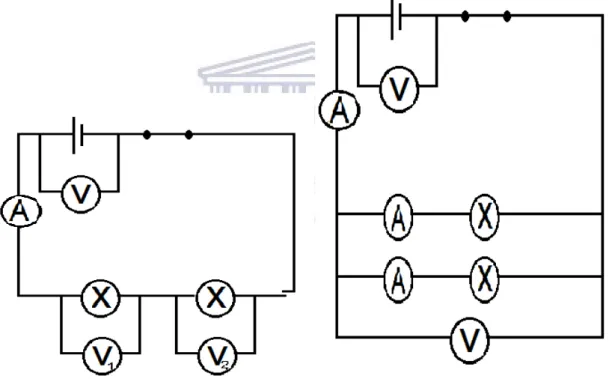
The theoretical framework is the structure that can hold or support a theory of a research study. The theoretical framework introduces and describes the theory which explains why the research problem under study exists (Labaree, 2013). The theoretical framework that underpins this study is constructivism. Constructivism is defined as an epistemological view which sees the learner as an active participant in the teaching and learning process. Constructivist learning theory suggests that learning is a constructive process in which a learner forms an internal picture of knowledge engages in a sense making process where individuals build new knowledge and understanding from the base of existing knowledge and perception (Chalmers & Keown 2006). This theory purports that learners learn better when they construct their own meaning. This is the theory which promotes learning contexts in which students play an active role in learning. In this study, learners will be provided with electricity circuit kit to investigate the relationship between voltage and current when resistance is kept constant. The teacher is going to guide learners to ensure that they are able to connect all apparatus correctly in both parallel and series connections. In constructivism, learners are guided until they understand what they are required to do.
http://etd.uwc.ac.za
30
In constructivist classroom, learners play key role in directing learning. The learner comes into a learning situation with prior knowledge on the subject matter. It is based on this prior knowledge that the learner interprets the new situation presented. This means that the construction of new knowledge in science is strongly influenced by prior knowledge. Learning occurs with educator and learner both in the role of co-learners. As such, each has a voice in the learning process. Learning communication is a three-way process, it is teacher-learner, learner-teacher and learner-learner communication, Goals and objectives are established through negotiations with each participant (educator and learners) having a voice in the process. With such an active role in the learning process, learners will also learn new ways to perform. Learners will be independent even after school leaving; there will be lower rate of drop outs in universities because of independency. Learners are prepared for the society and in life.
2.2.1 Role of an educator in a constructivist classroom
The educator’s role in a constructivist class is to first demonstrate or model what he would like the learners to adopt. Educator acts as a coach where he had to direct, guide and helps the learners to reach the next level of learning. Learners are helped to develop their own understanding of the content rather than giving them lecture. In this research, discovery method is used so that learners could develop their own scientific reasoning. Higher order thinking is encouraged in a constructivist classroom and this develops learners to be able to answer higher order thinking questions. As noted by Chetty, Hendren and Katz (2015) that the role of educator in teaching-learning assessment process is to monitor learners’ knowledge construction.
2.2.2 Limitations of constructivism approach
Though this approach is highly regarded in the literature there are limitations surrounding the proper implementation of constructivism that are put into consideration in this research. Preparing for constructivism classroom is time consuming; it requires proper planning that will accommodate all learners as unique as they are. The training necessary for constructive teaching is extensive and often requires costly long-term professional development. This may be unreasonable to school budgets as well as destructive to the learners’ learning. It also requires a reasonable number of learners in a classroom, with many learners in one classroom; educators are unable to adapt the curriculum to each learner as their prior knowledge
http://etd.uwc.ac.za
31
differs. The constructivism curriculum also eliminates standardized testing and grades. This eliminates grade-centred goals and rewards. Constructivism classroom needs a well-resourced classroom so that learners can be able to work independently. It may sometimes lead to misconceptions if not properly guided.
http://etd.uwc.ac.za
32
2.3 Studies based on constructivism
2.3.1 International studies based on constructivism
Zhao (2003) stated that the use of constructivist model in teaching environmental science at Beijing Normal University can improve learner’s understanding. Zhao explained that during teaching and learning in environmental science, both the concept map and mind map are useful tools to promote active learning and the students’ abilities to integrate knowledge; and that problem-based learning (PBL) and the use of case studies can effectively motivate students’ learning curiosity and develop creative abilities. He further explained that constructivism encourages students to confront real world problems which are within their everyday experience. The characteristics of constructivist teaching models include: prompting students to observe and formulate their own questions; allowing multiple interpretations and expressions of learning; encouraging students to work in groups; and in the use of their peers as resources to learning. The researcher in this study, agrees with Zhao’s arguments about constructivism as the study tries to find the effectiveness of the use of practical work in teaching electric circuits. In this study, the researcher also believe that constructivist approach can make the learners to develop the scarce skills that are required in the country.
In a study by Anderson (2007) the author reported on one of African countries, Ghana, that has similar related issues to this study in terms of poverty in rural areas and educational issues like lack of teachers in rural areas. The researcher in his study indicated that the learners in rural schools in Ghana have unequal access to science class, lack of resources and the gap between urban and rural schools. Comparable to this study, the researcher’s study on Relevance of science education is underpinned by the theory of constructivism. Anderson (2007) believed that the use of constructivism plays a significant role in the teaching and learning of science. As related to Zhao, Anderson also mentioned that through constructivism, learners construct their own meaning in learning and they develop knowledge and understanding of scientific ideas.
According to Asan (2007), constructivism plays a vital role in the science classroom where Robottom (2004) states that learners use their own believes, interpretations and ideas to interpret information conveyed by the teachers. His study is also
http://etd.uwc.ac.za
33
supported by emancipatory approach which is customized to learners’ prior knowledge and emphasized in hands-on problem-solving skills. In this approach, learners are developed to be critical thinkers that are prepared for the society and life.
Constructivism approach can be used in a science class to expose scientific inquiry in learners. Scientific inquiry supports learners to develop knowledge and understanding of scientific ideas as well as an understanding of how scientists study the natural world. Melville, Campbell, Fazio, Stefanile, and Tkaczyk (2014) conducted a research study on the practicum experiences of pre-service teachers that are using scientific inquiry in teaching science as required in science education standard document in Australia.
Achimugu (2012) conducted research on strategies for effectiveness of conducting practical chemistry in high school. In his research, learners construct their own meaning in learning through hands-on activities. His study is also underpinned by the theory of constructivism related to Haung and Odegaard (2014) who conducted a study teaching fourth and fifth grades the concept of force using scientific inquiry.
Papadimitriou (2012) wrote about the value of constructivism in a science lesson whereby learners are encouraged to discover, test structure and apply the knowledge obtained to new situation. Using constructivist approach in scenario based learning of electric circuits, he found that learners could discover the formulas and principles of electric circuits.
2.3.2 National studies on constructivism
In constructivism, learners are given skills that will enable them to succeed in a workplace that is characterized by diversity, competition, quality management practices and teamwork. Piaget, in a study piloted by Mpofu (2006) specified that knowledge cannot be given to learners; it is the learner’s responsibility to construct it from his or her mental and physical interaction with the environment. Learning is a physical and psychological activity and to be meaningful, one must understand and integrate knowledge into one’s cognitive structure. Constructivism approach is linked with the specific aims of physical sciences stated in CAPS document which are as follows:
http://etd.uwc.ac.za
34
• Physical sciences promote knowledge and skills in scientific inquiry and problem solving; the construction and application of scientific and technological knowledge.
• To make learners aware of their environment and to equip learners with investigating skills relating to physical and chemical phenomena.
• Develop understanding of scientific concepts, principles and attitudes towards life (DBE, 2010, p.8).
The aims that are mentioned above can be achieved when learners are exposed to practical work as they construct their own meaning in learning through hands-on activities. This approach is underpinned by a social constructivist, Vygotsky (1978) who believed that learners have various levels of understanding. Education should be influenced by the principle of scaffolding. Scaffolding is when an educator introduces a concept or a topic and ensures that learners have grasped the concept and thereafter withdraws to allow learners to work independently to increase their capabilities of critical thinking.
In this study, learners will be given support until they can apply new skills and strategies independently and it has been found to be an excellent method of developing learners’ higher levels of thinking skills. This process is interested on how learning will be achieved than rushing to finish the syllabus leaving many learners behind. Learners learn better when they construct their own meaning. Learners will be given the opportunity to discover themselves the differences between parallel and series connections using practical work (see lesson plan in appendix E). Moreover, Freire (1972) believed that human beings can take actions in their own lives and world rather than being controlled by political forces. He believed that humans can become aware of the world, reflect on it and act on it to change it. Learners should be involved in two-way communication and reflect in their societies what they have learnt that is linking everyday knowledge with school knowledge which probes critical thinking.
In a study conducted by Dhurumraj (2013) in a school in Pinetown in KwaZulu-Natal province purported that though constructivism had been ignored in teaching of physical sciences, it forms the major role in the teaching and learning of science as implemented in his study. Through constructivism, learners become actively involved
http://etd.uwc.ac.za
35
in constructing their own meaning in learning which allows them to develop cognitive processes that enables them to question validity and authenticity of work at hand.
Semeon (2014) concur with the above researchers about constructivism approach in teaching science. In his research, he highlighted that learners do not come to school as blank slates but with everyday knowledge through interaction with their environments and societies. The knowledge that the learners bring to school needs to be valued, through practical work and demonstrations; learners can construct their own new meaning in science learning. Practical work helps to resolve any contradictions between school knowledge and everyday knowledge. Constructivism helps learners to develop the ability of making good observations like classifying, measuring, inferring, predicting (etc.). Constructivism approach tends to close the gaps of the past that physical science is meant for highly gifted learners; all learners’ abilities are valued in a constructivism classroom.
2.4 Studies of practical work in science education
2.4.1 What is practical work?
Practical work is defined as learning experiences in which learners interact with materials or with secondary sources of data to observe and understand the natural world. The main aim of practical work as suggested by Dillon (2008) is:
• to make phenomena more real;
• to arouse and maintain interest;
• to promote a logical and reasoning method of thought;
• to practice seeing problems and seeking ways to solve them;
• to develop a critical attitude;
• to develop an ability to cooperate;
• To find facts and arrive at new principles.
Physics practical skills are science process skills. Science process skills are cognitive and psychomotor skills employed in problem solving. Science process skills are mental and physical abilities and competences which serves as a tool needed for the effective study of science and technology as well as problem solving, individual and societal development (Nwosu & Okeke, 1995). Practical work helps learners to
http://etd.uwc.ac.za
36
develop process skills such as observing, classifying, predicting, measuring, drawing, recording data, hypothesizing (etc.). This could not happen if learners are passive, are knowledge absorbers while teacher transmits knowledge to learners.
Practical work arouses and maintains interests and curiosity in science. Science is not stagnant but subjective to change. Learners learn by doing and thinking about what they do (Lowery, 1994). Through practical work learners can be able to verify laws and theories that they have already learnt. Practical work develops learners to be critical thinkers. Learners should be given chance to discover things by themselves by enabling them to practice scientific method (Jenkins & Nelson, 1979), to avoid a science class where learners could end-up be asking ‘what is supposed to happen teacher?
2.4.2 Meaning of an effective practical work
Millar and Abraham (2009) posited that most learners only enjoy doing practical work with little contribution that it has in learning. In a brief period after the learners have conducted practical work, they forget what they learnt from it and what they were doing it for. Osborne (1998) also supported this idea that practical work plays a limited role in science learning and has little educational value. Hodson (1991) claimed that:
As practised in many countries, practical work is ill-conceived, confused and unproductive. For many children, what goes on in the laboratory contributes little to their learning of science (p. 176).
To overcome the challenges that are highlighted by the above researchers, practical work should not only be made fun to learners but it must fulfil educational purpose. For this to happen practical work must be linked with teaching, it must not be done in isolation otherwise learners will only enjoy practical with no link between theories and practical and there will be no impact in learning. And therefore, the recommendation that was made by Minister of Education that learners must do practical work to improve performance will be in vain if practical work is isolated from theory. When planning practical lesson, educators must take into consideration the following objectives of practical work as indicated by Millar and Abrahams (2009) and Achimugu (2012): The main objective of the practical activity is:
http://etd.uwc.ac.za
37
(a) To help students develop their knowledge of the natural world and their understanding of some of the main ideas, theories and models that science uses to explain it.
(b) To help learners learn how to use some piece(s) of scientific apparatus and/or to follow some standard scientific procedure(s).
(c) to develop students’ understanding of the scientific approach to enquiry (e.g. of how to design an investigation, assess and evaluate the data, process the data to draw conclusions, evaluate the confidence with which these can be asserted).
(d) To verify laws and theories that the students have already learnt.
(e) Leads to fundamental and applied research in chemistry at all levels of education.
(f) It is used to reinforce what is learnt in the theory class and hence encourages the spirit of experimentation.
(g) Arouses and maintains interest and curiosity in physical sciences.
(h) Helps students to develop manipulative skills and proficiency in writing reports.
(i) Enhances students’ better understanding of concepts and principles and by so doing, significantly contributes to students’ achievements in chemistry. (j) Encourages students to be active in the class, in other hand, discourages
abstraction, rote memorization and inattentiveness in the class.
The following suggestions as identified by Achimugu (2012) should be taken into consideration when an educator wants to conduct an effective practical physical sciences class:
(i) Try out the experiment to ensure problem free practical. (ii) Teaches the learners necessary precautions.
(iii) Ensure that the laboratory environment is safe, clean and conducive for the learners to work and achieved the desired result.
(iv) The utility services in the laboratory are in good working condition i.e. water, first aid box, fire extinguishers, etc.
(v) All the apparatus and materials required for the practical are provided. (vi) The reagents required for the practical are prepared in large quantity. (vii) The entrance and exit routes of the laboratory are free.
http://etd.uwc.ac.za
38
(viii) Identify the number of learners that will take part in the practical. Where the number of learners outshoots the available facilities, they should be grouped.
(ix) Prepares practical guidelines or instructions to guide the learners. This could be written on the board or printed out and given to each learner or group.
(x) Works round to assist those learners in areas of identified difficulties. (xi) Outline the order of reporting practical chemistry i.e. tabular form.
(xii) Learners and laboratory assistants clean up the tables, wash the apparatus and replace them to their respective positions after each practical. (xiii) Learners leave the laboratory in, an orderly manner.
(xiv) Marks the learners’ practical works and makes necessary feedback to the learners.
To make teaching effective, it is first important to think of the meaning of word ‘effectiveness’ and consider the steps to be followed in developing such activity and monitor what happens when it is used (Millar, Tiberghien & Le Marachal, 2002). Effectiveness of practical work depends on the sequences of lesson activities of which a practical activity is a part of. The following table demonstrates the stages to be followed in developing steps for effective practical activity.
Table 5: Table showing steps in the development and evaluation of teaching and learning when planning practical activity lesson
Step Activity
1 Educator’s objectives (what the learners are intended to learn).
2 Tasks specification (what the learners are intended to do).
3 Learning events (what the learners will do). 4 Learning outcomes (what the learners learn).
In the first stage, when an educator is planning an activity, there are specific goals and objectives that he/she wants the learners to achieve which should be stated by
http://etd.uwc.ac.za
39
the educator when preparing for a practical activity. Educator’s objectives can be influenced by number of factors: what Curriculum Assessment Policy Statement (CAPS) requires; what resources are available; which role is going to be played by the educator, is the lesson going to be a demonstration; what role will be played by learners, is the lesson going to be hands on and minds on activity; how are the learners going to be assessed. Then the educator must compare the first stage with the last stage (stage 4) which shows what the learners have learn in the activity in comparison with what the educator required the learners to learn in stage 1.
If the learners did not achieve what the educator expected them to learn it would be indicating that the outcomes of the lesson were not fulfilled, the educator must consider to re-do the lesson in a different approach or check where the lesson did not go well to improve the lesson design to get the desired outcome. In the lesson preparation, educator has specifications, which is step 2, what he intends the learners to do which should be compared to the actual events, that is what the learners have done (step 3). By so doing, the objectives of conducting practical work would be a success.
The aim of practical work is to help learners to understand some of the ideas that science uses to describe or to explain what they observe. As this study investigates the effectiveness of using practical work to teach electric circuits in this research, learners have to be able: to identify the apparatus that they are going to use in the lesson like voltmeter, ammeter, resistors, switches and batteries; know how are these apparatus connected and how are they used as it is indicated in 2.5.2 (b) that practical work helps learners to understand how to use scientific apparatus and also to follow scientific procedure; learners will also learn what happens to voltmeter and ammeter readings when resistors are connected in series or parallel; when the switch is closed or open what happens to voltmeter and ammeter readings.
Now through the practical activity learners will be able to differentiate between electromotive force (emf) and potential difference which causes much confusion in grade 12 learners when solving electric circuit questions. And without applying their minds and their hands on the task, the activity will not be effective. As the learners are engaged in practical work, they will be enhancing what Dillon (2008) identified about practical work that ‘it promotes a logical and reasoning method of thought;
http://etd.uwc.ac.za
40
develop critical attitude and practice seeing problems and seeking ways to solve them’ (p. 5)
Millar and Abraham (2009) further postulated that for practical work to be considered effective, it must link or address two domains, which are the domain of objects and observables (domain 1) and the domain of ideas (domain 2). In the domain of objects and observables, learners do what was intended with the objects and materials provided and what they were meant to observe. Learners can later recall and describe what they did in the activity and what they observed. In the domain of ideas, during the activity, learners think about what they are doing and observing using the ideas intended. Learners can later discuss the activity using the idea it was aiming to develop and can show understanding of these ideas in the other context. If the lesson only addressed domain 1, learners will not be able to apply what they have learnt in class in another context then there would be a recurring challenge of learners who cannot show understand of ideas in another context. And that would be supporting what was stated by Hodson (1991) in the first paragraph of 2.5.2 of this chapter.
2.4.3 Types of practical work
Wellington (1988) indicated that there are at least six types of activities that take place in school science that could be classified as practical work:
teacher demonstrations; class practical’s, with all learners on similar tasks, working in small groups; a circus of ‘experiments’ with small groups engaged in different activities, rotating in a carousel; investigations, organized in one of the above two ways; and problem-solving activities. (p. 12)
The several types of activity have different purposes (Gott & Duggan, 1995) but, as Wellington (1988) also points out, many ‘experiments’ are nothing of the sort not least because no new knowledge is being made. Woolnough & Allosp (1985) have suggested three categories which might aid discussion about practical work, namely exercises, experiences and investigations.