(will be inserted by the editor)
t-DeLP: an argumentation-based Temporal Defeasible Logic
Programming framework
Pere Pardo · Llu´ıs Godo
Received: date / Accepted: date
Abstract The aim of this paper is to propose an argumentation-based defeasible logic, called t-DeLP, that focuses on forward temporal reasoning for causal infer-ence. We extend the language of the DeLP logical framework by associating tempo-ral parameters to litetempo-rals. A tempotempo-ral logic program is a set of basic tempotempo-ral facts and (strict or defeasible) durative rules. Facts and rules combine into durative argu-ments representing temporal processes. As usual, a dialectical procedure determines which arguments are undefeated, and hence which literals are warranted, or defeasi-bly follow from the program. t-DeLP, though, slightly differs from DeLP in order to accommodate temporal aspects, like the persistence of facts. The output of a t-DeLP program is a set of warranted literals, which is first shown to be non-contradictory and be closed under sub-arguments. This basic framework is then modified to deal with programs whose strict rules encode mutex constraints. The resulting framework is shown to satisfy stronger logical properties like indirect consistency and closure.
Keywords Logic programming·Argumentation·Non-monotonic logic·Temporal Reasoning
Mathematics Subject Classification (2000) 03B44·03B53
This paper is a revised and extended version of the conference paper [41] which was presented at the 5th International Conference on Scalable Uncertainty Management (SUM 2011).
P. Pardo
Institut d’Investigaci´o en Intel·lig`encia Artificial (IIIA - CSIC), E-08193 Bellaterra, Spain and Dept. de L`ogica, Hist. i Filo. Ci`encia, Universitat de Barcelona, E-08001 Barcelona, Spain E-mail: [email protected]
L. Godo
Institut d’Investigaci´o en Intel·lig`encia Artificial (IIIA - CSIC), E-08193 Bellaterra, Spain E-mail: [email protected]
1 Introduction
In this contribution, we present an argumentation-based temporal defeasible logic, called t-DeLP, mainly inspired by DeLP [23] but with a focus on causal temporal reasoning. The language is defined by a set of temporal literals -representing facts-, and (strict or defeasible) durative rules. A temporal logic program consists of tempo-ral facts and rules, which combine into arguments for further derivable facts. The main motivation for t-DeLP is to reason about interacting processes (modeled as arguments), and then decide which arguments (conclusions) are to prevail. An ar-gument expresses some delay between each premise (cause) and the conclusion (ef-fect), thus suggesting how a process might evolve. Since different arguments (process descriptions) might conflict, a dialectical procedure is proposed that decides which arguments prevail based on their conflicts. The conclusions of undefeated arguments define the set of warranted effects (defeasible logical consequences) of a t-DeLP pro-gram. These consequences thus describe the actual states that will turn up, according to the available information about the initial state(s) and the temporal rules.
A motivation fordefeasiblelogics (like for the family of non-monotonic logics) is the descriptive parsimony it allows for knowledge bases. This parsimony is in accor-dance with everyday causal reasoning, where it is standard practice to list only those causes that are uncommon or just specific to the process: e.g. asparkcaused afire. Causes that usually hold, likeoxygen, are not mentioned in the explanation (or rules) unless they are false and this explains the non-occurrence of the effect: thesparkdid not start afirebecauseno-oxygen. Thus, we aim to describe a general-purpose logic to reason about temporal or causal processes, leaving to the user the particular level-of-detail of explanations. Besides these questions of what is to occur afterwards, e.g. whetherfireorno-fire, another motivation exists for a specialized study of temporal aspects within this non-monotonic stance. Namely, the question whetherfirewill start at some future timetor instead att+ 1ort+ 2, etc. This is important in scenarios where the start and duration of a process depends on the initial context (e.g com-bustible, fire-retardant), or on the existence of other processes that are also occurring in parallel (rain, wind).
A well-known contribution among argumentation-based defeasible logics is that of Garc´ıa and Simari’s [23]. The authors present DeLP, a logic programming formal-ism based on defeasible argumentation. The question of how to define the defeat or preference relation between arguments is also discussed at length in this work. In-spired by Poole [42], the authors of [49] focus on a formal criteria calledgeneralized specificity, which gives preference to arguments with more premises or more direct rules.1But the latter seems at odds with causal reasoning in a temporal setting: we would rather preferless directrules, i.e. more detailed temporal inferences.2Thus, we adapt this and other aspects of DeLP to the temporal case in order to intuitively meet basic intuitions about causal explanations. Some of these differences arise from
1 This criterion captures the preference for e.g.{penguins do not fly}over{penguins are birds,birds fly}in evidence-based reasoning, not considered here.
2 More direct rules can fail to detect interactions. Consider, for instance, two moving objects that are
directed against each other. Under non-detailed rules, these objects wouldmagicallynot collide but reach their destinations untroubled.
the temporal asymmetry (past vs. future) of causation: persistence, the attack rela-tion and defeat deserve special attenrela-tion for the temporal case. As a consequence, the notion of warrant for (temporal) literals is slightly different from that of DeLP as presented in [23].
1.1 Structure of the paper
The paper is structured as follows. After Section 2 on related work, some prelimi-naries on notation and knowledge representation are presented in Section 3. Then, we present in Section 4 the t-DeLP logic programming framework. In Section 5 we show the basic argumentation-theoretic properties of warrant for t-DeLP programs: direct consistency and closure under sub-arguments. Finally, in Section 6, we present a modification of the t-DeLP algorithm for warrant, in order to deal with programs whose strict rules encode binary mutex constraints. For this extended framework, we prove that the notion of warrant satisfies direct consistency, indirect consistency and closure. The paper ends with Section 7, where t-DeLP is compared with Dung semantics [21], with DeLP regarding the defeat criteria (other elements being com-pared throughout the paper) and finally with the closely related logic programming framework TDR [5]. After the Conclusions section, we add an Appendix containing the proofs of the auxiliary results needed in this paper.
2 Related Work
There is a vast literature on logics for reasoning about events, roughly dividing into three areas: temporal logics, causal or conditional logics, and logics for actions. The former two put the focus on the temporal aspects of change, and resp. the causal relationships between state conditions. This is sometimes done by focusing on states and leaving events (transitions between states) without an explicit representation in the object language, as in the planning tradition. Logics for actions, on the other hand, aim to capture the effects of complex actions by making action events explicit. In comparison to temporal approaches, this is usually done under quite abstract notions of time (before vs. after this action).
Modal logic [15], [8] is one of the most central areas within logic in computer science, and has been used in particular for the study of actions and events (among many other topics). For example, studies in applied modal logic include modalities for time in linear time LTL [29], or branching time CTL, CTL∗[22]; or modalities for the execution of programs PDL [31]. The rather comprehensive knowledge on the area of modal logic has turned an advantage to the corresponding studies in these and many other topics.
In practice, though, the early discovery of some knowledge engineering prob-lems (conditionals, incomplete knowledge, the frame problem) motivated a switch from (classical) implication-based logics to non-monotonic rule-based systems (e.g. default logic [40]). Let us briefly recall these problems:
– conditionalscannot be faithfully modeled in monotonic (modal) logic due to the failure of antecedent strengthening (e.g.if I became rich, you would be happy;if I became rich and greedy, you would not be happy.)
– incomplete knowledge, i.e. a substantial lack of knowledge, does not prevent com-monsense reasoners to extract (possibly false) information by way of (possibly unsound) inferences, e.g. using default rules. These maneuvers also make sense for economic reasons: we can eliminate conditions for an event from its descrip-tion, if these are usually known to hold; and so we can forget about checking these default conditions.
The first works addressing these problems are rather old, see e.g. [36] and [47]. Both problems are about the existence of some sort of priority among the set of contin-gently false states and, resp., unknown facts. Thus, while standard approaches to conditionals are based on a preference for more similar worlds (among those satisfy-ing the antecedent), default logics assign more plausibility to default rules or normal facts than to their contraries (in case of ignorance).
Another motivation for the study of non-monotonic reasoning was the recognition of theframe problem. In the broad sense, this denotes a family of problems related to the description of actions: their effects, non-effects, or preconditions. Among them, we find:
– theframe problem-in the original, narrow sense- is the problem of finding (ef-ficient) representations for the persistence of facts through time or action execu-tions. Since an action will only change a small part of a scenario, it is unpractical to make an explicit list of which facts persist under which actions, to be used during inference.
– theramification problemis the problem of efficiently deriving the indirect effects of an action from a list of direct effects (e.g. possibly using laws). Otherwise, one must explicitly list all the effects of an action as direct effects.
– the qualification problemis that of finding efficient representations for the pre-conditions of an action. We would also like to prune many of the prepre-conditions that one would not bother to check before the action (unless one positively knows about their failure). Among these three problems, this is the only one apparently requiring a non-monotonic approach [14].
The original frame problem plagued the initial classical logic based approaches [38], etc. and also many (monotonic) temporal logic programming works [1]. De-spite considerable efforts were made to solve the frame problem, solutions were not completely satisfactory w.r.t. all the variations of this problem. More recently, some efforts have been devoted to solve the frame problem within monotonic modal log-ics. For example, some of the issues related to the frame problem in PDL have been successfully dealt with in [45], [26], [51], [14]. Other research areas, instead, have found natural ways to avoid the frame problem (as in the area of automated planning [25]) or address it in natural ways. Among the latter we find non-monotonic logics (see below). These logics have found more natural expressions to capture common sense reasoning and avoid knowledge representation issues.
The present work belongs to the area of non-monotonic temporal logics, where non-monotonicity here is built upon the recent area of computational argumentation
[21], [43], [46] and more specifically under the form of logic programming [12], [23]. In t-DeLP we do not represent events or actions explicitly, so a t-DeLP notion of update (computing the results of executing a program) would rather be similar to that of planning: a state-transition system, with some incorporated notion of t-DeLP consequence. Though this topic falls out of the scope of the paper, we present an example for this, based on the Yale shooting scenario. On the other hand, we hope to make clear that the above representation problems can be addressed when actions are considered: the (narrow) frame problem can be solved by means of persistence rules; the issue of conditionals and the ramification problem can be addressed by introducing rules that encode appropriate laws; and the qualification problem can be solved by the argumentation procedure, since arguments about preconditions can qualify whether an action is executable.
Let us then briefly survey different non-monotonic logics frameworks, and more specifically those addressing reasoning about events, action or time. Non-monotonic reasoning (see [10]) became, for the reasons exposed, another important area of re-search on the present topics. Inspired by common sense reasoning, these logics are based on the existence of priorities between inferences [44], [3], [39]. Thus, while all inferences separately make sense, some of them might be preferred to (and can-cel) others. This is useful in case a logical conflict exists between inferences; e.g.
typically birds fly, andpenguins are birdsare in conflict withpenguins do not fly. In this line, for example, one can find early approaches to counterfactual reasoning [36], and default reasoning [47]. Non-monotonic logics, though, have evolved into a rather disperse variety of logical approaches, including some modal approaches [34], [27]. This makes it difficult to reduce non-monotonic systems to each other or to modal logics, though some correspondences or reductions are known. For example: default logics into autoepistemic logics [34] or into DeLP [20], DeLP into answer set pro-gramming ASP [50], the relation between DeLP and normal logic programing [16], defeasible logic and definite logic programming [2]. Among non-monotonic modal approaches, we find [27],[11]. Other logics of action and causation include C/C+ [28], [19],A[24], event calculus [35] and others. These have been studied from the standpoint of PDL in [51].
Further motivations for the present, argumentation-based approach are precisely questions on these priorities between conflicting inferences [48], [23]: how are they defined, but also how can they be automatically generated, etc. In most approaches, answers to the second question have been traditionally assumed as given. In particu-lar, this is the case of abstract argumentation frameworks [21], and its extension with preferences [4]. These questions are certainly pertinent when one does consider the internal structure of inferences: in default logics [47] or in logic-based argumentation [12], [43]. For example, this internal structure of arguments would permit to decom-pose the preference betweenargumentsinto an aggregation of preferences between
their components, as proposed in [23].
Yet another approach for priorities consists in comparing the information con-tained in two arguments to decide between these two. Inspired by the notion of speci-ficity[42], Ches˜nevar et al. [49] explored the idea of a formal, general-purpose pref-erence relation for priorities. This led to the defeasible argumentation-based DeLP logic programming framework Garc´ıa and Simari [23]. The proposed framework
t-DeLP consists, roughly, in extending the language of DeLP with temporal infor-mation, and adaptating the preference relation to causal temporal reasoning. This contrasts with a focus on evidence-based reasoning, which traditionally motivated many non-monotonic logical systems. For a comparison between DeLP and t-DeLP in this respect, see Section 7.
Within the area of defeasible logics, rule-based systems were initially proposed (see Billington [7] and Nute [40]). These were recently extended to reason with tem-poral literals in Governatori and Terenziani [30]. Indeed, our language is mainly in-spired by this latter work. Rule-based systems, though, lack the simplicity and power of argumentation-based logical frameworks. First, rule-based systems are based on rules and defeaters, resp. to promote and prevent derivations. In contrast, argumen-tative frameworks only consist of rules, in a way that mirrors a deliberating human agent pondering reasons for and against candidate conclusions. Also, argumentation-based logics are more powerful than rule-argumentation-based systems: while priority relations be-tween rules establish local comparisons or preferences, preference relations bebe-tween arguments can be defined globally. Thus, arguments can be judged according to how much information they make use of, even if at the level of rules, they cannot be so compared. The latter question applies to other frameworks for reasoning with tem-poral information, either defeasible or based on belief change operators, e.g. Hunter [32], [33].
Finally, several frameworks have been proposed in the more recent area of logical models of argumentation. The initial approach of Dung [21] is based on abstract rela-tions of attack between arguments. This has been extended with temporal parameters describing for which time intervals an argument is available or can be legitimately stated, Cobo et al. [18], [17]. As we mentioned, Dung’s work [21] was also extended in the sense of considering arguments as structured by logical elements, e.g. Cami-nada and Amgoud [12], and Prakken [43] (or Besnard and Hunter [6] for classical logic). This internal logical structure explains both the relation of attack (logical con-flict), and the comparison-based relation of preference (that would turn an attack into a defeat). Several works in this area address temporal argumentation as well, but most of them do so by associating time intervals to literals and arguments, see for instance Augusto and Simari [5], Mann and Hunter [37]. Our approach differs from these works in that the interval where the conclusion of an argument holds, rather than being a primitive notion, obtains from different arguments (one for each time-point). In this sense, while these works are slightly more expressive than the present proposal, t-DeLP can be seen in some respects as a more faithful (and sim-pler) formalization of non-monotonic reasoning about temporal events. Concerning expressivity, our discrete time-point based approach in fact accommodates most of the interesting features from temporal rule-based systems and interval-valued argu-mentation frameworks [30], [5] (expiring literals, persistence).
3 Knowledge Representation
Concerning notation, throughout the paper we make use of the following conventions: strong negation is denoted∼p, for a propositional variablep∈Var. Given two sets
X, Y we denote the set-theoretic difference asXrY and the Cartesian product of
X andY asX ×Y. Sequences are denotedhx0, . . . , xnior [x0, . . . , xn]. Given a sequencex=hx0, . . . , xniand an elementx, we denote byx∩hxithe concatenation of xwithx, i.e. the sequencehx0, . . . , xn, xior [x0, . . . , xn, x]. Iff is a function
f :X →Y andX0 ⊆X, we definef[X0] ={f(a)∈Y |a∈X0}. Given a family of setsM, its union is denotedSM
.
After fixing the symbols used in this paper, let us describe with more detail the language of our object of study t-DeLP and some representational issues related to the argumentation-theoretic properties [12].
Our language builds upon a set of temporal literals, consisting of a pairhliteral, timei. Literals are expressions of the formpor ∼pfrom a given set of variables
p∈Var. Strong negation∼cannot be nested, so we will use the following notation over literals: if`=pthen∼`will denote∼p, and if`=∼pthen∼`will denotep. These literals, though, might rather be seen as ground predicates, of the formliteral =(object, property)or alsoliteral =(object, parameter, value).
Temporal parameters will take discrete values and will be denoted witht (possi-bly with subindexes). Thus, a temporal literal is of the formh`, ti. Time is relevant to determine whether a pair of temporal literals contradict each other: for this con-tradiction to exist, the literals expressed must be the negation of each otherandthey must be claimed to hold at the same time:h`, tiandh∼`, tiare contradictory. A tem-poral or causal statement (possibly an instance of some general law) is represented as a rule:a set of temporal literalsh`1, t1i, . . . ,h`n, tniimply a temporal literalh`, ti. In particular, rules with no duration, i.e. with no delay between their head and body, describe static constraints. Namely, rulesh`, ti −h`1, t1i, . . . ,h`n, tni, or with←, such thatt=t1=· · ·=tndescribe static defeasible or strict constraints within this
t.
In any case, literals of the formh(object, parameter, value), timeitacitly require some “logical” constraints to be satisfied: an object cannot have different values of a given parameter at a given time (or, in some cases, two objects cannot have the same value; e.g. for spatial location). These absolute constraints, represented by strict rules, can also be seen as induced by a family of sets ofpairwiseincompatible literals
X ={(o, p, v),(o, p, v0), . . .}, for fixedpando(or for fixedpandv); these literals are also calledmutexin the literature, for mutual exclusion.
Example 1 LetOandLbe the sets of objectsoand locationsl; and let@(o, l)∈Var denote:ois atl;
– theat most one location per objectpolicy is defined by a set{o} × Lfor each
o ∈ O; this set corresponds to the set of rulesh∼@(o, l), ti ← h@(o, l0), ti, for eachl6=l0.
– theat most one object per locationpolicy is defined by a setO × {l} for each
l ∈ L; this set corresponds to the set of rulesh∼@(o, l), ti ← h@(o0, l), ti, for eacho6=o0.
Specific results for t-DeLP programs containing such static strict rules are ad-dressed later in Section 6, though this will be actually done under the form of mutex constraints, rather than as static strict rules like in Example 1.
4 t-DeLP: defeasible logic with (discrete) time.
In a sketch, argumentation-based logic programming formalisms work as follows: we start with a knowledge base(Π, ∆)with temporal facts and rules, and a queryh`, ti; we combine facts and rules in(Π, ∆)into an argumentA, i.e. a set A ⊆ Π ∪∆
that entails the (presumable) fact h`, tiby applying modus ponens from A. Once some such argumentAforh`, tiis fixed, an argumentative process generates counter-argumentsB ⊆Π∪∆defeatingA; that is, withBconcluding the contrary ofh`, tior of some intermediate step inA. Then argumentsCdefendingAby way of attacking some suchBare considered; and so on, until all the relevant arguments for and against are generated. These arguments can be arranged in the form of a tree that hasAas its root, arcs are the defeat relation, and hence terminal nodes are unattacked arguments. At this point,Ais assigned a label (undefeated, or defeated), according to a recursive labeling procedure in this tree of arguments. The procedure determines whetherAis undefeated, i.e. whether it constitutes a solid justification or explanation for the truth ofh`, ti. In case it is, we sayh`, tiis warranted in the knowledge base(Π, ∆).
For the temporal component, we take the set of natural numbersNas our working set of discrete time points. The logic t-DeLP is based on temporal literalsh`, ti, where
`is a literal andt∈N, denoting` holds at time t. In order to solve conflicts between arguments, the preference (or defeat) relation between arguments will be based on: a preference for arguments withmore premisesandmore recentinformation. The latter notion of preference allows an argumentAto defeat the persistence of previous steps inAthat are not to persist according toAitself. In addition, since arguments must be consistent with strict information, strict arguments cannot be attacked. A further criterion,less durative rules, is not addressed here.3
Definition 1 (Literal, Rule) Given a finite set of propositional variablesVar, we defineLit=Var∪ {∼p|p∈Var}. The set of temporal literals is defined asTLit= {h`, ti |`∈Lit, t∈N}. Atemporal defeasible (resp. strict) ruleis an expressionδ
relating temporal literals of the form
h`, ti −h`0, t0i, . . . ,h`n, tni (resp. h`, ti ← h`0, t0i, . . . ,h`n, tni),
wheret≥max{t0, . . . tn}. We writebody(δ) ={h`0, t0i, . . . ,h`n, tni},head(δ) = h`, tiandliterals(δ) ={head(δ)} ∪body(δ).
A strict rule with an empty body, e.g.h`, ti ←, also denotedh`, ti, represents a basic fact that holds at timet. As in most of the DeLP literature -see [23], [13]- basic defeasible facts, or presumptions, of the formh`, ti−, are not considered. A strict rule δ∈Πpreserves the truth frombody(δ)tohead(δ). A defeasible ruleδ∈∆states a weaker claim: if the premises are true, this is in principle a reason for believing that the conclusion is also true. This conclusion, though, may be later withdrawn when other reasons are considered.
3 This is important, since rules with long duration might fail to detect conflicts, (so, e.g. the program
might fail to predict that two balls running into each will collide). Instead, we will assume rules are precise enough for the problem at hand.
A special subset of (defeasible) rules is that of persistence rules, of the form h`, t+ 1i −h`, tiand stating that, unless there exist reasons to the contrary,` is preserved fromttot+ 1(if true att). The set of defeasible persistence rules will be denoted∆p.
Strict persistence rules and strict durative rules carry a strong commitment on the preservation of a literal, and they will not in general be considered, examples as follows notwithstanding.
Example 2 h∼tuesday, t + 24i ← htuesday, ti and hwednesday, t + 24i ← htuesday, ti, where time units are hours, are examples of strict durative rules about facts that are true by linguistic convention. Since literals as above will not contra-dicted by contingent rules, the previous rules can safely be modeled as defeasible rules, with−replacing←.
Definition 2 (Derivability, Consistent Set)Given a set of rules and strict factsΓ, we say a literalh`, tiderives fromΓ, denotedΓ ` h`, tior alsoh`, ti ∈Cn(Γ)iff
– h`, ti ∈Γ, or
– there existsδ∈Γ withhead(δ) =h`, ti, and such thatbody(δ)is a set of literals that derive fromΓ.
We sayΓ isconsistentiff the setCn(Γ)contains no pair of literals of the formh`, ti andh∼`, ti. In particular, a set of literals is consistent iff it does not contain such a contradictory pair of literalsh`, ti,h∼`, ti.
Note that derivability is monotonic:Cn(Γ)⊆Cn(Γ0)wheneverΓ ⊆Γ0.
Definition 3 (Program)At-DeLP program, or t-de.l.p., is a pair(Π, ∆)whereΠ=
Πf ∪Πris a consistent set of temporal strict facts and rules, and∆a set of temporal defeasible rules.
Temporal rules as above can be seen as instances of general rulesδ∗of the form
` −(`0, d0), . . . ,(`n, dn)
-and similarly for strict rules with←-, where eachdiexpresses how much time in advance must `i hold for the rule to apply and produce a derivation of`. Such a general rule is to be understood as a shorthand for the set of rules
{h`, ti −h`0, t−d0i, . . . ,h`n, t−dni |t∈N, t≥max{d0, . . . , dn}}. For example, the rule
hp,4i −hq,3iwould be an instance ofp −(q,1).
Persistence rules can therefore be expressed as general rules of the form` −(`,1); this defeasible general persistence rule for`will be denotedδ`, and an instanceh`, t+ 1i −h`, tiofδ`will also be denoted byδ`(t); similarly, a set of instances ofδ`given by an interval[t, . . . , t+k]will be denoted{δ`(t0)}t≤t0≤t+k.
Though the general rules notation becomes handy at some points through the paper, the formal definitions below do make use only of temporal rules, i.e. instances of the above. Unless stated otherwise, in the remaining of the paper we will mean by
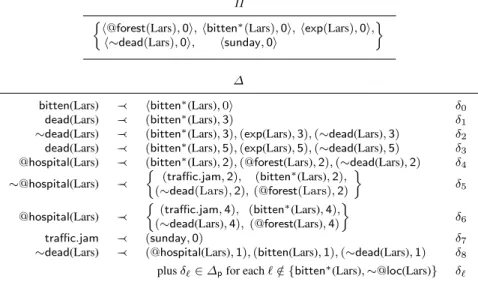
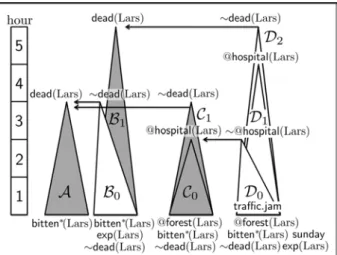
Example 3 Consider the situation described next and formalized in Figure 3. Lars, a tourist visiting the Snake Forest, has just been bitten by a venomous snake (denoted @forest(Lars), andbitten∗(Lars).4The poison of this type of snake does kill a person in 3 hours(δ1). But since our subject, Lars, is experienced (it has been bitten and cured a few times before), denotedexp(Lars), he may resist up to 5 hours(δ2, δ3). We decide to take him to the nearest hospital. In normal conditions this would take 2 hours(δ4), but since today is sunday, the traffic jam (δ7) makes it impossible to reach the hospital in less than 4 hours(δ5, δ6). The antidote takes less than an hour to become effective(δ8), and is given to persons that are at the hospital, have been recently bitten (denotedbitten(·)) and are alive (denoted∼dead(·)). We prove below in t-DeLP that Lars survives the snake attack.
Π
h@forest(Lars),0i,hbitten∗(Lars),0i,hexp(Lars),0i, h∼dead(Lars),0i, hsunday,0i
∆
bitten(Lars) − hbitten∗(Lars),0i δ0
dead(Lars) − (bitten
∗(Lars),3) δ
1
∼dead(Lars) − (bitten∗(Lars),3),(exp(Lars),3),(∼dead(Lars),3) δ
2 dead(Lars) − (bitten∗(Lars),5),(exp(Lars),5),(∼dead(Lars),5) δ3
@hospital(Lars) − (bitten∗(Lars),2),(@forest(Lars),2),(∼dead(Lars),2) δ4
∼@hospital(Lars) −
(traffic.jam,2), (bitten∗(Lars),2),
(∼dead(Lars),2),(@forest(Lars),2)
δ5
@hospital(Lars) −
(traffic.jam,4), (bitten∗(Lars),4),
(∼dead(Lars),4),(@forest(Lars),4)
δ6
traffic.jam − (sunday,0) δ7
∼dead(Lars) − (@hospital(Lars),1),(bitten(Lars),1),(∼dead(Lars),1) δ8
plusδ`∈∆pfor each` /∈ {bitten∗(Lars),∼@loc(Lars)} δ`
Fig. 1 The list of strict facts, defeasible rulesδ1-δ8and persistence rulesδ`for Example 3.
As it happens in DeLP, the set of derivable literals in(Π, ∆)will not in general be consistent. The first step to enforce consistency is to focus on those derivations that have the form of an argument.
Definition 4 (Argument) Given a t-de.l.p.(Π, ∆), an argument for h`, tiis a set A=AΠ∪ A∆, withAΠ ⊆Π andA∆⊆∆, such that:
(1) A∆∪Π` h`, ti, (2) Π∪ A∆is consistent,
(3) A∆is⊆-minimal satisfying (1) and (2). (4) AΠis⊆-minimal satisfyingA∆∪ AΠ ` h`, ti
4 We use two literalsbitten∗(·)andbitten(·). The literal with an asterisk is used to track the (unique) time where the snake bite occurred, and hence will not be allowed to persist (i.e. no persistence rules for this literal will exist in the program). The second literalbitten(·)just denotes the fact ofhaving been (recently) bittenand persistence rules for it are assumed.
Thus, arguments are consistent minimal derivations (i.e. without redundant infor-mation) and using minimal defeasible information. In particular, if a strict argument exists for some literal, then no defeasible derivation for the same literal constitutes an argument. In Example 3, each possible argument consists of facts inΠf and rules in
∆. Observe that, althoughΠand∆may be infinite (due to the coding of general rules as an infinite set of temporal rules), an argument for a t-de.l.p.(Π, ∆)will always be a finite subset ofΠ∪∆. Given an argumentAforh`, ti, we also define:
concl(A) = h`, ti base(A) = body[A]rhead[A] kAk = t−t(A) literals(A) = (Sbody[A])∪head[A] wheret(A) = min{t0∈N| h·, t0i ∈base(A)}.
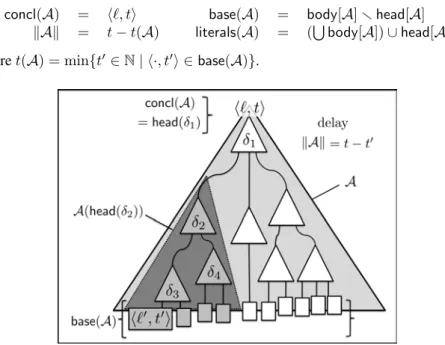
Fig. 2 The internal structure of an argumentA, as a set of facts (rectangles) and rules (small triangles). The dotted triangle represents the sub-argumentA(head(δ2))ofAdetermined by the literalhead(δ2).
The maximum difference between time-points of literals inA, i.e.t−t0, defines the delay ofA.
In DeLP, arguments are defined as sets of defeasible rulesA ⊆∆, leaving open how these are to be completed byΠ to obtain a (minimal, consistent) derivation of some literalh`, ti; since different completions allow for different conclusions, one must make explicit which is the intended conclusion (e.g. hA, `i). In contrast, we explicitly fix in an argumentAwhich are its strict rules, hence making the conclu-sionconcl(A)uniquely determined byA. This definition simplifies the detection of inconsistencies with intermediate steps in the strict part ofA. With more detail, there can be several ways to complete defeasible rules inAinto a derivation forconcl(A), and each of them can be attacked by different arguments. For example, the sets
hp,4i ← hq,2i hq,2i ← hr,1i hr0,0i and hp,4i ← hs,3i hs,3i ← hr,1i hr0,0i
may both complete the set of defeasible rules{hp0,5i −hp,4i,hr,1i −hr0,0i} ⊆∆
into an argument (derivation) forhp0,5i, but only the latter is attacked by an argument concludingh∼s,3i.
Now we define a sub-argument of an argumentA. A sub-argument will be the actual target of an attack by another argument.
Definition 5 (Sub-argument)Let(Π, ∆)be a t-de.l.p. and letAbe an argument for h`, tiin(Π, ∆). Given someh`0, t0i ∈ literals(A), asub-argumentforh`0, t0iis a subsetB ⊆ Asuch thatBis an argument forh`0, t0i.
The inductive definition for computing the sub-argument induced by some literal is straightforward (see the Appendix).
Proposition 1 Given some argument Aand a literalh`, ti ∈ literals(A), then the sub-argument ofAforh`, tiis unique.
From here on, this unique sub-argument ofAinduced byh`0, t0iwill be denoted A(h`0, t0i). For example, in Figure 2,A(head(δ2)) ={δ2, δ3, δ4,h`0, t0i, . . .}.
Fig. 3 The Snake Bites Lars scenario. Arguments are depicted as triangles, with arrows denoting conflicts among them. Arguments for which defeaters exist are depicted in grey.
Definition 6 (Attack)Given a t-de.l.p. (Π, ∆), let A0 andA1 be arguments. We sayA1attacksA0iff∼concl(A1)∈literals[A0], where we use the notation∼h`, ti to denoteh∼`, ti. In this case, we also say that A1attacksA0 at the sub-argument A0(∼concl(A1)).
Notice that an argumentA1cannot attack anotherA0at a sub-argument consist-ing of strict information only (i.e. ifA0(∼concl(A1)) ⊆Π), since in this caseA1 would not be consistent withΠ, and henceA1would not even be an argument.
As in DeLP, one refines the relation of attack relation into a defeat relation to de-cide which argument prevails in case of an attack. This relation could be in principle specified by the user5, but in this paper we adopt a formal criterion in order to meet the intuitive preferences exemplified next.
5 See [23] for a procedure based on a preference relation between rules. From this relation, one can
Example 4 See Figure 3 for an illustration of Example 3. The arguments are defined by the following rules (facts are not listed here):
A ⊇ {δ1(0)} B0⊇ {δ2(0)} B1⊇ {δ3(0)} C0⊇ {δ4(0)} C1⊇ {δ4(0), δ8(2)} ∪ {δ0(t), δbitten(Lars)(t), δ∼dead(Lars)(t)}0≤t<2
D0⊇ {δ7(0), δ5(0)} D1⊇ B0∪ {δ∼dead(Lars)(3), δ7(0), δ6(0)} D2⊇ D1∪ {δ0(0), δ8(4)} ∪ {δbitten(Lars)(t)}0≤t≤3
The arguments related by an arrow attack each other:C1,B0attackAand viceversa. But there are asymmetries in the quantity of information supporting each argument. Intuitively, in this example we have:
(1) B0should prevail overAsince it is based on more information (the premises ofA are a proper subset of those inB0); such an asymmetry betweenB0andAmakes the latter not to count as a reason againstB0. (See also Figure 3.)
To illustrate another kind of asymmetry in the amount of information, consider a new example:
(2) Suppose you hold an objectoat some distanced0from the floor, and drop it at
t = 0. It is expected to crash into the floor at, say,t= 3. This is modeled by an argumentAhavingbase(A) ={h@(o, d0),0i}, intermediate stepsh@(o, d1),1i andh@(o, d2),2i(i.e. both inliterals(A)given by appropriate rules), and conclu-sionconcl(A) =h@(o,0),3i; this latter literal@(o,0)denotesois at the floor. Now, admitting (as we do) persistence rules for positive facts like@(o,·), an argu-mentBcan be constructed for the conclusion that the object will remain floating over the floor, e.g. atd1. Namely, letB=A(h@(o, d1),1i)∪ {δ(t)@(o,d1)}1≤t<3.
Note that while the asymmetry for case (1) above is missingbase(B) =base(A), the argumentBshould not be a defeater forA. The idea is that the existence of some reason for a change (like gravity w.r.t. the position ofo) should override the use of persistence. Note that, after this change ceases to apply (e.g. whenolies at the floor), it is reasonable to use persistence to keep inferring that the position of
ois the same, so far no further changes are known.
Finally, to illustrate blocking defeaters, rephrase Example 3 with these rules: black-spotted snakes are generally poisonous, while green snakes are generally harmless. (3) Ifa green black-spotted snake bites Lars, we are not able to decide whether he
has been poisoned, since reasons for and against do not dominate each other.
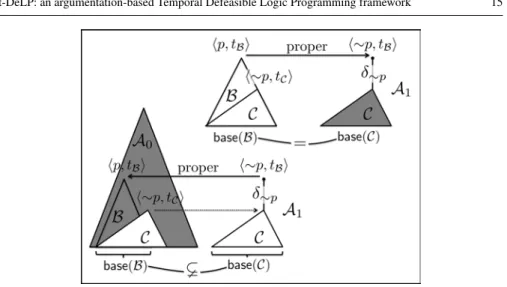
Definition 7 (Defeat)LetA1attackA0 atB, whereconcl(A1) = h∼`, ti. We say A1is aproper defeater forA0, denotedA1 A0, iff
– base(A1)!base(B), or
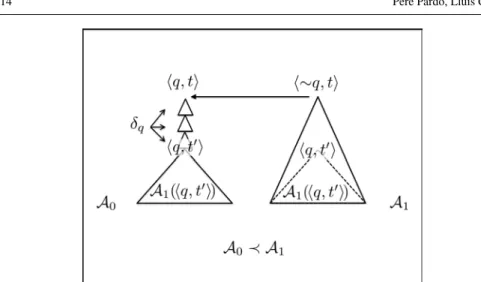
– B=A1(h`, t0i)∪ {δ`(t00)}t0≤t00<t, for somet0 < t.
We sayA1 is ablocking defeater for A0 when A1 attacksA0 butA1 6 A0 and A06 A1. Blocking defeat relations are denotedA1≺ A0. Finally, adefeateris a proper or a blocking defeater.
Fig. 4 An illustration of the second condition forA1is a proper defeater forA0. The argumentA0(left)
is obtained by extending a sub-argumentA1(h`, t0i)ofA1(right) just with persistence rulesδqfromt0
tot.
That, intuitively, the two criteria for proper defeat in Def. 7 suit the purposes of this paper is shown, resp., by Examples 3 (1)-(2). Example 3 (3) illustrates one of the cases of blocking defeat. In Definition 7, we adapt the formal criterion ofgeneralized specificity[49] (widely used in DeLP) to causal reasoning with temporal literals so that the amount of information in an argument is measured by its initial causes6 and by its use of substantive vs persistence rules (see Section 7.2 for more details on this issue).
Note that if we haveA1 A0due to the second possibility, namelyA0 ⊇ B= A1(h`, t0i)∪ {δ`(t00)}t0≤t00<t, thenbase(B) =base(A1(h`, t0i)). In this second case,
we will also say thatA1is (informationally) longer thanB.
As a result of this definition, any temporal change in truth-values, say from h∼p,2itohp,5i, must accommodate an explanation for the non-persistence of the earlier∼p, as occurring between3and5(if such persistence rules exist for∼p). This accommodation may consist in the first criteria on bases of the arguments forhp,5i andh∼p,2i; or that the persistence of∼pis the only reason forhp,5i, givenhp,2i; seeBin Fig. 5 (Top). Otherwise, it can be easily defeated; seeA1in Fig. 5 (Bottom).
Proposition 2 The following hold for any t-DeLP program:
(1) IfA1is a proper defeater for an argumentA0atB, thenBis not a defeater for A1.
(2) IfA,B attack each other, and B is not a proper defeater for A, then A is a defeater forB.
An argument B defeating A can in its turn have its own defeaters C, . . . and so on. (This is the case of A,B0,C0 in Figure 3.) This gives rise to
argumenta-tion lineswhere each argument defeats its predecessor. Argumentation lines, though, 6 Using the terminology of DeLP, the onlyactivation setsof literals considered for comparing
Fig. 5 Explanations ofpthat accommodate (Top), or not (Bottom) a previous instance of a∼pfact.
are not simply the composition of the defeat relation: again we refine this composi-tion by imposing some further constraints. These constraints are needed to enforce desirable properties: finite length, acyclicity, and intuitive defense relations (coun-terattacks). For instance, in an argumentation line[. . . ,A,B,C, . . .]we exclude the case whereC is a blocking defeater forB,provided thatBis already blocking de-feater forA. This prevents the case[. . . ,A,B,A, . . .]. Other forms of cyclic defeats [. . . ,A,B, . . . ,A,B, . . .]are also excluded in the definition. The following definition is adapted from [23] to the present framework.
Fig. 6 (Right) An argumentation lineΛ= [A1, . . . ,A4], with defeated sub-arguments depicted in grey.
Notice that the time of these attacks is decreasing, and that condition (iii) from Def. 8 is satisfied. (Left) The same argumentation lineΛis depicted as part of the dialectical treeT(Π,∆)(A1).
Definition 8 (Argumentation Line, Dialectical Tree)Let A1 be an argument in (Π, ∆). Anargumentation lineforA1is a sequenceΛ= [A1,A2, . . .]where (i) supporting arguments, i.e. those in odd positionsA2i+1∈Λare jointly consistent
withΠ, and similarly for interfering argumentsA2i∈Λ
(ii) a supporting (interfering) argument is different from the attacked sub-arguments of previous supporting (interfering) arguments:Ai+2k 6=Ai(∼concl(Ai+1)). (iii) Ai+1is a proper defeater forAiifAiis a blocking defeater forAi−1
An argumentation line[A1, . . . ,An]forA1ismaximalif there is no other argument An+1such that[A1, . . . ,An,An+1]is an arg. line forA1.
It is clear that the set of maximal argumentation lines forA1can be arranged in the form of a tree, where all paths from the rootA1to the leaf nodes exactly correspond to all the possible maximal argumentation lines forA1. This tree is calleddialectical
treefor A1, and is denoted T(Π,∆)(A1)(see [23] for more details). We will also express that a sequence of argumentsΛ = [A1, . . .]is a (non-necessarily maximal) argumentation line forA1byΛ∈ T(Π,∆)(A1).
Remark 1 While (i) and (iii) are exactly as in DeLP, the above condition (ii) is less restrictive than its counterpart in [23]. In this work, a sub-argument ofAicannot (in-directly) defend this argument. That is, a sub-argument ofAicannot occur asAi+2j in the same argumentation line. In our temporal case, we adopt a more liberal view concerning defenses based on sub-arguments: for instance, a sub-argument talking about a previous time might offer legitimate reasons to the defense ofAi. If its only available defense was in this sense a proper part of the attacked argument, then it should be admitted. (See the next example.)
Example 5 We expand the arguments of Example 4 (2) as follows: suppose an object
owill fall from height or distanced0into the floor, denoted by distance0. That is, a transition fromh@(o, d0),·itoh@(o,0),·iwill happen. Moreover, assume thatois an egg, and also that a boiling pot of water is awaiting at the floor. The temperature atd1is cold (i.e. not hot). Thus, we have
Πf ={h@(o, d0),0i,hhot(0),0i,h∼hot(d1),0i,h∼boils(o),0i}
The set ∆ is as before in Example 4 (2), plus persistence rules for local heat or coldness:δhot(0), δ∼hot(d1), and also the heat-transfer rules
δ1(t): hboils(o), t+ 1i − hhot(0), ti,h@(o,0), ti
δ2(t): h∼boils(o), t+ 1i − h∼hot(d1), ti,h@(o, d1), ti
The arguments to conclude that the egg will (A+) or will not (B+, among others) boil att= 4are defined as
A+ = A ∪ {hhot(0),0i} ∪ {δ(t)
hot(0)}0≤t<3∪ {δ1(3)} B+ = B ∪ {h∼hot(d
1),0i} ∪ {δ(t)∼hot(d1)}0≤t<3∪ {δ2(3)}
whereAandBare as in Example 4 (2). We haveconcl(A+) = hboils(o),4i and concl(B+) = h∼boils(o),4i, soA+ andB+ attack each other, just likeAandB. But now, theseA+andB+express: the expected fall-and-boiling of the egg (A) and,
respectively, that the egg keeps floating in air and stays unboiled (B). A more relevant difference with the pairA,Bis thatA+is not longer thanB+. In fact, we needA to defeatB+atB. Thus, Definition 8 allows for[A+,B+,A]to be an arg. line, soA can defendA+. If these defending sub-arguments were not allowed (see Definition 9 below), we could not conclude that the egg becomes hot att= 4.
Lemma 1 For any t-de.l.p.(Π, ∆),
(1) If[A1, . . . ,Am, . . . ,An]is an argumentation line forA1, then[Am, . . . ,An]is
an argumentation line forAm.
(2) Each argumentation lineΛ = [A1, . . .] ∈ T(Π,∆)(A1)is finite. The dialectical
treeT(Π,∆)(A1)is finite.
The following definitions of the marking procedure of dialectical trees and the notion of warrant exactly follow those of DeLP.
Definition 9 (Marking)LetT =T(Π,∆)(A1)be the dialectical tree forA1. Then, (1) mark all terminal nodes ofT with aU (for undefeated);
(2) mark a nodeBwith aD(for defeated) if it has a children node markedU; (3) markBwithU if all its children nodes are markedD.
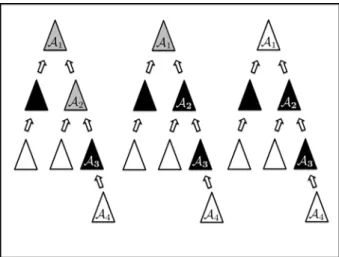
Initially all the arguments in the dialectical treeT(Π,∆)(A1)are unmarked (grey) as in Figure 6 (Left). To illustrate the marking procedure, see Figure 7, where argu-ments markedU are represented white, and those markedD are represented black.
Fig. 7 The marking procedure in the dialectical tree for an argumentA1: (Left) terminal nodes, e.g.A4,
are marked undefeated (white) first. (All) If a node, e.g.A3, has an undefeated child it is marked defeated
(black). If, otherwise, all their children are marked defeated this node is marked undefeated, e.g.A1.
(Right) The procedure ends with the root argumentA1being marked, undefeated in this case.
Note that in a dialectical treeT(Π,∆)(A1), an argumentAcan occur in different positions of several (maximal) argumentation lines in Λ, Λ0, . . . ∈ T(Π,∆)(A1). In
this case, the marking ofAinΛcan be different from the marking ofAinΛ0. Given an argumentation lineΛ = [A1,A2,A3, . . . ,An] ∈ T(Π,∆)(A1), we will express the evaluation of its arguments alongΛ according to the marking procedure by a corresponding sequence ofD’s andU’s , e.g.[D, D, U, . . . , U].
Definition 10 (Warrant) Given a t-de.l.p. (Π, ∆), we say h`, ti is warranted in (Π, ∆)iff there exists an argument A1 forh`, ti in(Π, ∆)such that A1 is unde-feated, i.e. markedU, inT(Π,∆)(A1). We will denote bywarr(Π, ∆)the set of war-ranted literals in(Π, ∆).
In the particular case of strict argumentsA ⊆ Π, we will have thatT(Π,∆)(A) only contains the argumentation line[A], so each strictly derivable fact is warranted. For any other argumentB, the strict argumentAcannot occur in any argumentation line inT(Π,∆)(B).
Example 6 (Cont’d) Recall Example 3. The arguments in Fig. 3 related by an arrow stand in the relation of proper defeat, e.g.A ← B0denotesB0 is a proper defeater forA. Thus we have the dialectical trees for each argument consist of the following argumentation lines (with the corresponding evaluations):
T(Π,∆)(A) = [A,B0], [A,C1,D0] [D, U], [D, D, U] T(Π,∆)(B0) = {[B0]} [U] T(Π,∆)(B1) = {[B1,D2]} [D, U] T(Π,∆)(Ci) = {[Ci,D0]} [D, U], for eachi∈ {0,1} T(Π,∆)(Dj) = {[Dj]} [U], for eachj ∈ {0,1,2}
SinceD2is undefeated, we (defeasibly) conclude that Lars will be alive att= 5. Let us now solve scenario (2) from Example 4. Recall the argumentA conclud-ing that droppconclud-ing the object will indeed cause it to crash into the floor (distance 0) att = 3. Ais a proper defeater for the rival arguments stating that the object will keep floating in the air once it reaches distance d0, d1or d2. Call these argu-mentsB0,B1andB2, resp. (Incidentally,B1properly defeatsB0and so doesB2with B0,B1.) If these arguments capture all the relevant phenomena in this scenario, then T(Π,∆)(A) = [A]soAis undefeated; on the other hand, for any0≤i < 3the di-alectical treeT(Π,∆)(Bi)contains a maximal argumentation lineΛ= [Bi,A], among possibly others. This can only be evaluated as[D, U], so eachBiis defeated.
For another example more in line with the AI tradition, consider the well-known Yale shooting scenario, where a turkey is expected to be killed, after someone loads a gun and shoots at it, possibly with somewaiting actions taking place before or between these two actions. Early logical formalisms were able to prove that the turkey diesif shot just after loading the gun, while failed to prove the same if some waiting occurred betweenloadandshoot. This prompted the use of frame axioms to describe what persists after some change. In t-DeLP, we proposed instead formal criteria to decide about particular uses of persistence.
Example 7 (Yale Shooting Scenario) In t-DeLP, we can solve this scenario by repre-senting:
actionshoot(att) by rules: δ0(t) =h∼loaded, t+ 1i −hloaded, ti,
δ1(t) =h∼alive, t+ 1i −hloaded, ti;
actionload(att) by rule: δ(t) =hloaded, t+ 1i −h∼loaded, ti.
Instead of having an explicitwaitaction, we just let persistence rulesδ`apply for any literal, i.e. any`∈ {loaded,∼loaded,alive,∼alive}. In the t-de.l.p.(Πf, ∆)defined
by
Πf ={h∼loaded,0i},
∆={δ(3), δ0(8), δ1(8)} ∪ {δ`}`∈{loaded,∼loaded,alive,∼alive} the literalh∼alive,9iis warranted.
5 Logical properties of t-DeLP
After presenting the procedure for computing warrant in t-DeLP, we proceed to show the logical properties of the proposed argumentation framework. These properties, called Rationality Postulates, were proposed by Caminada and Amgoud in [12] (see also [43]) to grant that certain types of counter-intuitive results do not occur in a given argumentation framework.
Definition 11 (Rationality Postulates) The Rationality Postulates, adapted to t-DeLP programs(Π, ∆), read as follows:
Sub-arguments: ifAis undefeated inT(Π,∆)(A), then any sub-argument A0ofAis also undefeated inT
(Π,∆)(A0). Direct Consistency: warr(Π, ∆)is consistent.
Indirect Consistency: warr(Π, ∆)∪Π is consistent. Closure: Cn(warr(Π, ∆)∪Π)⊆warr(Π, ∆),
i.e. strict consequences of warranted literals are warranted. These postulates were discussed in [12] for the case of argumentation frameworks defined on top of general defeasible rule-based systems, and using any of the accept-ability semantics proposed by Dung for abstract argumentation systems [21]. Given a defeasible rule-based system, these semantics are indeed applied to the abstract argumentation framework(A, R)generated by such a system:Abeing the set of ar-guments that can be constructed in the rule-based language, and the relationR(A,B) consisting of a general notion of attack, including rebuts (our notion of attack) and undercuts (not considered in t-DeLP). Then they provide several conditions under which the postulates hold in such sytems. Let us remark that t-DeLP does not exactly fall into the class of systems considered in [12]. Namely, while our arguments easily translate to rule-based systems in [12], our relation of defeat is different from theirs, in particular, our relation of defeat is local, relative to a dialectical tree, and varies across these trees for a given pair of arguments. Moreover, the t-DeLP notion of un-defeated argument does not correspond to any of the well-known Dung acceptability
semantics, and in consequence, t-DeLP warrant is also different from its equivalent notion in [12] ofjustified conclusionsunder any such semantics. See Section 7.1 for a discussion on the relationship between t-DeLP and Dung semantics.
For this reason, we provide in this section direct proofs for the Sub-arguments and Direct Consistency postulates in t-DeLP. Neither Indirect Consistency nor Clo-sure hold for general t-DeLP programs, as it happens in DeLP. However, in the next section we will show that these postulates do hold for a class of programs whose strict rules, roughly speaking, encode mutex constraints.
We first observe that being marked defeated in a dialectical tree can be expressed in the following more convenient form.
Remark 2 An argumentBis marked defeated in an argumentation line[A, . . . ,B]∈ T(Π,∆)(A)iff there is an argumentCmarked undefeated in the argumentation line [A, . . . ,B,C]∈ T(Π,∆)(A).
Lemma 2 Given a t-d.l.p.(Π, ∆), letA1 be an argument forh`, ti, and letA2be
an argument forh∼`, ti, withA2 being a defeater forA1 (atA1). If A2 is marked
defeated along the argumentation line[A1,A2]in the dialectical treeT(Π,∆)(A1),
thenA2is marked defeated in the dialectical treeT(Π,∆)(A2).
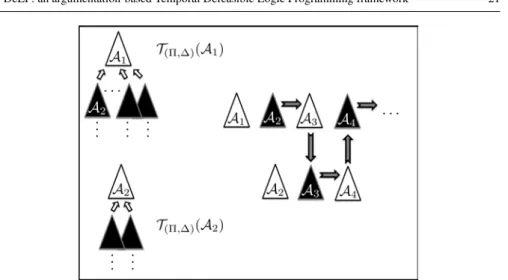
Proof LetA2be a defeater forA1atA1and assumeA2is defeated inT(Π,∆)(A1) and thatA2is undefeated inT(Π,∆)(A2). Clearly[A1,A2]is an argumentation line inT(Π,∆)(A1), hence there isA3 such that [A1,A2,A3]is an argumentation line T(Π,∆)(A1)withA3marked undefeated. (See Fig. 8 for an illustration of this proof.) Now, sinceA2is undefeated inT(Π,∆)(A2),[A2,A3]is an argumentation line in T(Π,∆)(A2)andA3is marked defeated. Therefore, there isA4such that[A2,A3,A4] is an argumentation line inT(Π,∆)(A2)withA4marked undefeated.
It is easy to check that if some condition (i)-(iii) from Def. 8 fails at the se-quence[A1,A2,A3,A4], then the same condition already fails either at[A1,A2,A3] or at[A2,A3,A4], contradicting that these two are argumentation line. Thus we have that[A1,A2,A3,A4]is an argumentation line inT(Π,∆)(A1), withA4 necessarily marked defeated, and hence there must existA5 such that[A1,A2,A3,A4,A5]is an argumentation line in the dialectical treeT(Π,∆)(A1)withA5necessarily marked undefeated.
Iterating this process, one can construct argumentation lines of any finite length [A1,A2,A3, . . . ,An,An+1]inT(Π,∆)(A1), in contradiction with Lemma 1 (2). 2
Theorem 1 Given at-de.l.p.(Π, ∆), the set of literalswarr(Π, ∆)is consistent. Proof Leth`, ti ∈ warr(Π, ∆). Thus, some argumentAfor h`, tiin(Π, ∆)exists that is undefeated inT(Π,∆)(A). Let thenBbe an arbitrary argument forh∼`, tiin (Π, ∆). Assume, towards a contradiction, thatBis undefeated inT(Π,∆)(B).
(Case: Ais a proper defeater forB) Consider the argumentation line [B,A] ∈ T(Π,∆)(B). Since Ais undefeated in T(Π,∆)(A), by Lemma 2, we haveA is undefeated in T(Π,∆)(B). Hence B is marked defeated inT(Π,∆)(B). SinceB was arbitrary,h∼`, ti∈/warr(Π, ∆).
Fig. 8 Constructing an infinite sequence of increasing argumentation lines: white and black triangles rep-resent, respectively, undefeated and defeated arguments in the corresponding dialectical trees.
(Case:Ais not a proper defeater forB). By Proposition 2 (ii),Bis a defeater for A, so[A,B]is an arg. line inT(Π,∆)(A). SinceAis undefeated in this tree,B must be defeated in this tree. Then again by Lemma 2, we haveBis also defeated inT(Π,∆)(B). SinceBwas arbitrary,h∼`, ti∈/warr(Π, ∆). 2 The previous results, with appropriate modifications, remain valid for other ar-gumentative frameworks in the DeLP family, like ODeLP [13]. Theorem 1 can be seen as a generalization of their Direct Consistency result when de.l.p.s are allowed strict rules. Similar results to those of Lemma 2 and Theorem 1 are made for the case of DeLP in [50, Props 1 and 2]. Also, the later results in Section 6 are in line with [12] for defeasible logics. However, t-DeLP does not seem to reduce to the logical frameworks considered in these two contributions.
In Lemma 2, we showed the property ofbeing defeatedforA2is downward pre-served from[A1,A2]to[A2]. (Or, conversely,being undefeatedis upward preserved from[A2]to any existing line of the form[A1,A2].) This downward property can be generalized todefeatedarguments in arbitrary interfering positions. Another upward preservation result holds forundefeatedarguments in supporting positions.
Corollary 1 Let Λ = [A1,A2, . . . ,A] be an argumentation line in T(Π,∆)(A1).
Then
(1) ifA=A2n+1is undefeated inΛ, then in the corresponding arg. line[A2, . . . ,A]
the (now interfering) argumentAis undefeated;
(2) ifA=A2nis defeated inΛ, then in the corresponding arg. line[A2, . . . ,A]the
(now supporting)Ais defeated.
Finally, we address the postulate of Sub-arguments for general t-DeLP programs.
Lemma 3 IfΛ= [A1, . . . ,An]is an arg. line forA1andA01⊇ A1(∼concl(A2)),
then
Proof Note first that A2 is a defeater for A01. It remains to be checked that Λ0 = [A0
1, . . . ,An]satisfies (i)-(iii) from Def. 8. Condition (i) is obvious: if a contradiction exists from the supporting elements ofΛ0, then, since their union is included in the union of supporting elements inΛ, the same contradiction would occur inΛ; similarly for interfering arguments. Condition (ii). IfA2k+1=A01(∼concl(A2)), then the fact A0
1(∼concl(A2)) =A1(∼concl(A2))implies the same violation of (ii) would occur inΛ; the remaining cases are direct. Condition (iii). The interesting case are the triples [A1,A2,A3]and[A01,A2,A3]. But being a blocking or proper defeater only depends on the attacked sub-argument. Thus, ifA3is blocking forA2and this is blocking for A0
1, then the same occurs for the other triple[A1,A2,A3], contradicting thatΛis an
arg. line. 2
Note that this Lemma implies the validity of the Sub-arguments postulate for arbitrary t-de.l.p. programs(Π, ∆).
Corollary 2 Given a t-de.l.p.(Π, ∆), ifA1is undefeated inT(Π,∆)(A1)andA01⊆ A1is an argument, thenA01is undefeated inT(Π,∆)(A01).
Proof Using Lemma 3, we have that ifA0
1⊆ A1is an argument, then the dialectical treeT(Π,∆)(A01)is a sub-tree ofT(Π,∆)(A1), containing those maximal argumenta-tion lines[A0
1,A2, . . .]with∼concl(A2)∈literals[A01]. But, sinceA2is defeated in T(Π,∆)(A1)so isA2inT(Π,∆)(A01). Thus,A01is undefeated inT(Π,∆)(A01). 2.
6 t-DeLP with mutex constraints
In the previous section, we have seen in Example 4 (2) and Example 5 programs (Π, ∆)whose set of strict rulesΠr ⊆Π exclusively consists of mutex rules of the formh∼q, ti ← hp, ti. Although in those particular examples the expected outputs warr(Π, ∆)are properly captured by the procedure for warrant, the Indirect Con-sistency and Closure postulates do not seem provable in the general case of t-DeLP programs with mutex rules. However, in this section we show that by slightly mod-ifying the procedure for warrant we are able to guarantee the fulfillment of these postulates. The modification essentially consists in strengthening the notion of con-sistency: instead of using a strict ruleh∼q, ti ← hp, tito detect a conflict (in the usual way) between arguments for literalspandqin a mutex set, we extend the notion of inconsistency (attacks, etc) to hold among pair of mutex literals. Recall from Section 3 that the intended representation of logical constraints is by a familyMof mutex sets. A mutex setX is a set of positive literalsX ={p, q, r, . . .} ⊆Varexpressing that they are pairwise incompatible. Hence each mutex setX induces a set of non-durative strict rulesΠX ={h∼q, ti ← hp, ti |p, q∈X, t∈N}. Given a family of mutex setsMwe will denote byΠMthe union of the sets of strict rulesΠXfor each
X ∈M.
Given a mutex familyM, one can naturally strengthen the notion of consistency for a set of literals by taking into account the mutex constraints.
Definition 12 (M-consistency)Given a mutex familyMand a set of literalsΓ, we say thatΓisM-consistentiffΓis consistent and moreover there are nohp, ti,hq, ti ∈
Γ andX ∈Msuch thatp, q∈X. For a set of literalsΓ and rulesΠ, we sayΓ∪Π
isM-consistent iff the set of literalsCn(Γ ∪Π)isM-consistent.
In what follows, we extend a t-DeLP program(Π, ∆)together with a family of mutex constraints M = {X1, X2, . . .}. The notion of M-consistency refines the notion of argument, attack and defeat and spreads to other related definitions like argumentation line, dialectical tree and warrant from Section 4.
Definition 13 (M-argument,M-attack,M-defeat)Let(Π, ∆)be a t-de.l.p. and
Ma mutex family. AnM-argumentin(Π, ∆)is defined as in Definition 4 replacing condition (2) by
(2’) Π∪ A∆isM-consistent
LetA1,A0beM-arguments in(Π, ∆), withconcl(A1) =h`, ti. Then:
– We say A1 M-attacks A0 if there existsh`0, ti ∈ literals[A0]such that either
`0=∼`or{`, `0} ⊆X for someX ∈M. In this case we sayA1M-attacksA0 at the sub-argumentA0(h`0, ti).
– Let A1 M-attackA0 at the sub-argument A0(h`0, ti). We say A1 is a proper
M-defeater forA0, denotedA1 A0, iff
– base(A1)!base(A0), or
– there ist0< tsuch thatA0=A1(h`0, t0i)∪ {δ`0(t00)}t0≤t00<t
IfA16 A0andA06 A1then we say thatA1areA0areblockingM-defeaters. From there, the notions of M-argumentation line,M-dialectical treeTM
(Π,∆)(·) and the corresponding notion of warrantwarrM(Π, ∆)are defined in the natural way fromT(Πf,∆)(·)andwarr(Πf, ∆)using now the latter notions ofM-argument,M
-attack andM-defeater. It is routine to check that all of the previous results remain valid forwarrM(Π, ∆).
As a consequence, we have the next result about Direct Consistency.
Corollary 3 Let(Π, ∆) be a t-de.l.p. andM a mutex family such thatΠ is M -consistent. Then,warrM(Π, ∆)isM-consistent.
Next we define the output of a t-DeLP program with an associated mutex family
Mas the closure ofwarrM(Π, ∆)with the set of strict rulesΠMinduced byM.
Definition 14 (M-output)Let(Π, ∆)be a t-de.l.p. with an associated mutex family
M, such thatΠ∪ΠMis consistent. Then we define:
OutputM(Π, ∆) = Cn(warrM(Π, ∆)∪ΠM).
Given the previous definitions, we can prove some results for the Rationality pos-tulates for the outputs of t-DeLP programs(Π, ∆)with an associated mutex familty
Min the particular case whenΠ only contains strict facts, i.e. whenΠ = Πf, or equivalently whenΠr=∅. Note that it does not make actually sense to ask whether the Sub-arguments postulate holds forOutputM(Π, ∆), since besides the arguments from(Π, ∆), this notion relies on the logical closure withΠM. On the other hand, it is easy to show that any derivation of a literal inOutputM(Π, ∆)still corresponds to the conclusion of anextendedargument, namely, an argument in(Π, ∆)extended with at most a rule inΠM.
Lemma 4 Given a set of literalsΓ, for anyh`, ti ∈Cn(Γ∪ΠM), we haveh`, ti ∈ Cn(Γ∪ {δ}), for someδ∈ΠM.
Proof LetA ⊆Γ ∪ΠMbe such thatA ` h`, ti. In caseh`, ti ∈Γ, just select any rule fromΠM. Otherwise, ifh`, ti∈/ Γ, then there must exist a ruleδ ∈ΠMsuch thathead(δ) =h∼q, tiandh`, ti=h∼q, ti. Then, sincebody(δ)is a set of positive atoms, head(δ)∩body[ΠM] = ∅, so it must be body(δ) ⊆ Γ. Thus, h∼q, ti =
h`, ti ∈Cn(Γ ∪ {δ}). 2
Theorem 2 Let consider the class of t-DeLP programs(Π, ∆)with an associated mutex familyM, such thatΠr=∅andΠisM-consistent. Then Direct Consistency,
Indirect Consistency and Closure are satisfied by theOutputMinference procedure. Proof We show the three properties for any t-DeLP program(Π, ∆)with an associ-ated mutex familyM, such thatΠr=∅andΠisM-consistent.
(i) Direct Consistency.Assume the contrary, so there exists a pairhp, ti,h∼p, tiof contradictory elements in OutputM(Π, ∆) = Cn(warrM(Π, ∆)∪ΠM). Con-sider the cases:
– Casehp, ti,h∼p, ti ∈warrM(Π, ∆): impossible, sincewarrM(Π, ∆)is con-sistent by Corollary 3.
– Case hp, ti ∈ warrM(Π, ∆), h∼p, ti ∈/ warrM(Π, ∆). In this case we haveh∼p, ti ∈ Cn(warrM(Π, ∆)∪Π
M). Applying Lemma 4 with Γ = warrM(Π, ∆), letδ∈Π
Mbe such thath∼p, ti ∈Cn(warrM(Π, ∆)∪ {δ}). Thus,body(δ) = {hq, ti} ⊆ warrM(Π, ∆), for some p, q ∈ X ∈ M. But this and the initial assumptionhp, ti ∈warrM(Π, ∆), contradict the fact that warrM(Π, ∆)isM-consistent.
– Casehp, ti ∈/ warrM(Πf, ∆). By Lemma 4, this is impossible: head[Π M] is a set of negated atoms, sohp, ti ∈/ warrM(Π, ∆)would imply hp, ti ∈/ warrM(Π, ∆).
Thus, in either case we reach a contradiction.
(ii) Closure. Let h`, ti ∈ Cn(OutputM(Π, ∆) ∪ Π). We show h`, ti ∈ OutputM(Π, ∆). The casesh`, ti ∈Πf andh`, ti ∈OutputM(Π, ∆)are imme-diate, so we can assume thath`, ti ∈/ OutputM(Π, ∆). By Lemma 4 withΓ = OutputM(Π, ∆), letδ∈ΠMbe such thath`, ti ∈Cn(OutputM(Πf, ∆)∪ {δ}). Thus,body(δ)∈OutputM(Π, ∆), but sincebody(δ)consists of a positive atom, and hence not an atom inhead[ΠM], we must havebody(δ) ⊆warrM(Πf, ∆).
Thus,
h`, ti ∈Cn(warrM(Πf, ∆)∪ΠM) =OutputM(Π, ∆).
(iii) Indirect Consistency. This follows from the previous results on closure and direct
consistency forOutputM(Π, ∆). 2
Finally, let us compare this proposalOutputM(·,·)with a more straightforward approach based on t-DeLP warrant alone, where the program directly contains mutex strict rulesΠ∪ΠM.7The two approaches are compared to each other with the help of an example, showing that the latter approachwarr(Π∪ΠM, ∆)might not satisfy indirect consistency or closure w.r.t. these mutex rulesΠM.
Example 8 Let(Π, ∆)andM, ΠMbe defined by Π = {hr,0i} ∆ = h∼p,1i −hr,0i, hq,1i −hr,0i, hp, t+ 100i −h∼p, ti, hq, t+ 1i −hq, ti =δ0 =δ1 =δ2(t) =δq(t) M = { {p, q} } ΠM = ( h∼p, ti ← hq, ti, h∼q, ti ← hp, ti ) =δM p (t) =δM q (t)
Then consider the next arguments. Those on the right are only available in the program(Π∪ΠM, ∆).
both in(Π, ∆)and only in
(Π∪ΠM, ∆) (Π∪ΠM, ∆)
A={hr,0i, δ0, δ2(1)} A+=A ∪ {δpM(101)} concl(A) =hp,101i concl(A+) =h∼q,101i B={hr,0i, δ1} ∪ {δq(t)}1≤t≤100 B+=B ∪ {δMq (101)}
concl(B) =hq,101i concl(B+) =h∼p,101i
The direct approachwarr(Π ∪ΠM, ∆), on the one hand makes the arguments A+,B+available. Observe that whileA+defeatsBas expected, because the pres-ence of persistpres-ence rules {δM
q (101)} in the argument Bmakes it weaker than ar-gumentA+, so we haveA+ B. However this does not apply to the other pair of argumentsAandB+, so we haveA ≺ B+. For the same reason,A+ ≺ B+. Hence, the dialectical trees become
T(Π∪ΠM,∆)(A) = {[A,B +,A+]} T(Π∪ΠM,∆)(A
+) = {[A+,B+]} adding[A]is against (ii) T(Π∪ΠM,∆)(B) = {[B,A
+,B+]} idem T(Π∪ΠM,∆)(B
+) = {[B+,A+]}
so we concludehp,101i,hq,101i ∈warr(Π∪ΠM, ∆)whileh∼q,101i,h∼p,101i∈/ warr(Π∪ΠM, ∆); in other words, the strict rulesΠMare not enforced, and the set of warranted literals is notM-consistent, hence not consistent withΠM.
On the other hand, we have in (Π, ∆)that AandBM-attack each other, and moreoverAis a properM-defeater forB, soA B. An easy computation shows thatT(Π,∆)(A) = [A]andT(Π,∆)(B) = [B,A]. As a result,hp,101i ∈warrM(Π, ∆) andhq,101i∈/ warrM(Π, ∆). In the last step to computeOutputM
(·,·), we obtain hp,2i,h∼q,2i ∈Cn(warrM(Π, ∆)∪Π
7 Some further remarks on the comparison of t-DeLP with Dung semantics, DeLP and the TDR system
In this section, we first discuss the relationship between the dialectical tree based-semantics of t-DeLP and Dung acceptability based-semantics for abstract argumentation frameworks. Then we report on the comparison of some particular aspects of t-DeLP with DeLP [23] and also with another temporal extension of DeLP in the literature called Temporal Defeasible Reasoning (TDR) [5].
7.1 t-DeLP and Dung acceptability semantics
Let us briefly review the semantics from [21] proposed forabstract argumentation frameworks. The latter simply consists of a relation R, called attack, on a set of (unstructured) elementsA={A, . . .}, calledarguments, i.e. a pair(A, R). The so-called acceptability semantics try to capture different intuitions about which subsets E⊆Aare collectively acceptable (calledextensions), given the attack relation. For example,
Eisconflict-freeiff noA,B ∈Eexist withR(A,B).
Other intuitive conditions upon extensions are defined from the notion of defense: a subsetEdefendsAiff
for eachBattackingA, there existsC ∈Ethat attacksB. By denotingF(E) ={B |EdefendsB}, we say a conflict-free extensionEis
admissible iff Edefends its arguments (E⊆ F(E)) complete iff F(E) =E
grounded iff Eis the⊆-minimal complete extension preferred iff Eis a⊆-maximal complete extension
stable iff Eis a preferred extension attacking each argument inAr E For each semanticsX = {admissible, . . .}, the (skeptical) justified or acceptable argumentsaccording toX are defined as the set of arguments in the intersection of all theX-extensions:T
{E|Eis anX −extension}.
If we directly rephrase the acceptability semantics from [21] and the related def-initions above, there is still a mismatch between Dung’s acceptability and accept-ability in t-DeLP (i.e. undefeated arguments). To see this, first note that the abstract notion of attackRcorresponds to our notion of defeatrelative tosome dialectical tree T(Π,∆)(A). Correspondingly, the (relevant) defense of an argumentAwill take place only in its own dialectical treeT(Π,∆)(A), so theFfunction would be expressed by
F(E) ={A | ∀B ∈A∃C ∈E([A,B]∈ T(Π,∆)(A) ⇒ [A,B,C]∈ T(Π,∆)(A)}8 Also, note that in a t-de.l.p.(Π, ∆)there is a unique notion ofextension, or set of “ac-ceptable” arguments; namely, those argumentsAthat are undefeated inT(Π,∆)(A). 8 Stronger definitions of the defense of an argumentAand of theFfunction exist; e.g. whereAis
“defended” in all its occurrences in dialectical trees of arbitrary argumentsT(Π,∆)(D), not just in its own