Unsupervised Generation of
Data Mining Features from
Linked Open Data
Technical Report TUD–KE–2011–2
Version 1.0, November 4th, 2011
Heiko Paulheim, Johannes Fürnkranz
Knowledge Engineering Group, Technische Universität Darmstadt
Knowl
edge
Engi
neeri
ng
Abstract
The quality of the results of a data mining process strongly depends on the quality of the data it processes. In this paper, we present a fully automatic approach for enriching data with features that are derived from Linked Open Data, a very large, openly available data collection. We identify six different types of feature generators, which are implemented in our open-source tool FeGeLOD. In four case studies, we show that our approach can be applied to different problems, ranging from classical data mining to ontology learning and ontology matching on the semantic web. The results show that features generated from publicly available information may allow data mining in problems where features are not available at all, as well as help improving the results for tasks where some features are already available.
Contents 1 Introduction 3 2 Approach 4 2.1 Entity Recognition . . . 4 2.2 Feature Generation . . . 4 2.3 Feature Selection . . . 5
3 Case Study 1: Data Mining Problems with Existing Features 8
4 Case Study 2: Data Mining Problems without Existing Features 11
5 Assessment of Feature Quality 14
6 Case Study 3: Ontology Learning 16
7 Case Study 4: Ontology Matching 18
8 Related Work 20
1 Introduction
Data mining aims at finding regularities and patterns in data. For example, given a database of book sales, the book selling company can analyze which types of books sell better than others, which book stores have a larger turnover than others, and so on. In particular, such patterns can be used to make predictions about unknown entities – e.g., predicting whether a new book is going to sell well, or whether it is a good idea to open a new book store in a certain city. During the past decades, a large variety of algorithms for data mining have been developed [49]. Software packages likeWeka
[5] or RapidMiner [34] are industrial-strength toolkits that can be used for building highly sophisticated, intelligent applications.
However, the results produced by a data mining algorithm can only be as good as the data it gets as input. The data mining algorithm depends on the available features for formulating a pattern, thus a pattern can only be found if all the components that the pattern is composed of is present in the input data. For example, a valuable pattern in the book-selling domain could be“Scientific books are sold well in cities with at least one large university”. To find such a pattern, the book selling company needs to have access to up to date information on the cities where their books are sold, the categories of those books, the universities in the cities, etc.
Such general-purpose information, e.g., about cities, universities, and also books and their genres, is often available in the World Wide Web. With the Linked Open Data initiative [3], a large variety of such data has become available in a standardized, machine processable form. Built on W3C standards such as RDF [46] and SPARQL [48], general-purpose datasets as well as domain-specific datasets, e.g., from the medical domain are publicly available.1
In this paper, we introduce the open source toolkitFeGeLOD, which automatically creates useful data mining features from Linked Open Data. The extensible toolkit is based on Weka[17] and implements different methods for creating features from datasets in Linked Open Data. It takes a data file as input and automatically enhances it with further features in a fully automated, domain-agnostic process.
The rest of this paper is structured as follows. Section 2 discusses the approach and the implementation of our toolkit. In the following, we present two case studies in which we have used our approach for improving data mining results for existing data sets (Section 3), and mining datasets without any given features (Section 4). In Section 5, we present a deeper analysis of the quality of the features generated by our approach throughout the two first case studies. In Sections 6 and 7, we present two more case studies that show how our approach can be applied to ontology learning and ontology matching problems, respectively. We conclude with a survey of related work in Section 8, and a summary and outlook on future work.
2 Approach
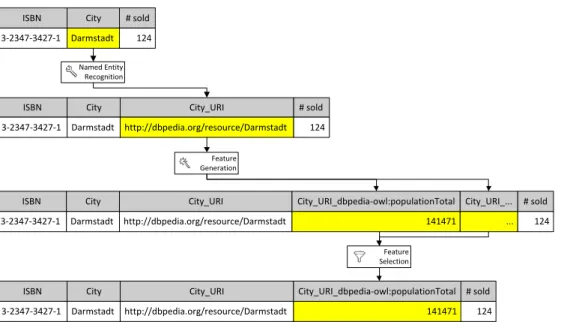
Our approach for generating data mining features from Linked Open Data is comprised of three subsequent steps: entity recognition, the actual feature generation, and optional selection of a subset of the generated features. Figure 2.1 shows the process. Each of the steps allows for modular extensions with new algorithms.
After the initial data file is loaded (in CSV or ARFF format), a column is selected for which features are to be generated. In the first step, the entries in this column are mapped to URIs identifying entities in Linked Open Data. Then, features are generated for those entities, using different generation strategies, and a filtering algorithm ensures a result dataset of manageable size. The resulting file has additional columns (or features) which can then be used by a data mining tool. Each of the steps can be configured, with the tool running either in batch mode or controlled via a graphical user interface.
2.1 Entity Recognition
Entities in Linked Open Data are identified by URIs. For example, the Technical University of Darmstadt (TU Darmstadt) is identified by the URI http://dbpedia.org/resource/Darmstadt_University_of_Technology in the datasetDBPedia, a dataset automatically constructed from structured information contained in Wikipedia [4]. To obtain useful features from a dataset in Linked Open Data, the first necessary step is to identify the URIs that correspond to the entities in the dataset. In the book store example, the city name (or ZIP code) of the city would be resolved to a URI representing that city, which is inserted as a new feature, as shown in the first step of Fig. 2.1.
There are several possible ways for identifying such links. ForDBPedia, as shown above, URIs always follow a common pattern, which most often has the name of the entity in question as one part. Therefore, we use a simple algorithm for “guessing” the correct URI: First, we turn the string (such as “darmstadt university of technology”) into a corresponding string used for identification inDBPedia, i.e., capitalize all major words, replace blanks by underscores, etc. If this fails, we try to remove words in the end. For example, the URI for the “Auburn University at Montgomery” can be found as
http://dbpedia.org/resource/Auburn_
University. Since this algorithm is prone to false positives (e.g. it could find the URI of the cityhttp://dbpedia.org/ resource/Darmstadtinstead of the university URI), we allow for typechecking by letting the user select appropriate categories for the desired entities. For example, the user can specify that the extracted URI has to represent a university, i.e., the URIhttp://dbpedia.org/ontology/Universitymust be one of its parents in the ontology.
Although this approach to entity recognition is very simple, it provides reasonable results and recognition rates, as shown in the case studies below. The implementation and evaluation of more sophisticated entity recognition algorithms is an important item for future work, but beyond the scope of this paper.
2.2 Feature Generation
Once we have identified the corresponding URI for an entity, we can use it for generating features. Currently,FeGeLOD
implements six different generation strategies, which are shown in Table 2.1 and explained in the remainder of this section. Two of them are only concerned with the entity itself, the other four take links to other entities into account.
The first generator creates one feature for eachdata propertyof an entity. Data properties are elementary values, such as the name and the population of a city. String-valued properties may be ignored, because free text or names can typically not directly be used as features, or, in case of names or free-text descriptions (i.e.,rdfs:labelandrdfs:comment), do not provide any useful information for learning. However, sometimes, a limited set of string values, such as the federal state a city is located in, can be extracted into a useful nominal attribute. Numbers and dates are also turned into numeric and date features, and string attributes are turned into nominal features.
The second generator, which only works on an entity itself, examines all itstypes, i.e., all statements about the entity where the predicate is rdf:type. Since RDF allows an entity to be of several types, there are potentially different types and categories an entity may belong to. InDBPedia, for example, we can often find very detailed classification information, becauseDBPediaalso contains lots of mappings to the more than 100,000 classes defined inYago[44]. For example, the TU Darmstadt is of typeOrganization,University, andEducational Institutionin theDBPediaontology, as well as of typeUniversities and Colleges in GermanyandTechnical Universities and CollegesinYago, amongst others.
The other four generators take the relation of entities to other entities into account. Two generators look at the
ISBN 3-2347-3427-1 City Darmstadt # sold 124 Named Entity Recognition ISBN 3-2347-3427-1 City Darmstadt # sold 124 City_URI http://dbpedia.org/resource/Darmstadt Feature Generation ISBN 3-2347-3427-1 City Darmstadt # sold 124 City_URI http://dbpedia.org/resource/Darmstadt City_URI_dbpedia-owl:populationTotal 141471 City_URI_... ... Feature Selection ISBN 3-2347-3427-1 City Darmstadt # sold 124 City_URI http://dbpedia.org/resource/Darmstadt City_URI_dbpedia-owl:populationTotal 141471
Figure 2.1:Our approach to feature generation from Linked Open Data. In a given data set, Linked Open Data URIs are identified using entity recognition. Then features are generated for those URIs, and a final feature selection step ensures a reasonable size of the resulting data set.
dbpedia-owl: populationTotal dbpedia:Darmstadt dbpedia: European_Space_Operations_Centre dbpedia:EUMETSAT dbpedia-owl:City dbpedia-owl:Organization rdf:type 141471 rdf:type dbpedia-owl: headquarter
Figure 2.2:An excerpt fromDBPediashowing some data about Darmstadt
create a binary or a numeric attribute, respectively, specifying whether the relation exists, or how many relations exist from/to a particular number of other entities.1
Two more generators do not consider only relations, but also at therelated types, i.e., they are concerned withqualified
relations. For example, for the relationlocatedInrelating entities with cities, the relation feature generator would only
record the entities that are located in a city. The generators concerned with types of qualified relations, in contrast, would generate individual features for each type of entity (universities, companies, theatres, etc.) located in the city.
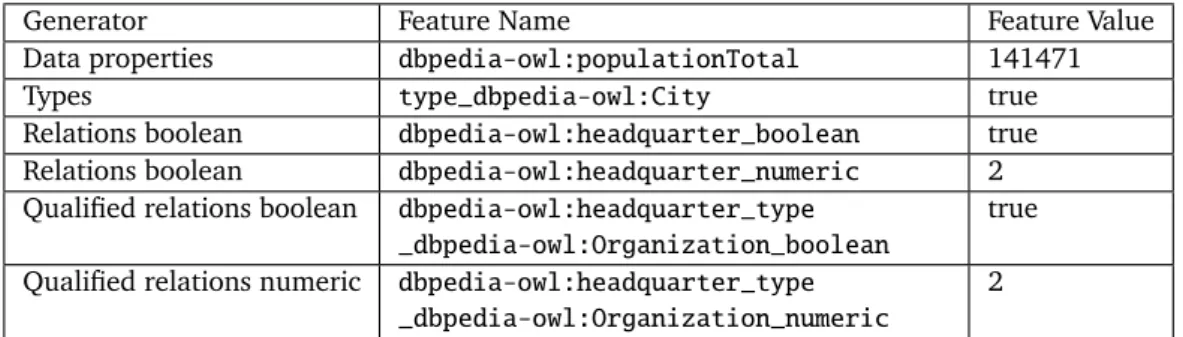
Table 2.1 sums up the SPARQL queries and the corresponding features generated. The table shows the basic forms of SPARQL queries; it is possible to impose further restrictions, e.g., only using relations and/or types from a set of given namespaces. Figure 2.2 depicts an excerpt of theDBPediadata about Darmstadt. Table 2.2 shows the features that would be generated for that example.
2.3 Feature Selection
Some of the generators create a larger amount of features. Especially the feature sets generated by the related types generators can become quite large. At the same time, some of the features may be extremely sparse.Yago, for example, defines many very specific categories, such as“Art schools in Paris”.
1 We are aware that the semantics of these features deny two essential semantic fundamental principles of linked open data, theopen world assumptionand thenon-unique naming assumption. For example, we would generate a feature stating that 42 scientists graduated from a particular university if we find 42 such relations, even though there are certainly more people that are not mentioned in the dataset. Moreover, some of the 42 may be duplicate identifiers for the same person. Despite its inaccuracy, the feature may have a value for data mining because, for example, the university may have a good reputation if it is the alma mater of 42 scientists that are well-known enough to be mentioned in a dataset likeDBPedia.
Generator Query Feature Values Data properties SELECT ?p ?v WHERE {?x ?p ?v.
FILTER(isLITERAL(?v)}
?att_data_?p mixed
Types SELECT ?t WHERE {?x rdf:type ?t.} ?att_type_?t {true,false}
Relations (boolean) SELECT ?p WHERE {?x ?p ?y.} ?att_in_boolean_?p {true,false}
SELECT ?p WHERE {?y ?p ?x.} ?att_out_boolean_?p {true,false} Relations (numeric) SELECT ?p ?y WHERE {?x ?p ?y.} ?att_in_numeric_?p numeric
SELECT ?p ?y WHERE {?y ?p ?x.} ?att_out_numeric_?p numeric Qualified relations
(boolean)
SELECT ?p ?t WHERE {?x ?p ?y. ?y rdf:type ?t.}
?att_in_type_boolean_?p_?t {true,false}
SELECT ?p ?t WHERE {?y ?p ?x. ?y rdf.type ?t.}
?att_out_type_boolean_?p_?t {true,false} Qualified relations
(numeric)
SELECT ?p ?y ?t WHERE {?x ?p ?y. ?y rdf:type ?t.}
?att_in_type_numeric_?p_?t numeric
SELECT ?p ?y ?t WHERE {?y ?p ?x. ?y rdf.type ?t.}
?att_out_type_numeric_?p_?t numeric
Table 2.1:SPARQL queries for the individual generators for a given resource ?x, and the corresponding attributes that are created.?attdenotes the attribute name containing the original entity, such as a city’s name.
Generator Feature Name Feature Value
Data properties dbpedia-owl:populationTotal 141471
Types type_dbpedia-owl:City true
Relations boolean dbpedia-owl:headquarter_boolean true Relations boolean dbpedia-owl:headquarter_numeric 2 Qualified relations boolean dbpedia-owl:headquarter_type
_dbpedia-owl:Organization_boolean
true Qualified relations numeric dbpedia-owl:headquarter_type
_dbpedia-owl:Organization_numeric
2
Especially for qualified relations, this can lead to a lot of features that are not too useful – the set of cities connected to an entity of type“Art schools in Paris”is probably limited to Paris alone, and all other instances will have azeroorfalse
value for this feature. On the other hand, creating type features forowl:Thingwill yield to a value which istruefor every instance. Such features will provide little value to a data mining tool, while their large number will impose certain scalability issues.
Therefore, it is useful to post-process the set of created features and discard features that have only little value. While there is a large body of work on feature selection [16], we have implemented only a rough heuristic so far: for a given thresholdp, all features are discarded that have a ratio higher thanpof missing, identical, or unique values (the latter is only applied to nominal features).
For our analysis, we have used values of0.95and0.99forp. That means that an attribute is discarded if it more than 95%(or99%, respectively) of its values are missing, identical, or different nominals.
3 Case Study 1: Data Mining Problems with Existing Features
To evaluate the value of our feature generation approach, we have tested it in several settings. The first case study is concerned withexistingdata mining problems, i.e., data mining problems that already come with a set of features. We have conducted tests with two datasets: the zoo data set from the UCI1[14], which poses a classification problem (i.e., classifying animals), and the AAUP2faculty salary data set3, which poses a regression problem (i.e., predicting the average salary and compensation of different staff groups at American universities).
The zoo dataset has a string-valued attribute, containing the animal’s name, 16 numeric attributes (15 of which only have 0 and 1 values), a class attribute with seven different values, and 101 instances. The goal is to predict the class of animal from the observed attributes.
The AAUP dataset has five numeric and two nominal attributes, plus a string-valued attribute containing the univer-sity’s name, as input variables. It consists of 1161 instances. There are eight target variables, describing the average salary and the average compensation of different staff at the universities. From the latter, we have picked two target variables: the average salary and the average compensation of full professors.
For the zoo dataset, we have recognized 54.5% of the entities in DBPedia, while for the AAUP data set, we have recognized 73.0% of all entities. We have run all six feature generators on both data sets. Furthermore, we have analyzed the performance of data mining algorithms on the unfiltered data, as well as with threshold values of 0.95 and 0.99 forp(see section 2.3).
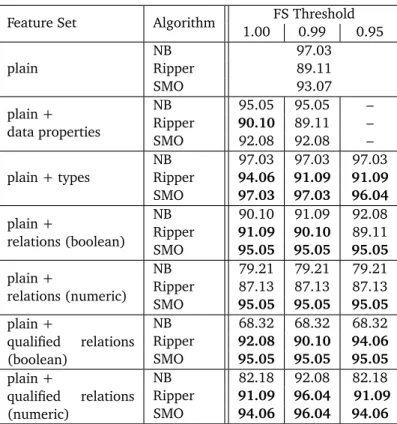
Table 3.1 shows the classification accuracy for the zoo dataset using three common machine learning algorithms, i.e., Naive Bayes [22], the Support Vector Machine algorithmSMO4[37], and the rule learning algorithmRipper[7], all in their respective standard configurations in the publicly availableWekadata mining library. A higher accuracy corresponds to a better classification result.
The results demonstrate that, at least for SMO and Ripper, better classification can be achieved in many cases (es-pecially using the generators for types and qualified relations), while Naive Bayes often performs worse when adding a large amount of generated features. The latter is not surprising because the Naïve Bayes classifier assumes that the features are independent given the target class. If many of the extracted features have a correlation (e.g., type features for matching classes inDBPediaandYago), this assumption is clearly violated, which may cancel out the positive effect of the additional information. SVMs and rule learning algorithms are not sensitive to this issue.
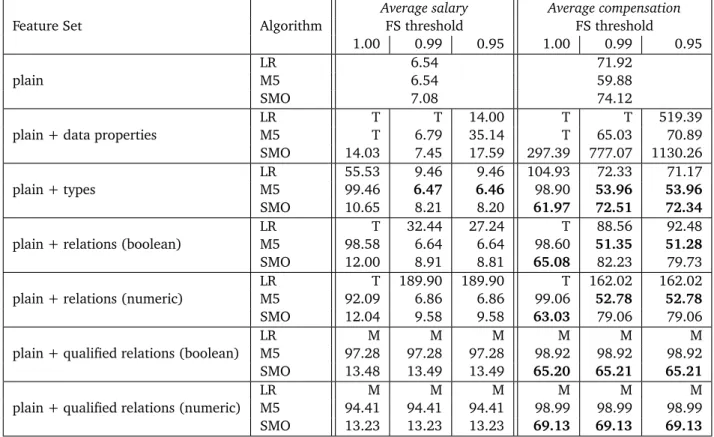
Table 3.2 shows the results of the two regression tasks (average salary and compensation of full professors) of the AAUP dataset. We have again used three common regression algorithms, i.e., Linear Regression, the regression variant of the Support Vector Machine implementation SMO [42], and M5 Rules [20], all in their respective standard configurations in
Weka. The tables depict the root relative squared error of the prediction. A lower error corresponds to a better regression result.
It is obvious that the second task (predicting the average compensation) is harder than the first one (predicting the average salary); therefore, it has the larger potential for being improved by additional attributes. However, for both tasks, improvements are possible. While the Linear Regression results do not improve when adding features, there is room for improvement when using one of the other two regression algorithms. Especially the results produced with SMO are strongly improving, as well as SMO is the most robust when adding a larger amount of (possibly irrelevant) features. On the other hand, it can also be observed that the number of features can become too large to be handled by some approaches, especially by linear regression.
Overall, the results show that adding features from Linked Open Data can improve the result quality of some data mining algorithms. However, not every algorithm benefits from the same type of features in the same way, thus, it is necessary to choose a good combination of a data mining and a feature generation algorithm.
For both M5 and linear regression, the results are worse when no post selection of attributes is done, i.e., the filtering is done with a threshold of1.00. Support vector machines, on the other hand, perform well with such large attribute sets, as in the classification case.
1 University of California, Irvine
2 American Association of University Professors
3 http://www.amstat.org/publications/jse/jse_data_archive.htm 4 Sequential Minimal Optimization
Feature Set Algorithm FS Threshold 1.00 0.99 0.95 plain NB 97.03 Ripper 89.11 SMO 93.07 plain + data properties NB 95.05 95.05 – Ripper 90.10 89.11 – SMO 92.08 92.08 – plain + types NB 97.03 97.03 97.03 Ripper 94.06 91.09 91.09 SMO 97.03 97.03 96.04 plain + relations (boolean) NB 90.10 91.09 92.08 Ripper 91.09 90.10 89.11 SMO 95.05 95.05 95.05 plain + relations (numeric) NB 79.21 79.21 79.21 Ripper 87.13 87.13 87.13 SMO 95.05 95.05 95.05 plain + qualified relations (boolean) NB 68.32 68.32 68.32 Ripper 92.08 90.10 94.06 SMO 95.05 95.05 95.05 plain + qualified relations (numeric) NB 82.18 92.08 82.18 Ripper 91.09 96.04 91.09 SMO 94.06 96.04 94.06
Table 3.1:Accuracy results for the zoo dataset, using Naive Bayes (NB), Ripper, and Support Vector Machines (SMO) as classificators, 10-fold cross validation, and using different feature selection (FS) threshold valuespfor feature selection. Results improving over the plain dataset without any generated features are marked in bold. The data properties feature generator did not generate any features that were kept when performing feature selection with a threshold ofp=0.95. From the joint feature set of all generated attributes withp=1.0, we had to remove three attributes of type date for processing with Naive Bayes and SMO.
Feature Set Algorithm
Average salary Average compensation
FS threshold FS threshold 1.00 0.99 0.95 1.00 0.99 0.95 plain LR 6.54 71.92 M5 6.54 59.88 SMO 7.08 74.12
plain + data properties
LR T T 14.00 T T 519.39 M5 T 6.79 35.14 T 65.03 70.89 SMO 14.03 7.45 17.59 297.39 777.07 1130.26 plain + types LR 55.53 9.46 9.46 104.93 72.33 71.17 M5 99.46 6.47 6.46 98.90 53.96 53.96 SMO 10.65 8.21 8.20 61.97 72.51 72.34
plain + relations (boolean)
LR T 32.44 27.24 T 88.56 92.48
M5 98.58 6.64 6.64 98.60 51.35 51.28
SMO 12.00 8.91 8.81 65.08 82.23 79.73
plain + relations (numeric)
LR T 189.90 189.90 T 162.02 162.02
M5 92.09 6.86 6.86 99.06 52.78 52.78
SMO 12.04 9.58 9.58 63.03 79.06 79.06
plain + qualified relations (boolean)
LR M M M M M M
M5 97.28 97.28 97.28 98.92 98.92 98.92
SMO 13.48 13.49 13.49 65.20 65.21 65.21
plain + qualified relations (numeric)
LR M M M M M M
M5 94.41 94.41 94.41 98.99 98.99 98.99
SMO 13.23 13.23 13.23 69.13 69.13 69.13
Table 3.2:Results (relative root squared error) for the AAUP dataset, using Linear Regression (LR), M5 rules (M5) and Support Vector Machines (SMO) as regression algorithms, 10-fold cross validation, and using different feature selection (FS) threshold valuespfor feature selection. For running the full data properties data set with SMO, four date attributes have been removed. Results improving over the plain dataset without any generated features are marked in bold. For the relations numeric and the qualified relations boolean generator, the feature sets forp=0.95andp=0.99are identical, for the qualified relations generator, the feature sets for all three thresholds are identical. Tasks marked withThave timed out (i.e., not finished after one week), tasks marked withMhave run out of memory (i.e., consumed more than 8GB).
4 Case Study 2: Data Mining Problems without Existing Features
In our second case study, we have analyzed the performance of our approach fornewdata mining problems, i.e., problems where no features except for an entity and a target attribute are given. We have again used two two different data sets for the evaluation. The first data set is the 1999 edition of the Mercer quality of living survey,1which is based on surveys on the quality of life in 218 cities world-wide. The results are mapped to a numeric scale, which is normalized so that 100 is the value of New York City resulting in a range between 23 and 106. The second dataset is the 2010 edition of the Corruption Perceptions Index by Transparency International,2which assigns a numeric corruption index between 0 and 10 to 178 countries of the world [27]. Both datasets consist only of two column: one with the city’s or country’s name, the other with the respective index.
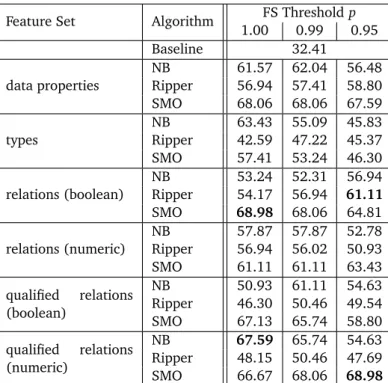
For the Mercer dataset, we have created three equally sized classes withWeka’s default discretization algorithm [13]. Thus, the task is to classify the quality of living in a city as low, medium, or high quality. Like in the first case study, we used three established classification algorithms. The classification accuracy results are depicted in table 4.1. As a baseline, we have ran a classifier that always predicts the largest class. The results show that each generator produces useful features, since the baseline is outperformed by every combination of a feature generator and a classifier.
Some further interesting aspects can be observed. First, it is noteworthy that there is no feature generation strategy which is the best choice for all classification algorithm. While each classifier reaches its minimum accuracy using the type features, the maxima are found with different feature sets.
For the transparency international dataset, we have again used, like in the first case study, three common regression algorithms, i.e., Linear Regression, the regression variant of SMO, and M5 rules. The results are depicted in table 4.2. The baseline (predicting the average) can be beaten in most of the cases, but unlike in the first case study, on of the algorithms (M5 rules) performs rather badly.
When dealing with data mining problems without any given features, the motivation is not always to obtain predictions for new instances. Instead, it is sometimes more interesting to produce anexplanationor aninterpretationfor the given phenomenon. In the datasets analyzed above, it may be interesting to find reasons what the typical attributes of a corrupt country are, or what makes a the quality of life in a city high or low. Of the approaches used, rule learning approaches are particularly well suited to produce an interpretable model of such a phenomenon.
For the Mercer data set, the Ripper rule learner finds some useful information about the characteristics that sep-arate low quality from high quality cities, using the different feature generators. For example, low quality cities are characterized as
• hot and very large cities (highest temperature in June larger than 27 C, area larger than334km2)
• cold cities (highest temperature in January lower than 16 C) where no music has been recorded (no incoming relations of typerecordedIn
• cities in Africa (latitude less than 24, longitude less than 47, ignoring the sign)
We have performed a similar analysis with the Transparency International dataset, transforming the numerical class attribute into two discrete classes and running Ripper with the different generators. Some example rules found for states that have a low perceived corruption are
• OECD member states (entities from the Yago categoryOECDMemberEconomy)
• Countries with a Human Development Index (HDI) larger than 78%. The HDI is calculated from life expectancy, education level, and economic performance of a country3
• Countries that are the headquarter of more than ten companies, but less than two cargo airlines4 • Countries that have more than ten mountains
1 Data available athttp://across.co.nz/qualityofliving.htm
2 Data available athttp://www.transparency.org/policy_research/surveys_indices/cpi/2010/results 3 http://hdr.undp.org/en/statistics/
4 As discussed above, the interpretation of this rule is not accurate when considering the open world assumption underlying Linked Open Data. A more concise interpretation would be “Countries that are the headquarter of more than ten companies, but less than two cargo airlines, which are important enough to have a dbPedia entry”.
Feature Set Algorithm FS Thresholdp 1.00 0.99 0.95 Baseline 32.41 data properties NB 61.57 62.04 56.48 Ripper 56.94 57.41 58.80 SMO 68.06 68.06 67.59 types NB 63.43 55.09 45.83 Ripper 42.59 47.22 45.37 SMO 57.41 53.24 46.30 relations (boolean) NB 53.24 52.31 56.94 Ripper 54.17 56.94 61.11 SMO 68.98 68.06 64.81 relations (numeric) NB 57.87 57.87 52.78 Ripper 56.94 56.02 50.93 SMO 61.11 61.11 63.43 qualified relations (boolean) NB 50.93 61.11 54.63 Ripper 46.30 50.46 49.54 SMO 67.13 65.74 58.80 qualified relations (numeric) NB 67.59 65.74 54.63 Ripper 48.15 50.46 47.69 SMO 66.67 68.06 68.98
Table 4.1:Mercer Quality of Living Dataset: Accuracy of Naïve Bayes (NB), Ripper, and Support Vector Machines (SMO) estimated by 10-fold cross-validation with three feature selection (FS) threshold values. Higher values indicate a better classification result. The best result for each classifier algorithm is marked in bold.
Feature Set Algorithm FS Threshold 1.00 0.99 0.95 Baseline 100.00 data properties LR M5 101.64 101.65 101.69 SMO 82.29 82.35 82.31 types LR 98.08 97.25 73.67 M5 103.45 103.45 76.41 SMO 74.94 78.03 76.01 relations (boolean) LR 94.23 95.39 95.79 M5 102.82 102.67 103.16 SMO 67.43 67.38 72.16 relations (numeric) LR 96.16 96.85 98.85 M5 101.37 103.26 104.98 SMO 97.37 114.13 147.02 qualified relations (boolean) LR M M 90.26 M5 101.91 101.91 102.34 SMO 74.70 68.41 72.69 qualified relations (numeric) LR M M 90.59 M5 101.91 101.91 102.34 SMO 74.70 68.41 72.69
Table 4.2:Transparency International Dataset: Relative root squared eror (RMSE) of Linear Regression (LR), M5 rules (M5) and Support Vector Machines (SMO) estimated by 10-fold cross-validation with three feature selection (FS) threshold values. Lower values indicate a better prediction. The best result for each classifier algorithm is marked in bold. Results marked withMcould not be computed with 8GB of memory.
These rules show that even if the relative error in the regression task for the Transparency International dataset is comparatively high, many of the rules that can be found indeed make sense. However, the last example shows that this does not apply to all the rules found. In particular, they may not be interpreted as cause-and-effect rules in a straight forward way. Rules may reflect very different circumstances, ranging from accidental correlations to actual cause-and-effect relations. In some cases, it may also not be trivial to decide which part of the rule is actually a cause and which is an effect – for example, companies may prefer less corrupt countries as their headquarters, but it is also possible that a larger number of companies hints at a more developed economy and thus lower perceived corruption.
The results from the second case study strengthen the observations from the first one: features from Linked Open Data can be beneficially used for data mining, also for tasks where no other attributes are given. However, a careful evaluation is needed, as some algorithms seem to be sensitive to this additional information, which not always has high quality.
5 Assessment of Feature Quality
In the case studies above, we have shown that Linked Open Data can be used to derive useful features for data mining tasks. Thus, we have assessed the quality of the generated features onlyindirectly by showing their influence on the performance of different data mining algorithms. In this section, we are going to discuss a direct assessment of the quality of the generated features.
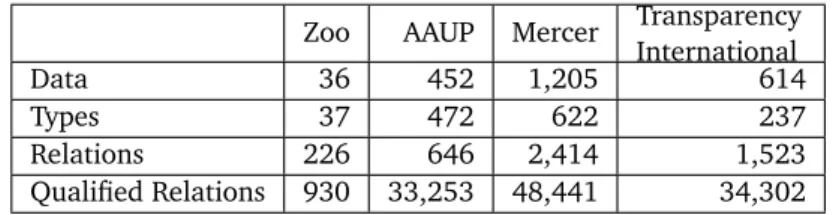
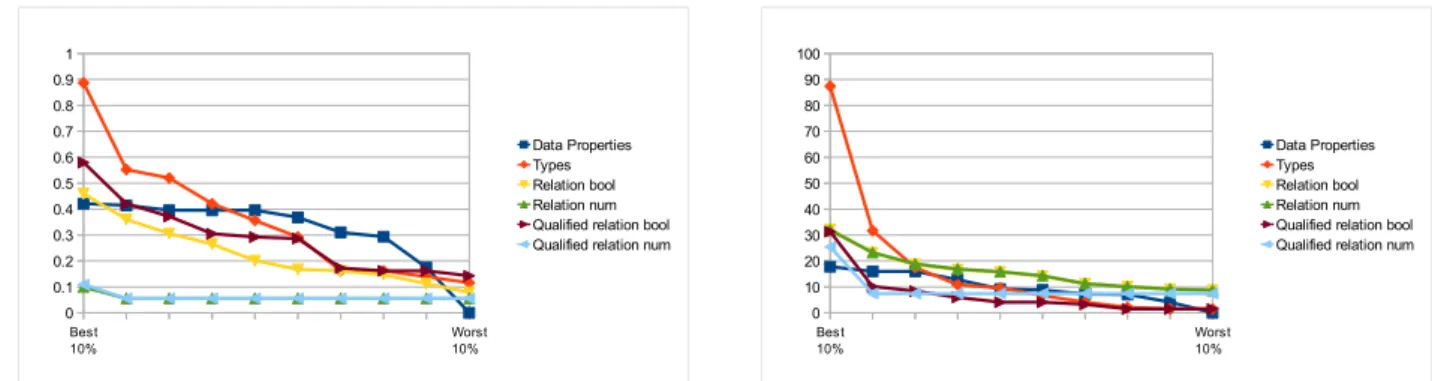
The case studies could have been performed with anytype of features. Therefore, we have analyzed the features generated in these tasks with respect to two common feature quality measures: information gain ratio [38] andχ2value [30]. The number of features generated with each generator are depicted in table 5.1.
Figure 5.1 shows the gain ratio and theχ2value of the features generated for the zoo dataset in section 31. The figure depicts the measures for the top 10% of the features, the next best 10% of the features, etc. Although those curves look very differently for the individual data sets, there are a few recurring patterns:
• Data properties are most often rated high with both heuristics. Furthermore, they often have a higher average value than most of the other feature generators, which produce some high-valued, but also a lot of low-valued features.
• Type features are often rated high in terms of information gain ratio (but not necessarily in terms ofχ2). • χ2often rates unqualified relation features very high.
These findings, as well as the results from the case studies, show that there is not a best practice for producing highly useful features which works for each data set and each data mining algorithm. Instead, some experiments are required to find an optimal feature generation mechanism for each data set and algorithm. We have accounted for that finding by designing our prototype ofFeGeLODin a way that allows for combining different generators in a modular fashion.
1 A complete set of evaluations for all datasets examined in this paper can be found athttp://www.ke.tu-darmstadt.de/resources/
fegelod/feature-quality-estimation
Zoo AAUP Mercer Transparency International
Data 36 452 1,205 614
Types 37 472 622 237
Relations 226 646 2,414 1,523
Qualified Relations 930 33,253 48,441 34,302
Table 5.1:Number of features generated for the different data sets. This table shows the numbers without any post-processing feature selection. The boolean and numerical variants of relations and qualified relations produce an equal number of features.
Best 10% Worst 10% 0 0.1 0.2 0.3 0.4 0.5 0.6 0.7 0.8 0.9 1 Data Properties Types Relation bool Relation num Qualified relation bool Qualified relation num
Best 10% Worst 10% 0 10 20 30 40 50 60 70 80 90 100 Data Properties Types Relation bool Relation num Qualified relation bool Qualified relation num
6 Case Study 3: Ontology Learning
In the third case study, we have addressed a different problem: the automatic induction of schema and ontology infor-mation from the instances of a dataset [32]. For datasets that do not have a richly axiomatized ontology, such ontology learning is useful for allowing more powerful reasoning on the dataset [43]. Ontology learning may also be used as a means to refine existing, weakly axiomatized ontologies by adding new formal axioms [31].
For employing our feature generation approach to the ontology learning problem, we follow the approach suggested in [45], where the Apriori association rule learner [1] is used for learning information about an ontology that underlies a given data set.
To show that our approach is applicable to the problem of ontology learning, we have used two datasets. The first dataset is a snapshot of FOAF (friend of a friend) documents on the semantic web. The FOAF ontology is one of the most prevalent ontologies [19], and it is used for describing persons, their affiliations and relations to other people. For our evaluation, we have used a dataset from 2005 [8] comprising 7118 documents, each describing one person. From that dataset, we tried to infer the FOAF ontology1.
The second dataset consists of an ontology defining persons, groups of persons, and places occurring in the New Testament, and a corresponding instance set of 724 of such persons, groups, and places2. The two datasets have been selected since they provide both a set of instances which can be used for learning, as well as an ontology (which is the target to be learned) that can be used as a gold standard for the evaluation.
In our case study, we have concentrated on learning only very basic ontological features, i.e., subclass relations and the domain and range of attributes. To that end, we have used the generators for types and for boolean relation features, and run an Apriori association rule miner on the generated dataset. The assocation rules found can be transferred back into ontology axioms, as depicted in table 6.1. If more than one rule of type 2 or 3 is found for the same predicate, they should be translated into an axiom stating that?p has the domain or range of theunionof all the types (or an automatically named superclass of the classes found for ontologies in OWL Lite or RDF Schema), rather than letting all the axioms stand by themselves (which would implicitly mean that?phas theintersectionof all types as its domain or range).
An example for a concept that can be learned using our approach is thefoaf:knowsrelation holding between two persons, indicating that those persons know each other. When discovering the association rule
p_in_boolean_foaf:knows = true → p_type_foaf:Person,
we can infer that the relationfoaf:knowshas the rangePerson(which implicitly tells us that there is a relation called
foaf:knowsand a class calledPerson). Likewise, we can infer the domain of the relation, which completes the axioms defining that concept.
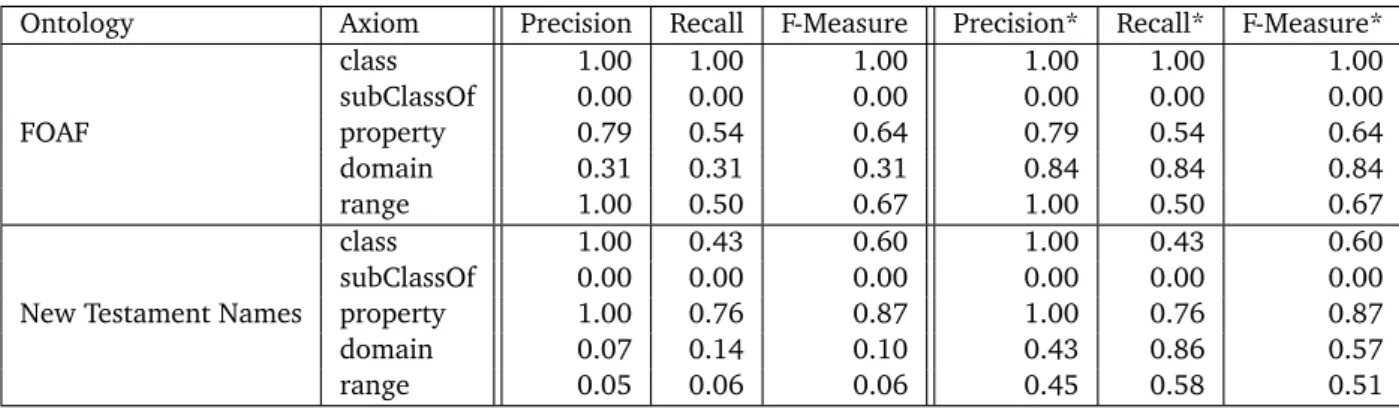
Table 6.2 shows the results of learning ontologies on those datasets, depicting the recall, precision, and F-measure for the different types of axioms. For each type of axiom analyzed, we have compared the axioms learned by our approach to the axioms in the corresponding gold standard ontology. We have analyzed both the absolute recall, precision, and F-measure, as well as arelaxedset of measures, which involves only classes and relations that are explicitly used in the instance sets. For example, the classfoaf:document, which is defined in the FOAF ontology, is not used in our instance set, therefore, we have ignored it when computing the relaxed recall.
The classes and properties have been learned implicitly by applying simple RDFS entailment rules [47]: ?c1 rdfs:subClass ?c2entails thatc1andc2are classes. With the same type of rules, properties can be identified.
The figures show that the results are mixed. While the retrieval of classes and properties already works quite well, the results for properties, ranges, and subclasses are not always satisfying. A large problem with the above datasets is that they have no fully materialized type information. For example, in the New Testament Names dataset, there are quite a 1 http://xmlns.com/foaf/spec/
2 http://www.semanticbible.com/ntn/ntn-overview.html
Association Rule Ontology Axiom
1 ?att_type_?t1=true → ?att_type_?t2=true ?t1 rdfs:subClassOf ?t2.
2 ?att_in_boolean_?p=true → ?att_type_t=true ?p rdfs:range ?t.
3 ?att_out_boolean_?p=true → ?att_type_t=true ?p rdfs:domain ?t.
Table 6.1:Association rules and their transformation to ontology axioms. The feature names follow the naming conven-tion introduced in table 2.1.
Ontology Axiom Precision Recall F-Measure Precision* Recall* F-Measure* FOAF class 1.00 1.00 1.00 1.00 1.00 1.00 subClassOf 0.00 0.00 0.00 0.00 0.00 0.00 property 0.79 0.54 0.64 0.79 0.54 0.64 domain 0.31 0.31 0.31 0.84 0.84 0.84 range 1.00 0.50 0.67 1.00 0.50 0.67
New Testament Names
class 1.00 0.43 0.60 1.00 0.43 0.60
subClassOf 0.00 0.00 0.00 0.00 0.00 0.00
property 1.00 0.76 0.87 1.00 0.76 0.87
domain 0.07 0.14 0.10 0.43 0.86 0.57
range 0.05 0.06 0.06 0.45 0.58 0.51
Table 6.2:Ontology learning results, depicting the recall, precision, and F-measure for the different types of axioms. The measures marked with an asterisk depict the figures for those axioms that were actually discoverable from the data set, ignoring those concepts that were not used in the respective data set.
few entities of typeManandWoman, respectively, while the common superclassHumanis not used at all in the instance set. Thus, the latter class cannot be discovered, neither can be the corresponding subclass relations. Since in our data set, no entities were described using a class and its superclass at the same time, our approach was not able to discover any subclass relations.
Furthermore, when trying to learn domain and range restrictions for such classes, it is learned that a lot of relations have the union ofManandWomanas their range, while the actual range (the classHuman) is not discovered. However, such issues cannot be solved fully automatically. A possible option would be to involve a user in an interactive setting, asking them to define a common superclass for classes that co-occur frequently.
Overall, the results show that our approach may not be applied only to classical data mining problems, but also to ontology learning. While our first results are encouraging, one can try to further improve these results in various ways, such as, e.g., learning restrictions for individual classes, or exploiting the numerical feature generators for learning cardinality restrictions.
7 Case Study 4: Ontology Matching
The fourth case study addresses as a similar problem as ontology learning. While ontology learning is always concerned with creating or improving asingleontology, ontology matching aims at creating relations betweenmultipleontologies [12]. When dealing with simple mappings, i.e., correspondences between single classes in different ontologies, the prob-lem is very close to the probprob-lem of ontology learning: it is necessary to findsubClassOfrelations between classes defined in different ontologies. An exact match of two classes can be predicted from two symmetricsubClassOfstatements.
Ontology matching is an essential building block for the Semantic Web and Linked Open Data. Since many ontologies are used in parallel for different datasets [19], an intelligent agent may only make sense from those different datasets if the mappings between the used ontologies are known. While Linked Open Data provides ample information about instance-level correspondences, mappings on the terminological level are currently rare [21].
Since some datasets in Linked Open Data use multiple ontologies in parallel, they allow for applying an instance-based matching approach [9], i.e., exploiting information about instances belonging to ontology classes for constructing a mapping between such classes. As discussed above, theDBPediadataset uses both its own ontology as well as theYago
classification system [4]. Thus, it can be used to predict a mapping between those two ontologies.
For our fourth case study, we used a partial gold standard mapping between theDBPediaand theYagoontology1. To
construct the dataset, we first gathered a set of instances that are anrdf:typeof at least one of the types defined in the partial gold standard. On this set of instances, we have run the generator creating boolean features. The resulting data set has 231,635 instances and 98,414 attributes. Since a boolean attribute is created for each possible class, but each instance only belongs to a few classes, the data set is extremely sparse.
Like in the third case study, we have ran an Apriori association rule miner on the data set, using different values for the minimum support for each rule. We have learned association rules with one condition in the head and one the body. For each learned pair of rulesX →Y andX →Y, whereX andY depict classes from different ontologies, we have assumed a mapping between those classes. We have evaluated that mapping against the a partial reference alignment between
DBPediaandYago, using the recall, precision, and F-measure formulas for partial reference alignments defined in [40].
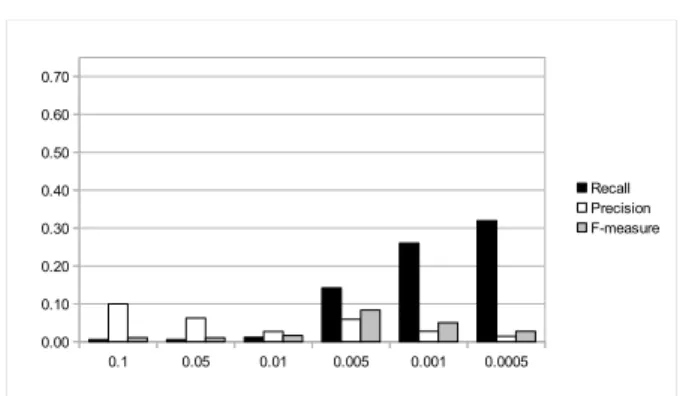
We have used two different approaches for creating the mapping: in the first approach, all mappings found for which association rules in both directions exist have been taken into account. In the second approach, we have enforced a bijective mapping by resolving ties based on the confidence scores of the rules that have lead to creating the mapping. The results are shown in figures 7.1 and 7.2, respectively, using different values for a rule’s minimum support (i.e., fraction of instances that a particular rule has to cover) for constructing the rules. It can be observed that with a decreasing minimum support, the recall value increases at the cost of precision. Filtering the resulting mappings based on the rules’ confidence scores can clearly improve precision while not sacrificing too much recall, which shows that there is a clear benefit in using not only the learned rules themselves, but also the meta information provided by the learning algorithm. However, it is not clear whether the rules’ confidence score is the best criterion, since precision takes its maximum at a medium value for a rule’s minimum support, i.e., when a lower number of rules is generated. This hints at difficulties in selecting the correct mapping from a larger set of candidates.
In total, an F-measure of 25% can be achieved. Since instance-level methods are capable of discovering other mappings than the predominant schema-level ones (e.g., mappings of categories with very different labels in weakly formalized hierarchies), that approach is an ideal candidate for using it as an addendum to the currently prevalent schema-level approaches for increasing the result quality.
1 http://www.netestate.de/De/Loesungen/DBpedia-YAGO-Ontology-Matching 0.1 0.05 0.01 0.005 0.001 0.0005 0.00 0.10 0.20 0.30 0.40 0.50 0.60 0.70 Recall Precision F-measure
0.1 0.05 0.01 0.005 0.001 0.0005 0.00 0.10 0.20 0.30 0.40 0.50 0.60 0.70 Recall Precision F-measure
Figure 7.2:Matching results with different values for the minimum rule support, using rule confidence for conflict resolu-tion
While we have looked only at simple class mappings so far, it is possible to use further features for learning more complex mappings [39], such as “AYAGO:FilmDirectoris adbPedia: Personin who is thedbpedia:director_ofof at least onedbPedia:Film”. Those could be easily discovered by using the generators for qualified relation features as well and including them in the rule learning dataset. However, gold standards for evaluating such complex mappings are currently not available.
8 Related Work
LiDDM[23] is an integrated system for data mining on the semantic web. It features different standard machine learning
techniques, such as clustering and classification of semantic web instances, as well as discovery of association rules. However, the user has to declare the types of features to be extracted upfront by defining their own SPARQL query, which requires some knowledge about the ontology underlying the data set used.
A similar approach is taken by theRapidMiner semweb plugin[24], which preprocesses RDF data in a way that it can be further processed by a data mining tool,RapidMinerin that case. Like forLiDDM, the user has to specify a SPARQL query upfront for retrieving the data of interest.The authors propose different methods for turning set-valued data, such as several types of an instance, into simple nominal features in a way that the number of generated features is low and the approach scales well.
In [6], Cheng et al. have proposed a similar approach to feature generation as we have pursued withFeGeLOD. They perform some studies with traditional data mining tasks, such as text classification and product recommendation. Like the two approaches above, the approach foresees that the type of feature to be extracted has to be specified using specific SPARQL queries. Since the user has to specify the type of features to be generated by defining a SPARQL query, these approaches aresupervised rather thanunsupervised, and they require some domain knowledge from the user to define the query. In contrast, our approach works in an unsupervised way and does not require any domain knowledge from the user.
An approach using ontologies as background knowledge for data mining isg-SEGS[36]. Given an ontology, which provides a description of nominal attributes, the approach leverages the taxonomical knowledge in that ontology for improving the data mining process, e.g., for learning more general rules. Both the ontology and the mapping from the data set to that ontology has to be provided a priori in that approach.
In contrast to those approaches, FeGeLOD follows a completely unsupervised approach, i.e., it may automatically generate features given a data set and a SPARQL endpoint. Despite that property, it allows for creating various types of features due to the modular nature of the implementation, which provides extensibility with respect to new entity recognition, feature generation, and feature selection mechanisms. Furthermore, none of the approaches has been shown to be applicable to the range of scenarios depicted in this paper forFeGeLOD.
Kämpgen and Harth suggest an approach for analyzing statistical linked data with online analytical processing (OLAP) tools. They discuss a common schema for such data and present various case studies. The two key differences is that our approach aims at running machine learning algorithms on the data, instead of OLAP methods, and that it uses general-purpose datasets (DBPediaat the moment) instead of special statistical datasets. Nevertheless, including statistical linked data sets in our approach may help increasing the quality of the prediction models created by machine learning algorithms in many of the examples discussed in this paper.
SPARQL-ML [25] is an approach that foresees the extension of the SPARQL query language [48] with a specialized statement to learn a model for a specific concept or numeric attribute in an RDF dataset. It therefore covers both classification and regression, other learning tasks – such as clustering or association rule mining – are thus not possible with SPARQL-ML. Furthermore, for applying the approach, it is required that the SPARQL endpoint of the data set that one wants to employ for data mining, e.g.,DBPedia, supports SPARQL-ML, which is currently not very wide spread. In contrast, our approach can be used withanyarbitrary SPARQL endpoint providing Linked Open Data.
There are also some works that use features from Linked Open Data for specific tasks, such as learning association rules [35], finding paths between entities [26], or ranking statements [15]. While those approaches often provide very good results for the specific task they are defined for, the work presented in this paper is rather designed as a broader framework with which such specific solutions can be built.
In our case studies, we have presented experiments in the fields of ontology learning and ontology matching, both of which are active fields of research. While these case studies have been discussed to demonstrate the versatility of our approach, it is out of the scope of this paper to elaborate on the full extent of related work in those two fields. Therefore, we refer to a number of survey articles summarizing the state of the art in ontology learning [10, 18, 32] and ontology matching [2, 11], respectively.
9 Conclusion and Outlook
In this paper, we have introduced an approach for unsupervised generation of data mining features from Linked Open Data. Our approach comprises three steps: entity recognition, feature generation, and feature selection mechanism. We have implemented our approach in a modular architecture which allows for using different algorithms for each of those steps. The focus of this paper has been on the actual feature generation step. We have introduced six different generation algorithms and applied them to various scenarios. The approach described in this paper works completely unsupervised, i.e., it can process a data set without the need of any further information given by the user, and without any domain knowledge. However, some basic information on objects’ types may improve the precision in the entity recognition step. In a number of case studies, we have shown how our approach can be applied to a number of different scenarios. Even with the simple feature generation technique that we used in this paper, the generated features may help improve the results in data mining tasks where features already exist, as well as for dealing with data mining problems without any features. Furthermore, we have shown how our approach can be used in the fields of ontology learning and ontology matching.
The results of the case studies and the assessments of the generated features show that there is no feature generation strategy that performs optimally for every given data set, data mining problem, and machine learning algorithm. At the moment, selecting suitable generators requires some experimentation. In the future, we aim at further assisting the user by predicting the benefit of generators in a given scenario and provide suggestions for generators.
As the focus of this paper has been on the actual generation step, the entity recognition as well as the feature selection step have been implemented in a very straight-forward way in order to provide a proof of concept. However, both steps deserve further attention. For entity recognition, existing approaches such asDBPediaSpotlight [33] may be employed (see [41] for a survey).
Some entity recognition algorithms do not only deliver the identified entity, but also a confidence score. Entities which have been identified with a lower confidence score could be assigned a lower weight, so their influence on the learned model would be reduced. Such an adjustment could help improving the overall result.
As some of the generators create a very large number of features, the employment of more sophisticated feature selection mechanisms [16] would be beneficial. Here, it is especially important to find mechanisms that are capable of dealing with the very sparse nature of Linked Open Data. Furthermore, with respect to runtime optimization, it would be beneficial to be able to discard features on the fly, i.e., in the moment in which they are generated, so that unnecessary queries on Linked Open Data are avoided. We are currently investigating whether the logic-based framework for feature relevancy, which has been introduced in [28], could be useful for this task.
At the moment, all of our generators are restricted to the entity and its immediate neighbors. This imposes a limitation on the sort of features that can be found. For example, for the perceived corruption of a country, features such as the turnover of companies located in that country might be useful. Likewise, relations to individuals might also provide useful features (e.g., the relation of a country to its government type, which is a relation between individuals,1would be highly useful for predicting the perceived corruption). However, generating such features leads to an unmanageable explosion of the feature space. Our approach, like other state-of-the-art approaches [29], foresees fully calculating the metric of each attribute while it is being examined. A more scalable approach would have to rely on quicker approximate estimates of a feature’s prospective value instead, performing an on-the-fly selection of features and interesting paths to follow.
So far, we have only used data gathered fromDBPedia. As many data sets in Linked Open Data are linked toDBPedia
[4], this is a good starting point. However, extending the feature generation to other data sets may also provide useful information. Finding good heuristics for identifying useful data sets while avoiding an explosion of the feature space would lead to a significant improvement of the feature generation mechanism. It will also be interesting to compare the result quality of predictive models generated from different data sets.
In summary, our case studies have shown that our approach to feature generation provides a useful framework to build solutions for different problems. All the algorithms described in this paper are available in an open-source implementa-tion2 which is based on the wide-spread machine learning frameworkWeka. With this, we hope to provide a valuable
and useful toolkit to the community.
1 e.g.dbpedia:Germanyanddbpedia:Federal_State 2 http://www.ke.tu-darmstadt.de/resources/fegelod
Bibliography
[1] R. Agrawal and R. Srikant. Fast algorithms for mining association rules in large databases. In20th International
Conference on Very Large Data Bases, pages 478–499. Morgan Kaufmann, Los Altos, CA, 1994. 16
[2] Z. Bellahsene, A. Bonifati, and E. Rahm, editors.Schema Matching and mapping. Springer, 2011. 20
[3] C. Bizer, T. Heath, and T. Berners-Lee. Linked Data - The Story So Far. International Journal on Semantic Web and
Information Systems, 5(3):1–22, 2009. 3
[4] C. Bizer, J. Lehmann, G. Kobilarov, S. Auer, C. Becker, R. Cyganiak, and S. Hellmann. DBpedia - A crystallization point for the Web of Data.Web Semantics - Science Services and Agents on the World Wide Web, 7(3):154–165, 2009. 4, 18, 21
[5] R. R. Bouckaert, E. Frank, M. Hall, G. Holmes, B. Pfahringer, P. Reutemann, and I. H. Witten. WEKA — Experiences with a Java open-source project.Journal of Machine Learning Research, 11:2533–2541, Sept. 2010. 3
[6] W. Cheng, G. Kasneci, T. Graepel, D. Stern, and R. Herbrich. Automated feature generation from structured knowl-edge. In20th ACM Conference on Information and Knowledge Management (CIKM 2011), 2011. 20
[7] W. W. Cohen. Fast effective rule induction. InTwelfth International Conference on Machine Learning, pages 115–123. Morgan Kaufmann, 1995. 8
[8] L. Ding, L. Zhou, T. Finin, and A. Joshi. How the semantic web is being used: An analysis of foaf. InProceedings of
the 38th International Conference on System Sciences, 2005. 16
[9] A. Doan, J. Madhavan, P. Domingos, and A. Halevy. Learning to map between ontologies on the semantic web.
InProceedings of the 11th international conference on World Wide Web, pages 662–673, New York, NY, USA, 2002.
ACM. 18
[10] L. Drumond and R. Girardi. A survey of ontology learning procedures. In F. L. G. de Freitas, H. Stuckenschmidt, H. S. Pinto, A. Malucelli, and Ó. Corcho, editors,Proceedings of the 3rd Workshop on Ontologies and their Applications,
Salvador, Bahia, Brazil, October 26, 2008, volume 427 ofCEUR Workshop Proceedings, 2008. 20
[11] J. Euzenat, A. Ferrara, C. Meilicke, J. Pane, F. Scharffe, P. Shvaiko, H. Stuckenschmidt, O. Sváb-Zamazal, V. Svátek, and C. Trojahn. Results of the Ontology Alignment Evaluation Initiative 2010. InProceedings of the 5th International
Workshop on Ontology Matching (OM-2010). 2010. 20
[12] J. Euzenat and P. Shvaiko. Ontology matching. Springer, 2007. 18
[13] U. M. Fayyad and K. B. Irani. Multi-interval discretization of continuousvalued attributes for classification learning.
InThirteenth International Joint Conference on Articial Intelligence, volume 2, pages 1022–1027. Morgan Kaufmann
Publishers, 1993. 11
[14] A. Frank and A. Asuncion. UCI Machine Learning Repository, 2010. 8
[15] T. Franz, A. Schultz, S. Sizov, and S. Staab. Triplerank: Ranking semantic web data by tensor decomposition. In
International Semantic Web Conference (ISWC), 2009. 20
[16] I. Guyon, S. Gunn, M. Nikravesh, and L. A. Zadeh, editors. Feature Extraction – Foundations and Applications. Springer, 2006. 7, 21
[17] M. Hall, E. Frank, G. Holmes, B. Pfahringer, P. Reutemann, and I. H. Witten. The WEKA data mining software: an update.SIGKDD Explor. Newsl., 11:10–18, November 2009. 3
[18] M. Hazman, S. R. El-Beltagy, and A. Rafea. Article: A survey of ontology learning approaches.International Journal
of Computer Applications, 22(8):36–43, May 2011. 20
[19] M. Hepp. Possible ontologies: How reality constraints building relevant ontologies. IEEE Internet Computing, 11(1):90–96, January/February 2007. 16, 18
[20] G. Holmes, M. Hall, and E. Frank. Generating rule sets from model trees. InTwelfth Australian Joint Conference on
Artificial Intelligence, pages 1–12. Springer, 1999. 8
[21] P. Jain, P. Hitzler, A. P. Sheth, K. Verma, and P. Z. Yeh. Ontology alignment for linked open data. In P. F. Patel-Schneider, Y. Pan, P. Hitzler, P. Mika, L. Z. 0007, J. Z. Pan, I. Horrocks, and B. Glimm, editors,9th International
Semantic Web Conference, ISWC 2010, volume 6496 ofLecture Notes in Computer Science, pages 402–417. Springer,
2010. 18
[22] G. H. John and P. Langley. Estimating continuous distributions in bayesian classifiers. InEleventh Conference on
Uncertainty in Artificial Intelligence, pages 338–345. Morgan Kaufmann, 1995. 8
[23] V. N. P. Kappara, R. Ichise, and O. Vyas. Liddm: A data mining system for linked data. InWorkshop on Linked Data
on the Web (LDOW2011), 2011. 20
[24] M. A. Khan, G. A. Grimnes, and A. Dengel. Two pre-processing operators for improved learning from semanticweb data. InFirst RapidMiner Community Meeting And Conference (RCOMM 2010), 2010. 20
[25] C. Kiefer, A. Bernstein, , and A. Locher. Adding data mining support to sparql via statistical relational learning methods. In5th European Semantic Web Conference (ESWC 2008), pages 478–492, 2008. 20
[26] K. J. Kochut and M. Janik. Sparqler: Extended sparql for semantic association discovery. InProceedings of the 4th
European conference on The Semantic Web: Research and Applications, pages 145–159. Springer, 2007. 20
[27] J. G. Lambsdorff. The Institutional Economics of Corruption and Reform. Cambrige Press, 2007. 11
[28] N. Lavrac, J. Fürnkranz, and D. Gamberger. Explicit feature construction and manipulation for covering rule learning algorithms. In J. Koronacki, Z. W. Ras, S. T. Wierzchon, and J. Kacprzyk, editors,Advances in Machine
Learning I: Dedicated to the Memory of Professor Ryszard S. Michalski, volume 262 of Studies in Computational
Intelligence, pages 121–146. Springer, 2010. 21
[29] H. T. Lin, N. Koul, and V. Honavar. Learning relational bayesian classifiers from rdf data. In10th International
Semantic Web Conference (ISWC2011), 2011. 21
[30] H. Liu and R. Setiono. Chi2: Feature selection and discretization of numeric attributes. In 7th International
Conference on Tools with Artificial Intelligence, pages 388–391, 1995. 14
[31] A. Maedche and S. Staab. Ontology learning for the semantic web. IEEE Intelligent Systems, 16(2):72 – 79, 2001. 16
[32] A. Maedche and S. Staab. Ontology learning. In S. Staab and R. Studer, editors,Handbook on Ontologies, Interna-tional Handbooks on Information Systems, pages 173–190. Springer, 2004. 16, 20
[33] P. N. Mendes, M. Jakob, A. García-Silva, and C. Bizer. Dbpedia spotlight: Shedding light on the web of documents.
InProceedings of the 7th International Conference on Semantic Systems (I-Semantics), 2011. 21
[34] I. Mierswa, M. Wurst, R. Klinkenberg, M. Scholz, and T. Euler. Yale: Rapid prototyping for complex data mining tasks. In L. Ungar, M. Craven, D. Gunopulos, and T. Eliassi-Rad, editors, Proceedings of the 12th ACM SIGKDD
International Conference on Knowledge Discovery and Data Mining (KDD-06), pages 935–940, New York, NY, USA,
August 2006. ACM. 3
[35] V. Nebot and R. Berlanga. Mining association rules from semantic web data. InProceedings of the 23rd international
conference on Industrial engineering and other applications of applied intelligent systems - Volume Part II, pages 504–
513, Berlin, Heidelberg, 2010. Springer. 20
[36] P. K. Novak, A. Vavpetiˇc, I. Trajkovski, and N. Lavraˇc. Towards semantic data mining with g-segs. InProceedings of
the 11th International Multiconference Information Society (IS 2009), 2009. 20
[37] J. Platt. Fast training of support vector machines using sequential minimal optimization. In B. Schoelkopf, C. Burges, and A. Smola, editors,Advances in Kernel Methods - Support Vector Learning. MIT Press, 1998. 8
[38] J. R. Quinlan. Induction of decision trees. Machine Learning, 1:81–106, 1986. 14
[39] D. Ritze, C. Meilicke, O. Svab-Zamazal, and H. Stuckenschmidt. A pattern-based ontology matching approach for detecting complex correspondences. InFourth International Workshop on Ontology Matching, 2009. 19
[40] D. Ritze and H. Paulheim. Towards an automatic parameterization of ontology matching tools based on example mappings. InSixth International Workshop on Ontology Matching, 2011. 18
[41] G. Rizzoa and R. Troncy. Nerd: evaluating named entity recognition tools in the web of data. InWorkshop on Web
Scale Knowledge Extraction (WEKEX’11), 2011. 21
[42] S. Shevade, S. Keerthi, C. Bhattacharyya, and K. Murthy. Improvements to the smo algorithm for svm regression.
InIEEE Transactions on Neural Networks, 1999. 8
[43] G. Stumme, A. Hotho, and B. Berendt. Semantic web mining - state of the art and future directions.Journal of Web
Semantics, 4(2):124–143, 2006. 16
[44] F. M. Suchanek, G. Kasneci, and G. Weikum. Yago: a core of semantic knowledge. InProceedings of the 16th
international conference on World Wide Web, WWW ’07, pages 697–706. ACM, 2007. 4
[45] J. Völker and M. Niepert. Statistical schema induction. InProceedings of the 8th extended semantic web conference
on The semantic web: research and applications - Part I, pages 124–138, Berlin, Heidelberg, 2011. Springer-Verlag.
16
[46] W3C. RDF.http://www.w3.org/TR/2004/REC-rdf-concepts, 2004. 3 [47] W3C. RDF Semantics.http://www.w3.org/TR/rdf-mt/, 2004. 16
[48] W3C. SPARQL Query Language for RDF.http://www.w3.org/TR/rdf-sparql-query/, 2008. 3, 20
[49] I. H. Witten and E. Frank. Data Mining: Practical Machine Learning Tools and Techniques. The Morgan Kaufmann Series in Data Management Systems. Morgan Kaufmann Publishers, San Francisco, CA, 2nd edition, 2005. 3