Tero S¨
antti
A Co-Processor Approach for Efficient Java
Execution in Embedded Systems
A Co-Processor Approach for
Efficient Java Execution in
Embedded Systems
Tero S¨
antti
To be presented, with the permission of the Faculty of Mathematics and Natural Sciences of the University of Turku, for public criticism in
Auditorium Alpha on November 10, 2008, at 12 noon.
University of Turku
Department of Information Technology University of Turku, FI-20014 Turku, Finland
Supervisors
Adjunct professor, Ph.D. Juha Plosila Department of Information Technology University of Turku
FI-20014 Turku Finland
D.Sc. (Tech) Seppo Virtanen
Department of Information Technology University of Turku
FI-20014 Turku Finland
Reviewers
Professor Dake Liu
Department of Electrical Engineering University of Link¨oping
S-58183 Link¨oping Sweden
Professor Timo D. H¨am¨al¨ainen Department of Computer Systems Tampere University of Technology FI-33101 Tampere
Finland
Opponent
Professor Jan Madsen
Department of Informatics and Mathematical Modeling Technical University of Denmark
DK-2800 Lyngby Denmark
ISBN 978-952-12-2155-2 ISSN 1239-1883
Abstract
This thesis deals with a hardware accelerated Java virtual machine, named REALJava. The REALJava virtual machine is targeted for resource con-strained embedded systems. The goal is to attain increased computational performance with reduced power consumption. While these objectives are often seen as trade-offs, in this context both of them can be attained simulta-neously by using dedicated hardware. The target level of the computational performance of the REALJava virtual machine is initially set to be as fast as the currently available full custom ASIC Java processors. As a secondary goal all of the components of the virtual machine are designed so that the resulting system can be scaled to support multiple co-processor cores.
The virtual machine is designed using the hardware/software co-design paradigm. The partitioning between the two domains is flexible, allowing customizations to the resulting system, for instance the floating point sup-port can be omitted from the hardware in order to decrease the size of the co-processor core. The communication between the hardware and the software domains is encapsulated into modules. This allows the REALJava virtual machine to be easily integrated into any system, simply by redesign-ing the communication modules. Besides the virtual machine and the re-lated co-processor architecture, several performance enhancing techniques are presented. These include techniques related to instruction folding, stack handling, method invocation, constant loading and control in time domain.
The REALJava virtual machine is prototyped using three different FPGA platforms. The original pipeline structure is modified to suit the FPGA envi-ronment. The performance of the resulting Java virtual machine is evaluated against existing Java solutions in the embedded systems field. The results show that the goals are attained, both in terms of computational perfor-mance and power consumption. Especially the computational perforperfor-mance is evaluated thoroughly, and the results show that the REALJava is more than twice as fast as the fastest full custom ASIC Java processor. In addition to standard Java virtual machine benchmarks, several new Java applications are designed to both verify the results and broaden the spectrum of the tests.
Acknowledgements
It gives me great pleasure to be able to express my gratitude to the individ-uals and institutions that have influenced and enabled the research in this thesis. First and foremost, I would like to thank my supervisor Ph.D. Juha Plosila for his continuous support, guidance and inspiration during the work leading up to this thesis. I am also very grateful to D.Sc. (Tech) Seppo Virta-nen, who examined this thesis thoroughly and provided excellent comments.
I also wish to thank professors Dake Liu from University of Link¨oping and Timo D. H¨am¨al¨ainen from Tampere University of Technology for their detailed reviews of this thesis and for providing insightful comments and sug-gestions for improvement. Their recommendations and sugsug-gestions raised the quality and the clarity of the final manuscript.
I gratefully acknowledge the funding from the late Department of Ap-plied Physics and the Department of Information Technology during the first part of my postgraduate studies. The second part was funded by the “Teknologiateollisuuden 100-vuotiss¨a¨ati¨o” -foundation of the Federation of Finnish Technology Industries, for which I am very grateful. The funding from the foundation allowed me to concentrate on the research and bring the work to a conclusion. I would also like to thank the Turku Centre for Computer Science (TUCS) for their financial support.
I wish to thank all the colleagues and co-workers in the Department. Especially Joonas Tyystj¨arvi is thanked for participating in the research and co-authoring several publications. I also wish to thank professors Jouni Isoaho, Ari Paasio and Johan Lilius (from ˚Abo Akademi) for all the dis-cussions related to the research in this thesis and other topics as well. The legendary group of people from the room 013 should also be mentioned. It has been a pleasure and a privilege to share the journey from a bunch of wannabe scientists to something more substantial with each of you. The office staff and the technical personnel deserve a special acknowledgement for all the help and support in their respective fields throughout the years.
My friends have also been supporting and understanding during my doc-toral studies. Especially all the wonderful people from Hayashi and Three Beers are thanked for listening to my ramblings about the research, and for providing occasional breaks from the work. The multidisciplinary discus-sions on all topics gave me much needed perspective at times.
I am grateful to my mother Merja S¨antti and my brother Kari S¨antti for their support and encouragement over the years. I also wish I could have shared these moments with my late father Jari S¨antti, who always encour-aged me to do my best at whatever I choose to start. Remembering his advice helped me in the darkest times during this work.
My final, most personal and sincerest thanks go to Johanna Tuominen. You have always kept the faith in me and my research. Your love and sup-port in all areas of life have been the cornerstones of my life.
Turku, September 2008
Contents
1 Introduction 1
1.1 Objectives . . . 3
1.2 List of Publications and Research Contributions . . . 5
1.3 Overview of the Thesis . . . 9
1.4 Related Work . . . 9
1.4.1 Software Solutions . . . 10
1.4.2 Hardware Solutions . . . 10
1.4.3 Co-Designed Java Virtual Machine . . . 12
1.4.4 History and Current Trends . . . 13
2 Java Virtual Machine Technology 15 2.1 Advantages of Virtual Machines . . . 15
2.2 Motivation for Choosing Java . . . 16
2.3 Java Language . . . 17
2.4 Java Variants . . . 18
2.4.1 Configurations and Profiles in J2ME . . . 19
2.4.2 History . . . 21
2.5 Generic Java Virtual Machine Architecture . . . 22
2.5.1 Lifespan of the Java Virtual Machine . . . 22
2.5.2 Data Placement Inside a JVM . . . 23
2.5.3 Bytecode Instruction Set . . . 25
2.5.4 Java Methods . . . 27
2.5.5 Classes, Class Files and Class Loading . . . 28
2.5.6 Exception Handling . . . 31
2.6 Java Virtual Machine Implementations . . . 32
2.6.1 Using Hardware Systems in Virtual Machine Imple-mentations . . . 36
2.7 Chapter Summary . . . 38
3 Conceptual Model of the REALJava Virtual Machine 39 3.1 Execution Model . . . 39
3.2 Partitioning . . . 41
3.3 Structure of the Co-Processor . . . 42
3.3.1 General Purpose Processor Pipeline Architecture . . . 42
3.3.2 The Modified Architecture for the Java Co-Processor . 43 3.3.3 Shared Resources . . . 45
3.3.4 Instruction Preprocessing . . . 46
3.3.5 Operand Access, ALU and Result Storing . . . 47
3.3.6 Caches, Stack and Registers . . . 48
3.3.7 Details of Instruction Folding . . . 49
3.4 Software Partition . . . 53
3.4.1 Virtual Machine Software . . . 54
3.4.2 Bytecode Execution and Method Invocation and Return 56 3.4.3 Co-Processor Allocation with Multithreading . . . 58
3.4.4 Co-Processor Memory Management . . . 60
3.4.5 Garbage Collection . . . 61
3.4.6 Porting the Software . . . 62
3.5 Data Structures . . . 63
3.5.1 Bytecode Storage Model . . . 63
3.5.2 Stack Layout . . . 64
3.5.3 Heap Management . . . 65
3.5.4 Other Data Structures . . . 66
3.6 Chapter Summary . . . 67
4 Prototyping the REALJava Virtual Machine 69 4.1 Major Changes from the Conceptual Model to the FPGA Implementation . . . 69
4.1.1 Changes in the SW Partition . . . 70
4.2 Description of the FPGA Platforms . . . 71
4.2.1 XESS XSA-3S1000 . . . 71
4.2.2 Xilinx ML310 and ML410 . . . 73
4.3 FPGA Techniques and Tools Used . . . 78
4.3.1 Size of the Co-Processor Core . . . 79
4.4 Communication . . . 82
4.4.1 XESS Board with Parallel Port Communication . . . . 83
4.4.2 ML310 and ML410 with PLB Communication . . . . 84
4.4.3 Internal Interface . . . 85
4.5 Memory Areas of the Prototypes . . . 86
4.6 Chapter Summary . . . 88
5 Performance Increasing Techniques 89 5.1 Identifying the Performance Hindrances . . . 90
5.2 Stack Handling . . . 92
5.4 Partial Instruction Folding . . . 98 5.5 Method Invocation . . . 99 5.5.1 Results . . . 104 5.5.2 Additional Benefits . . . 107 5.6 Constant Caches . . . 109 5.7 Time Control . . . 110
5.8 Additional Registers and Helper Addresses . . . 111
5.9 Impact of the Techniques . . . 118
5.10 Multicore Approach . . . 121
5.11 Chapter Summary . . . 122
6 Performance Evaluation 123 6.1 Overview of the Reference Systems . . . 123
6.2 Descriptions of the Benchmarks . . . 125
6.3 Results . . . 128
6.4 Memory Accesses . . . 137
6.5 Breakdown of the Performance Factors . . . 139
6.6 Preliminary Results for the Multicore REALJava . . . 144
6.7 Chapter Summary . . . 145
7 Conclusions 149 7.1 Current and Future Work . . . 151
A Java Instruction Set A-1
B Measurement Data B-1
C Version History C-1
List of Figures
2.1 An overview of the variants for a Java virtual machine. . . 19
2.2 A MSC of the lifespan of a Java virtual machine. . . 23
2.3 Data areas and software components of a JVM . . . 24
2.4 The structure of a Java class file. . . 30
2.5 An overview of a Java runtime system. . . 33
2.6 Possibilities to develop the Java virtual machine. . . 36
3.1 A MSC of the execution model for the REALJava. . . 40
3.2 The architecture of the REALJava . . . 43
3.3 A structural view of the pipeline. . . 44
3.4 The instruction preprocessing pipeline. . . 47
3.5 The execution pipeline and data transportation . . . 48
3.6 The internal structure of the folding unit. . . 52
3.7 Logical layout of the REALJava Virtual Machine. . . 56
3.8 A MSC of a method invocation. . . 58
3.9 The layout of data items in the stack frame. . . 64
3.10 Reference table during garbage collection . . . 66
4.1 The XESS XSA-3S1000 board . . . 72
4.2 Bus structure on Virtex devices . . . 74
4.3 The ML410 board . . . 76
4.4 The internal interface to the communication module. . . 86
5.1 Stack cache with linear architecture. . . 93
5.2 Stack cache with ring buffer architecture . . . 94
5.3 The effect of the connection from the stack cache to the ALU. 95 5.4 The effect of the enhanced stack manipulation . . . 97
5.5 The pipeline structure used in the FPGA prototypes . . . 98
5.6 The effect of the partial folding on the integer addition test . 99 5.7 A MSC of the straightforward invocation sequence. . . 100
5.8 The invoker connected to the ALU and the registers. . . 101
5.9 The invoker CAM and RAM structure. . . 101
5.10 Stack behavior during method invocation. . . 102
5.12 The effect of the method cache size on the cache hit rate. . . 104
5.13 The effect of the invoker acceleration . . . 105
5.14 The effect of the invoker acceleration on a real test (sort) . . 106
5.15 The relative performances in the simple method invocations . 107 5.16 A MSC of the final invocation sequence. . . 108
5.17 The effect of the improved software method invocation . . . . 109
5.18 The effect of the push and pop registers. . . 112
5.19 A MSC of the original execution sequence. . . 115
5.20 A MSC of the improved execution sequence. . . 117
5.21 Integer performance through the versions. . . 119
5.22 Double performance through the versions. . . 119
5.23 Performance of the string comparisons through the versions. . 120
5.24 Execution times in Mandel through the versions. . . 120
5.25 Execution times in Salesman through the versions. . . 121
6.1 Total loop executions for all available systems. . . 132
List of Tables
1.1 A short list of standalone type Java processors. . . 12
1.2 A short list of co-processor type Java processors. . . 12
3.1 The internal control registers. . . 49
3.2 Instruction folding classes . . . 50
3.3 Possible folding patterns . . . 51
4.1 FPGA resource usage of the REALJava co-processor. . . 80
4.2 FPGA logic usage of various processors and co-processors. . . 82
4.3 FPGA logic usage by subsystems. . . 83
4.4 Communication command bits. . . 84
4.5 Memory areas of the prototypes . . . 87
5.1 Method size statistics . . . 100
5.2 Impact of method invocation acceleration . . . 106
5.3 Contents of the register address space. . . 116
6.1 Size statistics of the tests . . . 128
6.2 Execution rates for various loops in hardware systems . . . . 130
6.3 Execution rates for various loops in software systems . . . 131
6.4 Total loop executions for various systems. . . 132
6.5 Total loop executions without double arithmetics . . . 133
6.6 Execution times for various benchmarks . . . 134
6.7 Results of the benchmarks modified for mobile phone. . . 135
6.8 Results of the CaffeineMark test suite. . . 137
6.9 Accesses to the physical memory . . . 138
6.10 Energy consumption and energy-delay products . . . 139
6.11 The effect of slowed down communication . . . 140
6.12 Coefficients of the performance . . . 143
6.13 Clock frequency scaling . . . 143
6.14 Execution times using multicore virtual machine . . . 145
List of Abbreviations
3D three Dimensional
AAL5 ATM Adaptation Layer 5 ALU Arithmetic Logic Unit
AMBA Advanced Microcontroller Bus Architecture API Application Programming Interface
ASIC Application Specific Integrated Circuit ATM Asynchronous Transfer Mode protocol ATX Advanced Technology Extended AWT Abstract Window Toolkit CAM Content Addressable Memory CDC Connected Device Configuration CISC Complex Instruction Set Computer CLDC Connected Limited Device Configuration CO Code Offset pointer
CPLD Complex Programmable Logic Device CPU Central Processing Unit
DCR Device Control Register DDR Double Data Rate DSP Digital Signal Processor EDK Embedded Development Kit EDP Energy-Delay Product FAT File Allocation Table FIFO First In, First Out
FPGA Field Programmable Gate Array FSM Finite State Machine
GCC GNU Compiler Collection GPR General Purpose Register GUI Graphical User Interface
GSM Global System for Mobile communications I/O Input/Output
IDE Integrated Drive Electronics ILP Instruction Level Parallelism IP Intellectual Property
IP Internet Protocol IRQ Interrupt ReQuest
ISA Instruction Set Architecture J2EE Java Enterprise edition J2ME Java Micro Edition J2SE Java Standard Edition JAR Java ARchive
JIT Just In Time compilation JNI Java Native Interface JPU Java Processing Unit JVM Java Virtual Machine
LO LOcal variable and parameter count register LPT Line Print Terminal
LUT LookUp Table
LV Local Variable pointer MAC Multiply-ACcumulate
MIDP Mobile Information Device Profile MOS Metal Oxide Semiconductor MP3 MPEG-1 audio layer 3 MSC Message Sequence Chart NoC Network-On-Chip NOP No OPeration
OPB On-chip Peripheral Bus PC Program Counter
PCI Peripheral Component Interconnect PDA Personal Digital Assistant
PLB Processor Local Bus RAM Random Access Memory
RISC Reduced Instruction Set Computer ROM Read Only Memory
RTSJ Real-Time Specification for Java
SDRAM Synchronous Dynamic Random Access Memory SOC System-On-Chip
ST Stack Top pointer
TCL Tool Command Language USB Universal Serial Bus
VHDL VHSIC Hardware Description Language VHSIC Very-High-Speed Integrated Circuit VLIW Very Long Instruction Word
VLSI Very-Large-Scale Integration XVM unknown Virtual Machine
Chapter 1
Introduction
With the rising popularity of wireless systems, there is a proliferation of internet-enabled embedded devices, most notably PDAs and mobile phones. In this context Java is emerging as a standard execution environment due to its security, portability, mobility and network support. Java technology allows easy access to utilities like calendars, planners and email clients as well as entertainment like media players and games. The applications can be installed to the device over a wireless internet connection or with a data cable provided by the manufacturer. However the limitations in both stor-age space and computational power cause certain Java execution techniques, such as just in time compilation (JIT), to be unusable in this application domain. Yet the consumers demand faster systems with more capabilities and longer battery lifes. This conundrum has sparked several methodologies to reduce the overheads in Java execution.
The overheads are due to the fact that Java applications are not writ-ten, nor compiled, for any given hardware device. In fact they are written and compiled for a virtual machine, the Java virtual machine (JVM). The Java applications are executed by emulating the Java virtual machine on the host system. Clearly the extra emulation layer causes overheads, but it also provides opportunities for several improvements, like increased security and platform independent programming models. Also power management can be included at the virtual layer, by using slower but more energy efficient routines when the battery is running low.
Java provides a rich standard library, which includes methods for net-work access and wireless communication. The library is included in the virtual machine, so the actual user application does not have to copy the code imported from the library. This keeps the deployable size of a given Java application quite small, a feature well suited for portable devices with
limited storage capacity and communication bandwidth. The richness of the standard library also increases programmer productivity, by reducing the need to “reinvent the wheel”.
Java is very popular and portable, as it is a write-once run-anywhere language. This enables coders to develop portable software for any plat-form. Java code is first compiled into bytecode, which is then run on a Java Virtual Machine. The JVM acts as an interpreter from bytecode to native microcode, or more recently uses JIT to affect the same result a bit faster at the cost of increased memory usage. This software only approach is quite inefficient in terms of power consumption and execution time. These prob-lems rise from the fact that executing one Java bytecode instruction requires several native instructions. For instance, the research of Radhakrishnan et al. [44] showed that a single Java bytecode instruction translated to approx-imately 25 native instructions on the SPARC processor architecture used in that study. Also the fact that the Java virtual machine instruction set archi-tecture (ISA) is stack based causes inefficiencies when executed on current processors, which typically have register based ISAs. Another source for inefficiency is the cache usage. As the JVM is the only part of software run-ning natively, it occupies the instruction cache, whereas the Java bytecode is treated as data for the JVM, hence being located in the data cache. Also the actual data processed by the Java code is assigned to the data cache. This clearly causes more memory accesses missing the cache.
When the execution of the bytecode is performed on hardware many of the problems in the software approach are avoided and the overall amount of memory accesses is reduced. Some of the performance gain comes from the inherent parallelism available in the hardware domain. For instance, when using hardware, the Java program counter can be updated in parallel with the execution of an instruction, while in software these steps would have to be performed sequentially. The hardware can update most of the inter-nal registers in similar fashion. Also the addition of a relatively small local memory to the hardware domain reduces the system wide physical memory accesses by removing unnecessary cache misses and keeping the temporary data locally cached. The cache performance is further improved by keeping the Java bytecode in the local memory, freeing the data cache for the actual data to be processed.
Since the Java virtual machine has the extra layer between software and hardware, it often is not suitable for low level hardware control, device drivers and hard realtime parts of a given embedded system. Using a full standalone Java processor in the system would be likely to require a general purpose processor for the low level accesses. This would make system
in-tegration both difficult and expensive. The solution proposed in this thesis is to take the best parts from both the full software and the full hardware approaches. This is done by using a co-processor for the execution of the Java applications. The co-processor approach provides easy integration with existing systems, with the execution speed of a standalone hardware Java virtual machine. The resulting system needs no special concerns related to accessing I/O devices and other services, since they are provided by the general purpose host processor. The integration is easier than in the stan-dalone solutions since there is no need for sharing resources between two fully autonomous processors.
1.1
Objectives
The main objective in this thesis has been to design and prototype an ef-ficient hardware accelerated Java virtual machine targeted for embedded systems. The secondary objective has been to develop understanding of us-ing hardware in Java execution and behavior of Java virtual machines in embedded context. The efficiency of the resulting REALJava virtual ma-chine is evaluated in terms of execution time and power consumption for a given application. Initially the computational performance is targeted to be at least as fast as the currently available full custom ASIC Java processors. No specific performance or timing requirements are set, since the REALJava is not designed for any predefined Java application, but rather for use as a general purpose Java virtual machine. The hardware acceleration is hidden inside the virtual machine so that both the Java programmers and the end users running the Java applications are left unaware of the acceleration, save for the increased performance. The research problems to be solved include:
1. Partitioning of the virtual machine. In order to use a hard-ware acceleration scheme the Java virtual machine is partitioned so that the platform specific parts are implemented in software while as much as possible of the actual Java bytecode execution is implemented in hardware. The partitioning has an impact on the number of communications between the two domains as well as on the overall efficiency of the resulting virtual machine.
2. Communication between the hardware and the software. The communication medium and protocol have a significant impact on the efficiency of the system. Thus the communication subsystem needs to be carefully tuned to avoid bottlenecks. The communication is to be separated from the rest of the virtual machine, both in hardware and software
do-mains, so that the virtual machine can be easily ported to new systems by redesigning only the communication modules.
3. Software partition. The virtual machine requires a software par-tition with support for the hardware acceleration. Besides the co-processor, this partition also controls the data structures to be kept in the memory region of the main CPU. Garbage collection and I/O also fall into the soft-ware domain, since they are highly platform1 dependent.
4. Hardware partition. An efficient stack based hardware architec-ture is required in order to provide sufficient performance. The hardware partition is designed initially targeting asynchronous ASIC technologies, but it is prototyped using FPGA technology. The transition from one technol-ogy to the other requires several paradigm shifts, since the FPGAs have very different characteristics when compared to ASICs and especially asyn-chronous systems.
5. Performance issues. Once the virtual machine has been built from the previous parts, it needs to be analyzed and evaluated. The observations made here will be reflected back to the previous problems and they are fine tuned accordingly. The measurement data gathered will also be used to show the feasibility of the chosen strategies and technologies.
All of the above mentioned problems are to be solved using techniques that allow system level scaling in the future. This design choice is motivated by the current trend towards multicore processor systems and even more so by the inherent multithreading support in Java. Since the Java program-ming language supports multithreading readily at the language level, it is reasonable to integrate several co-processor cores into a single system. Each of these cores can then execute a Java thread of their own, in a truly parallel fashion.
The research presented in this thesis is a part of the REALJava project, which aims to design a Java co-processor that is easily integrated to various systems. Asynchronous techniques have been chosen for this project because that allows the virtual machine to achieve good performance with reason-able power consumption and very easy integration with existing systems, since no clock limitations need to be considered. Asynchronous self-timed circuit technology [50], where timing is based on local handshakes between circuit blocks instead of a global clock signal, provides a promising platform
1
The platform refers to the underlying system, upon which the Java applications are to be executed. This includes the operating system and all of the hardware components in the system.
for obtaining a highly modular low-power and low-noise Java virtual ma-chine implementation. The conceptual model of the REALJava is entirely based on the asynchronous design paradigm, both internally and externally. However, since prototyping is done using FPGAs, the prototypes use syn-chronous techniques. This is due to the inherent synchrony of the FPGA technology. Asynchronous systems prototyped with FPGAs would suffer sig-nificant performance penalty for artificial synchronization between modules.
1.2
List of Publications and Research
Contribu-tions
The research towards this thesis has been partly included in the following papers (in chronological order):
(1) T. S¨antti and J. Plosila, Communication Scheme for an Ad-vanced Java Co-Processor, In Proc. Norchip 2004, Oslo, Norway, November, 2004
(2) T. S¨antti and J. Plosila,Architecture for an Advanced Java Co-Processor, In Proc. ISSCS 2005, Iasi, Romania, July, 2005
(3) T. S¨antti and J. Plosila,Instruction Folding for an Asynchronous Java Co-Processor,In Proc. 2005 International Symposium of System-on-Chip, Tampere, Finland, November, 2005
(4) T. S¨antti and J. Plosila, Real Time Flow Control for an Ad-vanced Java Co-Processor,In Proc. Norchip 2005, Oulu, Finland, November, 2005
(5) T. S¨antti, J. Tyystj¨arvi and J. Plosila,Java Co-Processor for Em-bedded Systems, In Processor Design: System-on-Chip Computing for ASICs and FPGAs, J. Nurmi, Ed. Kluwer Academic Publishers / Springer Publishers, ch. 13, pp. 287-308, 2007
(6) T. S¨antti, J. Tyystj¨arvi and J. Plosila, FPGA Prototype of the REALJava Co-Processor,In Proc. 2007 International Symposium of System-on-Chip, Tampere, Finland, November, 2007
(7) T. S¨antti, J. Tyystj¨arvi and J. Plosila, A Novel Hardware Accel-eration Scheme for Java Method Calls,In Proc. ISCAS, Seattle, Washington, USA, May, 2008
The general principles of the REALJava virtual machine have been de-veloped by the author. All of the hardware units presented in (1-7) have been designed by the author. The supporting software presented in (5-7) has been implemented by Joonas Tyystj¨arvi, save for the communication routines, which have been developed by the author. The research related to the software/hardware co-design issues has been carried out jointly by the author and Joonas Tyystj¨arvi. The same division of labor has also been used for the parts of the research that are not published in (1-7). All of the hardware and software components of the REALJava virtual machine have been designed completely from scratch, instead of modifying any previously existing systems. The only deviation from this is the Java standard library, for which the GNU Classpath [92] is used.
The research carried out for this thesis resulted in the following contri-butions (listed in the order they appear in this thesis):
• Conceptual model of a hardware accelerated Java virtual ma-chine. The model outlines the basic mechanisms required for execu-tion of Java applicaexecu-tions using a co-processor to enhance the perfor-mance. The model is loosely based on the principles presented in [36], and it has been further improved by the author while knowledge of the behavior of the hardware assisted virtual machine has increased.
• Asynchronous stack based co-processor architecture. The ar-chitecture is designed for asynchronous environments, and it includes a modified pipeline structure tailored to suit the execution of Java bytecode. The architecture is based on the author’s observations on the properties of the Java bytecode and general purpose processor ar-chitecture presented in several textbooks, including [23].
• Asynchronous instruction folding unit. The instruction folding as a concept is developed from the approach used in [19]. The structure of the folding unit and the instruction classification are results of the author’s research.
• Software partition of the co-designed virtual machine. The software partition is designed form scratch, without any reference de-sign. The architecture and functionality of the software is based on the Java virtual machine specification [38] and the additional commentary in [41]. Most of the work related to this partition has been done by Joonas Tyystj¨arvi, while the author’s involvement has been mainly on the hardware/software co-design issues and the communication proto-col and routines.
• FPGA prototypes. The prototypes are completely designed by the author, save for the board design. The prototypes are based on the ar-chitecture mentioned earlier, but they required modifications in order to make them suitable for the FPGA environment. All of the research and design here is the work of the author, save for the internal struc-tures of the units implemented with the Xilinx CoreGenerator.
• Java applications for identifying performance hindrances. Sev-eral small Java applications were developed by the author with support from Joonas Tyystj¨arvi. Most of these applications simply measure the time taken for a given instruction or a class of instructions. The data gathered from the prototypes of the REALJava and other execu-tion engines was then analyzed to find the instrucexecu-tions with relatively weak performance. Deeper analyses on the execution of those instruc-tion resulted in discovery of most of the performance enhancements that follow. The analyses were performed by the author.
• Stack caching and data transport architecture. The stack in the prototypes was not cached using a ring buffer. Instead a new cache architecture was designed by the author. The cache is more efficient in terms of hardware resources on an FPGA and provides good performance, as shown in 5.2.
• FPGA compatible pipeline structure. The pipeline structure designed for asynchronous environments is not usable as such in the FPGA domain. The modifications to the architecture were designed by the author, and most of the reasons for the modifications were obtained from the Xilinx documentation and the general properties of FPGA devices.
• Partial instruction folding. Since the folding unit was initially designed for asynchronous environments, it was left out from the pro-totypes. The benefits of the data loading parts of the folding are obtained with the new stack cache mentioned previously, leaving the data saving parts so far unhandled. The partial folding addresses these, and provides the in effect the same results. This technique was discovered and designed by the author.
• Method invocation acceleration. The method invocation acceler-ator is entirely based on the research of the author. The additional benefits were discovered during the analyses of the invocations that are not cacheable.
• Constant caches. The constant caches are also based on the author’s analyses on the execution of Java applications. Identification of the
instructions suitable for this and the structures needed for the caches are results of the author’s research.
• Time control mechanisms. The basic ideas behind using hard-ware timers came from the author, while the application of timers in the thread time slicing was a result of hardware/software co-design by the author and Joonas Tyystj¨arvi. The timers were designed by the author, with influences taken from the timer structures found in Microchip’s [91] PIC line of microcontrollers.
• Control register bank with additional functionality. The added functionalities in the control register bank are results of the author’s research. The purpose for designing most of the additions was to reduce the communication between the host CPU and the co-processor, while others provide enhanced debugging capabilities.
• Multicore Java virtual machine. While the multicore support in the REALJava virtual machine is still rudimentary, the research has from the start been carried out with the requirements of adopt-ing a multicore approach in mind. The software support required for the multicore version was developed by Joonas Tyystj¨arvi, while the hardware was designed by the author. The adoption of a multicore approach was motivated by the current trends of using several cores instead of one very powerful core. The execution model is based on the research of the author with the properties and limitations of the multithreading model used in Java.
• Java applications for performance evaluation. Several Java ap-plications were designed jointly by the author and Joonas Tyystj¨arvi to validate the results of publicly available benchmarks and to expand the application spectrum used for the performance evaluations. The author also ported some of these to be suitable for execution on a mo-bile phone. This was done in order to get yet another reference system for the comparisons.
These contributions should be usable in the design of Java hardware assisted executions engines, regardless of whether they are co-processors or standalone Java processors. The suitability of a given technique is heav-ily dependent on the surrounding architecture, the provided services and the logical layout of the various data segments inside the virtual machine. The stack cache architecture can be used in any stack based architecture, possibly requiring modification to the depth of the cache depending on the instruction set of the target architecture. The Java applications used for tests and analyses are readily usable for similar testing of any Java virtual
machine, since the applications are standard Java applications without any customizations or modifications. The contributions are also expected to survive the increase in memory sizes of embedded devices caused by low-ering memory prices. This can be justified by assuming that as memory sizes grow, the relationship between the memory sizes of desktop computers and embedded systems will remain. Also the Java applications will become larger as the amount of memory in desktop computers is increasing. These two assumptions together suggest that embedded systems will remain mem-ory limited in the foreseeable future. Additionally the multicore approach will scale the performance to allow the REALJava and it’s subsystems be viable far in to the future, even with heavier applications.
1.3
Overview of the Thesis
After having a look at the related work, the rest of the thesis is organized as follows. In Chapter 2 the structure of a generic Java virtual machine and the basics of the Java programming language are described. Chapter 3 describes the REALJava virtual machine at a conceptual level. Both the hardware based co-processor and the software partition of the virtual machine are presented. Chapter 4 presents the details of the FPGA prototypes of the REALJava virtual machine. Based on the analyses on the performance of the FPGA prototypes, modifications to the architecture are presented in Chapter 5. Measurement data of the performance of the REALJava virtual machine is presented in Chapter 6, with comparisons to existing Java sys-tems. Finally, in Chapter 7 conclusions are drawn and future efforts related to the REALJava virtual machine are discussed.
1.4
Related Work
This section discusses various approaches that can be deemed relevant for and related to the research presented in this thesis. First a brief glance is directed at the software only solutions. Then some hardware based ap-proaches are discussed. In the listings of both the software and hardware solutions only a representative selection is given, showing a wide spectrum of approaches. The representatives for the approaches are chosen by the au-thor based on the commercial success or the number and quality of scientific data available, for commercial products and research projects respectively. Finally, a hardware/software co-designed Java virtual machine with a rel-atively similar approach to the REALJava virtual machine is discussed in detail.
1.4.1 Software Solutions
Java virtual machines are usually implemented in software only. This ap-proach is currently dominant in the embedded application domain as well as in the desktop computer domain. In the embedded systems domain the Java virtual machine must cope with two major challenges: limited mem-ory resources and power consumption. This renders the most advanced and aggressive techniques of dynamic compilation unsuitable in most cases. However there is still some room for optimization and light weight recom-pilation at the run time. The most notable implementation in this field is the J2ME from Sun, but other implementations for embedded environments do exist. As examples, a few software based Java systems are introduced next. The first complete Java virtual machine that used the GNU Classpath was Japhar 2 [93]. It has been built from the ground up without consult-ing Sun’s sources, and thus qualifies for “cleanroom status”. Open source solutions have also been provided by corporate entities, such as the Open Runtime Platform (ORP) [94] and the Jikes RVM [2] initially developed by Intel and IBM, respectively. Both of them are currently maintained as SourceForge [95] projects. Academic research has produced several Java virtual machines, with varying target focuses. One of the many interesting systems is the SableVM [16, 96], which is designed especially to be portable and easy to extend for research purposes.
Maybe the most well known and best documented free software Java Virtual Machine is the Kaffe [97]. It has been used as a reference design in several studies related to JVMs, including topics like JIT optimization and garbage collection. As examples Latte [63] and Jessica [39] can be men-tioned. Also multitasking inside the Java virtual machine has been studied based on the Kaffe architecture, in the KaffeOS [4, 5] and Janos [60] projects.
1.4.2 Hardware Solutions
It is currently unrealistic to consider implementing an entire embedded soft-ware project in Java. For one thing, Java does not include a mechanism for directly accessing memory or hardware registers. This means that for instance the GSM communication of a mobile phone is hard (or even impos-sible in some cases) to implement using purely Java based software. Fur-thermore the execution speed and the unpredictability in time domain make Java quite unsuitable for hard realtime applications, such as handling the
2
data streams over GSM. So there will always be a need for device drivers and other pieces of supporting software written in C/C++ or assembly. This kind of low-level software might either be called from Java, in which case it is said to be a native method, or run as a separate thread of execution, in parallel with the Java runtime environment.
There are two main solution types for hardware acceleration in a Java virtual machine. The first one is designing the whole processor with Java bytecode instruction set, resulting in a system that needs no other processor. This solution is referred to as standalone solution and the PicoJava [19] de-veloped by Sun Microsystems is a well known example of this approach. The other solution is to use a general purpose processor as the CPU and to add a co-processor to boost the performance when Java execution is required. The work in this thesis uses this approach, as does for instance the Jiffy [1]. Virtual machines based on both strategies have been researched to some ex-tent, and full commercial solutions are also available. The research problems presented in Section 1.1 Are not directly to any of the solutions presented here, due to the differences in the approaches. One research project exists with closely matched approach, and it is given a deeper look to highlight the similarities and differences to REALJava. The analysis can be found in Section 1.4.3.
Standalone Java Processor Solutions
The processors in this group usually are limited in their instruction set, or support only a subset of the bytecodes. Also the classpath support may be limited. A list of the most notable representatives is presented in Table 1.1. The commercial solutions selected for this table arePicojava,AJile,Cjip, Lightfoot and TINI. In the research field the representatives are Fem-toJava [28], focusing on minimizing the size of the Java processor, JOP [48], which focuses on realtime performance and SHAP [64], focusing on the security aspects of Java.
Co-Processor Approach
The co-processor approach can be further divided into two categories, namely the hardware interpreters and execution co-processors. The hardware inter-preters take in Java bytecode stream and give a native instruction stream to the CPU. The executing co-processors actually perform the instructions in the Java bytecode stream. Some examples are listed in Table 1.2. The commercial representatives are Jazelle and JSTAR. In the research field
Processor Implementation Notes
PicoJava FPGA J2SE, never entered production
AJile ASIC J2ME
Cjip ASIC J2ME
Lightfoot ASIC & FPGA Available as IP core, J2ME FemtoJava FPGA Subset with 16-bit ALU TINI ASIC Enhanced 8051 running SW JVM JOP FPGA Subset, requires precompilation SHAP FPGA Realtime, subset,
requires precompilation
Table 1.1: A short list of standalone type Java processors.
the selected projects are REALJava, the topic of this thesis focusing on performance and scalability, Hard-Int, which focuses on the on chip trans-lation and JIFFY, focusing on JIT-like optimizations during the on chip translation.
Processor Implementation Notes
REALJava FPGA The topic of this thesis Hard-Int Simulation only Translator
JIFFY FPGA Translator, JIT on FPGA Jazelle ASIC Subset, ARM architecture only
JSTAR ASIC J2ME
Table 1.2: A short list of co-processor type Java processors.
1.4.3 Co-Designed Java Virtual Machine
A co-designed Java virtual machine has been proposed by Kent et al. in [32, 40]. The architecture they suggest is based on the co-processor ap-proach, but it is targeted at desktop computers. The PCI bus has been adopted as the communication medium, limiting the usability of the vir-tual machine to systems with PCI support. The architecture is based on recognizing sequences of the Java application bytecode that are suitable for execution on the co-processor, and adding instructions to transfer the exe-cution to the hardware. This is done during the class loading. At the same time instructions are added for returning the execution to the software, at the end of the hardware sequences. In their architecture the storage size of a Java method is further increased by alignment of the Java bytecodes. The
software partition of their virtual machine implements the complete instruc-tion set of Java, and thus causes the executable file to be larger than in the REALJava virtual machine, which only implements a subset of instructions on software. The partitioning between hardware and software is also differ-ent. The most critical difference is that the local variables are handled in the software, whereas the REALJava system keeps them in the hardware. Since the transfers between the local variables and the stack top are very common in Java, locating them both to the hardware has a huge impact on the per-formance. Also the way methods are invoked and returned from is different. Their architecture executes all of the method changes in software while the REALJava performs most of these in hardware. As the good programming practices outline, most of Java applications are composed of a large number of relatively small methods. This causes the method invocation subsystem to have a major impact on the overall performance of the virtual machine. As a consequence of the method handling, their system has access to only one method’s bytecode at a time. When the method is changed the hardware needs to retrieve the code segment again. In the REALJava the bytecode segments of the previously used methods are kept in the co-processors local memory, thus greatly reducing the amount of communication required for transferring data from the CPU to the co-processor. Finally the REALJava is both smaller in terms of LUTs used on the FPGA implementation and faster in terms of clock speed. In light of the publications related to their work with the Java virtual machine [20, 22, 29, 30, 31, 32, 40], it seems that the research has not led to an actual running virtual machine with hardware support. Rather than measuring actual performance, all of the data in the publications is obtained from simulations, and furthermore they often ignore the impact of communication between the co-processor and the host system. As a result no real performance metrics are available and this system is not used as a reference in the comparisons in Chapter 6.
1.4.4 History and Current Trends
This section reflects the authors personal views on the field of hardware accelerated Java execution. It is provided in order to shed light on the general history of the field, and also to try and predict the trends effecting the future of the field. In the past the efforts in the hardware acceleration of Java virtual machines have mainly been focusing on desktop computers and standalone Java chips or CPU specific co-processors on the embedded systems. The hardware acceleration in the desktop environment is rather challenging, mainly due to the fact that the raw number crunching perfor-mance of the CPUs is currently good enough to give very good results with software only solutions. Also the memory sizes in the desktop computers
are sufficient for JIT and other techniques to usable. Hardware accelerators running on FPGAs at mere hundreds of megahertzs are no mach for the CPUs running at several gigahertzs. In the embedded systems domain the Java chips are limited by their poor ability to be integrated into existing systems, causing the device manufacturers to prefer software solutions if a CPU specific co-processor is not available. The fact that the PicoJava Java processor never was produced commercially may also have dampened the research activities. If a major company in the field of Java virtual machines fails with their hardware implementation, how could smaller operators do better? The commercial success of the CPU specific co-processors on the other hand is very tightly coupled to the success of the CPU. Also being CPU specific naturally decreases usability across different platforms. The most successful CPU specific co-processors are designed by the CPU man-ufacturers, and they are closely integrated to the core of the CPU. The interest in the embedded system domain has not been a focus area in Java virtual machine development for more than about six to eight years, and of that time definitely most has been spend on the software only solutions and refining the J2ME specification.
The factors mentioned before have kept the academic interest towards the hardware acceleration of Java virtual machines relatively low, but now the efforts in the field are expected to rise. This is true especially in the embedded systems domain. This is partly motivated by the user device manufacturers, who are starting to move towards highly modular systems composed of several functional units and accelerators besides the main CPU. Like the desktop computers have done during the past few years, the embed-ded systems are also moving towards multicore platforms. The difference between the desktop computers and the embedded systems is that the mul-ticore approach in desktop domain is currently homogeneous, using several identical CPUs, while the embedded systems domain is moving towards heterogeneous multicore systems, composed of several different processing elements. This trend was clearly presented in the NoTA conference [98], aim-ing to agree on a unified way to integrate, communicate and define module interfaces in embedded devices. The presentations, such as [27], were often motivated by statements that multicore technologies are now emerging in the embedded systems domain. Several of the case studies presented also contained highly specialized co-processors or functional units. This trend validates the field of the research presented in this thesis, and also shows that the industry is also starting to move towards that direction.
Chapter 2
Java Virtual Machine
Technology
This chapter provides essential background information of the Java program-ming language and the Java virtual machine. The chapter also provides context for the work. Emphasis is given to the Java virtual machine spec-ification, and some implementation techniques are also discussed. Finally the use of hardware to enhance the execution of Java applications is briefly touched.
2.1
Advantages of Virtual Machines
One of the most important reasons to use a virtual machine is that the code is write-once run-anywhere. This means that the code needs to be compiled only once, then it can be run on any platform, even over a network con-nection. Another important advantage is that new devices need only a new virtual machine implementation to run all existing software. This reduces the development cost of a new generation of devices, as well as time to mar-ket.
Even though the reasons listed above are very attractive, especially to industry, if not the consumer, they are not the only reasons to use virtual machines. Virtual machines provide improved security features: the addi-tional layer between the code and the executing hardware can be used to increase security. While making it hard for you to shoot yourself in the foot, it also makes it harder for others to shoot you in the foot. Software downloaded from the internet can be verified to ensure it is original and not malevolent.
The security advantages are also present in some fully interpreted lan-guages, such as TCL and JavaScript. The difference here is in the execution speed. Virtual machines get some kind of precompiled input files (Java bytecode for example), and thus they need less run-time interpreting and manipulation of the source code resulting in better performance. According to [41] TCL has been (informally) measured to be up to 200 times slower than fully compiled C++, where as precompiled languages fall in the range of 10 to 20 times slower than C++. With modern technologies, such as JIT (Just In Time compilation), the difference is dropping below “only” 5 times slower. The performance is still significantly below C++, due to the fact that a C++ compiler can optimize register allocation, whereas a JIT compiler has to work starting with Java bytecode operating on a stack.
2.2
Motivation for Choosing Java
Although platform independence has been hailed as Java’s greatest strength, it is equally important to note that it is easier to produce bug-free software in Java than in C or C++. Java has been designed from the ground up to pro-duce code that is simpler to write and easier to maintain. Even though the developers of Java based the language on the syntax of C, they eliminated many of that language’s most troublesome features. These features some-times make C hard to understand and maintain, and they frequently lead to undetected programming errors. Here are just a few of the improvements:
1. All of Java’s primitive data types have a fixed size. For example, an integer is always 32 bits long in Java. Other languages for embedded systems have different assumptions based on the architecture.
2. Automatic bounds-checking prevents the programmer from writing or reading past the end of an array. Typically operating systems limit memory accesses to the threads allocated space, but they make no guarantees on the object accessed.
3. All test conditions must return either true or false. Common mistakes in languages with C/C++ like syntax, such as if (x = 0) {. . .}1, are detected at compile-time, thus eliminating an entire set of bugs.
4. Built-in support for strings and string manipulation allows statements like ”Hello, ” + ”world!”.
1
Using syntax like in C/C++,x = 0 is an assignment, while a condition testing should bex == 0.
In addition, Java is an object-oriented language similar to C++. This forces software developers to structure their data and functions into logical units called classes. Encapsulation, polymorphism, and inheritance are all available and are used extensively in the built-in class libraries. Java sim-plifies inheritance by eliminating multiple inheritance and replacing it with interfaces. It also adds many new features that are not available in C++, most notably:
1. Automatic garbage collection simplifies dynamic memory management and eliminates memory leaks.
2. Built-in thread library makes applications written in Java more portable by providing a consistent thread and synchronization interface across all operating systems and target devices.
3. An integrated exception mechanism organizes software exceptions into a logical class hierarchy and does not allow programmers to ignore them.
Finally, Java is extensively used in teaching of object oriented program-ming. This gives rise to a very large base of programmers who are familiar with the language. With so many coders well versed in the Java language, both industry and academia can start new software projects based on the Java technology and feel confident in the fact that a team with the necessary skill level can be hired easily.
2.3
Java Language
Java has become very popular lately. Some of the main features that have contributed to the success of Java are listed below.
• Portability: The application source code is compiled into bytecode format, which is architecture neutral. This is the “native” format of the Java Virtual Machine. Since the bytecode format is not platform dependent it makes write-once run-anywhere possible.
• Object oriented: Java is quite a simple language, with the look and feel of C/C++, resulting in easy transitioning for programmers familiar with C/C++. The object model of Java is simplified by allowing only single inheritance of implementation (ie. a subclass can be the extension of only one superclass). However a class can implement multiple interfaces, providing a mechanism for multiple inheritance.
• Standard library: A Java runtime system provides a rich standard library, called the Classpath. This helps to increase the productivity of programmers. It also keeps the code size of applications small since the routines from the classpath are not included in the executables, but are referenced from the classpath.
• Multithreading: Java supports multithreading at the language level. The system provides synchronization methods and the standard li-braries are designed to be thread safe.
• Safety: Java systems perform safety and sanity checks on the classes while they are loaded. Memory leaks are largely avoided due to the garbage collection and the omission of pointer type protects the system from dangling pointers. The array indices are checked to be valid in runtime, making sure that no accesses outside of the actual array are allowed. The extra layer of software between user application and operating system also provides additional security.
• Availability: Java runtime environment is available for several target platforms at no cost. Also the compiler tools are free, and some more sophisticated development environments can also be found. There are several open-source projects focusing on Java virtual machine imple-mentations, and they can form a good starting point if the intended target platform is not supported by the major commercial Java virtual machines.
2.4
Java Variants
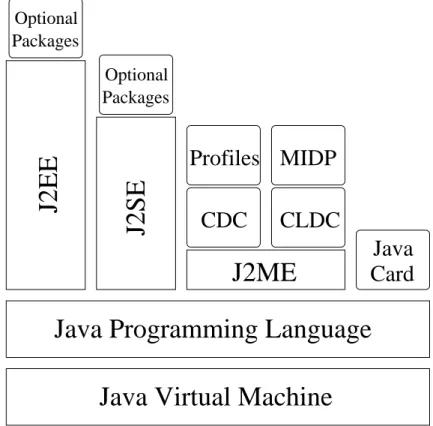
Java systems are currently divided into three major categories, as depicted in Figure 2.1. The largest of these is the Java Enterprice Edition (J2EE) [104], which is targeted for large systems running server software in Java. The Java runtime system found in normal desktop computers is known as Java Standard Edition (J2SE) [105]. Te Java Micro Edition (J2ME) [106] is designed for embedded devices and other resource constrained environ-ments. One more Java variant is the Java Card technology [107], which enables smart cards and other devices with very limited memory to run small Java applications.
The J2ME is further broken down by two criteria, based on the config-uration and profile used for a given device. The configconfig-urations define the minimum subset of Java implemented by a device, while the profiles can add some functionality to a given configuration. A Java ME configuration only defines a minimum complement or the “lowest common denominator” of a given Java technology. All the features included in a configuration must
Packages
Optional
Packages
Optional
Card
Java
J2EE
J2SE
J2ME
CDC
CLDC
Profiles MIDP
Java Programming Language
Java Virtual Machine
Figure 2.1: An overview of the variants for a Java virtual machine.
be generally applicable to a wide variety of devices. This means that the scope of a configuration is limited and often incomplete for any given real target devices. Additional features specific to a certain device, or category of devices, are defined in a profile specification.
2.4.1 Configurations and Profiles in J2ME
Currently there are two commonly used configurations. These are known as the Connected Device Configuration (CDC) and the Connected Limited Device Configuration (CLDC).
Connected Device Configuration is a framework for building a Java vir-tual machine suitable for 32-bit RISC/CISC/DSP microprocessors and a few megabytes of working memory. The applications on embedded devices range from pagers up to set-top boxes and high end PDAs. Three profiles are based on the CDC:
• Foundation Profile
– Java SE-like application programming interface (API) – No graphical user interface (GUI)
• Personal Basis Profile
– Extension to Foundation Profile – Lightweight GUI support
• Personal Profile
– Extension to Personal Basis Profile
– Full AWT (Abstract Window Toolkit) and applet support – Easy to port PersonalJava-based applications
This configuration is intended to be used by devices requiring a complete implementation of the Java virtual machine, and an API set that may, via the addition of profiles, include the entire J2SE API. Typical implemen-tations use some subset of that API depending on the profiles supported. Two commonly used versions are 1.0b and 1.1.2. The CDC 1.0b API [67] is based primarily on the J2SE 1.3 API and it includes all of the Java language APIs defined in the Java ME CLDC 1.0 specification. The CDC 1.1.2 API [68] is based primarily on the J2SE 1.4.2 API and it includes all of the Java language APIs defined in the CLDC 1.1 specification.
The Connected Limited Device Configuration [69] defines a Java virtual machine suitable for 16-bit or 32-bit RISC/CISC microprocessors with a few hundred kilobytes of available memory. Typical applications include mobile phones and lower end PDAs. There are currently three versions available, numbered 1.0, 1.1 and 1.1.1. The first one is the most limited and it has no floating point support. The classes float anddouble are completely removed from the specification. This causes all of the bytecode instructions operating on those data types to be redundant, so they are also removed with support-ing libraries. The CLDC version 1.1 adds the floatsupport-ing point data types and bytecode instructions as well as the supporting library methods in the class-path. The minimum memory budget is grown from 162kb to 190kb. This is mainly due to the added floating point support. Also some classes have been modified to be more compatible with J2SE, including Thread, Calen-dar, Date and TimeZone. The version 1.1.1 is only a maintenance release, and it adds only little to the 1.1 specification. The main difference is the ad-dition of support for certain features of the Java technology security model, to provide a common base of Permission classes. Also some arithmetic func-tions have been added to java.lang.Math2, such as sin, acos, atan and atan2.
2
Only one profile is currently available for the CLDC. It is called “Mo-bile Information Device Profile” (MIDP). Currently, two versions of the MIDP are available, 1.0 and 2.0, with a third version in planning stage. The MIDP profile adds the following characteristics to the CLDC configu-ration: a display with minimum screen-size of 96x54 pixels (which should be approximately square), a keyboard or a touch screen, at least 256 kb of non-volatile memory for the MIDP implementation, 8 kb of non-volatile memory for application-created persistent data and 128 kilobytes of volatile memory for the Java runtime (e.g., the Java heap), networking with limited bandwidth and sound capabilities. This is the minimum set of requirements. Typically mobile phones with a Java virtual machine support this set and often even surpass the requirements.
2.4.2 History
The Java programming language was originally a part of a research project to develop software for network devices and embedded systems. In the be-ginning of the ’90s, Javas predecessor, known as Oak, was created for a device called *7. The *7 was a small SPARC based device with a tiny operating system, much like an early version of a modern PDA. The *7 never made its way to a consumer device, but Oak, renamed to Java, was released in 1995. Java was then intended to be a new language for the Inter-net, and to be integrated into Netscape’s browser. In 1997 Sun announced the PicoJava processor architecture. The PicoJava was supposed to be a standalone Java engine using dedicated hardware, but Sun never actually manufactured these processors. Since then Java has been expanding the application domain steadily, including areas like desktop applications, web servers and server applications. The diverse requirements and capabilities of these application domains caused the separation of the Java standard edi-tion (J2SE) and the enterprise ediedi-tion (J2EE) in 1999. Every new release brought new features to the standard library, thus increasing the size of the runtime system. The growth in the portable device market, ushered by the mobile phone industry, revived Sun’s interest in the embedded systems. Sun defined different subsets of Java for embedded systems and collected them into Java micro edition (J2ME) in 2000. In order to broaden the application domain even further, the Real-Time Specification for Java (RTSJ) [6] was approved in 2002. Since the origins of Java lie in embedded systems and current trends have moved Java to that specific field, one might say that Java is coming home.
2.5
Generic Java Virtual Machine Architecture
The Java virtual machine is a definition of an abstract computing machine that executes bytecode programs. The JVM specification has three major components, namely:
1. Instruction set, called the bytecodes, and their functionality
2. Binary format, known as the class file, containing bytecode segments, symbol table and other ancillary data
3. Verification algorithm, used to verify that a class file contains valid programs
Several properties of the virtual machine are not specified, but rather suggested or left up to the implementors judgment. For instance the garbage collection is left to the implementor to choose. Similarly the execution engine is not specified, just the functionality of the instructions. All this freedom leaves the implementors with room for design decisions that suit the prop-erties of the target device while still maintaining full compatibility with the JVM specification.
2.5.1 Lifespan of the Java Virtual Machine
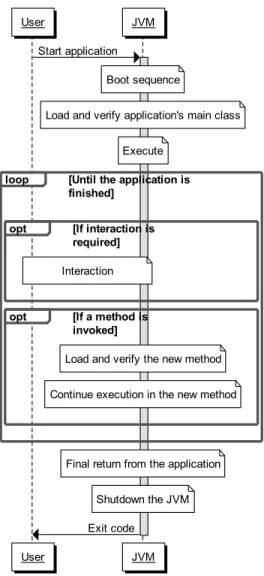
The Java virtual machine is started when the user requests a Java appli-cation to be started. At this time the virtual machine is created, and it performs a boot sequence, much like typical desktop computers. During the boot sequence the virtual machine initializes it’s data areas and sets system values, such as the current time and the time zone. After all these prepara-tions are completed, the virtual machine loads and verifies the main class of the application requested by the user. Then the execution of the application starts. While executing, user interaction may be required. The execution of a Java application usually involves invoking more than just the main method. When a new method is invoked, it is loaded and verified before the execution resumes in the new method. Finally, when the application is completed, the virtual machine performs shutdown. This last phase releases all of the memory areas reserved during the lifespan of the virtual machine. Also open files are closed and, if the virtual machine uses them, locks on resources are released. Then the virtual machine sends an exit code to the underlying system, and is destroyed. A Message Sequence Chart (MSC) of the sequence is shown in Figure 2.2.
Figure 2.2: A MSC of the lifespan of a Java virtual machine.
2.5.2 Data Placement Inside a JVM
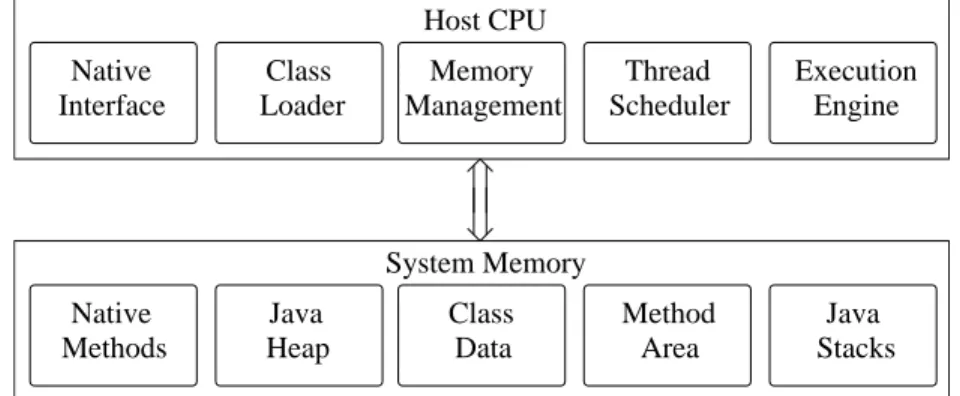
The data inside a JVM is typically placed in different areas depending on the type of the data. This is done in one part to make the structure clearer and in another part to ease the garbage collection process. When different areas are used for the various data types present, only the heap area needs to be collected. The following classification is a typical implementation, several aspects can be varied at the implementors discretion. Figure 2.3 shows the data areas and the software components of a typical implementation of the Java virtual machine.
Class data is an area dedicated for storing class specific information, such as the constant pool data. It also contains the field data for the class. This area is shared between all the threads running in the JVM.
Method area is also shared among the threads. It contains the bytecode implementations of the methods loaded to the JVM. This area provides the instruction streams during the execution of a Java application.
Native method area is similar to the method area, but instead of storing bytecode segments it stores platform dependent native code segments. Like the method area, this area is also shared between the threads.
Java heap is the last shared memory area, and it is used for storing the objects created during the runtime of the Java application. This includes all of the arrays and the other objects. The garbage collector clears any unnecessary objects from this area.
Java stack is private to each thread running on the JVM. In essence this means that every thread has a separate stack instance. A Java stack con-tains stack frame information, actual operand stack and the local variable area of the currently executing method. These items can be placed in any order. The specification does not dictate anything regarding the layout of the data. The operand stack is accessed very frequently during execution, so it should be fast. Methods Native Java Heap Class Data Native Interface Class Loader Memory Management Scheduler Thread Area Method Execution Engine Stacks Java System Memory Host CPU
Figure 2.3: An overview of the data areas and the software components in a Java virtual machine.
2.5.3 Bytecode Instruction Set
The bytecode instruction set contains 201 instructions. All of the Java vari-ants use the same instruction set, save for the smallest ones, which omit the floating point instructions. The bytecode instructions can be grouped into eight categories. Most virtual machine implementations also provide fast versions of some of the instructions. These are typically instructions that might cause a class to be loaded. When the class in question has already been loaded, the instruction will be replaced with the fast version, which does not check whether the class needs to be loaded. These are not part of the standard Java bytecode instruction set. Typically the fast versions are assigned bytecodes above 202. The bytecode instruction set is listed in the Appendix A, followed by the extended instructions used in the REALJava virtual machine.
The load and store categorycontains instructions that transfer data from local variables to the stack (load) or in the other direction (store). This category contains all together 70 instruction, but many of them have the same implementation. This is caused by the fact that the instructions contain type information of the data being transferred. For instance the
iload and the fload both transfer a 32-bit data item, and the type of the data item has no significance other than making verification possible. The large number of instructions in this group is an indication of their frequency in Java applications.
The arithmetic-logical categorycontains data manipulation instruc-tions. These operate on the data found in the Java stack. Usual cycle is to pop the top two elements of the stack, perform an operation on them and then store the result back to the top of the stack. These instructions are also typed, and here the type information is actually meaningful. For instance the addition of two integers, iadd, and the addition of two floats,
fadd, are completely different in implementation point of view. Even though the JVM supports types shorter than 32 bits (byte, short and char), there are no arithmetic-logical instructions for them. Instead they are calculated using operations for integers and then the result must be explicitly con-verted to the correct type. The Java compiler includes these conversions automatically, and the programmers do not need to consider it 3. Oddly, the comparisons that take floating point data types or long integers as inputs are part of this category. Those instructions pop the values to be compared, and then push an integer whose value tells the result of the comparison.
3
Of course the additional conversion has an effect on the performance, but the func-tionality will be correct.