Relationship of Dental Practitioners to the
Primary Care Network in Rural and Remote
Queensland and the Application of
Technology in the Management of Dental
Problems
by
Jacqueline Christine Stuart BDSc
Submitted in fulfilment of the requirements for the degree of
Doctor of Philosophy
Centre for Rural Health, University of Tasmania
Sixteenth of October 2018
i
Declaration of Originality
I, Jacqueline Christine Stuart, am the author of the thesis titled “Relationship of dental practitioners to the primary care network in rural and remote Queensland and the application of technology in the management of dental problems” submitted for the degree of Doctor of Philosophy. I declare that the material is original, and to the best of my knowledge and belief, contains no material previously published or written by another person, except where due acknowledgement is made in the text of the thesis, nor does the thesis contain any material that infringes copyright. The thesis contains no material which has been accepted for a degree or diploma by the University or any other institution.
ii
Statement of Authority of Access
I, Jacqueline Christine Stuart author of the thesis titled “Relationship of dental practitioners to the
primary care network in rural and remote Queensland and the application of technology in the
management of dental problems” submitted for the degree of Doctor of Philosophy, agree that this thesis may be made available for loan and limited copying and communication in accordance with the Copyright Act 1968.
iii
Statement regarding lectures resulting from this
thesis and the published work.
Presentations
The primary care network participants interviewed for this research project expressed their need for upskilling in emergency dental presentation management techniques and consequently the
candidate has developed and presented a series of presentations, in a volunteer capacity, from 2015 to 2018 throughout Queensland and Tasmania. The details of these presentations are as follows;
Date Title Organisation and
Location
Audience
6-12-2018 Emergency dental presentations to the medical practitioner & their management options.
Mackay General Medical Practitioner Training Program College of Medicine & Dentistry Division of Tropical Health & Medicine James Cook University.
Medical Registrars
2-09-2018 Connecting Oral Health into the overall medical health puzzle North Queensland Primary Health Network 2018 Conference Mackay General Medical Practitioners & other Allied Health Care Providers 7-06-2018 A workshop,
demonstrating practical emergency dental
techniques for the general medical practitioner
The Rural Doctors Association Queensland GMT18 conference for Queensland in association with Dental School at James Cook University in Cairns, Queensland. General Medical Practitioners
iv
8-06-2018 Emergency dentalpresentations to the medical practitioner & their management options.
The Rural Doctors Association Queensland GMT18 conference for Queensland in association with Dental School at James Cook University in Cairns, Queensland. General Medical Practitioners 30-05-2018 31-05-2017 25-05-2106 27-05-2015 Emergency dental
techniques for the general medical practitioner & their management options & Oral presentations of medical conditions.
College of Medicine & Dentistry Division of Tropical Health & Medicine James Cook University.
All final year/sixth year medical students at James Cook University
24-01-2018 Emergency dental presentations to the medical practitioner & their management options.
Generalist Medical Training Program in Cairns Medical Registrars 8-12-2017 Emergency dental presentations to the medical practitioner & their management options.
Generalist Medical Training Program in Toowoomba Medical Registrars 5-09-2017 Emergency dental presentations to the medical practitioner & their management options.
Generalist Medical Training Program in Mackay.
College of Medicine & Dentistry Division of Tropical Health and Medicine James Cook University. Medical Registrars 9-05-2017 10-05-2017 11-05-2017 16-05-2017 17-05-2017 18-05-2017 30-05-2017 Emergency dental presentations to the [General Medical Practitioner, Pharmacist or Allied Health Care
provider] & their management options.
Presentations in Cairns, Townsville & Mackay for the North Queensland Primary Health Network
General Medical Practitioners, Pharmacists & Allied Health Care Providers
v
31-05-20171-06-2017
29-10-2016 Emergency dental
techniques for the general medical practitioner & Oral presentations of medical conditions. The Medical Practitioners Association Hospital Services Emergency Medicine Workshop in Mackay General Medical Practitioners 20-07-2016 Emergency dental
techniques for the general medical practitioner & Oral presentations of medical conditions. “Rural Rounds” VCR linkup throughout Northern Queensland on the topics Queensland Rural General Medical Practitioners
26-11-2015. Does the relationship between the primary medical care network & dental practitioners affect patient care in rural and remote Queensland? Could technology help this communication? Melbourne, Rural Health Workforce Australia (RWHA) Dental Research Exchange Leaders in policy making decision for rural & remote health issues
29-05-2015 27-05-2015
Emergency dental techniques for the Pharmacist & Oral presentations of medical conditions. PSA (Pharmaceutical Society of Australia) in Launceston & Hobart, Tasmania, Pharmacists
Journal Articles
• Stuart, J., Hoang, H., Crocombe, L., & Barnett, T., (2017). “Relationships between dental personnel and non-dental primary health care providers in rural and remote Queensland, Australia: dental perspectives”. BMC Oral Health, 17 (1) Article 99. doi:10.1186/s12903-017-0389-y ISSN 147-6831 (2017) [Referred Article] 70:10:10:10
• Barnett, T., Hoang, H., Stuart, J., & Crocombe, L., (2017). “The relationship of primary care providers to dental practitioners in rural and remote Australia “, BMC Health Services Research, 17 Article 515. doi:10.1186/s12913-017-2473-z ISSN 1472-6963 (2017)Z [Refereed Article]25:25:25:25
vi
• Barnett, T., Hoang, H., Stuart, J., & Crocombe, L. (2016). “"Sorry, I'm not a dentist":
perspectives of rural GPs on oral health in the bush”Medical Journal of Australia, 204(1), 26. E1-26.e6 doi:10.5694/mja15.00740 ISSN 0025-729X (2016) [Refereed Article]25:25:25:25 • Barnett, T., Hoang, H., Stuart, J., &Crocombe, L. (2015). “Non-dental primary care providers'
views on challenges in providing oral health services and strategies to improve oral health in Australian rural and remote communities: a qualitative study”,British Medical Journal Open, 5, pp. 1-8. Article e009341. doi: 10.1136/bmjopen-2015-009341 ISSN 2044-6055 (2015) [Referred Article] 25:25:25:25
• Barnett, T., Hoang, H., Stuart, J., Crocombe, L. & Bell, E. (2014). “Utilisation of oral health services provided by non-dental health practitioners in developed countries: a review of the literature”. Community Dental Health, 31(4), 224-233. Doi:10.1922/CDH 3465Hoang10 ISSN 0265-529X(2014) [Referred Article]20:20:20:20:20
Conference Publications
• Barnett, T and Hoang, H and Stuart, Jand Crocombe, L and Page, S, “Dental extremes; they pull out their own teeth in the bush””, 34th Annual CRANAplus Conference 2016, Going to extremes: how isolation, geography and climate, built resourcefulness and innovation in healthcare, 12-14 October, 2016, Hobart, Tasmania (2016) [Conference Abstract] 20:20:20:20:20
• Barnett, A and Hoang, H and Stuart, J, “Dental care in small remote towns in Queensland”,
23-26 August, 2015, Dunedin, NZ, pp.39. (2015) [Plenary Presentation delivered by A/Professor Leonard Crocombe] 15:15:70
• Hoang, H and Barnett, A and Stuart, Jand Crocombe, L and Page, S, “Primary care providers’
strategies on how to fix the oral health crisis in the bush”, 6-9 September, 2015, Hobart, Tasmania (2015) [Plenary Presentation] 20:20:20:20:20
vii
• Barnett, T., Hoang, H., Stuart, J., & Crocombe, L. (2016). “Relationship of dental practitioners to rural primary care networks”. Centre of Research Excellence in Primary Oral Health Care [Government or Industry Research] 25:25:25:25
• Stuart, J. (2014). “On the Wallaby” with University of Tasmania’s Department of Rural
Health. Article published in Australian Dental Association State Newsletters for Queensland Feb 2014 and in Tasmania December 2013.
Statement of Co-Authorship
The following people contributed to the publication of the works undertaken and listed as part of this thesis.
We the undersigned agree with the previously stated “proportion of work undertaken” for each of
the above published (or submitted) peer-reviewed manuscripts contributing to this thesis:
A/Professor Tony Barnett Primary Supervisor
Department of Rural Health University of Tasmania
Signed: Date: 16-10-2018
Professor Nuala Byrne Head of School
Department of Rural Health University of Tasmania
viii
Dr Ha HoangSupervisor
Department of Rural Health University of Tasmania
Signed: Date: 16-10-2018
A/Professor Leonard Crocombe Supervisor
Department of Rural Health University of Tasmania
ix
Statement of Ethical Conduct
The research associated with this thesis abides by the international and Australian codes on human
and animal experimentation, and the guidelines by the Australian Government’s Office of the Gene
Technology Regulator and the rulings of the Safety, Ethics and Institutional Biosafety Committees of the University.
This study was approved by the Tasmanian Health and Medical Human Research Ethics Committee [reference number: H0013217].
Approval to interview participants from communities E,F, and G was given by the Director of Medical Services for Central Western Queensland, Dr David Rimmer.
Approval to interview oral health care providers from the NGO Mobile Dental Service was given by the Royal Flying Doctors Association Research Committee in February 2015.
x
Acknowledgements
The research reported in this thesis is a project of the Australian Primary Health Care Research
Institute (APHCRI), which is supported under the Australian Government’s Primary Health Care
Research, Evaluation and Development Strategy. The information and opinions contained in it do not necessarily reflect the views or policy of the Australian Primary Health Care Research Institute (APHCRI) or the Department of Health. This thesis has been completed as part of the research program of the Centre for Research Excellence in Primary Oral Health Care, funded by APHCRI. The candidate is grateful for the assistance of the many rural and remote dental and non-dental health care providers in Queensland who participated in this research by sharing their views and experiences, and by providing advice relevant to this research. It is important to specifically acknowledge the co-operation from;
• The Australian Primary Health Care Research Institute for funding this study. • The members of our National Advisory Committee for their active and enthusiastic
participation.
• The Chief Dental Officer of Queensland - who helped identify study sites for this project. • The Royal Flying Doctors Association for allowing the candidate to interview dental
personnel.
The candidate would like to thank the support team who made the journey in writing this thesis possible. Thanks must go to my exceptional supervisors Associate Professor Tony Barnett, Dr Ha Hoang and Associate Professor Leonard Crocombe. Thank you also to my brother Mark Kirschbaum, who continuously motivated me to expand on my professional involvement in the medical and dental environments and who unfailingly encouraged me to strive for academic excellence. To my husband Paul who unceasingly supported me and always inspires me. I love you more than I could
ever write in one small paragraph. Finally, to my three grown sons, who didn’t believe I could ever do this. To them I say …… never give up, always keep moving onwards and upwards. I hope I have
taught you the value of curiosity, hard work, perseverance and to never underestimate your mother!
xi
Table of Contents
DECLARATION OF ORIGINALITY ... I STATEMENT OF AUTHORITY OF ACCESS ... II STATEMENT REGARDING LECTURES RESULTING FROM THIS THESIS AND THE PUBLISHED WORK... III STATEMENT OF CO-AUTHORSHIP ... VII STATEMENT OF ETHICAL CONDUCT ... IX ACKNOWLEDGEMENTS ... X TABLE OF CONTENTS... XI LIST OF FIGURES ... XVIII LIST OF TABLES... XIX ABSTRACT ... XXI GLOSSARY ... XXIII
1CHAPTER ONE: INTRODUCTION... 1
1.1 BACKGROUND AND RATIONALE OF THE STUDY ... 2
1.1.1 Researcher’s reflexivity and contribution to original research ... 4
1.2 RESEARCH AIM AND RESEARCH QUESTIONS ... 5
1.3 STUDY SETTING:QUEENSLAND ... 6
1.4 ORAL HEALTH SERVICE ARRANGEMENTS IN AUSTRALIA AND QUEENSLAND ... 7
1.4.1 Dental workforce in Australia and Queensland... 8
1.4.2 Dental workforce ... 9
1.5 THE RURAL PRIMARY CARE NETWORK IN AUSTRALIA AND QUEENSLAND ... 12
1.5.1 Rural Primary Care Providers ... 12
1.5.2 Primary Care Networks in Queensland ... 13
1.6 OVERVIEW OF THE METHODOLOGY ... 13
1.7 STRENGTHS AND LIMITATIONS ... 15
1.8 STRUCTURE OF THE THESIS ... 16
1.8.1 Chapter 1 – Introduction ... 16
xii
1.8.3 Chapter 3 – Research Methodology ... 17
1.8.4 Chapter 4 – Results ... 17
1.8.5 Chapter 5 – Discussion ... 17
1.8.6 Chapter 6 – Conclusion ... 18
1.9 CONCLUSION ... 18
2CHAPTER TWO: A REVIEW OF THE LITERATURE... 19
2.1 INTRODUCTION ... 19
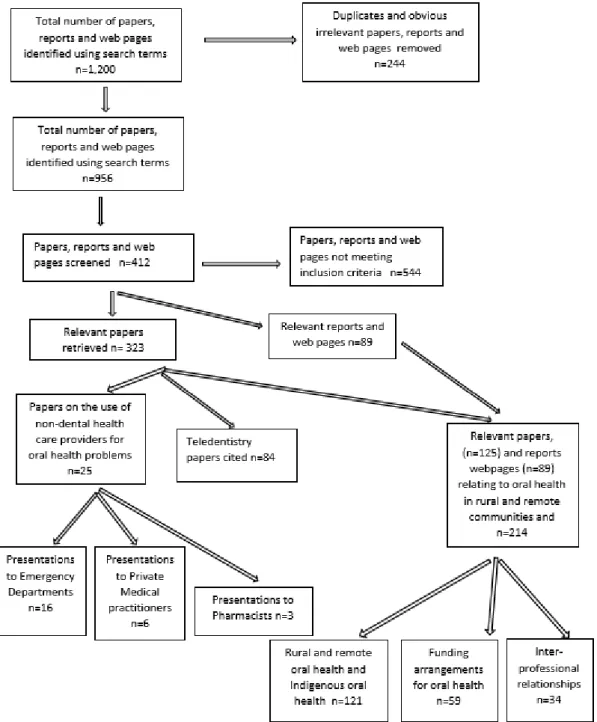
2.2 LITERATURE REVIEW METHODS ... 19
2.2.1 Search strategy ... 20
2.2.2 Search results ... 20
2.3 ORAL HEALTH IN RURAL AND REMOTE AUSTRALIA... 23
2.3.1 Oral Health in Rural and Remote Queensland ... 24
2.4 INDIGENOUS ORAL HEALTH IN AUSTRALIA ... 24
2.4.1 Indigenous oral health in rural and remote Queensland ... 25
2.5 ORAL HEALTH FUNDING ARRANGEMENTS IN AUSTRALIA... 26
2.5.1 Oral health funding arrangements in Australia ... 26
2.5.1.1 Privately Funded Dental Care ... 27
2.5.1.2 Federal Government Funded Dental Care ... 27
2.5.1.3 Queensland Government oral health funding schemes ... 29
2.6 ORAL HEALTH PRESENTATIONS TO NON-DENTAL HEALTH PROVIDERS ... 30
2.6.1 Global perspective ... 30
2.6.2 Australian Perspective ... 31
2.7 INTER-CONNECTION BETWEEN ORAL AND MEDICAL HEALTH ... 32
2.7.1 Psycho-social impacts on patients who are unable to access timely dental care ... 33
2.7.2 Oral Health Education for Non-Dental Primary Care Providers ... 34
2.7.2.1 Multidisciplinary university education ... 35
2.7.2.2 Post graduate education ... 36
2.7.3 Nature of interprofessional collaborations ... 39
2.7.3.1 Collaborations with medical practitioners... 40
2.7.3.2 Collaborations with pharmacists ... 41
2.7.3.3 Collaborations with other allied health care providers ... 42
2.7.4 Referral pathways ... 43
2.8 TELEDENTISTRY ... 44
2.8.1 The evolution of teledentistry ... 45
2.8.2 Population groups to benefit from teledentistry ... 47
xiii
2.8.3.1 Time-delayed/store-and-forward teledentistry ... 50
2.8.3.2 “Real-time” teledentistry ... 50
2.8.3.3 Digital Dental Images ... 51
2.8.4 Ethical and security based considerations for teledentistry... 53
2.8.5 Cost saving with teledentistry ... 55
2.8.6 Teledentistry for education ... 55
2.8.7 Patient acceptance of teledentistry ... 56
2.9 CONCEPTUAL FRAMEWORK ... 56
2.10 CONCLUSIONS ... 58
3CHAPTER THREE: METHODOLOGY ... 61
3.1 INTRODUCTION ... 61
3.2 RESEARCH PARADIGM AND APPROACH ... 62
3.3 RESEARCH DESIGN ... 64
3.3.1 Case study design ... 64
3.3.1.1 Setting for this study ... 66
3.3.2 Sampling and recruitment... 67
3.3.2.1 Rural and remote definitions ... 67
3.3.2.2 Inclusion criteria for study sites ... 68
3.3.2.3 Recruitment of study sites ... 68
3.3.2.4 Recruitment of participants ... 72
3.3.3 Data collection procedures ... 73
3.3.3.1 The interview guide ... 73
3.3.3.2 Semi-structured interviews ... 74
3.3.4 Data analysis ... 77
3.3.4.1 Reliability and validation strategies ... 78
3.4 ETHICAL APPROVAL AND ISSUES ... 80
3.4.1 Ethical considerations ... 81
3.4.2 Ethics Research Approvals ... 81
3.4.2.1 Health and Medical Human Research Approval ... 82
3.4.2.2 Executive Director of Medical Services Approval ... 82
3.4.2.3 Non-Government Organisation Approval ... 82
3.4.3 Ethical Procedural Design ... 82
3.4.3.1 Participant protection ethics ... 83
3.4.3.2 Data storage ethics ... 83
3.4.3.3 Sharing research discoveries ... 84
3.5 SUMMARY ... 84
xiv
4.1 RESULTS CASE STUDY 1:QUEENSLAND DISTRICT 1 ... 88
4.1.1 Characteristics of oral health service provision in Case Study 1 ... 88
4.1.2 Characteristics of the participants ... 90
4.1.3 Themes and subthemes ... 91
4.1.3.1 Challenges Faced ... 92
4.1.3.2 Communication and referral pathways ... 102
4.1.3.3 Interest in Teledentistry to enhance interprofessional collaboration ... 109
4.1.3.4 Strategies to improve oral health access and provision ... 112
4.1.4 Summary ... 125
4.2 RESULTS CASE STUDY 2:QUEENSLAND DISTRICT 2 ... 128
4.2.1 Introduction ... 128
4.2.2 Characteristics of oral health service provision in Case Study 2. ... 129
4.2.3 Characteristics of the participants ... 132
4.2.4 Themes and subthemes ... 133
4.2.4.1 Challenges to Effective Oral Health Care Service and Provision... 134
4.2.4.2 Communication and referral pathways ... 147
4.2.4.3 Interest in Teledentistry ... 151
4.2.4.4 Strategies to improve oral health care service and provision ... 153
4.2.5 Summary ... 166
4.3 RESULTS CASE STUDY 3:NGOMOBILE DENTAL SERVICE (MDS). ... 169
4.3.1 Characteristics of oral health delivery services in Case Study 3. ... 171
4.3.2 Characteristics of the participants ... 172
4.3.3 Themes and subthemes ... 174
4.3.3.1 Challenges to effective oral health care provision by the NGO Mobile Dental Service. ... 175
4.3.3.2 Influence of visits by the NGO MDS on rural communities... 189
4.3.3.3 Communication and referral pathways ... 192
4.3.3.4 Interest in teledentistry ... 206
4.3.3.5 Strategies to improve the oral health care provision. ... 209
4.3.4 Summary ... 219
5CHAPTER FIVE: DISCUSSION ... 224
5.1 ORAL HEALTH IN THE EIGHT RURAL AND REMOTE QUEENSLAND COMMUNITIES... 225
5.2 RESEARCH QUESTION 1 ... 225
5.2.1 Challenges to effective oral health care provision and access across all eight rural and remote Queensland communities ... 226
5.2.1.1 Dental workforce shortages ... 226
5.2.1.2 Relative costs of dental treatments ... 227
xv
5.2.2 The challenges of poor oral health on people’s lives ... 228
5.2.3 The challenges for the management of oral health issues by non-dental primary care providers ... 229
5.2.4 Challenges to effective oral health care provision by Dental Practitioners ... 230
5.2.4.1 Private Oral Health Care Delivery Models ... 231
5.2.4.2 Indigenous oral health care services ... 233
5.2.4.3 Government/ Public Health Services ... 233
5.2.4.4 NGO Mobile Dental Service ... 234
5.2.5 Specific challenges to effective oral health service provision by Case Study ... 234
5.2.5.1 Challenges for Case Study 1 ... 235
5.2.5.2 Challenges for Case Study 2 ... 236
5.2.5.3 Challenges for Case Study 3 ... 237
5.3 RESEARCH QUESTION 2 ... 239
5.3.1 Interprofessional communications ... 239
5.3.1.1 The community based “lynch pin” person ... 241
5.3.1.2 Government Dental Practitioners and the Rural Primary Care Network Participants ... 242
5.3.1.3 Private Dental Practitioners and the Rural Primary Care Network Participants... 242
5.3.1.4 NGO MDS Dental Personnel and the Rural Primary Care Network Participants ... 243
5.3.1.5 NGO MDS and Incumbent Dental Practitioners ... 243
5.3.2 Referral Processes and Pathways ... 244
5.3.2.1 Referral processes in Case Study 1 ... 245
5.3.2.2 Referral processes in Case Study 2 ... 245
5.3.2.3 Referral processes in Case Study 3 ... 246
5.4 RESEARCH QUESTION 3 ... 246
5.4.1 Preventative oral health strategies ... 247
5.4.1.1 Oral Health promotion ... 247
5.4.1.2 Water Fluoridation ... 248
5.4.2 Building the capacity of rural primary care practitioners ... 248
5.4.3 Alternative dental service delivery models ... 251
5.4.3.1 A mixed public and private oral health care delivery model... 252
5.4.3.2 Increased utilisation of auxiliary oral health care providers ... 253
5.4.3.3 Mobile oral health service delivery model ... 254
5.4.3.4 Indigenous Services Mobile Dental Service ... 254
5.4.3.5 The NGO Mobile Dental Service ... 254
5.4.3.6 Providing transportation for the patients to oral health services ... 255
5.4.3.7 Utilisation of Undergraduate Dental Students ... 255
5.4.4 Encouraging recruitment and retention of dental practitioners. ... 256
5.4.5 Improving interprofessional relationships ... 257
xvi
5.4.5.2 Establishing and maintaining effective communication and referral pathways ... 258
5.4.5.3 Having a community based oral health contact person ... 259
5.4.6 Strategies to improve oral health care access in each case study ... 260
5.4.6.1 Case Study 1 ... 260
5.4.6.2 Case Study 2 ... 261
5.4.6.3 Case Study 3 ... 262
5.5 RESEARCH QUESTION FOUR ... 263
5.5.1 Teledentistry/Intraoral cameras... 263
5.5.2 Teleconferencing with dental professionals ... 265
5.6 REVIEW OF THE CONCEPTUAL FRAMEWORK ... 266
5.7 SUMMARY ... 268
6CHAPTER SIX: CONCLUSION ... 272
6.1 SUMMARY OF FINDINGS IN RELATION TO THE LITERATURE REVIEW ... 272
6.1.1 RQ1: What are the barriers and challenges to effective oral health care provision and access in the eight communities studied? ... 273
6.1.2 RQ2: What is the relationship that exists between dental practitioners and the non-dental primary care network? ... 276
6.1.2.1 The relationship with government oral health service providers. ... 277
6.1.2.2 The relationship with private dental practitioners... 277
6.1.2.3 The relationship with the NGO Mobile Dental Service (MDS) dental personnel ... 277
6.1.3 RQ 3: What strategies have been suggested to improve oral health in the rural and remote regions examined? ... 278
6.1.4 RQ4: What is the level of interest in utilisation of technology by non-dental practitioners and dental practitioners in management of dental problems? ... 278
6.2 RECOMMENDATIONS ... 280
6.2.1 Increase the dental workforce ... 280
6.2.2 Build the capacity of non-dental rural primary care practitioners ... 280
6.2.3 Provide alternative dental service delivery models ... 281
6.2.4 Provide preventative oral health care ... 281
6.2.5 Improve interprofessional relationships ... 281
6.3 SPECIFIC RECOMMENDATIONS TO IMPROVE THE ORAL HEALTH CARE ACCESS FOR EACH ORAL HEALTH CARE DELIVERY MODEL FROM THE THREE CASE STUDIES ... 282
6.4 RECOMMENDATIONS IN RELATION TO APPLICATIONS FOR DENTAL TECHNOLOGIES CURRENTLY. ... 282
6.5 SIGNIFICANCE OF THE RESEARCH ... 282
6.6 AN IDEAL ORAL HEALTH DELIVERY MODEL FOR THE BUSH? ... 284
xvii
6.8 STRENGTHS AND LIMITATIONS OF THE RESEARCH ... 287
6.9 FUTURE RESEARCH ... 288
6.10 CONCLUSION ... 290
REFERENCES ... 292
APPENDIX A:OTHER FEDERAL GOVERNMENT FUNDED ORAL HEALTH SCHEMES ... 315
APPENDIX B:ORAL HEALTH FUNDING ARRANGEMENTS IN OTHER COUNTRIES ... 321
APPENDIX C:MANAGING AND ANALYSING QUALITATIVE DATA USING NVIVO10 SOFTWARE.324 APPENDIX D:ETHICS APPROVAL AND AMENDED APPROVAL DOCUMENTATION ... 327
APPENDIX E:INVITATION LETTER TO PARTICIPANTS ... 330
APPENDIX F:INFORMATION SHEET ... 332
APPENDIX G:INTERVIEW GUIDE ... 335
xviii
List of Figures
Figure 1.1: Australian Statistical Geography Standard remoteness structure 2011 ... 7
Figure 1.2: Distribution of dental practitioners across Australia by roles ... 11
Figure 1.3: Distribution of dental workforce across Queensland ... 11
Figure 1.4: The location of rural and remote classified Primary Health Care Facilities by type in Queensland ... 14
Figure 2.1: Review process of published papers from January 1990- December 2017 ... 21
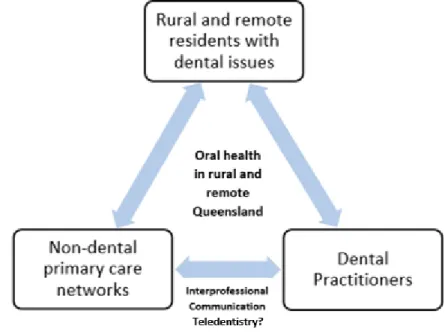
Figure 2.2: Conceptual Framework ... 57
Figure 3.1: The eight de-identified Queensland communities studied Towns A-H ... 69
Figure 4.1: Map of the location of the four de-identified communities included in Case Study 1. .... 90
Figure 4.2: Map of the three communities examined from Case Study 2. ... 130
Figure 4.3: Case Study 3 - The communities serviced by the NGO MDS in 2015 ... 170
Figure 5.1: The original conceptual framework before data collection ... 267
Figure 5.2: Modified Conceptual Framework demonstrating broken lines in communication. ... 268
Figure AC.1: Nvivo 10 representation, Case Study 1 ... 326
xix
List of Tables
Table 1.1: Registered dental practitioners per 100,000 population, by practitioner type and
remoteness area ... 9
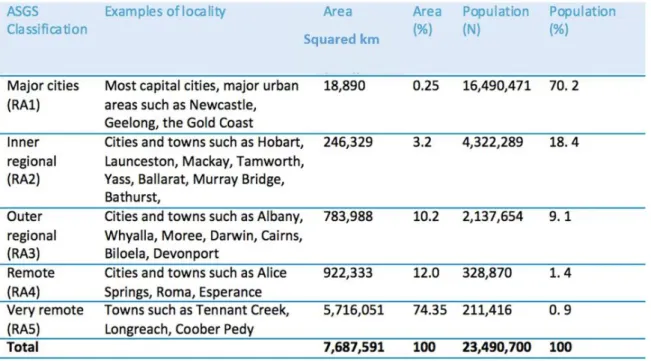
Table 3.1. Area of Australian land mass, and population, by ASGS Classification ... 67
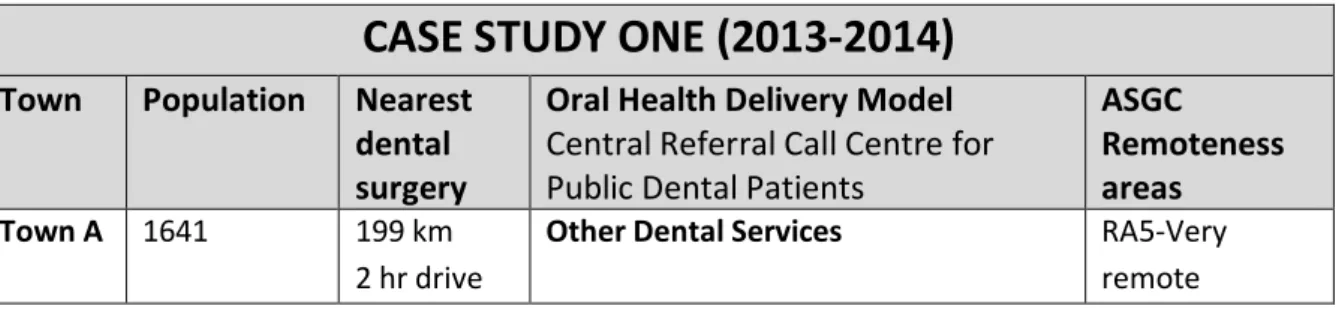
Table 3.2 Characteristics of the three case studies with different oral health delivery models ... 70
Table 3.3: Interview guide ... 73
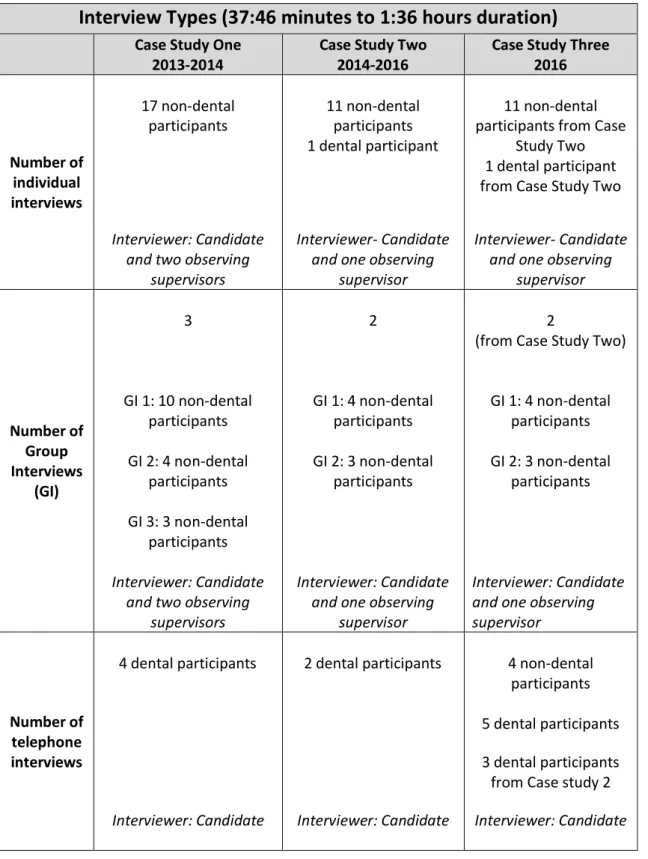
Table 3.4: Types of interviews and the number of participants in each interview type ... 76
Table 4.1: Characteristics of participants in Case Study 1 (n=39) ... 91
Table 4.2: Common Themes and Subthemes for Case Study 1 ... 92
Table 4.3: Frequency of oral health presentation to non-dental care providers... 94
Table 4.4: Characteristics of participants in Case Study 2 (n=24) ... 132
Table 4.5: Common Themes and Subthemes for Case Study 2 ... 133
Table 4.6: Frequency of oral health presentation to non-dental care providers... 145
Table 4.7: Characteristics of new participants in Case Study 3 (n=8)... 173
Table 4.8: Themes and Subthemes for Case Study 3 ... 174
Table 6.1: Barriers and challenges to oral health and strategies to improve oral health care service delivery in rural and remote Queensland. ... 274
Table 6.2: Barriers and challenges to oral health workforce shortages and strategies to increase the dental workforce ... 274
Table 6.3: Barriers and challenges to oral health delivery models and strategies to improve oral health care service delivery for each of the three case studies ... 275
Table 6.4: Barriers and challenges for the use of intraoral cameras in medical practice for remote diagnosis of dental issues (teledentistry) and strategies to utilise this technology... 279
xxi
Abstract
Oral health and access for oral health services for residents in rural and remote Australian communities is often poorer than for those living in capital cities. People who have difficulty in accessing timely oral health care often present to non-dental primary care providers in hospital emergency departments, medical practices, pharmacies and Indigenous health centres for
management of dental problems. However, these non-dental primary health care providers may not have the skills to deal with dental issues and can often only provide temporary, palliative relief. This study examined the extent to which oral health problems impact on service provision by non-dental primary health care providers in eight rural and remote Queensland communities. The study identified the challenges that residents face to timely oral health care access and the strategies most likely to be effective in improving oral health care access for these people. The effects on patient oral health outcomes of interprofessional relationships between the non-dental primary care networks and oral health care practitioners were explored, and the interest in the use of technology by non-dental primary care providers to manage oral health issues is assessed.
Eight Queensland communities were purposively selected as they did not have a resident dental practitioner but had an active non-dental primary care network. Three different models of oral health care delivery service were examined in three descriptive case studies. Semi-structured face to face and telephone interviews were conducted with 12 dental and 55 non-dental primary care providers. The transcribed interviews were analysed using thematic analysis with the assistance of a computer software package Nvivo 10.
This study found that the barriers to effective oral health care access include: (1) dental workforce shortages; (2) the patient costs of accessing oral health care in relation to travel, time off work and the actual cost of the treatment itself; (3) the lack of oral health awareness of residents; (4) poor oral health preventative strategies; (4) poor oral health promotional strategies; and (5) lack of oral health funding. Each of the three examined oral health care service models had challenges which were specific to their situations and strategies to overcome these barriers were explored. The nature of the relationships between non-oral health care practitioners and oral health care
practitioners were generally described as “poor at best” and often “non-existent”. This was
attributed in part to high staff turnovers and the transient nature of locum medical practitioners and pharmacists. The siloed behaviours of both the dental and non-dental care providers further
xxii
The interest of both dental and non-dental primary care providers, for the potential of intraoral cameras in medical practice to allow remote diagnosis of dental images by dental practitioners was explored. A number of practicalities were identified such as poor internet speed capabilities, personnel training requirements and the time constraints experienced by rural and remote primary health care providers.
Strategies to improve access to oral health services included: (1) increasing the dental workforce; (2) building the oral health care provision capacity of non-dental primary care providers; (3) providing alternative oral health service delivery models; (4) providing preventative oral health care; and (5) encouraging better interprofessional communication and collaborations between non-dental rural primary care networks and oral health care practitioners.
As the internet and telecommunications networks improve in rural and remote Queensland, further research should be undertaken to re-examine the interest in the applications for teledentistry to improve rural and remote oral health services. Further research could explore patient experiences around the issues of poor access to oral health services, including low socio-economic and
Indigenous peoples’ oral health access experiences. Revisiting the communities examined in this project into the future, with a study that uses a co-design intervention approach, would be an area for future research. It would also be of value to also explore the effects that the expected surplus of dental graduates towards 2020 might have on oral health in rural and remote Queensland into the future.
xxiii
Glossary
Comprehensive Oral Health Care: This type of oral health care provides definitive oral health care and includes comprehensive treatment planning, root canal therapies, crown and bridge procedures, implants, orthodontics and denture constructions.
CPD (Continuing Professional Development): Continuing Professional Education Points are a requirement for continuation of registration for medical and dental care providers to ensure competence and maintenance of currency of knowledge.
Dental Assistants:
also called dental nurses have the role of preparing patients for dental
examinations and of assisting dentists and other dental care providers in providing oral health care to patients.
Dental Hygienists:
perform various preventative treatments and to aid in the education and
implementation of oral hygiene needs of a patient.Dental Prosthetists: are qualified dental technicians who are registered with the Dental Board of Australia and have completed further dental studies to enable them to work directly with clients for the construction and maintenance of removal prosthetic appliances or dentures.
Dental Technicians:roles are to make and repair dentures (full and partial) and other dental appliances.
Dental Therapists:work within their scope of practice as dental allied health care providers and provide basic dental treatments to children such as dental check-ups, filling and baby teeth extractions.
Dental Workforce: A workforce providing oral health care which consists of dentists, oral health therapists, dental therapists, dental hygienists, dental technicians and dental assistants.
Dentists: Tertiary qualified dental practitioners who act as the team leader in the dental workforce and provide oral health care services to adults and children. They may pursue further education in specialist areas of dental care.
Dental Personnel: People who work in the oral health care service in either a clinical, assisting or practice managing and organisational role.
Dental Practitioners: dentists and oral health therapists who provide clinical oral health care directly to patients.
Dental Technology: Intraoral cameras utilised in teledentistry which are networked across telecommunication networks.
xxiv
DON (Director of Nursing): A registered nurse who supervises the care of all the patients at a health care facility. The director of nursing is person responsible for communicating between
the nursing staff and the physicians at a health care facility.
DRISS (Dental Relocation Infrastructure Scheme): A government initiative to offer dental practitioners substantial funding grants to establish new practices in rural Australia.
Emergency dental care: This type of dental care consists of emergency intervention for the relief of dental disease symptoms. It may involve temporary restoration, extraction or the removal of the nerve of the tooth. It does not include comprehensive oral health care.
eHealth: refers to the use of communications technologies and information in healthcare. Fluoride: A naturally occurring element found in existing water supplies. Fluoride helps
prevent tooth decay by making the tooth more resistant to acid attacks from plaque bacteria as also reversing early decay. Fluoridation of town water supplies is recognised world-wide as the safest preventative oral health care strategy.
Indigenous oral health care services: Provide oral health care to Aboriginal and Torres Strait Islander peoples.
Intraoral cameras: Small networkable cameras that are placed inside the mouth of a patient to take still or video images of teeth and oral tissues.
Medicare: Australia’s universal health care system where all Australians contribute to the cost of health care according to their incomes via income tax and a Medicare levy. Dentistry is generally not covered under Medicare although some rare exceptions do exist, such as for cleft palate surgery and certain government funded schemes.
NBN (National Broad Band Network): A national telecommunications infrastructure project designed to meet the rapidly expanding demand for internet access across the whole of Australia replacing the existing telephone network copper cables which are nearly worn out.
ND-RPCN (Non-Dental Rural Primary Care Network): A network of non-dental primary care health care providers who provide health care to rural and remote residents. The members of each network may vary, with some specialist practitioners flying in and flying out as required. The ND-RPCN may consist of General Medical Practitioners, Pharmacists, Directors of Nursing (DONs), Nurse
Unit Managers (NUMs), general nurses, women’s health nurses, speech pathologists, child and
community health nurses, mental health nurses and Indigenous health workers. The members of each network may vary, with some specialist practitioners flying in and flying out as required. NGO-Mobile Dental Service/ NGO MDS (Non-government organisation Mobile Dental Service): A philanthropic mobile dental service, jointly funded by a Queensland private mining company and a non-government organisation. It provides dental services to selected Queensland communities that have limited access to oral health care facilities.
xxv
NUM (Nurse Unit Manager): Refers to a registered nurse at managerial level who has completed formal nursing training and is responsible for coordinating patient services and supervising the staff in the hospital.
OHTGYP (Oral Health Therapist Graduate Year Program): The OHTGYP provided oral health
therapist graduates with a structured programme for enhanced practice experience via public sector placements in areas of need, such as rural and regional locations. The program ended in 2015. Oral Health Care Practitioners (Dental Auxiliaries): Those other oral health care providers who are not dentists which include: dental hygienists, dental therapists, oral health therapists, dental technicians and dental assistants.
Oral Health Therapists:Tertiary qualified personnel who are limited to the practice of dental hygiene, dental therapy on children and oral health promotion with education in both private and public forums.
Preventative dental care: This type of care may prevent the development of oral disease. It consists of dental promotion, education, oral hygiene instruction, prophylactic tooth cleaning and fluoride provision.
Private dental care:Most of Australia’s dental services (85%)are provided by the private dental practitioners who require fees for their service.
Public/government dental care: Free government oral health services are only provided for children up to 18 years of age and for adults with health care concession cards.
Root canal therapy: This is a dental procedure that removes the infected pulp (nerve) of the tooth and fills the tooth with an inert medicament that allows tooth retention rather than extraction. Rural multi-purpose health services: Rural multi-purpose health services provide 24 hour emergency, inpatient services and aged care services in medium-sized towns.
Teledentistry: the transmission of intraoral images across telecommunication pathways to remotely located dental practitioners for diagnosis of dental conditions.
Telehealth: is recognised way to provide medical care to distant communities. Telemedicine combines digital technologies, the internet and telecommunications to provide remote healthcare access to rural areas.
Teleconferencing: The conducting of meetings/treatment planning sessions/post graduate education across the internet via video links.
VGDYP (Voluntary Graduate Dental Year Program): The VDGYP provided dental graduates with a structured programme for enhanced practice experience and professional development
opportunities by placements in rural and remote locations. The Programme commenced on 1 January 2013 and ended at the end of 2015.
1
1
Chapter One: Introduction
“The art and science of asking questions is the source of all knowledge”
Thomas Berger (American novelist born 1924 and died 2014).
The World Health Organization defines good oral health as “a state of being free from chronic mouth
and facial pain, oral and throat cancer, oral sores, birth defects such as cleft lip and palate,
periodontal (gum) disease, tooth decay and tooth loss, and other diseases and disorders that affect
the oral cavity” (Petersen, 2003, p. 3). An affluent country such as Australia, should have good oral health as an attainable goal for its citizens regardless of their location or socioeconomic status. However, Australian rural and remote residents have poorer oral health and overall health outcomes and poorer access to health care services than residents in major cities. This study describes
strategies perceived by primary and dental care practitioners to improve the provision of oral health services to rural and remote communities in Queensland. The findings are predicted to influence current medical training and practice, which will ultimately benefit people living in rural and remote Australia experiencing oral health issues in the absence of a resident dentist. The study will provide information for policy makers, funding bodies and government departments to enable better
understanding the importance of effective and timely dental interventions, by dental and/or medical practitioners, in reducing preventable hospitalisations for conditions of dental origin.
This research project aimed to contribute to original research in several ways. The first was to investigate the extent to which oral health problems impact on service provision by primary health care providers, and the barriers that exist for effective oral health care provision to people in the communities studied. Another contribution was to identify what interventions and strategies were most likely to be effective in improving oral health in these communities. The nature of
interprofessional communications between dental and non-dental health care providers was examined for the effects that this collaboration or lack thereof has on patient outcomes. Another contribution made by this research project to original research was to assess the interest of dental practitioners and non-dental primary care networks in rural and remote Queensland in the
introduction of dental technologies to medical practice in order to improve the management of dental conditions.
This introductory chapter presents an overview of the study beginning with a background outlining the research and contextual information, which formed the foundation and rationale of the study. It
2
then states the research aim and objectives. This is then followed by an overview of the methodology and the structure of the thesis.
1.1 Background and rationale of the study
Australian residents living in major cities make up 69% of the total population. Only 20% of
Australians live in inner regional areas, 9% live in rural areas, 1.5% live in remote areas and 0.8% live in very remote areas (Australian Bureau of Statistics, 2016).
Australia’s recent National Oral Health Plan 2015-2024 (Oral Health Monitoring Group, 2015) recognised rural and remote residents as being a group within the population who experience poorer oral health than other Australian people. Inhabitants in these regions have poorer overall health outcomes and access to health care services than residents in major cities (Australian Bureau of Statistics, 2013b). Twenty-eight percent of adults who live outside capital cities visit the dentist usually only for acute dental emergencies, rather than for regular preventative care or check-ups (Australian Research Centre for Population Oral Health, 2014). They also have a greater risk of poorer oral health outcomes (National Advisory Council on Dental Health, 2012) and higher rates of dental caries, than people who live in cities (Slade et al., 2007). Rural residents present to dental practitioners with dental emergencies more often than residents of major cities (Brennan & Ellershaw, 2012). There are a myriad of influences that contribute to this situation, but dental service provision and access to dental services are key factors.
Towns in many rural and remote areas in Australia are often widely dispersed and lack the
population base to warrant a full-time dentist and so visiting mobile dental facilities or intermittent
“fly-in fly-out” dental services are often used to try to meet the oral health needs of rural and remote residents (Walker et al., 2013). Alternatively, residents may often access oral health care by travelling large distances (often hundreds of kilometres) to centrally located dental practitioners in larger communities. The oral health care that these rural and remote residents seek is often irregular due to the costs associated with travel such as: cost of fuel, time off work and away from the
responsibilities associated with caring for dependents, as well as the high costs of dental fees for those without health insurance cover (Curtis et al., 2007).
Rural communities are generally served by a range of non-dental health care professionals: the
“primary health care network”. In the absence of a resident dental practitioner, patients with a dental problem may present to the primary health care network located in general medical practices (Cohen et al., 2011), hospital emergency departments (Cohen et al., 2011; Cohen et al., 2008; Lee et al., 2012), pharmacies (Maunder & Landes, 2005) or Indigenous Health Centres (Kruger, Perera, et
3
al., 2010; Tennant & Kruger, 2014). Non-dental primary care providers are usually able to provide only temporary relief of symptoms and referral rather than definitive treatment (Barnett et al., 2014; Cohen et al., 2011; Maunder & Landes, 2005). Dental presentations to an emergency hospital department may result in admission for treatment. Between 2015- 2016, there were 67,266
potentially preventable hospitalisations for medical conditions from dental origins in Australia, the third highest reason for acute preventable hospital admissions in Australia. These admission rates were higher in rural areas and highest for remote and very remote areas (Australian Institute of Health and Welfare, 2016; Falster & Jorm, 2017). Without timely preventive dental care in rural settings, the concern is that people in these communities may have been hospitalised due to potentially avoidable dental conditions. Consequently, there are strong imperatives to investigate ways in which these communities can be provided with better oral health services in realistic and cost effective ways.
Practitioners in the primary health care network often work in extended capacities because of workforce shortages and such practitioners provide an important network of heath care
professionals serving rural and remote communities. Stronger links and cooperation between these non-dental rural health care practitioners and oral health care providers may improve oral health service provision for rural and remote residents such that oral health care interventions are more effective and result in appropriate referral. The National Oral Health Plan 2015-2014 in Australia aimed to encourage health professions to form better collaborative relationships (Oral Health Monitoring Group, 2015) to increase the understanding of the connections between oral health and overall medical health (National Advisory Council on Dental Health, 2012). The NOHP 2015-2024 proposes that oral health competency units be included as core components of medical, health and community services qualifications. It recommends that university programs should have oral health-focused units in their programs for non-dental health professionals, to establish the importance of the relationships between oral health and general health (Oral Health Monitoring Group, 2015). There are no formal policies addressing these issues and consequently this research project is well situated for original research to address these issues.
Teledentistry is a modern technology which uses the internet to transmit dental images and information from remote locations to a dental practitioner in a different location (Khan & Omar, 2013). Teledentistry utilises technologies to improve the remote facilitation of dental treatment and diagnosis in the physical absence of a dentist (Khan & Omar, 2013). It involves the electronic
transmission of intraoral dental images, taken by either dental or non-dental practitioners, to a remotely located dental practitioner or specialist via the internet. Intraoral cameras are small
4
the teeth. The development of new technologies in image taking and transmission along telecommunication pathways has allowed dentists to expand on their diagnostic and education options.
Telehealth in medical care (the use of computers and telecommunications to enhance medical care), has been well documented in the literature (Haddad et al., 2014) but the applications of
teledentistry are still reportedly misunderstood and underutilised (Mariño et al., 2015). Telehealth is recognised as a way to provide medical care to distant communities. Various forms of telemedicine are already used in medicine today which combine digital technologies, the internet and
telecommunications to provide remote health care access to rural areas (Zimlichman, 2005). This technology has been shown to have applications for the remote diagnosis of medical conditions including psychiatric, cardiac and dermatological disorders (Klaz et al., 2005). Teledentistry has developed as a follow-on from this technology (Elliott-Smith & Hovliaras-Delozier, 2007).
The combination of access to electronic health records with telecommunication technology could potentially enable health professionals in rural and remote communities to communicate with one another and the patient. The integration of oral health records and medical records into this system, via e-health, which is the term used for communication and information technologies in healthcare, would be a significant improvement to patient care (Schleyer et al., 2012).
The potential for teledentistry to encourage better communications between medical and dental professionals needs to be examined more closely as a way to improve oral health care provision for patients living in rural and remote Australia (Elliott-Smith & Hovliaras-Delozier, 2007; Jampani et al., 2011; Mariño et al., 2015).
1.1.1
Researcher’s reflexivity and contribution to original research
Researcher reflexivity provides another rationale for why this research project was embarked upon. It influences the approach to the research, the methods used, and the way that the findings are disseminated (Malterud, 2001).
This candidate has been a clinical dental practitioner for twenty-eight years. The first four years were spent working in the public sector in a Hospital Dental Clinic and with the School Dental Service in Queensland. The next twenty four years were spent working in private practice in a rural
Queensland. This candidate dealt with many dental emergency situations, and experienced serious work overloads due to the shortages of personnel in the dental workforce in rural areas. Dental colleagues and I experienced little or no interprofessional communications or collaboration with the medical practitioners or allied health care providers in the region. Dental conditions and medical conditions were deeply segregated, and siloed professional behaviours were common. I had used
5
teledentistry for dentist-to-dentist communication for several years in my practice but the potential to include it in medical practice to allow the remote diagnosis of dental conditions in rural and remote patients presenting to a medical practitioner was a possibility that deserved further exploration.
This candidate consequently volunteered as a research assistant as part of a team from the Centre of Research Excellence in Primary Oral Health Care funded by the Australian Primary Health Care Research Institute (APHCRI). This larger parent project explored relationships between the primary care networks and dental practitioners in several states around Australia. The larger research project used convenience sampling and chose QLD and other Australian states as the project settings. As this candidate resides in a smaller regional town of Mackay in North Queensland, Queensland was chosen for pragmatic reasons such as for the travel requirements for face-to-face interviews. The inside knowledge and experience of this candidate provided insights about issues of concern and aan understanding of the desire to improve the situation, and hence embark on further investigation. This candidate actively contributed to the collection and analysis of all of the contributing data from Queensland. After being trained by the primary supervisor during the first Queensland interview, this candidate took a substantial lead in the interview process for all of the participants from rural and remote Queensland, initially under supervision and then independently.
This PhD thesis further expanded the scope of the original study with an amended ethics approval to explore dental practitioner views , which were not included in the larger parent research project. This thesis also examines the interest of both dental and non-dental practitioners in the possible applications for introducing intra oral cameras into rural and remote medical practice to take images of dental problems which could then be assessed by dental practitioners in a more regional centre (teledentistry).
1.2 Research aim and research questions
The aims of this study were to: (1) describe the oral health care provision in rural and remote Queensland and (2) to report strategies perceived by the serving primary and dental care practitioners to improve the provision of oral health services to their communities. To achieve the aims of the study, the following research questions (RQs) were formulated:
RQ1: What are the barriers and challenges to effective oral health care provision and access in rural and remote communities in Queensland?
6
RQ2: What is the relationship that exists between dental practitioners and the non-dental primary health care network?
RQ3: What strategies have been suggested to improve oral health in the rural and remote regions examined?
RQ4: What is the level of interest in the use of technology by non-dental practitioners and dental practitioners in management of dental problems?
The first two research questions addressed the first aim to describe the oral health care provision in rural and remote Queensland, and the second two research questions aim to report strategies perceived by the serving primary and dental care practitioners to improve the provision of oral health services to their communities.
1.3 Study setting: Queensland
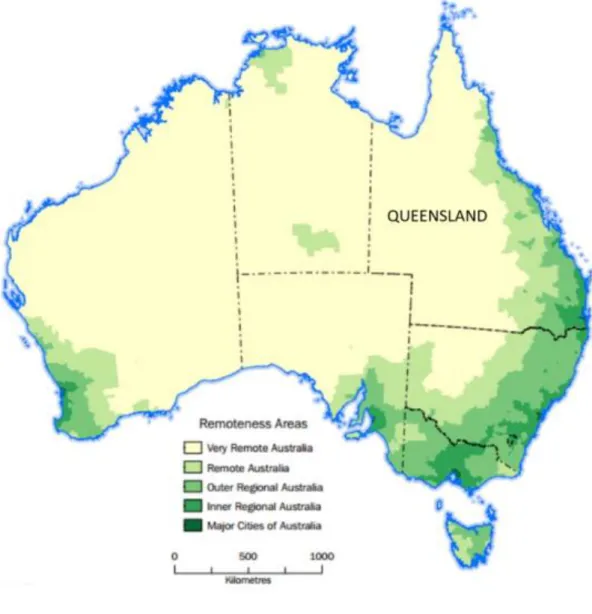
Queensland is one of the largest states in Australia with an area of 1.853 million km². Over 50% of Queensland is classified by the Australian Statistical Geography Standard (ASGS) as "Very Remote" (figure 1.1) and the population is concentrated in the south east of the state (70.2%), with the remaining 29.8% living in regional Queensland (including rural and remote areas).
Queensland has a population of 5 million people which is predicted to increase by one-third to 6.1
million people between 2011 and 2026. Queensland’s population is one of Australia’s most
geographically dispersed populations with health care services needing to be infiltrate into very remote and hard to access communities (Queensland Department of Health, 2013b). This predicted increase in population will have implications for the establishment of successful oral health service models, and this is one of the reasons why this study is timely, as it examines the strengths and limitations of three different operational oral health care delivery models. Around 33% of the population of Queensland are migrants or the children of migrants, with the majority of the original 19th century settlers coming from Britain and other parts of Europe. During recent times, there has been an increase in the number of migrants from South-East Asia (Queensland Government
Statisticians Office, 2015). The 2016 Census showed that 4% of the residents of Queensland were of Torres Strait Islander or Aboriginal origin (Queensland Government Statitician's Office, 2016). Queensland consists of vast areas of cattle and sheep grazing territory and has large gas and coal seam mining regions. Distances of many thousands of kilometres may separate communities from regional centres making the provision of quality dental care a challenging task.
7
Figure 1.1: Australian Statistical Geography Standard remoteness structure 2011 Source: (Australian Bureau of Statistics, 2013a)
1.4 Oral health service arrangements in Australia and Queensland
Australia’s universal health care system “Medicare” was introduced in 1984. All Australianscontribute to the cost of health care according to their incomes via income tax and a Medicare levy (Department of Health, 2017). In order to provide free hospital care, as well as free or subsidised health care services and medications to all Australians, the Commonwealth and the State
governments work co-operatively. Dentistry is generally not covered under Medicare although some rare exceptions do exist, such as for cleft palate surgery and certain government funded schemes (Department of Health, 2017). There have been many government oral health care funding provision
8
schemes historically in Australia and most of these have been superseded or shelved. A summary of historical government dental funding schemes is listed in Appendix A.
Oral health services in Australia are generally funded in two ways, either by providing free dental care in government dental clinics or by fee-for-service in private dental clinics. Private dental patients may or may not have private dental health insurance (National Advisory Council on Dental Health, 2012). Policy makers often consider oral health care as a separate condition from other medical conditions (Vieira & Caramelli, 2009). Free government oral health services are only provided for children up to 18 years of age and for adults with health care concession cards (Oral Health Monitoring Group, 2015). To be eligible for treatment at a government dental clinic as an adult in Queensland, patients must be above the age of completion for grade ten and must be
eligible for certain concession cards. Most (85%) of Australia’s dental services are provided by
private dental practitioners who require fees for their services (Tennant & Kruger, 2013). It has been argued that without substantial structural reform to this government/private divide for the supply of dental services in Australia, there will continue to be challenges in implementing policies capable of improving oral health (Lam et al., 2015) . There are several charitable organisations that attempt to partially fill the void left by this private/public divide and offer free dental care services to the
“working poor", i.e. those who do not qualify for a Health Care Card, but who also cannot afford to attend a private dental practitioner (See Appendix A attached). One such service providing
philanthropic dental services to many rural and remote Australian communities (Royal Flying Doctors Service, 2017) is the non-government organisation (NGO) Mobile Dental Service. This mobile dental service is a philanthropic venture jointly funded by a private mining company, the Commonwealth Government and a NGO (Royal Flying Doctors Service, 2016). The number of communities receiving free oral health care from this service throughout Central Queensland is increasing, with 22 rural and remote Queensland communities receiving care in 2017 (Royal Flying Doctors Service, 2017).
1.4.1 Dental workforce in Australia and Queensland
The oral health workforce in Australia is made up of dental practitioners (dentists) and other oral health practitioners (dental hygienists, dental therapists, oral health therapists, dental technicians and dental assistants) (Sheiham, 1992). Under current legislation these oral health care practitioners all have specific roles and duties (National Advisory Council on Dental Health, 2012). Scope of practice is a contentious issue as reported in the literature with proponents supporting the use of oral health therapists in providing equitable access to oral health care. They analogise the midlevel oral health care providers to nurse practitioners in medicine who are able to provide a high level of medical service without direct supervision from a medical practitioner (Edelstein, 2011). In June
9
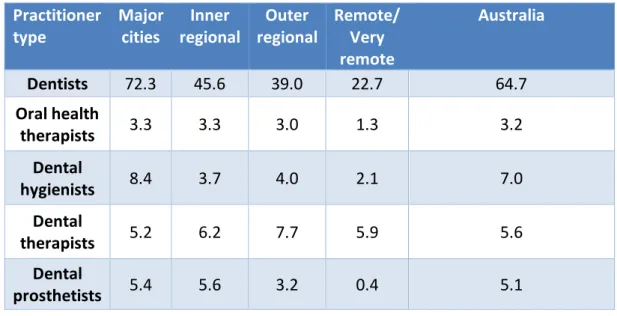
2017, the Dental Board of Australia released a Scope of Registration Practice Standard. This standard identified that other oral health care providers such as dental hygienists, dental therapists and oral health therapists could only perform procedures for which they are formally educated and only under the supervision of a dentist (Australian Health Practitioners Regulation Agency, 2017). Table 1.1 below shows the different types of registered dental practitioners and the maldistribution of these oral health care providers in Australia per 100,000 population in 2014.
Table 1.1: Registered dental practitioners per 100,000 population, by practitioner type and remoteness area
Source: (Australian Institute of Health and Welfare, 2014b)
1.4.2 Dental workforce
Australia has a maldistribution of dental practitioners with the vast majority practicing in major capital cities, with three times as many dentists practicing in cities and regional centres compared to rural and remote areas (Shiika et al., 2015; Tennant et al., 2013). The Dental Workforce Report from 2012 reports that there are 22.7 employed dentists per 100,000 population in remote or very remote Australia, compared to 72.3 employed dentists per 100,000 population in major cities. It documents the increases in dental workforce numbers where in 2009 there were 54.1 dentists, 5.6 dental therapists, 4.2 dental hygienists, 2.7 oral health therapists and 4.6 prosthetists, per 100,000 population (Australian Institute of Health and Welfare, 2014b).
The total numbers of registered dental workforce numbers in 2012 in Australia were 14 687 dentists, 1 425 dental hygienists, 1 117 dental therapists, 1 100 dental prosthetists, 15 381 dental assistants, and 675 oral heath therapists. An increase of 35.5% in dentists has occurred over a nine year period
Practitioner
type
Major
cities
Inner
regional
Outer
regional
Remote/
Very
remote
Australia
Dentists
72.3
45.6
39.0
22.7
64.7
Oral health
therapists
3.3
3.3
3.0
1.3
3.2
Dental
hygienists
8.4
3.7
4.0
2.1
7.0
Dental
therapists
5.2
6.2
7.7
5.9
5.6
Dental
prosthetists
5.4
5.6
3.2
0.4
5.1
10
and the Australian population has only increased by 15.1%. This led to the claim that an oversupply of dentists will soon be an issue in Australia (Australian Institute of Health and Welfare, 2014b). This oversupply has been as result of the near doubling of the number of new dental teaching institutions in Australia since 1990, with the new schools predominately situated outside of capital cities. It has been contended that more student training in rural areas often leads to new graduates being more likely to practice in rural and remote regions (Kruger & Tennant, 2015). It has been predicted that if the rate of supply continues at this level there will be an oversupply of dental practitioners by 2020 (Dental Statistics and Research Unit, 2013). The question as to whether or not these practitioners will choose to take up practice in rural and remote Australia remains to be discovered, with one study suggesting that the issue of dental workforce maldistribution may be better addressed by the alternative strategy of employing other mid-level dental providers with appropriate scope of practice requirements to service these areas (Estai, Kruger, & Tennant, 2016c). Although the total dental workforce numbers are increasing across Australia, the number choosing to work in rural and remote locations is not rising (Godwin et al., 2014), lifestyle choices, isolation from professional peers and practice viability play a major role in work location choices for dental practitioners (Godwin et al., 2017; Godwin et al., 2016).
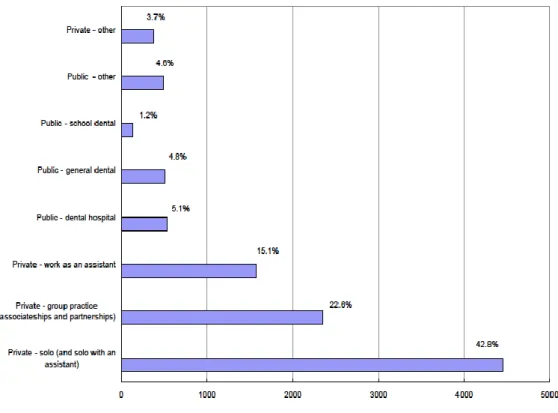
The Dental Board of Australia (2012) identified that the vast majority of dentists worked in either solo or group private practices across the relative workforce sectors. The majority of dental auxiliaries work in private practice: 92.7% of dental hygienists, 62.0% of oral health therapists and 90.5% of dental prosthetists (Dental Board of Australia, 2012). The distribution of dental
practitioners across Australia in different roles is illustrated in Figure 1.2.
The locations of dental practices and government clinics across Queensland are shown in Figure 1.3. It is evident that there are lower numbers of dental practitioners per head of population in rural to remote areas compared to metropolitan regions. In Australia, Queensland has the highest
concentration of the dental workforce along the Eastern coastline associated with capital city locations. Rural and remote areas are lacking in total dental workforce numbers demonstrating a considerable maldistribution (Olive et al., 2012; Perera et al., 2010).
11
Figure 1.2: Distribution of dental practitioners across Australia by roles Source: (Balasubramanian & Teusner, 2011)
Figure 1.3: Distribution of dental workforce across Queensland Source: (Olive et al., 2012) using data from Dental workforce 2012
12
1.5 The Rural Primary Care Network in Australia and Queensland
The non-dental rural primary care network in Australia is made up of health care practitioners who are the first point of contact for the rural or remote patient with health problems (Kruger & Tennant, 2015; Lee et al., 2012; Maunder & Landes, 2005). Registered professionals making up this network vary depending on the specific needs of each community.1.5.1 Rural Primary Care Providers
Combinations of the following health care professionals typically make up the primary care network in different communities: General Medical Practitioners, nurse practitioners, nurses, medical nurses, primary care nurses, child care and community nurses, midwives, hospital and private pharmacists, visiting or locum medical and allied health practitioners such as speech pathologists,
physiotherapists, occupational therapists, dieticians, mental health workers, social workers, spiritual care providers, community developers and exercise specialists. (Australian Government Department of Health, 2013b). Some primary network health care providers have a permanent community base, such as a local clinic or hospital, but others might be visiting and therefore may be based at different locations. The primary care network can be made up of both private and government funded
clinicians (Australian Government Department of Health, 2013b).
The primary health network aims to provide a full range of health-related services, which include prevention, screening and early intervention for all patients. It provides primary health care, hospital and emergency care, mental health, maternity health, aged care services, and preventative health care. Care is provided to specific population groups including older people, people with chronic disease, babies and children, Indigenous and Torres Strait Islander people and refugees (Keboa et al., 2016; Rural Health Standing Committee, 2009).
Effective primary health care is reported to involve a multidisciplinary approach to patient care co-ordination (Stans et al., 2013). The need for rural health practitioners to be multi-skilled is widely recognised and recent innovations include expanded roles for practice nurses, nurse practitioners and allied health therapy assistants (Cooper et al., 2007). The Queensland Health Department, in association with the Queensland branch of Royal Flying Doctors Association have developed primary health care guidelines to support the multiskilling needs of clinicians in remotely placed locations in Queensland. These resources include the “Primary Clinical Care Manual” with a specific chapter on dental emergencies included in the manual (The State of Queensland (Queensland Health) and the Royal Flying Doctors Service (Queensland Section), 2011).