1877-0428 © 2010 Published by Elsevier Ltd. doi:10.1016/j.sbspro.2010.03.498
Procedia Social and Behavioral Sciences 2 (2010) 3258–3262
WCES-2010
The relationship between motivational systems and second language
learning
Maryam Mohammadi
a*, Mahdi Moenikia
b, Adel Zahed-Babelan
caMA. Student of Islamic Azad University, Ardabil Branch bPayame Noor University, Ardabil, Iran cUniversity of Mohaghegh Ardabili, Ardabil, Iran
Received November 15, 2009; revised December 3, 2009; accepted January 25, 2010
Abstract
The present paper is based on research was done to study the relationship between motivational systems and second language learning. To do so, from 31000 students of high school in Ardabil city in 2008-9 academic years, 780 participants were selected via multi stage cluster sampling by using Cochran's formula. The instrument for date gathering was the Motivated Strategies for Learning Questionnaire (MSLQ). In present research the reliability of questionnaire computed via chronbach's Alpha (Į = .89). The method of research was correlation method. Data analyses by use of multiple regressions and independent t-test showed that: Motivational scale components were predictor of second language learning significantly. The Motivation of female students was more than male students significantly, and finally the mean score of female students' second language learning was more than male students significantly.
Keywords: Motivational systems; second language learning.
1. Introduction
Since the late 60s and early 70s, there has been a significant shift within the field of language learning and teaching with greater emphasis on learners and learning rather than on teachers and teaching (Sadighi, & Zarafshan, 2006). Learner autonomy is in line with current views about the active involvement of learners, popularity of learner-centered approaches, and learners’ independence of teachers (Littlewood, 1999).
Language proficiency has been consistently linked with strategy use (Khaldieh, 2000; Wharton, 2000). But using of second language learning strategies depends on motivation. Motivation as the main determinant of second / foreign language learning achievement has attracted the attention of many investigators. Different definitions of motivation have been posited by researchers. Dornyei maintained that motivation is one of the most elusive concepts in applied linguistics and indeed in educational psychology in general (Dornyei, 2003). In spite of the conceptual
* Maryam Mohammadi. Tel.: +989141502085; fax: +98-0451-5513005 E-mail address: [email protected].
© 2010 Elsevier Ltd. Open access under CC BY-NC-ND license.
differences, however, most researchers agree that motivation is related to persons’ choice of a particular action, persistence with it, and effort expended on it (Manolopoulou-Sergi, 2004). Brown (2001) argues that motivation is right only when its full complexity is recognised and applied appropriately in the language classroom.
According to Gardner’s (2000) socioeducational model of second language acquisition, motivation is responsible for achievement in second language. Motivation has long been a controversial issue with researchers on second and foreign language learning. This is not because there is any doubt about the importance of motivational factors in general for language learning, but because the contrast between intrinsic and extrinsic motivation, which has dominated the debate, is subject to serious criticisms. In addition it has not led to any conclusive results (Lai, 1999).
The theoretical framework on motivated strategies for learning, built up by McKeachie , Pintrich, Lin, and smith (1986), Pintrich, and DeGroot (1990), Pintrich, and Garcia (1991) has implicated two separated domains: motivation and learning strategies. The motivation domain covers student's intrinsic goal orientation, extrinsic goal orientation and task value, and these attributes make up the value component; control of learning beliefs and self-efficacy for learning, and performance, which make up the expectancy component; test anxiety which makes up the affective component. For the learning strategies domain, it covers rehearsal, elaboration, organization, critical thinking and metacognitive self- regulation, which make up the cognitive and metacognitive strategies component. Finally time and Place of study, effort regulation, peers learning, and help seeking make up resource management strategies.
Reasons for learning a second language can be classified according to the degree to which individuals freely choose to learn another language, i.e., the degree to which they are determined (Noels, 2001a). From a self-determination perspective, motivational orientations are classified as extrinsic or intrinsic motivation (Ryan, & Deci, 2000). Extrinsic motivation refers to motivation that exists because of the presence of an externally mediated activity or constraint For example, extrinsically motivated English as second language (ESL) students may say that they are taking English classes in order to improve their chances of getting a good job. Intrinsic motivation refers to motivation to fulfill a task that leads individuals to feel a sense of personal enjoyment and control when taking part in the task. When individuals’ motivations are self-determined, they become more involved in activities and make efforts to reach challenging. Intrinsically motivated activities are not a means to an end. They are the ends themselves; the motivation to perform an activity is for the experience of the activity itself and not for the gain of future rewards. For example, ESL students who are intrinsically motivated may say that they are taking a grammar class because of their interest in how the rules of the English language operate.
Lim (2007) found that, a significant, albeit negative, correlation was found as the value of learning a foreign language increases, foreign language use anxiety appears to go down. In order to examine further the effects of task values on foreign language use anxiety, a second order partial correlation analysis was used. Task values consisted of “interest,” “importance,” and “utility” in learning a foreign language. The results showed that “interest” (i.e., pure interest in foreign language learning) is negatively correlated to foreign language use anxiety. The more learners were intrinsically interested in learning a foreign language, the less they experienced foreign language use anxiety. “Importance” was positively related to foreign language use anxiety. The more importance learners attached to learning a foreign language, the higher the level of anxiety experienced. However, interestingly, “utility” appears to be negatively related to foreign language use anxiety. The more utility learners felt a foreign language would have in their future, the less foreign language use anxiety they had.
An examination of literature by Skinner and Madden (2009) has revealed a common theme: students will not always ask for help, even when they are aware that help is needed. The purpose of this action research study was to examine HS and help avoidance in the context of setting tasks in two types of English language-learning environment: a formal classroom situation and an informal community group. This action research study aimed firstly to explore whether and how instances of HS to understand tasks set could be increased, and secondly to examine the effects the two very different language-learning environments had on students’ HS. It was found that changes in HS behaviour were small and that regardless of interventions to support HS, learners will only seek help when the environment in which they are learning is relaxed and informal.
Peer-learning spaces can be particularly useful for English language learners (ELLs) in situations where the discrepancies among the home, school, and peer cultures have been well-documented (Manuel, 2008).
Pajares and Schunk (2001) found that students who believed they were capable of performing tasks used more cognitive and metacognitive strategies and persisted longer than those who did not. Similarly, other research findings suggest that self-efficacy beliefs are related to self-regulated learning variables and use of learning strategies (Pape, & Wang, 2003). The findings of Magogwe, and Oliver(2007) suggested more complex patterns of use than have appeared in earlier studies and
they also provide indication that there is a relationship between type of strategy use and successful language learning, but that this is mediated by a number of factors, including self-efficacy beliefs.
In Ray, Garavalia, and Gredler’ (2003) research Gender differences were found in achievement, with females earning higher grades than males. MoeniKia, and Abtin (2006) found that in secondary schools, females' self regulated learning strategy is more than males significantly.
So goal of the current study was to determine the role of self regulated strategies for learning on second language learning and compare gender differences in these variables.
2. Method
2.1. Participants
The Statistical population involved the Ardabil city high schools students (N = 31000) in 2008-9 academic years. From these, 780 students were selected as sample by using Cochran's formula and multistage cluster sampling.
2.2. Materials
In order to gathering the data of motivated strategies for learning and its components the Motivated Strategies for learning Questionnaire (MSLQ) modified by Pintrich and collaborators, bearing the constancy of (Į = .89) were used. Pintrich and collaborators have created this self-reporting tool with 81 items, based on the motivational model of expectancy times value (pintrich, 2003), with the objective of measuring different motivational components and the use of learning strategies in a given course or subject matter. One of the advantages of this instrument is that it has been applied and validated at different educational levels, both university and no non-university. Via MSLQ of pintrich and et al. could be measured Expectancy components, Value components, Affective components, Cognitive and metacognitive strategies, Resource management strategies. Scale reliabilities are robust, and confirmatory factor analyses demonstrated good factor structure. In addition, the instrument shows reasonable predictive validity to the actual course performance of students (pintrich, 2003).
2.3. Procedure
Research method was correlation. The questionnaire was distributed among participants and gathered data was analyzed by using multiple regression in enter model and independent t-test.
3. Results
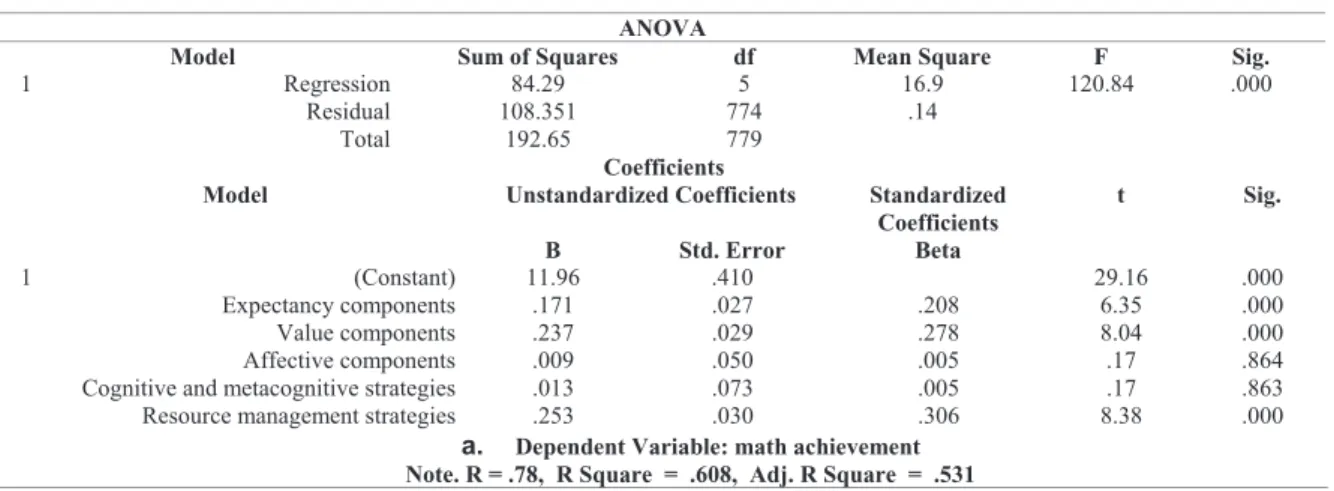
In order to determine the components of motivated strategies for learning in predicting the second language learning, taking the advantages of the enter method, multiple regression analysis was used.
Table 1. Predicting the second language learning on the base of motivated strategies for learning
ANOVA
Model Sum of Squares df Mean Square F Sig.
Regression 84.29 5 16.9 120.84 .000
Residual 108.351 774 .14
1
Total 192.65 779
Coefficients
Unstandardized Coefficients Standardized Coefficients Model B Std. Error Beta t Sig. (Constant) 11.96 .410 29.16 .000 Expectancy components .171 .027 .208 6.35 .000 Value components .237 .029 .278 8.04 .000 Affective components .009 .050 .005 .17 .864
Cognitive and metacognitive strategies .013 .073 .005 .17 .863 1
Resource management strategies .253 .030 .306 8.38 .000
a. Dependent Variable: math achievement Note. R = .78, R Square = .608, Adj. R Square = .531
As it can be seen from the results of table 1, adjusted R square is .531 and F = 120.84 is significant (p < .01). So, motivated strategies for learning may predict second language learning. From among components of motivated strategies for learning, the shares of expectancy components, value components and resource management strategies were .208, .278, and .306, respectively in predicting of second language learning were statistically significant (p < .01). But the shares of affective components and cognitive and metacognitive strategies were not statistically significant (p > .05).
Table 2. Independent samples test
gender variables N Mean Std.
Deviation
t df. Sig.
Males
Females Expectancy components
379 383 5.60 6.24 .54 .48 -17.23 778 .000 Males
Females Value components
379 383 5.53 6.23 .48 .45 -20.78 778 .000 Males
Females Resource management strategies 379 383 5.50 6.21 .53 .42 -21.17 778 .000 Males
Females Cognitive and metacognitive strategies 379 383 4.51 4.63 .18 .21 -8.19 778 .000 Males
Females Affective components
379 383 5.91 5.93 .29 .25 -1.30 778 .195 Males
Females second language learning
379 383 15.58 16.31 .38 .28 -30.12 778 .000
According to Table 2, there are differences between males and females in second language learning and components of motivated strategies for learning exceptional affective components statistically significant. Table 2, indicated that mean score of females was more than males in second language learning, expectancy components, value components resource management strategies, and Cognitive and metacognitive strategies statistically significant.
Figure 1. Mean score of males and females in variables
As Figure 1, demonstrate that the mean score of females in second language learning and components of motivated strategies for learning were more than males.
4. Discusstion
Findings of present study showed that motivated strategies for learning can be identified and explained .53 % of second language learning. To express better motivated strategies for learning is predictor for second language learning significantly. These findings are coherent with findings of researches (Brown, 2001; Dornyei, 2003;
15.58 16.31 5.91 4.51 5.5 5.53 5.6 5.93 4.63 6.21 6.23 6.24 3 5 7 9 11 13 15 17 Exp ect ancy co mp onent s Val ue comp onen ts Resou rce man age me nt st rate gies Cogni tive and met acog nitiv est rate gies Affe ctiv ecom pone nts seco nd l ang uag ele arni ng males females
Gardner, 2000; Manolopoulou-Sergi, 2004; pintrich, 2003; Ryan, & Deci, 2000; and Skinner, & Madden, 2009). All of these researches indicated that motivation is important factor in second language learning.
Findings showed that among components of motivated strategies for learning, the shares of expectancy components, value components and resource management strategies were significant in predicting of second language learning. Relation between expectancy components and second language learning is confirmed by researches done with Dornyei (2003), Gardner (2000), and Lai (1999); Relation between value components and second language learning is confirmed by researches done with Gardner (2000), Lim (2007); Noels (2001a); and Ryan, and Deci, 2000). Also findings of Brown (2001); Manuel (2008); and Skinner and Madden (2009) indicated that resource management strategies are important role in second language learning. These findings confirmed present research result. But in present research In conflict with the findings of Khaldieh (2000); Pajares and Schunk (2001); Pape, and Wang (2003); and Wharton (2000) the shares of affective components and cognitive and metacognitive strategies in predicting of second language learning were not statistically significant
Finally findings of research demonstrated that mean score of females was more than males in second language learning, expectancy components, value components resource management strategies, and Cognitive and metacognitive strategies statistically significant. This finding is in compliance with the findings of MoeniKia, and Abtin (2006); and Garavalia, and Gredler (2003).
References
Brown, H. D. (2001). Teaching by principles: an interactive approach to language pedagogy. (New York, Addison Wesley Longman).
Dornyei, Z., (2003). Attitudes, orientations, and motivations in language learning: Advances in theory, research, and applications. Blackwell
Publishing, Oxford.
Khaldieh, S.A., (2000). Learning strategies and writing processes of proficient vs. less-proficient learners of Arabic. Foreign Language Annals 33 (5), 522–533. Gardner, R. C. (2000). Correlation, causation, motivation, and second language acquisition. Canadian Psychology, 41, 10-24.
Lai, Eva Fung-kuen (1999). Motivation to Learn English in Hong Kong. Language, Culture and Curriculum, 12(3), 280 — 284.
Li, Daguo (2006). Motivation in second language acquisition in chinese research students in the UK. Evaluation & Research in Education, 19( 1), 38 - 58. Lim, Hye-Yeon. (2007).Effects of attributions and task values on foreign language use anxiety. Journal of Education and Human Development, 1(2), 1-20. Littlewood, W. (1999). Defining and developing autonomy in East Asia contexts, Journal of Social Sciences & Humanities of Shiraz University,
Applied Linguistics, 20(1), 71-94.
Manuel G. (2008). Peer-learning spaces: a staple in English language learners' tool kit for developing language and literacy. Journal of Research in Childhood Education, 22, retrieved June, 15, 2009 from: www.accessmylibrary.com.
Magogwe, J. M., Oliver, R. (2007). The relationship between language learning strategies, proficiency, age and self-efficacy beliefs: A study of language learners in Botswana. System 35, 338–352.
Manolopoulou-Sergi, E. (2004). Motivation within the information processing model of foreign language learning. System 32, 427–441. McKeachie, W. J., Pintrich, P. R., Lin, Y. G., & Smith, D. (1986). Teaching and learning in the college classroom: A review of the research
literature. In Ann Arbor, MI: National Centre for Research to Improve Post Secondary Teaching and Learning, the University of Michigan. Moenikia, M., & Abtin, J. (2006). Relationship between using of ICT and psychological characteristics in Ardabil secondary schools' students.
Iran, Ardabil, educational organization.
Noels, K.A. (2001a). New orientations in language learning motivation: Towards a model of intrinsic, extrinsic and integrative orientations. In Z. Dornyei and R. Schmidt (eds.), Motivation and second language acquisition. Honolulu: University of Hawai’I Second Language Teaching and Curriculum Centre, pp. 43–68.
Pajares, F., Schunk, D.H., (2001). Self-efficacy beliefs and school success: Self-efficacy, self-concept, and school achievement. In: Perception. Ablex Publishing, London, pp. 239–266.
Pape, S.J., Wang, C., (2003). Middle school children’s strategic behavior: classification and relation to academic achievement and mathematical problem-solving. Instructional Science, 31, 419–449.
Pintrich, P. R. (2003). A motivational science perspective on the role of student motivation in earning and teaching contexts. Journal of Educational Psychology, 95, 667-686.
Pintrich, P.R., & Garcia, T. (1991). Students' orientation and self- regulation in the College classroom. In M. Maehr & P.R. Pintrich (Eds.), Advances in motivation and achievement: Goals and self-regulatory process, (Vol. 7, pp.371-402). Greenwich, CT: JAI Press.
Pintrich, P.R., & DeGroot, E. (1990). Motivational and self- regulated learning components of classroom academic performance. Journal of Educational Psychology, 82, 33-40.
Ryan, R.M., & Deci, E.L. (2000). Self-determination theory and the facilitation of intrinsic motivation, social development, and well-being.
American Psychology, 55, 68–78.
Ray, M. W., Garavalia, L. S., & Gredler, M. E. (2003).Gender Differences in Self-Regulated Learning, Task Value, and Achievement in Developmental College Students. Available on www.eric.ed.gov/ERICWebPortal.
Sadighi, F., Zarafshan, M. (2006). Effects of attitude and motivation on the use of language learning strategies by Iranian EFL University students. Journal of Social Sciences & Humanities of Shiraz University, 23(1) ,71-80.
Skinner, B., & Madden, M. C. (2009). Help seeking in English language learning. ELT Journal, 64(1),21-31.