Tweaked Version
23.11.2009
Eli Biham1,⋆ and Orr Dunkelman2,3 1
Computer Science Department, Technion Haifa 32000, Israel
2 ´
Ecole Normale Sup´erieure D´epartement d’Informatique,
CNRS, INRIA 3
Faculty of Mathematics and Computer Science Weizmann Institute of Science
P.O. Box 26 Rehovot 76100, Israel
Abstract. In this document we present SHAvite-3, a secure and efficient hash function based on the HAIFA construction and the AES building blocks. SHAvite-3 uses a well understood set of primitives such as a Feistel block cipher which iterates a round function based on the AES round function. SHAvite-3’s compression functions are secure against cryptanalysis, while the selected mode of iteration offers maximal security against black box attacks on the hash function. SHAvite-3 is both fast and resource-efficient, making it suitable for a wide range of environments, ranging from 8-bit platforms to 64-bit platforms (and beyond).
1
Introduction
The recent security findings on the (lack of) collision resistance in SHA-1 [30, 70] mark the close end of SHA-1’s useful life. Although the use of SHA-256 may be a solution for this specific issue, the recent collision finding techniques as well as the results on the second preimage resistance of Merkle-Damg˚ard hash functions and the similarity of the SHA-256 design to the design of SHA-1, motivated the US National Institutes of Standards and Technology to issue a call for a successor algorithm to be named SHA-3. The essential requirements for SHA-3 are the support for message digests of 224, 256, 384, and 512 bits.
In this document, we present a candidate for SHA-3. Our design philosophy is to use well-understood components to achieve high security and competitive performance. We find this approach the most reasonable one given the advances in cryptanalysis of hash functions, and specifically, the results on SHA-1 and on Merkle-Damg˚ard hash functions.
A hash function is usually composed of a compression function and a mode that iterates this compression function to deal with arbitrarily long messages. For the compression function we developed a construction based on the well understood Davies-Meyer transformation of a block cipher into a compression function. The underlying block cipher is a Feistel construction which uses the AES round as a building block.
The hash function then iterates the compression function using the HAsh Iterative FrAme-work (HAIFA). The result is a fast and secure hash functions, which can be used to produce any digest size up to 512 bits. For digests of up to 256 bits we allow messages of up to (264−1) bits, and for longer digests we allow messages of up to (2128−1) bits in line with the current FIPS tradition of SHA-1 and the SHA-2 family, ensuring easy transition to SHAvite-3.
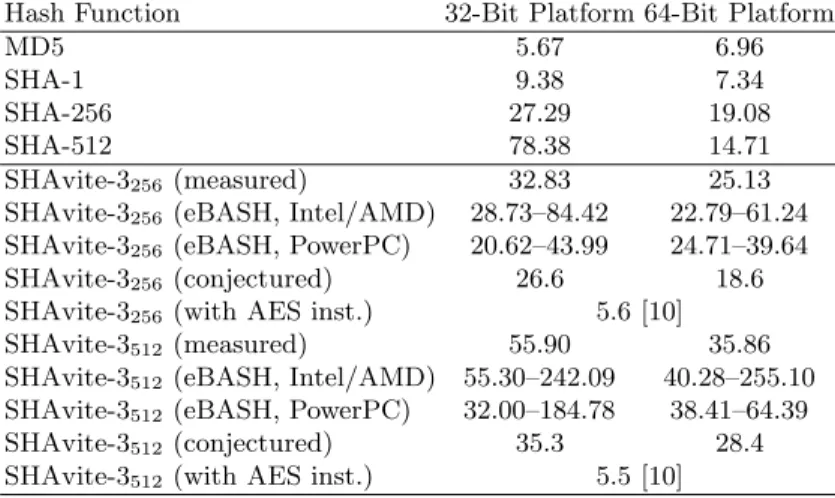
As SHAvite-3 is based on AES building blocks, as well as the HAIFA mode of iteration, it is assured to be compact and efficient, and suitable for many platforms (both modern CPUs, as well as smart cards and 8-bit machines). Our current implementation of SHAvite-3 achieves for 256-bit digests a speed of 32.83 cycles per byte on a 32-bit machine and of 25.13 cycles per byte on a 64-bit machine. For 512-bit digests, SHAvite-3 achieves speeds of 55.90 cycles per byte on a 32-bit machine, and 35.86 cycles per byte on a 64-bit machine. As shown in [10], on future Intel CPUs which support the AES-NI instruction set, speeds of 5.6 and 5.5 cycles per byte, respectively, are attainable. These speeds suggest that on future platforms, SHAvite-3 is the fastest remaining candidate.
SHAvite-3 is named after its speed and security, as it is both a secure hash function, and fast (vite in French). In Hebrew, the meaning of the word shavite is comet, a fast natural phenomena. The current proposed version is SHAvite-3 (pronounced “shavite shalosh”, as in Hebrew), as it is the third variant of the design (the first two are unpublished).
This document is organized as follows: In Section 2 we describe the AES round function and some mathematical background related to it. Section 3 outlines HAIFA which is the way SHAvite-3 iterates its compression function. The full specifications of SHAvite-3 are given in Section 4. The design criteria and motivation are outlined in Section 5. The security analysis is detailed in Section 6, and we introduce an efficient MAC based on SHAvite-3 in Section 7. We present our performance analysis in Section 8. Several test vectors are given in Appendix A. We summarize the proposal in Section 9.
2
AES and Some Mathematical Background
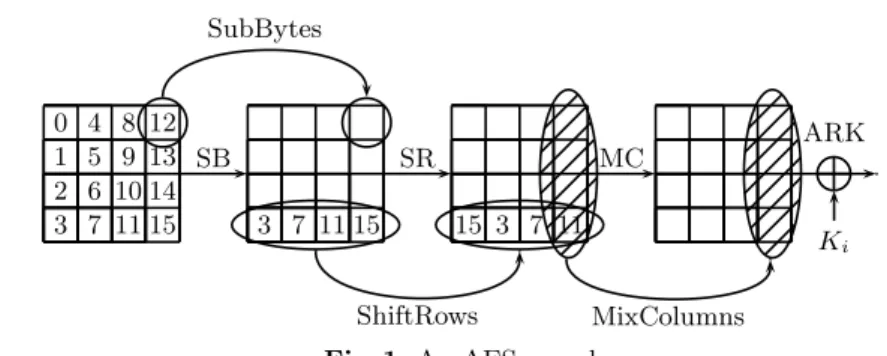
Our construction relies on the round function used in AES [66]. The advanced encryption standard is an SP-network with block size of 128 bits which supports key sizes of 128, 192, and 256 bits. A 128-bit plaintext is treated as a byte matrix of size 4x4, where each byte represents a value inGF(28). An AES round applies four operations to the state matrix:
– SubBytes (SB) — applying the same 8-bit to 8-bit invertible S-box 16 times in parallel on each byte of the state,
– ShiftRows (SR) — cyclic shift of each row (thei’th row is shifted by ibytes to the left),
– MixColumns (MC) — multiplication of each column by a constant 4x4 matrix over the field
GF(28), and
– AddRoundKey (ARK) — XORing the state with a 128-bit subkey.
We outline an AES round in Figure 1. We note that we only use the full round function of AES, and thus we omit here the full description of the key schedule and the exact definition of AES. Throughout this document we denote byAESRoundsubkey(x) one round of AES as defined in Federal Information Processing Standard 197 [66], using the subkeysubkey applied to the inputx. Specifically,
0 4 8 12 1 5 9 13 2 6 10 14 3 7 11 15 3 7 11 15 15 3 7 11 ShiftRows MixColumns SB SR MC ARK
L
Ki SubBytesFig. 1.An AES round
In AES, each byte represents a value in the fieldGF(28), i.e., the byte value 0x13 corresponds to the polynomial x4+x+ 1. The AES designers picked the following irreducible polynomial used to generate this field:
m(x) =x8+x4+x3+x+ 1.
Thus, to multiply two elements p(x), q(x) ∈ GF(2)/m(x) (which we denote by •, following Federal Information Processing Standard 197 [66]), first compute the product of p(x)q(x) (as polynomials overGF(2)), and then reduce the outcome modulom(x). For example, letp(x) =
x6+x5+x2+ 1 (i.e., p(x) represents the value 65
x) and let q(x) = x7+x3+x (i.e., q(x) represents the value 8Ax), thenp(x)•q(x) =x7+x4+x3+x2+ 1 (i.e., corresponding to 9Dx) as p(x)q(x) = x6+x5+x2+ 1 · x7+x3+x = x13+x12+x8+x6+x5+x
which reduces to x7+x4+x3+x2+ 1 modulom(x) =x8+x4+x3+x+ 1.
The MixColumns operation takes each 4-byte column (b0, b1, b2, b3)T, and multiplies it (from the left) with an MDS matrix over the fieldGF(28), thus the output (d
0, d1, d2, d3)T is computed as d0 d1 d2 d3 = 2 3 1 1 1 2 3 1 1 1 2 3 3 1 1 2 b0 b1 b2 b3
The computation of the S-box is done as follows:
– Given the inputx, compute r=x−1 in the field GF(28) (where zero is considered its own inverse).
– Computey=A·r+bas linear equations overGF(2) where
A= 1 0 0 0 1 1 1 1 1 1 0 0 0 1 1 1 1 1 1 0 0 0 1 1 1 1 1 1 0 0 0 1 1 1 1 1 1 0 0 0 0 1 1 1 1 1 0 0 0 0 1 1 1 1 1 0 0 0 0 1 1 1 1 1 b= 1 1 0 0 0 1 1 0
– Outputy.
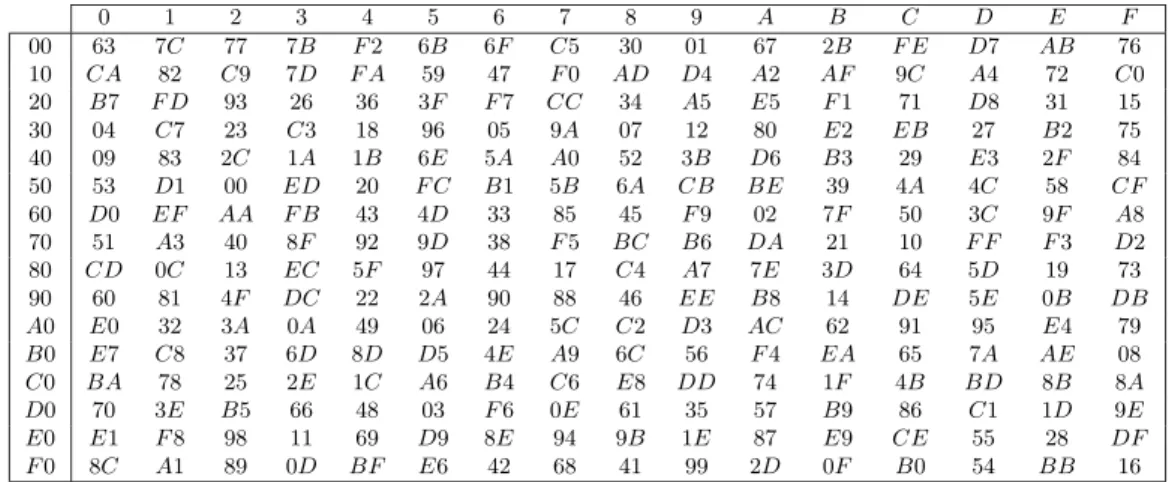
For completeness, we provide the S-box in Table 1.
0 1 2 3 4 5 6 7 8 9 A B C D E F 00 63 7C 77 7B F2 6B 6F C5 30 01 67 2B F E D7 AB 76 10 CA 82 C9 7D F A 59 47 F0 AD D4 A2 AF 9C A4 72 C0 20 B7 F D 93 26 36 3F F7 CC 34 A5 E5 F1 71 D8 31 15 30 04 C7 23 C3 18 96 05 9A 07 12 80 E2 EB 27 B2 75 40 09 83 2C 1A 1B 6E 5A A0 52 3B D6 B3 29 E3 2F 84 50 53 D1 00 ED 20 F C B1 5B 6A CB BE 39 4A 4C 58 CF 60 D0 EF AA F B 43 4D 33 85 45 F9 02 7F 50 3C 9F A8 70 51 A3 40 8F 92 9D 38 F5 BC B6 DA 21 10 F F F3 D2 80 CD 0C 13 EC 5F 97 44 17 C4 A7 7E 3D 64 5D 19 73 90 60 81 4F DC 22 2A 90 88 46 EE B8 14 DE 5E 0B DB A0 E0 32 3A 0A 49 06 24 5C C2 D3 AC 62 91 95 E4 79 B0 E7 C8 37 6D 8D D5 4E A9 6C 56 F4 EA 65 7A AE 08 C0 BA 78 25 2E 1C A6 B4 C6 E8 DD 74 1F 4B BD 8B 8A D0 70 3E B5 66 48 03 F6 0E 61 35 57 B9 86 C1 1D 9E E0 E1 F8 98 11 69 D9 8E 94 9B 1E 87 E9 CE 55 28 DF F0 8C A1 89 0D BF E6 42 68 41 99 2D 0F B0 54 BB 16
Table 1.AES’ S-box (all values are given in hexadecimal)
3
HAsh Iterative FrAmework
The most widely used mode of iteration is the Merkle-Damg˚ard construction [29, 55, 56]. While the collision resistance of the compression function is preserved in the Merkle-Damg˚ard con-struction, this is not the case for second preimage resistance as suggested in [1, 32, 48]. Other undesired properties in such iteration were also suggested: extensions attacks (which lead to some differentiability results [26]), chosen target preimage attacks [47], and Trojan message attacks [2].
The HAsh Iterative FrAmework allows to overcome these problems while maintaining a simple construction and at the same time allowing for a more flexible hash function (for example, it contains an integrated support for variable digest length). Under reasonable assumptions, it is claimed that HAIFA preserves the major security notions and is indeed second preimage resistant [23]. In particular, we show that the HAIFA mode of iteration is protected against the second preimage attacks, the chosen-target preimage attacks, and the Trojan message attacks of [1, 2, 32, 47, 48].
Moreover, HAIFA has an integrated support for keys, thus defining families of hash functions (when needed). This can also be used as a base for more efficient message authentication codes based on the hash function (as we suggest in Section 7).
3.1 Specifications of HAIFA
Hashing with HAIFA involves few steps:
1. Message padding, according to the HAIFA padding scheme.
3. Truncating the output to the required length.
The message padding used in HAIFA is very similar to the one used in Merkle-Damg˚ard, but offers a better security, as well as better support for different digest sizes. The compression is done using a compression function with four inputs:
– A chaining value (of lengthmc),
– A message block (of lengthn),
– The number of bits hashed so far including the current block (a counter of lengthc),
– A salt (of lengths).
Hence, to compress a messageM, the user first chooses a saltsaltat random. The salt can be application specific (e.g., a string identifying the application), a serial number within the application (e.g., the serial number of the message being signed), or even a counter. However, a careful application would ensure that the salt contains enough randomness to be unpredictable.
In order to computeHAIF AC
salt(M) using the compression functionC:{0,1}mc×{0,1}n×
{0,1}b× {0,1}s 7→ {0,1}mc the message is first padded, and divided into ℓ blocks of n bits
each,pad(M) =M1||M2||. . .||Mℓ. Now, the user:
1. Setsh0 as the initial value (according to the procedure defined in Section 3.3). 2. Computes iteratively
hi=C(hi−1, Mi,#bits, salt). 3. Truncateshℓ(according to the procedure defined in Section 3.3). 4. Output the truncated value asHAIF AC
salt(M).
3.2 The Padding Scheme
Letnbe the block length (e.g.,n= 512 or 1024). The padding of a messageM is: 1. Pad with a single bit of 1.
2. Pad with as many 0 bits as needed such that the length of the padded message (with the 1 bit and the 0’s) is congruent modulonto (n−(t+r)).
3. Pad with the message length encoded int bits. 4. Pad with the digest length encoded inrbits.
We note that when a full padding block is added (i.e., the entire original message was already processed by the previous calls to the compression function, and the full message length was already used as an input to the previous call as the #bitsparameter), the compression function is called with the #bits parameter set tozero. This property ensures that the additional full padding block is processed with a different #bits parameter than for prior invocations of the compression function.
3.3 Variable Digest Length
Different digest lengths are needed for different applications. HAIFA supports variable digest length while preventing relations between the digests of the same message with different hash sizes. For generating a digest of lengthm,
1. The initial valueh0is computed byh0=C(M IV, m,0,0), whereM IV is a masterIV, and
2. The digest length is used by the padding schemes, and thus directly affects the compression of the last block.
3. After the final block is processed, the digest is composed ofm bits of the last computed chaining valuehℓ.
Note that h0 can be computed during the initialization of the hash function or can be computed in advance, and be hard-coded into the implementation.
3.4 The Security of HAIFA Hash Functions
The HAIFA mode of iteration preserves many useful properties of the compression function. If the compression function is collision resistant, so does the hash function. The same is true with respect to PRF features of the compression function, i.e., if the compression function is PRF, then so does the hash function. This makes HAIFA ideal for message authentication codes besides hashing. HAIFA also offers maximal security against (second) preimage attacks.
3.4.1 Collision Resistance Preservation The proof that HAIFA preserves the collision resistance of the compression function is very similar to the one used to prove that Merkle-Damg˚ard hash functions retain the collision resistance of the underlying compression function. As HAIFA uses salts, we shall consider the strongest definition of a collision in the com-pression function where the adversary may control all the input parameters to the comcom-pression function including the salt, and tries to generate the same output. Under this strong assumption we assume that the adversary can even manipulate the #bitsparameter.
LetM1 andM2 be the two colliding messages, i.e.,HAIF ACsalt1(M1) =HAIF ACsalt2(M2), with respective lengthsℓ1andℓ2. If the lengthsℓ1andℓ2are different, or the salts are different, then the last compression function calls are necessarily different. Therefore, a collision in the (full) hash function allows to find a collision in the compression function of the last block.
If the lengths of the messages are the same and the salts are the same, one can start from the equal digest and equal last block and trace backwards till the point where the inputs to the compression function (either the input block or the input chaining value) differ, as at some point they must differ (otherwise M1 = M2). The same argument as the one for the Merkle-Damg˚ard mode shows that there must exist a message block i such that M1
i 6=
M2
i or h1i−1 6= h2i−1 (where the superscript denotes the corresponding message), for which
C(h1
i−1, Mi1, salt,#bits) =C(h2i−1, Mi2, salt,#bits), i.e., a collision of the compression function is found.
3.4.2 Security Against Extension Attacks HAIFA uses a bit counter, which is processed in each and every compression function call. This extra input offers great security advantages, one of which is the prefix-free encoding of the inputs to the compression function, which is independent of the messages themselves.
The reason for this is that the last block (or the one before it, in case an additional padding block is added) is compressed with the number of bits that were processed so far. If this value is not a multiple of the block size then the resulting chaining value is not equal to the chaining value that is needed to extend the message. If the message is a multiple of a block, then an additional block is hashed with the parameter #bits= 0. Thus, the chaining value required for the extension remains obscure to the adversary.
We conclude that as long as the compression function is secure, it is not possible to compute
some interesting security features (besides the obvious suitability for simpler MAC construc-tions).
3.4.3 PRF Preservation and PRO Preservation The bit counter scheme allows a prefix-free encoding of the message. Among other things, this proves that HAIFA (when instantiated with a random oracle as a compression function) preserves the pseudorandom oracle prop-erty [26]. Hence, a HAIFA hash function can be distinguished after q queries to the compres-sion function with probability at most O(q2/2mc) (or if m
c =m — with probability at most
O(q2/2m)).
The prefix-free encoding also ensures the preservation of the pseudorandom function prop-erty of the compression function [7]. And thus, the only way to distinguish a HAIFA hash function effectively from a random string/random oracle is to use internal collisions, providing security of min{2s,2m,2mc/2} against these attacks. The 2m option is for cases where more
than half of the bits of the internal state are truncated (and thus, “exhaustive search”-like attacks require less effort than attacks based on internal collisions).
3.4.4 Security Against Second Preimage Attacks HAIFA offers full security against second preimage attacks, i.e., finding a second preimage or a chosen target preimage of an m -bit digest requires 2mcompression functions calls. We first consider some of the latest results on Merkle-Damg˚ard, and show that they do not apply to HAIFA. We then discuss some theoretical reasoning why even future attacks are expected to fail.
– Dean’s expandable message technique (second preimage attack) — Dean’s at-tack [32] is based on finding fix-points for the compression function, which can be iterated repeatedly. While it may be easy to find a fix-point for an instance of the compression func-tion, the use of the #bitscounter prevents the repeated concatenation of the fixed-point to itself (as for different #bitsdifferent fix-points are expected). Moreover, even if a fixed-point for multiple #bits value is found, the phase of connecting the expandable message to the target message requires the adversary to commit to a specific location (i.e., which message block is replaced), which means, that the connection of the expandable message to the challenge message requires 2mc operations.
– Kelsey and Schneier’s expandable message (second preimage attack)— Kelsey and Schneier’s attack [48] is based on constructing an expandable message using Joux’s multicollision technique [43]. As noted before, even if such a message was constructed, the cost of connecting it to the challenge message is equivalent to the cost of finding a second preimage of the compression function. Moreover, to generate the expandable message, one needs to be able to connect from a given chaining value two sequences of blocks with differing lengths resulting in a common chaining value that can be connected to different positions in the sequence of chaining values. The best possible approach would be to set the length after one block of this multicollision (e.g., blockℓ), find a one block/two block collision that leads to the given length (i.e., start from positionℓ−1 and find a message block that leads to a collision with a two message block starting at positionℓ−2) and find from this location a collision between one message block with three blocks. The result is a very limited “expandable message” of between two and five blocks which must be used starting at blockℓ−2 (and then its length is either 3 or 5 blocks) or at blockℓ−1 (and then its length is either 2 or 4 blocks). All other options are foiled by the #bitsparameter which has to be determined in other locations as well. We recall that despite the “expandable
message”, the connection phase still requires the adversary to commit to a specific location, i.e., the time complexity of the online phase of the attack is not reduced at all (and is still 2m).
– The Herding Attack (chosen target preimage attacks)— In the herding attack [47], the adversary constructs a diamond structure, a set of many chaining values from which the adversary knows how to get to a specific target value. As HAIFA contains salts, the adversary has either to choose the salt on his own (making the attack scenario less realistic) or generate a diamond structure for every possible salt. If the salt length is equal to half the chaining value size (or even longer), this approach takes pre-processing time which is larger than a preimage attack and whose memory storage makes standard time-memory tradeoff attacks more favorable. Moreover, unlike the Merkle-Damg˚ard construction where the same diamond structure can be used in any possible location, in HAIFA, the diamond structure is fixed to a given location in the stream due to the #bits parameter, thus reducing the applicability of the attack.
– Second Preimage Attack Based on Herding— The latest second preimage attack suggested in [1] uses a diamond structure to allow the adversary to generate very short “patches” to the message, and thus obtain a second preimage attack which is slightly slower than the one of [48], but at the same time can deal with more hash function constructions. As stated earlier, the fact that the diamond structure is fixed to a given position, renders this impractical (or more precisely makes this attack equivalent to exhaustive search against the compression function).
– Trojan Message Attacks — In this attack the adversary introduces a malicious suffix which allows efficiently finding second preimages to a restricted set of messages [2]. The two variants of the attack are using collisions in the compression function. Once the ac-tual compression function is unknown in advance due to the salt, this attack is rendered impossible. By fixing the salt length to more thanm/2, the attack becomes slower than second preimage attacks, even if the adversary is allowed to supply a different suffix for every possible salt.
While the above issues deal with concrete attacks, one might ponder whether there are other second preimage attacks which may break HAIFA hash functions. Though the general case is not yet solved, the results of [23] claim that if the compression function is a random oracle, then indeed there is no a shortcut second preimage attack on HAIFA.
The main reason for the security is that the bit counter prevents applying any attack in more than one specific location (i.e., the adversary has to commit in advance to the location where the second preimage is to be found) even in the theoretical settings studied in [23]. Hence, the best strategy an adversary could apply is to try and find a single block second preimage, which requires an exhaustive search if the compression function is strong.
3.4.5 The Security Advantages of the Salt The salt parameter can be considered as defining a family of hash functions as needed by the formal definitions of [63] in order to ensure the security of the family of hash functions. This parameter can also be viewed as an instance of the randomized hashing concept [38]. Thus, it inherits all the advantages of the two concepts:
– The ability to define the security of the hash function in the theoretical model.
– Transformation of all attacks on the hash function that can use precomputation from an off-line part and an on-line part to only an on-line part (as the exactsaltis not known in advance).
– Increasing the security of digital signatures, as the signer chooses thesaltvalue, and thus, any attack aiming at finding two messages with the same hash value has to take thesalt
into consideration. See [38] for more details about this property.
We note that the salt can be application specific (e.g., a string identifying the application), a serial number that follows the application (e.g., the serial number of the message signed), a counter, or a random string. It is obvious that the salt can also be set as a combination of these values. However, we emphasize that applications that need the extra security suggested by the salt should use as many random bits of salt as possible.
4
Specifications of SHAvite-3
SHAvite-3 has two flavors, according to the used compression function and digest size: 1. SHAvite-3256 uses the compression functionC256 and produces digests of up to 256 bits, 2. SHAvite-3512 uses the compression functionC512 and produces digests of 257 to 512 bits. Specifically, digest lengths 160, 224, and 256 bits (required by the NIST call, as well as needed for a SHA-1 replacement) are to be produced by SHAvite-3256 (with truncation, as defined by HAIFA). The digest lengths 384 and 512 bits required by the call are to be produced by SHAvite-3512.
4.1 Specifications of SHAvite-3256
SHAvite-3256 is a HAIFA hash function, based on the compression function C256. The com-pression functionC256 accepts a chaining value of 256 bits (i.e.,mc= 256), a message block of size 512 bits (n= 512), a salt of size 256 bits (s= 256), and a bit counter of 64 bits (b= 64).
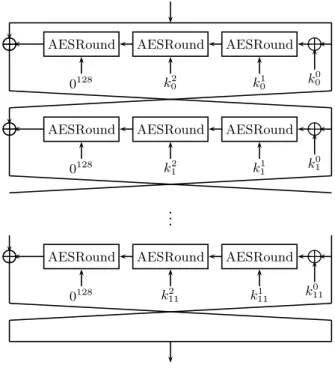
We use an underlying block cipherE256in a Davies-Meyer transformation to constructC256. The block cipher is a 12-round Feistel block cipher. Each round function of the block cipher is composed of three full rounds of AES. The plaintext size is 256 bits (the 256 bits of the chaining value), while the “key” (composed of the message block, the salt, and the counter) size is 512 + 64 + 256 = 832 bits. Not all the “key” bits are treated equally, as 512 of these bits are the message block, 64 bits are the bit counter, and the remaining 256 bits are the salt.
4.1.1 The C256’s Underlying Block Cipher — E 256
The block cipher accepts a 256-bit plaintextP, treated as an array of eight 32-bit wordsP[0, . . . ,7]. The plaintext is divided into two halves P = (L0, R0), where L0 contains words P[0, . . . ,3], and R0 contains words
P[4, . . . ,7]. We note that bytes 0,1,2,3 ofL0 are P[0], while bytes 12,13,14,15 of R0 areP[7]. Then, the round function is repeated 12 times:
(Li+1, Ri+1) = (Ri, Li⊕FRK3 i(Ri)).
F3(·) accepts an input of 128 bits, R
i, as well as a 384-bit subkey, RKi = (k0i, ki1, ki2), and applies three full rounds of AES, using k0
i as a whitening key before the first internal round,
k1
i the subkey of the first round,k2i the subkey of the internal second round (and all zeroes as the subkey of the third internal round):
F3 (k0 i,k 1 i,k 2 i)(x) =AESRound0 128(AESRoundk2 i(AESRoundk1i(x⊕k 0 i))).
L AESRound AESRound AESRound L L k0 0 k1 0 k2 0 0128 L AESRound AESRound AESRound L L k0 1 k1 1 k2 1 0128
.
.
.
L AESRound AESRound AESRound L L k0 11 k1 11 k2 11 0128Fig. 2.The underlying block cipher ofC256
We note that the last round’s subkey (which is XORed) is the all zero value (thus, this oper-ation can be omitted). We also note that all the AES rounds are full AES rounds (with the MixColumns operation).
The ciphertextC= (L12, R12) is the output of the block cipher, where bytes 0,1,2,3 ofL12 compose the first 32-bit word of the ciphertext. We outline the block cipher E256in Figure 2.
4.1.2 The Message Expansion The message expansion ofC256(the key schedule algorithm ofE256) accepts a 512-bit message block, a 64-bit counter, and a 256-bit salt. All are treated as arrays of 32-bit words (containing 16, 2, and 8 words, respectively), which are used to generate 36 subkeys of 128 bits each, or a total of 144 32-bit words.
Letrk[0, . . . ,143] be an array of 144 32-bit words, letmsg[0, . . . ,15] be the message array (of 32-bit each),cnt[0,1] be the counter array (we parse the 64-bit counter #bitsas a two word array, wherecnt[0] contains the least significant part of #bits), andsalt[0, . . . ,7] be the salt.
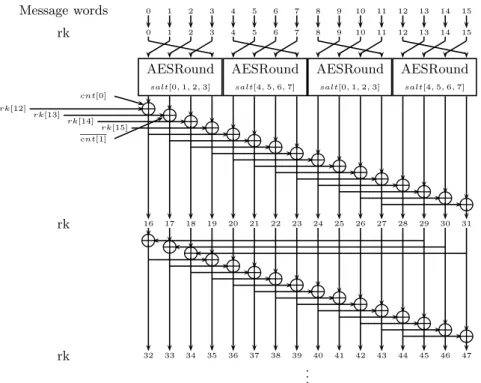
The first 16 words ofrk[·] are initialized with the message words themselves. After that, we repeat a process that generates 16 words in a nonlinear manner and then 16 words in a linear manner. The nonlinear process takes fourrk[·] words, encrypts them under the salt (twice under the first four words of the salt, and twice under the last four words of the salt), and XORs the outcome with four (other) rk[·] words to produce the next four words (this is repeated four times in each iteration of the nonlinear process). The linear process takes two words fromrk[·] and XORs them to produce the next word (this is repeated sixteen times in each iteration of the linear process).
Eight of the produced words are XORed with the counter (four withcnt[0] and four with
cnt[1]), where in four of these positions, the counter is complemented,1 thus preventing any slide properties of the cipher:rk[16],rk[58]⋆,rk[87]⋆, andrk[124] are XORed withcnt[0] during their update, andrk[17]⋆,rk[57],rk[86], andrk[127]⋆, are XORed withcnt[1]. All the locations marked by⋆ are actually XORed with the complemented value of the respective counter.
A summary of the computation ofrkis as follows:
– Fori= 0, . . . ,15 setrk[i]←msg[i].
– Seti←16
– Repeat four times:
1. Nonlinear Expansion Step:Repeat twice: (a) Let
t[0..3] =AESRound0128
(rk[i−15]||rk[i−14]||rk[i−13]||rk[i−16])⊕(salt[0]||salt[1]||salt[2]||salt[3]).
(b) Forj= 0, . . . ,3:rk[i+j]←t[j]⊕rk[i+j−4]. (c) Ifi= 16 thenrk[16]⊕=cnt[0] andrk[17]⊕=cnt[1]. (d) Ifi= 56 thenrk[57]⊕=cnt[1] andrk[58]⊕=cnt[0]. (e) i←i+ 4. (f) Let t[0..3] =AESRound0128
(rk[i−15]||rk[i−14]||rk[i−13]||rk[i−16])⊕(salt[4]||salt[5]||salt[6]||salt[7]).
(g) Forj= 0, . . . ,3:rk[i+j]←t[j]⊕rk[i+j−4]. (h) Ifi= 84 thenrk[86]⊕=cnt[1] andrk[87]⊕=cnt[0].
(i) Ifi= 124 thenrk[124]⊕=cnt[0] andrk[127]⊕=cnt[1]. (j) i←i+ 4.
2. Linear Expansion Step:Repeat sixteen times: (a) rk[i]←rk[i−16]⊕rk[i−3].
(b) i←i+ 1.
Figure 3 outlines the message expansion algorithm.
Oncerk[·] is initialized, its 144 words are parsed as 36 subkeys of 128-bit each, which are then used as 12 triplets of subkeys, i.e.,
RK0= (k00, k01, k20) = (rk[0], rk[1], rk[2], rk[3]), (rk[4], rk[5], rk[6], rk[7]), (rk[8], rk[9], rk[10], rk[11]) RK1= (k01, k11, k21) = (rk[12], rk[13], rk[14], rk[15]), (rk[16], rk[17], rk[18], rk[19]), (rk[20], rk[21], rk[22], rk[23]) .. . ... ... RKi = (k0i, ki1, k2i) = (rk[12·i], rk[12·i+ 1], rk[12·i+ 2], rk[12·i+ 3]), (rk[12·i+ 4], rk[12·i+ 5], rk[12·i+ 6], rk[12·i+ 7]), (rk[12·i+ 8], rk[12·i+ 9], rk[12·i+ 10], rk[12·i+ 11]) .. . ... ... 1
We note that this is the only difference between the original submitted version of SHAvite-3256and the tweaked version.
Message words 0 1 2 3 4 5 6 7 8 9 10 11 12 13 14 15 rk 0 1 2 3 4 5 6 7 8 9 10 11 12 13 14 15 AESRound salt[0,1,2,3] AESRound salt[4,5,6,7] AESRound salt[0,1,2,3] AESRound salt[4,5,6,7] rk[12] rk[13] rk[14] rk[15] cnt[0] cnt[1] L L L L L L L L L L L L L L L L 16 17 18 19 20 21 22 23 24 25 26 27 28 29 30 31 rk L L L L L L L L L L L L L L L L rk 32 33 34 35 36 37 38 39 40 41 42 43 44 45 46 47 .. .
The salts are XORed to the inputs before the SubBytes operations.
We note that the counters are XORed in different positions in different iterations of the nonlinear expansion step.
Fig. 3.The Message Expansion ofC256
4.1.3 Summary of C256 Each compression function call toC256has four inputs. The mes-sage blockMi, the saltsalt, and the bit counter #bitsare viewed as a key of the block cipher
E256, while the chaining valueh
i−1is treated as the plaintext. Then,
hi=C256(hi−1, Mi, salt,#bits) =EM256i||#bits||salt(hi−1)⊕hi−1.
4.1.4 Generating Digests of up to 256 Bits In order to hash the messageM into an
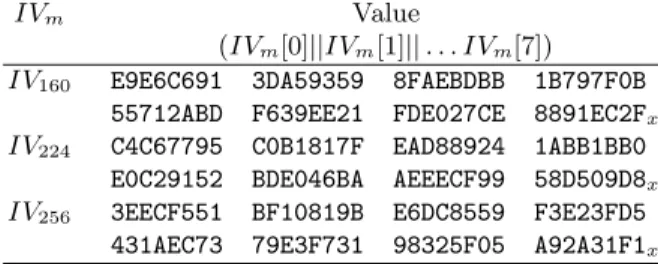
m-bit digest, form≤256, first computeIVm which is
h0=IVm=C256(M IV256, m,0,0), where
M IV256=C256(0,0,0,0) =ACCF8F80 96589E66 43361E2F ECC26B0F
D74AFFA7 FEDA3472 FAEC19EA EE4C3008x.
IVm Value
(IVm[0]||IVm[1]||. . . IVm[7])
IV160 E9E6C691 3DA59359 8FAEBDBB 1B797F0B
55712ABD F639EE21 FDE027CE 8891EC2Fx
IV224 C4C67795 C0B1817F EAD88924 1ABB1BB0
E0C29152 BDE046BA AEEECF99 58D509D8x
IV256 3EECF551 BF10819B E6DC8559 F3E23FD5
431AEC73 79E3F731 98325F05 A92A31F1x Table 2.IVmfor Common Values of the Digest Size
Let|M|be the length ofM before padding, measured in bits. Pad the messageM according to the padding scheme of HAIFA:
1. Pad a single bit of 1.
2. Pad as many 0 bits as needed such that the length of the padded message (with the 1 bit and the 0’s) is congruent modulo 512 to 432.
3. Pad|M|encoded in 64 bits. 4. Padmencoded in 16 bits.
Now, divide the padded messagepad(M) into 512-bit blocks,pad(M) =M1||M2||. . .||Mℓ, and perform:
1. Set #bits←0. 2. Seth0←IVm.
3. Fori= 1, . . . ,⌊|M|/512⌋:
– Set #bits←#bits+ 512.
– Computehi =C256(hi−1, Mi,#bits, salt).
4. – If the message length is a multiple of the block length (|M| = 0 mod 512), compute
hℓ=C256(hℓ−1, Mℓ,0, salt) (whereMℓ is a full padding block), else
– If the message length allows for the padding to be in the same block as the last message block (i.e.,|M|mod 512≤431), computehℓ=C256(hℓ−1, Mℓ,|M|, salt), else
– Process some of the padding block with the last block containing message, i.e., compute
hℓ−1 =C256(hℓ−2, Mℓ−1,|M|, salt), and then compute hℓ=C256(hℓ−1, Mℓ,0, salt) for processing the additional (partial) padding block.
5. Outputtruncatem(hℓ), wheretruncatem(x) outputs themleftmost bits ofx, i.e.,x[0]||x[1]|. . ..
4.2 Specifications of SHAvite-3512
SHAvite-3512is a HAIFA hash function, based on the compression functionC512. The compres-sion functionC512accepts a chaining value of 512 bits (i.e.,mc= 512), a message block of size 1024 bits (n= 1024), a salt of size 512 bits (s= 512), and a bit counter of 128 bits (b= 128).
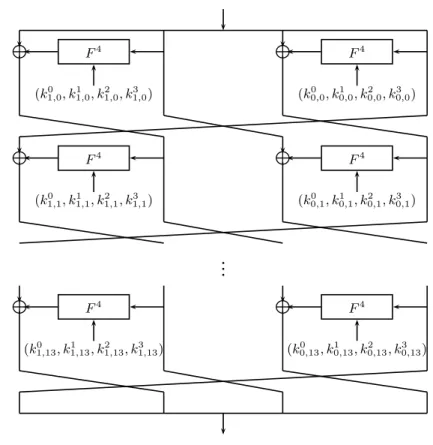
C512 is constructed similarly to C256, as a Davies-Meyer transformation of a block cipher. The underlying block cipher has 14 rounds, and has a generalized Feistel structure. The plaintext size is 512 bits (the 512 bits of the chaining value), while the “key” (composed of the message block, the salt, and the counter) size is 1024+128+512 = 1664 bits. The plaintext (the chaining value) is divided into four 128-bit words, and each round two of these 128-bit words enter the nonlinear round function and affect the other two (each word enters one nonlinear function and affect one word). The nonlinear function F4(·) is composed of four full rounds of AES.
F4 L F4 L (k0 0,0, k 1 0,0, k 2 0,0, k 3 0,0) (k0 1,0, k 1 1,0, k 2 1,0, k 3 1,0) F4 L F4 L (k0 0,1, k 1 0,1, k 2 0,1, k 3 0,1) (k0 1,1, k 1 1,1, k 2 1,1, k 3 1,1)
.
.
.
F4 L F4 L (k0 0,13, k 1 0,13, k 2 0,13, k 3 0,13) (k0 1,13, k 1 1,13, k 2 1,13, k 3 1,13)Fig. 4.The Underlying Block Cipher ofC512
4.2.1 TheC512’s Underlying Block Cipher —E512 The block cipher accepts a 512-bit plaintext P, treated as an array of sixteen 32-bit wordsP[0, . . . ,15]. The plaintext is divided into four 128-bit words P = (L0, A0, B0, R0), where L0 contains words P[0, . . . ,3], and R0 contains wordsP[12, . . . ,15]. We note that bytes 0,1,2,3 ofL0areP[0], while bytes 12,13,14,15 ofR0composeP[15]. Then, the round function is repeated 14 times:
(Li+1, Ai+1, Bi+1, Ri+1) = (Ri, Li⊕FRK04 ,i(Ai), Ai, Bi⊕F
4
RK1,i(Ri)).
F4(·) accepts an input of 128 bits (either R
i or Ai) as well as a 512-bit subkey RKi,j = (k0
i,j, ki,j1 , k2i,j, ki,j3 ), and applies four rounds of AES, usingki0as a whitening key before the first internal round, and where the AddRoundKey operation of the fourth internal round is omitted (or done with the all-zero key).
F(k40
i,j,k1i,j,k2i,j,k3i,j)(x) =AESRound0
128(AESRoundk3 i(AESRoundk 2 i(AESRoundk 1 i(x⊕k 0 i)))). As inE256, the last round’s subkey is the all-zero key, and all the rounds are full AES rounds (i.e., with the MixColumns operation).
The ciphertextC= (L14, A14, B14, R14) is the output of the block cipher, where bytes 0,1,2,3 of L14 compose the first 32-bit word of the ciphertext. We outline the block cipher E512 in Figure 4.
4.2.2 The Message Expansion ofC512 The message expansion ofC512 (the key schedule algorithm ofE512) accepts a 1024-bit message block, a 128-bit counter, and a 512-bit salt. All are treated as arrays of 32-bit words (of 32, 4, and 16 words, respectively), which are used to generate 112 subkeys of 128 bits each, or a total of 448 32-bit words.
Letrk[·] be an array of 448 32-bit words, letmsg[0, . . . ,31] be the message array,cnt[0, . . . ,3] be the counter array, andsalt[0, . . . ,15] be the salt. The first 32 words ofrkare initialized with the message words themselves. Then, we repeat a process that generates 32 words in a nonlinear manner and 32 words in a linear manner. Sixteen of the produced words are XORed with the counter (four with eachcnt[i]), where four times the XORed counter word is complemented.2 The computation ofrk[·] is done as follows:
– Fori= 0, . . . ,31 setrk[i]←msg[i].
– Seti←32
– Repeat six times:
1. Nonlinear Expansion Step:Repeat twice: (a) Let
t[0..3] =AESRound0128
(rk[i−31]||rk[i−30]||rk[i−29]||rk[i−32])⊕(salt[0]||salt[1]||salt[2]||salt[3]).
(b) Forj= 0, . . . ,3:rk[i+j]←t[j]⊕rk[i−4 +j]. (c) Ifi= 32 thenrk[32]⊕=cnt[0],rk[33]⊕=cnt[1],rk[34]⊕=cnt[2], and rk[35]⊕= cnt[3]. (d) i←i+ 4. (e) Let t[0..3] =AESRound0128
(rk[i−31]||rk[i−30]||rk[i−29]||rk[i−32])⊕(salt[4]||salt[5]||salt[6]||salt[7]).
(f) Forj= 0, . . . ,3:rk[i+j]←t[j]⊕rk[i−4 +j]. (g) If i = 164 then rk[164]⊕ = cnt[3], rk[165]⊕ = cnt[2], rk[166]⊕ = cnt[1], and rk[167]⊕=cnt[0]. (h) i←i+ 4. (i) Let t[0..3] =AESRound0128
(rk[i−31]||rk[i−30]||rk[i−29]||rk[i−32])⊕(salt[8]||salt[9]||salt[10]||salt[11]).
(j) Forj= 0, . . . ,3:rk[i+j]←t[j]⊕rk[i−4 +j]. (k) If i = 440 then rk[440]⊕ = cnt[1], rk[441]⊕ = cnt[0], rk[442]⊕ = cnt[3], and rk[443]⊕=cnt[2]. (l) i←i+ 4. (m) Let t[0..3] =AESRound0128
(rk[i−31]||rk[i−30]||rk[i−29]||rk[i−32])⊕(salt[12]||salt[13]||salt[14]||salt[15]) (n) Forj= 0, . . . ,3:rk[i+j]←t[j]⊕rk[i−4 +j].
(o) If i = 316 then rk[316]⊕ = cnt[2], rk[317]⊕ = cnt[3], rk[318]⊕ = cnt[0], and
rk[319]⊕=cnt[1]. 2
We note that this is the only difference between the original submitted version of SHAvite-3512and the tweaked version.
(p) i←i+ 4.
2. Linear Expansion Step:Repeat 32 times: (a) rk[i]←rk[i−32]⊕rk[i−7].
(b) i←i+ 1.
– Repeat theNonlinear Expansion Stepan additional time.
Once rk[·] is initialized, its 448 words are parsed as 112 words of 128-bit each, which are the subkeys (14 double quartets of 128-bit words each), i.e.,
RK0,0= (k0,00 , k10,0, k20,0, k0,03 ) = (rk[0], rk[1], rk[2], rk[3]), (rk[4], rk[5], rk[6], rk[7]), (rk[8], rk[9], rk[10], rk[11]) (rk[12], rk[13], rk[14], rk[15]) RK1,0= (k1,00 , k11,0, k21,0, k1,03 ) = (rk[16], rk[17], rk[18], rk[19]),(rk[20], rk[21], rk[22], rk[23]) ((rk[24], rk[25], rk[26], rk[27]),(rk[28], rk[29], rk[30], rk[31]) .. . ... ...
RK0,i = (k00,i, k10,i, k20,i, k0,i3 ) =
(rk[32·i], rk[32·i+ 1], rk[32·i+ 2], rk[32·i+ 3]),
(rk[32·i+ 4], rk[32·i+ 5], rk[32·i+ 6], rk[32·i+ 7]),
(rk[32·i+ 8], rk[32·i+ 9], rk[32·i+ 10], rk[32·i+ 11]),
(rk[32·i+ 12], rk[32·i+ 13], rk[32·i+ 14], rk[32·i+ 15])
RK1,i = (k01,i, k11,i, k21,i, k1,i3 ) =
(rk[32·i+ 16], rk[32·i+ 17], rk[32·i+ 18], rk[32·i+ 19]), (rk[32·i+ 20], rk[32·i+ 21], rk[32·i+ 22], rk[32·i+ 23]), (rk[32·i+ 24], rk[32·i+ 25], rk[32·i+ 26], rk[32·i+ 27]), (rk[32·i+ 28], rk[32·i+ 29], rk[32·i+ 30], rk[32·i+ 31]) .. . ... ...
4.2.3 Summary of C512 Each compression function call toC512has four inputs. The mes-sage blockMi, the saltsalt, and the bit counter #bitsare viewed as a key of the block cipher
E512, while the chaining valueh
i−1 is treated as the plaintext. Then, the output of the com-pression function is
hi=C512(hi−1, Mi, salt,#bits) =hi−1⊕EM512i||#bits||salt(hi−1).
4.2.4 Generating Digests of 257 to 512 Bits In order to hash the messageM into an
m-bit digest, for 256< m≤512, first computeIVmwhich is
h0=IVm=C512(M IV512, m,0,0). where
M IV512=C512(0,0,0,0) =F0C11673 6F0196F5 ECCBD1EA A6C59471
44AC3847 3BC53CB3 AD11AF21 4529BC86
0F2CFBA2 C73C31B7 B095486E 264A9D3F
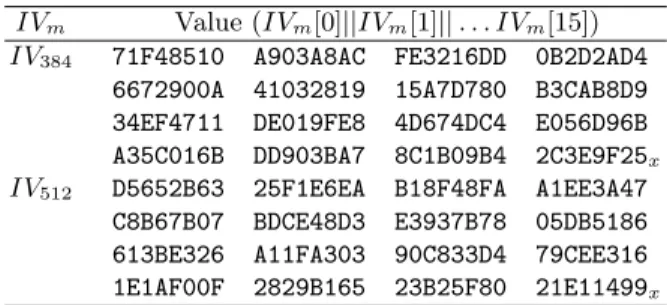
IVm Value (IVm[0]||IVm[1]||. . . IVm[15])
IV384 71F48510 A903A8AC FE3216DD 0B2D2AD4
6672900A 41032819 15A7D780 B3CAB8D9 34EF4711 DE019FE8 4D674DC4 E056D96B A35C016B DD903BA7 8C1B09B4 2C3E9F25x
IV512 D5652B63 25F1E6EA B18F48FA A1EE3A47
C8B67B07 BDCE48D3 E3937B78 05DB5186 613BE326 A11FA303 90C833D4 79CEE316 1E1AF00F 2829B165 23B25F80 21E11499x Table 3.IVmfor Common Values of the Digest Size
As before, let |M| be the length of the messageM before padding, measured in bits. Pad the messageM according to the padding scheme of HAIFA:
1. Pad a single bit of 1.
2. Pad as many 0 bits as needed such that the length of the padded message (with the 1 bit and the 0’s) is congruent modulo 1024 to 880.
3. Pad|M|encoded in 128 bits. 4. Padmencoded in 16 bits.
Now, divide the padded message pad(M) into 1024-bit blocks, pad(M) = M1||M2||. . .||Mℓ, and perform:
1. Set #bits←0. 2. Seth0←IVm.
3. Fori= 1, . . . ,⌊|M|/1024⌋:
– Set #bits←#bits+ 1024.
– Computehi =C512(hi−1, Mi,#bits, salt).
4. – If|M|= 0 mod 1024, computehℓ=C512(hℓ−1, Mℓ,0, salt), else
– If|M|mod 1024≤879, computehℓ=C512(hℓ−1, Mℓ,|M|, salt), else
– Computehℓ−1=C512(hℓ−2, Mℓ−1,|M|, salt), and computehℓ=C512(hℓ−1, Mℓ,0, salt). 5. Output truncatem(hℓ).
Table 3 lists the values ofIVmfor 384-bit and 512-bit digests produced by SHAvite-3512.
4.3 Changes from the Original Submission
As noted earlier, the only difference between the newC256 and its previous version is the fact that in four out of the eight positions where counter words are XORed, the counter word is complemented (specifically, twicecnt[0] and twicecnt[1]). This insures that at least four of the eight counter words which enter the computation are non-zero.
The only difference between the newC512 and its previous version is the fact that four out of sixteen positions where the counter words are XORed, the counter word is complemented (each of the four words is complemented once). This insures that at least four of the sixteen counter words which enter the computation are non-zero.
4.4 Degenerate Salts
In applications where a salt cannot be used or when the additional functionality is not needed (possibly in exchange for a loss in security) it is possible to use a fixed salt. While better security can be achieved if any such application would have its own salt, in certain cases an agreed fixed salt would better be used. As all fixed salts presumably have the same strength, we suggest the use of the all-zero salt in these cases. This salt can be hardcoded into unsalted implementations. The speed using such hardcoded salt (in particular the all-zero salt) is expected to be slightly faster than for the general case.
We note that the KAT/MCT answers for the NIST call were produced using these fixed salts.
5
Design Criteria and Rationale
In the recent few years, several advances in hash functions cryptanalysis were reported. These results show that small nonlinearity in bit-wise operations, diffused using a mixture of XORs, modular additions, and rotations, are insufficient to offer good security. Hence, in order to generate a good compression function, one has to use strong nonlinear components.
5.1 Designing the Compression Function
As we use the well-understood Davies-Meyer transformation, the problem of devising a secure compression function is reduced to the problem of constructing a secure block cipher. We have chosen a Feistel construction (or a generalized Feistel one) as a well understood construction, whose security properties are known. Adding to that the use of the AES round function, we obtain a secure compression function.
We use consecutive rounds of AES in the round function, and adapt the results on the secu-rity of AES to the secusecu-rity of SHAvite-3. This decision also allows the adaption of optimization techniques used for AES, offering an efficient construction. This also ensures that devices which need to include both AES and SHAvite-3 are expected to do so with fewer gates for both of them than in the case of AES and SHA-512 (for example). The same holds for software packages which include the two primitives. Thus, our choice makes the development and certification of products easier, as the AES round can be implemented and verified only once. This fact is expected to shorten the time required for the deployment of SHAvite-3.
We have set several requirements for the security of the compression functions in use: First of all, any differential characteristic of the block cipher should have a very low probability (i.e., less than 2−m). This is the first step in offering a secure cipher, but as demonstrated by the recent results, this is not sufficient, as the adversary can control the key (through the message). This extra control allows the adversary to find right pairs with respect to the differential despite its low probability, by picking messages that lead to satisfaction of some differential transitions. Thus, we aim at reducing the probability of any related-key differential of the block cipher, where the adversary has control over the key as well. We therefore ensure that the best related-key differential would have as low differential probability as possible (it may be at most 2−m/2 for anm-bit digest to prevent any collision attacks, but need to be about 2−mto prevent any differential-based second preimage attacks).
In order to ensure that the differential properties of the key schedule would not interact in an unpredictable manner with the “encryption” part of the block cipher (as happened in the recent attacks on AES [19–21]), we designed the message expansion with two types of operations — AES based operations which offers high nonlinearity, and linear operations which offer diffusion and “break” the sequence of AES operations.
5.2 Designing the Mode of Iteration
For the iteration method, we considered the following modes of iteration:
– Merkle-Damg˚ard — Following the recent results on the lack of second preimage resistance, we find the use of this mode unfit for a modern hash function.
– Enveloped Merkle-Damg˚ard — While the enveloped Merkle-Damg˚ard mode offers the preser-vation of the pseudo random properties of the compression function, it does not offer full second preimage resistance for long messages and is not secure against the herding attack. Hence, we decided to avoid the use of this mode.
– Tree-hash — While modes of iterations based on trees offer a great deal of parallelization in the implementation, they suffer from various flaws. For example, a preimage attack faster than exhaustive search on tree hash is presented in [2].3 This lack of security, as well as the fact that the memory requirements for tree hash functions are too large for constrained environments (such as smart cards), make tree hashes unsuitable for SHA-3.
– Sponge constructions — Even though sponge constructions have strong theoretical founda-tions [12], we identify two issues concerning their use. The first is the fact that the internal state is large, making it unsuitable for constrained environments, and may lead to perfor-mance penalties when sufficient cache memory is not available. The second issue concerns the gap between theory and practice. A sponge construction is secure if the round function is strong as a whole. However, as the internal state is large, such a function is expected to be very slow and hard to analyze. Explicit constructions solve this issue by using a weak round function, which is a very dangerous practice [28, 60].
– Widepipe — This mode offers security with a relatively small performance penalty [52]. Double internal state (i.e.,mc≥2m) is the minimal size that suggests full (second) preimage resistance of 2mfor anm-bit digest. It requires the function to handle twice the number of bits of the chaining value. Even this expansion rate of two causes a loss of resources (more gates are needed to store the chaining value, the compression function has to process more bits, etc.) and thus undesirable if can be avoided.
– HAIFA — HAIFA offers security against all known cryptanalytic attacks on modes of iteration, while incurring no (or very little) performance penalties.
As can easily be seen, HAIFA is the best solution that suggests full security without increas-ing the internal state. The performance penalty of a larger state in a hardware implementation is apparent. At a first glance, the penalty in software may be considerably small. However, when multiple instances of the hash function are being run in parallel or when the available cache memory is small, each additional cache-miss increases the running time of the hash function significantly.
The choice of HAIFA is thus natural. It offers the best performance for the required security for an m-bit hash function with collision resistance of 2m/2 and (second) preimage resistance of 2m.
5.3 Choices of Parameters
The choice of parameters was motivated by several arguments. First, we decided to maintain the same input parameters as the SHA-2 family. This decision was made to facilitate an easy tran-sition for any application that is expected to use SHAvite-3, allowing for a faster development and deployment.
3
The attack of [2] is applicable whenever all compression functions used in the tree are the same. This is not true when the there is an additional input to the compression function which changes in different calls, independent of the message.
The salt must be at least half the size of the chaining value in order to protect against herding attacks and Trojan message attacks (i.e.,s > mc/2) [17]. Nevertheless, we decided to pick the salt size equal to the chaining value size, for the sake of applications that use SHAvite-3 in ways where anm-bit digest requires a 2msecurity, which we wanted to maintain even against attacks targeting the salt.
5.4 Choices of Constants
SHAvite-3 uses a relatively small number of constants. There are constants used in the AES round over which we have no control. The only constants of SHAvite-3 we chose are the values ofM IV256, M IV512, the “tap” positions in the message expansion, and the locations of where the counter and salt are mixed, as well as when the counter is complemented.
In order to allow implementations to save memory, we decided to pickM IV256=C256(0,0,0,0) andM IV512=C512(0,0,0,0). These values can be easily computed on the fly, or precomputed and stored. In any case, we just tried to pick relatively random strings (as much as a fixed string can be random), without resorting to the standard set of “common constants” (i.e.,√2, φ, . . .). As for the tap positions, we first note that we use a register of 16 32-bit words in SHAvite-3256and 32 words in SHAvite-3512in the message expansion. We choose to perform a layer of AES rounds and only then to perform the XORs (of the nonlinear expansion step), in order to allow parallel computation of all the AES rounds of the nonlinear expansion step.
In SHAvite-3256, we have chosen the feedback taps of the linear feedback register to be 3 and 16 (i.e.,rk[i] =rk[i−3]⊕rk[i−16]). This choice ensures that the entire process is reversible and offers a good diffusion. Similarly, the choice of 7 and 32 ensures it in SHAvite-3512.
For the locations where the counter is mixed, we chose locations which allow good mixing of the counter, and prevent slide properties. For SHAvite-3256 the locations were chosen to be in the four different nonlinear expansion steps. We also chose that inside the nonlinear expansion step, the counter is mixed in different respective locations, and we ensured that the distance between the different locations is not regular, and does not repeat, thus foiling any slide property. In SHAvite-3512 we picked four out of the seven nonlinear update steps (taking the odd ones). Using similar considerations, we made sure to pick different respective locations in the nonlinear expansion step. Mixing the order of the counter words used each time only serves to further prevent any slide attack and prevent the existence of “weak” bit counters.
Following the concerns raised in [57, 61] (which had no impact on the security of SHAvite-3 as a hash function), we tweaked the compression functions of SHAvite-3. The tweak was chosen to be the complementation of counter words in four locations (out of the eight or 16 locations where the counter is XORed into the expanded message). The complementation locations were chosen to ensure that no slide properties would exist even for specially chosen message and salt values. For ease of implementation, each time the counter is XORed into the state, the last word of the counter is complemented. This allows software implementations to precompute the complementation, thus reducing the effect this may have on the running time.
Hence, there are no slide properties in the underlying block ciphers. Even if (somehow) the attacker can generate the same state in different positions, the counters break this property. As the bit counters change between different invocations of the compression function, this also assures that such relations cannot exist for more than a short number of rounds even between different invocations of the compression function.
In order to reduce the memory consumption, and prevent the need of storing tables of constants (which costs memory and/or gate area), we decided that SHAvite-3 would not use any other round constants. Even though this may seem to weaken the hash function, there
are two good argument why this is not the case. The first is the fact that some constants are embedded into the AES round constant, and we see no reason to add more (as the issue of potentially weak values is solved by AES’ constants and its design criteria). The second reason is the fact that the only conceivable problem following the use of the same constants (of the AES round function) over and over again is the existence of slide properties. As noted before, this is impossible, and thus, we conclude that there is no need for any additional round constants.
6
The Security of SHAvite-3
The security of SHAvite-3 is based on the security of its compression functionsC256 andC512, and the security of the mode of iteration used (HAIFA). Thus, we perform security analysis of each of these two parts independently, starting from the security of the compression functions.
6.1 The Security of the Compression Functions
SHAvite-3’s compression functions are based on AES. We therefore recall a few results con-cerning the security of AES.
Lemma 1. ([46])The exact 2-round AES maximal expected differential probability is equal to
53/234≈1.656·2−29.
Lemma 2. ([46])The 4-round AES maximal expected differential probability is upper bounded by (53/234)4≈1.881·2−114.
Note that the upper bound given in Lemma 2 is not tight. Under the assumption that 4-round AES behaves like a random permutation, the maximal expected differential probability is about 80·2−128= 2−121.7. This probability is derived from the Poisson distribution of the difference distribution table, whose maximal entry (besides the 0→0 entry) is expected to be 78·2−128or 80·2−128 with an overwhelming probability [59].
AsC256 uses 3-round AES as the round function, we use the following lemma:
Lemma 3. The maximal expected differential probability of 3-round AES is upper bounded by
2−49.
Proof. Any 3-round differential can be decomposed into two (overlapping) 2-round differ-entials (one without the first round, and one without the last round). In each of these 2-round constructions, the differential with the highest probability has only one active AES’ Super-box (2-round AES can be decomposed into 4 independent ciphers, each with input and output of 32 bits, called a Super-box). Having two active Super-boxes in the first (or the last) two rounds necessarily bound the probability of the differential to be no more than (53·2−34)2 = 2809·2−68 ≈1.372·2−57. Thus, a better differential (with higher probability) can have only one active Super-box in the first two rounds and in the last two rounds. This is possible if and only if there is one active S-box in the second round (being the last round of the first Super-box, and the first round of the second Super-box).
This differential has one active Super-box in the first two rounds, and four active S-boxes in the third round. Consider a possible output difference of this differential and consider all the one-round characteristics which lead to this output difference. In each active S-box there are 127 input differences which lead to the desired output difference with non-zero probability. Now, consider the second round. If it has only one active S-box, then there are only 255
possible differencesafterthe second round, whose differences in the active four bytes is linearly dependent (due to the MixColumns operation). In other words, setting the input difference to one of the active S-boxes of the third round, immediately fixes the input difference of the other active S-boxes. Hence, for the given output difference there are at most 127 possibilities for the output difference of the 2-round differentials in the first two rounds. In the computation of the upper bound, we take into consideration the fact that any 2-round differential has probability of at most 53·2−34, and that in the one-round characteristics there are four active S-boxes. For the given output difference in each active S-box there are 126 input differences with probability 2−7 and one with probability 2−6, each of the one-round characteristics has probabilities between 2−24 and 2−28. But not all the characteristics have probability 2−24, as for each active S-box there is only one input difference with probability 2−6that leads to the desired output difference. Therefore, we conclude that the maximal expected differential probability is upper bounded by
53·2−34· 2−24+ 126·2−28
= 53·142·2−34−28= 7526·2−62≈1.837·2−50.
⊓ ⊔ Considering the above lemma, we follow to prove the following results concerningE256:
Lemma 4. The differential properties ofE256:
Except for the trivial 0→0 characteristic,
– There is no iterative differential characteristic of 2-roundE256.
– Any 4-round iterative differential characteristicE256 has probability lower than 2−147.
– Any 3-round differential characteristic ofE256 has probability of no more than2−98.
– Any 9-round differential characteristic ofE256 has probability of no more than2−294.
Proof.
– Any 2-round iterative differential characteristic of a Feistel cipher requires that both rounds have a zero output difference. As the round function ofE256 is invertible, it follows that the input differences are zero as well which results in the trivial 0→0 characteristic.
– 4-round iterative characteristic cannot have two rounds with zero input difference (these two rounds cannot be next to each other, as this causes two rounds to have zero input difference, i.e., the whole difference is zero, and if they are separated by a non-zero input/output round, we obtain the same case as the 2-round iterative characteristics). Thus, the characteristic has at most one round with a zero input/output difference, and has probability of at most (2−49)3= 2−147.
– It can be easily seen that at least two rounds in any non-trivial 3-round characteristics have non-zero input difference. Therefore, the maximal probability is (2−49)2= 2−98.
– Following the previous lemma, it is easy to see that any 9-round differential characteristic ofC256 has at most probability of (2−98)3= 2−294.
⊓ ⊔
Lemma 5. The differential properties ofE512:
Except for the trivial 0→0 differential:
– There is no iterative differential characteristic of 2-roundE512.
– Any 3-round differential characteristic ofE512 has probability of no more than2−226.
Proof.
– As E512 can be represented as a Feistel block cipher with a bijective round function of 256 bits,4 Hence, similarly to the case of E256, there is no 2-round iterative differential characteristic.
– Recall thatF4(·) is composed of four AES rounds. Thus, the maximal expected differen-tial probability of any non-zero differendifferen-tial ofF4(·) is less than 2−113. Hence, if we look at the Feistel representation ofE512 in each active round, the maximal expected differen-tial probability is 2−113 (corresponding to only one of the F4(·) being active). Any non-trivial differential cannot have two consecutive rounds with input difference zero. Due to the bijectiveness of the round function. Hence, there are at least two active rounds, and the maximal differential probability of any 3-round differential characteristics is at most (2−113)2= 2−226.
– Following the previous lemma, it is easy to see that any 9-round differential characteristic ofE512has a maximal expected differential probability of (2−226)3= 2−678.
⊓ ⊔
6.1.1 The Security of the Underlying Block Ciphers Following the previous lemmas, it is easy to see that the underlying block ciphersE256andE512offer security against differen-tial cryptanalysis. While we did not discuss linear cryptanalysis, it is possible to offer similar assurances against linear cryptanalysis (even though the use of linear cryptanalysis in the hash function context is unclear).
The block ciphers in use are also secure against other cryptanalytic attacks. For example, the low probability of the best non-trivial differentials even for a small number of rounds, suggests that boomerang attacks (or amplified boomerang attacks) are not applicable to the block ciphers, and indicate that the amplified boomerang attack in the context of hash functions is likely avoided [44].
As the underlying block ciphersE256 and E512 are not used as block ciphers, there seems to be no apparent reason to analyze their security against other cryptanalytic techniques. Still, for completeness, we present results concerning the security of the two block ciphers, showing that their security is indeed intact:
– Linear Cryptanalysis— Results similar to the differential results, can be obtained for linear hulls of 3-round AES and 4-round AES. In [46] the 2-round maximal expected linear probability is found to be 1.638·2−28and the 4-round maximal expected linear probability is upper bounded by 1.802·2−110. Using a similar procedure as in the differential case, we obtain that the maximal expected linear probability of 3-round AES is no more than 2−47.4. Hence, linear cryptanalysis is likely to fail for bothE256andE512.
– Impossible Differential Cryptanalysis—E256is a Feistel block cipher with a bijective round function. This implies the existence of a 5-round impossible differential. However, due to the strong diffusion of the round function, we do not expect a longer impossible differ-ential inE256. ForE512, there is a 9-round impossible differential (following the structural impossible differential suggested in [49]). The strong round function suggests that there are no longer impossible differentials, and we conclude that E512 is secure against impossible differential cryptanalysis as well.
4
We note that in this representation there is also a re-ordering bit permutations before the first round and after the last round, similar to the initial and final permutations of DES.
– Differential-Linear Cryptanalysis — Given the probabilities of the best differentials and the best linear approximations, it is easy to see that there is no high probability differential-linear approximation in any of the underlying block ciphers.
– Algebraic Approaches — While the level of the threat algebraic attacks pose to block ciphers (and specifically to hash functions) is still open (see [24, 51]), we analyze the secu-rity of the underlying block cipher to this kind of attacks. Consider the round functions
F3(·) andF4(·). As they are composed of AES rounds, the best possible algebraic relations are of quadratic nature overGF(28). As each additional round doubles the degree, the ex-pected degree of algebraic relations concerning the input and output of the round functions overGF(28) is 8 inF3(·) and 16 inF4(·). The repetition of the rounds increases the alge-braic degree very quickly, and is expected to reach the maximal value after a few rounds. Specifically, in the case ofE256, after four rounds, the expected degree of any relation is 29 (more than the actual possible degree), which means that it achieved the maximal possible degree. In the case of E512, after four rounds, the expected degree of any relation is 212, which means that the maximal degree is achieved. Besides the high degree, it appears that the resulting equations are more dense than in AES, thus making algebraic attacks which exploit the sparse nature of the equations less likely to be applicable. We also note that this seems to render cube attacks [33] on the full cipher unsuccessful.
– Slide Attacks— Slide attacks exploit the self-similarity of the cipher. The standard solu-tion to the problem is to use different round constants, but these are not found in SHAvite-3. Despite that, SHAvite-3’s underlying block ciphers are secure against slide attacks due to the bit counters. The bit counters are added in positions which break any self similar-ity property that may exist. As observed in [57, 61], without the complementation of the counter, the case #bits= 0 (which happens only during initializations and the processing of a full padding block, i.e., where the adversary has almost no control over the inputs) the block ciphers posses some slid properties and fix points (for message blockm= 0 and salt
salt= 52 52 . . . 52x). In [22] several other special relationships for #bits= 0,m= 0, and
salt= 52 52 . . . 52xare discussed. Again, this issue is solved by the tweak.
– Square Attacks— SHAvite-3 uses the AES building block which is susceptible to square attacks in small number of rounds. The longest square properties that can be found are of four consecutive AES rounds, and using the Feistel structure of the underlying block ciphers, we can use them to find square properties of up to three rounds ofE256andE512. Hence, the underlying block ciphers are secure against Square attacks.
6.1.2 Resistance to Collision Attacks on the Compression Function Without loss of generality we discuss the case of C256 — the results in the case ofC512are much stronger.
We will now assume that a random salt has been selected, and we will approximate the probability of a differential given that fixed random salt.
Clearly, due to the properties of an AES round, at least 5 bytes are active in the input and the output in any layer of AES rounds in the message expansion of SHAvite-3. Without loss of generality, we concentrate on the second AES layer. We can assume that the differences in these 5 bytes are distinct (and even linearly independent) — the assumption that the salt is selected at random assures that the adversary cannot select the exact differences to his favorable values. The linear transforms evolve each of the (at least) 5 independent differences into at least 4 S-boxes at the input of the next AES layer (third layer) (or at the output of the first layer, in case of the input of the S-box). Therefore, in total, we get more than 20 active bytes at the input of layer 3 and output of layer 1. At the output of layer 1, the number of active bytes is usually a lower bound for the number of active S-boxes (due to the inverse mix column
operation, which will rarely reduce the number of the active bytes, especially if the original differences are linearly independent as assumed).
Now without loss of generality, assume that the number of active bytes at the output of layer two is larger or equal to the number of active bytes in the input, i.e., there are at least 10 active bytes in the input of the third layer, and at least 10 active S-boxes in the third layer. We can then safely assume that with a very high probability a majority of the S-boxes at the fourth layer are active, and therefore, that almost all the 128 rk[·] bytes generated after that layer are active.
We therefore conclude that except for a negligible probability, the number of active bytes inrk[·] is much higher than 1 + 20 + 32 + 128 = 181. When counting the active bytes generated between the second and third layer, and between the third and the fourth, which are not directly an input to the AES layers, the total number of active bytes inrk[·] is expected to be way over 200.
We therefore conclude that either the adversary makes trial hashing of a huge number of messages in order to get one with fewer than 200 active bytes — and this process will be very time consuming, or that the 200 or more active bytes inrk[·] will affect the computation of the main function with 200 active ‘hits’, each of them may be canceled at random with probability 2−8 on average, i.e., the probability of any characteristic may not be over 2−1600. As the total size of the input to the compression function is 512+256+256+64=1088 bits, we expect that there is not even a single right pair for almost all the characteristics, and a very small number of right pairs for the rest. Under these circumstances, no differential attack may be performed.
6.1.3 Resistance to (Second) Preimage Attacks on the Compression Function The use of Davies-Meyer makes the inversion of the compression function impossible without weak-nesses in the block cipher. As analyzed before, the block cipher is secure, and thus no such attacks are feasible.
In some instances, collision attacks can be transformed for a second preimage attacks for a set of “weak messages”, i.e., messages which satisfy some collision producing differential. As we showed before, there are none of these, and thus there are no such classes of weak message, i.e., the second preimage resistance is optimal.
6.1.4 Security in the Presence of Multiple Salts Our previous analysis assumed that the adversary has control over the salt, but has to choose the same salt for both message blocks. Repeating the previous analysis when the adversary has more control (additional 256-bit freedom in SHAvite-3256 and 512 more bits of freedom in SHAvite-3512), reveals that both hash functions are still secure, as difference in the salt may cancel message differences when
rk[·] and the salt have an active column in the same position. On the other hand, whenrk[·] has no active column, the salt difference leads to an active column.
In other words, if the adversary uses two different salts, then the evolution of differences in the message expansion is faster. Bytes that earlier were not active, get activated by the salt difference (bytes can also become inactive with some probability/lose of freedom).
Thus, even in the presence of multiple salts, the security properties of collision resistance and (second) preimage resistance, are preserved.