LEARNING PERCEPTION AND PLANNING WITH DEEP ACTIVE INFERENCE
Ozan C
¸ atal
Tim Verbelen
Johannes Nauta
Cedric De Boom
Bart Dhoedt
IDLab
Department of Information Technology at Ghent University - imec
ABSTRACT
Active inference is a process theory of the brain that states that all living organisms infer actions in order to minimize their (expected) free energy. However, current experiments are limited to predefined, often discrete, state spaces. In this paper we use recent advances in deep learning to learn the state space and approximate the necessary probability distri-butions to engage in active inference.
Index Terms— active inference, deep learning, percep-tion, planning
1. INTRODUCTION
Active inference postulates that action selection in biological systems, in particular the human brain, is actually an infer-ence problem where agents are attracted to a preferred prior state distribution in a hidden state space [1]. To do so, each living organism builds an internal generative model of the world, by minimizing the so-called free energy. The idea of active inference stems from neuroscience [2, 3] and has already been adopted to solve different control and learning tasks [4, 5, 1]. These experiments however typically make use of manually engineered state transition models and pre-defined, often discrete, state spaces.
In this paper we show that we can also learn the state space and state transition model, by using deep neural net-works as probability density estimators. By sampling from the learnt state transition model, we can plan ahead minimiz-ing the expected free energy, tradminimiz-ing off goal-directed behav-ior and uncertainty-resolving behavbehav-ior.
2. ACTIVE INFERENCE
Active inference states that every organism or agent entertains an internal model of the world, and implicitly tries to mini-mize the difference between what it believes about the world and what it perceives, hence minimizing its own variational free energy [2]. Moreover, the agent believes that it will min-imize its expected free energy in the future, in effect turning action selection into an inference problem. This boils down
Ozan C¸ atal is funded by a Ph.D. grant of the Flanders Research Founda-tion (FWO). This work is supported by AI Research Flanders
to optimizing for two distinct objectives. On the one hand the agent actively samples the world to update its internal model of the world and better explain observations. On the other hand the agent is driven to visit preferred states that it be-lieves a priori it will visit—a kind of global prior— which carry little expected free energy.
Formally, we assume an agent entertains a generative
modelP( ˜o,s˜,a˜, π)of the environment, which specifies the
joint probability of observations, actions and their hidden
causes, where actions are determined by some policyπ. If
the environment is modelled as a Markov Decision Process (MDP) this generative model factorizes as:
P( ˜o,s˜,a˜, π) =P(π)P(s0) T Y t=1 P(ot|st)P(st|st−1,at−1)P(at−1|π) (1)
The free energy is then defined as:
F =EQ[logQ(˜s)−logP( ˜o,s˜,a˜)] =DKL(Q(˜s)kP(˜s,a˜|o˜))−logP( ˜o)
=DKL(Q(˜s)kP(˜s,a˜))−EQ[logP( ˜o|s˜)]
(2)
whereQ(˜s)is an approximate posterior distribution. The
sec-ond equality shows that the free energy is minimized when the KL divergence term becomes zero, meaning that the ap-proximate posterior becomes the true posterior, in which case the free energy becomes the negative log evidence. This can also be rewritten as the third equality, which is the negative evidence lower bound (ELBO) that also appears in the varia-tional autoencoders (VAE) framework [6, 7].
In active inference, agents infer the actions that will result in visiting states of low expected free energy. They do this by sampling actions from a prior belief about policies according to how much expected free energy that policy will induce. Formally, this means that the probability of picking a policy is given by [8]:
P(π) =σ(−γG(π)) G(π) =X
τ
G(π, τ) (3)
whereσis the softmax function with precision parameterγ,
in its behavior. HereGis the expected free energy at future
timestepτwhen following policyπ[8]:
G(π, τ) =EQ(oτ,sτ|π)[logQ(sτ|π)−logP(oτ,sτ|π)] =EQ(oτ,sτ|π)[logQ(sτ|π)−logP(oτ|sτ, π)
−logP(sτ|π)]
=DKL(Q(sτ|π)kP(sτ)) +EQ(sτ)[H(oτ|sτ)]
(4)
We usedQ(oτ,sτ|π) =P(oτ|sτ)Q(sτ|π)and that the prior
probabilityP(sτ|π)is given by a preferred state distribution
P(sτ). This results into two terms: a KL divergence term
be-tween the predicted states and the prior preferred states, and an entropy term reflecting the expected ambiguity under pre-dicted states. Action selection in active inference thus entails:
1. EvaluateG(π)for each policyπ
2. Calculate the beliefP(π)over policies
3. Infer the next action usingP(π)P(at+1|π)
3. DEEP ACTIVE INFERENCE
For the agent’s model, we use deep neural networks to pa-rameterize the various factors of equation (1): i.e. the
tran-sition modelpθ(st|st−1,at)and the likelihood distribution
pξ(ot|st). Also the approximate posterior is parameterized
by a neural network pφ(st|st−1,at,ot). All distributions
are parameterized as i.i.d multivariate Gaussian distributions,
i.e. the outputs of the neural networks are the meansµand
standard deviations σof each Gaussian. Sampling is done
using the reparameterization trick, computingµ+σ with
∼N(0,1), which allows for backpropagation of the
gradi-ents. Minimizing the free energy then boils down to minimiz-ing the followminimiz-ing loss function:
∀t:minimize
φ,θ,ξ :−logpξ(ot|st)
+DKL(pφ(st|st−1,at−1,ot)kpθ(st|st−1,at−1)) (5)
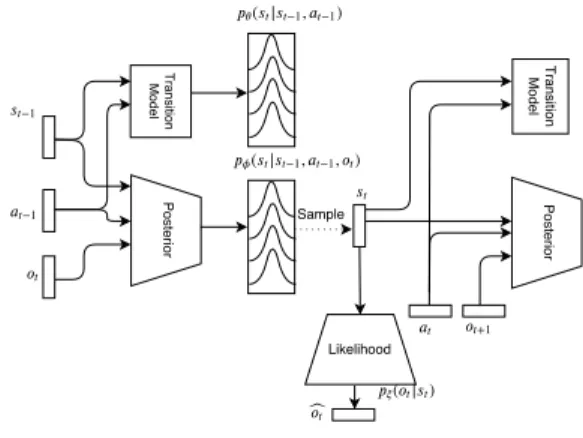
Figure 1 shows an overview of the information flow be-tween the transition model, approximate posterior and like-lihood neural networks. To engage in active inference using
these models, we need to estimateG(π, τ), which involves
es-timatingQ(sτ|π). As our model takes a state sample as input,
and only estimates the state distribution of the next timestep, the only way to get an estimate of the state distribution at a
future timestepτ > t+ 1is by Monte Carlo sampling.
Con-cretely, to inferP(π), we sample for each policyN
trajec-tories followingπusingpθ. This results inN state samples
ˆ
sτ, for which we can getN observation estimatesoˆτviapξ.
To be able to calculate the KL divergence and entropy, we use a Gaussian distribution fitted on the samples’ mean and variance. We then estimate the expected free energy for each
policy from current timesteptonward as follows:
Transition Model Transition Model Posterior Likelihood Posterior Sample
Fig. 1: We train simultaneously a transition model
pθ(st|st−1,at), an approximate posterior distribution model
pφ(st|st−1,at,ot), and a likelihood distribution pξ(ot|st)
model, by minimizing the variational free energy.
ˆ Gt(π) = t+K X τ=t+1 DKL(N(µsˆτ, σsˆτ)kP(sτ)) + 1 ρH(N(µoˆτ, σoˆτ)) +X π0 σ(−γGˆt+K(π0)) ˆGt+K(π0) (6)
The first summation term looksK timesteps ahead,
cal-culating the KL divergence between expected and preferred states and the entropy on the expected observations. We also
introduce an additional hyperparameterρ, which allows for
a trade-off between reaching preferred states on the one hand and resolving uncertainty on the other hand. The second
sum-mation term implies that afterK timesteps, we continue to
select policies according to their expected free energy, hence recursively re-evaluating the expected free energy of each
pol-icy at timestept+K. In practice, we unroll thisD times,
resulting into a search tree with an effective planning horizon
ofT =K×D.
4. EXPERIMENTS
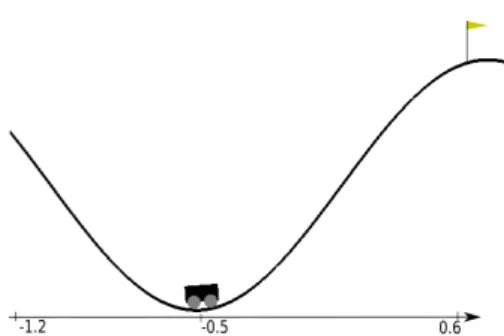
We experiment with the Mountain Car problem, where an agent needs to drive the car up the mountain in 1D by throt-tling left or right, as shown on Figure 2. The top of the moun-tain can only be reached by first building up momentum be-fore throttling right. The agent spawns at a random position, and only observes a noisy position sensor and has no access to its current velocity. At each timestep, the agent can choose
between two policies: πlto throttle to the left, πrto throttle
to the right. We experiment with two flavors of this environ-ment: one where the agent starts with fixed zero velocity, and one where the agent starts with a random initial velocity.
For our generative model, we instantiatepθ(st|st−1,at),
Fig. 2: The mountain car environment. The shown position
of the car at−0.5is the starting position in our evaluations.
networks with 20 hidden neurons, and a state space with 4 dimensions. To bootstrap the model, we train on actions and observation of a random agent minimizing the loss function in Equation (5) using stochastic gradient descent. Next, we instantiate an active inference agent that uses Equation (6) to plan ahead and select the best policy. As preferred state
distri-butionP(sτ), we manually drive the car up the mountain and
evaluate the model’s posterior state at the end of the sequence
ˆ
send, and setP(sτ) = N(ˆsend,1). To limit the
computa-tions, the active inference agent plans ahead for 90 timesteps, allowing to switch policy every 30 timesteps, effectively eval-uating a search tree with depth 3, using 100 samples for each
policy (K= 30, D= 3, N= 100).
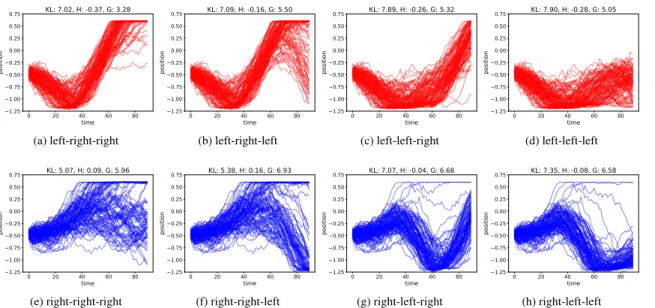
Figure 3 shows the sampled trajectories for all branches of the search tree, in the case the model is bootstrapped with
only a single observation at position−0.5. This is a
challeng-ing startchalleng-ing position as the car needs enough momentum in order to reach up the hill from there. In the case of a ran-dom starting velocity, the generative model is not sure about the velocity after only the first observation. This is reflected by the entropy (i.e. the expected ambiguity) of the sampled
trajectories. Now followingπrfrom the start will sometimes
reach the preferred state, depending on the initial velocity. In this case the active inference agent’s behavior is determined
by the parameterρ. Forρ >1, the agent will act greedily,
pre-ferring the policy that has a chance of reaching the top early,
cf. Figure 3e. When settingρ << 1, the entropy term will
play a bigger role, and the agent will select the policy that is less uncertain about the outcomes, rendering a more cautious agent that prefers a more precise and careful policy, moving
to the left first see Fig. 3a. We found settingρ= 0.1yields a
good trade-off for the mountain car agent.
In the environment with no initial velocity, the transition model learnt by the agent is quite accurate and the entropy terms are an order of magnitude lower, as shown in Figure 4. However, in terms of preferred state the lowest KL is still
achieved by followingπr. This is due to the fact that the KL
term is evaluated each timestep, and moving to the left, away from the preferred state in the sequence outweighs the benefit
of reaching the preferred state in the end. Choosingρ= 0.1
again forces the agent to put more weight on resolving uncer-tainty, preferring the policy in Figure 4a.
5. DISCUSSION
Using deep neural networks to instantiate the generative model and to approximate both prior and posterior distribu-tions, has the advantage that the generative model is indepen-dent of any state representation. The model can learn the best state representation for the observed data. Employing deep neural networks also opens up the possibility of using high-dimensional sensor inputs, e.g. images. The downside of our model, however, is the required sampling step, which means that a distribution is only calculated for the next timestep, and
distributions for timestepsτfurther in the future can only be
approximated by sampling.
Another point of discussion is the definition of the pre-ferred state distribution. In our case we opted for a Gaussian state distribution, centered around the state visited by an ex-pert demonstration, similar to our earlier work [9]. However, the standard deviation of this distribution will determine the absolute value of the KL term in Equation (6). A small stan-dard deviation will blow up the KL term, completely ignoring the entropy term. A large standard deviation will assign prob-ability mass to neighboring states, possibly introducing local optima that don’t reach the actual goal state. To mitigate this,
we introduced an additionalρ parameter that balances risk
and ambiguity.
Finally, planning by generating and evaluating trajectories of the complete search tree is computationally expensive. In this paper, we intentionally pursued this approach in order to directly investigate the effect of the KL term versus the en-tropy term. To mitigate the computational load, one might amortize the resulting policy by training a policy neural
net-workpπ(at|st)based on the visited states and the planned
actions by the agent, similar to [10]. In other approaches, the policy is learned directly through end-to-end training. For ex-ample, K. Ueltzh¨offer uses evolution strategies to learn both a model and a policy, that requires part of the state space to be fixed, to contain information of the preferred state [11]. B. Millidge on the other hand amortizes the expected free
en-ergyGas function of the state, similar to value function
es-timation in reinforcement learning [12]. Again, however, the perception part is omitted and the state space is fixed upfront.
6. CONCLUSION
In this paper, we have shown how generative models parame-terized by neural networks are trained by minimizing the free energy, and how these can be exploited by an active inference agent to select the optimal policy. We will further extend our models to work in more complex environments, in particular towards more complex sensory inputs such as camera, lidar or radar data.
0 20 40 60 80 time 1.25 1.00 0.75 0.50 0.25 0.00 0.25 0.50 0.75 position KL: 7.02, H: -0.37, G: 3.28 (a) left-right-right 0 20 40 60 80 time 1.25 1.00 0.75 0.50 0.25 0.00 0.25 0.50 0.75 position KL: 7.09, H: -0.16, G: 5.50 (b) left-right-left 0 20 40 60 80 time 1.25 1.00 0.75 0.50 0.25 0.00 0.25 0.50 0.75 position KL: 7.89, H: -0.26, G: 5.32 (c) left-left-right 0 20 40 60 80 time 1.25 1.00 0.75 0.50 0.25 0.00 0.25 0.50 0.75 position KL: 7.90, H: -0.28, G: 5.05 (d) left-left-left 0 20 40 60 80 time 1.25 1.00 0.75 0.50 0.25 0.00 0.25 0.50 0.75 position KL: 5.07, H: 0.09, G: 5.96 (e) right-right-right 0 20 40 60 80 time 1.25 1.00 0.75 0.50 0.25 0.00 0.25 0.50 0.75 position KL: 5.38, H: 0.16, G: 6.93 (f) right-right-left 0 20 40 60 80 time 1.25 1.00 0.75 0.50 0.25 0.00 0.25 0.50 0.75 position KL: 7.07, H: -0.04, G: 6.68 (g) right-left-right 0 20 40 60 80 time 1.25 1.00 0.75 0.50 0.25 0.00 0.25 0.50 0.75 position KL: 7.35, H: -0.08, G: 6.58 (h) right-left-left
Fig. 3: Depending on the random initial velocity, the car will reach the hill fast using the right policy only part of the cases (e), however starting with the left policy first also reaches the hill top and with lower entropy on the trajectories (a). A greedy agent (ρ >1) will pick (e) whereas a cautious agent (ρ <<1) will favor (a). For each policy we report the values of KL, H and G for
ρ= 0.1. 0 20 40time 60 80 1.25 1.00 0.75 0.50 0.25 0.00 0.25 0.50 0.75 position KL: 10.55, H: -1.83, G: -7.70 (a) left-right-right 0 20 40time 60 80 1.25 1.00 0.75 0.50 0.25 0.00 0.25 0.50 0.75 position KL: 10.44, H: -1.14, G: -0.96 (b) left-right-left 0 20 40time 60 80 1.25 1.00 0.75 0.50 0.25 0.00 0.25 0.50 0.75 position KL: 10.26, H: -1.25, G: -2.19 (c) left-left-right 0 20 40time 60 80 1.25 1.00 0.75 0.50 0.25 0.00 0.25 0.50 0.75 position KL: 10.42, H: -1.31, G: -2.67 (d) left-left-left 0 20 40 60 80 time 1.25 1.00 0.75 0.50 0.25 0.00 0.25 0.50 0.75 position KL: 9.14, H: -1.33, G: -4.16 (e) right-right-right 0 20 40 60 80 time 1.25 1.00 0.75 0.50 0.25 0.00 0.25 0.50 0.75 position KL: 9.88, H: -1.40, G: -4.16 (f) right-right-left 0 20 40 60 80 time 1.25 1.00 0.75 0.50 0.25 0.00 0.25 0.50 0.75 position KL: 11.03, H: -1.49, G: -3.87 (g) right-left-right 0 20 40 60 80 time 1.25 1.00 0.75 0.50 0.25 0.00 0.25 0.50 0.75 position KL: 11.11, H: -1.70, G: -5.91 (h) right-left-left
Fig. 4: When the environment starts the car with a fixed zero velocity, the model is on average much more certain on the predicted trajectories, resulting in lower entropy terms. However, policy (e) still achieves the lowest KL value, as this term is
evaluated each timestep, and moving away from the preferred state yields a high KL penalty. When choosingρ= 0.1, the agent
7. REFERENCES
[1] Karl Friston, Thomas FitzGerald, Francesco Rigoli, Philipp Schwartenbeck, and Giovanni Pezzulo, “Active
inference: A Process Theory,”Neural Computation, vol.
29, pp. 1–49, 2017.
[2] Karl Friston, “The free-energy principle: A unified
brain theory?,” Nature Reviews Neuroscience, vol. 11,
no. 2, pp. 127–138, 2010.
[3] Karl Friston, James Kilner, and Lee Harrison, “A free
energy principle for the brain,” Journal of Physiology
Paris, vol. 100, no. 1-3, pp. 70–87, 2006.
[4] Karl Friston, Spyridon Samothrakis, and Read Mon-tague, “Active inference and agency: Optimal control
without cost functions,” Biological Cybernetics, vol.
106, no. 8-9, pp. 523–541, 2012.
[5] Karl Friston, Philipp Schwartenbeck, Thomas FitzGer-ald, Michael Moutoussis, Timothy Behrens, and Ray-mond J. Dolan, “The anatomy of choice: active
infer-ence and agency,” Frontiers in Human Neuroscience,
vol. 7, no. September, pp. 1–18, 2013.
[6] Diederik P. Kingma and Max Welling, “Auto-encoding
variational bayes,”CoRR, vol. abs/1312.6114, 2013.
[7] Danilo Jimenez Rezende, Shakir Mohamed, and Daan Wierstra, “Stochastic backpropagation and approximate
inference in deep generative models,” inProceedings of
the 31st International Conference on Machine Learning, 2014.
[8] Philipp Schwartenbeck, Johannes Passecker, Tobias Hauser, Thomas H B FitzGerald, Martin Kronbichler,
and Karl J Friston, “Computational mechanisms of
curiosity and goal-directed exploration,” bioRxiv, p.
411272, 2018.
[9] Cedric De Boom, Tim Verbelen, and Bart Dhoedt, “Deep active inference for state estimation by learning
from demonstration,” in Conference of Complex
Sys-tems (CCS), Satellite Symposium on Complexity from Cells to Consciousness: Free Energy, Integrated Infor-mation, and Epsilon Machines, 2018.
[10] Ozan Catal, Johannes Nauta, Tim Verbelen, Pieter Simoens, and Bart Dhoedt, “Bayesian policy selection
using active inference,” in Workshop on Structure &
Priors in Reinforcement Learning at ICLR 2019 : pro-ceedings, 2019, p. 9.
[11] Kai Ueltzh¨offer, “Deep active inference,” Biological
Cybernetics, vol. 112, no. 6, pp. 547–573, Dec 2018. [12] Beren Millidge, “Deep active inference as variational