• No results found

The Lean Gap: A Review of Lean Approaches to Large-Scale Software Systems Development

N/A
N/A
Protected

Academic year: 2021

Share "The Lean Gap: A Review of Lean Approaches to Large-Scale Software Systems Development"

Copied!
41
0
0

Loading.... (view fulltext now)

Full text

(1)

1

The Lean Gap: A Review of Lean Approaches to

Large-Scale Software Systems Development

J.Pernstål

1

, T. Gorschek

3

, R. Feldt

2

1

Volvo Car Corporation,

SE-405 31 Göteborg,

Sweden

jpernsta@

volvocars.com

2

Department of

Computer Science and

Engineering,

Chalmers University of

Technology,

SE-412 96 Göteborg,

Sweden

robert.feldt@

chalmers.se

3

Blekinge Institute. of

Technology, Karlskrona,

SE-372 25

[email protected]

(2)

Abstract

Lean approaches to product development (LPD) have had a strong influence on many industries

and in recent years there have been many proponents for lean in software development as it can

support the increasing industry need of scaling agile software development. With it's roots in

industrial manufacturing and, later, industrial product development, it would seem natural that

LPD would adapt well to large-scale development projects of increasingly software-intensive

products, such as in the automotive industry. However, it is not clear what kind of experience and

results have been reported on the actual use of lean principles and practices in software

development for such large-scale industrial contexts. This was the motivation for this study as the

context was an ongoing industry process improvement project at Volvo Car Corporation and

Volvo Truck Corporation.

The objectives of this study are to identify and classify state of the art in large-scale software

development influenced by LPD approaches and use this established knowledge to support

industrial partners in decisions on a software process improvement (SPI) project, and to reveal

research gaps and proposed extensions to LPD in relation to its well-known principles and

practices.

For locating relevant state of the art we conducted a systematic mapping study, and the industrial

applicability and relevance of results and said extensions to LPD were further analyzed in the

context of an actual, industrial case.

A total of 10,230 papers were found in database searches, of which 38 papers were found relevant.

Of these, only 42 percent clearly addressed large-scale development. Furthermore, a majority of

papers (76 percent) were non-empirical and many lacked information about study design, context

and/or limitations. Most of the identified results focused on eliminating waste and creating flow in

the software development process, but there was a lack of results for other LPD principles and

practices.

Overall, it can be concluded that research in the much hyped field of lean software development is

in its nascent state when it comes to large scale development. There is very little support available

for practitioners who want to apply lean approaches for improving large-scale software

development, especially when it comes to inter-departmental interactions during development.

This paper explicitly maps the area, qualifies available research, and identifies gaps, as well as

suggests extensions to lean principles relevant for large scale development of software intensive

systems.

Keywords

Systematic Mapping Study; Software Engineering; Lean Product Development; Lean Software

Development; Agile Software Development; Automotive Software Development; Software

Intensive Product Development; Process Improvement.

1

Introduction

Software is rapidly becoming a substantial component and seen as the main driver and source of

innovations in a number of traditionally hardware-focused industries, (e.g., automotive and

aerospace) (Vekantesh-Prasad et al. 2010; Broy et al. 2007). For example, the worldwide value of

automotive software-intensive systems is expected to rise from 127 billion Euros in 2002 to 316

billion Euros in 2015 (Dannenberg and Kleinhans 2004). In these organizations, but generally in

large organizations, the software-intensive systems are commonly developed in the context of

(3)

large-scale development (i.e. systems of systems development), where software constitutes only

one, but important, part of the whole (Nihtilä 1999; Broy et al. 2007). This context is of particular

interest in this study where one of the key challenges is to integrate the software development into

the overall and multidisciplinary development of the complete product (Nihtilä 1999). This is a

challenge at Volvo Car Corporation (VCC) and Volvo Truck Corporation (VTC), where the

advancement of software has increased the uncertainty due to its changeable nature and the

interdependences between development tasks and artifacts, elevating the complexity of their

organizational structure and leading to communication and coordination problems across

departments (inter-departmental).

To avoid, or counter, large overhead, and enabling being highly responsive to change, software

development organizations have turned to agile software development over the past years, yielding

some good results (e.g., Mannaro et al. 2004; Layman et al. 2004; Svensson and Höst 2005), but

also leaving questions unanswered (e.g., Abrahamsson et al. 2003; Boehm 2002; Conboy 2009;

Wellington et al. 2005), ranging from scalability in large organizations to actual productivity and

quality issues. Thus simply applying agile (e.g., Scrum (Schwaber and Beedle 2001)) as a

stand-alone solution to coordination and communication problems in such large and complex

organization as VCC and VTC would not work. Hibbs et al. (2009) and Petersen (2010) claim that

lean practices and principles, building on lean product development (LPD), in contrast to agile, can

be applied to any scope, and is a prerequisite for scaling agile due to the unique focus on the

whole.

For all its benefits, LPD stems from the Toyota Product Development System (TPDS) (Morgan

and Liker 2006) for managing hardware development, and that was not originally designed for

development of software-intensive systems. Rather, it has primarily evolved, and been applied to

development of products that have traditionally been highly modular (e.g., vehicles) enabling

independent development and manufacturing (Morgan and Liker 2006). However, these products

are now becoming more large and complex, integrated systems due to the increased amount of

interacting software-intensive systems (e.g., central locking and engine control in a car) (Broy et

al. 2007). Even though Poppendieck and Poppendieck (2003) have looked into how lean principles

and practices can be used in software engineering (SE) and presented lean software development

(LSD), it is unclear what empirical evidence exists that lean principles and practices can be

successfully applied for software development in large-scale development projects of

software-intensive products. It is therefore relevant to review previous work and collect evidence of the

feasibility of applying lean to such industrial contexts from both an industrial and an academic

perspective.

The study presented in this paper was primarily motivated by an industry need of locating and

evaluating state of the art that could be contributing for solving a number of key improvement

issues identified in a previous case study (Pernstal et al. 2012). The case study is part of an SPI

project, assessing the inter-departmental interaction between Product development (PD) and

Manufacturing (Man) in the context of large-scale software-intensive systems development at two

Swedish automotive companies, namely Volvo Car Corporation (VCC) and Volvo Truck

Corporation (VTC). Since both companies have implemented lean manufacturing and are adopting

LPD, they expressed a need of identifying the state of the art in large-scale software development

building on lean principles and practices. Consequently, the main objective of the study presented

in this paper is to evaluate and summarize such state of the art for ensuring that this knowledge is

not omitted when developing solution for the identified issues in the companies. In addition we

also aim to identify needs and opportunities for future researchin essence figuring out what new

(4)

challenges and inadequacies might be present given the context of the case. For this we conducted

an extensive Systematic Mapping Study (SMS) (Petersen et al. 2008) as our initial searches in

database showed that there were relative few relevant and high-quality studies on the topic of

interest. Primarily because the case companies are adopting the well-established LPD principles

originating from TPDS and described in Morgan and Liker (2006), we structure the main part of

the analysis of the results according to these principles in order to identify lean gaps in large-scale

software-intensive development. Furthermore, we could have used the principles for LSD, but we

wanted to take a broader view, as such development covers different departments and engineering

disciplines and is not limited to software development. The LPD principles constitute the core of,

and serve as comprehensive guidelines for companies in their efforts to achieve LPD where one of

the key challenges is to obtain LPD across the whole companynot only within the development

organization, but also in other surrounding organizations such as marketing, product planning,

purchasing and manufacturing. In addition, industries developing software-intensive systems have

implemented lean manufacturing principles originating from the Toyota Production System (TPS)

(Liker 2004; Ohno 1988). In order to minimize waste in their lean manufacturing processes, a

well-known trend among these industries is also to improve their development processes by

implementing related LPD principles (Morgan and Liker 2006)—but it is unclear how the

principles address the fact that software as an artifact, and software engineering as a discipline, are

becoming a central component in the products developed.

The paper maps the area, identifies relevant work and qualifies it in terms of quality, and reveals

knowledge gaps. This is then discussed and reflected upon based upon previous observation from

needs identified at the case companies VCC and VTC, with the purpose of helping the case

companies in their decisions of adopting lean principles and practices as well as showing the

challenges in doing so. In addition, based on the findings and industrial needs we propose

extensions to the lean principles in the running analysis.

The remainder of the paper is organized as follows. Section 2 gives a brief background and

summarizes the related work. Section 3 provides an outline of the research methodology used in

the SMS. The results of the study are presented together with analysis in Section 4. Finally

conclusions and future research directions are presented in Section 5.

2

Background and Related Work

This section describes large-scale software development, presents related work on LPD and

summarizes previous most relevant reviews of studies reporting experiences, and best practices

within, or close to, the scope of this SMS. Finally, motivations and objectives are given.

2.1

Large-Scale Software-Intensive Systems development

Challenges in software development are often related to scaling-up software-intensive systems as

the complexity increases more than linear with the size (Brooks 1988; Curtis et al. 1988; Kraut and

Streeter 1995). Many industries develop large software systems that are embedded in their

products (e.g., vehicles and avionics) where the complexity becomes even more manifested

(Vekantesh-Prasad et al. 2010; Broy et al. 2007). This because such products are typically built of

functions, systems, and sub-systems including various hardware components and running on a

large amount of interacting software, requiring precise coordination and integration of

development tasks across multiple departments and engineering disciplines (Broy et al. 2007). For

example, the logics of the central locking system (CLS) is controlled by software distributed over

different sub-systems of the complete vehicle (e.g., door modules and alarm system), involving

(5)

mechanical engineering (e.g., door locks), electrical engineering (e.g., lock motors. sensors and

cable harnesses) and SE (e.g., controlling of the locking function logics). In addition,

manufacturing engineering must be involved in order to secure that the system fit the

manufacturing processes—how shall, for example, the CLS be configured and quality assured in

manufacturing? Moreover, in these industries, many of the systems are safety critical (e.g., airbag

and anti-locking braking systems in a vehicle) where the development is governed by safety

standards (e.g., ISO 26262), incorporating such as the V-model (ABG 1997) and including, for

example, hazard analysis, safety analysis and verification). For managing the rapidly increasing

share of software in these products, it has been acknowledged in research that the role of SE needs

to be better integrated into the PD as a whole (Nihtilä 1999).

2.2

Lean Product Development

Based on several studies on the automobile industry by researchers at the International Motor

Vehicle Program (IMVP) at the Massachusetts Institute of Technology (MIT), Womack et al.

(1990) introduced the LPD concept. This concept is building on TPDS under the heading of the

broader concept of lean production. They concluded that there were differences between mass and

Japanese lean producers not only in the manufacturing processes, but also in the PD processes in

terms of practices regarding strong leadership, teamwork, early communication and coordination

across departments, and concurrent development.

Many companies developing large software-intensive systems have implemented lean

manufacturing, but to make full use of this competitive weaponsqueezing out more waste of lean

manufacturing processeslean needs also to be extended to the PD processes (Morgan and Liker

2006). To increase the effectiveness in the PD processes, several companies have started to

implement some inherent principles and practices of LPD. Continuous improvement (Kaizen),

Kanban,  concurrent  engineering,  customers  and  suppliers’  involvement,  visual  management,  group  

work and cross-functional teams emerge as some of the practices used to reach the purpose of LPD

(Karlsson and Åhlström 1996; Morgan and Liker 2006;Sobek et al, 1999; Wang et al. 2012).

However, deploying only a few of the practices is not enough for achieving LPD. Womack and

Jones (2003) claim that lean is a way of thinking that must be adopted throughout the whole

enterprise. They conceptualize lean thinking into five categories: value, value stream, flow, pull,

and perfection. Value defines the use that a product offers a customer, and works backward to

build business processes. A value stream describes each step in processes and categorizes them

with regard to the value added (e.g., value adding, necessary non-value adding and non-value

adding steps). Flow organizes processes so products move smoothly through the value-creating

steps. Pull involves each customer calling output from the previous step, on demand. Finally,

perfection entails continuous improvement of processes for meeting customer needs and with zero

defects.

Literature specifically addressing LPD, are typically referring to studies on TPDS (Karlsson and

Åhlström 1996; Morgan and Liker 2006; Kennedy et al. 2008). Morgan and Liker (2006) present a

comprehensive work on LPD. Using the Sociotechnical Systems Theory (STS) (e.g., Miller and

Rice 1967) and the principles and practices of TPDS, they describe the core and essence of LPD in

a model called Lean Product Development System (LPDS). LPDS is based on the idea that LPD is

a philosophy being adopted throughout the whole enterprise rather than superficial applications of

a few lean principles and practices to parts of an organization. The LPDS model contains three

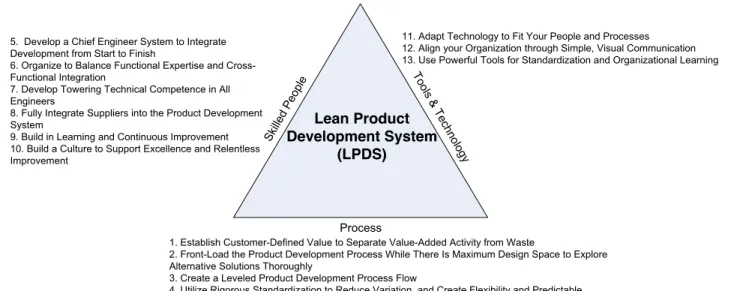
primary sub-systems: (1) process, (2) skilled people and (3) tools and technology. These are

described by means of 13 principles, see Fig. 1.

(6)

Lean Product

Development System

(LPDS)

S

ki

lle

d

P

eo

pl

e

1. Establish Customer-Defined Value to Separate Value-Added Activity from Waste

2. Front-Load the Product Development Process While There Is Maximum Design Space to Explore

Alternative Solutions Thoroughly

3. Create a Leveled Product Development Process Flow

4. Utilize Rigorous Standardization to Reduce Variation, and Create Flexibility and Predictable

Outcomes

11. Adapt Technology to Fit Your People and Processes

12. Align your Organization through Simple, Visual Communication

13. Use Powerful Tools for Standardization and Organizational Learning

5. Develop a Chief Engineer System to Integrate

Development from Start to Finish

6. Organize to Balance Functional Expertise and

Cross-Functional Integration

7. Develop Towering Technical Competence in All

Engineers

8. Fully Integrate Suppliers into the Product Development

System

9. Build in Learning and Continuous Improvement

10. Build a Culture to Support Excellence and Relentless

Improvement

Process

To

ols

&

T

ec

hn

olo

gy

Fig. 1. LPDS model adapted from Morgan and Liker (2006).

Whereas LPD principles are viewed as a platform for implementing lean approaches to PD on an

enterprise-level, LSD is commonly seen as a method for applying lean in the software

development discipline and referred to the work presented by Poppendieck and Poppendieck

(2003). Their adaptation of lean principles into seven software development principles is the main

source for interpreting lean principles in the context of SE. These principles are:(1) eliminate

waste

doing only what adds customer value without delays, (2) amplify learning

using frequent

feedback loops, (3) delay commitment

deciding as late as possible, (4) deliver as fast as

possible

minimizing the time from receiving customers

needs to delivery, (5) empower the

team

fostering respect for people among leaders and staff and building expert technical

workforce, (6) build integrity in

establishing product quality as early as possible for avoiding

defects in late phases, and (7) see the whole

for avoiding sub-optimizations, the whole software

development process is considered.

LSD has been associated with agile methods, such as XP (Beck, 2004) and Scrum (Schwaber and

Beedle 2001), and is often seen as just another agile method (Dybå and Dingsøyr, 2008; Higsmith,

2002). However, the definitions of the terms agile and lean are often ambiguous and inconsistent in

the software development literature (Conboy, 2009). This makes it difficult to identify differences

and overlaps between them, but in recent literature LSD is acknowledge as being a method

category with its own identity and even claimed to be the next evolutionary step from agile

towards lean approaches in software development (Hirnabe, 2008; Wang et al., 2012).

Poppendieck and Poppendieck (2003) advocate that lean is a platform upon which to build agile

software development practices, and view lean principles as the theoretical foundation behind agile

software development. Furthermore, Hibbs et al. (2009) claims that lean principles can be applied

to the whole enterprise where software development constitute one part of large-scale PD

processes, while agile methods mainly focus on team levels activities and specific practices for

developing software and usually do not concern the surrounding business context in which

software development take place. Others argue that even though there are differences, but also

overlaps, between agile and lean principles, they complement each other, and in particular, the

(7)

unique focus on the whole in LSD supports the expanding industry need of scaling agile software

development (Coplien and Bjornwig, 2010; Petersen, 2010; Wang et al., 2012). Similarly, it is

commonly claimed that agile methods have their shortcomings in large-scale development, where

it is recommended to mix the best features of traditional plan-driven and agile methods (e.g.,

Boehm, 2002; Conboy, 2009; Karlström and Runesson, 2005; Sommerville, 2007).

In summary, earlier work on lean and agile in SE indicates that adoption of lean principles in

software development is beneficial especially when it comes to large software systems

development. Even though lean and agile methods are influencing also more traditional industries,

such as the automotive one, the transition to lean and agile methods have only started and is not yet

widespread in the context of large-scale software development (Dybå and Dingsøyr, 2008; Wang

et al., 2012).

2.3

Summary of Related Reviews

For locating related literature reviews, we searched the scientific databases ACM Digital Library,

IEEE Xplore, Inspec, ISI Web of Science, Scopus, and Google Scholar. The search string was

based on the synonyms for systematic review defined by Biolchini et al. (2007). Reviews covering

the area focused on in this paper could not be found. However, studies reviewing literature on lean

and agile methods focusing on the SE field were found. The following presents the most relevant

ones.

Dybå and Dingsøyr (2008) conducted a systematic literature review (SLR) of empirical studies of

agile software development and LSD up to 2005, and identified 36 relevant empirical studies. Of

those, only one reported on applying lean practices to software development. Other main findings

were that most of the empirical studies focus on a single development method (e.g., XP) and

studies on agile), and implementations are mainly carried out on smaller scale (only three of the

papers investigated settings with more than 50 people).

Cawley et al. (2010) performed an SLR investigating to what extent lean and agile software

development methods have been adopted in regulated safety critical systems development. Most of

the studies identified were based on agile practices (XP and Scrum) combined with traditional

plan-driven development methods, but they found no studies where LSD had been used. However,

they believe that LSD has a potential of improving the development of safety-critical systems, and

thus, point out the need of further investigations in this area.

Wang et al. (2012) reviewed 30 experience reports published in agile conferences in which lean

principles and practices had been applied to agile software development. They divided the reports

into six categories of lean applications in agile software development. One of those concerned

applications of lean approaches for improving the interaction with other units that had already

implemented lean principles and practices established in the overall PD process while keeping the

agile software development processes internally. Furthermore, they found that several recently

published papers reporting on mature agile organizations show that these organizations have a

tendency to move from time-boxed agile processes to more flow-based lean processes. The

growing interest in LSD is also reflected by the fact that special issue on lean has recently been

published in IEEE software (2012).

2.4

Motivations and Objectives of this SMS

There are three main rationales for carrying out the SMS presented in this paper: (1) to the best of

our knowledge there are no systematic mapping studies locating the state of the art building on

LPD with a focus on large-scale software development, (2) an industrial need of evaluating the

(8)

strength of evidence and potential industrial value of such state of the art, and (3) gaps and needs

for future research in the area are unclear.

The SMS presented in this paper differs from previous reviews. Dybå and Dingsøyr (2008)

included LSD and had a clear focus on agile methods, while Wang et al. (2012) limited their

review to state of the art using lean applications in agile software development. Our main focus is

on lean application to large-scale software intensive systems development, mainly because agile

methods have primarily been applied to and studied in small-scale software development projects

(Dybå and Dingsøyr, 2008), which is a problem for large-scale development. Lean approaches on

the other hand seem to scale better than agile (Wang et al. 2012), which is why we use lean and

lean principles as the base for our study and analysis. We analyze our results from a broad lean

perspective by using LPD principles applicable to the whole enterprise and not the LSD principles

primarily adapted for software development as the main focus here is on software developed in the

context of larger systems in a multidisciplinary setting (e.g., software controlling the engine or the

CLS system in a vehicle).

Assessing the methodological quality and the strength of evidence in order to assist practitioners in

the case companies to evaluate the potential benefits and risks, and decision support prior to

adopting the state of the art is another main reason for performing the SMS. For this we reflect on

our results from the viewpoint of inter-departmental interaction by building on the collected data

and findings in an industrial case study reported in Pernstal et al. (2012). The study examines the

interface between PD and Man in large-scale development of software-intensive systems at VCC

and VTC. PD is concerned with design and development of software-intensive automotive systems

(e.g., development of power train and chassis control systems for vehicles). Man is concerned with

managing these systems when producing vehicles (e.g., vehicle manufacturing operations affected

by power train and chassis control systems). The case was chosen mainly because

inter-departmental coordination and communication is a key challenge in large-scale software projects

(Kraut and Streeter, 1995) and the interaction between PD and Man has been identified as critical,

both in the case companies and in literature (Morgan and Liker, 2006; Pernstal et al., 2012;

Wheelwright and Clark, 1994; Nihtilä, 1999). Furthermore, the researchers involved in the study

presented in this paper have access to rich and detailed information about the case, allowing better

possibilities to judge the industrial applicability and relevance of the results. In addition, we

assessed the quality of the selected papers by using an evaluation model proposed by Ivarsson and

Gorschek (2009, 2011) for gauging rigor and industrial relevance of studies.

Another main reason for conducting the SMS is to identify gaps and opportunities for future

research (Kitchenham and Charters 2007). LPD has primarily evolved and been adopted in

traditionally hardware-focused industrial sectors (e.g., automotives (Ward, 2007)) and aerospace

(Lean Aerospace Initiative (LAI) (Murman, 2004)), while the empirical evidence for the

applicability of lean and agile software development methods to such large-scale industrial

contexts is unclear (Dybå and Dingsøyr, 2008). However, software is increasingly becoming an

important component in these sectors, and unlike much hardware development and manufacturing,

software development is a nonroutine activity and the "material" itself is intangible, changeable,

and unpredictable (Brooks, 1987; Kraut and Streeter, 1995). Furthermore, to identify and suggest

areas for further studies addressing LPD in software-intensive industrial sectors, we give an overall

picture and an in depth analysis of how the state of the art in large-scale software development

based on lean principles and practices are related to LPD. In addition, to outline research needs

from an SE perspective, the identified state of the art is mapped to the different knowledge areas

(KA) as defined by SWEBOK (Abran et al., 2004). We chose SWEBOK as a way to structure the

(9)

paper as it is well known and established framework sponsored by IEEE. Although not perfect or

seen as optimal by all (Kaner, 2003)we considered it to be adequate for our purposes, and any

framework used have both proponents and opposers.

3

Research Methodology

The process for the SMS presented in this paper follows the guidelines by Kitchenham and

Charters (2007). It consists of the four main steps: (1) definition of research questions, (2)

generation of search strategy, (3) study selection, and (4) data extraction and quality assessment.

Three researchers were involved in this SMS. In order to enhance the validity and reliability, we

have continuously documented and updated the research procedures in a review protocol, which is

summarized below.

3.1

Research Questions

The research questions posed in the SMS presented in this paper are shown in Table 1.

Table 1.

Research questions.

Research question

Description

RQ1: What is the state of the art in large-scale

software development primarily based on lean

principles and practices?

Investigating if there are research contributions based on lean

principles and practices in large scale development of

software-intensive systems. In this study, we impose no limitations with

regard to the level of evaluation of the state of the art.

RQ2: What are the characteristics of the

identified state of the art?

Structuring and analyzing the main contributions of the

publications by combining the properties included in the

sub-questions RQ2.1, RQ2.2, RQ2.3 and RQ2.4.

RQ2.1: What type of research is

commonly conducted?

Reflecting the research approaches used in the publications

independent from the specific focus area.

RQ2.2: What is the relevance of the

state of the art?

Assessing the quality of the results reported by examining the

level of the industrial relevance.

RQ2.3: What is the rigor of the state of

the art?

Assessing the quality of the results reported by examining the

level of the rigor (e.g. descriptions of study design and context).

RQ2.4: What topics in SE does

state-of-the-art explicitly and clearly target?

Capturing the topics covered and identifying research gaps in the

field of SE.

RQ3: What relationships are there between

state of the art and the principles of LPD?

Ordering and analyzing of the state of the art reported in relation

to the LPD principles. The objectives are to identify research

gaps and needed extensions in LPD for large-scale software

development, and evaluate the applicability of the state of the art,

giving the industrial partners support in decisions on the SPI

project.

3.2

Search Strategy

The SMS was limited to peer-reviewed conference papers or journal articles written in English

language, published between 1990 to 2010, since the term 'lean' was first coined by Womack et

al.(1990). Furthermore, in order to reduce the number of irrelevant results, the search was only

applied to the title, keywords and abstract (Dybå et al. 2007).

The search string was generated on the basis of the scope of this SMS and is composed of two

groups of search terms, population AND intervention. Population includes alternative keywords

representing creation of software-intensive systems or products. Keywords covering common

concepts, principles and practices related to lean are embedded in intervention primarily based on

(Morgan and Liker 2006; Karlsson and Åhlström 1996; Sobek et al. 1999; Wang et al. 2012). As

(10)

inter-departmental interaction is one of the most critical challenges in large-scale software

development (Kraut and Streeter 1995), principles and practices that we could relate to this were

specifically considered. In order to identify relevant keywords and balance the comprehensiveness

and precision, the search string evolved over several pilot searches in the Scopus database. These

searches showed that terms not specific for lean, such as "integrated product development", was

used in publications that could be relevant (e.g., Negroni and Trabasso 2009). However, these

studies were excluded during selection process, primarily because they did not focus on software

development. To ensure the reliability and relevancy of the searches and to evaluate the search

strings, emerging key publications were listed and compared to the trial search.

In the first trial search, population targeted large-scale software development. However, the search

showed that there was a lack of relevant publications in this specific area (less than five). To

progress the review, we decided to extend the scope of the SMS so population covered

development of software-intensive systems in general. The relevance of the located state of the art

for large-scale software development was then assessed during the data extraction step.

With regard to the quality of the studies, it would have been effective to use keywords that limit

the publications to studies where the state of the art has been evaluated in some way (e.g.,

empirical, experience, lesson learned etc.) or in terms of a specific research method (e.g.,

experiment, case study etc.). However, trial searches with such restrictions on the search string

showed that there was a high risk of missing relevant papers, resulting in an incomplete overview

of the reviewed area. As a consequence, this delimitation was not imposed. Moreover, the

keywords for some of the practices commonly used in lean, such as pull and problem solving, were

too general, generating many irrelevant hits, and were thus discarded. The final search string's

keywords used for population and intervention and the Boolean expression are presented in Table

2.

Table 2.

Search string and keywords.

Population

AND

Intervention

software AND (development OR engineering

OR embedded system* OR electronic*)

lean* OR Kanban OR Kaizen OR 'continuous

improvement' OR 'cross* functional' OR

'concurrent engineering' OR 'integrated

product development'

The search string was applied to five electronic databases in the SE field. The list of selected

databases and the dates of the electronic search are provided in Table 3.

Table 3.

Searched databases.

Databases

Search date

ACM Digital Library

2011-02-05

IEEE Xplore

2011-02-05

Inspec

2011-02-05

ISI Web of Science

2011-02-05

Scopus (comprises Compendex)

2011-02-05

The search in the databases yielded in a total of 13,984 hits. After removing duplicates 10,230

publications remained to be further investigated. Due to large amount of publications, the reference

management application Mendeley (http://www.mendeley.com) was used.

(11)

3.3

Study Selection

The selection of relevant studies that are within the scope and relate to the research questions

posed in this SMS was based on a number of criteria for including publications. The purpose of the

criteria is to ensure inclusion of studies on large-scale software development and any kind of lean

development. In Table 4, the selection question and inclusion criteria are specified and briefly

explained.

Table 4.

Criteria for study selection.

Selection question

Inclusion criteria

Explanation

Is the main focus of the

study relevant?

The paper clearly states that it

focuses on

development

of

software or software intensive

products or systems

AND

includes any kind of

lean development

-Software-intensive systems or products consist

of integrated software and hardware solutions,

e.g., automobiles, aircrafts, mobile phones, etc.

- Lean development involves methods such as,

Kanban, Kaizen (continuous improvement),

concurrent development etc.

The process for study selection began with selecting relevant publications based on screening the

titles, keywords, and abstracts of the papers.

Start

Step 1 Screen title and keywords

Is the main focus relevant?

Step 2 Read abstract

Is the main focus relevant?

Exclude paper

(It is clear that the paper does NOT focus on

development of software AND lean.)

No

No

Include

paper

Include

paper

Unsure

Unsure

Yes

Yes

Exclude paper

(It is NOT clear that the paper focuses on

development of software AND lean.)

Exclude paper

(It is clear that the paper does NOT focus on

development of software AND lean.)

Fig. 2.

Process for study selection based on screening the titles, keywords, and abstracts.

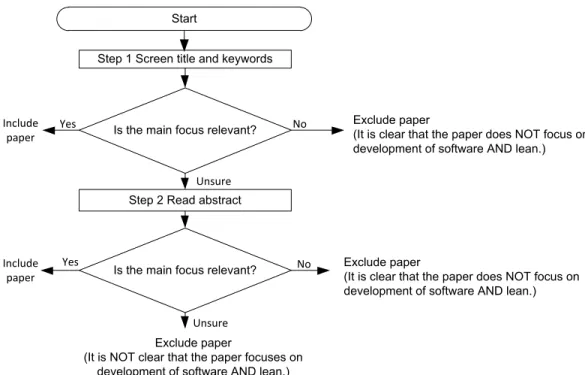
As shown in Fig. 2, the screening process consists of two main steps. First, the title and keywords

are screened. Depending on whether the main focus of the study is relevant, the paper is included.

If there are uncertainties about the main focus of the study, the abstract is read in the second step

where the paper is only included if the main focus is clearly relevant.

The three researchers elaborated a manual containing the process and selection criteria. To

enhance the quality of the manual and establish a unified understanding and interpretation of the

criteria and the process, we piloted and computed the inter-rater agreement. In the first pilot, we

assessed 100 randomly selected publications from the search performed in the databases. The

(12)

Fleiss' Kappa (Fleiss 1971) value showed a moderate agreement (0.5) according to Landis and

Koch (1977). We scrutinized the results of the pilot and refined the manual. In particular, the

definitions of the selection criteria were perceived too implicit, and hence they were further

detailed, specified and clarified by adding explanations. Then we performed a second pilot on 30

randomly selected publications, yielding a substantial agreement (0.74) (Landis and Koch 1977),

and one of the researchers used the agreed manual on the remaining papers selected for the

screening.

After the screening, one of the researchers also applied the inclusion criteria to the conclusion and

introduction sections of the remaining set of papers. Papers that were difficult to judge (e.g.,

unclear focus on lean approaches to software development) were classified as "unsure". A full-text

reading of these papers was conducted by the three researchers, and then further evaluated and

discussed based on the inclusion criteria (see Table 4) in a consensus meeting, yielding a final set

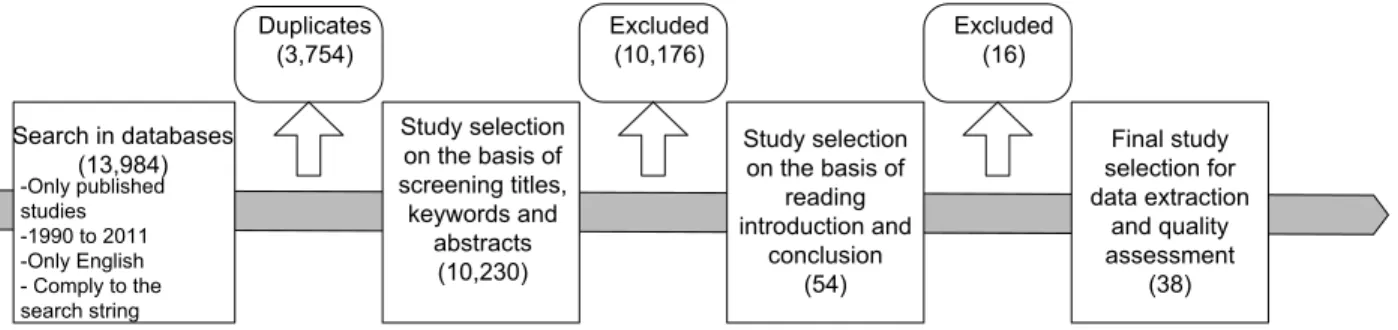
of agreed papers for data extraction. Fig. 3 shows the overall study selection process and the

statistics for how the publications from the selection based on the search in databases were reduced

to a final set of studies accepted for data extraction and quality assessment.

Search in databases

(13,984)

Study selection

on the basis of

screening titles,

keywords and

abstracts

(10,230)

-Only published

studies

-1990 to 2011

-Only English

- Comply to the

search string

Duplicates

(3,754)

Excluded

(10,176)

Study selection

on the basis of

reading

introduction and

conclusion

(54)

Excluded

(16)

Final study

selection for

data extraction

and quality

assessment

(38)

Fig. 3.

Overall study selection process and statistics.

The search string generated 13,984 published studies between 1990 and 2011 written in English.

Of those, 3,754 were identified as duplicates by listing titles and authors alphabetically in

Mendeley, which resulted in leaving 10,230 publications for the screening. After applying the

inclusion criteria on the titles, keywords, and abstracts, 10,176 papers were found irrelevant,

reducing the remaining number of publications to 54. Many of the excluded papers reported on

engineering of computer-aided software applications and tools applied to virtual development of

mechanical parts (e.g., CAD/CAM), automation in production, and lean manufacturing. Finally, 16

papers were excluded because either a copy of the full text was not available; the results of the

study were reported multiple times, or there was an unclear focus on software development.

Hence, a total of 38 publications were left for the subsequent quality assessment and data

extraction (see Appendix A).

3.4

Data Extraction and Quality Assessment

We developed a data extraction form on the basis of the research questions posed in Section 3.1.

The construction of the form aimed to gather data needed for the data synthesis so that the research

questions could be answered. This was primarily done quantitatively by classifying the selected

studies into a number of representative properties (systematic mapping)(Petersen et al. 2008), but

also qualitatively through in-depth analysis of the data (systematic review) (Kitchenham and

Charters 2007). Table 5 describes the properties used in the extraction form and their mapping to

the research questions.

(13)

Table 5.

Overview of extracted data.

Property

Description

Research

question(s)

Main focus

- Lean in large-scale software development

- Development phases

- Methods and practices used (e.g., Kanban, Kaizen, and concurrent

development etc.).

- Type of contribution (e.g., model, framework, process, method,

practice, metrics etc.).

RQ1

Context

- Domain (e.g., automotive, aerospace, telecommunication, web etc.).

- Project type (e.g., size, duration, complexity).

- Product type (e.g., system, software application, service complexity).

RQ1

Type of research

Categorization of the research type used in the papers based on the

existing classification scheme provided in Wieringa et al. (2006).

RQ2.1

Relevance and rigor Quality assessment of the papers by evaluating rigor and relevance

based on the method used by Ivarsson and Gorschek (2009, 2011).

RQ2.2,

RQ2.3

Topic in SE

Mapping of the main contributions of the papers to topic(s) in the SE

field according to the KAs in SWEBOK (Abran et al. 2004)

RQ2.4

LPD principles

Mapping of the main contributions of the papers to the LPD principles

in the LPDS model (Morgan and Liker 2006).

RQ3

For a deeper analysis, data was enriched by extracting qualitative data including descriptions of the

study context and the contributions, reported success factors and limitations, and the objectives of

the study.

To mitigate any misinterpretation of the study results due to low study quality, the extraction form

also included a quality assessment that was performed for each of the studies. For estimating the

study quality, the studies were assigned scores for rigor and relevance according to the evaluation

method provided in Ivarsson and Gorschek (2009, 2011).

In order to enhance the precision and consistency of the data extraction, and a common

understanding and interpretation of the properties among the researchers, we piloted the data

extraction form two times on a limited number of papers. After each pilot, the results were

compared and any disagreements between the researchers were resolved through further

discussions until consensus was reached. For example, clarifications of the knowledge areas and

research types were needed, and it was necessary to divide the level of relationship between the

contributions of the papers and the LPD-principles into the three scores of 'no', 'weak' and 'strong'

relationship. A 'strong' relationship entails that it is clearly and explicitly stated while a 'weak'

relationship means that it is only possible to deduce it.

The piloted data extraction form was then used by one of the researchers, who performed the

further data extraction. While doing the data extraction, the form was continuously discussed and

updated (e.g., adding, splitting and reformulating categories). The final data extraction form is

provided in Appendix B. The extracted data of each paper was filled out and documented in an MS

Excel sheet. Furthermore, a short rationale was added explaining why the paper should be in a

certain category (e.g., why the paper was attributed to a specific research type). From the entered

data, we calculated the frequencies of publications in each category, and used qualitative data

coding for scrutinizing and categorizing the extracted quotes (e.g., shared results, claims and

recommendations).

(14)

4

Results and Analysis

In this section, we present the results of the SMS derived from the 38 papers finally selected

according to the research questions specified in Section 3.1. Of these, 16 studies addressed

large-scale software development. The 38 included papers (S1-S38) are listed in Appendix A.

4.1

Quality Assessment (RQ2.2 and RQ 2.3)

We performed the quality assessment by evaluating the rigor and relevance of the studies based on

the aspects included in the model presented by Ivarsson and Gorschek (2011). The level of the

industrial relevance of the reported results is estimated with regard to the realism of the research

setting and the applicability of the research method for investigating phenomena in the real world.

The level of rigor is estimated through examination of to what extent and detail the context and

research method are presented, and the validity of the results is discussed. The maximum score for

rigor is three, while relevance has a maximum of four.

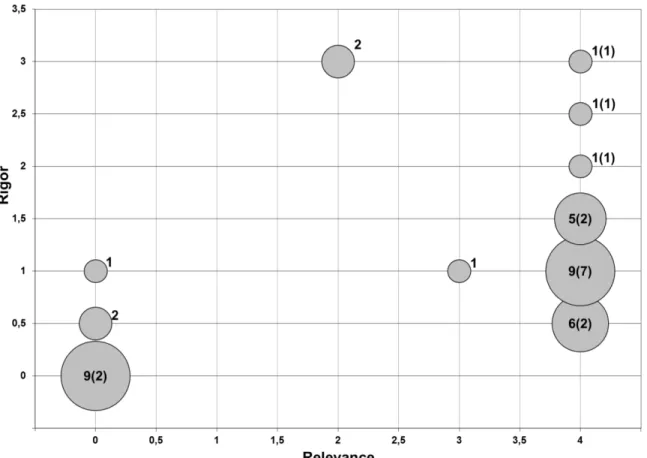
Fig. 4 shows the distribution of rigor and relevance of the selected studies, using a bubble graph

(Petersen et al. 2008). The size of the bubbles is proportional to the number of papers that are in

the pair of scores for relevance and rigor corresponding to the bubble coordinates (the number of

papers addressing large-scale software development is placed in brackets). The graph shows that

12 studies have zero relevance (32 percent) and of these nine studies (24 percent) have both zero

rigor and relevance where two studies address large-scale software projects. Typically, the 12

studies include descriptions of solutions that were evaluated by using small examples (six out of

12), or relying on the view of the author(s) (four out of 12). However, this does not mean that these

studies are out of scope of this review and thus should be excluded. The purpose of the model is to

give an overall picture in the field being reviewed by approximating the potential industrial

relevance and its progress, rather than providing precise and detailed criteria for an exact

classification of each individual study (Ivarsson and Gorschek 2011). Furthermore, our main

objective of the SMS is to establish knowledge about state of the art, being helpful for the case

companies in the search for solutions to the key issues identified in the SPI project. State of the art

deemed as irrelevant according to the model can be relevant for the case companies as there may

be other factors influencing the evaluation of the relevance than those based on the actual use in

industry. This makes it difficult to distinguish relevant studies from irrelevant ones. For example,

the likelihood of introducing subjective bias when assessing the value of research is high in both

what to assess (e.g., what constitutes value and quality), and reviewers' competence to assess it

(Dybå et al. 2007). Also the time perspective needs to be considered as it takes in the order of

15-20 years before state of the art has matured so it can be implemented in industry (Dybå et al.

2005). However, drawing conclusion merely based on these 12 studies should not be done as the

model indicates they have low quality.

On the other hand, 24 studies have relevance equal to three or more than three. Furthermore, 14

out of the 16 studies on large-scale software development have relevance equal to four. The

relatively high values of relevance are explained by that many studies are reporting on experiences

of applying lean approaches to real industrial settings. However, most of the studies are located in

the lower left and right quadrant, where 28 studies have a rigor equal to one or less than one and 11

of these studies are on large-scale software development. Insufficient information about the study

design and lacking discussion of the validity are the main reasons for the low values of rigor. For

example, 16 studies did not even briefly describe the study design, and only one provided a

detailed discussion of the validity. Omitting to report how the study was performed (e.g., sampling,

data collection and analysis), where (in what context), and any limitations of the results (e.g.,

(15)

generalizability and reliability) make it difficult to replicate the study and evaluate the results

(Dybå et al. 2005; Ivarsson and Gorschek 2011).

Fig. 4.

Distribution of rigor and relevance of selected studies (number of studies on large-scale are placed in

brackets).

To summarize, even though the quality assessment shows that the relevance of the studies is

relatively high, the lack of rigor reduces the possibility to judge the capability of the state of the art

to be contributing for practitioners seeking to adopt new best practices, and limits replications of

the studies.

4.2

Current State of the Art (RQ1)

In total 38 studies dealt with state of the art in software development built on lean principles and

practices. The studies were performed in contexts ranging from large and complex projects in

multi-national companies to student projects in academia. Of these, 42 percent (16 out of 38)

clearly dealt with software development in large-scale settings in different industrial sectors, such

as aerospace, avionics, telecommunication and industrial automation.

For all the selected studies, we identified and categorized the used lean practices. Each study was

then classified into a single category. However, in some studies lean practices were applied in

combination with agile methods (hybrids) and in many studies it was unclear which lean or agile

method that had been used. Therefore, studies not focusing on specific methods and practices (e.g.,

studies only mentioning or only implicitly related to a practice) were classified as generic lean or

generic lean and agile.

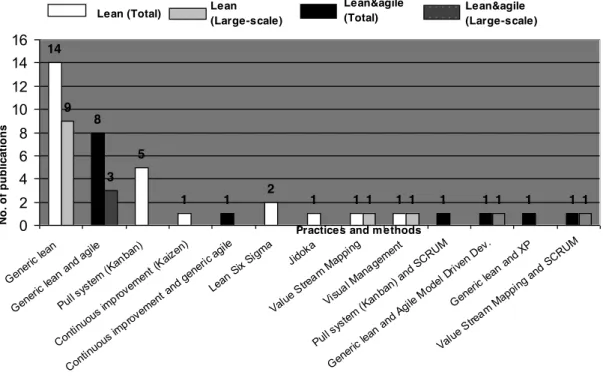
In Fig. 5, the number of studies per category of lean and agile methods is presented. For each

category the total number of studies and studies addressing large-scale development are given. For

(16)

example, the total number of studies classified as generic lean is 14 where nine of these studies are

addressing large-scale development. For all the studies, 66 percent (25 out of 38) reported on

solely lean, while 34 percent (13 out of 38) reported on lean and agile hybrids. Almost the same

relationships can be seen for studies on large-scale development, where 69 percent (11 out of 16)

reported on lean and 31 percent (5 out of 16) on hybrids. It is notable that publications reporting on

combinations of lean or hybrids of lean and agile, and plan-driven development (e.g., waterfall,

RUP, and V-model) could not be found, since such combinations have been recommended for

large-scale software development (Boehm 2002; Karlström and Runesson 2005; Sommerville

2007).

Looking at the diagram, most of the studies (24 out of 38) do not focus on any specific lean

practice; 14 studies report on generic lean, eight on generic lean and agile, one on generic lean and

agile model driven development, and one on generic lean and XP. Pull System (Kanban software

development) is the most frequently reported lean practice (six studies), but it can also be observed

that this practice has not been reported in large-scale software systems development. Furthermore,

12 out of the 14 studies reporting on a specific lean practice have been published recently

(2006-2010). This is much in line with Wang et al.(2012), who saw a trend of adopting more and more

concrete lean practices, and in particular, Kanban software development. With regard to studies on

large-scale development, 81 percent (13 out of 16) are classified into generic lean (nine studies),

generic lean and agile (three studies), and generic lean and agile model driven development (one

study). Value stream mapping (two studies) and visual management (one study) are the only

specific types of lean practices that are clearly focused on and reported.

Fig. 5.

Practices and methodologies reported and their frequencies.

4.3

Type of Research (RQ2.1)

To obtain an overview of the research type used in the studies, they were classified according to

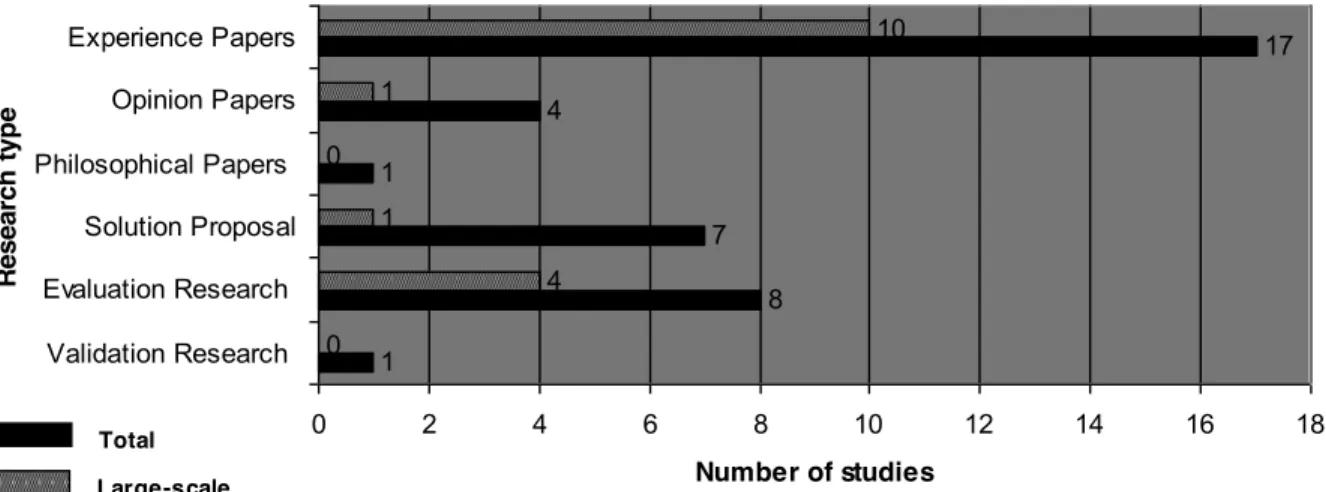
the classes provided in Wieringa et al .(2006). The diagram in Fig. 6 shows the distribution of the

research types for all the selected studies (black bars), and the 16 studies on large-scale

14

8

5

1

1

2

1

1

1

1

1

1

1

9

3

1

1

1

1

0

2

4

6

8

10

12

14

16

Ge

ne

ric

le

an

Ge

ne

ric

le

an

an

d a

gil

e

Pu

ll s

ys

tem

(Ka

nb

an

)

Co

nti

nu

ou

s i

mp

rov

em

en

t (K

aiz

en

)

Co

nti

nu

ou

s i

mp

rov

em

en

t a

nd

ge

ne

ric

ag

ile

Lean

Si

x S

igm

a

Jid

oka

Va

lue

S

tre

am

M

ap

pin

g

Vis

ua

l M

an

ag

em

en

t

Pu

ll s

ys

tem

(Ka

nb

an

) a

nd

SC

RU

M

Ge

ne

ric

le

an

an

d A

gil

e M

od

el

Dr

ive

n D

ev

.

Ge

ne

ric

le

an

an

d X

P

Va

lue

S

tre

am

M

ap

pin

g a

nd

SC

RU

M

Practices and m ethods

No

.

o

f

p

u

b

li

c

a

ti

o

n

s

Lean&agile

(Total)

Lean

(Large-scale)

Lean (Total)

Lean&agile

(17)

development (black and white bars). For example, in total 17 studies are classified as experienced

studies and of these 10 are studies on large-scale development. It can be observed that the most

common research type used is experience papers (45 percent of all studies and 62 percent of

studies on large-scale development) in which practitioners have reported their own experiences,

followed by evaluation research (21 percent of all studies and 25 percent of the studies on

large-scale development). Furthermore, a majority of the publications are non-empirical (76 percent),

since only 24 percent (nine out of 38) can be classified as evaluation research and validation

research. Of those four studies on large-scale development are empirical. This indicates that the

reviewed area in this SMS is not yet mature. One reason for this can be that the lean and agile

principles and practices have been introduced relatively recently in the field of SE (e.g., (Beck

2004; Poppendieck and Poppendieck 2003; Schwaber and Beedle 2001). Another reason could be

that although LPD has been used for many years by Japanese automakers and Western companies

in, for example, the automotive and aerospace industry (Murman 2004; Ward 2007), it is not until

recent years that software has become an important component in these traditionally

hardware-focused industrial sectors (Venkatech Prasad et al. 2010; Broy et al. 2007). Nevertheless, in order

to increase the maturity, there is a need for more validation and evaluation research efforts,

involving rigorous research methods (see also Section 4.1). These include, case studies on

large-scale software development projects in real industrial settings, where data is collected and

analyzed systematically and the validity of the results are scrutinized (Ivarsson and Gorschek

2009, 2011).

Fig. 6.

Research type distribution of all studies (black bars) and studies on large-scale software development (black

and white bars).

4.4

Topics in SE (RQ2.4)

We mapped the main contributions of the papers to topic(s) in the SE field according to the KAs in

SWEBOK (Abran et al. 2004) in order to obtain an overview of the coverage of the studies in the

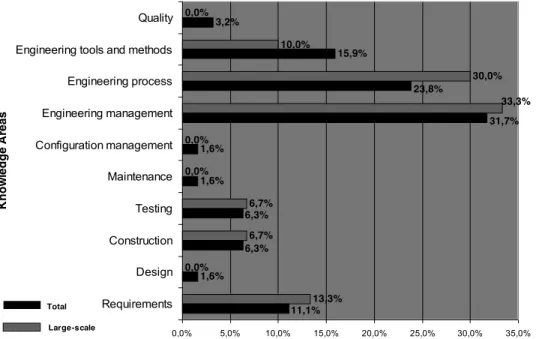
SE domain. Each study could be mapped to multiple KAs. The diagram in Fig. 7 shows the

proportion of all studies (black bars) and studies on large-scale software development (black and

white bars) per KA. For example, the proportion of all studies in the KA of engineering tools and

methods is 16 percent and the proportion of studies on large scale development in this KA is 10

percent.

1

8

7

1

4

17

0

4

1

0

1

10

0

2

4

6

8

10

12

14

16

18

Validation Research

Evaluation Research

Solution Proposal

Philosophical Papers

Opinion Papers

Experience Papers

R

e

s

e

a

rc

h

ty

pe

Number of studies

Large-scale

Total

(18)

Fig 7.

Proportions of studies per KA

all studies (black bars) and studies on large-scale software development (black

and white bars).

It can be observed that most of the studies could be classified into the KAs of engineering

management (32 percent) and engineering process (24 percent), whereas there are few studies

clearly addressing the KAs of configuration management (2 percent), maintenance (2 percent)

design (2 percent) and quality (3 percent). The proportions of the studies on large-scale software

development show a similar pattern. The largest proportions of these studies are mapped to the

KAs of engineering management (30 percent) and engineering process (33 percent), and there are

no studies classified into the KAs of configuration management, maintenance, design, and quality.

An explanation for this is the broadness of the KAs of engineering management and engineering

process spanning over the other KAs, which makes it easier to classify the studies into these two

KAs. Many studies that did not clearly specify which KA they addressed, usually dealt with SPI.

In order to primarily reducing lead times and enhance quality, these studies involved different

ways of tackling issues of general software development management based on lean management

principles (e.g., defining customer value and eliminating waste). This indicates that the reviewed

area of interest is immature, since most of the studies provide implicit state of the art without

detailed and practical guidance for adapting it to different situations and problems within a specific

KA. Lacoste (S15) and Linear and Preston (S16), for example, only articulate that Kaizen

(continuous improvement) management is a beneficial approach when improving the software life

cycle processes. Another example is Perera and Fernando (S24), who conducted an experiment

involving ten student projects and found that a hybrid process of lean and agile produces more

lines of code than an agile process, but they do not provide a detailed description of how the

processes differ and which practices are used.

Along with the lack of rigor, this makes it difficult for practitioners to understand the applicability

of the state of the art reported. For example, four studies on large-scale software development

could be mapped to the KA of requirements and of these only two had a rigor of more than one,

namely Ippolito and Murman (S11) and Petersen and Wohlin (S25). Ippolito and Murman (S11)

1,6%

1,6%

1,6%

15,9%

3,2%

13,3%

0,0%

6,7%

6,7%

0,0%

0,0%

30,0%

10,0%

0,0%

6,3%

6,3%

23,8%

31,7%

11,1%

33,3%

0,0% 5,0% 10,0% 15,0% 20,0% 25,0% 30,0% 35,0%

Requirements

Design

Construction

Testing

Maintenance

Configuration management

Engineering management

Engineering process

Engineering tools and methods

Quality

Kn

o

w

le

d

g

e

Ar

e

a

s

Large-scale Total

Figure

Fig. 1. LPDS model adapted from Morgan and Liker (2006).
Fig. 2. Process for study selection based on screening the titles, keywords, and abstracts
Fig. 3. Overall study selection process and statistics.
Fig. 4. Distribution of rigor and relevance of selected studies (number of studies on large-scale are placed in  brackets)
+5

References

Related documents

A person who is/was insured in the public system of pensions (first pillar) is entitled to an old-age pension (pensie pentru limită de vârstă) in the case that he/she meets

MANAGEMENT CONTROL OF PUBLIC SECTOR ACTIVITIES: THE FRAMEWORK OF HOFSTEDE The Dutch social scientist Geert Hofstede has become famous for his cul- ture studies, but before turning

2001-2002: Teaching Assistant, Observational Astronomy (Astro 310), University of Maryland, College Park 2001-2003: Teaching Assistant, Introduction to Astrophysics I and II (Astro

For the sample as a whole we find that each explanatory variable contributes to the change in daily sovereign bond yield spreads in the following maximum proportions: 56%

A version history of the elements can be provided within the model to represent the development of design processes and to demonstrate the sequence of versioning process in terms

Figure 4 24 shows that the largest shareholder owns an average ultimate voting block of 14.4 per cent (with a median of 9.9 per cent), whereas the second and third largest

n Very effective at detecting known attacks n Compensates for long software

SLNs combine the advantages of different colloidal carriers, like emulsions, liposome’s, (physically acceptable) polymeric nanoparticles (controlled drug release from