The World Bank Group
Integrity Vice Presidency
Forensic Audit Report
Arid Lands Resource Management Project – Phase II
Redacted ReportJuly 2011
This report details the findings and observations of the investigation conducted by the Africa Regional Team and the Forensic Services Unit of the Integrity Vice Presidency into the USD120m ALRMP II
Contents
Acronyms and Abbreviations ... 4
Executive Summary ... 5
Background ... 8
Allegations and INT’s initial assessment ... 10
Scope ... 12
Suspected Fraudulent Expenditures (SFEs)... 13
Questionable Expenditure (Q) ... 13
Methodology ... 15
Other audit work and procedures ... 17
PART I – Overview of Transactions Reviewed and Findings ... 19
Detailed findings by project categories ... 24
PART II – Non-Transactional Issues and Findings... 26
Bank and Cash Issues ... 26
Use of AIEs in the project ... 26
Balances of project bank accounts as at 30 June 2007 ... 28
Funds flow ... 31
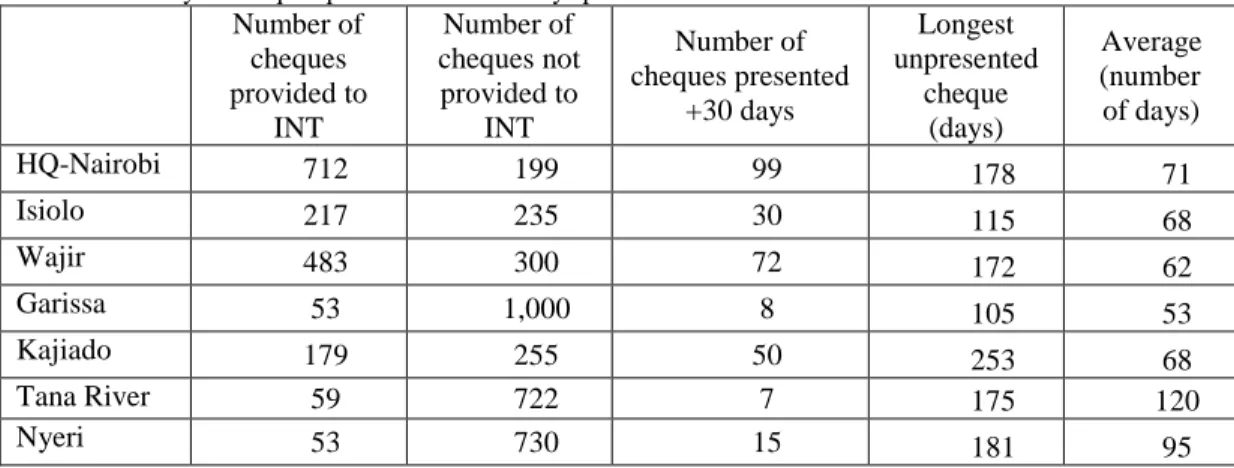
Unpresented cheques ... 31
Cheques banked not appearing in cashbook or supported by payment vouchers ... 33
Use of Cash Cheques ... 33
Some Other Behaviors Observed in Reviewing Cleared Cheques ... 35
ATM Withdrawals related to Commissioner of VAT cheques ... 36
Bank charges ... 37
Integrity of Bank Statements records ... 37
Delay in recording cash withdrawals in Isiolo’s cashbook ... 40
Tana River District Bank Reconciliation ... 41
Payroll/HR issues... 42
Other earnings to staff – adjustments June 2008 ... 47
March Quarter 2008 FMR and Payroll schedule variance (Ksh2,265,501.50) ... 48
Noncurrent Assets ... 50
Project accounting records for noncurrent assets... 50
IDA requirements on project asset disposals ... 51
Boarding of vehicles ... 52
Reconciliation of FMRs to vouchers provided ... 56
Attempted reconciliation of Garissa district FMR to the vouchers provided ... 57
VAT issues and the Kenya Revenue Authority ... 58
The risk of ‘double dipping’or use of vouchers for multiple projects by the PIU ... 60
Government Response ... 61
Acronyms and Abbreviations
AIE Authorisation to Incur Expenditure
ALRMP Arid Lands Resource Management Project
ALRMP II Arid Lands Resource Management Project – Phase II
ATM Automatic Teller Machine
CBI Confidential Business Information
CDC Community Development Committee
CDD Community Driven Development
CDF Constitutional Development Fund
DCA Development Credit Agreement
DMI Drought Management Initiative
DMO Drought Management Officer
DSG District Steering Group
EDRP Emergency Drought Recovery Project
FMR Financial Management Report
FMS Financial Management Specialist
FSU Forensic Services Unit, Integrity Vice Presidency
FY06/07 Financial year – 1 July 2006 to 30 June 2007
FY07/08 Financial year – 1 July 2007 to 30 June 2008
GOK/GoK Government of Kenya
IAD Kenyan Treasury – Internal Audit Department
IDA International Development Association
IFMIS Integrated Financial Management Information System
INT World Bank’s Integrity Vice Presidency
KACC Kenyan Anti-Corruption Commission
KACCAL Kenya: Adaption to Climate Change in Arid and Semi-Arid Lands Project
KCB Kenya Commercial Bank
KESSP Kenya Education Sector Support Program
KRA Kenyan Revenue Authority
KSH/Ksh Kenyan Schillings
LOA Loans and Disbursements
MOH Ministry of Health
NGOs Non-Government Organisations
PIP Project Implementation Plan
PIU Q
Project Implementation Unit Questionable Expenditures RFQ
SFE
Request for Quotations
Suspected Fraudulent Expenditure
SLD Support for Local Development
TTL Task Team Leader
USD United States dollars
VAT Value Added Tax
VFM Value for Money
WKCDD Western Kenya Community Driven Development and Flood Mitigation Project
Executive Summary
In April 2009 INT initiated a forensic audit of the Kenyan Second Arid Lands
Management Project (ALRMPII), a $120 million Bank-supported effort approved in May 2003 to enhance food security and reduce vulnerability in drought-prone and marginalized communities through a combination of institutional reforms and community empowerment. The purpose of the audit was to identify any expenditure that appeared to be fabricated, or inflated, or invalid. The audit proceeded in two stages. Where the documentation supporting an expenditure was complete and appeared authentic, the transaction was deemed to be valid and was not subject to further analysis.
On the other hand, where the documentation supporting transactions was either
insufficient or questionable, it was subject to further examination to determine whether it was a “suspected fraudulent expenditure” or SFE. If this further examination showed there were inconsistent documents supporting the expenditure, or inconsistent information, or
documents obtained through third parties or field research raised doubts about its genuineness, it was classified as an SFE. Fuller descriptions of the basis upon which documented expenditure was initially ‘questionable’ or determined to be a SFE are set out under the ‘scope’ section of this report.
Because the project involved a large number of relatively small transactions, managed at the district level and spread across Kenya, the forensic audit did not examine all project expenditures. Instead, for the fiscal years 2007 and 2008 (the audit period),1auditors reviewed all expenditures made in seven of the 28 districts covered by the project. These seven accounted for almost half the project’s total expenditure, and for the two year period reviewed, there were approximately 28,000 transactions in these seven districts.
The audit initially questioned transactions worth Ksh514m (Ksh251m and Ksh263m for FY07 and FY08 respectively). Following further analysis, SFEs of Ksh362m (Ksh176m and Ksh186m for FY07 and FY08 respectively) were established. This represents about 29% or a little less than one-third of the total expenditures reviewed.
The fraudulent behaviors in the transactions identified were broadly consistent across all districts sampled and the headquarters itself and were found in all categories of expenditures including fuel, vehicle repairs, training (capacity building), allowances and per diem, payroll, noncurrent assets. In relation to the community empowerment component, SFEs included income generating activities (matching grants), restocking activities, infrastructure (white elephants such as butcheries which were not certified by MOH or dispensaries which were never used), and in the drought management component of the project including allowances, training and data analysis. The audit did not group transactions by category of expenditure for headquarters because some SFE exhibited multiple risks and the categorization of expenditures by headquarter office was inconsistent (as explained later in the report,
1 A Supplementary Report dealing with specific allegations has been produced for Bank operations to
expenditures were often allocated to categories on what appears to be a subjective basis – this may have occurred in some districts as well).
The non-transactional issues audited included payroll, FMR issues, bank/cash and noncurrent assets.
The detailed analytical review of payroll identified questionable transactions for FY08 of Ksh2.9m. This sum consisted of two groups of transactions, those relating to the incorrect classification of allowances and backdated salary adjustments. A number of issues surrounding specific individuals were not resolved during the audit process because there were insufficient contemporary records made available to INT to substantiate the
allegation(s) and the lack of adequate response by project staff and GOK to such issues. Manipulation of bank statements and cash appears systemic across many of the districts sampled, possibly to avoid GOK regulations or defraud the project. There is a motive to under-report cash balances as under GOK rules unused funds must be repaid to the exchequer at the end of the financial year. While the audit does not prove that embezzlement occurred, it found that opportunities to embezzle cash from districts bank accounts existed in a number of ways - principally through the use of imprest accounts; but also via encashing cheques
equating to cheques written in the name of Commissioner of VAT (which were never subsequently presented).
The audit found a disconnect between the underlying vouchers provided and the financial management reports or FMR expenditures reported. While the FMRs were the basis for withdrawal applications from IDA, INT found that insufficient vouchers were provided to substantiate the expenditures reported in the FMRs and that the districts did not maintain sufficient workpapers to reconcile any differences arising. The project’s acknowledgement that IFMIS was not working and that only some of the districts operated ledgers, further confirmed the unreliability of the information.
Noncurrent assets was a risk identified in the planning stages of the audit, and indeed the audit found that this risk was realized due to the inadequacy of the financial and accounting systems of the project for the relevant periods. In particular, the audit could not determine whether fixed assets, principally vehicles and computers, were properly used for the project. It also determined that there are no accountability mechanisms within the loan documents to ensure that, if project assets are disposed of, the proceeds revert to the project and/or GOK, and similarly on closure of the project, no accountability mechanisms were identified to ensure that assets of the project are transferred to another project or GOK. Because the accounting and financial management systems were inadequate and because the proper use of project assets acquired was not demonstrated, an argument could be raised that the total expenditures under this category are questionable, as the borrower has failed to meet the financial covenants in Article 4 of the original Development Credit Agreement (DCA). This may be an observation relevant to all Bank projects where inadequate FM systems are subsequently found. The audit also identifies that GOK regulations were intermittently applied, which appeared to assist the project management to avoid accountability issues.
INT views the issues identified in this audit as systemic and serious, supported by the fact that total suspected fraudulent expenditures represented approximately 29% of those
sampled. The issues identified are consistent with findings in other recent audits conducted by the GOK authorities.
Background
1. Arid Lands Resource Management Project – Phase II (ALRMP II), project number P078058, was the successor project to ALRMP (P001331) which operated from July 1996 to June 2003 and was funded by the Bank, covered 22 districts with total IDA disbursements of USD19.24m. ALRMP was, in turn, a successor project to the Emergency Drought Recovery project (EDRP) (P001369) which operated from April 1993 to June 1997. ALRMP II was initially approved for an IDA loan of USD65.99m. Additional IDA financing of USD52.4m and a trust fund of USD5.59m was sought and approved under this project by the Board in late 2006 which made the ALRMP II a USD124m Bank funded project and increased the number of districts covered from 22 to 28. A successor project to ALRMP II, Kenya: Adaption to Climate Change in Arid and Semi-Arid Lands (KACCAL), project number P091979, has been approved by the Board but implementation is pending the outcome of this audit and any follow-up measures required. ALRMP II was made up of three components – drought monitoring, community driven development (CDD) and support for local development (SLD). Significantly CDD was the single largest activity (21.9%) of the project after funding the National and district co-ordination units (23.2%) (source: PIP for ALRMP II page 14). 2. The first two anticipated benefits of the project relate to CDD project goals, the original
PIP stated the project was “expected to generate a variety of social, economic and institutional benefits, which will strengthen sustainable livelihoods of the target population:
1. Community Empowerment: The Beneficiary Assessment of ALRMP I highlighted the
importance of empowerment as a benefit per se. ALRMP II will, through design improvements, further strengthen social capital and the voice of marginalized communities and increase their capacity to determine and implement their own development priorities.
2. Improved enabling environment for wealth creation: Reducing conflict and insecurity will create a more favorable environment for enterprise development. Greater access to financial services will also stimulate income diversification and open up new opportunities for innovators and entrepreneurs. This will lead to an increase in incomes and employment opportunities.(source: PIP, page 10, Anticipated Benefits)
3. The drought monitoring initiative component for ALRMP II was to build on the work of phase I of ALRMP, namely the implementation and strengthening of data collection and to institutionalize the drought management initiatives within GOK systems. The project acknowledged that in addition to data collection and analysis, interventions at the
community level were also required, hence the need for the remaining components. Due to a number of issues, including governance, phase I designed the drought monitoring system by establishing its own District structure, through the establishment of District Steering Committees (DSGs) with the responsibility to determine the local interventions. The DSG is a government committee chaired by the District Commissioner whose
cross-cutting project activities (both government and donor) at the district level and to engage with communities on development matters.
4. CDD can be characterized by a number of different criteria which can sometimes cause confusion when projects are generically described as a CDD project or there is reference to the CDD ‘model’. It is important therefore to define, from INT’s perspective, the CDD features of ALRMP II which justify this label. CDD projects incorporate the “empowerment of communities” by giving them the capacity to choose projects, and making them responsible for these choices, selecting leaders, implementing and fiscally managing their projects. Within ALRMP II there was a specific CDD component which was designed to empower local villages or community groups in the 28 arid and semi-arid districts. In addition there were several other components of the ALRMP II project not peculiar to the CDD model, namely an early warning data collection component for drought management purposes, a significant capacity building component, and the drought contingency fund component. Significantly, the CDD manual was used for all components of the project.
5. The effectiveness of the CDD approach hinges on the transparency and mechanisms that ensure the community has adequate information about the project: how to apply for funding, who can participate, the decision- making process, and, once the funding
decisions are made, on the transparency and efficiency of the payment systems, to get the funds to the intended beneficiaries.
Allegations and INT’s initial assessment
6. A forensic audit was commenced by INT into allegations arising in ALRMP II in early 2009 which covered the FY06/07 and FY07/08 years (audit period). INT decided to take this course of action after reviewing and assessing allegations, project financial
statements, and a report of the GoK’s Internal Audit Department (IAD) relating to project activities in the Tana River District from the 2003/2004 financial years to the date of the Report (June 25, 2007).
7. Because the allegations extended beyond the periods audited, the INT audit did not address all allegations. However, where a specific significant transaction, which was the subject of the allegations, was identified but may have partially fallen outside the audit period, the entire transaction was examined and is in this report.
8. The initial planning for the ALRMP II forensic audit identified a number of issues within the financial monitoring reports (FMRs) and supervision missions which provided useful leads. This assessment enabled INT to retain a focus on specific allegations and design a work program for non-transactional issues such as noncurrent assets, HR/payroll,
procurement, cash/bank, VAT and financial management reporting. For example, the FMRs on the FY07/08 financial statements for ALRMP II, dated 15 January 2009, referred to issues raised by the auditor and the auditors reasoning for a qualified opinion – those issues were considered as part of the assessment.
9. Several issues not identified in the FMR or the auditor’s management letter included the errors in note 7 to the annual financial statements on non-current assets and no comment on the lack of any accounting policies disclosing the treatment of non-current assets. Additionally, the FMR did not address the inadequate management responses to audit issues raised such as the ‘cash balance carried forward’ and the ‘non-current assets’. The management responses to the auditor’s management letter raised in themselves serious concerns for INT over the credibility of the annual financial statements and the
underlying accounting records.
10.INT’s concerns over the accounting processes were further heightened when project management proposed to rectify the fixed assets note by processing a journal. Management should have been reconciling the correct and true position rather than ‘correcting’ the position with a journal. In this instance, the correct approach may have necessitated an inventory count of all project vehicles. In relation to the concern expressed in the FMR and auditors’ letter on the cash position, the true cash position could have been reconstructed from bank statements and cashbooks, however there appears to have been no attempt to undertake this reconciliation. Further, INT was also concerned there was no evidence to suggest a reconciliation of the annual financial statements of the project to the quarterly FMRs had been undertaken, particularly given the importance of the FMRs in the report-based disbursement process.
statements which were adequate to reflect the operations, resources and expenditures related to the project. As reported in FM supervision reports, the financial information management systems was inadequate and not fully functioning during the relevant period, resulting in project officials relying on what was effectively a manual system. This failing may constitute a breach of the DCA.
Scope
12.Due to the range and extent of allegations, INT determined that extensive sampling was required. The behaviors described in the allegations suggested relatively small amounts were being defrauded in large volumes and in a systemic manner. To capture the range of behaviors and to form a solid understanding of the potential quantum of alleged fraud, a significant portion of the population of transactions had to be reviewed.
13.Although the project covered 28 arid and semi-arid districts within Kenya, it was necessary to audit a sample of districts to manage the quantity of the transactions ultimately reviewed. Initially 13 districts and headquarters were selected for audit but, due to the volume of work required, ultimately only 7 districts and headquarters were reviewed. While it was accepted this would not capture and identify all offending transactions, with the reduction in scope, INT would be better placed to ensure a more timely notification of significant issues which could be addressed on an ongoing basis to the project team, incorporated into the planning for the successor project, enable
management decisions to be made based on preliminary findings, reduce the impact on INT’s resources and finalize the investigation in a shorter timeframe. The 7 districts sampled included 2 semi-arid districts (Nyeri and Kajiado) and 5 arid districts (Tana River, Samburu, Isiolo, Garissa and Wajir).
14.The focus of this audit was to identify SFEs, i.e. project expenditures that based on a combination of desk reviews, third party verification and field work, appear to either be fabricated (not real expenditures), inflated or not valid project expenditures. It was not the objective of the audit to form a view on whether the dishonest intent existed for these ‘suspected fraudulent expenditures’, such enquiries are better left to the appropriate enforcement authority. SFEs normally had either inconsistent documents supporting the transaction or inconsistent information or documents were obtained through third parties or field work, which raised doubts as to the genuineness of the transaction.
15.During the course of the audit, questionable transactions were also identified. These transactions included SFEs but also included expenditures that were not supported by sufficient documents or, for other reasons, all or part of the expenditures did not meet the legal definition of eligible expenditure under either the DCA, or the subsequent
Agreement Amending Development Credit Agreement, or breached GOK regulations. Whether the ‘ineligible’ portion of the transaction was 1% or 100%, the entire transaction was classified as questionable (Q), if part of it was established as such. This approach was necessary due to the volume of transactions under review and to enable greater analysis of the SFE. (This approach is also in line with normal auditing approaches.) 16.Consequently, INT identified expenditures that were Q or SFE. These were categorized
by district and expense category, to the extent possible, but due to the issues highlighted in part I of this report, these expenses could not be fully reconciled to the categories in the FMRs, especially headquarters.
Suspected Fraudulent Expenditures (SFEs)
17.SFE was defined as expenditure for which, based on the work performed in the course of the audit, there is prima facie evidence that the expenditure (or part of it) had been misappropriated through fraud and corruption, or embezzled, or incurred for purposes other than the purposes of the project. SFE is also ‘questionable expenditure’ as defined below, but is reported separately within this report. An example of an SFE may be where the supporting documents provided for a voucher are inconsistent with the voucher or are false.
18.Transactions identified by INT as SFE do not necessarily imply knowledge by all or any project staff of the underlying potential dishonesty, as the various staff involved in preparing and/or processing the relevant vouchers and obtaining the relevant approvals may not have had any role in the underlying transaction. It may even be the case that the project itself was potentially defrauded, due to false misrepresentations of suppliers or actions of another party to the transaction.
Questionable Expenditure (Q)
19.For the purposes of this audit, eligible expenditure was defined as an expenditure that met the requirements under the DCA and complied with relevant GOK regulations and law. Expenditures that did not meet this initial threshold were questioned, by applying the formal definition of an ineligible expenditure under Bank rules and procedures, namely “any amount of the loan/credit … used to pay for an expenditure that is not eligible pursuant to the Loan Agreement/Development Credit Agreement (‘ineligible
expenditure’)”.
20.As well as this formal legal definition, INT relied on the Bank guidelines ‘Disbursement Guidelines for Projects’ published by LOA May 2006 and terms of reference applied by FM and LOA in their own in-depth reviews of statements of expenditures and withdrawal applications when analyzing the transactions.
21.In addition to the Bank’s requirements under the DCA, the project also operated in accordance with GOK regulations. While the project’s activities and administration were captured under Kenya’s Government Financial Management Act 2004, it is recognized that this Act was never fully operationalized and in practice, there is still a reliance on the Government Financial Regulations and Guidelines along with Treasury Circulars. 22.Sections 15 and 25 of the Government Financial Management Act 2004 specifically dealt
with withdrawals from the Consolidated Fund, and the duration of appropriations, which was applicable to at least the GOK counterpart funding, and even IDA funding; as those funds appeared to have flowed from the Special Account to the exchequer account (The Treasury) before being released to the Ministry for the project and the local project bank account itself.
23.Section 15 stated that withdrawals could not exceed appropriations in any one year, section 25 stated:
25 - Duration of appropriations.
25. (1) The following apply with respect to every appropriation by Parliament for a financial year -
(a) the appropriation ceases to have effect at the end of the financial year; and (b) any appropriated amounts that have been withdrawn from the exchequer
account but that have not been expended at the end of the financial year shall be paid into the exchequer account.
(2) The application of this section is subject to any specific provision in an Act relating to an appropriation.
[Extract of Government Finance Management Act 2004 of Kenya]
That said, we understand from our discussions in Kenya that the practice is not to transfer unspent balances to the exchequer account, but rather, have unspent balances certified by the Board of Survey at the end of the financial year, and any uncommitted balances deducted from the following years allocation.
24.In essence a payment voucher for expenditure for a project was questioned and required further analysis if: the goods or services purchased did not meet one of the categories defined in the Credit Agreement; there was insufficient evidence that the expenditure was incurred; there was evidence that some or all of the expenditure was embezzled; the goods or services had not been provided; the funds had not been expended as at the end of the financial period; and or the expenditures breached GOK regulations.
25.Even if only a portion of the transaction was questioned, INT categorized the entire expenditure pertaining to the transaction as questionable. For example, if a payment voucher claimed reimbursement for allowances and per diems for a training event for all participants, but INT found that one alleged participant had claimed allowances and per diems for multiple events on the same day, then the entire value of the payment voucher was treated as questionable — not just the portion that pertained to the one participant.
26.Examples of questionable expenditure for this audit would include: misappropriation through apparent fraud and corruption; funds that have been embezzled (where there is evidence that it is more likely than not that embezzlement has occurred); funds that have not been used for the intended purpose (e.g., buying textbooks rather than fixing the roof); funds spent for goods not provided or services not rendered at the time of payment (e.g., purchasing fuel on account); funds spent for expenditures that breach GOK
regulations (e.g. failure to comply with imprest requirements).
27.The identification and quantification of this questionable expenditure is seen to provide insight to the key risk areas detailed in this report. It is recognized that further work is required on these transactions, to extract the ineligible component amount in accordance with Bank guidelines.
Methodology
28.INT recognizes that, throughout the audit process, assistance was provided by PIU staff. Both PIU and ministry staff have responded to many queries and provided support and information to allow INT to conduct its audit as effectively as it was able.
29.A common characteristic of the CDD model relevant to INT from an investigative
perspective, is the decentralization of the payment systems within the project and the fact that there are significant numbers of relatively small transactions, because there are significant numbers of relatively small interventions. An investigation of fraud and corruption allegations requires each individual transaction to be identified, evidenced and then quantified i.e. the requirement of legal systems (as in Kenya) is for specific acts of dishonesty (transactions) to be subject to the judicial process with sufficient proof
(evidence) of the dishonest act and or intent, and then quantified (establishing the amount of the offending or impact on a project).
30.A 100% voucher review for headquarters and the districts sampled was planned as part of an initial desk review. Selected transactions would then be subject to a field review and/or third party verification. Subsequently, during the course of the voucher review, it was agreed that any voucher transaction involving Ksh20,000 (approximately USD260) or less would not be reviewed on grounds of immateriality, unless the document on its face was suspected to be fraudulent, or was related to other questionable expenditures requiring further analysis.
31.On the basis of the underlying examination of each transaction, the total amounts of questionable expenditures requiring further examination under the loans or grants for ALRMP II were quantified. Transactions were questioned when it was not apparent they had been used for the purposes intended, and may also include expenditures that involved a technical infringement of either the Loan Agreement or of GOK regulations, such as a prepayment for goods not yet delivered. The classification of each transaction will be dependent upon the evidence made available.
32.A team comprising forensic accountants and investigators was formed to perform the initial desk-based review of the vouchers and accounting records of the project. A mission in May/June 2009 resulted in the review of 3 districts (Nyeri, Kajiado and Tana River) and part of Headquarters. Following this review the documents for 4 further districts were scanned (Wajir, Garissa, Isiola, Samburu ) along with the significant documents identified during the intial review of the 3 districts.
33.A further team was formed that comprised initially of 4 Nairobi-based forensic
accountants to complete the desk-based review of the remaining 4 districts. In addition, the first round of field work was performed in February 2010 to validate the assumptions and findings arising from the initial desk work and to gain a greater understanding of the actual operations of the project at district and community level. Contact was also made with various third parties to attempt to verify certain transactions. The desk-based review
of the remaining districts was completed during February, March and April 2010. Field work was conducted in missions undertaken in February, April and September 2010. 34.INT designed the field work to validate a number of transactions as well as the
assumptions underlying the desk-based review. When the desk review found that the documentary evidence supporting various transactions was incomplete or was suspected to be inaccurate or not genuine, samples of those transactions and their supporting documents were subjected to an in-depth analysis. This deeper analysis frequently included field work, during which the authenticity of the documents was tested against other documentary records (including records held by third parties) and the roles of specific individuals in handling those records was determined to the extent possible. (For example, quotations held by the project would be compared to quotations provided by the named vendor, to see whether they matched; and handwriting and other identifying markers would be examined to see whether ostensibly different quotations may have come from a single source). Where INT was not able to confirm that the documentary evidence supporting a transaction was in good order, the transaction remained classified as inconclusive. Such cases warrant further investigation by the authorities in Kenya. 35.INT’s field work addressed a number of the allegations received to establish whether the
behavior purportedly occurring across districts was present. To demonstrate, INT were advised that a common practice in paying grants to a recipient CDC was for the senior committee members to visit the DMO’s office to collect the cheque and deposit it into the CDC’s bank account; the senior committee members would allegedly remain in town until the funds were cleared, usually 1-2 days, and then immediately withdraw a large cash amount and make a payment to the DMO. While INT were reviewing documents relating to an approved livestock restocking project by one of the CDCs, it was
established that the day following receipt of the approved grant (Ksh493,750), 27% of the funds were withdrawn from the community bank account. During field work, the
chairman of the CDC was unable to provide any explanation for this withdrawal, and an analysis of further records showed that restocking actually took place 2 months later. Although the above example provides weight to this allegation, based on INT’s investigative work, it is not clear how widespread this practice was and whether it occurred across districts not audited.
36.Third party verification provided independent verification of a transaction through the analysis and comparison of records not controlled by the party subject to audit (i.e. the project). INT sourced bank statements and cheques issued from commercial banks as a means to establish if the project cash book and payment vouchers correctly identified the recipient of the funds. Supplier verification, which was also undertaken as part of the field work, sought to confirm the legitimacy of the documents and establish actual supply of the goods and services. In addition, Kenya Revenue Authority (KRA) records were sought to compare payments recorded as being made by the districts against those received at KRA, mainly Value Added Tax (VAT).
transactions and identify behaviors from the desk-based review performed on a more selective basis.
38.On completion of the desk review, field work and verification through third party records, transactions were categorized provisionally as being either (i) eligible or (ii) questionable or (iii) both questionable and suspected to be fraudulent. Observations were captured for each transaction that was deemed either questionable and or suspected to be fraudulent, to justify the analysis, ensure consistency of approach amongst the forensic auditors, assist readers of this report, and identify recurring behaviors evidenced. 39.Once this provisional categorization had been made, INT provided a schedule of
payments, principally involving district staff, to the relevant DMO in order to provide an opportunity for further explanation for the transaction. Responses, which in some cases included the provision of additional documents not previously provided, were received from the DMOs of the 7 districts sampled.
40.Following a review of the DMO responses, a categorization of the transactions was made.
Other audit work and procedures
41.In addition to the transaction work, the audit included work to reconcile the vouchers reviewed, to the project’s FMRs, which form the basis for withdrawal applications from IDA by GOK. This audit approach was largely substantive, verifying individual transactions, and consequently avoided the reliance on the financial systems of the project or GOK but required quarterly prepared District FMRs to be vouched via work-papers to the underlying vouchers.
42.Specific audit procedures were devised for noncurrent assets, due to the risks identified in the initial assessment by INT. Requests for all District Fixed Asset Registers were made, so that INT could attempt to reconcile the asset registers to the annual financial statements. All disposals of fixed assets were targeted to ensure that Government procedures were followed and proceeds were properly accounted for. Procedures were devised to identify assets donated to the project from other closing projects.
43.Payroll and human resource (HR) issues were also subjected to specific audit procedures and reviewed analytically rather than on a transactional basis. In addition, INT
responded to specific allegations relating to the preponderance of certain regionally-originated employees performing finance and supply roles in the project, by reviewing and analyzing the ethnicities of employees in these roles.
44.Cash and bank records for the districts sampled were subjected to additional tests, due to an initial INT assessment that the only bank accounts reported on the FMRs were in fact the special account and headquarters Citibank account. That is, none of the individual district bank accounts were captured in the FMR reporting. Due to the substantive nature of the work performed, cleared cheque vouchers were also requested.
45.VAT records and elements of transactions were also subjected to additional procedures, due to the project’s VAT status during FY06/07 and FY07/08. The project was VAT exempt i.e. was not liable for VAT but dispensation processes existed, which required that each supplier to the project needed to receive specific KRA confirmation that the project was exempt (so that supplier could issue an exempt invoice). The alternative was that when a supplier issued the project an invoice including VAT, the project would withhold the VAT (paying the supplier the net amount) and then pay the VAT liability to KRA direct (all VAT payments were to be funded from Counterpart funds), and the project was to issue a VAT withholding certificate to the supplier. A reconciliation of the VAT paid to KRA by ALRMP should have matched the VAT it withheld from the supplier payments. INT’s audit found that neither KRA’s nor ALRMP’s records adequate to perform the reconciliation and that there were discrepancies between what ALRMP withheld for VAT purposes and what it paid to KRA. Within the Credit Agreement it was clear that if a VAT liability arose then it was to be funded by GOK (counterpart funds).
46.Although value-for-money issues were not specifically included as part of the forensic work, the audit makes some comments on value-for-money, in light of the findings of its field work. A differentiating factor between INT’s field work and the normal Bank supervision mission was that, where possible, the visit to a CDC was not pre-arranged.
PART I – Overview of Transactions Reviewed and Findings
47.This section of the report quantifies the findings of the transactions reviewed during the audit. Underpinning these findings are INT’s detailed work-papers, which itemize each transaction and the rationale for the classification of the expenditure which are attached as an annexure to this report.
48.The selection of the seven districts (five arid and two semi-arid districts) together with headquarters expenditure enabled the forensic audit to cover a significant portion of project expenditures for the periods FY06/07 and FY07/08. None of the new districts added as a result of the Amending Development Credit Agreement in late 2006 - Taita-Taveta, Kwale, Kilifi, Malindi, Lamu and Meru North – were sampled due to the low volume of expenditure and the fact that they were at an establishment stage.
Table 1
49.An analysis of the FMRs provided to the Bank indicated that for FY06/07 and FY07/08 the expenditure coverage of the audit was 53.7% and 49.3% respectively. The above Table 1 sets out the reported expenditure for each district sampled, and for headquarters with the payroll expense shown separately. All expenditure from the districts sampled and the headquarters (with the exception of payroll) were analyzed on a transactional basis. The payroll was a significant expense, representing 16-17% of total costs of the project for the relevant periods. Due to the nature of payroll expenditure, INT dealt with it principally on an analytical basis rather than a transactional basis.
50.Both IDA and GOK funded transactions were reviewed. The DCA dated June 26, 2003 (reference 3795 KE) refers under Schedule Two to the ‘description of the project’
District - Ksh 000s Garissa 67,846 5.1% 55,848 5.2% Tana River 40,055 3.0% 44,681 4.2% Nyeri 13,912 1.0% 20,459 1.9% Kajiado 22,021 1.7% 21,299 2.0% Samburu 52,311 3.9% 50,551 4.7% Isiolo 61,204 4.6% 57,313 5.4% Wajir 89,403 6.7% 69,451 6.5% Headquarters - other 84,784 6.4% 77,239 7.2% Transaction expenditure reviewed 431,537 32.5% 396,842 37.1%
Payroll 223,577 16.8% 176,769 16.5% Analytical expenditure reviewed 223,577 16.8% 176,769 16.5%
Total expenditure reviewed 655,114 49.3% 573,611 53.7%
Other districts 673,553 50.7% 494,951 46.3%
Total expenditure per FMRs 1,328,667 100.0% 1,068,562 100.0%
FY08 FY07
ALRMP II Forensic Audit
recording that the project consists of a number of parts and then refers Part A as ‘Natural Resource and Drought Management (NRDM)’, Part B as ‘Community –Driven
Development (CDD)’, and Part C as ‘Support to Local Development’. Part D is not referred to in the original agreement but is inserted under the amending agreement as ‘Emergency Recovery’. The GOK counterpart funding component was set out within Schedule One of the Agreement Amending Development Credit Agreement dated October, 25, 2006. Within category 6 (b) ‘other operations and maintenance’ for Parts A, B and C of the project of ‘incremental operating costs’, 50% of these expenditures incurred before 30 June 2007 and 40% thereafter, were to be met by IDA. Note that Part D of the project under 6(b) was to be funded 100% by IDA. Within category 6(a)
‘vehicle operation and maintenance’ 80% of the expenditures were to be financed by IDA. Identifying payment vouchers during the course of the audit which related to ‘Emergency Recovery’ and therefore 100% funded by IDA was problematic as there was no notation on the face of the vouchers that indicated whether the underlying transaction related to part A, B, C or D. This made it difficult to delineate or identify the counterpart funding requirement or check whether the counterpart element was correctly calculated. 51.Another issue which made it difficult to check the counterpart funding allocation and
analysis was the way certain expenses were allocated to certain categories. An example was fuel. If the fuel was purchased to drive a coach of participants to a training event, the cost could (and was) allocated to either ‘Transport Operating Expenditures’ (TOE) or ‘Training’ categories. If the expense was categorized as ‘Training’ there would be no counterpart funding requirement as that category was 100% funded by IDA compared with the TOE category which was only 80% funded by IDA and required counterpart funding of 20% from GOK. The purpose of this forensic audit was not to comment on the correctness or otherwise of the categorization of expenditures but problems arose during the course of the audit, as what appeared as inappropriately categorized
expenditures, were identified. This did not mean the incorrectly categorized expenditure was an SFE or an eligibility issue, but simply whether expenditures were properly
accounted for. However, this did impact the issue of the GOK counterpart liability and may be an issue, if SFE are requested to be reimbursed to the Bank.
52.Due to the lack of proper audit trails and insufficient supporting work-papers, no detailed reconciliations were performed between vouchers provided and the reported FMRs (for some or all of the districts no detailed supporting FMR work-papers were provided or ledgers were maintained). Consequently for this forensic audit, INT cannot illustrate systemic issues against the reported FMRs by category, but rather point to specific transactions and their similar nature to other transactions reviewed, across all the districts sampled and headquarters. While INT’s approach did allow it to summarise its findings at a district level (refer to Table 2 below), headquarters could not be analyzed this way, because it incorporates transfers to the districts and centralised procurements.
*Kajiado district & Headquarters – Payment Vouchers were not available to confirm ‘vouched expenditure’ amount for either FY06/07 or FY07/08.
53.The desk based review approached the analysis from the original payment vouchers provided in early 2009. The results of the desk based review were tabulated on a district by district basis creating detailed INT work-papers, which allowed analysis of each category (component of the FMR) for which vouchers were provided. Districts were not consistent in the way the vouchers were prepared for the audit, for example the Garissa district incorporated the vouchers relating to vehicle maintenance, maintenance of station and maintenance of equipment within a single lever arch folder – even though these expenditures are different categories. Likewise expenditure relating to support for local development was on some occasions captured within civil works, CDC payments and or the drought contingency fund, and or in its own ‘file’, depending on the district approach. For these reasons and for the reasons set out in the section headed FM issues it was not possible to reconcile by category the vouchers provided against the FMRs.
54.These issues also made it difficult for INT to reconcile, at a district level, the value of the vouchers provided against the reported FMR expenditure for that district. A number of valid reasons could explain variances. For example if there was an indication that surplus vouchers were provided for the audit, then an innocent double counting of transactions could have occurred as payment vouchers may have been provided within the accounting records of the district, and further payment vouchers may have been
provided at the CDC level (if the payment to the CDC was captured as well as the payment by the CDC for the project itself then the transaction was captured twice). Likewise, if insufficient vouchers were provided, then it may indicate that a file of vouchers were inadvertently not provided to INT or not scanned by INT for analysis (for Isiolo, Samburu, Wajir and Garissa districts) or inadvertently not reviewed or scanned by INT (for Tana River, Kajiado and Nyeri).
55.Table 2 also sets out the AIE for each district sampled for each year, this should approximate to the FMR expenditure as it represented the funds each district was authorized to spend. The district with the largest variances between AIE and FMR expenditures was Tana River district. Significant amounts by value of surplus vouchers were also identified for Tana River (both FY06/07 and FY07/08). INT performed additional work to try and ascertain whether double counting of transactions occurred – this could be observed when analyzing individual categories of expenditures for these districts. INT also reconfirmed the FMR expenditures reported for Tana River district. INT was aware of IAD’s Report on Tana River district which related to an earlier period but was reported and acted on during FY06/07 and FY07/08. The actual audit and results of that report on the Tana River district’s operations were significant as key members of that district office were replaced, the district’s records were reviewed (allowing for audit fatigue i.e. lost, missing or misfiled records), and certain activities were curtailed, e.g. the district ceased issuing Matching Grant payments. Consequently INT was not surprised with the results of Tana River district in respect of these analytical findings. Even the ‘Development Expenditure Estimates – 2007/2008’ set out in ‘Vote D 35 Ministry of State for Special Programmes’ for Tana River district reported
‘approved estimates 2006/2007’ of Ksh52,793,902 and for ‘estimates 2007/2008’ Ksh57,296,377 which did not approximate closely to actual expenditures reported. Unlike Garissa district where ‘approved estimates 2006/2007’ were Ksh55.98m and ‘estimates 2007/2008’ were Ksh65.49m, close to reported FMR expenditures of Ksh55.85m and Ksh67.85m respectively.
56.Despite the inability to reconcile the FMR expenditures for each district to vouchers actually provided, all Qs and SFEs have been separately identified by transaction and summary schedules of this information is set out above. INT reached its conclusion in relation to ‘questionable’ and ‘suspected fraudulent’ expenditures on a transaction basis and did not rely on the differences identified at an analytical level – rather using those observations to confirm detailed findings where possible.
Table 3
57.Table 3 indicates, SFE for the expenditure sampled for FY06/07 were Ksh176m and FY07/08 were Ksh186m. When contrasted against total expenditures reported in the FMRs for those districts, these figures represented 30.6% and 28.4% respectively of expenditures. The percentage of total (Q and SFE) was in excess of 100% for Nyeri in FY07/08 – this was due to the fact that more vouchers were reviewed than claimed in the FMR for that district for that period.
58.As Table 3 indicates SFEs and Qs were present in all districts sampled, as well as headquarters. For reasons set out below, the two transactions relating to the payroll amounting to Kshs2,863,000 for FY07/08 were simply treated as Qs because it was not possible to verify the expenditures sufficiently through third party verification or field work in the timeframe of the audit. Additional non-quantifiable payroll issues were identified and have been addressed in the payroll section of this report.
59.The analysis of these findings indicates that the behaviors were prevalent across all districts sampled and headquarters, which is an indicator that these are systemic. INT is also aware that these findings are consistent with behaviors found in the recent WKCDD
and KESSP forensic audits – to the extent that the behaviors relate to ‘CDD’ type projects in Kenya.
60.Although the behaviors may be systemic, that is not and adequate basis for INT to
extrapolate the findings of the forensic audit to the remaining districts or to other periods. As noted elsewhere in this report, some districts were at an early stage of implementation (the six new districts incorporated in this project under the Agreement Amending
Development Credit Agreement dated October 25, 2006) and the nature of the different activities or project components implemented in arid versus semi-arid districts may mean that certain behaviors will not exist, simply because the opportunity did not exist.
61.In relation to behaviors identified as relating to common expenditure incurred in many if not all projects or GOK ministries referred to in the Report of the Controller and Auditor General on the Appropriation Accounts, Other Public Accounts and the Accounts of the Funds of the Republic of Kenya for the Year Ended 30 June, 2009 (dated 19 May 2010), such as fuel, vehicle maintenance, training, payroll, vehicle and computer purchases, management and disposals, imprest warrants, and allowances and per diem, it appears to INT that the behaviors are not unique to this project.
Detailed findings by project categories
62.To the extent possible expenditures were analyzed by the categories across all districts sampled, relying on the coding of the vouchers by the districts. An attempt was made to reconcile the coding against the original categories as per the loan documents; however due to the accounting by the districts, this was not possible based on workpapers provided to INT during the audit. The analysis could not be performed by INT on headquarter expenses as the vouchers were not organized by category or expense type, but were provided to INT in chronological order.
63.Based on INT’s analysis of the transactions, the following categories have been used: civil works; goods and equipment; support for local development (SLD); CDD grants; drought contingency fund (DCF); training; transport operating expenditures (TOE), travel and other. For the purposes of this report and to assist operations reconcile the results against FMRs and project documents – civil works, goods and equipment and SLD formed category 1 & 2; CDD grants was Category 3; DCF was Category 4, Training was Category 5, TOE was Category 6a and all other expenses were captured as Category 6b. 64.The analysis of the expenditures by category, set out in Table 4, demonstrates that SFE
expenditures were identified across all categories. The summary demonstrates that the largest component of the project was also subjected to the most SFEs, i.e. civil works, purchases of equipment and SLD (cat. 1 & 2) represented the largest category of SFEs by value i.e. Ksh128m and 447 transactions (representing 64% of all expenditures reported for the districts sampled). CDD (cat. 3) with 324 suspect transactions worth Ksh101m (USD1.26m @ 80:1) represented 75% of all expenditures on this component of the project (for the districts sampled).
65.Significantly TOE (cat. 6a) had 365 transactions worth Ksh49.2m considered to be SFEs (cat. 5) while training had 172 transactions worth Ksh21.9m and DCF (cat. 4) had 84 transactions worth Ksh15.4m.
Table 4
Cat. 1 & 2 Cat. 3 Cat. 4 Cat. 5 Cat. 6a Cat. 6b Total
FY08 Garissa 19,904 11,999 7,348 10,462 9,401 8,731 67,845 Samburu 16,645 10,000 2,789 10,789 6,264 5,824 52,311 Tana River 10,491 9,550 2,160 6,376 5,819 5,660 40,056 Isiolo 17,807 12,000 6,210 10,790 8,450 5,947 61,204 Wajir 36,520 11,999 11,068 12,850 8,653 8,314 89,404 Kajiado 11,019 - 2,799 3,458 1,944 2,802 22,022 Nyeri 6,176 - 339 1,858 1,937 3,602 13,912 Total FY08 118,562 55,548 32,713 56,583 42,468 40,880 FY07 -Garissa 11,512 17,922 4,355 7,113 7,733 7,213 55,848 Samburu 11,366 18,000 2,907 7,312 5,795 5,171 50,551 Tana River 11,209 9,410 5,961 6,230 5,730 6,141 44,681 Isiolo 10,778 17,999 4,230 6,919 10,563 6,824 57,313 Wajir 16,892 18,000 9,788 8,159 8,659 7,953 69,451 Kajiado 10,457 - 2,914 3,117 1,685 3,127 21,300 Nyeri 10,277 - 2,809 2,525 1,872 2,976 20,459 Total FY07 82,491 81,331 32,964 41,375 42,037 39,405 Totals 201,053 136,879 65,677 97,958 84,505 80,285 666,357 SFE 128,438 101,998 15,418 21,893 49,242 9,618 326,607 64% 75% 23% 22% 58% 12% 49% Q 48,762 12,487 14,272 12,838 10,429 16,053 114,841 24% 9% 22% 13% 12% 20% 17% Total 177,200 114,485 29,690 34,731 59,671 25,671 441,448 88% 84% 45% 35% 71% 32% 66%
ANALYSIS OF SFE & Q BY LOAN CATEGORIES FOR DISTRICTS SAMPLED AGAINST DISTRICTS EXPENDITURE REPORTED IN FMRs
PART II – Non-Transactional Issues and Findings
66.This segment of the report captures the non-transactional aspects of the audit which include a review of payroll/HR issues, cash and bank issues, non-current assets, VAT and financial management reporting issues.
Bank and Cash Issues
67.The way bank accounts were operated and the handling of cash by the districts sampled were the focus of additional work in INT’s forensic audit. There were a number of issues which are set out below that were identified across multiple districts. The significant use of cash to settle transactions made it difficult for INT to substantiate the transactions retrospectively, let alone identify and locate recipients. INT understands that working in remote parts of Kenya requires the use of cash, especially when communities do not have access to local banking facilities.
Use of AIEs in the project
68.As the project was operated under GOK ministries, latterly the Ministry of State for the Development of Northern Kenya and Other Arid Lands, GOK regulations applied and the project was subject to GOK’s estimates, appropriations rules and procedures, and
financial management regulations. In respect of cash and funding, that meant that the IDA component (as well as the GOK component) of the project funds were channeled through the exchequer account. Before authorized accounting officers could spend the money ‘Authorized to Incur Expenditures’ (AIEs) were required.
69.Under the project before any money was released to the districts by headquarters, AIE’s were required for each DMO (the ‘AIE holder’) for each district, setting out by category upper limits of expenditure that could be incurred. The AIEs should have matched the funds released by headquarters to each district. Typically the AIEs were issued around the same time as when the remittances occurred.
70.AIE enabled the project (and GOK generally) to control who (which district) and when funds were spent. An AIE specified for the district the categories on which the funds could be spent. For example if the disbursement related to the Drought Contingency Fund, then the AIE would specify that category (see sample Table 5 for Tana River district below – in Ksh). Set out below is a table of the remittances made by headquarters to the districts sampled by INT for both FY06/07 and FY07/08.
Table 5
71.An analytical review of the FMR expenditures reported for each district should match or reflect the issuance of AIEs, and later in this section, in relation to the observation that significant FMR expenditure is reported in the fourth quarter, this appears generally consistent with the timing of the remittances to district offices. For example Tana River district received Ksh24.7 million in March 2007 and a further Ksh3.8 million in June 2007, which represented 64.7% of the total Ksh58 million remitted to Tana River for that financial year (FY06/07).
72.Using Tana River district FY06/07 as an example, the AIEs provided to INT for that period (refer to Table 6 below – in Ksh) amounted to almost Ksh56 million yet remittances to the district amounted to almost Ksh58 million (see Table 5 above), resulting in a Ksh2 million difference. There were possible obvious explanations, such as missing AIEs, but neither the district nor headquarters appeared to have conducted reconciliations and consequently expenditure could have potentially occurred without appropriate AIEs, therefore making the expenditure unauthorised. There was a control in relation to AIEs issued, as each Payment Voucher captured the category to which the payment would be accounted for, which kept a running total of the AIE value for that category to ensure no overspending occurred. But no part of the district FMR reporting package captured the remittance information and compared it with the AIEs issued.
FY07/08 Total for all Total for Districts
Pmt dates districts Tana River Kajiado Nyeri Wajir Samburu Ijara Isiolo Garissa Sampled
14-Aug-07 222,700,000 10,000,000 5,700,000 5,800,000 12,500,000 11,350,000 11,400,000 12,200,000 12,900,000 81,850,000 30-Aug-07 205,633,024 3,974,855 3,959,878 6,535,035 13,203,809 11,789,793 11,584,312 11,827,321 13,027,581 75,902,584 31-Oct-07 66,450,937 4,089,619 1,201,163 1,396,082 4,347,950 3,084,280 3,356,415 3,638,228 4,864,370 25,978,106 3-Nov-07 6,055,180 595,770 555,770 555,770 555,770 933,500 595,770 3,792,350 11-Feb-08 3,452,000 2,052,000 1,400,000 3,452,000 15-Feb-08 5,612,600 4,368,000 4,368,000 23-Feb-08 244,247,438 12,279,285 4,894,023 6,799,142 16,529,134 11,657,750 12,102,385 14,277,180 13,257,439 91,796,338 8-Apr-08 19,926,487 15,614,487 1,672,000 2,640,000 19,926,487 2-May-08 67,371,637 4,089,619 1,201,163 1,396,083 4,347,950 3,084,280 3,356,415 3,638,228 4,543,370 25,657,107 10-Jun-08 244,054,400 12,829,945 4,894,023 6,799,143 13,129,135 11,657,750 12,102,385 14,757,180 14,899,080 91,068,641 24-Jun-08 8,236,000 5,736,000 5,736,000 1,093,739,702 47,859,093 21,850,249 28,725,485 90,332,234 54,851,623 54,457,682 63,323,636 68,127,610 429,527,612 4.38% 2.00% 2.63% 8.26% 5.02% 4.98% 5.79% 6.23% 39.27%
FY06/07 Total for all Total for Districts
Pmt dates districts Tana River Kajiado Nyeri Wajir Samburu Ijara Isiolo Garissa Sampled
23-Aug-06 340,180,281 22,603,998 9,150,696 8,865,803 23,809,923 22,229,476 22,561,862 22,705,428 23,208,647 155,135,833 23-Aug-06 6,866,737 -12-Oct-06 131,320 131,320 131,320 30-Oct-06 53,683,251 3,623,477 1,247,581 1,316,939 6,771,700 2,647,619 2,741,490 4,535,425 3,747,300 26,631,531 30-Oct-06 51,316,019 3,133,475 1,247,573 1,316,940 4,243,500 2,689,616 3,043,790 4,535,428 3,876,800 24,087,122 7-Mar-07 48,323,031 3,832,302 1,425,730 1,466,099 7,055,500 2,058,423 2,332,865 2,750,153 3,454,675 24,375,747 12-Mar-07 317,267,315 20,931,173 8,116,843 8,145,841 21,658,000 20,427,744 19,456,525 21,705,275 20,861,000 141,302,401 7-Jun-07 39,360,000 2,640,000 2,640,000 2,640,000 2,640,000 10,560,000 14-Jun-07 18,693,900 1,195,200 5,895,000 187,500 2,970,100 918,000 1,508,120 12,673,920 875,821,854 57,959,625 23,828,423 23,751,622 69,433,623 52,880,378 53,106,632 57,149,709 56,787,862 394,897,874 6.62% 2.72% 2.71% 7.93% 6.04% 6.06% 6.53% 6.48% 45.09% ARID LANDS RESOURCE MANAGEMENT PROJECT II - REMITTANCES TO DISTRICTS FROM HEADQUARTERS
Table 6
73.It was noted that in general AIEs and remittances were not issued or made based on either a seasonal or cyclical basis, but on historical practice as a proportion of the authorized appropriations. For discretionary components of the project the timing of the remittances was less predictable.
74.When reviewing the AIE issued and remitted on 14 June 2007 to Tana River of Ksh1,195,200, it covered training (Ksh899,700), TOE (Ksh156,000) and travel
(Ksh139,500). INT found that a number of vouchers in these categories dated between 14 and 30 June 2007 were questionable and some, suspected to be fraudulent. INT questions how for example, training events could be planned/proposed, approved, venues confirmed, participants invited and confirmed, events to occur and paid for, all within two weeks, when prior to the issuing of the AIE there would have been no anticipation of such funding.
75.AIEs were not the focus of the INT audit but the fact that they appear to have been used in the district FMR to calculate a proxy for the district bank balances or undisbursed funds (see below), make them relevant, especially to the authorization process of expenditures generally. INT was concerned that remittances did not match exactly the AIEs issued, as the FMRs tracked to AIEs issued.
Balances of project bank accounts as at 30 June 2007
76.During the forensic audit it was noted that the bank balances as per project bank records were much higher than the balance reported in the FMR or the annual financial statements. The formal FMR package sent to IDA contained bank information about Headquarters Project Bank Account (with Citibank) – Part Three of the FMR package; and the IDA Special Account – Part Four of the FMR package. Part Six of some of the FMR package reports related to
ARID LANDS RESOURCE MANAGEMENT PROJECT II - TANA RIVER DISTRICT AUTHORISED TO INCURR EXPENDITURE (AIE) 2006/07
IDA GOK IDA GOK GOK(DCF) IDA GOK IDA? IDA GOK IDA TOTAL
Civil works 2,475,450 412,575 2,475,450 412,575 5,776,050 Purchase of equipment 2,474,550 412,425 280,000 2,474,550 412,425 6,053,950 Purchase of furniture 180,000 30,000 180,000 30,000 420,000 CDC pmts 9,000,000 9,000,000 18,000,000 DCF pmts 1,400,000 70,000 1,400,000 70,000 2,940,000 Training 3,500,000 175,000 3,500,000 175,000 899,700 8,249,700
Transport Operating Expenditure 654,328 163,582 654,328 163,582 525,000 654,328 163,582 136,700 654,328 163,582 156,000 4,089,340
MV Repairs 428,800 192,960 428,800 192,960 85,000 428,800 192,960 428,800 192,960 2,572,040 Travelling 325,000 325,000 325,000 325,000 610,000 325,000 325,000 353,100 325,000 325,000 139,500 3,702,600 Bank charges? 25,000 25,000 25,000 25,000 25,000 25,000 25,000 25,000 200,000 Postal charges 2,500 2,500 2,500 2,500 2,500 2,500 2,500 2,500 20,000 Telephone 65,250 86,130 65,250 86,130 65,250 86,130 65,250 86,130 605,520 Catering 8,750 8,750 8,750 8,750 8,750 8,750 8,750 8,750 70,000 Electricity 57,720 76,190 57,720 76,190 57,720 76,190 57,720 76,192 535,642 Stationary 66,825 80,190 66,825 80,190 66,825 80,190 66,825 80,190 588,060 Newspaper subs 3,750 3,750 3,750 3,750 3,750 3,750 3,750 3,750 30,000 Cleaning 6,250 6,250 6,250 6,250 6,250 6,250 6,250 6,250 50,000 Maintenance of equipment 50,000 55,000 50,000 55,000 50,000 55,000 50,000 55,000 420,000 Maintenance of station 37,500 37,500 37,500 37,500 37,500 37,500 37,500 37,500 300,000 Drought monitors 94,500 94,500 94,500 94,500 94,500 94,500 94,500 94,500 756,000 Mobile teachers 75,000 75,000 75,000 75,000 75,000 75,000 75,000 75,000 600,000 20,931,173 2,332,302 1,901,173 1,232,302 1,500,000 20,931,173 2,332,302 489,800 1,901,173 1,232,304 1,195,200 55,978,902
2007’s FMR Report package. No actual bank account information was provided for any other Headquarter bank accounts or for any of the district bank accounts; yet during INT’s review of cleared cheques (see below), it was noted that the project had, at the time, an account with KCB Nairobi. INT had not been made aware of the existence of this account by project management.
77.It is unclear why all district and some Headquarter bank accounts were not reported to IDA as part of the formal FMR package sent to IDA, INT can only surmise that it may have been because it was simply assumed that these balances would be minimal or nil. If Part Six of the FMR package had been provided, i.e. the reconciled cashbook balances per district, then it should have contained the reconciliations themselves and a copy of the bank statement showing the closing period balance. The FMR packages appeared to capture a proxy for district bank balances by reporting ‘unaccounted for advances to districts’. ‘Unaccounted for advances to districts’ represented the difference between AIEs and reported expenditure within the FMRs themselves. The two assumptions that would validate the use of this information as a proxy for the actual bank balances in the districts would be that the districts had nil balances at the start of the period and that transfers equating to the value of the AIEs had occurred to the districts.
78.Even the Headquarters Citibank bank balance which was reported in the FMR appeared understated. For example the 31 December 2007 FMR reported the balance as
Ksh51,410,674, which incorporated within unpresented cheques, a cheque that was 18 months old (‘Pann Printers’ for Ksh193,965) and two other significant cheques which were 6 months old (‘Scangraphics’ for Ksh286,262.90 and ‘Ramco Printings’ for Ksh700,258.60).
79.INT determined that district bank account balances were not necessarily minimal or nil as at the beginning or end of a financial period (see Wajir example below). Even the
cashbook reported balances as reported in Part Six of the FMR were not insignificant (e.g. as at 31 March 2007 total cashbook balance was Ksh540.6 million). INT also determined that significant numbers of unpresented cheques existed on project bank accounts, many of which should have been ‘written back’ or cancelled (this would be good business practice), which raised concerns about the validity or correctness of the original payment voucher. INT also identified cheques presented on bank accounts which did not appear in the cashbook. Considering the controls and role of the District Accountant (one of the mandatory dual signatures required to operate the bank account and sign cheques) in the operation of district project bank accounts, such issues are indicators that a significant degree of collusion or mutual ineptness existed on a systemic basis, as these problems were identified across a number of the districts sampled.
80.Wajir district’s bank balance, as per its own district FMR (FY06/07: Ksh816,665,
FY07/08: Ksh1,189,695) had balances that were significantly less than the actual balance as per the local banks’ records for both FY06/07 (Ksh16,898,926) and FY07/08
(Ksh22,148,996), the reported FMR balances were approximately 5% of the local banks’ records.