www.advmat.de
In Situ Transformation of MOFs into Layered Double
Hydroxide Embedded Metal Sulfides for Improved
Electrocatalytic and Supercapacitive Performance
Gamze Yilmaz, Kah Meng Yam, Chun Zhang, Hong Jin Fan, and Ghim Wei Ho*
G. Yilmaz, Prof. G. W. Ho
Department of Electrical and Computer Engineering National University of Singapore
4 Engineering Drive 3, Singapore 117583, Singapore E-mail: [email protected]
G. Yilmaz
Department of Chemical and Biomolecular Engineering National University of Singapore
4 Engineering Drive 4, Singapore 117583, Singapore K. M. Yam, Prof. C. Zhang
Department of Physics and Chemistry National University of Singapore
2 Science Drive 3, Singapore 117583, Singapore Prof. H. J. Fan
School of Physical and Mathematical Sciences Nanyang Technological University
Singapore 117583, Singapore Prof. G. W. Ho
Engineering Science Programme National University of Singapore
9 Engineering Drive 1, Singapore 117583, Singapore DOI: 10.1002/adma.201606814
Developments in alternative clean fuel and energy storage technologies come forth as strong contenders to fossil-based sources. As such, electrochemically active hollow nanostruc-tured materials are judiciously investigated due to their unique
Direct adoption of metal-organic frameworks (MOFs) as electrode materials shows impoverished electrochemical performance owing to low electrical conductivity and poor chemical stability. In this study, we demonstrate self-templated pseudomorphic transformation of MOF into surface chemistry rich hollow framework that delivers highly reactive, durable, and universal electrochemically active energy conversion and storage functionalities. In situ pseudomorphic transformation of MOF-derived hollow rhombic dodecahe-dron template and sulfurization of nickel cobalt layered double hydroxides LDHs) lead to the construction of interlayered metal sulfides (NiCo-LDH/Co9S8) system. The embedment of metal sulfide species (Co9S8) at the
LDH intergalleries offers optimal interfacing of the hybrid constituent ele-ments and materials stability. The hybrid NiCo-LDH/Co9S8 system collectively
presents an ideal porous structure, rich redox chemistry, and high electrical conductivity matrix. This leads to a significant enhancement in its comple-mentary electrocatalytic hydrogen evolution and supercapacitive energy storage properties. This work establishes the potential of MOF derived scaf-fold for designing of novel class hybrid inorganic–organic functional materials for electrochemical applications and beyond.
Electrocatalysts
structural merits of low mass density, large surface area, surface permeability, high loading capacity, and shortened diffu-sion paths for enhanced mass and charge transport.[1] These properties render them
promising candidates in diverse energy conversion and storage applications. Over the past decades, templating approach has proven its efficacy in synthesizing well-defined hollow structures.[2] However,
intricate synthesis steps, such as surface modification and core template removal (needing toxic etchants) often result in low reproducibility, high cost, and poor uniformity hollow nanostructures. More-over, it is challenging to introduce func-tional chemical species into the hollow and porous intercrystalline structure with exceptional homogeneity and dispersity. Instead, agglomeration and loading of the chemical species on outer surfaces often occur which lead to nonoptimal chemical interaction and pore blockage issues. All these obstacles limit the realization of well-coordinated heterospecies hollow structures with advanced functional properties.
As a novel subclass of porous metal-organic frameworks (MOFs), zeolitic imidazole frameworks (ZIFs) comprise of coor-dinated inorganic clusters and organic linkers, and have been recognized to be dual-functioning materials serving as both sacrificial templates and metal precursors toward construction of well-defined hollow structures.[3] Specifically, self-templated
ZIFs engage assembly of metal ions and polydendate organic ligands at precursor level which favorably eliminate the tem-plate removal processing steps and ease the fabrication of multi-metal hollow structures with molecular controllable composi-tion. Recently, multi-metallic MOFs that deploy two metals have been designed to augment electrical conductivity as opposed to mono-metallic system.[4] Distinctively, the layered hydroxides
promote intercalation of ions at the interlayers that decreases mass transport resistance while the sulfides improve the elec-trical conductivity owing to reduced bandgap.[5] Besides,
het-eroatomic species explicitly metal hydroxides and sulfides have shown to offer overwhelming richness in electrochemically active properties as compare to the oxide counterpart. Despite the remarkable progresses made in the synthesis of hollow nanostructures, heteroatomic MOF-derived system with incor-porated functional chemical species layered double hydroxide (LDH) nanosheets remains largely unexplored thus far.
Given the adaptability of self-templated MOFs in construc-tion of multi-metallic hollow structures and apparent merits of heteroatomic hydroxides and sulfides moieties, we devise the synthesis of MOF-derived LDH entrapped interlayered metal sulfides system that possesses synergetic electrochemical prop-erties within an integral framework. Sacrificial ZIF template is exploited to accomplish in situ homogenous pseudomorphic chemical transformation of nickel cobalt layered double hydrox-ides (NiCo-LDHs) into hybrid NiCo-LDH/cobalt sulfide (Co9S8)
system. The Co9S8 species are purposefully incorporated
within the spatially confined interlayered structure to consid-erably enhance the stability and reactivity of the material. The hybrid multi-metallic–heteroatomic MOF derivative exhibits superior electrochemical performance and remarkable stability as supercapacitor and electrocatalyst electrode material. The complementary electrochemical measurements and density functional theory computations show that the combination of multi-metallic–heteroatomic constitution and hollow structure significantly enhances the electrical conductivity and the free energy for H2O adsorption.
The schematic in Figure 1a demonstrates the strategy for the synthesis approach of NiCo-LDH/Co9S8 hybrid, and its
distinc-tive difference from the prior works is illustrated in Figure S1a in the Supporting Information. A room temperature precipita-tion process is employed to synthesize well-defined, monodis-persed ZIF-67 crystals using cobalt ions as the metallic node and 2-methyl imidazole as the organic linker in methanol solu-tion. As-prepared ZIF-67 evolves into uniform rhombic dodeca-hedron shape with 12 congruent rhombic faces and 24 edges with an average particle size of 700 nm (Figure S1b, Supporting Information). To probe the chemical identity, the crystals were characterized by X-ray diffraction (XRD) (Figure S2, Supporting Information). All diffraction peaks can be readily indexed to ZIF-67 and match well with the reported and simulated works.[3c,d] As-synthesized ZIF-67 crystals were then thermally
treated under nitrogen (N2) at 400 °C for 2h to remove
physi-cally attached groups and enhance the amorphous carbon con-tent of the final product. The scanning electron microscopy (SEM) and transmission electron microscopy (TEM) images (Figure 1b,e) show that annealed ZIF-67 (ZIF-67-C) retains the overall morphology of the framework with an apparent inner wall contraction toward the center (Figures S3–S5, Supporting Information). This structural shrinkage can be attributed to the cross-linking of the organic ligands which is corroborated by the thermogravimetric analysis (TGA) analysis showing the decomposition onset of ZIF-67 around 400 °C (Figure S6, Sup-porting Information).[3d] Subsequently, the LDH was
synthe-sized through the release of hydroxyl and nickel ions from the hydrolysis of nickel nitrate in ethanol, possible partial oxidation of Co2+ ions by (NO
3)− ions and dissolved oxygen in the
solu-tion, subsequent coprecipitation of Co2+/Co3+ with Ni2+, and
gradual etching of ZIF-67 template by the protons released from the hydrolysis process of nickel ions.[6] The ZIF-67-C
derived NiCo-LDH (C/LDH) maintains the rhombic dodeca-hedral structure (Figure 1c,f). Subsequently, the C/LDH was sulfurized to yield the NiCo-LDH/Co9S8 hybrid (C/LDH/S)
(Figure 1d,g). The extent of sulfurization was optimized without compromising the structural integrity and LDH charac-teristic features (Figure S7, Supporting Information). Figure 1d and inset show the typical SEM images of the C/LDH/S which exhibit the polyhedron morphology, hence retaining the orig-inal sacrificial template structure.
The crystallinity and cooccurrence of the phases in C/ LDH/S were investigated by XRD. NiCo-LDH (denoted as LDH) was also prepared using as-synthesized ZIF-67, which is not thermally treated under N2 at 400 °C (Figures S8 and
Figure S9, Supporting Information). All diffraction patterns of LDH (Figure 2a) are indexed to (003), (006), (009), and (110) plane reflections of the hydrotalcite-like LDH phase with cor-responding 2θ values of 10.9°, 22.1°, 33.5°, and 60.3°.[7] All
Figure 1. a) Schematic illustration for the synthesis process of hollow NiCo-LDH/Co9S8 hybrid. Panoramic and single (inset) SEM images of b)
ZIF-67 diffraction peaks are absent indicating the complete conversion to LDH phase. Similar to LDH, C/LDH exhibits distinguished peaks corresponding to the (00n) planes dem-onstrating successful preparation of LDH phase from the ZIF-67-C. According to the XRD peak positions, the interlayer spacing increased from 8.10 to 8.58 Å after calcination treat-ment. The change in interlayer spacing may be attributed to the modification of interlayer occupying anion, which compensates the positive charge of brucite-like layers, after the thermal pro-cess. This is due to the cross-linking of the organic ligand with removal of OH groups and solvent/water/moisture inside the ZIF material, which may further affect the formation of anionic compound.[8] Moreover, the formation of amorphous carbon
after 400 °C calcination treatment was confirmed by Raman spectrum of C/LDH (Figure S10, Supporting Information), representing two characteristic peaks at 1335 and 1580 cm−1.
After sulfurization, C/LDH/S displays the LDH plane reflec-tions with the emergence of new peaks as an indication of a new crystal phase formation. The two obvious diffraction peaks
appearing in the XRD pattern (Figure 2a) match well with the characteristics (200) and (311) reflections of cubic Co9S8 phase
(JCPDS card no 19-0364).[9]
The structural features and chemical composition of C/LDH and C/LDH/S were further characterized using TEM. The outer frame of the C/LDH structure is densely decorated by intercon-nected nanosheets covering the well-defined hollow interior (Figure 2c). The hollow structure of C/LDH demonstrates the successful etching process. Similarly, by adjusting the reaction conditions, ZIF-67 core/NiCo-LDH shell structures can also be synthesized (Figure S11, Supporting Information). After sul-furization, the uniformly distributed nanosheets on the shell of the C/LDH become thicker (Figure 2f). High-resolution TEM images recorded from the edge regions of the C/LDH (Figure 2d,e) reveals a lattice spacing of 8.58 Å, which is in good agreement with the (003) plane of ZIF-67-C derived NiCo-LDH. In the case of C/LDH/S (Figure 2g,h), two lattice fringes with different spacing are detected, namely 4.0 and 2.7 Å, corresponding to the (006) and (311) planes of NiCo-LDH and
Figure 2. a) The representative XRD patterns for as-prepared LDH, C/LDH, and C/LDH/S. b) Elemental mapping of C/LDH/S for Ni, Co, C, O, and S. TEM and high-resolution TEM images of c–e) C/LDH and f–h) C/LDH/S. High-resolution i) S 2p, j) Co 2p, and k) Ni 2p XPS spectra for C/LDH/S.
Co9S8, respectively. This indicates the hybrid nature of the
C/LDH/S. Furthermore, the uniform distribution of Ni, Co, O, S, and C across the structure was mapped using energy disper-sive X-ray spectroscopy (EDX) as presented in Figure 2b.
X-ray photoemission spectroscopy (XPS) was also per-formed to provide insight on the chemical states of elements in C/LDH/S. The XPS data survey spectrum of C/LDH/S (Figure S12, Supporting Information) shows the existence of Ni, Co, S, O, and C elements, which is in agreement with the EDX analysis. The atomic percentage of the elements for each sample is shown in Table S1, which suggests the forma-tion of Ni0.7Co0.3–LDH complex (Ni:Co ≅ 2.5) for both LDH
and C/LDH before sulfur treatment. The electronic state of sulfur in C/LDH/S is carefully investigated, the S 2p peaks at 161.7 and 163.0 eV is attributed to the S 2p3/2 and S 2p1/2
orbitals of Co9S8 (Figure 2i).[10] The combination of LDH
char-acteristic features and the sulfide compound corroborates the hybrid nature of C/LDH/S. Besides, S 2p spectra of C/LDH/S displays one additional peak at 167.3 eV, corresponding to oxi-dized sulfur groups (CSOxC, x = 2–4),
such as sulfate or sulfonate, in agreement with the CS peak (Figure S13c, Supporting Information) observed at 283.8 eV.[11] This is
also consistent with the Fourier transform infrared spectroscopy (FTIR) spectrum of C/ LDH/S (Figure S14, Supporting Informa-tion). Meanwhile, the core level spectrum of Co 2p (Figure 2j) can be divided into two spin–orbit doublets. The doublet at 781.0 (Co 2p3/2) and 796.4 eV (Co 2p1/2) shows the
Co 2p characteristics of NiCo-LDH, while the doublet at 778.4 (Co 2p3/2) and 793.5 eV
(Co 2p3/2) is in accordance with the formation
of Co9S8.[7b,10,12] For Ni 2p spectra (Figure 2k),
a significant spin–orbit doublet, with two shake-up satellites, are located at 872.8 and 855.2 eV, which can be ascribed to the Ni 2p3/2
and Ni 2p1/2 signals of Ni2+, respectively.[7,13]
The FTIR analysis (Figure S14, Supporting Information) and TGA (Figure S15, Sup-porting Information) investigations were further performed to gain information about the intercalation nature of the layered double hydroxides. The NO3− ions are found to be
the interlayer anions between the brucite-like layers in LDH and C/LDH and its existence is supported by N 1s XPS spectra (Figure S16, Supporting Information). This is also con-sistent with the XRD analysis depicting LDH interlayer spacing of 8.10 Å, which is in the range of the hydrocalcite-like compounds with NO3− interlayer anions.[14] Moreover,
smaller sized CO32− ion is also known of its
strong affinity to cationic host LDH layers and its identity was confirmed by the C 1s XPS spectra (Figure S13a, Supporting Information).[8b,14b,15] In case of C/LDH, the
C 1s spectra can be divided into several peaks corresponding to CC (284.5 eV), CO
(285.1 eV), and CN (287.2 eV), showing the intercalation of different carbon-based functional groups between the layers (Figure S13b, Supporting Information).[11b–d] We further
car-ried out TGA (Figure S15, Supporting Information) to under-stand the anions in the gallery region of the LDH since thermal decomposition behavior of the LDH is strongly related to the nature of the intercalated counteranions.[16] Although C/LDH
and LDH have similar characteristic thermal behavior, tem-perature intervals required for decomposition and the amount of water removed from the structure is different. The decom-position/collapse onset temperature of the C/LDH (289 °C) is found to be higher than that of the LDH (245 °C), showing its higher thermal stability. Moreover, C/LDH (11.1 wt%) has higher water/hydroxyl content compared with LDH (7.8 wt%), which further supports the broader interspace distance as observed in XRD pattern (Figure 2a) and consistent with the occupation of larger interlayer carbon-based anion between the double hydroxide layers besides the nitrate anions. As for C/LDH/S, the thermal behavior indicates the presence of sulfur
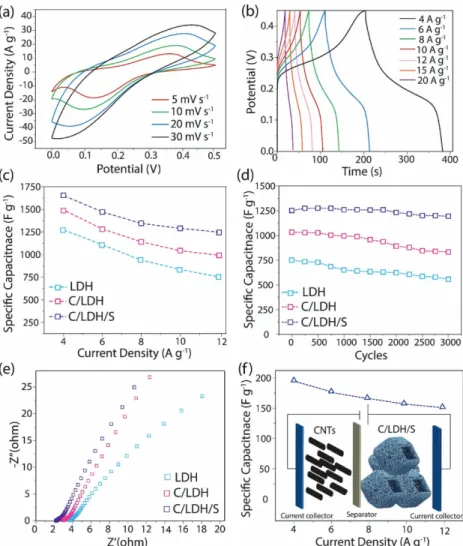
Figure 3. Supercapacitive performance. a) CV curves at various scan rates; b) charge–dis-charge profiles at various current densities for C/LDH/S. c) Specific capacitances as a function of current density, d) cycling stability tests over 3000 cycles, and e) Nyquist plots in a frequency range from 0.01 Hz to 100 kHz for the electrodes. f) Calculated specific capacitance values for C/LDH/S//CNTs asymmetric supercapacitor cell. Inset is the schematic illustration of the cell.
containing functionalities. Although the determination of the precise nature of the interlayer region is difficult, we propose the presence of different intergallery anions in LDH, C/LDH, and C/LDH/S structures, since the intercalation reactions are generally nonselective processes and can be affected by the reaction conditions.[17]
High surface area brings exceptional electrochemical prop-erties owing to rich electrode/electrolyte interfacial area for electrochemical reactions. Together with hollow architecture, it combines the advantages of easily accessible active surface sites and rapid transportation of electrolyte, resulting in an improved electrochemical performance. Hence, surface area and porosity properties of C/LDH/S were studied by N2
adsorption/des-orption measurements and presented in Figure S17 in the Supporting Information and Table S2 in the Supporting Infor-mation. A specific surface area of 116.2 cm2 g−1 with a pore
volume of 0.439 cm3 g−1 was obtained using the multipoint
Brunauer–Emmett–Teller method. As such, capacitive performances of supercapacitor electrodes based on C/LDH/S were investi-gated using a three-electrode system in 1 m
KOH aqueous electrolyte. Figure 3a shows the representative cyclic voltammetry (CV) curves of the C/LDH/S at various scan rates in the potential range of 0–0.5 V (vs saturated caolmel electrode (SCE)). Greater accessi-bility of electrolyte ions through the electrode surface at low sweep rates has resulted in dis-tinguishable symmetric anodic and cathodic peaks at 5 mV s−1, suggesting the
pseudo-capacitive characteristics of the electrode (Figure S18, Supporting Information). This arises from reversible faradaic reactions asso-ciated with the nickel and cobalt hydroxide/ sulfide.[13,18] At higher scan rates, anodic and
cathodic peaks are shifted to more negative and positive potentials, respectively, owing to the increase in the internal resistance of the electrode.
The galvanostatic charge–discharge (CD) profiles were also measured at different cur-rent densities (4 to 20 A g−1) and presented in
Figure 3b. The symmetric CD profiles are an indication of good capacitive behavior with highly reversible and fast reaction kinetics. Based on the CD curves, the specific capaci-tance (Csp) was calculated at different current
densities using the following equation
= ∆/ ∆
sp
C i t m V (1)
where i (in A) is the discharge current, Δt (in
s) is the discharge time, m (in g) is the mass of active material, and ΔV (in V) is the
poten-tial drop in discharge (excluding the ohmic potential drop). The specific capacitances obtained for C/LDH/S are 1653, 1470, 1345, 1288, 1249, 1145, and 1025 F g−1 at current
densities of 4, 6, 8, 10, 12, 15, and 20 A g−1
(Figure 3c), respectively. The C/LDH/S electrode shows rela-tively high specific capacitance and excellent cycling stability (95.4% after 3000 cycles) (Figure 3d) as compared to prior works (Table S3, Supporting Information). To understand the synergistic effect originating from the coexistence of NiCo-layered double hydroxide and cobalt sulfide, and the effect of calcination step, electrochemical performance of sulfurized layered double hydroxide (LDH/S) (Figure S19, Supporting Information), as well as LDH and C/LDH, was evaluated. LDH, C/LDH, LDH/S, and C/LDH/S deliver specific capacitances of 1275, 1493, 1511, and 1653 F g−1 at 4 A g−1, respectively.
Com-paratively, C/LDH/S shows 22.0%, 12.0%, and 14.9% higher rate capabilities than LDH, C/LDH, and LDH/S, respectively. Moreover, effect of Co9S8 loading on supercapacitor
perfor-mance of C/LDH/S was investigated for C/LDH/S hybrids containing ≈10 (C/LDH/S-10), ≈20 (C/LDH/S), and ≈30 wt% (C/LDH/S-30) cobalt sulfide (Figures S20 and S21, Supporting
Figure 4. Electrocatalytic performance. a) Digital images for the evolution of H2 bubbles,
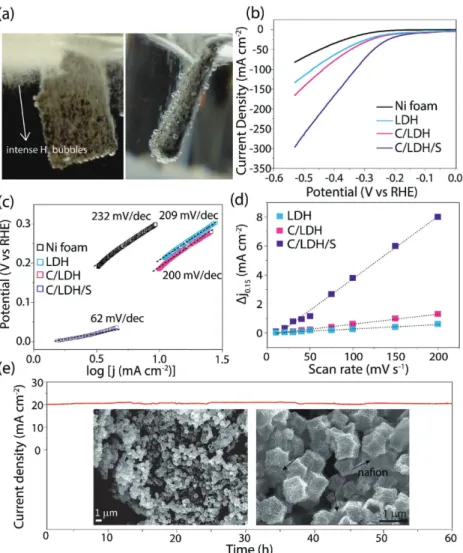
cap-tured at 0.35 V during LSV test of C/LDH/S. b) HER polarization curves for nickel foam (Ni foam), LDH, C/LDH, and C/LDH/S at a scan rate of 5 mV s−1 and c) corresponding Tafel plots for
the electrocatalysts. d) Current density differences calculated at 0.15 V from the cyclic voltam-metry curves collected at various scan rates in the region where no redox peaks are observed (0.1–0.2 V). e) Time-dependent current curve for C/LDH/S under static overpotential for 60 h. Inset shows the different magnification SEM images for C/LDH/S after 60 h stability test.
Information). C/LDH/S with ≈20% weight percentage of Co9S8
in the C/LDH/S hybrid exhibits the optimum performance among the samples investigated.
We further investigated the transport characteristics of the LDH, C/LDH, and C/LDH/S by electrochemical impedance spectroscopy to understand their electrochemical behavior. Equivalent series resistance of C/LDH/S is found to be 2.21 Ω, smaller than that for C/LDH (2.88 Ω) and LDH (3.53 Ω) as presented in Figure 3e. Smaller charge transfer resistance of C/LDH/S, determined from the diameter of the semicircle, and improved ion diffusion, suggested by the higher angle vertical line, substantiate the enhanced electrochemical properties of C/LDH/S. Furthermore, LDH derived from calcined ZIF-67 (C/LDH) resulted in augmented supercapacitive properties compared to the pristine LDH. This improvement can be attrib-uted to enlarged interlayer spacing of C/LDH and increased amorphous carbon content, which facilitate electrolyte penetra-tion for fast diffusion and reacpenetra-tion, leading to higher reacpenetra-tion kinetics.[16c]
An asymmetric supercapacitor device with two-electrode configuration (see the details in Figure S22, Supporting Infor-mation) was assembled using C/LDH/S and carbon nanotubes (CNTs) as positive and negative electrodes, respectively. A spe-cific capacitance of 194 F g−1 is calculated at 4 A g−1 (Figure S22c,
Supporting Information), which decreases to 151 F g−1 at
12 A g−1, showing a superior rate capability of 77.8% (Figure 3f).
Furthermore, C/LDH/S//CNTs exhibits a high stability with 90.9% retention of the initial capacitance (Figure S22e, Sup-porting Information) when cycled for 10 000 cycles at 8 A g−1.
The cell also delivers a high energy density of 39 Wh kg−1 at the
lowest power density of 2.4 kW kg−1 when the current density
is 4 A g−1, and it can hold 30.1 Wh kg−1 even at the highest
power density of 7.4 kW kg−1 (Figure S22f,
Supporting Information).
To date, transition metal chalcogenides have shown to be highly active hydrogen evo-lution reaction (HER) electrocatalysts under acidic conditions. Specifically, great efforts have been devoted to dichalcogenides since their active sites resemble to that of nitro-genase/hydrogenase. However, considering the vulnerability of most HER catalysts in acidic solutions and the commercialization of hydrogen production from alkaline elec-trolyzer, it is highly desirable to develop HER catalyst with high activity and stability oper-able at basic pH.[19] Recently, cobalt sulfides
have been demonstrated as active catalysts in alkaline medium and their activities was shown to be enhanced by incorporation of a secondary transition metal due to decrease in the adsorption energy of hydrogen in the first step of HER reaction pathway :
H O2 + + ↔ −e− M M Hads+OH− (2)
where M stands for metal atom and Hads
indicates adsorbed hydrogen atom on active site.[20] On this basis, we further evaluated
the as-synthesized hollow MOF-derived materials as electrocat-alysts for HER in 1.0 m KOH solution. The HER electrocatalytic
activities of pure nickel foam, LDH, C/LDH, C/LDH/S, and Co9S8/C were first tested by linear sweep voltammetry (LSV)
from 0 to −0.6 V (vs reversible hydrogen electrode (RHE)) with a typical three-electrode set up. Intense vigorous H2 bubbles
were observed during the measurements of C/LDH/S electrode showing its high electrocatalytic activity (Figure 4a). The repre-sentative polarization curves of the electrocatalysts are shown in Figure 4b and Figure S23 in the Supporting Information. Compared to pure nickel foam, LDH, C/LDH, and Co9S8/C, C/
LDH/S requires a lower onset potential of 47 mV and an over-potential of 142 mV to drive the cathodic current density of 10 mA cm−2. In contrast, higher overpotentials of 294, 201, 185,
and 155 mV are required to drive the same current density for bare nickel foam, LDH, C/LDH, and Co9S8/C, respectively. The
HER kinetics of the catalysts was further studied through the Tafel plots (Figure 4c, Figure S23d, Supporting Information). C/LDH/S exhibits the smallest slope of 62 mV dec−1, exhibiting
the highest electrocatalytic activity and kinetics toward HER among all other samples in alkaline electrolyte. The catalytic performance is comparable to other reported electro-catalysts (Table S4, Supporting Information). Moreover, inves-tigations for the effect of Co9S8 loading on HER performance
of C/LDH/S indicated an optimum cobalt sulfide loading of
≈20 wt% (Figure S24, Supporting Information).
As the catalytic activity is affected by the amount of active sites, the electrochemically active surface area of the electrocata-lysts are compared by measuring the double layer capacitance (Cdl) in non-Faradic region at different scan rates (Figure 4d).[21]
C/LDH/S possesses significantly higher Cdl than that of the C/
LDH and LDH, in agreement with its markedly higher HER
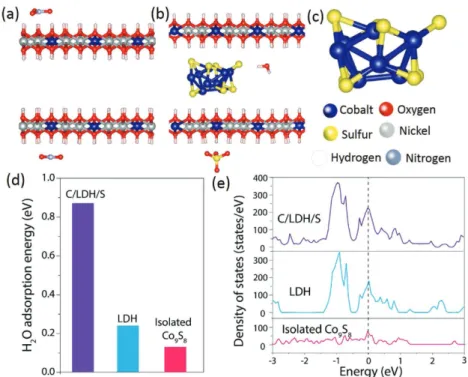
Figure 5. Optimized atomic configurations of a) C/LDH, b) NiCo-LDH/Co9S8 (C/LDH/S), and
c) isolated Co9S8. d) Calculated H2O adsorption energies and e) density of states for C/LDH,
activity. Correspondingly, the electrochemical impedance meas-urements of C/LDH/S exhibits lower impedance and thus considerably accelerate HER kinetics (Figure S25, Supporting Information). Considering the importance of the durability of the electrocatalysts, chronoamperometric measurement with a static potential corresponding to 20 mA cm−2 was carried out over
60 h and presented in Figure 4e. It is noteworthy that no apparent HER activity degradation is recorded, implying the excellent durability of the C/LDH/S electrocatalyst. Such high stability is believed to correlate with well retention of the initial morphology of C/LDH/S after 60 h stability test (Figure 4e inset).
To provide further insight on the excellent HER electrocata-lytic activity of multi-metallic NiCo-LDH/Co9S8 (C/LDH/S)
hybrid and shed light on the synergistic effects between C/LDH and Co9S8, density functional theory calculations were carried
out. The optimized atomic configurations of C/LDH interlay-ered with nitrate ions, NiCo-LDH/Co9S8 hybrid and isolated
Co9S8 are presented in Figure 5a–c, respectively. In view of
the importance of water adsorption on catalysis as the first step, the chemisorption of the H2O on the optimized
struc-tures was studied (Figure S26, Supporting Information) and shown in Figure 5d. The NiCo-LDH/Co9S8 hybrid exhibits H2O
chemisorption energy (absolute) of 0.87 eV, which is much higher than C/LDH (0.24 eV) and Co9S8 (0.14 eV), signifying
enhanced water adsorption attributes of the hybrid system. Meanwhile, the electronic properties of the species were inves-tigated by the density of states analysis (Figure 5e). The C/LDH possesses high density of states across the Fermi level without any gap, suggesting a high conductive behavior, whereas the isolated Co9S8 exhibits continuous and gapless states, however
of a less intense nature. The NiCo-LDH/Co9S8 hybrid combines
the unique advantages of individual C/LDH and Co9S8
cata-lysts, which is observable from the increased and continuous electronic states. The synergistic effect between the layered double hydroxide and cobalt sulfide results in high electrical conductivity and metallic-like charge transfer, and through the van der Waals and hydrogen bond interactions, significant water adsorption is realized. The synergistic effect between the layered double hydroxide and cobalt sulfide has been real-ized through high electrical conductivity arising from the col-laborative contribution of C/LDH and Co9S8 to the metallic-like
charge transfer. Combination of continuous density of states of cobalt sulfide together with the intense density of states of the layered double hydroxide, C/LDH/S system ensure abundant and extended electron active sites, substantial charge carrier concentration, and thus it offers enhanced electron mobility throughout the structure. Therefore, introduction of cobalt sulfide into the layered double hydroxide structure has proved to be an effective strategy to modify the electronic properties and paved the way for a more electrochemically active sulfide/ hydroxide hybrid. Importantly, through the van der Waals and hydrogen bond interactions, which ensure the coexistence of sulfide/hydroxide hybrid, the most favorable H2O
adsorp-tion was obtained on C/LDH/S system, whereas less favorable H2O adsorption activities were observed on individual C/LDH
and Co9S8. Thus, above results further confirm that hybrid C/
LDH/S can achieve excellent HER catalytic attributes compared with layered double hydroxide and cobalt sulfide, suggesting their synergistic effect.
In summary, a self-templated MOF pseudomorphic trans-formation strategy to synthesize hollow multi-metallic–hetero-atomic polyhedra has been established for the first time. Based on pseudomorphic substitution through ZIF-derived template, hybrid NiCo-LDH/Co9S8 hollow system is constructed. The
homogeneous incorporation of multiple metallic species, the creation of heterosulfides–hydroxides and the disposition of hollow structure optimize the catalytic sites, electrical conduc-tivity, and hydrogen adsorption of the NiCo-LDH/Co9S8. When
employed as supercapacitor and electrocatalyst electrode, the NiCo-LDH/Co9S8 demonstrates significantly improved
electro-chemical performances and outstanding stability. This MOF-templated preparation scheme can possibly be extended to the preparation of other porous constituents MOFs composites, which may be exploited for diverse potential applications in energy storage, conversion, or environmental purposes.
Supporting Information
Supporting Information is available from the Wiley Online Library or from the author.
Acknowledgements
This work was supported by MOE 000-B38-112 and R-263-000-B63-112 (Ministry of Education, Republic of Singapore).
Conflict of Interest
The authors declare no conflict of interest.
Keywords
electrocatalysts, hydrogen evolution reaction, layered double hydroxides, metal organic frameworks, supercapacitors
Received: December 16, 2016 Revised: March 29, 2017 Published online: May 3, 2017
[1] X. Lai, J. E. Halpert, D. Wang, Energy Environ. Sci. 2012, 5, 5604. [2] X. Wang, J. Feng, Y. Bai, Q. Zhang, Y. Yin, Chem. Rev. 2016, 116,
10983.
[3] a) L. Wang, Y. Han, X. Feng, J. Zhou, P. Qi, B. Wang, Coord. Chem. Rev. 2016, 307, 361; b) L. Hu, Q. Chen, Nanoscale 2014, 6, 1236; c) Y. Z. Zhang, Y. Wang, Y. L. Xie, T. Cheng, W. Y. Lai, H. Pang, W. Huang, Nanoscale 2014, 6, 14354; d) J. Shao, Z. Wan, H. Liu, H. Zheng, T. Gao, M. Shen, Q. Qu, H. Zheng, J. Mater. Chem. A
2014, 2, 12194; e) J. Tang, Y. Yamauchi. Nat. Chem. 2016, 8, 638; f) R. R. Salunkhe, Y. V. Kaneti, J. Kim, J. H. Kim, Y. Yamauchi, Acc. Chem. Res. 2016, 49, 2796; g) R. R. Salunkhe, J. Tang, N. Kobayashi, J. Kim, Y. Ide, S. Tominaka, J. H. Kim, Y. Yamauchi, Chem. Sci. 2016, 7, 5704.
[4] Z. Zhang, Y. Chen, X. Xu, J. Zhang, G. Xiang, W. He, X. Wang, Angew. Chem., Int. Ed. 2014, 53, 429.
[5] a) J. Chen, X. Wang, J. Wang, P. S. Lee, Adv. Energy Mater. 2015, 6, 1501745; b) G. Fan, D. G. Evans, X. Duan, Chem. Soc. Rev. 2014,
43, 7040; c) K. Yan, G. Wu, W. Jin, Energy Technol. 2016, 4, 354; d) Q. Wang, D. O’Hare, Chem. Rev. 2012, 112, 4124.
[6] a) H. Hu, B. Guan, B. Xia, X. W. Lou, J. Am. Chem. Soc. 2015, 137, 5590; b) C. Sun, J. Yang, X. Rui, W. Zhang, Q. Yan, P. Chen, F. Huo, W. Huang, X. Dong, J. Mater. Chem. A 2015, 3, 8483.
[7] a) T. Li, G. Li, L. Li, L. Liu, Y. Xu, H. Ding, T. Zhang, ACS Appl. Mater. Interfaces 2016, 8, 2562; b) G. Nagaraju, G. S. R. Raju, Y. H. Ko, J. S. Yu, Nanoscale 2016, 8, 812.
[8] a) X. Long, Z. Wang, S. Xiao, Y. An, S. Yang, Mater. Today 2016, 19, 213; b) Z. Liu, R. Ma, M. Osada, N. Iyi, Y. Ebina, K. Takada, T. Sasaki, J. Am. Chem. Soc. 2006, 128, 4872.
[9] a) L. Fei, B. P. Williams, S. H. Yoo, J. M. Carlin, Y. L. Joo, Chem. Commun. 2016, 52, 1501; b) R. Ramachandran, M. Saranya, C. Santhosh, V. Velmurugan, B. P. Raghupathy, S. K. Jeong, A. N. Grace, RSC Adv. 2014, 4, 21151; c) J. Mujtaba, H. Sun, G. Huang, Y. Zhao, H. Arandiyan, G. Sun, S. Xu, J. Zhu, RSC Adv.
2016, 6, 31775.
[10] a) J. Liu, C. Wu, D. Xiao, P. Kopold, L. Gu, P. A. van Aken, J. Maier, Y. Yu, Small 2016, 12, 2354; b) H. Zhu, J. Zhang, R. Yanzhang, M. Du, Q. Wang, G. Gao, J. Wu, G. Wu, M. Zhang, B. Liu, Adv. Mater. 2015, 27, 4752.
[11] a) Z. Yang, Z. Yao, G. Li, G. Fang, H. Nie, Z. Liu, X. Zhou, X. a. Chen, S. Huang, ACS Nano 2011, 6, 205; b) M. Wu, J. Wang, Z. Wu, H. L. Xin, D. Wang, J. Mater. Chem. A 2015, 3, 7727; c) J. Liang, Y. Jiao, M. Jaroniec, S. Z. Qiao, Angew. Chem., Int. Ed.
2012, 51, 11496; d) Y. Chang, F. Hong, C. He, Q. Zhang, J. Liu, Adv. Mater. 2013, 25, 4794.
[12] J. Pu, Z. Wang, K. Wu, N. Yu, E. Sheng, Phys. Chem. Chem. Phys.
2014, 16, 785.
[13] H. Chen, L. Hu, M. Chen, Y. Yan, L. Wu, Adv. Funct. Mater. 2014, 24, 934.
[14] a) R. Xu, H. C. Zeng, Chem. Mater. 2003, 15, 2040; b) J. T. Kloprogge, D. Wharton, L. Hickey, R. L. Frost, Am. Mineral. 2002, 87, 623.
[15] a) B. M. Hunter, W. Hieringer, J. Winkler, H. Gray, A. Müller, Energy Environ. Sci. 2016, 9, 1734; b) G. Abellán, J. A. Carrasco, E. Coronado, J. Romero, M. Varela, J. Mater. Chem. C 2014, 2, 3723. [16] a) V. R. Constantino, T. J. Pinnavaia, J. Inorg. Chem. 1995, 34,
883; b) F. R. Costa, A. Leuteritz, U. Wagenknecht, D. Jehnichen, L. Haeussler, G. Heinrich, Appl. Clay Sci. 2008, 38, 153; c) L. Wang, Z. H. Dong, Z. G. Wang, F. X. Zhang, J. Jin, Adv. Funct. Mater. 2013, 23, 2758.
[17] A. I. Khan, D. O’Hare, J. Mater. Chem. 2002, 12, 3191.
[18] a) J. Yang, C. Yu, X. Fan, S. Liang, S. Li, H. Huang, Z. Ling, C. Hao, J. Qiu, Energy Environ. Sci. 2016, 9, 1299; b) J. Pu, Y. Tong, S. Wang, E. Sheng, Z. Wang, J. Power Sources 2014, 250, 250.
[19] a) W. Zhu, X. Yue, W. Zhang, S. Yu, Y. Zhang, J. Wang, J. Wang, Chem. Commun. 2016, 52, 1486; b) K. Zeng, D. Zhang, Prog. Energy Combust. Sci. 2010, 36, 307; c) A. Sivanantham, P. Ganesan, S. Shanmugam, Adv. Funct. Mater. 2016, 26, 4661.
[20] a) Z. F. Huang, J. Song, K. Li, M. Tahir, Y.-T. Wang, L. Pan, L. Wang, X. Zhang, J. J. Zou, J. Am. Chem. Soc. 2016, 138, 1359; b) J. Staszak-Jirkovský, C. D. Malliakas, P. P. Lopes, N. Danilovic, S. S. Kota, K.-C. Chang, B. Genorio, D. Strmcnik, V. R. Stamenkovic, M. G. Kanatzidis, Nat. Mater. 2016, 15, 197.
[21] a) C. C. McCrory, S. Jung, J. C. Peters, T. F. Jaramillo, J. Am. Chem. Soc. 2013, 135, 16977; b) J. Tian, Q. Liu, N. Cheng, A. M. Asiri, X. Sun, Angew. Chem., Int. Ed. 2014, 53, 9577.