Upper and lower bounds for finite domain constraints to realize skeptical
c-inference over conditional knowledge bases
Christian Komo and Christoph Beierle
FernUniversit¨at in HagenHagen, Germany
Abstract
Skeptical c-inference for a knowledge base containing con-ditionals of the formIf A then usually Bis defined by taking the set of all c-representations into account. C-representations are ranking functions induced by impact vectors encoding the conditional impact of the conditionals on each possible world. We deal with the question of determining a maximal impact factoru∈Nsuch that c-inference can be implemented by a finite domain constraint problem with solutions bounded by
u. While in general, determining a sufficient upper bound for these CSPs is an open problem, we prove that for a knowledge base withnconditionals with a world verifying all condition-als it follows thatn−1is a sufficient maximal impact factor. Furthermore, we show that the conjecture supported by previ-ous work that the number of conditionals is sufficient does not hold. By constructing suitable knowledge bases withn condi-tionals we establish that the exponential lower bound2n−1is
needed as possible impact factor for solutions of these finite domains problems to fully realize skeptical c-inference.
1
Introduction
In the area of knowledge representation and reasoning, rules play a prominent role. Nonmonotonic reasoning investi-gates default rules of the form ”If A then normally/usual-ly/preferably B”, and various semantical approaches have been proposed for inductive inferences based on knowl-edge bases of such rules. Calculi to compute inductive in-ferences like Adam’s system P (Adams 1975), probabilistic approaches like p-entailment (Goldszmidt and Pearl 1991), or possibilistic inference methods (Dubois and Prade 2015) have been developed, as well as inductive methods based on Spohn’s ordinal conditional functions (OCFs) (Spohn 1988; 2012) like Pearl’s system Z (Pearl 1990) or c-representations (Kern-Isberner 2001; 2004). OCFs assign a degree of surprise to each world ω inducing a non-monotonic inference relation (Dubois and Prade 2015; Pearl 1990; Spohn 1988). C-representations are special ranking functions exhibiting desirable inference properties (Kern-Isberner 2001; 2004). In this paper we focus on skeptical c-inference which is introduced in (Beierle, Eichhorn, and Kern-Isberner 2016) as skeptical inference relation taking all representations into account. The authors show that c-inference can be reduced to solve a constraint satisfaction problem (CSP). In (Beierle et al. 2018) c-inference under a maximal impact factor is introduced as skeptical inference
operation taking c-representations as solutions of a finite do-main CSP into account. Let us follow (Beierle and Kutsch 2017) and callu ∈ NsufficientforRif c-inference under
a maximal impactufully realizes skeptical c-inference and l∈Nminimally sufficientif this property is not fulfilled for l−1. The present paper deals with upper and lower bounds foru∈Nto be sufficient and minimally sufficient, respec-tively. We provide the following main contributions. • We formulate and prove a criterion generalizing (Beierle
and Kutsch 2019, Proposition 19) such thatu=|R| −1 is sufficient forR: If there is a world verifying all condi-tionals fromR(Proposition 13).
• We prove that for every given verification/ falsification be-haviour of conditionals on worlds there is a knowledge base realizing this behaviour (Proposition 14).
• All experiments made with a reasoning platform InfOCF in (Beierle and Kutsch 2019) supported the conjecture that a maximal impactu=|R|is sufficient forR. How-ever, here we construct a knowledge base with n con-ditionals such that 2n−1 is minimally sufficient. Conse-quently there is no polynomial bound for u ∈ N to be
minimally sufficient for all knowledge bases withn con-ditionals (Proposition 16).
The rest of the paper is organized as follows. After briefly recalling the basics of conditional logic, ranking functions, skeptical c-inference and its formulation as a constraint sat-isfaction problem (CSP) we deal in Section 3 with resource bounded c-inference and the concept of sufficient and reg-ular bounds for finite domain CSPs. The topic of Section 4 is a criterion on a knowledge baseRsuch that|R| −1is a sufficient bound forR. In Section 5, we deal with the con-struction of knowledge bases whose existence will establish the exponential lower bound for skeptical inference under maximal impactuto be equivalent to skeptical c-inference for all knowledge bases. In the final section we conclude and point out future work.
2
Conditional logic, OCFS, c-representations
and the constraint satisfaction problem
Conditional Logic and OCFs LetΣ = {v1, ..., vm} bea propositional alphabet. A literal is the positive (vi) or
eitherviorvi. From these we obtain the propositional
lan-guageLas the set of formulas ofΣclosed under negation¬, conjunction∧, and disjunction∨. For shorter formulas, we abbreviate conjunction by juxtaposition (i.e.,ABstands for A∧B), and negation by overlining (i.e.,Ais equivalent to ¬A). LetΩΣdenote the set of possible worlds overL;ΩΣ will be taken here simply as the set of all propositional in-terpretations overLand can be identified with the set of all complete conjunctions overΣ; we will often just writeΩ in-stead ofΩΣ. Forω∈Ω,ω|=Ameans that the propositional formulaA∈ Lholds in the possible worldω.
Aconditional(B|A)withA, B ∈ Lencodes the defea-sible rule “ifAthen normallyB” and is a trivalent logical entity with the evaluation (de Finetti 1937; Kern-Isberner 2001) (withuforunknownorindeterminate)
J(B|A)Kω= 1 iff ω|=AB (verification) 0 iff ω|=AB (falsification)
u iff ω|=A (not applicable) (1) An Ordinal Conditional Function (OCF, ranking func-tion) (Spohn 1988; 2012) is a functionκ: Ω→N0∪ {∞} that assigns to each world ω ∈ Ω an implausibility rank κ(ω): the higherκ(ω), the more surprisingωis. OCFs have to satisfy the normalization condition that there has to be a world that is maximally plausible, i.e.,κ−1(0) 6= ∅. The rank of a formulaAis defined byκ(A) = min{κ(ω)|ω|= A}. An OCF κ accepts a conditional (B|A), denoted by κ|= (B|A), iff the verification of the conditional is less sur-prising than its falsification, i.e., iffκ(AB)< κ(AB). This can also be understood as a nonmonotonic inference relation between the premiseAand the conclusionB: We say that A κ-entailsB, writtenA|∼κB, iffA=⊥orκaccepts the conditional(B|A):κ |= (B|A)iffκ(AB) < κ(AB)iff A|∼κB. The acceptance relation is extended as usual to a setRof conditionals, called aknowledge base, by defining κ |= Riffκ |= (B|A)for all (B|A) ∈ R. This is syn-onymous to saying thatκis admissiblewith respect to R (Goldszmidt and Pearl 1996), or thatκis aranking modelof R.Risconsistentiff it has a ranking model.
Among the models of R, c-representations are special models obtained by assigning an individual impact to each conditional and generating the world ranks as the sum of impacts of falsified conditionals. C-inference is an inference relation taking all c-representations ofRinto account. Definition 1(c-representation (Kern-Isberner 2001; 2004)). Ac-representationof a knowledge baseRis a ranking func-tion κ#»η constructed from #»η = (η1, . . . , ηn)with integer
impactsηi ∈ N0, i ∈ {1, . . . , n}assigned to each condi-tional(Bi|Ai)such thatκacceptsRand is given by:
κ#»η(ω) =
X
16i6n ω|=AiBi
ηi (2)
We will denote the set of all c-representations of R by O(CR(R)).
Definition 2 (c-inference, |∼cR (Beierle, Eichhorn, and Kern-Isberner 2016)). Let Rbe a knowledge base and let
A,Bbe formulas.B isa (skeptical) c-inference fromAin the context ofR, denoted byA|∼cRB, iffA|∼κBholds for all c-representationsκforR.
In (Beierle, Eichhorn, and Kern-Isberner 2016), a model-ing of c-representations as solutions of a constraint satisfac-tion problemCR(R)is given and shown to be correct and complete with respect to the set of all c-representations of R.
Definition 3 (CR(R) (Beierle, Eichhorn, and Kern-Is-berner 2013)). Let R = {(B1|A1), . . . ,(Bn|An)}. The
constraint satisfaction problem for c-representations of R, denoted by CR(R), on the constraint variables {η1, . . . , ηn} ranging overN0 is given by the conjunction of the constraints, for alli∈ {1, . . . , n}:
ηi >0 (3) ηi > min ω|=AiBi X j6=i ω|=AjBj ηj− min ω|=AiBi X j6=i ω|=AjBj ηj (4) A solution ofCR(R)is ann-tuple(η1, . . . , ηn) ∈ Nn0. For a constraint satisfaction problem CSP, the set of so-lutions is denoted by Sol(CSP). Thus, with Sol(CR(R)) we denote the set of all solutions of CR(R). Let us recall the soundness and completeness of constructing c-representations by integer impacts from solutions of CR(R).
Proposition 4((Beierle, Eichhorn, and Kern-Isberner 2016; Beierle et al. 2018)). LetR={(Bi|Ai), i= 1, . . . , n}be
a knowledge base. Then we have
O(CR(R)) ={κ#»η | #»η ∈Sol(CR(R))} (5)
whereκ#»η is defined as in (2).
3
Resource bounded c-inference
If a knowledge base R is consistent, there are in general infinitely many c-representations acceptingR, including in-ferentially equivalent ones.
Definition 5 (≡|∼). Two ranking functionsκ, κ0 are
infer-entially equivalent, denoted byκ≡|∼ κ0 iff for all(B|A)it
is the case thatκ|= (B|A)iffκ0|= (B|A).
For instance, if there is ak∈Nsuch thatκ0(ω) =k·κ(ω) for all worlds ω, then κ ≡|∼ κ0; in general, two
rank-ing functions are inferentially equivalent iff they induce the same total preorder on worlds.
Proposition 6((Beierle et al. 2018)). For ranking functions κandκ0, we haveκ≡|∼ κ0 iff for allω1, ω2 ∈ Ωit is the case thatκ(ω1)6κ(ω2)iffκ0(ω1)6κ0(ω2).
For a setOof OCFs,O/≡|∼ denotes the set of induced
equivalence classes. Recently, it has been suggested to take inferential equivalence of c-representations into account and to sharpen CR(R)by introducing an upper bound for the impact valuesηi.
Definition 7 (CRu(R)(Beierle et al. 2018)). Let R = {(B1|A1), . . . ,(Bn|An)} and u ∈ N. The finite domain
variables{η1, . . . , ηn}ranging overN0is given by the con-junction of the constraints, for alli∈ {1, . . . , n}:
ηi>0 (6) ηi> min ω|=AiBi X j6=i ω|=AjBj ηj− min ω|=AiBi X j6=i ω|=AjBj ηj (7) ηi6u (8) A solution ofCRu(R)is ann-tuple(η1, . . . , ηn)∈Nn0, its set of solutions is denoted bySol(CRu(R)). For #»η ∈
Sol(CRu(R))andκas in equation (2), κis theOCF in-duced by#»η, denoted byκ#»η, and the set of all induced OCFs
is denoted byO(CRu(R)) ={κ#»η | #»η ∈Sol(CRu(R))}.
C-inference defined with respect to a maximal impact value can be viewed as a kind of resource-bounded infer-ence operation.
Definition 8 (c-inference under maximal impact value, |∼c,uR (Beierle et al. 2018)). LetRbe a knowledge base, u ∈ N, and let A, B be formulas. B is a (skeptical)
c-inference from A in the context ofRunder maximal im-pact valueu, denoted byA|∼c,uRB, iffA|∼κBholds for all c-representationsκwithκ∈ O(CRu(R)).
The following definition introduces a criterion for a max-imal impact value ensuring that |∼c,uR fully realizes skeptical c-inference. For an OCFκ, the definition uses the total pre-order4κ on worlds given by ω1 4κ ω2 iff κ(ω1) 6 κ(ω2).
Definition 9(regular, minimally regular (Beierle et al. 2018; Beierle and Kutsch 2017)). For R let ˆu ∈ N be the
smallest number such that |{4κ|κ∈ O(CRuˆ(R))}| =
|{4κ|κ∈ O(CR(R))|. ThenCRu(R)is calledregulariff
u>u, andˆ CRuˆ(R)isminimally regular; we also say that uisregular forRandˆuisminimally regular forR.
WhileCR(R) correctly and completely models the set of all c-representations for R (Beierle, Eichhorn, and Kern-Isberner 2016), every regularCRu(R)is correct and complete when taking inferential equivalence into account (Beierle et al. 2018). Thus, for regularu, |∼Rc and |∼c,uR co-incide.
Proposition 10((Beierle et al. 2018)). LetRbe a knowl-edge base, CRu(R)regular, andA,B be formulas. Then A|∼RcBiffA|∼c,uRB.
When we are not interested in capturing all c-representations as done by a regularCRu(R), but aim at capturing c-inference instead, we can specify a maximal im-pact value from this perspective in order to obtain a finite domain CSP.
Definition 11(sufficient, minimally sufficient (Beierle et al. 2018; Beierle and Kutsch 2017)). Let R be a knowledge base and letu∈N. ThenCRu(R)is calledsufficientiff for
all formulasA, Bwe have
A|∼RcB iff A|∼c,uRB. (9) IfCRu(R)is sufficient, we will also callusufficient forR. Ifuˆis sufficient forRanduˆ−1is not sufficient forR, then ˆ
uisminimally sufficient forR.
The condition thatCRl(R)is regular is only a sufficient condition for (9) but not necessary, see (Beierle and Kutsch 2019, Proposition 5). Let us introduce the following concept of a minimal solution.
Definition 12 (minimal solution). Let R be a knowledge base and let #»η = (η1, . . . , ηn)be a solution to the
con-straint satisfaction problemCR(R). Then#»η is called mini-mal solutiontoCR(R)if for every solution(η01, . . . , ηn0)to CR(R)we haveηi6η0ifor alli∈ {1, . . . , n}.
It follows immediately from the definition that a minimal solution toCR(R), if such a solution exists, is uniquely de-termined. Further a minimal solution in the sense of Defini-tion 12 is also cw-minimal, ind-minimal and sum-minimal in the sense of (Beierle, Eichhorn, and Kutsch 2017).
4
A criterion such that
CR
n−1(
R
)
is
sufficient
The scope of this section is to prove for a knowledge base R={r1, . . . , rn}with a worldω∈Ωverifying all
condi-tionals fromRwe have thatCRn−1(R)is sufficient. Proposition 13. Let n ∈ N, n > 1, and let R =
{(Bi|Ai), i = 1, . . . , n} be a knowledge base. We
as-sume that there exists ω ∈ Ω with ω |= AiBi for all
i ∈ {1, . . . n}. Then the knowledge base is consistent and CRn−1(R)is sufficient.
Proof. Chooseωe ∈ Ω accepting all conditionals fromR. Then min ω|=AiBi X j6=i ω|=AjBj ηj− min ω|=AiBi X j6=i ω|=AjBj ηj =− min ω|=AiBi X j6=i ω|=AjBj ηj
for alli∈ {1, . . . , n}. Thus, the constraint (4) reduces to ηi>− min ω|=AiBi X j6=i ω|=AjBj ηj (10) for alli∈ {1, . . . , n}.
The implication ” =⇒ ” from (9) is obvious since O(CRn−1(R)) ⊆ O(CR(R)). For the proof of the other implication ”⇐=” fix formulasA , Bsuch that
A`c,nR −1B. (11) We have to showA`c
RB. Due to Proposition 4 this requires κ#»η(AB)< κ#»η(AB)for allκ#»η (defined in (2)) where#»η =
(η1, . . . , ηn)∈Sol(CR(R)). That is, in turn, equivalent to
∀ω0∈Ω
AB∃ω
1∈Ω
AB with κ#»η(ω1)< κ#»η(ω0). (12)
Fix any c-representation κ#»η ∈ O(CR(R)) with #»η =
(η1, . . . , ηn) and ηi > 0, i ∈ {1, . . . , n}. Further, fix
ω0 ∈ Ω
AB. Let us define the set of all indices such that
ηi >0and the corresponding conditional is falsified byω0
as
Our goal is to constructω1∈ΩABsuch that n i∈ {1, . . . , n};ηi>0andω1|=AiBi o ( n i∈ {1, . . . , n};ηi>0andω0|=AiBi o . (14)
Indeed, assume that (14) is proven. From (14) we get imme-diately κ#»η(ω1) = X i∈{1,... ,n} ω1|=A iBi ηi< X i∈{1,... ,n} ω0|=A iBi ηi =κ#»η(ω0)
implying that (12) is fulfilled. Altogether, to finish the proof we have to show the existence ofω1 ∈Ω
AB with (14). We
distinguish the cases as follows.
Case (i). First, let us consider the case|J|=n. Choose arbitrary ηi0 ∈ {1, . . . , n−1} for i ∈ {1, . . . , n}. Since ηi0 >0it follows that (10) holds (which is equivalent to (4)) and so #»η0 fulfils (3), (4). Due to Proposition 4 it follows κ#»η0 ∈ O(CRn−1(R)). From (11) we getω1 ∈ ΩAB with κ#»η0(ω1) < κ#»η0(ω0). Thus X i∈{1,... ,n} ω1|=AiBi ηi0 < n X i=1 ηi0.
How-ever, this yields
i∈ {1, . . . , n};ω1|=AiBi ({1, . . . , n}.
Consequently (14) holds.
Case (ii). Let us consider the case|J| < n. We define #» η0 = (η01, . . . , ηn0)by ηi0 := 0, ifi∈ {1, . . . n}withηi= 0, 1, ifi∈J , n−1, otherwise. (15)
Since ηi0 > 0, i ∈ {1, . . . , n} it remains to prove the constraint (4) which we know is equivalent to (10). Ifi ∈ {1, . . . , n} such that η0i > 0 then obviously (10) holds. Therefore let us consideri∈ {1, . . . , n}such thatη0i = 0. Sinceηi= 0we know that (10) holds. Thus
0>− min ω|=AiBi X j6=i ω|=AjBj ηj and so min ω|=AiBi X j6=i ω|=AjBj ηj∈N∞(i.e.6= 0). By (15) we have
ηj > 0 impliesηj0 > 0and so min ω|=AiBi
X
j6=i ω|=AjBj
ηj0 ∈ N∞.
Consequently (4) is also satisfied forη0i= 0. Making use of Proposition 4 it follows thatκ#»η0 ∈ O(CRn−1(R)). By (11) we know A `κ#»η0 B. Therefore, there isω1 ∈ Ω
AB with κ#»η0(ω1)< κ#»η0(ω0). Thus X i∈{1,... ,n} ω1|=A iBi η0i< X i∈{1,... ,n} ω0|=A iBi ηi0. (16)
By definition ofJ and #»η0, see (13), (15), it holds for all i ∈ {1, . . . , n}withηi > 0andω0 |=AiBithatη0i = 1.
Therefore X i∈{1,... ,n} ω0|=AiBi η0i=|J|. By (16) we get X i∈{1,... ,n} ω1|=A iBi ηi0<|J|6n−1. (17)
We finish the proof of (14) by contradiction. Suppose that (14) is wrong. Due to (16) the two sets in (14) can not be identical. Therefore, there must be ank∈ {1, . . . , n}such thatηk >0andω1 |=AkBkbut notk ∈J. Sincek /∈ J,
by (15), there holdsηk0 =n−1. But then
X i∈{1,... ,n} ω1|=AiBi η0i=n−1 + X i6=k ω1|=AiBi η0i>n−1,
contradicting (17). Altogether the existence ofω1with (14) is also proven in the case (ii). The proof is complete.
Remark. In (Beierle and Kutsch 2019) the knowledge baseRn = {(a1|>), . . . ,(an|>)} ofnconditionals facts
over Σn = {a1, . . . , an} is introduced and it is proven
that CRn−1(Rn) is sufficient for n > 1. Since ω =
(a1, . . . , an)accepts all conditionals from Rn, our more
general Proposition 13 yields the same conclusion in that case but makes no use of the special structure of the condi-tionals fromRn.
5
Existence of a knowledge base such that
2
n−1is minimally sufficient and minimally
regular
In this section we deal with the construction of a knowledge baseR = {(Bi|Ai), i = 1, . . . , n} where2n−1is
mini-mally sufficient and minimini-mally regular. Further we will clar-ify the construction and present an explicit knowledge base forn= 5.
Let Ω = {ωi; i = 1, . . . , m}. For conditionals
(Bj|Aj)j=1,... ,,n a matrix (mi,j) withmi,j ∈ {v , f,−}
describing the evaluation according to (1) can be defined by
mi,j= [[(Bj|Aj)]]ωi. (18) In (18)mi,j=vmeans thatωiverifies(Bj|Aj), the
mean-ing ofmi,j = f is thatωi falsifies (Bj|Aj)and we write
mi,j =−ifωi|=Aj.
In the following proposition we tackle the ”inverse prob-lem”: For a given evaluation matrix(mi,j)i=1,...,m;j=1,... ,n
we construct a (not necessarily consistent) knowledge base R = {(Bj|Aj), j = 1, . . . , n} such that the evaluation is
just given by (18).
Proposition 14. Letn , m∈N, letΣ ={v1, . . . , vm}be a
propositional alphabet and letΩ ={ω1, . . . , ω2m}. For all i∈ {1, . . . ,2m}andj∈ {1, . . . , n}letmi,j∈ {v , f , /}be
worlds r1 r2 r3 . . . rn ω1 m1,1 m1,2 m1,3 . . . m1,n ω2 m2,1 m2,2 m2,3 . . . m2,n ω3 m3,1 m3,2 m3,3 . . . m3,n . . . ω2m m2m,1 m2m,2 m2m,3 . . . m2m,n Table 1: Evaluation tableau
given. Then there exists a (not necessarily consistent) knowl-edge baseR={(Bj|Aj), j = 1, . . . , n}such that the
fol-lowing holds:
Ifmi,j =vthenωi|=AjBj, (19)
Ifmi,j =f thenωi|=AjBj, (20)
Ifmi,j =−thenωi|=Aj. (21)
Proof. We have to constructrj= (Bj|Aj)such thatmi,j=
[[(Bi|Ai)]]ωi. To do so we define the formulas
Aj := _ {ωi∈Ω;mi,j∈{+,−}} ωi, (22) Bj := _ {ωi∈Ω;mi,j∈{+}} ωi (23)
for all j ∈ {1, . . . , n}. Due to construction we see that (19), (20), (21) hold.
Proposition 14 can be summarized as follows: Every eval-uation table (see Table 1), described by an evaleval-uation matrix (mi,j)i=1,...,m;j=1,... ,n, can be generated by a knowledge
baseR={(Bj|Aj), j= 1, . . . , n}.
Proposition 15. There exists a consistent knowledge base R = {(Bi|Ai), i = 1, . . . , n}, such that the constraint
satisfaction problemCR(R)is given by the conjunction of the constraints ηi> i−1 X j=1 ηj (24)
for all i ∈ {1, . . . , n}. (Ifi = 1thenPi−1
j=1ηj = 0and
so (24) meansη1 > 0.) The constraint satisfaction prob-lem (24) has the minimal solution
#»η = (1,2,4,8, . . . ,2n−1). (25) Proof. Consider disjoint subsets Ω+,Ω− ⊆ Ω where |Ω+|=nand|Ω−|=n. Let us writeΩ = Ω+∪Ω−∪Ωrest
where Ω−={ω−1 , ω − 2 , . . . , ω − n}, Ω+={ω+1 , ω + 2 , . . . , ω + n}, Ωrest:= Ω\(Ω−∪Ω+).
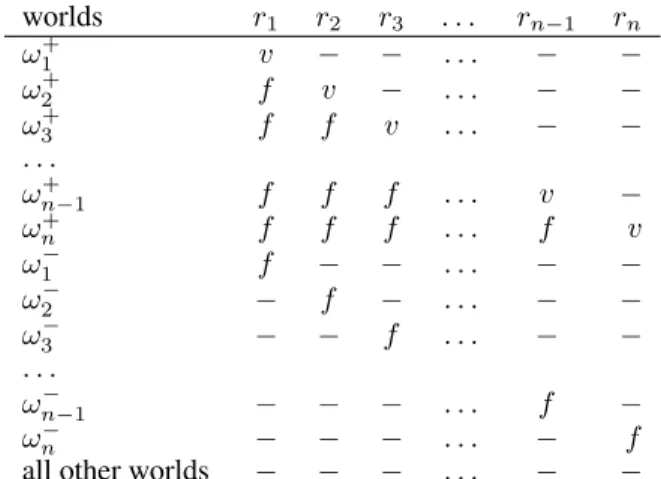
Looking at Proposition 14 there exists a knowledge base R={ri = (Bi|Ai), i= 1, , . . . , n}fulfilling the
follow-ing evaluation tableau:
worlds r1 r2 r3 . . . rn−1 rn ω1+ v − − . . . − − ω2+ f v − . . . − − ω3+ f f v . . . − − . . . ωn+−1 f f f . . . v − ωn+ f f f . . . f v ω1− f − − . . . − − ω2− − f − . . . − − ω3− − − f . . . − − . . . ωn−−1 − − − . . . f − ωn− − − − . . . − f
all other worlds − − − . . . − −
By (22), (23) in the proof of Proposition 14 it follows that we can choose the knowledge baseR={ri= (Bi|Ai), i=
1, . . . , n}in the following way
Ai := _ {ω∈Ω; [[ri]]ω∈{+,−}} ω=ωi−∨ω+i ∨. . .∨ωn+, Bi := _ {ω∈Ω; [[ri]]ω∈{+}} ω=ωi+
for alli∈ {1, . . . , n}. Consequently we obtain ri= ωi+|ω − i ∨ω + i ∨. . .∨ω + n . Fixi∈ {1, . . . , n}. Due to construction
min ω|=AiBi X j6=i ω|=AjBj ηj− min ω|=AiBi X j6=i ω|=AjBj ηj= i−1 X j=1 ηj
for alli∈ {1, . . . , n}. Consequently (4) transforms to (24) and soCR(R)is given by (24) for alli∈ {1, . . . , n}. (In-equality (24) implies (3).) It follows immediately that there exists a minimal solution #»η = (η1, . . . , ηn)toCR(R)
sat-isfying ηi= 1 + i−1 X j=1 ηj
for alli∈ {1, . . . , n}. The proof of the representation (25) is by induction. Fori = 1we have η1 = 1 = 21−1. The proof of the inductive step follows from
ηi= 1 + i−1 X j=1 ηj = 1 + i−2 X j=0 2j= 1 + 1−2 i−1 1−2 = 2 i−1. Consequently (25) holds.
The following remarkable lemma states that all c-representations ofRare inferentially equivalent.
Lemma 1. Let R = {(Bi|Ai), i = 1, . . . , n}
de-note a knowledge base with constraint satisfaction prob-lem CR(R) given by (25). Then every c-representation κ ∈ O(CR(R))is inferentially equivalent to κ#»η (defined
in (2)) where #»η is the minimal solution toCR(R)given by #»
Proof. Let κ ∈ O(CR(R)) denote an arbitrary c-representation and letω1, ω2∈Ω. Let us define
J1:={i∈ {1, . . . , n};ω1|=AiBi},
J2:={i∈ {1, . . . , n};ω2|=AiBi}.
Let us writemaxM = 0ifM ⊆ {1, . . . , n}withM =∅. Assertion. We have
κ(ω1)> κ(ω2) ⇐⇒ max(J1\J2)>max(J2\J1), (26) κ(ω1) =κ(ω2) ⇐⇒ J1=J2. (27) Proof of the assertion. Due to Proposition 4 we haveκ= κ#»η0 with #»η0 = (η10, . . . , η0n) ∈ Sol(CR(R)). Since (26) implies (27) it remains to show (26). We obtain
κ(ω1)−κ(ω2) = X j∈J1 ηj− X j∈J2 η0j= X j∈J1\J2 η0j− X j∈J2\J1 ηj0.
Defineq1:= maxJ1andq2:= maxJ2. Assumemax(J1\ J2)>max(J2\J1). Thenq1> q2and it follows
κ(ω1)−κ(ω2) = X j∈J1\J2 ηj− X j∈J2\J1 ηj >ηq1− X j∈{1,... ,q1−1} ηj >0
due to the structure ofCR(R). On the other hand if
X
j∈J1\J2
ηj0 − X
j∈J2\J1
ηj0 =κ(ω1)−κ(ω2)>0
it follows due to the structure ofCR(R)thatmax(J1\J2)> max(J2\J1). The proof of the assertion is complete.
Letκ , κ0 ∈ O(CR(R))be c-representations. Making use of the proven assertion we see that
κ(ω1)6κ(ω2) ⇐⇒ κ0(ω1)6κ0(ω2)
for allω1, ω2 ∈Ω. Due to Proposition 6 we get thatκand κ0are inferentially equivalent. The claim follows.
Now we have all ingredients at hand to prove the main result of this section
Proposition 16. For everyn ∈ Nthere exists a consistent knowledge base R = {(Bi|Ai), i = 1, . . . , n} such that
2n−1is minimally sufficient and minimally regular.
Proof. Let R be the knowledge base whose existence is proven in Proposition 15. Due to Lemma 1 we know that CR2n−1(R)is regular and, see Proposition 10, also suffi-cient. By (25) we have #»η = (1,2,4,8, . . . ,2n−1) for the minimal solution ofR. Sinceηn = 2n−1, by the definition
of a minimal solution,Sol(CRl(R))) =
∅ifl <2n−1. For
a consistent knowledge base a regularCRl(R)necessarily
has a non empty set of solutionsSol(CRl(R))). Therefore
CRl(R)is not regular and, by Proposition 10, also not suf-ficient see forl < 2n−1. Altogether2n−1is minimally suf-ficient and minimally regular forR.
Example 17. In this example (see Proposition 16 forn= 5) we want to clarify and explain the construction of a knowl-edge baseR={ri = (Bi|Ai), i= 1, . . . ,5}withn= 5
conditionals such that24 = 16is minimally sufficient and minimally regular for R. Looking at the proof of Proposi-tion 16 our goal is to constructRsuch thatCR(R)is given by:
η1>0 η4> η1+η2+η3 η2> η1 η5> η1+η2+η3+η4 η3> η1+η2
An inspection of the proof of Proposition 15 yields that R can be constructed such that the following evaluation tableau is fulfilled: worlds r1 r2 r3 r4 r5 a b c d e v − − − − a b c d e f v − − − a b c d e f f v − − a b c d e f f f v − a b c d e f f f f v a b c d e f − − − − a b c d e − f − − − a b c d e − − f − − a b c d e − − − f − a b c d e − − − − f
all other worlds − − − − −
Due to (22), (23) we finally arrive at the following ”ex-plicit” knowledge base
r1 = ( a b c d e | a b c d e∨ a b c d e∨ a b c d e ∨a b c d e∨ a b c d e∨ a b c d e ) , r2 = ( a b c d e | a b c d e∨ a b c d e∨ a b c d e ∨a b c d e∨ a b c d e ) , r3 = ( a b c d e | a b c d e∨ a b c d e ∨a b c d e∨ a b c d e ) , r4 = ( a b c d e | a b c d e∨ a b c d e∨ a b c d e ) , r5 = ( a b c d e | a b c d e∨ a b c d e )
6
Conclusions and Further Work
We presented a criterion on a knowledge baseRsuch that using |R| −1 as an upper bound is sufficient for realizing skeptical c-inference forRby a finite domain constraint sys-tem. Given any verification/ falsification behaviour of con-ditionals on worlds, we developed a constructive approach yielding a knowledge base realizing this behaviour. Further-more, and in contrast to the previous conjecture that a max-imal impactu= |R|is sufficient forR, due to the present paper, we know that there is no polynomial bound foru∈Nto be minimally sufficient for all knowledge bases with n conditionals for realizing skeptical c-inference overR. The problem of proving a sufficient upper bound for all knowl-edge bases remains open and will be addressed in a future work.
References
Adams, E. W. 1975. The Logic of Conditionals: An Appli-cation of Probability to Deductive Logic. Synthese Library. Springer, Dordrecht.
Beierle, C., and Kutsch, S. 2017. Regular and sufficient bounds of finite domain constraints for skeptical c-inference. In Benferhat S, Tabia K, A. M., ed.,Advances in artificial intelligence: from theory to practice, volume 10350 ofLNAI, 477–487. Springer.
Beierle, C., and Kutsch, S. 2019. Computation and compar-ison of nonmonotonic skeptical inference relations induced by sets of ranking models for the realization of intelligent agents.Appl Intell49(1):28–43.
Beierle, C.; Eichhorn, C.; Kern-Isberner, G.; and Kutsch, S. 2018. Properties of skeptical c-inference for conditional knowledge bases and its realization as a constraint satisfac-tion problem.Ann. Math. Artif. Intell.83(3-4):247–275. Beierle, C.; Eichhorn, C.; and Kern-Isberner, G. 2013. A declarative approach for computing ordinal conditional functions using constraint logic programming. In19th In-ternational Conference on Applications of Declarative Pro-gramming and Knowledge Management, INAP 2011, and 25th Workshop on Logic Programming, WLP 2011, Wien, Austria, Revised Selected Papers, volume 7773 of LNAI, 175–192. Springer, New York.
Beierle, C.; Eichhorn, C.; and Kern-Isberner, G. 2016. Skep-tical inference based on c-representations and its characteri-zation as a constraint satisfaction problem. InFoIKS-2016, volume 9616 ofLNCS, 65–82. Springer.
Beierle, C.; Eichhorn, C.; and Kutsch, S. 2017. A practical comparison of qualitative inferences with preferred ranking models.KI31:41–52.
de Finetti, B. 1937. La pr´evision, ses lois logiques et ses sources subjectives. Ann. Inst. H. Poincar´e 7(1):1– 68. English translation inStudies in Subjective Probability, ed. H. Kyburg and H.E. Smokler, 1974, 93-158. New York: Wiley & Sons.
Dubois, D., and Prade, H. 2015. Possibility theory and its applications: where do we stand? In Kacprzyk, J., and Pedrycz, W., eds.,Springer Handbook of Computational In-telligence, 31–60. Springer, Heidelberg.
Goldszmidt, M., and Pearl, J. 1991. On the consistency of defeasible databases. Artif. Intell.52(2):121–149.
Goldszmidt, M., and Pearl, J. 1996. Qualitative probabilities for default reasoning, belief revision, and causal modeling. Artificial Intelligence84(1-2):57–112.
Kern-Isberner, G. 2001.Conditionals in nonmonotonic rea-soning and belief revision, volume 2087 ofLNAI. Springer. Kern-Isberner, G. 2004. A thorough axiomatization of a principle of conditional preservation in belief revision.Ann. Math. Artif. Intell.40(1-2):127–164.
Pearl, J. 1990. System Z: a natural ordering of defaults with tractable applications to nonmonotonic reasoning. In Pro-ceedings of the 3rd Conference on Theoretical Aspects of Reasoning About Knowledge (TARK1990), 121–135. Mor-gan Kaufmann Publishers Inc., San Francisco.
Spohn, W. 1988. Ordinal conditional functions: a dynamic theory of epistemic states. In Harper, W., and Skyrms, B., eds., Causation in Decision, Belief Change, and Statistics, II. Kluwer Academic Publishers. 105–134.
Spohn, W. 2012.The Laws of Belief: Ranking Theory and Its Philosophical Applications. Oxford University Press, Ox-ford.