Hierarchical
Gaussian Topologies
Miquel Moretó
∗,1, Carmen Martínez
†,2,
Ramon Beivide
†,2, Enrique Vallejo
†,2,
Mateo Valero
∗,1∗ Dept. Arquitectura de Computadors, Universitat Politècnica de Catalunya, Campus
Nord, 08034 Barcelona, Spain
†Dept. Electrónica y Computadores, Universidad de Cantabria, Avenida de los Castros
s/n, 39005 Santander, Spain
ABSTRACT
We present in this paper some of the properties of hierarchical Gaussian networksHGβ, an
in-teresting hierarchical-type structure built up with dense Midimews. We also provide the optimal routing algorithm for these structures. Such networks may be considered in the design of efective and optimized interconnection networks.
KEYWORDS: Interconnection Networks; Hierarchical Networks; Routing
1
Introduction
Definition 1 Givent ≤b, a vertexαis said tot-dominatea vertexβifβ ∈Bt(α), where
Bt(α) = {γ ∈Z[i]π |D(γ, α)≤t}
is the ball of radii t centered in α embedded in Gπ. Then, a vertex subset S is called a perfect t
-dominating setif every vertex ofGπ ist-dominated by a unique vertex inS.
In a recent paper, we have introduced new hierarchical-type interconnection networks based in Gaussian networks, an interesting class of degree four Circulant graphs, whose nodes are labeled by means of a subset of the Gaussian integers [5]. In this paper, we analyze these hierarchical networks of Gaussian networks, providing an optimal routing algorithm. Hierarchical Gaussian networks can be considered as good candidates for implementing parallel systems based on chip multiprocessors (M-CMPs). As presented in [6], in such sys-tems two interconnection levels are needed, one for on-chip communications and another joining different chips.
1E-mail: {mmoreto,mateo}@ac.upc.edu
2
Related Work
LetZ[i] ={x+yi|x, y ∈Z}be the Euclidean ring of the Gaussian integers, whereZdenotes
the ring of the integers. We denote as N(x +yi) = x2 + y2 the norm of x+yi ∈
Z[i]. If
0 6= π = a+bi ∈ Z[i], we considerZ[i]π the ring of the classes ofZ[i]modulo the ideal(π).
This is clearly a finite set and in [4] it is proved that if gcd(a, b) = 1, then Z[i]π andZN are
isomorphic rings, whereN =a2+b2. Next, we define Gaussian networks.
Definition 2 (From [4]) Let π = a+bi ∈ Z[i]such thatgcd(a, b) = 1. We define theGaussian network generated byπ,Gπ = (V, E), as follows:
• V =Z[i]π is the node set.
• E ={(α, β)∈V ×V |β−α≡ ±1,±i (mod π)}is the links set.
These networks are regular graphs of degree four and in [4] we proved that they are isomorphic to Ca2+b2(a, b), the circulant graph ofN = a2+b2 nodes and jumps±a,±b. The
Gaussian network with maximum number of nodes for a given diametert >0is generated byπ =t+ (t+ 1)i, havingN = 2t2+ 2t+ 1nodes. We call themdenseGaussian networks and are isomorphic to the dense Midimew ofN nodes and jumpstandt+ 1introduced in [2]. These networks are the base of our hierarchical structure.
3
Hierarchical Gaussian Networks
Currently, the increasing number of transistors per chip is facilitating the design of Chip Multiprocessors (CMPs) as they provide high performance and cost-effective computing for many scientific and commercial workloads. By combining multiple CMPs higher perfor-mance can be achieved. Such is the case of Piranha [1] and IBM Power4 [7]. Hence, it is nec-essary exploring new networks whose topological properties match the new requirements imposed by these emerging architectures. We explore in this section hierarchical Gaussian networks as possible candidates for implementing such two-level interconnection networks. Definition 3 Given t a positive integer letβ = t+ (t+ 1)i. We define the 2-Level hierarchical Gaussian networkHGβ = (V, E)ofGβ as follows:
• V =Z[i]β×Z[i]β
• E ={((α1,1, α1,2),(α1,1, α2,2))∈ V ×V |α1,2 =α2,2 andd(α1,1, α2,1) = 1, orα1,1 =α2,1 = 0and
d(α1,2, α2,2) = 1}, wheredis the graph distance inGβ.
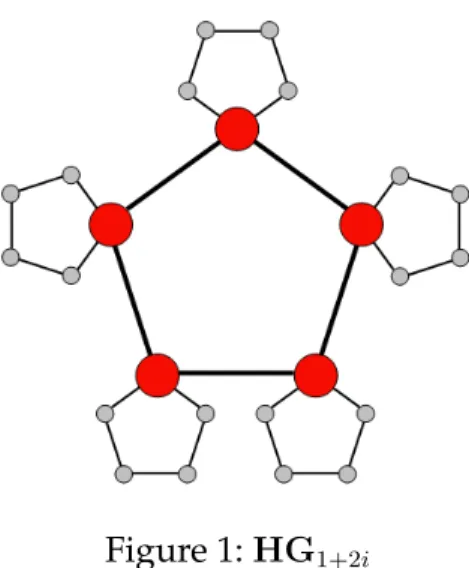
An intuitive visualization of how to build this network is to takeN dense Gaussian net-works ofN nodes and join their centers following the adjacency pattern of a dense Gaussian network ofN nodes. An illustrative simple example withβ = 1 + 2ican be seen in Figure 1. Thus, we have thatHGβhasN2nodes and2N2+ 2N links, whereN =N(β) = 2t2+ 2t+ 1.
Also, it is clear that the diameter of this structure is also 3t. This is neither a regular graph, as we have nodes of degree four and eight, nor a node-symmetric network.
Despite these facts,HGβ hasN + 1subgraphs isomorphic toGβ. The firstN subgraphs
correspond to the N dense Gaussian networks in the lower level of hierarchy. Their corre-sponding links are denoted level-1links. The last subgraph is the dense Gaussian network
Figure 1:HG1+2i
in the higher level of hierarchy and its links are denotedlevel-2links.
The hierarchical Gaussian network has an edge-connectivity of 4, but a vertex-connectivity of 1. This is because if a vertex of the dense Gaussian network in the higher level of hierarchy falls then it disconnects the dense Gaussian network that is under this vertex from the rest of the network. In [5] we found the formula for the average distance of these networks. Lemma 4 Given t a positive integer. Let β = t+ (t+ 1)i. The average distance of HGβ can be
computed as 3NN+1−12t+13 , whereN = 2t2+ 2t+ 1.
4
Routing in Hierarchical Gaussian Networks
Many optimal algorithms for finding minimum paths have been proposed for Circulant graphs; see, for example, [3]. Such algorithms consider graphs whose nodes are labeled by means of integers and implement the Euclidean division algorithm which has a high compu-tational cost. If we consider routing in terms of Gaussian integers, that is, in the isomorphic Gaussian network, we can propose a new algorithm just based on integer sums and com-parisons that was introduced in [5].
Lemma 5 Lettbe a positive integer andβ =t+ (t+ 1)i∈Z[i]. Letα=x+yiandα0 =x0 +y0i
be such that|x|+|y| ≤tand|x0|+|y0| ≤t. Ifr ≡α0−α (mod β)is such that|Re(r)|+|Im(r)| minimum, thenr= (α0−α) +γπwithγ ∈ {0,±1,±i,±(1 +i),±(1−i)}.
If we want to travel from α to α0, we have to obtain X + Y i ≡ (α0 − α) (mod π) with |X| +|Y| minimum. This Lemma implies that we only need to compare the graph weight of, at most, nine Gaussian integers to find the pair. We denote the obtained result as (X, Y) :=routing_record(α, α0, t). Note thatX+Y igives us all the minimum paths fromα
toα0 in the dense Gaussian network of diametert.
Now, we give an idea of the routing in hierarchical Gaussian network. Although it is not a node-symmetric graph, we can use the symmetry of our network to obtain all the possible shortest paths from a source nodes = (α1, α2)to a destination node d = (α01, α
0
of the algorithm is that, if both nodes are in the same dense Gaussian network, then we can follow a direct routing. In other cases, the routing consists in going to the center of the cor-responding dense Gaussian network, then go up to the higher level of hierarchy and attain the destination dense Gaussian network. Now, we just have to go to the destination node following the links in the lower level of hierarchy. Next, we give the complete algorithm.
Data:s= (α1, α2): Source node;d= (α01, α 0
2): Destination node;β =t+ (t+ 1)i: graph
generator
Result:(x1, y1, x2, y2, x3, y3)such that:(x1, y1)level-1 links;(x2, y2)level-2 links;(x3, y3)
level-1 links begin
if(α2 =α02)then
(x1, y1) = routing_record(α1, α10, t)// links to attainddirectly;
(x2, y2) = (x3, y3) = (0,0); else
(x1, y1) :=routing_record(α1,0, t)// links to reach the center;
(x2, y2) :=routing_record(α2, α02, t)// links in the higher level of hierarchy ;
(x3, y3) :=routing_record(0, α01, t)// links to attaind; end
end
Algorithm 1: Routing Algorithm forHGβ.
5
Conclusions
We have introduced hierarchical Gaussian networksHGβ, a hierarchical-type structure that
may be suitable for implementing parallel systems based on chip multiprocessors. Further-more, we have solved the minimal routing problem in dense Gaussian and in hierarchical Gaussian networks, using just integer additions and comparisons.
References
[1] L.A. Barroso et al. "Piranha: A Scalable Architecture Based on Single-Chip Multiprocess-ing". 27th ISCA, pp. 282-293. June 2000.
[2] R. Beivide, E. Herrada, J.L. Balcázar and A. Arruabarrena. "Optimal Distance Networks of Low Degree for Parallel Computers". IEEE Transactions on Computers, Vol. C-40, No. 10, pp. 1109-1124, 1991.
[3] J.-Y. Cai, G. Havas, B. Mans, A. Nerurkar, J.-P. Seifert, I. Shparlinski. "On Routing in Circulant Graphs". Cocoon’99, Japan.
[4] C. Martínez, R. Beivide, J. Gutierrez and E. Gabidulin. "On the Perfectt-Dominating Set Problem in Circulant Graphs and Codes over Gaussian Integers". Accepted for presen-tation at IEEE International Symposyum on Information Theory, 2005, Australia.
[5] C. Marínez, E. Vallejo, M. Beivide, M. Moretó and M. Valero. "Hierarchical Topologies for Large-scale Two-level Networks". Jornadas de Paralelismo, 2005, Spain.
[6] M.R. Marty, J.D. Bingham, M.D. Hill, A.J. Hu, M. Martin and d: Wood. "Improving Multiple-CMP Systems using Token Coherence". 11th HPCA, 2005.
[7] J.M. Tendler et al. "Power4 System Microarchitecture". IBM Journal of Research and De-velopment, 46(1), 2002.