VCU Scholars Compass
Theses and Dissertations Graduate School
2009
Comparing Bootstrap and Jackknife Variance
Estimation Methods for Area Under the ROC
Curve Using One-Stage Cluster Survey Data
Allison Dunning
Virginia Commonwealth University
Follow this and additional works at:http://scholarscompass.vcu.edu/etd Part of theBiostatistics Commons
© The Author
This Thesis is brought to you for free and open access by the Graduate School at VCU Scholars Compass. It has been accepted for inclusion in Theses and Dissertations by an authorized administrator of VCU Scholars Compass. For more information, please [email protected].
Downloaded from
COMPARING BOOTSTRAP AND JACKKNIFE VARIANCE ESTIMATION METHODS FOR AREA UNDER THE ROC CURVE USING ONE-STAGE CLUSTER
SURVEY DATA
A Thesis submitted in partial fulfillment of the requirements for the degree of Master of Science at Virginia Commonwealth University.
by
ALLISON MARIE DUNNING B.S. Statistics, Virginia Tech, 2007
Director: CHRISTINE SCHUBERT, PH.D.
ASSISTANT PROFESSOR, DEPARTMENT OF BIOSTATISTICS
Virginia Commonwealth University Richmond, VA
Acknowledgement
First I must acknowledge my family, without your support I would not be here today. To my mother and father you have always been there for me, a constant source of support. You believed in me even when I did not believe in myself. You never allowed me to give up on myself and reminded me often that I could achieve anything I wanted. To my sister Becky, your support the past two years has meant a lot. I thank you for living with me these past two years and putting up will all my mood swings, it couldn’t have been much fun. To my brother Andy, I have always looked up to you and I thank you for your support over the years.
To Virginia Commonwealth University and especially the Department of Biostatistics, I thank you for your financial support over the past two years. To my professors, I thank you for the time you committed to furthering my education and the support you have provided me over the past two years.
I must make special mention of my thesis advisor Dr. Schubert. Ever since my entry to the department you have been looking out for me. I thank you for all your guidance and support over the past two years and especially this last year working on my
thesis. Without you this thesis would never have happened. You knew how to push me in the right direction without being overbearing. I cannot express the gratitude I feel for the countless hours of work you devoted to this project and to me. I really appreciate everything you have done for me, and I will carry all our meetings over the past year with me into the future.
I would also like to thank Dr. Sabo and Dr. McClish, your guidance over the past year has been astonishing. I appreciate greatly the time you allowed me and the help you provided it will not be forgotten.
I would like to acknowledge the 32 students and faculty of Virginia Tech who lost their lives April 16, 2007. That event has forever changed my life. Two years ago as I entered my graduate work following this event I could not imagine how I was to achieve anything with the anguish left by my fallen peers and mentors. But as Nikki Giovonni stated in her poem “We will Prevail”, I have done just that. Through the support of my friends and family and Hokie spirit I have prevailed and accomplished something that two years ago seemed impossible. You will never be forgotten.
Table of Contents
ACKNOWLEDGEMENT... II
LIST OF TABLES ... VI
LIST OF FIGURES ... VII
ABSTRACT...VIII
1. INTRODUCTION... 1
1.1 Motivation and Purpose ... 1
1.2 Previous Studies ... 3
1.3 Outline of Thesis ... 5
2. METHODS ... 7
2.1 Survey Design ... 7
2.1.1 One Stage Cluster Sampling ... 9
2.1.2 National Health and Nutrition Examination Survey (NHANES) ... 11
2.2 Receiver Operator Characteristic (ROC) Curves ... 15
2.2.1 Logistic Regression... 15
2.2.2 Receiver Operator Characteristic (ROC) Curves ... 18
2.2.3 Area under the ROC Curve (AUC) ... 21
2.3 Variance Estimation Methods ... 25
2.3.2 Jackknife... 30
3 RESULTS ... 33
3.1 Simulated Data ... 33
3.1.1 Simulated Data Introduction ... 35
3.1.2 Simulated Data: Methods ... 37
3.1.3 Simulated Data Results ... 41
3.1.4 Simulated Data Conclusions ... 50
3.2 NHANES Data... 51
3.2.1 NHANES Data Introduction ... 51
3.2.2 NHANES Methods... 55
3.2.3 NHANES Results... 58
3.2.4 NHANES Conclusions... 62
4 DISCUSSION AND FUTURE WORK... 63
BIBLIOGRAPHY ... 66
APPENDIX... 68
List of Tables
Table 1………...16 Table 2 NHANES Results ... 58
List of Figures
page
Figure 1: Bootstrap and Jackknife AUC Estimates vs. True Area ...1
Figure 2: Bootstrap and Jackknife AUC Estimates vs. Prevalence ...1
Figure 3: Jackknife vs. Bootstrap Variance Estimates for 2 Clusters...1
Figure 4: Jacknife vs. Bootstrap Variance Estimates...1
Figure 5: Jackknife vs. Bootstrap Variance Estimates for 5 Clusters...1
Figure 6: Jackknife vs. Bootstrap Variance Estimates for 7 Clusters...1
Figure 7: Log Bootstrap Variance Estimates vs. True Area, Prevalence, & Clusters ...1
Figure 8: Log Jackknife Variance Estimates vs. True Area, Prevalence, & Clusters...1
Abstract
COMPARING BOOTSTRAP AND JACKKNIFE VARIANCE ESTIMATION
METHODS FOR AREA UNDER THE ROC CURVE USING ONE-STAGE CLUSTER SURVEY DATA
By Allison M. Dunning M.S.
A thesis submitted in partial fulfillment of the requirements for the degree of Master of Science at Virginia Commonwealth University.
Virginia Commonwealth University, 2009
Major Director: Christine Schubert, Assistant Professor Department of Biostatistics
The purpose of this research is to examine the bootstrap and jackknife as methods for estimating the variance of the AUC from a study using a complex sampling design and to determine which characteristics of the sampling design effects this estimation.
Data from a one-stage cluster sampling design of 10 clusters was examined. Factors included three true AUCs (.60, .75, and .90), three prevalence levels (50/50, 70/30, 90/10) (non-disease/disease), and finally three number of clusters sampled (2, 5, or 7). A simulated sample was constructed for each of the 27 combinations of AUC, prevalence and number of clusters.
Estimates of the AUC obtained from both the bootstrap and jackknife methods provide unbiased estimates for the AUC. In general it was found that bootstrap variance estimation methods provided smaller variance estimates. For both the bootstrap and jackknife variance estimates, the rarer the disease in the population the higher the
variance estimate. As the true area increased the variance estimate decreased for both the bootstrap and jackknife methods. For both the bootstrap and jackknife variance
estimates, as number of clusters sampled increased the variance decreased, however the trend for the jackknife may be effected by outliers.
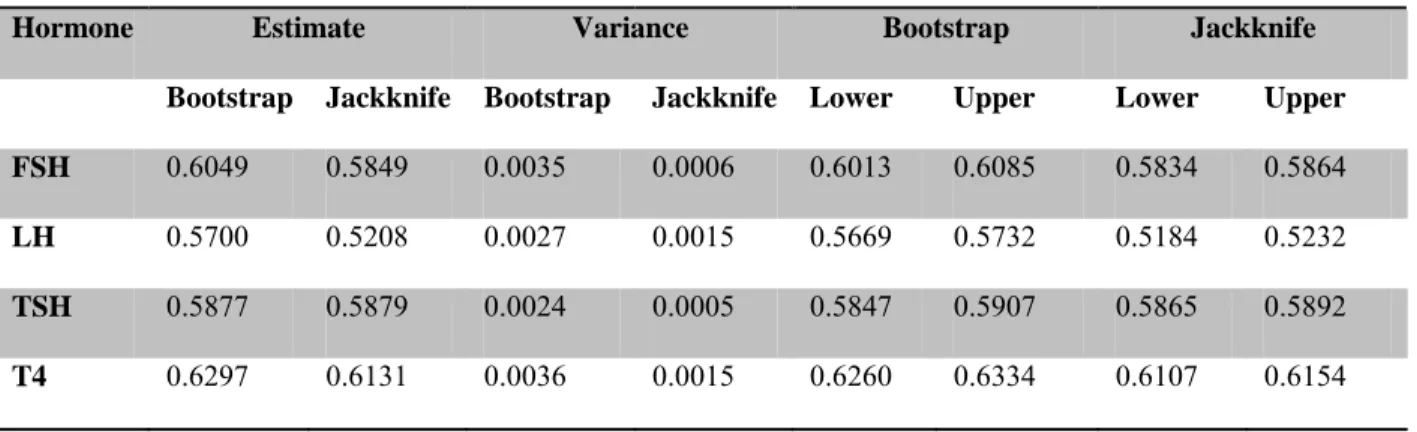
The National Health and Nutrition Examination Survey (NHANES) conducted by the CDC is a complex survey which implements the use of the one-stage cluster sampling design. A subset of the 2001-2002 NHANES data was created looking only at adult women. A separate logistic regression analysis was conducted to determine if exposure to certain furans in the environment have an effect on abnormal levels of four hormones (FSH, LH, TSH, and T4) in women.
Bootstrap and jackknife variance estimation techniques were applied to estimate the AUC and variances for the four logistic regressions. The AUC estimates provided by both the bootstrap and jackknife methods were similar, with the exception of LH. Unlike in the simulated study, the jackknife variance estimation method provided consistently
smaller variance estimates than bootstrap. AUC estimates for all four hormones suggested that exposure to furans effects abnormal levels of hormones more than expected by chance.
The bootstrap variance estimation technique provided better variance estimates for AUC when sampling many clusters. When only sampling a few clusters or as in the NHANES study where the entire population was treated as a single cluster, the jackknife variance estimation method provides smaller variance estimates for the AUC.
1.
Introduction
1.1Motivation and Purpose
Survey samples are becoming an increasingly popular method to obtain information. With the introduction of the internet and in particular email, there is virtually no limit to the number of people who can now be reached. Everyday millions of inboxes are filled with requests to fill out an online survey. In conjunction with this growing technology and improving ability to reach people, statistically valid surveys are also being developed and the ability to administer these surveys is monumentally easier than in years past; thus the popularity of these surveys is also increasing.
Such surveys often implement the use of complex sampling designs. For example, the Centers for Disease Control (CDC) conduct the National Health and Nutrition Examination Survey (NHANES), which uses a one-stage cluster sampling approach. Obtaining estimates, and in particular their variances, requires special considerations. For example, if one wishes to perform a logistic regression analysis on data collected from NHANES, one estimate that can be used to summarize this analysis is the area under the receiver operator characteristic (ROC) curve. Such an estimate must incorporate appropriate adjustments specific to the sampling design. Special techniques exist to estimate these values as well as their variances. Two popular techniques are the bootstrap and jackknife variance estimation methods. These two techniques are part of a larger group known as replication methods.
The purpose of this research is to use these replication methods to create estimates for the variances of area under the ROC curve (AUC) obtained from data collected using one-stage cluster sampling designs. In particular, this research will focus on comparing the bootstrap and jackknife variance estimation methods. It will be of interest to
determine if certain factors related to the sample and the sampling design affect these variance estimates. In addition to the calculation of the AUC for data obtained from NHANES, data will be simulated so as to test the effect of three factors related to the sample and sampling design on the variance estimates from both methods. The three factors to be tested are true AUC, prevalence of disease, and number of clusters sampled. A comparison of the two methods will be performed using simulated data. Finally these methods will be used to analyze data obtained from NHANES.
1.2Previous Studies
A discussion will now follow of previous work comparing variance estimation techniques in complex surveys. It is important to note that while studies have been conducted to compare variance techniques for complex surveys, these studies have yet to be extended to AUC.
A study published in 1996 by Rust and Rao examined data obtained from NHANES. Replication based variance estimation methods such as the bootstrap and jackknife have been suggested to “confront the fact that the sample design, …, impacts the level of error associated with estimates obtained from the data” (Rao). Studies, such as those done by Kovar et al, have shown that both the bootstrap and jackknife methods provide similar results when looking at linear estimators (Rao). Kovar et al also showed that the jackknife method had lower mean square error as an estimator of the sampling variance.
Several publications have looked at comparing the jackknife technique to another replication method known as balanced repeated replication (BRR). It should be noted that in Rust 1985, the BRR method has been shown to be similar to the bootstrap method in terms of variance estimates behavior (Rust). A paper published in 1985, this time by Rust alone, compared variance estimation for complex estimators in sample surveys. In
this paper, Rust compared the jackknife method with the BRR method. Rust found that that the BRR method performed better than the jackknife in variance estimation of population estimates from sample surveys. The work of Kish and Frankel looked at comparing these methods for estimation of ratios. This study found that BRR provided the best coverage in terms of confidence intervals calculated around the estimates for the ratios. Cambell and Meyer also compared BRR and jackknifing for variance estimation. Their results agreed with Kish and Frankels findings that BRR provided the best
confidence intervals. It also found that BRR gave better performance across a variety of population conditions.
These studies would suggest that perhaps the jackknife procedure will not
perform as well as other replication techniques. However, these studies have focused on specific population estimates, such as ratios, and have yet to look at how these replication methods will behave when used to estimate AUC and its variance. This research is the first step in examining how these previous results compare to those proposed in this research for AUC.
1.3Outline of Thesis
The purpose of this thesis is to compare the bootstrap and jackknife variance estimation techniques in estimating the variance of AUC for data collected using one-stage cluster sampling designs. This will be accomplished by first applying both techniques to simulated data. This simulated data will be structured to look at the effect of true population AUC, prevalence of disease and number of clusters sampled on both estimation techniques. The techniques will then be compared using the results from the simulated data study. Finally, both techniques will be applied to data collected from NHANES in order to both compare the provided variance estimates by both techniques and to determine whether or not exposure of the US population to harmful chemicals effect hormone levels in women.
Before these variance estimation techniques can be applied, the research methodology will be discussed. First, a discussion of survey design will be given. This will include an overview of one-stage cluster sampling designs. Then, a discussion of NHANES will outline how this survey is conducted and how its data is structured for analysis. Background of the ROC curve will be provided, including an introduction to logistic regression analysis and how the ROC curve is calculated. A discussion on summary measurements for the ROC curve is given, focusing in particular on the area under the ROC curve. Finally, the methodology concludes with a discussion of variance estimation methods, including detailed descriptions of the bootstrap and jackknife variance
Following the methodology, the data will be introduced. A description of the simulated data will be given. This will include full details of how the simulated data is structured and how it was created. Further, the NHANES data will be described including what variables were collected, and how they were collected. A logistic
regression analysis will be introduced to determine if exposure to ten furans has an effect on reproductive and thyroid hormone levels in women. Once the data has been
introduced, the results will be presented. A discussion of the methods used will include a description of how the bootstrap and jackknife techniques were applied to both the simulated data and the NHANES data. Finally, the results from the simulated data and NHANES are presented. The results for the NHANES data will not only include the comparison of the two variance estimation techniques but also the results of the research question. Conclusions and discussion of implications of the research is then presented. This will include suggestions for future work.
2. Methods
2.1 Survey Design
Survey analysis is typically conducted as if all sample observations were
independently selected with equal probabilities; however, in practice the sample selection is more complex. Often with survey data some subjects may be selected with higher probability than others. Also, some subjects are included in the sample simply because of their membership in a certain group, as in a cluster sample. So the question arises, “What special methods and computer programs are available for the more appropriate analysis of complex survey data?” Implementing typical survey analysis under the assumption of simple random sampling with replacement on surveys that employs stratification and clustering of observations along with unequal selection probabilities can lead to bias and misleading results (Lee). This is due in part to the complex survey design, which is defined as any survey that has restrictions on the sampling other than the simple random sample with replacement assumption. These complex designs require special
consideration when analyzed. Some examples of complex survey designs are those surveys that implement stratification or cluster sampling, or a combination of both. Stratification employs the use of scientifically identified groups known as strata, to split the population into different groups for analysis. Cluster sampling employs the use of clusters to split the population into convenient and cost effective groups, not necessarily considering the differences between the groups. Many large scale population studies use
such cluster designs to efficiently organize the study. The focus of this research will be on cluster sampling techniques.
2.1.1 One Stage Cluster Sampling
One type of complex survey sampling design is cluster sampling. In cluster sampling, one chooses observations by groups of elements (called clusters) rather than by individual elements. An advantage is that cluster sampling can reduce survey costs when acquiring information on groups or clusters is easier and less expensive than obtaining information for individuals. All survey methods still require the use of a sampling frame which lists all possible elements available for the study. Unfortunately it is sometimes difficult to find a good frame for listing population elements. However, a frame listing clusters may be readily available. For example, if a study is interested in interviewing individuals in a certain city living in apartments, a listing of all residents in the city may not be available. However one could easily obtain a listing of apartment buildings in the city. The apartment buildings could then be used as clusters.
Often in complex surveys the sample sizes for each cluster or group are not equal. In such cases, elements in the smaller clusters are more likely to be chosen for the sample over the larger clusters. Also in certain complex designs, the clusters may be stratified according to certain survey objectives. This use of disproportionate stratification and unequal sized clusters complicates the estimation process (Lee).
To obtain a cluster sample, the first task is to specify the clusters to be used. Typically measurements within a cluster are correlated. Therefore the amount of information contained from one element in a cluster about a population parameter may
not be substantial. However, it is not uncommon to come upon the situation where elements within a cluster are very different from one another. One example may be dorms on a college campus, for which one would expect residents to differ in some way. In the case where the elements in a cluster are similar, more information may be gathered by sampling a larger number of clusters of smaller size. When considering a cluster sample it is important to note the differences in the construction of a stratum versus a cluster. As previously noted, strata are typically very different from one another with respect to characteristics being measured; however, elements within a stratum are to be as homogeneous as possible. On the other hand, clusters should be as heterogeneous as possible within, and one cluster should be very much like another to take full advantage of the cost efficiency of cluster sampling. This is so each cluster is representative of the true population. It also reduces variability. Once a sampling frame of clusters is
obtained, a simple random sample of those clusters is chosen. Then all elements in every selected cluster are sampled for inclusion in a study or survey. Issues surrounding the homogeneity within and between clusters as well as sample sizes within a cluster must be considered in variance estimates of population parameters.
The next section will describe one survey that implicates the use of cluster sampling, the National Health and Nutrition Examination Survey (NHANES).
2.1.2 National Health and Nutrition Examination Survey (NHANES)
The National Health and Nutrition Examination Survey (NHANES) is a program of studies designed to assess the health and nutritional status of adults and children in the United States, conducted by Centers for Disease Control (CDC). The NHANES program began in the early 1960s and has been conducted several times as a series of surveys focusing on different population groups or health topics until the 1990’s. Since 1999, the survey has been conducted continuously with data being combined in two year intervals. The survey is unique in that it combines interviews and physical examinations. The CDC makes this collected data available, both from interviews and physical
examinations, for use by the public and other health organizations on their website. NHANES is conducted by first splitting the country into counties, which serve as primary sampling units and using these counties as a sampling frame. Of the many counties across the country, 15 are selected to be visited each year. Clusters of
households are selected, each person in a selected household is screened for demographic characteristics, and one or more persons per household are selected for the sample. This research uses, NHANES 2001-2002, for which there were 13,156 persons selected for the sample; 11,039 of those were interviewed (83.9%) and 10,477 (79.6%) were examined in the NHANES mobile examination center (MEC). The NHANES interview includes demographic, socioeconomic, dietary, and health-related questions. In addition, the examination component consists of medical, dental, and physiological measurements, as well as laboratory tests, which are administered by highly trained medical personnel.
Health interviews are conducted in respondents’ homes, and health measurements are performed in specially designed and equipped mobile centers, which travel to the designated locations throughout the country. The mobile center staff automatically transmit data into databases where it is available to CDC staff. Survey information is available to CDC staff within 24 hours of collection. This quick data collection and submission enhances the capability of collecting quality data and increases the speed with which results are released to the public.
The sample for the survey is selected to represent the non-institutionalized U.S. population of all ages, meaning that both children and adults are selected to be questioned and examined. The tests and procedures performed in the examination depend on the age of the participant; in general, older individuals receive more extensive examinations. All participants visit the physician, give dietary interviews and have body measurements taken, and all but the very young have blood taken and a dental screening. Participants of NHANES receive compensation and a report of medical findings, and all information collected in the survey is kept strictly confidential.
The National Institutes of Health (NIH), the Food and Drug Administration (FDA) and CDC are among the agencies that rely upon NHANES to provide data essential for the implementation and evaluation of program activities (Services). Findings from the NHANES survey are used to determine the prevalence of major diseases and risk factors for diseases, and chronic conditions in the population. Risk factors, those aspects of a person’s lifestyle, constitution, heredity, or environment that
may increase the chances of developing a certain disease or condition, are examined. Past surveys have provided data to create growth charts used nationally by pediatricians to evaluate children’s growth. Blood lead data were instrumental in developing policy to eliminate lead from gasoline, food and soft drink cans, resulting in a decline in elevated blood levels by more than 70% since the 1970s (Services). Data have continued to indicate that undiagnosed diabetes is a significant problem in the United States. Facts about the distribution of health problems and risk factors in the population give researchers important clues to the causes of disease. From the NHANES survey, the CDC can identify the health care needs of the population, from which government agencies and private sector organizations can establish policies and plan research, education, and health promotion programs to help improve present health status and prevent future health problems.
One problem with analyzing the NHANES data is the complex survey structure. NHANES is described by the CDC as a complex sample survey. Data collected comes from interviews, examinations, and laboratory tests based on blood and urine samples. Dust or tap water samples may also be collected in the home. The source of a data item is important for both assessment of quality of information and for determining the
appropriate sampling weights. Interview data, while administered by a trained NHANES member, are based on self reporting and are therefore subject to non-sampling errors, such as recall problems, and misunderstanding of the question, among other factors. Examination data and laboratory data are subject to measurement variation and possible
examiner effects. To help reduce these errors, prior to and during data collection,
NHANES field staff participates in comprehensive training and annual refresher training for interviewers and MEC staff. The primary sampling units (PSUs) for the NHANES survey are generally single counties, although small counties are sometimes combined to meet a minimum population size. Because NHANES is a complex probability sample, analytic approaches based on data from simple random samples are usually not
appropriate. As with any complex probability sample, the sample design information should be explicitly used when producing statistical estimates or undertaking statistical analysis of the NHANES data. Ignoring the complex design can lead to biased estimates and overstated significance levels. Sample weights and the stratification and clustering of the design must be incorporated into an analysis to get proper estimates and standard errors of estimates.
2.2 Receiver Operator Characteristic (ROC) Curves
2.2.1 Logistic Regression
Often when looking at survey data the responses are categorical, whether binary (having two outcomes), nominal, (having several unordered outcomes) or ordinal (having several ordered outcomes). To examine the association among variables methods using categorical response variables are necessary. Logistic regression is a commonly used analysis method when conducting surveys, as it is used to examine the association of a categorical outcome or response with a number of independent variables (Lee).
Specifically, logistic regression is a way of converting the proportions or rates of categorical data into numbers that have real interpretations. For example, logistic
regression is commonly used when the outcome or response is the presence or absence of a condition, often a disease. In these cases, the explanatory variable is often a test or procedure used to detect this condition. Logistic regression allows us to convert these agreement proportions into probabilities of having the disease. In addition, these probabilities can be converted into sensitivity and specificity which can be used to determine the accuracy of a procedure or test in successfully predicting the absence or presence of a condition. Sensitivity is the probability that the test correctly identifies a diseased patient with the disease and specificity is the probability that the test correctly identifies the non-disease patients without the disease. Table 1 below helps demonstrate
Table 1
Actual Condition of Population
Test Result Patients with Disease Patients without Disease Totals
Positive Negative a c b d a+b c+d
Totals a+c b+d a+b+c+d
As defined by Zhou in Statistical Methods in Diagnostic Medicine, the sensitivity of a test is its ability to correctly identify patients who are known to have the condition. And similarly specificity is the probability that the test result is negative, given that the condition is absent. Sensitivity is the true positive rate and specificity is the true negative rate, because the test or procedure indicates the correct diagnosis (Zhou). Sensitivity is calculated as the proportion of true positives = a
a+c. Specificity is calculated as the
proportion of true negatives = d
b+d.
While these measures give good estimates of how well a test performs they are dependent on the cutoff used to define positive and negative test results, also known as the decision threshold (Zhou). Sensitivity and specificity are affected by the choice of decision threshold but are not affected by the prevalence of the condition, which makes them good measures of intrinsic accuracy. Using logistic regression provides the
sensitivity and specificity of a procedure or test at all decision thresholds giving an idea of how well a test performs over the entire range of decision thresholds.
2.2.2 Receiver Operator Characteristic (ROC) Curves
From logistic regression a graph in which the Y-axis represents sensitivity and the X-axis represents 1 minus specificity can be obtained for every possible threshold. This plot is the Receiver Operator Characteristic or ROC curve. An ROC curve is a way of describing the intrinsic accuracy of a test apart from the decision thresholds. Since the 1970s, the ROC curve has been the most valuable tool for describing and comparing diagnostic tests and procedures (Zhou). It is interesting to note that the name “receiver operator characteristic” curve comes from the notion that given the curve, we – the receivers of the information – can use (or operate at) any point on the curve by using the appropriate decision threshold (Zhou). As stated above, the sensitivity and specificity of a procedure or test is independent of disease prevalence, and since the ROC curve is a plot of these measurements, it too is independent of disease prevalence. Also, the ROC curve has the advantage of being invariant to monotonic transformations, as it does not depend on the scale of the test results (Zhou).
ROC curves can be constructed from either objective or subjective measurements. However, regardless of the type of decision threshold the curve has the same
interpretation; it illustrates the trade-off between the sensitivity and false positive rate as the decision threshold changes. For measurements that are made objectively, the decision variable is explicit, so one can choose from an infinite number of decision thresholds along the continuum of test results. Also for diagnostic tests interpreted subjectively, the
decision thresholds are implicit or latent, for they exist only in the mind of the observer (Zhou).
A procedure or test that cannot discriminate between presence and absence of a condition will provide an ROC curve which is a forty-five degree line passing through the origin with slope of one (Giulia Bisoffi). The best tests have high sensitivity and low 1- specificity. Correspondingly, effective tests or procedures will provide a convex curve above this line. Specifically the ROC curve gives the precise magnitude at which the false positive rate increases as the sensitivity increases (Zhou). Assuming the statistical model used for the disease and non-disease populations has a binormal distribution, as it is the most commonly used model for fitting ROC curves in diagnostic medicine, the curve is then completely specified by two parameters, “a” and “b”. A binormal distribution assumed that both the non-disease and disease populations are normally distributed with different means and standard deviations
(
2)
,(
, 2)
,
disease N μ σD D non disease N μND σND
⎛ − ⎞
⎜ ⎟
⎝ : : ⎠ Where ‘a’ is the standardized
difference in means of the distributions of the test results for patients with and without the condition; and ‘b’ is the ratio of the standard deviations of the test results for patients without versus with the condition (Zhou).
Through the use of logistic regression, a statistical model can be fit to the test results of a sample of subjects producing a fitted ROC curve (or smooth curve) (Zhou). This is in contrast to the empirical ROC curve which only uses the observed data.
Assuming they are on two similar scales one can compare two ROC curves. For example, it may be of interest to compare two testing procedures on their accuracy of correctly diagnosing the same disease. It may be of interest to compare the two ROC curves. In situations like this, it is helpful to have a single number to compare the curves. In the following section we will talk about one such summary for ROC curves known as the area under the ROC curve (AUC).
2.2.3 Area under the ROC Curve (AUC)
The area under the ROC curve (AUC) is a single number summary of an ROC curve that one can use to compare the effectiveness of two separate diagnostic tests or procedures. It is easier to compare a single number than to compare both the sensitivities and specificities of the two tests (Zhou). When presented with two tests/procedures used in detecting a certain condition it is not always feasible to simply directly compare two ROC curves. It may be that the two curves are very similar making it hard to detect which is better. Therefore rather than compare two ROC curves visually, the AUC for the two ROC curves are compared. As such, the AUC is “the most common quantitative index describing an ROC curve” (Hanley).
There are two methods for computing estimates of the AUC. These depend on the assumptions regarding the underlying distributions of the two populations for those with and without the condition. If binormality of the two populations is assumed then a generally unbiased estimate for AUC can be obtained. In this case the area under the smooth or fitted ROC curve is calculated as:
2 1 a A b ⎛ ⎞ ⎜ ⎟ = Φ ⎜ + ⎟ ⎝ ⎠ 1.1
Where Φ
( )
is the cumulative normal distribution,a(
D ND)
D μ μ σ − = and ND b D σ σ = (Zhou).
In this case μND and σND represent the mean and standard deviation of the population of
subjects without the condition and μD and σD represent the mean and standard deviation
of the population of subjects with the condition. However, if no assumptions are made concerning the underlying distributions of the two populations, then nonparametric methods can be used to estimate the AUC. The nonparametric estimate of the AUC is found through the trapezoidal method (Korn). First the ROC curve is separated into many segments, the area of each segment is computed, and then the computed areas of these trapezoidal segments are summed. Typically the trapezoidal method will
underestimate the area (Zhou). If we let TNDirepresent the observed test result for the ith
subject without the condition, and TDjthe observed test result for the jth subject with the condition. Then a formula for “the nonparametric estimate of the area, denotedANP” is given by:
(
)
1 , ANP TDi TNDj nND Dn ϕ =∑∑
where(
)
(
)
(
)
1 , 0 if , , 2 if , and , 1 ifTDj TNDi TNDi TDj TDj TNDi TNDi TDj TDj TNDi TNDi TDj ϕ ϕ ϕ = > = = = < (Zhou).
This formula is useful for both ordinal and continuous data. It is interesting to note that the nonparametric estimate of the AUC using the trapezoidal method is equivalent to the Mann-Whitney statistic for the rank sum test. In general the
interpreted in several ways. The most popular interpretation is that the AUC is the probability that a randomly chosen subject with the condition of interest has a
test/procedure result indicating greater suspicion than that of a randomly chosen subject without the condition of interest. Another interpretation of the AUC is that it is the average value of sensitivity (specificity) for all possible values of specificity (sensitivity) (Zhou). As stated previously, the ROC curve is invariant to the prevalence of the
condition and therefore the AUC is also invariant to the prevalence of the condition. Therefore, the ROC curve area is simply a description of a test’s inherent ability to discriminate between subjects with versus without the condition (Zhou).
The AUC takes on values between 0 and 1, since the ROC is a plot of
probabilities bounded by 0 and 1. Although the true range is between 0 and 1, we expect by chance a test to correctly detect a condition about 50% of the time. Thus the practical lower bound of AUC is 0.5. An area of 1.0 means that a test or procedure is performing perfectly, so that the test or procedure correctly diagnoses each patient as having or not having the condition. A diagnostic test or procedure when the ROC curve falls above the chance line (has an AUC greater than 0.5) will have at least some ability to discriminate between patients with and without the condition (Zhou).
Finally it is commonly of interest to compare two testing procedures and their ability to correctly diagnose patients to the same condition. If the population is known, then one can test if the two ROC curves are exactly the same with the hypothesis:
Another way to compare these procedures is to compare their respective AUCs. In order to determine if the two AUCs are significantly different the variances of both ROC area estimates must be taken into account. Some methods for estimating these variances are discussed in the next section.
2.3 Variance Estimation Methods
Estimates of variances are necessary to evaluate the significance of the AUC statistic. For complex estimators such as the AUC statistic used in sample surveys, special difficulties arise in the estimation of the variance. Such difficulties could be that the variance of the estimate may not be a linear or even known function of the population parameters (Levy). Unique to survey designs, a researcher who wishes to analyze data and compute appropriate variance estimates from a complex sample survey must overcome three major issues in the data: (1) the presence of survey weights in the data, (2) response and (3) the sample design, with the weighting adjustments for non-response compensation and post-stratification. These issues will impact the level of error associated with any estimates obtained from the data (Rao). There are a variety of
approaches that can be taken to deal with the impact of the design and estimation features of the survey on the inference of the population parameter.
The assumptions associated with the underlying population of interest determine which methods can be used to estimate the variance of an AUC estimate. If one assumes binormality of the underlying distributions, variance can be computed using typical variance estimation methods using linear estimates. When inferences about the parameters of a finite population are based on sample survey data without model assumptions, other methods must be used to derive estimates of the variances of the parameter estimates (Rust). One technique is replication, in which the variance of the
parameter estimator is obtained from the variability of estimates derived from different, comparable parts of the original sample (Rust). These methods, once thought to be too tedious and difficult to perform, have recently grown in popularity with the
implementation of computer algorithms.
“Replication is a general class of methods in which an estimate of the variance of an estimated population parameter is obtained by expressing the estimated population parameter as a sum or mean of several statistics, each of which is based on a subset of the sample observations. One can obtain an estimate for the variance of the estimated
population parameter by calculating the variance of these “part sample” statistics” (Levy). Hansen et al in a 1950s textbook first referred to these replication techniques as random group methods. In current literature replication methods are sometimes called resampling methods.
Replication methods estimate the sampling variance of a statistic by computing the statistic for subsets of the sample and examining its variability over the subsets (Levy). All replication techniques use computational intensity to overcome difficulties and inconveniences in utilizing an analytic solution to the problem at hand (Rao).
Two popular replication methods include the bootstrap and the jackknife. In the following two sections the bootstrap and jackknife variance estimation procedures are outlined. Later, a discussion and comparison of the two methods is conducted to
determine how each performs in estimating the variance of the AUC statistic from a one-stage cluster survey.
2.3.1 Bootstrap
The bootstrap is one replication method that can be used for variance estimation in sample surveys. The name bootstrap derives from the phrase “to pull oneself up by one’s bootstrap” (Efron). The bootstrap was introduced in 1979 as a computer based method for estimating variance. Because of modern technological breakthroughs, the bootstrap has been developed more recently because the modern computer power it requires to simplify intricate calculations (Efron).
The general idea of the bootstrap is to create artificial datasets with the same structure and sample size as the original data. To create these artificial datasets simple random samples are taken from the original with replacement, so that the same PSU may be chosen multiple times and included in the same artificial or pseudo sample. Once the artificial datasets are chosen, an estimate, *θb of the parameter of interest,θ is calculated from each pseudo sample. Then an estimate of the variance of the parameter of interest is calculated as follows for the bootstrap:
(
)
2 1 * * ( ) 1 1 B VarBS b B b θ = θ −θ − =∑
where B is the number of replicate samples and * 1 *
1 B b B b θ = θ =
∑
.The issue of how many replicates is required to provide an acceptable variance estimate arises. This problem is not trivial since the precision of the variance estimator continues to increase as the number of replicates increases, but the resources needed to carry out the bootstrap method obviously increases as well (Rao). It has been suggested that the number of replicate samples needs to be large. Efron states that a large B would be 200 replicates, however if confidence intervals will be calculated then it has been suggested that B needs to be 1000 (Efron). While most literature when describing the appropriate number of replicates reference Efron who says for just variance estimation B = 200 is efficient, several studies have been done showing that perhaps this standard is low. Booth and Sakar (Booth) in 1998 published an article that argued that the number of replicates should be determined by the conditional coefficient of variation. Efron’s suggestion is based on the unconditional coefficient of variation which involves both sampling and resampling variability. Booth argues that only the resampling variability needs to be considered and provides the following simple formula for B,
( )
2 1 2 2 2 B α δ − Φ ≈ (0.1)Where the values of α and δ are determined by
2 ˆ 1 1 1 2 ˆ B P σ α δ δ σ ⎛ ⎞ ⎜ ⎟ − = − < < + ⎜ ⎟ ⎝ ⎠ and 2 ˆ 2 ˆ B σ σ is
bootstrap approximation of the variance and 2σ is the true variance. This formula requires approximately 800 replicates to achieve a relative error less than 10% with probability .95 (Booth). However when considering confidence intervals, Booths’ article calculates a required B similar to Efron’s B = 1000. This research will use B=800 bootstrap replicates.
2.3.2 Jackknife
The second replication-based variance estimator discussed here is the jackknife. Jackknifing is another method for estimating the variance of estimates obtained from complex sample surveys. As a replication based technique it is calculated using the estimates of the parameter of interest for several part samples and then the variance is found using these estimates. Unlike the bootstrap, the jackknife has a longer history originating in 1956 with Quenoille. Tukey in 1958 extended the definition to say that the technique could be adapted to produce variance estimates for many estimators (Rust). In particular, the jackknife method can be used to estimate the variance of parameters from complex sample survey data. A result of this long history is that there now exist several variations to the jackknife procedure (Levy). The use of the jackknife procedure requires the data to be split into groups. A single jackknife replicate is created by removing from the sample all units associated with a given PSU from one group and inflating the
weights of all other units from the same group (Rao).
To find the jackknife variance estimate, suppose the data is composed of L clusters, the sample within each cluster is subdivided into nh disjoint sample PSUs. For
each PSU in the original dataset an estimate
( )
r( )hi is obtained based on all observations except those in PSU i in clusterh. Then the variance estimate for the parameter of interest is obtained by:( )
(
)
2 1 ( ) 1 1 n L h nh Var r rhi r nh h i − = − = =∑
∑
where r is the estimate for the parameter of interest from the entire original dataset (Levy). This method is referred to as the delete one jackknife technique. The delete one jackknife method deletes one PSU at a time and adjusts the full sample weights for the other PSUs in that cluster, repeating the process for each cluster independently.
It is important to note that the estimate r(hi) consists of cluster estimates from all
PSUs except PSU hi and that the estimate from that PSU for the cluster is calculated
based on the estimates of the other PSUs within the cluster. This creates a need to appropriately adjust the estimate by
1
nh
nh− to reflect the absence of the data from that
particular PSU. Alternative methods to calculate the jackknife variance estimator that differ from the method above do exist. One alternative is to replace the whole sample parameter estimate, r, with the mean of the r(hi) estimates. An advantage of using the
whole sample parameter estimate, r, rather than mean is that it generalizes readily to more complex estimators (Rao).
The precision of the jackknife estimate is maximized when each PSU is of size one and each unit is omitted once. Also, if necessary the jackknife procedure can be used with combined clusters. In this case, replicates can be formed by omitting PSUs from several clusters at a time, without adding bias to the jackknife variance estimate (Rust).
large range of sample survey statistics, with the introduction of only slight bias. This bias typically has little impact on the inferences made about the population parameters (Rao). It is suggested to ensure the variance estimator remains approximately unbiased to have the designation of PSUs as 1 and 2, respectively, within each cluster, be random and not based on the data or PSU characteristics. If with replacement sampling is used,
3 Results
3.1 Simulated Data
It is of interest to determine whether bootstrap or jackknife replication techniques provide the best variance estimates for AUC from one-stage cluster survey data. In order to provide evidence to determine which method performs the best, data must be simulated and include examining what if any factors may affect each technique. Three factors in particular were examined with respect to their effect on variance estimation. The first factor was true population AUC. The second factor was prevalence in the population of the disease or condition, i.e. is the disease rare or more common. The third factor was the numbers of clusters selected to sample.
Larger true AUC would suggest that a test or procedure is more accurately distinguishing between patients with and without the disease. It is expected that the higher the AUC (the better the test is doing), the less variability there would be. Also if the true AUC is close to .5, this means the test is really no better than chance. Therefore the closer the actual AUC is to .5 the more variability is expected. It is of interest to determine if these expected trends exist within a complex survey design and whether or not the two variance estimation methods show consistent trends or if one method is immune to this factor. In particular, data will be simulated for three different true AUCs, .90, .75, and .60.
It is unclear how prevalence of a disease would affect variance estimation. As a disease becomes less common in the population it is unclear whether it would be easier to distinguish between disease and non-disease. This will be addressed by accounting for different prevalence
levels of disease in the simulated data. It is of interest to determine if the two variance estimation methods provide similar trends in prevalence or if they differ. Three different prevalence levels of disease will be simulated, .5 prevalence, .3 prevalence, and .1 prevalence.
Generally, variance decreases as sample size increases. The simulated data will account for differing sample sizes by sampling differing numbers of clusters from the population. It is expected that as the number of clusters sampled increases the variance estimates will decrease, or approach the true variance. It will be determined whether this trend is consistent across both variance estimation techniques. Three different numbers of clusters sampled will be simulated, samples where 2 of 10 clusters are sampled, 5 of 10 clusters are sampled and 7 of 10 clusters are sampled.
3.1.1 Simulated Data Introduction
To test these factors, data was simulated to obtain AUC estimates and variances using the bootstrap and jackknife techniques. The simulated population consisted of 1000 individuals who were assigned to 10 clusters of 100 individuals each. To create the simulated population some assumptions were made. The first assumption is that the underlying disease and non-disease populations were normally distributed. By making this assumption of binormality, equation 1.1 can be used , where b is defined as the ratio of the variances between the non-disease and disease
population, 2 2 ND D σ σ ⎛ ⎞ ⎜ ⎟ ⎜ ⎟ ⎝ ⎠
. Once the area and b have been set, the equation can be solved for a as
follows: a= 1+b2*Φ−1
(
Area)
. To create the simulated data it was further assumed that the non-disease population was from a standard normal distribution,(
ND~N(
0,1)
)
. The ratio of variances, b, was set to be equal to one (b=1,a= 2 *Φ−1(
AUC)
). Then for each AUC of interest the equation could be solved for a and the disease population would be distributed as normal with mean equal to a, and the variance would equal one,(
D~ N a(
,1)
)
. The total population was created by concatenating the non-disease and disease populations. Then 10 clusters were randomly assigned with each cluster containing 100 individuals. To account for the different prevalence levels, once an area had been set and the disease and non-disease distributions had been found the population was created to account for different prevalencedistribution and 500 individuals were drawn from the disease population distribution. For the .3 prevalence, 700 individuals were drawn from the non-disease population distribution and 300 individuals were drawn using the disease population distribution. Finally for the .1 prevalence, 900 individuals were simulated from the non-disease population distribution and 100 individuals were simulated using the disease population distribution. While the population reflected the prevalence the 10 clusters were drawn randomly and may not have the same prevalence within each cluster. Then to account for the differing sample sizes the following method was used. Once the area had been set and the three prevalence levels were created, within each prevalence level three different samples were taken, the first sampling only 2 of the 10 clusters of size 100 individuals, the second sampled 5 of the 10 clusters each of size 100 individuals and finally the last sample consisted of 7 of the 10 clusters of size 100 individuals from the population. This resulted in 27 combinations of true area, prevalence and number of clusters sampled. For each of the 27 cases, 100 replicates were taken. The simulated data was created using an original SAS macro specifically written for the purpose of this thesis (see appendix).
3.1.2 Simulated Data: Methods
A previous section detailed how each sample was created for the simulated data. This section will detail how the bootstrap and jackknife techniques were applied. For a given case, once a replicate was created it was uploaded into a SAS macro that would determine the AUC estimate and its variance based on either the jackknife or bootstrap method. A description of the two original macros designed to analyze the simulated data will now be provided.
In a previous section a general description of the bootstrap method to variance estimation was given. An original SAS macro was created to carry out this process for the simulated data created (see appendix). This macro requires the user to specify: an input data set, a total sample size, the number of bootstrap replicates (B), an index variable and the cluster variable name. From literature research it was determined to use B =800 bootstrap replicates. Each of the 100 samples within a case simulated as described previously will be used as an input dataset. The total sample size will be dependent on the number of clusters sampled in the simulated sample, for 2 clusters sampled the sample size will be 200, for 5 clusters sampled the sample size will be 500 and for 7 clusters sampled the sample size will be 700. For each bootstrap replicate a pseudo dataset is created by taking a simple random sample with replacement from the original simulated sample. This pseudo dataset will have the same total sample size as the original simulated sample; since the sample was taken with replacement certain observations can be chosen more than once for inclusion in the pseudo dataset. A survey logistic regression is applied to the pseudo dataset to predict whether or not each observation is from the diseased or
process is repeated for B=800 bootstrap replicates on each sample. A dataset is created that contains the 800 AUC estimates obtained from the 800 bootstrap replicates. The AUC estimate for the simulated replicate is then determined to be the mean of the 800 replicate AUC estimates. And the variance for the AUC of the simulated sample is calculated as the variance of the 800 AUC estimates obtained from the 800 bootstrap replicates. This process is done for each of the 100 replicates for each of the 27 cases, so that in the end there are 100 AUC estimates and variance estimates using the bootstrap technique for each case. Once the 100 replicates for each case were created the mean AUC and mean variance were computed for each of the 27 cases from their 100 replicates.
In a previous section a general description of the jackknife method to variance estimation was given. An original SAS macro was created to carry out this process for the simulated data created. (See appendix). The macro requires the user to specify: an input data set, a total sample size, the number of clusters sampled, the sample size within each cluster, an index variable, the cluster variable name, an individual weight variable and a jackknife weight variable. Again, total sample size is dependent on the number of clusters sampled and is the same as given above. The number of clusters sampled will be 2, 5, or 7. The sample size within each cluster is the same for all samples, 100 individuals in each cluster. The individual weights are calculated as
(
)
where the total # of clusters in the population = 10 , and
M M s
s = = # of clusters sampled (2,
5 or 7), giving the following weights: for 2 clusters sampled the weight will be 5, for 5 clusters sampled the weight will be 2 and for 7 clusters sampled the weight will be approximately 1.4. The jackknife weight is calculated
as 1 where # clusters sampled(2, 5, or 7), cluster sample size = 100 1 s nh s nh nh h − = = =
∑
. So for 2clusters sampled, the jackknife weight is 1.98, for 5 clusters sampled the jackknife weight is 4.95, and for 7 clusters sampled the jackknife weight is 6.93. For each replicate of each case the macro first runs a survey logistic regression on the replicate to predict whether each individual was from the disease or non-disease population. An AUC estimate is obtained from the survey logistic regression; this will be called the full AUC. A pseudo dataset is then created by removing one observation from the original replicate dataset. Once an observation is removed the macro determines from which cluster the observation was taken and reweights the remaining individuals within that cluster by a factor of
1
nh
nh− where nhis the number of individuals in each
cluster
(
nh=100)
. The weights of the individuals in the other clusters remain the same. Once the pseudo dataset is created a survey logistic regression is run to predict whether individuals are from the disease or non-disease population. From the survey logistic regression an estimate of the AUC is obtained. This process is repeated until each observation has been removed. Again a dataset is created that contains the AUC estimates obtained from removing each observation one at a time. This dataset will be the same size as the original replicate dataset. Again the estimate for the AUC of the replicate is determined to be the mean of the AUCs from the pseudo datasets.The variance is then determined to be 1
(
( )
)
21 1 s n nh F i nh h i θ θ ⎛ − ⎞ − ⎜ ⎟ ⎝ ⎠ = =
∑
∑
where 1 1 s nh nh h − =∑
is thesize. This process is done for each replicate, so that in the end there are 100 AUC estimates and variance estimates using the jackknife technique for each of the 27 cases. Once the 100
replicates for each are obtained the mean AUC and mean variance are computed for each of the 27 cases. The following section will describe the results obtained from these analyses.
3.1.3 Simulated Data Results
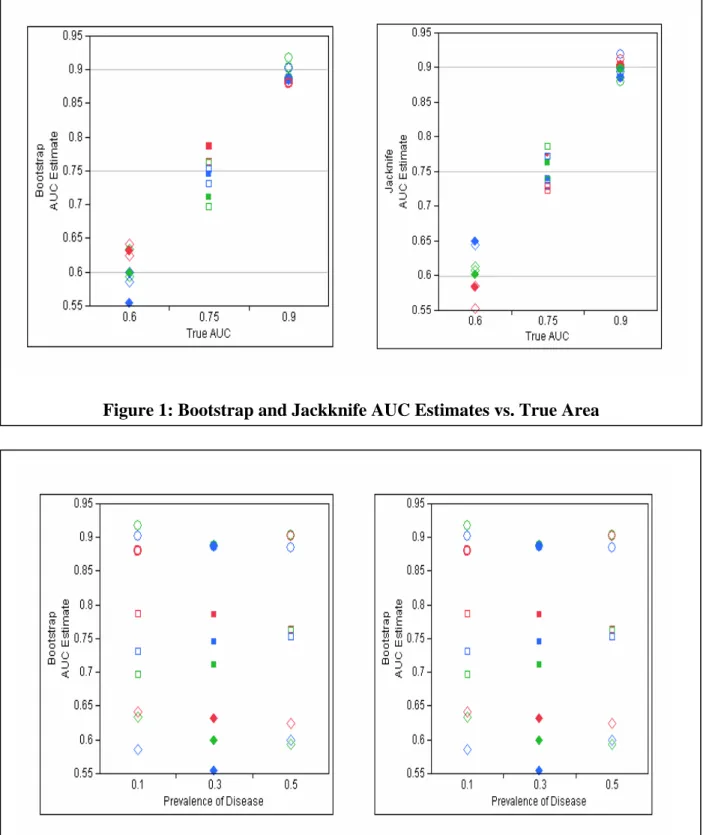
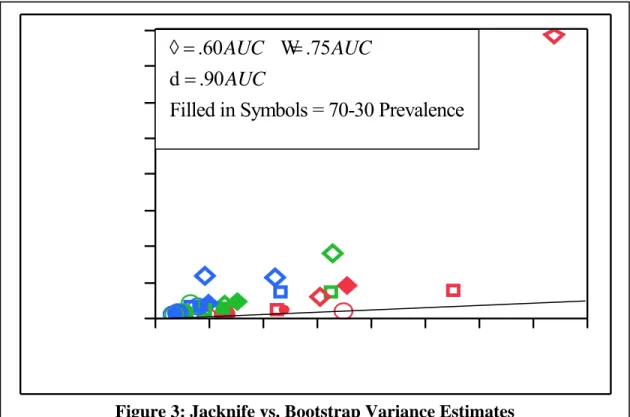
The true interest lies in determining whether the bootstrap or jackknife techniques for variance estimation provide better estimates for the AUC. In statistics an estimator is assessed based on several characteristics. These methods of assessment incorporate a trade-off between bias and variance of estimators. Bias is defined as the difference between the expected value of an estimator and the true value of the parameter it is estimating. An estimate is said to be unbiased if its expected value is equal to the parameter it is estimating. So before we can compare the variances of the bootstrap and jackknife estimates of AUC we must compare the estimates themselves to determine if one technique provides estimates that are more biased than the other. Figure 1 below shows the AUC estimates from each method (Bootstrap and Jackknife) plotted against the true AUC. As can be seen both methods give consistent results, both methods provide no bias when estimating the true AUC. Statistical tests confirmed that both the bootstrap and jackknife AUC estimates were unbiased and that the bootstrap AUC estimates were not significantly different than the jackknife AUC estimates. Also note in Figure 2 below that the prevalence of disease does not seem to have any effect on the AUC estimates from either method.
Figure 1: Bootstrap and Jackknife AUC Estimates vs. True Area
Figure 2: Bootstrap and Jackknife AUC Estimates vs. Prevalence
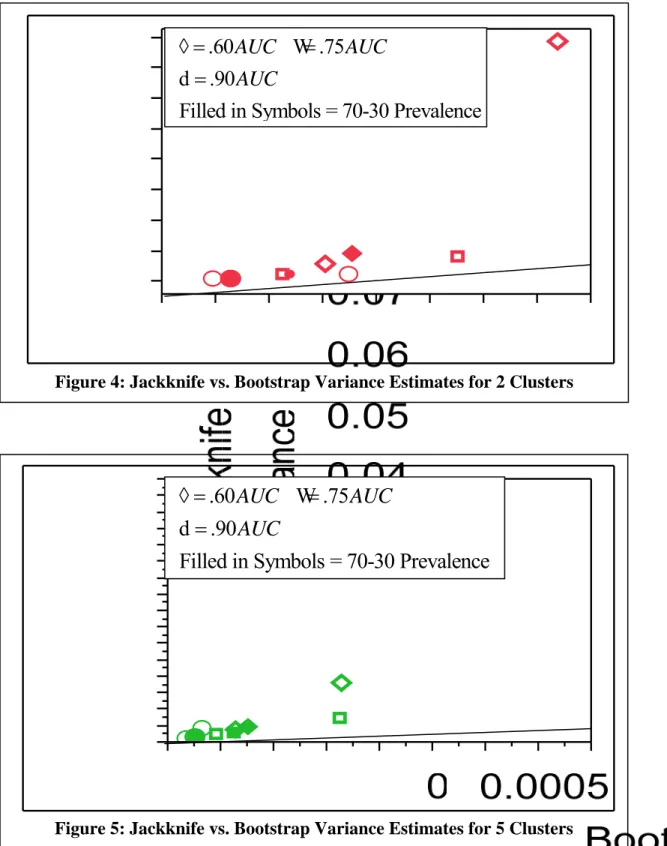
Figure 3: Jacknife vs. Bootstrap Variance Estimates
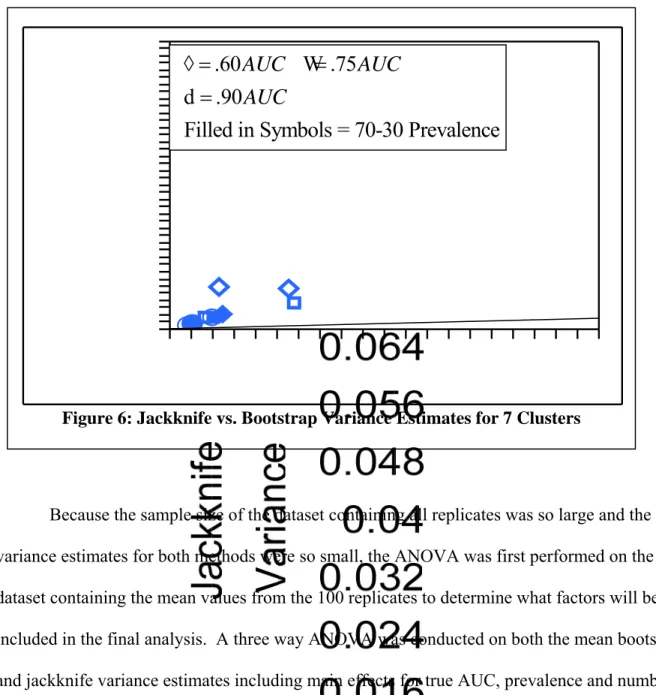
Using these results, it is determined that the bootstrap and jackknife techniques provide no bias for the AUC estimates and thus the better estimator can be determined by comparing the variances on the AUC estimates. The method that provides smaller variance estimates will be the preferred method. A graph of the Jackknife versus the Bootstrap variance estimates was plotted as seen in Figure 3. Note the presence of an outlier located at true AUC of .60, prevalence of .1 and 2 clusters, this will be discussed further in the next section. This graph shows that the jackknife estimates are consistently higher than the bootstrap variance estimates. As can be noted in Figures 4, 5, and 6, there is an obvious difference between variance estimates based on the number of clusters sampled. This trend and others will be examined by
implementing the use of a three-way block ANOVA.
.60
.75
.90
Filled in Symbols = 70-30 Prevalence
AUC
AUC
AUC
◊ =
=
=
W
d
Figure 4: Jackknife vs. Bootstrap Variance Estimates for 2 Clusters
Figure 5: Jackknife vs. Bootstrap Variance Estimates for 5 Clusters
.60
.75
.90
Filled in Symbols = 70-30 Prevalence
AUC
AUC
AUC
◊ =
=
=
W
d
.60
.75
.90
Filled in Symbols = 70-30 Prevalence
AUC
AUC
AUC
◊ =
=
=
W
d
Figure 6: Jackknife vs. Bootstrap Variance Estimates for 7 Clusters
Because the sample size of the dataset containing all replicates was so large and the variance estimates for both methods were so small, the ANOVA was first performed on the dataset containing the mean values from the 100 replicates to determine what factors will be included in the final analysis. A three way ANOVA was conducted on both the mean bootstrap and jackknife variance estimates including main effects for true AUC, prevalence and number of clusters sampled as well as interactions. For the jackknife variance estimates, no interactions were found to be significant at the .05 level. For the bootstrap variance estimates, all two-way interactions were found to be significant. When Tukey’s multiple comparison procedure was applied to look at all pair-wise differences, all pair-wise differences of interest were found to be
.60
.75
.90
Filled in Symbols = 70-30 Prevalence
AUC
AUC
AUC
◊ =
=
=
W
d
examining plots of theses two-way interactions, no non-ignorable interactions were found. All interactions showed similar trends for the different levels of each factor. Therefore it was decided to omit the two-way interactions in the final analysis. The final analysis performed on the dataset containing all 100 replicates was a three-way block ANOVA with main effects for true AUC, prevalence, number of clusters sampled and the block factor of replicate. The results of the analysis can be found in the Appendix. The block factor consisted of a block for each of the 100 replicates so that each block contained all 27 cases and there were 100 blocks.
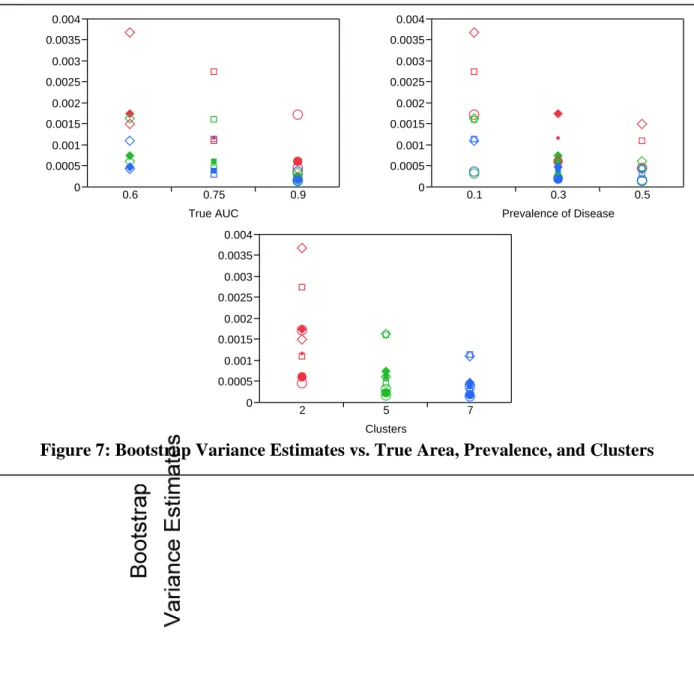
For the bootstrap variance estimates, the ANOVA found that all three characteristics had an effect on variance estimates. For the true AUC the block ANOVA found, after adjusting for prevalence level and number of clusters sampled, that area of .90 provided significantly lower variance estimates than all other areas. Also, area of .75 provided significantly lower variance estimates than area of .60. Within the prevalence levels the block ANOVA found, after adjusting for number of clusters sampled and true AUC, that the .1 prevalence level had significantly higher variance estimates than both the .5 and .3 prevalence levels. Also the .3 prevalence had significantly higher variance estimates than the .5 prevalence. In other words, as the disease becomes rarer in the population the variance estimates tend to increase. Finally, within the different number of clusters sampled the block ANOVA found, after adjusting for prevalence level and true AUC, that all three cluster groups had significantly different variance estimates. Two clusters sampled provided the highest variance estimates followed by 5 clusters sampled and finally 7 clusters sampled provide the smallest variance estimates. In conclusion a three-way block ANOVA of bootstrap variance estimates including main effects for true AUC, prevalence, and number of clusters sampled accounting for block factor of replicates, determined that all
Figure 7: Bootstrap Variance Estimates vs. True Area, Prevalence, and Clusters
three factors have a significant effect on bootstrap variance estimation. As true AUC increases the bootstrap variance estimates decreases. The rarer a disease is the higher the bootstrap variance estimate will be. Finally, the larger the sample size, or more clusters sampled, the smaller the bootstrap variance estimate. These trends are illustrated in Figure 7 below.
0 0.0005 0.001 0.0015 0.002 0.0025 0.003 0.0035 0.004 0.6 0.75 0.9 True AUC 0 0.0005 0.001 0.0015 0.002 0.0025 0.003 0.0035 0.004 0.1 0.3 0.5 Prevalence of Disease 0 0.0005 0.001 0.0015 0.002 0.0025 0.003 0.0035 0.004 2 5 7 Clusters
For the jackknife variance estimates, the block ANOVA found that all three
characteristics had an effect on variance estimates. Looking at true AUC the block ANOVA found, after adjusting for prevalence level and number of clusters sampled, that area of .60 provided significantly higher variance estimates than all other areas. Areas of .75 and .90 were not found to be significantly different. Within the prevalence levels the block ANOVA found, after adjusting for number of clusters sampled and true AUC, that the .1 prevalence had significantly higher variance estimates than both the .5 and .3 prevalence levels. However prevalence levels .5 and .3 were not found to be significantly different. In other words, rarer diseases have higher variance estimates than less rare diseases. Finally, within the different number of clusters sampled the block ANOVA found, that 2 clusters had significantly higher variance estimates then 5 and 7 clusters, 5 and 7 clusters sampled were not found to be
significantly different. In conclusion a three-way block ANOVA of jackknife variance estimates including main effects for true area, prevalence, and number of clusters sampled, determined that all three factors had a significant effect on jackknife variance estimation. As true AUC
decreases, gets closer to chance, the jackknife variance estimates increase. The rarer a disease is the higher the jackknife variance estimate will be. Finally, the smaller the sample size, or fewer clusters sampled, the larger the jackknife variance estimates. These trends are illustrated in Figure 8 below.
Figure 8: Jackknife Variance Estimates vs. True Area, Prevalence, & Clusters 0 0.01 0.02 0.03 0.04 0.05 0.06 0.07 0.08 Jackkni fe Var iance 0.6 0.75 0.9 True AUC 0 0.01 0.02 0.03 0.04 0.05 0.06 0.07 0.08 Jackkni fe Var iance 0.1 0.3 0.5 Prevalence of Disease 0 0.01 0.02 0.03 0.04 0.05 0.06 0.07 0.08 Jackkni fe Var iance 2 5 7 Clusters
3.1.4 Simulated Data Conclusions
To summarize, for bootstrap and jackknife variance estimation methods, the more rare the condition the higher the variance estimation. Thus as a disease becomes more rare it
becomes more difficult to distinguish those individuals with the disease and those without. Also for both the bootstrap and jackknife variance estimation methods, as the AUC increases the variance decreases. In other words, as the test or procedure is better able to correctly distinguish disease and non-disease subjects the variance decreases. Note that the trend in the jackknife variance estimation method was not as strong as that in the bootstrap variance estimation methods. Finally the trends for the bootstrap and jackknife variance estimation methods are similar when looking at number of clusters sample