University of Wollongong
University of Wollongong
Research Online
Research Online
Faculty of Engineering and Information
Sciences - Papers: Part B
Faculty of Engineering and Information
Sciences
2018
CCA-secure Revocable Identity-based Encryption with Ciphertext
CCA-secure Revocable Identity-based Encryption with Ciphertext
Evolution in the Cloud
Evolution in the Cloud
Yinxia Sun
Nanjing Normal University, [email protected]
Willy Susilo
University of Wollongong, [email protected]
Futai Zhang
Nanjing Normal University, [email protected]
Anmin Fu
Nanjing University of Science and Technology, [email protected]
Follow this and additional works at: https://ro.uow.edu.au/eispapers1
Part of the Engineering Commons, and the Science and Technology Studies Commons
Recommended Citation
Recommended Citation
Sun, Yinxia; Susilo, Willy; Zhang, Futai; and Fu, Anmin, "CCA-secure Revocable Identity-based Encryption with Ciphertext Evolution in the Cloud" (2018). Faculty of Engineering and Information Sciences - Papers: Part B. 2222.
https://ro.uow.edu.au/eispapers1/2222
Research Online is the open access institutional repository for the University of Wollongong. For further information contact the UOW Library: [email protected]
CCA-secure Revocable Identity-based Encryption with Ciphertext Evolution in the
CCA-secure Revocable Identity-based Encryption with Ciphertext Evolution in the
Cloud
Cloud
Abstract
Abstract
Identity-based encryption (IBE) is a very attractive cryptographic primitive due to its unnecessity of any certificate managements. Nevertheless, the user revocation problem in IBE remains an elusive research problem and hence, it is an important research topic. One possible approach in achieving revocations is to update user’s decryption keys. However, to avoid the need of secret channels, public time keys need to be issued to allow this update to occur. It is unfortunate that this method often suffers from two
problems: 1) the user has to maintain linearly growing decryption keys; and 2) the revoked users can still access ciphertexts prior to revocation. At the first glance, proxy re-encryption technique may provide a solution to this problem, but the ciphertexts will become longer after each re-encryption, which makes it impractical. In this paper, we present a revocable identity-based encryption scheme with cloud-aided ciphertext evolution. Our construction solves the two aforementioned problems via ciphertext evolution implemented by the cloud. Additionally, the size of ciphertexts in the cloud remains constant size regardless of evolutions. The scheme is provably secure against chosen ciphertext attacks based on the BDH problem. The comparisons with the existing related works show that our scheme enjoys better efficiency, thus is practical for the data sharing in cloud storage.
Disciplines
Disciplines
Engineering | Science and Technology Studies
Publication Details
Publication Details
Sun, Y., Susilo, W., Zhang, F. & Fu, A. (2018). CCA-secure Revocable Identity-based Encryption with Ciphertext Evolution in the Cloud. IEEE Access, 6 56977-56983.
Received September 6, 2018, accepted September 21, 2018, date of publication October 1, 2018, date of current version October 25, 2018.
Digital Object Identifier 10.1109/ACCESS.2018.2873019
CCA-Secure Revocable Identity-Based Encryption
With Ciphertext Evolution in the Cloud
YINXIA SUN 1, WILLY SUSILO 2, (Senior Member, IEEE),
FUTAI ZHANG1, AND ANMIN FU3, (Member, IEEE)
1School of Computer Science and Technology, Nanjing Normal University, Nanjing 210023, China
2School of Computing and Information Technology, University of Wollongong, Wollongong, NSW 2500, Australia 3School of Computer Science and Engineering, Nanjing University of Science and Technology, Nanjing 210094, China
Corresponding author: Yinxia Sun ([email protected])
This work was supported by the Nature Science Foundation of China under Grant 61502237, Grant 61672289, and Grant 61572255.
ABSTRACT Identity-based encryption (IBE) is a very attractive cryptographic primitive due to its unneces-sity of any certificate managements. Nevertheless, the user revocation problem in IBE remains an elusive research problem and hence, it is an important research topic. One possible approach in achieving revocations is to update user’s decryption keys. However, to avoid the need of secret channels, public time keys need to be issued to allow this update to occur. It is unfortunate that this method often suffers from two problems: 1) the user has to maintain linearly growing decryption keys; and 2) the revoked users can still access ciphertexts prior to revocation. At the first glance, proxy re-encryption technique may provide a solution to this problem, but the ciphertexts will become longer after each re-encryption, which makes it impractical. In this paper, we present a revocable identity-based encryption scheme with cloud-aided ciphertext evolution. Our construction solves the two aforementioned problems via ciphertext evolution implemented by the cloud. In addition, the size of ciphertexts in the cloud remains constant size regardless of evolutions. The scheme is provably secure against chosen ciphertext attacks based on the BDH problem. The comparisons with the existing related works show that our scheme enjoys better efficiency, and thus it is practical for the data sharing in cloud storage.
INDEX TERMS CCA, ciphertext evolution, cloud, identity-based encryption, revocable.
I. INTRODUCTION
Public key encryption (PKE) provides an excellent solution to the problem of key distribution in symmetric key. An impor-tant issue in PKE is the authenticity of user public keys. The traditional PKE authenticates user public key via releasing certificates. Nevertheless, the certificate management is a heavy burden to the public key system, which is the primary drawback in PKE. To overcome this drawback, Shamir set forth a new notion called ‘‘Identity based public key cryptog-raphy’’ in 1984 [16]. This public key cryptosystem employs every user’s unique identity as its public key. Therefore, the authenticity of this public key is no longer questionable, and hence, there is no certificate required. Since the first prac-tical identity-based encryption (IBE) scheme was presented by Boneh and Franklin [3] in 2001, IBE has attracted a lot of attentions from both academia and industry. To date, there have been many IBE schemes proposed in the literature such as [2] and [4]–[7]. One important issue to make identity-based encryption practical is the user revocation. This problem was first discussed in BF’s seminal work [3]. As stated earlier,
different from the traditional public key system, there is no certificate in identity-based system. Therefore, the con-ventional user revocation technique is not applicable to the identity-based systems. Actually, the user private key can be viewed as an implicit certificate. Boneh and Franklin suggested that the PKG periodically issues new private keys by attaching time tags for non-revoked users. The user revo-cation can be launched by the PKG stoping the issuing of new user private keys with the time tags. Unfortunately, this revocation system is very impractical, because the PKG has to carry heavy overhead (O(n) where n is the number of non-revoked users), especially for the establishing of secret channels. Boldyreva et al.[1] presented the first scalable revocable IBE scheme in 2008. In their scheme, only public channels are required for the key-updating. Furthermore, they utilized the complete subtree to realize a logarithm growth O(log(n)) of key-updating with non-revoked users.
With this approach of revocation method, many revoca-ble identity-based encryption (RIBE) schemes have been proposed. However, when taking these schemes in some
VOLUME 6, 2018
2169-35362018 IEEE. Translations and content mining are permitted for academic research only. Personal use is also permitted, but republication/redistribution requires IEEE permission. See http://www.ieee.org/publications_standards/publications/rights/index.html for more information.
Y. Sunet al.: CCA-Secure RIBE With Ciphertext Evolution in the Cloud
application scenarios, some problems arise. Let’s consider the scenario of secure data sharing in cloud storage by apply-ing a revocable identity-based encryption. Suppose there are four entities involved, namely the data owner, the data user, the cloud server and the PKG. To our best knowledge, the existing schemes suffer from two shortcomings or at least one of them.
• The data user needs to utilize the time keyTKID,t as
well as the private key to decrypt a ciphertext encrypted at the timet. So, the data user has to maintain all the time keys (O(t)) (or decryption keys computed from time keys) for different time-period decryptions. This consumes a lot of storage resources for data users, thus it is very impractical especially in source-limited environments.
• When a user is revoked by the PKG for such as private
key compromise or expiring, the user can still decrypt those ciphertexts prior to revocation in the cloud.
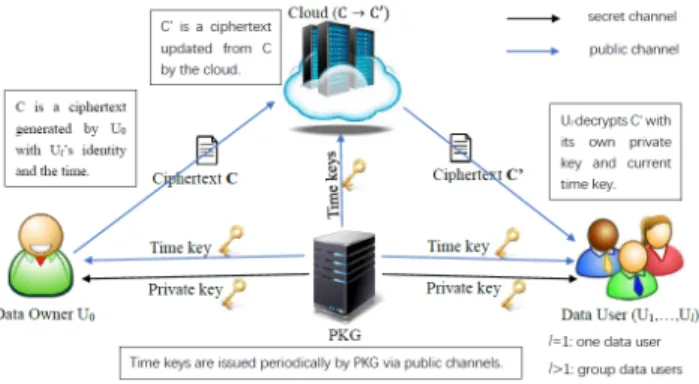
FIGURE 1. System model of RIBE with ciphertext evolution in the cloud.
Though some works [10] do not have these problems, they suffer from new problems: the ciphertexts grow longer with the number of ciphertext-transformation (the basic con-struction), or the costly computation and communication of re-encryption keys between the user and the server. We give a new and efficient RIBE scheme that can solve the two prob-lems. As shown in Fig. 1, the cloud server helps a ciphertextC uploaded by the data owner evolve to a new one C0; then the data user decrypts the ciphertext by employing merely its current time key as well as private key. So,
? the data user only needs to keep one time key – the current time key;
? and the revoked data user cannot access any ciphertext including those before revocation;
? no matter how many times a ciphertext in the cloud evolves, the length of the ciphertext remains unchanged; ? different to proxy re-encryption, no computation or
com-munication is needed for the re-encryption keys. We construct a revocable identity-based encryption scheme with (cloud-aided) ciphertext evolution (RIBE-CE). Our scheme is proved secure against chosen ciphertext attacks based on the hardness of the BDH problem in the random oracle model. We also analyze the efficiency by comparing our scheme with the existing works.
Organization of the Paper:The rest of the paper is orga-nized as follows. In Sect. 2, we give the definition of a cloud-aided RIBE-CE scheme and its security model against two types of adversaries. The related mathematical notions are also reviewed in this section. Sect. 3 presents the con-crete RIBE-CE construction and the formal security proofs. In Sect. 4, we analyze the efficiency by comparing with other related representative works. Finally, Sect. 5 concludes the paper.
A. RELATED WORKS
Boldyrevaet al.[1] first presented a scalable revocable IBE scheme in 2008. The complete subtree structure is used to obtain a logarithm growth of updating key. This work was subsequently improved in [12] with strong security. In 2013, Seo and Emura introduced decryption-key-exposure threat and presented a revocable IBE scheme that can resist decryption-key-exposure [15]. Sunet al.[17] extended Seo et al.’s scheme to the certificateless setting. In 2017, Watanabeet al.[20] gave a new revocable and decryption-key-exposure resistent IBE scheme. The scheme has short public parameters in prime-order groups. A very recent work showed a revocable hierarchical identity-based encryption scheme [8].
Unfortunately, almost all these RIBE works suffer from the two drawbacks mentioned above especially in the applications like cloud storage. In 2014, Liang et al.[10] employed proxy re-encryption technique to construct a revocable identity-based encryption scheme. Their scheme solves the two problems by re-encrypting ciphertexts in the cloud. However, the ciphertexts become longer and longer with the number of re-encryption. Reference [14] improved Liang et al.’s scheme on the efficiency but suffers from increasing list of decryption keys for different-period cipher-texts. References [18] and [19] pointed out the security weak-ness of Lianget al.’s scheme against collusion attacks. Other related works are such as [9] and [13]. In these works, the revocation is implemented by a third party e.g. the cloud server. They have special applications.
II. DEFINITION AND SECURITY MODEL A. SCHEME DEFINITION
An RIBE-CE scheme is made up of the following algorithms.
• Setup(k): Taking a security parameterk as input, this algorithm outputs a master secret keymskand public parametersparams.
• Private-Key-Extract(params,msk,ID): Taking
params,mskand an identityIDas input, this algorithm outputs a private keySKID, which is transmitted to the
user via a secret channel. It is run by the PKG
• Time-Key-Update(params,msk,ID,t): Taking
params, msk, an identity ID and a time tag t as
input, this algorithm outputs a time key TKID,t, which
is transmitted to the user via a public channel. It is run by the PKG
Y. Sunet al.: CCA-Secure RIBE With Ciphertext Evolution in the Cloud
• Encrypt(params,ID,t,M): Taking params, ID, t and a message M as input, this algorithm outputs a ciphertextC. It is run by the data owner.
• Decrypt(params,SKID,TKID,t): Taking params,
SKID,TKID,t andC as input, this algorithm outputs a
messageMor a failure symbol. It is run by the data user.
• Revoke(ID,t): TakingIDandtas input, the PKG stops
issuing the time keyTKID,t for the user.
• Ciphertext-Evolve(params,C,TKID,t,t0): Taking
TKID,t, t0 and C as input, this algorithm outputs a
ciphertextC0. It is run by the cloud server.
B. SECURITY MODEL
Two types of adversaries are considered: an outside adver-sary who knows all time keys; an inside adveradver-sary who is a malicious revoked user. The cloud server can be viewed as an outside adversary.
We define the IND-CCA security of revocable identity based encryption with ciphertext evolution via the following game between the challengerCand the adversaryA. LetA be Ao or Ai that denote an outside adversary or an inside
adversary, respectively.
Setup:Cruns the setup algorithm to provide public param-etersparamstoA, while keeps the master secret keymsk
for itself.
Phase 1: Then, A may make some private key queries Qprivatekey, time key queries Qtimekey, decryp-tion queries Qdecryption and ciphertext evolution queries Qciphertextevolution to the challenger C on its behalf. The query-answers are described as follows.
Qprivatekey A−ID→C,C−SK−−→ID A Qtimekey A−(−−ID,→t) C,C−−−→TKID,t A Qdecryption A (C,ID,t) −−−−→C,C−M→A Qciphertextevolution A CID,t,t 0 −−−−→C,C−C−−ID,→t0 A
Challenge: A outputs two messagesM0 and M1 of the
same length, an identityID∗and a time tagt∗. The challenger randomly choosesβfrom{0,1}and encryptsMβto output a challenge ciphertextC∗.
Phase 2:Acontinues to make queries as before, subject to the constrain that Ao cannot make a private key
extrac-tion query on ID∗ and Ai cannot make a time key query
on (ID∗,t∗).
Guess:Finally,Aoutputs a guessβ0∈ {0,1}.
The advantage of A in the above game is defined by = |Pr(β0 = β)− 1/2|. An RIBE-CE scheme is said to be IND-CPA (indistinguishability against chosen plaintext attacks) secure if no PPT adversary has non-negligible.
C. BILINEAR PAIRING AND COMPLEXITY ASSUMPTION
Bilinear paring.G1is an additive group with prime orderq
and a generatorP.G2is a multiplicative group with the same
orderq. Abilinear pairingis defined ase:G1×G1→G2
satisfying the conditions (1) as described below.
Bilinearity:a,b∈Z∗ q,e(aP,bP)=e(P,P)ab;
Non−degeneracy:e(P,P)6=1G2;
Computability:e(aP,bP)can be effectively computed. (1)
Bilinear Diffie-Hellman (BDH) problem. Given (aP,bP,cP∈G1)with a,b,c∈RZ∗
q, to compute e(P,P)abc.
III. THE CONSTRUCTION A. GENERIC CONSTRUCTION
Generally suppose an identity based encryption scheme is made up of four algorithmsIBECCASetup, IBECCAExtract, IBECCAEnc andIBECCADec. We can give a generic construction of revocable identity-based encryption with (cloud-aided) ciphertext evo-lution (RIBE-CE for short).
−Setup(k):
IBECCASetup(k)→(params,msk).
−Private-Key-Extract(params,msk,ID): IBECCAExtract(params,msk,ID)→SKID. −Time-Key-Update(params,msk,ID,t): IBECCAExtract(params,msk,ID||t)→TKID,t;
TKID,tis sent to both the user and the cloud server. −Encrypt(params,ID,t,M):
C0=IBECCAEnc(M,ID);
C=IBECCAEnc(C0,ID||t);
output the final ciphertextC.
−Decrypt(params,SKID,TKID,t,C):
C0=IBECCADec(C,TKID,t);
M =IBECCADec(C0,SKID). −Revoke(ID,t):
The PKG does not generat the time keyTKID,t. −Ciphertext-Evolve(params,C,TKID,t,t0):
C0=IBECCADec(C,TKID,t);
C0=IBECCA
Enc(C0,ID||t
0);
C−−−→Evolve C0.
The security of the generic construction can be provided by Theorem 1 below.
Theorem 1: If the underlying IBE scheme is IND-CCA secure then our generic construction of RIBE-CE is IND-CCA secure against both an outside adversaryAoand
an inside adversaryAi.
Proof: Suppose B is an adversary against the IBE scheme. It will acts as the challenger interacting withA.Bhas a list of IBE public parametersparamswhich is published to Aas well as some other necessary parameters. ThenAmay make some queries.
Y. Sunet al.: CCA-Secure RIBE With Ciphertext Evolution in the Cloud
Private key extraction query: A−ID→B−ID→C, C−SK−−→ID
B−SK−−→ID
A. Time key query:
A−−→ID,t B−−→ID||t C, C−SK−−−ID→||t B−SK−−−ID→||t A, TKID,t =SKID||t.
Ciphertext evolution query: ForA (C,ID,t,t
0
)
−−−−−−→ B, B
firstly searches the time key list for TKID,t and TKID,t0,
then computes C0 = IBEDec(C,TKID,t) and C0 =
IBEEnc(C0,ID||t0). At last,C
C0
−→A.
If ID has been revoked at time t0, TKID,t0 is randomly
chosen by the cloud.
Decryption query: For A −−−−→(C,ID,t) C, firstly B uses TKID,t to make a decryption asC0 = IBECCADec(C,TKID,t).
Then
B −−−→C0,ID C, C −M→ B, B −M→ A.
Challenge: A selects two messages (M0,M1), an
iden-tityID∗and a timet∗as the challenge.Bsends (M0,M1,ID∗)
to its challenger then receives a challenge ciphertext C0∗. Bfurther computesC∗=IBECCAEnc(C0∗,ID∗||t∗) by inputting (C0∗,ID∗||t∗) as a message and an identity. ReturnC∗toAas the challenge ciphertext.
Amay continue to make queries as before, subject to the following constrains
• the private key extraction query onID∗is not allowed; (especially forAo)
• the time key query on (ID∗,t∗) is not allowed; (espe-cially forAi)
• the decryption query onC∗of (ID∗,t∗) is not allowed. Guess.In the end,Agives a guessβ ∈ {0,1}.Boutput the same guess.
If A’s advantage to win the above game is, it is clear thatB’s advantage to break the IND-CCA security of the IBE scheme is not less than.
B. CONCRETE CONSTRUCTION
To be concrete, the construction can be efficient.
• Setup(k): Select two cyclic groups (G1,+) and (G2,·)
of the same orderq.Pis a generator ofG1.e : G1×
G1 → G2 is a bilinear pairing. Choose s ∈ Z∗q at
random and computeP0 = sP. Select four hash
func-tions: H1 : {0,1}∗ → G1, H2 : {0,1}∗ → G1,
H3 : {0,1}l × {0,1}l → Z∗q,H4 : G2 → {0,1}l and
H5: {0,1}l → {0,1}l.lis the message length.
The system parametersparamsare
hG1,G2,q,P,P0,e,H1, . . . ,H5i.
The master secret keymkiss.
• Private-Key-Extract(params, mk, ID): The PKG computes QID = H1(ID) and then calculatesSKID =
sQIDas the private key of userID.
• Time-Key-Update(params, mk, ID, t): The PKG computes QID,t = H2(ID,t) and then calculates
TKID,t = sQID,t as the time key of the userIDat the
timet.
• Encrypt(params,M,ID,t): The data owner does the following to encrypt a messageM.
– chooseσ ∈ {0,1}l, computer =H3(σ,M); – computeU =rP; – compute V =σ⊕H4(e(QID,P0)r)⊕H4(e(QID,t,P0)r); – compute W =M⊕H5(σ);
– output the ciphertextC=(U,V,W).
• Decrypt(params, C = (U,V,W), SKID, TKID,t):
The data user computes
σ =V ⊕H4(e(SKID,U))⊕H4(e(TKID,t,U)).
Then it can recover the message by calculating M =W ⊕H5(σ).
If the equationU =H3(σ,M)Pholds, the messageM
is correct.
• Revoke(ID,t): If the userIDwith identity needs to be
revoked at the timet, the PKG stops generating the time keyTKID,t for the user.
• Ciphertext-Evolve(params, C = (U,V,W), ID, TKID,t,TKID,t0):
The cloud computes
V0=V ⊕H4(e(TKID,t,U))⊕H4(e(TKID,t0,U));
then updates the ciphertext to beC0=(U,V0,W). Correctness 1.To recover the plaintext from the cipher-text C = (U,V,W), the key point is to compute σ. So, we first verify the correctness ofσ.
σ =V ⊕H4(e(SKID,U))⊕H4(e(TKID,t,U)) =σ ⊕H4(e(QID,P0)r)⊕H4(e(QID,t,P0)r) ⊕H4(e(sQID,rP))⊕H4(e(sQID,t,rP)) =σ ⊕H4(e(sQID,rP))⊕H4(e(sQID,t,rP)) ⊕H4(e(sQID,rP))⊕H4(e(sQID,t,rP)) =σ. Then M =W ⊕H5(σ) =M⊕H5(σ)⊕H5(σ) =M.
So, if the equationU =H3(σ,M)Pholds, the messageM
is correct.
Y. Sunet al.: CCA-Secure RIBE With Ciphertext Evolution in the Cloud
Correctness 2.To verify the decryption on the ciphertext after evolutionC0=(U,V0,W), we can observe that
V0 =V⊕H4(e(TKID,t,U))⊕H4(e(TKID,t0,U)) =σ⊕H4(e(QID,P0)r)⊕H4(e(QID,t,P0)r)
⊕H4(e(TKID,t,U))⊕H4(e(TKID,t0,U)) =σ⊕H4(e(QID,P0)r)⊕H4(e(TKID,t,U))
⊕H4(e(TKID,t,U))⊕H4(e(TKID,t0,U)) =σ⊕H4(e(QID,P0)r)⊕H4(e(TKID,t0,U)) =σ⊕H4(e(QID,P0)r)⊕H4(e(QID,t0,P0)r).
Obviously, theV0inC0=(U,V0,W) keeps the encryption algorithm. So the decryption is also suitable to the evolving ciphertexts.
Remark: If the data user is revoked, the cloud randomly choosesTKID,t0 ∈G1for the ciphertext evolution. From the
point of practical view, 1) the revocation is also the cloud server’s wish; 2) the message is for the data user himself but not for other persons. It is different from proxy re-encryption. So, if the revoked user and the cloud server collude, though they can access the data encrypted before revocation, we can ignore this kind of attack.
C. THE SECURITY
Theorem 2:The hash functions are viewed as random oracles. If there exists an outside adversaryAoagainst the IND-CCA
security of our scheme with advantage, makingq1timesH1
hash queries andq4timesH4hash queries, then there exists an
algorithmBthat can solve the BDH problem with probability 0≥/(q
1·q4).
Proof: Suppose B intends to solve the BDH problem with random instances<aP,bp,cP>and its ultimate goal e(P,P)abc. Now it will act the challenger to interact with the adversaryAo. In the beginning,Bsetups public parameters
as<G1,G2,q,P,P0=aP,Hi(1≤i≤5)>.
BeforeAomakes some queries, it selectsI ∈[1,q1].
Hash queries. All hash queries are answered by randomly choosing a proper element. The detailed query-answers are < (IDi,xi ∈R Zq∗,xiP) > for H1, <
(IDi, ,ti,yi ∈R Z∗q,yiP) >for H2,< (σ,M,r) >for H3,
< (E,h) >for H4, < (σ,h)˜ >for H5. Especially, when
i=I,Bresponds withH1(IDi)=bP.
Private key queries. When B receives a private key query on (IDi), it searches theH1list for<(IDi,xi,xiP)>
and computes SKIDi = xiaP as the answer. Note that if
i=I,Baborts the game.
Time key queries. WhenB receives a time key query on (IDi,ti), it searches theH2 list for< (IDi,ti,yi,yiP) >
and computesTKIDi,ti =yiaPas the answer.
Decryption queries. When B receives a decryption query on (C=(U,V,W),ID,t), it runsDecrypt(params, C,SKID,TKID,t) by extracting the private keySKIDand the
time key TKID,t firstly. If i = I, without loss of
indistin-guishability from the reality, suppose the ciphertext is not generated byAoitself andCacts as follows.
• ChooseM ∈R{0,1}land returnMas the answer;
• Selecth∈R{0,1}lSetH4(BDH(QID,U,P0))=h;
• Computeσ =V⊕h⊕H4(TKID,t,U) and setH5(σ)=
W ⊕M;
• Pickr∈RZ∗qand setH3(σ,M)=r.
Actually, due to the difficulty of Discrete Logarithm (U = ˜
rP → ˜r), the equation r = ˜r holds just with negligible probability. So, ifAomakes theH3(σ,M) query, the answer
is easy to be found incorrect. However, it is not difficult to see that if the H3(σ,M) query occurs, Ao has made
H4(BDH(QIDi,U,P0)) before with non-negligible
probabil-ity for the computation ofσ. Since BDH(QIDi,U,P0) is a
BDH problem, our decryption query implementation seems real to the adversaryAo.
After that, Ao outputs two messages (M0,M1) and the
identityID∗and the time periodt∗that it wants to challenge. IfID∗ 6= IDI,Baborts the game; otherwise,Bgenerates a
challenge ciphertextC∗=(U∗,V∗,W∗) by setting
U∗=cP, V∗∈R{0,1}l, W∗∈R{0,1}l.
Ao continues to make more queries as before, except
the private key query on ID∗ and the decryption query on (C∗,ID∗,t∗).
At the end of the game,Aooutputs its guess forβ.Bpicks
a tuple (E,h) at random from theH4list and outputs theEas
the solution to the BDH problem.
Analysis.IfBdoes not abort the game andAocan break
the IND-CCA security of the scheme with advantage,Bcan solve the BDH problem with probability0 ≥/q4. Clearly,
the game will not abort ifID∗=IDI. So,0≥/(q1·q4).
Theorem 3: The hash functions are viewed as random oracles. If there exists an inside adversary Ai against the
IND-CCA security of our scheme with advantage, making q2timesH2hash queries andq4timesH4hash queries, then
there exists an algorithmBthat can solve the BDH problem with probability0≥/(q2·q4).
Proof: In this proof, B is still a solver to the BDH problem with random instances<aP,bp,cP>and its goal is to compute e(P,P)abc. It acts as the challenger interact-ing with the adversary Ai. B setups public parameters as
<G1,G2,q,P,P0=aP,Hi(1≤i≤5)>.
BeforeAimakes queries, it selectsI ∈[1,q2] and suppose
theIth query to theH2oracle is on (ID∗,t∗).
Hash queries. All hash queries are answered by randomly choosing a proper element. The detailed query-answers are < (IDi,xi ∈R Zq∗,xiP) > for H1, <
(IDi, ,tj,y ∈R Z∗q,yP) > for H2, < (σ,M,r) >for H3,
< (E,h) >for H4,< (σ,h)˜ >for H5. Especially, when
(IDi,tj)=(ID∗,t∗),Bresponds withH2(IDi,tj)=bP.
Private key queries. When B receives a private key query on (IDi), it searches theH1list for<(IDi,xi,xiP) >
and computesSKIDi =xiaPas the answer.
Time key queries.WhenB receives a time key query on (IDi,tj), it searches the H2 list for < (IDi,tj,y,yP) >
and computes TKIDi,tj = yaP as the answer. Note that if
(IDi,tj)=(ID∗,t∗),Baborts the game.
Y. Sunet al.: CCA-Secure RIBE With Ciphertext Evolution in the Cloud
Decryption queries. When B receives a decryption query on (C=(U,V,W),ID,t), it runsDecrypt(params, C,SKID,TKID,t) by extracting the private keySKIDand the
time keyTKID,tfirstly. If (IDi,tj)=(ID∗,t∗), without loss of
indistinguishability from the reality, suppose the ciphertext is not generated byAiitself andCworks as follows.
• ChooseM ∈R{0,1}l and returnM as the answer;
• Selecth∈R{0,1}l SetH4(BDH(QID,t,U,P0))=h;
• Computeσ = V ⊕h⊕H4(SKID,U) and setH5(σ)=
W ⊕M;
• Pickr∈RZ∗qand setH3(σ,M)=r.
Similarly, due to the difficulty of Discrete Logarithm (U = rP˜ → r), the equation˜ r = r˜ holds just with negligible probability. So, if Ai makes theH3(σ,M) query,
the answer is easy to be found incorrect. However, it is not difficult to see that if the H3(σ,M) query occurs, Ai has
made H4(BDH(QID,t,U,P0)) before with non-negligible
probability for the computation of σ. Since to com-pute BDH(QID,t,U,P0) is a hard problem, our decryption
simulation seems real to the adversaryAi.
After that, Ai launches the challenge by outputting two
messages (M0,M1) and an identityID∗and a time periodt∗.
B generates a challenge ciphertextC∗ = (U∗,V∗,W∗) by setting
U∗=cP, V∗∈R{0,1}l, W∗∈R{0,1}l.
Ai continues to make more queries as before, except
the time key query on (ID∗,t∗) and the decryption query on (C∗,ID∗,t∗).
At the end of the game,Aioutputs its guess forβ.Bpicks
a tuple (E,h) at random from theH4list and outputs theEas
the solution to the BDH problem.
Analysis.Similar to the analysis of the above proof, IfB does not abort the game and Ai can break the IND-CCA
security of the scheme with advantage,Bcan solve the BDH problem with probability 0 ≥ /q4. Since the probability
that the game does not abort is 1/q2, the probability 0 ≥
/(q2·q4).
D. THE EFFICIENCY
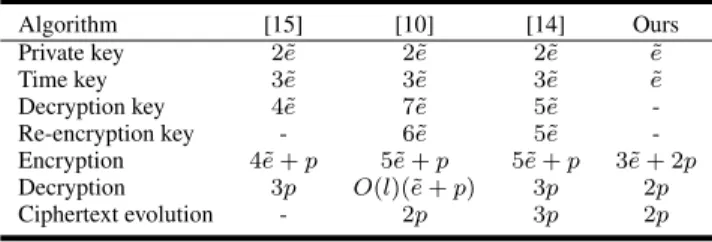
This section evaluates the efficiency by comparing our scheme with some representative related schemes [15], [10] and [14]. We build the experiment platform on a win-dows 10 machine which is equiped with Intel(R) Core(TM) i5-4460S CPU colcked at 2.9GHZ and 4GB system memory. The cryptography library that we choose is JPBC Library. The element length of group G1 andG2 in our scheme is
512-bit. For a 128-bit message, the running time for Private-Key-Extract, Time-Key-Update, Encrypt, Decryptand Ciphertext-Evolve is 13ms, 13ms, 33ms, 16ms and 8ms, respectively. Table 1 makes efficiency comparison via main calculations, the exponential computation and the bilinear pairing. The algorithms include 1) generations of private key, time key, decryption key and re-encryption key; 2) encryp-tion, decryption and ciphertext evolution. Then we make further comparison in Table 2, including a) the length of
TABLE 1.Comparison of computation.
TABLE 2.Comparison.
TABLE 3. Notations.
the decryption key list and the ciphertext after evolution; b) whether the ciphertexts prior to revocation are still avail-able to the revoked user; c) the security level and the party implementing revocation. Table 3 describes the notations.
From the comparisons above, except for the comparable efficiency to the existing schemes in encryption and decryp-tion, we can see that our scheme performs better in the following aspects:
• more efficient in generations of private key, time key, decryption key and re-encryption key, and decryption;
• solving the two problems simultaneously with constant
ciphertext after evolutions in the cloud.
IV. CONCLUSION
This paper focussed on the user revocation problem in identity-based encryption. One of the efficient revocation methods is to issue time keys periodically via public channels for non-revoked users. We take the scenario of cloud storage as consideration and find that most of the existing works suffer from increasing decryption key list or accessability to ciphertexts prior to revocation. Though the technique of proxy re-encryption can solve the two problems, the length of the ciphertexts grow linearly with the number of ciphertext-evolutions. Therefore, it is a heavy burden to the server when the data is big. Additionally, the users have to put more com-putation and communication resource on re-encryption keys. This is not suitable for source-limited applications. In this paper, we presented an efficient solution to the two afore-mentioned problems simultaneously. The size of a ciphertext
Y. Sunet al.: CCA-Secure RIBE With Ciphertext Evolution in the Cloud
in the cloud remains constant, no matter how many times the ciphertext evolves. The new revocable identity-based encryp-tion with ciphertext evoluencryp-tion scheme is constructed by using bilinear parings. The time keys are generated by the PKG periodically and sent to both the user and the cloud. The cloud makes ciphertext evolution by using the time keys. Hence, no extra key computations are involved in our construction. It is efficient for the data sharing application in the cloud. Our scheme enjoys provably strong security against chosen ciphertext attacks based on standard hard problem.
REFERENCES
[1] A. Boldyreva, V. Goyal, and V. Kumar, ‘‘Identity-based encryption with efficient revocation,’’ inProc. CCS, 2008, pp. 417–426.
[2] D. Boneh and X. Boyen, ‘‘Efficient selective-ID secure identity-based encryption without random oracles,’’ inProc. EUROCRYPT, in Lecture Notes in Computer Science, vol. 3027, 2004, pp. 223–238.
[3] D. Boneh and M. Franklin, ‘‘Identity-based encryption from the weil pair-ing,’’ inProc. CRYPTO, in Lecture Notes in Computer Science, vol. 2139, 2001, pp. 213–229.
[4] D. Boneh and X. Boyen, ‘‘Secure identity based encryption without ran-dom oracles,’’ inProc. CRYPTO, in Lecture Notes in Computer Science, vol. 3152, 2004, pp. 443–459.
[5] R. Brent, ‘‘Efficient identity-based encryption without random oracles,’’ inProc. EUROCRYPT, in Lecture Notes in Computer Science, vol. 3494, 2005, pp. 114–127.
[6] C. Cocks, ‘‘An identity based encryption scheme based on quadratic residues,’’ inCryptography and Coding(Lecture Notes in Computer Sci-ence), vol. 2260, B. Honary, Eds. Berlin, Germany: Springer, 2001. [7] C. Gentry, ‘‘Practical identity-based encryption without random oracles,’’
inProc. EUROCRYPT, in Lecture Notes in Computer Science, vol. 4004, 2006, pp. 445–464.
[8] K. Lee and S. Park, ‘‘Revocable hierarchical identity-based encryption with shorter private keys and update keys,’’Des., Codes Cryptogr., vol. 86, no. 10, pp. 2407–2440, 2018.
[9] J. Li, J. Li, X. Chen, C. Jia, and W. Lou, ‘‘Identity-based encryption with outsourced revocation in cloud computing,’’IEEE Trans. Comput., vol. 64, no. 2, pp. 425–437, Feb. 2015.
[10] K. Liang, J. K. Liu, D. S. Wong, and W. Susilo, ‘‘An efficient cloud-based revocable identity-based proxy re-encryption scheme for public clouds data sharing,’’ inProc. 19th Eur. Symp. Res. Comput. Secur., vol. 8712. Sep. 2014, pp. 257–272.
[11] B. Libert and J.-J. Quisquater, ‘‘Efficient revocation and threshold pairing based cryptosystems,’’ inProc. PODC, 2003, pp. 163–171.
[12] B. Libert and D. Vergnaud, ‘‘Adaptive-ID secure revocable identity-based encryption,’’ inProc. CT-RSA, in Lecture Notes in Computer Science, vol. 5473, 2009, pp. 1–15.
[13] K. Nguyen, H. Wang, and J. Zhang, ‘‘Server-aided revocable identity-based encryption from lattices,’’ inProc. CANS, in Lecture Notes in Computer Science, vol. 10052, 2016, pp. 107–123.
[14] B. Qin, R. H. Deng, Y. Li, and S. Liu, ‘‘Server-aided revocable identity-based encryption,’’ inProc. ESORICS, in Lecture Notes in Computer Science, vol. 9326, 2015, pp. 286–304.
[15] J. H. Seo and K. Emura, ‘‘Revocable identity-based encryption revisited: Security model and construction,’’ inProc. PKC, in Lecture Notes in Computer Science, vol. 7778, 2013, pp. 216–234.
[16] A. Shamir, ‘‘Identity-based cryptosystems and signature schemes,’’ inProc. CRYPTO, 1984, pp. 47–53.
[17] Y. Sun, F. Zhang, L. Shen, and R. H. Deng, ‘‘Efficient revocable certificate-less encryption against decryption key exposure,’’IET Inf. Secur., vol. 9, no. 3, pp. 158–166, 2015.
[18] Y.-M. Tseng, T.-T. Tsai, S.-S. Huang, and C.-P. Huang, ‘‘Identity-based encryption with cloud revocation authority and its applications,’’IEEE Trans. Cloud Comput., to be published, doi:10.1109/TCC.2016.2541138.
[19] C. Wang, Y. Li, J. Fang, and J. Xie, ‘‘Cloud-aided scalable revocable identity-based encryption scheme with ciphertext update,’’Concurrency Comput., Pract. Exper., vol. 29, no. 20, p. e4035, 2017.
[20] Y. Watanabe, K. Emura, and J. H. Seo, ‘‘New revocable IBE in prime-order groups: Adaptively secure, decryption key exposure resistant, and with short public parameters,’’ inProc. CT-RSA, in Lecture Notes in Computer Science, vol. 10159, 2017, pp. 432–449.
YINXIA SUNreceived the bachelor’s and master’s degrees in mathematics from Nanjing Normal Uni-versity, China, and the D.Phil. degrees from Xidian University, China. She is currently an Associate Professor at Nanjing Normal University. Her main research interests include cryptography and cloud storage. She received the title of Excellent Member from CACR in 2015.
WILLY SUSILO received the bachelor’s degree
(Summa Cum Laude)predicate in computer sci-ence from Universitas Surabaya, Indonesia, and the master’s and D.Phil. degrees from UOW. He is the Director of the Institute of Cybersecurity and Cryptology. His main research interests include cryptography and cyber security. He received the prestigious ARC Future Fellowship from the Australian Research Council. He also received the UOW Researcher of the Year 2016 due to his research excellence.
FUTAI ZHANGreceived the bachelor’s and mas-ter’s degrees in mathematics from Shanxi Normal University, China, and the D.Phil. degrees from Xidian University, China. He is currently a Professor at Nanjing Normal University. His main research interests include cryptography and appli-cations of cryptography in cyberspace security.
ANMIN FUreceived the Ph.D. degree in infor-mation security from Xidian University in 2011. He is currently an Associate Professor and also the Supervisor of Ph.D. students of Nanjing Uni-versity of Science and Technology, China. His research interests include cloud computing secu-rity, IoT secusecu-rity, and privacy preserving. He has published over 50 technical papers, including international journals and conferences, such as the IEEE TRANSACTIONS ONBIG DATA, the IEEE
TRANSACTIONS ONVEHICULARTECHNOLOGY, the IEEE COMMUNICATIONSLETTERS,
theJournal of Network and Computer Applications,Computers&Security, andCluster Computing.