Scandinavian Society of Clinical
Chemistry
Certificate of Analysis
NFKK Reference Serum X
Components in Human Serum, Lot Number: NFKK2002a
Version 7
Description of the material
The NFKK Reference Serum X is an unmodified fresh frozen human serum.1 It is intended for use in evaluation and verification of the trueness of measurement procedures in laboratory medicine for the components listed in Table 1. One unit consists of 5 mL serum in a polypropylene vial with a Teflon-coated stopper.
Source of the material
The serum was collected from Danish blood donors by Hjørring County Hospital, Denmark. Preparation of the material
After collection in blood bags without anti-coagulant, the serum was pooled and frozen. Later the pool was sterile-filtered and distributed into vials by Statens Serum Institut, Denmark [1].
Date of expiry
The values and uncertainties specified in this certificate are valid from 2012-05-01 until 2014-05-01 provided the handling, storage and use of the material are in accordance with the below instructions. The material is regularly monitored and the purchasers will be notified of any significant changes resulting in recertification or withdrawal of the material during the period of validity.
WARNINGS
THE NFKK REFERENCE SERUM X IS INTENDED FOR IN-VITRO USE ONLY. The material is of human origin. HANDLE THE MATERIAL AS A BIOHAZARDOUS MATERIAL CAPABLE OF
TRANSMITTING INFECTIOUS DISEASES. Each donor unit of serum or plasma used in the preparation of this material have been tested and are found to be non-reactive for HBsAg, HCV and HIV-1 antibodies. However, no test procedure can offer complete assurance that hepatitis B virus, hepatitis C virus, HIV or other infectious agents are absent from this material. Therefore this material based on human blood should be handled as a POTENTIALLY INFECTIOUS HUMAN SERUM, according to the laboratory’s procedure(s) and good laboratory practices.
Intended use
The material is intended for evaluation and verification of trueness of measurement procedures, usually involving in-vitro diagnostic (IVD) medical devices. If the user of the IVD product obtains a measurement result that does not agree with the values specified in this certificate (taking into account the respective uncertainties), further investigations may be necessary. The user should first investigate if the disagreement originates from within the laboratory, e.g. due to sample handling, calibration, maintenance and/or reagents. If the error is not found in the laboratory, contact the manufacturer. It is also recommended to contact other users of the same measuring system. The results may be used to document a complaint intended for the manufacturer of the IVD, taking into account the quality specifications that are stated by the manufacturer.
Storage and stability
Store the material only at < – 70 C and do not expose it to sunlight or ultraviolet radiation, otherwise the concentrations of the components may be affected.
Instructions for use
1. Remove the material from the freezer and place the vial on absorbing material in darkness at room temperature for two hours
2. After thawing, gently mix the serum for 10 minutes, e.g. by placing it in a slow turning mixer 3. Analyse within two hours.
Property values
Certified (Table 1) and indicative (Table 2) property values relate to the total amount-of-substance concentration, mass concentration or catalytic activity concentration of the components in the material. The indicative values are for information only.
Certified Values
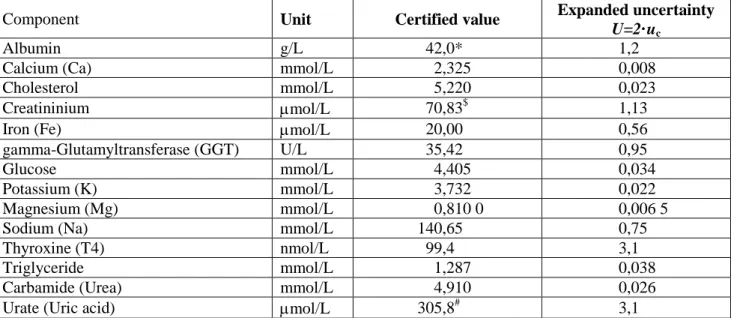
Table 1: Certified values and their expanded uncertainties.
Component Unit Certified value Expanded uncertainty
U=2·uc
Albumin g/L 42,0* 1,2
Calcium (Ca) mmol/L 2,325 0,008
Cholesterol mmol/L 5,220 0,023
Creatininium mol/L 70,83$ 1,13
Iron (Fe) mol/L 20,00 0,56
gamma-Glutamyltransferase (GGT) U/L 35,42 0,95
Glucose mmol/L 4,405 0,034
Potassium (K) mmol/L 3,732 0,022
Magnesium (Mg) mmol/L 0,810 0 0,006 5
Sodium (Na) mmol/L 140,65 0,75
Thyroxine (T4) nmol/L 99,4 3,1
Triglyceride mmol/L 1,287 0,038
Carbamide (Urea) mmol/L 4,910 0,026
Urate (Uric acid) mol/L 305,8# 3,1
* 2009-05-24: Re-certified via ERM-DA470 from 41,5 g/L with U= 2,7 g/L to 42,0 g/L with U=1,2 g/L (where U=u·2,1 g/L)
$ 2012-05-01: Re-certified by Universiteit Gent, Faculteit Farmaceutischen Wetenschappen from 73,90 with U=0,60 to 70,83 with U=1,13. # 2012-05-01: Re-certified by Referencinstitut für Bioanalytik from 309,9 with U=5,8 to 305,8 with U=3,1 (where U=u·2,6)
Measurement techniques used for the certification
In the Nordic Trueness Project 2002, 136 laboratories from five countries performed replicate analyses on IMEP-17 Material 1 and/or Reference Serum CAL and NFKK Reference Serum X for up to 5 days [2]. All laboratories used routine measurement procedures. Afterwards the transferrals of values from the IMEP-17 Material 1 or the Reference Serum CAL to the NFKK Reference Serum X were done [2]. Reference serum CAL is the calibrator used in the Nordic Reference Interval Project (NORIP) [3]. IMEP-17 Material 1 is used in the Nordic Trueness Project. All materials are manufactured similar to NFKK Reference Serum X.
The re-certified albumin value is transferred from the certified value of ERM-DA470 via the arithmetic mean of ten replicate measurements on both materials using a Roche Cobas c501 measurement system with
reagents Tinaquant Albumin Gen 2, lot 601 443.
The re-certified creatininium value is the arithmetic mean of five individual measurements using ID-GC/MS as described in [4] and [5].
The re-certified Urate (Uric acid) value is the arithmetic mean of six individual measurements using ID-GC/MS as described in [6].
Indicative values
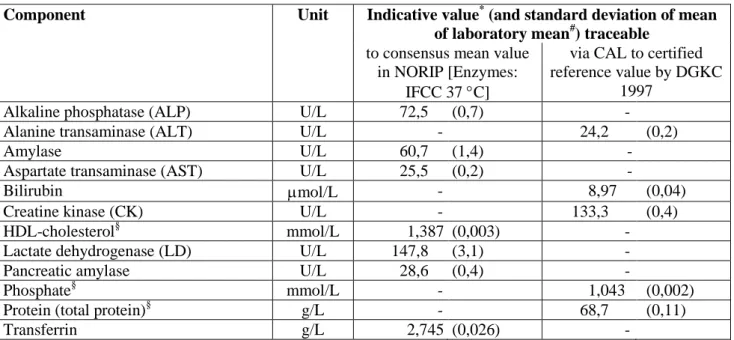
Table 2: Indicative values for components in NFKK Reference Serum X, obtained in the NORIP project. Component Unit Indicative value* (and standard deviation of mean
of laboratory mean#) traceable to consensus mean value
in NORIP [Enzymes: IFCC 37 C]
via CAL to certified reference value by DGKC
1997
Alkaline phosphatase (ALP) U/L 72,5 (0,7) -
Alanine transaminase (ALT) U/L - 24,2 (0,2)
Amylase U/L 60,7 (1,4) -
Aspartate transaminase (AST) U/L 25,5 (0,2) -
Bilirubin mol/L - 8,97 (0,04)
Creatine kinase (CK) U/L - 133,3 (0,4)
HDL-cholesterol§ mmol/L 1,387 (0,003) -
Lactate dehydrogenase (LD) U/L 147,8 (3,1) -
Pancreatic amylase U/L 28,6 (0,4) -
Phosphate§ mmol/L - 1,043 (0,002)
Protein (total protein)§ g/L - 68,7 (0,11)
Transferrin g/L 2,745 (0,026) -
* For values in the first column, the value is the mean of laboratory means. For values in the second column, the indicative value is the mean of factors M(X)/M(CAL) multiplied with certified reference value for CAL, where M(X) and M(CAL) is laboratory mean of X and CAL respectively.
# No expanded uncertainties can be provided for these components, however, the obtained standard deviation of mean of laboratory means (SDM), from approximately 102 laboratories using routine measurement systems can be used to judge upon the reliability of the value (first column) and the reliability of the value relative to CAL (second column). For the enzymes a lower number of laboratories were involved (ALT: 86, Amylase: 24, AST: 79, CK: 81, Pancreatic amylase: 21, ALP: 23, LD: 3). For values in the second column the SDM is without the main source of uncertainty from the target value of CAL.
§ In the Nordic Trueness Project 2002, these components were re-assigned with transferred values via CAL. No significant difference between the two sets of values was observed (p<0,05).
Traceability
The certified values are traceable to SI or to an international measurement standard (GGT) via the IMEP-17 Material 1 and Material CAL through reference measurement procedures and international certified
reference materials [7-8]. The re-certified value for albumin is traceable via ERM-DA470. The re-certified values for creatininium respectively urate (uric acid) are traceable to SI via the procedures described in [4], [5] respectively [6] The indicative values are obtained in the frame of NORIP, as either the arithmetic mean of all participants’ mean measurement values or traceable to the certified value from DGKC 1997 [2] via the arithmetic mean of all participants mean values transferred via CAL. For enzymes the values are obtained using IFCC 37 C compatible routine measuring systems [3].
Homogeneity
Note, that because the values are averages of observations done on many vials, no separate contribution from the between-vial variation is included in the uncertainty statement. Statistical analysis has concluded that the vial-to-vial variation including sample treatment will be of very little practical importance to the routine laboratories [2].
Commutability
No specific commutability study was performed for this material. However, the entire production process has been outlined to ensure commutability provided the instructions given here are adhered to.
Further information
Legal Notice
It is a prerequisite that the necessary precautions are taken, by the user, for storage, handling and use especially in regard to safety. The material(s) must be treated as a patient sample that is POTENTIALLY INFECTIUS AND CAPABLE OF TRANSMITTING INFECTIUS DISEASE. This precaution also applies to materials screened and found non-reactive for HIV, HBsAG and HCV antibodies. However no known test procedure can offer complete assurance that HIV, hepatitis B virus, hepatitis C virus, or other infectious agents are absent from the material(s). NFKK, DEKS, NOBIDA and the suppliers do not take responsibility for infections with HIV, hepatitis B virus or hepatitis C virus. Neither shall they be liable for any particular, indirect, incidental and consequential damage caused by delays and erroneous transportation, storage, handling and use.
Analysts, investigators and participating laboratories
M. Blom and I. Nørgaard, Hjørring County hospital, Denmark collected serum from Danish blood donors and performed the viral screening.
L. Blou, Statens Serum Institut, Denmark performed the filtration and distribution into the vials.
Many Nordic laboratories who most kindly assisted with their careful measurements of the reference materials.
The Nordic Reference Interval Group (P. Felding, L. Franzson, K. Hellsing, P. Simonsson, V. Kairisto, P.H. Pedersen and P. Rustad) performed the protocol for the measurement procedures at the Nordic laboratories.
G. Nordin and U. Örnemark, EQUALIS, Sweden, collected and compiled the data.
G.M. Henriksen, A. Marker and J. Hervel, DEKS, planned and performed the initial homogeneity study.
P. Rustad, Fürst Medisinsk Laboratorium, Norway, performed the data treatment and transferral of values and uncertainties. He also evaluated the homogeneity.
M.M. Pedersen, DEKS, Denmark performed the protocol for the long-term and accelerated stability studies and monitors the outcome.
A. Uldall, DEKS coordinated and monitored the overall work leading to the establishment and issuance of this certificate.
Supplier of the serum
Information about suppliers can be obtained from DEKS, 54 M1, Herlev University Hospital, DK-2730 Herlev, Denmark, Phone: +45 3868 3266, Fax: +45 4453 5369 e-mail: [email protected].
Certifying officers
Ingunn Torsteinsdottir
Chairman, NFKK
NFKK
Att: Overlakare Ingunn Torsteinsdottir Department of Clinical Biochemistry Landspitali - University Hospital Hringbraut IS-101 Reykjavik Telefon: +354 543 5033 Pål Rustad Chairman, NOBIDA Morten M. Pedersen Chemist, DEKS
Revision history
Date of certification: 2003-11-21. Date of latest revision: 20012-05-01
Revision history: 2004-05-27: The Transferrin values in table 2 was corrected from “2,709 (0,025) g/L” to “2,745 (0,026) g/L”.
2004-11-12: The validity of the certificate was prolonged for 24 months and the references were updated with volume and pages. 2006-11-21: The validity of the certificate was prolonged for 24 months and the contact information for the chairman of NFKK was updated.
2008-11-24: The validity of the certificate was prolonged for 6 months
2009-05-24: The certified value of albumin was changed from 41,5 g/L to 42,0 g/L and the uncertainty from 2,7 g/L to 1,2 g/L. The content of the certificate is updated accordingly. The validity of the certificate was prolonged for 24 months.
2012-05-01: The certified value of creatininium was changed from 73,90 mol/L/ to 70,83 mol/L and the uncertainty from 0,60
mol/L to 1,13 mol/L. The certified value of urate (uric acid) was changed from 309,9 mol/L/ to 305,8 mol/L and the
uncertainty from 5,8 mol/L to 3,1 molL. The content of the certificate is updated accordingly. The contact information for the
chairman of NFKK was updated. The validity of the certificate was prolonged for 24 months.
References
1Henriksen, G. M., et al. Preparation and testing of minimally processed fresh frozen human reference sera. Applications to international EQA.
Scand. J. Clin. Lab. Invest 64[4], 293-308. 2004
2 Pedersen MM, et al. The Nordic Trueness Project 2002 – Use of Reference Measurement Procedure Values in a General Clinical Chemistry Survey. Scand J Clin Lab Invest 2004; 64:309-320.
3 Rustad P. et al. The Nordic Reference Interval Project 2000: recommended reference intervals for 25 common biochemical properties. Scand J Clin Lab Invest 2004; 64(4):271-284
4 Stöckl, D. et al. Candidate reference methods for determination of target values for cholesterol, creatinine, uric acid, and glucose in external quality assessment and internal accuracy control. I Method setup. Clin Chem 1993; 39:993-1000.
5 Thienpont, L. M. et al. Candidate reference methods for determination of target values for cholesterol, creatinine, uric acid, and glucose in external quality assessment and internal accuracy control. II Method transfer. Clin Chem 1993; 39:1001-1006.
6 Siekmann L. Determination of uric acid by isotope dilution-niass spectrometry. J. Clin. Chem. Clin. Biochem 1985, 23:129-135
7 U. Örnemark et al. IMEP-17 Trace and minor constituents in human serum. Certification report, Internal report GE/R/IM/36/01 (EUR 20243 EN),
IRMM, Geel, September 2002, http://www.irmm.jrc.be/imep/imep17/certification_report_eur_20243_en.pdf
8 L. Van Nevel, et al. IMEP-17 Trace and minor constituents in human serum. Report to participants. Part 1 International comparability, Internal