Improving Students’ Reading Comprehension Through Information Gap Technique
Ita Retno Sari, Ari Nurweni, Flora Nainggolan [email protected]
English Department, Lampung University
Penelitian ini bertujuan untuk mengetahui peningkatan kemampuan membaca siswa setelah diajarkan melalui information gap technique. Penelitian ini menggunakan desain one group pretest dan posttest. Tes membaca digunakan untuk pengambilan data. Data ini di analisis menggunakan repeated measured T-test. Subyek penelitian ini 30 siswa dari kelas dua pada SMAN 12 Bandar Lampung. Hasil penelitian menunjukkan bahwa adanya peningkatan antara pretest dan posttest. Dengan level signifikan adalah p<0.05 (p=0.000). Dari hasil yang didapat, disimpulkan bahwa
information gap technique memberi kesempatan kepada siswa untuk meningkatkan kemampuan membaca mereka.
The aims of the research were to find out the improvement of students’ reading comprehension after they were through by information gap technique. The research used one group pretest and posttest design. The reading test was used to collect the data. The datas were analyzed by using repeated measured T-test. The subjects of this study were 30 students from second grade students of SMAN 12 Bandar Lampung. The result showed that there was a statistically significant improvement of the students’ mean score between the pretest and the posttest with significant level p<0.05 (p=0.000). This suggests that information gap technique facilities the student to improve their reading comprehension achievement.
INTRODUCTION
According to (Tarigan (1990:7) in Jaenal 2010) argues that reading is a process that is carried and used by readers who want to get the message delivered by the author through the medium of words or written language. Reading is important for everybody in order to cope with new knowledge in the changing world of the technological age.
Reading is one of the language skills which help students in the process of learning English. Valetta in Rahmatannas (2008: 1) says that the ability to understand the target language greatly depends on one knowledge of vocabulary in the broader sense. It proves that a student who does not know English vocabulary fairly well, will have problems in facing new reading materials. Naturally, reading skill is very complex, therefore it is difficult to master. This stands to reason for reading involves determining main idea, identifying spesific information, reference, inference, and vocabulary.
Having good reading proficiency means that the reader has abilities to understand written statements or any type of written texts accurately and efficiently (Mahfood, 2007:1). Reading is a form of non verbal communication, Reading enables students to understand and comprehend language through form like text passage. But some students thought that reading is perhaps the most difficulty language skill to learn.
Based on the interview with the teacher of SMAN 12 Bandar Lampung, the students had difficulties in reading. Some English teachers use a conventional method to teach reading. Conventional method usually makes students bored because the method is monotonous and the students are not active, so it makes the learners get bored. One of the ways to make the teaching reading effective is making the student active and fun in the classroom.
Based on the statements above, the researcher tried to find the strategy that can be used to improve students’ reading comprehension. There are many strategies that can be used in improving reading comprehension, in order to make the students interest in teaching and learning process especially in acquiring the reading comprehension, the teacher should use an appropriate teaching technique which is suitable to the students’ level. English teacher should use an interesting teaching technique to present their teaching materials which is expected not only to increase students’ ability in reading English but also to make students enjoy in creating fun in the classroom. In this case, the researcher used information gap technique.
In an information gap activity, one person or one group has certain information that the other does not have, the information can be shared with others in order to solve a problem, gather information or make decisions. Information gap is useful activity in which one person has information that the other lacks. Another advantage of information gap activities is that students are forced to negotiate
meaning because they must make what they are saying comprehensible to others in order to accomplish the task (Neu&Reeser, 1997 : 28).
In order to improve students’ reading achievement, information gap can be aaplayed to make the students understand more about the text. They can find the main information in the text, and that can help them in answering the questions.
METHOD
The research used one group pretest and posttest design. The subjects of this research were 30 students of SMAN 12 Bandar Lampung in the second semester. The instruments of this research was reading test. This research used the result of the tryout test to measure the validity, reliability, level of difficulties, and discrimination power of the tests. The total items of the tryout test was 70 items. The reseacher checked the students’ reading comprehension by giving two reading tests to the students. The reading tests were pretest and posttest. There were 40 items including the entire aspects: vocabulary, determining main idea, reference, inference, and identifying specific information. The dataanalyzed by using Repeated Measure T-Test of SPSS (Statistical Package for Social Science) version 16.0.The reading test was conducted in this research before and after the students got the treatments of learning reading comprehension through information ga technique.
RESULT
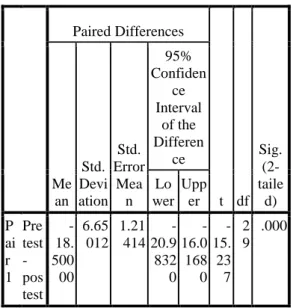
The increase enabled the researcher to test the hypothesis of the research by using Repeated Measures T-test computed through SPSS version 17.0 as well. Therefore, for the first hypothesis, the null hypothesis was rejected and the research hypothesis was accepted. Before using information gap technique.in teaching reading, the mean score was 53.5, but after using information gap technique.in teaching reading, the mean score was 72.0. Then, from the output we can see that the significance value (2 tailed) showed that p < 0.05 (p = .000). It means that there is a significant difference of students’ reading comprehension before and after being taught by using information gap technique. It could be seen on the table bellow:
Table 1 The Data Analysis Paired Differences t df Sig. (2-taile d) Me an Std. Devi ation Std. Error Mea n 95% Confiden ce Interval of the Differen ce Lo wer Upp er P ai r 1 Pre test - pos test -18. 500 00 6.65 012 1.21 414 -20.9 832 0 -16.0 168 0 -15. 23 7 2 9 .000
The researcher did not only find the increase of students’ reading comprehension, the researcher also found the improvement of each aspect of reading comprehension. The results of reading aspects in experimental class that were taught using information gap technique can be seen as follows.
a. Determining Main Idea
Table 2 Result of Main Idea
Ite m s Pretest Posttest Gain Tota l corr ect ans wer Percen tage Tota l corr ect ans wer Perc enta ge 1 14 46.66 % 19 63.3 3% 5 (2.38%) 16 16 53.33 % 19 63.3 3% 3 (1.42%) 21 17 56.66 % 22 73.3 3% 5 (2.38%) 26 23 76.66 % 26 86.6 6% 3 (1.42%) 41 9 30% 15 50 % 6 (2.85%) 46 18 60% 22 73.3 3% 4 (1.90%) 61 16 53.33 % 19 63.3 3% 3 (1.42%) To tal 113 53.80 % 142 67.6 1% 29 (13.8%)
That table shows the total correct answer of pretest was 113 with the percentage was 53.80%, and for the total correct answer of posttest was 142 with the
percentage was 67.61%. It can be seen that the gain of both of test was 29 (13.8%).
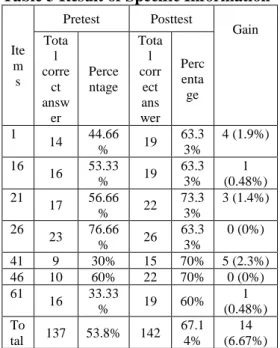
b. Identifying Specific Information Table 3 Result of Specific Information
Ite m s Pretest Posttest Gain Tota l corre ct answ er Perce ntage Tota l corr ect ans wer Perc enta ge 1 14 44.66 % 19 63.3 3% 4 (1.9%) 16 16 53.33 % 19 63.3 3% 1 (0.48%) 21 17 56.66 % 22 73.3 3% 3 (1.4%) 26 23 76.66 % 26 63.3 3% 0 (0%) 41 9 30% 15 70% 5 (2.3%) 46 10 60% 22 70% 0 (0%) 61 16 33.33 % 19 60% 1 (0.48%) To tal 137 53.8% 142 67.1 4% 14 (6.67%)
That table shows that the total correct answer of pretest was 137 with the percentage was 53.80%, and for the total correct answer of posttest was 142 with the percentage was 67.14%. It can be seen that the gain of both of test was 14 (6.67%)
c. Finding Inference
Table 4 Result of Inference
Ite m s Pre-test Post-test Gain Tota l corre ct answ er Perce ntage Tota l corre ct answ er Perc enta ge 8 17 56.66 % 20 66.6 6% 3 (1.1%) 18 12 40% 19 63.3 3% 7 (2.5%) 23 18 60% 23 76.6 6% 5 (1.85%) 28 20 66.66 % 22 73.3 3% 2 (0.74%) 33 14 46.66 % 17 56.6 6% 3 (1.1%) 38 16 53.33 % 20 66.6 6% 4 (1.48%) 48 20 66.66 % 24 80 % 4 (1.48%) 58 14 46.66 18 60 4 (1.48%)
% % 63 14 46.66 % 19 63.3 3% 5 (1.85%) To tal 145 53.70 % 182 66.6 6% 37 (13.7%)
That table shows that the total correct answer of pretest was 145 with the percentage was 53.70%, and for the total correct answer of posttest was 182 with the percentage was 66.66%. it can be seen that the gain of both of test was 37 (13.7%).
d. Finding Referenc
Table 5 Result of References
Ite ms Pre-test Post-test Gain Total corre ct answ er Perce ntage Total corre ct answ er Perce ntage 4 13 43.33 % 16 53.33 % 3 (1.42%) 9 13 43.33 % 21 70% 8 (3.80%) 19 17 56.66 % 20 66.66 % 3 (1.42%) 34 16 53.33 % 20 66.66 % 4 (1.90%) 44 16 53.33 % 25 83.33 % 9 (4.28%) 59 16 53.33 % 25 83.33 % 9 (4.28%) 69 11 36.33 % 29 63.33 % 8 (3.80%) Tot al 102 48.57 % 146 69.52 % 44 (20.95% )
That table shows that the total correct answer of pretest was 102 with the percentage was 48.57%, and for the total correct answer of posttest was 146 with the percentage was 69.52%. It can be seen that the gain of both of test was 44 (20.95%)
e. Understanding Vocabulary
Table 6 Result of Vocabulary
Ite m s Pre-test Post-test Gain Tota l corr ect ans wer Perce ntage Tota l corr ect ans wer Perc enta ge 5 20 66.66 % 25 83.3 3% 5 (1.66%) 10 11 36.66 % 23 76.6 6% 12 (4%) 25 18 60% 26 86.6 6% 8 (2.66%)
30 15 50% 24 80% 9 (3%) 35 17 56.66 % 23 76.6 6% 6 (2%) 40 19 63.33 % 27 90% 8 (2.66%) 45 13 53.33 % 24 80% 11 (3.66%) 50 17 56.66 % 27 90% 10 (3.33%) 55 13 43.33 % 27 90% 14 (4.66%) 65 12 40% 27 90% 15 (5%) To tal 155 51.66 % 253 84.3 3% 98 (32.67%)
That table shows the total correct answer of pretest was 155 with the percentage was 51.66%, and for the total correct answer of posttest was 253 with the percentage was 84.33%. It can be seen that the gain of both of test was 98 (32.67%).
Based on the table, it can be seen that each aspect of reading comprehension had different gain. The gain of determining main idea was 29 (13.8%), identifying specific information was 14 (6.67%), making inference was 37 (13.7%), finding reference was 44 (20.95%), and understanding vocabulary was 98 (32.67%). Form that result, it can be concluded that specific information is the kind of reading comprehension which had lowest increase, the increase was 6.67%. On the other hand, vocabulary is the kind of reading comprehension which had highest increase, that was 32.67%.
DISCUSSION
In the first meeting, the researcher gave pretest for class. Pretest needed to find out the students’ basic ability in reading comprehension before they were given some treatments. The pretest was conducted in experimental class. The result of pretest showed that students of experimental class had the low basic ability in reading comprehension. The highest score was 70 and the lowest score was 42.5. Then, it was found that the increase of the students’ ability after the treatment showed a difference that was the students’ mean increased from 53.50 to 72 point with the gain score was 18.7.
It proved that after getting the treatment the students’ scores were higher. There was an increase on the students’ achievement after the treatments.
In line with the description above, the researcher analyzed the increase of reading aspect in the pre-test and post-test score. Based on the analysis, information gap technique.increased the students’ reading comprehension in vocabulary which increased 32.67%, The increase was also found in other aspects of reading comprehension, such as determining the main idea (13.8%), identifying specific information (6.67 %), finding reference (20.95%), and finding inference (13.7 %). The researcher did the pretest and posttest. Before giving the posttest, the researcher gave treatment. Pretest and posttest were done in order to find out the
previous score before being given the treatment and to find out how far the gain was achieved. In the pretest result, the data showed that score of 70 was the highest, score of 42.5 was the lowest and score of 53.5 was the mean score. In the posttest result, the data showed that score 82.5 was the highest, score 62.5 was the lowest, and 72 was the mean score.
The steps of information gap technique are, the first step is deviding the students to their group. In this section, there were 30 students who were deviddinto 6 groups, so there were 5 students in each group. The second step is making an expert group. The students whohad their firstgroup had to say number one until five, and they must come together with the students who said the same number. Their group which was based on the number was an expert group. Third is giiving a paragraph from the text which will be discussed. The students in expert group got one of the paragraph, so there were five expert group with different paragraph. The four step is asking, in this step, the students asked themselves regarding the main idea and tried to find the most important information within the text. Fifth is coming baack to the first group and sharing the information they got from the expert group. The students were paraphrasing the main ideas. They used words other than what was already in text. Then the students put what they red into their own words, and the last is questioning, the the students wrote a question about what they red. The question should be based on the main idea and what the students had paraphrased. The students also had to write down an answer. The students compared both of their questions and answers to the previous section to see how the information lined up together.
There were 30 students who were devided into 6 groups, so there were 5 students in each group. The students whohad their firstgroup had to say number one until five, and they must come together with the students who said the same number as an expert group. The students in expert group got one of the paragraph, so there were five expert group with different paragraph. The students asked themselves regarding the main idea and tried to find the most important information within the text. Fifth is coming baack to the first group and sharing the information they got from the expert group.
The next activity was putting the main ideas and details in their own words by paraphrasing. So, the teacher asked students to make a paragraph or summarize, only one paragraph which contains with the outline of that story. In this section, actually they understood about the outline of this story, but they felt so confused when they do not know about the meaning of the word, so that to overcome this trouble, the researcher asked them to open the dictionary. They also can finish this section clearly by discussing together.
The last activity the students was making the questions. The researcher asked students to make questions about what they have read, like “what is the message or the moral value that we can learn from the story?” And the students have themselves answered, that was “we should be more smart and clever to solve the problems, so we can’t get any trouble”.
In the closure, the researcher asked to the students whether there was any difficulty on the lesson or not. In fact, they generally understood the lesson but they seemed still confused. So the researcher gave little review about technique and they got the conclusion from the researcher. Finally, the researcher closed the meeting.
In the second and third treatment, the researcher did almost the same activity to begin the class as what the researcher did in the first activity. But the title of the text was actually different. There was an improvement in the running of students’ activity in doing the technique.
DoritSasson(2008) said that information gap activities are those in which students exchange information in order to complete a required lesson plan activity. Information gap technique is effective technique for learning English. Furthermore, Scott Thornbury, (2002:89) stated that information gap is an activity in which information is distributed between students in pairs or small groups. In order to complete a task, students must exchange information in order to fill the information gap.William (1981:17) stated that what the teacher might achieve through the activities. The activities can help the teacher:
After the three time conducting treatments, the posttest was administered to know whether there was a difference in the students’ reading comprehension score before and after being taught by using information gap technique. The result of posttest was administered to the students showed that the highest score was 82.5 and the lowest score was 60.
Besides that, the researcher found that there were the different portions of score in each aspect of reading comprehension. The gain of determining main idea was 29 (13.8%), identifying specific information was 14 (6.67%), making reference was 44 (20.95%), finding inference was 37 (13.7%) and understanding vocabulary was 98 (32.67%).
Form that result, it can be concluded that specific information is the kind of reading comprehension which had the lowest improvement, the improvement was 6.67%. On the other hand, vocabulary is the kind of reading comprehension which had highest improvement, that was 32.67%.
CONCLUSION
After conducting the research at the second grade students of SMAN 12 Bandar Lampung and analyzing the data, the researcher concluded a major conclusion. Information gap technique could improve the students’ reading comprehension and it was able also in improving aspects of reading. Learning reading comprehension through information gap technique helped the students to enjoy and be active in the class. Therefore, by using information gap technique they might be easier to understand reading comprehensio
SUGGESTIONS
Some suggestions could be listed as follows:
1. English teachers can use information gap technique in teaching reading comprehension as one of the appropriate techniquesthat can be applied in the class. It is because this technique can built up the students’ understanding regarding reading comprehension material.
2. In practicing reading comprehension to improve students’ understanding in all aspects of reading, the teachers should be able to provide every single chance to their students. So the students have chance to practice their pronunciation, fluency, comprehensibility, vocabulary, and etc. For example, the teachers may give many chances to the students to find out main idea, specific information, inference, reference, and vocabulary.
3. English teachers should be able to manage the condition of the class in order to create a good atmosphere of teaching learning process. When the teachers decide to use this technique, they should have a good way to make the situation of learning process well. Because it can be so noisy and sometimes the students cannot control their emotion to speak.
REFERENCES
Mahfoodh. (2007). Reading for EFL College Students. From (http//:www.yementimes.com//article.sthml,) retrieved on January, 15th 2015
Neu and Reeser. (1997). Complete course for listening and reading comprehension.Rusia: JR Gurdis Publisher.
Tarigan. 1990. Pengajaran pragmatik. Bandung: Angkasa.
Thornbury. (1981). The power of reading: Insights from the research. Englewood, CA: Libraries Unlimited.
Valletta.(1971). Reading skill and Technique. Oxford University Press: Printed in Singapore.
William. (1981). Building reading comprehension habits in grades. From:http://web001.greece.k12.us/academy,Htm. Retrieved on April 22nd 2015.http://englishstory12.blogspot.com