LUND UNIVERSITY Department of Economics
NEKP01 Master’s Thesis in Economics Autumn 2015
The Compromise Algorithm in the Swedish PhD Admissions Problem
Dingquan Miao*
Abstract
What mechanism should be designed to allocate PhD applicants to universities in Sweden? We introduce the Swedish PhD admissions problem, and it is influenced by the college admissions problem (Gale and Shapley 1962) and the student placement problem (Balinski and Sönmez 1999). In order to “solve” this problem, we design a novel mechanism, namely the compromise algorithm. We propose three theorems from this algorithm, i.e. equivalence theorems. The equivalence theorems specify the equivalence relations among stability, worse and responsiveness. Additionally, we find a positive result that the number of fields determines the strategy-proofness of the algorithm; meanwhile, the student optimal stable matching and the university optimal stable matching can be treated as special cases of our model when we restrict the number of fields. Generally, the compromise algorithm generates a stable matching that falls in between the student optimal stable matching and the university optimal stable matching.
KEYWORDS: Matching, Swedish PhD Admissions Problem, Stability, Compromise Algorithm
Supervisor: Dr. Jens Gudmundsson Date submitted: January 18, 2016 Date examined: January 26, 2016 Discussant: Josefin Kilman
* I would like to express my deepest gratitude to my supervisor Jens Gudmundsson, for his endless patience, constant encouragement and invaluable help. His guidance and support helped me overcome
Contents
1 INTRODUCTION 3
2 MODEL AND PROPERTIES 8
2.1 PhD Admissions Problem . . . 8 2.2 Matching and Properties of Matching . . . 9
3 ALGORITHMS 11
3.1 Gale-Shapley Deferred Acceptance Algorithm . . . 11 3.2 Compromise Algorithm . . . 12 4 WORSE 16 5 RESPONSIVENESS 20 6 EQUIVALENCE 22 7 STRATEGY-PROOF 23 7.1 A General Case . . . 23 7.2 A Special Case . . . 26 8 RESPECTING IMPROVEMENTS 26 9 CONCLUSION 29 References 32
List of Tables
1 PREFERENCES FOR EXAMPLE 1 . . . 14 2 PREFERENCES FOR EXAMPLE 2 . . . 24 3 MATCHING RESULTS FOR STRATEGY-PROOFNESS . . 25 4 PREFERENCES FOR EXAMPLE 3 . . . 27 5 MATCHING RESULTS FOR RESPECTING IMPROVEMENTS 29
List of Figures
1 INTRODUCTION
With the development of the science and technology civilisation, the number of postgraduate applicants increases rapidly. Nevertheless, research insti-tutions and departments from higher education system are generally con-strained by limited educational resources, such as research funding, grants, supervisions, and so on. The opportunity of engaging the PhD program ex-hibits scarcity property, and the admission of the PhD program is exception-ally competitive. In order to allocate these scare resources more efficiently, it is appealing and meaningful to investigate the following problems: who should study PhD program, who is the right person for the research insti-tution, what system should be designed to select qualified PhD candidates and so on. In this paper we study the Swedish PhD admission problem and design a mechanism for the admission system based on its distinctive attributes. The Swedish PhD program is a vital component of the national higher education system, and it has several idiosyncrasies: (1) In Sweden, each university posts PhD positions on its websites and admits PhD stu-dent individually. There is no centralised “admission centre” to deal with the national PhD admissions, and this may cause some potential shortcomings. For example, there is no unified requirement, and the degree of competence for the admission is unlikely to be the same for different universities, but all the admitted PhD candidates are able to access education resources from different universities, such as the U6 network, MIT and etc.1If PhD
candi-dates have the right to access the education resources equally among different academic networks within the country, then a centralised admission system can fully utilise the academic resources among universities, and it is more efficient to admit students through a centralised admission centre, e.g. a stu-1The U6 network consists of universities at Göteborg, Linköping, Lund, Stockholm,
Umeå, Uppsala and Stockholm School of Economics. And MIT is the abbreviation of Research School of Management and IT, which is a co-operation between twelve Swedish universities.
dent who is not qualified for one university might be acceptable for another university. (2)The Swedish PhD programs are considered as public goods for students; meanwhile, the programs select qualified candidates as employ-ees for the universities, since PhD programs are mainly research-based in Sweden. Therefore, we may want to take both students’ and universities’ preferences into account. (3) The Swedish PhD program is very competitive, because of its reputation of high research standard.2Meanwhile, Swedish
uni-versities consider PhD candidates as employees and pay them salaries, and this will cause two effects: (i) It assists PhD candidates to focus more on their research; (ii) The salary, on the other hand, limits the number of positions offered at each university in Sweden indirectly.3
In contrast with the analysis of traditional economic markets that price level determines the equilibrium of the market, many real-world situations are not consistent with traditional theory (Roth 2007). For example, the school admission problem (Gale and Shapley 1962), the marriage problem (Gale and Shapley 1962), the housing allocation problem (Shapley and Scarf 1974), and the human organs for transplants problem (Roth, Sönmez and Ünver 2004) and so on. The allocation of these cases is no longer depending on price, and it should generate an “efficient outcome” under different norms rather than the traditional equilibrium theory. A question arises for how to allocate the resources of these markets, and the abstract theory developed in the early 1960s on the basis of the college admissions problem and the marriage problem (Gale and Shapley 1962). And the solution structured a well-known matching algorithm that assigns students to universities, namely the Gale-2For example, the number of admissions of the four largest universities in Sweden are:
Lund University admits 4-6 students each year out of a number of students, Stockholm Uni-versity admits 5-10 students each year out of about 100 applications, Uppsala UniUni-versity admits 8 students each year out of about 100 applications and University of Gothenburg admits approximately 6 students every second year out of a number of students.
3Even studentship is a common funding form, other funding forms may exist to
com-plete the studentships, e.g. the PhD program in Economics at Stockholm University also allows students to be self-financed.
Shapely “deferred acceptance” algorithm. More importantly, this deferred acceptance algorithm generates optimal stable matchings (Gale and Shapley 1962). A matching assigns one set of agents (e.g. students) to another set of agents (e.g. universities), and a matching is stable if it is individually rational and there is no blocking pair at that matching. More specifically, a matching matches two agentsAandB with↵and , respectively; if no agent prefers unmatched option than her current matching, then this matching is individually rational; if no pair of agents prefers each other (A and , B and↵) to their partners at this matching, then there is no blocking pair at this matching. An optimal stable matching is the stable matching for one agent that is at least as well off under this matching as the agent would be in any other stable matchings. And the deferred acceptance algorithm can be classified into two ways. Specifically, for the college admissions problem: either students propose to universities, namely the student proposing deferred acceptance (henceforth SP-DA) algorithm, or universities apply to students, that is, the university proposing deferred acceptance (henceforth UP-DA) algorithm. The first case leads to the student optimal stable matching, and the latter one produces the university optimal stable matching.
However, the empirical work of Gale-Shapley algorithm was not recog-nized until the 1980s, and it started from the medical markets (Roth 1984). It has been empirically verified the importance of the stability from two medical markets: the U.S. and the U.K.. In the U.S., a successful centralized clearinghouse, namely the National Resident Matching Program (NRMP), which was proved to produce stable matching. It was hypothesized that the success of the NRMP was intimately correlated to the stability of the matching it produced (Roth 1984). To test the “stability hypothesis” of med-ical markets in the U.S., a study was made in the U.K. in the early 1990s (Roth 1991). And this empirical work verified the “stability hypothesis”, i.e. for those regions that employed algorithms generate stable matching had turned out to be successful, while, for the others had broken down in
various ways. Along with medical markets, applications in the education markets have been extensively studied. Like the medical markets, the theo-retically design of assignment mechanism in the education markets is closely related to the real world applications. After the famous Gale-Shapley college admissions problem, one real-life application of the Turkish student place-ment problem were introduced, namely the multi-category serial dictatorship mechanism (Balinski and Sönmez 1999). Balinski and Sönmez showed (1999) that the multi-category serial dictatorship and the Gale-Shapley college op-timal stable mechanisms are equivalent. Another inspired paper (Abdulka-diroğlu and Sönmez, 2003) described mechanisms applied in the U.S. at that time, for instance, Boston student assignment mechanism and Columbus student assignment mechanism. Additionally, Abdulkadiroğlu and Sönmez (2003) explained some serious shortcomings of these two mechanisms, and they suggested two alternative mechanisms that offer practical solution for those drawbacks, namely the Gale-Shapley student optimal stable mecha-nism and the top trading cycles mechamecha-nism (Shapley and Scarf 1974). Along with theoretical studies, popular empirical studies of Gale-Shapley and Top Trading Cycles mechanisms suggest that the efficiency can be improved by replacing the Boston mechanism with either Gale-Shapley and Top Trading Cycles mechanism (Chen and Sönmez 2006). After Abdulkadiroğlu and Sön-mez published their paper (2003), New York City high schools replaced it allocation mechanism with the student-proposing deferred acceptance mech-anism (Abdulkadiroğlu, Pathak and Roth 2005).
In order to deal with idiosyncrasies mentioned in the Swedish PhD ad-mission problem, a novel mechanism is introduced in this paper, namely the compromise algorithm. This algorithm has some desirable properties, e.g. it takes both the students and universities’ preferences into account and gen-erates stable matchings. This paper illustrates the Swedish PhD admissions problem in comparison with two well-known problems, specifically, the col-lege admissions problem (Gale and Shapley 1962) and the Turkish student
placement problem (Balinski and Sönmez 1999). Sönmez (2015) explained in his mini-course video that the “no-tie” assumption in the Turkish student placement problem is acceptable. The “no-tie” assumption indicates univer-sities’ preferences on students are strict, alternatively, it assumes students acquire different grades in each field. Since in the very unlikely case there is a tie, and the tie becomes relevant only for the border line students, e.g. if a university has 100 slots, only the tie occurs at 100th applicant matters. And the Turkish admissions system will assign the younger student with a higher score if two students have the same score on border line. However, in the Swedish PhD admissions problem, the PhD position for each university in Sweden is more limited, and “tie” becomes more sensitive than in the Turkish student placement problem. In order to mitigate the sensitivity of “tie” in the Swedish PhD admissions problem, we adopt the lexicographic preference orders over different fields rather than (strict) preference orders over stu-dents, and the lexicographic preferences impose a less restricted assumption on students’ grades, i.e. lexicographic preferences allow students to acquire same grades in some fields as long as there is no two students achieve same grades in every fields. Note that, the structure of preference relations of the Swedish PhD problem is a generalisation of the structure preference relations of the Turkish student placement problem (Balinski and Sönmez 1999).
We present three main contributions of this paper. First, this paper intro-duces a new matching mechanism, namely the compromise algorithm. This algorithm is deigned for the Swedish PhD admissions problem, and it gen-erates a stable matching. The essence of this algorithm is to start from the SP-DA algorithm, and then universities whose capacities are filled will col-lectively reject their least preferred students; the assignments subsequently continue iterating from SP-DA algorithm until the matching is not stable, and the algorithm selects the stable matching previously adjacent to that unstable matching. The compromise algorithm eventually produces a stable matching that falls in between the student optimal stable matching and the
university optimal stable matching. Besides the compromise algorithm, three important theorems are derived from the compromise algorithm, namely the equivalence theorems. The equivalence theorems suggest the equivalence re-lations among stability, worse and responsiveness. The equivalence theorems offer alternative inspections for the stability of the algorithm, which will be discussed in later section. Furthermore, one minor finding is obtained from the model, that is, if we restrict the number of fields to one, the compromise algorithm generates not only stable but also strategy-proof matching, more-over, this matching is equivalent to the student optimal student matching and the university optimal stable matching.
The paper is structured as follows. We introduce the basic structures and properties of the model in Section 2. And we review the Gale-Shapely deferred acceptance algorithm and present our compromise algorithm in Sec-tion 3. In SecSec-tion 4, 5, and 6, we demonstrate the equivalence theorems with relevant concepts of worse and responsiveness, and then we show how they re-late to the compromise algorithm. In Section 7, we examine the properties of strategy-proofness and discuss two related cases. We investigate whether the compromise algorithm respecting improvements in Section 8. We conclude in Section 9.
2 MODEL AND PROPERTIES
2.1 PhD Admissions Problem
There is a finite set ofstudents S={s1, . . . , sn}, and a set of universities U = {u1,. . ., um} is defined for university colleges and universities in Swe-den. A binary preference relation Rs on U [{s} is defined for all s 2 S such that, for each {u, u0} ✓ U [{s}, uR
su0 if student s 2 S consid-ers u is at least as desirable as u0. Each student s 2 S has a strict
if and only if uRsu0 and u0¬Rsu. A vector of student preferences PS = (Ps1, . . . , Psn) where Psi is the strict preference relation for student si 2
S. Both types of preference relations are rational, i.e. completeness and transitivity. There is a finite set of fields F = {f1, . . . , fk}, e.g. F = {microeconomics, macroeconomics, econometrics, . . .}. For each field f 2 F, each students2Shas agradegs
f 2R. Letgs= (gfs)f2F 2RF be the list ofs’s grades andG = (gs)
s2S 2RF⇥S be the matrix consists of all students’ grades in all fields. Each university u 2U has a (strict) preference Pu over fields. This, together with the grade matrix G, induces a lexicographic
preference relation Plex
u over all students and “no-student option”. The no-student option is ranked prior to those students who are unqualified for universityu. For {i, j}✓S[U, if iPj(lex)j, then iis acceptableto j. In par-ticular, for eachu2U, there exists a list of thresholdsgu = (gu
f)f2F 2RF such that, for alls2S,sPlex
u uif and only if there isf 2F such thatgfs > gfu and, for eachf0 2F such thatf0Puf,gsf0 = gfu0. And GT = (gu)u2U 2RF⇥U
is the threshold matrix consists of all universities’ thresholds in all fields. Generally, for eachu2U and{s, s0}✓S[{u}, sPlex
u s0 if and only if there is f 2F such thatgs
f > gs 0
f and, for eachf0 2F such that f0Puf,gfs0 =gs 0 f0. It
is assumed that for any pair of students{s, s0}✓S there exists at least one fieldf 2F such thatgs
f 6=gs 0
f. In contrast to the student placement problem (Balinski and Sönmez 1999), the no tie assumption restricts students to pos-sess different test scores in every skill category. We allow students to achieve same grades in some fields as long as there is no two students acquire same grades in every field. Each university u 2 U is constrained by its limited PhD position(s), and a vector of university capacities q = (qu1, . . . , qum)
wherequ 2N+ is the capacity of university u.
2.2 Matching and Properties of Matching
Amatching µ:S!U [S matches students with universities. With some
and for eachu2U,µ(u) ={s2S|µ(s) =u}. Also,|µ(u)|qu. Ifµ(s) =s, then s is not assigned a university at µ. If µ(u) = ;, then uhas no student at µ. The set of matchings is M. A matching µ 2 M is individually rational if, for each student, the student finds his assigned university at least as desirable as the no-university option atµ, meanwhile, the university assets the no-student option as the least preferred option among all students at µ(u).4
DEFINITION 1 (Individual rationality) A matching µ 2M is individu-ally rational at R if, for each s2S andu2U,
µ(s)Rss, and8s2µ(u), sPulexu.
Correspondingly, a matching is wastef ul if, a student prefers u to her current assigned university, and she acquires sufficient grades in terms of the lexicographical threshold ofu, and she is not admitted by u.
DEFINITION 2 (Wastefulness) For a matching µ 2 M is wasteful, if there is u2U ands2S,
uPsµ(s), and|µ(u)|< qu, andsPulexu.
Astablematching can be defined as no individual or any pair of agents can benefit from blocking or deviating from their current matchings. A student-university pair(s, u)2S⇥U is a blocking pairfor µ2M if,uPsµ(s)and there is s0 2µ(u)such thatsPlex
u s0.
DEFINITION 3(Stability) For a matching µ2M is stable if, • for each u2U ands2S are individually rational, and • there is no blocking pair.
The list of students’ preferences and colleges’ preferences, and the capacities of colleges define the college admissions problem (Gale and Shapley, 1962),
and it is denoted as (PS, PU, q). The student placement problem (Balinski and Sönmez, 1999) consists of students’ preferences, students’ test scores, and the capacities of colleges, which can be expressed as(PS, G, q). The Swedish PhD admissions problem reveals preferences by the lexicographical order on different fields of economics, and universities rank PhD applicants based on their grades in each field of economics. The Swedish PhD admissions problem can thus be defined as (PS, PUlex, q).
3 ALGORITHMS
In this section, we firstly review the classic Gale-Shapely Deferred Acceptance Algorithm (Gale and Shapley 1962), and then introduce the compromise algorithm, since the compromise algorithm builds on the SP-DA algorithm. Moreover, we demonstrate the compromise algorithm with comprehensive example.
3.1 Gale-Shapley Deferred Acceptance Algorithm
In order to illustrate our algorithm, we need to start from introducing the Gale and Shapley’s deferred acceptance algorithm (1962). The student
proposing deferred acceptance (SP-DA) algorithm is one of the main
contributions studied by them and it can be explained as: each students2S proposes to her most preferred university. Meanwhile, each universityu2U ranks its applicant(s), if any, in a list depends on student academic perfor-mance. Specifically, u temporarily keeps the best qu 2 N applicants and rejects the rest if the number of applications exceeds qu, and it keeps all acceptable offer(s) if the number of applications does not exceed qu. Each students2S who gets rejected in the last step proposes to her next choice, and each university again tentatively accepts at most qu applicant(s) based on the priority from both the new applicant(s) and previous ones, and
re-jects the rest. Student who gets rejected will not apply to the same university again, and student will be matched to the no-university option if she has been rejected by all the universities she finds acceptable, and this algorithm con-tinues progressing until no students make further proposals. This algorithm yields a student optimal stable matching that is preferred by students,
and it is the worst stable matching for universities (Roth 1985). Note that, a matchingµ2Mis optimalif for each students2S is at least as well off under the matchingµ as she would be in any other stable matching.
3.2 Compromise Algorithm
As mentioned in the previous section, the SP-DA algorithm generates opti-mal stable matching for students, while it is an “adverse” stable matching to universities. In order to take both students’ and universities’ preferences into account, we design thecompromise algorithm. The algorithm starts from
running a SP-DA algorithm, and yields a student optimal stable matching. Secondly, for those universities who filled their capacities can reject their least preferred applicants, and the algorithm runs the SP-DA algorithm again, and we check if it generates a stable matching. The process continues iterating two preceding steps until the unstable matchingµ2M appears, and the al-gorithm selects the stable matching that previously adjacent to this unstable matchingµ. The compromise algorithm is as follows.
Step 1. Set k= 0 as an initial point, and run the SP-DA algorithm and get the student optimal stable matchingµ0.
Step 2. Each university such that, |µk(u)|=qu, rejects its least preferred student among the students assigned to it atµk, that is, foru2U,s2µk(u) is rejected if, for each s0 2µ
k(u),s0Rlexu s.
Step 3. Each rejected student continues with her application, and the application procedure follows the SP-DA algorithm and generates matching µk+1 .
Step4. If the matchingµk+1isunstable, then selectµk and the algorithm terminates. Otherwise, increasek by 1, and return to step 2.5
The following example is constructed to illustrate our algorithm progres-sively.
EXAMPLE 1. Let S = {s1, s2, s3, s4, s5, s6, s7}, U = {u1, u2, u3}, q =
(qu1, qu2, qu3) = (3,2,1), F = {f1, f2, f3}. The threshold matrix and grade
matrix are as follows:
GT = 2 6 4 gu1 f gu2 f gu3 f 3 7 5= 2 6 4 gu1 f1 g u1 f2 g u1 f3 gu2 f1 g u2 f2 g u2 f3 gu3 f1 g u3 f2 g u3 f3 3 7 5= 2 6 4 83 85 80 81 82 80 84 83 85 3 7 5 G = 2 6 6 6 6 6 6 6 6 6 6 6 4 gs1 f gs2 f gs3 f gs4 f gs5 f gs6 f gs7 f 3 7 7 7 7 7 7 7 7 7 7 7 5 = 2 6 6 6 6 6 6 6 6 6 6 6 4 gs1 f1 g s1 f2 g s1 f3 gs2 f1 g s2 f2 g s2 f3 gs3 f1 g s3 f2 g s3 f3 gs4 f1 g s4 f2 g s4 f3 gs5 f1 g s5 f2 g s5 f3 gs6 f1 g s6 f2 g s6 f3 gs7 f1 g s7 f2 g s7 f3 3 7 7 7 7 7 7 7 7 7 7 7 5 = 2 6 6 6 6 6 6 6 6 6 6 6 4 95 87 76 87 85 90 92 85 83 85 77 80 85 93 90 83 87 95 78 95 90 3 7 7 7 7 7 7 7 7 7 7 7 5
And students’ and universities’ preference relations are as follows:6
5We use “asterisk” to denote the iteration process and the number of asterisks equals
to the number of times of iteration, e.g. Step2⇤represents repeating step 2 once.
6Table 1.c displays the preferences orderings only foracceptablestudents, i.e. omitting
those students who acquire insufficient grades in comparison with thresholds for each university.
Ps1 Ps2 Ps3 Ps4 Ps5 Ps6 Ps7
u1 u1 u1 u1 u2 u2 u2
u3 u2 u2 u3 u3 u1 u3
u2 u3 u3 u2 u1 u3 u1
(a) Students’ Preferences onU
Pu1 Pu2 Pu3 f2 f1 f3 f1 f2 f1 f3 f3 f2 (b) Universities’ Preferences onF Plex u1 P lex u2 P lex u3 s7 s1 s6 s5 s3 s2 s1 s2 s5 s6 s5 s7 s3 s4 s2 s6 (c) Universities’ Lexico-graphic Preferences on S
Table 1: PREFERENCES FOR EXAMPLE 1
Step 1: In the light of the SP-DA algorithm, the admission procedure implements as follows. Firstly, each student applies to her most preferred university, for example, s1, s2, s3, s4 propose to u1, and s5, s6, s7 propose
to u2. Secondly, each university is limited by its capacityqu and it declines the unacceptable applications, for instance, u1 rejects s4 since gfs4 < g
u1
f , u2
rejects s7 since gsf7 < gfu2. Thirdly, s4 and s7 move to their next preferred
universities, i.e. s4 and s7 both apply to u3; u3 rejects s4, owing to s4 is
not qualified for u3 either, meanwhile, s7 is tentatively accepted by u3. s4
continues applying to her last option u2, s6 is then rejected by u2, due to
s5Pulex2 s4P lex
u2 s6 and qu2 = 2; and s6 moves to her next preferred university
u1, and u1 rejects s2, since s1Pulex1 s6P lex u1 s3P
lex
u1 s2 and qu1 = 3. s2 then goes
to her next preferred choice u2. Lastly,s4 is rejected by u2,because she has
been rejected by all universities, s4 is assigned to the no university option,
i.e. µ0(s4) =s4. The rest students are assigned to their tentative positions.
Therefore, Step 1 generates student optimal stable matchingµ0(µk, andk= 0).
µ0 =
u1 u2 u3
s1, s3, s6 s2, s5 s7
Step 2: Each university u 2 U such that, |µk(u)| = qu, rejects its least preferred applicant at µ0. For example,u1 rejectss3 andu2 rejects s5,since
s1Pulex1 s6P lex
u1 s3 ands2P
lex
u2 s5, u3 rejects s7 given qu3 = 1.
Step 3: Each rejected student continues with her application, and the application procedure obeys the SP-DA algorithm. For example, s3 applies
to u2, s5 proposes to u3 and s7 proposes to u1. And this generates the
following matchingµ1.
µ1 =
u1 u2 u3
s1, s6, s7 s2, s3 s5
!
Step 4:The matching µ1 is not blocked by any individual and there is no
blocking pair exists, hence,µ1 is a stable matching. The algorithm continues
and starts from µ1 (increasek by 1), and it returns to step 2.
Step 2⇤: Each university u 2 U such that, |µ
k(u)| = qu, rejects its least preferred applicant at µ1. For example,u1 rejectss6 andu2 rejects s2,since
s7Pulex1 s1P lex
u1 s6 ands3P
lex
u2 s2, u3 rejects s5 given qu3 = 1.
Step 3⇤: Each rejected student continues with her application, and the application procedure follows the SP-DA algorithm. For instance, s6 and s5
propose tou3 andu1, respectively; ands2has no university to apply, because
she has been rejected by all universities. And this generates the matching µ2.
µ2 =
u1 u2 u3
s1, s5, s7 s3 s6
!
Step 4⇤:The matching µ
2 is unstable with one blocking pair (s2, u2), i.e.
s2Pulex2 u2 andu2Ps2s2. Therefore, the algorithm terminates and we select µ1
such that,M(PS, PUlex, q) =µ1.
PROPOSITION 1. The compromise algorithm generates a stable match-ing that falls in between the student optimal stable matchmatch-ing and university
optimal stable matching.
In the following three sections, we will introduce three important theo-rems for the compromise algorithm, i.e. the equivalence theotheo-rems. Based on these equivalence theorems, the algorithm can be converted into two alter-native versions. And Section 4 will demonstrate the first possible option.
4 WORSE
In this section, we demonstrate the first equivalence theorem, and this the-orem interprets the compromise algorithm in an alternative way. Before illustrating the theorem, we can define the relevant concept of this theorem. The university will not reject its current least preferred applicant if the re-jection will replace with an even less preferred applicant in the next round for the university, otherwise, the university is worse o↵. Suppose a
stu-dent s 2 µk(u) is the least preferred student among all students that are matched to u at roundk, then university u2U is not going to reject s if a less preferred students0 is assigned to uat next round k+ 1, otherwise, the university uis worse off.
DEFINITION 4(Worse) A universityuis worse offatµk+1 than atµk if, • there exists s0 2µ
k+1(u)such that, for all s2µk(u),sPulexs0, or • µk+1(u)(µk(u)
In view of the compromise algorithm, for anyu2U, and for somes0 2µ
k(u)
is the least preferred student at µk(u) implies s0 62 µk+1. If µk+1 assigns u
a less preferred student than µk, then u is worse off at µk+1 than at µk. In addition, µk+1(u) ( µk(u) corresponds the case where student s who has passed the threshold grades of u, and u does not get any new applicant at µk+1, then u is worse off at µk+1 if s is no longer an assigned applicant for
u, i.e. for some (gs)
s2S > gu, µk+1(u) = µk(u)\{s}. We should note that µk+1(u)(µk(u)implies the matching µk+1 is wasteful.
The definition of worse is intimately related to the compromise algorithm, and it is one of the important building blocks for the following three theorems. THEOREM 1. Given µ0, µ1, . . . , µk is stable for k 0, µk+1 is stable if
and only if no university is worse off at µk+1 than at µk. P roof of T heorem 1
Part 1:Given the conditions from theorem 1, prove that ifµk+1is stable,
then no university is worse off atµk+1 than atµk.
Assume µk+1 is stable, by contradiction, suppose u 2 U is worse off at
µk+1 than at µk. By definition of worse, we have the following two cases.
case 1:
there exists s0 2µk+11 (u)such that, f or each s 2µk1(u), sPlex
u s0.
Letsbe the least preferred student atµk(u), i.e. µk(s) =u, and|µk(u)|= qu. By the design of algorithm, sproposes to a less preferred university until she is not rejected.
) uPsµk+1(s),
Combine with the definition of case 1, i.e. sPlex u s0.
) (s, u) 2 S⇥U is a blocking pair to µk+1, which contradicts the
as-sumption that µk+1 is stable.
Therefore, if µk+1 is a stable matching then no university is worse offat
µk+1 than at µk.
case 2:
µk+1(u)(µk(u)
) µk(u) =µk+1(u)[{s}, sinces is the least preferred student atµk(u). By the design of the algorithm,uis wasteful at matchingµk+1 such that,
rejected. ) sRlex
u ;and uPsµk+1(s)
) (s, u) 2 S⇥U is a blocking pair to µk+1, which contradicts the
as-sumption that µk+1 is stable.
Again, if µk+1is a stable matching then no university is worse offatµk+1
than atµk.
Part 2:Given the conditions from theorem 1, prove that if no university
is worse off at µk+1 than at µk, thenµk+1 is stable.
Firstly, introduce the following notations: s0 :=least preferred student at µ
k+1(u),
s00 :=least preferred student at µ k(u).
(I) Assume uis not worse off at µk+1 than at µk, ) s0Rlex
u s00
(II)Supposeµk+1is not stable, and there is a blocking pair(s, u)2S⇥U
at µk+1 such that,
) sPlex
u s0 anduPsµk+1(s)
(III)From the known conditions of theorem 1, µk is a stable matching. ) for any pair (s, u)2S⇥U is not a blocking pair atµk
) u¬Psµk(s), or s¬Pulexs0 , µk(s)Rsu, ors¬Pulexs0 Hence, there are two cases:
case 1:
µk(s)Rsu
* uPsµk+1(s)from (II)
) µk(s)RsuPsµk+1(s)
By the design of algorithm, and s /2µk+1(s)ands0 2µk+1(s),
) s has been rejected by ubeforeµk+1
case 1.1:
case 1.1.1: s=s00 * s0Rlex u s00 from (I) ) s0Rlex u s ) contradicts sPlex u s0 from(II) case 1.1.2: s6=s00
By the design of the algorithm,shas been rejected becauseuhas received better proposals and is able to fill its capacity with better student atµk+1.
) s0Rlex u s ) contradicts sPlex u s0 from(II) case 1.2: s /2µk(u)
By the design of the algorithm,shas been rejected becauseuhas received better proposals and is able to fill its capacity with better student atµk+1.
) s0Rlex
u s
) contradicts sPlex
u s0 from(II)
Hence, if no university is worse offat µk+1 than atµk,µk+1 is stable.
case 2:
s¬Plex
u s0
* uis not worse off at µk+1 than at µk, and s¬Pulexs0 holds at µk+1
) (s, u)2S⇥U is not a blocking pair forµk+1
Again, if no university is worse offatµk+1than atµk, thenµk+1is stable.
) For k 0, µk is stable, µk+1 is stable if and only if no university is
5 RESPONSIVENESS
Now, we proceed to the second equivalence theorem, similar with the previ-ous one, it offers an intuitive translation of the compromise algorithm, and necessary concept is explained in this section. A responsive preference is applied when university’s capacity is greater than one, and it is a preference relation orders the sets of students rather than individual students, i.e. for any university u’s preference is responsive if, only one student is different under two different matchings, and it prefers the set consists more preferred student. Let PLEX
u denotes the responsive preferences to u’s lexicographic preference relation,Plex
u .
DEFINITION5(Responsiveness) For a transitive prefence relation,PLEX
u ,
is responsive toPlex
u if,
8T ✓S, s2S\T ands0 2S,
sPulexs0 andsRlexu u implies T [{s}PuLEXT [{s0}.
THEOREM 2. For µ2U,µk(u)PuLEXµk+1(u)if and only ifuis worse off
at µk+1 than at µk. P roof of T heorem 2
Part 1:Given the conditions from theorem 2, prove thatµk(u)PuLEXµk+1(u)
if no university is worse offat µk+1 than at µk.
Assume for eachu2U is not worse offat µk+1 than atµk. By definition of worse, we have the following two cases.
case 1[s0 6=;] :
there exists s0 2µk+11 (u)such that, f or each s 2µk1(u), sPlex
Letsbe the least preferred student at µk(u), i.e. µ(s) =u, and|µk(u)|= qu.
By the definition of algorithm, and the definition of worse. ) µk(u)\{s}=µk+1\{s0}
Let T be the complement of both sets, i.e. ) T =µk(u)\{s}=µk+1\{s0}
) T [{s}=µk(u)andT [{s0}=µk+1(u)
* sPlex
u s0 ands0 6=;
)T [{s}PLEX
u T [{s0}
, µk(u)PuLEXµk+1(u)
Hence,µk(u)PuLEXµk+1(u)if no university is worse offatµk+1than atµk.
case 2[s0 =;] :
µk+1(u)(µk(u)
) µk(u) =µk+1(u)[{s}, sinces is the least preferred student atµk(u). By the design of the algorithm,
) sRlex
u ;,
By the definition of responsiveness, ) µk+1(u)[{s}PuLEXµk+1(u)[ ;
)µk(u)PuLEXµk+1(u)
Again,µk(u)PuLEXµk+1(u)if no university is worse offatµk+1than atµk.
Part 2:Given the conditions from theorem 2, prove that u2U is worse
off at µk+1 than at µk if µk(u)PuLEXµk+1(u).
Firstly, introduce the following notations: s0 :=least preferred student at µ
k+1(u),
s:=least preferred student at µk(u). Assume µk(u)PuLEXµk+1(u).
By the design of algorithm, let T =µk(u)\{s}=µk+1(u).
) T [{s}=µk(u)andT [{s0}=µk+1(u)
) T [{s}PLEX
) sPlex
u s0
Suppose for each u2U is not worse off at atµk+1 than atµk, ) s0Rlex
u s
) contradicts the assumption that µk(u)PuLEXµk+1(u).
Hence, uis worse off at µk+1 than atµk if µk(u)PuLEXµk+1(u).
)µk(u)PuLEXµk+1(u)if and only ifu2U is worse offat µk+1than atµk. ⇤
We have now established the first two theorems, and we summarise all three equivalence theorems in next section.
6 EQUIVALENCE
The theorem 1 and theorem 2 have presented that there exist equivalence re-lationships among stability, worse and responsiveness. For example, theorem 1 states thatµk is stable andµk+1 is not stable is equivalent to sayingu2U
is worse offat µk+1than at µk , and theorem 2 impliesuis worse off atµk+1
than atµk is equivalent to µk(u)PuLEXµk+1(u). We can thus infer that there
is an equivalence relationship between stability and responsiveness.
THEOREM 3. Given µ0, µ1, . . . , µk is stable for k 0, for each u 2 U, µk+1 is not stable if and only if µk(u)PuLEXµk+1(u).
P roof of T heorem 3
For u 2 U, and based on the compromise algorithm, the following two theorems have been proved. From theorem 1, given µk is stable for k 0, µk+1 is stable if and only if no university is worse off at µk+1 than at µk. Equivalently, givenµk is stable fork 0, µk+1is not stable if and only if for
if and only if for some u is worse off at µk+1 than at µk. Therefore, by the above two theorems, given µk is stable for k 0, µk+1 is not stable if and
only if µk(u)PuLEXµk+1(u). ⇤
The above theorems (Theorem 1, Theorem 2, and Theorem 3) are termed equivalence theorems, and the equivalence theorems offer us alternative ways to check the stability of the compromise algorithm. In some circumstances, it is more straightforward to verify if some university is worse off or has re-sponsive preferences at two adjacent matchings. For example, according to theorem 1, the compromise algorithm can be interpreted as follows. The com-promise algorithm runs the SP-DA algorithm first, and produces a student optimal stable matching. And then we check if each university such that, |µk(u)|=qu, wants to reject its least preferred applicant in such a way that, rejection will not make it worse off at µk+1 than at µk. The algorithm thus can be illustrated as a series of iterative SP-DA processes with a terminating point such that, not all universities want to reject their least preferred ap-plicants. We leave to the reader to verify that, by equivalence theorems, we can terminate the compromise algorithm atµk+1(u), if µk(u)PuLEXµk+1(u).
7 STRATEGY-PROOF
7.1 A General Case
A mechanism is strategy-proof if reporting the true preference is a dominant strategy for everyone (Roth 1985). In consequence of the compromise al-gorithm, university can benefit from misrepresenting its preferences, but it is less obvious whether the matchingM(PS, PUlex, q) is immune to students’ manipulation. We can test whether the property of strategy-proof is tenable for compromise algorithm by following example.
EXAMPLE 2. This example is the same as EXAMPLE 1, except that s7
untruthfully reports her preference orderings, and the new preference rela-tions for s7 is u2P˜s7u3P˜s7s7P˜s7u1. And students and universities’ preference
relations are as follows:
Ps1 Ps2 Ps3 Ps4 Ps5 Ps6 P˜s7
u1 u1 u1 u1 u2 u2 u2
u3 u2 u2 u3 u3 u1 u3
u2 u3 u3 u2 u1 u3
(a) Students’ Preferences onU
Pu1 Pu2 Pu3 f2 f1 f3 f1 f2 f1 f3 f3 f2 (b) Universities’ Preferences onF Plex u1 P lex u2 P lex u3 s7 s1 s6 s5 s3 s2 s1 s2 s5 s6 s5 s7 s3 s4 s2 s6 (c) Universities’ Lexico-graphic Preferences on S
Table 2: PREFERENCES FOR EXAMPLE 2
Step 1: Student s1, s2,s3 ands4 propose to universityu1, student s5,s6,
s7 propose to university u2, and the SP-DA algorithm assigns each student
with at most one university. Therefore Step 1 generates student optimal stable matching µ0 (µk, and k= 0).7
µ0 =
u1 u2 u3
s1, s3, s6 s2, s5 s7
!
Step 2: Each university such that, |µk(u)| = qu, rejects its least pre-ferred applicant at µ0. For example, u1 rejects s3 and u2 rejects s5, since
s1Pulex1 s6P lex
u1 s3 ands2P
lex
u2 s5, u3 rejects s7 given qu3 = 1.
Step3:Each rejected student applies to her next preferred university, and the application procedure follows the SP-DA algorithm, and this generates the following matching µ1.
7Students
µ1 =
u1 u2 u3
s1, s6 s2, s3 s5
!
Step 4: The matching µ1 is unstable, since u1 is worse off at µ1 than µ0
according to equivalence theorems, i.e. s3Pulex1 u1. The algorithm terminates
and we select µ1 such that,M(PS( ˜Ps7), P lex
U , q) =µ0.
The matching results of true and truthless preferences ofs7 are presented
in Figure 3. From the results, s7 is able to manipulate results of
compro-mise algorithm by reporting the untruthful preferences. For example, at M(PS, PUlex, q), s3, s5 and s7 are assigned to u2, u3 and u1, respectively.
while, at M(PS( ˜Ps7), P lex
U , q), s3, s5 and s7 move to u1, u2 and u3,
respec-tively. And other students’ matchings are unchanged. From Table 3(b), s3,
s5 and s7 are assigned to more preferred choices.
s1 s2 s3 s4 s5 s6 s7
M(PS, PUlex, q) u1 u2 u2 s4 u3 u1 u1
M(PS( ˜Ps7), P lex
U , q) u1 u2 u1 s4 u2 u1 u3
(a) Matching Results for Students in EXAMPLE 1 and EXAM-PLE 2 Ps3 Ps5 Ps7 u1 u2 u2 u2 u3 u3 u3 u1 u1 (b) Preferences for Some Students onU
7.2 A Special Case
If we restrict the number of fields to 1, that is, the number of fields set F only contains one element. Based on the structure of the universities’ preferences, all universities have the same preference orderings over students S. In this case, the student optimal stable matching is equivalent to the university optimal stable matching, and we can verify this matching is the unique strategy-proof and stable matching over the preference domain. Al-calde and Barberà (1994) formally proved this result, and the result states that if the preferences of one side of agents satisfy the top dominance con-dition, and the preferences of the other side of agents are unrestricted, then the matching rule generates a unique stable and strategy-proof matching on admissible preference profiles. For any pair of preferencesPlex
u ,Plex
0
u for uni-versity u 2 U, and any two students s and s0 that are preferred to u, if s is the most preferred student at Plex
u , and s0 is the most preferred student at Plex0
u , then this type of preferences orderings is top dominance. When we limit the number of fields to1, each university have only one possible order of preferences, and this order satisfies top dominance, meanwhile, the prefer-ences of the students are unrestricted. No one can manipulate the matching results by misrepresenting their preferences when |F| = 1. More generally, the number of fields equals to total number of possible relations.
PROPOSITION 2. The compromise algorithm is generally not strategy-proof, however, there is one unique stable and strategy-proof matching if |F|= 1.
8 RESPECTING IMPROVEMENTS
An algorithm is respecting improvements if no student ever receives a less preferred assignment on account of she performs better in grades. Balinski and Sönmez (1999) show that the SP-DA algorithm is the unique stable
admissions mechanism respects improvements. It is indispensable to check the respecting improvements of the compromise algorithm, and we can test if the compromise algorithm respects improvements by the following example. EXAMPLE 3. This example is the same as EXAMPLE 1, except that s5
deliberately scores worse in f3, andgfs˜5 = ( gfs51 g s5
f2 g
s5
˜
f3 ) = ( 85 93 87 ).
And students and universities’ preference relations are as follows:8
Ps1 Ps2 Ps3 Ps4 Ps5 Ps6 Ps7
u1 u1 u1 u1 u2 u2 u2
u3 u2 u2 u3 u3 u1 u3
u2 u3 u3 u2 u1 u3 u1
(a) Students’ Preferences onU
Pu1 Pu2 Pu3 f2 f1 f3 f1 f2 f1 f3 f3 f2 (b) Universities’ Preferences onF Plex u1 P lex u2 P lex u3 s7 s1 s6 s5 s3 s2 s1 s2 s7 s6 s5 s5 s3 s4 s2 s6 (c) Universities’ Lexico-graphic Preferences on S
Table 4: PREFERENCES FOR EXAMPLE 3
Step 1: Student s1, s2,s3 ands4 propose to universityu1, student s5,s6,
s7 propose to university u2, and the SP-DA algorithm assigns each student
with at most one university. As a result, Step 1 generates student optimal stable matching µ0 (µk, and k= 0).9
µ0 =
u1 u2 u3
s1, s3, s6 s2, s5 s7
!
Step 2: Each university u 2 U such that, |µk(u)| = qu, rejects its least preferred applicant at µ0. For example,u1 rejectss3 andu2 rejects s5,since
8Table 1.c displays the preferences orderings only foracceptablestudents, i.e. omitting
those students who acquire insufficient grades in comparison with thresholds for each university.
9Students
s1Pulex1 s6P lex
u1 s3 ands2P
lex
u2 s5, u3 rejects s7 given qu3 = 1.
Step3:Each rejected student applies to her next preferred university, and the application procedure obeys the SP-DA algorithm, and this produces the following matchingµ1.
µ1 =
u1 u2 u3
s1, s6, s7 s2, s3 s5
!
Step 4: The matching µ1 is unstable, since u3 is worse off at µ1 than µ0
according to equivalence theorems, i.e. s7Pulex1 s5. The algorithm terminates
and we select µ1 such that,M(PS(gfs˜5), PUlex, q) =µ0.
PROPOSITION 3. The compromise algorithm does not respect improve-ments.
The matching results of respecting improvements are presented in Table 5. From the results, s5 is assigned to her most preferred choice because of
a lower grade in f3, therefore, the compromise algorithm does not respect
improvements. As a consequence of worse performance of s5, students s3,
s5 and s7 are assigned to more preferred choices than before, e.g. s3 moves
from u2 to u1, s5 moves from u3 to u2 and s7 prefers new assigned u3 to
u1 (Table 5(b)). The proposition 3 is consisting with the results from the
student placement problem (Balinski and Sönmez 1999), that is, the SP-DA algorithm is the unique stable admissions mechanism respects improvements.
s1 s2 s3 s4 s5 s6 s7
M(PS, PUlex, q) u1 u2 u2 u0 u3 u1 u1
M(PS(gfs˜5), PUlex, q) u1 u2 u1 u0 u2 u1 u3
(a) Matching Results for Students in EXAMPLE 1 and EXAM-PLE 3 Ps3 Ps5 Ps7 u1 u2 u2 u2 u3 u3 u3 u1 u1 (b) Preferences for Some Students onU
Table 5: MATCHING RESULTS FOR RESPECTING IMPROVEMENTS
9 CONCLUSION
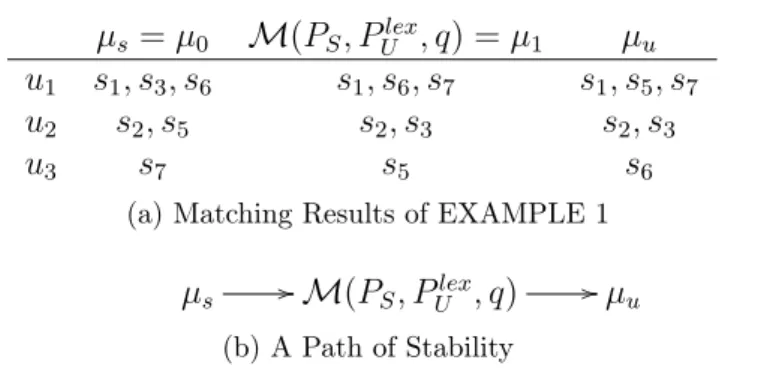
The Swedish PhD program is a vital component of national higher education system, meanwhile, it supports students with salaries. Even the compromise algorithm is neither strategy-proof (generally) nor respecting improvements, it produces stable matching that compromise the students and universities’ preferences. The most important desideratum for a matching is stability, and the compromise algorithm does lead to a stable matching M(PS, PUlex, q). What makes this stable matching differ from other matchings? We can anal-yse the matching results produced from EXAMPLE 1 and compare with typical matchings generated from the Gale-Shapley deferred acceptance al-gorithm, i.e. the student optimal stable matching and the university optimal stable matching.
µs =µ0 M(PS, PUlex, q) =µ1 µu u1 s1, s3, s6 s1, s6, s7 s1, s5, s7
u2 s2, s5 s2, s3 s2, s3
u3 s7 s5 s6
(a) Matching Results of EXAMPLE 1
µs //M(PS, PUlex, q) //µu
(b) A Path of Stability
Figure 1: STABILITY OF COMPROMISE ALGORITHM
We use µsto denote the student optimal stable matching, which is equiv-alent to µ0 at the compromised algorithm. And µu signifies the university optimal stable matching, and compromise algorithm generates stable match-ing M(PS, PUlex, q), i.e. µ1 in EXAMPLE 1. The matching results can be
seen from Figure 1, each university is assigned with different students at different matchings, and compromise algorithm produces a stable matching that follows the direction from the SP-DA algorithm to UP-DA algorithm (Figure 1(b)). Particularly, the SP-DA algorithm creates the stable match-ingµs that is optimal for students, and the UP-DA algorithm produces the stable matching µu that is optimal for universities, whereas the compromise algorithm generates a compromise stable matching that in between µs and µu.
We should notice that there is one special case of the strategy-proofness. If the number of fields|F|= 1, then compromise algorithm satisfies the top dominance condition (Alcalde and Barberà 1994), and it creates a unique stable and strategy-proof matching that is equivalent to the student optimal stable matching and the university optimal stable matching. Alternatively, if|F|= 1, thenµs=M(PS, PUlex, q) =µu.
The equivalence theorems are major findings from the compromise algo-rithm, and they endow the algorithm with alternate options. Essentially, we
can determine whether to terminate the algorithm by checking its stability, worse or responsiveness.
This thresholds factor generalises the student placement problem, it al-lows each university to rank the no student option prior to some students at its preference orderings. The related issues of thresholds factor can be further studied, and one possible implication is students will not apply to those universities that she is not qualified, since she will be rejected for sure. Specifically, suppose each student has the symmetric information about the thresholds of each university, and she knows whether she is qualified for the basic requirements for each university before the application, and she will only apply to universities that she is both qualified and desired. Two ques-tions arise from the above problem: What will change for the compromise algorithm under the above case? What if students access to asymmetric information set?
Lastly, this paper tries to design a mechanism that captures attributes of the real-world Swedish PhD admissions problem, and it aims to offer a solution such that, both students and universities are “satisfied” from the matching produced by the algorithm.
References
[1] Abdulkadiroğlu, A. and Sönmez, T. School choice: A mechanism design approach. American Economic Review, 93(3):729–747, 2003.
[2] Alcalde, J. and Barberà, S. Top dominance and the possibility of strategy-proof stable solutions to matching problems.Economic Theory, 4:417–435, 1994.
[3] Balinski, M. and Sönmez, T. A tale of two mechanisms: Student place-ment. Journal of Economic Theory, 84:73–94, 1999.
[4] Chen, Y. and Sönmez, T. School choice: an experimental study. Journal of Economic Theory, 127:202–231, 2006.
[5] Gale, D. and Shapley, L. S. College admissions and the stability of marriage. American Mathematical Monthly, 69(1):9–15, January 1962. [6] Gudmundsson, J. Compromises and rewards: Stable and
non-manipulable probabilistic pairing. Working Papers, Department of Eco-nomics, Lund University, 2015:32, October 2015.
[7] Roth, A. E. The evolution of the labor market for medical interns and residents: A case study in game theory. Journal of Political Economy, 92:991–1016, 1984.
[8] Roth, A. E. The college admissions problem is not equivalent to the marriage problem. Journal of Economic Theory, 36:277–288, 1985a. [9] Roth, A. E. A natural experiment in the organization of entry-level
labor markets: Regional markets for new physicians and surgeons in the united kingdom. The American Economic Review, 81(3):415–440, 1991. [10] Roth, A. E. Repugnance as a constraint on markets. Journal of
[11] Roth, A. E., Abdulkadiroğlu A. and Pathak, P. A. The new york city high school match. American Economic Review, 95(2):364–367, 2005. [12] Roth, A. E., Sönmez T. and Ünver, M. U. Kidney exchange. Quarterly
Journal of Economics, 119(2):457–488, May 2004.
[13] Shapley, L. S. and Scarf, H. On cores and indivisibility. Journal of Mathematical Economics, 1:23–37, 1974.