Security, Privacy, and Transparency Guarantees
for Machine Learning Systems
Mathias L´ecuyer
Submitted in partial fulfillment of the requirements for the degree of
Doctor of Philosophy
in the Graduate School of Arts and Sciences
COLUMBIA UNIVERSITY 2019
c
2019
Mathias L´ecuyer All rights reserved
ABSTRACT
Security, Privacy, and Transparency Guarantees for Machine Learning Systems Mathias L´ecuyer
Machine learning (ML) is transforming a wide range of applications, promising to bring im-mense economic and social benefits. However, it also raises substantial security, privacy, and transparency challenges. ML workloads indeed push companies toward aggressive data collection and loose data access policies, placing troves of sensitive user information at risk if the company is hacked. ML also introduces new attack vectors, such as adversarial example attacks, which can completely nullify models’ accuracy under attack. Finally, ML models make complex data-driven decisions, which are opaque to the end-users, and difficult to inspect for programmers. In this dissertation we describe three systems we developed. Each system addresses a dimension of the previous challenges, by combining new practical systems techniques with rigorous theory to achieve a guaranteed level of protection, and make systems easier to understand. First we present Sage, a differentially private ML platform that enforces a meaningful protection semantic for the troves of personal information amassed by today’s companies. Second we describe PixelDP, a defense against adversarial examples that leverages differential privacy theory to provide a guar-anteed level of accuracy under attack. Third we introduce Sunlight, a tool to enhance the trans-parency of opaque targeting services, using rigorous causal inference theory to explain targeting decisions to end-users.
Contents
Introduction 1
The Shift to ML-Driven Code . . . 2
Security, Privacy, and Transparency Implications . . . 3
Focus of This Dissertation . . . 6
Chapter 1 Data Protection and Privacy in Machine Learning Systems 9 1.1 Motivation . . . 10
1.2 The Sage System . . . 11
1.3 Background . . . 13 1.4 Design . . . 18 1.5 Theory . . . 38 1.6 Evaluation . . . 47 1.7 Related Work . . . 59 1.8 Summary . . . 60
Chapter 2 Security Guarantees Against Adversarial Examples 62 2.1 Motivation . . . 63
2.2 The PixelDP Defense . . . 64
2.3 Background . . . 66
2.4 Design . . . 71
2.5 Theory . . . 77
2.6 Evaluation . . . 81
2.8 Summary . . . 96
Chapter 3 Data Use Transparency in Opaque Targeting Services 98 3.1 Motivation . . . 99
3.2 The Sunlight System . . . 100
3.3 Background . . . 103 3.4 Design . . . 106 3.5 Theory . . . 113 3.6 Evaluation . . . 122 3.7 Related Work . . . 142 3.8 Summary . . . 142 Conclusion 144 Bibliography 147
Acknowledgements
This dissertation would not have been possible without my advisors and mentors, Roxana Geam-basu, Augustin Chaintreau, Daniel Hsu, and Siddhartha Sen. I thank you for your guidance and support, both human and intellectual. In particular my main advisor Roxana Geambasu created an environment supportive of family life, and relentlessly fostered my academic career. For this I am especially grateful.
I also thank my co-authors, Vaggelis Atlidakis, Jonathan Bell, Augustin Chaintreau, Guillaume Ducoffe, Roxana Geambasu, Daniel Hsu, Tzu-Kuo Huang Suman Jana, Francis Lan, Joshua Lock-erman, Lamont Nelson, Jason Nieh, Andrei Papancea, Theofilos Petsios, Siddhartha Sen, Amit Sharma, Aleksandrs Slivkins, Riley Spahn, Giannis Spiliopoulos Max Tucker, Nicolas Viennot, and Kiran Vodrahalli, for their work and the dynamic research environment they helped create. I thank the members of my thesis committee, David Blei, Augustin Chaintreau, Roxana Geambasu, Daniel Hsu, and Siddhartha Sen, for valuable discussions and feedback. I also acknowledge the funding that made this work possible: NSF grants CNS-1514437 and CNS-1351089.
Last, but not least, I couldn’t thank my wife and two daughters enough, for their love during this endeavor, their patience with my travels and research induced absent-mindedness, their support both moral and material. I am also obliged to my wife for numerous discussions that pushed my work forward, introduced me to new ideas, and brought clarity to my research and writing.
Introduction
The recent machine learning (ML) revolution, powered by new systems supporting massive amounts of data and advanced algorithms to analyse them, is transforming a wide range of applications. These include search, personalized recommendations, and smart assistants, as well as security and safety-critical applications, such as self-driving cars, face recognition based access control, and fraud detection. However, ML-driven applications also introduce disruptive workloads and atypical semantics that do not fit existing system paradigms. Adversaries can manipulate model predictions without explicitly breaking into host machines. Traditional protection abstractions from operating systems are ill-equipped to handle the new data access patterns of ML workloads, hence being ineffective at safeguarding the vast troves of collected data. And ML models are of-ten too opaque for end-users to understand and trust, and too brittle for system designers security requirements. These challenges pose serious barriers to reaching ML’s full potential.
We propose that by combining techniques from systems and theory, we candesign ML systems that are both practical and provide provable guarantees of security, privacy, and transparency. Three steps are involved. First, components requiring strong guarantees should be separated from those that can do with best-effort, heuristic operation. This separation enables designs that are practical but still guarantee clear semantics. Second, each component requiring rigorous guar-antees is matched to the theoretical field best suited as a foundation for a solution, either within theoretical computer science or from other domains. Third, building blocks are assembled into a coherent architecture to implement a prototype, evaluated against multiple workloads and at scale to understand its strengths and limitations.
This thesis describes abstractions, tools, and systems that leverage this approach to enhance the security, robustness, and transparency in ML-powered systems. We start with background on the shift to ML-driven code and the challenges it raises in security, privacy, and transparency. We then focus on the specific aspects of these challenges we will address, before detailing each contribution in its dedicated chapter.
The Shift to ML-Driven Code
Three recent trends are combining to make Machine Learning (ML) ubiquitous. First, enor-mous amounts of data is constantly generated and collected. The internet started this trend by connected data generating devices and sensors to means of storage and analysis. More recent tech-nological developments such as mobile phones, social media, or the internet of things accelerated this trend. Second, recent advances in ML, and in particular deep learning, leverage this data to enable great performance at many tasks, such as processing and understanding images, voice, or text, personalizing content, and performing data-driven optimization of decisions. Third, maturing systems support gives broad access to the tools and hardware necessary to process these troves of data, train state-of-the-art models, and deploy them around the world.
Because of its success, ML is now used in many domains and applications. The best known applications may be those of user facing online services, such as ad targeting, search, price opti-mization, content personalization, content recommendation, or voice based smart assistants. But these are only the tip of the iceberg. ML is also used in less visible applications, from cloud infrastructure optimization, to fraud detection, malware detection, or face recognition based au-thentication. ML is even used in decisions with important societal implications, for instance to sort applications in hiring, personalize education, prioritize patients for medical interventions, and make bail recommendations for prisoners.
This ubiquity of ML deployments is changing the origin and makeup of the code driving many of our applications, services, and devices. Traditional code is written by programmers and encodes algorithms that express business logic and configuration. While this code can be complex, its ideal behavior is specified in advance, and the implementation includes the entire logic. Traditional
code can thus be understood by humans, and audited for incorrect behavior. ML is a drastic shift from this paradigm: it is used when one cannot specify the desired behavior of the “code” in advance. This happens when there are too many tasks or variables to handle, such as in large scale personalization or price optimization, or when tasks are too complex and not well understood, such as in autonomous driving or speech recognition. To enable these applications part of the “code” is learned using: an ML model, an optimization algorithm, and a lot of data. Data is leveraged both at training time to learn the “code”, and at prediction time to run the “code”. Often, this data comes from users which means that it can be of personal nature (e.g. emails, searches, website visits, locations, heartbeats), and it can be manipulated.
Security, Privacy, and Transparency Implications
The shift to ML-driven “code” has profound security, privacy, and transparency implications. Increased Data Exposure: A looming security and privacy threat posed by ML-driven applica-tions is the vast troves of personal information that organizaapplica-tions routinely collect to fuel them. ML applications indeed have blurry data requirements: data collected to improve a news recommen-dation service may also be relevant for ad targeting, a smart assistant, or fraud detection. Because data requirements are unclear many organizations collect all the data they can even if no clear use-case exists yet. They also adopt wide-access policies for this data, such as the “data lake” policy: all data collected from the company’s various products is integrated into one central repository, to which all employees and services get access. Improperly protected, this data can be grabbed by hackers or unethical employees – and frequently is, as countless data breach reports demonstrate.
Moreover, ML models increase exposure because of their relationship with the data. ML mod-els indeed incorporate the sensitive data they train on, but are often handled as traditional, secret-free code would be. ML platforms, such as Google’s Tensorflow-Extended (TFX), Facebook’s FBLearner, and Uber’s Michelangelo, routinely push models trained over sensitive data to servers all around the world[13;79;116;162] and sometimes to end-user devices[198;178] for faster predictions. Some companies also report pushing feature models – such as user embedding vectors and
statis-tics of user activity – into shared model stores that are widely accessible within the company, even though they may not enable such wide access for the data itself[79;116;172].
There is perhaps a sense that, because ML models aggregate data from multiple users, they “obfuscate” individuals’ data sufficiently to warrant weaker protection than that of the data itself. However, that perception is succumbing to increasing evidence that ML models leak substantial information about their training sets. Carlini, et.al.[28] showed that language models over users’ emails leak secrets – such as passwords, social security numbers, and credit card numbers – that users often include in their communications. Shokri, et.al.[173]showed that membership in a train-ing set can be inferred from ML models even when the attacker only has access to the model’s external predictions. Calandrino, et.al.[26] showed recommenders leak information across users. Finally, it has long been established both theoretically and empirically that access to too many linear statistics from a dataset – as an adversary might have due to periodic releases of ML code which often includes statistics used for featurization – isfundamentally non-private[9;48;65;83]. New Attack Vectors. In addition to leaking training set information, leaving logic decisions to trained ML models opens new attacks surfaces. In traditional appliactions, an adversary trigger-ing behavior outside of the code’s specification by crafttrigger-ing specific inputs is concidered a major vulnerability. Examples include gaining priviledged access to protected data, executing code of the adversary’s chosing on remote machines, or triggering actions under another user’s credentials with cross site scripting. In ML-driven applications, code is learned from data and inputs influence the program’s behavior by design. Since these changes are part of the expected behavior, it is hard to defend against malicious users trying to influence the code through data, opening new attack surfaces in two broad phases of the applications’ life cycle[147].
First, in many applications users have some control over the data used at prediction time (e.g tection, text in spam filtering, the binary in malware detection, part of the image is face recognition, sound in voice recognition). An adversary can manipulate these inputs at prediciton time, creating small perturbations to correctly classified inputs that cause a DNN to produce an erroneous pre-diction, possibly of the adversary’s choosing[180]. These adversarial examples pose serious threats
to security-critical applications. Since the initial demonstration of adversarial examples, attack methodologies have been refined to become much more efficient[30;6], demonstrated on physical objects[7], and extended to other applications such as voice recognition[159] as well as other ML tasks such as reinforcement learning[101] and generative models[100].
Second, an attacker can sometimes influence the training data (e.g. through crowdsourcing, data sharing, or user actions) with the aim of corrupting the learned model. In this broad class of attacks, called data poisoning, the goal can be to degrade accuracy, or to ensure that targeted data features will be assigned a specific label of the attackers’ chosing at prediction time. After being introduced for support verctor machines in[16], it has then been the focus of intense research with extensions to clustering[17], topic modeling[131], collaborative filtering[115], or neural networks[204]. Opaque Decisions Applied at Large Scale. Finally, ML applications introduce a new scale in the complexity of software systems. In traditional applications code is written by software developers. This requires significant efforts, which has two consequences. First, the logic typically follows specifications and is built to be as simple as possible and understandable by humans. Code can thus be audited to understand its behavior, and tested against the specifications. Second, the same logic is deployed for every user with minimal personalization, as manual fine grained personaliza-tion is not realistic. In ML applicapersonaliza-tions on the other hand, the code in learned from large amounts of data. Because data is constantly updated, can be complex and noisy, and can be user generated, ML code is much more complex and hard to audit. And since the code can automatically be opti-mized for different users and population segments, it is possible to personalize the logic at scale, resulting in a context dependent behavior. This paradigm shift has three important technical and societal ramifications. First, the complexity of ML models and the data they are trained on makes it hard to interpret and explain their decisions. This poses difficulties both by making ML-driven ap-plications increasingly hard to understand and debug[169;88;4], and by preventing applications from providing justifications and transparency for their decisions[209].
Second, this lack of transparency is turning the Web into an opaque and privacy-insensitive environment. As ML-driven applications exploit data for varied and undisclosed purposes,
per-sonalizing decisions to each user, it is increasingly hard for users and investigators (such as FTC agents, journalists, or researchers) to answer questions such as: Who has what data, and for what purposes is it used? Who shares data with whom? Does the service adhere to its own privacy policy? Examples of problematic practices abound, highlighting the need for more transparency. Google was found to have used institutional emails from ad-free Google Apps for Education to target ads in users’ personal accounts [73;167]. MySpace was found to have violated its privacy policy by leaking personally identifiable information to advertisers[102]. Several consumer sites, such as Orbitz and Staples, were found to have adjusted their product pricing based on user loca-tion[122;187]. Large tech companies were found to enable questionable targeting[91], or participate in undisclosed data sharing deals[134].
Third, deploying hard to audit data driven code in increasingly impactful applications such as hiring[89], insurance pricing[92], or policing[156;140], can introduce and perpetuate discriminatory or otherwise unfair practices. These effects can be hard to measure, as they can affect specific sub-populations or individuals even when ML models have a great average performance over the entire population. These unfair behaviors can come from existing biases encoded in the data[21;27], result from optimizing in average over the population[37;25], be caused by the need for exploration in the data gathering process[18;160], or follow from strategic adaptation to the deployed algorithms[137].
Focus of This Dissertation
In this dissertation, we focus on one specific aspect of each of the previous challenges. In each case, we build systems and tools mixing both theory and systems mechanisms to alleviate the adverse impact of the shift to ML-driven code. Through this work, we hope to enable the promises of ML driven ecosystems without imposing undue risks.
First, Chapter 1 focuses on the increased data exposure challenge brought by the switch to ML code. Focusing on reducing the exposure of data through the release of ML models, we make the case that in ML systems, privacy and data protection are intertwined. To reduce and bound the data exposure coming from ML models leaking information about their training data, we leverage differential privacy (DP) theory, which offers strong guarantees against such leaks.
However, differential privacy is not directly applicable to entire ML workloads. We thus designed and built an ML platform[111]that enforces a global DP guarantee across all models produced from a constantly updating data stream. To make this possible, we use and extend DP theory, proposing a new model of interaction with the data more adapted to the requirements of ML workloads. To alleviate differential privacy’s adversarial impact on models’ utility, we devise a heuristic, but practical, privacy resource allocation mechanism, and leverage theory form statistics to ensure that only high quality models are released. We also leverage training set minimization techniques from the ML literature to create DP summaries of past data[109]. These summaries can be leveraged to provide high utility despite the privacy constraints.
Second, Chapter 2 considers the new attack vectors introduced by ML. Specifically, it describes a new defense strategy[106] against adversarial examples, an ML-specific class of attacks in which the adversary finds a small perturbation to an input which results in a prediction of the adversary’s choosing. This defense leverages differential privacy, a seemingly unrelated theory from the pri-vacy domain, to provide provable robustness guarantees against adversarial examples. To ensure scalability, a crucial property given the trend of using larger and larger models, we devise a train-ing technique that empirically maximizes models’ utility while maintaintrain-ing the strong robustness guarantees. This approach yields the first certified defense that both scales to large networks and datasets (such as Google’s Inception network for ImageNet) and applies broadly to arbitrary model types. Moreover, this approach enables a firewall-like security architecture, in which a small model is prepended to an existing, already trained one to make it more robust. Such an architecture is common in traditional software systems but unique for ML workloads.
Third, Chapter 3 concentrates on a facet of the challenge of ML’s opaque decisions. More pre-cisely, it presents transparency tools[108;110] that provide a new visibility into how ML-driven web services use end-users’ data for targeting. These tools enable large scale randomized experiments that collect and analyse data from the studied services to deduce which user inputs cause which out-puts (e.g. ads, recommendations). The data collection and analysis is decomposed in a multi-stage pipeline. Crucial stages leverage theory from causal inference and statistics to audit the impact of
specific pieces of user data on targeting, giving strong causal semantics and measures of statistical confidence. Other stages, such as the targeting detection stage, leverage sparsity assumptions and filtering heuristics to provide scalability without compromising the strong semantics.
The remainder of this dissertation details each contribution, an evaluation of the corresponding system, and the relevant related work.
Chapter 1
Data Protection and Privacy in Machine Learning
Sys-tems
This chapter focuses on the information that ML models leak about their training data, an as-pect of the first challenge brought by the switch to ML, increased data exposure. It draws heavily on our paper describing Sage[111], an ML platform that enforces a global differential privacy guar-antee over entire ML workloads, to bound the data exposure through all released models. It also incorporates parts of Pyramid[109], in which we introduced training set reduction techniques as a mechanism to reduce access to past data.
1.1
Motivation
Machine learning (ML) is changing the origin and makeup of the code driving many of our applications, services, and devices. Traditional code is written by programmers and encodes algo-rithms that express business logic, plus a bit of configuration data. We keep sensitive data – such as passwords, keys, and user data – out of our code, because we often ship this code to untrusted locations, such as end-user devices and app stores. We mediate accesses to sensitive data with access control. When we do include secrets in code, or when our code is responsible for leaking user information to an unauthorized entity (e.g., through an incorrect access control decision), it is considered a major vulnerability.
With ML, “code” – in the form of ML models – is learned by an ML platform from a lot of training data. Learning code enables large-scale personalization, as well as powerful new ap-plications like autonomous cars. Often, the data used for learning comes from users and is of personal nature, including emails, searches, website visits, heartbeats, and driving behavior. And although ML “code” is derived from sensitive data, it is often handled as secret-free code. ML platforms, such as Google’s Tensorflow-Extended (TFX), routinely push models trained over sen-sitive data to servers all around the world[13;79;116;162]and sometimes to end-user devices[198;178]for faster predictions. Some companies also push feature models – such as user embedding vectors and statistics of user activity – into model stores that are often times widely accessible within the companies[79;116;172]. Such exposure would be inconceivable in a traditional application. Think of a word processor: it might pushyourdocuments toyourdevice for faster access, but it would be outrageous if it pushedyourdocuments tomy(and everyone else’s) device!
There is perhaps a sense that because ML models aggregate data from multiple users, they “obfuscate” individuals’ data and warrant weaker protection than the data itself. However, this perception is succumbing to growing evidence that ML models can leak specifics about individual entries in their training sets. Language models trained over users’ emails for auto-complete have been shown to encode not only commonly used phrases but also social security numbers and credit card numbers that users may include in their communications[28]. Prediction APIs have been shown to be enable testing for membership of a particular user or entry within a training set[173]. Finally, it has long been established both theoretically and empirically that access to too many linear statistics from a dataset – as an adversary might have due to periodic releases of models, which often incorporate statistics used for featurization – isfundamentally non-private[9;48;65;83].
1.2
The Sage System
As companies continue to disseminate many versions of models into untrusted domains, con-trolling the risk of data exposure becomes critical. We presentSage, an ML platform based on TFX that uses differential privacy (DP)[55] to bound the cumulative exposure of individual entries in a company’s sensitive data streams through all the models released from those streams. At a high level, DP randomizes a computation over a dataset (e.g. training one model) to bound the leakage of individual entries in the dataset through the output of the computation (the model). Each new DP computation increases the bound over data leakage, and can be seen as consuming part of a privacy budgetthat should not be exceeded; Sage makes the process that generates all models and statistics preserve aglobal DP guarantee.
Sage builds upon the rich literature on DP MLalgorithms(e.g.,[2;207;125], see§2.3.2) and con-tributes pragmatic solutions two of the most pressing systems challenges of global DP: (1) run-ning out of privacy budget and (2) the privacy-utility tradeoff. Sage expects to be given trairun-ning pipelines explicitly programmed to individually satisfy a parameterized DP guarantee. It acts as a new access control layer in TFX that: mediates all accesses to the data by these DP training pipelines; instantiates their DP parameters at runtime; and accounts for the cumulative privacy loss from all pipelines to enforce the global DP guarantee against the stream. At the same time,
Sage provides the developers with: control over the quality of the models produced by the DP training pipelines and mechanisms to minimize privacy budget use (thereby addressing challenge (2)); and the ability to release models endlessly without running out of privacy budget for the stream (thereby addressing challenge (1)).
The key to addressing both challenges is the realization that ML workloads operate on grow-ing databases, a model of interaction that has been explored very little in DP, and only with a purely theoretical and far from practical approach[44]. Most DP literature, largely focused on indi-vidual algorithms, assumes either static databases (which do not incorporate new data) or online streaming (where computations do not revisit old data). In contrast,ML workloads– which consist of many algorithms invoked periodically – operate ongrowing databases. Across invocations of different training algorithms, the workload both incorporates new data and reuses old data, often times adaptively. It is in thatadaptive reuse of old data coupled with new datathat our design of Sage finds the opportunity to address the preceding two challenges in ways that are practical and integrate well with TFX-like platforms.
To address the running out of privacy budget challenge, we develop block composition, the first privacy accounting method that both allows efficient training on growing databases and avoids running out of privacy budget as long as the database grows fast enough. Block composition splits the data stream intoblocks, for example by time (e.g., one day’s worth of data goes into one block) or by users (e.g., each user’s data goes into one block), depending on the unit of protection (event-or user-level privacy). Block composition lets training pipelines combine available blocks into larger datasets to train models effectively, but accounts for the privacy loss of releasing a model at the level of the specific blocks used to train that model. When the privacy loss for a given block reaches a pre-configured ceiling, the block isretired and will not be used again. However, new blocks from the stream arrive with zero privacy loss and can be used to train future models. Thus, as long as the database adds new blocks fast enough relative to the rate at which models arrive, Sage will never run out of privacy budget for the stream. Finally, block composition allows
adaptivity in the choice of training computation, privacy parameters, and blocks to execute on, thereby modeling the most comprehensive form of adaptivity in DP literature.
To address the privacy-utility tradeoff we develop privacy-adaptive training, a training pro-cedure that controls the utility of DP-trained models by repeatedly and adaptively training them on growing data and/or DP parameters available from the stream. Models retrain until, with high probability, they meet programmer-specified quality criteria (e.g. an accuracy target). Privacy-adaptive training uses block composition’s support for adaptivity and integrates well with TFX’s design, which includes a model validation stage in training pipelines. Another implication of Sage’s privacy guarantees is that data is retired when its privacy budget is exhausted. This can lead to less data being available, reducing utility. Sage proposes a mechanism that leverages training set minimzation mechanisms to build protected data summaries. These DP summarizes can be used and re-used at will to create new features that minimize the need for training data, thereby conserving the privacy budget of available data and retaining some utility from retired data.
1.3
Background
Our effort builds upon an opportunity we observe in today’s companies: the rise of ML plat-forms, trusted infrastructures that provide key services for ML workloads in production, plus strong library support for their development. They can be thought of as operating systems for ML workloads. Google has TensorFlow-Extended (TFX)[13]; Facebook has FBLearner[79]; Uber has Michelangelo[116]; and Twitter has DeepBird[113]. The opportunity is to incorporate DP into these platforms as a new type of access control that constrains data leakage through the models a company disseminates.
1.3.1 ML Platforms
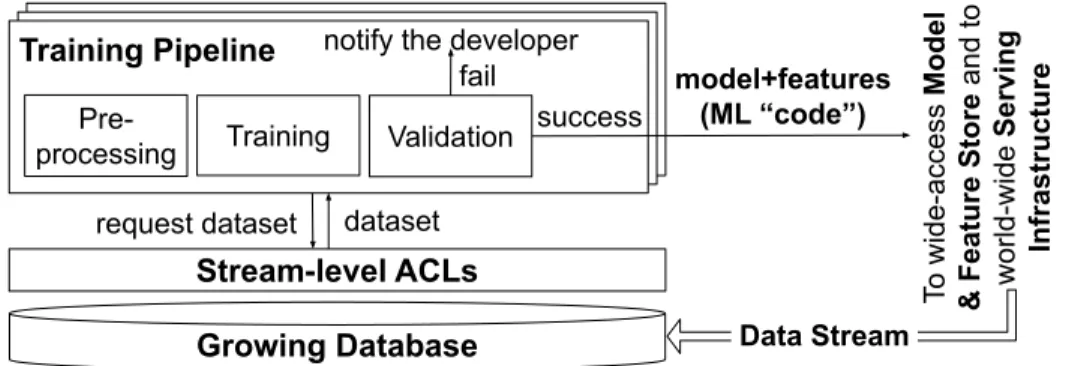
Fig. 11 shows our view of an ML platform; it is based on[13;79;116]. The platform has several components:Training Pipelines(one for each model pushed into production),Serving Infrastruc-ture, and a shared data store, which we call the Growing Databasebecause it accumulates data from the company’s various streams. The access control policies on the Growing Database are exercised through Stream-level ACLs and are typically restrictive for sensitive streams.
ç√
Stream-level ACLs
dataset request dataset
fail notify the developer
Training Pipeline model+features (ML “code”) Pre-processing Growing Database
Training Validation success
T
o wide-access
Model
& Feature Store
and to
world-wide
Serving
Infrastructure
Data Stream.
Fig. 11:Typical Architecture of an ML Platform.
The Training Pipeline trains a model on data from the Growing Database and verifies that it meets specific quality criteria before it is deployed for serving or shared with other teams. It is launched periodically (e.g., daily) on datasets containing samples from a representative time window (e.g., logs over the past month). It has three customizable modules: (1) Pre-processing loads the dataset from the Growing Database, transforms it into a format suitable for training and inference by applying feature transformation operators, and splits the transformed dataset into a training set and a testing set; (2) Trainingtrains the model on a training set; and (3) Validation evaluates one or morequality metrics– such as accuracy for classification or mean squared error (MSE) for regression – on the testing set. It checks that the metrics reach specificquality targets to warrant the model’s push into serving. The targets can be fixed by developers or can be val-ues achieved by a previous model. If the model meets all quality criteria, it is bundled with its feature transformation operators (a.k.a. features) and pushed into the Serving Infrastructure. The model+features bundle is what we callML code.
TheServing Infrastructuremanages the online aspects of the model. It distributes the model+features to inference servers around the world and to end-user devices and continuously evaluates and par-tially updates it on new data. The model+features bundle is also often pushed into a company-wide Model and Feature Store, from where other teams within the company can discover it and integrate into their own models. Twitter and Uber report sharing embedding models[172] and tens of thou-sands of summary statistics[116] across teams through their Feature Stores. To enable such wide
sharing, companies sometimes enforce more permissive access control policies on the Model and Feature Store than on the raw data.
1.3.2 Threat Model
We are concerned with the increase in sensitive data exposure that is caused by applying looser access controls to data-carrying ML code –models+features– than are typically applied to the data. This includes placing models+features in company-wide Model and Feature Stores, where they can be accessed by developers not authorized to access the raw data. It includes pushing models+features, or their predictions, to end-user devices and prediction servers that could be compromised by hackers or oppressive governments. And it includes opening the models+features to the world through prediction APIs that can leak training data if queried sufficiently[186;173]. Our goal is to “neutralize” the wider exposure of ML codes by making the process of generating them DP across all models+features ever released from a sensitive stream.
We assume the following components are trusted and implemented correctly: Growing Database; Stream-level ACLs; the ML platform code running a Training Pipeline. We alsotrust the developer that instantiates the modules in each pipeline as long as the developer is authorized by Stream-level ACLs to access the data stream(s) used by the pipeline. However, we do not trust the wide-access Model and Feature Store or the locations to which the serving infrastructure disseminates the model+features or their predictions. Once a model/feature is pushed to those components, it is consideredreleasedto the untrusted domain and accessible to adversaries.
We focus on two classes of attacks against models and statistics (see Dwork[64]): (1) member-ship inference, in which the adversary infers whether a particular entry is in the training set based on either white-box or black-box access to the model, features, and/or predictions[9;65;83;173]; and (2)reconstruction attacks, in which the adversary infers unknown sensitive attributes about entries in the training set based on similar white-box or black-box access[28;48;64].
1.3.3 Differential Privacy
DP is concerned with whether the output of a computation over a dataset – such as training an ML model – can reveal information about individual entries in the dataset. To prevent such
information leakage, randomnessis introduced into the computation to hide details of individual entries.
Definition 1(Differential Privacy (DP)[61]). A randomized algorithmQ:D → V is(, δ)-DP if for anyD,D0with|D⊕D0| ≤1and for anyS ⊆ V, we have:P(Q(D)∈ S)≤eP(Q(D0)∈ S) +δ.
The > 0 and δ ∈ [0,1] parameters quantify the strength of the privacy guarantee: small
values imply that one draw from such an algorithm’s output gives little information about whether it ran onDorD0. Theprivacy budgetupper bounds an(, δ)-DP computation’s privacy loss with probability (1-δ). ⊕is a dataset distance (e.g. the symmetric difference[130]). If|D⊕D0| ≤ 1, D
andD0 areneighboring datasets.
Multiple mechanisms exist to make a computation DP. They add noise to the computation scaled by its sensitivity s, the maximum change in the computation’s output when run on any two neighboring datasets. Adding noise from a Laplace distribution with mean zero and scale
s
(denoted laplace(0, s
)) gives (,0)-DP. Adding noise from a Gaussian distribution scaled by s
q
2 ln(1.δ25)gives(, δ)-DP.
DP is known to address the attacks in our threat model[173;64;28;90]. At a high level, membership and reconstruction attacks work by finding data points that make the observed model more likely: if those points were in the training set, the likelihood of the observed output increases. DP prevents these attacks, as no specific data point can drastically increase the likelihood of the model outputted by the training procedure.
DP literature is very rich and mature, including in ML. DP versions exist for almost ev-ery popular ML algorithm, including: stochastic gradient descent (SGD)[2;207]; various regres-sions[34;144;181;211;99]; collaborative filtering[128]; language models[127]; feature selection[36]; model selection[175]; evaluation[23]; and statistics, e.g. contingency tables[10], histograms[203]. The privacy module in TensorFlow v2 implements several SGD-based algorithms[125].
A key strength of DP is itscompositionproperty, which in its basic form, states that the process of running an(1, δ1)-DP and an(2, δ2)-DP computation on the same dataset is(1+2, δ1+δ2)
Privacy-Adaptive Training
Stream-level ACLs dataset, ε, δ request dataset
notify the developer
ACCEPT
Sage Access Control ((εg,δg)-DP across all pipelines)
RETRY Data Stream. (ε,δ)-DP Training Pipeline (ε/3,0)-DP Pre-processing (ε/3,δ)-DP Training (ε/3,0)-DP SLAed Validation Model+features sent to
Model & Feature Store
and
Serving Infrastructure
REJECT/timeout
time
D1 3 4 D7 D8 privacy budget: used (dark) and available (clear)
εg,δg
D2 D3
blocks
D4 D5 D6
Growing Database
Fig. 12:Sage DP ML Platform.Highlights changes from non-DP version.
Pipelines – from piecemeal DP components, such as DP ML algorithms. Composition also lets one account for (and bound) the privacy loss resulting from a sequence of DP-computed outputs, such as the release of multiple models+features.
A distinction exists between user-level and event-level privacy. User-level privacy enforces DP on all data points contributed by a user toward a computation. Event-level privacy enforces DP on individual data points (e.g., individual clicks). User-level privacy is more meaningful than event-level privacy, but much more challenging to sustain on streams. Although Sage’s design can in theory be applied to user-level privacy (§1.5.6), we focus most of the chapter onevent-level privacy, which we deem practical enough to be deployed in big companies. §1.8 discusses the limitations of this semantic.
1.4
Design
The Sage training platform enforces a global(g, δg)-DP semantic over all models+features that
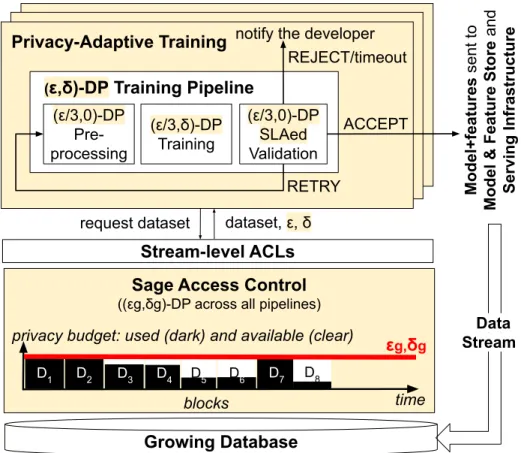
have been, or will ever be, released from each sensitive data stream. The highlighted portions in Fig. 12 show the changes Sage brings to a typical ML platform. First, each Training Pipeline must be made to individually satisfy (, δ)-DP for some privacy parameters given by Sage at runtime (box(, δ)-DP Training Pipeline, §1.4.1). The developer is responsible for making this switch to DP, and while research is needed to ease DP programming, this work leaves that challenge aside.
Second, Sage introduces an additional layer of access control beyond traditional stream-level ACLs (box Sage Access Control, §1.4.2). The new layer splits the data stream into blocks and accounts for the privacy loss of releasing a model+features bundle at the level of the specific blocks that were used to train that bundle. In theory, blocks can be defined by any insensitive attribute, with two attributes particularly relevant here: time (e.g., one day’s worth of data goes into one block) and user ID (e.g., a user’s data goes into the same block). Defining blocks by time provides event-level privacy; defining them by user ID accommodates user-level privacy. Because of our focus on the former, the remainder of this section assumes that blocks are defined by time; §1.5 discusses sharding by user ID and other attributes.
When the privacy loss for a block reaches the (g, δg) ceiling, the block is retired (blocks
D1, D2, D7are retired in Fig. 12). However, new blocks arrive with a clean budget and can be used
to train future models: as long as the database grows fast enough in new blocks, the system will never run out of privacy budget for the stream. Perhaps surprisingly, this privacy loss accounting method, which we call block composition, is the first practical approach to avoid running out of privacy budget while enabling effective training of ML models on growing databases. §1.4.2 gives the intuition of block composition while§1.5 formalizes it and proves it(g, δg)-DP.
Third, Sage provides developers with control over the quality of models produced by the DP Training Pipelines. Such pipelines can produce less accurate models that fail to meet their quality targets more often than without DP. They can also push in production low-quality models whose validations succeed by mere chance. Both situations lead to operational headaches: the former
1 def preprocessing_fn(inputs, epsilon):
2 dist_01 = tft.scale_to_0_1(inputs["distance"],0,100)
3 speed_01 = tft.scale_to_0_1(inputs["speed"],0,100)
4 hour_of_day_speed = group by mean
5 sage.dp group by mean(
6 inputs["hour_of_day"], speed_01, 24, epsilon, 1.0)
7 return {"dist_scaled": dist_01,
8 "hour_of_day": inputs["hour_of_day"],
9 "hour_of_day_speed": hour_of_day_speed,
10 "duration": inputs["duration"]}
11
12 def trainer_fn(hparams, schema, epsilon, delta): [...]
13 feature_columns = [numeric_column("dist_scaled"), 14 numeric_column("hour_of_day_speed"), 15 categorical_column("hour_of_day", num_buckets=24)] 16 estimator = \ 17 tf.estimator.DNNRegressorsage.DPDNNRegressor( 18 config=run_config, 19 feature_columns=feature_columns, 20 dnn_hidden_units=hparams.hidden_units,
21 privacy budget=(epsilon, delta))
22 return tfx.executors.TrainingSpec(estimator,...) 23 24 def validator_fn(epsilon): 25 model_validator = \ 26 tfx.components.ModelValidatorsage.DPModelValidator( 27 examples=examples_gen.outputs.output, 28 model=trainer.outputs.output,
29 metric_fn = _MSE_FN, target = _MSE_TARGET,
30 epsilon=epsilon, confidence=0.95, B=1)
31 return model_validator
32
33 def dp_group_by_mean(key_tensor, value_tensor, nkeys,
34 epsilon, value range):
35 key_tensor = tf.dtypes.cast(key_tensor, tf.int64)
36 ones = tf.fill(tf.shape(key_tensor), 1.0)
37 dp_counts = group_by_sum(key_tensor, ones, nkeys)\
38 + laplace(0.0, 2/epsilon, nkeys)
39 dp_sums = group_by_sum(
40 key_tensor,value_tensor,nkeys)\
41 + laplace(0.0, value range * 2/epsilon, nkeys)
42 return tf.gather(dp_sums/dp_counts, key_tensor)
List. 1.1: Example Training Pipeline. Shows non-DP TFX (stricken through) and DP Sage
(high-lighted) versions. TFX API is simplified for exposition.
gives more frequent notifications of failed training, the latter gives dissatisfied users. The issue is often referred to as the privacy-utility tradeoff of running under a DP regime. Sage addresses this challenge by wrapping the (, δ)-DP Training Pipeline into an iterative process that reduces the effects of DP randomness on the quality of the models and the semantic of their validation by invoking training pipelines repeatedly on increasing amounts of data and/or privacy budgets (box Privacy-Adaptive Training,§1.4.3).
1.4.1 Example(, δ)-DP Training Pipeline
Sage expects each pipeline submitted by the ML developer to satisfy a parameterized(, δ)-DP. Acknowledging that DP programming abstractions warrant further research, L 1.1 illustrates the changes a developer would have to make at present to convert a non-DP training pipeline written for TFX to a DP training pipeline suitable for Sage. Removed/replaced code is stricken through and the added code is highlighted. The pipeline processes New York City Yellow Cab data[146]and trains a model to predict the duration of a ride.
To integrate with TFX (non-DP version), the developer implements three TFX callbacks.
(1)preprocessing fnuses the dataset to compute aggregate features and make user-specified
feature transformations. The model has three features: the distance of the ride; the hour of the day; and an aggregate feature representing the average speed of cab rides each hour of the day. (2)trainer fn specifies the model that is to be trained: it configures the columns to be mod-eled, defines hyperparameters, and specifies the dataset. The model trains with a neural network regressor. (3)validator fnvalidates the model by comparing test set MSE to a constant.
To integrate with Sage (DP version), the developer: (a) switches library calls to DP ver-sions of the functions (which ideally would be available in the ML platform) and (b) splits the
(, δ) parameters, which are assigned by Sage at runtime, across the DP function calls. (1)
preprocessing fnreplaces one call with a DP version that is implemented in Sage: the mean
speed per day uses Sage’sdp group by mean. This function (lines 32-40) computes the number of times each key appears and the sum of the values associated with each key. It makes both DP by adding draws from appropriately-scaled Laplace distributions to each count. Each data point has exactly one key value so the privacy budget usage composes in parallel across keys[130]. The privacy budget is split across the sum and count queries. We envision common functions like this being available in the DP ML platform. (2) trainer fn switches the call to the non-private regressor with the DP implementation, which in Sage is a simple wrapper around TensorFlow’s DP SGD-based optimizer. (3)validator fninvokes Sage’s DP model validator (§1.4.3).
Fig. 13:Characteristics of Data Interaction in ML.
1.4.2 Sage Access Control
Sage uses the composition property of DP to rigorously account for (and bound) the cumu-lative leakage of data from sensitive user streams across multiple releases of models+features learned from these streams. Specifically, for each sensitive stream, Sage maintains a pre-specified event-level(g, δg)-DP guarantee across all uses of the stream. Unfortunately, traditional DP
com-position theory considers either static databases, which leads to wasteful privacy accounting; or purely online streaming, which is inefficient for many ML workloads, including deep neural net-work training. We thus developed our own composition theory, calledblock composition, which leverages characteristics of ML workloads running on growing databases to permit both efficient privacy accounting and efficient learning. §1.5 formalizes the new theory. This section describes the limitations of existing DP composition for ML and gives the intuition for block composition and how Sage uses it as a new form of access control in ML platforms.
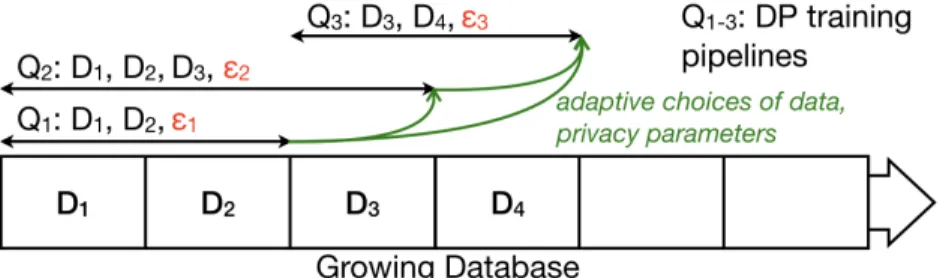
Data Interaction in ML on Growing Databases.Fig. 13 shows an example of a typical workload as seen by an ML platform. Each training pipeline, orqueryin DP parlance, is denoted Qi. We
note two characteristics. First, a typical ML workload consists of multiple training pipelines, training over time on a continuously growing database, and on data subsets of various sizes. For instance, Q2 may train a large deep neural network requiring massive amounts of data to reach a
good performance, while Q3 may train a linear model with smaller data requirements, or even a
simple statistic like the mean of a feature over the past day. All pipelines are typically updated or retrained periodically on new data, with old data eventually being deemed irrelevant and ignored.
Second, the data given to a training pipeline – and for a DP model its DP parameters – are typically chosenadaptively. For example, the model trained inQ1on data fromD1,2 with budget 1 may give unsatisfactory performance. After a new block D3 is collected, a developer may
decide to retrain the same model in queryQ2 on data from D1,2,3, and with a higher DP budget 2. Adaptivity can also happen indirectly through the data. Suppose Q2 successfully trained a
recommendation model. Then, future data collected from the users (e.g. in D4) may depend on
the recommendations. Any subsequent query, such asQ3, is potentially influenced byQ2’s output.
These characteristics imply three requirements for a composition theory suitable for ML. It must support:
R1 Queries on overlapping data subsets of diverse sizes.
R2 Adaptivity in the choice of: queries, DP parameters, and data subsets the queries process. R3 Endless execution on a growing database.
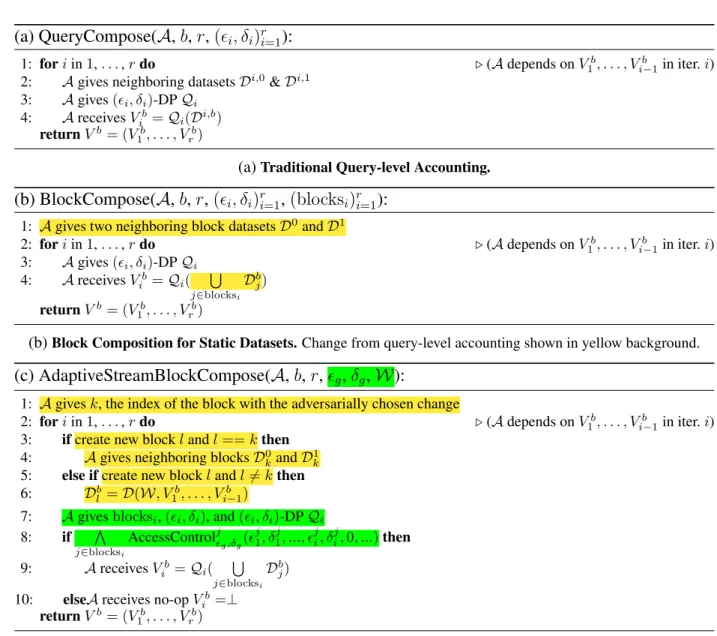
Limitations of Existing Composition Theory for ML.No previous DP composition theory sup-ports all three requirements. DP has mostly been studied for static databases, where (adaptively chosen) queries are assumed to compute overthe entire database. Consequently, composition ac-counting is typically made atquery level: each query consumes part of the total available privacy budget for the database. Query-level accounting has carried over even in extensions to DP theory that handle streaming databases[60]and partitioned queries[130]. There are multiple ways to apply query-level accounting to ML, but each trades off at least one of our requirements.
First, one can query overlapping data subsets (R1) adaptively across queries, the data used, and the DP parameters[163] (R2) by accounting for composition at the query level against the entire stream. Queries on Fig. 13 would thus result in a total privacy loss of1 +2+3 over the
whole stream. This approach wastes privacy budget and leads to the problem of “running out of budget”. Once g = 1 +2 +3, enforcing a global leakage bound of g means thatone must
data and (2) there will be new data coming into the system in the future (e.g.,D5). This violates
requirement (R3) of endless execution on streams.
Second, one can restructure the queries to enable finer granularity with query-level account-ing. The data stream is partitioned in blocks, as in Fig. 13. Each query is split into multiple ones, each running with DP on an individual block. The DP results are then aggregated, for instance by averaging model updates as in federated learning[127]. Since each block is a separate dataset, traditional composition can account for privacy loss at the block level. This approach supports adaptivity (R2) and execution of the system on streams (R3) as new data blocks incur no privacy loss from past queries. However, it violates requirement (R1), resulting in unnecessarily noisy learning[50;51]. Consider computing a feature average. DP requires adding noise once, after sum-ming all values on the combined blocks. But with independent queries over each block, we must add the same amount of noise to the sum over each block, yielding a more noisy total. Addition-ally, several DP training algorithms[2;127] fundamentally rely on sampling small training batches from large datasets to amplify privacy, which cannot be done without combining blocks.
Third, one can consume the data stream online using streaming DP. A new data point is allo-cated to one of the waiting queries, which consumes its entire privacy budget. Because each point is used by one query and discarded, DP holds over the entire stream. New data can be adaptively assigned to any query (R2) and arrives with a fresh budget (R3). However, queries cannot use past data or overlapping subsets, violatingR1and rendering the approach impractical for large models. Block Composition. Our new composition theory meets all three requirements. It splits the data stream into disjointblocks (e.g., one day’s worth of data for event-level privacy), forming a growing database on which queries can run on overlapping and adaptively chosen sets of blocks (R1, R2). This lets pipelines combine blocks with available privacy budgets to assemble large datasets. Despite running overlapping queries, we can still account for the privacy loss of each individual blocks, where each query impacts the blocks it actually uses,not the entire data stream. Unused blocks, including future ones, incur no privacy loss. In Fig. 13, the first three blocks each incur a privacy loss of 1 +2 while the last block has 2 +3. The privacy loss of these three
queries over the entire data stream will only be the maximum of these two values. Moreover, when the database grows (e.g. blockD5 arrives), the new blocks’ privacy loss is zero. The system can
thus run endlessly by training new models on new data (R3).
Sage Access Control. With block composition, Sage controls data leakage from a stream by enforcing DP on its blocks. The company configures a desirable (g, δg) global policy for each
sensitive stream. The Sage Access Control component tracks the available privacy budget for each data block. It allows access to a block until it runs out of budget, after which access to the block will never be granted again. When the Sage Iterator (described in §1.4.3) for a pipeline requests data, Sage Access Control only offers blocks with available privacy budget. The Iterator then determines the(, δ)privacy parameters it will use for its iteration and informs Sage Access Control, which deducts (, δ) from the available privacy budgets of those blocks. Finally, the Iterator invokes the developer-supplied DP Training Pipeline, trusting it to enforce the chosen
(, δ)privacy parameters. §1.5 proves that this access control policy enforces (g, δg)-DP for the
stream.
The preceding operation is a DP-informed retention policy, but one can use block composition to define other access control policies. Suppose the company is willing to assume that its devel-opers (or user devices and prediction servers in distinct geographies) will not collude to violate its customers’ privacy. Then the company could enforce a separate(g, δg)guarantee for each context
(developer or geography) by maintaining separate lists of per-block available budgets. 1.4.3 Privacy-Adaptive Training
Sage’s design adds reliability to the DP model training and validation processes, which are ren-dered imprecise by the DP randomness. We describe two novel techniques: (1)SLAed validation, which accounts for the effect of randomness in the validation process to give a high-probability guarantee of correctness for the validation (akin to a quality service level agreement, or SLA); and (2)privacy-adaptive training, which launches the(, δ)-DP Training Pipeline repeatedly on increasing amounts of data from the stream, and/or with increased privacy parameters, until the validation succeeds.
1 class DPLossValidator(sage.DPModelValidator):
2 def validate(loss_fn, target, epsilon, confidence, B):
3 if _ACCEPT_test(..., epsilon, (1-confidence)/2, B):
4 return ACCEPT
5 if _REJECT_test(..., epsilon, (1-confidence)/2, B):
6 return REJECT
7 return RETRY
8
9 def _ACCEPT_test(test_labels, dp_test_predictions,
10 loss_fn, target, epsilon, eta, B):
11 n_test = dp_test_predictions.size()
12 n_test_dp = n_test + laplace(2/epsilon)
13 n_test_dp_min = n_test_dp - 2*log(3/(2*eta))/epsilon
14 dp_test_loss = clip_by_value(loss_fn(test_labels, 15 dp_test_predictions), 0, B) + laplace(2*B/epsilon) 16 corrected_dp_test_loss = dp_test_loss + 17 2*B*log(3/(2*eta))/epsilon 18 return bernstein_upper_bound( 19 corrected_dp_test_loss / n_test_dp_min,
20 n_test_dp_min, eta/3, B) <= target
21
22 def _REJECT_test(train_labels, dp_train_predictions,
23 loss_fn, target, epsilon, eta, B):
24 n_train = dp_train_predictions.size()
25 n_train_dp = n_train + laplace(2/epsilon)
26 n_train_dp_min = n_train_dp - 2*log(3/eta)/epsilon
27 n_train_dp_max = n_train_dp + 2*log(3/eta)/epsilon
28 dp_train_loss = clip_by_value(loss_fn(train_labels, 29 dp_train_predictions), 0, B) + laplace(2*B/epsilon) 30 corrected_dp_train_loss = dp_train_loss -31 2*B*log(3/(2*eta))/epsilon 32 return hoeffding_lower_bound( 33 corrected_dp_train_loss / n_train_dp_max,
34 n_train_dp_min, eta/3, B) > target
35
36 def bernstein_upper_bound(loss, n, eta, B):
37 return loss+sqrt(2*B*loss*log(1/eta)/n)+4*log(1/eta)/n
38 def hoeffding_lower_bound(loss, n, eta, B):
39 return loss-B*sqrt(log(1/eta)/n)
List. 1.2:Implementation ofsage.DPLossValidatorused in List. 1.1.
SLAed DP Validation. Fig. 12 shows the three possible outcomes of SLAed validation: ACCEPT, REJECT, and RETRY. If SLAed validation returns ACCEPT, then with high probability (e.g. 95%) the model reaches its configured quality targets when predicting on new data from the same dis-tribution. For certain metrics and under certain assumptions, it is also possible to give statistical guarantees of correct negative assessment. In such cases, if SLAed validation returns REJECT, then with high probability (e.g., 95%) this type of modelwill neverreach the target, no matter how much data it is trained/validated on. Finally, if SLAed validation returns RETRY, it signals that more data is needed for an assessment.
We have implemented SLAed validators for three classes of metrics: loss metrics (e.g. MSE, log loss), accuracy metrics, andabsolute errorsof sum-based statistics such as mean and variance.
We give the intuition for these tests before detailing each test. All validators follow the same logic. First, we compute a DP version of the test quantity (e.g. MSE) on a testing set. Second, we compute theworst-case impact of DP noiseon that quantity for a given confidence probability; we call this a correction for DP impact. For example, if we add Laplace noise with parameter 1 to the sum of squared errors onndata points, assuming that the loss is in[0,1]we know that with probability(1−η)the sum is deflated by less than−1
ln(
1
2η), because a draw from this Laplace
distribution has just an η probability to be more negative than this value. Third, we use known statistical concentration inequalities, also made DP and corrected for worst case noise impact, to upper bound with high probability the loss on the entire distribution.
Loss SLAed Validator. A loss function is a measure of erroneous predictions on a dataset (so lower is better). Examples include: mean squared error for regression, log loss for classification, and minus log likelihood for Bayesian generative models. L 1.2 shows our loss validator. The validation function consists of two tests: ACCEPTand REJECT.
ACCEPTTest: Denote a loss function l(f, x, y) with range [0, B] measuring the quality of a prediction f(x) with label y (lower is better), and a target loss τloss on the data distribution D.
Denote: the DP-trained model fdp; the loss function range [0, B]; the target loss τloss. Given a
the DP-trained modelfdp, we want to releasefdp only ifLD(fdp), E(x,y)∼Dl(fdp, x, y) ≤τloss.
The test works as follows. First, compute a DP estimate of the number of samples in the test set, corrected for the impact of DP noise to be a lower bound on the true value with probability(1−η
3) (Lines 11-13 L 1.2): ndpte =nte+ Laplace( 2 )− 2 ln( 3 2η).
Then, compute a DP estimate of the loss corrected for DP impact (Lines 14-17 L 1.2) to be an upper bound on the true value,Lte(fdp), n1te Ptel(fdp, x, y), with probability(1− η3):
Ldpte(fdp) = 1 ndpte X te l(fdp, x, y) + Laplace(2B ) + 2B ln( 3 2η)
Lines 18-20, we see that Sage will ACCEPTwhen: Ldpte(fdp) + s 2BLdpte(fdp) ln(3/η) ndpte + 4Bln(3/η) ndpte ≤τloss.
This test gives the following guarantee:
Proposition 1(Loss ACCEPTTest). With probability at least(1−η), the ACCEPTtest returns true only ifLD(fdp)≤τloss.
Proof. The corrections for DP noise imply thatP(ndpte > nte)≤ η3, andP(Ldpte(fdp)>Lte(fdp))≤ η
3 (i.e. the lower bounds hold with probability at least
(1-η 3)). Define UB dp , Ldpte(fdp) + r 2BLdpte(fdp) ln(3/η) ndpte + 4 ln(3/η) ndpte , and UB,Lte(f dp) +q2BLte(fdp) ln(3/η) nte + 4 ln(3/η) nte . Applying
Bern-stein’s inequality[171] yields P(L
D(fdp) > UB) ≤ η3. A union bound on those three inequalities
gives that with probability at least (1−η), LD(fdp) ≤ UB ≤ UBdp. The test ACCEPTs when
UBdp ≤τloss.
This test uses Bernstein’s concentration inequality to compute a upper bound for the loss over the entire distribution[171], which will give good bounds if the loss is small. If instead one expects the variance to be small, one can use empirical Bernstein bounds[123] as a drop-in replacement. Otherwise, one can fall back to Hoeffding’s inequality[81].
REJECTTest: The ACCEPTtest is already sufficient to ensure the quality of a model released by Sage’s privacy-adaptive training. However, when the target is unachievable on the data distribution D, these iterations waste valuable privacy resources. The REJECTtest tries to detect unachievable targets so iteration can stop early. Assumingfdp is obtained by a DP algorithm for approximately
minimizing the training loss, the test detects when no model (DP or not) from the considered classF can ever hope to achieveτloss onD. The reasoning behind the test uses the fact that the
minimum training loss is no more than the training loss of anyf ∈ F; and this in particular holds for thef∗ ∈ F with smallest expected loss overD.
The REJECT test terminates a model when no model of the considered class F can hope to achieve the desired τloss performance. Noting the best possible model on the data distribution
f? ,arg min
f∈FLD(f), we want to reject whenLD(f?)> τloss. To do this, it considers the best
model in F on the training setfˆ, arg minf∈FLtr(f), and proceeds as follows. First, compute
24-27 L 1.2): ndptr =ntr+ Laplace( 2 ), ndptr =ndptr − 2 ln( 3 η), ndptr =ndptr +2 ln( 3 η).
Then, compute a DP estimate of the loss corrected for DP impact (Lines 14-17 L 1.2) to be a lower bound on the true value with probability(1−η3):
Ldpte( ˆf) = 1 ndptr X tr l( ˆf , x, y) + Laplace(2B )− 2B ln( 3 2η) .
Finally, Sage will REJECTwhen:
Ldpte( ˆf)−B
s
log(3/η)
ndptr > τloss.
This test gives the following guarantee:
Proposition 2(Loss REJECTTest). With probability at least(1−η),fdp(or more accuratlyF) is
rejected only ifLD(f?)> τloss.
Proof. By definition,Ltr( ˆf)≤ Ltr(f?). Applying Hoeffding’s inequality[81]tof?givesP(LD(f?)< Ltr(f?)−B
q
log(3/η)
ntr ) ≤
η
3. Similarly to the proof for Proposition (1), applying a union bounds
over this inequality and the DP correction gives that with probability at least(1−η), LD(f?) ≥ Ltr(f?)−B q log(3/η) ntr ≥ L dp tr( ˆf)−B qlog(3/η) ndptr
> τloss, concluding the proof.
Here we leverage Hoeffding’s inequality[81] as we need to bound L
D(f?): since we do not
know f?, we cannot compute its variance or loss on the training set to use (empirical) Bernstein
bounds.
We highlight that this result relies on fˆ, which may not always be available. In particular, is can be computed for convex problems, but not for DNNs for instance. Whenfˆis not available, Sage will not use the REJECTtest.
DP Guarantee: We now need to prove that the ACCEPT and REJECTtests each are (,0)-DP. Since they each use a disjoint split of the dataset (training and testing) running both tests is(,0) -DP over the entire dataset.
Proposition 3(DP ACCEPT). ACCEPT is(,0)-DP.
Proof. The only data interaction for ACCEPT are to compute ndpte and Ldpte(fdp). The former is sensitivity 1, and is made 2-DP with the Laplace mechanism. The latter uses data in the inner summer, which is sensitivity B and is made 2-DP with the Laplace mechanism. Using basic composition, the test is(,0)-DP.
The proof for REJECTis a bit more complicated as part of the procedure involves computing
ˆ
f, which is not DP.
Proposition 4(DP REJECT). REJECTis(,0)-DP.
Proof. To apply the same argument as for Prop.3, we need to show that computingLtr( ˆf), which
includes computingfˆ, has sensitivityB. Recall thatfˆminimizes the training loss:
ˆ ftr = arg min f∈F X ntr l(f, x, y).
If we add a data point d, then fˆtr has a loss at worst B on the new point. Because the best
model with the new data pointfˆtr+dis a least as good asfˆtr (otherwise it wouldn’t be thearg min
model),Ltr+d( ˆftr+d)≤ Ltr( ˆftr) +B. Similarly,fˆtr+dcannot be better thanfˆtr on the training set,
soLtr+d( ˆftr+d)≥ Ltr( ˆftr). Hence the sensitivty of computingLtr( ˆf)is at mostB.
Findingfˆis possible for some classes of problems (e.g. convex optimization), but not all (e.g. DNNs). As we see in the proof of Prop.4, getting the loss minimizerfˆis crucial to the DP property.
ACCEPTand REJECTare(,0)-DP. They use disjoint datasets, sovalidateis(,0)-DP. Accuracy SLAed Validator. The accuracy metric applies to classification problems, where a model predicts one out of many classes. The targetτaccis the proportion of correct predictions to
with two small changes. First, the upper and lower bounds are reversed as losses are minimized while accuracy is maximized. Second, the result of classification predictions follows a binomial distribution, which yields tighter confidence intervals. Note 1{predicate} the indicator function with value 1if the predicate is true, and0otherwise, andBin(k, n, η)andBin(k, n, η)the upper and lower bounds on the probability parameter p of a binomial distribution such that k happen can happen with probability at least η out of n independent draws (both can be conservatively approximated using a Clopper-Pearson interval).
We computektedp =P nte1{f(x) =y}+Laplace( 2 )andn dp te =nte+Laplace(2). Similarly
for the training settr,kdptr =P nte1{
ˆ
f(x) =y}+Laplace(2)andndptr =ntr+Laplace(2). Sage
will ACCEPTwhen:
Bin kdpte − 2 ln( 3 η), n dp te + 2 ln( 3 η), η 3 ≥τacc.
And REJECTwhen:
Binkdptr +2 ln( 3 η), n dp tr − 2 ln( 3 η), η 3 < τacc.
Using the same reasoning as before, we can prove the equivalent four Propositions (1, 2, 3, 4) for the accuracy validator. Findingfˆfor accuracy is computationally hard.
Sum-based Statistics SLAed Validator.This validator applies to computing sum based statistics (e.g. mean, variance). The target is defined as the maximum size of the absolute (additive) error
τerr for these summary statistics on the data distribution. This error can be computed directly on
the training set, so there is no need to a test set. Second, because of the law of large numbers, we can always reach the target precision, so there is no rejection test. We next show the test using Hoeffding’s inequality[81] (if we expect the variance to be small, empirical Bernstein bounds[123] will be better and are directly applicable).
Compute: ndptr =ntr+Laplace( 2 )− 2 ln( 2 η)
SageACCEPTs if:
1 ndptr 2 ln( 2 η) +B s ln(2/η) ndptr ≤τerr,
in which case the absolute error is bellowτerrwith probability at least(1−η), accounting for the
statistical error, as well as the impact of DP noise on both the sum based summary statistic and the ACCEPTtest. Once again, the same reasoning allows us to prove equivalent Propositions to 1 and 3.
Privacy-Adaptive Training. Sage attempts to improve the quality of the model and its validation by supplying them with more data or privacy budgets so the SLAed validator can either ACCEPTor REJECTthe model. Several ways exist to improve a DP model’s quality. First, we can increase the dataset’s size: at least in theory, it has been proven that one can compensate for the loss in accuracy due toany(, δ)-DP guarantee by increasing the training set size[96]. Second, we can increase the privacy budget(, δ)to decrease the noise added to the computation: this must be done within the available budgets of the blocks involved in the training andnot too aggressively, because wasting privacy budget on one pipeline can prevent other pipelines from using those blocks.
Privacy-adaptive training searches for a configuration that can be either ACCEPTed or RE -JECTed by the SLAed validator. We have investigated multiple strategies for how to do this search. Those that conserve privacy budget have proven the most efficient. We start out with a small pri-vacy budget (0, δ0) and with developer-configured start time and minimum window size for the
model’s training. On RETRY from the validator, we make sure to double either the privacy bud-get or the number of samples available to the Training Pipeline by accepting new data from the stream. Evaluation §1.6.4 shows that compared to alternatives, this iteration strategy conserves privacy budgets and improves performance when multiple Training Pipelines contend for the same blocks.
1.4.4 Preserving Privacy Budget and Mitigating Block Retirement
With Sage’s access control (§1.4.2) a data block is retired when its privacy budget is exhausted, and the blocks’ data can never be queried again. To conserve privacy budget and retain some utility from retired blocks, Sage proposes an optional mechanism that leverages a training set minimization mechanism called count based featurization, together with differential privacy, to buildprotected data summaries. These summaries are used to enhance the training data with new
features, which reduces the volume of training data required to reach performance targets. This reduces the amount of data queried by a training pipeline, conserving DP budget. Because these protected data summaries are DP, they can remain in use even after a block is retired, retaining some utility from old data.
We next detail how Sage leverages count featurization, a known ML mechanism, to count featurize observations before feeding them to models for training and prediction. We then describe ourDP count tablesthat enable DP count featurization with minimal impact on utility.
Count Featurization
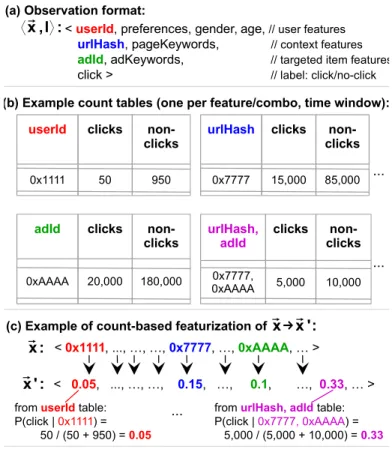
Count-based featurization[177] is a popular approach to handling categorical variables of high cardinality. Rather than directly using the value of a categorical variable, this technique featurizes the data with the number of times a particular feature value (e.g., a user ID) was observed with each label and the conditional probability of the label given the feature value. This substantially reduces dimensionality: standard encoding of categorical