LOCATION PRIVACY IN THE ERA
OF BIG DATA AND MACHINE
LEARNING
Sina Shaham
Engineering and Information Technologies
University of Sydney
A thesis submitted to fulfil requirements for the degree of
Master of Philosophy
Statement of Originality
I hereby declare that all material presented in this thesis are the original work of the author, except where specific reference is made to the work of others. The content of this thesis has not been submitted in whole or in part consideration for any other degree or qualification in this, or any other university.
The original motivation to pursue my research was provided by my supervisor Dr. Zihuai Lin in the school of Electrical and Information Engineering, the University of Sydney, Australia.
Sina Shaham December 2019
Acknowledgements
I would like to pay special thankfulness, warmth, and appreciation to many people who helped me. This work would not have been possible with the inspiration and encouragement from them.
I would like to show my warm thanks to my supervisor Dr. Zihuai Lin who supported me at every bit, including but not limited to the research.
I am very thankful to Dr. Ming Ding. His vast knowledge and guidance on research has been quite invaluable to me. His valuable comments have significantly improved the level of my research.
Publications
The following is a list of my publications finished during my Master of Philosophy.
[C1] Sina Shaham, Ming Ding, Bo Liu, Zihuai Lin, Jun Li, ‘Machine Learning Aided Anonymization of Spatiotemporal Trajectory Datasets’ accepted by INFOCOM WORKSHOPS, 2019.
[C2] Sina Shaham, Ming Ding, Bo Liu, Zihuai Lin, Jun Li, ‘Transition-Entropy: A Novel Metric for Privacy Preservation in Location-Based Services’ accepted by INFOCOM WORK-SHOPS, 2019.
[J1] Sina Shaham, Ming Ding, Bo Liu, Shuping Dang, Zihuai Lin, and Jun Li, ‘Privacy Preservation in Location-Based Services: A Novel Metric and Attack Model’ Submitted to IEEE Transactions on Knowledge and Data Engineering, 2019.
[J2] Sina Shaham, Ming Ding, Bo Liu, Shuping Dang, Zihuai Lin, and Jun Li, ‘Privacy Preserving Location Data Publishing: A Machine Learning Approach’ Submitted to IEEE Transactions on Knowledge and Data Engineering, 2019.
[J3] Sina Shaham, Ming Ding, Matthew Kokshoorn, Zihuai Lin, Shuping Dang, and Rana Abbas, ‘Fast Channel Estimation and Beam Tracking for Millimeter Wave Vehicular Communications’ Published in IEEE Access, 2019.
Abstract
Location data of individuals is one of the most sensitive sources of information that once revealed to ill-intended individuals or service providers, can cause severe privacy concerns. In this thesis, we aim at preserving the privacy of users in telecommunication networks against untrusted service providers as well as improving their privacy in the publication of location datasets.
For improving the location privacy of users in telecommunication networks, we consider the movement of users in trajectories and investigate the threats that the query history may pose on location privacy. We develop an attack model based on the Viterbi algorithm termed as Viterbi attack, which represents a realistic privacy threat in trajectories. Next, we propose a metric called transition entropy that helps to evaluate the performance of dummy generation algorithms, followed by developing a robust dummy generation algorithm that can defend users against the Viterbi attack. We compare and evaluate our proposed algorithm and metric on a publicly available dataset published by Microsoft, i.e., Geolife dataset.
For privacy preserving data publishing, an enhanced framework for anonymization of spatio-temporal trajectory datasets termed the machine learning based anonymization (MLA) is proposed. The framework consists of a robust alignment technique and a machine learning approach for clustering datasets. The framework and all the proposed algorithms are applied to the Geolife dataset, which includes GPS logs of over 180 users in Beijing, China.
Table of Contents
List of Figures xv
List of Tables xvii
Nomenclature xix
1 Introduction 1
1.1 Location Privacy . . . 1
1.2 Research Problems . . . 3
1.2.1 Location Privacy in Telecommunication Networks . . . 3
1.2.2 Location Privacy in Publication of Location Datasets . . . 4
1.3 Contribution of The Thesis and The Thesis Outline . . . 5
2 Background 7 2.1 Location Data in Telecommunication Networks . . . 7
2.2 Publication of Location Data . . . 10
2.2.1 Generalization Technique . . . 10
2.2.2 Other Anonymization Techniques . . . 11
3 Location Privacy in Mobile Networks 13 3.1 Introduction . . . 13
xii Table of Contents
3.2.1 System Architecture . . . 16
3.2.2 Preliminaries . . . 17
3.2.3 Cell Entropy Metric . . . 19
3.2.4 Adversary Model . . . 19
3.2.5 Side Information . . . 19
3.3 Transition Entropy . . . 20
3.3.1 Transition entropy metric for two consecutive queries . . . 20
3.3.2 Transition entropy metric for trajectories . . . 24
3.4 Viterbi Attack . . . 28
3.5 Proposed Algorithms to Improve Location Privacy of Users . . . 30
3.5.1 Exhaustive Search Algorithm . . . 30
3.5.2 RDG Algorithm . . . 31
3.6 Performance Evaluation . . . 33
3.6.1 Experimental Setup . . . 33
3.6.2 Performance Analysis . . . 34
3.6.3 Performance of Algorithms against Viterbi Attack . . . 41
3.7 Conclusion . . . 42
4 Location Privacy in Publication of Location Datasets 43 4.1 System Model . . . 45
4.1.1 Privacy Model . . . 46
4.1.2 Hierarchical Tree Transformation . . . 47
4.1.3 Evaluation Metrics . . . 48
4.1.4 Problem Formulation . . . 51
4.2 MLA . . . 51
4.2.1 Alignment . . . 52
Table of Contents xiii
4.3 Experiments . . . 62
4.3.1 Performance Evaluation and Comparison . . . 62
4.3.2 Detailed Analysis ofk′-means Algorithm . . . 65
4.3.3 Comparison . . . 66 4.4 Applications . . . 68 4.4.1 Location-Based Data . . . 69 4.4.2 Medical Records . . . 69 4.4.3 Web Analytics . . . 70 4.5 Conclusion . . . 70 5 Conclusion 71 References 73
List of Figures
1.1 Classification of the LBS apps based on their application. . . 2
1.2 Scenario 1: Location privacy of users in telecommunication networks. . . 4
1.3 Scenario 2: Location privacy in publication of location trajectory datasets. . . 5
3.1 An example of location privacy of the user being compromised by considering the introduced side information. . . 15
3.2 System architecture of LBSs. . . 18
3.3 Bipartite graph generated by two consecutive queries of a user. . . 21
3.4 An example of two consecutive queried location sets. . . 27
3.5 Comparison of algorithms in terms of cell entropy for differentk. . . 34
3.6 Comparison of algorithms in terms of transition entropy for differentk. . . . 37
3.7 The performance evaluation and comparison of algorithms against the Viterbi attack considering various path lengths and privacy requirementk. . . 39
4.1 An example of DGH forx-coordinate. . . 48
4.2 An overview of progressive SA for alignment of four trajectories and generating the anonymized trajectory. . . 53
4.3 Performance evaluation of MLA with different values ofk. . . 64
4.4 Detailed performance evaluation of thek′-means algorithm. . . 66
xvi List of Figures
4.6 Comparison of MLA with the previous work proposed in [1] when applying random clustering to both. . . 68
Nomenclature
Acronyms / Abbreviations
DGH Domain Generalization Hierarchy DLS Domain Location Selection GPS Global Positioning System LBS Location Based Service LCA Lowest Common Ancestor
MLA Machine Learning based Anonymization RAM Random Access Memory
RDG Robust Dummy Generation SA Sequence Alignment
Chapter 1
Introduction
This chapter presents a brief background knowledge of our research topics and raises research problems. Moreover, this chapter illustrates the main contributions of this thesis.
1.1
Location Privacy
The ubiquitous use of location-based mobile applications has made location data one of the primary sources of information. Users of such applications provide their location data to location-based service (LBS) providers in exchange for the services they offer. This process is referred to as querying a service from the LBS provider. An example of LBS application is Google Maps, with over 2 billion monthly users in 2018. Perhaps, it is not a surprise to know that the annual market for LBSs is expected to reach 77.84 billion US dollars by 2021, according to ‘Research and Markets’ report [2]. Fig.1.1categorizes the services LBS applications provide based on their most widely used applications. On the service provider side, location data are captured in trajectories of moving objects and stored in datasets. Each entry of the dataset indicates a path traveled by a user ordered based on the time of queries.
In spite of numerous advantages that the LBS applications provide for their users, they are associated with a number of location privacy concerns that severely compromise the
2 Introduction
Fig. 1.1 Classification of the LBS apps based on their application.
privacy of users. If ill-intended individuals or organizations (adversaries) have access to the location data of users, they can compromise the privacy of users. Adversaries may unveil sensitive information, such as home address [3], workplace [4], health conditions [5], children’s schools [6], and daily shopping habits [7].
Privacy threats become more drastic if the user locations are stored along with other sources of information. For instance, consider an LBS application that daily records the health conditions of its users and stores them along with their location coordinates [8–10]. If the LBS provider publishes the stored dataset without applying any anonymization technique, adversaries may be able to identify individuals and infer their health status. To mention a few, adversaries can know about diseases users carry, the medication they use, or health conditions
1.2 Research Problems 3
that they may have. Therefore, it is crucial to anonymize the location data of users so that they can enjoy the benefits of LBS applications without compromising their privacy.
More formally, Beresford et al. [11] define location privacy as the ability to prevent other parties from learning one’s current or past locations. In simple words, it refers to having control over on how our location data is being used. Recent misconducts in the US election and Facebook scandal has exposed the importance of privacy and in particular location privacy more than any time before in history [12]. Also, the most widely used metric for preserving the location privacy of users is calledk-anonymity, in which the aims is to hide the location of users among at leastk−1 other users to prevent malicious attacks on their privacy.
1.2
Research Problems
In this thesis, we consider the location privacy of individuals in telecommunication networks in two perspectives. In the first scenario, the location privacy of users is investigated in telecommunications networks, in which the LBS provider itself can be the source of threat. In this scenario, the aim is to hide the actual location of users to protect them from untrusted LBS providers. In the second scenario, the publication of location trajectory datasets is considered, in which the aim is to anonymize the dataset so that no individual can be identified in the dataset. In the following two subsections, these two scenarios and the existing research problems are elaborated.
1.2.1
Location Privacy in Telecommunication Networks
The architecture of the first scenario is shown in Fig. 1.2. In this scenario, the LBS users are directly in contact with the LBS provider with no middle-man or a third-party service provider. If the LBS provider is untrusted, it can collect the location data of users and analyze them to learn sensitive information, such as the type of queries submitted [3], shopping habits
4 Introduction
of users [7], and the address of users’ properties or workplaces [4]. Therefore, it is of great importance to devise new ways to preserve the location privacy of LBS application users.
Fig. 1.2 Scenario 1: Location privacy of users in telecommunication networks.
1.2.2
Location Privacy in Publication of Location Datasets
The architecture used for the second scenario is shown in Fig. 1.3. This scenario considers the publication of location trajectory datasets to the public or third-parties. Despite numerous use cases that the publication of location data can provide to users and researchers, it poses a significant threat to users’ privacy. As an example, consider a person who has been using GPS navigation to travel from home to work every morning of weekdays. If an adversary has some prior knowledge about the user, such as the home address, it may be able to identify the user. This can compromise private information about the user, such as the user’s health condition and how often does the user visit his/her specialist. Therefore, it is crucial to anonymize spatiotemporal datasets before publishing them to the public.
1.3 Contribution of The Thesis and The Thesis Outline 5
Fig. 1.3 Scenario 2: Location privacy in publication of location trajectory datasets.
1.3
Contribution of The Thesis and The Thesis Outline
In this thesis, improving the location privacy of users is considered in telecommunication networks as well as the publication of location datasets. With respect to the two major research problems, contributions are classified into the following two parts.
With regard to location privacy in telecommunication networks, we have made the following contributions:
• We propose a novel metric called the transition entropy, which considers the privacy of users in trajectories and not just the static snapshots of the queried locations. We explain the calculation of the metric for two consecutive locations and then expand it to paths with higher lengths. Moreover, we develop an exhaustive search algorithm to improve the transition entropy of the existing dummy-generation algorithms.
6 Introduction
• We propose an attack model based on the Viterbi algorithm and term it as Viterbi attack. Based on our experiment, it is crucial to consider the Viterbi attack in the design of dummy-based algorithms as it can severely compromise the privacy of users.
• We propose an algorithm called robust dummy generation (RDG) that is resilient to the Viterbi attack while maintaining the high performance in terms of the traditional cell entropy metric in addition to having a robust performance in terms of transition entropy. • We compare and evaluate the performance of the proposed metrics and algorithms on a
publicly available dataset published by Microsoft, i.e., Geolife dataset.
For the publication of location datasets without compromising the privacy of users, our contributions are as follows:
• We propose to usek′-means algorithm for trajectory clustering and develop a technique to enable it. We also propose a variation ofk′-means algorithm to preserve user privacy in overly sensitive spatio-temporal trajectory datasets.
• We propose to use a method termed the progressive sequence alignment for alignment of the trajectories in each cluster.
• We propose a privacy metric to evaluate and compare generalization algorithms based on the released area by data generalization.
Chapter 2
Background
In this chapter, comprehensive background knowledge and literature review associated with the two research problems explained in the previous chapter are provided and elaborated.
2.1
Location Data in Telecommunication Networks
Anonymity is defined as “the state of being not identifiable within a set of subjects, the anonymity set" [13]. Also, the location of a user is said to be k-anonymous if it is not distinguishable from at leastk−1 other user locations [14]. To obtaink-anonymity for users, several approaches have been proposed, from which we have identified four broad categories: location cloaking, mixed-zones, pseudonyms, and dummy aided algorithms. The location cloaking technique is based on requesting LBSs for an area consisting ofk locations via a trusted party, mixed-zones are predicated on anonymous regions for users, the pseudonyms approach takes advantage of fake IDs for users, and finally, the dummy generation algorithms query fake locations to confuse adversaries.
Gruteser and Grunwald [15] initiated the research on location cloaking. The key idea is to employ a trusted server in order to aid users becomek-anonymous. Upon receiving a query from a user, the location anonymizer server computes a cloaking box including the location of
8 Background
the user andk−1 other user locations and queries the requested service from the LBS provider for all theklocations. Therefore, making it difficult for the LBS provider to identify the user [16,17]. Several algorithms have been proposed to implement location cloaking scheme such as ICliqueCloak [18] and MaxAccuCloak [19]. The main drawback of the location cloaking is the need for a location anonymizer, which is an additional cost overhead to the system. Also, the location anonymizer can become a data privacy threat itself.
The authors in [20] proposed the idea of mixed zones. Mixed zone is defined as the spatial zone where the identity of users is not identifiable. All users entering into a mixed zone will change their pseudonym to a new unused pseudonym making it difficult for adversaries to identify the users. The anonymization process is performed by a middle-ware mechanism before transferring the data to third-party applications. The authors further extended their work in [21] by considering irregular shapes for mixed zones. Moreover, the use of mixed zones has particularly attracted attention in vehicular communications. Applying mixed zones on road networks is considered in [22,23], where a mixed zone construction method called MobiMix is proposed. Lu et al. [24] exploited the pseudonym changes in mixed zones at social spots, and Gao et al. [25] applied mix zones approach on trajectories for mobile crowd sensing applications. Furthermore, the use of cryptography for the generation of mixed zones in vehicular communications is considered in [26]. As it is the case for location cloaking approach, the main drawback of mixed zones is also the need for a middle-ware mechanism or a trusted party before transferring the data to an untrusted LBS provider.
Another technique to increase the location privacy of users is based on the assignment of pseudonyms to hide the identity of users. The identity of a user can be the name of the person, a unique identifier, such as IP address, or any properties that can be related to the user. The authors in [27] proposed a scenario called the intermediary scenario, in which a trusted intermediary collects the location information of users, such as GPS data and assigns a pseudonym before sending them to an untrusted third-party LBS provider. The paper claims
2.1 Location Data in Telecommunication Networks 9
that the use of pseudonyms prevents the third-party LBS provider from identifying and tracking users. The work in [28] suggests that instead of delegating the generation of pseudonyms to the location intermediary, users are suggested to generate the pseudonyms themselves. The use of pseudonyms for preserving the location privacy has also been considered in vehicular communication systems, such as the work presented in [29]. There are several drawbacks associated with this approach. First of all, many of the location-based applications require users to subscribe in order to use services. Secondly, similar to the last two categories, this approach also requires a trusted intermediary, and more importantly, by analyzing the patterns in location data, an adversary can discover the identity of the users [30].
The dummy-based algorithms are considered to be a more promising approach as there is no need for a trusted anonymizer. This technique was initially proposed in [31]. The key idea is to achievek-anonymity by sendingk−1 dummy locations aside from the real location of the user while requesting for a service. All locations use the same identifier corresponding to the user, and therefore, it would be difficult for adversaries to identify the real locations of users. Several algorithms have been proposed to help users generate dummies. The authors in [32] proposed to use a virtual circle or a virtual grid that is based on the real location of users to generate dummies. The idea was further developed in [33]. More recently, an algorithm called dummy-location selection (DLS) was proposed in [34]. The algorithm takes the number of queries made on the map into consideration and demonstrates via simulations that the previous algorithms are susceptible to probability attacks. Although the algorithm provides an excellent framework for the generation of dummies, it does not take into account the susceptibility of users in trajectories and the privacy threats associated with that. Do et al. [35] utilized conditional probabilities to generate realistic false locations, and Hara et al. [36] proposed a method based on physical constraints of the real environment.
10 Background
2.2
Publication of Location Data
In the second scenario considered in this thesis, the service provider aims to publish location datasets to the public or third parties. Unfortunately, merely removing unique identifiers of users cannot protect their privacy, as databases can be linked to each other based on their quasi-identifiers. Doing so, adversaries can reveal sensitive information about the users and compromise their privacy.
2.2.1
Generalization Technique
Generalization is currently one of the mainstream approaches for the anonymization of spa-tiotemporal trajectory datasets. The generalization technique is predicated on two interrelated mechanisms: clustering and alignment. Clustering aims at finding the best grouping of trajecto-ries that minimizes a predefined cost function, and the alignment process aligns trajectotrajecto-ries in each group.
The notion of k-anonymity was adopted in [37] for anonymization of spatiotemporal datasets. The authors proved that the anonymization process is NP-hard and followed a heuristic approach to cluster the trajectories. The use of ‘edit distance’ metric for anonymization of spatiotemporal datasets was proposed in [38]. In this work, the authors target grouping the trajectories based on their similarity and choose a cluster head for each cluster to represent the cluster. Also, dummy trajectories were added to anonymize the datasets further. Yarovoy et al. [39] proposed to use Hilbert indexing for clustering trajectories. The authors in [40,41] chose to avoid alignment by selecting trajectories with the highest similarity as representatives of clusters. Poulis et al. [42] investigated applying restriction on the amount of generalization that can be applied by proposing a user-defined utility metric. Takahashi et al. [43] proposed an approach termed as CMAO to anonymize the real-time publication of spatiotemporal trajectories. The proposed idea is based on generalizing each queried location point withk−1 other queried location by other users, and hence, achievingk-anonmity.
2.2 Publication of Location Data 11
The current state-of-art technique for applying gerelization to spatiotemporal datasets is based on domain generalization hierarchy (DGH) trees. In essence, DGH can be seen as a coding scheme to anonymize trajectories. We have categorized types of DGHs in the literature as:
• Full-domain generalization: This technique emphasizes on the level that each value of an attribute is located in the generalization tree. If a value of an attribute is generalized to its parent node, all values of that attribute in the dataset must be generalized to the same level [44–46].
• Subtree generalization: In this method, if a value of an attribute is generalized to its parent node, all other child nodes of that parent node need to be replaced with the parent node as well [47,48].
• Cell generalization: This generalization technique considers each cell in the table sepa-rately. One cell can be generalized to its parent node while other values of that attribute remain unchanged [49–51].
2.2.2
Other Anonymization Techniques
Aside from the generalization technique, we have categorized the existing methods for the anonymization spatiotemporal datasets into three major groups:
• Perturbationanonymizes location datasets by addition of noise to data; • ID swappingswaps user IDs in road junctions to anonymize location datasets; • Splittingdivides trajectories into shorter lengths to anonymize location datasets.
The authors in [52] proposed an algorithm that swaps the IDs of users in trajectories once they reach an intersection. Doing so, the algorithm prevents adversaries from identifying a
12 Background
particular user. Cicek et al. [53] made a distinction between sensitive and insensitive location nodes of trajectories. Their proposed algorithm only groups the paths around the sensitive nodes and exploits generalization to create supernodes.
Moreover, Cristina et al. [54] shifted the burden of privacy preservation in data publishing to the user side. The authors attempted to anonymize the data on the mobile phones before storage on the database as they would have more control over their privacy. Instead of clustering trajectories for anonymization, Cicek et al. in [53] focused on the obfuscation of underlying map for sensitive locations. Brito et al. [55] minimized the information loss during the data anonymization by suppressing key locations. The Local suppression and splitting techniques were considered for trajectory anonymization in [56]. Although the proposed approach is useful for a predefined number of locations, it cannot be generalized to system models in which the users can make queries from an arbitrary location on the map. Naghizadeh et al. [57] focused on the stop points along trajectories. A sensitivity measure is introduced in this work, which relies on the amount of time users spend in different locations. Sensitive locations are replaced or displaced with a less sensitive location to preserve the privacy of users. Jiang et al. [58] considered the perturbation of locations by adding noise to preserve the privacy of users. Adding noise can generate fake trajectories that do not correspond to realistic scenarios.
Chapter 3
Location Privacy in Mobile Networks
3.1
Introduction
With the ubiquitous use of smartphones and social networks, location-based services (LBSs) have become an essential part of contemporary society. The users of smart devices can download LBS applications from Google Play or Apple Store, and query for LBSs they desire. For example, users can query their locations from an LBS provider to find restaurants nearby [59], refine route planning [60], and receive location-based advertisements [61]. The annual market for LBSs is expected to reach 77.84 billion US dollars by 2021, with an annual growth rate of 38.9% [2].
Unfortunately, the privacy issues associated with the LBSs have raised many concerns. Notably, after the recent Facebook data privacy scandal occupying the headlines of major media [62]. Different from the security of data, which is mainly concerned with secure encryption and integrity, privacy indicates how in control users are to prevent the leakage of their data; Can LBS providers analyze users’ locations to find out their home address? Can LBS providers take advantage of users’ data to figure out their shopping habits? Can LBS providers share user data with third-parties? And these are just some of the issues that may compromise the location privacy of users.
14 Location Privacy in Mobile Networks
Krumm et al. [63] warn about the current location privacy threats. The authors show that just by having the last location of a day, it is possible to estimate the home location within 60 meters of the actual site. The authors in [64] demonstrate that even when locations are queried from LBS providers as members of a community, sensitive locations associated with users can still be identified based on the distribution of queries. Beresford and Stajano [11] also warn that a system collecting users’ locations may invade their location privacy. Therefore, it is crucial to devise new ways to preserve the location privacy of users formally defined as “the ability to prevent other parties from learning one’s current or past locations" [65].
Researchers have proposed several approaches to preserve the location privacy of users, among which dummy-based algorithms have drawn a great deal of attention [66–69,65,70–73]. For a given user location, the dummy generation algorithms aim at generatingk−1 dummy locations aside from the actual location of the user and submitting them all together to the LBS server. Thus, making it difficult for untrusted servers, or so-called adversaries, to identify the actual user location. All algorithms are executed in the application layer of mobile phones before sending queries to LBS providers. The groundwork in this field was laid by the authors of [31]. They generated dummies randomly throughout the map and evolved them as users move. Followed by this work, the authors in [32] and [33] proposed to choose the candidate dummies from a virtual circle or grid constructed around the current location of the user.
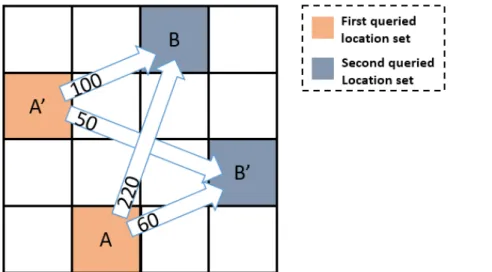
More recently, an enhanced algorithm was proposed in [34], termed as the dummy-location selection (DLS) algorithm. The algorithm considers the likelihood of locations being real or fake predicated on the history of queries on the map. The basic idea of the DLS algorithm can be explained intuitively in Fig.3.1. Assume that a user is at locationAand a dummy generation algorithm is required to generate one dummy to preserve the location privacy of user shown by
A′. The DLS algorithm argues thatA′cannot just be any point on the map but a location that has a similar likelihood of being queried as to the locationA. Such a likelihood can be calculated from the history of queries on the map. For instance, if the locationAhas been queried 1000
3.1 Introduction 15
Fig. 3.1 An example of location privacy of the user being compromised by considering the introduced side information.
times, andA′has been queried only 5 times, the LBS provider can infer with a high likelihood that the locationA is the real location of the user. Based on this logic, the DLS algorithm attempts to select dummies with the same likelihood as the actual locations. Information such as the query likelihood, and extra details that adversaries may know are usually referred to as ‘side information’. Unfortunately, the DLS algorithm overlooks a significant piece of side information, which can severely compromise the location privacy, as explained in the following.
Suppose that the userA moves to location Band the DLS algorithm generates another dummyB′associated with the locationB. Based on the history of trajectories traveled on the map, the adversary may know the likelihood of paths which have been traveled by users. For instance, the locationBhas been queried sequentially after the locationAfor 220 times. This is shown by a directed arrow connectingAtoBin the map. Let us now look at the four directed edges connecting the two sets of locations and consider the number of times that each path has been traveled. It can be seen from Fig.3.1that in total, locationBhas been called 320 times after locationsAandA′, whereas locationB′has been queried only 110 times. Therefore, the adversary can infer with a high likelihood that the real location is possibly locationB, and thus, compromise the location privacy of user.
16 Location Privacy in Mobile Networks
In this work, we study the impact of such side information on the location privacy of users. Compared with the existing literature, the main contributions of this study are presented as follows:
• We propose a novel metric called transition entropy. This metric investigates the privacy of users in trajectories as well as static queries. To improve the transition entropy of already existing algorithms, we have also developed an exhaustive framework that can improve transition entropy for a given algorithm.
• We show the susceptibility of user privacy in trajectories by developing an attack model based on Viterbi Algorithm.
• We propose an algorithm called robust dummy generation (RDG) that is resilient to the Viterbi attack. Moreover, this algorithm maintains high cell entropy performance as well as higher levels of transition entropy.
• We compare and evaluate the performance of the proposed metrics and algorithms on a publicly available dataset published by Microsoft, i.e., Geolife dataset.
3.2
System Model and Problem Formulation
3.2.1
System Architecture
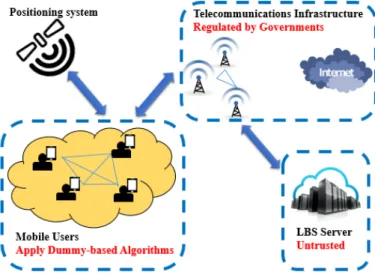
Following the recent standards and the current system designs used in the telecommunications industry [74,41,75,76], we adopt a non-cooperative system architecture as shown in Fig.3.2. In this design, there are two main parties involved: LBS users and an LBS server. There is also the telecommunication infrastructure in between which works as a medium for communications between the two parties. The role of each party is explained in the following.
1) LBS users: The system model consists of multiple users equipped with mobile phones with embedded GPS modules. Users can benefit from numerous LBSs provided by LBS servers
3.2 System Model and Problem Formulation 17
via a variety of LBS applications that can be downloaded and installed. Regardless of whether applications require users to log in to the system or not, the users request for services by providing their (I) identifiers such as IP address, username, etc. (II) location information (III) type of services (IV) some dummy locations to hide their exact locations. Moreover, in this work, we focus on ‘explicit’ trajectory data in which queries are made at uniform time intervals. GPS data is the most representative example of explicit trajectory data which is widely used in researches of trajectory analysis [77–79].
2) LBS server: The LBS provider is responsible for providing queried services by users. The LBS server is capable of storing the queried information and may have access to other databases and side information. This configuration enables the LBS server to infer historical query probabilities of users. After each query from a user, the server stores the requested information and updates the database accordingly.
3) Intermediary infrastructure: The queried services from the LBS server are transmitted through telecommunications infrastructure. The telecommunications infrastructure is con-trolled by mobile operators and regulated by government agencies [80,41]. Therefore, such infrastructure is considered to be trusted in the system model. Admittedly, this assumption might not hold for untrusted operators and governments that violate the privacy of users in the name of national security. Such a consideration is out of the scope of our work here.
3.2.2
Preliminaries
Assume that the location map is divided into an n×n grid, and a user communicates with an LBS server for service. At the timetq, the user intends to make his/herq-th query from the service provider, preserving kq-anonymity. Here, kq quantifies the privacy protection requirement of the user. This metric implies that the adversary is not able to identify the real location of the user with a probability higher than 1/kq. Hence, such a user needs to transmitkq−1 dummy locations to hide his/her true location from the observer. Note that the
18 Location Privacy in Mobile Networks
Fig. 3.2 System architecture of LBSs.
term ‘location’ refers to the cell in which the user is located. We denote the set of locations transmitted to the LBS provider atq-th query by
LSq={l1q,l2q, ...,lqkq}. (3.1)
Also, the real location is shown byrq, whererq∈LSq. The probability of locationlxqbeing the real location can be expressed as
Pr(lxq=rq), ∀x=1, ...,kq. (3.2)
In the next query, the user requires kq+1-anonymity and queries the location set LSq+1=
{lq1+1,l2q+1, ...,lq+1
kq+1}from the LBS provider. The probability ofl
q+1
y ∈LSq+1 being queried
consecutively afterlxq∈LSqis denoted by
3.2 System Model and Problem Formulation 19
3.2.3
Cell Entropy Metric
The cell entropy metric was implicitly proposed as part of the DLS algorithm in [34]. The metric is predicated on two factors: query probabilities of cells and the concept of entropy explained as follows.
For a given location setLSq={l1q,l2q, ...,lkqq}which includes the real location of a user and
kq−1 dummies chosen to preservekq-anonymity, the set of query probabilities are shown by
Bq={bq1,b2q, ...,bqkq}, whereb q
j is the query probability of location (cell)l q
j for j=1,2, ...,kq.
The query probability of celllqj is calculated by
bqj= number of queries inl q j
number of queries in the whole map. (3.4) The cell entropy borrows the concept of entropy from information theory to quantify uncertainty in query probabilities. The cell entropy metric for location setLSqcan be calculated as [34]
hc=− kq
∑
j=1 bqjlog2(bqj). (3.5)3.2.4
Adversary Model
Two types of adversary models are considered in our work: active adversary, and passive adversary. A passive adversary can listen to the communications between the users and the LBS provider. The passive adversary can compromise the location privacy of users by performing an eavesdropping attack and analyzing the collected information. An active adversary, on the other hand, compromises the LBS provider and has access to the data stored on the server.
3.2.5
Side Information
There are several side information that adversaries may possess to compromise the location privacy of users. Adversaries may know about the probability of a query being made in different
20 Location Privacy in Mobile Networks
locations of the map. For instance, if a location has been queried five times among the overall 1000 queries made on the map, its query probability can be calculated as 5/1000. Exploiting query probabilities, adversaries can understand the likelihood of locations being genuine or fake. For instance, if a user queries two locations at the same time, one with a comparably higher probability, it is more likely that the real location is the one with the higher probability.
Query probability has always been a critical consideration in the generation of dummy locations. In this work, apart from the possession of traditional side information by adversaries, we consider another prominent side information that can severely compromise the privacy of users. That is, the trajectories users have traveled, which reveals how many time a location has been queried after its neighbor locations. Authorities do not specify any time limit for storing the location information of the users, as it is the case in the US [81]. This lack of legislation enables adversaries to monitor users and get access to trajectories they travel.
3.3
Transition Entropy
In this section, we propose a metric called transition entropy to quantify privacy preservation in LBSs. We first explain the metric for two consecutive queries, then, expand it to trajectories with higher lengths. This metric quantifies the privacy of users in trajectories and can be used as a benchmark to compare and evaluate the performance of dummy-based algorithms. Moreover, transition entropy necessitates the development of new algorithms, as it reveals the susceptibility of user privacy.
3.3.1
Transition entropy metric for two consecutive queries
Considerq-th and(q+1)-th query of a user from the LBS provider. In theq-th query, the user requests service for the location setLSq={l1q,l2q, ...,lkqq}includingkq−1 dummies and the real
3.3 Transition Entropy 21
Fig. 3.3 Bipartite graph generated by two consecutive queries of a user.
anonymity constraint ofkq+1and making its(q+1)-th query. Dummies can be generated using any of the existing algorithms. Based on the setsLSqandLSq+1, we generate a bipartite graph shown in Fig. 3.3, where each set forms vertices at one side of the bipartite graph. Looking at the history of queries on the map, we denote the number of times locationlyq+1∈LSq+1has been queried after locationlxq∈LSqbynxy, and assign it to the directed edge connectinglxqto
lyq+1. Also, as explained in the system model section, for every locationlqx ∈LSq, we denote the query probability of locationlxqby bqx. Query probabilities are also calculated from the historical data stored at the LBS provider.
Our goal is to find out how probable it is for each member of the location setLSq+1to be the real location, given the location setLSq. In other words, the aim is to calculate the posterior probability of members inLSq+1 with respect toLSq. This probability for each member of
22 Location Privacy in Mobile Networks ∀lyq+1∈LSq+1: Pr(lyq+1=rq+1|LSq) = (3.6) kq
∑
s=1 Pr((lsq⇒lyq+1),(lsq=rq)) = (3.7) kq∑
s=1 Pr(lsq⇒lyq+1|lsq=rq)Pr(lsq=rq), (3.8)where (3.7) is the joint probability of lsq being the real location of LSq, and moving to the locationlyq+1afterlsq. The former probability in (3.8) can be calculated as
∀lyq+1∈LSq+1, ∀lqx ∈LSq: Pr(lxq⇒lyq+1|lxq=rq) = nxy ∑k q+1 y=1nxy , (3.9)
and the latter probability indicates the normalized query probability and is given by
∀lxq∈LSq: Pr(lxq=rq) = b q x ∑k q j=1b q j . (3.10)
Note that (3.10) indicates that the posterior probabilities of cells inLSqare set to the normalized query probability of the locations inLSq. By calculating (3.8) for every member of LSq+1, the posterior probabilities of locations inLSq+1 are determined based onLSq. Having these probabilities, we exploit the concept of entropy to infer the uncertainty in identifying dummies. The entropy can be derived by
ht=− kq+1
∑
y=1
3.3 Transition Entropy 23
Algorithm 1:Transition entropy for two consecutive queries.
1 Input:LSqandLSq+1 2 Output:ht 3 Initialization:CellSum=0,h=0. 4 for1≤x≤kqdo 5 EdgeSum=0 6 for1≤y≤kq+1do 7 EdgeSum=EdgeSum+nxy 8 end 9 for1≤y≤kq+1do 10 Pr(lxq⇒lyq+1|lxq=rq) =nxy/EdgeSum 11 end 12 end 13 for1≤x≤kqdo 14 CellSum=CellSum+bqx 15 end 16 for1≤x≤kqdo 17 Pr(lxq=rq) =bqx/CellSum 18 end 19 for1≤y≤kq+1do 20 Pr(lyq+1=rq+1|LSq) =0 21 for1≤x≤kqdo 22 Pr(lyq+1=rq+1|LSq) =Pr(lqy+1=rq+1|LSq) 23 +Pr(lyq+1=rq+1|lxq=rq)Pr(lxq=rq) 24 end 25 ht=ht− 26 Pr(lyq+1=rq+1|LSq)log2(Pr(lyq+1=rq+1|LSq)) 27 end 28 returnht
We defineht as the transition entropy of the location setLSq+1with respect toLSq. The transition entropy metric reveals the uncertainty in identifying the real location by adversaries. Having a higher transition entropy reveals that for each member ofLSq+1, the probability of paths originating fromLSqto the destination of that member is similar to the other members of
LSq+1. Hence, it would be more difficult for the adversary to compromisekq+1-anonymity of the user. The formal algorithm for computing the transition entropy in two consecutive queries is presented in Algorithm1.
24 Location Privacy in Mobile Networks
Algorithm 2:Transition entropy for trajectories of lengthc+1.
1 Input:LSq,LSq+1, ...,LSq+c 2 Output:ht
3 Start:
4 Run Algo. 1 forLSqandLSq+1
5 forq+1≤query≤q+c−1do
6 Normalize posterior probabilities ofLSquery
7 Query probabilities ofLSquery←posterior probabilities ofLSquery 8 Run Algo. 1 forLSqueryandLSquery+1
9 end
10 ht←Normalize posterior probabilities ofLSq+cand calculate their entropy 11 returnht
The main advantages of the transition entropy metric are:
• considering the performance of the dummy based algorithms in trajectories and not just for a stationary set of locations.
• being able to investigate the performance of the dummy based algorithms for users with varyingk-anonymity requirements in their trajectories.
• elimination of the need for many other previously considered factors, such as time reachability and direction similarity.
3.3.2
Transition entropy metric for trajectories
Here, we generalize the transition entropy metric for trajectories with different lengths. Consider a user requesting for its (c+1)-th query at timetq+c. Hence, providing the LBS provider with the location setLSq+c={l1q+c,l2q+c, ...,lq+c
kq+c}in order to preservekq+c-anonymity. The previous
queried location sets of the user are shown byLSq+ifori=0, ...,c−1, each with the privacy requirement shown bykq+i. Initially, we aim to calculate the posterior probability of each location inLSq+c. The posterior probabilities indicate the likelihood of any location inLSq+c
being the real location based on the previous queries of the user. The posterior probability for each location inLSq+ccan be written as
3.3 Transition Entropy 25 kq+c−1
∑
sc=1 kq+c−2∑
sc−1=1...
kq∑
s1=1(
Pr(lq s1 =r q)Pr(lq+c−1 sc ⇒lyq+c|lsqc+c−1=rq+c−1)× c−1∏
i=1 Pr(lq+i−1 si ⇒l q+i+1 q+i |l q+i−1 si =r q+i−1))
(3.15) ∀lyq+c∈LSq+c: Pr(lyq+c=rq+c|LSq, ...,LSq+c−1) = (3.12) kq+c−1∑
sc=1 Pr((lsqc+c−1⇒lyq+c), (lsqc+c−1=rq+c−1)|LSq, ...,LSq+c−2)) = (3.13) kq+c−1∑
sc=1 Pr(lsqc+c−1⇒lyq+c|lsqc+c−1=rq+c−1)× Pr(lsqc+c−1=rq+c−1|LSq, ...,LSq+c−2). (3.14)Following the same process of moving from (3.12) to (3.14), the probability of Pr(lq+c−1
sc−1 = rq+c−1|LSq, ...,LSq+c−2)can be solved recursively to reach (3.15). Also, the transition proba-bilities in (3.12) can be calculated as (3.9). Therefore, evaluating (3.15) for each node inLSq+c, we can determine the likelihood of a location being the real location of the queried setLSq+c. Finally, we borrow the concept of entropy to characterize the uncertainty in probabilities of
LSq+c. So that: ht=− kq+c
∑
y=1 Pr(lyq+c=rq+c|LSq, ...,LSq+c−1) log2(Pr(lyq+c=rq+c|LSq, ...,LSq+c−1)). (3.16)26 Location Privacy in Mobile Networks
We callht, the transition entropy of the setLSq+cwith respect to location setsLSq, ...,LSq+c−1.
Our experiments will demonstrate that the proposed transition entropy metric shows the high possibility of revealing the real location of users from their previous queries made on the map. The algorithm to calculate the transition entropy metric is presented formally in Algorithm4.
In the derivation of transition entropy, the only place in which query probabilities of loca-tions play a role is in the first queried location set. The transiloca-tions between the queried localoca-tions determine the remaining factors. It is essential to understand why the query probabilities of the other locations on the path are not used in the calculation of transition entropy.
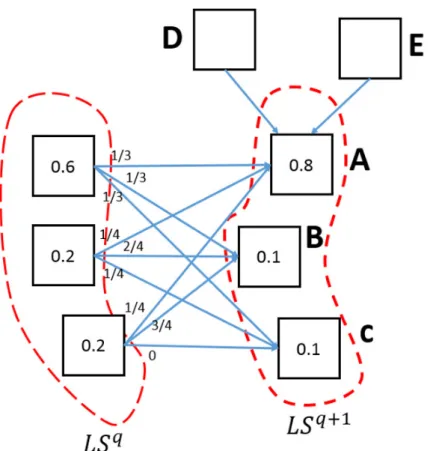
We explain the concept using an example. Fig. 3.4. demonstrates a case where a user requests an LBS in two consecutive queries. The numbers written on the nodes indicate the normalized query probability of locations, and the numbers printed on the edges indicate the normalized probability of that transition. Now, consider the calculation ofLSq+1 based on the previous queried location setLSq. The purpose of the example is to illustrate why the posterior probabilities calculated by previous queries forLSq+1is more reliable than the query probabilities of locations inLSq+1. First, let us calculate the posterior probabilities ofLSq+1
and its entropy. According to (3.15), the posterior probabilities can be written as
Posterior probability of A being the true location= (3.17) 3 5× 1 3+ 1 5× 1 4+ 1 5× 1 4 = 6 20
Posterior probability of B being the true location= (3.18) 3 5× 1 3+ 1 5× 2 4+ 1 5× 3 4 = 9 20
Posterior probability of C being the true location= (3.19) 3 5× 1 3+ 1 5× 1 4 = 5 20
3.3 Transition Entropy 27
Fig. 3.4 An example of two consecutive queried location sets.
According to the query probabilities of LSq+1, the location A is more likely to be the real location as it has a significantly higher query probability. However, looking at the posterior probabilities calculated for the location set, we can see that based onLSq, locationBis more probable to be the real location of the user. This discrepancy can be explained by looking at what the actual meaning of query probability is. The query probability indicates the number of times a location has been called but does not specify if it has been called after any particular location. Therefore, although the locationAhas been called more times than the other locations in LSq+1, most of these queries have been made after locations E and D, which are not a member of the location setLSq. Hence, it can be seen that the posterior probabilities are more credible, as they are considering the number of times queries made after the previous location setLSq.
28 Location Privacy in Mobile Networks
3.4
Viterbi Attack
The Viterbi algorithm is a well-known dynamic programming algorithm proposed in 1967 [82]. Initially, it was used for convolutional codes, but then it found numerous applications, such as exploring the most likely sequence of hidden states in Hidden Markov Models (HMMs). For a given graph, the aim of the algorithm is to find the shortest path or so-called Viterbi path. The Viterbi algorithm provides several features which distinguish this algorithm from the other existing algorithms for this purpose. The most essential characteristic of the algorithm is the low computational complexity. Here, we design an attack model based on the Viterbi algorithm and name it Viterbi attack, since the principal idea behind the attack is inspired by the Viterbi algorithm. The proposed Viterbi attack can significantly compromise the location privacy of users if it is not considered in the design of the dummy generation algorithms. As it will be demonstrated in simulations, even for short trajectories, the Viterbi attack can reveal a significant number of user locations.
Given the location setsLSq,LSq+1,...,LSq+c, corresponding to a trajectory of lengthc+1 of a user, an adversary seeks to find the most probable location sequence or so-called state sequence. Hence, the attacker aims to identify locations which are most likely to be the actual locations of the user and not the dummies. The desired state sequence of the adversary includes all the real locations of the user shown by{rq,rq+1, ...,rq+c}.
We defineµ(c+1,u)to be the maximum probability of a state sequence with the length ofc+1, givenzq,zq+1, ...,zq+c wherezj∈LSj and zq+c=u∈LSq+c. This function can be mathematically expressed as
µ(c+1,u) =
max
zq:q+m|zq+m=uPr(z
3.4 Viterbi Attack 29
where for eachu∈LSq, and the initial value of the µ function is set to be
µ(0,u) =Pr(u=rq). (3.21)
As the most credible information for the first queried location set is the query probability, Pr(u=rq)is calculated via equation (3.10). Starting from the second queried location set the most probable path can be calculated recursively as
µ(m+1,u) =
max
u′∈LSq+c−1µ(c,u
′)
Pr(u′→u). (3.22)
Algorithm 3:Viterbi attack.
1 Input:Location setsLSq,LSq+1,...,LSq+cand the normalized query probability for the
location setLSq
2 Output:EstStatewhich is the most likely path 3 Start:. 4 for1≤u≤kqdo 5 µ(q,u) =Pr(luq=rq) 6 pointer(q,u) =0 7 end 8 for1≤ j≤cdo 9 for1≤u≤kq+jdo 10 µ(q+ j,u) = max u′∈LSq+j−1µ(q+j−1,u ′)Pr(u′→u)
11 pointer(q+j,u)←state of max
u′∈LSq+j−1µ(q+j−1,u
′)
12 end 13 end
14 EstState[c] =state ofmax(µ(q+c,:))
15 forc−1≥ j≥0do
16 EstState[j] =pointer(q+j+1,EstState[j+1]) 17 end
18 Output:EstState.
The formal presentation of Viterbi attack is given in Algorithm3. The algorithm starts by setting the initial values of theµ array to their normalized query probability in lines 4−7. An array called pointeris used to keep track of the most likely state of the previous queried
30 Location Privacy in Mobile Networks
location set as the most probable path is calculated in lines 8−13. Finally, the most probable path is chosen and the corresponding states are returned as outputs.
3.5
Proposed Algorithms to Improve Location Privacy of
Users
In this section, we start by developing an exhaustive search algorithm to improve the transition entropy metric for a given dummy-generation algorithm. We denote this hypothetical algorithm byX and aim at increasing its transition entropy in trajectories.
Next, we propose an algorithm called RDG that significantly increase the privacy of users against the Viterbi attack, while maintaining the high performance in terms of transition entropy and cell entropy. The basis of the RDG algorithm is an algorithm called DLS proposed in [34].
3.5.1
Exhaustive Search Algorithm
Algorithm 4:Exhaustive search algorithm
1 Input:LSq={l1q,l2q, ...,lkqq},{l q+1
1 },kq+1
2 Output:LSq+1 3 Start:
4 D←generate a pool of 4kq+1dummies using theX algorithm 5 {S1,S2, ...Sm} ←choosemdistinct(kq+1−1)-subsets ofD 6 for1≤y≤mdo
7 Sy←Sy∪ {l1q+1}
8 hy←calculate transition entropy ofSy 9 H←H∪ {hy}
10 end
11 LSq+1←Scorresponding to the maximumh 12 returnLSq+1
Suppose that a user has made itsq-th query shown byLSq = {l1q,l2q, ...,lqkq}, which includes
3.5 Proposed Algorithms to Improve Location Privacy of Users 31
algorithmX. In the next query, the user moves to a new location (l1q+1) and seeks to generate
kq+1−1 dummy locations. The following approach will help the user increase its transition entropy while generatingLSq+1.
The idea is to generate a pool of dummies based on the algorithmX instead of onlykq+1−1 dummy locations. Having the dummy pool, the exhaustive search algorithm goes through
kq+1−1 subsets of the pool to find the one that maximizes the transition entropy. The formal description of the proposed exhaustive approach is presented in Algorithm 4. The inputs of the algorithm are the location set LSq = {l1q,l2q, ...,lkqq}, the real location of the user in
(q+1)-th query, and the privacy requirement of the user in(q+1)-th query.
The exhaustive search algorithm starts by generating a pool of 4kq+1dummies using theX
algorithm and assigns them to an empty setD. Then,mdistinct subsets ofDwith(kq+1−1)
members are chosen and assigned toS ={S1,S2, ...Sm}. Any of the members in S, once
attached to l1q+1 will form a complete kq+1 set, preserving kq+1-anonymity. Note that the constraintmis chosen to limit the number of subsets computed in case of a large pool size. Next, the transition entropies resulted from the members ofS are calculated and stored in
H. Finally, the member ofSthat results in the maximum transition entropy is returned as the output.
3.5.2
RDG Algorithm
We propose a robust algorithm called RDG to preserve the location privacy of LBS users. The RDG algorithm has three advantages compared with the existing algorithms: (I) Provides high resilience against the Viterbi attack (II) Achieves near-optimal cell entropy (III) Results in a much higher transition entropy compared with the existing approaches. The algorithm is based on the idea of posterior probabilities, and it is formally presented in Algorithm5.
Following the same setup as the proposed exhaustive search algorithm, a user has made its
32 Location Privacy in Mobile Networks
dummies. The dummies inLSqare generated using the DLS algorithm. In the next query, the user moves to a new location (l1q+1) and seeks to generatekq+1−1 dummy locations. IfLSq
is the initial query of the user from the LBS provider, then the initial posterior probabilities are set to the normalized query probabilities of the locations inLSq; otherwise, the posterior probabilities are calculated by (3.12). In the algorithm, posterior probabilities are assigned to an array calledweight.
The algorithm starts with the generation of a pool of dummies using the DLS algorithm based on the real location ofLSq+1. Using the DLS algorithm to generate the pool of dummies will ensure high performance in terms of cell entropy. From our experiments, setting the pool size to four times of thekq+1maintains the cell entropy sufficiently high, while resulting in a robust performance in terms of the transition entropy and Viterbi attack resilience. Next, the algorithm continues by employing a greedy approach to add the most suitable dummies for the location setLSq+1. For choosing thei-th member of the setLSq+1, each of the remaining dummies in the pool is checked one by one. A criterion chosen here is based on maximizing the entropy for the arrayweight. For each memberu∈LSq+1, theweight array is calculated as
weight(q+1,u) =
max
u′∈LSqweight(q,u
′)Pr(u′→u). (3.23)
The first index of the weight array is used to distinguish between weights corresponding to different location sets. For each member of the dummy pool, its weight is calculated, followed by the entropy of the weight array. After calculation of the entropy for all possible members, the member having the maximum entropy is chosen as the next member ofLSq+1. The process continues until allkq+1−1 dummies ofLSq+1are chosen. Note that before the calculation of entropy, the weights are normalized to make the accumulation of probabilities add up to one. The algorithm is designed to provide a high cell entropy and transition entropy for users’ of the LBS applications while protecting them from the Viterbi attack on trajectories.
3.6 Performance Evaluation 33 Algorithm 5:RDG algorithm. 1 Input:LSq={l1q,l2q, ...,lq kq},{l q+1 1 },kq+1 2 Output:LSq+1 3 Start: 4 for1≤u≤kqdo
5 weight(q,u)←Posterior probability ofluq 6 end
7 D←generate a pool of 4kq+1dummies using the DLS algorithm 8 for1≤member≤kq+1−1do 9 entropy=zeros(1× |D|) 10 for1≤d≤ |D|do 11 LSq+1=LSq+1∪ {D[d]} 12 for1≤u≤kq+1do 13 weight(q+1,u) = max u′∈LSqweight(q,u ′)Pr(u′→u) 14 end 15 normalizeweight(2,:)
16 entropy[d]←entropy ofweight(q+1,:)
17 LSq+1=LSq+1− {D[d]} 18 end
19 NewMember← {member ofDwhich maximizeentropy}
LSq+1=LSq+1∪ {NewMember} 20 D=D− {NewMember} 21 end 22 returnLSq+1
3.6
Performance Evaluation
3.6.1
Experimental Setup
In our experiments, we use the data collected by Geolife project [83–85]. The Geolife dataset includes the GPS trajectories of 182 users from April 2007 to August 2012 in Beijing, China. The dataset contains 17,621 trajectories with a total distance of 1,292,951 km. Two main advantages are distinguishing Geolife dataset for our work: Firstly, the recorded data aside from monitoring the daily routines of users, such as going to work or home, includes trajec-tories involving sports activities such as hiking and cycling. Secondly, many of the recorded
34 Location Privacy in Mobile Networks
Fig. 3.5 Comparison of algorithms in terms of cell entropy for differentk.
trajectories are tagged with transportation modes, which indicate the use of various means of traveling from bus and car to airplane and train.
We conducted our experiments on 1km×1km central part on the Beijing map with the resolution of 0.01km×0.01km for each grid cell. The location privacy requirements of users are investigated for values 2 to 30. For each value ofk, the trial is repeated 3000 times to ensure the reliability of results. The experiments were performed on a PC with a 3.40 GHz Core-i7 Intel processor, 64-bit Windows 7 operating system, and an 8.00 GB of RAM. Python programming is used to implement algorithms.
3.6.2
Performance Analysis
We evaluate the performance of the proposed algorithms and metrics through extensive experi-ments. We intend to show that the proposed RDG algorithm can achieve:
3.6 Performance Evaluation 35
• Robust transition entropy performance compared to prior works; • Privacy protection against the Viterbi attack.
Therefore, in the following subsections, we start by evaluating the performance of algorithms in terms of cell entropy, followed by transition entropy analysis and investigating the resilience to the Viterbi attack.
Cell entropy performance evaluation
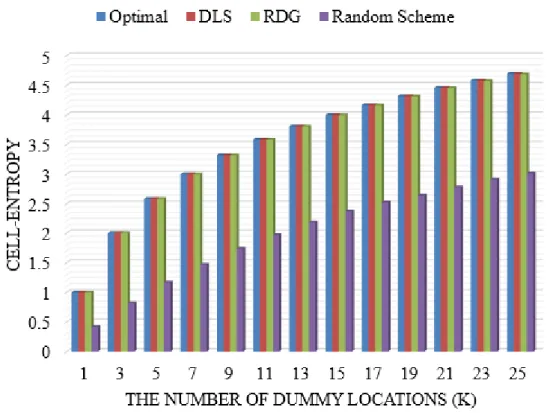
Cell entropy indicates how different is the query probability of the actual user location from its associated dummies. A higher cell entropy is desirable, as it results in higher uncertainty of finding the real location. Fig. 3.5presents the comparison among different algorithms in terms of cell entropy. The optimal value is achieved when allklocations queried from the LBS provider have the same probability of 1/k, or equivalently, the location set has the cell entropy ofh=log2(k). The optimal value is the upper bound for all algorithms since it is the maximum entropy that a location set can achieve.
In Fig 3.5, three algorithms are compared, including the DLS algorithm which is the conventional method for generation of dummy locations, our proposed RDG algorithm, and the random scheme by which dummies are chosen randomly. Moreover, optimal cell entropy values are shown as a benchmark.
As expected, the random scheme proposed in [31] results in a lower cell entropy compared to the other algorithms due to the random generation of dummies. On the other hand, the RDG and DLS algorithms both consider query probability of cells in the generation of dummies. Therefore, the cell entropy of these two algorithms is higher than the random scheme and almost achieve near-optimal performance. Having such a high cell entropy ensures that the adversary is not able to compromise the location privacy of users from a stationery set of locations submitted to the server. Unfortunately, although the DLS algorithm has a robust
36 Location Privacy in Mobile Networks
performance for a single collection of queried locations, no consideration has been given to locations queried as part of trajectories.
3.6 Performance Evaluation 37
(a) Trajectories of length 2.
(b) Trajectories of length 3.
(c) Trajectories of length 4.
38 Location Privacy in Mobile Networks
Transition entropy performance evaluation
The currently established cell entropy metric only considers the location privacy for a stationary set of queried locations submitted to the LBS server but overlooks the fact that users may ask for services successively. If users query location sets in consecutive attempts, they reveal the trajectory they are traveling. Therefore, adversaries can use the likelihood of traveling different paths between consecutive location sets to calculate the posterior probabilities and compromise the location privacy of users.
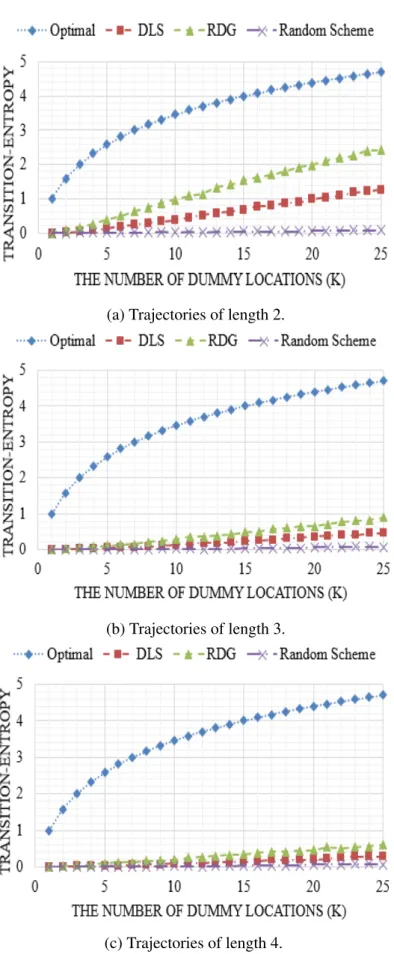
Fig.3.6compares the performance of different algorithms in terms of the transition entropy metric for variousk. Having a lower transition entropy suggests a lower privacy level for users of the LBS applications and a higher likelihood for adversaries to find out the actual coordinates of the users. We start our evaluation by trajectories of length 2 in Fig. 3.6a, and then focus on the transition entropy for longer paths in Figs. 3.6band3.6c. In all the three graphs, the comparison is conducted among the optimal transition entropy values, the widely adopted algorithm DLS, the proposed RDG algorithm, and the random scheme.
3.6 Performance Evaluation 39
(a) Percentage of user locations protected for the trajectory length of 2.
(b) Percentage of user locations protected for the trajectory length of 4.
(c) Percentage of user locations protected for the trajectory length of 6.
(d) Percentage of user locations protected for the trajectory length of 8.
Fig. 3.7 The performance evaluation and comparison of algorithms against the Viterbi attack considering various path lengths and privacy requirementk.
In Fig.3.6a, two consecutive location sets are generated based on the specified value of
k. Each of the locations sets includes the real location of the user and its associated dummies. To make experiments as realistic as possible, the movement pattern is chosen randomly from the recorded trajectories in the dataset. The optimal value corresponds to a scenario, in which all members of the second location set are equally likely to be called consecutively after
40 Location Privacy in Mobile Networks
the members of the first location set. This outcome is desirable, as it results in achievingk -anonymity for users and protecting their location privacy. The optimal values can be calculated in a similar way as the optimal number for the cell entropy. Considering Fig.3.6a, the random scheme in which the dummy locations are chosen randomly achieves the lowest transition entropy, indicating that the adversary can easily recognize most of the dummies from the transition entropy even for the two consecutive location sets queried by the user.
Furthermore, it can be seen from the figure that although the DLS algorithm achieves near-optimal performance in terms of cell entropy, it results in significantly low privacy protection in trajectories. Even for two consecutive queries from the LBS provider, the DLS algorithm indicates a significantly low transition entropy. Such performance shows that adversaries can compromise the location privacy of users by calculating the posterior probabilities.
Fortunately, the proposed RDG algorithm can significantly improve the transition entropy, achieving almost twice as high transition entropy as the DLS algorithm. In other words, the likelihood of compromising thek-anonymity requirement is decreased by the proposed algorithm, which leads to a higher location privacy level for users of the LBSs.
Figs. 3.6band 3.6cextend our analysis of transition entropy to trajectories with higher lengths. Both graphs indicate that as more locations are queried from the LBS provider, the transition entropy decreases. These experimental outcomes match well with the theory because having more information results in a more accurate calculation of posterior probabilities by adversaries; Hence, we expect to see less uncertainty and transition entropy.
Further investigating Figs.3.6band3.6c, the DLS algorithm can be seen to have a very low transition entropy compared to the proposed RDG algorithm. Therefore, the RDG algorithm is viable in increasing the transition entropy of users while maintaining the cell entropy to a near-optimal level. However, as the adversary acquires more location points, the threat to location privacy of users gets more serious. This fact can be seen in Fig.3.6. As the length of
3.6 Performance Evaluation 41
trajectory increases, the transition entropy decreases, which refers to having a higher chance for adversaries to get access to the location data of users.
3.6.3
Performance of Algorithms against Viterbi Attack
In this section, we compare and evaluate the performance of our proposed RDG algorithm and the widely accepted DLS method against the proposed attack model. The Viterbi attack considers users in trajectories instead of just taking into account snapshots of the real locations and dummies. The Viterbi attack is based on the calculation of posterior probabilities of user locations revealed to the LBS provider. It will be shown in the following that applying such an attack can significantly compromise the location privacy of users. Therefore, having a robust algorithm such as RDG is crucial to protect the location privacy.
Fig.3.7illustrates the performance of the RDG and DLS algorithms once the Viterbi attack is applied to the dataset. The figure consists of four subfigures to show the performance with various length of trajectories. In each subfigure, the percentage of real locations of users which have been protected are exhibited for different privacy requirementsk. For instance, in Fig.
3.7b, whenk=5, the graph indicates that the DLS algorithm can only protect 0.8 percent of the queried locations, and therefore, adversaries can almost distinguish all true locations of users from their associated dummies. This indicates how dangerous and powerful the Viterbi attack can be in compromising the privacy of users.
Considering the performance of the DLS algorithm, it can be seen in the figure that for path lengths greater than 2, the Viterbi attack can almost find out all real locations of the users despite the existence of dummy locations. Therefore, although in a single query user locations are protected using the existing dummy generation algorithms, when users are considered in trajectories, due to the extra side information that adversaries may hold, they are able to identify user locations.