CERTIFICATION REPORT
Certification of
244
Pu spike
reference material: IRMM-042a
Certified reference material
for the amount content of
244
Pu and Pu isotope
amount ratios
R. Buják, R. Jakopič, R. Eykens, F. Kehoe, H. Kühn, S. Richter and Y. Aregbe
This publication is a Reference Materials report by the Joint Research Centre (JRC), the European Commission’s science and knowledge service. It aims to provide evidence-based scientific support to the European policymaking process. The scientific output expressed does not imply a policy position of the European Commission. Neither the European Commission nor any person acting on behalf of the Commission is responsible for the use that might be made of this publication.
Contact information
Name: Renáta Buják
Address: Retieseweg 111, 2440 Geel, Belgium Email: [email protected] Tel.: +3214571960 JRC Science Hub https://ec.europa.eu/jrc JRC108889 EUR 28943 EN
PDF ISBN 978-92-79-77103-3 ISSN 1831-9424 doi:10.2760/0252
Luxembourg: Publications Office of the European Union, 2017
© European Atomic Energy Community, 2017
Reuse is authorised provided the source is acknowledged. The reuse policy of European Commission documents is regulated by Decision 2011/833/EU (OJ L 330, 14.12.2011, p. 39).
For any use or reproduction of photos or other material that is not under the EU copyright, permission must be sought directly from the copyright holders.
How to cite this report: Buják, R., Jakopič, R., Eykens, R., Kehoe, F., Kühn, H., Richter, S. and Aregbe, Y.,
Certification of 244Pu spike reference material: IRMM-042a, EUR 28943 EN, Publications Office of the European Union, Luxembourg, 2017, ISBN 978-92-79-77103-3, doi:10.2760/0252, JRC108889. All images © European Atomic Energy Community 2017
Title:Certification of 244Pu spike reference material: IRMM-042a
Abstract
IRMM-042a is a Certified Reference Material (CRM) of highly enriched 244Pu that has been re-certified for the amount content of 244Pu and for the plutonium isotope amount ratios.
The main purpose of this material is for use as a spike isotopic reference material to measure the amount content of plutonium in nuclear and environmental samples by isotope dilution mass spectrometry (IDMS). The CRM serves the nuclear safeguards community in Europe and worldwide as quality control tool.
Contents
Acknowledgments ... 1
Abstract………….. ... 2
1 Introduction ... 5
1.1
Background ... 5
1.2
Choice of the material ... 5
1.3
Design of the project ... 5
2 Participants ... 6
3
Material processing and process control ... 6
4
Homogeneity ... 6
4.1
Between-unit homogeneity ... 6
4.2
Within-unit homogeneity and minimum sample intake ... 9
5
Stability ... 9
6
Characterisation ... 10
6.1
Amount content of
244Pu and its uncertainty ... 10
6.2
Plutonium isotope amount ratios and their uncertainties ... 12
6.3
External certified test sample EQRAIN-11 ... 13
6.4
Comparison of the amount content of
244Pu from the homogeneity and
characterisation study ... 14
7
Value Assignment ... 15
7.1
Certified values and their uncertainties ... 15
8
Metrological traceability and commutability ... 18
8.1
Metrological traceability ... 18
8.2
Commutability ... 18
9
Instructions for use ... 18
9.1
Safety information ... 18
9.2
Storage conditions ... 18
9.3
Preparation and use of the material ... 19
9.4
Minimum sample intake ... 19
9.5
Use of the certified value ... 19
10
Conclusions ... 19
References
……….20
List of Abbreviations and definitions ... 22
List of Tables ... 24
List of Figures ... 25
Acknowledgments
The authors would like to thank to the internal reviewers: David Vanleeuw (JRC Geel, Directorate G - Nuclear Safety and Security, G2 - Standards for Nuclear Safety, Security and Safeguards) and Guy Auclair (JRC Geel, Directorate F - Health, Consumers and Reference Materials F6 - Reference Materials) as well as the experts of the Certification Advisory Panel: Steven D. Balsley (International Atomic Energy Agency, Vienna, Austria), Peter Mason (NBL Program Office, US Department of Energy, Argonne, U.S.A.) and Richard Essex (National Institute of Standards and Technology, Gaithersburg, U.S.A.) for reviewing the certification report. The authors are specially thankful to Ulf Jacobsson (JRC Geel Directorate G - Nuclear Safety and Security, G2 - Standards for Nuclear Safety, Security and Safeguards) for reviewing the mass metrology data and equations as well as for the revised version of the Weighing Certificate: 3810 REV1.
Authors
R. Buják, R. Jakopič, R. Eykens, F. Kehoe, H. Kühn, S. Richter, Y. Aregbe
European Commission, Joint Research Centre, Directorate G - Nuclear Safety and Security, Geel, Belgium
Abstract
IRMM-042a is an existing spike Certified Reference Material (CRM) of highly enriched 244Pu
that has been re-certified for the amount content of 244Pu and for the plutonium isotope
amount ratios. Since the reference material was produced 30 years ago, there have been significant improvements in analytical instruments and methods. Accordingly, the uncertainty of the 244Pu amount content of the original material certificate was considered to
be too large. Furthermore, recent measurements of a plutonium external quality control certified test sample (EQRAIN Plutonium Program No 11) by Isotope Dilution Thermal
Ionization Mass Spectrometry (ID-TIMS) using the IRMM-042a indicated a slight deviation from the previous value for the amount content of 244Pu as certified in 1987. Therefore, it
was decided to perform a new series of certification measurements in compliance with ISO 17034:2016 [1] and to issue a new certificate.
Between-unit homogeneity was quantified in accordance with ISO Guide 35:2006 [2]. No dedicated stability studies were carried out for this material since the general behaviour of this material is well known from past experience. However, a post-certification stability monitoring will be carried out to evaluate its stability after issuance of the certificate.
The certified value for the amount content of 244Pu was obtained from the characterisation
measurements on randomly selected units by ID-TIMS using the IRMM-049d 242Pu CRM as
the spike. The plutonium isotope amount ratios were measured by Triton TIMS.
Uncertainties of the certified values were estimated in compliance with the Guide to the Expression of Uncertainty in Measurement (GUM) [3] and include uncertainties related to possible inhomogeneity and to characterisation.
The main purpose of this material is for use as a spike isotopic reference material to measure the amount content of plutonium in nuclear and environmental samples by isotope dilution mass spectrometry (IDMS). The IRMM-042a CRM is supplied in flame sealed glass ampoules containing about 10 mL of nitric acid solution (c = 5 mol/L) with a mass fraction of plutonium of about 1 μg/g solution.
The material is a true solution; therefore there is no recommended minimum sample intake1
to be taken into account.
The following values were assigned:
IRMM-042a PLUTONIUM IN NITRIC ACID SOLUTION
Amount content Certified value 1) [nmol/g (solution)] Uncertainty 2) [nmol/g (solution)] 244Pu 3.7507 0.0050 Pu 3) 3.8298 0.0051
Isotope amount ratios Certified value 1) [mol/mol] Uncertainty 2) [mol/mol] n(238Pu)/n(244Pu) 0.0000434 0.0000064 n(239Pu)/n(244Pu) 0.00034360 0.00000095 n(240Pu)/n(244Pu) 0.0068953 0.0000095 n(241Pu)/n(244Pu) 0.00015954 0.00000072 n(242Pu)/n(244Pu) 0.0136091 0.0000094 Mass fraction Certified value 1) [µg/g (solution)] Uncertainty 2) [µg/g (solution)] 244Pu 3) 0.9154 0.0012 Pu 3) 0.9345 0.0013 Molar mass Certified value 1) [g/mol] Uncertainty 2) [g/mol] Pu 3) 244.007852 0.000039
1) The certified values are traceable to the International System of units (SI) via the values on the respective
certificates of IRMM-049d and IRMM-290b-A3. The reference date for the certified values is January 1, 2017.
2) The uncertainty is the expanded uncertainty with a coverage factor k = 2 corresponding to a level of
confidence of about 95 % estimated in accordance with ISO/IEC Guide 98-3, Guide to the Expression of Uncertainty in Measurement (GUM:1995), ISO, 2008.
3) The derived certified values are calculated from the certified amount content of 244Pu, certified plutonium
isotope amount ratios and the atomic masses according to Wang et al. (The AME 2012 atomic mass evaluation (II). Tables, Graphs and References, Chinese Physics C, Vol. 36, No. 12, 1603-2014, 2012).
The half-lives of radionuclides were obtained from DDEP-BIPM (Table of radionuclides) and R. Wellum et al. (A new evaluation of the half-life of 241Pu, J. Anal. At. Spectrom., 24, 801-807, 2009).
The following values were assigned (continued):
IRMM-042a PLUTONIUM IN NITRIC ACID SOLUTION
Isotope mass fractions (·100) Certified value 1) 3) [g/g] Uncertainty 2) [g/g] m(238Pu)/m(Pu) 0.00414 0.00061 m(239Pu)/m(Pu) 0.032971 0.000072 m(240Pu)/m(Pu) 0.66467 0.00017 m(241Pu)/m(Pu) 0.019278 0.000074 m(242Pu)/m(Pu) 1.32216 0.00018 m(244Pu)/m(Pu) 97.95678 0.00068
Isotope amount fractions (·100) Certified value 1) 3) [mol/mol] Uncertainty 2) [mol/mol] n(238Pu)/n(Pu) 0.00425 0.00062 n(239Pu)/n(Pu) 0.033654 0.000074 n(240Pu)/n(Pu) 0.67562 0.00018 n(241Pu)/n(Pu) 0.019514 0.000075 n(242Pu)/n(Pu) 1.33281 0.00018 n(244Pu)/n(Pu) 97.93416 0.00069
1) The certified values are traceable to the International System of units (SI) via the values on the respective
certificates of IRMM-049d and IRMM-290b-A3. The reference date for the certified values is January 1, 2017.
2) The uncertainty is the expanded uncertainty with a coverage factor k = 2 corresponding to a level of
confidence of about 95 % estimated in accordance with ISO/IEC Guide 98-3, Guide to the Expression of Uncertainty in Measurement (GUM:1995), ISO, 2008.
3) The derived certified values are calculated from the certified amount content of 244Pu, certified plutonium
isotope amount ratios and the atomic masses according to Wang et al. (The AME 2012 atomic mass evaluation (II). Tables, Graphs and References, Chinese Physics C, Vol. 36, No. 12, 1603-2014, 2012).
The half-lives of radionuclides were obtained from DDEP-BIPM (Table of radionuclides) and R. Wellum et al. (A new evaluation of the half-life of 241Pu, J. Anal. At. Spectrom., 24, 801-807, 2009).
1 Introduction
1.1 BackgroundThe JRC-Geel Directorate G – Nuclear Safety and Security, Unit G.2 Standards for Nuclear Safety, Security and Safeguards (previously known as EC-JRC-IRMM) has been providing solutions of enriched plutonium isotopes for the measurements of nuclear materials using state-of-the-art analytical techniques for many years.
Plutonium is a transuranic, primarily man-made radioactive element with many isotopes, among which the 244Pu has the longest half-life (81.2·106 a). Unlike the other isotopes of
plutonium, 244Pu is not produced in quantity by neutron capture reactions in any but the
highest neutron flux environments, and it occurs in nature only in trace amounts as a primordial 244Pu [4]. Hence, it is very suitable as a spike isotope for mass-spectrometric
isotope dilution measurements of nuclear materials and environmental samples.
The original material certificate of IRMM-042a was issued in 1987. It had a relative expanded uncertainty on the amount content of plutonium of about 0.2 % due to instrument capabilities and methods used in mass spectrometry at that time. With the recent improvements in mass spectrometry, and the development of new analytical methods, measurement precision has improved markedly since the 1980s. In addition to these improvements, the revised requirements for measurement uncertainties as expressed in the International Target Values 2010 for Measurement Uncertainties in Safeguarding Nuclear Materials (ITV-2010) [5], bolsters the need for certified reference materials (CRMs) with smaller uncertainties. In addition, recent measurements in the scope of the inter-laboratory comparison (ILC) EQRAIN indicated a slight deviation from the previous amount content of 244Pu in IRMM-042a compared to the certified value from 1987.
For these reasons, new characterisation and homogeneity measurements of the IRMM-042a were performed and a new material certificate with revised certified values and uncertainties was issued.
1.2 Choice of the material
The material is an existing CRM, supplied in flame sealed glass ampoules containing about 10 mL of nitric acid solution (c = 5 mol/L) with a mass fraction of plutonium of about 1 μg/g solution. In the past 30 years, since the production of the IRMM-042a, there is no evidence that the material has degraded and it is still believed to be fit for purpose (see Section 5).
1.3 Design of the project
IRMM-042a was characterised for the amount contents of 244Pu and total Pu, the mass
fractions of 244Pu and total Pu, the isotope amount ratios of plutonium, the isotope amount
and mass fractions (e.g. isotopic composition) and the molar mass of Pu.
Characterisation and homogeneity measurements for the amount content were carried out in compliance with ISO 17034:2016 on randomly selected units that were chemically purified by anion exchange. Ten units were analysed for the homogeneity assessment using IRMM-083 as 240Pu spike CRM and six units for the characterisation using IRMM-049d as 242Pu spike CRM. The amount content of 244Pu in the selected units was determined by
Isotope Dilution Thermal Ionisation Mass Spectrometry (ID-TIMS) [6].
The isotope amount ratios of plutonium were measured by Triton TIMS on additional four randomly selected units.
2 Participants
Project management and evaluation, processing, homogeneity study and characterisation have been performed at the European Commission, Joint Research Centre, Directorate G - Nuclear Safety and Security, G.2 - Standards for Nuclear Safety, Security and Safeguards, Geel, Belgium.
3 Material processing and process control
The IRMM-042a is an existing CRM; therefore no material processing and process control were carried out for this re-certification project.
4 Homogeneity
A key requirement for any reference material is the equivalence between the various units. In this respect, it is relevant whether the variation between units is significant compared to the uncertainty of the certified value. In contrast to that it is not relevant if this variation between units is significant compared to the analytical variation. Consequently, ISO 17034:2016 [1] requires RM producers to quantify the between-unit variation. This aspect is covered in between-unit homogeneity studies.
The within-unit inhomogeneity does not influence the uncertainty of the certified value when the minimum sample intake is respected, but determines the minimum size of an aliquot that is representative for the whole unit.
4.1 Between-unit homogeneity
The between-unit homogeneity was evaluated to ensure that the certified values of the CRM are valid for all 135 units of the material, within the stated uncertainty.
Ten units were selected to assess the homogeneity for the amount content of 244Pu using a
random stratified sampling scheme covering the whole batch (unit numbers: 9, 19, 48, 55, 67, 97, 101, 121, 132 and 164). The batch was divided into ten groups (with a similar number of units) and one unit was selected randomly from each group. The measurement results from unit No 121 showed a relative difference of 0.52 % compared to the average of
the results from the other units. This relative difference is too high to stem from a statistical outlier. Despite thorough review of the data no numerical mistake in the weighing or in the mass spectrometry results could be found. The sample No 121 was believed to have been
compromised during the chemical separation. Therefore, it was considered as an erroneous sample and was excluded from the final homogeneity evaluation based on this technical reason.
The homogeneity assessment for the plutonium isotope amount ratios was deemed unnecessary. This statement is based on the long experience of JRC.G.2-Geel producing and certifying nuclear reference materials. It was demonstrated in the course of various certification projects of spike isotopic CRMs that no inhomogeneity effects were observed for the isotope ratios [7].
The homogeneity study for the amount content of 244Pu was designed as follows.
The entire sample of each selected unit was taken for the IDMS analysis. One ampoule of IRMM-083 240Pu spike CRM was selected (No 1915) and diluted gravimetrically 10-fold one
prepared and chemically purified using an anion exchange resin (Bio-Rad AG1-X4, 100-200 mesh, Bio-Rad, Hercules, USA) as described in detail in [8, 9]. About 50 ng of the purified Pu solution was loaded on the evaporation filaments for isotope ratios measurements on the Triton TIMS (Thermo Fisher Scientific, Bremen, Germany) using the total evaporation (TE) method [8, 10, 11, 12, 13]. The mass fractionation correction was done by measuring a plutonium isotopic reference material, IRMM-290b-A3. Three filaments were prepared for each of the blends and distributed between two sample turrets for analysis. Each of the turrets also contained six filaments of the IRMM-290b-A3 isotopic standard. The two sample turrets were measured on different days.
Using the 240Pu spike IRMM-083 (C
y, spike) the amount content of 244Pu in IRMM-042a (Cx,
sample) can be determined through a measurement of the isotope amount ratio in a blend,
Rb= n(244Pu)/n(240Pu) via the following simplified IDMS equation:
x x b b y x y y x
R
R
R
R
R
m
m
C
C
Equation 1 whereCx: amount content of 244Pu in the sample [mol/g] Cy: amount content of 240Pu in the spike [mol/g]
mx: mass of the sample [g]
my: mass of the spike [g]
Rb: isotope amount ratio n(244Pu)/n(240Pu) of the blend [mol/mol] Rx: isotope amount ratio n(244Pu)/n(240Pu) of the sample [mol/mol] Ry: isotope amount ratio n(244Pu)/n(240Pu) of the spike [mol/mol]
The measurements for all ten selected units of IRMM-042a were performed under intermediate precision conditions rather than repeatability conditions. The respective fractions of the samples were measured in a randomised manner to be able to separate a potential analytical drift from a trend in the filling sequence. Some replicate measurement results had to be excluded from the evaluation due to technical reasons, such as e.g. loss of sample prior to total evaporation measurement, high background from the filament due to unusually high filament temperatures or very low signal intensity. The results for the amount content of 244Pu in the selected units are summarised in Annex 1.
Regression analyses were performed to evaluate potential trends in the analytical sequence as well as trends in the filling sequence. No trends in the filling sequence or the analytical sequence were visible. The result of the statistical evaluation is shown in Table 1.
Quantification of between-unit inhomogeneity was accomplished by analysis of variance (ANOVA), which can separate the between-unit standard deviation (sbb) from the within-unit
standard deviation (swb). The latter is equivalent to the method intermediate precision if the
individual samples are representative for the whole unit.
Evaluation by ANOVA requires unit means that follow at least a unimodal distribution and results for each unit that follow unimodal distributions with approximately the same standard deviations (homoscedasticity). Distribution of the unit means was visually tested using histograms and normal probability plots. Minor deviations from unimodality of the
individual values do not significantly affect the estimate of between-unit standard deviations. The results of all statistical evaluations are given in Table 1.
Table 1 Results of the statistical evaluation of the homogeneity studies for the amount content
of 244Pu in IRMM-042a
Trends 1) Outliers 2) Distribution
Analytical
sequence sequence Filling Individual results means Unit Individual results means Unit Amount content
of 244Pu no no none none unimodal unimodal
1) at 95 % confidence level 2) at 99 % confidence level
Method intermediate precision (swb,rel), between–unit standard deviation (sbb,rel) and u*bb,rel
were calculated as:
y
within rel , wbMS
s
Equation 2y
N
MS
MS
s
within between rel bb
, Equation 3y
ν
N
MS
u
MSwithin within * rel bb 4 ,2
Equation 4MSwithin mean square within a unit from an ANOVA MSbetween mean squares between-unit from an ANOVA
y
mean of all results of the homogeneity studyN mean number of replicates per unit
MSwithin
ν
degrees of freedom of MSwithinOne has to bear in mind that sbb,rel and swb,rel are estimates of the true standard deviations
and therefore subject to random fluctuations. Therefore, the mean square between groups (MSbetween) can be smaller than the mean squares within groups (MSwithin), resulting in
negative arguments under the square root used for the estimation of the between-unit variation, whereas the true variation cannot be lower than zero. In this case, u*
bb, the
maximum inhomogeneity that could be hidden by method repeatability (in our case intermediate precision) was calculated as described by Linsinger et al. [14]. u*
bb is
comparable to the limit of detection of an analytical method, yielding the maximum inhomogeneity that might be undetected by the given study setup.
The uncertainty contribution for homogeneity was determined under intermediate precision conditions because the isotopic measurements for all selected units of IRMM-042a could not be carried out on the same day. Consequently, day-to-day effects can occur that could mask the between-unit variation. Therefore, the data were first checked using one way-ANOVA for any significant difference in between-day means. No significant day-to-day difference was observed. The results of the evaluation of the between-unit variation are summarised in Table 2. The resulting values from the above equations were converted into relative uncertainties.
Table 2 Results of the homogeneity studies for the amount content of 244Pu in IRMM-042a
swb,rel [%] sbb,rel [%] u* bb,rel [%] Amount content of 244Pu 0.016 0.047 0.0057
The homogeneity study showed no outlying unit means at a 99 % confidence level and no trends in the filling sequence at a 95 % confidence level. Therefore, the between-unit standard deviation can be used as estimate of ubb. As u*bb sets the limits of the study to
detect inhomogeneity, the larger value of sbb and u*bb is adopted as uncertainty contribution
to account for potential inhomogeneity.
4.2 Within-unit homogeneity and minimum sample intake
The within-unit homogeneity is closely related to the minimum sample intake. The minimum sample intake is the minimum amount of sample that is representative for the whole unit and thus should be used in an analysis. Using sample sizes equal to or above the minimum sample intake guarantee the certified value within its stated uncertainty.
Quantification of within-unit inhomogeneity for IRMM-042a was not necessary because the material is a true solution and as such can be regarded as completely homogeneous. Therefore, no minimum sample intake needs to be taken into account for analysis.
5 Stability
Stability testing is necessary to establish conditions for storage (long-term stability) as well as conditions for dispatch to the customers (short-term stability). The IRMM-042a is a plutonium reference material, consisting of plutonium radionuclides and their decay products. The certified isotope amount ratios and amount contents of this reference material are decaying according to their half-lives [15, 16], a process which is quantitatively predictable using the decay data. It should be noted that the term stability in this context does not refer to radioactive decay.
No dedicated short-term or long-term stability study was carried out for this re-certification project. Due to the nature of the measurands, the sample matrix, past experience acquired with various nuclear CRMs at JRC-Geel, the evidence given by verification of external quality sample (see Section 6.3), spike solutions stored at room temperature for long period are chemically stable with no measurable change in isotopic composition or in amount contents. Hence, no additional uncertainty contribution from the stability to the overall uncertainty of the certified values for IRMM-042a was applied.
Nevertheless, the IRMM-042a will be subjected to post-certification monitoring to control its stability. Units of IRMM-042a will be analysed on a regular basis to verify the certified values.
6 Characterisation
Material characterisation is the process of determining the property values of a reference material. The material characterisation for the amount content of 244Pu was based on the
ID-TIMS using the IRMM-049d spike CRM, and also verified by measurement of an external quality control certified test sample (EQRAIN Plutonium Program No 11). Characterisation
measurements of the n(238Pu)/n(244Pu), n(239Pu)/n(244Pu), n(240Pu)/n(244Pu), n(241Pu)/n(244Pu) and n(242Pu)/n(244Pu) isotope amount ratios was performed by TIMS. IDMS
has the potential to be a primary ratio method of measurement.
A primary method is "a method having the highest metrological qualities, whose operation(s) can be completely described and understood and for which a complete uncertainty statement can be written in terms of SI units. A primary ratio method measures the value of a ratio of an unknown to a standard of the same quantity; its operation must
be completely described by a measurement equation [2, 17]."
6.1 Amount content of
244Pu and its uncertainty
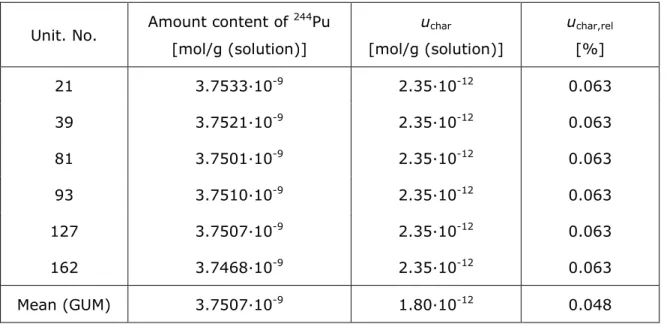
The characterisation measurements for the amount content of 244Pu were carried out on six
randomly selected units by ID-TIMS using the IRMM-049d 242Pu spike CRM (unit numbers:
21, 39, 81, 93, 127 and 162). The same chemical and measurement procedures were applied as for the homogeneity study (see Section 4). The amount content of 244Pu and its
measurement uncertainty was calculated according to the Guide to the Expression of Uncertainty in Measurement (GUM) [3] using the GUM Workbench software. The results for the amount content of 244Pu and its associated measurement uncertainty from the
characterisation are summarised in Table 3.
Table 3
Amount content of
244Pu and its standard measurement uncertainty fromcharacterisation in the selected units of IRMM-042a
Unit. No. Amount content of
244Pu [mol/g (solution)] uchar [mol/g (solution)] uchar,rel [%] 21 3.7533·10-9 2.35·10-12 0.063 39 3.7521·10-9 2.35·10-12 0.063 81 3.7501·10-9 2.35·10-12 0.063 93 3.7510·10-9 2.35·10-12 0.063 127 3.7507·10-9 2.35·10-12 0.063 162 3.7468·10-9 2.35·10-12 0.063 Mean (GUM) 3.7507·10-9 1.80·10-12 0.048
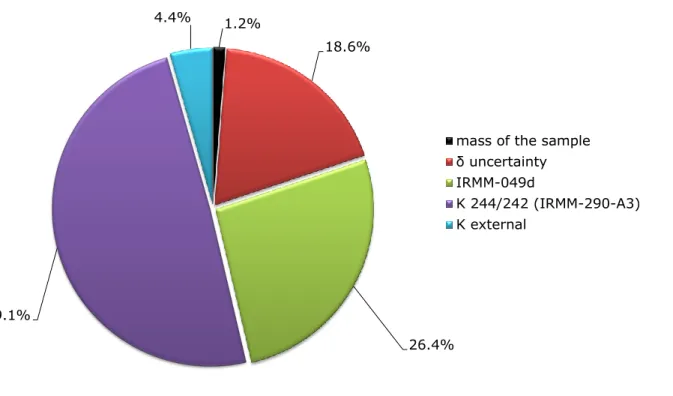
Figure 1 Uncertainty contributions from characterisation of the 244Pu amount content in
IRMM-042a
The legends on the pile chart are as follows:
- m sample is the uncertainty associated with the weighing of the sample (substitution
weighing)
- δ uncertainty is an additional uncertainty, which can be attributed to the chemical
separation. In order to cover all type of uncertainties from multiple replicate measurements, consistency checking is applied. Consistency checking shows
'whether the variation between the results of the replicates is smaller than, or equal
to, the uncertainty introduced by all statistically independent input quantities' (see
for more details [18]). Whenever the consistency check fails the so-called 'delta uncertainty' is added.
- IRMM-049d represents the uncertainty of the amount content of 242Pu in the spike
IRMM-049d
- K244/242 is the K-factor for the n(244Pu)/n(242Pu) ratio and represents the uncertainty
of the IRMM-290b-A3 isotopic standard
- Kexternal is the external K-factor that includes uncertainty from external calibration in
the (modified) total evaporation according to Richter et al. [19]
Relative distributions of various uncertainty components from characterisation are shown in Figure 1. The two major contributors to the final uncertainty for the amount content of 244Pu
are the uncertainties associated with the Pu isotopic standard (IRMM-290b-A3) used for mass fractionation correction and the 242Pu spike CRM (IRMM-049d) used for the
1.2%
18.6%
26.4% 49.1%
4.4%
mass of the sample δ uncertainty IRMM-049d
K 244/242 (IRMM-290-A3) K external
determination of the amount content of 244Pu. Detailed calculations and the uncertainty
budgets are given in Annex 10.
6.2 Plutonium isotope amount ratios and their uncertainties
Four units were selected for the characterization measurements of the isotope amount ratios (unit numbers: 23, 77, 105, 149) by TIMS after the chemical purification by anion exchange. Each unit was measured in four replicates together with the Pu isotopic standard IRMM-290b-A3 on the same sample turret. The values for the plutonium isotope amount ratios from characterisation were obtained as the mean of four results from the respective units.
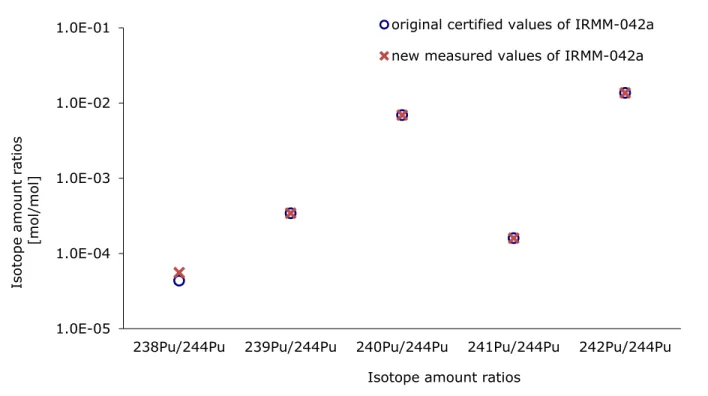
The values for the plutonium isotope amount ratios from characterisation are in agreement (after normalisation to the same reference date, January 1, 2017) with the values from the material certificate from 1987 (denoted as 'original certificate of IRMM-042a’) except for the
n(238Pu)/n(244Pu) amount ratios, where a significant difference has been observed (Figure
2). The reason for this could be the isobaric interference of 238U isotope in the sample. As
the applied standard procedure was to carry out one purification step prior to the TIMS measurements, it was not unexpected that the 238Pu might not be verified. In the course of
this certification project it was not feasible to correct for any remaining 238U by means of
alpha spectrometry. Therefore it was decided that the n(238Pu)/n(244Pu) amount ratio from
the original certificate, which was at that time confirmed by alpha spectrometry, is reliable. The n(238Pu)/n(244Pu) amount ratio from the original certificate was decayed to the reference
date of January 1, 2017, and used as the certified value in IRMM-042a.
Figure 2 Comparison of the plutonium isotope amount ratios from the characterisation with the
values from the material certificate of IRMM-042a. The values are normalised to January 1, 2017. 1.0E-05 1.0E-04 1.0E-03 1.0E-02 1.0E-01
238Pu/244Pu 239Pu/244Pu 240Pu/244Pu 241Pu/244Pu 242Pu/244Pu
Isotope amount r at ios [mol /mol]
Isotope amount ratios
original certified values of IRMM-042a new measured values of IRMM-042a
6.3 External certified test sample EQRAIN-11
The EQRAIN (Evaluation de la Qualité des Résultats d'Analyse dans l'Industrie Nucléaire) inter-laboratory comparison (ILC) programme is organised at regular interval for the analysis of uranium and plutonium by CEA/CETAMA (Commission d'Etablissement des Méthodes d'Analyse du CEA). The IRMM-042a material was used as spike CRM in the scope of the EQRAIN Plutonium Nb. 11 ILC organised in 2011. The certified test sample of EQRAIN-11 was a plutonium nitrate solution with undisclosed value for the total amount of plutonium.
Five blends were gravimetrically prepared using aliquots of the EQRAIN-11 ampoule of the certified test sample No M107 containing 239Pu and 5 ampoules of IRMM-042a. The blends
were chemically purified using an anion exchange resin and the isotopic measurements performed on the Triton TIMS. Three replicates for each blend were measured on the same sample turret together with six replicates of the Pu isotopic standards (IRMM-290b-A3) for mass fractionation correction.
Figure 3 compares the six results for the amount content of 244Pu in IRMM-042a spiked with
IRMM-049d with the 5 results (denoted as Blend1 to Blend5) when spiked with EQRAIN-11 No M107. Further, the original IRMM-042a certified value from 1987 and the new
IRMM-042a certified value are shown. It can be seen that the five individual results using EQRAIN-11 M107 as spike material confirm the new certified value within the measurement uncertainties (see Section 7) as well as the original certified value from 1987. This provides confidence in the reliable value assignment by ID-TIMS using IRMM-049d as spike CRM.
Figure 3 Comparison of the new certified amount content of 244Pu in IRMM-042 (six ampoules
spiked with IRMM-049d, see also section 6.2) with the results from, five ampoules spiked with EQRAIN-11 (No M107) and the original certified value from 1987 (see Annex 7)
Via participation in EQRAIN-11 using IRMM-049d to measure the Pu amount content in sample No M107 the JRC.G.2-Geel has successfully inter-calibrated IRMM-049d with
3.730E-09 3.735E-09 3.740E-09 3.745E-09 3.750E-09 3.755E-09 3.760E-09 3.765E-09 3.770E-09 3.775E-09 244 Pu amount content [mol /g]
Selected units of IRMM-042a
new certified value
new certified value + U(k = 2) new certified value - U(k = 2)
EQRAIN No11
IRMM-042a (see Annex 4). In EQRAIN-11 (M107) eight laboratories measured the Pu amount content satisfactory applying four different analytical techniques: ID-TIMS, coulometry, alpha spectrometry and K-shell absorption-edge spectrometry/X-ray fluorescence (K-edge XRF), see Annex 4. This not only provides an external verification of the method independency of the certified reference value and the long-term stability of IRMM-042a material, but also demonstrates the JRC.G.2-Geel's measurement capabilities in plutonium analysis.
6.4 Comparison of the amount content of
244Pu from the
homogeneity and characterisation study
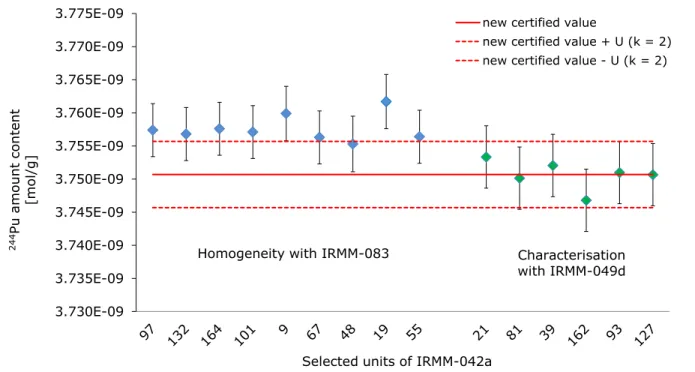
When comparing the results of the 244Pu amount content from the homogeneity study (240Pu
IRMM-083 spike CRM) with the results from the characterisation study (242Pu IRMM-049d
spike CRM), a positive bias of 0.18 % is observed (Figure 4).
Figure 4 Comparison of the amount content 244Pu from the homogeneity study with the
characterisation study (relative difference 0.18 % on the average values)
In principle a CRM is not required in a homogeneity study according to ISO 17034:2016
'…validated measurement procedures shall be selected so that the precision and selectivity
are fit for purpose…' [1]. Although, most of the values (except vial 19) agree with the new
IRMM-042a reference value within uncertainties further discussion on the observed bias is given:
In 2009 the JRC-Geel initiated a metrologically-based inter-calibration campaign among selected plutonium spike CRMs [9]. The aim of this on-going campaign is threefold: (1) to perform measurements on selected plutonium spike isotopic reference materials for quality control purposes, (2) to confirm and verify the amount content and the isotopic composition of new spike CRMs, and (3) to demonstrate the JRC.G.2-Geel's measurement capabilities for
3.730E-09 3.735E-09 3.740E-09 3.745E-09 3.750E-09 3.755E-09 3.760E-09 3.765E-09 3.770E-09 3.775E-09 244 Pu amount content [mol /g]
Selected units of IRMM-042a
new certified value
new certified value + U (k = 2) new certified value - U (k = 2)
Characterisation with IRMM-049d Homogeneity with IRMM-083
plutonium analysis via external quality tools. IRMM-083 has been successfully inter-calibrated with several other JRC.G.2-Geel spike CRMs [9] and particularly via EQRAIN-13 (sample Q005) with IRMM-049d [20]. This implies that IRMM-083 is inter-linked with IRMM-042a. We therefore believe that the specific single unit of IRMM-083 (No 1915) used
in the homogeneity study was either a statistical outlier in the series, or that an error occurred prior to spiking (see Section 4.1). Either possibility would explain the systematically high values compared to the characterization results. The single unit of IRMM-083 was exclusively used for the purpose to assess the equivalence between the various units of IRMM-042a. The fact that the results for the amount content of 244Pu from
the homogeneity and the IRMM-042a certified value are not strictly compatible to a 95 % confidence level does not compromise the characterisation or the homogeneity study. Additionally, the evaluated sbb of 0.047 % in the homogeneity study is representative of the
between-unit standard deviation of a typical liquid spike isotopic reference material [21]. We therefore conclude that the homogeneity study is fit for purpose, as all criteria set in ISO 17034 are met, and does not put the certified reference value of the 240Pu IRMM-083
spike CRM or the assigned value of the new certified IRMM-042a 244Pu spike CRM and its
expanded uncertainty in question. Nevertheless, the IRMM-083 spike CRM will be subject to further inter-calibration via external quality tools in the future.
7 Value Assignment
Certified values are values that fulfil the highest levels of accuracy. Full uncertainty budgets in accordance with the 'Guide to the Expression of Uncertainty in Measurement' [3] were established.
7.1 Certified values and their uncertainties
The uncertainty of the amount content of 244Pu is a combined uncertainty related to the
characterisation, uchar and to the potential between unit inhomogeneity, ubb. The
contributions of short-term and long-term stability are negligible as it was discussed in Section 5. These different contributions were combined to estimate the expanded uncertainty of the certified value (UCRM) with a coverage factor k as (see Table 4)
2 bb
u
u
k
U
2 char CRM
Equation 5Because of the sufficient degrees of freedom of different uncertainty contributions, a coverage factor k of 2 was applied to obtain the expanded uncertainties for all certified properties. The certified values and their related uncertainties are listed in Table 5.
Table 4 Certified amount content of 244Pu and its uncertainties in IRMM-042a Certified value 1) [nmol/g (solution)] uchar, rel [%] sbb, rel [%] UCRM, rel2) [%] UCRM2) [nmol/g (solution)] 244Pu 3.7507 0.095 0.047 0.13 0.0050
1) The reference date for the certified value is January 1, 2017. 2) Expanded (k = 2) uncertainty
Table 5 Certified isotope amount ratios and their uncertainties in IRMM-042a
Isotope amount
ratios Certified value
1) [mol/mol] uchar, rel [%] UCRM, rel 2) [%] UCRM2) [mol/mol] n(238Pu)/n(244Pu) 0.0000434 7.00 15.0 0.0000064 n(239Pu)/n(244Pu) 0.0003436 0.14 0.28 0.00000095 n(240Pu)/n(244Pu) 0.0068953 0.069 0.14 0.0000095 n(241Pu)/n(244Pu) 0.00015954 0.23 0.45 0.00000072 n(242Pu)/n(244Pu) 0.0136091 0.035 0.07 0.0000094
1) The reference date for the certified value is January 1, 2017. 2) Expanded (k = 2) uncertainty
The values for the amount contents of the total Pu, the mass fractions of 244Pu and total Pu,
the isotope amount and mass fractions (isotopic composition) and the molar mass of Pu in IRMM-042a were calculated by using the certified values of the amount content of 244Pu, the
isotope amount ratios and the isotope atomic masses [22]. These derived certified values were calculated from the certified values from the characterisation study applying a well understood mathematical model. They are summarised in Table 6.
Table 6 The derived certified values of plutonium isotopic mass and amount fraction, amount content of total Pu, mass fraction of 244Pu and total Pu and the molar mass of Pu and their
uncertainties in IRMM-042a
IRMM-042a
Isotope mass fractions (·100) Certified value 1) [g/g] Uncertainty 2) [g/g] m(238Pu)/m(Pu) 0.00414 0.00061 m(239Pu)/m(Pu) 0.032971 0.000072 m(240Pu)/m(Pu) 0.66467 0.00017 m(241Pu)/m(Pu) 0.019278 0.000074 m(242Pu)/m(Pu) 1.32216 0.00018 m(244Pu)/m(Pu) 97.95678 0.00068
Isotope amount fractions (·100) Certified value 1) [mol/mol] Uncertainty 2) [mol/mol] n(238Pu)/n(Pu) 0.00425 0.00062 n(239Pu)/n(Pu) 0.033654 0.000074 n(240Pu)/n(Pu) 0.67562 0.00018 n(241Pu)/n(Pu) 0.019514 0.000075 n(242Pu)/n(Pu) 1.33281 0.00018 n(244Pu)/n(Pu) 97.93416 0.00069 Amount content Certified value 1) [nmol/g (solution)] Uncertainty 2) [nmol/g (solution)] Pu 3.8298 0.0051 Mass fraction Certified value 1) [µg/g (solution)] Uncertainty 2) [µg/g (solution)] Pu 0.9345 0.0013 244Pu 0.9154 0.0012
1) The reference date for the derived certified value is January 1, 2017. 2) Expanded (k = 2) uncertainty
8 Metrological traceability and commutability
8.1 Metrological traceability
Identity
The measurands are structurally defined and independent of the measurement method.
Quantity value
The certified values are traceable to the SI via the values on the respective material certificates of IRMM-049d and IRMM-290b-A3.
8.2 Commutability
Many measurement procedures include one or more steps, which are selecting specific analytes (or specific groups of analytes) from the sample for the subsequent steps of the whole measurement process. Often the complete identity of these 'intermediate analytes' is not fully known or taken into account. Therefore, it is difficult to mimic all the analytically relevant properties of real samples within a CRM. The degree of equivalence in the analytical behaviour of real samples and a CRM with respect to various measurement procedures (methods) is summarised in a concept called 'commutability of a reference material'. There are various definitions expressing this concept. For instance, the CLSI Guideline C-53A [23] recommends the use of the following definition for the term
commutability:
"The equivalence of the mathematical relationships among the results of different measurement procedures for an RM and for representative samples of the type intended to be measured."
The commutability of a CRM defines its fitness for use and, thus, is a crucial characteristic in case of the application of different measurement methods. When commutability of a CRM is not established in such cases, the results from routinely used methods cannot be legitimately compared with the certified value to determine whether a bias does not exist in calibration, nor can the CRM be used as a calibrant.
The IRMM-042a is a highly enriched 244Pu spike in nitrate acid solution certified for amount
content of 244Pu and plutonium isotope amount ratios. This CRM is used as spike for IDMS
measurements of plutonium in nuclear and environmental samples.
9 Instructions for use
9.1 Safety information
The IRMM-042a contains radioactive material. The vials should be handled with great care and by experienced personnel in a laboratory suitably equipped for the safe handling of radioactive materials.
9.2 Storage conditions
The vials should be stored at + 18 °C ± 5 °C.
Please note that the European Commission cannot be held responsible for changes that happen during storage of the material at the customer's premises, especially of opened vials.
9.3 Preparation and use of the material
The spike CRM has to be mixed well with the sample solution to ensure the isotopic equilibrium between the spike and the sample. Users are cautioned that once the ampoule is opened, the amount content of plutonium may be affected by evaporation losses.
9.4 Minimum sample intake
There is no minimum sample intake to be taken into account.
9.5 Use of the certified value
The main purpose of the material is to be used as spike isotopic reference material for determination of the plutonium amount content in an unknown sample by isotope dilution mass spectrometry (IDMS). The amount content (Cx) of plutonium can be calculated using
the following IDMS equation:
y i x i x b b y x y
R
R
R
R
R
R
m
m
)
(
)
(
y xC
C
, Equation 6where Cy is the element amount content of the spike, mx and my are the masses of sample
and spike, respectively, Rx, Ry and Rb are the isotope amount ratios of the sample, the spike
and the blend, respectively,
(
R
i)
x and
(
R
i)
y are the sums of all isotope amount ratios insample and in spike, respectively.
10 Conclusions
An existing spike CRM of highly enriched 244Pu has been re-certified for the amount content 244Pu and for the plutonium isotope amount ratios. The certified values for the amount
content and isotope amount ratios were obtained on randomly selected units by ID-TIMS and TIMS, respectively. The IRMM-042a isotopic reference material is supplied in a flame sealed glass ampoule containing about 10 mL of nitric acid solution (c = 5 mol/L) with approximately 10 µg 244Pu.
References
1 ISO 17034, General requirements for the competence of reference materials producers, International Organization for Standardization, Geneva, Switzerland, 2016
2 ISO Guide 35, Reference materials – General and statistical principles for certification, International Organization for Standardization, Geneva, Switzerland, 2006
3 ISO/IEC Guide 98-3, Guide to the Expression of Uncertainty in Measurement (GUM, 1995), International Organization for Standardization, Geneva, Switzerland, 2008
4 S. Winkler, I. Ahmad, R. Golser, W. Kutschera, K.A. Orlandini, M. Paul, A. Priller, P. Steier, C. Vockenhuber (2004) Anthropogenic 244Pu in the environment, New Astronomy Reviews.
48: 151-154
5 K. Zhao, M. Penkin, C. Norman, S. Balsley, K. Mayer, P. Peerani, C. Pietri, S. Tapodi, Y. Tsutaki, M. Boella, G. Renha, E. Kuhn (2012) International Target Values 2010 for Measurement Uncertainties in Safeguarding Nuclear Materials. ESARDA Bulletin 48:3-24 6 J. Vogl, W. Pritzkow (2010), Isotope dilution mass spectrometry – a primary method of measurement and its role for RM certification, J. Metrol. Soc. India, 25, 135-164
7 R. Jakopič, J. Bauwens, R. Buják, R. Eykens, C. Hennessy, F. Kehoe, S. Mialle, C. Venchiarutti, S. Richter and Y. Aregbe (2014) Preparation and Certification of Large-Sized Dried (LSD) Spike - IRMM-1027p, EUR26520 EN
8 R. Jakopič, J. Bauwens, R. Buják, R. Eykens, C, Hennessy, F. Kehoe, H. Kühn, S. Richter, Y. Aregbe (2013) Preparation and certification of Large-Sized Dried (LSD) spike IRMM-1027o, EUR 25857 EN
9 R. Jakopič, A. Verbruggen, R. Eykens, F. Kehoe, H. Kühn, Y. Kushigeta, U. Jacobsson, J. Bauwens, S. Richter, R. Wellum, Y. Aregbe (2010), An inter-calibration campaign using various selected Pu spike isotopic reference materials, J. Radioanal. Nucl. Chem., 286, 449-454
10 E.L. Callis, R.M. Abernathey (1991), High precision isotopic analysis of uranium and plutonium by total sample volatilization and signal integration, Int. J. Mass Spectrom. Ion Process, 103, 322-327
11 S. Richter, S.A. Goldberg (2003), Improved techniques for high accuracy isotope ratio measurement of nuclear materials using thermal ionisation mass spectrometry, Int. J. Mass Spectrom., 229, 181-197
12 S. Bürger, S.D. Balsley, S.D. Baumann, S.F. Boulyga, J.A. Cunningham, S. Kappel, A. Kopft, J. Poths (2012), Uranium and Plutonium analysis of nuclear material samples by multi-collector thermal ionisation mass spectrometry: quality control, measurement uncertainty, and metrological traceability, Int. J. Mass Spectrom., 311, 40-50
13 S. Boulyga, S. Konegger-Kappel, S. Richter, L. Sangley (2015), Mass spectrometry analysis for nuclear safeguards, J. Anal. At. Spectros., 30, 1469-1489
14 T.P.J. Linsinger, J. Pauwels, A.M.H. van der Veen, H. Schimmel, A. Lamberty (2001) Homogeneity and stability of reference materials. Accred. Qual. Assur., 6:20-25
15 R. Wellum, A. Verbruggen, R. Kessel (2009) A new evaluation of the half-life of 241Pu, J.
21
16 http://www.nucleide.org/DDEP_WG/DDEPdata.htm "last checked on July 28, 2017
17 M. K. Milton, T. J. Quinn, (2001) Primary methods for the measurement. Metrologia, 38, 289-296.
18 R. Kessel, M. Berglund, R. Wellum (2008) Accred Qual Assur, 13:293-298
19 S. Richter,H. Kühn, Y. Aregbe, M. Hedberg, J. Horta-Domenech, K. Mayer, E. Zuleger, S. Bürger, S. Boulyga, A. Köpf, J. Poths, K. Mathew (2011) J. Anal. At. Spectrom., 26:550-564 20 ESSAI D’APTITUDE PAR COMPARAISON INTERLABORATOIRES - SYNTHESE DU PROGRAMME EQRAIN "Plutonium" N°13, CEA/DEN/MAR/DMRC/CETAMA/NT DO1 15/02/17 17KKTA000001
21 https://ec.europa.eu/jrc/en/reference-materials/catalogue
22 M. Wang, G. Audi, A. H. Wapstra, F. G. Kondev, M. MacCormick, X. Xu, B. Pfeiffer, The AME2012 atomic mass evaluation (II). Tables, Graphs and References, Chinese Physics C, Vol. 36, No.12, 1603-2014, 2012
23 H. Vesper, H. Emons, M. Gnezda, C. P. Jain, W. G. Miller, R. Rej, G. Schumann, J. Tate, L. Thienpont, J. E. Vaks (2010) Characterization and Qualification of Commutable Reference Materials for Laboratory Medicine; Approved Guideline, CLSI document C53-A, Clinical and Laboratory Standards Institute, Wayne, PA, USA
List of Abbreviations and definitions
ANOVA Analysis of variance
c amount of substance concentration
CEA Le Commissariat a l`energie atomique et aux energies alternatives, la
Direction de l’énergie nucléaire (Alternative Energies and Atomic Energy Commission)
CETAMA Commission d'Etablissement des Methodes d'Analyse du CEA
CLSI CRM
Clinical and Laboratory Standards Institute Certified reference material
EC European Commission
EQRAIN Evaluation de la Qualité des Résultats d'Analyse dans
l'Industrie Nucléaire
GUM Guide to the Expression of Uncertainty in Measurement
IDMS Isotope dilution mass spectrometry
ID-TIMS Isotope dilution thermal ionisation mass spectrometry
ILC Inter-laboratory comparison
ISO International Organization for Standardization
ITV-2010 International Target Values
JRC Joint Research Centre of the European Commission
k Coverage factor
m mass
M Molar mass
MS Mass spectrometry
MSbetween Mean of squares between-unit from an ANOVA MSwithin Mean of squares within-unit from an ANOVA n
N
amount of substance
Mean number of replicates per unit
p.a. pro analysis
rel Index denoting relative figures (uncertainties etc.)
Rx Isotope amount ratio of the sample
Ry Isotope amount ratio of the spike
RM Reference material
s Standard deviation
sbb Between-unit standard deviation; an additional index "rel" is added
when appropriate
SI International System of Units
swb Within-unit standard deviation
TIMS Thermal Ionisation Mass Spectrometry
u Standard uncertainty
U Expanded uncertainty
u*
bb Standard uncertainty related to a maximum between-unit
inhomogeneity that could be hidden by method repeatability; an additional index "rel" is added as appropriate
ubb Standard uncertainty related to a possible between-unit
inhomogeneity; an additional index "rel" is added as appropriate
uchar Standard uncertainty of the material characterisation; an additional
index "rel" is added as appropriate
uCRM Combined standard uncertainty of the certified value; an additional
index "rel" is added as appropriate
UCRM Expanded uncertainty of the certified value; an additional index "rel"
is added as appropriate
ults Standard uncertainty of the long-term stability; an additional index
"rel" is added as appropriate
usts Standard uncertainty of the short-term stability; an additional index
"rel" is added as appropriate
K-edge XRF K-shell absorption-edge spectrometry/X-ray fluorescence
y
Arithmetic mean Significance level
MSwithin
List of Tables
Table 1 Results of the statistical evaluation of the homogeneity studies for the amount content of 244Pu in IRMM-042a ... 8
Table 2 Results of the homogeneity studies for the amount content of 244Pu in
IRMM-042a ... 9 Table 3 Amount content of 244Pu and its standard measurement uncertainty from
characterisation in the selected units of IRMM-042a ... 10 Table 4 Certified amount content of 244Pu and its uncertainties in IRMM-042a ... 16
Table 5 Certified isotope amount ratios and their uncertainties in IRMM-042a ... 16 Table 6 The derived certified values of plutonium isotopic mass and amount fraction, amount content of total Pu, mass fraction of 244Pu and total Pu and the molar mass of Pu
List of Figures
Figure 1 Uncertainty contributions from characterisation of the 244Pu amount content in IRMM-042a... 11 Figure 2 Comparison of the plutonium isotope amount ratios from the characterisation with the values from the material certificate of IRMM-042a. The values are normalised to January 1, 2017. ... 12 Figure 3 Comparison of the new certified amount content of 244Pu in IRMM-042 (six ampoules spiked with IRMM-049d, see also section 6.2) with the results from, five ampoules spiked with EQRAIN-11 (No M107) and the original certified value from 1987 (see Annex 7) ... 13 Figure 4 Comparison of the amount content 244Pu from the homogeneity study with the characterisation study (relative difference 0.23 % on the average values) ... 14
Annexes
Annex 1.Results of the homogeneity study for the amount content of 244Pu (single value,
mean and standard deviation)
... 27
Annex 2.Certificate of IRMM-083... 28
Annex 3.Certificate of the reference value of EQRAIN-11, Ampoule No 3 (M107)... 31
Annex 4.Results of EQRAIN Plutonium Nb. 11 Program (Ampoule 3: M107)... 32
Annex 5.Certificate of IRMM-049d... 33
Annex 6.Certificate of IRMM-290b-A3... 36
Annex 7.Certificate of old IRMM-042a... 38
Annex 8.Weighing certificate for the homogeneity samples... 42
Annex 9.Weighing certificate for the characterisation samples... 43
Annex 10.GUM Workbench calculations... 44
Annex 1. Results of the homogeneity study for the amount content of 244Pu (single
value, mean and standard deviation)
244
Pu amount content
[nmol/g (solution)]Unit No. Rep. 1 Rep. 2 Rep. 3 Mean ± s
97
3.75786
3.75719
3.75725
3.75743 ± 0.00037 1323.75732
3.75604
3.75709
3.75682 ± 0.00068 1643.75766
3.75798
3.75723
3.75762 ± 0.00038 1013.75669
3.75672
3.75773
3.75705 ± 0.00059 93.75951
3.76035
N.A. 3.75993 ± 0.00059 673.75579
3.75657
3.75654
3.75630 ± 0.00044 483.75657
3.75478
3.75462
3.75532 ± 0.00108 193.76123
3.76213
N.A. 3.76168 ± 0.00064 553.75653
3.75653
3.75609
3.75638 ± 0.00025For the samples No. 9 and 19 only two replicates were available, as the signal before the start of the TE measurements for the replicate No. 3 was too high and a significant amount of material was lost. Therefore, these two measurement results were discarded.
Annex 4. Results of EQRAIN Plutonium Nb. 11 Program (Ampoule 3: M107) The Figure F1 and Table T1 are taken from the CEA/CETAMA Technical Report
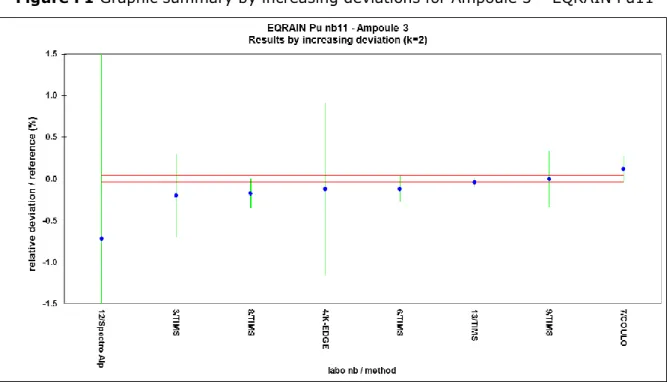
Figure F1 Graphic summary by increasing deviations for Ampoule 3 – EQRAIN Pu11
Table T1 Data for Ampoule 3 – EQRAIN Pu11
The laboratory performance of JRC.G.2-Geel (labo 9) was evaluated against the EQRAIN-11 reference value established at CEA/CETAMA and to be found satisfactory, as expressed by means of the respective z- and zeta-scores given in T1.
GETTING IN TOUCH WITH THE EU In person
All over the European Union there are hundreds of Europe Direct information centres. You can find the address of the centre nearest you at: http://europa.eu/contact
On the phone or by email
Europe Direct is a service that answers your questions about the European Union. You can contact this service:
- by freephone: 00 800 6 7 8 9 10 11 (certain operators may charge for these calls), - at the following standard number: +32 22999696, or
- by electronic mail via: http://europa.eu/contact
FINDING INFORMATION ABOUT THE EU Online
Information about the European Union in all the official languages of the EU is available on the Europa website at: http://europa.eu
EU publications
You can download or order free and priced EU publications from EU Bookshop at:
http://bookshop.europa.eu. Multiple copies of free publications may be obtained by contacting Europe Direct or your local information centre (see http://europa.eu/contact).
KJ -NA -2 8 9 4 3 -EN -N

![Table 2 Results of the homogeneity studies for the amount content of 244 Pu in IRMM-042a s wb,rel [%] s bb,rel[%] u * bb,rel[%] Amount content of 244 Pu 0.016 0.047 0.0057](https://thumb-us.123doks.com/thumbv2/123dok_us/120459.2514043/12.918.185.745.316.425/table-results-homogeneity-studies-content-pu-irmm-content.webp)

![Table 4 Certified amount content of 244 Pu and its uncertainties in IRMM-042a Certified value 1) [nmol/g (solution)] u char, rel[%] s bb, rel[%] U CRM, rel 2)[%] U CRM 2) [nmol/g (solution)] 244 Pu 3.7507 0.095 0.047 0.13 0.0050](https://thumb-us.123doks.com/thumbv2/123dok_us/120459.2514043/19.918.97.803.374.623/table-certified-content-uncertainties-irmm-certified-solution-solution.webp)