Parameterized Kernel Principal Component Analysis:
Theory and Applications to Supervised and Unsupervised Image Alignment
Fernando De la Torre
Minh Hoai Nguyen.
Robotics Institute, Carnegie Mellon University, Pittsburgh, PA15213.
[email protected] [email protected]Abstract
Parameterized Appearance Models (PAMs) (e.g. eigen-tracking, active appearance models, morphable models) use Principal Component Analysis (PCA) to model the shape and appearance of objects in images. Given a new image with an unknown appearance/shape configuration, PAMs can detect and track the object by optimizing the model’s parameters that best match the image. While PAMs have numerous advantages for image registration relative to al-ternative approaches, they suffer from two major limita-tions: First, PCA cannot model non-linear structure in the data. Second, learning PAMs requires precise manually la-beled training data. This paper proposes Parameterized Kernel Principal Component Analysis (PKPCA), an exten-sion of PAMs that uses Kernel PCA (KPCA) for learning a non-linear appearance model invariant to rigid and/or non-rigid deformations. We demonstrate improved perfor-mance in supervised and unsupervised image registration, and present a novel application to improve the quality of manual landmarks in faces. In addition, we suggest a clean and effective matrix formulation for PKPCA.
1. Introduction
Since the early work of Sirovich and Kirby [33] param-eterizing the human face using Principal Component Anal-ysis (PCA) and the successful eigenfaces of Turk and Pent-land [34], many computer vision researchers have used PCA techniques to construct linear models of optical flow, shape or graylevel [5, 6, 8, 26, 21, 7, 16]. The modeling power of PCA techniques is especially useful when applied to visual data, because there is a need for dimensionality reduction given the increase in the number of features.
Parameterized Appearance Models (PAMs) (e.g. eigen-tracking [6], active appearance models [8, 12, 24, 16], mor-phable models [7, 21, 35]) have proven to be a good statis-tical tool to build models of shape and appearance variation of objects. In particular, PAMs have been extensively
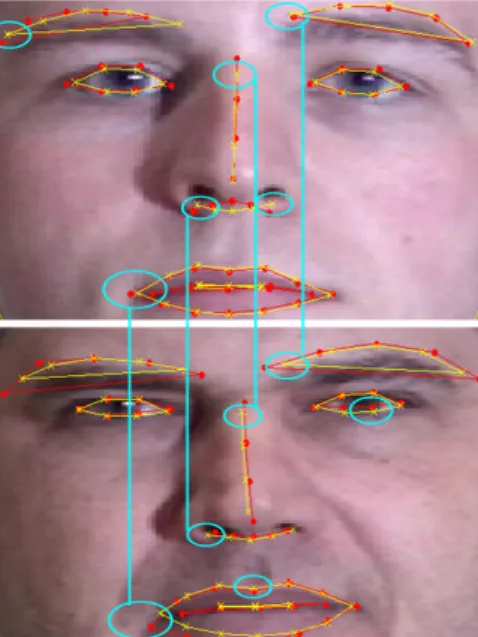
ap-Figure 1. Unsupervised learning of a non-linear generative model of frontal face images. Red dots denote initial manual labeling. Yellow crosses represent the automatic re-labeling using PKPCA. Images are better seen in color.
plied to the detection, tracking and synthesis of faces dur-ing the last decade. PAMs utilize PCA to model shape and appearance variations across pose, expression, illumination and identity. However, the linear assumption of PCA does not always hold true. For instance, modeling pose changes with 2D models is a very rough approximation (e.g. points disappear with occlusion) and non-linear models are pre-ferred. Similarly, the space of frontal faces is likely to be better described by a non-linear model to account for differ-ent expressions, illumination, beards or glasses. In fact, nu-merous papers have shown the advantages of Kernel PCA (KPCA) over PCA in face recognition or image modeling tasks (e.g.[38, 28, 37, 25, 30]). This suggests that KPCA is a more powerful model for image analysis, provided that the correct kernel and kernel parameters are known. This paper describes an extension of PAMs, Parameterized Ker-1
nel PCA (PKPCA), a framework for learning a non-linear generative model of objects’ appearance and shape in a su-pervised and unsusu-pervised manner.
Fig. 1 illustrates an application of PKPCA. The red dots represents the manual labeling done by experienced label-ers to build AAMs [8]. The yellow crosses are the result of re-labeling using PKPCA. PKPCA learns, in an unsu-pervised manner, a non-linear model of frontal faces from 600images (starting from the red dots). As it can be ob-served (see blue circles), PKPCA is able to learn a more consistent labeling among subject’s faces (e.g. nose, cor-ners of the mouth, eyes). Moreover, PKPCA builds a more compact model (less eigenvectors), which is less prone to over-fitting and more computationally efficient.
The rest of this paper is organized as follows. Sec. 2 re-views previous works on image alignment with appearance models. Sec. 3 proposes an energy-based framework for learning KPCA. Sec. 4 derives PKPCA by incorporating rigid and non-rigid transformations into the KPCA formu-lation. Sec. 5 illustrates the benefits of our approach for rigid/non-rigid supervised and unsupervised image align-ment.
2. Previous work
Over the last decade, appearance models have become increasingly important in computer graphics and vision. In particular, parameterized appearance models (PAMs) have proven useful in the detection, tracking, and synthesis of hu-man faces from video [7, 6, 5, 14, 8, 24, 11, 26, 21, 16, 35]. One of the main benefits of PAMs is its use of gradient de-scent methods to align images with high dimensional defor-mation models.
Although widely used, one of the main limitations of PAMs is its use of a linear model. Several attempts have been made to extend appearance models in order to cope with non-linearities. Cooteset al. [10] build view-based Ac-tive Appearance Models (AAMs) capable of tracking non-linear pose changes from profile to profile by continuously switching several discrete linear appearance models. How-ever, it remains unclear how to impose consistency of the identity parameters across multiple views. Romdhani et al.[28] use KPCA with point distribution models to model the shape out-of-plane motion. However, the KPCA is only applied to the shape, and it is not embedded into the appear-ance model that drives the AAM fitting. Moreover, finding the pre-image shape is an iterative procedure prone to en-countering local minima. More importantly, the model is learned in a supervised manner (i.e. manual labeling). In the context of discriminative models, Avidan [1] has proposed a gradient-based method to make support vector machines invariant to translations.
Supervised image alignment [7, 6, 8, 24, 11] is well un-derstood in the literature. By supervised alignment, we
re-fer to an image that is registered w.r.t. a previously learned model (off-line). Learning the model in an unsupervised manner has been less explored. Frey and Jojic [14] pro-pose a method for learning a factor analysis model invari-antly to geometric transformations. The proposed method grows polynomially with the number of possible spatial transformations, and it can be computationally intensive when working with high dimensional motion models. To improve upon this problem, De la Torre and Black [11] pro-pose parameterized component analysis, a gradient-based method that learns a PCA model invariantly to affine trans-formations. More recently, Miller et al. have proposed the Congealing method [23, 19] that uses an entropy mea-sure to align images with respect to the distribution of the data. Baker et al. [2] learned an AAM invariantly to rigid and non-rigid motion. Kookinos and Yuille [22] pro-posed a probabilistic framework and extended previous ap-proaches [2, 23, 11] to deal with articulated objects using a Markov Random Field (MRF) on top of the AAM.
Unlike previous works, we integrate the kernel methods in the core of the AAM framework. In particular, we de-velop a gradient descent algorithm for the efficiently fitting of kernel appearance models into new images. Moreover, we show how to learn the kernel appearance model in an un-supervised fashion invariantly to rigid and non-rigid trans-formations. Furthermore, we suggest a clean and effective matrix formulation.
3. Energy-based PCA methods
Component Analysis (CA) methods (e.g. PCA, LDA, Tensor Factorization) have been successfully applied in nu-merous classification, clustering and dimensionality reduc-tion tasks in the last two decades. Many CA techniques are especially appealing because they can be formulated as eigen-problems, offering great potential for efficient learn-ing of linear and non-linear data representations without local minima. However, the eigen-formulation often ob-scures important aspects of the learning process such as un-derstanding normalization factors, reducing effect of noise, dealing with missing data, and learning the kernel. In this section, we review previous work on energy-based func-tions for PCA using a unified matrix formulation.
3.1. Principal component analysis
PCA is a statistical technique useful for dimensionality reduction, see [13, 20] for a review of applications and ex-tensions. LetD = [d1d2 ...dn]be a matrixD ∈ ℜd×n,
see notation1, where each column d
i is a data sample,
1Bold capital letters denote a matrixD, bold lower-case letters a
col-umn vectord.djrepresents thejthcolumn of the matrixD.dijdenotes
the scalar in the rowiand columnjof the matrixDand the scalari-th
vari-n is the number of training samples, and d is the num-ber of features (pixels). The principal components maxi-mizePn
i=1||BTdi||22 = ||BTΣB||F, with the constraint
BTB = I, and where Σ = DDT = P
ididTi is the
covariance matrix (assuming zero mean). The columns of B ∈ ℜd×k (principal components) form an orthonormal
basis that spans the principal subspace of the dataD. If the effective rank ofD is much less than d, we can approxi-mate the column space ofDwithk ≪dprincipal compo-nents. The datadi can be approximated as a linear com-bination of the principal components as drec
i = BBTdi
whereci = BTdi are the linear coefficients obtained by
projecting the training data onto the principal subspace; that is,C=BTD∈ ℜk×n.
The optimal Bcan be computed as the leading eigen-vectors ofDDT [20]. In cases whered ≫ n, it will be more convenient to compute the eigenvectors ofDTDthat
are related to the eigenvectors ofDDT. However, for large
data sets of high dimensional data, formulating PCA as an error function [27] and applying numerical optimization al-gorithms is a more efficient procedure (in both space and time) to computeB. Moreover, error functions provide an easier interpretation and generalization. Several error func-tions exist of which stationary points are solufunc-tions of PCA (i.e. the subspace is the same as PCA). Among them, the most appealing one is formulated as [3, 32]:
E1(B,C) = n X i=1 ||di−Bci|| 2 2 =||D−BC||F (1)
A common approach to optimize eq. 1 alternates between solving forBwhileC is fixed and vice versa. This tech-nique is commonly known as Alternated Least Squares (ALS) or Criss-Cross Regression.
3.2. Kernel PCA
KPCA [29, 31] is a popular generalization of PCA that allows non-linear feature extraction. KPCA maps the data to a (usually) higher dimensional space, where the data can be linearly modeled (assuming the correct mapping is found). There is no need to explicitly define the mapping using the ”kernel trick”. KPCA uses a kernel function that implicitly defines the non-linear mapping.
Consider a lifting of the original points to a higher di-mensional spaceΓ= [φ(d1)φ(d2) · · · φ(dn) ]whereφ
defines the mapping. The kernelized version of eq. 1 can be written as:
E2(B,C) =||Γ−BC||F (2) ables.diagis an operator that transforms a vector to a diagonal matrix or takes the diagonal of the matrix into a vector.1k ∈ ℜk×1is a vector of ones.Ik∈ ℜk×kis the identity matrix.tr(A) =P
iaiiis the trace of the matrixAand|A|denotes the determinant. ||A||
F =tr(ATA) =
tr(AAT)designates the Frobenius norm of matrixA.
Computing the optimalB=ΓCT(CCT)−1
and substitut-ing this value into eq. 2, it can be shown that:
E2(C)∝ −tr(CKCT(CCT)−1) (3) whereK = ΓTΓ ∈ ℜn×n
is the standard kernel matrix. Each element kij of K represents the similarity between
two samples by means of a kernel function (e.g. Gaussian Radial Basis Function, polynomial). OptimizingE2 w.r.t.
Ccan be achieved by computing the leading eigenvectors ofK(Cis the transpose of the eigenvector matrix). After the diagonalization,CKCT = ΛandCCT = I
k. The
computational cost of the eigen-decomposition is O(n3)
(no sparsity is assumed), where nis the number of sam-ples. In KPCA, it is (usually) not convenient to compute the eigenvectors ofΓΓT since the dimension of the matrix can be very high dimensional (including infinity).
For large amounts of data (largen), an iterative approach to computing KPCA is computationally more efficient. Re-call that Bcan be expressed as linear combination of the mapped original dataΓ. That is,B=Γα. Substituting this expression into eq. 2 results in:
E3(α,C) =||Γ(In−αC)||F (4) Assuming thatK is invertible, similarly to iterative PCA, we can alternate between computingαandCas:
α=CT(CCT)−1&C= (αTKα)−1αTK (5) The computational cost of each iteration isO(n2k).
4. Parameterized KPCA
Previous section has related the KPCA learning problem to an alternate optimization and made use of the “kernel trick” for effective optimization. This section demonstrates how to parameterize KPCA to compensate for rigid and non-rigid motion. In particular, we show how to register a new image w.r.t. a previously learned KPCA model (su-pervised), and how to learn the KPCA model invariantly to non-rigid geometric transformations (unsupervised).
4.1. Supervised registration with PKPCA
This section extends previous work on Eigentracking [6], AAMs [8] and morphable models [7, 21]) by incorporating KPCA into the formulation.
4.1.1 Rigid motion
We parameterize the image d(f(x,a)) ∈ ℜd×1 with a rigid geometric transformation f(x,a) [6, 8, 21]. In the case of an affine transformation, f(x,a) =
a1 a2 + a3 a4 a5 a6 x y wherea = (a1, a2, a3, a4, a5, a6)are
the affine parameters andx= (x1, y1,· · ·, xn, yn)is a
vec-tor containing the coordinates of the pixels of a given image region. Once the image has been parameterized, the super-vised alignment problem can be defined as recovering the motion parameters a that align the image w.r.t the kernel subspace, that is, minimizing:
E4(cn,a) =||φ d(f(x,a))−Bcn||22 (6) Using the fact thatBTB=Λ, and definingk(x,y)as the
kernel function,E4can be rewritten as:
E4(a) =k(d(f(x,a),d(f(x,a))−
d(f(x,a))T
ΓCΛ−1CTΓTd(f(x,a)) (7) In eq. 7, we have marginalized the parametercn from
the optimization process. However, the minimization prob-lem remains highly non-linear. Recall thatCis the matrix containing the eigenvectors of the kernel matrix,K, learned in the training process. To optimize over the motion pa-rameters,a, we use a Gauss-Newton [4, 6] descent scheme with closed-form increments as in [11]. Following previous work in optical flow and appearance tracking [4, 6, 8, 11], we expand the image changes using Taylor series.a0is the initial motion estimation of rigid parameters and∆ais the motion increment.
d f(x,a0+∆a)
=d(f(x,a0)) +Ja(a
0
)∆a+h.o.t. (8)
h.o.t. denotes higher order terms of the expansion. Ja(a0) = [∂d(f∂a(x1,a0)) . . . ∂d(f(x,a
0
))
∂a6 ] is the Jacobian
matrix evaluated ata0. To optimize overain the case of the RBF Gauassian kernel, we use a fixed-point updating. E4
can be rewritten as:
E4(a)∝ −rTM r (9)
withM=CΛ−1CT&ri=e−γ||pi +J∆a||2
2∀i
After differentiating E4 w.r.t. ∆aand setting it to zero,
eq. 7 can be updated as: ∂E4 ∂∆a = X ij wij(4JTJ∆a+ 2JTpi+ 2JTpj) = 0 pi=d(f(x,a 0 ))−di, wij≈mije−γ||pi|| 2 2−γ||pj|| 2 2 ∆a=−(X ij 2wijJTJ)−1JT X ij wij(pi+pj) =− 1 1TnW1n (JTJ)−1JTPW1n (10) 4.1.2 Non-rigid motion
In the previous section, we have parameterized the data with a rigid transformation. In many situations, however, it is in-teresting to recover non-rigid motion (e.g. modeling facial expression). In this section, we propose an extension of sec-tion 4.1.1 that takes into account non-rigid mosec-tion.
A simple way to incorporate non-rigid motion is to change the definition of f. Consider f(Bscs,a) =
f(Pk
i=1csibSi,a), where Bs is a non-rigid shape model
learned by computing PCA on a set of registered shapes [9]. csrepresent the non-rigid parameters, andadenote the rigid
parameters. In this case,f(Bscs,a)will model rigid and non-rigid motion. Aligning a new image w.r.t. the non-rigid model is done minimizing:
E5(a,cn,cs) =||φ d(f(Bscs,a)) −Bcn|| 2 2 =k(d(f(Bscs,a),d(f(Bscs,a))− (11) d(f(Bscs,a))TΓCΛ− 1 CTΓTd(f(Bscs,a))) Similar to the rigid case, we make a first order approxima-tion of:d f(Bs(cs+∆cs),a+∆a)
=d(f(Bsc0s,a0))+ Js(c0
s,a0)∆s+h.o.t., wheres= [a cs]. The updates are
equivalent to the rigid motion case of eq. (10); the differ-ence is the use of a different JacobianJs= ∂d f(B
sc0 s,a
0
)
∂s . We omit the expressions in the interest of space.
4.2. Unsupervised registration with KPCA
In Sec 3.2, the KPCA has been learned off-line from a set of manually labeled or segmented images. The KPCA was used in section 4.1 for supervised alignment. However, manually labeling images is often time consuming and error prone. This section extends previous expressions (Eq. 7 and Eq. 6) to learn the KPCA model in an unsupervised manner. Learning KPCA invariantly to rigid and non-rigid geo-metric transformations requires learningB andBs. The
unsupervised alignment problem minimizes: E6(A,C a ,Cs,B,Bs) = n X i=1 ||φ di(f(Bscis,ai))−Bcai|| 2 2 subject to BTB=Λ,&BsTBs=Is (12) w.r.t. to the rigid motion parameters A = [a1 · · · an],
the appearance coefficientsCa = [ca
1 · · · c
a
n], the shape coefficientsCs, the shape basesBs, and appearance bases
B. The algorithm alternates between two steps: the first step, registers each of the images w.r.t. to an initial model by computingAandCs, whileCa is marginalized. The
second step recomputes the matrixCa (eigenvectors ofK)
andBsusing the new aligned landmarks. TheBsmatrix
contains the modes of shape variation that preservex%of shape energy (typically90%), after performing procrustes in the shape landmarks. After the first iteration, we add additional modes inBsto allow translational movement of some of the landmarks, otherwiseBswould be the same at each iteration.
5. Experiments
In this section, we report experimental results for super-vised and unsupersuper-vised image registration, and compare the
results to previous methods for rigid appearance registration (Eigentracking [6]) , non-rigid registration (AAMs [8]), and unsupervised registration (Congealing [23]).
5.1. Supervised alignment
This section highlights the benefits of registering with KPCA rather than linear PCA for rigid (i.e. [6]) and rigid/non-rigid (i.e. [8]) motion models.
5.1.1 Rigid appearance registration
Many recognition algorithms operate on the basis that the object to be recognized is seen in a canonical pose. In this experiment, we show how to register an object with respect to a generic model that contains all possible classes. Since the classes are very diverse, it is unlikely that a linear as-sumption will hold.
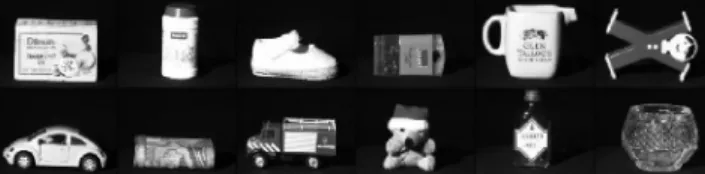
We selected48objects from the Amsterdam Library of Object Images database [15]. Each object is recorded un-der 8 different illumination conditions and the image size is 72×96. Some examples of objects are given in fig. 2.
Figure 2. Some images from the ALOI database
For each object, seven images were selected for train-ing and the last one was used for testtrain-ing. We shifted the test image five pixels horizontally and five pixels vertically. Using an affine transformation as rigid motion, we tried to recover the translation using Eigentracking (PCA) [6] and supervised PKPCA (rigid). We retained 70% of the energy for both methods, which was the best setting for both. Fig. 3 plots the errors for each of the 48 images. The error is the difference between the recovered translation and the initial perturbation,i.e. |tx−5|+|ty−5|. As shown in fig. 3,
PKPCA allows for more accurate registration starting from the same initial configuration. At first, this result seems to be counter intuitive because images of the same object at different illuminations often form a linear subspace (assum-ing Lambertian surfaces). However two noteworthy fac-tors exist: First, the linearity assumption breaks down when combining images of different objects. Second, the object surfaces are not Lambertian and there are shadow effects. In this experiment, we have used the RBF Gaussian kernel for KPCA. Fig. 3 shows the reconstruction error, PKPCA achieves better reconstruction and alignment.
Figure 3. Top: error versus testing images. Bottom: left) original image, center) PCA reconstruction, right) KPCA reconstruction
5.1.2 Registering faces with PKPCA
Accurate alignment of faces is a very important step in ap-plications such as facial expression analysis or face recogni-tion. AAMs and MMs [8, 12, 16, 24, 35] are state-of-the-art algorithms for face alignment. In this section, we compare PKPCA and AAMs for non-rigid alignment on the CMU Multi-PIE database [18].
We randomly select 700 face images (120×160) con-taining 5 different expressions: smile, disgust, surprise, scream and squint (roughly 140 images each). All images are frontal and are taken under the same illumination condi-tions. Each face is manually labeled with 68 landmarks as shown in fig. 4a. A PCA model of shape is built retaining 80% of the energy [8, 12, 24]. The total number of param-eters to recover is 12, six for affine transformation and an-other six for shape variation. For appearance modeling, we extract the intensity values of pixels inside the rectangular patches around the landmarks as in [12]. Figure 4b shows an example of patches for landmarks around the mouth area. Both PKPCA and linear PCA alignment systems are trained by retaining 80% of the energy. We use 100 testing images
Figure 4. (a) example of landmarks associated with each face, (b) patches for appearance modeling, (c) example of shape distortion and randomly perturb the affine and non-rigid transforma-tion with increasing power. Figure 4.c shows an example of such perturbation. The correct landmarks are marked in cyan (circles), while the transformed shape is shown in
yel-low (stars). Note that none of the subjects in the testing images are in the training set. For each testing image, we record the sum of absolute differences between the ground truth landmarks and the recovered ones. Fig. 5 shows the average and standard deviation of the alignment error as a function of the amount of perturbation. As can be observed, PKPCA provides better alignment in comparison with lin-ear PCA, for the same percentage of energy preserved in the models. The difference is especially significant for large amounts of perturbation.
Figure 5. Aligment error versus amount of perturbation.
5.2. Unsupervised alignment
This section shows the benefits of unsupervised align-ment in two data sets, the USPS dataset and Multi-PIE [18].
5.2.1 USPS data set
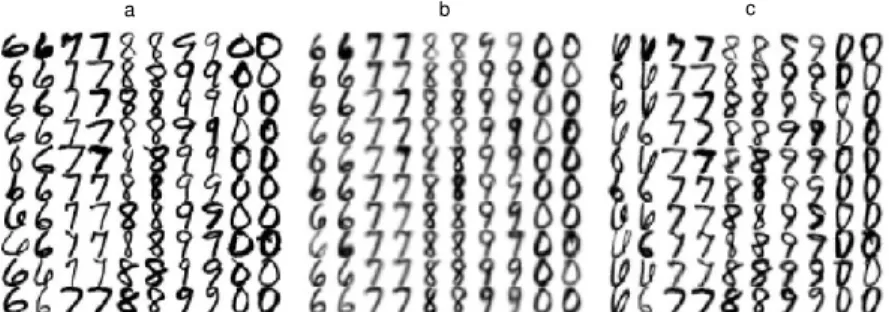
Fig. 6 shows the results of jointly registering and learning the model for the USPS data set. We randomly select a setS of 100 images (16×16) of ten hand-written digits from the USPS dataset (fig. 6.a). Figure 6.b showsSafter 5 itera-tions. The energy amounts preserved by KPCA at iterations 1, 2, 3, 4 and 5 are 70%, 72.5%, 75%, 77.5%, and80% respectively. The initial setSrequires 33 principal compo-nents to preserve 80% of the energy. After jointly align-ing the data and computalign-ing PKPCA, only6eigen-bases are needed to preserve80%of the energy. This indicates that after convergence, we obtain a more compact model, likely to have better generalization properties.
For comparison purposes, we also perform unsupervised alignment using the Congealing method [23]. To avoid warping outside image boundaries, we pad the images with 15-pixel white borders on each side. The experiment is done using the code provided by the author2for affine transfor-mation with 80 iterations. The result is given in Fig. 6c. As can be seen, our method produces better visual results. Moreover, the number of bases to encode data after align-ment (using PCA with80%energy) is14, twice as many as
2http://www.cs.umass.edu/∼elm/congealing/
our method (6). In the experiments reported by [23], the au-thors jointly aligned samples of the same number, achieving better alignment results than the ones in fig. 6.c. Further-more, our method is more computationally efficient. Em-ploying a Pentium 4 3Ghz running Windows XP our method takes 25s, while the Congealing method takes 305s.
5.3. Improving face labeling
This section shows an application of PKPCA to improve upon manual labeling of landmarks in faces. Previous work of Walkeret al.[36] has addressed this important problem by finding correspondences among salient points in images. Recently [19] proposed an extension of Congealing meth-ods to align faces with rigid transformations. In this sec-tion, we demonstrate how to extend previous work in order to align facial features of people’s faces using PKPCA.
We selected920frontal face images with neutral expres-sion and direct illumination (see fig. 1) from the CMU Multi-PIE database [18]. We use600face images to learn a KPCA model of appearance,C(eq. 3), around66 land-marks and a linear model of shape,Bs. We perform PCA
on the shape, since it has been previously shown that a linear model provides good generalization across identities and expressions; whereas, a linear model does not gener-alize well for appearance [17]. The algorithm starts with the manually labeled landmarks red dots in fig.(7). Differ-ent images have been labeled by differDiffer-ent people. Bs is obtained by computing PCA on the landmarks and preserv-ing95%of the energy. An a additional translational basis (xandydirections) is added for the landmarks in the eyes, brows and corners of the mouth. These extra basis will al-low compensation for more accurate positioning of the land-marks outside the shape model. The KPCA model (C) is computed by performing KPCA on patches of22×22 pix-els around the landmark locations [12], and preserving90% of the energy. Once the initial model is built, the algorithm alternates between two steps until convergence: (i) align all images w.r.t. the KPCA model, (ii) Recompute the KPCA model so it minimizes Eq. 12.
We let the algorithm run for 10 iterations. At each iteration the number of eigenvectors decreases, since the data is better aligned, and hence more compactly encoded. The amount of eigenvectors for those ten iterations is: 139,106,97,93,91,89,88,87,86,85,85. As we can see at the end of the convergence, the KPCA is more com-pact (41% less eigenvectors that the initial configuration). Furthermore, the landmarks are placed more consistently across people’s features. Fig. 7 shows some examples of landmarks before and after learning KPCA. The yellow crosses correspond to the placement of the landmarks af-ter learning the model invariantly to non-rigid deformations. The red dots represent the initial manual labeling. As we can see, PKPCA is able to achieve a more consistent
label-a b c
Figure 6. Joint alignment of handwritten digits, (a) original digits from USPS dataset, (b) result of PKPCA, (c) result of Congealing method.
ing across subjects’ features (e.g.nose, eyes).
Since the PKPCA model has fewer parameters, it is likely to be less prone to over-fitting in new testing data. To test the fitting capabilities of the new model, we took 320testing subjects from the CMU Multi-pie database [18]. We start from the mean shape and let the PKPCA algorithm converge. The error and standard deviation for the initial model is3.73±3.8 pixels and PKPCA3.42±3.1. The difference is not statistically significant in this dataset, but recall that the PKPCA model uses41% fewer number of eigenvectors.
6. Conclusion
In this paper, we have extended KPCA by incorporating geometric transformations into the formulation, and a gradi-ent descgradi-ent algorithm has been proposed for fast alignmgradi-ent. Furthermore, we show how to learn this model in an unsu-pervised manner. Preliminary experiments show the ben-efits of our approach in comparison with traditional linear PCA models to register both rigid and non-rigid motion.
AcknowledgmentsThis work was partially supported by Na-tional Institute of Justice award 2005-IJ-CX-K067 and NaNa-tional Institute of Health Grant R01 MH 051435.
References
[1] S. Avidan. Support vector tracking. InConference on Com-puter Vision and Pattern Recognition, 2001.
[2] S. Baker, I. Matthews, and J. Schneider. Automatic con-struction of active appearance models as an image coding problem. IEEE Transactions on Pattern Analysis and Ma-chine Intelligence, 26(10):1380 – 1384, October 2004. [3] P. Baldi and K. Hornik. Neural networks and principal
com-ponent analysis: Learning from examples without local min-ima.Neural Networks, 2:53–58, 1989.
[4] J. R. Bergen, P. Anandan, K. J. Hanna, and R. Hingorani. Hi-erarchical model-based motion estimation. European Con-ference on Computer Vision, 1992.
[5] M. J. Black, D. J. Fleet, and Y. Yacoob. Robustly estimating changes in image appearance. Computer Vision and Image Understanding, 78(1):8–31, 2000.
[6] M. J. Black and A. D. Jepson. Eigentracking: Robust match-ing and trackmatch-ing of objects usmatch-ing view-based representa-tion. International Journal of Computer Vision, 26(1):63– 84, 1998.
[7] V. Blanz and T. Vetter. A morphable model for the synthesis of 3d faces. InSIGGRAPH, 1999.
[8] T. Cootes, G. Edwards, and C. Taylor. Active appearance models.PAMI, 23(6):681–685, 2001.
[9] T. Cootes and C. Taylor. Statistical models of appearance for computer vision. InTech. report, Univ. of Manchester, 2001.
[10] T. Cootes, K. Walker, and C. Taylor. View-based active ap-pearance models. InIEEE International Conference on Au-tomatic Face and Gesture Recognition, 2000.
[11] F. de la Torre and M. J. Black. Robust parameterized com-ponent analysis: theory and applications to 2d facial appear-ance models. Computer Vision and Image Understanding, 91:53 – 71, 2003.
[12] F. de la Torre, A. Collet, J. Cohn, and T. Kanade. Filtered component analysis to increase robustness to local minima in appearance models. InInternational Conference on Com-puter Vision and Pattern Recognition, 2007.
[13] K. I. Diamantaras. Principal Component Neural Networks (Therory and Applications). John Wiley & Sons, 1996. [14] B. J. Frey and N. Jojic. Transformation-invariant clustering
and dimensionality reduction. IEEE Transaction on Pattern Analysis and Machine Intelligence, to appear.
[15] J. Geusebroek, G. Burghouts, and A. Smeulders. The am-sterdam library of object images. International Journal of Computer Vision, 61(1):103–112, 2005.
[16] S. Gong, S. Mckenna, and A. Psarrou. Dynamic Vision: From Images to Face Recognition. Imperial College Press, 2000.
[17] R. Gross, I. Matthews, and S. Baker. Generic vs. person specific active appearance models. Image and Vision Com-puting, 23(11):1080–1093, 2005.
[18] R. Gross, I. Matthews, J. F. Cohn, T. Kanade, and S. Baker. The CMU Multi-Pose, Illumination, and Expression (Multi-PIE) face database. Technical report, Carnegie Mellon Uni-versity Robotics Institute.TR-07-08, 2007.
Figure 7. Red dots represent the initial manual labeling. Yellow crosses are the landmarks re-labeled with PKPCA (better seen in color).
[19] G. Huang, V. Jain, and E. Learned-Miller. Unsupervised joint alignment of complex images. InInternational Con-ference on Computer Vision, October, Brasil 2007.
[20] I. T. Jolliffe. Principal Component Analysis. New York: Springer-Verlag, 1986.
[21] M. J. Jones and T. Poggio. Multidimensional morphable models. InInternational Conference on Computer Vision, pages 683–688, 1998.
[22] I. Kookinos and A. Yuille. Unsupervised learning of object deformation models. InInternational Conference on Com-puter Vision, 2007.
[23] E. G. Learned-Miller. Data driven image models through continuous joint alignment. IEEE Transactions on Pattern Analysis and Machine Intelligence, 28(2):236–250, 2006. [24] I. Matthews and S. Baker. Active appearance models
revis-ited. International Journal of Computer Vision, 60(2):135– 164, Nov. 2004.
[25] T. Melzer, M. Reiter, and H.Bischof. Kernel cca: A non-linear extension of canonical correlation analysis. Interna-tional Conference on Artificial Neural Networks, 2001. [26] S. K. Nayar and T. Poggio. Early Visual Learning. Oxford
University Press, 1996.
[27] E. Oja. A simplified neuron model as principal component analyzer. Journal of Mathematical Biology, 15:267–273, 1982.
[28] S. Romdhani, S. Gong, and A. Psarrou. A multiview non-linear active shape model using kernel pca. InBritish Ma-chine Vision Conference, 1999.
[29] B. Scholkopf and A. Smola. Learning with Kernels: Sup-port Vector Machines, Regularization, Optimization, and Beyond. MIT Press, 2002.
[30] B. Sch¨olkopf, A. Smola, and K. Mller. Nonlinear component analysis as a kernel eigenvalue problem. Neural Computa-tion, 10:1299–1319, 1998.
[31] J. Shawe-Taylor and N. Cristianini.Kernel Methods for Pat-tern Analysis. Cambridge University Press, 2004.
[32] H. Shum, K. Ikeuchi, and R. Reddy. Principal component analysis with missing data and its application to polyhedral object modeling.Pattern Analysis and Machine Intelligence, 17(9):855–867, 1995.
[33] L. Sirovich and M. Kirby. Low-dimensional procedure for the characterization of human faces. J. Opt. Soc. Am. A, 4(3):519–524, March 1987.
[34] M. Turk and A. Pentland. Eigenfaces for recognition. Jour-nal Cognitive Neuroscience, 3(1):71–86, 1991.
[35] T. Vetter. Learning novel views to a single face image. In
Automatic Face and Gesture Recognition, 1997.
[36] K. Walker, T. Cootes, and C. Taylor. Automatically build-ing appearance models from image sequences usbuild-ing salient features. Image and Vision Computing, 20(5-6):435–440, 2002.
[37] S. G. Y. Li and H. Liddell. Recognising trajectories of fa-cial identities using kernel discriminant analysis.Image and Vision Computing, 21(13-14):1077–1086, 2003.
[38] M. Yang, N. Ahuja, and D. Kriegman. Face recognition us-ing kernel eigenfaces. InInternational Conference on Image Processing, 2003.