POLICY
RESEARCH
WORKING
PAPER
235
8
Why Infrastructure
To encourage the privatefunding and provision of
Financing
Facilities
infrastructure services,Often Fall Short of
governments have usedspecialized financing facilitiesTheir Objectives
to offer financial support toinvestors. A study of five cases shows that these facilities
Daniela Klingebiel have often fallen short of their
Jeff Ruster objectives, for two main sets
of reasons. First, the environment was not conducive to private
participation in infrastructure. And second, the facility was faulty in design.
The World Bank
Private Sector Development Department
Private Participation in Infrastructure
Public Disclosure Authorized
Public Disclosure Authorized
Public Disclosure Authorized
Summary findings
To encourage the private funding and provision of They find that these facilities have often fallen short of infrastructure services, governments have used their objectives for two main sets of reasons. First, the specialized financing facilities to offer financial support environment was not conducive to private participation to investors, often in the form of grants, soft loans, or in infrastructure because of poor sector policies, an
guarantees. unstable macroeconomic environment, and inadequate
Klingebiel and Ruster present case studies of financial sector policies, among other reasons. Second, infrastructure financing facilities in various stages of the facility was faulty in design - in terms of sectors
development in Colombia, India, and Pakistan. They also targeted, pricing of instruments, and consistency of present case studies of government-sponsored financing objectives and instruments.
facilities (not of infrastructure) in Argentina and Moldova.
This paper - a product of Private Participation in Infrastructure, Private Sector Development Department - is part of a
larger effort in the department to examine government policies in infrastructure. Copies of the paper are available free from the World Bank, 1818 H Street NW, Washington, DC 20433. Please contact Mina Salehi, room 110-1 8, telephone 202-473-7157, fax 202-522-2029, email address [email protected]. Policy Research Working Papers are also posted on the Web atwww.worldbank.org/research/workingpapers. Daniela Klingebiel maybe contacted at [email protected]. June 2000. (38 pages)
The Policy Research Working Paper Series disseminates the findings of work in progress to encourage the exchange of ideas about development issues. An objective of the series is to get the findings out quickly, even if the presentations are less than fully polished. The papers carry the names of the authors and should be cited accordingly. The findings, interpretations, and conclusions expressed in this paper are entirely those of the authors. They do not necessarily represent the view of the World Bank, its Executive Directors, or the countries they represent.
OFTEN FALL SHORT OF THEIR OBJECTIVES
by
Daniela Klingebiel Jeff Ruster
As part of an overall strategy to induce private funding and provision of infrastructure services, governments have offered support to investors in the form of grants, loans and guarantees. These supports have often been provided through an institutional approach of specialized financing facilities. A prelimninary stocktaking of the experience shows that these facilities have often fallen short of their intended objectives mainly for two sets of reasons: (i) a lack of a conducive environment for private participation in infrastructure-poor sector policies, unstable political environment, a poor macro-framework and inadequate financial sector policies-and (ii) faulty design of the facility itself-inconsistent objectives, instruments, and pricing of instruments, sectors targeted.
TABLE OF CONTENTS
Page No.
I. ExEcuTIvE SUMMARY ... 1
II. 1]TRODUCTION ... 7
III. CROSS-COUNTRY EXPERIENCE wrrH TFRASTRUCTuRE FuNDs/FAcILmEs ... 11
IV. CASE STUDIES ... 14
A. Colombia: Infrastructure Facility ... 15
B. India: Infrastructure Development Finance Company Limited (IDFC). 19 C. Pakistan: Private Sector Energy Development Fund (PSEDF) ... 23
D. Argentina: Capital Market Development Backstop Facility ... 27
E. Moldova: Pre-Export Guarantee Facility (PEGF) ... 31
1. Governments worldwide are seeking to increase private capital flows to a broad range of infrastructure sectors. However, private sector involvement, most notably within the emerging markets, has been limited due to investor unwillingness to assume many of the commercial, financial and political risks surrounding these large-scale undertakings.I In addition to the risk profile of the project and sector in question, additional factors that will determine private sector involvement in infrastructure include the following:
* the development status of the enabling legal and regulatory environment; * market structure (natural monopoly vs. multiple potential providers); * macroeconomic conditions;
* financial, technical and institutional capabilities of the host government and relevant state-owned enterprises;
* availability and quality of information required by investors to conduct due diligence undertakings;
- tendering process utilized (structured vs. unstructured, competitive vs. direct assignment); and
- liquidity of local financial markets.
2. As part of their overall strategy to induce private funding and provision of these services, governments have sought to attract private investment by offering support to investors, often in the form of of grants, soft loans, or guarantees.2 A growing number of
governments have developed an institutional approach to providing such support. This institutional approach, referred to hereafter as Infrastructure Financing Facilities (IFFs)
appear to offer a number of benefits, including the following: * leverage Government and donor funding;
- reduce transaction costs by offering a wholesale approach for allocating donor support for smaller-scale infrastructure financings;
* increase transparency and consistency to evaluating and allocating government support; and
* allow for portfolio diversification.3
For the purposes of this discussion risks are classified according to the following categories: political-currency convertibility and transferability, parastatal breach of contract, changes in law and trade regimes, revocation of permits, expropriation, war, sabotage, etc.; financial-Financial market interruptions, interest rate and exchange rate fluctuations, prepayment; and commercial-Construction delays and overruns, increases in operations and maintenance expense, changes in prices of inputs and outputs, availability and quality of fuel supply, contractor insolvency, etc.
2 However, govemments can also attempt to address the policy problems that underlie investors' concerns by
raising prices to cost covering levels, ensuring macro stability, and establishing a sound macro-framework. See for a detailed discussion on instruments: Dailami, Klein (1997).
3 However, country funds will have only very limited possibilities of diversifying risks as infrastructure
projects tend to be lumpy and thus the fund in effect may not finance more than 10 to 20 projects. In addition, empirical evidence shows that returns in infrastructure projects tend to be highly correlated and correlate with national income. For example, electric power, highways, waterways, airports and postal services are all positively correlated with national income. See for more detail: Bailey, Jensen, 1972.
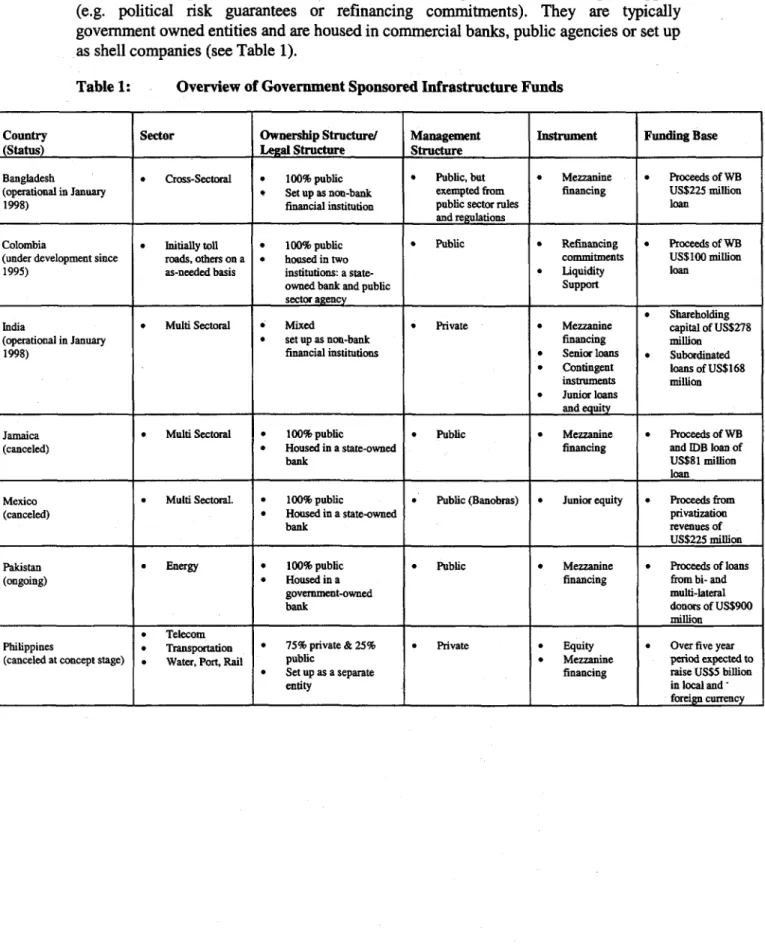
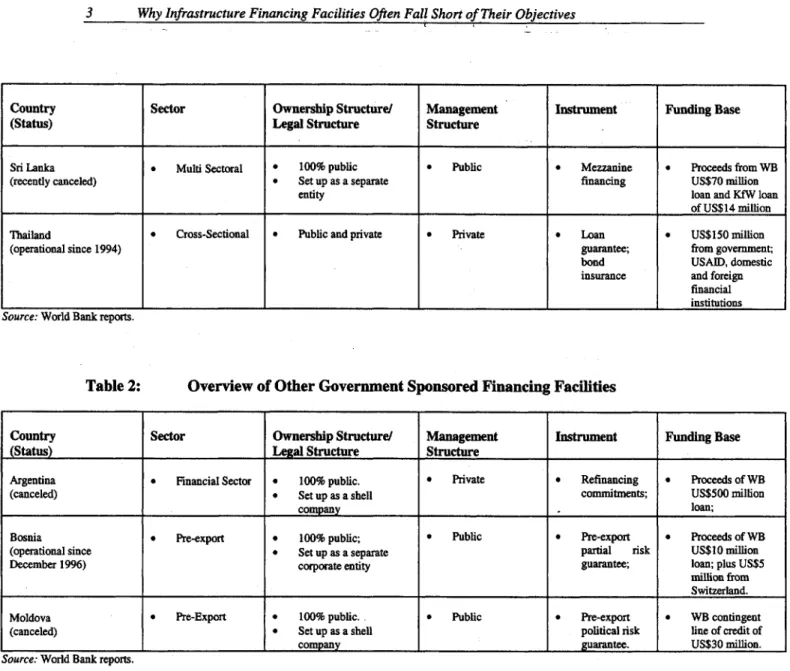
3. IFFs effectively serve as a wholesale mechanism to channel either direct funding in the form of equity, senior and subordinated debt and grants and/or contingent support (e.g. political risk guarantees or refinancing commitments). They are typically government owned entities and are housed in commercial banks, public agencies or set up as shell companies (see Table 1).
Table 1: Overview of Government Sponsored Infrastructure Funds
Country Sector Ownership Structure/ Management Instrument Funding Base
(Status) Legal Structure Structure
Bangladesh * Cross-Sectoral * 100% public * Public, but * Mezzanine * Proceeds of WB (operational in January * Set up as non-bank exempted from financing US$225 million 1998) financial institution public sector rules loan
and regulations
Colombia * Initially toll * 100% public Public * Refinancing * Proceeds of WB (under development since roads, others on a * housed in two commitments US$100 million 1995) as-needed basis institutions: a state- * Liquidity loan
owned bank and public Support = _________________ Lsector agency
Shareholding India * Multi Sectoral * Mixed * Private * Mezzanine capital of US$278 (operational in January * set up as non-bank financing million 1998) financial institutions * Senior loans * Subordinated
* Contingent loans of US$168 instruments million * Junior loans
and equity
Jamaica * Multi Sectoral * 100% public * Public * Mezzanine * Proceeds of WB (canceled) * Housed in a state-owned financing and IDB loan of
bank US$81 million
loan
Mexico * Multi Sectoral. * 100% public * Public (Banobras) * Junior equity * Proceeds from (canceled) * Housed in a state-owned privatization
bank revenues of
._______________ ______________ US$225 million
Pakistan * Energy * 100% pubEic * Public * Mezzanine * Proceeds of loans (ongoing) * Housed in a financing from bi- and
govermment-owned multi-lateral
bank donors of US$900
______________________ ________________________ ____________________ m illion
_ Telecom
Philippines * Transportation * 75% private & 25% * Private * Equity * Over five year (canceled at concept stage) * Water, Port, Rail public * Mezzanine period expected to
* Set up as a separate financing aise US$5 bilElon
entity in local
Country Sector Ownership Structurel Management Instrument Funding Base
(Status) Legal Structure Structure
Sri Lanka * Multi Sectoral * 100% public * Public * Mezzanine * Proceeds from WB (recently canceled) * Set up as a separate financing US$70 million
entity loan and KfW loan
of US$14 million Thailand * Cross-Sectional * Public and private * Private * Loan * US$150 million (operational since 1994) guarantee; from government;
bond USAID, domestic insurance and foreign
financial institutions
Source: World Bank reports.
Table 2: Overview of Other Government Sponsored Financing Facilities
Country Sector Ownership Structure/ Management Instrument Funding Base
(Status) LeIgal Structure Structure
Argentina * Financial Sector * 100% public. * Private * Refinancing * Proceeds of WB (canceled) * Set up as a shell commitments; US$500 million
company . loan;
Bosnia * Pre-export * 100% public; * Public * Pre-export * Proceeds of WB (operational since * Set up as a separate partial risk US$10 million December 1996) corporate entity guarantee; loan; plus US$5
million from Switzerland. Moldova * Pre-Export * 100% public. * Public * Pre-export * WB contingent (canceled) * Set up as a shel political risk line of credit of company guarantee. US$30 million.
Source: World Bank reports.
4. This paper attempts to take stock of some of the cross country experiences with IFFs via desktop review, evaluates their preliminary success and attempts to draw some initial lessons. It provides examples of infrastructure funds/facilities with varying institutional arrangements, sources of funding, sector(s) targeted, instruments offered and policy orientations. The success of the facility will be determined by assessing whether the facility has (i) minimized and leveraged government's involvement in the financing of infrastructure projects; (ii) increased the efficiency of sector development through the provision of a transparent and systematic review of eligible projects; (iii) allocated risks to those parties best able to manage them (i. e. distance the government from commercial risks); and (iv) provided a transitional mechanism to facilitate the closing of a number of benchmark transactions.
5. For the purposes of conducting this analysis, three case studies were selected featuring IFFs at different stages of development. Each case was chosen to exemplify the various types of policy issues that can arise in the design of an IFF that may adversely affect the success of the iFFs. The cases were also selected so as to evaluate whether the success of the facility was related to the types of instruments offered. The three case studies include (i) Colombia, (ii) India; and (iii) Pakistan. Two of the IFFs presented, Colombia and India, were at the conceptual stage at the time this study was undertaken. As there is limited experience with the use of contingent instruments in infrastructure financing facilities, two other government sponsored financing facilities not geared at infrastructure-the Argentine and Moldovan government sponsored facilities-were included in the study given their wholesale approach and focus on utilization of contingent instruments.
6. The preliminary analysis of the three IFFs and the two other government sponsored facilities shows that these facilities have often fallen short of their intended objectives mainly for two sets of reasons: (i) a lack of a conducive environment for private participation in infrastructure-poor sector policies, unstable political environment, a poor macro-framework and inadequate financial sector policies-and (ii) faulty design of the facility itself-inconsistent objectives, instruments, and pricing of instruments, sectors targeted.
7. Conducive Environment for Private Participation in Infrastructure. The decisions as to whether companies will enter a market are dependent on the tariff and regulatory framework as well as on the stability of the macro-framework, political stability and adequate financial sector policies. To ensure that government resources are not used over the long term to simply compensate private investors for gaps in the regulatory framework, an appropriate legal and regulatory framework coupled with adequate enforcement mechanisms and secure property rights should be in place. An insufficient regulatory and legal framework will tend to increase the cost of capital to investors and may thus adversely affect the commercial viability of projects. In the worst of cases, private capital flows may simply not be available at any cost. Over the short-term, the government may use the IFFs as a transitional tool to bring a number of benchmark transactions to financial closure and affirm the legal and regulatory framework. To avoid a permanent subsidy, IFFs should be set up as transitional tool. 8. It should also be noted that building up a track record may prove to be a useless exercise, if a government change can result in the new government reneging on contracts or reversing decisions of the "old" government. In addition, the scarcity of long-term capital is often used as a justification for governments to establish an infrastructure fund. Yet, while a government sponsored debt fund may temporarily mitigate a lack of long-term resources, it does not tend to resolve the underlying causes for under developed or undeveloped capital markets, i. e. unstable macro-policies and inadequate financial sector policies. Finally, if the government employs contingent instruments to foster the development of financial markets (i.e. jump-starting the primary market in long-term bonds via put options for local investors), it should ensure such development is not
hampered by regulatory restrictions (e. i. are institutional funds allowed to invest also in non-investment grade securities).
9. Adequate Design Features of Facility. The analysis presented also illustrates that
the IFF's success was also adversely affected by micro-level issues relating to its design including inconsistent objectives, an inadequate institutional framework, and inadequate design parameters.
10. Develop Clear and Consistent Objectives. The cross country analysis suggests
that public-sector counterparts should develop clear and consistent objectives on which to base the design of the facility as some objectives could work at cross purposes. For example, the Government may want to achieve such development objectives via the facility as expanding liquidity, lowering funding cost by offering credit enhancements, better allocating risk between the government and the private sector, developing the domestic capital market, improving the quality of service and increasing competition. However, governments will be unable to pursue all of these objectives at the same time. A better allocation of risk between the private and public sector may lead to higher risk exposure of the private sector, which in turn may reduce private resources flowing into infrastructure.4 In addition, government should avoid mixing commercial and developmental objectives as instruments for the latter may feature required pricing at levels that may not allow for a market return. Moreover, to provide effective and efficient support to private participation in infrastructure on a transitional basis, the design parameters of the IFF should be consistent with the policy environment.
11. Understand Investor Requirements. As experience presented in the paper further
reveals, to ensure that the design of the facility is offering instruments that addresses the impediments to private participation in infrastructure, the government may want to conduct a thorough demand survey. A demand or broader market survey may also provide guidance to the government on the following issues:
* to identify the nature and magnitude of the financing gap;
* the appropriateness of the fund as an instrument to support private investment and the timing of the fund;
* the design of instruments;
* the 1FF funding requirements; and
* the staffing levels and skill mix needed to manage those instruments.
12. Nevertheless, the development of such funds tends to be a complex and time consuming process, especially if contingent instruments are offered as the facility may need to build up institutional capacity. In the meantime, given that developing countries tend to be vulnerable to shocks, economic conditions may change and may adversely
4 Nevertheless, at the same time, government may have implemented a set of policy reform that improves the overall regulatory environment and allow, among other things, for cost covering tariffs. This would in turn reduce govemments' the need for the govemment to offer financial support to attract private resources into the sector.
affect the usefulness of the instruments if they cannot be adapted in structure to the new economic environment.5
13. Develop Institutional Framework that is in Line with Objectives of Fund. The
facility needs adequate institutional capacity and an effective organizational structure, independence in its decision making process and technical support in the start up face to ensure that the facility builds up adequate technical capacity.
14. Experience with IFFs shows that financial engineering cannot substitute for the lack of sound policy, only open or disguised government subsidies can. The question then is which approach to project finance levers government funds with respect to reform efforts and not with respect to other funds. Country experience does indicate that good reform will eventually bring in those as well but there is not enough of a track record to confirm this empirically at this point in time.
As the Argentine case study also illustrates, it is very difficult to restructure these instruments, as the instrument structure is rarely flexible enough, itself a reflection of the rigidity associated with donor funding in support of such initiative.
II.
INTRODUCTION15. Private Participation in infrastructure (PPI) has risen substantially over the last ten years and today, increasing from about US$16 billion in 1990 to U$S 120 billion in 1997. For developing countries, PPI-financing averaged 15 to 20 percent a year. Private activity, however, has been concentrated in relatively few countries. Middle income countries have attracted most private activity; among low-income countries only China and India have attracted substantial private investment. In other regions, notably Sub-Saharan Africa, the number of countries with projects with private participation has been increasing, but private activity remains limited. In 1998, ten countries accounted for 74 percent of all investments in infrastructure projects (Argentina, Brazil, China, Hungary, India, Indonesia, Malaysia, Mexico and Thailand).6
16. Why the move to Private Participation in Infrastructure (PPI).7 Physical
infrastructure projects have been traditionally financed with public funds and operated by public entities. Driven by fiscal austerity and widespread disenchantment with the performance of state-owned utilities,8 innovations in technology and policy,9 many governments are turning to the private sector to build, operate, finance, own, and transfer telecommunication facilities, power plants, ports and airports as well as toll roads. In industrialized countries, the move to PPI is toward restructuring or unbundling integrated industry structures, introducing competition and choice (particularly in the electricity and telecommunications industry) and regulating those parts of the infrastructure sector where elements of natural monopolies exists. In the developing world the picture is more mixed and reflects the different levels of achievements in institutional, regulatoiy and policy developments.
17. Barriers constraining effective private involvement in infrastructure. Many
developing countries are now in transition to private provision of infrastructure. Nevertheless, effective private involvement in emerging economies is still hampered to a varying degree by the following factors: an inadequate legal and regulatory framework,10
6 Roger (1999).
7 See for more detail: Klein, Roger (1994).
8 According to the World Bank, developing countries currently spend about US$200 million a year on infrastructure development. The large investment needs in infrastructure place an enormous burden on public finances and is probably unsustainable over the long run, especially in Asia where infrastructure investment needs are estimated to be around $ 1.2-1.5 trillion over the next decade World Bank. However, due to the financial crises that the region is grappling with which will adversely affect GDP growth, these figures need to be adjusted downwards. Figures cited in World Bank (1994) and World Bank (1996), Infrastructure Development in East Asia and Pacific: Toward a New Public-Private Partnership.
9 A rethinling of the traditional doctrine of publicly owned utility monopolies has led to innovations in the
regulatory arena, notably the unbundling of natural monopolies into network facility and potentially competitive activities, the separation of ownership from service provision and new forms of service provision.
10 This includes a need for more conducive sector policies, particularly regarding pricing, competition, and public monopolies. Moreover, in the area of tariff policy, an increase in tariffs to full economic cost is a precondition for ensuring the financeability of private infrastructure projects. This may, however, include the elimination of subsidy-induced distortions that involves major adjustment in the tariff structures. In developing countries, annual subsidies from underpricing water, power, and rail services are estimated to amount to US$120 billion annually which amounts to (very roughly) about one third of total annual overall investment in infrastructure services in developing countries or US$350 billion. World Bank.
poorly structured concession and contractual arrangements, high transaction costs,'" political risk, and a lack of an established reputation and track record from the part of the government. The financing of such projects is encumbered by weak domestic capital market that rarely, if ever, are willing and able to support the infrastructure investment needs facing most developing countries, an unstable macro-framework that increases interest rate risk, and a below-investment grade sovereign credit rating limiting access to international capital markets for infrastructure projects (as domestic companies and projects cannot receive a credit rating that is better than the sovereign rating.12 Indeed, of
the US$15 to 20 trillion available for funding from institutional investors, only around 300 million are slated for investment in non-investment grade securities which will be divided between purchasing sovereign or Brady bonds, other company and infrastructure bonds.13
18. Due to the large sunk costs, which can take from 10 to 30 years to recoup, associated with infrastructure projects and their various risks,14 private investors have
been hesitant to invest in emerging market economies with high country risk and unproven regulatory regimes unless supported by host governments through tax incentives and some sort of financial support intended to improve the cash flow or reduce risk.15 Economic justification for government support to infrastructure projects mainly evolve around the following four sets of arguments:
* incomplete information or information asymmetries on the government's macro and regulatory- policy between public and private agents;
* the Government's ability to better pool and spread risks which would put it in a better position to fund infrastructure projects and lower its cost of capital; * agency costs between equity- and debtholders and between equity holders and
managers; and
* the Government may have inside (or superior) information compared to other market participants.
19. However, theory suggests that imperfections associated with capital markets in financing infrastructure provide only limited justifications for government intervention. While guarantees may be used as instruments to complete imperfect contingency markets, they involve considerable disincentives on their own. For example, credit guarantees will
In the US, contraction and bidding cost amount typically up to two to three. percent of total project cost, whereas these costs tend to range from ten to 15 percent in emerging markets. See also: Klein, So, Shin, 1996.
12 While rating agencies have still to break with this tradition, investors in some Latin American countries are
pricing corporate lower than the sovereign in the secondary market. See for detail: Swafford, 1997. In another development, credit rating agencies hope to expand their business into project finance and encourage project sponsors to obtain a rating on their project with which then will be used by commercial banks, multi-lateral and bilateral lenders, investment banks and institutional investors. See for more detail: Gopinath, 1997.
13 In developed and developing economies, mutual funds, insurance companies and pension funds are often
prohibited by regulation to invest in non-investment grade securities. Figures cited after Klein, 1997.
14 These are expropriation risk, demand risk, payment risk, exchange and interest rate risk, and political and
regulatory risk. See for a detailed discussion: Irwin, Klein, Perry, Thobani (1997).
15 However, as Klein (1997) points out government guarantees or support is not required in jurisdictions with a
provide disincentives to the private sector for performance, maintenance and further investment (Mody, Patro 1996). Furthermore, governments' true cost of capital may not be lower than that of the private sector if taxpayers were to be compensated adequately for the risks they assume. In addition, there seems to be no comparative advantage of the government in risk bearing and risk pooling. Finally, neither do appropriate mechanisms exist with which the government can credibly signal inside information nor are there adequate mechanisms of public intervention with which the government can correct failures in capital markets that are due to agency costs.16
20. While justifications for government support to infrastructure appear limited, a case could be made for transitional mechanisms to jumpstart private sector involvement in infrastructure by helping to bring a few benchmark transactions to closure to validate the untested policy framework-catalytic role of government support-and to mitigate specific risks of infrastructure projects which private investors can neither manage efficiently nor transfer.
21. Governments have mainly used one of three mechanisms to provide financial support to infrastructure projects via provision of (i) direct financial support through subsidized loans (senior subordinate), equity contributions or grants;17 (ii) provision of
contingent supports such as political risk, minimum revenue, construction cost overrun or debt refinancing guarantees,18 and (iii) government sponsored infrastructure financing
facilities.
22. In recent years, government sponsored infrastructure funds have enjoyed increasing popularity in emerging market economies and have been increasingly employed by Governments (see Table 1). On the surface they appear to be a good instrument for government intervention in the financing of infrastructure as they feature a number of advantages that appear to be in line with the core principles of providing government support. In general, funds may have advantages, as they:
* leverage Government and donor funding;
* reduce transaction costs by offering a wholesale approach for allocating donor support for smaller-scale infrastructure financings;
16 See for more detail: Hoffinann-Burchardi, Klein, Mas (1996).
17 Note that subsidies may be structured as lower than market interest rates, longer repayment periods and
average life not offered by private investors, subordinate claims on project security and collateral packages, etc. IS However, explicit govermment guarantees bring with them undesirable consequences as they reduce the incentives of firms to run projects efficiently, weaken market screening and while they relieve current government budgets, they also shift obligations to future periods and as many of these guarantees become effective during recessions they may trigger a new style of debt crisis. See for more detail: Engel, Fischer, Galetovic (1998) and Lewis, Mody, (1998).
* increase transparency and consistency to evaluating and allocating government support; and
* allow for portfolio diversification.19
23. The proliferation of government sponsored financing facilities raises the following questions: Have government-sponsored funds been successful in attracting private investment? What other objectives have government tried to achieve with infrastructure funds and have funds proven to be the appropriate tool? What are the advantages of an infrastructure fund compared to other form of government support? If this instrument is effective for achieving demonstration effects, what demonstration were actually sought versus those that were actually achieved? Are there any preconditions for the establishment of a fund? What are the important design parameters? Is a government sponsored infrastructure fund a more efficient way to provide government support to infrastructure financing? Is it an appropriate way of providing government support? 24. The paper will take stock of cross country experience with infrastructure financing facilities and attempts to assess the preliminary success of this form of Government support to financing infrastructure. In particular, it will examine what country case studies can tell us about the different types of funds, their objectives, instruments and pricing, results of existing funds and lessons learned.
25. The remainder of the paper is organized as follows. Section 3 provides an overview of cross country experience with government sponsored financing facilities. Section 4 will analyze in greater detail specific case studies. The analysis will encompass design objectives and design parameter of the fund, present the results and finally the lessons from that country case.
19 However, country funds will have only very limited possibilities of diversifying risks as infrastructure projects tend to be lumpy and thus the fund in effect may not finance more than 10 to 20 projects. In addition, empirical evidence shows that returns in infrastructure projects tend to be highly correlated and correlate with national income. For example, electric power, highways, waterways, airports and postal services are all positively correlated with national income. See for more detail: Bailey, Jensen, 1972.
III. CROSS-COUNTRY EXPERIENCE WITH INFRASTRUCTURE
FUNDS/FACILITIES
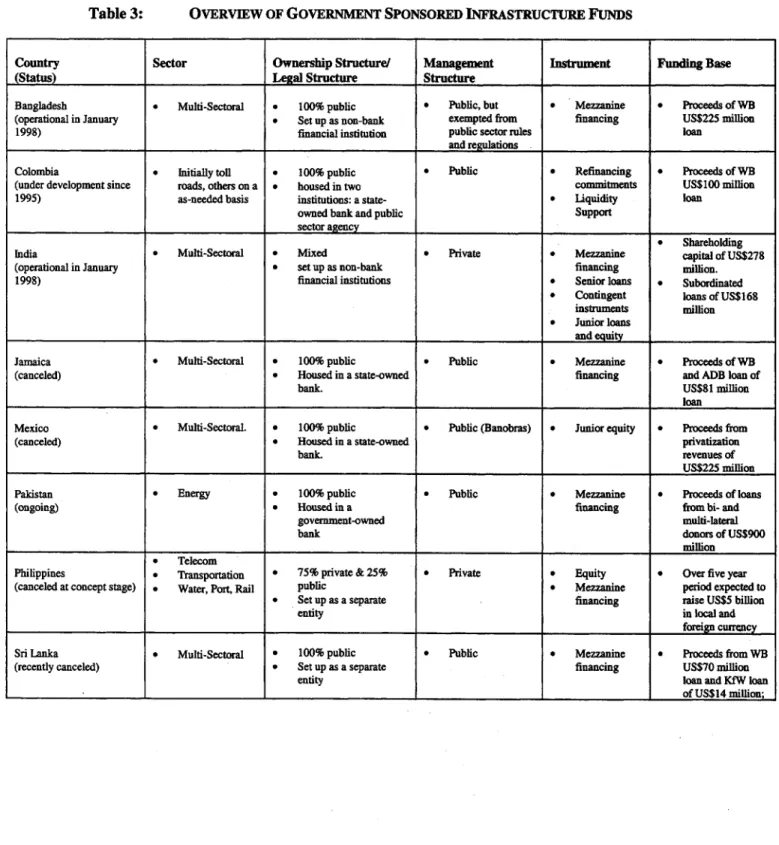
26. The following tables present a survey of twelve government sponsored funds/facilities for which more detailed information was available, and an overview of their respective design parameters. Table 3 provides information on nine financing facilities that focus on promoting private participation in infrastructure. Table 2 entails information on three other government financing facilities of which two were designed to support export activities and one was aimed at promoting capital market development. 27. Ownership/Management Structure of Facilities. Regarding the ownership structure of the facilities contained in both tables, nine facilities are owned by the public sector while three have mixed, i. e. public and private ownership. While government funds may be justified to provide "transitional" and "catalytic" support to infrastructure, their intended limited life span was not reflected in their legal structure. Only two of the publicly owned funds were set up as shell companies that can easily be dismantled. The rest were established on a more permanent basis, i. e. either as non-bank financial institutions or as part of an existing government-owned bank.20 The majority of facilities were also managed by the public sector, reflecting the fact that the decisions made by the fund have potential fiscal implications and can therefore not completely be handed over to the private sector.21
28. Instruments offered by Facilities. The variety of instruments offered by the
facilities shows that they were targeted at different sectors and thus at projects that faced different impediments in attracting private capital. Nevertheless, half of the funds offered blunt direct funding instruments-including junior equity, and mezzanine financing-which suggests that government concluded the lack of long-term finance to be a major impediment to attracting private investment. Only half of the funds offered contingent instruments that can-if structured correctly-be more specifically targeted at commercial, financial and political risks that private investors may be unwilling to assume. For example, in one case, the facility offered refinancing commnitments aimed at financial market interruption risk.
29. Funding Base. The World Bank supported the majority of the funds-nine out of
twelve-and almost all of the funds relied on government financing which may be a reflection of their developmental focus. Out of twelve funds, only one intended to raise
additional money from the capital markets.
20 As the Colombian case later will show, housing the facility in a government owned bank may give rise to a set of problems that is linked to the differing objectives of the institutions. While the facilities may have clearly defined developmental objectives, public banks, in general, overall pursue commercial objectives. The difference in objectives will have repercussions on the pricing of the instruments. While the facility may want to price access to the instruments at levels that encourage their usage, public banks may want to price the instruments at levels that not only
insulates them as much as possible against commercial risk but also allow them to make a profit.
21 As will be discussed in greater detail later, the public sector should rely on the technical expertise of the private sector by hiring consultants that provide support on technical issues. But it needs to reserve the right for itself to make the final decision to mitigate the risk of conflict of interests.
30. Results/Track Record. Out of nine IFFs in our sample, three were in operation at
the point in time this study was written. Five facilities were already canceled indicating the complexity of policy issues facilities have to resolve to be successful and one facility was still in development (see Table 3).
Table 3: OVERVIEW OF GOVERNMENT SPONSORED INFRASTRUCTURE FUNDS
Country Sector Ownership Structure/ Management Instrument Funding Base
(Status) Legal Structure Structure
Bangladesh * Multi-Sectoral * 100% public * Public, but * Mezzanine * Proceeds of WB (operational in January * Set up as non-bank exempted from financing US$225 milion 1998) financial institution pubhc sector rules loan
and regulations
Colombia * Initially toll * 100% public * Public * Refinancing * Proceeds of WB (under development since roads, others on a * housed in two commitments US$100 million 1995) as-needed basis institutions: a state- * iquidity loan
owned bank and public Support
sector agency X
* Shareholding India * Multi-Sectoral * Mixed * Private * Mezzanine capital of US$278 (operational in January * set up as non-bank financing million. 1998) financial institutions * Senior loans * Subordinated
* Contingent loans of US$168
instruments million
* Junior loans
and equity
Jamaica * Multi-Sectoral * 100% public * Public * Mezzanine * Proceeds of WB (canceled) * Housed in a state-owned financing and ADB loan of
bank. US$81 millon
loan
Mexico * Multi-Sectoral. * 100% public * Public (Banobras) * Junior equity * Proceeds from (canceled) * Housed in a state-owned privatization
bank. revenues of
US$225 million
Pakistan * Energy * 100% public * Public * Mezzanine * Proceeds of loans (ongoing) * Housed in a financing from bi- and
government-owned multi-lateal bank donors of US$900
milion
* Telecom
Philippines * Transportation * 75% private & 25% * Private * Equity * Over five year (canceled at concept stage) * Water, Port, Rail public * Mezzanine period expected to
. Set up as a separate financing raise US$5 bilion entity in local and
foreign currency Sri Lanka * Multi-Sectoral * 100% public * Public * Mezzanine * Proceeds from WB (recently canceled) * Set up as a separate financing US$70 millon
entity loan and KfW loan
Country Sector Ownership Structure/ Management Instrument Funding Base
(Status) Legal Structure Structure
Tbailand * Multi-Sectoral * Public and private * Private * Loan * US $ 150 million (operational since 1994) guarantee from govemment;
bond USAID, domestic insurance and foreign
financial
institutions
Source: World Bank reports.
Table 4: OVERVIEW OF OTHER GOVERNMENT SPONSORED FINANCING FACILITIES
Country Sector Ownership Structure/ Management Instrument Funding Base
(Status) Lekal Structure Structure
Argentina * Financial Sector * 100% public. * Private * Refinancing * Proceeds of WB (canceled) * Set up as a shell commitments US$500 rillion
company loan
Bosnia * Pre-export * 100% public * Public * Pre-export * Proceeds of WB (operational since * Set up as a separate partial risk US$10 million December 1996) cotporate entity guarantee loan; plus US$5
million from Switzerland Moldova * Pre-Export * 100% public * Public * Pre-export * WB contingent (canceled) * Set up as a shell political risk line of credit of
cornpany guarantee US$30 million
IV. CASE STUDIES
31. Due to their potential advantages-lower transaction cost, leveraging of government funds-infrastructure facilities, at least on a theoretical level, appear to be a potentially more efficient way to provide government support during the transition to private provision of infrastructure. But how successful have these funds been in practice? Have they strengthened reform efforts by the government in the regulatory framework? Have they been able to attract private investment or have they indeed facilitated the transition to private provision of infrastructure? Have the facilities used the right instruments? Has the scarcity of long-term financing been an important impediment to private investment in infrastructure and have the facilities employed adequate instruments to mobilize more long-term financing resources? What lessons can we learn from recent experiences? The following analysis of case studies attempts to answer these questions.
32. Methodology of Paper. The analysis will extend to three infrastructure financing
facilities and two entities targeted at other sectors of the economy as valuable lessons can be drawn from these experiences. For each case a systematic description of the facility including its objectives, instruments applied, pricing of instruments, institutional framework and operative arrangements is presented. This is followed by an assessment of the results. The analysis concludes with a brief review of lessons learned.
33. Evaluating Outcomes. As noted, government sponsored funds/facilities may
allow for more efficient use of public resources. A more efficient use of public of public resources can be measured in terms of three performance indicators which center on the extent to which government assistance provided by the funds/facilities: (i) attract additional investment by serving as an enabler of commercially viable projects that otherwise may not have been financeable; (ii) reduce cost to project sponsors and to users of facilities or equipment that are financed in part from a financing facilities,2 2 and/or (iii) bring beneficial projects to completion earlier than would have been the case with traditional financing.
34. Evaluation Criteria. Due to their recent inception and the long gestation period of
the projects they are targeting, the following analysis focuses on assessing the success of the facility on the basis of qualitative criteria. Does the fund: (i) minimize and leverage government's involvement in the financing of infrastructure projects; (ii) increase the efficiency of sector development through the provision of a transparent and systematic review of eligible projects; (iii) allocate risks to those parties best able to manage them (i.
e. distance the government from commercial risk); and (iv) provide a transitional mechanism to facilitate the closing of a number of benchmark transactions which helps to improve and affirm the working, legal and regulatory environment for the sector.
22 However, the reduction in cost is brought about not by offering financing at below market rates. On the
contrary, the financial viability of projects is improved through the enhancement of their security package and/or cash flow for the direct benefit of long-term debt providers (without exposing the government to commercial risk). This should result in a direct improvement in the financing terms (tenor, pricing timing) available to the project.
35. Lessons Learned. The analysis concludes with a review of what lessons can be
drawn from the case study to determine necessary preconditions, if any, for establishing infrastructure financing facilities and to learn what factors in the design of the facility are crucial to ensure the success of a financing facility.
36. Sources for the Analysis. Only published sources (i. e. World Bank reports) or
interviews with experts familiar with individual facilities were employed. In the future, as greater attention is focused on providing efficient government support to infrastructure, there is hope that quantitative data will be available.
37. Selection of Cases for Detailed Analysis. We selected three IFFs for a more
detailed analysis that were at a different stage in the development of the facility to exemplify various types of policy issues that may arise in the design of the facility and may adversely affect its success. The three IFFs are (i) Colombia, (ii) India, and (iii) Pakistan. As there is limited experience with the use of contingent instruments by infrastructure financing facilities, two government sponsored facilities targeted at non-infrastructure sectors which had a track record with contingent instruments were included in the analysis. These are (iv) Argentina, and (v) Moldova.
A. Colombia: "Infrastructure Facility"23
38. Rationale and Objectives. During the last several years, the Colombian govemment, as part of its "Economic Modernization Program", has attempted to improve resource allocation by attracting private sector investment in infrastructure while focusing public resources in social sub-sectors. In support of this policy a number of laws were passed in the transport, energy, telecommunications, and water sanitation sub-sectors during 1993 and 1995. Moreover, the government has been working on setting up an infrastructure facility to (i) increase private capital flows to the infrastructure sectors, (ii) improve the conditions of debt financing, and (iii) better allocate risk between public and private enmities.
39. Sectors Targeted and Instruments offered. At the time of the drafting of the
paper, it was envisioned that the facility would start on a pilot basis in the transport sector. It was envisioned to extend the reach of the facility to other projects once the regulatory and policy environment of other sector was considered adequate.24 The facility
would offer three instruments to be provided by two separate entities: (i) local and international market refinancing commitments, and (ii) a put options for local investors, and (iii) a liquidity support facility (available in US$ and local currency).
40. Local and international market refinancing commitments are call options targeted at financial market interruption risk and jump starting the development of the (local) debt market for limited recourse financing. They provide a commitment from the facility to
23 For more detail see: The World Bank, Report No. 17154-Co, January 1998.
24 At that stage, any projects that are tendered by the Colombian Government through a competitive bidding
project sponsors to refinance their debt if the project raises debt from the market that is of shorter maturity than its contract. It would benefit the equity holder as the commitment implies a default guarantee.25 To insulate the facility from commercial risk, project sponsors can exercise the option if the project is in compliance with a set of performance
indicators.2 6
41. The put option is aimed at jump-starting the primary market in securities by offering investors the chance to sell the securities at a steep discount to the facility. Under a put option, the facility provides to investors of infrastructure projects a "liquidity of last resort" facility. The project sponsor or borrower is unaffected as the terms and conditions of his loans remain unchanged. To avoid muting investors' incentives to monitor the project and insulate the facility against commercial risk, investors can only exercise the put option if the project satisfies specific performance criteria.
42. The liquidity support facility offers coverage under the project's concessional and contractual arrangements against payments delays or defaults by public sector entities and would only be callable if the public sector entity failed to meet its payment obligation and such failure would result in debt service default of the project company. This bridge financing is intended to be offered during 12 to 18 months while the budgetary request is being processed and funded by the government.
43. Pricing. The fees-up-front, commitment, and annual fee-of the two instruments will be set to encourage access to these instruments and recover costs. The interest rates of the instruments will be set at lender of last resort levels so as to ensure that they are only exercised as a last resort.
44. Institutional Set Up. The instruments were to be provided by two facilities housed
in two different public sector institutions.2 7 The refinancing commitments and the put option will be offered by a facility housed in Bancoldex, a government owned export bank which will be responsible for the administration including the bidding process, the marketing and servicing of existing instruments and liability management. The international refinancing commitments will be backstopped by the World Bank. The liquidity support facility will be housed in Invias, the public sector transport agency, and managed by Invias personnel.
25 Upon exercise of the instrument, Bancoldex would extend bridge financing directly to the project company that would then apply the proceeds to pay down outstanding debt with its lenders. The term of the refinancing proceeds would be determined in relationship to the project's cash flow generation and debt servicing capacity. The repayment schedule could not extend the term of the concession agreement.
26 For example, the project must maintain a minimum specified investment grade credit rating (e. g. BBB- or its equivalent local currency rating) with no published negative outlook for at least 12 months prior to the drawing of the refinance commnitment. The project must also maintain a minimum debt service coverage ratio.
27 At first, it was intended that both instruments be offered through a facility housed in Bancoldex. However, Bancoldex did not want to be exposed to the government non-payment risk. Thus, it was decided to provide the liquidity support facility through Invias.
45. Funding Base. Initially, the international refinancing commitment and the
liquidity support instrument would be backstopped by a World Bank contingent line of credit of about US$80 million.
Figure 1: Columbia
Infrastructure Financing Facility - Operational Arrangements
Pwject Framework (i)
( a Only)
1~~~~~~~~~~~~41
/ ~ ~~~~~~~~ \LcaOrec:yt
0) Forthe sarri subprvied rrupbe kirunmls oould be dfreid (i.e. Refirandrg Canritrnart vdI the Saancty Uqldty Support
Facilfty)
46. Results. The design phase of the facility has been a long drawn out process due to
a lack of government coordination, the long lead time between the demand survey and the final implementation of the facilities and inconsistencies between developmental objectives being pursued by the government and commercial objectives being pursued by
Bancoldex, the public banks in which the facility was to be housed.
47. Lessons Learned. The Colombian case study offers best practice in three important aspects: (i) employment of a detailed demand analysis that identifies impediments to private investment in infrastructure, (ii) provision of a limited number of instruments that are well targeted at specific non-commercial risks, and (iii) leverage of govemment funds. Nevertheless, it also highlights some of the problems governments face when setting up these facilities.
48. The concept of the facility and the design of the instruments were based on a detailed demand analysis, which helped to initially identify obstacles to private investment in infrastructure. However, the survey was not of sufficient detail to provide specific information as to the underlying factors that are constraining private capital flows to that sector. For example construction risk which was identified as a key impediment for private investment in toll roads. Yet the information gathered in the survey was of insufficient detail to identify specifically what part of the construction risk was the constraining factor. And the facilities was to offer a limited number of instruments targeted at specific risks-financial market interruption-and aimed at achieving a better risk allocation between the private and public sector and allowing the project company to insure itself against those aspects of the refinancing risks it has little control over. By the same token, as the exercise of the refinancing option is linked to good performance, the facility is insulated against such risk over which they have limited control, commercial risks. The limited number of instruments in combination with the limited number of sectors targeted also mitigate demands on the organizational structure and on internal technical capacity and make the management of the facilities more manageable from the government's point of view.
49. Nevertheless, the Colombian case also exemplifies some of problems that arise in the design phase of a government infrastructure sponsored financing facility and may adversely affect the effectiveness of this form of government assistance to infrastructure. A large amount of government and donor resources have been spent during the design phase and have yet to yield concrete results. The high implementation and design costs can partly be attributed to a lack of government coordination. The different government agencies involved in the endeavor failed to establish good channels of communication early on in the process and decide which of the government agencies is to take the lead in designing and setting up the facility. The lack of ownership on the part of the government agencies and ministries involved and the lack of a champion for the project advancing the project through the different bureaucratic processes let the project languish.
50. In addition, long gestation periods of financing facilities entail the risk that the results of the demand survey (which is aimed at identifying impediments to private
participation in infrastructure) on which the concept of the facility is based are no longer valid. In the interim period, economic or (political) conditions may have changed rendering the instruments offered by the facilities less useful to private sponsors (see Argentine example).
51. Moreover, the Colombian experience also highlights a more subtle point. All government entities involved in the initiative should have a consistent set of objectives. The government's longer-term developmental objectives, i.e. local capital market development, carried direct pricing and risk allocation implications for the instruments offered. However, the government decided to house the facility in a government-owned bank, which was pursuing short-term commercial objectives and was apprehensive of assuming projects with longer-term time horizon. Problems arising from government entities pursuing different policy objectives are difficult to resolve (i. e. liquidity support facility).
B. India: "Infrastructure Development Finance Company Limited (IDFC)"2 8
52. Rationale/Objectives. The expansion and efficient use of infrastructure is fast
becoming one of India's key development issues. Implementation of public sector infrastructure projects have generally been slow, with frequent cost overruns and inadequate construction quality. Moreover, public resources are limited and will not be able to finance necessary investments. Against this background, the Government has introduced some reforms in the policy, legal and administrative framework to attract private investment. The government has also sponsored the establishment of the Infrastructure Development Finance Corporation (IDFC) that broadly speaking seeks to stimulate private and long-term local funding for infrastructure projects. According to its developmental objectives, IDFC seeks to create new financial instruments and project implementation structures to increase capital flows and enhance the terms and conditions of funding for infrastructure projects. At the same time, IDFC is pursuing commercial objectives seeking a market return on its investments.
53. Sectors Targeted/Instruments. At the time of writing this report, IDFC was
intended to have a cross-sectoral orientation, targeting the power, telecommunications, ports, toll roads and municipal services sector. Yet during its first two years of existence IDFC was to concentrate on the power and telecommunications sectors. Likewise, IDFC instruments were to focus principally on the provision of direct funding instrument in the form of: co-financing via long-term debt, preferred and common equity for greenfield projects, as well as refinancing of existing local currency debt.29 Then IDFC was to gradually move into the water, transport and urban finance sectors, offering instruments aimed at improving the terms and conditions of third party debt offerings like take out financing, contingent refinancing commitments, put options and bond insurance. According to its commercial objectives, IDFC was to price its instrument to ensure a
28 See for more detail: Infrastructure Development Finance Company Limited, Draft - Business Plan, May 3rd
1997.
29 Direct funding and refinancing is projected to amount to 64 and 19 percent of total assets, respectively,
market return and may thus run the risk of pricing its instruments (that are more developmental in nature) so as to discourage their utilization by third-party financiers.
54. Institutional Set Up. IDFC is set up as a non-banking financial company30 with mixed, but mainly public sector ownership.3 1 It is managed by a Board of Directors
consisting of three professional and eight part-time directors-representing different shareholders-as well as one full time- non-executive director who will assume the role of chairman. The chairman also chairs the IDFC Infrastructure Policy Advisory Group. The day-to-day responsibility for the management of the IDFC rests with the managing director who will have responsibility for implementing the policies established by Board of Directors and for the hiring and managing of staff. As remuneration packages are market based, IDFC should be able to compete with the private sector and attract high-caliber people.
55. Funding Base. IDFC has three major sources of funding: (i) equity; provided by
government, multilateral and private entities, (ii) a subordinated loan extended by the Government of India and the Reserve Bank of India, and (iii) debt financing (which will mainly be focused on the local domestic market) with emphasis on wholesale funding. Its injected equity and mezzanine debt financing amounts to around US$400 million. In order to allow institutional investors to invest in IDFC bonds or increase their attractiveness, the following regulatory changes needed to be made: (i) list infrastructure sector as priority sector for banks; as a result IDFC bonds would also qualify within the quality sector target of bank, (ii) notification of new categorization of investment for Provident Funds, Superannuation and Gratuity Funds wherein they would be required to invest in notified AAA rated infrastructure bonds with maturity of over ten years and more, and (iii) modification of insurance regulation to specifically enable and earmark utilization of insurance deposits for investment in infrastructure related equity/debt instrument of IDFC.
56. Activities. At the time of the drafting of this report, IDFC was still in the start-up
phase as it only recently had opened for business officially (December of 1997). However, it appeared that it very soon may come under pressure to support private projects with its resources in ways that may not be in line with its developmental objective and provide an efficient way of using public resources. For example, IDFC provided contingent, revolving and subordinated lines of credit to cover cost overruns and traffic shortfalls for one toll road during the first seven years during which the project was to generate insufficient cash to service its senior debt service payment obligations (making it junior to subordinated debt).
30 As such its needs to be registered in a separate category and in view of the nature of its business would necessitate separate standard for income recognition, asset classification and provisioning. IFDC is envisioned to follow more stringent accounting rules close to international standards.
31 Government of India and Reserve Bank of India holds 35 percent of total capital; 5 percent are held by the Industrial Development Bank of India; 25 percent are held by other domestic financial institutions; and the remaining 35 percent are held by overseas institutions and multi-lateral agencies.
I
1
~~~~~~~~~~~~~~~~~~~~~~4(()t'
X
3V
57. Lessons Learned. In its future operation IDFC is facing the following three
challenges that may adversely affect its success: (i) balance its countervailing catalytic and commercial objectives, (ii) target its services on limited sectors and a limited number of instruments, and (iii) resolve the potential conflict of interest in its policy advisory role.
58. As noted, IDFC's conflicting developmental and commercial objectives may hamper its ability to price instruments that are more developmental in nature so as to encourage their usage by third-party financiers. Conversely, it may shy away from contingent and specifically targeted instruments, at would be of value added and are not provided by the marketplace, and instead concentrate on higher-yield and relatively more available traditional debt and equity investments. Direct lending products also do not tend to allow the government, which has an equity participation in the fund, to minimize and leverage its involvement and insulate itself against risks over which it has no control (commercial risks).
59. The development and design of IDFC's financial products has yet to be based on a thorough demand side analysis. Such an analysis could help to clearly identify gaps in the legal and regulatory framework that jeopardize the commercial viability of projects, risks that the private sector is not willing to take on, the type of instruments that would mitigate those risks, and the demand for products and instruments. This would help IDFC to target and leverage its support and maximize its impact while at the same time keep its own internal technical capacity and organizational needs at a manageable level. The large number of sectors IDFC intends to service in combination with the large number and diverse types of instruments will impose a high burden on its management and necessitate staff with a diverse mix of skills that is relatively scarce in India.
60. But IDFC is facing another challenge. The viability of its project pipeline is jeopardized by gaps in the legal and regulatory framework. For example, the financial closure of IPPs in the power sector is hampered by a number of factors including (i) a lack of creditworthiness of the State Electricity Boards, (ii) vague and politicized tariff setting and adjustment procedures, (iii) unclear dispatch criteria, and (iv) inadequate fuel supply and transportation agreements. Before these legal and regulatory issues have not been resolved, there may be little demand for IDFC's instruments. By the same token, IDFC may face some pressure to provide financing instruments or broad guarantees that compensate the project sponsors for the inadequacies with the regulatory framework so that these projects can be brought to financial closure.
61. Finally, IDFC faces potential conflicts of interests in its policy advisory role to the government vis-a-vis required legal and regulatory reform in the targeted sectors. The trade-off between structuring bankable transactions and promoting economic efficiency could be blurred as IDFC attempts to balance the divergent interests of the private and public sector counterparts.
C. Pakistan: 'Private Sector Energy Development Fund (PSEDF)"3 2
62. Rationale and Objectives. Beginning in the late 1980s, the Government of
Pakistan has attempted to encourage private sector participation in infrastructure to shift the burden of infrastructure investment from the public to the private sector. To that effect, the Government started to gradual reforms in the energy sector. As its ability to attract foreign investment in the sector was hampered by the country's poor credit rating it set up the Private Sector Energy Development Fund. The fund was to pursue the main following developmental objectives: It was aimed at (i) mobilizing resources for the co-financing of private sector investments in energy development by providing a catalytic function for private equity and loan financing, and (ii) setting an institutional framework to sustain private investment and operation in the energy sector.
63. Sector Targeted/Instruments/Pricing of Instruments. The fund provided subordinated loans for projects in the energy sector. Between 1989 and 1994, the funding furnished by the facility was subsidized in two ways: (i) the (fixed) nominal interest rate was below market levels but positive in real term, and (ii) the loans carried an eight year grace period33 plus a very favorable exchange rate insurance offered by the State Bank of Pakistan transferring the exchange rate risk to State Bank.34 While the long grace period remained in place after the program was restructured in 1994, interest rates were more closely aligned with markets rates and sub-projects covered foreign exchange and interest rate risk. Nevertheless, the pricing structure was so complex and World Bank specific that projects encountered difficulties if they attempted to hedge their interest rate exposure.3 5 When this difficulty was noticed, the World Bank and the Government of
Pakistan agreed to provide a market based fixed interest rate option (i. e. which is equivalent to an interest rate swap). To maximize leverage and encourage the mobilization of commercial bank loans, the fund financed a maximum of 30 percent of project costs. Following established practices in limited recourse finance, the Fund required that the borrowers establish service escrow accounts to be held at levels sufficient to meet six months debt service requirements.
32 The World Bank, Report No. P-6347-PAK, 7226-PAK, P4807-PAK.
33 Typically, the grace period covers the construction period, which range between three to four years. An eight-year grace period allows equity holders to receive returns on their investment before creditors are serviced. In the Paldstan case, the eight year grace period was designed to flatten the overall amortization profile of debt and to prevent the front loading of the tariff allowing the government to negotiate a power tariff which was "flatter" and, thus imposed less of a payment shock to the power consumers.
34 The exchange rate insurance was not linked to the PSEDF but was in existence in Pakistan before the foundation of PSEDF.
35 The complex pricing structure made it difficult to find a counterpart for the hedge. When this difficulty was noticed, the World Bank and the Government agreed to provide a market-based fixed interest rate option (i. e. which is equivalent to a commercial interest rate swap).
Figure 3:
Pakistan
"Private Sector Energy Development Fund" -Operational
Arrangenments-VWIdBank& dmos Wcdd nMiew. s1edinNERQ 9C