*Corresponding author: Address: Cumhuriyet District, Özgürlük Strict. No:11/A Şekerpınar/Çayırova
, 41435, Kocaeli TURKEY. E-mail address: [email protected], Phone: +902627235333 Fax: +902627235656
Challenges, Methodologies, and Issues in Mobile Banking Testing Process
*1Fatma Molu and 2Ayşe Betül Karagöz
1,2
Kuwait Turkish Participation Bank, R&D Center, Kocaeli, Turkey
Abstract:
Mobile banking is defined as using a mobile phone to access bank account, or any other financial account. Mobile banking can be done accessing a bank’s web page through web browser on mobile phone, using text messaging, or by downloading a mobile bank application to mobile phone. A significant number of mobile phone users have already experienced mobile banking and surveys about use of mobile banking predict increasing number of mobile banking customers.
High rate of adoption mobile banking and developing mobile technology enhance competitive pressure in mobile banking sector. As a result of that, consumers prefer mobile banking services which are reliable, secure, usable, etc. Customers use mobile banking services of the banks which they trust. Therefore, banks place importance of testing process of mobile banks to serve their customers with bug-free applications with customer oriented design and process. Software testing of financial applications developed for mobile devices is an emerging research area that encounters wide range of challenges in terms of unique features of mobile devices, limited bandwidth, unreliability of wireless networks, as well as the changing context (environmental factors). Additionally privacy of customer data, masking financial data and security are key concepts that should be considered in testing process of mobile banking applications. Traditional guidelines and methods used in testing of desktop applications may not be directly applicable to a mobile environment. Therefore, it is essential to develop and adopt appropriate testing methodologies that can evaluate the quality of mobile applications.
This paper focuses on challenges that are faced in testing process of mobile banking applications considering testing methodologies. Connectivity, screen size, different display resolutions, data entry methods, inadequacy fields of testing tools in mobile testing are main challenging areas of mobile banking testing process. Additionally, the paper proposes a generic framework and provides detailed guidelines on how to conduct usability testing considering challenges. The paper also covers security issues in mobile banking and testing methods to minimize security risks. Moreover, real time example cases from development and testing process of mobile financial applications from a bank in Turkey are referenced in the paper. Finally, some remarking conclusions are addressed in the last part of the paper.
Key words: mobile banking, software testing, testing methodologies, financial services
1. Introduction
Online banking provides services for customers of a financial institution to conduct financial transaction on a secured website operated by the institution, which can be a retail bank, virtual bank, credit union or building society [1]. Mobile banking refers to online banking that occurs using mobile phone instead of using a PC. The earliest mobile banking services were offered over SMS, but today consumers can use mobile banking services through applications with the increasing usage rate of smartphones and mobile operating systems [1]. It is accepted as a way for the customer to perform banking transactions on his or her smartphone or other mobile device
F.MOLU et al./ ISITES2014 Karabuk - TURKEY 857
in digital world with a busy, technologically oriented lifestyle.
In parallel with the exponential growth of the number and variety of consumer and enterprise mobile applications, increasing number of people experience mobile banking all over the world. According to the 2013 Federal Reserve Consumers and Mobile Financial Services Report [3],
87% of the U.S. adult population has a mobile phone
52% of the mobile phones are smartphones (internet-enabled)
87% of smartphone users access the internet regularly (in the past week)
28% of mobile phone users have used mobile banking over past 12 months
48% of smartphone users have used mobile banking in past 12 months
The report released by Monitise and Cognizant entitled, 'Segment-Based Strategies for Mobile Banking' reveals the importance of the way of better understanding the mobile banking customers for financial institutions. Segmenting the customers based on mobile adoption, desired features and benefits, mobile devices and monetization potential are key concepts that should be considered [4]. The factors that limit consumer adoption of mobile banking are concerns about security of the technology and the expectation for real benefits over existing methods for banking [3].
With the proliferation of mobile devices globally, banks and financial services are faced with different challenges and reorder top priorities for mobile banking applications. As a result, financial institutions are making serious investments on testing mobile banking services for customer satisfaction and take place in the market. However, testing mobile banking is a challenged field including security testing, quality testing, vulnerability testing, automation, compliances and verification for financial services, etc.
2. How Mobile Banking Works?
Since the banks are constantly on the search for solutions to reduce operational cost and to build positive customer experience, mobile banking comes with the concept of “anywhere banking” as customers could access their bank accounts from the comforts of their home or office. Mobile banking has evolved from a simple information delivery channel to a comprehensive banking transaction channel [6].
Mobile banking works in three different ways [7] through mobile web, hybrid and native applications.
2.1 Mobile Web
Mobile banking apps are accessed over the web and built using web technologies including HTML5 and JavaScript. It is a cost effective way for multi-device support and provides opportunity to control application updates. On the other hand, using mobile web causes limited
F.MOLU et al./ ISITES2014 Karabuk - TURKEY 858
access to device hardware and user interactions are not native. 2.2 Hybrid
Mobile banking apps are built using combination of HTML5 and JavaScript and packaged with a framework or a custom native shell. Hybrid mobile banking application can use full device capabilities, but it is needed to build native wrappers from multiple platforms.
2.3Native Mobile
Native mobile banking apps are built using platform native languages and tools like Objective-C for iOS, Java for Android, and .NET for Windows Phone. Richest interaction can be built with native apps with the availability of full device capabilities. However, it is needed to build for multiple platforms, so it is more expensive to build and requires specialized developer expertise for each platform [7].
3. Challenges in Testing Mobile Banking
Banks need to ensure that mobile banking application meets a high quality in order to prevent revenue loss, loss productivity and damage to brand reputation [5]. To achieve that, it is essential to build an effective testing process for mobile applications.
The challenges of mobile testing come with tradeoffs to consider and choices to make about the mix of different techniques and methods used in testing. Each testing choice will have pros and cons associated with it, and completely satisfying testing methodology according to features of mobile banking application is not easy. Building an ideal testing strategy combines different testing options that together provide with the best overall testing result that balances the tradeoff between cost, quality, and time-to-market [8]. Testing for mobile applications represents a quantum leap in complexity and cost over more traditional applications [14].
3.1 Variety of Mobile Devices
Mobile devices differ in screen sizes, input methods (QWERTY, touch, normal) with different hardware capabilities [10]. The major challenge in mobile banking testing is the multiplicity of mobile devices with different capabilities, features and restrictions that bank customers are using. Devices may have different technical capabilities such as amount of available memory, screen resolution, screen orientation and size of the display, network connectivity options, support for different standards and interfaces [11].
Additionally, some hardware elements are used with mobile banking apps for better customer experience, such as scanners, GPS, etc. Customers can upload scanned files or photos through apps. These extra hardware elements place additional demands on the tester, particularly in terms of isolating a bug to hardware or software [11]. It is not possible for testing team to
F.MOLU et al./ ISITES2014 Karabuk - TURKEY 859
guarantee that if a tested application works well on a given device, it will work 100% on another device even if it is from the same product family. Because, CPU, memory, screen resolution, OS optimization, hardware could differentiate [12].
3.2 Operating Systems
While the most of desktop applications are tested on a single dominant platform, Windows, the lack of similar dominant platform for mobile apps results in many apps being developed for and tested on Android, iOS, Blackberry, etc. On the other hand the slow pace of OS updates on Android devices and the resulting OS fragmentation necessitate that testing professionals must test apps on various versions of Android.
Figure 1 Comparison of iOS and Android Fragmentation [9]
Testing a single application across multiple devices running on the same platform and every platform poses a unique challenge for testers.
3.3 Network and Performance
Mobile banking applications require network connectivity to talk to server to take and send to information. Mobile networks use different technologies like CDMA and GSM with their 2G, 3G and 4G versions. The network infrastructure used by network operators may affect data communication between app and the backend. Apart from the different operators, an application needs to be tested on Wi-Fi network as well [16].
Within the scope of performance testing of mobile bank apps, server connection changes to WIFI from 2G/3G/4G or vice versa, shared images size used for application is as per the requirement, application response time, code optimization for the CPU cycle, battery consumption, resources like camera, GPS, memory leaks, etc. [12].
3.4 Environmental Factors
Mobile environment is very dynamic and has constraints like limited computing resources or available memory and battery life. Considering mobile environmental factors, it is a fact that mobile bank application’s behavior is affected by other running background applications, battery
F.MOLU et al./ ISITES2014 Karabuk - TURKEY 860
state of the device, network switching, memory card, GPS, camera usage, etc. Testers’ goal is to ensure that mobile banking application should integrate with these features successfully [14]. To achieve that is a major challenge considering to all possible cases.
3.5 Security
Yet the increasing use of mobile financial services has been accompanied by increased risk. According to Javelin Strategy’s 2012 Identity Fraud Report [18], smartphone owners are one-third more likely to have been victims of identity fraud in the past year [19].
Mobile banking providers and customers accept the security number one risk banks and a key barrier for consumer adoption [17]. Customers’ expectations are to know that their mobile interactions and transactions are encrypted, and get assurance that they will be reimbursed for any loses associated with a mobile-banking bleach [21].
Figure 2 Barriers to Mobile Banking [22]
The survey performed by Monitise/Future Foundation in 2011 shows the common reason is concern about security.
Banks need to ensure that their services are available and secured within any mobile device configuration. In security testing of mobile banking, risk based authentication and anomaly detection, application based security features, out-of-band authentication, mobile operating system security, and expanded defense minded devices should be in the scope of testing [20]. It needs specialized expertise and technical domain knowledge. Also, there are a great number of test cases that could be occurring in real time.
F.MOLU et al./ ISITES2014 Karabuk - TURKEY 861
3.6 Automation
Skilled testing engineer is required not only to assess the automation tools available in the testing market but also quickly detect user interface defects because of the importance of UI in mobile banking that affects the customer’s trust towards to bank [12].
The variety of devices makes executing the automation test script a key challenge, because devices differ in keystrokes, input methods, menu structure and display properties single script does not function on every device [10]. Integration with existing systems, accelerated development, performance&security issues and backward compatibility are mainly some of challenges of mobile test automation. Building stable automation framework for multiple platforms, using emulators for automation early in development cycle are milestones for planning automation. On the other hand, to emulate real time usage, it is essential to use real device for automation [29].
Moreover, it is possible to use commercial or open source mobile test automation tools for mobile testing. A mobile banking application can be automated in one of three manners, whic are user agent-based automation, cloud-based automation, lab-based automation (devices/simulators) [30].
3.7 Usability Testing
It is essential that usability testing should be carried out in conjunction with key users, in their own environment [11]. Because mobile banking audience comprises of various people ranging from non-tech savvy people to skilled users, from young generation to old age users. Target group use mobile banking with different ways and purposes and have their own expectations. Testers have to make sure that it provides a good overall response to all users and does not cause grief to a particular set of users [14].
Usability testing includes text visibility in the selected language, feedback from interaction with the system, navigation between interfaces, and verification of functionality, etc. [12]. Testing usability features with different mobile environmental factors, with different mobile devices and conducting tests with a wide range of target group is challenging subject to consider.
To create right personas and conducting usability testing with different personas in their environment is challenging point of usability testing.
Comprising all possibilities of mobile context which includes location, identities of nearby people, objects and environmental factors that may affect users’ attention for a mobile banking usability test is not easy [26]. Additionally, usability testing face with social challenges such as privacy, acceptance and adoption issues, comfor and personalization [27]. Especially, while conducting usability testing for mobile banking, privacy is a key point. During the test, privacy should be guaranteed to make users feel comfortable for best results.
F.MOLU et al./ ISITES2014 Karabuk - TURKEY 862
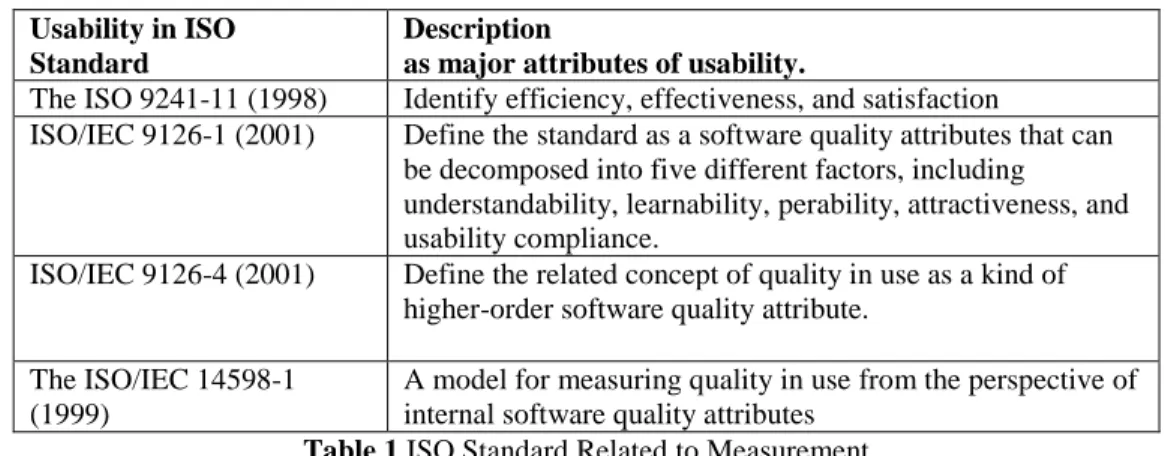
how to measure usability is limited for mobile applications [28]. The International Organization for Standardization (ISO) address the definiton of usability measurement standards. Following table indicates the ISO standars for ISO.
Usability in ISO Standard
Description
as major attributes of usability.
The ISO 9241-11 (1998) Identify efficiency, effectiveness, and satisfaction
ISO/IEC 9126-1 (2001) Define the standard as a software quality attributes that can be decomposed into five different factors, including
understandability, learnability, perability, attractiveness, and usability compliance.
ISO/IEC 9126-4 (2001) Define the related concept of quality in use as a kind of higher-order software quality attribute.
The ISO/IEC 14598-1 (1999)
A model for measuring quality in use from the perspective of internal software quality attributes
Table 1 ISO Standard Related to Measurement
3.8 Manual Testing
Time to market has significant role in mobile world. Also, mobile financial services directly affect end users. As a result of that, testers should create design, write code, test and release an application within a very short period of time. Traditional manual testing doesn’t meet the speed requirements of mobile world. All the mobile devices are becoming more and more elaborate, and are based on more and more advanced technologies. Location recognition, Wi-Fi, real-time events, popups – all this makes both manual and automated testing way more complicated [23]. 3.9 Privacy
One of the most challenging issues of mobility is privacy of user information is while mobile devices are much more personalized and tied to the user’s identity than a traditional computer. For mobile banking applications, privacy is comes along with high priority. During test process, it is significant to test the scenarios covers the risk related to legitimate applications passing user data to other application or third parties in an unauthorized manner [15], especially while there is integration with third party web services. Moreover, some security vulnerabilities can be related to OS that give unauthorized access to user information or content.
4. Case Study
In Kuwait Turkish Participation Bank, Turkey, we performed mobile banking application testing and faced with some of challenges mentioned in previous sections.
In testing process, masking financial data and keeping safe customer information is critical. During the testing period, making sure about data accuracy is a challenge.
F.MOLU et al./ ISITES2014 Karabuk - TURKEY 863
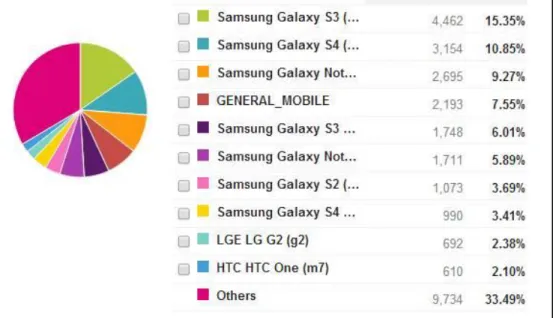
Mobile banking of Kuwait Turkish’s is developed for iOS, Android and Windows. That means testing effort is necessary for all operating system including different devices with different hardware and OS features. As an example, following scatter chart displays download percentages of Android devices which Kuwait Turkish Android Mobile Banking Application is downloaded from during January-March 2014. Even this data, that is only for Android, points the challenge of device variety for mobile banking testing.
Figure 3 Android Mobile Banking App Download
While performing usability tests, it was a challenge to monitor original customer behaviors, because people do not feel comfortable while doing financial transaction during the test. Even the usability tests are conducted in their own environment, it is not easy to simulate the real time experience when the subject is financial data. Furthermore, Kuwait Turkish has a wide range of bank customers from university students, businessmen to housewives or tradesmen. Retail and enterprise customers’ expectations differentiate from each other. To handle all these diversity is a key challenge for building a successful customer experience.
Mobile banking services are integrated to some third party services, such as credit card transactions. In this case, it is a challenge to re-test the integration cases in every bug fix according to network, connectivity issues. Moreover, network status, scenarios like checking mobile banking app while switching from 2G to 3G or WIFI, considering environmental factors of wide range of bank customers are key areas that we have to manage.
Besides its challenges, automated tests in mobile testing is lifesaving methodology for bug-free applications. However, tool selection, hiring qualified technical personnel for test automation, creating automation process considering cost of scripting and maintenance are the issues we are working on so far. In next step, test coverage for highly preferred mobile platforms will be succeeded with mobile test automation tools. While working on mobile test automation strategy, we consider the banking regulations, especially for using cloud-based test automation. Using cloud is a challenging area for banking applications’ testing because of the regulations.
F.MOLU et al./ ISITES2014 Karabuk - TURKEY 864
5. Conclusions
The pervasiveness of mobility means that there is a rapid proliferation of devices and platforms. In financial industry, enterprise mobility testing assumes significance as vendors and enterprises look at reducing time-cycle, cost and effort while adhering to the latest standards [24].
The rapid technology development in mobile technology like 2G, 3G, 4G and change in online habits of customers with increasing expectations has become major challenges for banks. As a result of that, quality of mobile financial services is key are in competitive mobile financial sector.
Banks should ensure a smart and an integrated mobile-first testing strategy is in place for tomorrow’s mobile banking needs [23]. Additionally, to ensure test data usage is compliant with data confidentiality requirements should be considered in mobile banking testing. Testing should cover system integration and integrity of test data on and off the mobile. Adopting risk-based testing approaches and focus on automation can be solution for mobile testing challenges. In long term, cost-effective regression testing over the application lifecycle is essential for mobile testing process. Banks also should establish mobile security testing considering financial regulations [25].
Banks prioritize mobile payments, mobile payments, cross selling capabilities through mobile banking and gamification of mobile banking services. At this point, application and service quality, user experience will make difference among financial competitors. It is a fact that tester are under intense pressure to get solutions to market quickly and cost-effectively while assuring quality [13].
References
[1] Online/Mobile Banking Statistics [Online]. Available:http://www.statisticbrain.com/online-mobile-banking-statistics/.
[2] Siciliano R., What is Mobile Banking? Is it Safe? [Online]. Available:
http://www.huffingtonpost.com/robert-siciliano/what-is-mobile-banking-is_b_3652771.html. July 2013.
[3] “Consumers and Mobile Financial Services 2013”, Board of Governors Of The Federal Reserve System, March 2013.
[4] “Segment-Based Strategies for Mobile Banking”, Cognizant Business Consulting&Monitise, June 2013.
[5] Pradhan T., “Mobile Application Testing”, Tata Consulting Services, 2011. [6] Kiran K.S.R, “Evolution of Mobile Banking”, Finacle from Infosys, 2014.
[7] Church S., “Pick Your Poison – Mobile Web, Native or Hybrid?”, Denver Startup Week, Oct 2012.
F.MOLU et al./ ISITES2014 Karabuk - TURKEY 865
http://www.keynote.com/mobile-app-testing.html
[9] “Android Fragmentation Report 2013”, OpenSignal Report, July 2013. [10] Mobile Application Testing [Online]. Available:
http://en.wikipedia.org/wiki/Mobile_application_testing [11] Challenges in Mobile App Testing [Online]. Available: http://www.kualitatem.com/challenges-in-mobile-app-testing/
[12] Kumar M., Chauhan M., “Best Practices in Mobile Application Testing”, Infosys, 2013. [13] Edwards A., “Rising to Modern banking Challenges Through Mobile Testing”, Test Plant, May 2012.
[14] Verma P., “Mobile Application Testing: Challenges and Approaches”, IBM the Mobile Frontier, March 2012.
[15] Pegueros V., “Security of Mobile Banking and Payments”, SANS Institute, Nov 2012. [16] Dak R., Challenges in Testing Mobile Applications [Online]. Available:
http://rumadak.wordpress.com/2013/06/10/challenges-in-testing-mobile-applications/ [17] “Mobile Banking”, BBVA Innovation Edge, April 2012.
[18] “2012 Identity Fraud Industry Report: Social Media and Mobile Forming the New Fraud Frontier”, Fiserv.&Intersections Inc.&Wells Fargo, 2013.
[19] Schneider I., “5 Critical Strategies for Mobile Banking Security”, Bank Systems&Technology, July 2012.
[20] Marous J., “Understanding the Mobile Banking Consumer”, Bank Marketing Strategy, July 2013.
[21] Kitten T., “Mobile Banking: Consumer Education Needed”, Bank Info Security, Nov 2011. [22] Honda M., “4 Key Challenges of Mobile Testing”, Ministry of Testing, Jan 2014.
[23] Devadevan V., “Mobile Banking in India- Issues & Challenges”, International Journal of Emerging Technology and Advanced Engineering, ISSN 2250-2459, Vol.3, Issue 6, June 2013. [24] Mobility Testing [Online]. Available:
http://www.wipro.com/services/mobility-segments/mobility-testing.aspx
[25] Konda K.R., “Mobile Banking Applications Call for Specialized Software Testing”, InformationWeek, March 2014.
[26] Zhang, Dongsong, and Boonlit Adipat. “Challenges, methodologies, and issues in the usability testing of mobile applications.” International Journal of Human-Computer Interaction 18.3 (2005): 293-308.
[27] Looije, Rosemarijn, Guido M. te Brake, and Mark A. Neerincx. “Usability engineering for mobile maps.” Proceedings of the 4th international conference on mobile technology,
applications, and systems and the 1st international symposium on Computer human interaction in mobile technology. ACM, 2007.
[28] Hussain, Azham, and Elaine Ferneley. “Usability metric for mobile application: A goal question metric (GQM) approach.” Proceedings of the 10th International Conference on Information Integration and Web-based Applications & Services. ACM, 2008.
[29] Cygnet Infotech, “Mobile Test Automation: Challenges and Open Source Solutions”, Feb 2013.
[30] Cognizant,”Selecting The Right Mobile Testing Strategy: Challenges and Principles”, Cognizant 20-20 Insights, Sept 2012.
![Figure 1 Comparison of iOS and Android Fragmentation [9]](https://thumb-us.123doks.com/thumbv2/123dok_us/7901.2500363/4.918.115.792.376.552/figure-comparison-ios-android-fragmentation.webp)
![Figure 2 Barriers to Mobile Banking [22]](https://thumb-us.123doks.com/thumbv2/123dok_us/7901.2500363/5.918.109.812.457.814/figure-barriers-to-mobile-banking.webp)