PLEROMA: A SDN-based High Performance
Publish/Subscribe Middleware
Muhammad Adnan Tariq, Boris Koldehofe, Sukanya Bhowmik, Kurt Rothermel
University of Stuttgart
{first name.last name}@ipvs.uni-stuttgart.de
ABSTRACT
With the increasing popularity of Software-defined networks (SDN), TCAM memory of switches can be directly accessed by a publish/subscribe middleware to perform filtering oper-ations at low latency. This way two important requirements for a publish/subscribe middleware can be fulfilled: namely bandwidth efficiency and line-rate performance in forward-ing messages between producers and consumers. Neverthe-less, it is challenging to sustain line-rate performance in the presence of dynamic changes in the interest of producers and consumers. In this paper, we propose and evaluate the PLEROMA middleware to realize publish/subscribe at line-rate and bandwidth efficiently in SDN. PLEROMA offers methods to efficiently reconfigure a deployed topology in the presence of dynamic subscriptions and advertisements. Fur-thermore, PLEROMA ensures interoperability and indepen-dent reconfiguration of multiple controlled SDN networks.
Categories and Subject Descriptors
C.2.1 [Network Architecture and Design]: Distributed networks; C.2.4 [Distributed Systems]: Distributed ap-plications; D.2.11 [Software Architectures]: Data ab-straction
Keywords
Content-based Routing, Publish/Subscribe, Software-defined Networking, Network Virtualization
1.
INTRODUCTION
Publish/Subscribe is a universal paradigm to mediate information (events) in a bandwidth efficient manner be-tween multiple consumers (subscribers)and multiple produc-ers (publishproduc-ers) of information. Each subscriber expresses in a subscription its interest in events and in turn receives all events matching the expressed interest. Therefore, pub-lish/subscribe can yield significant saving in terms of band-width usage especially if the interest in information is highly
Permission to make digital or hard copies of all or part of this work for personal or classroom use is granted without fee provided that copies are not made or distributed for profit or commercial advantage and that copies bear this notice and the full citation on the first page. Copyrights for components of this work owned by others than ACM must be honored. Abstracting with credit is permitted. To copy otherwise, or republish, to post on servers or to redistribute to lists, requires prior specific permission and/or a fee. Request permissions from [email protected].
Middleware’14December 08 - 12 2014, Bordeaux, France
Copyright 2014 ACM 978-1-4503-2785-5/14/12...$15.00 http://dx.doi.org/10.1145/2663165.2663338
diverse.
In publish/subscribe systems, (e.g. [2, 19, 8, 25]), saving bandwidth is commonly achieved by installing filters inside the network. Filtering is performed by specific components calledbrokerswhich are placed inside the network and medi-ate events between subscribers and publishers. Broker-based filtering in a publish/subscribe system imposes a significant delay by extending the end-to-end path length with a detour to the brokers and a processing delay for matching events against installed filters.
Recent progress towards the software-defined configura-tion of computer networks, however, poses a high potential to reduce this delay and apply publish/subscribe in delay sensitive application fields to quickly react to events, e.g., financial applications, traffic control, online gaming, manu-facturing, or the smart grid. Standards like OpenFlow [3]1 specify the interface to directly install and modify flows on switches and install dedicated communication paths between the hosts connected to the network. To match the received packets efficiently against the installed flows, switches are equipped with a specific hardware called TCAM memory. Interestingly, the matching operations performed by TCAM memory are equivalent in expressiveness to many filtering operations needed in content-based publish/subscribe sys-tems [13] and can significantly outperform software imple-mentations. Therefore, in a software-defined network, it is possible to install a network topology which is not only band-width efficient, but also yields line-rate performance in for-warding events between producers and consumers.
While a deployed network topology offers line-rate perfor-mance in forwarding events at the data-plane, the topology needs also to be dynamically updated with ongoing sub-scriptions and advertisements. In software-defined networks this is the task of the controller, a logically centralized com-ponent which is in charge of installing/modifying flows in switches and can access the switches via a dedicated control network. The design of the control algorithm is therefore crucial for the performance of a publish/subscribe middle-ware in the presence of dynamic subscriptions and unsub-scriptions.
In this paper we focus on three main requirements towards achieving scalability for SDN-configured publish/subscribe: 1. Publish/subscribe should in the presence of subscrip-tions and advertisements offer a low latency until sub-1The OpenFlow standard is defined by the OpenNetwork Foundation, and many switch vendors such as CISCO, HP, and NEC currently implement the OpenFlow as part of their products
© ACM, 2014. This is the author's version of the work. It is posted here by permission of ACM for
your personal use. Not for redistribution. The definitive version was published in proceedings of
15th International Middleware conference, pp. 1-12, Bordeaux, France, December 08-12, 2014.
http://doi.acm.org/10.1145/2663165.2663338
scribers can react to published events. For example, financial trading, traffic monitoring, or online gaming are not only known to be highly latency sensitive appli-cations, but also highly dynamic with respect to the interests of publishers and subscribers [10, 15]. The subscriptions and advertisements often depend on the context on which subscriptions and publications are performed. In order to analyse the trend of stocks and quotes, the threshold for receiving events is updated in the time-scale ranging from just a few seconds to sev-eral hours for a single subscription [10]. Traffic mon-itoring and online gaming require location-dependent updates of run-time parameters such as the location of objects, often at larger frequency than one update per minute per subscriber [15].
2. Publish/subscribe should offer interoperability between multiple independently manageable network domains. Independently managed network domains naturally ari-se in many business systems, for instance to avoid in-terference of manufacturing processes and enforce se-curity policies in accessing events [22, 24]. In addi-tion, a partitioning of a large network can increase the scalability by performing multiple concurrent adver-tisements and subscriptions.
3. The control algorithm must be efficient in the number of flows installed in a switch. Note, that the cost for TCAM is critical in the design of switches. Therefore, vendors offer only a limited set of flows which is cur-rently in the order of 40,000–180,000 flow entries per switch [5].
The contributions of this paper are a detailed perfor-mance evaluation of SDN-configured publish/subscribe sys-tems and methods for their scalable reconfiguration address-ing the aforementioned requirements. In Section 2, we first give an overview of the PLEROMA middleware. Section 3– 5 present mechanisms that i) achieve efficient reconfigura-tion of the network topology, ii) ensure interoperability of multiple independently controlled SDN networks, and iii) limit the number of flows to be installed inside an SDN switch. Finally, in Section 6 we present detailed performance evaluation of PLEROMA on a real SDN testbed [12] and Mininet [16] environment with respect to event forwarding performance (throughput and delay), reconfiguration delays, control overhead in managing multiple controllers and band-width efficiency. We conclude with a comparison to state of the art publish/subscribe systems and future work.
2.
THE PLEROMA MIDDLEWARE
Before introducing the methods for managing dynamic subscriptions and unsubscriptions we present the main com-ponents of the PLEROMA middleware. The middleware manages one or multiple interconnected network partitions (cf. Figure 1). The network partition is composed of a set of SDN-configurable switches. Two neighboring network par-titions are interconnected to each other by a pair of border switches. All switches of a partition are controlled by a sin-gle controller which knows the entire network topology of a partition including outgoing links to neighboring partitions. Each controller runs the PLEROMA middleware which configures the network topology to comprise short and band-width efficient paths between publishers and subscribers.
Controller: Runs PLEROMA Middleware to configure a network partition
Install/Delete flows Packets forwarded to ܫܲ௫ Switches: Forward events Hosts: subscriptions/ unsubscriptions Network Partition Border switches: interconnect partitions
Figure 1: Two interconnected network partitions: Each con-troler autonously configures its network partition using the PLEROMA middleware.
The network topology is changed by installing or remov-ing flows on the SDN-switches. In this paper, we follow the widely accepted OpenFlow standard to perform such updates. Consequently, each flow will describe any content which can be matched against the header fields, such as VLAN tags, a MAC address, or IP address [20]. A flow fur-ther defines an outgoing port of a switch to which a packet with a matching header field is forwarded. Note that not all of these fields are equally well suited to describe a network topology for publish/subscribe. For example, configuring MAC addresses can easily conflict with other services oper-ated at the link layer. Therefore, in this paper we assume that PLEROMA will only install flows with respect to the fields corresponding to IP-Multicast addresses.
An update of the network topology is initiated whenever the controller receives an advertisement or a subscription re-quest. Advertisements, publications, and subscriptions are performed by hosts connected to the SDN-switches of the network topology. A publisher is required to send an adver-tisement before sending any publications, while a subscriber is required to perform a subscription before receiving any messages. Since hosts are not directly connected and aware of the SDN-control network, each publisher/subscriber is re-quired to send an advertisement/subscription to a specific IP address,IPf ix, which has been reserved specifically for the purpose of performing advertisements and subscriptions. No switch will install a flow with respect toIPf ixand therefore, all packets carrying this address will be directly forwarded from a switch over the control network to the controller.
To ensure high expressiveness and establish paths with low-bandwidth usage between publishers and subscribers, we follow the content-based subscription model, i.e., an event is composed of a set of attribute value pairs. The event space Ω, i.e., the set of all possible events that can be disseminated by the publishers, can be interpreted by a multi-dimensional space of which each dimension refers to the values of a spe-cific attribute. An event is simply represented as a point in this space. Building on the principle of spatial index-ing [13], we can divide the event space into regular subspaces that serve as enclosing approximations for events,
advertise-İ d1 = A d2 = B L2 =0 0 100 0 100 0 1 0 100 0 100 01 00 10 11 50 50 0 0 100 010 50 50 000 011 001 100 101 110 111 25 75 d1 = A d1 = A d1 = A d2 = B d2 = B d2 = B 100 U1 =100 L1 =0 U2=100 50 Adv ={ A = [50,75], B = [0,100] }
Figure 2: This figure illustrates for two attributes A and B the decomposition of the event-space in subspaces each associated with a distinctdz[14].
ments, and subscriptions. Any subspace can be identified by a binary string named dz-expression (in shortdz). In par-ticular,dz-expression fulfill following characteristics. 1) The shorter the dz the larger is the corresponding subspace in Ω. 2) A subspace represented bydzi iscovered by the sub-space represented bydzj, iff dzj is a prefix ofdzi. In this case, we write dzj dzi. 3) Two subspaces dzi and dzj are overlapping if either dzi dzj or dzj dzi holds and the overlapdzi∩dzj is identified by the longest of twodz. 4) For overlapping non identical subspacesdzi anddzj, the non overlapping part, saydzi−dzj, may need to be identi-fied by multiple subspaces. For instance, the non overlapped part ofdzi= 0 w.r.t. dzj= 000 contains subspaces 001, 010 and 011.
The advertisement/subscription can be composed of sev-eral dz, denoted asDZ. For instance, to approximate the advertisement in Figure 2 two dzare required, i.e., DZ = {110,100}. The containment and overlap relationships be-tween a pair ofDZcan be defined w.r.t. set of dz-expressions represented by them.
Using the above relationships, an eventedisseminated by a publisherpwill comprise in its packet header fields a dz of maximum length. In order to deliver e to a subscriber s, the controller must have installed on each switch along the path (between p and s) a flow comprising a covering dz in a field. The subspace relationship of dz-expressions allows subscribers with overlapping subscriptions to share a common subpath(s) and therefore, bandwidth.
Incoming advertisements and subscriptions are processed by the controller in a sequence to avoid inconsistent up-dates to the network topology. In order to ensure connec-tivity between the distinct network partitions, a controller will need to react in addition to internal advertisement and subscription requests, also to external advertisements and subscriptions received via the border gateways (switches). The rate at which a controller receives external and inter-nal requests is critical for the time until a subscription is available. Furthermore, with increasing number of adver-tisements and subscriptions the number of flows to be in-stalled within each partition can grow.
The PLEROMA middleware addresses these issues along three components: TheTopology Reconfiguratorreacts upon dynamic internal advertisements/subscriptions. It computes changes in the network topology of a single partition and in-stalls flows correspondingly. Theborder-gate configuration component of the PLEROMA middleware acts upon exter-nal advertisements/subscriptions. It treats border gateway switches as additional subscriber and publisher and ensures that events published in one particular network partition will be also forwarded to subscribers in other network par-titions. Partitioning the network already helps to improve scalability since subscriptions (of which many may only be of relevance to a single partition) can be processed concur-rently by multiple controllers. However, the number of flows can be further reduced by the dimension-selection compo-nent which determines for each network partition the most relevant attributes and limits the length of any installeddz.
3.
TOPOLOGY RECONFIGURATION
In this section, we describe how reconfigurations of the network topology are performed. To this end, we need to maintain a dissemination structure which allows for band-width and latency efficient forwarding of packets. Moreover, changes to the network topology must be efficiently installed, to handle many subscription and advertisement requests.
3.1
Overview
For the design of a dissemination structure we consider as constraints latency efficiency, bandwidth usage, and cost efficiency to update the network topology. Clearly, the low-est latency is achieved if a controller low-establishes a short-est path for each publisher/subscriber pair. However, this severely limits the reuse in forwarding an event on common paths. Moreover, each new subscription or advertisement would trigger updates of the network topology to add paths between all relevant publishers and subscribers and there-fore, impose a very high reconfiguration cost.
A common alternative—often taken by traditional broker-based systems [2, 8]—is to embed the paths between publish-ers and subscribpublish-ers by means of filtpublish-ers in a single spanning tree. The spanning tree reflects low latency paths between any pair of publisher and subscriber. Since all paths between publishers and subscribers are embedded in the same tree, the number of times an event needs to be forwarded is sig-nificantly reduced. The reconfiguration cost is also limited to the edges in the spanning tree and is significantly reduced wherever subscriptions and advertisements overlap. Never-theless, such a topology imposes limits on the capacity of for-warding events. While links in the core of the spanning tree are heavily utilized other links remain even idle. Moreover, with an increasing number of subscribers and publishers the path length may increase (because of the limited choice of edges in the spanning tree) imposing larger delays [27, 17].
The approach followed by the PLEROMA middleware is to maintain multiple independently configurable spanning trees. The intention is to i) better balance the load on the links of the network and this way offer a higher forwarding capacity in sending events, ii) reduce the length of the path by limiting the number of publishers and subscribers (i.e., organizing edges of the spanning tree only w.r.t. relevant publishers and subscribers) and this way reduce both the latency as well as the reconfiguration cost of a path. To this end, PLEROMA accomplishes the following: Depending on
dynamic advertisements of the publishers, PLEROMA up-dates the set of spanning trees and determines to which spanning trees a publisher should forward its events (cf. Section 3.2). Furthermore, depending on dynamic subscrip-tions, PLEROMA installs flows with respect to a spanning tree to ensure published events will reach each subscriber on an embedded path (cf. Section 3.3).
3.2
Spanning trees
The controller maintains a set of spanning trees (in short trees), denoted byT. Each treet∈T is built to disseminate events covered by a set of subspaces and is overlapping with advertisements of some publishers. It logically interconnects all hosts and switches of a partition. A tree t is identified by the set of dz-expressions, DZ(t), that span the overlap with advertisements of the publishers. We will ensure for all treestandt inT thatDZ(t)∩DZ(t) =∅.Therefore, an event will be disseminated at most in a single tree. LetPt denotes the set of publishers whose advertisements overlap with DZ(t) of a tree t. Likewise, Tp denotes the set of trees with which the advertisement of a publisherpoverlaps. Furthermore, DZt(p) defines the part of the advertisement of a publisherpinPtwhich overlaps withDZ(t).
On the arrival of an advertisementDZ(p) from a publisher p, the controller checks for eachdziinDZ(p) the trees inT to which the publisher canjoin, i.e., each treet∈T whose subspace setDZ(t) overlaps with the subspace ofdzi. More-over, the controller creates a separate tree tn for the (fine granular) subspaces ofdziwhich are not covered by theDZ of existing trees (cf. Algorithm 1, lines 2-15). In more de-tail, the controller checks the containment relation between dziand the dzcomprised inDZ of existing trees, and per-forms one of the three actions: (1) Ifdzi∈DZ(p) iscovered by DZ of one or more existing trees, then the publisherp joins the corresponding trees (for publishing events matching dzi). For instance, a publisherpwith a new advertisement
DZ(p) ={11}joins an existing tree withDZ={1}. (2) If dzi inDZ(p)covers the DZ of one or more existing trees, then pjoins the corresponding trees (for publishing events matching the covered subspaces of itsdzi) and the uncovered subspaces are added to theDZof new treetn. For instance, a publisherpwith a new advertisementDZ(p) ={0}joins an existing tree withDZcontaining 00 and uncovered part ofDZ(p), i.e., 01, is added to theDZ(tn) of a new treetn. (3) If no containment relation exists, then dzi is added to the DZ(tn) of newly created tree tn. The procedure cre-ateTree is used to build the tree tn as a shortest path tree rooted at the publisher p2(cf. Algorithm 1, line 14). With the controller having a complete view on the switch network, the building of a tree (e.g.,tn) is reduced to a simple graph problem. The procedure adjustFlowMultSubs identifies ex-isting subscriptions in the system that matchDZtn(p) and
establishes routing paths along the edges oftnbetween the subscribers (of those subscriptions) and the publisherpby adding flows to the switch network. The addition of flows to the switch network is detailed in Section 3.3.
The proposed strategy might result in the creation of large number of trees depending on the advertisements of the pub-lishers. To avoid this problem, the controller merges exist-2We opted for shortest path tree in our implementation, however, other tree creation algorithms such as minimum spanning tree etc., can also be employed without any mod-ification to the propose approach.
ing trees if their number increases above a certain threshold. Merging can be easily performed by mappingDZ of trees (to be merged) to a smaller set of coarser subspaces (i.e., with shorter |dz|). For instance, two treest1 and t2 with DZ(t1) ={0000,0010}and DZ(t2) ={0001,0011} respec-tively, can be merged in a single tree with DZ = {00}. Section 5 details further methods to avoid the problem as-sociated with the number of trees.
Finally, it is worth noting that the proposed tree creation strategy can be further enhanced by taking into account the event traffic and available subscriptions in the systems. However, we opted for the simple version to ensure low re-configuration overhead in terms of creation/merging of trees and thus low reconfiguration delay in the presence of dynam-ically arriving (un)subscriptions and (un)advertisements.
3.3
Maintenance of flow tables
The flow tables in the switch network are modified (e.g, by adding or removing flow entries) by the controller as a result of (un)subscription and (un)advertisement requests. In the following, we will first focus on subscription requests and later briefly describe the handling of unsubscription requests by the controller.
3.3.1 Subscription requests
Subscription requests are handled similar to the advertise-ments, except for the fact that a newly arrived subscription cannot trigger the creation of new trees (cf. Algorithm 1, lines 16-25). More precisely, upon the reception of a sub-scriptionDZ(s) from a subscribers, the controller searches for a set of treesTs such that the subspaces represented by theDZ of trees inTs overlap with the subspaces ofDZ(s). If no overlap exists (i.e.,Tsis empty), then the subscription is simply stored at the controller. The stored subscriptions are again checked for overlap, wheneverDZ of an existing tree is changed or a new tree is created as a result of an arrival of a new advertisement (cf. Algorithm 1, lines 9, 15). Nevertheless, ifTs is not empty (i.e, overlap exists), then the controller adds subscribersto eachtinTsby establish-ing paths between the subscribersand all publishers with overlapping advertisements int. Each path between a pub-lisher p and a subscriber s on a tree t only forwards the events matching the subspaces overlapped betweenDZt(s) andDZt(p). This way false positives are avoided.
As a first step, the controller calculates the route be-tween the subscriber s and each relevant publisher p (in Pt) on the treet. A route consists of a sequence of physical switches (denoted asR) on which flows need to be estab-lished along with the out ports (denoted as oP) through which a matching event should be forwarded so that con-nectivity is achieved between the publisherp and the sub-scribers, i.e., p, s, t={(Ri, oPi), . . .(Rj, oPj)}. Once the route is calculated, the controller establishes the path by in-serting (or modifying) flows on the switches along the route between the publisherpand the subscribers. The flows en-sure only the events matching the overlapped subspaces (i.e., DZt(s)∩DZt(p)) are forwarded on the path. The process of establishing paths along the switch network is detailed in the next section.
3.3.2 Flow installation
The installation of flows on the switches requires to specify thematch field (MF),instruction set(IS)and priority order
R1 R2 R4 R5 R6 p1 s1 s2 1 2 1 3 2 1 2 1 2 1 2 3 1 1* Æ 2 1* Æ 2, destIP = S1 100* Æ 2 100* Æ 2, destIP = S2 MF POIS
destIP = ff0e:8000::/19 1 Out Port = {2,3} destIP = ff0e:8000::/17 0 Out Port = {2}
Example flow table 1 3 2 R3 Change destination IP address to IP of S1 DZ(s2) = { 100 } DZ(s1) = { 1 } DZ(p1) = { 1 }
Figure 3: Forwarding in the switch network
R1 R2 R4 R5 R6 p1 s1 s2 s3 1 2 1 3 2 1 2 1 2 1 2 3 1 2 1* Æ 2 1* Æ 2 100* Æ 2, 3 : PO = 1 DZ(s2) = { 100 } DZ(s1) = { 1 } DZ(s3) = { 10 } DZ(p1) = { 1 } 1 3 2 R3 10* Æ 2 10* Æ 3 : PO = 0 10* Æ 2 100* Æ 2 100* Æ 2, 3 : PO = 1 10* Æ 2, 3 : PO = 1 1* Æ 2 : PO = 0
Change to flows are shown in rectangles 1 2 3 5 4
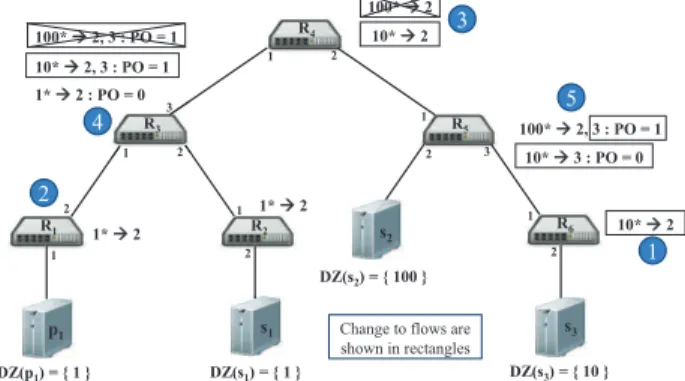
Figure 4: Flow maintenance on the arrival ofs3
(PO) of a flow [20]. The matching field defines the header information against which packets are matched. Recall that PLEROMA uses for interoperability with other services the IP-multicast range to embed dz-expressions. For instance, subspaces withdz= 101101 anddz= 101 are converted to IPv6 multicast addressesff0e:b400:*andff0e:a000:* re-spectively. The symbol∗is used to represent standard wild-card/masking operations, which are supported by hardware switches for matching IP addresses using Class-less Interdo-main Routing (CIDR). Therefore, an eventdz= 101101 can be matched against a flow withdz= 101 in hardware switch during forwarding, i.e.,ff0e:a000::/19ff0e:b400::/22. Furthermore, in the instruction set the outgoing ports are specified, ensuring that a matching packet (i.e., an event) can be forwarded to multiple destinations in the spanning tree. Other than forwarding on out ports, another action which can be specified in IS is to change the destination IP field of the matching packets (i.e., events) on the terminal switches (from dz) to the IP of the hosts on which sub-scribers are running, as depicted by switchesR2 andR5 in Figure 3. Finally the priority order, needs to be defined to decide on the order in which flows will be applied to a packet. For example, an incoming event (dz= 1001) on switchR3 matches multiple flows withdz= 1 anddz= 100. However, the switch only follows the instructions of the first match. Therefore, to ensure proper forwarding the flow installation gives higher priority to the flows with longerdz. In Figure 3, priority order onR3 ensures that all packets matching flow withdz= 100 are forwarded to both switches (R2andR4), however, packets matching flow with dz= 1 but not with dz= 100 are only forwarded toR2.
To describe the maintenance of flows in the presence of dynamic (un)subscriptions, we first define the containment relation between flows w.r.t. a single switch. A flowf l1 cov-ers (or contains) another flowf l2, denoted byf l1f l2, iff the following two conditions hold: (i) thedzassociated with the destination IP address in the match field off l2is covered by the dz of f l1, and (ii) the out ports to which a packet matchingf l2is forwarded are subset of those specified in the ISoff l1. Likewise, a partial containment relation () can be defined between flows of a switch (or flows to be installed on a switch). A flow f l1 partially covers (or contains) an-other flowf l2, denoted byf l1 f l2, ifdz associated with the match field off l1 coversdzof f l2, but not all the out ports used for forwarding packets matchingf l2 are listed in theISoff l1.
The procedureflowAddition is used by the controller to
set up flows on the switches along the routep, s, tbetween the publisherpand the subscribers(cf. Algorithm 1, lines 31 - 51). The dz used for creating the match field of the new flows (to be added in the switch network) is determined from the overlap betweenDZt(s) andDZt(p), as mentioned earlier.
In more detail, the controller iteratively checks the exist-ing entries in the flow tables of each switch Ri along the routep, s, tand determines whether to add a new flowf ln or to modify (or delete) existing flows. The following cases drive the process of flow addition and modification at a par-ticular switchRi. The cases are explained w.r.t. the changes to the flow tables of the switches in Figure 4 on the arrival of new subscribers3 with subscriptionDZ(s3) ={10}. (1) If the flows are not currently installed on a switch, then the new flowf lnis simply added to the flow table of that switch, e.g., a new flow withdz = 10 is added to R6 in Figure 4. (2) If an existing flowf lcalready covers the new flowf lnto be installed on the switch (i.e., f lc f ln), then no action is performed, e.g., no new flow is added to the switchR1 in Figure 4. (3) If an existing flowf lc is covered by the new flowf ln, then the new flowf ln is added andf lcis deleted from the flow table as it is no longer needed, e.g., in Figure 4 existing flows associated withdz= 100 are replaced by new flows withdz= 10 onR3 and R4. (4) If the new flowf ln is partially covered by an existing flowf lc (i.e.,f lcf ln), thenf lnshould be added with high priority and should in-clude the out ports in theIS off lc, as depicted by R3 in Figure 4. (5) Finally, if the existing flow f lc is partially covered by the new flowf ln, then besides addingf lnto the flow table, the existing flowf lcshould be updated to include out ports used byf ln and to hold higher priority thanf ln, e.g., in Figure 4 an additional out port (i.e.,oP = 3) and a higher priority order is assigned to an existing flow onR5 withdz= 100.
3.3.3 Unsubscriptions
Until now we have focused on the maintenance of flow ta-bles w.r.t. advertisements and subscriptions in the system. Now, we will briefly discuss the handling of unsubscriptions. On the arrival of an unsubscription, the subscribers is re-moved from all the treesTsassociated with the correspond-ing subscription. This is accomplished by removcorrespond-ing previ-ously established paths between s and all publishers with overlapping advertisements (i.e.,DZt(s)∩DZt(p)=∅) on each treetinTs. To remove a path on a treet, the flows are either deleted or downgraded depending upon other
sub-Algorithm 1 Publish/Subscribe maintenance at a single controller
1: upon eventReceive(ADV,p,DZ(p)) do 2: for alldzi∈DZ(p)do
3: dzNewTree =∅
4: Tp={t∈T∧ ∃dzj∈DZ(t) :dzidzj∨dzjdzi}//
Set of trees with overlapping subspaces withdzi 5: if Tp=∅then 6: for allt∈Tp do 7: DZt(p) =DZ(t)∩dz i// Overlapped subspaces 8: joinTree(p,DZt(p),t) 9: addFlowMultSub(p,DZt(p),t) 10: uncoveredSubspace =dzi−t∈treeSetDZt(p) 11: dzNewTree = uncoveredSubspace 12: else 13: dzNewTree =dzi 14: tn=createTree(p, dzNewTree) 15: addFlowMultSub(p, dzNewTree,tn) 16: upon eventReceive(SUB,s,DZ(s)) do 17: for alldzi∈DZ(s)do 18: Ts={t∈T∧ ∃dzj∈DZ(t) :dzidzj∨dzjdzi} 19: if Ts=∅then 20: for allt∈Ts do 21: DZt(s) =dz i∩DZ(t) // Overlapped subspaces 22: pubSet ={p∈Pt∧ ∃dzj ∈DZt(p) :dzidzj∨
dzjdzi}// Publishers with overlappingDZt(p) 23: for allp∈pubSet do
24: overlapWithPub =dzi∩DZt(p) 25: flowAddition(overlapWithPub,p, s, t,t) 26: procedureaddFlowMultSub(p,DZ,t)do 27: for all s∈Sdo 28: if DZ∩DZt(s)=∅then 29: overlapWithPub =DZ∩DZt(s) 30: flowAddition(overlapWithPub,p, s, t,t) 31: procedureflowAddition(dz,p, s, t,t)do
32: destIP = (binary(ff0e:b400)&(dz112−|dz|))\16+|dz|
33: for allri∈ p, s, tdo 34: Flowf ln=M F∪IS∪P O 35: f ln.M F= destIP 36: f ln.P O= default value 37: f ln.IS.oP={ri.oPi} 38: curFlow =getCurrentFlowsFromSwitch(ri.Ri) 39: if riis last entry inp, s, tthen
40: f ln.IS.set-destIP =s.IP
41: if curFlow=∅ ∧ ¬(∃f lc∈curFlow :f lcf ln)then
// Cases 3 - 4: None of the curFlow fully coversf ln 42: for allf lc∈curFlow :f lnf lcdo// Case 3 43: deleteFlowFromSwitch(f lc,ri.Ri) 44: for allf lc∈curFlow :f lcf lndo// Case 4 45: f ln.IS.oP =f ln.IS.oP∪f lc.IS.oP
46: increasePriority(f ln.P O)
47: for allf lc∈curFlow :f lnf lcdo// Case 5 48: f lc.IS.oP =f lc.IS.oP∪f ln.IS.oP
49: increasePriority(f lc.P O) 50: modifyFlowOnSwitch(f lc,ri.Ri) 51: addFlowOnSwitch(f ln,ri.Ri)
scribers reachable (w.r.t. their relevant publishers) via a particular switch or in other words depending upon the al-ready established paths passing through a particular switch. For example, on the arrival of an unsubscription froms3in Figure 4, the flow with dz = 10 is deleted from the flow table ofR6 as no other subscriber is reachable w.r.t. p1 via R6. However, the flows installed on switchesR3,R4 andR5 have to be downgraded from dz = 10 to usedz = 100 (in their match fields) because the path fromp1 to subscriber s2 withDZ(s2) ={100}passes through these switches.
4.
INTEROPERABILITY OF PARTITIONS
So far the mechanisms allow only for the independent
con-figuration of a single partition. In this section, we detail how PLEROMA ensures also connectivity between subscribers and publishers of distinct partitions. Our mechanisms pre-serve the decentralized control in which each controller per-forms independent updates to its own switch network (i.e., own partition) and therefore, ensures scalability in perform-ing reconfiguration. The design goal of PLEROMA is to minimize the coordination overhead between partitions and exchange as little information as possible between neighbor-ing partitions. To this end the controller needs to perform two main tasks. 1) The controller has to discover adjoined switch networks and establish communication with the cor-responding controllers (cf. Section 4.1). 2) The controller has to install inter-partition paths that provide connectiv-ity between publishers and subscribers in different partitions (cf. Section 4.2).
4.1
Communication across partitions
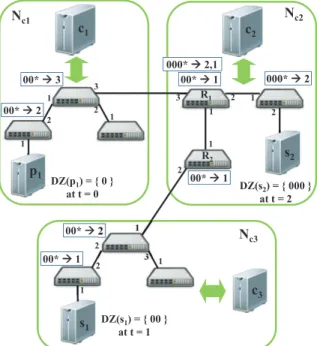
In order to set up routing paths between publishers and subscribers residing in different switch networks, additional knowledge is required such as i) interconnectivity between network partitions, ii) identity of controllers assigned to dif-ferent switch networks (i.e., partitions), and iii) local sub-scriptions and advertisements managed by each switch net-work. For instance, in Figure 5 an inter-switch routing path between an incoming subscriber s1 (at c3) and an exist-ing publisher p1 can only be established if the controller c3 knows that i) a publisher p1 with DZ(p1) is residing in partition Nc1, and ii) partition Nc1 is only reachable via Nc2.
In our approach, a controller (e.g., c1 in Figure 5) only maintains knowledge about the directly reachable neighbor-ing switch networks (e.g.,Nc2). Information required to set
up inter-network paths (such as advertisements or subscrip-tions) is only shared with the neighboring switch networks (e.g., Nc2 ), which in turn may choose to share the
infor-mation with their respective neighbors (e.g., Nc3 ) and in
this way the routing paths spanning multiple switch net-works can be established. In realizing a decentralized ap-proach, two important issues have to be resolved: First, the controller c, which is only aware of its own Nc, needs to discover reachable switch networks. Second, the controller cneeds mechanisms to contact and share information with the controllers of the discovered switch networks without knowing their actual identities.
Discovery of adjoining switch networks: A controllerccan discover each of its adjoining switch networksNcn by
iden-tifying border switch/es connectingNc and Ncn. Here, we
briefly describe an OSI layer 3 (i.e., network layer) mech-anism to automatically detect the border switches of ad-joining switch networks in the same connectivity domain. More precisely, a controller (such as Floodlight [7]) discov-ers the topology associated with it by sending Link Layer Discovery Protocol (LLDP) packets to all switches in its own local switch network. On receiving LLDP packet di-rectly from the controller, a switchRi forwards the packet over all its ports to other connected switches. However, in case the LLDP packet is received from another switch it is handed over to the controller which accordingly creates a connection between the two switches (i.e., target switch of the LLDP packet and the switch forwarding the packet to the controller) in its discovery table. In general, LLDP packets generated by one controller is considered invalid by
c1 DZ(s1) = { 00 } at t = 1 c2 s1 c3 Nc3 Nc2 Nc1 1 2 1 2 3 1 3 2 1 2 1 1 1 2 1 2 3 1 DZ(p1) = { 0 } at t = 0 00* Æ2 00* Æ2 00* Æ1 00* Æ3 00* Æ1 000* Æ2 2 000* Æ2,1 R1 s2 DZ(s2) = { 000 } at t = 2 00* Æ1 R2 p1
Figure 5: Publish/Subscribe across multiple independently controlled switch networks.
the other controllers. However, we extend this mechanism by identifying the LLDP packets received from other con-trollers and noting down the switch-port tuples at which they were received. Clearly, according to this mechanism, a switch can receive a packet from another controller only if it is directly connected to a switch of the adjoining network.
Communication between controllers: For a controllercto forward a packet to a controller cn of a neighboring parti-tion, clooks up the switch-port tuple (R, oP) for the par-titionNcn. It instructs the border switchR to forward the
packet via portoP. The destination IP of the packet is set to IPf ix. Therefore, the border switch ofNcnwill forward the
packet tocn. In Figure 5, the switchesR1andR2connected to the network Nc2 serve as border gateways (or switches)
with their ports 3 and 2 linked to adjoining networksNc1and Nc3respectively. The controllerc2can communicate withc1
by sending message through switch-port tuple (R1,3) with destination IP set to IPf ix. It is worth mentioning that the proposed strategy ensures interoperability between het-erogeneous switch networks. A neighboring switch network may be organized (and optimized) in a different manner and may be managed by multiple controllers (e.g., for load bal-ancing).
4.2
Inter-partition routing paths
In this section, we detail how to establish inter-partition paths building on the mechanisms in Section 4.1. In gen-eral, to set up paths, advertisements are forwarded across all partitions of the SDN network. The subscription re-quests subsequently follow the reverse path previously taken by overlapping advertisements.
More precisely, a controller c on receiving an advertise-ment request Adve from a host (connected to a switch in
Nc) forwards the request to the controllers of its adjoining networks using the border switches. The external request Adve (i.e., request from an adjoining network) is perceived
by a (remote) controllercras arriving from the virtual host connected to its border switch. Requests from virtual hosts (i.e., external requests) are treated in the same way as those from the local hosts. Moreover, the external advertisement requestAdveis forwarded bycrto all other adjoining switch networks, except the one from which the (external) request is received, to ensure advertisement is known to all parti-tions of the SDN network. For example, in Figure 5 on receiving an external advertisement request (DZ(p1) ={0} at time = 0) from Nc1, the controller c2 i) identifies it as
arriving from a virtual host connected to switchR1 at port 3, ii) creates/merges trees associated withdz = 0 in Nc2,
and iii) finally forwards the external request to the adjoin-ing networkNc3.
It is important to mention that forwarding each advertise-ment to all partitions of the SDN network increases the inter-partition control traffic and induces extra load on controllers (in terms of processing and memory resources). Therefore, we employed covering-based forwarding approach, where an advertisement request is only shared with the controller of a neighbouring switch network if it is not covered by previ-ously forwarded requests.
Likewise, on receiving a subscription request matching an external advertisement, a controllerc establishes the path in its own Nc3 by modifying flow tables of switches along
the route between the subscriber and the virtual host of the external advertisement. Moreover, the controllercforwards the subscription to the controller of the adjoining network from where the external advertisement arrives. Similar to advertisements, a subscription request is only forwarded to an adjoining network if it is not covered by the previously forwarded subscriptions (to save inter-switch network con-trol traffic). For example, in Figure 5 the concon-trollerc3 for-wards an incoming subscriptions (DZ(s1) = {00}at time = 1) to c2 for setting up paths in Nc2. The request is in
turn forwarded by controllerc2 toc1. However, subsequent subscription request froms2 (i.e.,DZ(s2) ={000}at time = 2) is not forwarded byc2 toc1 because it is already cov-ered by the subscription ofs1.
5.
DIMENSION SELECTION
In PLEROMA, the length of dz-expressions required to accurately represent the subspaces mapped by subscriptions (advertisements or events) increases linearly with the num-ber of attributes (or dimensions) in the system. Recall, in practice the length ofdzis limited by the range of IPv6 (or IPv4) multicast address reserved for the publish/subscribe. Similarly, for an event space with many attributes, the num-ber of dz(i.e., subspaces) for an accurate subscription (or advertisement) representation may be very high and may produce flow tables with large number of entries.
PLEROMA addresses the above limitations by perform-ing spatial indexperform-ing only on a small subset of dimensions, denoted as ΩD. The dimensions in the set ΩD are selected according to their ability to avoid dissemination of unnec-essary messages during in-network filtering. More precisely, the ability of a dimensiondto reduce false positives mainly depends on two factors, i.e., selectivity of subscriptions and distribution of events along that dimension. It is worth men-tioning, that both the factors play an equally important role during the selection of dimensions. For instance, selection of a dimension solely based on high selectivity of subscriptions may not be beneficial if the event traffic along the dimension
is always consumed by the same subscriptions. Therefore, PLEROMA utilizes variability (or in other words variance) in the set of subscriptions matched by the events (according to current event traffic) as the main criteria for the selection of dimensions to perform in-network filtering of events.
In more detail, let Et be the set of last ψ events pub-lished in the system before a given time t. Let Sed denote the set of subscriptions matched by an evente∈Et along a dimension d. The number of subscriptions matched by the events in Et along all dimensions can be represented by a matrix W ∈ R|Ω|×|Et|, such thatwi,j = |Sji|. Given the matrix W, the dimensions with high variability in the set of subscriptions matched by events in Et can be eas-ily selected by calculating the variance along each row (of W). However, distribution of events and subscriptions may be correlated along different dimensions, e.g., subscriptions may consume similar event traffic along multiple dimensions. Selection of highly correlated dimensions is not desirable be-cause correlated dimensions introduce redundancy (i.e., ad-ditional overhead in terms of the length of dz-expressions and number of flows) without much benefit towards reduc-tion of unnecessary event traffic in the system.
Without going into much mathematical details, we high-light the main steps required to select the dimensions (in ΩD) that can perform in-network filtering with low redun-dancy. Initially, we calculate the covariance matrix, i.e., C = W ×WT, where W is a centred matrix obtained by subtracting the mean of the matrix W from its columns. The covariance matrix captures the correlations between all possible pairs of dimensions w.r.t. event traffic consumed by the subscriptions along each dimension. Afterwards, we spectrally analyse the covariance matrix by means of eigen-decomposition, i.e., C= QΛQT, where Λ ={λ
i, . . . , λ|Ω|}
is diagonal matrix of eigenvalues and Q ={qi. . . , q|Ω|} is
the matrix whose columns are orthogonal eigenvectors of C. The eigendecomposition transforms the original dimen-sions(in Ω) into an orthogonal basis (represented byQ) such that the eigenvectors (ofQ) represent the dimensions along which the variance in W is maximized (i.e., variance in the event traffic matched by subscriptions is maximized). However, dimensions in the orthogonal basis (i.e., eigenvec-tors) do not directly correspond to the original dimensions. Therefore, we need a method that can utilize the variability information represented by eigenvectors to select the origi-nal dimensions. We employed the method proposed by [18] for this purpose. In particular, an eigenvectorqwith largest eigenvalue represents the dimension (in the orthogonal basis) along which variance is maximized and thus this eigenvec-torqis used to rank the original dimensions. In more detail, a higher absolute value of ithcoefficient of q (i.e.,qi) indi-cates that the dimensiondiis more important to be used for filtering. Thus the dimensions (in the original space) that correspond to the firstkcoefficients with higher magnitude are selected for filtering. The number of dimensions (i.e.,k) to use for filtering can be determined by analysing the mag-nitude of coefficients in q. More precisely, given the eigen-vectorq(i.e., with the highest eigenvalue) sorted according to the magnitude of its coefficients, k can be selected such that
k
iqi
|Ω|
i q
is above an administrator defined threshold. Once the dimensions in ΩD are selected, the controller i) generates newDZ for existing subscriptions and advertise-ments, ii) installs flows between publishers and subscribers
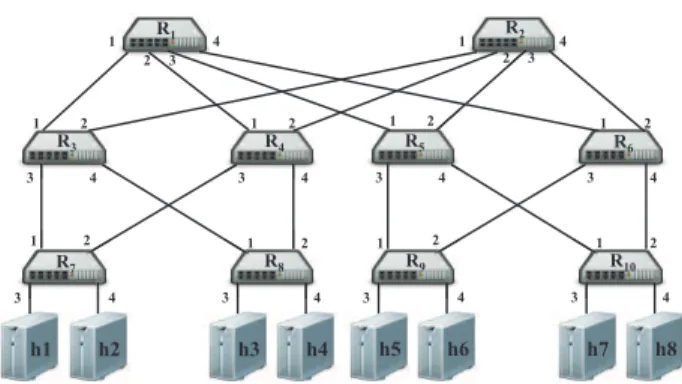
h4 h3 h2 h1 R8 R4 R3 R7 R1 1 1 1 1 2 2 2 2 3 3 3 3 4 4 4 4 1 2 h8 h7 h6 h5 R10 R6 R5 R9 R2 1 1 1 1 2 2 2 2 3 3 3 3 4 4 4 4 1 2 3 3 4 4
Figure 6: Testbed topology.
in the switch network w.r.t. to newly createdDZ, and iii) fi-nally notifies publishers about the selected dimensions to en-sure future events are published with correctdz. In practice, subscriptions/advertisements as well as event traffic change dynamically and therefore, over time the previously selected dimensions may become suboptimal. In order to adapt to the changes, a controller periodically collects information about the events disseminated (in the recent time window) by the publishers and repeats the dimension selection pro-cess.
6.
PERFORMANCE EVALUATIONS
This section is dedicated to an analysis of the design and implementation of the proposed PLEROMA middleware. A series of experiments are conducted to understand the effects of the design on performance metrics such as (i) end-to-end delay for event dissemination, (ii) throughput w.r.t. number of published events, (iii) bandwidth efficiency in terms of false positives w.r.t. length ofdzand number of flows, (v) reconfiguration delay in the presence of dynamics, and (iv) control overhead in managing multiple control partitions.
6.1
Experimental setup
The PLEROMA middleware has been evaluated under two test environments. The majority of the experiments has been conducted on a SDN testbed [12] consisting of com-modity PC hardware and virtualization technologies as used in datacenters. Figure 7 depicts the hierarchical fat-tree topology of the testbed which consists of a cluster of hosts (running on commodity rack PCs). Some of these hosts act as OpenFlow switches (switch hosts) with four phys-ical ports by executing a production-grade software switch (Open vSwitch [21]) attached to the 4-port NIC, i.e., switches R1 toR10. The other hosts act as end systems (end hosts) by executing virtual machines on two physical machines, i.e., h1toh8. The end hosts implement the functionality to pub-lish and subscribe events. The SDN controller is hosted on a front end machine which manages the virtual machines and network topology. Besides the testbed, experiments as-sociated with multiple controllers have been conducted on a prominent tool for emulating software-defined networks, namely, Mininet [16]. Mininet uses the concept of OS-level lightweight virtualization for network emulation that allows users to experiment with various topologies and applica-tion traffic. We use Mininet to experiment with 20 switches on two different topologies, a fat-tree topology (as describe above) and a ring topology. In the ring topology, each switch
0 1 2 3 4 5 5 10 20 40 80 Maximum delay [ms]
No. of Flows (103) - (a)
0 0.5 1 1.5 2 1 2 4 8 16
End to End delay [ms]
No. of Subscriptions (103) - (b) Uniform Zipfian 10 20 30 40 50 60 70 80 10 20 30 40 50 60 70 80 Events Received (10 3 )
Events sent /sec (103) - (c)
0 5 10 15 20 5 10 15 20
False positives rate [%]
dz-length - (d) 1600 Sub-Uniform 100 Sub-Uniform 1600 Sub-Zipfian 100 Sub-Zipfian 0 5 10 15 20 25 1 2 3 4 5 6 7
False positives rate [%]
Dimensions - (e) Zipfian 1 Zipfian 2 Zipfian 3 0 20 40 60 80 100 5 10 15 20 25 Reconfig. time [ms] No. of Subscriptions (103) - (f) 0 20 40 60 80 100 1 2 3 4 5 6 7 8 9 10
Avg. controller overhead [%]
No. of controllers - (g) 100 subscriptions 200 subscriptions 400 subscriptions 1 1.5 2 2.5 3 1 2 3 4 5 6 7 8 9 10
Total controller traffic
No. of controllers - (h) 100 subscriptions 200 subscriptions 400 subscriptions
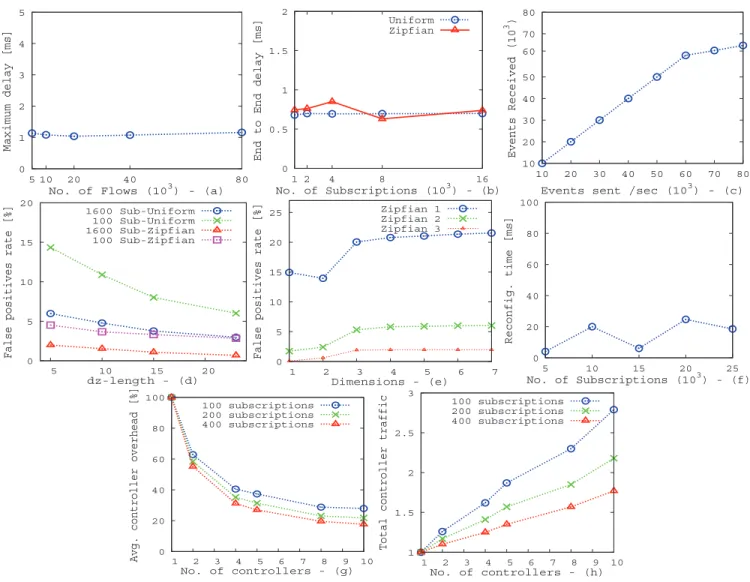
Figure 7: Performance evaluations
has an end host connected to it which may play the role of a publisher or a subscriber.
The content-based schema contains up to 10 attributes, where the domain of each attribute vary in the range [0,1023]. Experiments are performed on two different models for the distributions of subscriptions and events. The uniform model generates random subscriptions and events independent from each other. The interest popularity model chooses 7 hotspot regions around which subscriptions/events are generated us-ing the widely used zipfian distribution.
6.2
End-to-end delay
The first set of experiments study the delay characteristics of the aforementioned SDN testbed (with fat-tree toplogy) w.r.t. various metrics. More specifically, we first analyse the effect of flow table entries on the end-to-end delay between a publisher and a subscriber connected via the longest path in the topology. During the experiment, the flow table size of each switch along the longest path is varied between 5000 to 80,000 entries and 10,000 UDP packets containing random events (i.e., events matching different entries in the flow ta-ble) are sent from the publisher at a constant rate. The size of each packet is up to 64 bytes depending upon the length
ofdz. Figure 7(a) shows that the average delay calculated at the subscriber remains almost constant for different flow table sizes. This clearly indicates that the number of entries in the flow table has very little impact on the processing delay at the switches.
We next analyse the end-to-end delay to deliver an event from a publisher to all interested subscribers w.r.t. the num-ber of subscriptions in the system. For the experiment, up to 16,000 subscriptions are generated using the two above mentioned distributions (i.e., uniform and zipfian) and di-vided among different end hosts. Furthermore, end-to-end delay measurements are averaged across 10,000 events pub-lished in the system at a constant rate. Figure 7(b) indicates that the number of subscriptions does not significantly im-pact end-to-end delay. It is worth noting that for uniform distribution the generated subscription set is randomly di-vided among all end hosts (i.e., subscribers). As a result, the possibility of every end host receiving at least some events is extremely high, resulting in a near constant end-to-end de-lay in the system. However, in case of zipfian distribution, each end host is assigned a hotspot and subscribes for sub-spaces corresponding to its respective hotspot only. With events also following a zipfian distribution, it may so
hap-pen that one or more end hosts do not receive any events. As a result, the average end-to-end delay in the system may vary (albeit slightly) with different subscription workloads, as indicated in Figure 7(b).
We would like to stress that using virtual switches does not invalidate our results, but rather gives very conserva-tive performance bounds. For instance, recently performed micro-benchmarks to evaluate the forwarding delay using a NEC hardware switch validate our results and indicate addi-tional gain that is expected from using hardware switch [5].
6.3
Throughput
In this experiment, we evaluate the ability of the switch network and the end hosts to handle high incoming event rates. Subscriptions are generated following zipfian distri-bution and are divided among 4 end hosts. A single pub-lisher is used to send events at varying rates. According to Figure 7(c), beyond a certain event rate, not all the events are received by the end hosts. However, results indicate that the switch network is able to successfully forward every event to the end hosts. The drop in received events is due to the processing limitations at the end hosts. In another set of experiments, we determine that by using faster machines the throughput can be increased upto 170,000 events per second. However, in either case the bottleneck is on the side of end hosts.
6.4
Bandwidth efficiency w.r.t. false positives
False positives are those events which are delivered to a subscriber without it being interested in receiving them. We define false positive rate (FPR) as a percentage of the num-ber of unnecessary events received to the total numnum-ber of events received. Clearly, false positives are undesirable and the aim of any publish/subscribe system is to keep them to a minimum. We observe that longer thedz, the lesser are the false positives. This follows from the fact that as the length of thedzincreases, the granularity of the subspaces (assigned to advertisements, subscriptions and events) also increases and hence the false positives delivered to a sub-scriber decrease. Figure 7(d) shows the variation of false positive rate with the length of dz for different number of subscriptions for both uniform as well as zipfian distribution. As seen in the figure, with increase in the length of thedzthe false positives decrease for both distributions. The variation of false positives is also noticeable with number of subscrip-tions. This is justifiable as a large number of subscriptions divided randomly among end hosts almost represents the near-ideal case. As we only have a limited number of bits, sayLdz, for the representation ofdzin an IP multicast ad-dress, subscriptions and events which differ indzonly after the Ldz cannot be differentiated. Thus, for less number of subscriptions, an evente might fit into the filtering criteria of a subspace – which does not actually contain (or cover) the evente– due todztruncation and is counted as a false positive. But for large number of subscriptions, the same event e might have been contained in (or covered by) the subspace subscribed by another subscription and hence is no longer counted as a false positive.It is quite clear from the above discussion that theLdz constraint in thedzrepresentation of subscriptions and events severely impacts the occurrence of false positives. If the number of dimensions in the event space is high, the dz constituting subscription subspaces can be very long and
difficult to be accommodated in limited number of bits (cf. Section 5). For this reason we introduced the concept of di-mension selection in this paper. To portray the effectiveness of this concept, we conducted a set of experiments using an event space with 7 dimensions. The subscriptions were gen-erated using zipfian distribution and divided equally among the end hosts. Events for the experiments are also gener-ated primarily using zipfian distribution. To model vary-ing selectivity (across different dimensions of event space), we impose restrictions on the degree of variance of event values along certain dimensions. Depending on the restric-tions, three types of zipfian workloads are generated and evaluated. Figure 7(e) presents the behavior of FPR on di-mension selection for the generated zipfian workloads. The figure clearly indicates that reduction of dimensions proves to be an effective way for decreasing false positives.
6.5
Reconfiguration delay
This experiment measures the average reconfiguration time required by a controller on the arrival of a new subscription, after a particular number of subscriptions has already been deployed in the system. Figure 7(f) shows that the recon-figuration delay varies significantly with the initial number of subscriptions installed in the system and it is difficult to draw a relationship between the two. Results indicate that this delay depends on the number of flows modified/added on arrival of a subscription which itself is influenced by vari-ous factors such as position of the subscriber in the network, existing subscription workload etc. However, it is quite clear from the results that even with 25,000 already deployed sub-scriptions in the system, the controller is capable of process-ing around 54 subscriptions/second. This implies that the proposed system scales fairly well in the presence of dynam-ically arriving subscription and unsubscription requests.
6.6
Control overhead
A single controller processes one subscription request at a time (to ensure consistency of flow tables in the switch network) and this behavior can be further improved, as dis-cussed earlier, by introducing multiple controllers capable of processing simultaneous requests in disjoint network parti-tions. In the distributed setting, there are mainly two types of control messages received by a controller. These are mes-sages generated by end hosts (i.e., internal advertisements and subscriptions) and those generated by controllers (i.e., external advertisements and subscriptions) to share control information with others (i.e., controllers). Even though this implies that the generated (control) traffic increases, analy-sis shows that the average overhead at each controller may reduce significantly. Earlier, every end host request would be sent to the only controller available in the system. But now, end host requests are primarily sent only to the lo-cal controller which then takes a decision on sharing it with other controllers. So, our next set of evaluations study the behavior of average controller overhead and total control traffic with increased partitioning. We use uniform distribu-tion and the subscripdistribu-tions are randomly distributed between the end hosts of the network. Consequently, the number of requests received per controller for different number of con-troller instances leading to different network configurations has been measured.
Figure 7(g) presents normalized graphs depicting average controller overhead when the number of controller instances
(network partitions) is gradually increased from 1 to 10. For each subscription workload, the average controller overhead reduces with increasing number of controllers. The normal-ization has been done to compare the benefits of partitioning when different number of subscriptions is used. It is visible from the figure that if the number of subscriptions is signifi-cantly increased, the benefit of partitioning increases as well. This follows from the fact that with more number of sub-scriptions, the probability of a match at the local controller also increases. This means that gradually lesser number of subscriptions needs to be shared with remote controllers be-cause of covering-based routing. For the same reason, in Figure 7(h), which depicts behavior of total control traffic with increased partitioning, the comparative increase in con-trol traffic for 400 subscriptions is less than 200 subscriptions which in turn is less than 100 subscriptions.
7.
RELATED WORK
In the past decade, many middleware implementations for content-based publish/subscribe have been proposed with scalability as the main design criteria [2, 8, 19, 25]. Sub-scription summarization – using techniques such as sub-scription covering [2] and subsub-scription merging [19] – has been identified as a promising method to achieve scalability. Using subscription summaries, events are filtered from dis-seminating to the parts of the broker network that do not host interested subscribers. Similarly, forwarding of new subscriptions is only restricted to the brokers which previ-ously do not receive subsuming (or covering) subscription summaries. Clearly, subscription summarization is benefi-cial to reduce unnecessary message overhead in the broker network. However, the time until a new subscriber starts receiving events may be arbitrarily high, because the sub-scription request has to be forwarded and processed by a se-ries of brokers. Moreover, maintenance of subscription sum-maries is very expensive in the presence of dynamic changes to the topology of the borker network [4]. In literature sev-eral solutions have been proposed to reduce the overhead associated with the maintenance of subscription summaries and efficient handling of new subscriptions [1, 10, 4]. Ja-yaram et al. [10] introduce the concept of parametric sub-scription to efficiently handle the subsub-scriptions which are continuously changing w.r.t. certain parameters such as lo-cation. Kyra [1] partitions the publish/subscribe broker net-work into smaller routing netnet-works such that event matching and subscription maintenance overhead is balanced between the networks. However, the partitions are frequently recal-culated to cope with the changes in the workload (e.g., event traffic) as well as dynamics of the system (e.g., failure or ar-rival of a broker).
A common drawback of most of the existing publish/sub-scribe systems is their dependence on the application layer mechanisms to optimize publish/subscribe operations. For instance, event routing on a broker network that is orga-nized oblivious to the underlying physical network (in short underlay), may result in higher bandwidth utilization (irre-spective of the use of subscription summarization and event filtering mechanisms) and higher end-to-end delays, since multiple logical links in the broker network may share the same physical links [27]. Only a few systems explicitly take into account the properties of the underlying network and its topology to organize publish/subscribe broker network [9, 17, 27, 6]. Although, such systems bear significant cost, it is
still hard to accurately infer advanced underlay properties such as the current link utilization based on observations on end systems (such as brokers). In the past, IP multicast has been proposed to distribute events between the clusters (or groups) of subscribers and publishers. Clearly, IP multicast overcomes many drawbacks of application layer by routing events on the network layer [23, 26]. However, IP multicast is very expensive in the presence of frequently changing sub-scriptions and event traffic, mainly because clusters have to be recalculated to ensure minimal false positives. The re-cent advent of new networking technologies, such as SDN and NetFPGA, has raised some research efforts towards re-alizing publish/subscribe middleware that can support event filtering and routing within the network. LIPSIN [11] uses bloom filters in data packets to enable efficient multicast of events on the network layer. However, the expressiveness of LIPSIN is limited to the topic-based publish/subscribe. Zhang et al. [28] address impact of SDN on future design of publish/subscribe middleware and describe realization of logically centralized publish/subscribe controller in a dis-tributed manner. Koldehofe et al. [14] present reference ar-chitecture to realize content-based publish/subscribe using OpenFlow specifications. Nevertheless, to the best of our knowledge we are first ones to thoroughly evaluate the per-formance of SDN-enabled content-based publish/subscribe middleware.
8.
CONCLUSION
In this paper we have proposed the PLEROMA middle-ware leveraging line-rate performance for content-based pub-lish/subscribe in Software-definable computer networks. In particular, we have proposed methods that preserve the per-formance characteristics of PLEROMA in the presence of dynamic subscriptions and publications. Our evaluations show that PLEROMA i) imposes very low latency in mediat-ing events between publisher and subscriber, ii) achieves low latency reconfiguration, iii) reduces the control overhead in managing multiple partitions, and iv) allows for limiting the number of flows and preserve at the same time bandwidth efficiency. Our future research will be on further optimiz-ing the proposed methods to efficiently configure SDN-based publish/subscribe systems so that predictable performance guarantees can also be provided. In this direction, beyond the presented algorithms for forwarding events and perform-ing reconfigurations, new mechanisms need to be introduced in order to detect and react to overload situation in the pres-ence of a dynamic workload.
Acknowledgments
We are very grateful to Frank D¨urr and Thomas Kohler for providing us with deep insight in the performance of hardware switches [5]. Moreover, we would like to thank all students contributing to the implementation and testing of PLEROMA. Special thanks to Mohamed El-Shamouty for supporting us day and night in the evaluations.
9.
REFERENCES
[1] F. Cao and J. P. Singh. Efficient event routing in content-based publish-subscribe service networks. In Proceedings of the 23th IEEE international conference on computer communications, joint conference of the
IEEE computer and communications societies (INFOCOM). IEEE, 2004.
[2] A. Carzaniga, D. S. Rosenblum, and A. L. Wolf. Design and evaluation of a wide-area event
notification service.ACM Transactions on Computer Systems, 19(3):332–383, 2001.
[3] O. M. E. Committee.Software-defined Networking: The New Norm for Networks. Open Networking Foundation, 2012.
[4] G. Cugola, D. Frey, A. L. Murphy, and G. P. Picco. Minimizing the reconfiguration overhead in
content-based publish-subscribe. InProceedings of the ACM symposium on applied computing (SAC), 2004. [5] F. D¨urr and T. Kohler. Comparing the Forwarding
Latency of OpenFlow Hardware and Software Switches. Tecnical report 2014/04, Universit¨at Stuttgart, Fakult¨at Informatik, Elektrotechnik und Informationstechnik, 2014.
[6] C. Esposito, D. Cotroneo, and A. Gokhale. Reliable publish/subscribe middleware for time-sensitive Internet-scale applications. InProceedings of the 3rd ACM international conference on distributed event-based systems (DEBS), 2009.
[7] Project Floodlight: open source software for building software defined networks.
http://www.projectfloodlight.org/.
[8] H.-A. Jacobsen, A. K. Y. Cheung, G. Li, B. Maniymaran, V. Muthusamy, and R. S.
Kazemzadeh. The PADRES publish/subscribe system. InPrinciples and Applications of Distributed
Event-Based Systems, pages 164–205. 2010. [9] M. A. Jaeger, H. Parzyjegla, G. Muehl, and
K. Herrmann. Self-organizing broker topologies for publish/subscribe systems. InProceedings of the ACM symposium on applied computing (SAC), 2007. [10] K. R. Jayaram, C. Jayalath, and P. Eugster.
Parametric subscriptions for content-based publish/subscribe networks. InProceedings of the ACM/IFIP/USENIX 11th International Conference on Middleware, Middleware ’10, pages 128–147, Berlin, Heidelberg, 2010. Springer-Verlag. [11] P. Jokela, A. Zahemszky, C. Esteve Rothenberg,
S. Arianfar, and P. Nikander. LIPSIN: line speed publish/subscribe inter-networking.ACM SIGCOMM Computer Communication Review, 39(4):195–206, 2009.
[12] B. Koldehofe, F. D¨urr, and M. A. Tariq. Event-based Systems Meet Software-defined Networking. In Proceedings of the 7th ACM International Conference on Distributed Event-Based Systems (DEBS), pages 649–671. John Wiley & Sons, Ltd., June 2013. [13] B. Koldehofe, F. D¨urr, M. A. Tariq, and
K. Rothermel. The power of software-defined networking: Line-rate content-based routing using openflow. InProceedings of the 7th MW4NG Workshop of the 13th International Middleware Conference 2012, pages 3:1–3:6, 2012.
[14] B. Koldehofe, F. D¨urr, M. A. Tariq, and K. Rothermel. The power of software-defined networking: line-rate content-based routing using Openflow. InProceedings of the 7th Workshop on Middleware for Next Generation Internet Computing,
MW4NG ’12, pages 3:1–3:6, New York, NY, USA, 2012. ACM.
[15] B. Koldehofe, B. Ottenw¨alder, K. Rothermel, and U. Ramachandran. Moving Range Queries in
Distributed Complex Event Processing. InProceedings of the 6th ACM International Conference on
Distributed Event-Based Systems (DEBS)., pages 201–212, Berlin, July 2012. ACM.
[1

![Figure 2: This figure illustrates for two attributes A and B the decomposition of the event-space in subspaces each associated with a distinct dz [14].](https://thumb-us.123doks.com/thumbv2/123dok_us/36606.2505145/3.918.142.412.43.317/figure-figure-illustrates-attributes-decomposition-subspaces-associated-distinct.webp)