AMAZING: An Optimal Bidding Strategy for
Amazon EC2 Cloud Spot Instance
ShaoJie Tang∗, Jing Yuan†, Xiang-Yang Li∗
∗Department of Computer Science, Illinois Institute of Technology, Chicago, IL 60616 †Department of Computer Science, University of Illinois, Chicago, IL 60607 Abstract—With the recent introduction of Spot Instances in
the Amazon Elastic Compute Cloud (EC2), users can bid for resources and thus control the balance of reliability versus mone-tary costs. Mechanisms and tools that deal with the cost-reliability trade-offs under this schema are of great value for users seeking to lessen their costs while maintaining high reliability. In this paper, we propose a set of bidding strategies to minimize the cost and volatility of resource provisioning. Essentially, to derive an optimal bidding strategy, we formulate this problem as a Constrained Markov Decision Process (CMDP). Based on this model, we are able to obtain an optimal randomized bidding strategy through linear programming. Using real Instance Price traces and workload models, we compare several adaptive check-pointing schemes in terms of monetary costs and job completion time. We evaluate our model and demonstrate how users should bid optimally on Spot Instances to reach different objectives with desired levels of confidence.
Keywords-cloud computing, bidding strategy, EC2. I. INTRODUCTION
With the recent advance of Cloud Computing, computing as a utility has been widely recognized and realized. Computing resources can be allocated transparently on an as-need basis. Pricing of these resources can differ dynamically depending on current demand and supply. In December 2009, Amazon released Spot Instances, which is a new way to purchase and consume Amazon EC2 Instances. They allow customers to bid on unused Amazon EC2 capacity and run those Instances for as long as their bid exceeds the current Spot Price. The Spot Price changes periodically based on supply and demand, and customers whose bids meet or exceed it gain access to the available Spot Instances. For customers with flexibility in when their applications can run, Spot Instances can significantly lower their Amazon EC2 costs. Addition-ally, Spot Instances can provide access to large amounts of additional capacity for applications with urgent needs. Just a few examples of categories of applications well-suited to Spot Instances are: Image and video processing, conversion and rendering, Scientific research data processing, Financial modeling and analysis.
From above description, there is clearly a trade-off between the reliability of service and cost of the Instances. Existing middleware run on top of these infrastructures fails to cope or leverage changes in pricing or reliability. Ideally, the middleware would have mechanisms to seek by itself the best bidding strategy given the pricing history and demands of the application. In this paper, we investigate bidding strategies that can be used to achieve the goal of minimizing monetary costs
under specified reliability requirement,e.g., delay requirement. In specific, a bidding strategy should be able to provide a bidding decision, e.g., the bidding price and time duration, whenever needed. Using real price traces of Amazon’s Spot Instances, we study various strategies that can adapt to current Instance Price and show their benefit compared to static, cost-ignorant strategies. Our key result is that the adaptive strategies significantly reduce the monetary cost, while maintaining high reliability.
Notice that when designing a bidding strategy, it is crit-ical to balance the reliability and monetary costs. Previous researchers investigate probabilistic model and checkpointing mechanisms to tackle the problem of how to bid given set of constraints, e.g., cost and reliability constraints. Nevertheless, previous approaches were considered merely under the fixed bid price model, and only empirical results were given in their study. In this work, we try to design an optimal bidding strategy that utilizes both the dynamic pricing model and historic data. We first investigate how different prices transit among each other as time goes on. We characterize above transition process using Price Transition Probability Matrix (PTPM) where each entry in the matrix represents corre-sponding transition probability between two Instance Prices. We show that if the price transition matrix is utilized in an intelligent manner, we can improve the execution efficacy while reducing monetary costs. In this perspective we have designed intelligent bidding strategy AMAZING. The novelty of AMAZINGlies in the intelligence that it learns and adapts from the transition of prices, to make the bid decisions. In specific, in order to make proper bid decision at each Instance hour, we formulated the problem as a Constrained Markov Decision Process (CMDP) [6]. After solving corresponding linear programming, AMAZING applies optimal bidding op-tions during the course of the job’s computation. In addition to the optimal bidding strategy, we also propose two simple yet efficient heuristic bidding approaches. We are able to show that both heuristic approaches perform very good in terms of high reliability and low monetary cost in practice.
The remainder of this paper is organized as follows. In Section II, we detail the market system of Amazon’s Spot Instances, and describe our system model for the application and its execution. In Section III, we present our method for optimizing a user’s bid. In Section IV, we show the utility of our model through simulation results. In Section V, we compare and contrast our approach with previous work, and Section VI concludes this paper.
II. SYSTEM MODEL OFSPOTINSTANCE
In this section we describe the work model adopted by Spot Instance.
A. Characteristics of the Spot Instances
Spot Instances enable users to bid for unused Amazon EC2 capacity. Amazon provides 64 types of Spot Instances that differ by computing/memory, OS type and geographical location [15]. Figure. 1 illustrates partial price history for Spot Instance us-east-1.linux.c1.medium. As shown in the figure, Spot Instances are charged the Spot Price set by Amazon EC2, which fluctuates periodically depending on the supply of and demand for Spot Instance capacity. In specific, Amazon EC2 will change the Spot Price periodically as new requests are received and as available Spot capacity changes (e.g. due to Instance terminations). While the Spot Price may change anytime, in general the Spot Price will change once per hour, which is named as Instance hour in this work, and in many cases less frequently. To use Spot Instances, the users place a Spot Instance request, specifying the Instance type, the region desired, the number of Spot Instances they want to run, and the maximum price they are willing to pay per hour. To determine how that maximum price compares to past Spot Prices, the Spot Price history is available via the Amazon EC2 API and the AWS Management Console. If the maximum price bid of the user exceeds the current Spot Price, her request is fulfilled and her Instances will run until either she chooses to terminate them or the Spot Price increases above her maximum price (whichever is sooner). 0.057 0.058 0.059 0.06 0.061 0.062 0.063
Time (11−18 June, 2011) − us−east−1.linux.c1.medium
Price of spot instance (USD)
Fig. 1. Spot price fluctuations ofus-east-1.linux.c1.mediumInstance type. Figure. 2 illustrates how Amazon EC2 charges per-hour
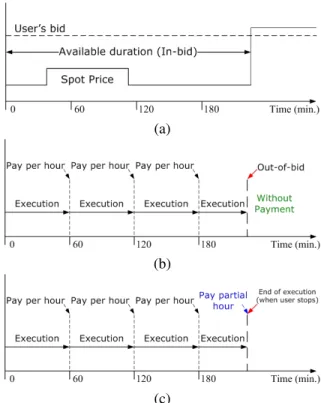
price for using a Spot Instance. It is important to note the following characteristics of Amazon EC2’s Spot Instances. When a user’s maximum price bid exceeds the current Spot Price, the requested resources are granted. Conversely, Ama-zon stops immediately without any notice when a user’s bid is less than the current price. We call this a failure (or out-of-bid). To increase efficiency of task execution, users are suggested to save their intermediate results periodically by means of checkpointing [2].
B. Problem Formulations
We assume a user is submitting a compute-intensive job that is divisible. Divisible workloads such as video encoding, advanced graphics and virtual reality are an important class of application prevalent in high-performance parallel computing.
(a)
(b)
(c)
Fig. 2. Examples of pricing for Amazon EC2 Spot Instances: (a) Available duration starts when user’s bid exceeds the current Spot Price and ends the other way; (b) When a user’s Spot Instance is out-of-bid; (c) When a user stops using Spot Instance.
This is a common type of application that could be submitted on EC2 and amenable to failure-prone Spot Instances [8]. Suppose that the job consists of a total amount of work load W to be executed. We measure W in hours of computation needed on a single EC2 Instance with processing capacity of 2.5 EC2 Compute Units i.e., a single core of the High-CPU medium Instance type. We refer to the time needed for processingW on a particular Instance typeIt the task length
T =T(It). Suppose that the processing capacity of It isCt,
we have T(It) =W/Ct. It is worth to note that T is the net
computation time excluding any overheads due to out-of-bid, checkpointing and restart. Therefore T is different from the actualexecution timeTe. Lettd denote the deadline or delay
requirement for a job (for a fixed Instance type), andE[Te]the
expected execution time, our objective is to design a bidding strategy which can minimize the total monetary cost while satisfying delay constraintE[Te]≤td.
In this work, we denote bytc the time for taking a
check-point, andtr the time for a restart. And let pmax denote the
maximum Spot Price (exclude the burst noises) of a particular Instance type. Further, for a specific Instance type, the Spot Price for the ith hour is denoted byp
i. We define the result
of each hour during the course of the job’s computation as in-bidorout-of-bid, representing whether a job is occupying the computing resource. As discussed later, if the user’s current bid exceedspi, theresult of theithhour stays in-bid. Otherwise,
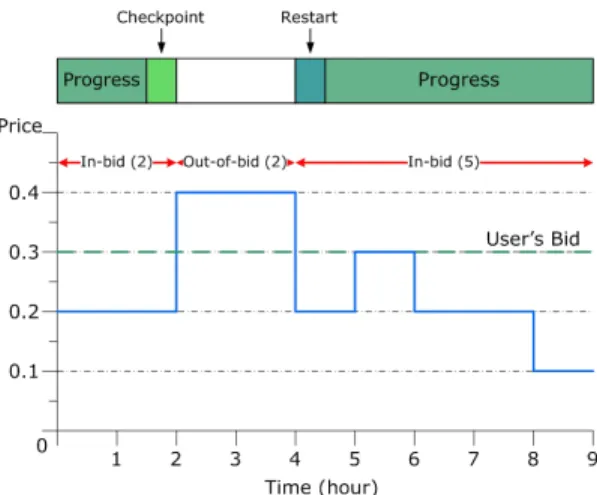
Fig. 3. Illustration of the execution model for Amazon EC2 Spot Instances.
C. Execution Scenario
Figure. 3 illustrates an exemplary execution scenario. A user submits a job with a total amount of workload W = 6 unit-hours (assuming EC2’s small Instance server). User’s bid price is0.30USD, and during the course of the job’s computation, the job encounters an out-of-bid result (i.e. failure) between time 2 and 4. The total available time was 7 hours (tc =
0.5 hour for checkpointing and tr = 0.5 hour for restart),
from real execution progress (i.e.useful computation) is only
(1.5+4.5) = 6hours. The overall execution timeTeis9hours.
During the job’s active execution, the spot price fluctuates: 1
hour at 0.10 USD per time unit, 5 hours at 0.20 USD per time unit, and 1 hour at 0.30 USD per time unit, leading to total cost of 1.4 USD. Thus the average cost is1.4/7 = 0.2
USD per hour. The per hour average execution progress is T /Te= 6/9≈0.67 hour.
III. BIDDINGSTRATEGIES
We next propose set of bidding strategies, aiming to min-imize the monetary cost under required reliability level. For ease of introduction, we first introduce one simple yet efficient heuristic and then propose our optimal bidding strategy based on Constrained Markov Decision Process.
A. A Heuristics — Always Bidding Maximum Price
We first propose a heuristic bidding strategy. This heuristic is easy to implement and has good performance in prac-tice. This strategy is called Always Bidding Maximum Price (ABMP). By following ABMP, we always bid the maximum price regardless of current state. The motivation of this strategy can be summarized as follows: Firstly, since ABMP always bid at the maximum price, thus the job Instance will never be terminated by Amazon. In other words, ABMP ensures consistent execution of any job. Therefore the completion time is minimized. Secondly, no matter what strategy we implement, we must pay the minimum price at least. Notice that in current Spot Instance setting, the maximum price is at most 1.1 times the minimum one, thus ABMP will pay at most
10% more than the minimum cost. Therefore ABMP strategy
guarantees (1) minimum completion time and (2) at most10%
more than the minimum cost.
B. AMAZING: CMDP-based Dual-Option Bid Strategy
In this section, we study the following constrained optimiza-tion problem:considering a long state evolving process, given an execution time (delay constraint td) and price transition probability matrix, what is the optimal bid strategy µ, such that the expected monetary cost E[M] to finish the entire job is minimized, and the expected execution time satisfies E[Te]≤td?
To tackle the above problem, we design an optimal bidding strategy, namely AMAZING, that utilizes both the dynamic pricing model and the state transition intelligence.AMAZING
is built upon Price Transition Probability Matrix (PTPM), a back-end system runs a linear programming routine to select a bid option (make a desirable decision for the next Instance hour) ahead of each Instance hour. ThePTPMfor a particular Spot Instance type can be learnt from Spot Price history released on Amazon EC2 website. With E different Spot Prices for a particular Instance type, we can build anE×E matrix PTPM to represent the transition probability between each Spot Price pairσ andτ. In our system, we estimate the transition probability between two Spot Pricesσ andτ based on the relative transition frequency. Therefore each entry in
PTPM, denoted byΛ(σ, τ), is defined as the fraction of time whenσis followed byτin adjacent hours wheneverσappears. Clearly, an entryΛ(σ, τ)of a higher value indicates a higher transition probability from Spot Price σ toτ. In our system, an AI agent is trained to extract Spot Price patterns from the dynamically changed Spot Price data.
Theoretically, a general bidding strategy may bid any price for a specific Instance. However, we prove in Theorem 1 that any bidding strategy can be simulated by so call Dual-Option Strategy where the bidding option in a dual-option strategy is eitherbidding the maximum Spot Priceorbidding zero dollars.
Theorem 1: Any sequence of bidding decisions can be
obtained by carefully performing dual-option strategy, either bid the maximum Spot Price or give up, at each instance hour.
Proof:Letpmaxdenote the maximum Spot Price (exclude
the burst noises) observed from the Spot Price history of a particular type of Spot Instance. Suppose that we have a bidding sequence {b1, b2,· · ·, bn}. Here, bi is the bid price
for the ith hour. The result for each hour is either in-bid or
out-of-bid, as shown in Figure. 3. If the result of theithhour isin-bidand the Spot Price ispi, then we can substitutebi by
pmax i.e., bidding the maximum Spot Price. As a result, the
result of theithhour would not change. Further, since the Spot
Instances are charged based on Spot Prices, the user will be charged the same price atpi. On the other hand, if the result
of the ith hour is out-of-bid, then we can substitute b
i by 0
USD (give up). In this scenario, the result of theithhour stays
the same, and the user will not be charged at all. Thus any bidding strategy, including the optimal one, can be substituted by a dual-option strategy without changing the final output.
(a)
(b)
(c)
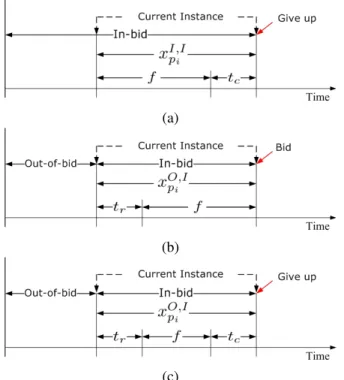
Fig. 4. Examples of execution progressf for Amazon EC2 Spot Instances under different Instance states.
Theorem 1 implies that an optimal dual-option strategy must be also an optimal strategy. Therefore, in the rest of this paper, we can reduce the number of possible bidding options to two instead of infinity without affecting the optimality of our strategy. LetA denote the set of bidding options that we consider at each hour. Implied by Theorem 1,A is composed of only two elements: A = {B,G}. Here B is short for
bid the maximum price and G is short for bid zero or give up. We denote the bid option made in the ith hour by a
i
where ai ∈ A. The basic idea of AMAZING is that during
each Instance hour, we pre-select a bidding option, either bid maximum price or giving up, for the next Instance hour with certain selection probability. The selection probability for each bid option is calculated based on current state and PTPM. Since we always make our bid option ahead of time, we can set a checkpoint at current hour whenever we decide to give up in the next hour.
We use xα,β
pi to denote an integrated state (or simply
state) of the ith hour. Let α and β denote the result of the (i−1)th hour and the ith hour, respectively. Note that α, β ∈ {I, O}, where I is short for in-bid and O is short for out-of-bid. For instance, xO,I
p represents such a state: (1) out-of-bid in previous hour, (2) in-bid at current hour, and (3) the Spot Price at current hour is p. By integrating the result from previous hour to current hour, xα,β
p provides a
compact representation to calculate the execution progress. Execution progress represents the actual progress resulted from current hstate, bidding optioni pair. Let f(xi,ai) denote the
execution progress resulted from statexiunder bidding option
ai. Refer to Figure. 4 as three examples: (a) assume the result
Algorithm 1 Pseudo Code forAMAZINGPolicy
Input: Optimal bidding strategyµ(computed from Algorithm 2) and current state information
Output: The bidding decision for the next hour
1: Randomly choose a bid option based on bidding strategy µ
calculated from Algorithm 2 for the next Instance hour; 2: ifthe bidding option is to give up in the next Instance hourthen 3: set a checkpoint at the end of current Instance hour; 4: Perform bidding decision correspondingly in the next hour.
of previous hour is in-bid, and current hour is also in-bid, then the execution progress is 1−tc under option give up, e.g., f(xI,Ipi ,G) = 1−tc. This is because it takes tc time to set the checkpoint at the end of current hour; (b) assume the result of previous hour is out-of-bid, and current hour is in-bid, then the execution progress is 1−tr under option bid, e.g., f(xO,I
pi ,B) = 1−tr. This is because it takes tr time to restart the program at the beginning of current hour; (c) assume the result of previous hour isout-of-bid, and current hour isin-bid, then the execution progress is1−tr−tc under
optiongive up,e.g.,f(xO,I
pi ,G) = 1−tr−tc. This is because it takes tr and tc time to restart the programm and set the
checkpoint, respectively. The complete definition off(xi,ai)
is summarized as follows. f(xi,ai) = 1−tc, if xi=xI,Ipi ,ai=G 1−tr, if xi=xO,Ipi ,ai=B 1−tc−tr, if xi=xO,Ipi ,ai=G 1, if xi=xI,Ipi ,ai=B 0, otherwise (1)
AMAZINGworks as follows: In each Instance hour,
AMAZ-ING pre-selects a bidding option for the next Instance hour according to decision strategy µ. The calculation of µ will be discussed in detail later. It is worth noting that during computing the selection strategy µ, we already take into account all potential overhead (e.g., checkpoint, restart). Please refer to Algorithm 1 for pseudo codes.
In Algorithm 1, µ specifies the selection probability of each bid option at different states. In following discussions, we focus on finding such an optimal selection strategy µ. We model the computation of selection strategy µ as Con-strained Markov Decision Process (CMDP). By solving the corresponding Linear Programming (LP) in polynomial time [6], we obtain an optimal selection strategy µfor each state.
1) Constrained Markov Decision Process: Markov decision processes (MDP), also known as controlled Markov chains, constitute a basic framework for dynamically controlling sys-tems that evolve in a stochastic way. To make it fit our problem setting, we define a tuple {O, X,A, P, M, D}, where: (a) O = {t|t = 1,2,· · · } denotes the set of decision epochs. Decisions are made at the beginning of each Instance hour. (b) X ={x1,x2,· · ·,xn} is a countable state space. Although
we limit the study in this work to discrete Instance state tran-sitions, the continuous case can also be handled by dividing
it to discrete space. We have xi =xα,βpi for xi ∈ X. (c) A is an action set A = {B,G}. Theoretically, each Instance
hour has 4·E possible states. As defined previously, E is the number of different Spot Prices that presented in the price history of a particular Instance type. Since α, β ∈ {I, O}, the number of different combinations of α, β is 4. Thus we have 4·E possible states for each Instance hour. In order to reduce the searching space, we leverage underlying transition matrix to facilitate our study. We use the previous example in Figure. 4(a) for illustration. In this example, a possible bid option ai could be give up i.e., ai =G. Notice that current
statexi =xI,Ipi and bid optionai together limit thevalidstate space for the next instance hour to be xi+1=xI,Opi+1, thus the size of searching space for the next instance hour is reduced toE. Different bidding options made in theithInstance hour
will lead to different valid state space for the(i+1)thInstance
hour. (d) Letρ(xi,ai)denote theoccupation measureof
state-option pair hxi,aii, it represents the probability that such
state-option pair ever exists in the decision process. Notice that the occupation measureρ()is decided by corresponding decision making strategy. (e)P represents the state transition probability matrix (different from PTPM). DefinePi,j(ai) as
the probability of moving from statexitoxj, when bid option
ai is taken. Here xj denotes any valid state of the (i+ 1)th
Instance hour. If xj is a valid state given xi and ai, then
Pi,j(ai) = Λ(pi, pj). Recall that Λ(σ, τ) is the transition
probability from price σ to τ. Otherwise, Pi,j(ai) = 0. (f)
M is the immediate cost. In this paper, we define E[M] as the expected total monetary cost during the course of the job’s computation, which can be computed as in Equation. 2. (g)D is the maximum allowed job completion time i.e., deadline. In this paper, we have D=td. Recall that f(xi,ai)denotes
theexecution progressfor theithInstance hour. Please refer to Equation. 1 for detailed calculation off under different states. Therefore, assume the processing capacity is 1 and workload isW, we have E[f]≥ W
td whereE[f], which is calculated in Equation 2, denotes the expected average execution progress per Instance hour.
E[f] = X xi∈X X ai∈A ρ(xi,ai)·f(xi,ai) E[M] = X xi∈X X ai∈A ρ(xi,ai)·pi·td (2)
2) Optimal Bid Option Selection Strategy µ: In order to compute the optimal selection strategy µ of the CMDP with expected monetary cost criteria, we can formulate it as a linear programming. After solving the corresponding LP, we can obtain the optimal strategy through normalization [6]. We next write the bid optimization problem defined above as the following LP. The constraints (1) and (3) ensure thatρ(xi,ai)
is a feasible probability measure. The deadline requirement can be respected under constraint (2) by setting the expected average execution progress no less than Wt
d. In inequality (4),
δxj(xi)is the delta function ofxi concentrated onxj, which is defined in following equation:δxj(xi) =
(
1, if i=j
0, otherwise
This constraint describes that the outgoing rate and incom-ing rate for a state must be the same. At the same time, it emphasizes the property for ergodic processes. After solving the linear programming, we get an optimal occupation measure ρ()in terms of monetary cost minimization for each state/bid-option pair. However, sinceP
ai∈Aρ(xi,ai)≤1, we can not directly useρ(xi,ai)as the probability of taking actionai at
statexi. Instead, the optimal bid strategyµcan be determined
from ρ(xi,ai) as follows: µ(ai|xi) =
ρ(xi,ai)
P
ai∈Aρ(xi,ai). Here
µ(ai|xi) represents the probability that taking bid option ai
at statexi. It is easy to verify thatPai∈Aµ(ai|xi) = 1. For any number of input state, Algorithm 2 can return an optimal selection strategyµin polynomial time. As input of Algorithm 1,µ specifies the selection probability of different bid option for different states.
Problem:LP-Minimizing Expected Monetary Cost
Objective: MinimizeE[M] subject to: (1) ρ(xi,ai)≥0, ∀xi,∀ai (2) E[f]·td≥W (3) P xi∈X P ai∈Aρ(xi,ai) = 1 (4) ∀xj∈X P xi∈X P
ai∈Aρ(xi,ai)(δxj(xi)−Pi,j(ai)) = 0
Algorithm 2 Computation of Optimal Bidding Strategyµ Input: Execution deadlinetd, transition matrixP
Output: Optimal bidding strategyµ.
1: Solve corresponding CMDP linear programming to get the oc-cupation measureρ(xi,ai),∀xi∈X,∀ai∈A;
2: Calculate optimal bidding strategyµfromρ(xi,ai)as:
µ(ai|xi) = P ρ(xi,ai) ai∈Aρ(xi,ai)
IV. PERFORMANCEEVALUATION
In our study we considered prices of Instance types that run under Linux/UNIX OS and are deployed in the zone us-east-1. Interested readers please refer to [1] for details. We simulated the bid optimization algorithms based on the real price traces in terms of the task completion time, total price, and the time overhead of checkpointing and restart.
A. Evaluation Settings
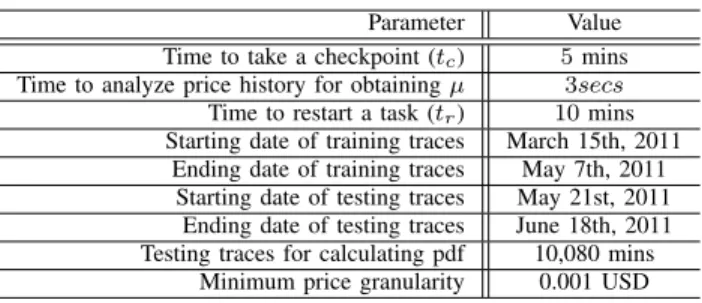
Table. I shows our simulation setup in detail. We assume that the checkpointing cost of running programs is known. We used the constant value for the tc but using a variable
checkpointing cost is also possible in our system model. If not stated otherwise, we use the Instance type D with task lengthT of 164 minutes (2.7 hours). Furthermore, our models assume that a job is executed on a single instance only, as running several instances of same type in parallel yields the identical time and proportional cost behavior.
TABLE I
VALUES OF PARAMETERS USED IN THIS PAPER
Parameter Value Time to take a checkpoint (tc) 5mins Time to analyze price history for obtainingµ 3secs Time to restart a task (tr) 10mins Starting date of training traces March 15th, 2011
Ending date of training traces May 7th, 2011 Starting date of testing traces May 21st, 2011
Ending date of testing traces June 18th, 2011 Testing traces for calculating pdf 10,080 mins
Minimum price granularity 0.001 USD
B. Impact of Constraint Parameters
In this part, we study how the constraint factors such as budgetary constraint influence the distributions of the execu-tion time and monetary cost per Instance. We also investigate the overhead of the checkpoint/restart during the course of the job’s computation.
1) Execution Time and Monetary Cost: Figure. 5(a) shows execution time for various values of budgetary constraints and desired confidence in meeting the job’s deadline cT. Instead
of assuming a fixed deadline, we study here the execution time which can be achieved with confidence cT. As shown
in Figure 5(a), low budgets in conjunction with high values of confidence lead to extremely long execution times, which can be up to factor 15 compared to the task length T. For sufficiently high budget (≥ 0.18 USD) the execution time drops to half of the peak value. Only in the top range of the budgetary constraints the execution time is on the order ofT. Figure. 5(b) shows the monetary cost under varied budgetary constraints and desired confidence in meeting the budget cM.
Differently from the execution time, monetary cost increases only slightly with the budget constraint, and is relatively indifferent to the confidence. We explain this by the fact that a long execution time comes primarily from out-of-bid (give up) time. In this scenario, the user is not charged. Even during an execution time of 35 hours there might be only small in-bid time on the order of execution time T that is charged. In conclusion, a user does not save much by bidding low (within
10%) but risks very high execution times.
We also find that a slight change of the budgetary confidence cM has significant impact on the execution time. If the user
assumes 0.01 USD more for the budget, she will benefit from a significant reduction of execution time at the same confidence value.
2) Overhead of Checkpoint/restart: Figure 5(c) shows the overhead of checkpoint/restart during the task execution, where both the budgetary constraint and the confidence of availability (in-bid) time cI. We denote availability time by
AT. We study the time overhead due to checkpointing and restart. We observe that our approach outperforms previous work in terms of low execution time and overhead while meeting the budgetary constraint. This will be discussed in detail later in Section IV-C. Clearly, low budgets lead to more frequent out-of-bid situations, which increases the checkpoint-ing overhead. 0.17 0.175 0.18 0.185 0.19 0.6 0.8 1 0 10 20 30 40
Budget Constraint per Instance (USD) Confidence cT
Execution time (Hour)
(a) 0.175 0.18 0.185 0.19 0.6 0.8 1 0.17 0.175 0.18 0.185 0.19
Budget Constraint per Instance (USD) Confidence cM
Monetary Cost per Instance (USD)
(b) 0.175 0.18 0.185 0.19 0.6 0.8 1 0 0.25 0.5 0.75
Budget Constraint per Instance (USD) Confidence cI
Time Overhead of Checkpoint/Restart (Hour)
(c) 0.175 0.18 0.185 0.19 0 2 4 6 0 0.5 1
Budget Constraint per Instance (USD) Task Length (Hour)
Availability Ratio (0.9)
(d)
Fig. 5. (a-b)Influence of budget constraint and desired confidencescT and cM; (c) Overhead of the checkpoint/restart for various budget constraints; (d) Availability ratio depending on the budget constraint and task lengthT.
3) Influence of Task Length: Figure 5(d) illustrates how the distributions of the availability ratio (AR) depends on the task lengthT. Availability ratio is another importance feature utilized in cloud computing to evaluate the efficacy of bidding algorithms. We first give a T-free definition of availability ratio (AR): the ratio of the total time in-bid to execution time
i.e.,AR=AT /Te. Figure 5(d) showsAR(0.9)i.e., valuev≥
(90%of values assumed byAR) as a function of the budgetary constraint andT. Here the influence ofT is strongly visible,
0 2 4 6 8 10 12 14 0 0.2 0.4 0.6 0.8 1
Execution Time on us−east−1.c1.medium (Hour)
CDF AMAZING .057−HOUR .058−HOUR .059−HOUR .060−HOUR .061−HOUR .062−HOUR .063−HOUR 0 2 4 6 8 10 12 14 0 0.2 0.4 0.6 0.8 1
Execution Time on us−east−1.c1.medium (Hour)
CDF AMAZING .057−HOUR .058−HOUR .059−HOUR .060−HOUR .061−HOUR .062−HOUR .063−HOUR 0 2 4 6 8 10 12 14 0 0.2 0.4 0.6 0.8 1
Execution Time on us−east−1.c1.medium (Hour)
CDF AMAZING .057−HOUR .058−HOUR .059−HOUR .060−HOUR .061−HOUR .062−HOUR .063−HOUR (a) (b) (c)
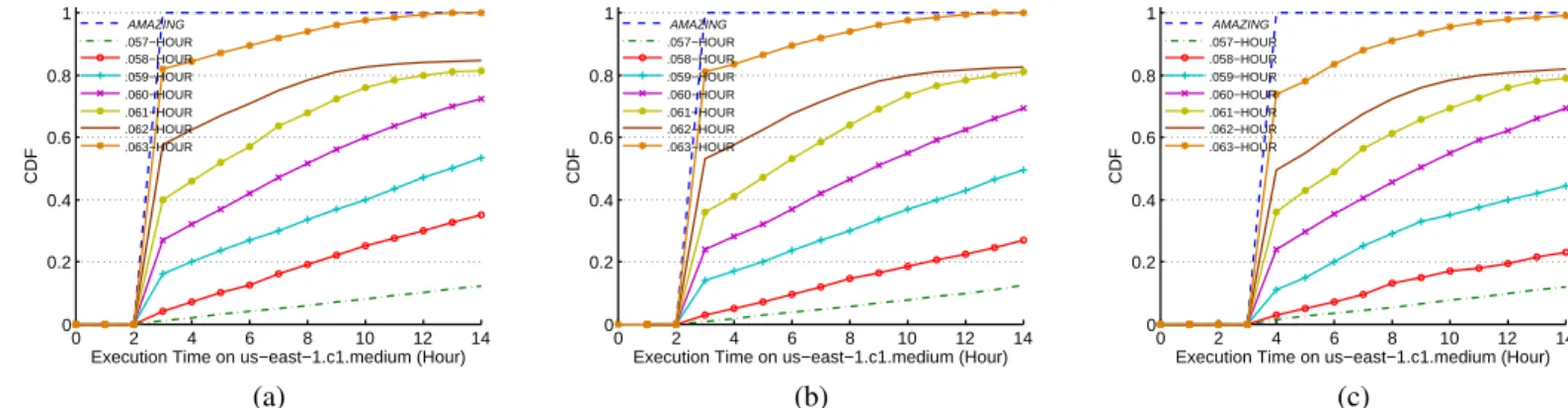
Fig. 6. CDF of execution time for different task lengthT on Instance type D, where (a)T = 144mins (b)T = 164mins (c)T= 184mins.
0.120 0.13 0.14 0.15 0.16 0.17 0.2 0.4 0.6 0.8 1
Monetary Cost per Instance on us−east−1.c1.medium (USD)
CDF AMAZING .057−HOUR .058−HOUR .059−HOUR .060−HOUR .061−HOUR .062−HOUR .063−HOUR 0.14 0.15 0.16 0.17 0.18 0.19 0 0.2 0.4 0.6 0.8 1
Monetary Cost per Instance on us−east−1.c1.medium (USD)
CDF AMAZING .057−HOUR .058−HOUR .059−HOUR .060−HOUR .061−HOUR .062−HOUR .063−HOUR 0.18 0.19 0.2 0.21 0.22 0.23 0 0.2 0.4 0.6 0.8 1
Monetary Cost per Instance on us−east−1.c1.medium (USD)
CDF AMAZING .057−HOUR .058−HOUR .059−HOUR .060−HOUR .061−HOUR .062−HOUR .063−HOUR (a) (b) (c)
Fig. 7. CDF of monetary cost for different task lengthT on Instance type D, where (a)T = 144mins (b)T = 164mins (c)T = 184mins.
especially for low budgets. As a consequence, distribution of AR depend onT, and cannot be stored only as functions of T-freefactors.
C. Evaluation of Execution Time
In this section we study performance ofAMAZINGin terms of the execution time compared to previous work [8], [16]. In previous work, bid price for each Instance hour is fixed and various checkpointing strategies are proposed to balance the reliability and monetary cost during the course of job’s computation. The HOUR strategy proposed in [16] is the hourly strategy, where a checkpoint is taken at a boundary of each paid hour. We conduct extensive experiments to compare the performance ofAMAZINGwith theHOURstrategy, where the bid price and the task length T are both varied.
Figure 6 shows the cumulative distribution function (CDF) of the execution timeTeaccording to different bidding
strate-gies and task lengthsT. The budget constraint for our proposed approach is set to be0.18USD per Instance. We used the same settings of the remaining parameters, such as checkpointing cost, rollback cost (restart cost) and processing capacity of the Instance type as in [16], [8]. Obviously under the same task length T, theAMAZING strategy has much lower time over-head. We explain this by the fact that our bid option for each Instance hour is computed from the Instance state transition probability matrix (STPM).AMZAING exploits the predicted Spot Price transition to solve the bid optimization problem,
thus it is more likely to help customers skip unnecessary checkpoints/restart when the Spot Price is relatively smooth. Consequently, more clock time is utilized to perform effective computation, and a higher utilization ratio (UR) is achieved, where U R =T /Te. On the other hand, the HOUR strategy
asks customers to take a checkpoint at a boundary of each paid hour withoutlooking aheadeven if with high probability the Spot Price could be even lower in the next Instance hour. As a result, more than 20% of the availability time is taken for hourly checkpointing/recovery, less time is utilized for real program processing. In summary, achieving a higher utilization ratio (UR) during the course of task computation is the main reason that the proposed AM AZIN G strategy outperforms theHOU Rstrategy.
We also observed that the advantage ofAMAZING is even more obvious when the task lengthT increases. As shown in Figure 6, the HOU R strategy with various bid prices rarely meets the confidencecT = 90%under the budget constraint of
0.18USD. In contrast,AM AZIN Greaches100%confidence of meeting the deadline requirement at less than4 hours.
D. Evaluation of Monetary Cost
In this section we study performance of AMAZING in terms of the monetary cost compared to previous work [8], [16]. In Figure 7, we illustrated the cumulative distribution function (CDF) of the monetary costs per Instance according to different bidding strategies and task length T. Under the
same task lengthT, the monetary cost followed theAMAZING
bid strategy is much lower (10%) than that conducted by the HOU R strategy for various bid prices. The main reason is that in the proposedAMAZINGstrategy, PTPM facilitates the decision making by means of predicting the transition among various Instance states and optimizing the balance of reliability versus monetary costs. With intelligence about the Instance state transition,AMAZINGhas more chance to obtain the Spot Instances charged at lower prices by EC2, while keeping a high utilization ratio to complete submitted jobs before deadline.
We also observed that the advantage of AMAZINGis even more obvious as the task length T increases. As shown in Figure 7(c), the HOU Rstrategy with various bid prices can not meets the budget constraint of 0.18 USD. In contrast, AM AZIN G reaches budgetary confidence cM >15% even
under harsh monetary cost constraint.
In the results of Figure 7(b), the HOUR checkpointing strategy with two highest bid prices can not meet the user’s budgetary constraints (0.18USD), while the three lowest bid prices can not meet the given deadline constraint (17.6hours). As we can observe from Figure 6 and 7 some bid prices followed theHOU R strategy are not feasible. The proposed
AMAZINGapproach outperforms theHOU Rstrategy in terms
of both execution reliability and monetary cost. V. RELATED WORK
Branches of related work include cloud computing eco-nomics and resource management services. Several previous work focus on the economics of Cloud Computing i.e., the performance and monetary benefits of Cloud Computing compared to other traditional computing platforms such as Clusters, Grids, and ISPs [7], [10]–[12], [14]. These economic studies are important for understanding the performance trade-offs among those computing platforms. However, these work assume a static pricing model for EC2’s dedicated on-demand Instances and do not address the specific and concrete deci-sions an application scientist must make to balance bid price and resource allocation when using a market-based Cloud Computing platform, such as Spot Instances. Several systems for monitoring and managing cloud applications exist [3]– [5], but these systems currently do not consider cloud prices that vary dynamically over time. Several middleware currently deployed over Clouds have fault-tolerance mechanisms [9], [13], but these mechanisms currently are not cost-aware either. It is a critical challenge to control the balance of reliability versus monetary costs in the context of unreliable resources such as Spot Instances. Previous researchers investigate proba-bilistic model [8] and checkpointing mechanisms [16]–[18] to answer the question of how to bid given these constraints. Given the maximum price that users are willing to pay per hour, researchers tend to apply probabilistic model and different checkpointing strategies to meet the requirements. Nevertheless, these approaches were considered merely under the fixed bid price model, and only periodically checkpointing schemes were given in their study. In this work, we try to design an optimal bidding strategy that utilizes both the
dynamic pricing model and the state transition intelligence to meet customers’ computing requirements.
VI. CONCLUSION
In this work, we propose an effective bid option making strategy to balance the reliability versus monetary costs in the context of unreliable resources such as Spot Instances. Dif-ferent from previous work on cloud applications, AMAZING
exploits the intelligence about state transition among various Spot Instances to facilitates decision making during the course of job’s computation. Our state context aware design tries to intelligently adapt the bid using intelligence from detected state patterns. In this paper, the decision making optimization problem is formulated as a Constrained Markov Decision Process (CMDP). After solving the CMDP,AMAZINGapplies optimal bid decision to each Instance hour until the job’s computation is completed. Our experimental results verifies
that AMAZING outperforms previous work in terms of both
execution time and monetary cost. REFERENCES
[1] Amazon EC2 Spot Instances. http://aws.amazon.com/ec2/#instance. [2] Amazon Simple Storage Service FAQs. http://aws.amazon.com/s3/faqs/. [3] CloudKick: Simple, powerful tools to manage and monitor cloud servers.
http://www.cloudkick.com/.
[4] CloudStatus. http://www.cloudstatus.com/.
[5] RightScale: Cloud Computing Management Platform. http://www.rightscale.com/.
[6] ALTMAN, E. Constrained Markov decision processes, vol. 7. CRC Press, 1999.
[7] ANDRZEJAK, A., KONDO, D.,ANDANDERSON, D. Exploiting non-dedicated resources for cloud computing, 2010.
[8] ANDRZEJAK, A., KONDO, D.,ANDYI, S. Decision model for cloud computing under sla constraints. In 2010 18th Annual IEEE/ACM International Symposium on Modeling, Analysis and Simulation of Computer and Telecommunication Systems(2010), IEEE, pp. 257–266. [9] DEAN, J.,ANDGHEMAWAT, S. Mapreduce: Simplified data processing on large clusters.Communications of the ACM 51, 1 (2008), 107–113. [10] DEELMAN, E., SINGH, G., LIVNY, M., BERRIMAN, B.,ANDGOOD, J. The cost of doing science on the cloud: the montage example. InProceedings of the 2008 ACM/IEEE conference on Supercomputing
(2008), IEEE Press, p. 50.
[11] GARFINKEL, S.Commodity grid computing with amazon’s s3 and ec2. Defense Technical Information Center, 2007.
[12] KONDO, D., JAVADI, B., MALECOT, P., CAPPELLO, F.,ANDANDER
-SON, D. Cost-benefit analysis of cloud computing versus desktop grids. IEEE.
[13] LITZKOW, M., LIVNY, M.,ANDMUTKA, M. Condor-a hunter of idle workstations. InDistributed Computing Systems, 1988., 8th Interna-tional Conference on(1988), IEEE, pp. 104–111.
[14] PLANKAR, M., IAMNITCHI, A., RIPEANU, M., AND GARFINKEL, S. Amazon s3 for science grids: a viable solution. In Data-Aware Distributed Computing Workshop (DADC)(2008).
[15] STOKELY, M., WINGET, J., KEYES, C.,ANDYOLKEN, B. Using a market economy to provision compute resources across planet-wide clusters. IEEE.
[16] YI, S., HEO, J., CHO, Y.,ANDHONG, J. Adaptive page-level incremen-tal checkpointing based on expected recovery time. InProceedings of the 2006 ACM symposium on Applied computing(2006), ACM, pp. 1472– 1476.
[17] YI, S., HEO, J., CHO, Y., AND HONG, J. Taking point decision mechanism for page-level incremental checkpointing based on cost analysis of process execution time.Journal of Information Science and Engineering 23, 5 (2007), 1325.
[18] YI, S., KONDO, D., ANDANDRZEJAK, A. Reducing costs of spot instances via checkpointing in the amazon elastic compute cloud. In
2010 IEEE 3rd International Conference on Cloud Computing(2010), IEEE, pp. 236–243.