Goal Directed Project Management intelligent system for the support of
ERP Implementation and Optimal Adaptation Procedure
I. ZAFEIROPOULOS, Dr.K.METAXIOTIS, Prof.J.PSARRAS
Decision Support Systems Laboratory, Department of Electrical & Computer Engineering,
National Technical University of Athens
9 Iroon Polytechniou Str., Zografou 15 773
GREECE
Abstract: -One of the most difficult tasks in the world of ERP systems has proven to be their installation and customization to fulfill the needs of the customer. In this paper the authors present an auxiliary project management tool that supports the complicated process of implementation and optimal adaptation of an ERP system. Its objective is to provide the project manager with the ability to create all the necessary elements for the management and realization of such a project, to lead the consultants and to establish a direct communication between the project team members during the procedure of Implementation and Optimal Adaptation of ERP systems.
Key-Words: -Goal Directed Project Management Tool ERP Implementation
1 Introduction
We observe that the enterprising environment is altered radically and the way of operation of enterprises is modernized by the import and use of Information Systems. Thus is observed an intense activity in the market of such systems and mainly the Enterprise Resource Planning – ERP, which has as aim to be used and "serve" all the departments of an enterprise [1-3]. An ERP is constituted by many sub systems, which collaborate aiming at the complete cooperation and interaction of the enterprise departments and at the leveling of the proper company operation. Generally the complete installation of ERP and the start of the usage of ERP adjusts the Modelling and the optimal Adaptation to the needs of the enterprise. On the whole the complete installation of the ERP is a very important project management and IT work The basic objective of this work is the production of an auxiliary tool which will be used in the work of Implementation and Optimal Adaptation (IOA) of ERP systems.
The functional result of the proposed work is expected to support considerably the process of concretization and installation of ERP’s in enterprises, aiming at the promotion of their possibilities as well as the increase of their competitiveness in the World market [4-7].
More specifically, with the development of this system, we are aiming at the achievement of the following results, which will be ensured by the successful progress of this project and the
exploitation of the breadth of the new possibilities that will be provided:
Facilitation and effective guidance for the installation process (IOA) of an ERP in all stages and levels of analysis.
More rapid implementation of ERP’s. Shortening of ERP’s start-up in the enterprise-customer aiming at the optimal exploitation of system and the reduction of cost of the transient period.
Control and reduction of implementation cost (time, human and other resources) of ERP not only from the company-customer side but also from the implementor’s side.
Control and reduction of enterprise and economic risks of the implementation for the two involved parts.
Progressive and smooth passage of the enterprise in the new organizational and administrative systems that are provided by the ERP’s.
Optimal adaptation of processes and structures of enterprise in the ERP’s.
Optimal guidance and control of processes of the suitable training of users of ERP’s.
Support to the Team of the Optimal Installation and Technical Support of the Operation of ERP’s.
2 Problem Formulation
The current tool addresses the selection, implementation and optimization on a project basis,
in order to achieve the business objectives enabled by an ERP. With the help of the tool, projects are clearly defined, allowing envisioned changes to be implemented effectively via a structured approach. In order to carry out the project, a project management methodology is needed.
2.1
Goal Directed Project Management
One characteristic of most organizational changes is that they increasingly tend to cross the boundaries between disciplines, departments and even enterprises, which entail radical restructuring. The Goal-Directed Project Management® (GDPM) method from (former) Coopers & Lybrand was selected as the underlying concept and philosophy of the tool. GDPM provided a philosophy to direct changes towards a predefined goal [8].
Goal Directed Project Management is a comprehensive philosophy, process and method for managing projects, and has proven applicable to all kinds of projects ranging from behavioral change to large technical endeavors. The big difference between GDPM and other PM methods is its simple and scalable approach. It fits for large programs as well as for small projects. The method is based upon layered planning:
• A management level focusing on controllable results (Milestones) throughout the project and how to organize to achieve these.
• A detail level outlining the activities and responsibility for achieving a Milestone.
Separating the big picture from the details is a prerequisite for management to obtain and keep a stable overview of progress and results, and at the same time ensure control on a sufficient level of detail.
GDPM also implies a planning process, on both levels, involving the different parties so that a common understanding of task and the objectives is reached, and ownership to the plans is gained. Using GDPM the benefits are the following:
• As a Project Manager you have a perfect instrument to get commitment from your project team
• As a Project Sponsor you get the instrument to monitor the project based on results
• As a Project Team Member you have a clear picture of what has to be achieved by the project GDPM has been successfully used and is still being used in many companies of any size around the world.
GDPM methodology comes from IT projects and is particularly suited for small and medium-sized projects. It allows different levels of formalism and is suitable for any kind of projects.
2.2 The need of developing the proposed
Tool
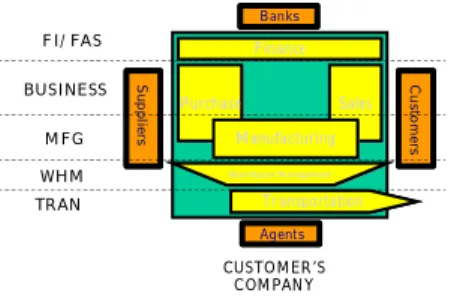
Whe The need of developing tools that support ERP Implementation and Optimal Adaptation Procedure results from the fact that a completed ERP system is constituted from multiple applications related with each other, as it is shown in figure 3.
CUSTOMER’S COMPANY Finance Finance Sales Sales Warehouse Management Warehouse Management Purchase Purchase Manufacturing Manufacturing Transportation Transportation C us to m ers S up pli ers Banks Agents FI/ FAS BUSINESS MFG WHM TRAN
Fig. 1 ERP diagram
Every application needs to be adapted in a very low and analytical level so that it reflects all the processes of the enterprise that are related with the content of the application. For this reason the most developed companies in the area of developing ERP systems (SAP, BAAN, ORACLE, PEOPLESOFT etc), have developed and offer with their corresponding products modern tools and methodologies for the support of ERP Implementation and Optimal Adaptation Procedure. The companies apply continuing research on these tools and the methodologies that they use and as a result advanced publications are continuously being developed. They use them for even more rapid installation and mainly more effective operation of their systems.
Naturally, the tools that support ERP Implementation and Optimal Adaptation Procedure constitute secret weapons of the companies, since they are placed in an evolved field of research and competition between them – in international market – is particularly intense. As a result companies are trying to adapt tools as specialized in their systems as possible to prevent any escape of their particular characteristics to likely antagonists.
All of the existent tools of support of Implementation and Optimal Adaptation of popular ERP systems are based on specific methodologies what have been developed basically by the corresponding companies. Their general structure includes systems for enterprise analysis, internal processes modeling, incorporation or adaptation of installed information systems. The ERP
Implementation and Optimal Adaptation Procedure constitute of ERP Modeling Tools and ERP Implementation Management Tools. The first ones are based mainly on the use of libraries containing templates and scripts, and the others on the creation of three basic plans of the installation project: the work plan, the resource plan and the budget plan. In conclusion, one of the main characteristics of systems and tools that support the Implementation and Optimal Adaptation Procedure of the most popular ERP systems is their specialization in the respective system. Moreover none of the developed systems uses a methodology based on Goal Directed Project Management, which at the time constitutes the optimum and most developed method for the management of such projects of implementation. As a result there is an absence of tools that could independently analyze and model an enterprise or support the processes of modeling and optimal adaptation of ERP Systems addressed to small or medium-sized enterprises. The fulfillment of this lack in the area of ERP systems of such size and level of work, through analytic research in the special subjects of this object, but also taking into account the conditions of Greek enterprising market, constitutes the need of developing a system that offers important tools of general use for the management of support of ERP Implementation and Optimal Adaptation Procedure, independently from the ERP system.
Taking these into consideration and with utilization of the modern method of goal directed project management that was described in the previous paragraph, we present a project management tool for the Implementation and Optimal Adaptation procedure of ERP systems.
3 Problem Solution
The system designing aims at the most optimal exploitation of methodology that is developed and at the growth of a flexible, friendly and functional management support tool.
3.1
Architecture of Auxiliary Tool for
Implementation and Optimal Adaptation
(IOA) of an ERP system
A short analysis of each sub system is presented in the following paragraphs.
3.1.1 Scenarios and Milestones Repository
This sub system provides a number of stored, ready, formal scripts of project management. Each one includes a total from rationally structured and drawn
milestones, the corresponding activities as well as the relative plans of roles/duties. It is a suitably structured and organized database. Individual objective for the creation of a formal Script and Milestone library, in the frames of the proposed project, is initially the determination and the analysis of a sub-sections total of a life circle of representative implementation projects. The sub-sections of work are considered the structural departments of the whole implementation project. It is noted that the provided analysis of scripts is indicative and conform to the most optimal reported practices and is also reliable with the methodological rules of ERP modelling and installation.
The use of this sub system will be made via the Sub system of Modeling and project Management whose description follows.
3.1.2 Sub system of Adaptation to ERP
In this sub system it is contained and stored all the material concerning all previous experience of use of the tool in MOA projects. Each achieved work of Management ERP implementation is registered in this sub system so that it is used, suitably modified, in enterprises of similar kind. Indicative registered Information can be the following:
Baseline and Actual Analysis and Diagram of Stages/Sub-sections of work
Baseline and Actual Analysis and Diagram of Milestones
Baseline and Actual Analysis and Diagram of Tasks
Baseline and Actual Analysis of Entrusting of Duties
Baseline and Actual Timetable of implementation
Budget Analysis
Deliverables, objective analysis, requirements, risks etc
Other forms useful as models of report This library will be permanently enriched with each achieved work of ERP implementation, facilitating and rendering as more effective the use of the management system.
3.1.3 Project Management Configurator
This sub system is one of the basic, as it constitutes the node of analysis/modeling of the requirements and the creation of project management of IOA. Moreover it constitutes the core of project management as it includes all the mechanisms and tools of production of results and management data. The analysis/adaptation concerns the explicit and well-aimed determination of related milestones and in their methodological connection with activities
and persons in charge of implementation. This sub system communicates with the Script and Milestone library at the commands of choice of suitable scripts, which when shaped suitably (addition, abstraction of milestones, adaptation of parameters etc) compose the considered project. This sub system communicates also with the library of models at the commands of choice and/or addition of models for the creation of work. The adaptation of scripts and models is made according to the requirements (time, economical, technical etc) of the particular company and the specifications of the under installation system, with the abstraction – addition – alteration of milestones, activities and entrusting of duties. In the frames of management and work follow-up services are provided in the following fields:
Management and Growth of Plan of work (Project Schedule)
Management and Growth of Plan of Points of Stations (Milestone chart)
Management and Growth of Plan of Entrusting of Duties (Responsibility of chart)
Management and Analysis of Employment (Resource Charts)
Provision of Analytic List of Points of Stations (Milestone List)
Modelling and Analysis of project management using stored previous experience and knowledge (Knowledge Repository)
Simultaneously, with the planning of project are provided also possibilities of progress follow-up and imprinting of present situation in graphical way and with possibility of multilevel analysis, depending on the degree of detail that is required.
In this sub system are also included the following tools:
Analysis and Management of Danger (Risk Management)
Basic Analysis of Budget (Basic Budget Management).
The tool of Risk Management is important part of the management system, as it provides to the administrator the possibility of analyzing, supplementing questionnaires - checklists, and it locates in time problematic situations that potentially place in danger the smooth conduct of work.
At the same way is also forecasted the exploitation of library of ready templates in such a way that there is most optimal use of previous experience. The sub system will provide exit compatible with known and popular software packets (e.g. MS Project, Excel, etc).
3.1.4 Methodology Documentation
It includes in structured and functional way the complete methodology of project management of ERP implementation. The methodology will be organized in such a way that the user is guided in the suitable forms depending on his profile (stage of implementation, unit of work, etc). The analysis and the organization will be done based on the methodological levels (administrative, technical etc), the stages of implementation (ph. stage of implementation, stage of preparation and choice etc), and object of analysis (budget, analysis of activities etc).
3.1.5 Data Base
In the Database are stored and elaborated all the elements concerning the IOA projects of the Management Team. It is also connected and interacts with the Analysis/ Adaptation and Management of projects. Moreover in the Database are registered the information and the user profiles according to which, for every user, based on his role in the project management team the environment of management and the rights of access are determined.
3.1.6 User Interface
The Sub system of communication with the user interacts with the Sub system of Analysis/Adaptation and Management and with the Documentation of Methodology library, aiming at a functional, reliable and easy exploitation of the system’s abilities, from the user’s aspect, with the help of a suitably structured menu, toolboxes and contacts (links). The environment is graphic and pact with the modern models of functionalism and aesthetics, providing possibilities of dispatch and reception of electronic post, useful electronic addresses and a good level of parameterization and adaptability.
The guidance of administrator through the use of the system will be done in methodological level, via the forms of documentation of methodology, as well as in functional level via suitably organized help (wizards, tutorial, demos, help index etc).
In the objectives of this sub system’s development, lies the ease of handling and presentation of the data and results since the tool is sought not to limit itself – as far as utilization is concerned– in the experts of the enterprise that undertake the IOA project, but to be also possible the use of some utilities from executives of the enterprise - client in which the ERP is installed, since in every case they can have a more realistic and complete picture of individual questions of enterprise.
The individual characteristics of this sub system and the way it supports the project management of IOA projects are to be determined with precision at the following analysis.
3.2
Description of Auxiliary Tool for
Implementation and Optimal Adaptation
(IOA) of an ERP system
In this paragraph we briefly present the user interface of the proposed tool. The tool is accessible through the local network as well as the Internet, so that its access is possible from the area of installation. Its objective is a direct communication between the consultants and the project manager. For this purpose the data should be managed dynamically.
It is in wizard mode so that its utilization becomes as simpler as possible. It can be parameterized to an extent rate, so that it leads the user depending on his role, the tasks that have been assigned to him, the kind of work and the requirements of the customer. The parameterization is realized by the project manager, who has the right to alter the project details and the data during the project and these changes are dynamically perceptible from the project team. From the other side, the project manager has access to elements that are repeated in each project like predefined tasks, common documents and templates. In this way precious time is being saved during the planning phase of the project.
The tool supports three main categories of users: Project Manager
Consultants
System Administrator
The Project Manager and the consultants use the project management subsystem whereas the system administrator uses the data management subsystem and has access to the database.
Each user has a login name and a password. The system recognizes the user that has logged in and this data defines the user’s access to each application of the tool.
In the first page, the user selects creating a new project, editing an existing project or modifying the users if the user is an administrator:
Fig. 3 Login Screen
When creating a new project the user becomes automatically the project manager of that project. The project manager is responsible to create, supported by the tool, all the necessary elements for the right management and realization of the project.
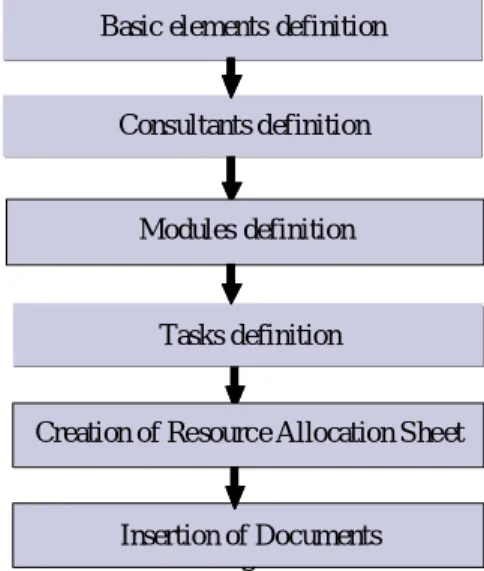
The tool leads the project manager to create a new project through a wizard in order to insert all the necessary data and to provide the correct input of them in the system. The following figure shows the flow chart of the procedure of creating a project:
Fig. 4 Flow Chart
The procedure consists of the following steps: 1st step: The user (Project Manager) creates a new project in the system, by inserting its main elements: customer, title, the modules that are going to be implemented, the business type, the start date, the planned end date and the planned duration and some comments. The tool of Management of work includes the following individual sub system
2nd step: The Project Manager assigns the consultants that will participate in the project and therefore gives them access to project elements. 3rd step: The Project Manager defines the modules of the ERP system that are going to be installed:
Insertion of Documents Tasks definition
Creation of Resource Allocation Sheet Basic elements definition
Consultants definition
4th step: The Project Manager prepares the task list which is based on predefined tasks that are:
Module based Time phased
Connected with each other in such a way that in order to begin a task, another one should have finished.
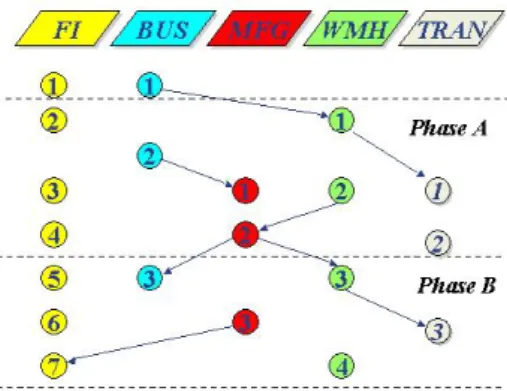
The connection between tasks and with the modules and the phases of the project is shown in the following figure:
Fig. 5 Tasks – Modules – Phases
Each predefined task contains data like its description and its deliverables. The user can change the predefined task to the specific needs of the project, remove a task from the list or add a specific task that concerns only a project. The tasks are presented both in list and diagram in order to show their relations and their module based and time phased attributes. Each task has general details and specific details in the project.
5th step: The project manager prepares the Resource Allocation Sheet of the project, which is based on an excel template and uploads it to the system.
6th step: The project manager creates or uploads documents, files and deliverables related with the project.
After the creation of the project and the insertion of its main data, some users (the project manager that inserted the project in the system and the consultants that he has assigned) will have access to the project’s elements. Specifically the user reaches a list with the projects that he is involved in and his role in each of them.
According to this role, the user can select a project to edit its elements, by inserting, updating or removing data. These elements are:
Project Task List. This list contains the selected and adapted by the project manager tasks. The project manager has full access to a task and the
consultant can read its data and update only some elements like comments or whether the task has been completed.
As the consultant follows the wizard, the tasks that are assigns to him appear one next to the other in the order that they should be carried out. The user also has access to the documents related to each task.
Resource Allocation Sheet. There is a list with all the versions of the resource allocation sheet. The project manager can edit it or create a new version and the consultants can read it.
Project documents. The documents are categorized in types (contracts, deliverables, reports). The user selects type and reaches a list with the documents of that type and according to his role can read, edit a document or upload a new document.
The application provides safety of data in a high level. Each user has not access and cannot change any data apart from what his role requires. On the other hand the System Administrator has direct access to them and can modify and easily adapt their structure to the needs of each project.
The tool can be adapted to any kind of ERP Implementation and Optimal Adaptation project and its application is independent from the ERP system that has to be installed.
4 Conclusion
This paper presented a Project Management tool that is able to support the complicated process of Implementation and optimal adaptation (IOA) of an ERP system to the needs of an enterprise. The tool was connected to, and tested with the operations and capabilities of the ERP commercial package ‘SINGULAR Enterprise (SEn)’ of the Greek Software House DELTA-SINGULAR S.A. The functional result of this system was proved to support considerably the process of IOA of SEn in the companies-customers.
The system was applied without the need of any adaptations to the specific ERP package. As a result of its usage, the services provided by the company were upgraded and the project work was improved in the fields of time, organization, planning, control, facilities and communication. The project manager had a supervisory view of the tasks, the milestones, the progress of each task separately and the progress of the whole project. The work of the consultants was absolutely controlled and the resources were best allocated.
Moreover the consultants were aware of their responsibilities and had access only to the elements that concerned them or could be useful to them.
They had access to deliverables from the place of the customer and could communicate with the project manager who could dynamically apply changes during the project realization. The tool resulted to a better cooperation between the project team members and between the company-provider and the company-customer. Finally it resulted to the improvement of the image of the company that applied it.
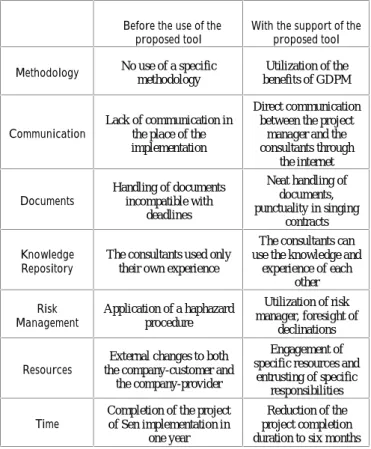
The results of the application of the tool to the process of IOA of the ERP package ‘Sen’ are shown in the following Table 1:
Before the use of the
proposed tool With the support of theproposed tool Methodology No use of a specificmethodology benefits of GDPMUtilization of the
Communication Lack of communication inthe place of the implementation
Direct communication between the project
manager and the consultants through
the internet
Documents Handling of documentsincompatible with deadlines Neat handling of documents, punctuality in singing contracts Knowledge
Repository The consultants used onlytheir own experience
The consultants can use the knowledge and
experience of each other
Risk
Management Application of a haphazardprocedure
Utilization of risk manager, foresight of
declinations
Resources the company-customer andExternal changes to both the company-provider
Engagement of specific resources and
entrusting of specific responsibilities
Time Completion of the projectof Sen implementation in one year
Reduction of the project completion duration to six months
Table 1 : Results of Application
With the use of the tool by the company, an increase both in the productivity and in the quality of the company’s services is expected in the near future.
With the development of this system, the authors achieved the following goals:
Facilitation and effective guidance for the installation process (IOA) in all stages and in all levels of analysis.
More rapid implementation of IOA.
Control and reduction of cost of implementation (time, human and other resources), both from the side of company-customer and from the side of a Software House (e.g. DELTA-SINGULAR in Greece).
Control and reduction of enterprise and economic risks of the implementation for the two involved parts.
Progressive and smooth passage of the enterprise in the new organizational and administrative systems that are provided by an ERP environment.
Optimal adaptation of processes and structures of the enterprise in an ERP environment.
Support to the Team of the Optimal Installation and Technical Support.
References:
[1] Pawlowski, S. and M-C Boudreau et al.: “Constraints and Flexibility in Enterprise Systems: A Dialectic of System and Job.”, Americas Conference on Information Systems, August 13-15 1999, Milwaukee, WI.
[2] Chung, SH. and CA. Synder: “ERP Initiation – A Historical Perspective.”, Americas Conference on Information Systems, August 13-15 1999, Milwaukee, WI.
[3] Davenport, TH.: “Mission Critical: Realizing the Promise of Enterprise Systems.”, Boston, MA, Harvard Business School Press (2000). [4] Kennerley, M. and Neely Andy: “Enterprise
resource planning: analyzing the impact”, Integrated Manufacturing Systems, Vol. 12, Issue 2 (2001), pp.103-113.
[5] Metaxiotis, K., Psarras, J. and Ergazakis, K.: “Production Scheduling in ERP Systems: An AI-based Approach to Face the Gap”, Business Process Management Journal Vol.9 No.2, pp. 221-247.
[6] Laughlin, S.: “An ERP Game Plan”, Journal of Business Strategy, pp. 32-35 (1999).
[7] Rosemann, M.: “ERP Software: “Characteristics and Consequences”, 7th European Conference on Information Systems – ECIS ’99, Copenhagen, Denmark, June 1999. [8] Anderson, S. E, Grude V. K, Haug T.: Goal Directed Project Management: Effective Techniques and Strategies, Kogan Page Professional Paperback Series