Project Management Certification Programmes:
How appropriate are they?
A Research Report Presented to Graduate School of Business Leadership
University of South Africa [UNISA]
I
NP
ARTIALF
ULFILMENT OF THER
EQUIREMENTS FOR THEM
ASTERSD
EGREE INB
USINESSL
EADERSHIPU
NIVERSITY OFS
OUTHA
FRICASubmitted By
Natisha GareebDate of Submission
December 2011Supervised By
Prof PMD RwelamilaD
ECLARATIONI, Natisha Gareeb, Student Number 72221259, hereby declare that the disserta-tion entitled Project Management Certification Programmes: How appropri-ate are they? is a result of my own investigation and research, and presents my own work unless specifically referenced in the text. This work has not been submitted in part or in full for any other degree or to any other University.
A
CKNOWLEDGEMENTSI would like to acknowledge my supervisor for his technical and academic patronage in particular, toward the completion of this MBL degree by research. I acknowledge the academic and managerial support structure at UNISA SBL.
A special thanks to my husband Prashil, and my two beautiful sons, Yashad and Dhi-ran for their moral support.
“ RESEARCH IS TO SEE WHAT EVERYBODY ELSE SEES, AND
TO THINK WHAT NOBODY ELSE HAS THOUGHT.”
……… Albert Szent-Gyorgyi
A
BSTRACTThe competences of project managers are a vital role in projects success. An exten-sive literature survey was conducted to determine the constitution of an adequate knowledge base for would-be project managers.
A detailed literature study was conducted. The literature review discussed how to assess project management competencies. Technical skills and social cultural skills were identified from the literature review. A comprehensive list of criteria was used to generate the critical success factors.Based on the critical success factors that were obtained from the literature in the content for the knowledge base was constructed.
This research then started to address what constitutes certification requirements. Certification programs were identified globally for the study. This study identified what the certification programs offered.
This research started by proposing a knowledge base and using the “grounded the-ory approach” used content analysis to compare the proposed knowledge base with project management certification programs.
The study concluded with recommendations on the gaps that exist in project man-agement certification programs.
T
ABLE OFC
ONTENTSTitle Page ………... i
Declaration ……….... ii
Acknowledgements ………... iii
Abstract ………... v
List of Abbreviations and Acronyms ……….. .x
List of Figures ………... xi
List of Tables ……….…… xiii
Chapter One: General Introduction………...……….……. 1
1.1 Introduction ………...…….…. 1
1.1.1 Importance of project management……...…………...……… 1
1.1.2 Importance of the right knowledge base ………..… 2
1.1.3 Competency...………..…………... 3
1.1.4 Project management certifications...……. 5
1.2 Definitions...………. 7 1.2.1 Project……...…………...………...7 1.2.2 Project management………..…………... 7 1.2.3 Project manager...………..…………... 9 1.2.4 Skill...………... 9 1.2.5 Knowledge ………..…………... 10 1.2.6 Body of knowledge...………….…………... 11
1.2.7 Project management competencies...…. 12
1.3 The problem statement...……….. 12
1.4 Research objectives ...……….. 14
1.5 Contribution of the study in relation to the existing body of knowledge … 14 1.6 Delimitation of the study ...………... 14
1.7 Brief methodology ...……….. 14
1.8 Outline of the research report.……… 15
Chapter Two: Theory and Practice of Project Management Certification
Pro-grams…... 17
2.1 Introduction……….……….. 18
2.2 Assessing project management competencies …...………. 18
2.3 Certification programs: A global approach to project management...21
a Body of knowledge…... 22
b Ethical behaviours... 22
c Defined minimum standards... 22
2.3.1 Certification programs……...………... 23
i. The American Association of Cost Engineers (AACE)... 24
ii. The Project Management Institute (PMI)... 27
iii. The UK Association for Project Management (UK APM)... 34
iv. The International Project Management Associations (IPMA)... 42
v. The Australian Institute of Project Management (AIPM)... 49
vi. The American Academy of Project Management (AAPM)... 53
vii. The International Association for Project and Program Management (IAPPM)... 55
2.3.2 Summary: Certification programs……...………... 60
2.4 Project management certification merits and demerits...…… 65
2.4.1 Merits of certification ……...…………...……… 65
2.4.2 Demerits of certification ………..…...………... 66
2.5 Developing the knowledge base...……... 66
2.5.1 Attributes of a good project manager ……...………. 67
2.5.2 Contributors to project failure/ success ………..…………... 69
a) Project failure... 70
b) Project success dimension identified by scholars... 72
c) Technical skills required... 73
d) Social-cultural skills required... 76
2.6 Critical factors for project success ...…...77
2.7 Proposed content for competent project managers...……...80
Chapter Three: Research Design and Methods ……….. 82
3.1 Introduction…………...……….. 83
3.2 Research designs ………. 83
3.2.1 Qualitative research design ……….…... 83
3.2.2 Quantitative research design ……….…... 84
3.3 Sample design and sample size...…... 85
3.4 Data collection method……….. 86
3.5 Methodology selected...…... 86
3.5.1 Method for analysis ……...……… 89
3.6 Research instrument...……... 91
3.6.1 Coding frame ……...………... 92
3.6.2 Establishing the allocated scores ……...………... 93
3.7 Ethical considerations...…... 94
3.8 Summary...…... 95
Chapter Four: Results and Discussions ………. 96
4.1 Introduction ………...………. 97
4.1.1 Data description ………...……….. 98
4.1.2 Approach to answering the research questions ……...……….... 98
4.1.3 Coding frame and adequacy scale ………... 99
4.2 Presentation of the results and analysis …... 101
4.2.1 Presentation of results ………... 101
4.2.2 Adequacy of the programs ………... 102
4.2.3 The inadequacy of the knowledge areas ………... 104
4.2.4 Individual certification program scoring obtained…………... 105
a) The American Association of Cost Engineers (AACE)... 105
b) The Project Management Institute (PMI)... 107
c) The UK Association for Project Management (UK APM)... 108
d) The International Project Management Associations (IPMA). 109 e) The American Academy of Project Management (AAPM)... 110
f) The International Association for Project and Program Management (IAPPM)... 112
4.3 Validity of the answers to the research questions …... 113
4.4 Discussion of results …... 124
4.4 Summary …... 125
Chapter Five: Conclusion and Recommendations………126
5.1 Introduction ………... 127
5.2 Conclusions ………... 127
5.2.1 The ideal knowledge base …………...………... 127
5.2.2 Core / noncore PM knowledge areas………...128
5.2.3 Inadequacy of the certification programs ………...128
5.2.4 Technical abilities versus social cultural abilities... 128
5.2.5 Project management certification requirements... 129
5.2.6 Project management development programs... 129
5.3 Recommendations ………... 130
5.3.1 The ideal knowledge base …………...………... 130
5.3.2 Core / noncore PM knowledge areas……….. 130
5.3.3 Inadequacy of the certification programs ………... 130
5.3.4 Technical abilities versus social cultural abilities... 130
5.3.5 Project management development programs... 130
5.4 Further research ………... 131
5.4.1 Post graduate programsat learning institutions ... 131
L
IST OFA
BBREVIATIONS ANDA
CRONYMSPM - Project Management
PMP - Project Management Programme PMI - Project Management Institution
C3PM - Certified Program and Project Management Portfolio AACE - American Institute of Cost Engineering
CESB - Council of Engineering and Scientific Specialty Board IPMA - International Project Management Association
ICB - International Project Management Association Competency Base-line
PMP - Project Management Professionals MA - Member Association
AAPM - American Association of Project Management AIPM - Australian Institute for Project Management
NCSPM - National Competency Standards for Project Management RTO - Registered Training Organization
PMSA - Project Management South Africa SGB - Standards Generating Body
PMSGB - Project Management Standard Generating Body ICC - International Interim Cost Consultant
L
IST OFF
IGURESCHAPTER ONE: ORIENTATION
Figure 1.1: Focus of this research report 13
Figure 1.2: Chapter one in context with the overall research report 16 CHAPTER TWO: THEROY AND PRACTICE OF PROJECT MANAGEMENT
CER-TIFCATION PROGRAMS
Figure 2.1: Chapter two in context with the overall research report 17
Figure 2.2: Preliminary project managers competency framework 20
Figure 2.3: PMP process 29
Figure 2.4: The project management processes by knowledge areas 31
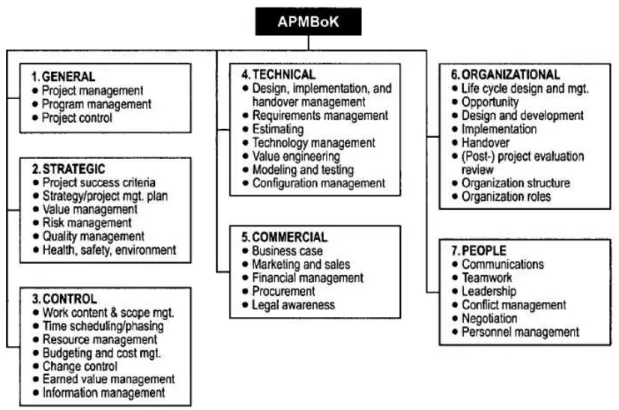
Figure 2.5: The association of project management body of knowledge 40
Figure 2.6: ICB competency baseline 43
Figure 2.7: Levels of competencies required by the IPMA 44
Figure 2.8: IPMA eye of competence 47
Figure 2.9: AIPM levels for project management 50 Figure 2.10: Guide to the Reg PM registrations 51 Figure 2.11: IAPPM Project and Program Management Certification
Framework 56
Figure 2.12: IAPPM Certified Project Manager: certification track 58
Figure 2.13: Linking competence and project success/ organisation
performance 67
Figure 2.14: Qualification pyramid 68
Figure 2.15: Role description “project manager” 69
Figure 2.16: Project failures 71
Figure 2.17:Project stages taking into account audience list, objectives and work
breakdown structure. 74
CHAPTER THREE: RESEARCH DESIGN AND METHODS
Figure 3.1: Progress thus far 82
Figure 3.2: Chapter 3 in context with the overall research report 83 Figure 3.3: Summary of research of qualitative content analysis 87
Figure 3.4: Basic proceeding of qualitative content analysis 90 Figure 3.5: Progress from the procedure 91
Figure 3.6: The coding process 92
CHAPTER FOUR: RESULTS AND DISCUSSIONS
Figure 4.1: Progress thus far 96
Figure 4.2: Chapter 4 in context with the overall research report 97 Figure 4.3: Comparative analysis of the certification program scoring 103 Figure 4.4: Average scoring of the knowledge areas 105
Figure 4.5: AACE scoring 106
Figure 4.6: PMI scoring 108
Figure 4.7: UK APM scoring 109
Figure 4.8: IPMA scoring 110
Figure 4.9: AAPM scoring 111
Figure 4.10: IAPPM scoring 113
Figure 4.11: Knowledge areas 123
CHAPTER FIVE: CONCLUSION AND RECOMMENDATIONS
Figure 5.1: Progress thus far 126
L
IST OFT
ABLESCHAPTER ONE: ORIENTATION
Table 1.1: Chapter outline 15
CHAPTER TWO: THEROY AND PRACTICE OF PROJECT MANAGEMENT CER-TIFCATION PROGRAMS
Table 2.1: Guide to the RPP registrations 36 Table 2.2: IPMA levels to accompany Figure 2.4 above 44 Table 2.3: Process for IAPPM Figure 2.12 above certification requirement 59 Table 2.4: Summary of certification programs 62 Table 2.5: Project success dimensions 1 72 Table 2.6: Project success dimensions 2 73 Table 2.7: Summary of the technical skills required for project success 75 Table 2.8: Summary of the social-cultural skills required for project
Success 76
Table 2.9: Success factors for project success 77 Table 2.10: Knowledge base for project mangers 80
CHAPTER THREE: RESEARCH DESIGN AND METHODS
Table 3.1: Distinguishing characteristics of different qualitative designs 89 Table 3.2: Knowledge base with allocated scores 93
Table 3.3: Adequacy scale 94
CHAPTER FOUR: RESULTS AND DISCUSSIONS
Table 4.1: Results per certification program 99 Table 4.2: Knowledge base with allocated scores 100
Table 4.3: Adequacy scale 101
Table 4.4: Results per certification program 102 Table 4.5: Average score per knowledge area scoring and gaps 116 Table 4.6: AACE individual scoring and gaps 117 Table 4.7: PMI individual scoring and gaps 118 Table 4.8: UK APM individual scoring and gaps 119
Table 4.9: IPMA individual scoring and gaps 120 Table 4.10: AAPM individual scoring and gaps 121 Table 4.11: IAPPM individual scoring and gaps 122
C
HAPTERO
NE: G
ENERALI
NTRODUCTION1.1 Introduction
This research project developed an appropriate generic knowledge base to develop competent project managers. The importance of project management, project man-agement in the organizations, the right knowledge base, project manman-agement certifi-cation, competency, the problem statement, research objectives and research ques-tions are discussed.
1.1.1Importance of project management According to Thomas and Mullaly (2009a):
“If project management had no value, people wouldn’t use it. The trouble is, nobody knows exactly what the value is. And many are starting to ask.”
The authors adopted five dimensions of value in their study of more than half of 65 participating project organizations. This constituted of satisfaction, alignment, process outcomes, business outcomes, and return on investment. They found that the first four could be measured directly, but the value of return on investment could only be derived from the other measures.
Thomas and Mullaly (2009a) concluded that project management showed value but organisations choose to implement project management not because of rationally de-fined business case but because someone at senior level decided that order was bet-ter than chaos. Thomas and Mullaly (2009b) stated that value comes from under-standing ultimately.
Thomas and Mullaly (2009 a, b) statements are bold and out there to be discussed, a few points on the importance of project management are discussed below.
The importance of project management is to deliver a successful project while man-aging both the technical and social cultural aspects that are present during the pro-ject.
Successful project management can be measured using the technical issues faced during the project. The technical aspects are to ensure that the project is completed within schedule, allocated budget, and meeting performance criteria. When the pro-ject management systems are in place it is easier to identify areas of improvement and see the gaps. The social cultural issues ensure that there is coordination be-tween integration of teams and time, that resource are put to good use, risks are identified and managed, and communication is maintained. The most important factor of project management is the anticipation of even better profit than planned.
Srivannaboon (2006) stated that project management is a specialized form of man-agement that is used to accomplish a series of business goals, strategies, and work tasks within schedule and time. Smith (2003) and Srivannaboon (2006) recognized that the strategic importance of project management in the corporate world is accele-rating and one reason may be a strong belief by business leaders that have aligned project management with business strategy. This can significantly enhance the achievement of organizational goals, strategies, and performance.
1.1.2Importance of the right knowledge base
Project management was developed originally from the technical fields (engineering and construction) but now can be applied to a variety of activities (Smith 1999). Smith (1999) claimed that most project managers started in the technical field of study, become ‘accidental project managers’ but lacked the managerial functions to manage project work.
The research surrounding project management competencies by Hartman and Skulmoski (1999) suggested that if the competencies are improved then the likelihood of the project success is also improved.
In order for project managers to successfully deliver the business objects through project management, they needed the right knowledge base to start therefore this research identified the constitution of the right knowledge base for project managers.
1.1.3Competency
Different authors have different perspective of what competencies really mean. The definition of competency varied depending on the stakeholders and the agenda. Hoffman (1999) indicated that there are three definitions of the term:
“Competencies are either defined as observable performance, or the stan-dards or quality of the outcome of the person’s performance, or the underlying attributes of a person.”
Mirabile (1997) defined competencies as:
“……knowledge, skill, ability or characteristics associated with high perfor-mance on a job, such as problem solving, analytical thinking, or leadership”.
McLagan (1989) suggested that:
“…..for the purpose of training and development, a competency is a cluster of interrelated knowledge, skills, and attitudes that correlates with effective job performance, can be measured and evaluated and that can be improved through training and development.”
Association for the Advancement of Cost engineering AACE (2011) defined compe-tency as:
“….the quality or state of being functionally adequate characterized by marked or sufficient aptitude + attitude + skill+ strength + knowledge “.
Hoffman (1999) concluded that the purpose of defining competencies is to improve human work performance.
Gareis and Huemann (1999) suggested that project management competencies can be further developed after attainment of the ideal project management knowledge
base. Instruments for further development can include PM self-assessments, PM benchmarking, and significant PM research initiatives.
The common attributes of what competencies mean is knowledge, skill, attitudes and experience. Theses can be measured through outcomes that can be measured. The competent individual needs to continuously develop their knowledge to keep up to date with research, technology and tools on project management.
The literature review conducted by Ahadzie (2009) indicated the following to be the strategic importance of competency based measure:
Focus primarily on what mangers do that makes them successful or not. This should therefore help to establish what makes them (i.e. managers) effective and /or ineffective and also accountable for their actions.
Provide the psychological and understanding needed for selecting and predict-ing human performance.
Resonate well with the potential expectation of HR managerial dynamics have been shown to maximize developmental efficacy.
Have the potential for achieving genuine economic value for organizations, which is why there is an increasingly important recognition in their use in the examination of managerial effectiveness.
Based on a study by Rwelamila (2007a) there are six competencies that a project manager should possess. These are:
Sense of ownership and mission – responsible for the project and other broader organizational issues.
Political awareness – knows who the influential players are, what they want and how best to work with them.
Relationship development – spends time and energy getting to know project sponsors, users and contractors.
Strategic influence – builds coalitions and orchestrates situations to overcome obstacles and obtain support.
Interpersonal assessment – identifies specific interests, motivations, strengths and weaknesses of others.
Action orientation – reacts to problems energetically and with a sense of ur-gency.
Section 1.1.3 dealt with what competence really means, the strategic importance of competence, and what competencies a project manger should posses. Literature in-dicated that competence is not a static concept but can be developed constantly. A few instruments were discussed for continuous development.
1.1.4Project management certifications
The right professional certification is important and can add value to the certificate holder, but this will depend on the type of knowledge base it uses or owns (i.e. it must have the right knowledge base to add value to their members) and the reputability of the certification body (i.e. have a set of standards and the ethical behaviours of the selection process).
To be recognised in the market place a professional certification body need the fol-lowing (Smith 2003):
a body of knowledge
a commitment to the ethical behaviours defined by characteristic of the profes-sion
a set of defined minimum standards that must be met for entry into the pro-fession
Professionals usually require a review of their qualifications to determine if standards of knowledge and achievement are met (Smith 2003). The purpose of a certification is to acknowledge competencies in a professional.
Some organisations that provide project management certification are the Associa-tion for the Advancement of Cost engineering (AACE), The Project Management In-stitute (PMI), The UK Association for Project Management (UK APM), The Interna-tional Project Management Associations (IPMA), The Australian Institute of Project Management (AIPM), The America Academy of Project Management (AAPM), and the International Association for Project and Program Management (IAPPM).
The basic core competencies of the AACE (2011) focused on the project manage-ment process, legal skills, computer measuremanage-ment, costing and risks. The candidate needs to register with the AACE and pass the International Interim Cost Consultant (ICC) exam to obtain the AACE certificate.
PMI (2011) published Project management body of knowledge (PMBOK) a knowl-edge base for project mangers. The candidate that passes the entry requirement must write a two hundred multiple-choice exams based on the nine knowledge areas in PMBOK; the candidate must have a record of experience and graduate qualifica-tion. The candidate will receive a project management professional (PMP) certificate if the PMP requirements are met.
The UK APM (2011) assesses the candidate based on his needs to demonstrate a high level of competence across the entire project life cycle and goes for an assess-ment process against specific criteria. This ends with a peer review. The candidate then obtains a certified project management certificate.
The IPMA (2011) is based on a competence baseline and based on the levels of pro-ject management experience; the hours spent managing propro-jects; self assessments, interviews; formal examinations the individual can be grouped as a certified project director, certified senior project manager, certified project manager or a certified pro-ject management associate.
The AIPM (2011) focused on outcomes. The AIPM issues a certificate based on the outcomes and the number of years as a practicing project manager.
The AAPM (2011) was the first to introduce postgraduate certification in project man-agement. The candidate needs a graduate degree, project management training or passes the AAPM examination to obtain a MPM (Master’s in Project management). The IAPPM (2011) adds value to their members by allowing them to manage projects and programs successfully. The IAPPM uses its CPPMBok (Certified project and program management body of knowledge) as a knowledge base. IAPPM offers three-level certified project and program management credentials based on their guidelines
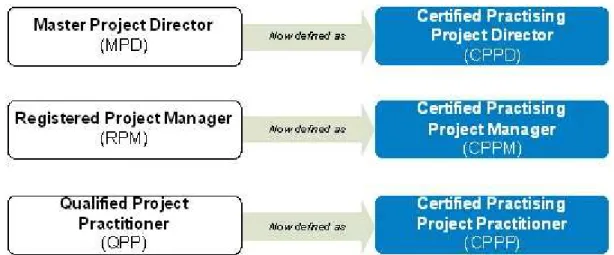
and candidates can register as the certified project professional (CPP), the certified project manager (CPM) or the certified project director (CPD).
Most professional associations have their own body of knowledge relevant to their needs. The associations above will be discussed in detail in Chapter 2 of this re-search report.
1.2 Definitions
1.2.1 Project
PMI (2004) defined a project as:
“…..as a temporary endeavor undertaken to create a unique product, service or result. “
AACE (2011) defined mega project as:
"…. with characteristics include requirements to manage numerous and concur-rent activities (sub-projects), complex procurement, high risks and uncertainties, social and environmental impacts, and project execution time exceeding 48 months. Typically, a mega-project will also exceed $1 billion dollars. However, much smaller projects could also be classified as mega-projects because of pro-ject execution complexities."
UK APM (2011) defined a project as:
“... a unique, transient endeavour undertaken to achieve a desired outcome.”
The common themes for what a project means are a temporary endeavour to achieve a desired outcome.
1.2.2Project management
“....the application of knowledge, skills, tools, and techniques to project activities in order to meet or exceed stakeholder needs and expectations from a project. Meeting or exceeding stakeholder needs and expectations involves balancing competing demands among: scope, time, cost and quality, stakeholders with differing needs and expectations, identified requirements (needs) and unidenti-fied requirements (expectations).”
AACE (2011) defined Project management as:
“…the utilization of skills and knowledge in coordinating the organizing, plan-ning, scheduling, directing, controlling, monitoring and evaluating of prescribed activities to ensure that the stated objectives of a project, manufactured product, or service, are achieved.”
Levene (2011) defined Project management as:
“....the processes of managing change by planning the work, executing it, and coordinating the contribution of the people and organizations with an interest in the project. Project management is required when introducing any new entity or making a change that involves moving from one state to another. “
UK APM (2011) defined Project management as:
“Project management is the process by which projects are defined, planned, monitored, controlled and delivered such that the agreed benefits are realised. Projects are unique, transient endeavours undertaken to achieve a desired out-come. Projects bring about change and project management is recognised as the most efficient way of managing such change. ”
The common themes for what project management means are using skill and knowl-edge through the process planning, executing, monitoring and controlling activities within a project to meet or exceed stakeholder expectation.
1.2.3Project manager
AACE (2011) defined a project manager as:
“….an individual who has been assigned responsibility and authority for accom-plishing a specifically designated unit of work effort or group of closely related efforts established to achieve stated or anticipated objectives, defined tasks, or other units of related effort on a schedule for performing the stated work funded as a part of the project. The project manager is responsible for the planning, controlling, and reporting of the project.”
UK APM (2011) defined Project manager as:
“The individual responsible and accountable for the successful delivery of the project.”
Pivac, Pivac and Ravlic (2011) stated that:
“Project managers carry the major role in project completion and represent the main responsible factor of a project success.”
The common themes for what a project manager means is an individual whom is re-sponsible for the planning, monitoring, controlling and reporting of activities within the project to achieve successful delivery of the project.
1.2.4Skill
Hogan (2011) defined skill as the
“…proficiency on a specific task”.
Hogan (2011) stated that the definition included an evaluation of the level of profi-ciency (e.g., highly skilled) and the task to be accomplished that are acquired through learning and experience.
“…the Macquarie Dictionary defines skill as ‘the ability that comes from knowl-edge, practice, aptitude, etc., to do something well’. The basis of the definition appears to have embedded in it the idea of competence, proficiency- to
basi-cally do something well and effectively. The definition also contains a dimension of learning by doing or of incremental ability. ”
Spector (2011) stated that
“Skill refers to a person's current level of proficiency on a particular task or fam-ily of tasks. Skills can be classified as either mental (e.g., report writing) or physical (running a machinist's lathe), although most job tasks involve elements of both. Skill reflects a person's current level of proficiency. In contrast, ability re-flects the capability or capacity to develop a skill. Skills can be assessed by a variety of devices, including assessment centres, psychological tests, situational tests, and work sampling”
The common themes for what skill means, is that it’s the ability that comes knowl-edge, practice, aptitude to do something well. Skill refers to a person’s current level of proficiency. Skills can be improved by knowledge and experience.
1.2.5Knowledge
Audi (1995) defined knowledge as
“…justified true belief”
Adam (2011) defined knowledge as:
“Truth and belief, though independent, are both required for knowledge. Knowl-edge requires that these two things, otherwise independent, come together.”
Zagzebski (2011) stated that
“Knowledge is a highly valued state in which a person is in cognitive contact with reality.”
The common attributes for what knowledge means are a highly valued state that comes from truth and belief.
1.2.6Body of knowledge(knowledge base) UK APM (2011) defined BoK as:
“An inclusive term that describes the sum of knowledge within the profession of project management. As with other professions, such as law and medicine, the body of knowledge rests with the practitioners and academics that apply and advance it.”
Livari, Hirschheim and Klein (2004) stated that:
“It is common for applied disciplines, especially established ones, to possess a body of knowledge (BoK). Applied disciplines have established such a BoK, which codifies the accumulated knowledge of the discipline.”
Stretton (2010) stated that
“Knowledge standards or guides, which typically take the form of bodies of knowledge, focus primarily on what project management practitioners need to know to perform effectively. The most compelling argument for having a body of knowledge for project management is to help overcome the “reinventing the wheel” problem. A good body of knowledge should help practitioners do their job better, by both direct referencing and by use in more formal educational processes.”
PMI (2011) stated that there are five attributed of a professional body:
“An identifiable and independent project management body of knowledge (PMBOK standards).
Supporting educational programs by an accredited institution (Accreditation). A qualifying process (Certification).
A code of conduct (Ethics)
The common attributes of what a body of knowledge means are that it comes from practitioners and academics and the purpose of BoK is to codify the accumulated knowledge of the discipline. A good body of knowledge helps practitioners do their job better and doesn’t allow them to reinvent the wheel.
1.2.7Project management competencies
Project management competencies are not well understood. Very few authors have looked at both project management and project management competencies.
Hartman and Skulmoski (1999) stated that:
“Project management competence research has focused on project manage-ment skills and on the competences of the project manager and that project par-ticipant competence is mainly used in organisations to help guide decision-making on its human resources.”
Project management literature surrounding competency is described in Hartman and Skulmoski (1999), as “simplistic, anecdotal or theoretical”. Not much information is available on which competencies are most important for task performance and project success. This observation is shared by the author.
Section 1.2 looked at the definitions of terms that will be used through out this re-search report. Project, project management, project manager, skill, knowledge, body of knowledge was defined. Competence was defined in section 1.1.3. This section defined both project management and project management competencies.
1.3 The problem statement
Bigelow’s (2004) stated that industry research from Gartner Inc. showed that a deficient project management workforce is one of the leading culprits for an astounding $75 billion in profit loss each year. Poor project management competencies accounts for 60% of the project failures.
Rwelamila’s (2007b) study on SA public sector organizations stated that at face value project oriented organizations purport to be fully fledged POO and performing as
competent PM organizations, but really are dependant on accidental project managers. Rwelamila’s (2007b) study indicated that there is a lack of competent pro-ject managers within SA and a need for competence in propro-ject management.
Bigelow’s (2004) and Rwelamila’s (2007b) argued that there is a lack of project man-agement competencies and this is linked to project failure. Therefore it is important for project managers to have the right knowledge base. Project management certifi-cation is important for project managers because the purpose of a certificertifi-cation is to acknowledge competencies in a professional. The lack of project management knowledge can be addressed by studying the certification programmes globally. Therefore this research addressed if project management associations provides ade-quate knowledge to the base for project management practitioners.
This research focused on the following four questions.
Are the PM voluntary associations or certification institutes providing adequate PM knowledge base for their members?
What constitute PM certification requirements?
Are there any gaps between the ideal PM knowledge base and PM Certifica-tion requirements?
Do PM Certification requirements need to be reviewed towards providing ade-quate PM knowledge base?
Figure 1.1: Focus of this research report The focus of this research report is depicted in Figure 1.1.
1.4 Research objectives
The main questions of the research report are to:
i. Determine the content of the existing project management certification pro-grammes.
ii. Propose (an) ideal generic Project Management knowledge base & skills. iii. Determine the gaps between the ideal project management knowledge base
and the project management certification programme base.
iv. Identification of initiatives for the development of common pm competencies.
1.5 Contribution of the study in relation to the existing body of knowledge
This research addressed at a global level the project management certification pro-grammes that are available and the proposed of an ideal project management knowledge base. This research addressed the lack of a competent knowledge base. Most project mangers gain knowledge through experience, experience doesn’t de-termine if the manger is practicing the right project management principles. Therefore the aim of the study was to access the existing project management knowledge base through project management certification programmes and proposed a more appro-priate base.
1.6 Delimitation of the study
In brief, this research is limited to certification programmes only; therefore this re-search does not cover project management degrees that are obtained from higher learning institutions and diplomas.
Also this study does not cover the success rate of project managers with a project management certification and project managers without certification.
1.7 Brief methodology
The problem statement was discussed in section 1.3 and the questions were dis-cussed in section 1.4. A detailed literature review was completed to determine an ideal project management knowledge base (Chapter 2). A content analysis was con
ducted to look at each certification programme and access how appropriate they are compared to the proposed ideal base.
1.8 Outline of the research report
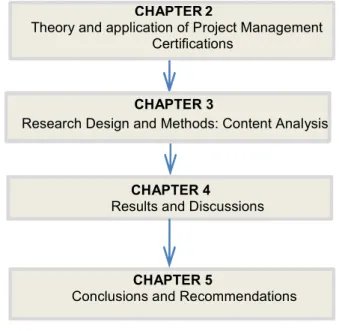
Table 1.1 and Figure 1.2 provided the outline of this research report. This research report consisted of five chapters as indicated in Table 1.1.
TABLE 1.1: Chapter outline
Chapter 2: Theory and Practice of
Project Management Certification Programs
Constitutes the theory and practice of project management certification programmes.
Chapter 3: Research Design and
Methods
Constitutes the types of methodologies and the methodology used in the study, the data collected and analysed in this research re-port.
Chapter 4: Results and
Discussions
Constitute the results and the discussions.
Chapter 5: Conclusion and
Recommendations
Constitutes the conclusion and the recom-mendation.
CHAPTER 1 General Introduction
1.1 Introduction
1.1.1. Importance of project management 1.1.2 Importance of the right knowledge base 1.1.3 Competency
1.1.4 Project management certification
1.2 Definitions
1.3 The problem statement
1.4 Research objectives
1.5 Contribution of this study to the existing body of knowledge
1.6 Delimitation of the study
1.7 Brief methodology
1.8 Outline of the research report
Figure 1.2: Chapter one in context with the overall research report
1.9Summary
This chapter clearly describes what the research report is about and a brief approach to the research problem. The problem statement was described in section 1.3 and the research questions in section 1.4. Brief definitions, the methodology, and limita-tions are discussed.
Definitions for project management and competencies were discussed and it was noted that different authors have different perspective of the term competency. The most common attributes of competencies were picked up from the various definitions and grouped together.
CHAPTER 3
Research Design and Methods: Content Analysis
CHAPTER 4
Results and Discussions
CHAPTER 5
Conclusions and Recommendations Theory and application of Project Management
Certifications CHAPTER 2
C
HAPTERT
WO:
T
HEORY ANDP
RACTICE OFP
ROJECTM
ANAGEMENTC
ERTIFICATIONP
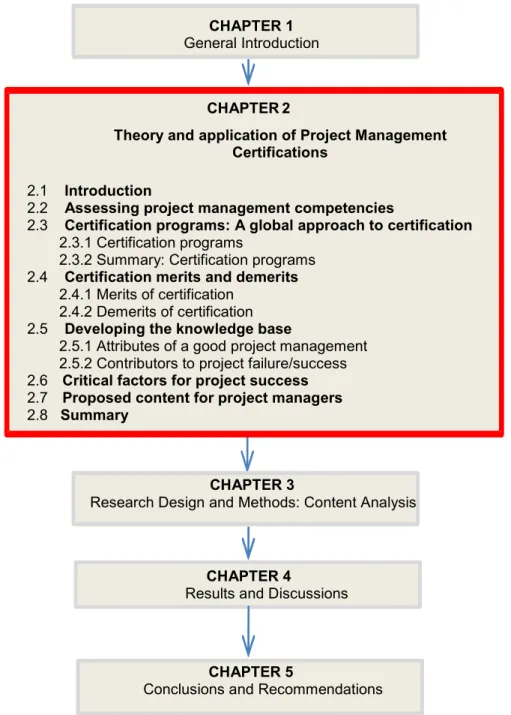
ROGRAMSChapter one provided the conditions for this research study. This chapter explored literature on how project managers should be assessed, how institutions approach project management certification, merits and demerits of certification, attributes of a good project manager, project success factors and a knowledge base for project managers. The chapter layout is provided in Figure 2.1.
Figure 2.1: Chapter two in context with the overall research report
CHAPTER 3
Research Design and Methods: Content Analysis
CHAPTER 4
Results and Discussions
CHAPTER 5
Conclusions and Recommendations 2.1 Introduction
2.2 Assessing project management competencies
2.3 Certification programs: A global approach to certification
2.3.1 Certification programs
2.3.2 Summary: Certification programs 2.4 Certification merits and demerits
2.4.1 Merits of certification 2.4.2 Demerits of certification 2.5 Developing the knowledge base
2.5.1 Attributes of a good project management 2.5.2 Contributors to project failure/success 2.6 Critical factors for project success
2.7 Proposed content for project managers
2.8 Summary
CHAPTER2
Theory and application of Project Management Certifications
CHAPTER 1
2.1 Introduction
The following represents a brief summary of the theoretical and practical research covered on project management certification programs. The early 1950s were noted, as the project management era, where project management tools and techniques were used for complex engineering projects. Prior to the 1950s projects were managed on an adhoc basis using mostly Gantt charts (Kumar 2005).
Project management has moved to encompass techniques other than those of the planning and scheduling of activities. There have been many developments over the past fifty years to extend project management by incorporating detailed methods for the management and control of cost, resources, quality, and performance.
Project management evolved from the 1950, since when project management asso-ciation were formed. This chapter entailed a closer look at what were the project management associations that were formed, the certification programs that are avail-able, and what are the curriculum and the criteria to join in the respective associa-tions.
2.2 Assessing project management competencies
Project management competencies assessments are important because this forms the starting point for the project management associations to certify applicants. This section deals with the theory on project management assessment.
Skills management and the assessment of skills are gaining popularity in human re-source management (Homer 2001). Project management and project management competence were defined in Section 1.2.
To assess competencies of employees and determine skill gaps allow organisations to apply more cost effective; significant training and development practices; deter-mine changes in individuals and team performances; and select better candidates (Hoffmann 1999).
Hoffmann (1999) suggested that if the performance standards are set and have been achieved this means that competency has been achieved.
Homer (2001) stated that people skills are one of the most important foundations for a company because they impact on every aspect of corporate process and ultimately profit.
Crawford (2008) concluded that performance-based inference of competencies are concerned with demonstration of the ability to do something at a standard considered acceptable in the workplace, with an emphasis on threshold rather than high perfor-mance or differentiating competencies. Threshold competencies are units of behav-iour that are essential to do a job but that are not causally related to superior job per-formance
Historically employers have hired and measured employees abilities and skill based on intelligent quotient (IQ) alone. IQ was used to measures one’s ability to learn, problem solve, and understand information. Intelligence has evolved to encompass both IQ and emotional quotient (EQ).
Gordon (2010) defined EQ as the ability to identify and manage emotional informa-tion in one self and others and focuses energy on required behaviour. These skills complement the cognitive skills.
Carrick (2010) stated that Daniel Goleman introduced EQ as a yardstick to measure leadership success, and there is a consensus that EQ can be developed through learning and development.
Paterson (2011) stated that emotional intelligence plays a vital role at leadership level and when star performers were compared with average performers at senior levels then nearly 90% of the difference in their profiles was attributable to emotional intelli-gence skills rather cognitive ability or technical skill.
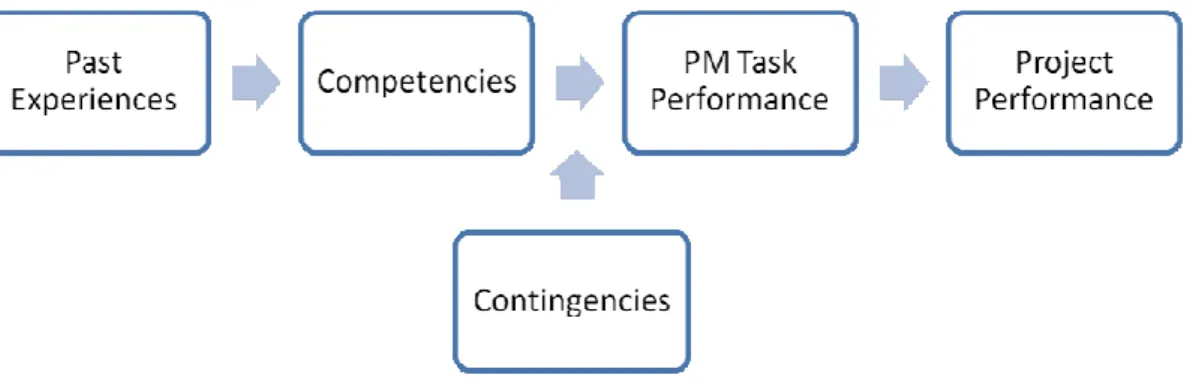
Hartman and Skulmoski (1999) suggested that assessment of competencies can be examined by a model (Figure 2.2) for project management competencies, which
include inputs, processes and outputs. Where inputs (can include and not limited to knowledge; skills; traits; motives; self image; social role; and behaviour), process competencies (examples of project management processes include planning; control-ling and closing a project) and outputs (can include project performance metrics such as budget and schedule compliance and project success criteria like customer satis-faction). Hartman and Skulmoski (1999) discussed three components that are needed for effective project management competencies that deal with outcomes. The competencies included:
• Tools to help manage a project
• Process that allows to pick the right tools and use them well
• Knowledge (theory and experience) that provides the safeguards against failure and promotes more reliable success.
Figure 2.2: Preliminary project managers competency framework
Source: Hartman and Skulmoski (1999)
Section 2.2 involved the types of assessment for project managers’ assessments and a number of views on how to assess the project manager. The common attributes from section 2.2 indicated that by doing a something at standard threshold rather than superior performance means that competency is achieved.
An individual needs to possess both IQ and EQ to be competent, were IQ is the technical ability and EQ is the emotional quotient.
Secondly there are many ways to measure competencies through outcomes or examinations this gives an indication on the technical abilities and EQ can be measured by psychometric assessments. The EQ can be developed through training and development.
After discussing competence and the measurement thereof the next section is going to cover a global approach to project management certification programs.
2.3 Certification programs: A global approach to project management
Professional standards are important for project management professionals. Certifi-cation is necessary to practice or demonstrate competence in project management.
Gareis and Huemann (1999) stated that different societies are becoming more pro-jects orientated. Their study looked at a plan on how to assess project management competencies in project –oriented societies.
Different societies are offering different project management content and this can be gained from studying the content of project management professional association. This has been conducted in Section 2.3.1.
Smith (2003) presented the requirements of a professional certification body. These requirements were mapped to the certification programmes to determine if they com-ply with the criteria.
To be recognised in the market place a professional certification body need the fol-lowing (Smith 2003):
a) a body of knowledge
b) a commitment to the ethical behaviours defined by characteristic of the profes-sion
c) a set of defined minimum standards that must be met for entry into the pro-fession
a) Body of knowledge
A body of knowledge plays a significant role in project management because knowl-edge is a principle source of competitive advantage. Lin (2010) concluded that a good knowledge base can improve competitive advantage and generates new knowledge effectively.
The body of knowledge should be composed of acceptable standards. Crawford (2008) stated that there are a number of benefits that come with standardization which are encouragement of technological innovation, guaranteeing marketplace choice, competition, convenience, strategy for fostering economic growth via the broad diffusion of technology and technical rules, and shaping foreign markets ac-cording to the specification of local technologies.
Therefore the project management associations should possess a BoK were they can keep their standards that contribute to their core competencies.
b) Ethical behaviours
The project management association should abide by some ethical standard and have code of conducts in place on how the employees, members, board of directors conduct themselves and their financial reporting. The association should abide by ethical standards in the way they select candidates and the process of certifications.
There is no international recognized ethical code that is standardised for project management associations, although each association abide by their own code of practices.
c) Defined minimum standards
There is a distinction between licensure and minimum standards. The distinctions be-tween these standards is that when licensure is required the professional may not legally practice without a license while in the situation were professional certification is used that government agency may certify that an individual has certain skills but
may not prevent the practice of an occupation using these skills by people who do not have such a certificate (Crawford and Pollack 2008).
To attain professional status, professional associations must be given legal responsi-bility to determine who is qualified to practice. If there are no effective certification schemes then it will be impossible for practitioners to lay claim to any sort of special status or privilege (Zwerman and Thomas 2006).
The term that is defined as minimum standard that Smith (2003) mentioned are con-sidered to be minimum quality standards used to identify those who have met the standard, but not to prohibit those who have not.
2.3.1 Certification programs
The certification programs listed below offer project management certification to organizations and individuals. The purpose of a certification program is to acknowledge the competencies of individual in a professional area (Smith 2003). The following certification institutes are discussed in this research report.
i. Association for the Advancement of Cost engineering (AACE) ii. The Project Management Institute (PMI)
iii. The UK Association for Project Management (UK APM) iv. The International Project Management Associations (IPMA)
v. The Australian Institute of Project Management (AIPM) vi. The American Academy of Project Management (AAPM)
vii. The International Association for Project and Program Management (IAPPM)
A detailed view of how the association was formed, the code of conduct it followed by the association, entry requirements, process for certification, core competencies and the certification obtained will be examined for each of these associations.
i The American Association of Cost Engineers Background
The AACE was one of the first project management associations to form in 1957. Early practitioners of project management that were specialists in planning and scheduling, cost estimating, and cost/schedule control (project control) formed the AACE (Amos 2005). The AACE released in 2006 the first integrated process for portfolio, program and project management (Total Cost Management Framework). The AACE demonstrates expertise in the knowledge of cost engineering.
Their certification program is accredited by the Council of Engineering and Scientific Specialty Board as an engineering certificate (AACE 2011).
Professionalism
The AACE abide by the Canon of Ethics by having a defined body of knowledge and code of ethics that managers need to abide by. The AACE has a certification process and standards in place for certification of their professionals.
Entry requirements
The entry requirement to the AACE is a four year minimum degree and four years of applicable experience or eight years of cost engineering, project management experience.
Process for certification
Step 1: Must meet the entry requirements
Step 2: Must submit application instruction and fees Step 3: Must submit a professional paper
The professional paper must consist of a minimum of 2500 word. The paper is a technical paper that must be submitted electronically to the AACE staff. AACE recommends that the technical paper topic that the applicant is familiar with or a project that the applicant has already completed. The AACE has help guideline for the process of putting the paper together.
Step 4: The applicant must then pass the AACE International Interim Cost Consultant (ICC) exam.
The ICC examination consists of a four part-part exam of 7 hours in total. The exam consists of long answer, true/false and multiple-choice questions. The long answer section consists of five questions where the applicant will select two out of the five questions depending on their expertise. Of which the passing grade is 70%.
Core competencies
The basic core competencies of the AACE (2011) can be obtained from the following:
• AACE International Certification Study Guide, 3rd edition • Recommended Practices
• Skills & Knowledge of Cost Engineering, 5th edition
• TCM Framework: An Integrated Approach to Portfolio, Program and Project Management.
Section 1: Costs
This section consists of what are the cost elements, pricing, materials, labour, engineering, engineering parts and tools economic costs and the activity-based cost management
Section 2: Cost estimating
This section consists of cost estimating, process product manufacturing and discrete product manufacturing
Section 3: Planning and scheduling
This section consists of how to plan and schedule projects
Section 4: Progress and cost control
This section consists of progress measurement and earned value for variable budg-ets, tracking cost and schedule performance and performance and productivity man-agement.
Section 5: Project management
This section consists of the project management fundamentals, project organisation structure, project planning, project labour cost control, leadership and management
of project people, quality management, value analysis, contracting for capital projects and strategic asset management
Section 6: Economic analysis
This section consists of the basic engineering economics and applied engineering economics.
Section 7: Statistics, probability and risk
This section consists of concepts of statistics and probability, basic concepts in de-scriptive statistics and risk management.
Certification obtained
If the applicant manages to proceed through steps 1-3 successfully they will obtain the:
• Certified Cost Engineer (CCE) used by engineers • Certified Cost Consultant (CCC) used by non engineers
Comments by scholars
Skulmoski (2001) indicated that the AACE is a good example of a professional organisation that has well established certification programs and that certification from the AACE indicated demonstrable expertise in the most current skills and knowledge. The author goes on to state that processes that contribute to project success can be described in both the AACE International Certifications guide and the PMI’s PMBOK guide.
Skulmoski (2001) further indicated that the certified cost engineer has the basic understanding of cost engineering skills and knowledge but the same cost engineer however cannot be able to safely create a workable project schedule.
Observations
Although the CCE/CCC certification is accredited by both the Council of Engineering and Specialty Boards and the International Cost Engineering Council, the focus of the AACE is more cost estimation and controls, focusing more on economic analysis. The cost engineering are used mostly for applications of scientific principles and
techniques to cost estimating, controls, business planning and management science, profitability analysis, project management, planning and scheduling.
This program like most associations requires that the candidate plan and organise the requirements that need to take place for certification. If employers are in support of this certification it makes it easier for the candidates to get certification.
iiThe Project Management Institute
Background
The PMI was formed in 1969 in the USA. PMI published “A Guide to the Project Management Body of Knowledge” (PMBOK Guide), which described project management practices that are common. PMI also offers multiple certifications programs. PMI was formed due to the fact that were many management practices that were common to projects, these practices were then documented as “standards” and thus the procedures and concepts necessary to support project management was formed. The PMI certification is a standalone certification program.
Despite the lack of accreditation from an independent accrediting body, the certification has gained wide acceptance from government and corporations (Chen 1999).
Professionalism
The PMI (2011) abide by their Code of Ethics by identifying and documenting a body of knowledge (PMBOK). PMI has also established a code of ethics concerning ethical behaviors for managers. The PMI has a certification program and exam that professional need to achieve to attain certification.
Entry requirement
The applicant needs to have a four-year degree and at least three years of project management experience, with 4,500 hours leading and directing projects and 35 hours of project management education, or A secondary diploma with at least five
years of project management experience, with 7,500 hours leading and directing projects and 35 hours of project management education (PMI 2011).
The hours of project management work must be recorded and the project management work consists of leading and directing project tasks. If multiple projects are worked during the same time, all the hours spent leading and directing project tasks counts towards the total.
Where 35 contact hours addresses the learning objectives in project management. One hour of classroom instruction equals one contact hour. The course hours may include content on project quality, project scope, project schedule, project budget, project communications, project risk, project procurement, and project integration management (PMI 2011).
The applicant for the PMP credential must:
• Perform their duties under supervision and are responsible for all aspects of the project for the life of the project.
• Lead and direct cross functional teams to deliver projects within the constraints of schedule, budget, and scope. (Leading and directing project tasks are identified in the PMP examinations specification. The applicant needs to have experience in all five process group areas across all the project management cycle. The five process areas are discussed in step 2).
• Demonstrate sufficient knowledge and experience to appropriately apply a methodology to projects that have a reasonably well-defined requirements and deliverables.
Process for certification
The process for certification is depicted in Figure 2.3 and the steps are listed as follows:
Step 1: If the applicant meets the entry requirements then the applicant can apply using the PMP application form on the PMI (2011) website. PMP Handbooks are also available.
Step 2: The applicant then must write multiple choice examinations and must obtain a pass mark of 69% of the total examination.
The examination consists of 200 multiple choice questions and is usually a computer-based test.
PMI core competencies are defined in PMBOK (PMI 2004). PMI (2004) defined project management as encompassing five process groups:
• Initiating process • Planning process • Executing process • Controlling process • Closing process Figure 2.3: PMP process Source: PMI (2011)
Core competencies
The core competencies of PMP support these five processes and are defined in the guide to the Project Management Body of Knowledge (PMI 2004).
PMBOK has nine knowledge areas and depicted in Figure 2.4. The knowledge areas listed in PMBOK (PMI 2004)are:
• Project integration management describes the processes required to ensure that the various elements of project are properly coordinated. It consists of project plan development, project plan execution, and overall change control. • Project scope management describes the processes required to complete the
project successfully. It consists of initiation, scope planning, scope definition, scope verification, and scope change control.
• Project time management describes the processes required to ensure timely completion of the project. It consists of activity definition, activity sequencing, activity duration estimating, schedule development, and schedule control. • Project cost management describes the processes required to ensure that the
project is completed within the approved budget time. It consists of resource planning, cost estimating, cost budgeting and cost control.
• Project quality management describes the processes required to ensure that the project will satisfy the needs for which it was undertaken. It consists of quality planning, quality assurance, and quality control.
• Project human resource management describes the processes required to make the most effective use of people involved with the project. It consists of organisational planning, staff acquisitions, and team development.
• Project communications management describes the processes required to ensure timely and appropriate generation, collection, dissemination, storage, and ultimate disposition of project information. It consists of communications planning, information distribution, performance reporting, and administrative closure.
• Project risk management describes the processes concerned with identifying, analysing, and responding to project risk. It consists of risk identification, risk quantification, risk response development, and risk response control.
• Project procurement management describes the processes required to acquire goods and services from outside the performing organisation. It consists of procurement planning, solicitation planning, solicitation, source selection, contract administration, and contract close-out.
Figure 2.4: The project management processes by knowledge areas
Source: Stretton (2010)
Certification obtained
If the applicant meets all the requirements and is successful then they obtain a Project management professional Certification (PMP).
Bolles (2002) discussed the fundamental class for minimum project management re-quirements for a project management course. He states that the following should be required.
• The history of project management as a professional • Definitions of key word and terms
• Review of PMBOK Guide framework
• Overview of scope management processes and templates • Overview of time management processes and templates
• Overview of communication management processes and templates • Overview of risk management processes and templates
• Introduction of use of scheduling software (MS Project)
Comments by scholars
PMI has significant membership and is the largest of the project management professional associations (Crawford and Pollack 2008).
Crawford and Pollack (2008) stated that PMI has developed arguably the most significant project management standard, the PMBOK guide. The authors reiterate that PMBOK is approved as an American National Standard by ANSI and is recognized by the Institute of Electrical and Electronics Engineers as an IEEE standard.
Crawford and Pollack (2008) also argued that because PMBOK has been developed in North America and is predominantly for the North American audience.
Smith (2003) indicated that PMI’s accreditation fosters the attainment and mainte-nance of excellence in graduate education programs for project management in terms of standards and performance and further notes that PMI’s accreditation in-terests lies exclusively within the field of project management.
Sawaya and Trapanese (2004) noted that PMI has become known as the project management certification of choice for many organisations and is one of the most widely used certification program to measure project management skills.
Craig (2002) stated that in the PMBOK guide there are a lot of statements of prin-ciple and facts that could be disagreed upon, but PMI does care and you need to
adjust your thinking to suit what’s in PMBOK or you won’t be able to pass the PMP’s exam.
Alam, Gale, Brown, and Khan (2010) suggested that the focus on PMBOK through the iterations has been centred on the technical skills deemed necessary for man-aging projects relegating the social cultural skills to the background. From their lit-erature study there is criticism from other authors considering that PMBOK essen-tially focuses on project delivery and largely ignoring the front end stage of pro-jects.
Chin, Yap and Spowage (2010) indicated that:
• Comprehensive knowledge base covering widely proven practices.
• it is a misconception that project managers just follow a process and the project will take care of itself
• Has been argued that the PMBoK processes are rather bureaucratic and may hinder the creativity of the project manager.
• A prescriptive application of PMBoK involves a lot of documentation and reports as the primary communication mechanism within its framework. • The nature of PMBoK make it difficult for project managers using PMBoK to
react quickly to unprecedented situations which is considered essential in creative or changeable project environments.
Observations
Although the PMP is a widely recognised certificate and the largest membership as indicated by Crawford and Pollack (2008) there are some flaws as noted by lit-erature above and my observations below.
Firstly the body of knowledge only caters to certain specific audience as stated by Crawford and Pollack (2008) this indicates that PMBoK is not as versatile as it is portrayed and may not be adapted easily to international projects that do adopt the PMBoK way of conducting a project.
Secondly as suggested by Craig (2002) you need to adjust your thinking to suit PMBoK to pass the PMP exam but by merely passing an exam doesn’t equip the future PM in the work environments to conduct projects successfully.