ISSN 2286-4822 www.euacademic.org
Impact Factor: 3.1 (UIF) DRJI Value: 5.9 (B+)
Impact of Web 2.0 Technology on Learning in
Higher Education: An Experimental Study
AYESHA KHALIL
Secondary Teacher Education Department Allama Iqbal Open University, Islamabad Pakistan
REHANA MASRUR
Secondary Teacher Education Department Allama Iqbal Open University, Islamabad Pakistan
Abstract:
This paper is an overview that how Web 2.0 technology facilitates the learning of students in higher education. Web 2.0 technologies empower learners to create personalized and community-based collaborative environments. In education, Learning is being assisted by dint of using certain typical web 2.0 technologies like Wikis, Blogs, Portals, Podcasts, tagging, RSS (Really Simple Sindication), Video sharing (Vidcasts), Social networking, Social Book-marking etc. Many of Web 2.0 applications such as Wikipedia, Facebook, Youtube, Twitter, link in, and user-generated portals etc., are mature and offer high interactivity and rich content amongst the learners. As far as learning through web 2.0 is concerned, Web 2.0 tools and services are concerned with expressive, playful, exploratory or reflective aspects of knowledge building amongst learners. Learning is influenced by the Web 2.0 in four basic dimensions of learners. These dimensions are Collaborations, Publications, Literacies, and Inquiry. Web 2.0 tools emerge to support fundamental aspects of learning that may not be easy to promote in learners. These tools seem to be marked to bring revolution in the ways in which learners can interact with and on the web.
learning. Students belonging to higher education, registered on the portal as experimental group were taught through web 2.0 portal. Findings demonstrated that learning of the students was highly facilitated by using web 2.0 as a medium of learning. There was a significant difference between the learning level of students after being facilitated by the web 2.0 technology.
Key words: Web 2.0, higher education, learning, collaboration,
publications, interactive learning, knowledge building, inquiry, social networking
Introduction:
Learners are empowered for creating their own personalized, collaborative, interactive and socialized environments through Web 2.0 technologies. Active connectivity through social networking technology facilitate to learners to enhance their existing learning and to get new knowledge. It is necessary to announce social acts that reveal the social norms of awareness, connections, identities, relationships, and interactions among and between learners which are essential for interactive learning. Web 2.0 technology makes it possible for to learn in participatory environment, emphasizing the attributes Web 2.0 technology of digital multi-modals representations, and syndications which empowers the learner for managing their own learning spaces.
developing more participatory environments”. They further argued that “learners are engaged in contribution oriented pedagogy environments. Self-publishing and user-generated content (UGC) enhance multiple forms of interaction. This participatory environment requires a deeper level of social interaction that engages learners in experience design strategies that keep learners experiences in mind so they are able to determine and craft their own learning experiences”.
Learners are enabled to interact through Web 2.0 environments by adopting investigative and inspired positions, where social dimensions of learning are not overlooked. Siemens (2006) argues that “in the learning process, networks and networking, both have a central role”. In contrast, Ackermann (2004) emphasizes, “the experiential and active approach to learning and knowledge building, pointing to the process that builds on both individual and collective endeavors.” Students of higher education seem to be particularly attracted to many Web 2.0 developments, often for the social aspects of easy communication, co-ordination and online expression of personal identities. At the same time, the affordances of Web 2.0 seem to harmonize well with current policy initiatives and modern thinking about educational practice. In particular, they seem to offer new opportunities for learners to take more control of their learning and access their own customized information, resources, tools and services; encourage a wider range of expressive capability; facilitate more collaborative ways of working, community creation, dialogue and sharing knowledge; furnish a setting for learner achievements to attract an authentic audience. Taken together, these developments in Web 2.0 create four broad forms of impact, which can be summarized as:
collaborative and more oriented to the building of classroom communities. Publications: The “read-and-write” function of web 2.0 ropes the learners in creating original material for publication. Its relatively unbounded space can offer a strong feeling of doing authentic research when students can publish and discuss the products of their study. Literacies: As learners engage with digital artifacts through web 2.0, so the curriculum must address the challenge of developing their confidence with new Literacies and their increased potential for creativity. Inquiry: Web 2.0 technologies offer new ways for learners to conduct personal research. It creates new structures for organizing data, new sources to refer to, new forms of authority, and new tools to interrogate this rich space of information.
On the more cognitive side, Web 2.0 invites users to develop confidence in new modes of enquiry and new forms of literacy. Web 2.0 users must acquire the skills that are necessary to navigate and interrogate this new knowledge space. They must also become literate in digital formats for expression that go beyond the familiar medium of print. On the more social side, effective Web 2.0 users must be comfortable with collaborative modes of engagement. They must also welcome new opportunities for publication on the internet and the audience attention that this entails. To support these activities, a range of new internet tools has emerged. Most of them exist as web-based services that are accessible through a traditional browser. Most of them are also free to use. These tools have stimulated considerable growth in young people’s recreational use of the internet. Much of this has been concentrated on gaming, communication and shaping online spaces for the expression of personal identity. Consequently, there is much interest in how such informal, out-of-school activity, which can be relevant and inspiring, can be connected with the more familiar in-school curriculum.
the current years has focused preliminary perception of learners about using socialized and collaborative learning tends to be positive. It is not necessary that if learners of younger generation are developed in a technology-led environment, they may not possibly get the essential abilities to tie together web 2.0 for academic and learning purposes. Learners have their own preferences to adjust the ways they want to learn, their level of engagement with technologies, and the degree of their academic performance and study skills. Prensky (2001) described that “a generation of learners who have grown up in a world of computers, mobile phones and the web; i.e. a generation reliant upon digital media and tools”. Prensky argued that “these digital natives are seen to stand in stark contrast to older generations of ‘digital immigrants’, who adopted digital media later on in their lives.”
According to Alexinder and Levine (2008), “Web 2.0 refers to the social use of Web which allows learners to collaborate, to have active participation in content creation, to share information online, to generate knowledge”. Learning and teaching both are transformed being influenced by the emerging role of web 2.0 platforms. Blogs, wikis, micro blogs, Tag-based folksonomies, syndications of content through RSS, social bookmarking, media sharing, social networking sites, and other social software articrafts, are the some specific services and technologies provided by web 2.0 which exceedingly add in higher education.
Efforts are made to explore more excessive and beneficial functions of web 2.0 technologies for superior level of activities, more advantageous for students’ learning in higher education. As cited by Dron 2006; McLoughlin & Lee 2007; Hargadon 2008, “It is important to realize that Web 2.0 has to share something new with higher education- the development of the clear picture of features that might constitute a new ICT pedagogy in 21st century”.
learning is improved with the espousal of web 2.0 tools, student-centered learning has transformed into a form which is more interactive and collaborative in many aspects mainly (1) comprehensive conversations and meaningful interactions are promoted, (2) from others to make comprehensive meaning, user has experiences and opinions, (3) networking and collaboration is promoted between its users and (4) the way context is determined by its self-centered set of users. In this context, Herrington (2006) explained the learning that “Authentic contexts play an important role in higher order learning and they should provide a purpose and motivation for learning, and to provide a sustained and complex learning environment that can be explored at length” (p. 3).
Though much has been written about use of technology in teaching learning process; the area of impact of Web 2 Technology upon learning of Post Graduate Students in Pakistani Context is a prey to researchers’ negligence. Therefore, the present study was aimed to compare the level of impact of Web 2.0 Technology upon students’ learning through pre-test and Post-test, after being taught by the web 2.0 technology.
Methodology:
This research was conducted in order to determine the impact of Web 2.0 Technology upon students’ learning. For answering these research goals, the researcher opted to use a Web Portal which was designed upon the concept of Web 2.0 technology.
sample of control group, selected through random sampling. As research instrument, a MCQ test was designed on the subject of “Educational Measurement and Evaluation”, which was comprised of 32 items. This test was utilized for pre-test and post-pre-test on the both experimental and control groups. The control group was being treated with the conventional pedagogical methodology of classroom lectures. As treatment on experimental group, the researcher applied web 2.0 technology as learning tool, and a portal was designed as a host where the instructor could place the lesson notes and learning material on daily basis. The students were given an access to share their learning on the pedagogical analogy. For this purpose, 24 participants were registered in the online
course “Educational Measurement and Evaluation
(EME)”offered on the portal for experimental purpose. The portal was used as an interface between instructor and the participants. To examine the effect of use of web 2.0 technology on learning of students, the researcher scheduled an online course “Educational Measurement and Evaluation (EME)” on the described portal in 14 sessions for continuous 2 weeks i.e. one session each day. After every session, the participants generated an interactive discussion being facilitated as discussion forum. This experiment showed that participants shared their knowledge having availed web 2.0 learning facility. Participant of the course used to share their comments about daily topics and sometimes they put queries in order to understand the topic more clearly. The purpose of the experiment was to determine whether the learning of the students was being facilitated by the use of Web 2.0 technology as a tool of learning.
taught by the web 2.0 online portal and by the conventional lecture method. All the participants of experimental group attempted the test online, as the researcher had uploaded the test on the portal. Quantitative data was collected using the results of pre-tests and post-tests of both groups, control and experimental.
Data Analysis:
Data was analyzed by using IBM SPSS 19 (latest version of statistical package for social sciences). Data was interpreted in the form of tables and was analyzed by using t-test for comparison purposes. First comparison was made between the pre- test and post-test results of control groups. Secondly, t-test was applied to compare the results of pre-test and post-test of experimental group in order to determine either the learning is enhanced and more facilitated by the use of web 2.0 technology or not. Once again, t-test was applied on the results obtained by the control group and experimental group, in order to compare the retention level of the participants of both groups.
N Minimum
score
Maximum score Mean
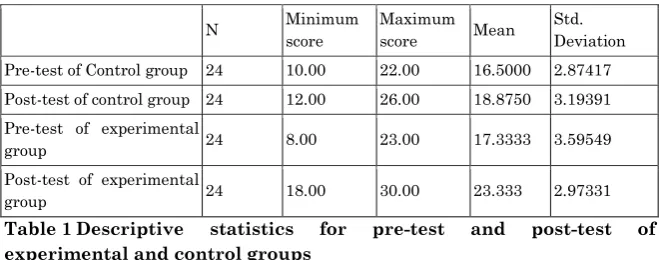
Std. Deviation Pre-test of Control group 24 10.00 22.00 16.5000 2.87417 Post-test of control group 24 12.00 26.00 18.8750 3.19391 Pre-test of experimental
group 24 8.00 23.00 17.3333 3.59549
Post-test of experimental
group 24 18.00 30.00 23.333 2.97331
Table 1 Descriptive statistics for pre-test and post-test of experimental and control groups
Basic Groups N Mean Std. Deviation
Std. Error Mean Marks obtained
by the students
Control Group 24 16.50 2.874 .587 Experimental
Group 24 17.33 3.595 .734
Table 2 Comparison of pre-test results of control and experimental groups
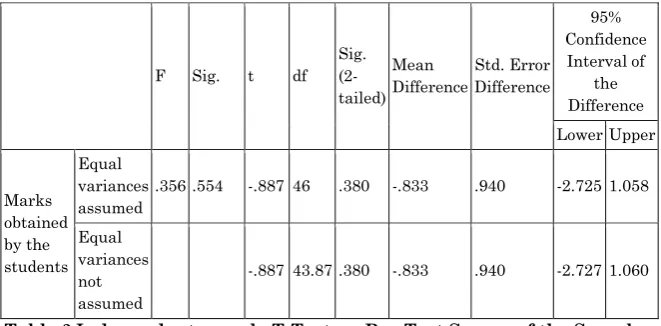
Table 2 shows that there is no significance difference between the mean scores of pre-test of both, control and experimental group. This satisfies the condition of the experiment that both groups taken for the study are same.
F Sig. t df Sig. (2-tailed)
Mean Difference
Std. Error Difference
95% Confidence Interval of
the Difference Lower Upper
Marks obtained by the students
Equal variances assumed
.356 .554 -.887 46 .380 -.833 .940 -2.725 1.058
Equal variances not assumed
-.887 43.87 .380 -.833 .940 -2.727 1.060
Table 3 Independent sample T-Test on Pre-Test Scores of the Sample
Marks obtained by the students
Groups N Mean Std.
Deviation
Std. Error Mean Control Group 24 18.88 3.194 .652 Experimental
Group 24 233 2.973 .607
Table 4 comparison of post-test results of control and experimental groups
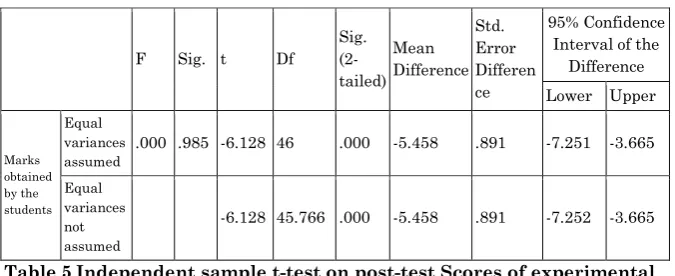
Group statistics was applied to make a comparison between the post-test results of both control and experimental groups. Table 4 showed that there was a significance difference between the mean scores of post-test results of both, control and experimental group.
F Sig. t Df
Sig. (2-tailed)
Mean Difference
Std. Error Differen ce
95% Confidence Interval of the
Difference Lower Upper
Marks obtained by the students
Equal variances assumed
.000 .985 -6.128 46 .000 -5.458 .891 -7.251 -3.665
Equal variances not assumed
-6.128 45.766 .000 -5.458 .891 -7.252 -3.665
Table 5 Independent sample t-test on post-test Scores of experimental and control groups
Mean N Std. Deviation
Std. Error Mean
Pair 1 (Control Group)
Pre-test of control
group 16.500 24 2.87417 .58669
Post-group of
control group 18.875 24 3.19391 .65195 Table 6 Paired sample statistics on control group
In table 6, the comparison of pre-test results and post-test results of control group was shown. The difference between both mean values showed that treatment provided during the experiment had an impact on the learning level of students, as the post-test scores of control groups were improved.
Mean N Std.
Deviation
Std. Error Mean Pair 2
(Experimental Group)
Pre-group of
experimental group 17.3333 24 3.59549 .73393 Post-group of
experimental group 23333 24 2.97331 .60692 Table 7 Paired sample statistics on experimental group
In table 7, the comparison of pre-test results and post-test results of experimental group was shown. The difference between both mean values showed that treatment provided during the experiment had a significance impact on the learning level of students, as the post-test scores of experimental groups were highly improved.
Mean Std. Deviation
Std. Error Mean
95% Confidence Interval of the
Difference df sig Lower Upper
Pair 1 (Control Group)
Pre-test and Post-test of control group
-2.37500 1.58286 .32310 -3.04338 -1.70662 -7.351 23 .000
(control group)
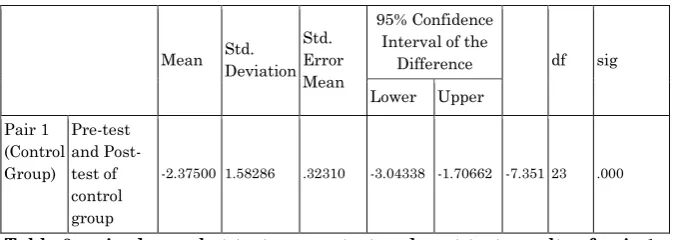
Paired sample t-test was applied on the pre-test and post-test results of pair-1, that was control group. Table 8 revealed t-value = -7.351 at α = 0.05 which showed a significant difference between pre-test results and post-test results of control group. This meant that learning level of students of control group was enhanced when they were taught through traditional method in the classroom. Mean Std. Deviatio n Std. Error Mean 95% Confidence Interval of the
Difference Lower Upper Pair 2 (experimental group) Pre-test and Post-test of experimenta l group
-7.00000 75486 .97058 -9.00780 -99220 -7.212 23 .000
Table 9 Paired sample t-test on pre-test and post-test results of pair-2 (experimental group)
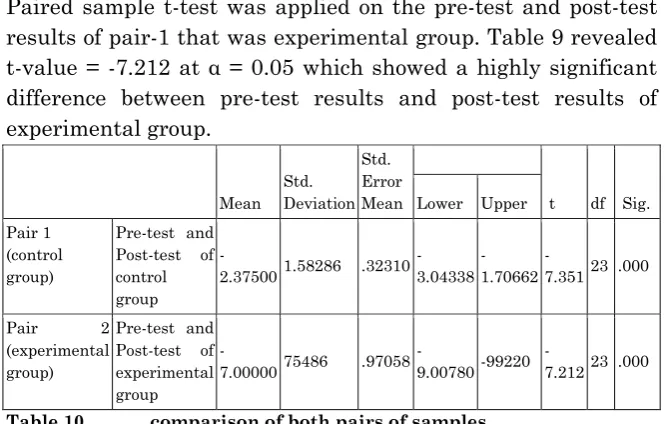
Paired sample t-test was applied on the pre-test and post-test results of pair-1 that was experimental group. Table 9 revealed t-value = -7.212 at α = 0.05 which showed a highly significant difference between pre-test results and post-test results of experimental group. Mean Std. Deviation Std. Error
Mean Lower Upper t df Sig. Pair 1
(control group)
Pre-test and Post-test of control group
-2.37500 1.58286 .32310 -3.04338
-1.70662
-7.351 23 .000
Pair 2
(experimental group)
Pre-test and Post-test of experimental group
-7.00000 75486 .97058
-9.00780 -99220
-7.212 23 .000
Table 10 compares the significance of both experimental and control groups through pre-test and post-test results of both. A paired sample t-test was applied on both pairs. Pair-1 (control group) value was -7.351 and pair-2 (experimental group) t-value was -7.212, both at α = 0.05. Table showed that experimental group’s t-value was significant to reject the null hypothesis H0 that was concluded that impact of using web 2.0
technology on students’ learning level is highly significant. So it was concluded that there was a greatly significant difference in the learning level of students before and after facilitated by Web 2.0 Technology.
Conclusions and Discussion:
As a second generation of services available on the World Wide Web, Web 2.0 facilitates the learners to collaborate, interrelate and split the information online. Web 2.0 has given voice to the individuals being an assortment of internet services and practices. Learners are capable to create and publish their own material. Also searching and retrieving the available material, data or information through web 2.0 technology is now possible. Web 2.0 is the up gradation of existing version of www, which have changed the learner, web-designers and software developers in accordance with the features provided by it.
digital literacy skills and fosters participatory learning. Web 2.0 refers to the social use of Web which allows learners to collaborate, to have active participation in content creation, to share information online, to generate knowledge. Beneath all the hype, web 2.0 platforms are seen to have an emerging role to transform learning.
Overall, then it can be said that yes, Web 2.0 matters. The results obtained by the research brought to light that web 2.0 technology is a very focal dynamic which have a positive impact on the learning of students as the learning level of students was greatly enhanced and facilitated by using web 2.0 technology.
Future Implications:
Concerning the future of learning in combination with Web 2.0 applications, this study emphasizes that the key for designing future interfaces for technology enhanced learning should be made easy to use for the students of higher education. This needs the concentration of research on the end users. Future researchers can explore the use of Web 2.0 technology for leaning in Pakistan in a comparative perspective with other developing countries by analyzing the degree of using Web 2.0 technology for learning purposes. Retention level of students in their learning might be analyzed if the duration of experiment be extended. Problems and challenges of using web 2.0 technology for learning in higher education may be explored at national level.
BIBLIOGRAPHY:
Education (IJRE) 33, 2013.
Blocher, M., Tu, C.H., and Li, Z. 2009. Constructs for Personal
Learning Environments in Web 2.0. Northern Arizona
University.
Chatti, M. A. and Jarke, M. 2007. “The future of e-learning: a shift to knowledge networking and social software.” Int. J. Knowledge and Learning 3(4/5).
Conole, G. and Alevizo, P. 2010. “A literature review of the use of Web 2.0 tools in Higher Education.” A report commissioned by the Higher Education Academy. The Open University, Walton Hall, Milton Keynes, UK. Crook, C. and Harrinson, C. 2008. Web 2.0 technologies for
learning: The current landscape – opportunities, challenges and tensions. ‘Web 2.0 technologies for learning at KS3 and 4’, Coventry, BECTA.
Grosseck, G. 2009. To use or not to use Web 2.0 in Higher Education?. Procedia Social and Behavioral Sciences 1, 478–482. Available online at www.sciencedirect.com. Kuiper, E. Volman, M. and Terwel, J. 2008. “Integrating critical
web skills and content knowledge: development and evaluation of a 5th grade educational program.”
Computers in human behavior 24: 666-692.
Lei, C. et al. 2012. “Using Web 2.0 Tools to Enhance Learning in Higher Education: A Case Study in Technological
Education.” Proceedings of the international
MultiConference of Engineers and Computer Scientists 2012, Vol. II, IMECS 2012, March 14-16, 2012, Hong Kong.
Maloney, E. 2007. “What Web 2.0 can teach us about learning.” The Chronicle of Higher Education 53(18), January 5th, p.B26
Maloney, E. 2007. “What Web 2.0 Can Teach Us About Learning?” Chronicle of Higher Education 25(18) pp 26-29.
self-regulated learning in the Web 2.0 era: International exemplars of innovative pedagogy using social software.” Australasian Journal of Educational Technology 26(1): 28-43.
Narayan, V. and Baglow, L. 2010. “New beginnings: Facilitating effective learning through the use of Web 2.0 tools.” Proceedings Ascilite, Sydney.
O’Reilley, T. 2005. “What is the Web 2.0.”
http://www.oreilly.com/pub/a/oreilly/tim/news/2005/09/30 /what-is-web-20.html (2007-11-20).
Prenksy, M. 2001. “Digital natives, digital immigrants.” On the
Horizon, 9(5): 1-6.
Siemens, G. 2006. Knowing Knowledge, Lulu.com.
Tan, J. P. 2009. Literature Review - Digital Kids, Analog Students: A Mixed Method Study Of Students’ Engagement With A School-Based Learning Innovation. A dissertation submitted in fulfillment of the requirements of the degree of Doctors of Philosophy. Tu, C., Blocher, M., and Roberts, G. 2008. “Constructs for Web
2.0 learning environments: a theatrical metaphor.” Educational Media International 45(4): 253–269.
Tyagi, S. 2012. “Adoption of Web 2.0 technology in higher education: A case study of universities in National
Capital Region, India.” International Journal of
Education and Development using Information and Communication Technology (IJEDICT) 8(2): 28-43. Wenger, E., White, N., and Smith, J. 2009. Digital Habitats