Operation and Maintenance
of a Small Drinking-water
Supply
Resources for Drinking-water
Assistance Programme
Citation: Ministry of Health. 2010. Operation and Maintenance of a Small Drinking- water Supply: Resources for Drinking-water Assistance Programme. Wellington:
Ministry of Health.
Published in December 2010 by the Ministry of Health
PO Box 5013, Wellington 6145, New Zealand
ISBN 978-0-478-35922-0 (online) HP 5061
In December 2013, legislation changed the term ‘public health risk management plan’ to ‘water safety plan’. Any reference within the text to ‘public health risk management plan’ has been changed to reflect the new legislation. No other
changes have been made to this document.
This document is available on the Ministry of Health’s website: www.health.govt.nz
Contents
1
Introduction
11.1 What this booklet covers 1
1.2 Further guidance 1
2
Setting Objectives for the Operation of Your Water Supply
22.1 Quantity and pressure 2
2.2 Quality 3
2.3 Cost 3
2.4 Other level-of-service targets 3
2.5 Recording performance 4
3
Planned versus Unplanned Maintenance
54
Writing an Operations and Maintenance Manual
64.1 Overview of the water supply 6
4.2 Contacts list 7
4.3 Details of site access and security 7
4.4 Drawings 7
4.5 Standard operating procedures (SOPs) 9
4.6 Log sheets 10
4.7 Emergency response plan 12
5
Communicating with Other Staff
145.1 Day books 14
5.2 Locking out and tagging out 14
6
Managing Equipment
166.1 Asset inventory 16
6.2 Equipment numbering 17
Appendix: Standard Sheets
19List of Tables
Table 1: Useful drawings to include in an O&M manual 7 Table 1: Information that may be included in an asset inventory 17 Table 2: Example of equipment numbering format 18
List of Figures
Figure 1: Example of a process flow diagram 8 Figure 2: Example of a distribution system drawing 8 Figure 3: Example standard operating procedure 10 Figure 4: Daily inspection log sheet 11 Figure 5: Daily monitoring log 11
1
Introduction
1.1 What this booklet covers
This booklet offers information about how to operate and maintain a small water supply (serving fewer than 500 people). The booklet is intended to be used by people who own or operate an existing small water supply or intend to develop a new one.
Paying close attention to good operation and maintenance helps to ensure the equipment and treatment process are consistent, reliable and safe. The objective of this resource is to help water suppliers to:
• manage the life of equipment
• meet performance targets for the water supply • ensure a reliable supply of safe drinking-water.
1.2 Further guidance
This booklet is part of the Resources for Drinking-water Assistance Programme. Further guidance is available on other aspects of planning, developing and operating small drinking-water supplies, including:
• Managing Projects for Small Drinking-water Supplies
• Operation and Maintenance of a Small Drinking-water Supply
• Pumps Pipes and Storage
• UV Disinfection and Cartridge Filtration.
• Optimisation of Small Drinking-water Treatment Systems
• Sampling and Monitoring for Small Drinking-Water Systems
• Treatment Options for Small Drinking-Water Supplies
• Pathogens and Pathways and Small Drinking-Water Supplies
• Sustainable Management of Small Drinking-Water Supplies
• Design and Operation of Bores for Small Drinking-Water Supplies.
2
Setting Objectives for the Operation of Your Water
Supply
It can be very useful to set objectives for the operation of a water supply. This is valuable because it clarifies upfront the expectations of the stakeholders in the water supply and means the people running the supply can tell whether they are achieving the desired results. If objectives are not agreed, conflicting expectations from stakeholders will make it more difficult to run the water supply in a way that keeps all stakeholders satisfied.
For the purposes of this exercise, all of the people and organisations affected by the water supply are considered to be stakeholders – not just the people using the water. This includes customers as well as regional councils, the Ministry of Health and other users of the water source.
Some of these objectives are described as ‘levels of service’. The following sections describe levels of service in terms of quantity, pressure, quality and other targets. Having a level-of-service target and a measure of performance for achieving the target can only be useful if these relate in some way to the ongoing operation of the water supply. In other words, a water supplier needs to decide what outcomes are important, and then ensure that the way the supply is run will enable these to be achieved.
2.1 Quantity and pressure
The quantity of water that can be provided to individual users and the water pressure available are affected by the availability of water at the source (including during periods of dry weather), the amount other users are taking, and the size of infrastructure such as pipes, pumps and treatment systems. In addition, the water supply sometimes needs to be stopped for planned maintenance or when there is a fault.
Because the amount of water available may not always be as much as people wish to use, a practical level of service may need to be negotiated with the consumers. Level-of-service targets can include statements about:
• the acceptable minimum flow rate and pressure – there is normally a target for the minimum flow rate and an acceptable pressure range at a property boundary (there may also need to be provision for fire-fighting)
• overall water production targets, including during average and peak consumption periods
• the number of hours/days’ warning required to the community before the water supply is turned off for planned maintenance
• the acceptable amount of down time when this happens.
Often targets for continuity of supply, flow rate and pressure are different if properties are expected to have their own water storage, such as in many rural schemes.
2.2 Quality
The quality of the water supplied to customers is affected by the quality of the source water and how the water is treated.
The first priority for a water supplier is to provide safe water. The Drinking-water
Standards1 contain maximum acceptable levels for contaminants. These are levels that should not be exceeded. Often for small water supplies the only measure of water safety will be Escherichia coli (E. coli), and so the quality target will simply be ‘No E. coli
present’.
Often customers are also concerned about the look and taste of the water (aesthetic quality). There should be statements about this aesthetic quality in the level-of-service target.
2.3 Cost
A key concern for customers using the water supply is the affordability of the service. It will be important to keep track of the regular operating expenses associated with
running the supply so that changes can be monitored. As an example, power and chemical consumption could be recorded every month to see how the costs vary throughout the year.
The management of the costs for water supply are discussed in more detail in the booklet Sustainable Management of Small Supplies.2
2.4 Other level-of-service targets
The level of service also includes customer service issues such as response times to complaints and call-outs. These and other features of the service could be measured against targets.
Some aspects of the plant’s operation don’t have such a direct impact on the
consumers of the water but are still important for other stakeholders and the long-term viability of the supply. There are many examples, but the following are likely to be relevant to a water supply:
• compliance with limits set by the raw water take consent • compliance with any regulation of how wastes are disposed of • the frequency of workplace accidents.
1
Drinking-water Standards for New Zealand 2005 (revised 2008).
2
2.5 Recording performance
If operating targets have been set, it is useful to measure how the water supply is performing against them as well as how that performance is changing over time. As an example, changes in power costs can bring attention to issues such as deteriorating water quality or a regular pattern of interruptions to the water supply. A log sheet system, similar to the one described in section 4.6, could be used to keep a record of performance against the targets. Any anomalies should be acted on.
Performance records are a valuable reporting mechanism. They allow operators to demonstrate the performance of their systems to the water committees or communities they serve. These records can also provide these community governance structures with evidence of the need for and impact of planned maintenance activities.
3
Planned versus Unplanned Maintenance
The aim of maintenance is to improve reliability and minimise costs. Equipment deteriorates with age and use. Regular, programmed maintenance of equipment ensures that the expected service life of the equipment is achieved.
Maintenance can either be planned (preventive) or unplanned (reactive). Preventive maintenance involves making adjustments, cleaning, lubricating and replacing minor components at regular intervals before a failure occurs. These activities and intervals are usually given in the manufacturer’s recommendations. How frequently they are actually done is a matter of judging the cost-effectiveness of the maintenance. Where equipment is essential to the operation of the water supply, or where failure would lead to a personal safety or a water quality issue, then cost should not be the only
consideration.
Some preventive maintenance activities are based on a measure of the condition of the asset rather than the date on the calendar. This might include measures such as pump vibration, oil condition and operating efficiency. There are sophisticated instruments for assessing the condition of equipment, but simpler methods are likely to be used in small supplies. These would involve making regular observations such as listening and
feeling for excessive vibration and looking for signs of corrosion.
Reactive maintenance follows the failure of a piece of equipment. Generally it needs to be done quickly in order to get the water supply going again. There needs to be a plan for having people and equipment available to undertake the repairs. There also need to be spare parts available for equipment identified as critical. A water supply tends to hold the more common items in storage so that repairs don’t have to wait until the item can be purchased and delivered.
4
Writing an Operations and Maintenance Manual
This section offers advice on putting together an operations and maintenance (O&M) manual designed to ensure consistent plant operation that meets the needs and expectations of the consumers of the water. These expectations will vary between communities, and what suits a large community will not always suit a small one. As a result, the manual should always be written with the agreed levels of service in mind, rather than being copied directly from another water supply.
The O&M manual is a detailed set of instructions for running a water supply. It gives new staff guidance on how tasks need to be done as well as helping to achieve
consistency between the individuals running the supply. It should be designed to help staff do their job well. It should also have links to the supply’s water safety plan
(formerly known as Public Health Risk Management Plan (PHRMP)).
Once an O&M manual is completed, it is a valuable source of information and should be used regularly. It will also need to be reviewed regularly to ensure it is up to date with all installed equipment items. The people who operate the water supply should be part of its preparation, because ultimately it is for their use. Anyone else involved in the water supply can help to improve it through review and comment. This could include people involved in funding or using the supply.
How the information is presented should also be thought about to ensure it can be easily used. This will help to prevent it becoming a dusty document in a corner. As an example, the following sections could be included:
• overview of the water supply • contacts list
• details of site access and security • drawings
• standard operating procedures • log sheets
• maintenance schedules
• water quality monitoring schedule, procedures and reporting requirements • emergency response plan
• asset inventory and asset data sheets.
These aspects are described in the following sections of the booklet. The booklet’s appendix also includes blank worksheets that could be adopted or adapted as needed.
4.1 Overview of the water supply
The overview tells someone who is not familiar with the water supply what the
components are and how the system operates. The overview should contain the supply name and a description of the water supply. It could include information such as:
• where the source, treatment and distribution systems are located • the nature and size of the population served
• who owns and operates the supply
• a general introduction to how the system works.
4.2 Contacts list
These contacts would include phone numbers of the owner and operator, and the details of suppliers such as power companies and chemical suppliers. Details of emergency services should also be included as a health and safety precaution.
4.3 Details of site access and security
There should be a record somewhere of who holds keys, alarm codes and any other information that is relevant. It may or may not be appropriate to include this in the O&M manual, depending on who has access to it.
4.4 Drawings
There are a variety of drawings that are useful for the operation of a water supply. For a small supply it may be appropriate to include all of the drawings, but in many cases only a few drawings are included in the manual and the names of any other useful drawings are listed in the manual so they can be referred to separately. The drawings that would normally be included in an operating manual are listed in Table 1.
Table 1: Useful drawings to include in an O&M manual Location map
and/or aerial photo
A location map summarises where the various parts of the water supply are in relation to each other.
Site plans Site plans normally give detailed information on the location and design of the water supply components. The location of site services such as power, phone, wastewater and stormwater services is also useful.
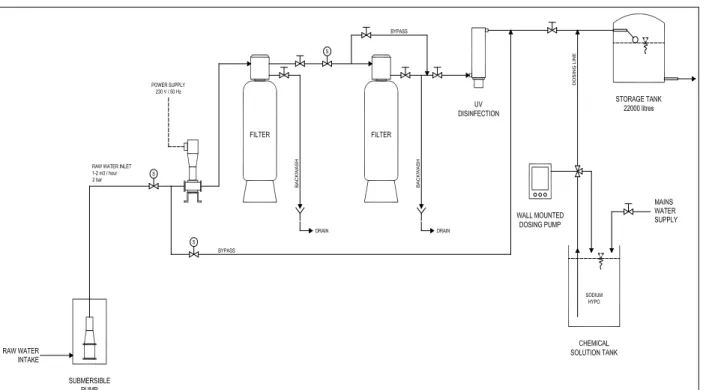
Process diagram This is a schematic diagram showing how the water collection, treatment and distribution process works. An example of a process diagram is shown in Figure 1.
Distribution system drawings
In order to operate a distribution system efficiently, it is essential to know where the pipes are. Accurate drawings showing the location of the assets, such as in Figure 2, will be very helpful when undertaking maintenance.
Figure 1: Example of a process flow diagram
Figure 2: Example of a distribution system drawing
Field Room 1 Room 2 Toilets Hall Drinking fountain Driveway Incoming main from reservoir Field Room 1 Room 2 Toilets Hall Drinking fountain Driveway Incoming main from reservoir
4.5 Standard operating procedures (SOPs)
The procedures for operating and maintaining the system make up the majority of the manual and identify the tasks required to ‘run and fix’ the water supply and the specific details on how to carry out these tasks.
This section of your O&M manual describes the procedures required to operate the water supply. A standard operating procedure (SOP) gives instructions for the operation of each piece of equipment. The SOP should give guidance for common problems and include ways to check that the job has been done correctly. Every major asset will probably have at least one SOP associated with it.
SOPs should be included for transgressions of the Drinking-water Standards so that everyone knows their role ahead of time. The local Drinking Water Assistance Programme (DWAP) facilitator can help you to develop an SOP that will ensure the safety of the water users is protected as well as meeting any legal requirements.
There are two different styles in which an SOP can be written: • a prescriptive set of instructions, a bit like a recipe book
• a set of activities that need to be carried out and the reasons for each activity, along with some flexibility in how the result is achieved.
Procedures that are written in a prescriptive way, and don’t explain why the task is needed, can lead to people blindly following the instructions. This is risky because when the conditions change, inappropriate actions can be taken if the reasons for an action are not understood.
SOPs may typically be needed for the following (many others may apply): • selecting the treatment flow rate
• shutting down and starting up the plant • backwashing filters
• operating dosing systems
• calibrating monitoring equipment • running automated systems manually • collecting water samples
• cleaning the distribution system
• communicating with other staff (e.g., day books, tagging out equipment).
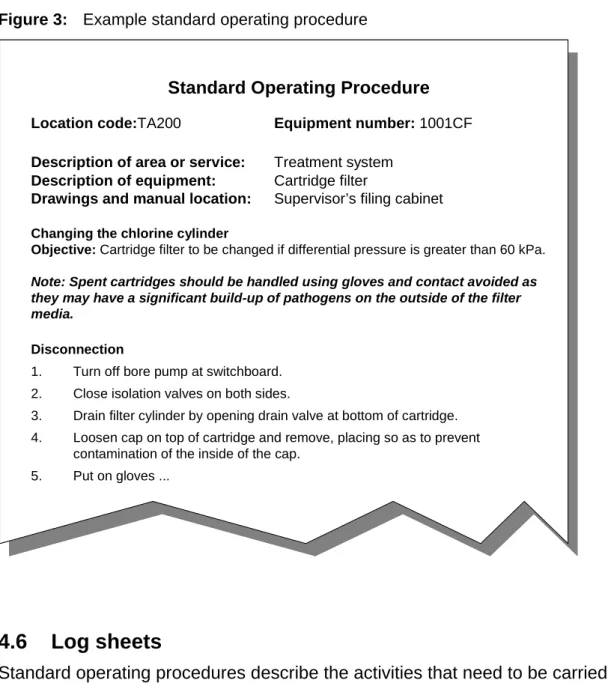
An example of an SOP is included in Figure 3.
It is good practice to write the operations manual with health and safety requirements in mind, particularly the SOPs. Advice is available from the Department of Labour on how best to comply with the regulations and protect both workers and others entering the site. Health and safety in a workplace are governed by various laws, in particular the Health and Safety in Employment Act.
Figure 3: Example standard operating procedure
4.6 Log sheets
Standard operating procedures describe the activities that need to be carried out. The log sheets indicate when to do them and allow their successful completion to be
recorded. There are normally log sheets for routine monitoring, inspections and maintenance.
Usually there will be activities that occur daily, weekly, monthly or less frequently. The records for activities occurring at the same interval normally go on the same log sheet to save on paper.
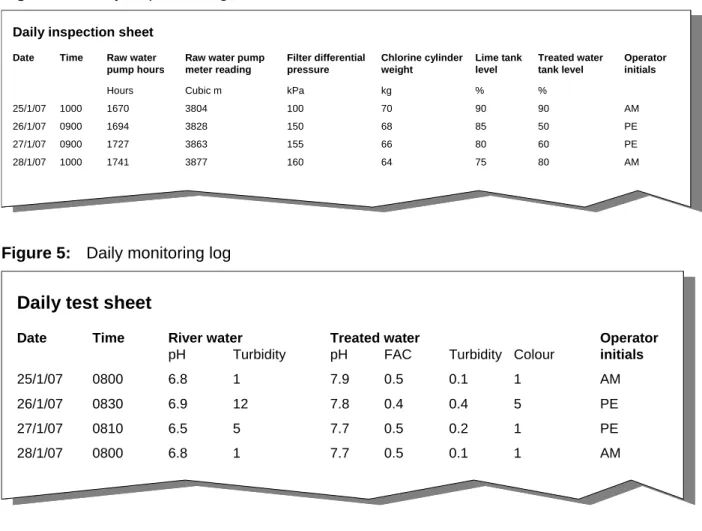
A daily inspection log sheet like the one shown in Figure 4 would be filled out (and filed) for each day of operation. A log sheet could include boxes to tick as a reminder to check that equipment is working correctly.
For many water supplies, the requirements for water quality monitoring for the Drinking-water Standards can require careful attention to make sure a sample is not missed accidentally, leading to non-compliance. The log sheets help to ensure the tests are not forgotten. The days where testing is not required could be blanked out on the log sheet. Sometimes it is helpful to write the sampling requirements into a calendar or a diary.
Standard Operating Procedure
Location code:TA200 Equipment number: 1001CF
Description of area or service: Treatment system
Description of equipment: Cartridge filter
Drawings and manual location: Supervisor’s filing cabinet
Changing the chlorine cylinder
Objective:Cartridge filter to be changed if differential pressure is greater than 60 kPa.
Note: Spent cartridges should be handled using gloves and contact avoided as they may have a significant build-up of pathogens on the outside of the filter media.
Disconnection
1. Turn off bore pump at switchboard. 2. Close isolation valves on both sides.
3. Drain filter cylinder by opening drain valve at bottom of cartridge. 4. Loosen cap on top of cartridge and remove, placing so as to prevent
contamination of the inside of the cap. 5. Put on gloves ...
In addition to raw and treated water quality monitoring, log sheets detailing records of water abstraction from a bore or surface water source may be required to comply with resource consent conditions. DWAP facilitators can help to plan the monitoring for a small water supply.
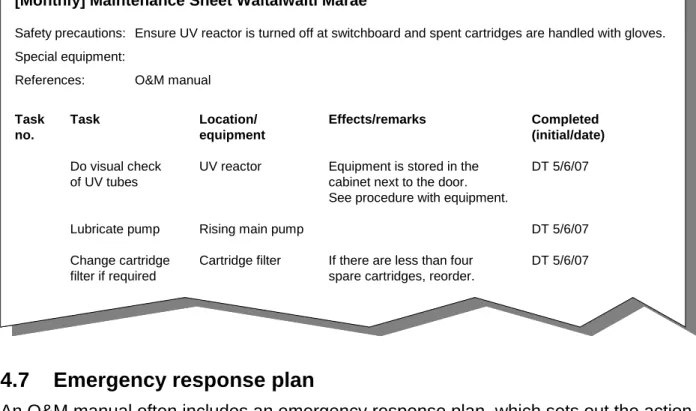
A maintenance record like the one shown in Figure 4 could be used to allow space to write comments about the supply.
Figure 4: Daily inspection log sheet
Figure 5: Daily monitoring log
Daily inspection sheet
Date Time Raw water Raw water pump Filter differential Chlorine cylinder Lime tank Treated water Operator
pump hours meter reading pressure weight level tank level initials
Hours Cubic m kPa kg % %
25/1/07 1000 1670 3804 100 70 90 90 AM
26/1/07 0900 1694 3828 150 68 85 50 PE
27/1/07 0900 1727 3863 155 66 80 60 PE
28/1/07 1000 1741 3877 160 64 75 80 AM
Daily test sheet
Date Time River water Treated water Operator
pH Turbidity pH FAC Turbidity Colour initials
25/1/07 0800 6.8 1 7.9 0.5 0.1 1 AM
26/1/07 0830 6.9 12 7.8 0.4 0.4 5 PE
27/1/07 0810 6.5 5 7.7 0.5 0.2 1 PE
Figure 6: Maintenance record
4.7 Emergency response plan
An O&M manual often includes an emergency response plan, which sets out the action to be taken in an emergency event. An emergency could be any of a range of
unforeseen or uncommon sudden incidents that may affect water quality or availability and/or jeopardise personal safety.
The emergency response plan should build on the contingency plan developed as part of the water safety plan process by including events that may jeopardise personal safety. Particular issues to consider are the effects of:
• natural disasters, including flooding, wind damage, earthquake and tsunami • fire
• vandalism and break-in
• contamination of the water source
• sudden major failure in pipelines or water storage • sudden major failure in treatment
• prolonged power failure.
The particular effect of each event on the supply of sufficient safe drinking-water needs to be considered. The O&M plan would describe the responsibilities of staff, actions that need to be taken to make the supply safe, the resources that are available to cope with the emergency (and how to obtain them), and when and how the public are to be notified. Alternative methods of communication may be needed in an emergency, and transport may be difficult. The aim is to resolve as many of the issues as possible ahead of time and ensure that the level of preparation is appropriate to the level of risk.
[Monthly] Maintenance Sheet Waitaiwaiti Marae
Safety precautions: Ensure UV reactor is turned off at switchboard and spent cartridges are handled with gloves. Special equipment:
References: O&M manual
Task Task Location/ Effects/remarks Completed
no. equipment (initial/date)
Do visual check UV reactor Equipment is stored in the DT 5/6/07
of UV tubes cabinet next to the door.
See procedure with equipment.
Lubricate pump Rising main pump DT 5/6/07
Change cartridge Cartridge filter If there are less than four DT 5/6/07
Another related issue to consider is a sudden loss of key staff. This can happen for any of a range of reasons. Having an up-to-date operating manual is an important way to prepare for this. In the event that an emergency situation prevents the attendance of the normal personnel, the emergency response plan becomes that much more important.
5
Communicating with Other Staff
5.1 Day books
A day book is a useful way for staff to communicate between shifts or to make a record of events that have occurred that could affect the way the water supply is operated. A day book differs from a log sheet in that the entries are not normally a record of routine checks that can be recorded on a standard sheet. Day book entries are used as a way to alert others to events that have happened and to co-ordinate activities. Generally all staff will have ready access to the day book and are entitled to read it and make entries.
Specifically, the day book should be used to:
• create a daily record of significant incidents, events or actions • provide a means of communication between operators
• record details of non-compliances or other problems
• record staff arrival and departure for health and safety reasons, particularly where they work alone.
There are two types of daybook:
• the ‘diary’ type, which is often used where there is a regular pattern of operation • an un-dated daybook, which can be used where there is irregular or infrequent
operation, to avoid excessive unused sections; in this case the day and date would be entered on arrival at the plant.
5.2 Locking out and tagging out
It is important to have a safe system of work when operating and maintaining
equipment. One aspect of this is controlling when equipment is operated. There are many situations where a device should not be operated. Most often this is when it is faulty or where its operation would lead to a safety hazard.
A lockout / tag-out system is intended to prevent equipment being operated when there is a reason not to. These tags can be purchased from most suppliers of safety
equipment. The system can operate at two levels.
Out-of-service (caution) tag: This would be left on the equipment isolation switch and tells people not to run the device until a defect listed on the tag is remedied. Out-of-service tags are marked with the worker’s name, contact number (preferably mobile), company or section, date of placement, details of defect, and signature. Once the defect is remedied, an authorised and competent person may remove the tag, returning the device to service.
Danger tag: These are used to prevent equipment being switched on when it would be dangerous to do so, such as when someone is working on it. Danger
tags are marked with the same information as the caution tag (as a minimum). For safety, the tag should have to be removed by the same person who places it.
Personal locks can also be used to lock off switches to disable equipment. Each operator has a different lock and key so that they know that someone else won’t start a device without them knowing about it.
6
Managing Equipment
Most large water suppliers use a formal system to keep track of the maintenance and operation of the various items of equipment they use. This is obviously important when an organisation is operating hundreds or thousands of individual assets that may need to be maintained regularly, or where funds need to be available when they wear out and need replacing.
The same issues are relevant to a small drinking-water supply, albeit on a smaller scale. Having a systematic way to keep track of the various pumps, pipes and other items means that it is easier to record and control:
• the maintenance of individual assets • repeated failures of assets
• renewal of equipment.
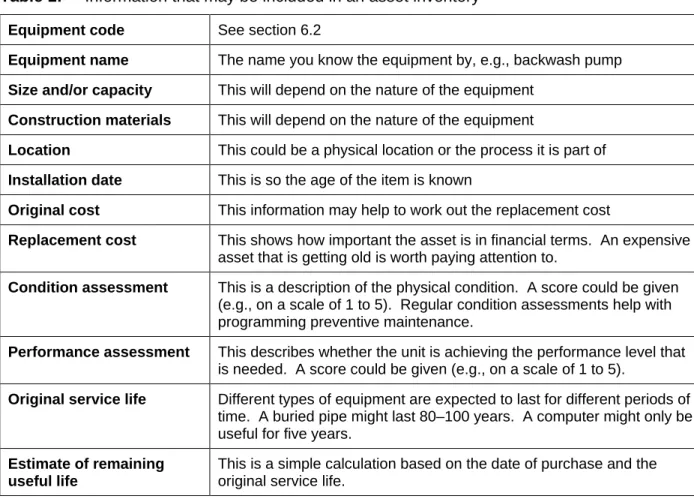
The usual way to manage a large number of assets is to keep an inventory. An equipment inventory is a list of all the components of the water supply. The inventory will include equipment associated with the following areas.
Water source: examples are bore components, intake structure equipment, pumps, pipes and valves.
Treatment systems and buildings: such as monitoring equipment, valves, pipes, internal plumbing and electrical systems, along with items not specifically related to the water supply, such as heaters, desks, tables and chairs.
Storage: for example, details of the tank such as volume, construction material and when it was built.
Distribution: information could include the length, diameter and location of the pipes, the rating and age of pressure booster pumps, and the location and model of hydrants.
Maintaining an inventory can be done in any of a number of ways. One approach is presented below.
6.1 Asset inventory
The asset inventory is a list of the equipment the water supply owns, along with the information that will help the owner to judge when it may start to wear out or need to be replaced.
Table 1: Information that may be included in an asset inventory Equipment code See section 6.2
Equipment name The name you know the equipment by, e.g., backwash pump
Size and/or capacity This will depend on the nature of the equipment
Construction materials This will depend on the nature of the equipment
Location This could be a physical location or the process it is part of
Installation date This is so the age of the item is known
Original cost This information may help to work out the replacement cost
Replacement cost This shows how important the asset is in financial terms. An expensive asset that is getting old is worth paying attention to.
Condition assessment This is a description of the physical condition. A score could be given (e.g., on a scale of 1 to 5). Regular condition assessments help with programming preventive maintenance.
Performance assessment This describes whether the unit is achieving the performance level that is needed. A score could be given (e.g., on a scale of 1 to 5).
Original service life Different types of equipment are expected to last for different periods of time. A buried pipe might last 80–100 years. A computer might only be useful for five years.
Estimate of remaining useful life
This is a simple calculation based on the date of purchase and the original service life.
6.2 Equipment numbering
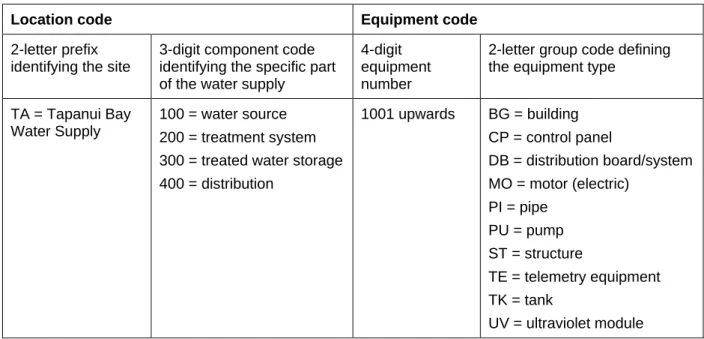
Equipment can be numbered with codes so that records relating to the equipment are unambiguous. One example of an equipment numbering format is given in this section.
An equipment number might look like this: TA100 – 1001PU. Here the equipment number is divided into two codes: a location code to describe where it is, and an equipment code to distinguish it from other equipment. The equipment number shown above means pump number 1001, located at the water source in the Tapanui Bay Water Supply,
Table 2: Example of equipment numbering format
Location code Equipment code
2-letter prefix identifying the site
3-digit component code identifying the specific part of the water supply
4-digit equipment number
2-letter group code defining the equipment type
TA = Tapanui Bay Water Supply
100 = water source 200 = treatment system 300 = treated water storage 400 = distribution 1001 upwards BG = building CP = control panel DB = distribution board/system MO = motor (electric) PI = pipe PU = pump ST = structure TE = telemetry equipment TK = tank UV = ultraviolet module
Appendix: Standard Sheets
Equipment register [name of supply]
Equipment name: Date:
[Attach photo(s) of equipment]
Equipment location: Inventory number:
Equipment data sheet [name of supply] Equipment location: Inventory number:
Description of area or service: Description of equipment: Manual and drawings location:
Equipment details Type: Manufacturer: Model: Serial no.: Acquisition date: Nameplate data Comments:
Operating target value
Name Date Changes
Revision 1 Revision 2
Equipment register [name of supply] E qui pm e n t c ode E qui pm e n t n am e S iz e an d /o r cap aci ty C ons tru c ti o n m a te ri a ls Loc a ti on In s ta ll a ti o n d at e O ri g in a l c os t R ep lac e m en t c o st C ondi ti o n as se ss m en t (1 – 5) P er fo rm an ce a sse ss m en t (1 – 5) O ri g in a l s er v ice li fe Es ti m a te o f re m a ini ng u sef u l li fe
Monitoring log sheet [name of supply] Location:
Target value:
Standard operating procedure (SOP) [name of supply] SOP title:
Location code: Equipment number: Description of area of service:
Safety equipment required: Drawings and manual location:
[Insert frequency]Inspection sheet [name of supply] Safety precautions: Special equipment: References: Task no.
Task Location/equipment Effects/remarks Completed (initial/date)
[insert frequency]Maintenance sheet [name of supply] Safety precautions: Special equipment: References: Task no.
Task Location/equipment Effects/remarks Completed (initial/date)
Emergency contacts [name of supply]
Contact number Contact person
Fire Department 111 Civil Defence
Vandalism / break-in 111 Power failure
Health Protection Officer Operations Manager Supervisor