Technology Assessment
Technology Assessment
Program
Prepared for:
Agency for Healthcare Research and Quality 540 Gaither Road
Rockville, Maryland 20850
Report on the Evidence
Regarding Off-Label Indications
for Targeted Therapies used in
Cancer Treatment
Report on the Evidence Regarding Off-Label
Indications for Targeted Therapies used in Cancer
Treatment
Technology Assessment Report
Project ID: CANT1106
January 29, 2010
Duke Evidence-based Practice Center
Amy P. Abernethy, MD
Remy R. Coeytaux, MD, PhD
Kenneth Carson, MD
Douglas McCrory, MD
Sally Y. Barbour, PharmD
Margaret Gradison, MD
R. Julian Irvine, MCM
Jane L. Wheeler, MSPH
This report is based on research conducted by the Duke Evidence-based Practice Center under contract to the Agency for Healthcare Research and Quality
(AHRQ), Rockville, MD (Contract No. HHSA 290-02-0025). The findings and conclusions in this document are those of the author(s) who are responsible for its contents; the findings and conclusions do not necessarily represent the views of AHRQ. No statement in this article should be construed as an official position of
the Agency for Healthcare Research and Quality or of the U.S. Department of Health and Human Services.
The information in this report is intended to help health care decision-makers; patients and clinicians; health system leaders; and policymakers make well-informed decisions and thereby improve the quality of health care services. This report is not intended to be a substitute for the application of clinical judgment. Decisions concerning the provision of clinical care should consider this report in the same way as any medical reference and in conjunction with all other pertinent information, i.e., in the context of available resources and circumstances
presented by individual patients.
This report may be used, in whole or in part, as the basis for development of clinical practice guidelines and other quality enhancement tools, or as a basis for reimbursement and coverage policies. AHRQ or U.S. Department of Health and Human Services endorsement of such derivative products may not be stated or implied.
None of the investigators has any affiliations or financial involvement related to the material presented in this report.
Peer Reviewers
We wish to acknowledge individuals listed below for their review of this report. This report has been reviewed in draft form by individuals chosen for their expertise and diverse perspectives. The purpose of the review was to provide candid, objective, and critical comments for consideration by the EPC in preparation of the final report. Synthesis of the scientific literature presented here does not necessarily represent the views of individual reviewers.
Al B. Benson III, MD, FACP Professor of Medicine
Robert H. Lurie Comprehensive Cancer Center, Northwestern University Chicago, Illinois
Jennifer L. Malin, MD, PhD
Member, UCLA Jonsson Comprehensive Cancer Center Patients and Survivors Program Area
Attending Physician, VA Greater Los Angeles Healthcare System Los Angeles, California
John L. Marshall, MD
Chief, Division of Hematology/Oncology
Associate Director for Clinical Research, Lombardi Comprehensive Cancer Center Georgetown University Medical Center
Acknowledgements
The authors gratefully acknowledge the contributions of R. Julian Irvine, Project Co-ordinator; Rebecca Gray and Amanda McMillan, Editors; and Alice Thacher, Research Assistant.
Contents
Executive Summary ... 1 Chapter 1. Background ... 4 Clinical Context ... 4 Technology Assessed... 4 Policy Context ... 6 Scope of Study... 7 Chapter 2. Methods... 10 Selection Criteria... 10 Search Strategy ... 11 Data Abstraction ... 12 Quality Assessment ... 12 Data Synthesis... 13 Chapter 3. Results... 14Velocity of Evolution of the Literature... 14
Systematic Review for Drug/Disease Combinations ... 14
Chapter 4. Discussion ... 22
References... 26
Acronyms and Abbreviations... 68
Appendix: Results of Systematic Literature Review for Specific Drug/Disease Combinations... 73
Executive Summary
Background
The term “targeted therapies” refers to antineoplastic treatments designed not to kill cells but, more precisely, to attack growth factors, cell surface receptors, and intracellular proteins that mediate the cancer cell’s ability to proliferate, grow, or evade cell death. Examples of targeted therapies include small molecule inhibitors, monoclonal antibodies, and conjugated agents. Intended to damage or destroy cancer cells while minimizing the effects on normal cells, several targeted therapies have been successfully brought into routine clinical use, with approval from the U.S. Food and Drug Administration (FDA) for specific indications. The use of these FDA-approved agents has expanded to include multiple indications other than those for which they received FDA approval (i.e., “label indications”); in current clinical practice in oncology, off-label prescribing is common.
The primary purpose of this technology assessment is to evaluate the state of the evidence for/against the use of selected targeted therapies for off-label indications. Secondarily, the report also considers the practicality of the traditional systematic review approach, when applied to examine the evidence in rapidly evolving therapeutic areas such as targeted therapies for various cancers.
Methods
Through review of four drug compendia – the American Society of Health-System Pharmacists’ American Hospital Formulary Service-Drug Information (AHFS-DI; 2006 version); National Comprehensive Cancer Network’s (NCCN) Drugs and Biologics
Compendium (online version); United States Pharmacopeia Drug Information (USP-DI; 2006 version); and Elsevier Gold Standard’s Clinical Pharmacology (online version) – 19 off-label indications for eight targeted therapies were identified that were (1) FDA-approved, (2) marketed in or before January 2007, and (3) clearly recommended by at least one of the four compendia. MEDLINE® was searched through September 14, 2007, for potentially relevant publications. Studies were included if they were conducted in humans, investigated one of the 19 drug/disease combinations of interest, and reported at least one of the following outcomes: survival, disease-free survival, tumor response (any criteria acceptable), quality of life, or adverse effects. All study designs were included. This search of the published literature was supplemented by a search for relevant unpublished conference abstracts from the 2006 and 2007 annual meetings of the American Society of Clinical Oncology (ASCO) and the American Society of Hematology (ASH).
Data were abstracted from included journal articles and abstracts directly into summary tables for each drug/disease combination by one investigator and over-read by another.
Abstracted data included: study design, phase, selection/randomization, and eligibility criteria; number of patients, median age, previous treatment, stage of disease, drug dose per day, and outcomes sought; tumor response (number with tumor response assessed, complete response, partial response, stable disease, progressive disease); survival (overall, median, disease-free); and
(e.g., randomization and allocation concealment; similarity of compared groups at baseline; specification of eligibility criteria; blinding of assessors, care providers, and patients) and external validity (e.g., description of the patient population, similarity to the target population of the report, use of highly selective criteria). In addition to data abstraction and quality analysis, a narrative description of study findings was prepared.
Results
Results for each of the 19 systematic reviews undertaken for this technology assessment are presented in summary tables in an Appendix to the main report. Here we provide results of the overarching endeavor to describe the state of the evidence for/against the use of targeted therapies for specified off-label indications in oncology.
In this set of systematic reviews of off-label indications for targeted therapies used in oncology, data relevant to the efficacy of any given drug varied greatly in quantity and quality. A high degree of heterogeneity in the data often prevented the combining of data, as required by traditional systematic review methodology, and complicated comparisons of results across studies. The variable and often inadequate quality of available data in this area also impeded efforts to draw definitive conclusions regarding safety or efficacy.
This technology assessment comprised 19 discrete systematic reviews; as such, it represents a large-scale undertaking. A principal difficulty encountered repeatedly was that of establishing a cut-off date for study inclusion. New evidence – with data that might potentially change conclusions, and hence warranted consideration for inclusion – continued to emerge after each of three arbitrarily chosen cut-off dates for study inclusion.
Discussion
Systematic reviews are not always a feasible and/or reliable way to answer questions regarding clinical effectiveness of new therapies. In areas where the pace of research is rapid, such as targeted therapies for off-label indications in oncology, the sheer volume of research and its heterogeneity make the process of systematic review challenging, if not impossible, within a reasonable timeframe.
In fields where the evidence is rapidly emerging and where the disease or condition entails clinical urgency, timeliness of evidence review is seriously challenged when using traditional systematic review methodology. Systematic reviews require “drawing a line in the sand,” i.e., establishing an arbitrary cut-off date for study inclusion. Publication of new, potentially relevant, studies led the authors of this report to redefine the inclusion period three different times in the effort to include potentially relevant new information. Yet establishing a final cut-off date is eventually a necessity; this means that the results of any systematic review may be out of date even before completion of that review or its publication.
The compendia, a primary source of synthesized evidence for practicing clinical oncologists, are a vital, albeit imperfect, component of current evidence-based practice. The exercise
represented by this technology assessment, i.e., the effort to describe the current evidence supporting/refuting the use of targeted therapies, represents an attempt to conduct on a limited scale the task performed by the compendia for the full off-label armamentarium in oncology.
The difficulties encountered on the smaller scale of this technology assessment suggest that the compendia’s task is monumental and fraught with challenge. Considering the difficulties inherent in their purpose, the compendia perform an impressive service. Until a tested system is established to ensure access to comprehensive, timely, high-quality data, it is important to work with the compendia to continue to provide clinicians with a source of evidence that can guide their clinical decisions – while recognizing that this evidence synthesis is imperfect.
This technology assessment had several limitations. Variability in the quality and quantity of data made the drawing of conclusions regarding either the efficacy or the safety of the included drugs and respective indications difficult (if possible) and uncertain. Publication bias may have skewed results, because publication of negative results typically lags behind publication of positive results. The literature examined fell within a 10-year window, and reviews may have excluded relevant studies published before or after the endpoints. In particular, the literature reviews did not include published reports indexed in MEDLINE® after September 14, 2007.
Several areas for potential improvement in the current system of evidence development and review emerged through the conduct of this technology assessment. First, better definition of what constitutes “evidence” could help to minimize opinion and subjectivity in the process of evidence reporting. Second, the establishment of a standard approach for reporting on factors relevant to quality (e.g., study phase [e.g., Phase II, Phase III], presence/absence of a control group, blinding) could facilitate critical evaluation and weighting of published evidence. Third, an articulated consensus on the role of comparative effectiveness research in the evaluation of cancer treatments could strengthen both evidence generation and review. Finally, concerted national attention is well-directed toward the development and implementation of a new system for evidence review, one that is designed for rapid learning and expedient translation of research results into clinical practice improvements, and that features evaluation of the comparative effectiveness of available treatments in real-world clinical populations.
Chapter 1. Background
Clinical Context
Traditional anticancer treatment has relied on cytotoxic chemotherapy as a primary
intervention. Chemotherapy has proven effective for many cancer diagnoses because it is toxic to rapidly proliferating cells such as tumor cells. As a systemic treatment, however, it also affects normal cells in the surrounding or peripheral area, and can alter, impair, or destroy those cells. Rather than damaging only the tumor, it typically causes multiple undesirable side effects which impair the patient’s function, quality of life, and even survival.
Over the past 10 years, seeking to develop antineoplastic treatments with less associated toxicity, scientists and clinicians have tested a number of more specific agents termed “targeted therapies.” These agents are designed not to kill cells but, more precisely, to attack growth factors, cell surface receptors, and intracellular proteins that mediate a malignancy’s ability to proliferate, grow, or evade cell death. Examples of targeted therapies include small molecule inhibitors, monoclonal antibodies, and conjugated agents. Several of these agents have been successfully brought into routine clinical use.
Targeted therapies have been heralded as a promising new approach to cancer treatment; they have raised hopes and expectations of cure for previously intractable cancers, without the
toxicity associated with traditional chemotherapy. They can be used as single agents, in
combination with chemotherapy, or in combination with other targeted therapies. Their toxicity profile and scope of applicability differs from that of traditional chemotherapies. As new agents, with intensive research and development preceding their introduction into the market, they are currently very expensive.
Scientific enthusiasm surrounding targeted therapies has prompted a flurry of research activity focused on harnessing their potential. Consequently, the list of potential uses for targeted therapies has expanded, and continues to expand rapidly, beyond the original FDA-approved indications for these new drugs. The Coverage and Analysis Group at the Centers for Medicare and Medicaid Services (CMS) requested this report from The Technology Assessment Program (TAP) at the Agency for Healthcare Research and Quality (AHRQ). AHRQ assigned this report to the following Evidence-based Practice Center: Duke (Contract Number: HHSA 290-02-0025). This technology assessment has been conducted to evaluate the state of the evidence supporting the use of targeted therapies outside of their FDA-approved indications; it also evaluates the practicality of traditional systematic review approaches in rapidly evolving therapeutic areas such as targeted therapies for various cancers.
Technology Assessed
The advent of targeted therapies has raised hopes of a new approach to cancer treatment – one that does not entail the deleterious collateral damage, adverse effects, or symptom side effects of traditional chemotherapy and radiation therapy. Targeted therapies that specifically damage or destroy cancer cells, while minimizing the effects on normal cells, currently include antibody therapies and small molecules, with gene therapies potentially an additional approach on the horizon.
Types of Therapies Considered
Antibody therapies use targeted antibodies to bind to a specific protein, thereby blocking its activity. Other mechanisms may also factor into the success of antibody therapies in treating cancer. For example, the complement and immune systems can recognize antibodies, and may destroy the cells to which the antibodies are bound.
Monoclonal antibodies are classes of identical antibodies produced by a single type of immune cell, and that have an affinity for a specific antigen. Attaching to tumor cells, monoclonal antibodies mark the cell for attack by the immune system, block specific
transmembrane receptors, or deliver chemotherapeutic or radioactive drugs. Bevacizumab, now the standard of care for treatment of metastatic colon cancer, is an example of a monoclonal antibody in widespread clinical use.
Conjugated agents, another antibody therapy, represent a class of targeted therapies in which an antibody or protein is linked to a toxin or radioisotope. The antibody or protein component brings the entire cytotoxic agent to the cancer cell of interest, hopefully without binding to normal cells. This approach is designed to provide the benefit of radiation or chemotherapy on a cell-specific basis. An example is tositumomab, where an anti-CD20 antibody is covalently bound to 131I, indicated for use in refractory follicular lymphoma. Since these drugs are rarely used off-label at present, they are not discussed further in this technology assessment.
Small molecule targeted therapies are drugs specially designed to bind certain receptors that inhibit signaling pathways for growth and proliferation within tumor cells. Small molecule inhibitors enter cells and disrupt protein functions and interactions. An example of a small molecule is imatinib, which has become standard of care for chronic myelogenous leukemia and gastrointestinal stromal tumors (GIST).
Many small molecules, including imatinib, inhibit the function of tyrosine kinases.
Normally, the binding of various soluble factors outside normal tissue to cell surface receptors activates tyrosine kinases. These tyrosine kinases may either be a component of the receptor or an associated protein. When activated, they turn on a cascade of other proteins inside the cell, ultimately increasing the cells’ ability to grow and divide. One way in which cancer cells proliferate and become resistant to cell death is by increasing the number of cell surface
receptors, thus amplifying pro-survival signals. Another mechanism is mutatation of the tyrosine kinases associated with these receptors, thereby resulting in constitutively active kinases,
ultimately causing uncontrolled cell proliferation. In either situation, tyrosine kinase inhibitors locate and bind to specific proteins, thereby causing a desirable effect, such as inhibiting vascular endothelial growth.
Another category of small molecule inhibitor is the proteosome inhibitor. Cellular functions such as proliferation and cell death in normal cells are dependent on levels of various
intracellular proteins. The levels of these proteins are controlled in part by degradation, a function performed by the proteosome. Treatment with a proteosome inhibitor blocks the degradation of proteins; in cancer cells, this can push the cell towards cell death.
Gene therapies deliver genetic material into an individual’s cells using a vector, usually a virus. The purpose of these treatments is to block expression of genes that promote tumor development, and/or to replace missing or defective tumor-suppressor genes. Such treatments may make tumor cells more susceptible to standard chemotherapy or radiotherapy. They may make normal tissues less susceptible to the damage induced by conventional treatments. Or, by
remove the tumor cell’s ability to proliferate unchecked. Because gene therapy is, as yet, an experimental treatment that is not available outside of a clinical trial, gene therapies are not included in this technology assessment.
Inclusion criteria for targeted therapies
This technology assessment evaluates the strength of the evidence for targeted therapies. To include a maximum number of agents being used for off-label indications in oncology, we included medications that were: (1) FDA-approved targeted agents; (2) marketed in January 2007 or before; and (3) with compendia-listed indications other than the FDA-approved indication as of December 2006.
Consistent with the rapid evolution of this technology, some indications that were off-label in December 2006 are now FDA-approved; these reviews are still included in this summary since they provide insight into the nature of the literature as a whole.
The concept of a disease-specific indication for a drug is fluid. For some drug/disease indications the relationship represents a one-to-one relationship. For others, there are multiple different treatment situations within a disease category such that defining “indication” as the disease in which the drug is used is too broad and makes it difficult to draw conclusions about the data (e.g., alemtuzumab for NHL). Conversely, the indication may need to be sharply
narrowed to reflect appropriate use of a drug only in certain times in a disease trajectory (e.g., for refractory disease after prior specified therapy, or in the setting of a positive biomarker). For this report, we used the drug/disease indication as specified within the compendia, since that reflects the indication considered for reimbursement purposes.
Policy Context
Targeted therapies are increasingly used in cancer treatment because of (1) their potential for improved efficacy in comparison to traditional chemotherapies, and (2) their association with fewer side effects. Heralded as the centerpiece of cancer care of the future, targeted therapies are the subject of a large volume of recent and current research. Research on targeted therapies is proceeding at a rapid pace. Between January 1, 2000, and September 1, 2008, the U.S. Food and Drug Administration (FDA) approved 41 anticancer drugs; 17 of these were targeted agents.1
Like other pharmaceutical treatments, targeted therapies must be approved by the FDA before being prescribed outside of the clinical trial setting. A major purpose of FDA review is to ensure patient safety; the National Cancer Institute Common Toxicity Criteria for Adverse Event reporting (CTCAE) provides standard terminology and definitions for adverse event reporting. Once FDA-approved, however, drugs may be used in new contexts as indicated by the available literature, based on the judgment of the prescribing physician rather than on specific
requirements dictated by the FDA. When a drug is prescribed for an indication other than that for which it has obtained FDA approval, the prescription is termed “off-label.” Third-party reimbursement for off-label uses of medications varies. For drugs falling within a category reimbursed by CMS (e.g., injection or Medicare Part D), payment for an off-label use of a drug is guided by whether that drug is listed for the particular off-label indication in one of the approved drug compendia.
Off-label prescribing in oncology is facilitated by Medicare insurability of off-label uses of anticancer drugs and biologics, stipulated under Social Security Act Section 1861(t)(2)(B)(ii)(I) and (II), under the Omnibus Budget Reconciliation Act of 1993. This statute recognized certain compendia as authoritative sources for determining a “medically-accepted indication” of drugs and biological agents used off-label in an anticancer chemotherapeutic regimen, unless the Secretary of Health and Human Services (HHS) determines otherwise. For purposes of the legislation, a compendium was defined as “a comprehensive listing of FDA-approved drugs and biologicals or a comprehensive listing of a specific subset of drugs and biologicals in a specialty compendium” (§414.930). The statute originally indicated that medically-accepted indications would be determined by three designated compendia: American Medical Association Drug Evaluations (AMA-DE), American Hospital Formulary Service Drug Information (AHFS-DI),2 and United States Pharmacopeia Drug Information (USP-DI).3 While the statute pertained specifically to CMS, most other third-party payers and state legislatures have followed suit.4
Implementation of the legislation has shifted in the course of compendia history. The AMA-DE is no longer published; its contents were incorporated into the USP-DI. Publication of the USP-DI ceased in 2007, with contents rolled into a successor compendium, DrugPoints. On June 6, 2008, CMS announced that it would recognize an additional compendium produced by the National Comprehensive Cancer Network (NCCN), the NCCN Drugs & Biologics
Compendium, as a mandated reference for establishing coverage policy and coverage decisions regarding the use of drugs and biologics in cancer care. As of the time of this technology assessment report, the current recognized authoritative compendia are: National Comprehensive Cancer Network’s (NCCN) Drugs and Biologics Compendium;Thompson Micromedex’
DrugDex;Elsevier Gold Standard’s Clinical Pharmacology; and American Society of Health-System Pharmacists’ (ASHP) American Hospital Formulary Service-Drug Information (AHFS-DI).5 It should be noted that there is no standardized approach across the various compendia to determining which off-label indications should be included.
Many of the newly developed targeted therapies have been studied, or are currently being studied, for use in disease scenarios other than those for which they originally received FDA approval. Based on this emerging evidence, certain off-label indications are listed in drug compendia; these listings are significant in that oncologists often refer to the compendia when prescribing drugs for off-label uses.
Against this backdrop of off-label prescribing based on compendia listings of non-FDA-approved indications for cancer drugs, CMS requested a technology assessment of the efficacy and safety of selected targeted therapies when prescribed for off-label indications. Given the rapid evolution of this literature, a secondary purpose of the technology assessment was to conduct a horizon scan of early-stage trials (Phase I or prominent preclinical studies) of these agents. This limited horizon scan was intended to complement information gained through systematic review of the current body of literature, and to identify expected future directions. CMS will consider this information as background to its further discussion of coverage for and policies regarding targeted therapies.
Scope of Study
from a list of all targeted therapy drugs available through the end of 2006. Four compendia – AHFS-DI (2006 version), NCCN Drugs & Biologics Compendium (online version), USP-DI (2006 version), and Clinical Pharmacology (online version) – were searched for listings of off-label indications for these drugs. The drug/indication combinations selected for inclusion in the current technology assessment are those for which these compendia provided clear
recommendations. FDA-approved indications of these eight drugs are listed in Table 2.
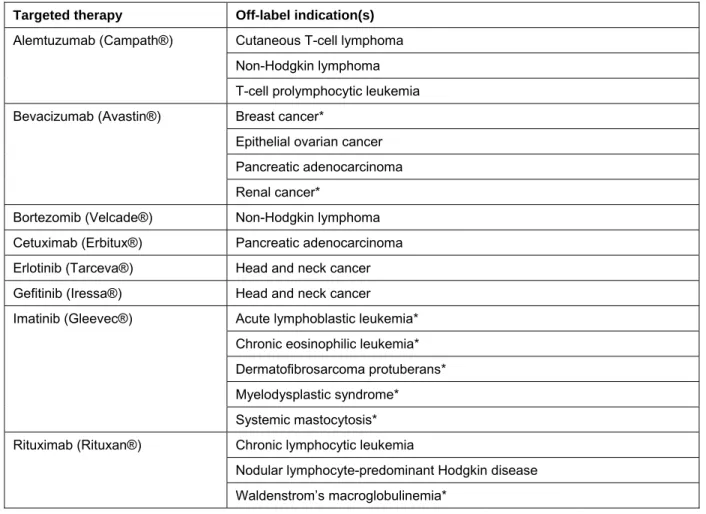
Table 1. Drugs and off-label indications included in the technology assessment
Targeted therapy Off-label indication(s)
* Indications that were approved by the FDA at some point during the completion of this technology assessment.
Cutaneous T-cell lymphoma Alemtuzumab (Campath®)
Non-Hodgkin lymphoma T-cell prolymphocytic leukemia Breast cancer*
Bevacizumab (Avastin®)
Epithelial ovarian cancer Pancreatic adenocarcinoma Renal cancer*
Bortezomib (Velcade®) Non-Hodgkin lymphoma Cetuximab (Erbitux®) Pancreatic adenocarcinoma Erlotinib (Tarceva®) Head and neck cancer Gefitinib (Iressa®) Head and neck cancer
Acute lymphoblastic leukemia* Imatinib (Gleevec®)
Chronic eosinophilic leukemia* Dermatofibrosarcoma protuberans* Myelodysplastic syndrome* Systemic mastocytosis* Chronic lymphocytic leukemia Rituximab (Rituxan®)
Nodular lymphocyte-predominant Hodgkin disease Waldenstrom’s macroglobulinemia*
Table 2. FDA-approved indications of drugs included in the technology assessment, as of January 2007*
Drug FDA-approved indication(s)
Alemtuzumab (Campath®) • B-cell chronic lymphocytic leukemia (B-CLL) in patients who have been treated with alkylating agents and who have failed fludarabine therapy
Bevacizumab (Avastin®) • First-line treatment of patients with metastatic carcinoma of the colon or rectum Bortezomib (Velcade®) • Multiple myeloma patients who have received at least one prior therapy
• Relapsed/refractory mantel cell lymphoma
Cetuximab (Erbitux®) • In combination with radiation therapy, indicated for locally or regionally advanced squamous cell carcinoma of the head and neck. As a single agent, indicated for recurrent or metastatic head and neck carcinoma when prior platinum-based therapy has failed.
• In combination with irinotecan, indicated in patients with colorectal carcinoma refractory to irinoctecan-based chemotherapy. As a single agent, indicated for metastatic colorectal carcinoma intolerant to irinotecan-based chemotherapy. Erlotinib (Tarceva®) • As a single agent, indicated for locally advanced or metastatic non-small cell
lung cancer after failure of at least one prior chemotherapy regimen
• In combination with gemcitabine, indicated for the first-line treatment of patients with locally advanced, unresectable, or metastatic pancreatic cancer
Gefitinib (Iressa®) • As a single agent, indicated for continued treatment of locally advanced or metastatic non-small cell lung cancer after failure of both platinum-based and docetaxal chemotherapies among patients who are benefiting or have benefited from gefitinib
Imatinib (Gleevec®) • Kit (CD117) positive unresectable and/or metastatic malignant gastrointestinal stromal tumors GIST
• PH+ CML in chronic phase or in blast crisis, accelerated phase after failure of interferon-alpha therapy, or whose disease has recurred after stem cell transplant, or who are resistant to interferon-alpha therapy
Rituximab (Rituxan®) • Relapsed or refractory low-grade or follicular, CD20-positive, B-cell, non-Hodgkin’s lymphoma
• First-line treatment of diffuse large B-cell, CD20-positive, non-Hodgkin’s lymphoma in combination with CHOP or other anthracycline-based chemotherapy regimens
Chapter 2. Methods
Selection Criteria
Selection of Drugs
Medications currently being used for off-label indications in oncology were included in the systematic review if they met the following inclusion criteria:
• Targeted agent;
• FDA-approved;
• Marketed in January 2007 or before; and,
• Having compendia-listed indications other than the FDA-approved indication, in one of the following four compendia as of December 2006: AHFS-DI (2006 version), NCCN (online version), USP-DI (2006 version), and Clinical Pharmacology (online version).
Selection of Studies
Each citation identified from the search strategies was evaluated by the investigators according to the following selection criteria.
Studies were included in the evidence tables if they met all of the following inclusion criteria:
• Conducted in humans;
• Investigated use of the candidate drug for the off-label indication;
• Addressed one of the off-label indications listed in Table 1 for included drugs;
• Reported at least the following outcomes for efficacy: survival, disease-free survival, tumor response, quality of life, or adverse effects.
All study designs – case reports, retrospective case series, clinical trials (Phase I, Phase II, Phase III, Phase IV), and large database (outcomes) studies – were included. Any type of tumor response criteria was considered to meet the eligibility criterion regarding efficacy outcome.
Studies were not included if they met any of the following exclusion criteria:
• Described only predictors of response;
• Was a pharmacokinetic study (i.e., a study in which outcomes are drug levels);
• Was conducted in a non-human setting (i.e., animal model or in vitro).
Our previous review of the quality of the compendia found that the compendia used
information from abstracts, review articles, and other types of reports, in addition to randomized controlled trials, to support their listed recommendations. Hence, to ensure that our dataset was complete, we also included this level of information in our review. Studies that did not meet the eligibility criteria for inclusion in the evidence tables, or that were presented in abstract form only (i.e., without a companion published manuscript), were summarized in horizon scan and abstract tables only.
Search Strategy
A systematic MEDLINE® search employed the following algorithm: 1 alemtuzumab.mp. (1034)
2 campath.mp. (669)
3 exp lymphoma, t-cell, cutaneous/ (6371) 4 exp lymphoma, non-hodgkin/ (68316) 5 leukemia, prolymphocytic/ (391) 6 leukemia, t-cell, chronic/ (185)
7 leukemia, lymphocytic, chronic/ (8687) 8 (1 or 2) and (or/3-7) (421)
9 (bortezomib or velcade).mp. (1733) 10 exp lymphoma, non-hodgkin/ (68316) 11 9 and 10 (128)
12 (bevacizumab or avastin).mp. (2720) 13 exp Breast Neoplasms/ (165832) 14 ovarian neoplasms/ (49018)
15 exp pancreatic neoplasms/ (42132) 16 exp kidney neoplasms/ (46624) 17 12 and (or/13-16) (489)
18 (cetuximab or erbitux).mp. (1497) 19 exp pancreatic neoplasms/ (42132) 20 18 and 19 (61)
21 (erlotinib or tarceva).mp. (1300)
22 exp "Head and Neck Neoplasms"/ (195248) 23 21 and 22 (73)
24 (gefitinib or iressa).mp. (2337)
25 exp "Head and Neck Neoplasms"/ (195248) 26 24 and 25 (143)
27 (imatinib or gleevec).mp. (5493)
28 exp leukemia, lymphocytic, acute/ or exp leukemia, t-cell, acute/ (16285) 29 chronic eosinophilic leukemia.mp. (115)
30 dermatofibrosarcoma/ or dermatofibrosarcoma protuberans.mp. (1065) 31 exp Myelodysplastic Syndromes/ (12465)
32 exp mastocytosis, systemic/ (383) 33 27 and (or/28-32) (417)
34 (rituximab or rituxan).mp. (5132)
35 exp leukemia, lymphocytic, chronic/ (8687)
36 hodgkin disease/ or "nodular lymphocyte predominant hodgkin$ disease".mp. (28136) 37 waldenstrom macroglobulinemia/ (4062)
38 (waldenstr$ adj1 macroglobulinemia).mp. (4395) 39 34 and (or/35-38) (523)
conduct of this technology assessment. With respect to collecting abstracts and published reports for review in the literature synthesis, the search was last run on September 14, 2007.
Because the literature was evolving rapidly, and because the compendia frequently referenced unpublished conference abstracts from key international meetings such as the American Society of Clinical Oncology (ASCO) and American Society of Hematology (ASH) annual conferences, we supplemented the literature search with searches of conference abstracts for 2006 and 2007 (ASH and ASCO). We did not repeat this in 2008 or 2009, because the conference abstracts were minimally instructive to our overall understanding of the literature. In order to search the abstracts, we used the professional organizations’ online databases, searching by drug name cross-matched with disease and using the same search terms as outlined above.
Data Abstraction
Data were abstracted from journal articles and abstracts directly into standardized data tables by four investigators independently. One data table was completed for each drug/disease
combination (i.e., a targeted therapy and a specific off-label use of that targeted therapy). Each data table was over-read by an investigator other than the one who originally abstracted the data for that drug/disease combination.
The following data were abstracted from included studies: study design, phase, selection/randomization, and eligibility criteria; number of patients, median age, previous treatment, stage of disease, drug dose per day, and outcomes sought; tumor response (number with tumor response assessed, complete response, partial response, stable disease, progressive disease); survival (overall, median, disease-free); adverse events and tolerability; and quality assessment (see below). Data tables were created using Microsoft Excel (Microsoft, Inc.; Redmond, WA).
Please note the following additional details:
• Journal articles which reported results of Phase I dosing studies were considered as horizon scan reports rather than as full-text reports; hence these reports were not included in the primary data tables.
• For most drug/disease combinations reviewed, data populating the adverse events tables were abstracted from full reports only, and not from abstracts. Due to space constraints, abstracts do not typically include information on adverse events.
Quality Assessment
The quality of included studies was assessed on the following quality elements: internal validity (e.g., randomization and allocation concealment; similarity of compared groups at baseline; specification of eligibility criteria; blinding of assessors, care providers, and patients) and external validity (e.g., description of the patient population, similarity to the target
population of the report, use of highly selective criteria). We adopted as a framework the quality assessment criteria used in a 2003 British report on imatinib mesylate for unresectable and/or metastatic gastrointestinal stromal tumors (GIST).6 These criteria were, in turn, drawn from a 2001 methodological publication of the British National Health Service Centre for Reviews and Dissemination.7 The specific quality criteria we selected cover the range of study designs used
in this report including experimental studies, cohort studies, case-control studies, and case series. Point scores were allocated by assigning one point for each quality category. There were a total of six possible categories. Quality ratings of “yes” to a quality criteria were assigned 1 point; no and unknown were both assigned 0 points. The last category, adequate description of subseries, was not applicable to all studies. Hence, the total possible quality points were 5 or 6 depending upon the applicability of the subseries category. High quality studies were those with ≥ 3/5 or 4/6 points. Abstract quality was not scored.
Data Synthesis
In addition to data abstraction and quality analysis, a narrative description of study findings was prepared. Results are presented in Chapter 3, immediately below.
Chapter 3. Results
Velocity of Evolution of the Literature
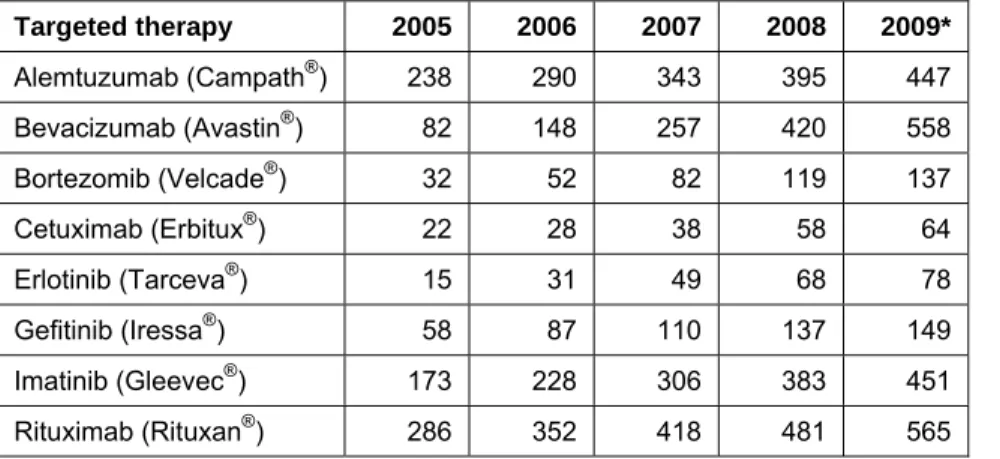
An important outcome of this technology assessment is its description of the state of the evidence in a single, quickly evolving, field of biomedical research. The body of literature surrounding targeted therapies is growing at a rapid rate (Table 3). Significant difficulty was encountered in the conduct of this study due to the continuous change in the available evidence; akin to drawing a line in the sand, we placed time boundaries for study inclusion – a necessity in order to proceed with any search strategy. As new information became available, however, we felt compelled to redraw the line in the interests of performing the most complete systematic review possible. This approach is largely infeasible and delayed completion of the study. In a larger sense, the “moving target” nature of evidence calls into question the feasibility of a time-bounded, static, evidence review process based on systematic review, in an environment where the evidence pool is continuously expanding.
Illustrating this challenge, Table 3 presents the number of identified publications available by December of the search year. The searches included only those drug/disease combinations planned for this technology assessment, using the search strategy outline above; total number of papers are presented by agent (summing across diseases, if more than one drug/disease
combination was evaluated for that particular agent).
Table 3. Number of identified publications reporting on select off-label indications of each targeted therapy
Targeted therapy 2005 2006 2007 2008 2009* Alemtuzumab (Campath®) 238 290 343 395 447 Bevacizumab (Avastin®) 82 148 257 420 558 Bortezomib (Velcade®) 32 52 82 119 137 Cetuximab (Erbitux®) 22 28 38 58 64 Erlotinib (Tarceva®) 15 31 49 68 78 Gefitinib (Iressa®) 58 87 110 137 149 Imatinib (Gleevec®) 173 228 306 383 451 Rituximab (Rituxan®) 286 352 418 481 565
*2009 figures are extrapolated using 6-month figures, as follows: 2009 estimate = 2008 estimate + [(total through June 2009) – (total through 2008)] x 2.
Systematic Literature Review for Drug/Disease Combinations
The Appendix summarizes the literature identified through the final search date of September 14, 2007. Each section covering a specific drug/disease combination follows the same structure, namely:
» Background
• Overview of drug
• Overview of disease
• Rationale for use of drug in disease » Methods » Results • Studies identified • Efficacy • Survival • Adverse Events • Horizon Scan
» Discussion (Summary of findings) » Supporting tables
• Appendix Table 1 – Full published reports of studies for drug/disease combination
o Study
o Study design o Patients
o Tumor response o Survival
o Other including quality assessment
• Appendix Table 2 – ASH & ASCO abstracts (2006/2007) presenting studies for drug/disease combination o Study o Study design o Patients o Tumor response o Survival
o Other including adverse events and tolerability
• Appendix Table 3 – Horizon scan studies for drug/disease combination
o Study
o Study design o Drug dose per day o Sample size o Comments
• Appendix Table 4 – Adverse events (grade 3 & 4 only) from full published reports of studies for drug/disease combination
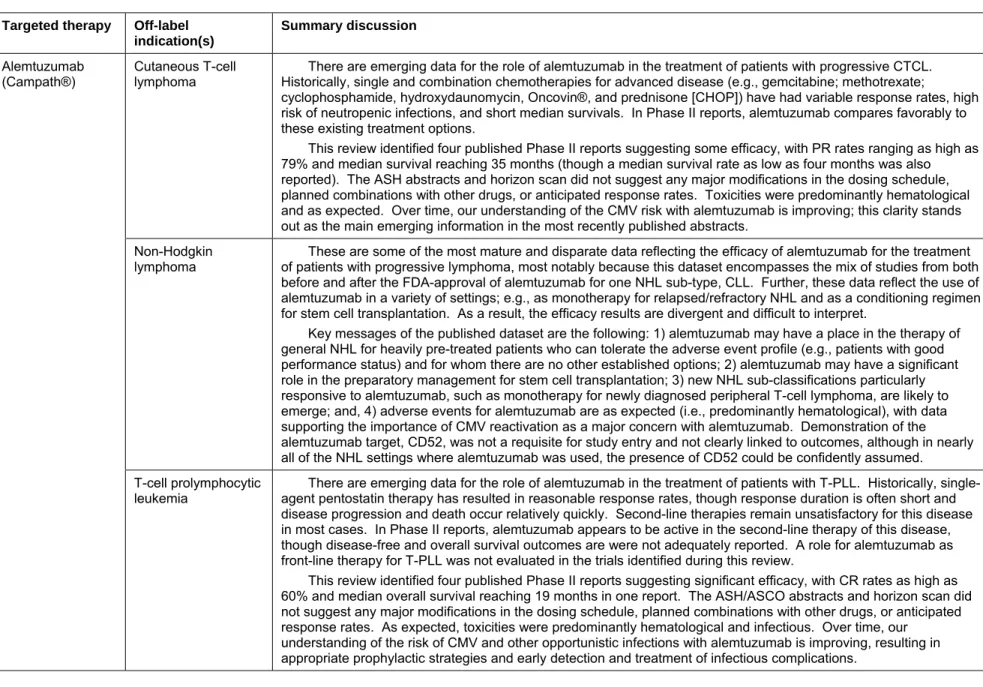
The summary of findings by indication presented here (Table 4) recapitulates the discussion section of each drug/disease section.
Table 4. Indications and summary of the systematic evidence review (last search date September 14, 2007) Targeted therapy Off-label
indication(s)
Summary discussion
Cutaneous T-cell lymphoma
There are emerging data for the role of alemtuzumab in the treatment of patients with progressive CTCL. Historically, single and combination chemotherapies for advanced disease (e.g., gemcitabine; methotrexate;
cyclophosphamide, hydroxydaunomycin, Oncovin®, and prednisone [CHOP]) have had variable response rates, high risk of neutropenic infections, and short median survivals. In Phase II reports, alemtuzumab compares favorably to these existing treatment options.
This review identified four published Phase II reports suggesting some efficacy, with PR rates ranging as high as 79% and median survival reaching 35 months (though a median survival rate as low as four months was also reported). The ASH abstracts and horizon scan did not suggest any major modifications in the dosing schedule, planned combinations with other drugs, or anticipated response rates. Toxicities were predominantly hematological and as expected. Over time, our understanding of the CMV risk with alemtuzumab is improving; this clarity stands out as the main emerging information in the most recently published abstracts.
Non-Hodgkin lymphoma
These are some of the most mature and disparate data reflecting the efficacy of alemtuzumab for the treatment of patients with progressive lymphoma, most notably because this dataset encompasses the mix of studies from both before and after the FDA-approval of alemtuzumab for one NHL sub-type, CLL. Further, these data reflect the use of alemtuzumab in a variety of settings; e.g., as monotherapy for relapsed/refractory NHL and as a conditioning regimen for stem cell transplantation. As a result, the efficacy results are divergent and difficult to interpret.
Key messages of the published dataset are the following: 1) alemtuzumab may have a place in the therapy of general NHL for heavily pre-treated patients who can tolerate the adverse event profile (e.g., patients with good performance status) and for whom there are no other established options; 2) alemtuzumab may have a significant role in the preparatory management for stem cell transplantation; 3) new NHL sub-classifications particularly responsive to alemtuzumab, such as monotherapy for newly diagnosed peripheral T-cell lymphoma, are likely to emerge; and, 4) adverse events for alemtuzumab are as expected (i.e., predominantly hematological), with data supporting the importance of CMV reactivation as a major concern with alemtuzumab. Demonstration of the alemtuzumab target, CD52, was not a requisite for study entry and not clearly linked to outcomes, although in nearly all of the NHL settings where alemtuzumab was used, the presence of CD52 could be confidently assumed. Alemtuzumab
(Campath®)
T-cell prolymphocytic
leukemia agent pentostatin therapy has resulted in reasonable response rates, though response duration is often short and There are emerging data for the role of alemtuzumab in the treatment of patients with T-PLL. Historically,
single-disease progression and death occur relatively quickly. Second-line therapies remain unsatisfactory for this single-disease in most cases. In Phase II reports, alemtuzumab appears to be active in the second-line therapy of this disease, though disease-free and overall survival outcomes are were not adequately reported. A role for alemtuzumab as front-line therapy for T-PLL was not evaluated in the trials identified during this review.
This review identified four published Phase II reports suggesting significant efficacy, with CR rates as high as 60% and median overall survival reaching 19 months in one report. The ASH/ASCO abstracts and horizon scan did not suggest any major modifications in the dosing schedule, planned combinations with other drugs, or anticipated response rates. As expected, toxicities were predominantly hematological and infectious. Over time, our
understanding of the risk of CMV and other opportunistic infections with alemtuzumab is improving, resulting in appropriate prophylactic strategies and early detection and treatment of infectious complications.
Targeted therapy Off-label indication(s)
Summary discussion
Breast cancer* Because multiple treatment regimens are available to patients with metastatic breast cancer, and patients with no
visceral involvement will sometimes live for years with their disease, demonstration of survival benefit from the addition of a VEGF inhibitor to the treatment regimen will be difficult. This review identified a single clinical trial that assessed the marginal benefits and harms associated with bevacizumab as adjunctive therapy in the treatment of breast cancer. That trial compared capecitabine alone to capecitabine with bevacizumab among patients with previously treated metastatic breast cancer. Bevacizumab contributed to improved response rates but not progression-free survival.
The existing literature suggests that bevacizumab is relatively well tolerated at doses of 10 to 15 mg/kg every two to three weeks. Leukopenia and hypertension were the two most common serious adverse events. The ASCO 2007 abstracts and horizon scan did not suggest any major modifications in the dosing schedule, planned combinations with other drugs, or anticipated response rates. Additional research is needed to determine whether the addition of a VEGF antibody, which has clearly been shown to be effective in the treatment of some cancers, and for which there is biological plausibility for the treatment of breast cancer, adds significantly to the current treatment options for
metastatic breast cancer in terms of survival benefit.
The FDA approved the use of bevacizumab for breast cancer in 2008 based upon emerging data, some of which were not available at the time of the most recent literature search presented in this report.
Epithelial ovarian cancer
There are compelling reasons to evaluate the use of monoclonal antibodies to VEGF in the treatment of epithelial ovarian cancer, especially in light of ovarian cancer’s high mortality rate and the proven efficacy of this class of targeted therapies in the treatment of colon, rectal, non-small cell lung, and breast cancers, and glioma.. However, to date there are limited data that support the use of bevacizumab in the treatment of epithelial ovarian cancer. The published case series and case reports suggest that bevacizumab may contribute to clinical response, including reduction in CA125 levels. These studies were not designed to directly evaluate the efficacy of bevacizumab, however, and there is inherent bias in relying on case reports or retrospective case series to assess either efficacy or safety of interventions, especially those typically used in combination with other treatments.
The ASCO abstract and horizon scan articles did not suggest any major modifications in the dosing schedule, planned combinations with other drugs, or anticipated response rates. There were insufficient data identified in this review to comment on toxicities potentially associated with bevacizumab in the treatment of ovarian cancer. Bevacizumab
(Avastin®)
Pancreatic adenocarcinoma
The findings from the Phase II studies suggest that bevacizumab does little to improve clinical outcomes in the treatment of pancreatic adenocarcinoma. Complete responses ranged from 0 to 1% in these studies. The single Phase III trial, which enrolled 602 patients and compared gemcitabine plus bevacizumab 10 mg/kg to gemcitabine plus placebo, did not demonstrate a survival benefit associated with bevacizumab. These findings are consistent with recently published expert opinion that there is no consensus about second-line therapy after pancreatic cancer progression after gemcitabine failure.
Targeted therapy Off-label indication(s)
Summary discussion
Renal cancer* Given the upregulation of VEGF associated with the mutated version of the von Hippel–Lindau tumor suppressor
gene in the majority of renal cell cancers, drugs that target the inhibition of angiogenesis are logical therapeutic agents. The findings from this review support the use of bevacizumab in the treatment of renal cell cancer. The three fully published trials as well as the published abstracts demonstrated that bevacizumab appears to be both well tolerated and efficacious. The Phase III clinical trial published in abstract form demonstrated a 30.6% complete response associated with bevacizumab, compared to 12.4% associated with placebo when administered along with interferon therapy. Hypertension and proteinuria are among the more common adverse events associated with bevacizumab therapy.
Bortezomib (Velcade®)
Non-Hodgkin lymphoma
Although preclinical studies suggest a potential role for proteasome inhibitors in the treatment of hematologic malignancies, the studies identified in this review do not provide sufficient evidence to recommend the use of bortezomib in the treatment of NHL and related diseases. The quality of the uncontrolled Phase II studies was generally poor, and there were no randomized controlled trials that compared bortezomib to alternative therapies. Clinical response was highly variable, with CR and PR rates ranging from 0 to 90%. The patient populations represented in the studies were heterogeneous, as were the history of prior treatments and the other interventions
used concurrently with bortezomib. Dosing of bortezomib ranged from 1.3 to 1.8 mg/m2 at intervals ranging from 3 to
10 days.
The ASH 2006, ASH 2007, and ASCO 2007 abstracts and horizon scan did not suggest any major modifications in the dosing schedule, planned combinations with other drugs, or anticipated response rates. The horizon scan revealed reports of cardiovascular toxicities, including arrhythmias, as well as a potentially higher incidence of varicella herpes zoster among patients being treated with bortezomib.
Further research is needed to determine what role, if any, bortezomib should have in the treatment of NHL, with the exception of mantle cell lymphoma.
Cetuximab (Erbitux®)
Pancreatic adenocarcinoma
Results from the clinical trials published as abstracts demonstate that the use of cetuximab as an adjunct in the treatment of pancreatic adenocarcinoma is associated with an increase in partial response from 8% to 16%. Only a single subject who received cetuximab had a complete response. Further research is needed to evaluate the efficacy and safety of cetuximab for patients with this cancer.
Erlotinib (Tarceva®)
Head and neck cancer
The overexpression of EGFR in 80% to 100% of HNSCC makes erlotinib a logical targeted therapy for HNSCC. The two full reports and the four abstracts in this review provide emerging evidence for the role of erlotinib in the treatment of patients with HNSCC. Historically, single and combination chemotherapies for advanced disease have had low response rates and short median survivals. In Phase II reports, erlotinib compares favorably to existing treatment options.
This review identified two published Phase II reports suggesting some efficacy, with partial response and stable disease rates of 19% and 49%, respectively, in one of the studies. Complete response rates were highly variable across the six studies, ranging from 0 to 84%. There was a relatively low rate of toxicities reported in the two full reports, with dermatitis being the most commonly reported adverse event. The reports identified in this review did not suggest any major modifications in the dosing schedule, planned combinations with other drugs, or anticipated response rates.
Targeted therapy Off-label indication(s)
Summary discussion
Gefitinib (Iressa®) Head and neck
cancer
The paucity of published reports and the heterogeneity of the patient populations and the dosages studied preclude drawing conclusions at this time regarding the role of gefitinib in the treatment of HNSCC. Data available do not support its off-label use. Access to this drug has been severely restricted in the United States following the FDA approved labeling change in June 2005, such that gefitinib is seldom used either on-label for lung cancer or off-label for HNSCC. Interest in further clinical trials of this agent has also waned in the United States due to issues of access. Acute lymphoblastic
leukemia* to 30% of ALL cases. Because imatinib specifically targets cells with the Philadelphia chromosome, it is potentially The constitutively activated tyrosine kinase bcr-abl, a product of the Philadelphia chromosome, is present in 20%
useful as adjuvant therapy for patients with Ph+ ALL. This review identified two randomized clinical trials and 22 uncontrolled trials involving 1,430 patients with ALL, the vast majority of whom were previously untreated and were Philadelphia chromosome positive.
Neither of the two randomized clinical trials identified in this review evaluated the efficacy of imatinib for ongoing treatment. One randomized trial demonstrated improved median survival when imatinib was added to ongoing to the induction regimen; all patients received imatinib during the ongoing treatment period in this study (the other
randomized study did not have response or survival data available yet at the time of this review). The evidence from the Phase II trials suggests that this targeted therapy may be effective either as monotherapy or as combination therapy in the treatment of ALL, across the treatment settings studied, with CR rates in some studies reaching 100%. These favorable results must be considered in the context of the expected treatment success rates of existing therapies, which are generally high in the initial treatment of Ph+ ALL, maintained across treatment plans in children, and lead to treatment failure in adults; it follows that imatinib is usually used in adults with Ph+ ALL.
The ASH/American Society of Clinical Oncology (ASCO) abstracts and horizon scan did not suggest any major modifications in the dosing schedule, planned combinations with other drugs, or anticipated response rates. These reports did, however, suggest that imatinib may be associated with a variety of different adverse events, including acute tumor lysis syndrome, cardiotoxicity, or pleural effusion.
Imatinib (Gleevec®)
Chronic eosinophilic
leukemia* without significant toxicity in the treatment of chronic eosinophilic leukemia. The RT-PCR analysis suggests that Each of the nine case reports or series considered in the horizon scan reported favorable responses to imatinib
Targeted therapy Off-label indication(s)
Summary discussion
Dermatofibrosarcoma protuberans*
The vast majority of DFSP tumors have a chromosomal translocation that fuses the collagen gene with the PDGF gene, the result of which is the production of a self-stimulatory growth signal, rapid cell division, and tumor formation. This process involves the constitutive activation of the PDGF receptor, which provides a rationale for targeted inhibition of the PDGF receptor as a treatment strategy for patients with unresectable locally advanced or metastatic DFSP. This review identified two Phase II reports involving 35 patients with DFSP treated with imatinib as monotherapy. Neutropenia and maculopapular rash were the only Grade 3 adverse events reported. Fifty percent of patients in the full report demonstrated a PR and 36% of patients in the trial published as an abstract demonstrated a clinical response. In these Phase II reports, imatinib compares favorably to existing treatment options. The ASCO 2007 abstract and horizon scan did not suggest any major modifications in the dosing schedule, planned
combinations with other drugs, or anticipated response rates.
Given the rarity of DFSP tumors, the substantial mortality risk for those that transform into a sarcoma or metastasize, the lack of other systemic therapeutic interventions for DFSP, and the presence of the PDGF receptor as a target in DFSP, treatment with imatinib in DFSP is a sensible strategy even in the setting of few published reports and incomplete exploration in clinical trials identified in this review.
Myelodysplastic
syndrome* been implicated in the pathogenesis of various myeloproliferative disorders. This offers a rationale for targeted Recent research suggests that some MDS patients express the PDGF receptor oncogene, and that PDGF has
inhibition of the c-kit and PDGF receptor oncogenes as an MDS treatment strategy. This rationale, combined with the fact that MDS is often refractory to existing treatments, suggests that imatinib may be a potentially important targeted therapy for MDS. The published data described in this review suggest that imatinib is well tolerated in this patient population, with the only commonly occurring adverse event being neutropenic fever (21%). The two studies involving a total of fewer than 50 patients provide insufficient data to support firm conclusions, but their findings suggest that imatinib is not effective in the treatment of MDS. Complete response was achieved in a single patient, and only one patient achieved a partial response.
Systemic mastocytosis*
Over the past few years, clinical research initiatives aimed at developing more tolerable and effective therapies for SM have investigated treatments, including imatinib, that specifically target the constitutive kinase activity of the
mutated c-kit proto-oncogene and the FIP1L1-PDGFRα fusion gene. This review identified three Phase II reports
involving 29 patients with SM treated with imatinib as monotherapy or in combination with prednisone. The results suggest that imatinib is well tolerated among patients with SM, with the only commonly occurring Grade 3/4 adverse event (7%) being toxicoderma. These three reports provide insufficient data to support firm conclusions, but their findings suggest some efficacy of imatinib in the treatment of SM, with PR rates ranging between 30% and 100%. The ASH 2006 abstracts and horizon scan did not suggest any major modifications in the dosing schedule, planned combinations with other drugs, or anticipated response rates.
Given the rarity of SM (and lack of patients for clinical trials), the need for systemic therapeutic interventions among some patients with severe and/or highly symptomatic disease, and the presence of a target for imatinib in this disease, treatment with imatinib in SM is a sensible strategy even in the setting of few published data and the incomplete exploration in clinical trials identified in this review.
* Indications that were approved by the FDA at some point during the completion of this technology assessment.
Targeted therapy Off-label indication(s) Summary discussion Rituximab (Rituxan®) Chronic lymphocytic leukemia
As an anti-CD20 immunoglobulin, rituximab is theoretically well suited to treating CD20-positive CLL. Nearly all of the reports identified in this review included only patients with CLL known to have CD20-positive status. These reports provide relatively compelling evidence in support of the role of rituximab in the treatment of CLL. The quality of the studies was generally poor, and there is great variability in the clinical response rates, but in the aggregate the reports suggest some efficacy. CR and PR rates ranged from 0 to 70% and 15% to 67%, respectively, among the 16 fully published studies, and no clear pattern of the type or nature of adverse events possibly associated with rituximab use among patients with CLL was evident. Comparative effectiveness trials are needed to better determine the appropriate role of rituximab in the treatment of CLL.
Nodular lymphocyte-predominant Hodgkin disease
Because rituximab is an anti-CD20 immunoglobulin that antagonizes the high-density CD20 surface antigens characteristic of the malignant cell population of NLPHD patients, it has emerged as a promising treatment option since its first off-label use in 1999 for a patient with difficult refractory NLPHD. Subsequent case reports and Phase II studies identified in this review provide further evidence that rituximab appears to be both effective in the short term and well tolerated, but that the duration of response may be limited. The observed CR and PR rates of 45% to 69% and 28% to 54%, respectively, compare favorably to existing treatment options, as do the estimated 10- and 20-year overall survival rates of 97% and 85% reported in a published abstract. The ASH 2006 and 2007 abstracts and horizon scan did not suggest any major modifications in the dosing schedule, planned combinations with other drugs, or anticipated response rates. Only one out of 14 patients (7%) experienced a Grade 3/4 adverse event in the single study that reported adverse events.
Waldenstrom’s macroglobulinemia
Rituximab, an anti-CD20 immunoglobulin that targets the CD20 surface antigens that are expressed on
malignant lymphocytes in WM, was used as an off-label treatment for WM from the late 1990s until its recent approval by the FDA. This review identified 13 published Phase II reports suggesting some efficacy, with one reported CR rate reaching 18% and PR rates ranging as high as 90%. Historically, single and combination chemotherapies for advanced disease have had variable response rates and short median survivals. In Phase II reports, rituximab was generally well-tolerated, and it compares favorably to these existing treatment options. The ASH 2006, ASH 2007, and ASCO 2007 abstracts and horizon scan did not suggest any major modifications in the dosing schedule, planned combinations with other drugs, or anticipated response rates.
Chapter 4. Discussion
In this technology assessment, we attempted to provide complete and comprehensive reviews of 19 different drug/diseases indications. At the time of their selection, these indications were all off-label. Over the time course of doing this project, the literature evolved quickly (e.g., the number of potentially relevant articles related to alemtuzumab published in a calendar year increased from 290 to 447 from 2006 to 2009) and the FDA approved several indications (e.g., all five of the indications for imatinib were approved over that period). For some indications there was both biological plausibility of the drug/disease combination as well as relatively compelling evidence to support the prescription of that particular drug in that particular disease (e.g., alemtuzumab in cutaneous T cell lymphoma [CTCL]), and in other indications evidence was scant or not at all supportive (e.g., bevacizumab in pancreatic cancer).
This technology assessment constituted, in effect, a series of 19 systematic reviews of the medical literature on off-label indications of selected antineoplastic drugs. In terms of sheer labor effort, the scope of this undertaking was vast. A first and important observation is,
therefore, recognition of the quantity of work expected of the compendia which are charged with continuously performing and updating systematic reviews on the comprehensive list of FDA-approved drugs and biologics. Moreover, this study confirmed the pervasive sense among
clinicians that the drug landscape in oncology is frequently changing, not only as new indications arise but also as public support and interest shift to focus on specific drugs (e.g., gefitinib fell out of favor over the course of this review).
In listing off-label indications, the compendia function as a stepping stone between (1) drug development and research that produces substantial supporting evidence, and (2) FDA approval.
For many of the indications included in this technology assessment, FDA listing was in progress. Here, the drug’s accessibility, via the mechanism of compendia off-label listing, jibes with this intended role of the compendia. We found that the volume of identified data was variable even for those agents that secured FDA approval, although those approved were primarily those with the more robust datasets identified in this review (e.g., the large number of studies for imatinib for acute lymphoblastic leukemia (ALL), and Phase III studies of
bevacizumab for renal cell carcinoma). From our reviews, we could discern which drugs should not be accessible for the studied indication, and in general, their listing in the compendia was rescinded (e.g., bevacizumab for pancreatic cancer). The extent of review varied depending on expected usage and cost; expensive drugs likely to be used in common cancers (e.g.,
bevacizumab) tended to undergo full FDA review, whereas uncommon cancers did not. Each discrete systematic review yielded interesting information on the off-label use(s) of a specific targeted therapy. However, the quality of studies varied tremendously, and the low quality of many published studies made it difficult to draw conclusions regarding the agent’s effectiveness or safety. Study quality varied both across and within drugs. Because of the paucity of high-quality evidence, the data available – though voluminous – may have little meaning or value for informing clinical practice. Similarly, our horizon scan yielded little useful evidence; review of this level of evidence may serve better as an early warning system, alerting clinicians to potential adverse events (e.g., CMV in alemtuzumab) than as a viable source of data on efficacy.
The indication of alemtuzumab for Non-Hodgkin Lymphoma (NHL) illustrates many of the issues encountered in a systematic review of the literature in the rapidly evolving field of
targeted therapies. Clinical indication for use of alemtuzumab varied; specifically, we found the agent used at diverse stages of disease presentation. Four of the 11 published reports included alemtuzumab as a part of a stem cell transplant conditioning regimen, to reduce toxicity from donor lymphocyte infusion, or in conjunction with some other aspect of transplant therapy. Similarly, transplant was frequently the indication in abstracts and the horizon scan. In the remainder of studies, participants generally had relapsed or refractory NHL, or minimal residual disease after other standard therapies. Two abstracts presented the choice of alemtuzumab as first-line therapy in NHL; both involved patients with peripheral T cell lymphoma as their NHL subtype. In this wide variety of contexts, it is difficult – though necessary for the practicing clinician – to try to interpret efficacy outcomes and tolerability from the available evidence. In this drug/disease combination, reported response rates varied tremendously, from 4 percent to 80 percent. This variation could be due to the fact that many studies were not limited to a single disease or a single drug regimen; in studying alemtuzumab for NHL, as with other drug/disease combinations, patients with a variety of diseases were included in clinical trials.
The quantity, as well as quality, of data varied widely across the included indications. Practical considerations may account for some of this disparity in quality. Targeted therapies treat diseases that are frequently rare (e.g., alemtuzumab for T-cell prolymphocytic leukemia or imatinib for dermatofibrosarcoma protuberans [DFSP]); hence it is difficult to get many cases at one institution. Clinical trials are costly; hence it is impractical to expect cooperative clinical trials or industry-funded research of every permutation. In certain drug/disease combinations, (e.g., bevacizumab for epithelial ovarian cancer [EOC]), the data are severely limited. A published case series and case reports suggest that bevacizumab may contribute to clinical response in EOC, including reduction in CA125 levels. However, these studies were not
designed to directly evaluate the efficacy of bevacizumab, and there is inherent bias in relying on case reports or retrospective case series to assess either efficacy or safety of interventions,
especially those typically used in combination with other treatments. A larger quantity of data supported more mature drugs (e.g., imatinib). Given the complexities of completing clinical trials, and the small number of patients available at any single institution, the level of data for some drug/disease combinations was remarkable – and likely reflective of public enthusiasm for those drugs.
In some diseases, despite limited, lower quality, and/or ambiguous data, the use of an off-label indication may be a reasonable clinical decision. For example, given the rarity of
dermatofibrosarcoma protuberans (DFSP) tumors, the substantial mortality risk for those tumors that progress into a sarcoma or metastasize, the lack of other systemic therapeutic interventions for DFSP, and the presence of the PDGF receptor as a target in DFSP, treatment with imatinib in DFSP is a sensible strategy even in the setting of few published reports, incomplete exploration in clinical trials, or data coming only from uncontrolled Phase II trials. Here, in a very
immediate sense, the clinician’s judgment of best treatment choice for an individual patient must take into account whatever evidence is available, and base the decision on that data, albeit limited. Likewise, in certain diseases with long survival estimates, the short time period of drug development makes calculation of median survival impossible (e.g., rituximab for nodular lymphocyte-predominant Hodgkin disease) and clinicians must evaluate the evidence in the absence of survival data. The balance of adverse effects versus potential clinical benefit presses another clinical judgment on oncologists; for example, despite risk of adverse events, targeted therapies may be a good choice for heavily pre-treated NHL patients who can tolerate the