“European Framework for Measuring Progress”
e-Frame
www.eframeproject.eu
SP1-Cooperation
Coordination and support actions (Coordinating actions) FP7 SSH-2011-3
Grant Agreement Number 290520
SSH.2011.6.2-1
Deliverable D5.2
Dissemination level: PU
Stocktaking Report on Social Monitoring and Reporting in Europe
Authors: Heinz-Herbert Noll and Catrin Berger
GESIS – Leibniz Institute for the Social Sciences
Social Indicators Research Centre (ZSi)
Mannheim
March 2014
DRAFT
Deliverable 5.2
Stocktaking Report on Social Monitoring and Reporting in Europe
Summary
This report seeks to take stock of major social monitoring and reporting activities existing in Eu-rope at national as well as supranational levels. While the currently flourishing debate on measur-ing well-bemeasur-ing and progress “beyond GDP” has a strong focus on discussmeasur-ing why ‘new’ sorts of in-dicators going “beyond GDP” are needed and proposing new measurement, monitoring, reporting or even accounting initiatives, this debate does not always seem to be sufficiently aware and take notice of the many activities, which do already exist.
The activities covered by this stocktaking report are aimed at regular monitoring of as well as re-porting on the living conditions and well-being of the population and their changes over time. So-cial monitoring and reporting activities provide quantitative information and empirically based analytical knowledge on well-being and progress in a single society or groups of societies – like the European Union – to be used for different purposes, including policy making. This report co-vers activities at national and supranational levels, focusing at comprehensive social reports and monitoring instruments, while monitoring and reporting activities in the field of sustainable de-velopment are only partially included.
Providing a systematic overview over the variety of social monitoring and reporting activities cur-rently going on in Europe turns out to be more than just a pure academic stocktaking exercise. By documenting and allowing better access to this information, the report also aims to establish link-ages between past and current activities and to form a more solid fundament for present and fu-ture discourses and initiatives in the field of measuring and monitoring well-being and progress. In other words, this stocktaking report is first and foremost to be considered as a contribution to enhance the future measurement of well-being and societal progress ‘beyond GDP’ and to im-prove respective information infrastructures. To this end, the report does not only seek to identify blind spots at the European map of social monitoring and reporting, but even more aims to pre-sent, discuss and assess different approaches as well as to flag “good practices” in the light of the current debate about measuring and monitoring well-being and progress beyond GDP. Based on the inventory and descriptions of as well as analytical reflections on social monitoring and report-ing activities, the final parts of the report also identify common patterns and trends and present suggestions for future improvements and research agendas.
Index
1. Introduction: Social Monitoring and Reporting in Europe ... 7
2. Social Monitoring and Reporting – Activities at European Level ... 15
2.1. Activities by the European Union and Supranational Organizations ... 15
2.1.1 Social Monitoring ... 16
2.1.2 Social Reporting ... 22
2.2 Social Monitoring and Reporting Activities at European Level – Non Supranational Institutions ... 24
2.3 Sustainable Development ... 26
3. Social Monitoring and Reporting in Europe: National Activities ... 29
3.1 Northern Europe ... 29
3.1.1 Social Monitoring ... 29
3.1.2 Social Reporting ... 31
3.1.3 Sustainable Development ... 34
3.2 Western and Central Europe ... 35
3.2.1 Social Monitoring ... 35
3.2.2 Social Reporting ... 39
3.2.3 Sustainable Development ... 43
3.3 Eastern Europe ... 45
3.3.1 Social Monitoring Activities ... 45
3.3.2 Social Reporting Activities ... 46
3.3.3 Sustainable Development ... 49
3.4 Southern Europe ... 50
3.4.1 Social Monitoring ... 50
3.4.2 Social Reporting ... 54
3.4.3 Sustainable Development ... 58
4. Social Monitoring and Reporting in Europe: Patterns and Trends ... 59
4.1 General Patterns and Observations ... 59
4.1.1 Widespread Practice in Europe ... 59
4.1.3 Diversity in Notions of Well-Being and Approaches of Social Monitoring
and Reporting ... 60
4.1.4 Agents of Social Monitoring and Reporting ... 62
4.2 Some Recent Trends in Social Monitoring and Reporting in Europe ... 65
5. Looking Forward ... 69
1. Introduction: Social Monitoring and Reporting in Europe Aims and Objectives
This report aims to take stock of major social monitoring and reporting activities existing in Eu-rope at national as well as supranational levels. While the currently flourishing debate on measur-ing well-bemeasur-ing and progress “beyond GDP” strongly focuses on discussmeasur-ing why “new” sorts of indi-cators that go “beyond GDP” are needed and proposes new measurement, monitoring, reporting or even accounting initiatives, this debate does not always seem to be sufficiently aware and to take notice of the many activities that already exist. The most influential report by the “Commis-sion on the Measurement of Economic Performance and Social Progress” (Stiglitz, Sen, Fitoussi 2009), for example, seems to largely overlook many of the available approaches, instruments and ongoing activities for measuring and monitoring well-being and the quality of life. Even the long and esteemed tradition of French social reporting – not to mention the social monitoring and re-porting activities in many other nations in Europe and beyond – have not been noted by the commission established by the French Government, although these social reporting activities have contributed considerably in terms of measuring and monitoring well-being and social pro-gress within French society beyond economic accounting and GDP (Noll 2011: 114f.).
Providing a systematic overview of the variety of social monitoring and reporting activities cur-rently going on in Europe thus turns out to be more than just a pure academic stocktaking exer-cise. By documenting and allowing better access to this information, this report also aims to es-tablish linkages between past and current activities and to form a more solid fundament for pre-sent and future discourses and initiatives in the field of measuring and monitoring well-being and progress. In other words, this stocktaking report is first and foremost to be considered as a con-tribution towards enhancing the future measurement of well-being and societal progress “beyond GDP” and to improve respective information infrastructures. To this end, our report will not only align the landscape and seek to identify blind spots in the European map of social monitoring and reporting, but above all, present, discuss and assess different approaches as well as flag “good practices” in the light of the current debate on measuring and monitoring well-being and progress beyond GDP. Based on the inventory and descriptions of, as well as analytical reflections on, social monitoring and reporting activities, the final parts of the report also seek to identify trends and common patterns, as well as achievements, gaps and deficiencies, and will make suggestions for future developments and research agendas.
Background
Social monitoring and reporting activities are nowadays integral parts of the complex information systems in many nation states as well as international and supranational organizations like the OECD, the European Union and the United Nations (Noll 2004: 163). Some of these activities can be traced back as far as to the early 1970s – such as the national social reports in France, the United Kingdom and the Netherlands – while others are more recent. The majority of currently existing social monitoring and reporting activities turn out to be direct or indirect outcomes of the so-called “social indicators movement” (Land 1983; Noll/Zapf 1994, Noll 2004) that emerged in the 1960s, proposing for the first time a call to measure and monitor the well-being of individual citizens and populations more adequately by going beyond the traditional approaches of regular economic accounting and reporting schemes. In a pioneering volume, published in the mid-1960s and edited by Raymond Bauer, “Social Indicators” were defined as “statistics, statistical series, and all other forms of evidence that enable us to assess where we stand and are going with re-spect to our values and goals” (Bauer, 1966: 1). Similarly, Mancur Olson – an American economist and social reporting pioneer – highlighted measuring well-being as the primary function of social indicators by defining a social indicator as ”a statistic of direct normative interest which facilitates concise, comprehensive and balanced judgements about the condition of major aspects of a soci-ety. ...It is a direct measure of welfare and is subject to the interpretation that if it changes in the 'right' direction ...things have gotten better, or people are 'better off'” (Olson 1969: 97). The po-tent mission of the social indicators movement, which had its origin in the United States, and which proposed new approaches of measuring well-being or quality of life “beyond GDP”, was soon taken up in Europe by scholars like Erik Allardt (Finland), Wolfgang Zapf (Germany), Sten Jo-hansson (Sweden), and, not least, Jacques Delors (France), the subsequent President of the Euro-pean Commission (Delors 1971).
This first “beyond GDP” movement of the 1960s and 1970s resulted in a variety of research re-ports and initiatives, which prepared the ground for different sorts of social monitoring and social reporting activities in subsequent years (Noll 2011). Among those path-breaking research projects and activities in the field of measuring and monitoring well-being were the "SPES-Project" led by Wolfgang Zapf in Germany, resulting in a German System of Social Indicators (Zapf 1979), the "Scandinavian Welfare Survey" project headed by Erik Allardt (1972), and the "Swedish Level of Living Survey" project headed by Sten Johansson (1973), to name just a few. As part of the Social Indicators Movement, national governments and statistical institutes in several countries as well as supranational organizations likewise took up the issue of social monitoring and reporting be-yond the traditional economic approaches. A most prominent example of those early activities in the field of measuring well-being is a large-scale OECD project, the „Programme of Work on Social
Indicators”, which was launched in the early 1970s and discontinued in the mid-1980s (OECD 1982; Bertrand, 1986/1987) after publishing a series of working documents and the single report “Living Conditions in OECD Countries” (OECD 1986). In addition, Eurostat – as part of the Europe-an Commission - has been involved in social monitoring Europe-and reporting activities since the early 1980s: The report "Social Indicators for the European Community", published twice in 1980 and 1984, was replaced by the report "Social Portrait of Europe" in the early 1990s. In the mid-1990s Eurostat established a task force on “social indicators”, which aimed to help Eurostat define a proposal for an action program for social indicators and social reporting, aiming to develop sys-tematic reporting on quality of life in Europe. While some of the early initiatives aimed at more adequate measurement of individual and societal well-being at national and supranational level failed to get off the ground and to be implemented as part of the regular information infrastruc-ture, others were successful, resulting in regular monitoring and reporting activities, some of them still existing.
Social Monitoring and Reporting - What Are We Talking About?
What do we actually mean by social monitoring and reporting? The activities we are referring to under these labels are aimed at regular monitoring and analysis of as well as reporting on the liv-ing conditions and well-beliv-ing of the population and their changes over time. Social monitorliv-ing and reporting thus generates – comprehensive or domain-specific – quantitative information and empirically based analytical knowledge on well-being and progress in a single society or groups of societies – like the European Union – to be used for different purposes, e.g. policy making. Social monitoring may be defined as a systematic and continuous observation of individual and societal well-being and related changes across time by making use of quantitative measurement instru-ments, e.g. indicator systems and indicator dashboards or composite indexes. Social reporting goes beyond social monitoring by also incorporating elements of analysis, interpretation and evaluation and may thus be defined as a more or less institutionalized collection, presentation and analysis of data to be used to comprehensively assess the life situation and well-being of the population and their changes over time (Noll 2004: 163). According to a definition used in New Zealand’s Social Report, the aim is “to measure what is important - what a society cares about. In order to do this, agreement is needed about what to measure. This involves making some explicit value judgements about what quality of life means, and about the characteristics of society con-sidered desirable“ (Social Report New Zealand 2001: 8). Regarded from a more explicit policy-making point of view, social reporting has also been defined as “the description and analysis of the living conditions of the population seen in relationship to the objectives and measures of an ensemble of social policy fields” (Gilomen 1995).
Relevant distinctions in social monitoring and reporting activities concern the following character-istics:
• Comprehensiveness: comprehensive versus specialized focus on particular societal do-mains or population groups;
• The level of society addressed: e.g. supranational, national or local level;
• The institutional setting or background: e.g. statistical office, research institute, govern-mental agency or NGO.
More generally, social monitoring and reporting activities typically seem to be characterized by the following basic properties (Noll 1999; Noll 2012):
• A strong focus on the well-being of individual citizens and the general population;
• The units of observation are individuals and private households, rather than institutions and organizations;
• Measurement turns out to be primarily focused on outcomes rather than inputs;
• Following a normative perspective, social monitoring and reporting seeks to identify pro-gress or repro-gress as well as inequalities – advantages and disadvantages – across groups, regions, nations etc.;
• Policy orientation: social monitoring and reporting aims to provide expert knowledge for political elites, administrations and governments;
• Empirical or quantitative measurement approach: The information provided usually fo-cuses on quantitative empirical data and is based on quantitative empirical analysis;
• Representativeness: The information provided by social monitoring and reporting activi-ties claims to be relevant for the whole population or parts of it and thus needs to be based on representative data;
• Timeliness and continuity across time;
• Intelligibility: Since social monitoring and reporting activities do not only address academ-ics, policy makers and other experts, but also the ordinary citizen, understandability is of crucial importance.
Since the publication of “Toward a Social Report” – a prototype of a social report conceptualized and authored by the American economist Mancur Olson on behalf of the US Government De-partment of Health, Education and Welfare (1969) – social reports have been published regularly for many years in numerous countries as well as by supranational organizations. Some of the most well-known national social reports, e.g. the British Social Trends, the Dutch Social and Cultural
Report, and the French Données Sociales, have been published regularly since the early 1970s. Besides social reports numerous social monitoring activities have also been established as an out-come of research on social indicators: Examples of monitoring initiatives implemented as early as in the 1970s are sets or systems of social indicators (Noll 2014a) providing aggregate level infor-mation – such as the German System of Social Indicators (Noll 2014b) or the Swedish survey based ULF system (Vogel 1990) – as well as “Quality of Life Surveys”, e.g. the “Scandinavian Wel-fare Survey” (Allardt 1972) and the “German WelWel-fare Survey” (Noll 2014c), providing individual level information on well-being and progress. These and other early social monitoring and report-ing initiatives prepared the ground for numerous others appearreport-ing in subsequent years, many of them being covered by this report.
Functions
Social monitoring and reporting aims to provide information for citizens and the general public (enlightenment function), but also seeks to inform policy makers in a broad sense. According to early considerations on the functions of social monitoring and reporting by the Swedish scholars Sten Johansson (2001) and Joachim Vogel “social reporting belongs to the democratic infrastruc-ture and has a special political function. To put it simply, social reporting places welfare issues on the political agenda. It supplies material to the public debate, influencing the media and, indirect-ly, the administration” (Vogel 1990: 441). Duncan MacRae (1985) suggested distinguishing three ways of affecting public policy by social monitoring and reporting: problem definition, policy choice and program monitoring. According to Brown and Corbett, five basic policy-relevant uses of social monitoring and reporting activities may be distinguished, which they consider as a “hier-archical typology of uses which incur progressively exacting demands: description, monitoring, setting goals, outcomes-based accountability and evaluation” (Brown/Corbett 1997: iii). While monitoring instruments and social reports have been quite successfully used for purposes of de-scription, monitoring and the identification of problems to be addressed by policy-making agen-cies, their usability for purposes like setting goals, program evaluation and impact assessment seems at least to be more difficult and demanding or may even be challenged.
Content and Coverage of the Report
The stocktaking conducted within Work Package 5 of the e-Frame Project covers social monitoring as well as social reporting activities.
Social monitoring activities to be taken into account include:
• Well-being indicator sets and indicator systems;
Social reporting activities to be taken into account include:
• Comprehensive Social Reports, or reports that at least cut across various life domains. Social reports restricted to specific domains – like health, family, or education – or to specific population groups – like children, the elderly, or women – which exist in many countries, are not included for practical reasons, because this would exceed the limits of the proposed stocktaking task. Reports on poverty are taken into account only when multiple dimensions of poverty are addressed, which means that they are not restricted to poverty in terms of income or financial aspects only.
The distinction between social monitoring and social reporting activities is not always clear-cut and should be understood as pragmatic. In practice, both types of activities are sometimes even combined: Monitoring activities may be supplemented by reports, and reporting activities may be supplemented by monitoring instruments or at least by some sort of additional supply of (online) information in terms of well-being indicators or indices.
Beyond social monitoring and reporting activities in a strict sense, this stocktaking report also in-cludes, to some extent, activities of monitoring (indicators, indexes) of and reporting on "sustain-ability", but only when issues of “social sustainability” are covered. Moreover, projects and policy initiatives related to social monitoring and reporting will be taken into account in case that they are considered as particularly innovative or promising, even if they have not yet been implement-ed and have not resultimplement-ed in regular monitoring and reporting activities.
The report does not cover surveys and/or databases, e.g. the European Union Statistics on Income and Living Conditions (EU-SILC), the European Quality of Life Survey (EQLS) or the European Social Survey (ESS), in a systematic and comprehensive way, although such activities may be referred to occasionally.
This stocktaking report focuses on social monitoring and reporting activities at supranational and national level. The various activities existing at sub-national levels, like regions or cities and local communities, are not covered. Activities at supranational level to be included are those undertak-en by major supranational organizations, like the OECD, United Nations, or the European Council and the European Union, but also those by NGOs and research institutes, given that these activi-ties are relevant from a European point of view. Stocktaking at national level is focused on rele-vant social monitoring and reporting activities in the EU member states. Non-European activities are thus only exceptionally included. For the purposes of this report, the EU member states are
grouped into four country clusters: northern Europe, including the Baltic countries, western and central Europe, eastern Europe and southern Europe.
As a major outcome of our work in taking stock of social monitoring and reporting activities in Eu-rope a database (MS Access) has been set up,1 which incorporates a variety of information for numerous activities that have been identified and considered as relevant. It distinguishes, first of all, among different types of activities: (1) sets/systems of social indicators and indices; (2) social reports; (3) projects related to social monitoring and reporting; (4) other relevant activities, e.g. databases. For each activity the following characteristics have been identified and saved in the da-tabase:
• Official name or title of activity
• Name of institution publishing/hosting activity
• Type of Institution (e.g. Government, NSI, research institute)
• Level /scope of activity (e.g. national, supranational)
• Country where activity is located
• European region where activity is located (e.g. East, North, South)
• Year of first edition/launch of activity
• Year of latest edition/end of activity
• Frequency, periodicity of activity
• Objective and/or subjective dimensions considered?
• Sustainability issues considered?
• Web-link to activity
Although the stocktaking exercise conducted is not aimed at completeness, but rather seeks to identify those activities which seem to be directly relevant, the database currently includes 148 national level social monitoring and reporting activities in 32 European countries as well as some selected non-European nations (e.g. U.S., Canada, New Zealand); moreover, the database covers 89 pan-European or supranational social monitoring and reporting activities. This report largely builds on the content of the database2, from which selected extracts will be published in various
sections of this report.
1 This database is accessible online at the following website: http://www.gesis.org/en/social-indicators/products-of-the-zsi/european-social-monitoring-and-reporting/
2The Social Indicators Research Centre of GESIS (www.gesis.org/social-indicators) seeks to continously
The results of the stock-taking will be presented and synthesized in the following parts of this re-port. Chapters 2 and 3 will give an overview of existing social monitoring and reporting activities at the supranational and national level, and will highlight some “good practices”. The subsequent parts of the report will identify patterns and trends in European social monitoring and reporting activities (Chapter 4). The final Chapter on “Looking forward” is supposed to reflect on achieve-ments and deficiencies, to discuss options and dilemmas, and to identify issues to be put on fu-ture research and policy agendas.
2. Social Monitoring and Reporting – Activities at European Level
This section will focus on social monitoring and reporting activities with a cross-national, Europe-an scope. The following overview thus includes all those major reports Europe-and monitoring instru-ments that cover all or subsets of nations in Europe, but must not necessarily be restricted to Eu-ropean countries. The section will be subdivided into two parts. While the first part will have a fo-cus on the activities under the auspices of the European Union and supranational organizations, a second part will address activities of other – mostly national – stakeholders such as research insti-tutes and think tanks, which reach out beyond the national level and do have a European scope.
2.1. Activities by the European Union and Supranational Organizations
Unsurprisingly, European Union institutions and supranational organizations, e.g. the OECD, the World Bank or the United Nations, have always played a prominent role when it comes to social monitoring and reporting activities with a pan-European or at least cross-national scope. Early ac-tivities of this sort include for example projects and reports on social indicators, but also various social reports. In recent years we have seen a range of new and quite influential activities in the field of social monitoring and reporting initiated by supranational organizations and the European Union, many of them resulting from broader policy strategies and projects.
Among these strategies and projects to be highlighted are the Beyond-GDP initiative (www.ec.europa.eu/environment/beyond_gdp/) conveyed by the European Commission (Euro-pean Commission 2009) and the OECD project on the Measurement of Well-being and Progress
(www.oecd.org/statistics/measuringwell-beingandprogress.htm), which both have had an enor-mous impact and triggered numerous other initiatives at national and supranational levels. At the European Union level, the Open Method of Coordination (OMC), which had been introduced by the Lisbon European Council (2000) as an approach to implementing the EU strategy for sustained economic growth and greater social cohesion, has also played an important role as a framework for indicator development and various social monitoring and reporting activities. As a method of “soft regulation”, the OMC is supposed to contribute to a convergence of social conditions within the European Union by defining binding common objectives, while institutional solutions and pol-icy choices are left to national governments (principle of subsidiarity). In this context, periodic monitoring of goal attainment and benchmarking, based on a set of agreed upon indicators is of crucial importance, not least to identify and share best practices and to allow mutual learning. Until now, the OMC has been implemented in areas such as social inclusion and employment, health care and long-term care and pensions. The Indicators Subgroup of the Social Protection
Committee plays a key role in the process of developing common indicators for EU member states, but also external experts have contributed considerably (see e.g. Atkinson et al 2002). Eu-rope 2020, following up on the so-called Lisbon strategy, is another very important policy strate-gy, which also turns out to be relevant as a framework for social monitoring and reporting activi-ties. At the level of the United Nations, the Millennium Development Goals Strategy – launched in 2001in cooperation with the World Bank, the OECD and the IWF and seeking to reduce poverty and inequalities, improving health and education as well as to foster environmental sustainability
– has been accompanied by various monitoring and reporting activities too.
Around these and other policy strategies several social monitoring and reporting activities, which thus are directly policy-driven, have been launched in recent years, some of them being explicitly referred to in the sections below.
2.1.1 Social Monitoring
As mentioned above, many of the current social monitoring activities of the European Union are related to overarching policy strategies, in which sets of indicators are frequently used as quanti-tative measures of goal achievement. As it would certainly go beyond the scope of this report to present all the respective activities comprehensively and at full length, table 2.1.1.1 will follow a selective and exemplary approach and will only supply basic information for each of those ad-dressed.
Europe 2020 Indicators: Without doubt, the Europe 2020 strategy “for smart, sustainable and in-clusive growth” currently belongs to the most important and popular European Union policy strategies aiming to achieve five key policy goals by 2020. A set of eight headline indicators, such as the employment rate, early school leavers rate, greenhouse gas emissions, people at risk of poverty or social exclusion, has been selected with a view to monitoring achievement and pro-gress toward those goals. Related data are provided by Eurostat and are accessible online (http://epp.eurostat.ec.europa.eu/portal/page/portal/europe_2020_indicators/headline_indicat ors)
Table 2.1.1.1: Supranational Social Monitoring Activities: European Com- mission
Title Launch Latest Update
Europe 2020
Indica-tors 2010 2014
Quality of Life (QoL)
indicators 2012 2014
Employment and so-cial policy indicators (OMC, overarching indicators)
2006 2011
Indicators of the so-cial inclusion strand (OMC)
2006 2010
Indicators of the
pen-sion strand (OMC) 2006 2011
Indicators of the health and long term care strand (OMC)
2006 2010
Laeken Indicators
(Lisbon Strategy) 2001
Structural Indicators
(Lisbon Strategy) 2000 2010
Open Method of Coordination: Sets of commonly agreed indicators (approved in 2006, 2008 and 2009) have also been developed as part of the different strands related to the Open Method of Coordination:
• Employment and Social Policy Indicators
• Indicators of Social Inclusion
• Pension Indicators
• Health and Long-term Care Indicators
Some of the indicator sets distinguish between “primary” and “secondary” or “core” and “con-text” indicators. Eurostat publishes data related to all of the indicator sets, but it is not always clear whether and to which extent the data are still being updated continuously. The indicator sets are currently used for various monitoring activities at European (e.g. Social Protection Per-formance Monitor, Social Indicators Short List) and national levels (e.g. National Strategy Re-ports).
EUROSTAT - Quality of Life Indicators: An interesting recent social monitoring activity at the Eu-ropean Union level is the EUROSTAT - Quality of Life Indicators, which have been developed with-in a project with-initiated by the European Statistical System Committee (European Statistical System
2011). The initiative is closely related to the European Commission’s “GDP and beyond – measur-ing progress in a changmeasur-ing world” communication, but is obviously also a response to the report of the “Commission on the Measurement of Economic Performance and Social Progress” (Stiglitz et al. 2009). The set of quality of life indicators selected covers nine domains/dimensions (http://epp.eurostat.ec.europa.eu/portal/page/portal/quality_life/introduction):
• Material living conditions • Productive or main activity • Health
• Education
• Leisure and social interactions • Economic and physical safety • Governance and basic rights • Natural and living environment • Overall experience of life
The data used for the quantification of the indicators are taken from different sources within the European Statistical System, such as the EU-SILC, European Labour Force Survey, European Health Interview Survey, and other sources. In the case that official data are not yet available, data from sources outside the ESS are sometimes referred to. At present, the Quality of Life Indicators project is still under construction and is not yet fully developed (http://epp.eurostat.ec.europa.eu/portal/page/portal/quality_life/introduction).
As a tripartite European agency, the European Foundation for the Improvement of Living and Working Conditions (Eurofound), whose role is to provide knowledge in the area of social and work-related policies, is also an active player in the field of social monitoring. Major Eurofound activities on this account are two regular pan-European surveys:
• European Quality of Life Survey (EQLS)
In terms of general social monitoring, the European Quality of Life Survey is of particular importance. Up to now, it was carried out in 2003, 2007 and 2011/2012; a further round is envisaged for 2016. Based on this survey, Eurofound monitors and analyzes developments in quality of life in Europe from a comparative perspective. Results are published regularly in various reports, such as overview reports and analytical reports, focusing on trends in quality of life and special top-ics, as well as enlargement country reports focusing on the social situation in candidate countries. Recent reports in this series include
Quality of Life in Europe: Impacts of the Crisis (2012), Quality of Life in
Europe: Subjective Well-Being (2013) and Quality of life in
Europe: Trends 2003–2012 (2014). An interactive “Survey Mapping Tool” at Eurofound’s
website additionally allows users to browse through
the data and display data as maps, charts and tables
(http://www.eurofound.europa.eu/surveys/smt/3eqls/index.EF.php).
Table 2.1.1.2 provides an overview of social monitoring activities launched by supranational or-ganizations aside from the European Commission.
Table 2.1.1.2: Supranational Social Monitoring Activities: Supranational Organizations
Institution Title Launch Latest
Up-date
OECD How's life - measuring well-being 2011 2013
Social data and indicators 2001 2011
Your Better Life Index 2011 2012
UN Millennium Development Goals
Indi-cators 2005 2013 Social Indicators 1989 (Handbook on Social Indica-tors) 2011 DevInfo 2004 2012
UNDP Human Development Index 1990 2011
International Human Development
Indicators 1990 2011
Multidimensional Poverty Index 2010 2011
World Bank Social Indicators of Development
(online database)
1997 print edition:
1987-1996
2011
The OECD has been a key player in the field of social monitoring for many years. Leaving aside the early social indicators projects of the 1970s, the OECD, for example, has regularly published a compilation of Social Data and Indicators as part of its report Society at a Glance since 2001. This set of indicators addresses issues of self-sufficiency, equity, health and social cohesion and also includes general context indicators in the OECD member countries.
OECD - Better Life Initiative: Among the social monitoring activities launched by supranational organizations, the OECD’s Better Life Initiative is currently perhaps the most successful and popu-lar approach towards measuring and monitoring well-being. The initiative was launched in 2011 as an outcome of the previous work around the project on the Measurement of Well-being and Progress and was also incisively stimulated by the Stiglitz et al. commissions report. The Better Life Initiative includes two main elements: the How’s life set of well-being indicators and the (composite) Your Better Life Index. In addition, the OECD also publishes a biannual report in print format (see below, table 2.1.2.2) titled “How’s Life”, assessing people’s well-being in OECD coun-tries.
The How’s Life set of indicators covers the following 11 domains or dimensions of well-being:
• Housing • Income • Jobs • Community • Education • Environment • Governance • Health • Life satisfaction • Safety • Work-life balance
Each topic is addressed by one to four indicators, which are supposed to measure well-being out-comes. Indicators are currently only broken down by very few socio-economic characteristics, such as sex and socio-economic status. While the set of indicators up to now reflects current well-being exclusively, it is planned that the indicator set will also be complemented by indicators measuring the sustainability of well-being over time.
OECD: Better Life Index
Source: http://www.oecdbetterlifeindex.org
The Better Life Index combines the information from the individual How’s Life indicators into one composite index of well-being (www.oecdbetterlifeindex.org/). In a default setting, the index is calculated by averaging the indicators with equal weights. An online tool allows users however to vary the weighting schema and to attach their own weights to each of the topics.
The United Nations Organizations are engaged in several social monitoring activities, which cover European countries as well. A compendium of Social Indicators has been published by the United Nations’ Statistical Division regularly for many years. Indicators focus on five areas of concern: Population, health, housing, education and work. The interest and work by the UN on Social Indi-cators can be traced back as far as to the project Towards a System of Social and Demographic Statistics (United Nations 1975), headed by the subsequent Nobel laureate Sir Richard Stone in the 1970s. In 1989, moreover, an influential Handbook on Social Indicators was published by the UN (United Nations 1989).
The Human Development Index (HDI) and related Human Development Indicators, which are provided as part of the United Nations Development Program (UNDP), have received enormous public attention globally. Launched in 1990, the HDI as well as the circa 45 human development indicators – structured in 14 dimensions – are published in the annual Human Development Re-ports. Beyond the HDI, recent reports also include a number of additional composite indices such as the Multidimensional Poverty Index or the Gender Inequality Index. Originally, the development of the HDI and Human Development Indicators was inspired to a great extent by the eminent economists Mahbub ul Haq and Amartya Sen. The calculation of the HDI has been revised several times since its first release (http://hdr.undp.org/en).
A more recent activity of the United Nations – in collaboration with several partners – is the Mil-lennium Development Goals Indicators - Project(www.un.org/millenniumgoals/). A set of 60 in-dicators has been selected with a view to monitoring progress toward the achievement of the eight internationally-agreed development goals (target date=2015). Results are published in
Mil-lennium Development Goals Reports, starting in 2012. DevInfo is a related UN database system set up for the purpose of monitoring the achievement of these Millennium Development Goals, as well as to disseminate and present respective information.
Last, but not least, the World Bank has published the regularly updated Social Indicators of Devel-opmentsincethe 1980sas another important and long-standing supranational social monitoring activity in the field of development and human welfare. The 26 indicators cover issues like child labor, gender inequality, refugees and asylum seekers. Indicators also address issues of gender disparities related to key topics such as education, health, labor force participation, and political participation. The selected social Indicators are part of the World Development Indicators, which are a compilation of more than 300 indicators, structured in 18 dimensions and presented for 214 countries from 1960 until today.
2.1.2 Social Reporting
The following section will present a brief overview of the most relevant social reporting activities carried out by European Union Institutions as well as those under the auspices of supranational organizations (table 2.1.2.1). Several of the previously presented social monitoring activities are – as has already been mentioned– accompanied by the publication of printed reports. In the follow-ing section these reports will not be presented in detail again, but rather the focus will be on those social reports not yet mentioned.
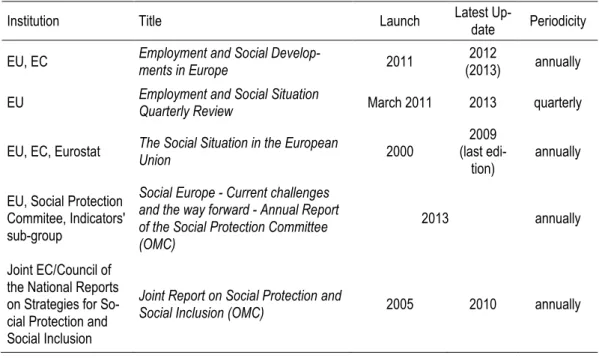
Encouraged by various European treaties, European Union institutions have been engaged in so-cial reporting activities at the European level for many years. The report The Soso-cial Situation in the European Union – a follow-up publication to the Social Portrait of Europe –used to be the flagship social reporting activity by the European commission during the first decade of the centu-ry. It aimed at fulfilling the Commission's obligation, according to Article 159 of the Treaty, to re-port on a wide range of social policy areas. As an annual rere-port it was published jointly by the Di-rectorate General of Employment, Social Affairs & Equal Opportunities and EUROSTAT from 2000
until 2010. The report – focusing on varying topics in each edition – covered issues of the quality of life of people living in Europe, demographic trends and issues of social conditions in a broad sense, with a view to providing background information for social policy development. Since 2011 the Social Situation Report has been replaced by a report on Employment and Social Develop-ments in Europe, which also replaces the previous Employment in Europe report. In addition, the Commission publishes the Employment and Social Situation Quarterly Review, which provides continuously up-to-date statistical information and analytic insights around these topics.
Table 2.1.2.1: Supranational Reporting Activities: European Commission
Institution Title Launch Latest
Up-date Periodicity
EU, EC Employment and Social
Develop-ments in Europe 2011
2012
(2013) annually
EU Employment and Social Situation
Quarterly Review March 2011 2013 quarterly
EU, EC, Eurostat The Social Situation in the European
Union 2000
2009 (last
edi-tion)
annually
EU, Social Protection Commitee, Indicators' sub-group
Social Europe - Current challenges and the way forward - Annual Report of the Social Protection Committee (OMC)
2013 annually
Joint EC/Council of the National Reports on Strategies for So-cial Protection and Social Inclusion
Joint Report on Social Protection and
Social Inclusion (OMC) 2005 2010 annually
In 2013 the European Commission and its Directorate General for Employment, Social Affairs and Inclusion launched the new report Social Europe - Current Challenges and the Way Forward. It is the first issue of a report to be published annually, prepared by the Social Protection Committee in the context of the social division of the Open Method of Cooperation (OMC) following the pre-viously published series of “Joint Reports on Social Protection and Social Inclusion”.3 The Social Protection Committee is a committee of high level officials from all EU Member States and the Commission. The new report focuses on the social situation in the European Union and key social trends, the evolution of resources and expenditure for social protection policies, issues of financ-ing and expenditure of social protection, and key policy developments within the three strands of the social OMC. An annex presents country profiles for each of the member states. The new re-port makes use of the “Social Protection Performance Monitor”, an instrument developed to
identify the main social trends to be observedand key positive social developmentsin the Euro-pean Union by the usage of a dashboard of main social indicators.
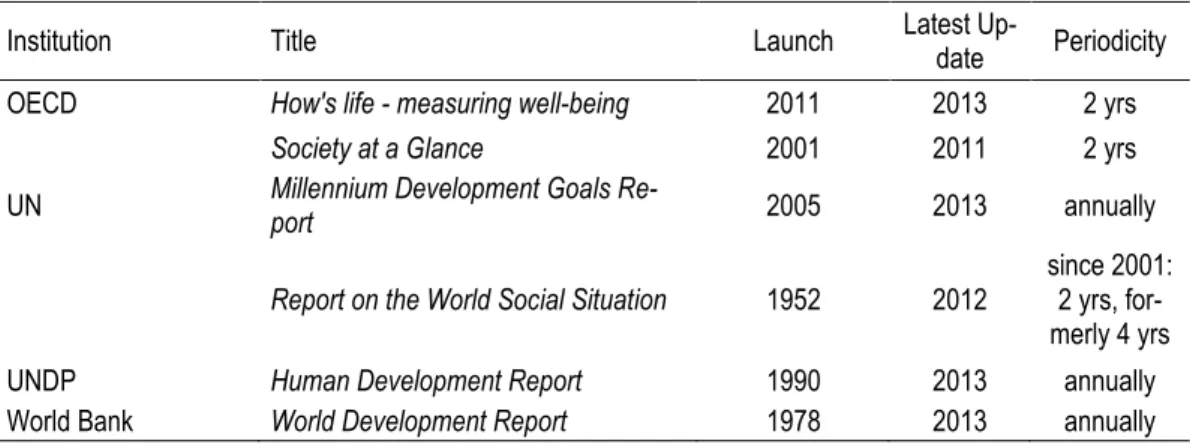
Table 2.1.2.2: Supranational Reporting Activities: other supranational organizations
Institution Title Launch Latest
Up-date Periodicity
OECD How's life - measuring well-being 2011 2013 2 yrs
Society at a Glance 2001 2011 2 yrs
UN Millennium Development Goals
Re-port 2005 2013 annually
Report on the World Social Situation 1952 2012
since 2001: 2 yrs, for-merly 4 yrs
UNDP Human Development Report 1990 2013 annually
World Bank World Development Report 1978 2013 annually
At the United Nations level, social reporting has similarly been considered as a major concern for decades (table 2.1.2.2). The Report on the World Social Situation (www.undesadspd.org/ReportontheWorldSocialSituation.aspx) has been published regularly since the early 1950s. This report, now published biennially (until 2001 every 4 years), identifies social trends of international concern and provides analysis of major development issues such as pov-erty, inequality or the global social crisis. The UN’s most popular flagship report, the Human De-velopment Report (www.hdr.undp.org/en), launched in 1990, has been published annually since then. Focusing on varying themes in each issue, e.g. sustainability or migration, the Human Devel-opment Reports provide detailed information, such as the Human DevelDevel-opment Index and a set of indicators, and thorough analysis regarding human development issues in a global perspective. More recently, the UN also launched the Millennium Development Goals Report
(www.un.org/millenniumgoals/reports), which is related to the Millennium Development Goals
Strategy (see above). Last, but not least, the World Bank has published a comprehensive annual social report as well since 1978, the World Development Report. Each edition addresses a specific development issue, such as jobs, gender equality or poverty.
2.2 Social Monitoring and Reporting Activities at European Level – Non Supranational Institutions
Although European Union institutions and supranational organizations are obviously the key ac-tors when it comes to social monitoring and reporting activities at a supranational, European lev-el, there are also some activities initiated and maintained by other institutions, such as research
institutes, think tanks or NGOs. The following section will present a sample of those activities con-sidered particularly interesting and relevant (table 2.2).
Table 2.2: Supranational Social Monitoring Activities: National Institutions and Non- Profit Organizations
Institution Title Launch Latest
Up-date Center for Global
De-velopment
Millennium Development Goals
Pro-gress Index 2009 2011
Center for Societal
Progress, Germany Fortschrittsindex/Progress Index 2010 2011
International Institute
of Social Studies Indices of Social Development 1990 2010
Legatum Institute
(UK) Prosperity Index 2011 2013
The New Economics
Foundation - nef (UK) Happy Planet Index 2006 2012
Social Indicators
Re-search Center (ZSi) European System of Social Indicators 2001 2014
Social Progress
Im-perative Social Progress Index 2013
Social Watch Basic Capabilities Index (BCI) 1990 2011
European System of Social Indicators: The European System of Social Indicators is one of the few comprehensive indicator systems to be used to continuously monitor the individual and societal well-being of European citizens in terms of quality of life, social cohesion and sustainability, as well as changes in the social structure of European societies (Noll 2002; Noll 2014).4 This indicator system, developed and maintained by the Social Indicators Research Centre at GESIS - Leibniz In-stitute for the Social Sciences in Germany, covers the EU member states, Norway and Switzerland as well as Japan and the United States as two major non-European reference societies. At present there are time-series data available for more than 700 indicators from 10 out of the projected 13 life-domains. A selection of key indicators address dimensions of well-being and social change considered to be particularly relevant. Year-by-year time series start at the beginning of the 1980s, as far as data availability allows. For selected indicators regional disaggregation is available at the NUTS-1 level. The Social Indicators Monitor - SIMon (www.gesis.org/simon) provides com-fortable online access to the time series data from the European System of Social Indicators5.
4For more information see also:
http://www.gesis.org/en/social-indicators/products-of-the-zsi/european-system-of-social-indicators/
5 SIMon also provides access to the time series data from the „German System of Social Indicators“, which
While the European System of Social Indicators is – according to our knowledge – currently the only comprehensive social monitoring activity outside the world of supranational organizations in terms of indicator systems, there are several composite index activities with a European scope. Among those activities, which have been initiated by supranational non-profit organizations or re-search institutes in recent years, are the Basic Capabilities Index, launched in 1990by the interna-tional network Social Watch (www.socialwatch.org), as well as a sample of Social development In-dices issued by the Institute of Social Studies (www.indsocdev.org/). There are also a couple of composite index activities with a European scope, launched by national institutions. Among those index activities are the Progress Index, launched by the Center for Societal Progress in Germany (www.fortschrittsindex.de),the Prosperity Index launched by the British Legatum Institute in 2011 (www.prosperity.com), as well as theHappy Planet Index (www.happyplanetindex.org), published by the London based New Economics Foundation.
Up to now we have seen very few social reporting activities with a European scope initiated out-side supranational organizations. A few publications resembling social reports, launched by the European Centre for Social Welfare Policy and Research, aim to monitor living standards and life chances for different groups within society across the EU and to evaluate how policies affect them. The European Observatory on the Social Situation - Monitoring Report was published from 2005 to 2009. Moreover, the Hungarian research institute Tárki published a European Social Re-port twice, in 2008 and 2009, which however were focused on demographic issues as well as the labor market, income and housing situation of households in Europe. The same institution has al-so published another focused report on European Inequalities: Social Inclusion and Income Distri-bution in the European Union. A non-official, research based comprehensive European Social Re-port has not been published yet.
2.3 Sustainable Development
Monitoring and reporting activities on sustainable development at a supranational level are in their majority guided by sustainable development strategies initiated by supranational organiza-tions, such as, for example, the Sustainable Development Strategy of the EU (2001, renewed 2006) and the Europe 2020 Strategy, the 10-year strategy following the Lisbon strategy, which aims to achieve more sustainable and smarter growth. Monitoring and reporting activities in the field of sustainable development have also been stimulated by the initiative on Measuring Pro-gress, Well-Being and Sustainable Development by the European Statistical System’s Sponsorship Group, the recommendations launched by the Stiglitz-Sen-Fitoussi Report, as well as the “GDP
and beyond” communication from the European Commission to the European Council and the Eu-ropean Parliament (EuEu-ropean Commission 2009).
According to the European Sustainable Development Strategy, Eurostat regularly provides the
Sustainable Development Indicators, updated every other year since 2005, and publishes the Monitoring Report Sustainable Development in the European Union, first published in 2011. Worth mentioning in this context are also a few FP7-research projects, which are related to issues of sustainable development: e.g. POINT - Policy Influence of Indicators (2008-2011) or INSTREAM - The Integration of Mainstream Economic Indicators with Sustainable Development Objectives
(2008-2011).
In 2011 the OECD also launched a sustainable development strategy under the label “Green Growth”. Within this framework, the OECD has published the report Towards Green Growth: Monitoring Progress - OECD Indicators, presenting the conceptual framework for developing green growth indicators.
The Agenda 21 is the United Nations’ strategy for sustainable development. National, interna-tional and regional institutions are called on to implement the program through strategies, poli-cies and procedures. There is also a Local Agenda 21 providing a framework for local level activi-ties. The Agenda 21 was adopted in 1992 at the UN Conference on Environment and Develop-ment (UNCED) in Rio de Janeiro. The latest UN conference, Rio+20, was held in 2012. Reports on sustainable development, such as the CSD National Reports, which are based on the CSD Indica-tors at UN level, are chiefly published by the Commission on Sustainable Development (CSD). There are also joint initiatives, in which several supranational organizations are involved. Worth mentioning here are the Working Group on Statistics on Sustainable Development and the Task Force on Measuring Sustainable Measurement, joint activities of UNECE, Eurostat and the OECD. This working group seeks to establish a common understanding of sustainable development and to define core principles of sustainability measurement. A framework and set of “suggested indi-cators to measure sustainable development” published in 2013 has been one important outcome (Joint UNECE/Eurostat/OECD Task Force on Measuring Sustainable Development 2013).
Other activities in the field of monitoring sustainable development include composite indices of sustainable development. One example is the Ecological Footprint index, developed by the inter-national Ecological Footprint Network in 1990. It is supposed to measure a person's demand on the biological capacity of the earth, or – in other words – man’s impact on nature. It has been cal-culated for individuals, groups of people (e.g. nations) as well as certain activities, but does not
cover social dimensions of sustainable development.6 The same applies to the
Adjusted Net Sav-ing index published by the World Bank in 2006. Other composite indices – in contrast – also in-clude the social dimensions of sustainability: Among those indices are the Human Sustainable De-velopment Index (UN 2010), which combines the Human Development Index with per capita car-bon emissions, as well as the FEEM Sustainability Index, published for the first time in 2009 by the Italian Fondazione Eni Enrico Mattei, which covers economic, environmental and social dimen-sions. Last but not least, the Sustainable Society Index (SSI), released by the Dutch Sustainable So-ciety Foundation in 2006, should be mentioned. It’s objective is to measure human, environmen-tal and economic wellbeing, based on 21 indicators all together.
3. Social Monitoring and Reporting in Europe: National Activities 3.1 Northern Europe
This section on Northern Europe covers the Scandinavian countries (Denmark, Finland, Iceland, Norway, Sweden) as well as the Baltic States (Estonia, Latvia, Lithuania). Although the latter were part of the Soviet Union until regaining independence in the early 1990s and thus – due to their socialist past – also bear similarities to some of the Eastern European member states of the Euro-pean Union, the Baltic countries have always maintained strong economic and cultural ties to the Scandinavian countries. The Scandinavian countries also provided economic and political support to the Baltic States after regaining independence and not least promoted the development of sta-tistical services as well as social monitoring and reporting activities. There are thus some good reasons to consider the Baltic states as part of Northern rather than Eastern Europe in our stock-take of social monitoring and reporting activities.
Looking at the history of social monitoring and reporting, the Scandinavian countries certainly were among the forerunners and trendsetters and can thus look back on a long and rich tradition of those activities. Observers have pointed to the fact that "national social reporting obviously was promoted best in Europe under the preconditions of an articulated welfare state program of social policy, an interventionist orientation of government and innovative statistical agencies" (Noll/Zapf 1994: 5), conditions which were particularly well developed in Scandinavia. In contrast to the Scandinavian countries, social monitoring and reporting activities in the Baltic States are more recent and have emerged only after the transition to a post-socialist political system.
3.1.1 Social Monitoring
Table 3.1.1 presents an overview of the monitoring instruments identified in Northern Europe and specifies their main characteristics.
Overall, there is currently only a limited number of social monitoring activities going on in Scandi-navia. Two more recent ones have been initiated in Finland: “Findicator” and the “Welfare Com-pass”.
Findicator – Indicators for Social Progress (www.findikaattori.fi) is a joint initiative by Statistics Fin-land - the Finnish national statistical institute - and the Prime Minister’s Office, which was launched in 2009. Findicator is an Internet-service aimed at providing online access to indicators
and data considered as relevant and topical for measuring and monitoring social progress. Findi-cator allows access to about 100 social indicators, structured by 12 domains and presented in
Table 3.1.1: Social Monitoring Activities in Northern Europe
Country Institution Title Launch Latest
Update
Scandinavia
Finland Statistics Finland,
Prime Minister's Office
Findicator - Indicators for Social
Progress 2009 2013
Finland National Institute for
Health and Welfare Welfare Compass 2012
Baltic States
Estonia Statistical Office of
Es-tonia
Main social and economomic
in-dicators of Estonia 2000 2007
Latvia
Latvijas Statistica - Central Statistical Bu-reau Key Indicators 1993 (engl. 1998) 2013
Lithuania Statistics Lithuania Main indicators of economic and
social development 2013
Lithuania Statistics Lithuania Quality of Life Indicators 2005 2011
three languages. In addition, a set of sustainable development indicators is also available. Follow-ing the Scandinavian tradition, Findicator is almost exclusively based on objective indicators and only includes very few subjective measures, such as “fear of crime”. The data are regularly updat-ed and accessible in different formats (graphs, tables), which also allows comfortable further us-age and manipulation of the data for different purposes.7
Findicator, moreover, provides access to the statistical databases behind the indicators and enables users to do their own calculations, alt-hough these possibilities are limited to rather simple analyzes of course. As a modern social moni-toring instrument, Findicator may certainly be classified as an example of “good practice” in Eu-rope.
The Welfare Compass ( http://hyvinvointikompassi.thl.fi/en/web/hyvinvointikompassi/tietoa-palvelusta),launchedby the Finnish National Institute of Health and Welfare in 2012, is another more focused social monitoring tool, providing access to circa 100 key indicators for health, wel-fare, and social and health services. The data are presented at national, regional, and eventually also at municipal and hospital-district level. For selected indicators international comparative data
are also available. The Welfare Compass project is not yet fully implemented and still under de-velopment.
The Quality of Life Indicators initiative launched by the Lithuanian national statistical institute (http://web.stat.gov.lt/en) in 2011 turns out to be the most interesting social monitoring activity identified in the Baltic States. The set of 15 indicators, covering fields like income, housing, em-ployment, health and education, have been selected by following the proposals of the European Statistical System’s Sponsorship Group “Measuring Progress, Well-being and Sustainable Devel-opment” (European Statistical System 2011). The current selection of indicators is supposed to be revised in the near future “in order to better implement quality-of-life measurement tasks: to provide policy-makers with information about what is making European citizens (un)happy, and, above all, what are the main differences between various social groups in terms of overall well-being (quality of life)” (see website).
Other monitoring activities in the Baltic states include the “Main Social and Economic Indicators” (Estonia, Lithuania), covering socio-economic, financial and macro-economic indicators, published quarterly by the National Statistical Institutes in these countries, as well as “Key Indicators”, regu-larly published by the Latvian National Statistical Institute since 1993. The latter monitoring activi-ties are, however, primarily based on traditional economic and social statistics, and are thus only in a limited sense to be considered as tools qualified to measure and monitor well-being directly.
3.1.2 Social Reporting
Social reports have been published in the Nordic countries since the mid-1970s, and in the Baltic states only since the early 2000s. Table 3.1.2 provides an overview of currently existing as well as some previous social reporting activities in Northern Europe and lists their basic characteristics. The Scandinavian countries – particularly Sweden, but also to some extent Finland – were not on-ly among the forerunners in social reporting, but also had a strong influence on social reporting activities in other parts of Europe and beyond. The early Scandinavian social reporting activities were primarily characterized by: (1) a strong conceptual underpinning, (2) an explicit policy orien-tation, (3) the development of specialized welfare surveys to be used as databases for social re-porting, and (4) the leading role of the National Statistical Institutes.8
8 For more detailed information on social reporting in the Nordic countries see Habich/Noll (1994), Uusitalo
Table 3.1.2: Social Reporting Activities in Northern Europe
Country Institution Title Launch Latest
Update Periodicity
Scandinavia
Denmark Danmarks Statistics
So-cialforskningsinstituttet Levevilkår i Danmark 1976 1999 4-5 yrs
Norway Norges Offentlige
Utred-ninger
Levekår i Norge. Er graset grønt
for alle? 1993
Norway Statistics Norway Social Trends 2000 2001
Norway Statistics Norway Sosialt Utsyn/Social Survey 1974 2000 irregularly
Sweden Statistika Centralbyran Perspektiv på Välfärden 1982 2004
Sweden
Socialstyrelsen (National Board of Health and Wel-fare)
Social rapport/Social report 1994 2010 irregularly
Baltic States
Estonia
Fafo Norway, Tartu Uni-versity, University of Lat-via
Poverty in Estonia. Overview of main trends and patterns of poverty in the years 1996–2002
2005
Estonia Statistical Office of
Esto-nia
Sotsiaalelu arvudes. 2007.
So-cial Life in Figures 2008
Estonia Statistical Office of
Esto-nia Sotsiaaltrendid. Social Trends 1998 2010 3 yrs
Latvia Latvijas Statistica -
Cen-tral Statistical Bureau
Material Deprivation of Latvia in
2011 (only in Latvian) 2012/02 2013
Lithuania Statistics Lithuania Economic and Social
Develop-ment in Lithuania 2012 monthly
Conceptually, social reporting in the Scandinavian countries has been mainly driven and shaped by the so-called “level of living approach”, which proposes a notion of welfare or well-being as the “individual’s command over resources by the help of which one can control and purposely direct one’s living conditions” (Uusitalo 1994: 106) and thus gives strong priority to objective measures and indicators to be used in social reporting.9 An alternative notion of well-being proposed by the eminent Finnish sociologist Erik Allardt (1973), distinguishing three major dimensions of welfare – having, loving, and being – and also including subjective components, had only limited impact on institutionalized social reporting activities in the Nordic countries and elsewhere. The primary da-tabase – the “level of living survey” – which had been explicitly developed for social monitoring and reporting purposes, had its origin in a pioneering study at the Swedish Institute for Social Re-search and was directed by Sten Johansson, the later Director General of Statistics Sweden. In subsequent years, the “level of living surveys” were carried out by Statistics Sweden. Similar sur-veys were also organized in other Scandinavian countries, coordinated by the “Nordic Committee
for Surveys on Living Conditions”, and have been used not only for national social reports in these countries, but also for a supranational “Social Report for the Nordic Countries” (Vogel 1991). The long tradition of social reporting in the Nordic countries, grounded in a well-institutionalized system of official data collection, is documented in a series of comprehensive and special social reports published since the 1970s, in their majority by the National Statistical Institutes (Table 3.1.2). In the meantime, however, some of these long-established reporting programs have been discontinued, such as Sosialt Utsyn (Norway, 1976-2000), Perspektiv på Välfärden (Sweden, 1982-2004), Levevilkår i Danmark (Denmark, 1976-1999).10 The only comprehensive report in Scandina-via which is still regularly published is the Social Rapport/Social Report released by the National Board of Health and Welfare in Sweden. This report has a focus on social problems and particular-ly disadvantaged population groups and covers the following domains: migration, employment, poverty, health, elderly people and education. In 2010, the National Institute of Health and Wel-fare published a report on Welfare in Finland (available in Finnish only), which is the fourth report in an intermittent series.
Most of the Scandinavian reports mentioned are – due to the underlying “level of living” concept – similarly structured, covering a core set of life domains, and making primarily – if not exclusively – use of objective indicators. A common feature of social reporting in the Scandinavian countries is, moreover, the strong emphasis put on issues of equality or inequality.
Besides the long established and regularly published comprehensive reports, there are also a few one-time publications that should be considered social reports and which seem worth mention-ing, such as Social Trends 2000, a publication from Statistics Norway. The report was published in the series “Statistical Analyses” and focuses on the state of and changes in the living conditions in Norway at the end of the 1990s. Another similar report is Levekår i Norge. Er graset grønt for alle?
It was published in 1993 by the Norwegian administration services and provides an overview on living conditions in Norway, covering the domains of income, education and employment. It also provides information on the living conditions of specific groups within society, such as children, the elderly, immigrants and disabled people.
In the Baltic States, social reporting is actually not yet well developed, according to our inquiries. At present, Estonia turns out to be the only Baltic State where a comprehensive report – Sotsiaal-trendid / Social Trends (www.stat.ee/65394) – has been published regularly every third year by