© 2005, Instituto de Estudios Fiscales
Establishing a Performance Management Framework
for Government
1*
JACK DIAMOND
International Monetary Fund Fiscal Affairs Department
Recibido: Abril 2005
Aceptado: Mayo 2005
Abstract
Based on the experience of budget management reforms that have been introduced over the last two decades in a lar-ge number of member countries of the Organization for Economic Cooperation and Development (OECD) it is not uncommon to find emerging market economies moving toward performance-based budgeting where measures of performance play a key role. While it might be tempting for middle income countries to press forward to adopt a full-blown outputs and outcomes framework, there are some risks in the move. Such a change in orientation is only possible once managers have had adequate experience in refining the definition of programs and their objectives, and on this basis developing a comprehensive system of performance measurement. It is argued in this paper that to develop a comprehensive performance measurement system requires resolving a number of issues involved in clearly defining how to measure «performance» as well as overcoming a number of technical issues in the design and use of measures of that «performance». However, perhaps the most critical step is introducing a system whereby performance information can influence resource allocation decisions, i.e., establishing a performance management system. Based on international experience, this paper reviews each of these hurdles in moving toward a performance management framework.
Key words: Performance Budgeting, Performance Measurement.
JEL Classification: E6, D7, P2.
I. Requisites for Moving Toward a Performance Management
Framework
Based on the experience of budget management reforms that have been introduced over the last two decades in a large number of member countries of the Organization for Eco nomic Cooperation and Development (OECD), it is not uncommon to find emerging econo
* This Working Paper should not be reported as representing the views of the IMF.
The views expressed in this Working Paper are those of the author(s) and do not necessarily represent those of the IMF or IMF policy. Working Papers describe research in progress by the author(s) and are published to elicit comments and to further debate.
mies moving toward performance-based budgeting. Many have completed the first step of this process by moving away from the traditional emphasis on managers’ stewardship of public resources and on compliance within strict detailed appropriations. This usually in volves implementing some form of program management and budgeting, along ministry of finance (MOF) lines, where there is greater emphasis on achieving efficient and effective outputs and outcomes. In this process, measures of performance have tended to play a key role as a basis for introducing initiatives such as strategic planning, performance agreements for selected services, remuneration bonuses based on performance, and external evaluation of agency programs.
While experience differs within the OECD, there are evidently different channels whereby performance measurement has exerted a positive influence on public expenditure management. In budget preparation, the wider use and availability of performance data has strengthened the hands of the ministry of finance in challenging the budget proposals of line ministries. Budget execution has been strengthened generally by allowing comparisons be tween poor and good performers and allowing both external as well as peer pressure to stim ulate reforms in service delivery. This has been made more formal by introducing contrac tual agreements for service managers with explicit performance targets. In Australia and New Zealand, there has been a more formal linking of performance measures with budget al locations, while in most other OECD countries these linkages are more indirect.
While it might be tempting for middle-income countries to press forward to adopt a full-blown performance management framework, such as that implemented by countries like Australia and New Zealand 2, there are evident risks in the move. Such a change in orienta tion is only possible once managers have had adequate experience in refining the definition of programs and their objectives, and on this basis developing a comprehensive system of performance measurement. The latter is usually lacking in emerging market economies, but at the same time is recognized as critical to the successful implementation of a performance budgeting and management system. It is argued below that to develop a comprehensive per formance measurement system requires first clearly defining how to measure «perfor mance»; secondly, overcoming a number of technical issues in the design and use of mea-sures of that «performance»; and thirdly, making performance information relevant for resource allocation decisions, i.e., establishing a performance management system. This pa per reviews each of these dimensions in moving toward a performance management frame work.
II. Different Measures of Performance
A general consensus is emerging in OECD member countries that performance mea surement improves the quality of management by helping officials make better decisions and use resources more effectively 3. Quantifying performance allows managers to monitor changes, identify potential problems, and take timely corrective action. Data that describe performance in terms of where the agency has been, where it is today, and how it compares with other similar agencies allows managers to direct resources to (and officials to support)
activities that are successful. Performance measures also influence employee behavior. When employees know the basis on which they will be assessed, they are more likely to per form. For the government as a whole, it can be argued, performance recognition builds trust and enhances credibility with taxpayers.
In accepting the need for performance measurement, it is important not to underesti mate the problems in its implementation. There is general agreement that the critical first step in implementation is to define performance. Trying to measure performance demands that organizations clearly articulate their objectives, and hence the basis on which perfor mance will be measured. Performance cannot be measured until these objectives are trans lated into measurable desired results. This process itself has been considered invaluable. It has been argued that the very act of defining the desired results to be achieved has enormous power to focus the energies of an organization 4. Unfortunately, this first step of defining the dimensions of performance is often quite difficult for government agencies. Performance is system-specific and depends ultimately on the goals of the wider budget management sys tem. If the budget management system is a traditional one, performance will be defined by measures of compliance and stewardship. On the other hand, if the budget management sys tem is outcomes focused, and judges success in terms of impact on society, in this case per formance will be defined by measures of the effectiveness of outputs produced. The need to refer to the budget system’s basic orientation when defining performance is illustrated in Figure 1, which also attempts to define some specific performance terminology.
Figure 1 describes in somewhat abstract terms a government «production process» 5. The process commences from the cost of acquiring inputs, the use of these inputs in a pro duction process, to the production of outputs that have an outcome, in the sense of meeting some defined objective of government policy. Arising from this process there are a range of possible indicators of performance. Traditional budget systems focus on inputs, the amount of resources actually used (usually expressed as the amount of funds or the number of em ployee-years), or both. The key concept is economy, or the aggregate control of input costs at the margin. In output-focused budget systems, inputs are related to an agency’s output to produce indicators of efficiency or productivity 6. In outcome-focused budget systems, an agency’s outputs are related to the achievement of its ultimate goals producing indicators of effectiveness. In such systems, often costs are compared with the final outcomes attained to give measures of cost effectiveness, or sometimes termed value-for-money indicators.
In performance budgeting, therefore, there are a number of ways that spending can fail to meet expected «performance», and it is important to differentiate the source of this perfor mance failure in order to specify the cure:
• Technically inefficient: arising from resources not being employed in the techni cally best way to produce a given output or service level. The attainment of technical efficiency implies that it is impossible to reduce the physical level of any input wit hout reducing the level of output. The failure to attain the maximum possible output level with given inputs has been referred to by Liebenstein as X-inefficiency 7, and must be resolved by improving and changing the internal functioning of organiza tions and the units that comprise them.
Systems Budget Different in Performance of Concept The 1. Figure P erformance Concepts T raditional Budgets
Based on standards and rules on how inputs should be allocated.
Emphasis on economy
Input types constrained, outputs not constrained
i.e. least cost inputs
Output-F
ocused Budgets
Based on services delivered and products produced
Emphasis on relating inputs to outputs
Outputs constrained, inputs not constrained
i.e. efficiency
T echnically Efficient
Costs Inputs Process
Economically Efficient
Value for money
Outputs
Performance Budgeting
Effectiveness
Style of Budget Management
Economy
Outcomes-F
ocused Budgets
Based on what is to be achieved, with emphasis
on outcomes and impact.
Outputs not constrained, inputs types constrained
i.e. the effectiveness of outputs produced
• Economically inefficient: arising from resources not being employed in the most economically efficient way, so that a higher return in the form of a higher provision of service can be obtained without increasing costs by switching spending between resources. The attainment of economic or allocative efficiency implies that it is im possible to substitute one input for another without increasing total costs of a given output or service level.
• Technically ineffective: expenditures are not effective in the sense that although re sources are allocated efficiently (both in a technical and economic sense) to provide a certain service, the service itself does not satisfy the objectives it was designed to meet.
• Economically ineffective: expenditures can be efficient (in the sense that resources are allocated to produce the maximum output of a certain service at least cost), and effective (in the sense that the output has the desired outcome), but overall effective ness in the use of public resources could be increased by cutting some expenditures and reallocating the resources to other services, i.e., becoming more allocatively ef fective.
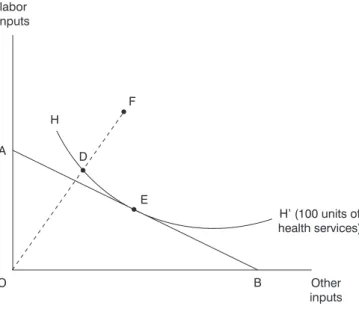
Some of these performance concepts are illustrated in Figure 2, where curve HH’ shows all the different combinations of labor and other inputs to produce a given output of health service, say, rural disease prevention. The line AB shows the available budget for this service which can buy OA units of labor, or OB units of other inputs, or any combination along the line AB. The slope of AB reflects the relative prices of labor and other inputs. If the service delivery is operating at point F, this is technically inefficient. All the points above HH’ use more of at least one input than is required. Technical efficiency can be increased by
Figure 2. Technical and Economic Efficiency
labor inputs A O Other inputs H’ (100 units of health services) E D F H B
a more efficient allocation of resources to reach point D. However, even though at point D the service delivery is technically efficient, this may not be economically efficient since costs can be reduced by reallocating the mix of labor and other inputs to reach point E. With this combination of labor and other inputs, it is possible to deliver the same service at least cost.
Suppose the objective is to prevent disease in rural areas by providing the services of rural health clinics. While the service delivered may be technically and economically effi cient at point E, it may not be technically effective in the sense that it may not actually pre vent disease in rural areas. For example, the rural health clinics may not be within easy ac cess of disease ridden areas. This is a technical flaw to be resolved by health specialists and not one to which economists can make much contribution. However, even if service delivery was technically effective in eliminating disease in the rural population, this does not mean it is economically effective. It may be possible, for example, to attain the same level of disease prevention through less costly improvements in rural water supply. In the latter case, the government’s service would be more cost effective, or would attain best value for its money 8.
Different dimensions of performance vary in the way they can be improved through better systems of budget management. As indicated, technical inefficiency is symptomatic of more general shortcomings in the internal organization and procedures of the producing unit. This type of inefficiency, Liebenstein argues, is likely to be the greatest source of ineffi ciency, particularly in the public sector. It is also the one that is more amenable to improved budget management. To some extent, improved budget procedures can promote economic efficiency. At the same time, it must be recognized that for other sources of nonperforming expenditures involving the lack of effectiveness of expenditure programs, the role of budget management is necessarily more circumscribed. Questions linking resource allocation to ob jectives are more clearly in the realm of policy. In this case, the role of improved budget management tends to be supportive to facilitate and improve the process of making such pol icy choices through greater transparency and the provision of timely and relevant perfor mance information.
III. Defining a Framework for Performance Measurement
Moving from the above rather schematic description of the dimensions of performance to the practical problem of developing a framework for measuring performance in govern ment requires addressing some key issues:
• Output or outcome?
«Performance budgeting» is a term that often refers to both output- and outcomes-fo cused budget systems. The properties desired by both of these concepts are described in Boxes 1 and 2 below. There is an ongoing debate between the value of focusing on output as against the outcome or impact of these outputs. This debate tends to be at two levels. Firstly, there are the evident practical measurement problems. Often, outcomes are difficult to mea
sure directly (e.g., greater national security) or they are complex, for example, in the case where there are interlinkages between a number of different programs and subprograms (e.g., lower morbidity rates). Secondly, at a higher level, there is controversy over account ability-what should managers be held accountable for? On practical grounds, output is gener ally what the agency can exert control over, but the ultimate outcome is often determined by external factors, usually of an unpredictable nature. Also, observed outcomes can be inter preted in different ways. Rather than what the agency’s program itself achieved, outcomes can be interpreted as the consequence of what the program did, so that outcomes can be con sidered as including side effects, whether intended or not. Thus the Office of Management and Budget (OMB) in the United States focuses on intended outcomes 9, while others like Australia report ex post on the total outcome, intended and unintended. This has led some writers to differentiate outcome, based on intended effects, from impact, which would in clude the total effects of the agency’s actions. Others differentiate between different levels of outcome, or like Hatry differentiate between intermediate and end outcomes 10. For example, some countries like the United States and United Kingdom make a distinction between dif ferent levels of outcomes depending on the time horizon.
Clearly «performance» in government is subject to different interpretations. However, it does appear that in the OECD member countries there is increasing recognition that the output approach has limitations and may deflect the attention of delivery agencies from the impact of their programs, which from the government viewpoint is the more relevant con cept 11. As a consequence, more and more OECD member countries are adopting an out come-focused approach. At the same time, it should be recognized that many OECD govern ments preceded this move with extensive use of output measures 12.
Box 1. Desirable Properties of Outputs
• Should be a good or service provided to individuals/organizations external to the agency.
• Should be able to be clearly identified and described.
• Should be for final use and not for an internal process or intermediate output.
• Should contribute to achievement of planned outcomes.
• Should be under the control (directly or indirectly) of the agency.
• Should be able to generate information on attributes of performance-price, quantity, and quality.
• Should generate information that is a basis for performance comparisons over time or with other actual or potential providers.
Example: policy advice
Output: briefs or submissions prepared Quantity: number
In preparing the budget, it will be necessary to determine and agree performance targets for each output measure. These should be chosen selectively, with priority on their clarity in interpretation, so that they provide an undisputed indicator of the degree of output (and even outcome) achieved in any time period. The approach is to specify the output as a rate, and the frequency with which the target will be met. Additionally, it is useful to set out the informa tion on which each target will be estimated, perhaps based on actual performance data for previous periods, as well as identifying the implications for the cost of the output if there is a significant difference between expected and actual target achievement. The latter will pro vide a platform from which the operating unit could analyze and explain any variances in performance 13. The United Kingdom, in designing its Public Sector Agreements within gov ernment, has placed much emphasis on the importance of setting meaningful targets along side agencies’ budgets. This, it is argued, not only assists managers in improving their agency’s performance, but as a means of allowing the center to identify polices and pro cesses that work as well as in enhancing public accountability 14. To use the U.K. acronym, in their selection these targets should be SMART: Specific, Measurable, Achievable, Rele vant, and Timed. It has been found, however, that as there has been a shift in focus from out puts to outcomes, the technical problems of measurement have increased, and it has had to be admitted that setting targets for some outcomes is inherently difficult 15.
Box 2. Desirable Properties of Outcomes
• Should adequately reflect the government’s objectives and priorities.
• Should be indicated by the impact on the community.
• Should be differentiated from the agency’s strategies to which they contribute.
• Should clearly identify target groups, if so focused.
• Should be achievable in the specified time frame.
• Should be possible to monitor and assess the achievement of the outcome.
• Should be possible to identify the causal link between agency’s output and the outcome.
• Should have clarity in definition and description to be easily reported exter nally.
Example: Ensuring young homeless people have access to appropriate accommodation. Made more precise by including a target: 90 percent of young homeless have access to appropria te accommodation within 24 hours.
Operationalized by clearly identified target group, definition of «appropriate housing,» and cau sal link between agency action, such as assistance through a subsidy.
• Process indicators
It is also important not to neglect process. This generates indicators of workload, throughput, and work rate, which give important measures of the technical efficiency of an
agency’s operations. Such process indicators of performance include the amount of work that comes into a program or work in progress but not yet being completed 16. While amounts of work by themselves are not outputs or outcomes, workload data can be used as an input to produce output data: for example, the amount of work not completed as a proxy for delays in service to customers, a quality dimension of output (see below). There are some activities where it is difficult to measure outputs or outcomes but where process-related mea-sures may still be a useful to access performance. It cannot be denied that often the major gains to be made in budget system reform are made in improving process, and eliminating the so-called «invisible» X-inefficiency in government operations.
• The quality dimension
This is an important consideration for the efficiency of service provision, where effi ciency as measured by the ratio of outputs to inputs can be improved by reducing quality of the output. If outcomes are tracked, a more accurate indicator of efficiency becomes possible by including a quality dimension, which can be broken down into various characteristics shown in Box 3. While some regard quality characteristics as an output, others like Hatry designate them as a special type of intermediate outcome, since quality characteristics indi cate how well the service was delivered but do not indicate what results occurred after the service was delivered. All agree, however, that quality of service is an important dimension to measure and to track, although the mode of tracking is often disputed. Some governments have questioned the value of internal measures of quality (e.g., Denmark) and have empha sized rather client surveys of the level of service satisfaction. Although both approaches are important, certainly client surveys provide an important «reality check» on formal indicators of quality that are generated internally. Moreover, an important question remains: since there are many dimensions to quality, who decides what qualitative characteristics are important for a particular service?
Box 3. Typical Service Quality Characteristics • Timeliness in service provision.
• Accessibility and convenience.
• Accuracy of the assistance.
• Courtesy in service delivery.
• Adequacy of information dissemination to potential users.
• Condition and safety of agency facilities used.
• Customer satisfaction. Source: Hatry, 1999, p. 17.
• Relating performance to inputs
Ultimately, for resource allocation decisions there is a need to relate output and out-come measures to costs. This is often difficult because accounting systems are not necessar
ily set up to bring cost data together on a program basis and hence data on inputs is not readily available on a timely basis 17. Often in emerging market economies, especially in transitional economies, this is aggravated by the fact that the role of cost accounting is not developed and there is little expertise to carry out this work. In any case, the work is often not straightforward. Allocating costs to programs can be a major problem in cases with large central overheads and in activities where more than one service is being delivered 18. Thirdly, there may be limitations in the accounting system, especially if cash based, that may not be able to record the full costs of capital since depreciation is not included. Fourthly, there is a need to focus on marginal rather than average cost that is typically more difficult to measure. Confusing average efficiency for marginal efficiency may cause extra resources to be allocated to programs with proven average efficiency but where the additional resources have little impact on output. These practical costing problems are often important since fea sible performance measures are those that can be established at reasonable cost and this may well depend on the availability of reliable cost data.
IV. Using Performance Measures
While it is undeniable that performance measurement is a key tool in the process of im proving the delivery of public services, this should not be viewed as an end in itself, but part of a wider reform process. Performance measurement has become so popular it has tended to lead the reform process rather than be seen as an integral part of a wider performance man agement reform. While many benefits flow from the mere act of trying to measure perfor mance, to be fully effective performance measurement must be integrated into a performance management system. Failure to recognize this, and to move from performance measurement to performance management, gives rise to some concerns.
• The danger of overreliance on Performance Measures
There is a significant danger of overreliance on performance measures-they tend to of fer clues to the success/failure of a program, but usually a comprehensive evaluation process is required to confirm this, which is unfortunately not a costless activity 19. It is important to recognize that performance measurement has at least three limitations 20. First, perfor mance data do not by themselves tell why the outcomes occurred, that is the extent to which the program caused the measured results, because there is unlikely to be any practical counterfactual. A performance measure assumes some causality between a program’s activi ties and its outcomes, but one which can only be confirmed ex post through a properly de signed evaluation study. Secondly, it should be admitted that some outcomes cannot be mea sured directly. The most obvious example is success in preventing undesirable events. Thirdly, it should be recognized that the information provided by performance measures is just part of the information that is needed by managers and elected officials to make resource allocation decisions. Performance information may provide a clearer understanding of what is expected and what has been accomplished, but other supporting information will be re quired. For example, the costs of providing goods and services by alternative approaches can
be derived from agency accounting and finance officers providing financial and resource in formation, or from benchmarked cost data.
In sum, it might be best to view the major purpose of performance measurement as nec essary but not sufficient to determine what should be done. This implies managers cannot rely solely on performance measurement for decision-making 21. It is interesting to note that the private sector is moving away from the narrow focus on outcomes measurement toward a broader approach as evidenced in the «balanced scorecard» (Kaplan and Norton, 1992), that has also attracted some interest within OECD governments 22.
• Danger of inappropriate measures
It also should be recognized that measuring performance is not an easy job that gets even more difficult as measurement moves from program outputs to program outcomes. In this paper there has been a deliberate use of the term performance measurement rather than performance indicator. When dealing with processes and outputs there is greater assurance over the consistency in the interpretation of the measures of performance. When one deals with outcomes, direct measures are often difficult, hence the measures can only «indicate» the outcome rather than directly measure it. Often it takes more than one indicator to ade quately capture an outcome, further complicating interpretation 23. Not surprisingly, perfor mance indicators tend to be subject to a greater degree of interpretation and hence are more open to abuse as well as to the danger of selecting inappropriate indicators. A concern in the use of performance measures is that the measures displace the actual outcomes as an agency’s objectives. This «goal displacement» can often lead to emphasizing the wrong ac tivities (e.g., those that are easier to measure) and to an agency’s energies being spent in im proving «the numbers» without improving actual outcomes 24. An obvious example is the usual bias of performance measurement to the short-term, for ease of measurement. How ever, there is a distinct danger that the short-run beneficial outcomes may result in increased costs over the longer-run, with an undesirable shifting of costs into the future.
• Danger of misuse
Inevitably performance measures require careful interpretation, and adequate knowl edge of the different factors impacting the measures. This need for interpretation brings its own dangers. Experience has shown that no matter how clearly defined, performance indica tors are invariably recorded and interpreted in very different ways by different people. More over, when people feel the future of a program is dependent on an indicator, a positive bias may come into play-they inevitably will interpret them in the way that is most favorable to the agency. Perhaps of more concern is the danger of introducing performance measurement without the managers’ commitment to the new performance management system. Often at tempts are made to enforce such commitment from above, or from the outside by the legisla ture, by demanding performance information. Experience has shown that when managers and staff are required to collect and compile performance measures that are recognized as in appropriate or will never be used by the agency, they will become cynical about performance measurement and more likely to seek ways to use it to their own ends. Often the greater the pressure from above, the more the pressure from below to subvert the system. As more at tempts are made to use performance measures, the higher the stakes become and the greater
the incentives for people to identify self-serving performance indicators and to report mis leading performance data. Hence the need to provide managers with incentives to buy-in to the new performance measurement system, such as offering increased managerial flexibility.
• The danger of information overload and lack of selectivity
Performance indicators can be irrelevant for decision-making, even if they are accurate. The essence of performance measurement is to reduce the multidimensional aspects of the program’s outcome to a few measurable indicators 25. This is often recognized as leading to oversimplification, and hence gives rise to the counterpressure to employ multiple measures of performance. However, from a decision-making viewpoint this may not be a solu tion-more data make decisions more informed not necessarily easier 26. This may also result in confusion between different types of indicators and their use. For example, an approach to use a weighted average of different measures may lead to misleading aggregate indicators as critical subgroup differences are lost in the aggregation process.
V. Guidelines for Using Performance Measures
How to guard against the above dangers? The experience of practitioners in perfor mance measurement points to some guidelines, namely:
• Aim for clarity in purpose
First, it is necessary to be sure about who will use the performance information, how they will use it, and why they will use it. There are many potential users of performance in formation, ranging from the program manager, the central evaluator in the ministry of fi nance, the member of a legislative watchdog committee, and the final consumer of the gov ernment service. Each of these potential users has different objectives: for example, making better resource allocation decisions, improving services, increasing accountability, etc. Mea-sures should only be chosen when users are identified and their objectives properly defined. The ultimate aim should be to help the user reach more informed conclusions and to make better decisions about service performance.
• Focus on core information
Second, once the purpose has been clarified there should be a conscious effort to priori tize between different performance measures to avoid information overload. It is usually rec ommended that in the first instance the focus should be on the priorities of the entity, i.e., its core objectives and service areas. Often it takes sufficient time and effort to establish success criteria for these priorities and objectives without widening the scope of performance mea surement.
• Align with practical needs of the agency
Third, it is necessary to make performance information as relevant as possible to the agency. To do so requires performance measurement to be aligned with the objective, setting procedures and the performance review process of the agency. In this way, those collecting
and processing the data can appreciate what these are being used for and relate their use to the agency’s procedures. Of course, this does not mean ignoring the multiple uses of perfor mance information. There should be links between the performance measures used at an op erational level, those used by agency’s management, and those used by higher level govern ment officials, say in the ministry of finance.
• Balance the perspective on performance
Fourth, it is necessary to recognize that different activities create different needs for performance measurement. Narrow program activities perhaps can be covered by very few measures, but complex program activities may need a wide range of performance measures balanced over the different aspects of the services. Often it is felt desirable to have an appro priate mix of internally generated and external measures. Obviously, meeting this need may involve trade-offs with other criteria such as focus and alignment.
• Review the performance measures
Fifth, there should be a consistent effort to upgrade performance measurement. This re flects the fact that the previously chosen criteria are subject to change over time. Agency ob jectives change, priorities between objectives change, different users emerge, and hence the required balance of performance information is necessarily changed. Selected performance measures, therefore, should be regularly reviewed and updated to reflect such changes in pri orities and shifts in the focus of public policy. A performance measurement system that is static is not likely to be fulfilling its function as part of a performance management system.
• Ensure robustness of basic information
Lastly, but perhaps more importantly, performance measures should be based on reli able and timely data. The basic raw data should be robust, in the sense of being derived in a way that is verifiable, free from bias, and preferably comparable over time and between dif ferent organizations. Data should also be capable of being derived in a time frame compati ble with the needs of decision-makers.
VI. Establishing a Performance Information System
If performance measurement is to be more than simply an add-on to the traditional budget process it should become an essential part of the process of performance budgeting. In turn, performance budgeting must be viewed as an integrated method of allocating resources. The central idea is to link resource allocation explicitly to outputs or out come-performance-and this should be recognized as involving more than just budgeting. Rather it encompasses the entire budget management process in supporting and demanding better performance: budget planning, budget execution, reporting, and auditing. In this way, performance measurement requires to be fully integrated into a performance manage ment system. To support the latter, in turn, entails establishing a performance information system.
An effective performance information system requires managers to develop their per formance information to ensure the following management needs are met:
• Performance measures are chosen that are clearly linked to intended objectives, and will enable ready assessment of performance in terms of effectiveness, efficiency, and service quality. Needless to say they must be feasible and accurate, and derived in a cost effective way.
• As far as possible, a core set of performance information should be identified that minimizes the cost of performance management and ensures that performance infor mation is relevant and understandable to the organization and its stakeholders.
• The continued appropriateness of performance information should be regularly as sessed. «Appropriateness» could include such factors as relevance, cost, value, and usefulness to decision-makers.
• Responsibilities for performance measurement and reporting need to be clearly defi ned and understood, including whether services are delivered by the agency, are out sourced, or produced by other third-party arrangements.
• Monitoring and periodic evaluation of performance should be balanced with other operating demands and used appropriately. It should be expected that performance will be monitored on a continuing basis and complemented by periodic evaluation, generally within at least a five-year, and preferably a three-year cycle.
• Performance management activity should be planned and integrated with business planning that can be fully supported by the performance management information system.
Two points are worth emphasizing when establishing such an information system: the need for a reporting structure and the assurance of data qualit
• Reporting structures must be planned and set up y.
Performance management requires not just measuring performance but reporting on it. At the outset there is a need to consider the structure of the data capture, its ultimate presen tation as management information to different levels of user that can be expected to have dif ferent reporting needs. Unfortunately, typically reforms in performance measurement are de signed and used by agency managers to meet their needs, without regard for what other users, such as citizens or their elected representatives, want to know. To encourage account ability and better governance, citizen participation is to be encouraged. Lack of citizen in volvement can undermine the value of performance measurement by minimizing its impor tance in the eyes of elected officials.
Some general principles in reporting on performance are indicated in Box 4 below. The range of performance measures should be reported regularly and consistently, and allow per formance to be measured against the standard chosen. This means data could cover: actual performance compared to the plan; actual performance compared to a predetermined stan dard; actual compared to actual performance of peers; and actual compared to performance in previous period. Experience has shown there are great benefits in benchmarking in this way, especially in allowing external comparisons to some pre-determined standard of good practice or a benchmark, e.g., peer group activity.
Box 4. Key Principles for Reporting Performance Information
• Be Open: Provide feedback of the results and explain the reasons for collection of information and the use to which it will be put.
• Be Selective: Do not report all measures to everyone, so as not to overload users with information that is not relevant to them.
• Be Focused: When a specific issue is under review it is necessary to report only the measures relevant to that issue.
• Be Proactive: Take action to indicate where a response or an action is required as a result of the information being provided.
• Be Pragmatic: Concentrate on what can be influenced.
• Be Reasonable: Take or suggest action that is reasonable in the circumstances.
• The need for a system of verification.
Performance measurement must be credible. It is not enough to introduce performance measurement without the added assurance of internal controls and data verification 27. Per formance measurement verification helps to ensure that expenditure on performance mea surement is spent wisely. If elected officials and administrators can trust the reliability of such information, the likelihood is increased that performance information will be used for decision-making purposes. The value of performance information is undermined if its accu racy cannot be verified, and the government without some such verification may not take performance measurement seriously. Given the need, who will carry out this validation? The most obvious candidates are internal audit staffs or external auditors, and typically a cooper ative effort is recommended. This verification should be performed at least annually on a ro tational basis so that all programs are covered in say a three-year cycle.
VII. Developing a Performance Management System
It is as well to recognize that it will take time to introduce a comprehensive system of performance management. The ultimate objective is to put in place a system to match costs with activities, to measure performance of these activities, to develop standards of perfor mance, and compare costs and performance levels with agreed standards. The challenge of this approach is to link performance information to the budget process and the allocation of resources. International experience has shown that until this connection occurs performance, is seen merely as a regular reporting requirement, but not directly relevant to day-to-day management and budgeting.
How to develop such a performance management system? Six discernable steps are de scribed here, all of which require developing and strengthening performance measurement capacity: First by clarifying objectives of programs, and hence better defining how their per formance will be judged 28; secondly, by providing a stronger link between inputs into the
production process and the monitoring of the achievement of outcomes; thirdly, by making performance information relevant in resource allocation decisions; fourthly, by presenting information on planned performance (usually in budget documents) and actual performance (in documents such as annual reports) on a consistent basis; and fifthly, providing incentives for managers to use performance measures in making day-to-day management decisions. The final step is developing a system to monitor program management. All of these steps re quire developing and strengthening performance measurement capacity.
• Step 1: Improve definition of programs and their objectives.
Well-defined programs require to be anchored in a strategic plan incorporating the as pects indicated in Box 5 that should be formulated for implementing services or units.
Box 5. Features of the Strategic Plan
• Comprehensive description of the agency’s mission, including the organiza tion’s main functions and operations.
• General or strategic goals and objectives for the organization’s main functions and operations.
• Description of the guidelines to be followed to attain the goals and objectives.
• Identification of external factors crucial to the organization which are beyond its control and which could have a significant impact on the attainment of gene ral goals and objectives.
• Description of program evaluation.
• The plan is used to define or revise general goals and objectives.
The term of the strategic plan should be long (at least five years), consistent with a me dium-term budget framework, and similarly periodically updated. Based on the strategic plan, annual implementation plans, or operating plans, should be prepared subsequently, pro viding a direct link between the long-term goals of the strategic plan and those identified in budgets, to serve as a point of reference for annual progress evaluations. The main features of an operating plan are described in Box 6.
In the initial period of introducing a performance management framework, there may be a role for a central advice unit to assist agencies in making the required changes outlined above.
• Step 2: Provide a stronger link between budgeting inputs and program outcomes Since the budget remains the chief motivating force in determining the allocation of resources to meet the objectives of program management, this means the performance targets should be matched with full annual budgetary costs. This matching of budgetary costs with program performance provides not just the information but the incentives for budget managers to make efficient trade-offs in allocating resources to meet the program targets.
Box 6. Main Features of an Operating Plan
An Operating plan should include:
• Operating objectives defining the targeted level of program implementation, i.e., outputs.
• Output goals expressed in an objective, quantifiable, and measurable manner.
• Description of how annual goals or operating objectives will relate to the gene ral goals of the strategic plan.
• Indicators for use in assessing the value of relevant products, level of service, and the results of each program activity.
• Bases for comparing program results with established implementation targets.
• Description of the methods to be used in checking and validating the measure ments obtained.
Each agency should be required to identify the linkages between financial and nonfi nancial inputs to their production of goods and services, and the outcomes that they have identified, or are in the process of identifying in redefining their programs. Examining out-comes associated with programs in isolation from the direct inputs to their daily operations reduces the relevance of performance measures. This process may not necessarily mean that agencies have to identify all the outputs of the production process. This will come later as managers gain more experience in measuring performance.
The identification of outcomes should be a joint exercise of the ministry of finance and the relevant ministry in charge of the services. The outcomes associated with the programs should then be agreed with the minister of the government who has responsibility for that part of the public sector. The linking of inputs to program outcomes is predominantly the re sponsibility of the relevant ministry as only they have the detailed knowledge to provide this essential connection 29.
• Step 3: Make performance information relevant
It is common to find program structures with defined measures of performance which have little impact on the allocation of resourcing. Goals or objectives may be set, but often this is done predominantly within the service ministry, after the budget has been passed. Due to this, there is little impact on the allocation of resourcing between major functional areas of the budget, such as education and health. Furthermore, often these goals or objectives within a ministry only affect the allocation of resources at the margin, with the bulk of resources al located regardless of the performance of the sector concerned.
To force a break with this approach, a phased introduction of the new system is recom mended. In the first stage major ministries and service agencies provide six months prior to the processing of the budget an agreed set of outcomes of their programs, with clear linkages to the associated financial and nonfinancial inputs. This provides the ministry of finance with the opportunity to examine the total level of their resourcing in light of the proposed out
comes of the programs, and feed that information into the formulation of the budget. Without associated performance measures this information may not have a significant impact on the determination of the budget, but it is an important transitory phase. In the next stage, all agencies would provide similar information six months prior to the budget, together with a full set of performance measures that clearly shows how each agency has performed during the last 12 months. This would be the first point at which the budget would reflect the rela tive allocation between ministries and service agencies and would be directly affected by their performance 30.
• Step 4: Present performance information on a consistent basis
It is important that the process of publicly releasing performance information six months prior to the budget be comprehensive, so that all agencies release information on a full set of programs, and associated outcomes, with clear linkages of inputs and performance indicators. The central budget documentation should include a summary of performance in formation published by agencies and a clear indication of where resourcing has been affected by good or poor performance. It is recommended that the publication by agencies of such in formation be an annual process to raise the accountability of agencies and their managers for the efficient and effective use of public funds. This accountability should not, however, be restricted to an annual reporting process. All documents released publicly by agencies that deal with their operations should include performance measures from the commencement of their use. Alongside this regular reporting, publishing the results of periodic evaluation should be encouraged. Indeed it is recommended that all agencies would conduct periodic re views of their programs, preferably with all programs reviewed over three years.
• Step 5: Provide incentives for managers to use performance information
To clearly establish performance targets as a permanent feature of public sector man agement, the establishment of a process for performance agreements with agencies should be encouraged. Agency performance agreements should be included in their business plans, commencing with the major ministries and service agencies, progressively including all agencies. To work, however, incentives cannot be purely negative, where managers must fear budget cuts. There must also be an appropriate set of rewards for good managers. Those managers that are innovative in the provision of goods and services, and at the same time provide savings to the budget, should be identified and appropriately compensated. This may take the form of allowing them more flexibility in decision-making. Initiatives in the intro duction of performance-based pay should be encouraged. The opportunity should be pro vided for employees to enter into workplace agreements with management, whereby perfor mance bonuses are paid for an agreed level of performance or achievement of some operational or strategic objectives. This could extend to individual employees, reducing their standard rate of pay and having it replaced with performance-based pay.
• Step 6: Develop a system to monitor program management
In this new performance management system, the ministry of finance should define the general features of a monitoring system to be adopted by the units and services that manage budget programs, as well as the information to be reported periodically. Among these are: the progress in the attainment of objectives; the costs incurred; and the most significant
physical and financial discrepancies vis-à-vis indicator-based estimates. There should also be an explanation and examination of the causes of discrepancies observed, classified as in ternal if attributable to management, or external in all other cases. Ideally, this should be ac companied by a description of corrective measures to be adopted or proposed, as appropri ate. Performance measures should have clearly defined characteristics to ensure the provision of sufficient relevant information for taking management decisions.
VIII. Assessing Performance of the Budget System
These steps toward a performance management system are directed to setting up a clear accountability framework for budget managers that lies at the heart of the new performance budgeting model. From the above description it is evident that this accountability framework is based on some key elements:
• a clear ex ante specification of the performance expected of each agency head;
• agreed ex ante arrangements for the collection of all the information required to as sess performance;
• incentives and sanctions to encourage agency heads to act in the government’s inte rests;
• a clear performance assessment process involving ex post reporting of actual perfor mance against the initial specification; and
• devolution of decision-making authority to give agency heads the degree of manage rial autonomy they need to achieve the tasks assigned to them.
This reformulated accountability arrangement represents a fundamental change toward a more devolved system of budget management whose effects are quite far reaching. How ever, for this reorientation to be fully effective will require certain preconditions to be met. Clearly, before introducing a performance management framework there should be some assurance that this will rest on a solid basis of public expenditure management (PEM). The question arises, therefore, of how to judge whether a PEM system is robust enough to accommodate the previously discussed changes required by performance-oriented budget management. In turn this requires an assessment of the overall performance of the PEM sys tem.
From this perspective, it is important to take note of some recent work directed at mea suring the performance of the public expenditure management system as a whole 31. This ef fort has arisen from the fiduciary needs of donors and multilateral development agencies that increasingly direct aid to countries through general budget support rather than projects. The recognition that expenditure is fungible has forced recognition of the need to look at govern ment spending in a more comprehensive way, and for fiduciary purposes to examine the per formance of public expenditure management system as a whole. To replace the multiple di agnostic tools used for this purpose by bilateral and multilateral agencies, work is ongoing to
develop common tools for measuring the performance of budget systems that would satisfy most donors’ requirements. This has resulted in the development of an assessment frame work, designed to measure the performance of countries at all levels of PEM development. Performance is judged from a strict fiduciary risk perspective as well as from a development risk viewpoint.
This standardized assessment, developed by the World Bank with the assistance of its development partners, including the IMF, has aimed at streamlining and condensing the pre vious diagnostic tools 32. Taking six critical objectives of a well-functioning PEM system (see Box 7), a small number of high-level indicators were derived to assess performance against these objectives 33. Each indicator is measured against a four-point ordinal scale A-D, and guidance notes have been developed on what level of performance would meet each score, for each indicator. This has then been applied to pilot countries for testing.
Box 7. Critical Objectives of PEM Systems Measured in Standardized Assessment
• Budget realism: budget is realistic and implemented as intended in a predictable manner.
• Comprehensive, policy-based budget: budget captures relevant fiscal transac tions, and is prepared with due regard to government policy.
• Fiscal management: aggregate fiscal position and risk are monitored and mana ged.
• Information: adequate fiscal, revenue, and expenditure records and information are produced, maintained, and disseminated to meet decision-making, control management and reporting purposes.
• Control: arrangements are in place for the exercise of control and stewardship in the use of public funds.
• Accountability and transparency: arrangements for external transparency and scrutiny of public finances are operating.
Source: PEFA, PFM Performance Measurement Framework, February 2004.
The result is a standardized assessment tool, where countries’ budget systems are as sessed against benchmarks based on international good practices in a variety of different di mensions. While the standard assessment may be a synthesis of assessments generated through existing instruments, the ultimate objective in the medium term would be to replace the existing instruments and to harmonize recommendations for improving the PEM system.
The new approach emphasizes actions aimed strengthening PEM systems with the ulti mate objective to make aid more effective. However, this approach also has potential as a guide to budget system reform. The power of the approach is to recognize the PEM system as a system, where different phases of the process are interrelated. This integrated approach
to performance assessment is beneficial in identifying key weaknesses in the system that cause problems elsewhere in the system, and this assists in prioritizing remedial actions in often capacity-constrained public administrations. The emphasis has been placed on proactively using this tool for capacity development, by diagnosing weaknesses in the PEM system and then developing a strategy and action plan jointly with the donor community and the government to correct these weaknesses. Using this approach it should be possible to strengthen PEM systems to reach a basic level that can then accommodate performance man agement reforms.
Notas
1. A first draft of this paper was prepared for the CARTAC Workshop on Program and Performance Budgeting, June 15-18, 2004, Barbados. It has been subsequently revised with the assistance of Mr. James Brumby, and the comments of other colleagues in the Fiscal Affairs Department of the IMF. The helpful comments of Mr. Justine Rodriguez, of the U.S. Office of Management and Budget, are gratefully acknowledged. The usual dis claimers apply.
2. Many countries have budgets with program structures, but moving from this to performance budgeting focu sed on outputs and outcomes and linking them with inputs is not easy, as discussed more fully in Diamond, 2003.
3. Osborne and Gaebler, 1992, «Organizations that measure the results of their work...find that the information transforms them», p. 63; see also Kristensen, Groszyk, and Buhler, 2000.
4. Not surprisingly, perhaps, high-performance organizations have often been found to have clear goals and a strong focus.
5. The use of a simple production model to characterize the operation of a government unit is usually regarded as the foundation for assessing performance, and has a long tradition, e.g., Brace et al, 1980; Jackson and Palmer, 1989; Boyne and Law, 1991; Hyndman and Anderson, 1995. However, others have questioned its adequacy, especially for complex public programs; see Osborne, Bovaird, Martin, Tricker, and Waterston, 1995. Others have been more critical of the fundamental production model, for example stressing the differential access to information of ruling groups, hence using «political models of performance assessment, Pollitt, 1993, or orga nizational models, such as Kotter and Heskett, 1992.
6. Where the ratio of input to output defines efficiency and the reciprocal ratio of output to input defines produc tivity.
7. See Leibenstein, 1966, p. 394.
8. From this brief review of the main concepts and issues in the performance literature, it is perhaps possible to find sympathy for the conclusion «that the notion of performance-often bereft of normative standards, inva riably full of ambiguity-is, in theory and practice, both contestable and complex», Carter et al, 1991, p. 50. 9. For a full description of the performance management framework and its specific terminology under the Go
vernment Performance Results Act (GPRA, see Groszyk, 2001. 10. Hatry, 1999, p. 15.
11. See Kristensen, Groszyk, Buhler, 2001, p. 1. At the same time, several writers (notably Pollitt, 1993) suggest the emphasis on outcomes over outputs (and the broader emphasis on economy and efficiency rather than ef
fectiveness) may reflect the political interest of a government that is primarily concerned with cost-cutting rat her than performance evaluation.
12. «Australia, Netherlands, and New Zealand began by concentrating on outputs and are now moving to an out-comes approach. Australia and the Netherlands are changing their accounting and budgeting systems to focus on outcomes. France recently passed a law, which requires the production of outputs and outcomes in budget documentation for the majority of programmes», OECD, 2004, p. 7. It should be noted that while Australian states began with a focus on output, the federal government specifically rejected output budgeting, preferring to move directly to outcomes.
13. For a much fuller discussion with examples, see OECD, 2000. 14. Hill, 2004.
15. Henderson, 2004, contrasts a straightforward target such «reduce substantially the mortality rates by 2010 from heart disease by at least 40 percent in people under 75; from cancer by at least 20 percent in people under 75...», (Department of Health) with, for example, «Improve effectiveness of the U.K. contribution to conflict prevention and management as demonstrated by a reduction in the number of people whose lives are affected by violent conflict and a reduction in potential sources of future conflict...» (FCO, Ministry of Defence, DIFID).
16. Performance measurement is even applicable to internal support services, but the outcomes from internal sup port occur within the organization, and it is impossible to estimate the impact these services have on outcomes of external services.
17. The problems of the measurement and allocation of costs is necessarily limited when government units typi cally use cash accounting principles. In the United Kingdom, one of the problems encountered in enforcing ac countability in the Next Steps Agencies, created in the late 1980s and early 1990s, was the lack of information on unit costs. This arose from them not having commercial style accounts as well as because of the undevelo ped nature of their costing systems. A related problem was that typically the measure used as the cost object was rarely the ultimate result, but an intermediate output measure related to activity. A full discussion is con tained in Pendlebury et al, 1994.
18. It has also been argued that the increasing complexity of government operations has significantly contributed to the problem. Traditional cost accounting is adequate when processes were simple. However, as technology has advanced in scale and complexity with major investments the cost profile of government organizations has been significantly complicated. Costs that traditionally had been considered overheads now represent activi ties critical to the delivery of government services. It is increasingly difficult to associate these costs directly to individual programs or customers. See Gearhart, 1999.
19. «Performance indicators are no substitute for the independent, in-depth qualitative examination of the impact of policies which evaluations can provide», OECD, 2004, p. 15. Due to the costs involved, these necessarily have to be used sparing and guided by some cost-benefit principle.
20. See Hatry, 1999, p. 4 ff; Perrin, 1998, p. 374.
21. As a consequence, it is often recommended that any ongoing monitoring of performance be supplemented with periodic program evaluation or reviews. That is, «an effective performance information system will in clude an appropriate mix of ongoing performance information and periodic evaluations», Australian Depart ment of Finance, 1996, p. 3. The latter allows a wider range of information and stakeholder perceptions. From the U.S. perspective, see Joyce, 1993, p. 10.
22. The balanced scorecard looks at a wide range of measures, including difficult to measure factors such as the company’s focus on innovation and learning. For example, Osborne et al, 1995, would include as an important dimension of performance in social programs indicators of the process of «learning lessons» and «empower ment» of communities, p. 31 ff.
23. Perhaps not surprisingly, it is often found that the development of performance indicators has been fastest in the least problematic areas where government units have clearly defined functions, and that the problems of measuring performance increase with the complexity of government activities; see Carter et al, 1991. 24. The PEM literature is replete with examples of poor or dysfunctional performance measures: a tax office mea
suring the cost per application of revenue collected might encourage the office to leave difficult cases aside; a hospital using «cost per occupied patient bed» could encourage managers to retain patients to ensure no beds are unoccupied; rating a school’s performance based on examination success rates might lead to schools dis couraging low performers from joining the school, etc.
25. «Performance measurement should aim at developing a limited number of well-chosen, stable measures, so that a track record of an organization’s performance over time can be built up. This does not mean that perfor mance measures are defined once and for all; they may need to be modified to take into account changes in the managerial context and the environment in which the organization exists.» OECD, 1994, p. 14.
26. «There are limits on how much information decision-makers can make good use of: people have “bounded ra tionality’ and so do organizations», OECD, 2004, p. 4.
27. This issue of quality control in performance measurement is dealt with more fully in Wholey, 1999. 28. See the interesting discussion on the importance of defining objectives as one of the main obstacles found
when measuring performance of U.S. federal agencies, CBO, 1993.
29. A discussion of the development of an information system to support this central first step is discussed further in Diamond and Khemani, 2004.
30. During this stage, ministries could also use these performance measures to determine the allocation of up to 10 percent of resourcing between service areas. It may also be useful to recommend that the percentage of resour ce allocation subject to satisfactory performance of managers be increased progressively by at least 5 percent each year. This will provide a clear message to managers that performance information is important and rele vant in deciding on the allocation of budget resources.
31. See Allen, Schiavo-Campo, and Garrity, 2002.
32. The Public Expenditure and Financial Accountability (PEFA) program is a joint program of the World Bank, European Commission, IMF, development agencies from France, Norway, Switzerland and the United King dom, and the Strategic Partnership with Africa (SPA). The program was established in December 2001; its se cretariat is based in the World Bank.
33. While the approach concentrates on a standard set of indicators considered relevant to all country circumstan ces, it is recognized that a country may add further indicators to meet specific needs.
References
Allen, R., S. Schiavo-Campo, and T.C. Garrity, 2002, «Assessing and Reforming Public Management: A New Approach», (Washington: World Bank).
Australian Department of Finance, March 1996, Performance Information Reviews.
Barrett, K. and R. Greene, 2000, «Truth in Measurement», Governing (July).
Boyne, G. and J. Law, 1991, «Accountability and Local Authority Annual Reports: The Case of the Welsh District Councils», Financial Accountability and Management, Vol. 7 No. 4, pp. 179-194.
Brace, P., R. Elkin, D.D. Robinson and H.E. Steinberg, 1980, «Reporting of Service Efforts and Ac complishments», FASB.
Carter, N., R. Klein and P. Day, 1991, How Organizations Measure Success (London: Routledge). Diamond, J., 1990, «Measuring Efficiency in Government: Techniques and Experience», in Govern
ment Financial Management: Issues and Country Studies, ed. by A. Premchand (Washington: Inter national Monetary Fund).
Diamond, J., 2003, «From Program to Performance Budgeting: The Challenge for Emerging Market Economies», IMF Working Paper 03/169 (Washington: International Monetary Fund).
Diamond, J. and P. Khemani, 2004, «Introducing Financial Management Information Systems in De veloping Countries», IMF Working Paper (forthcoming) (Washington: International Monetary Fund).
Gearhart, J., 1999, «Activity Based Management and Performance Measurement Systems», Govern ment Finance Review (February). pp. 13-16.
Groszyk, W., 2001, «Outcome-Focused Management in the United States», OECD Journal on Bud geting Vol. 1 No. 4, pp. 23-39.
Hatry, H.P., 1999, Performance Measurement: Getting Results (Washington: Urban Institute Press). Henderson, S., 2004, «The Challenges of Measuring Performance», paper presented at the OECD Se
nior Budget Officials Meeting, «Performance and Information in the Budget Process», Paris, April. Hill, A., 2004, «The Use of Performance Targets: UK Experience», paper presented at the OECD Se nior Budget Officials Meeting, «Performance and Information in the Budget Process», Paris, April. Hyndman, N.S. and R. Anderson, 1995, «The Use of Performance Information in External Reporting:
An Empirical Study of U.K. Executive Agencies», Financial Accountability and Management, Vol. 11 No. 1 (February), pp. 1-17.
Jackson, P. and B. Palmer, 1989, First Steps in Measuring Performance in the Public Sector», Public Finance Foundation.
Joyce, P.C., 1993, «Using Performance Measures for Federal Budgeting: Proposals and Prospects»,
Public Budgeting and Finance, Vol. 13, pp. 1-15.
Kaplan, R.S. and D.P. Norton, 1996, «The Balanced Scorecard: Translating Strategy into Action», Harvard Business School Press.
Kotter, J. and J. Heskett, 1992, Corporate Culture and Performance» (New York: Free Press). Kristensen, O.K., W. Groszyk, and B. Buhler, 2001,«Outcome-focused Management and Budgeting»,
OECD Journal on Budgeting, Vol. 1 No. 4.
Leibenstein, H., 1966, «Allocative Efficiency vs. X-Efficiency», American Economic Review, Vol. 56 (June), pp. 392-415.
Maholland, L. and P. Muetz, 2002, «A Balanced Scorecard Approach to Performance Measurement»,
Government Finance Review (April), pp. 12-15.
OECD, 1994, «Performance Management in Government: Performance Measurement and Re sults-Oriented Management», Public Management Occasional Papers, No. 3 (Paris: OECD).