182 www.ijergs.org
Automatic Response System Using SMS
Prabhat Kumar Singh1, Diljeet Singh Chundawat1, Roopesh Kumar1 1
Asst. Professsor, Department of Computer Science & Engineering, MIT, Mandsaur [email protected]
ABSTRACT – This paper presents a novel method to send SMS through mobile at the remote host on a mobile service as well for internet host. The method is based on the reliability of the software en-corporate. The system uses a specified code, which is being used to access a data base system. The data residing the code will be immediately resend to the user regarding which the request had been send. The utility of the work enhances from the educational system to the various business unit. The software is being created in the J2ME.
Keywords— SMS, J2ME, Mobile Device, GPRS,GSM,Automatic Response,Short code.
INTRODUCTION
Application for mobile devices are becoming increasingly sophisticated. Java Micro Edition (J2ME) is intended to make programming uniform and simple for mobile devices, following the same goals as Java technology for desktop and enterprise computing. As noted in [1], J2ME addresses a wide range of pervasive and mobile technologies; it is actually a suite of Java profiles specialized for various technologies.
Short Message Service (SMS) in wireless systems provides the capability of limited-size data messages to subscriber's cellular phone. And the development of value added services based upon the GSM standard is becoming increasingly important to both network operators and the subscribers to such networks. This project outlines a wireless service system capable of providing real time information of the student information of the college. The system allows a user to the service to receive student information on demand primarily by means of short messages delivered to their GSM mobile phone.
So far SMS was sent from the Internet to the mobile phones. We are introducing a new system to send SMS in the reverse order also, but with a difference. Here people can send SMS from their mobile phone to a particular number (short code number) and request for a service or information. Here, the customers have to use codes rather than long messages. You can get a dedicated short code number for your purpose or use predefined number. In both case, the customer/user will send the code to the assigned number and in turn the code along with the mobile number will be routed to server. The processed result (SMS message) will be sent back to the customer’s mobile at the same moment itself. Here, the customer will be spending money for the short code message and all you need to invest is for the response SMS, which in turn you can charge your customers for the service being provided. This service is possible with the addition of an MSISDN reply number to any SMS, and gives the opportunity to respond to your message using that number.
The various questionnaires for the stakeholders prepared by the school/college staff and the author were successfully administered through the system. The system supports a consultative style of decision-making that enables the stakeholders to contribute their views. The server can compile the responses, and then present the results to all. Hence, the school/college leaders can make timely and informed decisions that improve the school’s programmers. In addition, the system facilitates communication between the school and the home, and encourages collaboration. Finally, it supports the teachers in analyzing the students, and performs both formative and summative evaluation of lessons and other academic programs as referred by [2]. Project is limited to use of only text messages. At present multimedia message (MMS) support is not implemented. The scope of Project is limited to use of GSM protocol while sending and receiving message from application (i.e. not using TCP/IP to send/receive message which is more cost effective)
ISSN 2091-2730
183 www.ijergs.org
II LITERATURE REVIEW
G. Lawton [9] proposed new techniques for coming generation of mobile phones will enable objects from enterprise systems to be distributed across a range of devices of different scales. This object mobility will provide for applications that can take advantage of device-local data and processes to support rich client interaction. However, such mobilized applications bring with them new challenges for the software architect. Distributed objects running on telephones or other small mobile devices will have to work within a number of key constraints, such as limitations on memory and available APIs, and the need to maintain data integrity.
II.1 Classroom through interactive SMS
Classroom interactivity has a number of significant benefits: it promotes an active learning environment, provides greater feedback for lecturers, increases student motivation, and enables a learning community. On the other hand, interactive activities for large classes (over 100 students) have proven to be quite difficult. During the past six years the rapid proliferation of mobile devices, particularly cellular phones, in the student demographic has changed the levels of student access to information and communications technology (ICT) in the classroom - presenting an extraordinary opportunity to develop interactive classroom systems and to enhance students’ learning experience. This paper aims to describe the development of a classroom interaction system as well as to understand the impact that mobile applications such as short -message-services (SMS) can have on students’ learning experience. A variety of positive outcomes from the use of CFS technologies have been reported including improved understanding of important concepts increased student engagement and participation, improved quality of discussion in the classroom and a better teacher awareness of student difficulties [13]. . Mobile phones are regarded as essential devices by the student demographic and have the advantages of being familiar, permanently configured to work correctly, and battery lives generally measured in days rather than hours.
III PROBLEM FORMULATION
Here we are taking the area of acquiring general information related to subject. The subject can be any education institute, professional organization, medical organization and many more. Let us suppose it could be an educational system and one want to know about general information related to a student. Such as his address, marks in current academic year, aggregate, age, roll number etc. One of the oldest methods is to go to institute & ask for that particular information. The drawback of this approach is the queue & wandering from one department to another in which user has to spend his precious time. An alternative approach is to call enquiry office but there are vast chances of that they will asked to call again & again or may be most of the times telephone lines are busy. Another approach is to check on related colleges websites in which user can login & find information. But to access an Internet, users need to have knowledge & facility of computer, which is not available everywhere, always.
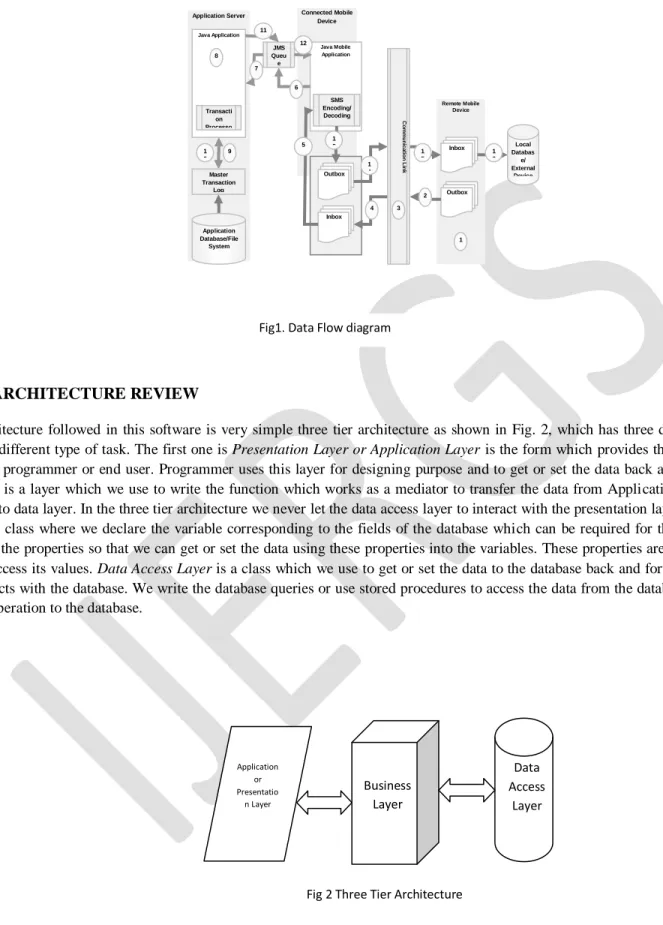
The SMS is accepted by the program (JsmsEngine) running on computer i.e. application server. Listen for incoming SMS, if message received message and save to database (or file). System then will read the SMS message from database (or file) and interpret the keyword in the SMS for example: GET 12345 ABC (I would like the system to able, identify different keywords to perform different respond, white space will be used to determine end of the keyword). (Optional) if possible I would like the system to be customize to be respond on certain keyword (system admin will able to set the desire keyword and the system responds.) Later the system will be respond according to keyword in the SMS received (for example, SMS message received keyword is TITLE and system will respond back with a SMS "Hello world". Each different set of keyword will have a different set of respond. Java to Micro Edition will be used as language for mobile programming & Java data base connectivity & Jsms Engine for implementation of project. Here we are considering student database for case study but this project can also be developed for employee’s information in an organization. The data flow of the system is shown in the Fig 1.
184 www.ijergs.org
IV ARCHITECTURE REVIEW
Architecture followed in this software is very simple three tier architecture as shown in Fig. 2, which has three different layers for three different type of task. The first one is Presentation Layer or Application Layeris the form which provides the user interface to either programmer or end user. Programmer uses this layer for designing purpose and to get or set the data back and forth. Business
Layer is a layer which we use to write the function which works as a mediator to transfer the data from Application or presentation
layer to data layer. In the three tier architecture we never let the data access layer to interact with the presentation layer. This layer has also a class where we declare the variable corresponding to the fields of the database which can be required for the application and make the properties so that we can get or set the data using these properties into the variables. These properties are public so that we can access its values. Data Access Layer is a class which we use to get or set the data to the database back and forth. This layer only interacts with the database. We write the database queries or use stored procedures to access the data from the database or to perform any operation to the database.
Connected Mobile Device Application Server Java Mobile Application Inbox Outbox Java Application Transacti on Processo r JMS Queu e SMS Encoding/ Decoding Remote Mobile Device Outbox Inbox Local Databas e/ External Device C o m m u n ic a ti o n L in k (G S M ) 1 2 3 4 9 8 5 1 4 6 7 Master Transaction Log 1 0 11 12 1 3 1 5 1 6 Application Database/File System Application or Presentatio n Layer Business Layer Data Access Layer
Fig 2 Three Tier Architecture Fig1. Data Flow diagram
ISSN 2091-2730
185 www.ijergs.org
Remote Mobile initiates a Data Request, frames a SMS manually or automatically and sends a SMS to the Mobile number of Connected Mobile Device as shown in Fig 3. Message sent over GSM link is then captured by operator and then redirected again over GSM link to Inbox of Connected Mobile Device Message in Inbox is then read by Java Mobile Application running on Mobile Device and suitable decoding (formatting) of message is done After Message is decoded to suitable format, message is sent to Java Messaging Service Queue (which is hosted on Application Server), via serial communication port Standard Java Application running on server retrieves the message from JMS Queue Standard Java Application frame a query as per message received, fire a Query through Transaction processor and retrieve desired data. Transaction processor too creates Log of data retrieved Standard Java Application posts data retrieved to JMS queue which then read by Java Mobile Application on Mobile Device and then decoded to suitable SMS format.
V.USE CASE DIAGRAM
The Use case diagram is used to identify the primary elements and processes that form the system. The primary elements are
termed as "actors" and the processes are called "use cases." The Use case diagram shows which actors interact with each use case. A use case diagram is a type of behavioral diagram. Its purpose is to present a graphical overview of the functionality provided by a system in terms of actors, their goals—represented as use cases—and any dependencies between these use cases. Component of Use Case Diagram- Use Cases, Actors, System boundary boxes (optional), Associations, Include, Extend, Generalization and Actor Generalization as shown in Fig 4.
V.1 CLASS DISCRIPTION
Class diagrams are the blueprints and model the static structure of a system as shown in Fig 5. You can use class diagrams to model the objects that make up the system, to display the relationships between the objects, and to describe what those objects do and the services that they provide. Class diagrams are useful in many stages of system design, classes that often translate into actual software classes and objects when start writing code. During the implementation phase of a software development cycle, class diagram is used to convert models into code and to convert code into models.
Application Database Database Access Application Server Java Application Java Enabled Connected Mobile Device Remote Mobile Device
186 www.ijergs.org
Fig4. Use Case Diagram for Automatic Response System Using SMS
ISSN 2091-2730
187 www.ijergs.org
V.2 SEQUENCE DIAGRAM
Sequence diagrams model the flow of logic within system in a visual manner, enabling you both to document and validate your logic, and are commonly used for both analysis and design purposes as shown in Fig. 6. Sequence diagrams are the most popular artifact for dynamic modeling, which focuses on identifying the behavior of the system. A sequence diagram shows, as parallel vertical lines, different processes or objects that live simultaneously, and, as horizontal arrows, the messages exchanged between them, in the order in which they occur. This allows the specification of simple runtime scenarios in a graphical manner. The main purpose of a sequence diagram is to define event sequences that result in some desired outcome. The focus is less on messages themselves and more on the order in which messages occur; nevertheless, most sequence diagrams will communicate what messages are sent between a system's objects as well as the order in which they occur. The diagram conveys this information along the horizontal and vertical dimensions: the vertical dimension shows, top down, the time sequence of messages/calls as they occur, and the horizontal dimension shows, left to right, the object instances that the messages are sent to.
CONCLUSION
The reasons for the enormous popularity of SMS have been the fact that this mechanism of sending and receiving messages not only saves time but costs less as well. The advantage for network operators has been the ease of deploying equipment from any vendors that implement the standard. Like other cellular standards. The above proposed and developed application is a mobile application for adding values to an institution. This application can only run on the cell phone having GPRS enabled services with them. This application can further be enhanced by adding various features to it like we can send and receive various information regarding students on a cell over the air (OTA).Even a student can view their assignments on the mobile phone by just using certain services that can be availed from the server. The scope of Project is limited to use of GSM protocol while sending and receiving message from application (i.e. not using TCP/IP to send/receive message which is more cost effective)
188 www.ijergs.org
REFERENCES
[1] V. Cepa , M. Mezini ―MobCon: A Generative Middleware Framework for Java Mobile Applications‖ Proceedings of the 38th
Hawaii International Conference on System Sciences – 2005
[2] D. A. McConnell, D. N. Steer, K. D. Owens, J. R. Knott, S. Van Horn, W. Borowski, J. Dick, A. Foos, M. Malone, H. McGrew, L. Greer, and P. J. Heaney, "Using Conceptests to Assess and Improve Student Conceptual Understanding in Introductory
Geoscience Courses," Journal of Geoscience Education vol. 54, pp. 61-68, 2006.
[3] A. L. Bishop, R. K. Dinkins, and J. L. Dominick, "Programming Handheld Devices to Enhance Learning" EDUCAUSE Quarterly vol. 26, pp. 50-53,2003.
[4] M. Freeman and P. Blayney, "Promoting interactive in-class learning environments:. A comparison of an electronic response
system with a traditional alternative," Proceedings of the 11th Australasian Teaching Economics Conference, 2005.
[5] H. Sheng, F. F.-H. Nah, and K. Siau, "Using Wire less Technology to Facilitate Learning: A Grounded Theory Approach," presented at Eleventh Americas Conference on Information Systems, Omaha, 2005.
[6] G. Schwabe, C. Göth, and D. Frohberg, "Does Team Size Matter in Mobile Learning?," in Proceedings of the Fourth International Conference on Mobile Business. Sydney, Australia: IEEE Computer Society, 2005, pp. 227-234.
[7] By T. Umedu , Shigeharu Urata , Akio Nakata , Teruo Higashino:‖Automatic Decomposition of Java Program for Implementation
on Mobile Terminals‖
[8] A. Stone , J. Brigg:‖SMS and Interactivity — Some Results from the Field, and its Implications on Effective Uses of Mobile
Technologies in Education”: IEEE Computer Society, Craig Smith Issue Date:August 2002