Kansantaloustieteen laitoksen tutkimuksia, No. 116:2009 Dissertationes Oeconomicae
KHAN MD ANICHUL HOQUE
ESSAYS ON BANKING CRISES
ISBN 978-952-10-4834-0 (nid.) ISBN 978-952-10-4835-7 (pdf)
Acknowledgements
I am very grateful to my supervisor Professor Pertti Haaparanta for his guidance and encouragement without which I could never accomplish the job with my thesis. I am also grateful to Professor Tapio Palokangas who took supervising responsibility at a crucial stage of my thesis and provided me the necessary suggestions. Then my heartiest gratitude goes to the pre-examiners of the thesis, Professor Paavo Okko and Dr. Marko Korhonen, whose comments greatly helped me to improve the thesis. This thesis has been written during the time I have been at Economics Department of Helsinki University as a graduate school fellow of the Finnish Doctoral Program in Economic (FDPE) and as a scholar fellow of Yrjö Jahnsonn (YJ) Foundation. I thank both the FDPE and YJ foundation for giving me the opportunity to concentrate exclusively on my doctoral studies, and the Economics Dept for its arrangement of working room with necessary research equipments. In this regard I am very thankful to Professor Vesa Kanniainen for his cooperation to get position at the Dept and to get FDPE fellowship, and for his all time fruitful comments. I would also like to thank Professor Mika Linden and Professor Anne Mikkola for their time worthy instructions I needed to complete the thesis.
During my doctoral studies I had an opportunity to visit the Monetary Policy and Research Dept at the Bank of Finland. My full hearted gratefulness goes to Dr. Esa Jokivuolle, Dr. Tuomas Takalo, Prof. Matti Viren and the unit’s head Dr. Jouko Vilmunen for their fruitful suggestions and encouragements on the essays of my thesis. My special thanks to the participants and discussants who made fruitful comments on my different essays in different workshops related with Macroeconomics and Development, and Capital Markets and Financial Economics arranged by FDPE and Helsinki Centre of Economic Research (HECER). I am thankful to HECER’s director Otto Toivonen for his suggestions made in different times. Then my gratitude goes to Dr. Heikki Pursiainen and Prof. Essi Eerola for their cooperation during the pre-examination of the thesis.
Finally, my highest debt is to my mother and late father who struggled all through their lives for the better lives of us, the brothers and sisters. I should have done a lot to repay this debt, but I could not for this degree. My next highest debt is to my eldest brother who gave proper guidance and financial supports for living to all of us, the younger brothers and sisters, besides his very hard study life. In the end, definitely my gratitude goes to my wife Farhana and son Anan. I could not pay time as they wished because of this degree.
Helsinki, January 2009 Khan Md Anichul Hoque
Contents
I. Introduction... 1
II. Deposit insurance scheme and banking crises: a special focus on less
developed countries... 21
III. Central bank autonomy and banking sector’s instability ... 76
IV. Factors correlating with long-lasting banking crises: a special focus
on crisis resolution policy measures ... 109
I. Introduction
1 Goals and background
1.1 Goals of the thesis
This thesis aims at finding the role of deposit insurance scheme (DIS) and central bank (CB) in keeping the banking system safe. The thesis also studies the factors associated with long-lasting banking crises. Although many studies have attempted to identify the causes of banking system instability, still there is void in dealing with efficient DIS and powerful CB for the stability of banking system. The empirical study by Demirguc-Kunt and Detragiache (2002) shed partial light on the issue of efficient DIS and banking sector stability by using a smaller data set. Using a larger and updated dataset, this thesis attempts to give a more complete picture about the efficient forms of DIS with a special focus of their uses in developing countries. This thesis illustrates empirically whether a more independent or more powerful CB is beneficial for a safe banking system. Even though there have been many studies on the effect of CB’s independence for price stability, there are so far no studies that consider the role of the strength of a CB for the safety of banking system. This thesis determines the impact of CB’s strength on the stability of banking system.
Finally, the target of the thesis is to identify the factors of long-lasting banking crises. The special focus is given on the crisis resolution policy measures which the government may (or may not) introduce right after the banking system is destabilized.
1.2 Background
1.2.1 Banking sector in a country
So far, banks have been the most efficient financial intermediaries in countries around the globe. A bank’s most important task is to collect credit from different sources and lend money to the entrepreneurs. In most countries the banking sector is the backbone of economic development. Problems in the banking sector involve impediments to economic development and growth of a country. Being the sector of financial
intermediaries, the banking sector is the most affected sector during a financial crisis in a country, and hence “financial crisis” very often termed as “banking crisis”.
1.2.2 Composition of financial crisis
To define the composition of financial crisis I begin with Minsky model as reported in Kindleberger (2000). The model follows that a financial crisis start with a displacement implied by some exogenous outside shock to the macroeconomic system. The nature of this displacement is not the same; it varies from one speculative boom to another. It can be accompanied by the outburst or end of a war, a bumper harvest or crop failure, the widespread adoption of an invention with pervasive effects, some political event or surprising financial success, or a debt conversion that precipitously lowers interest rates. If this displacement is sufficiently large and pervasive, the economic outlook will be altered with the change of profit opportunities in at least one important sector. It brings opportunities for profit in some new or existing lines, but closing out others. A boom is said to underway if the gainers from the opportunities dominate the losers, for which investment and production pick up. However, this boom is fed by an expansion of bank credit, enlarging the total money supply.
Kindleberger argues that a boom with enlarged money supply can turn into “euphoria.” That is, if the effective demand for goods or financial assets gets higher (as it can), the higher will be the prices leading to higher profit opportunities, turning to more investments. And the new investments can lead to increasing income, stimulating further investments with further income increase. Then, there can be “overtrading” with a built up process that speculation for price increase is added to investment for production and sale. This overtrading may spread from one country to another. There are many factors for this spread. For instance, the increase of price of internationally traded goods and assets in one country can cause price increase in others; the income changes in a country can influence others by foreign-trade multiplier through increased or decreased imports; capital flows; psychological connections – investor euphoria in one country influences investors in others.
Kindleberger adds that interest rates, velocity of money-circulation, and prices of goods and services continue to go up while the speculative boom keeps on. At some point, a few insiders choose to take their profits and sell out. As new recruits to speculation are balanced by insiders who withdraw, there develops hesitation at the
top of the market. Prices starts to level off then, resulting an uneasy period of “financial distress”. As distress persists, a considerable segment of the speculating community in an economy realize that the market cannot go higher and it is time to withdraw their money from banks. In many cases the race for money may turn into a rush. A crisis may be precipitated by different ways, e.g., with the signal of failure of a bank or firm, the revelation of a swindle by someone who sought to escape distress by fraudulent means, or a fall in the price of the primary object of speculation as it is seen to be overpriced. Bankruptcies of firms increase as prices decline with the rush on.
There can be a “lender of last resort” to convince the market that sufficient volume of money will be made available to meet the demand for cash. It can be domestic, i.e., the government or the central bank or can be international but there is no specific “world government” or “world bank” to conduct this job. However, there is debate of using the lender of last resort instrument – proponents worry more about the current crisis than about prevention some future one and opponents argue that it encourages the speculation in the first place.
Kindleberger raises the question of validity and relevance about the Minsky model at some extents. For instance, he argues that structural changes in the institutional underpinnings of an economy, including the rise of corporations, big labour union, big government, modern banking, speedier communications, and so on make a model of crisis based on the instability of credit uninteresting. He also argues that there can be no price bubbles because market prices reflect fundamentals, and that sharp falls in prices frequently reflect “policy switching” by government or central bank.
1.2.3 The countries with financial crises
Financial crises have been the concern of economic analysts for centuries. Kindleberger (2000) shows the record of financial crises taken place since the beginning of 17th century. The century’s very beginning financial crisis took place in the Holy Roman Empire during the period of 1618-23, and the others in Dutch Republic and England during 1636-37 and 1690-96 respectively. All of these crises were seriously related with different wars.
There have been many financial crises through the 18th and 19th centuries. However, most of the crises took place in Europe, especially in England. One of the reasons for
the most crises in England could be that as World’s trade and financial activities were mostly dominated by England, the financial conditional up-down was also mostly affected by England. Remarkably, the other European countries or business cities experienced financial crises are France, Germany, Italy, Austria, and Amsterdam. With the independence in 1776 the USA gradually turned to be an economic power in the world. Gradually it has been the most powerful country to influence the world’ trade and financial activities for years. The USA’s economy is as well not unaffected by financial crises and it has experienced many.
During the 18th and 19th centuries, most of the financial crises were explicitly related with the political factors rather than the economic factors. For instance, the crises of Amsterdam (1763 and 1772), England (1815-16 and 1857), and of France (1864) were related with different wars. Similarly the crises of England (1720), France (1720), the USA (1792), England (1793), Hamburg (1799), England (1810), the USA (1837), France (1838), and the USA (1873) were respectively related with the Treaty of Utrecht in 1713, death of Louis XIV in 1715, constitution adopted in 1789, the Reign of Terror after the onset of French revolution, the break of continental blockade, Wellington’s peninsula campaign, Jackson presidency, the Monarchy of 1830, and the fraud exposed in 1872 campaign.
One of the most discussing and severe financial crises during the 20th century was the crisis of the USA in 1929. The crisis, often called “The Great Depression”, was preceded by an extended economic boom (see e.g. Richardson 2006, Hori 1996, Cecchetti and Karras 1994, and Stricker 1984 for details about the crisis). The crisis inflicted immense damage not only upon the USA but also the entire world. Especially, it caused financial crises in Britain, Germany, Austria, and Japan in the early 1930s. The major reason of the crises in other countries was the cutting-off of the U.S. foreign lending.
Until the 80s of the 20th century the financial crises were mostly experienced by some European countries and the USA (see the record of Kindleberger, 2000, and Caprio and Klingebiel, 2003). Financial crises have been experienced by other countries mostly since the 1980s. Many developing countries around the globe have begun to experience financial crises since the 1980s. According to Lindgren at al (1996), at least two-thirds of the IMF member countries have experienced some form of systematic financial crisis during 1980-96. In many regions, almost every country has experienced at least one financial crisis. Thus the widely used terms are, e.g., the
“Nordic Financial Crises”, “Latin American Financial Crises”, “East Asian Financial Crises” and so on. Financial crises have also been classified according to the country’s economic development, e.g. Transition Economic Financial Crises, Emerging Economic Financial Crises.
Another point to note that, unlike the crises of 17th to 19th centuries, almost all of the crises in the 20th century are explicitly related with economic or financial factors instead of the political factors. For instance, the crisis of the USA (1929) related with extended economic boom, Europe (1931-33) with cut-off of U.S. foreign lending, the USA (1974-75) with collapse of Bretton Woods and OPEC 1973 oil price rise, the USA (1979-82) with the Third World syndicated bank loans, OPEC 1979 oil price rise, real estate in Southwest U.S., the farmland of U.S. and so on. Similarly the crisis of Japan (1990) explicitly related with Nikkei shares index and real estate, and the crisis of Mexico, East Asia, Russia and Brazil in 1990s with the financial deregulation, capital inflow and outflow, and the domestic boom (see Kindleberger 2000 for details).
1.2.4 Region based causes of recent banking crises
So far, there have been numerous studies attempting to identify the causes of banking crises and to design efficient mechanisms for crisis-prevention.1 The list of causal factors has increased after every drive of crises occurrences. Rojas-Suarez and Weisbrod (1996), and Rojas-Suarez and Hausmann (1996), for instance, show that the crises in Latin American countries of the 1980s brought emphasis on the need for appropriate macroeconomic fundamentals, especially on the fiscal and monetary policies. They argue that these crises lasted longer, affected a larger segment of the banking industry and brought higher costs for the public. On the other hand, the Mexican crisis of 1994 identified that the lack of appropriate regulatory and supervisory frameworks in the context of financial liberalization contributed significantly to the crisis (see among others Guidotti et al 2004).
The East Asian crisis in the late 1990s popularized the role of “contagion” in the emergence of a crisis (see e.g. Cathie 1998 and Kawai et al 2001).2 Krugman (2001),
1
See for example, Gavin and Hausmann (1996), Rojas-Suarez and Weisbrod (1995), Sundararajan and Balino (1991).
2
The issue of contagion has been analyzed in a large number of papers, including, Calvo (2000), Claessens, Dornbusch and Park (2000), Pericolli and Sbracia (2002), Perry and Lederman (1999) and Reinhart and Kaminsky (2000).
Summers (1999), and Corsetti et al. (1998) argue that due to the government’s implicit guarantee, the East Asian countries had substantial investments in unproductive sectors and these investments created vulnerability both in the real and financial sectors of the countries. Simultaneously, in order to protect depositors in banks and other financial institutions, the governments accumulated large contingent liabilities. The strong trade linkages among these economies induced the contagious effect, spreading the crisis throughout the region.
Many studies have examined the Nordic banking crises (see e.g. Drees and Pazarbasioglu 1995, and Pesola 2001). As the crises elsewhere in the world, these were also caused by bad banking, inadequate market discipline, weak banking regulation and supervision, premature financial liberalization, and inadequate macro policies (Ingves, 2002). However, the severity of the causes of Nordic crises differs from the other crises, e.g. the crises of emerging economies.3
1.2.5 Causes of banking crises in general
In addition to studies focusing specifically on case-wise or region-wise banking crisis, a number of studies have examined the common causes of banking crises irrespective of individual cases or regions. Demirguc-Kunt and Detragiache (1999, 2002 and 2005) and Kaminsky and Reinhart (1999) were the ground breaking studies examining the common causes of banking crises. The first two essays of my dissertation rely on studies by Demirguc-Kunt and Detragiache (DKD henceforth) extensively.
So far, DKD (1999) has been the first study that defines the common causes of banking crises empirically irrespective of developing or developed country context. They show that a banking crisis tends to erupt in the following cases: weak macroeconomic environment combined with low economic growth, high inflation, and high real interest rate; the vulnerability of the economy to balance-of-payment crisis; the use of explicit deposit insurance scheme in the country; and weak law enforcement in the country. DKD (2005) is an extended version of DKD (1999). In that paper, they, with a new dataset, verify and uphold the parameters found in their earlier paper.
3
For instance, the severity of the above mentioned causes of crises is higher in developing countries. See, e.g. Komulainen and Lukkarila (2003) for details about the factors of developing economies’ financial crises.
DKD (2002) also builds on their 1999 version, but with the special reference to the deposit insurance scheme (DIS henceforth). The study confirms their previous finding that the use of explicit DIS adversely affects the bank stability. In addition, the study shows that this adverse impact is stronger, the more extensive the coverage offered to depositors. The impact is also stronger if the scheme is funded instead of it unfunded and if the scheme is run by the government rather than by the private sector.
1.2.6 The studies of this dissertation relative to other studies
The first essay of my dissertation builds on DKD (2002) by using a larger dataset both in terms of the time period and the number of countries. In particular, the number of developing countries is much higher in my dataset than in DKD (2002). Given that the fundamentals affecting banking crises in developing countries may differ from those in developed countries (see e.g. Ingves 2002), the presence of a large number of developing countries in a sample could change the estimation results found in DKD (2002). This essay attempts to examine this change by a logit estimation model. Explicitly, taking a sample comprising a large number of developing countries, the essay examines the impacts of explicit DIS forms on banking crises and also examines the impacts when the DIS forms handled by a country with less economic development. In the analysis, this essay includes some new, previously unexamined, forms of explicit DIS. These forms, for instance, include as follows: whether the scheme has power to intervene in bank’s operation; whether it has power to cancel or revoke the deposit insurance of banks; and whether it has power to take legal action against bank officials.
The second essay of the dissertation examines the effect of CB’s autonomy, i.e. the degree of CB’s independence from executive body, on banking crises. Neither DKD (1999, 2002 and 2005) or Kaminsky and Reinhart (1999), nor any other study has considered this issue. There have been many studies on the influence of powerful CB, but most of these deals with the relationship of powerful CB over inflation, economic growth or government fiscal deficit (see e.g. Alesina and Summers 1993, Cukierman et al 1992 and 1993, Cukierman 1993 and 1994, De Long and Summers 1992, Doi 1998). However, according to Padoa-Schioppa (2002), Freixas et al (2000), and Goodhart (1987), there are many reasons to expect that the CB’s role has impact on banking crises. Some studies, for instance Blejer and Schumacher (1998), Mishkin
(2000), Quintyn and Taylor (2003), Doi (1998), Cukierman (1994) and Lohmann (1992), argue that a powerful CB can reduce the likelihood of financial crisis.
Banking crises can last for a long period or for a short period. A long lasting banking crisis may generate massive costs to the economy. The third essay of my dissertation examines the factors correlated with long-lasting banking crises. This is closely related to Honohan and Klingebiel (2003) which deals with the relation between different crisis resolution policy measures4 and the costs of banking crises. Crisis resolution policy measures are usually undertaken immediately after the eruptions of banking crises in order to contain the panicking stage of the crises and then attempting to rapid recovery. Honohan and Klingebiel show that these measures increase the costs of banking crises. In this essay, the resolution measures are the key factors explaining the lengths of banking crises. It is plausible that these measures prolong banking crises. Other studies closely related to this essay are Abderrezak (2000) and Frydl (1999). Abderrezak deals with the explanatory factors of the durations of banking crises but does not consider the crises resolution policy measures. Frydl studies the relation between the lengths and the costs of banking crises.
2 Contents of the dissertation
2.1 Deposit insurance scheme and banking crises: a special focus on less
developed countries
The aim of each country is to keep banking sector stable. With that aim, a country may exercise explicit deposit insurance scheme (EDIS), where rules and regulations are defined in advance to insure the deposited funds in banks. Otherwise, the country is said to use implicit deposit insurance scheme (IDIS), because it establishes a de facto insurance system to depositors of banks. The first paper of my thesis examines the impact of EDIS on banking crises empirically, with special reference to less developed economies. There is disagreement among researchers on whether an EDIS
4
Crisis resolution policy measures are termed as “accommodating approaches” in Honohan and Klingebiel (2003).
increases the likelihood of a banking crisis.5 DKD (2002) show, by a dataset of 61 countries for 1980-1997, that an EDIS compared to IDIS increases the banking crisis probability. This probability is even greater if the EDIS is implemented in an inefficient form (or design).
Despite of this controversial evidence, countries, especially the less developed countries (LDCs), have used EDIS increasingly (12 countries in 1974, 71 in 1999, and 87 in 2003). On the other hand, a large number of LDCs with both EDIS and IDIS have experienced and are still experiencing banking crises (Caprio and Klingebiel 2003). DKD (2002) included a small number of LDCs, especially the LDCs exercising EDIS, in their sample. The inclusion of a larger number of LDCs in a sample could establish the result that IDIS causes banking crises. If EDIS causes the crises, the main reason could be that the EDIS handled by countries with less-developed institutional framework. In such a case, including more LDCs, especially those with EDIS, in a sample can make the estimation results of DKD (2002) more robust.
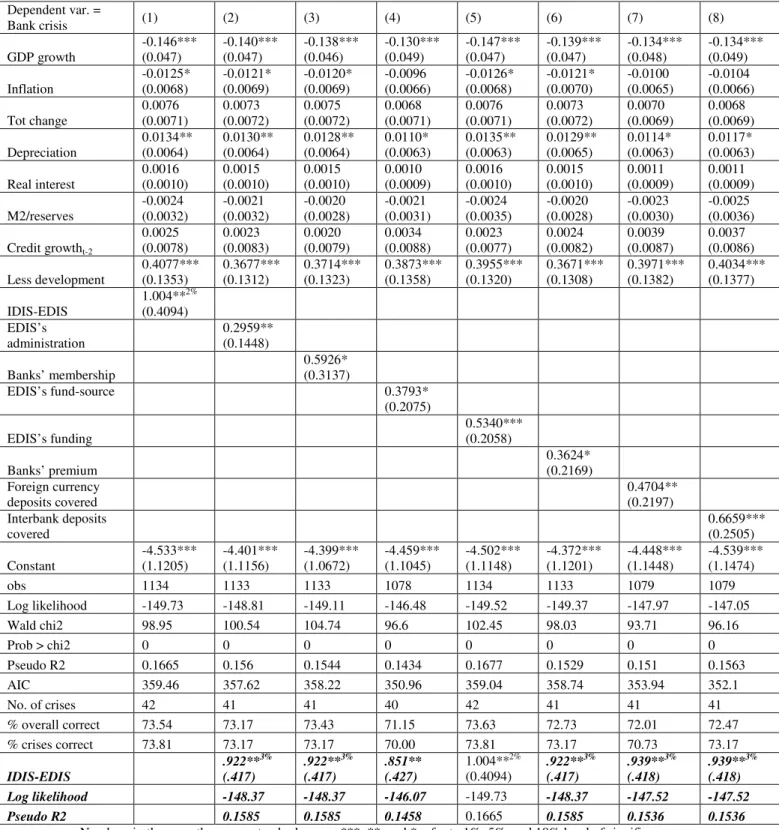
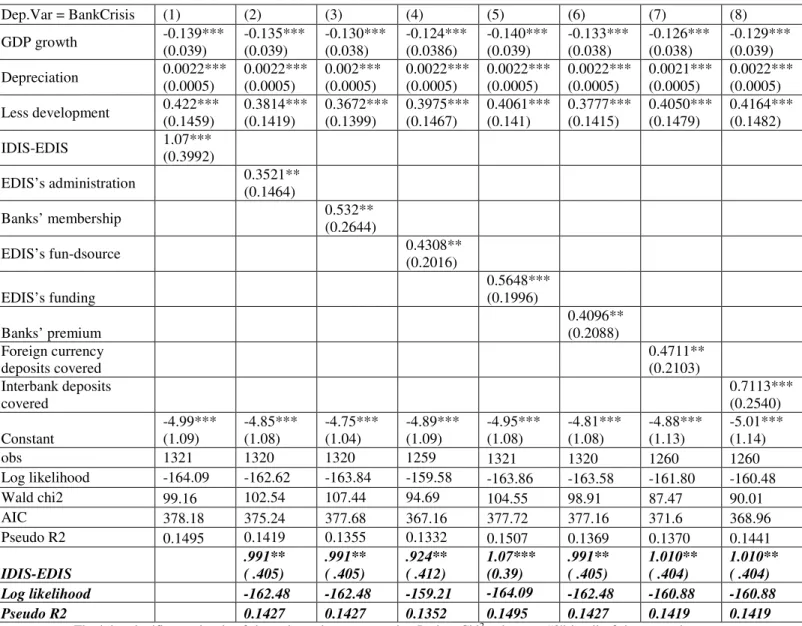
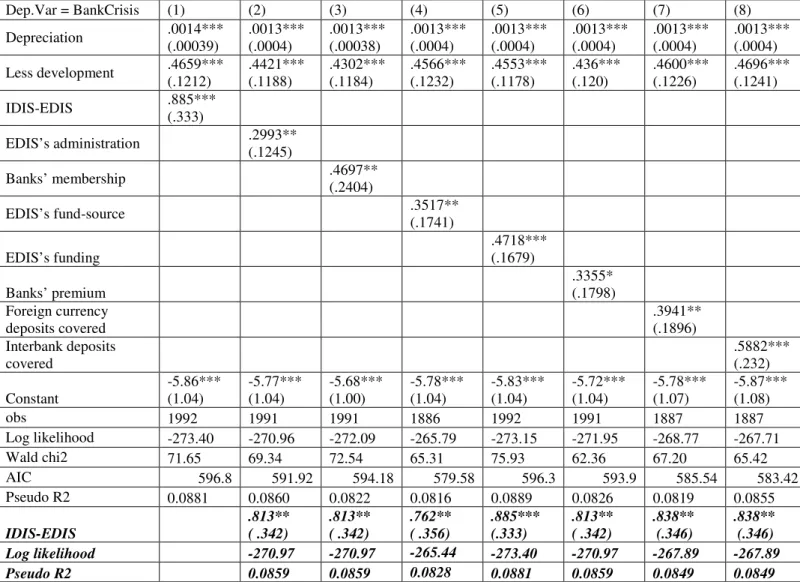
By a sample of about 150 countries, of which over 70% are developing economies, this study examines the impact of EDIS with its different forms on banking crises for the period of 1980-2003. The additional speciality of this study is that, besides the previously studied forms of EDIS, it also examines the impact of some forms of EDIS newly detected by Berth et al (2004). These include the power of EDIS to intervene in bank operations, to cancel or revoke the deposit insurance of banks, and to take legal action against bank officials. These newly detected forms also include the payout time to depositors and the information of whether the EDIS provides any compensation to deposits in the event of bank failure, which were not explicitly covered earlier. I also examine the effect of EDIS on the probability of banking crisis when the EDIS handled by a country with its less developed institutional structure. Finally, I am interested to see how my estimation results differ from those found in DKD (2002). I use a logit estimation model controlling for yearly fixed effects and a set of other explanatory variables. I find that the EDIS in general (i.e. without taking EDIS’s forms into account) is strongly significant in increasing the banking crisis probability. This significance level is stronger than what is found in DKD (2002). The probability is even stronger if the EDIS formed with ex ante funding, or with the coverage of
5
For instance Diamond and Dybvig (1983) and Bhattacharya et al (1998) argue in favour of EDIS’s decreasing crisis probability and Kane (1989) argues in favour of EDIS’s increasing the probability.
inter-bank deposits, or with high level of coverage in average. The crisis probability also becomes greater if the EDIS is not legally authorized to directly intervene in banks’ operation, or to cancel or revoke the banks’ deposit insurance, or if the scheme allows deposits to be compensated after bank failure although the deposits were not explicitly covered before the failure.
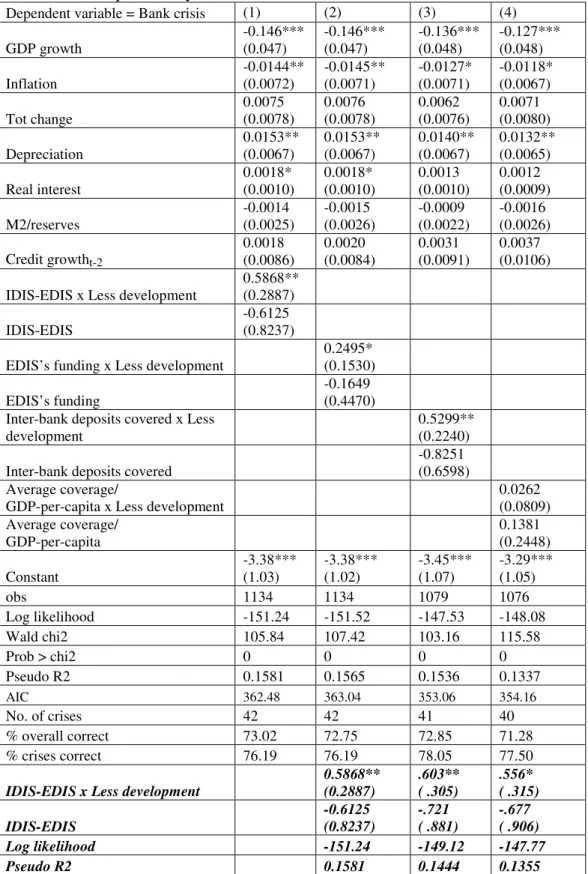
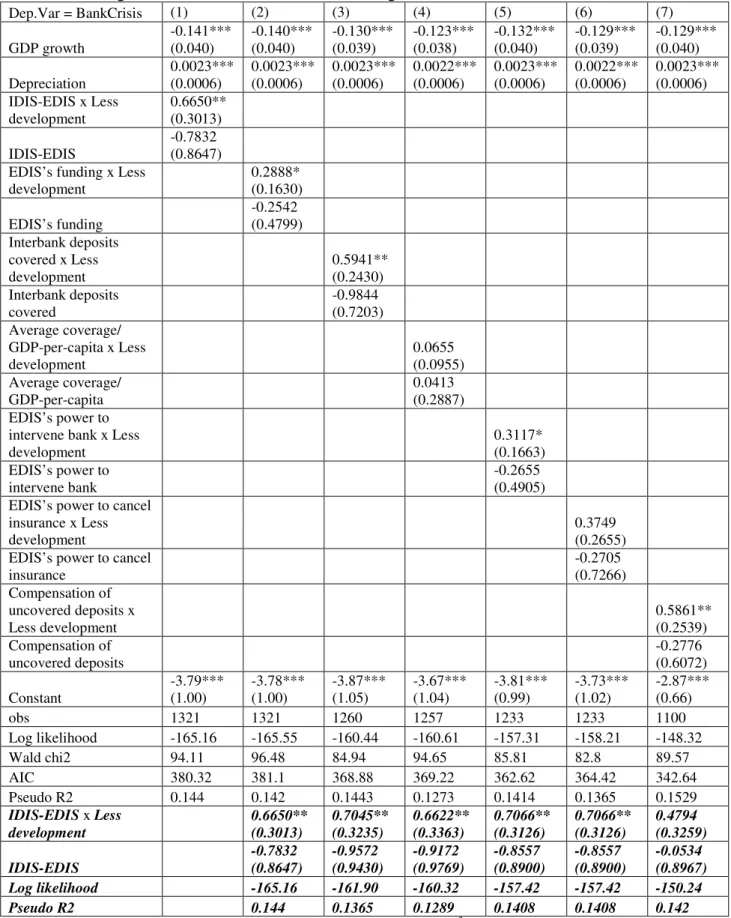
Next, this study finds that the crisis probability increases if the EDIS handled by a country with less developed institutional structure. Thus using the EDIS in a LDC is more risky than its use in an industrialized country. This probability is greater if the EDIS provides coverage to the inter-bank deposits, or if the EDIS lacks legal power to directly intervene banks, or if the EDIS compensate uncovered deposits after a bank failure. Interestingly this study finds that once a country’s less-development to handle an EDIS is controlled, the EDIS separately is not a significant factor of banking crisis any more. That is, a country’s overall economic development is so important to handle the EDIS efficiently. This result is in line with Chen and Fishe (1993), who argue that an EDIS cannot play its appropriate role in a LDC because of its less diversified economic base, making the country more tended to liquidity crisis which the EDIS cannot prevent. The result is also supported by Gropp and Vesala (2001), who show that an EDIS significantly reduces the risk taking of banks in the EU countries, which are mostly developed.
In addition, this study shows that the crisis probability decreases if a country with less corruption handles the EDIS. However, once the corruption level of a country handling the EDIS is controlled, the EDIS separately is still a significant factor to increase the banking crisis probability. This implies that, for a more efficient use of EDIS, the LDC needs to remove, not only the corruption but also other setbacks of being less developed, e.g. the government’s vulnerability to international and internal pressure, unskilled personnel in institutions, unemployment pressure, autocracy and repression of press, bureaucracy, poor contract enforcement, and so on.
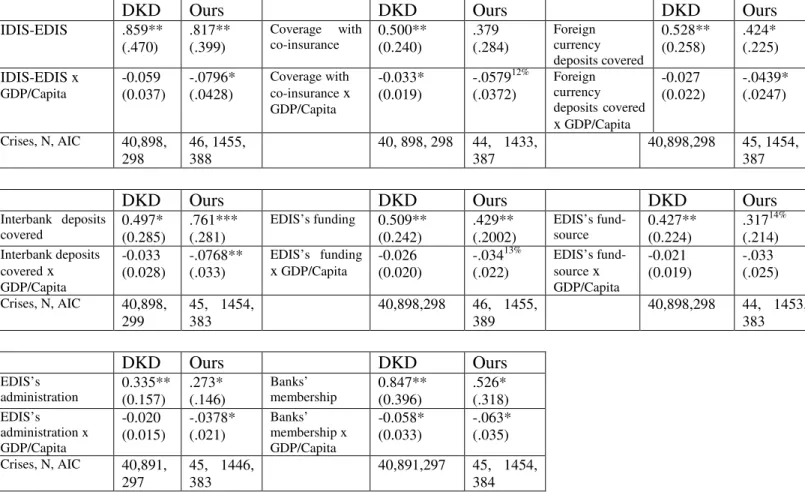
By using an empirical model similar to DKD (2002), this study shows that the coefficient of an EDIS handling by countries with differing GDP-per-capita is larger in magnitude and also more strongly significant than the coefficient found in DKD (2002).
2.2 Central bank autonomy and banking sector’s instability
The second paper of my thesis examines empirically the relationship between the level of central bank (CB) autonomy and the instability of banking system as defined by the systemic banking crisis. The CB, the bankers’ bank, is one of the core institutions of a country to uphold its monetary policy. A CB’s major role is to keep price stability. Besides, it plays a role in many other financial activities, e.g. managing the government’s financial transactions, financing budget deficit through the issuing of money, funding development projects undertaken by the government, and bailing out insolvent banks and publicly-owned enterprises (see Cukierman et al, 1992). A CB can have direct influence on banking sector stability through its measure of bailing-out banks, efficient controlling over the financing of budget deficits and that over the funding of inefficient government development projects. The CB’s role in stabilizing financial market is supported by many, as mentioned in the earlier subsections.
However, all CBs have not the same amount of autonomy to handle their tasks. They may have a different degree of independence granted by the executive branch of government. In one hand, studies claim that the independency of the CB can reduce the banking sector’s instability. On the other hand, there is also a conflicting view that the more independent CB can rather increase the instability, as the central banker can be undemocratic or bureaucratic and may behave opportunistically (Cukierman 1994). An undemocratic, opportunistic, but independent central banker can easily destabilize the banking sector. This paper attempts to resolve the contingent role of CB’s autonomy on the instability of banking sector.
I use the data of the decade 1980s from Cukierman et al (1992) in which the data on CB’s independence are by decades. CB’s independence is measured according to 16 different legal variables and by an aggregated legal variable which takes the weighted average of 16 variables available. I characterize a country’s banking sector as unstable when the country experiences a systemic banking crisis. The dependent variable banking crisis dummy takes the value one if a country experiences systemic banking crisis for one or more years during the 1980s, otherwise zero. Each of the variables of CB’s independence is tested separately along with a set of control variables.
Using a sample of 54 countries and a logit estimation model, I find that a more autonomous CB (as measured by CB’s aggregated legal power) reduces the likelihood of banking crisis. When different variables for CB’s independence are tested independently, I find that CB autonomy with regard to its chief executive officer’s term of office and CB autonomy in setting interest rate on loans to government decrease the probability of banking crisis. I also find that the crisis probability reduces more if an autonomous CB can perform its duties in a country with stronger law and order tradition. That is, a country’s improved law-and-order tradition is so important for an autonomous CB to perform its due role efficiently.
2.3 Factors correlating with long-lasting banking crises: a special focus
on crises resolution policy measures
A banking crisis can last long or short. The third paper of my thesis determines the explanatory variables related to the long lasting crises. A long crisis-spell, i.e. the crisis with long duration, can have costly aftermath on the real economy. For example, after a long crisis-spell, domestic depositors and investors may lose their confidence in the banking system and transfer their funds abroad. It is therefore of the utmost importance to shield economy from the costly aftermath of long crisis spell. In order to determine the possible explanatory variables of long crisis-spells, I highlight mostly the crisis resolution policy (CRP) measures, which are usually undertaken immediately after the occurrences of banking crises. Briefly the measures are:
(1) blanket guarantee6 to all creditors and depositors,
(2) open-ended and extended liquidity support to all weak financial institutions, (3) forbearance of any banking regulations,
(4) recapitalization or repeated recapitalization of weak or failed banks,
(5) public debt relief program for bank borrowers to facilitate repayment of their debts,
(6) setting up a centralized Asset Management Company.7
6
This guarantee usually means a declaration by the government that all deposits and perhaps other financial instruments will be protected.
7
Although different CRP measures are enacted to shorten crisis-spells, in practice they may not. The measures usually relax the existing banking regulation and are not market-oriented. Such measures may enable the bank management to abuse the measure for their personal benefit, leading rather to the longer banking sector instability. However, it is hard to see that a government not taking any CRP measures once the country is clutched by systemic banking crisis. The reason is that otherwise the government would not know how long the crisis would continue. In my dataset of 35 crisis-episodes with the information of using CRP measures, only 3 episodes are found not using any CRP measures. Hence, the aim of this study is to see which of the CRP measures associated with longer crisis-spells in comparison with the other CRP measures.
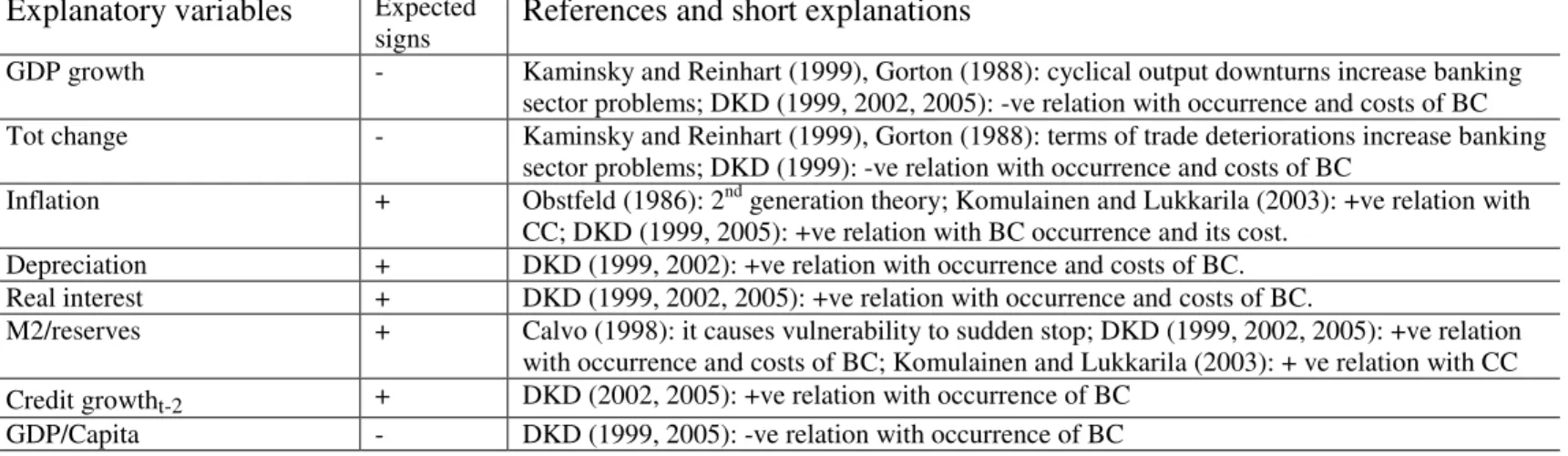
The fundamentals causing the occurrences of banking crises may also prolong the crises. To test this assertion, I take the explanatory variables used in earlier studies as the causes of banking crises’ occurrences and the costs of crises (see for instance DKD 1999, 2002 and 2005).
The data on crisis-spells come from Caprio and Klingebiel (2003) and it is yearly data for the period of 1977-2002. Data on CRP measures are taken from Honohan and Klingebiel (2003). Both the industrialized and developing countries are included in the sample. The estimation model I use is a duration model. I also use the OLS model for the robustness check of the results.
From the sample of crisis-spells with CRP measures, the finding of this study is that the measure of regulation-forbearance which allows insolvent banks to remain open is strongly significant. Another measure the execution of public debt relief program helping bank borrowers to repay their public debt is also significant, but at weaker level. Both of the measures are positively related with the durations of crises, i.e. the use of the measures lengthen the crisis-spells. Rests of the measures are found to be statistically insignificant to have any relation with the durations of crises. Two of the measures, the blanket guarantee and the use of centralized Asset Management Company, are even having negative signs of relation with the durations of crises. The results exemplify that the adverse effect in terms of the duration of crisis is relatively higher in using the measures the regulation-forbearance allowing the insolvent banks remain open and the execution of public debt relief program helping bank borrowers to repay their public debt. I therefore propose that a government grasped with banking crisis better to avoid using the said two measures. If it has no
alternatives other than using some CRP measures, it can use some measures which are found statistically insignificant to have any relation with the durations of crises. Evidently, it can use the blanket guarantee, the liquidity support, recapitalization of banks, or a centralized Asset Management Company. It can also use some regulation forbearance allowing the lesser degree of lenience towards banks (e.g. over looking violations of laws by individual banks or the business deregulation on banking designing to introduce new profit opportunities to weak banks, and so on).
Amongst the explanatory variables other than CRP measures, this study finds that a crisis lasts longer with the following factors: if the crisis begins with a higher real interest rate; if it begins when the banking sector has larger exposure to the private sector borrowers; and if it begins in the presence of explicit deposit insurance scheme. On the other hand, a crisis does not last long with the following factors: if the crisis begins with high growth (lagged by two years) of real domestic credits in the private sector; and if the crisis begins with high liquidity shortage in banks. Finally, similar with Abderrezak (2001), I find that the probability of crisis-spell termination increases as the spell gets older.
3. Contributions and further research
3.1 Major contributions of the thesis
This thesis shows that using an EDIS instead of IDIS increases the banking system instability. The argument for introduction of EDIS could be the inevitably need of some form of depositors’ explicit safety net. This safety net is needed to stop the chance of bank runs for the greater and long-term economic interest of a country. Instead of focusing on the long-term cost-benefit analysis of using the EDIS, this thesis rather attempts to point out the forms (or designs) of EDIS and also other interacting factors that make the EDIS more risky. EDIS works better if it provides low coverage and if its authority is powerful enough to take punitive actions against banks. The most important finding is that the EDIS measure is rather efficient for the industrialized countries which are capable to prevent possible moral hazard in EDIS by their superior institutional structures. On the other hand, EDIS is no good for the LDCs, because of their inferior institutional structures.
The CB can affect the banking sector stability in many ways. I show that curtailing the CB’s power (which implies its independence from the executive body) to performing its due role increases the risk of banking sector instability. The CB’s power measured by its chief executive officer’s long-term contract and its power in setting interest rate on government loans are especially relevant for the banking sector stability. I also show that an autonomous CB can perform its due role more efficiently to reduce the banking sector instability if the country’s law-and-order tradition is stronger.
In the final essay, I pay attention to the major causes of the long lasting banking crises. I show that, amongst the CRP measures used, the regulation-forbearance allowing the insolvent banks to remain open and the execution of public debt relief program helping bank borrowers to repay their public debt are respectively strongly and weakly significant to increase the durations of crises. Hence, I suggest governments with banking crises to avoid using these two measures. However, it can choose the measures for instance the blanket guarantee, the liquidity support, the recapitalization of banks, or using a centralized Asset Management Company because of their insignificant relations with crises’ durations. I also show that some factors not only cause banking crises to occur (as found in earlier studies), but also prolong the crises. These factors include e.g. high real interest rate, large exposure of the banking sector to the private sector borrowers, and the use of explicit deposit insurance scheme.
3.2 Suggestions for further research
This section presents some general and particular suggestions for further research. In line with many other empirical studies, I have investigated the fundamentals of systemic banking crises where the crises are defined by multiple decisive factors and are designed by financial expertise related with the crises experienced countries. It would be easier to examine the causes of banking crises if the crises occurrences could be defined based on a single decisive factor. However, the single decisive factor needs to be uniquely defined before conducting such a study.
Very often it happens that a crisis could have been averted if the central authority would intervene in time. Proper actions and well-timed information to the depositors and investors could minimize to a great extent the overall economic loss. In this, the
freedom of the press could play a pivotal role. The relationship between freedom of press and the banking sector stability would be an interesting issue.
Demirguc-Kunt and Detragiache (1999) showed that the occurrence of banking crisis is more frequent in the countries with EDIS. Policymakers of the countries across the world should be aware about this adverse effect of EDIS. Even after this, countries, especially the LDCs, around the globe are introducing EDIS increasingly. At this point a study would be interesting if it examines the long-term economic benefit of an economy with EDIS compared to a similar economy with IDIS.8
There are still some fundamentals which may influence the banking sector’s stability. For instance, supervision of banks is not uniform in countries across the globe. In some countries the CB supervise banks and in others ministry of finance does this alone or jointly with CB. I leave for further examination to show whether the banking sector stability is influenced by this variation of banks’ supervision, or whether the banking sector’s stability is influenced by discipline, provision and capital structures of banks.
8
For instance, the long-term economic growth of LDCs with EDIS compared to the long-term growth of LDCs with IDIS.
Reference
Abderrezak, A. (2000): “International Banking Crises: A Duration Analysis,” Global Economy Quarterly, Vol. 1, pp. 359-374.
Alesina, A. and Summers, L.H. (1993): “Central Bank Independence and Macroeconomic Performance: Some Comparative Evidence,” Journal of Money, Credit and Banking, pp. 151-62.
Bhattacharya, S., Boot, A.W.A., Thakor, A.V. (1998): “The economics of bank regulation,” Journal of Money, Credit, and Banking 30 (4), 745-770.
Blejer M. I. and Schumacher L. (1998): “Central bank vulnerability and the credibility of commitments: a value-at-risk approach to currency crises,” IMF Working Paper No. 65.
Calvo, G. (2000): “Capital Markets, Contagion and Recession: An Explanation of the Russian Virus, in Wanted,” World Financial Stability, John Hopkins University Press. Caprio, G. and Klingebiel, D. (2003): “Episodes of Systemic and Borderline Financial Crises.” World Bank.
Cathie, J. (1998): “Financial contagion in East Asia and the origins of the economic and financial crisis in Korea,” Asia Pacific Business Review, V. 4, Iss. 2-3.
Cecchetti, S.G., Karras, G. (1994): ”Sources of output fluctuations during the Interwar Period: Further evidence on the causes of the Great Depression,” Review of Economics and Statistics, v. 76, iss. 1, p. 80-102.
Chen, L. L. and Fishe, R.P.H. (1993): “Informal Financial Arrangements and the Stability of Deposit Insurance in Less Developed Countries,” Southern Economic Journal, Vol. 60, Issue. 1
Claessens, S. R., Dornbusch and Park, Y. C. (2000): “International Financial Contagion: How it Spreads and How it can be Stopped,” The World Bank.
Corsetti G., Pesenti P., and Roubini N. (1999): “What caused the Asian currency and financial crisis?” Japan and the World Economy, Vol. 11, Issue. 3.
Cukierman, A. (1993): “Central bank independence, growth, investment, and real rates,” Carnegie-Rochester Conference Series on Public Policy, No. 39, p. 95-140, North Holland.
Cuckierman, A. (1994): “Central Bank Independence and Monetary Control” The Economic Journal, Vol. 104, No. 427.
Cukierman, A., Webb, S.B., and Neyapti B. (1992): “Measuring the Independence of Central Banks and Its Effect on Policy Outcomes,” World Bank Economic Review Vol. 6, No. 3.
Cukierman, A., Pantelis, K., Summers, L. H., and Webb, S. B. (1993): “Central Bank Independence, Growth, Investment, and Real Rate,” Carnegie- Rochester Conference Series on Public Policy.
Das, Udaibir S. and Quintyn, Marc (2002): “Crisis Prevention and Crisis Management: The Role of Regulatory Governance,” IMF WP/163.
De Long, Bradford, J., and Summers, L. H. (1992): “Macoreconomic Policy and Long-Run Growth,” Federal Reserve Bank of Kansas City, Economic Review, pp. 5-30.
Demirgúc-Kunt, A. and Detragiache, E. (1999): “The Determinants of Banking Crises: Evidence from Industrial and Developing Countries,” The World Bank, Policy Research Working Paper Series: 1828.
Demirgúc-Kunt, A., and Detragiache E. (2002): “Does Deposit Insurance Increase Banking System Stability? An Empirical Investigation” Journal of Monetary Economics, Vol. 49, Issue 7.
Demirgúc-Kunt, A. and Detragiache, E. (2005): “Cross-country Empirical Studies of Systemic Bank Distress: A Survey,” National Institute Economic Review, Vol. 0, Issue 192.
Diamond, D., and P. Dybvig (1983): "Bank Runs, Deposit Insurance and Liquidity," Journal of Political Economy 91.
Doi, T. (1998): “Central Bank Independence Promotes Budgetary Efficiency,” Discussion Paper Series No. F-68, Institute of Social Science, University of Tokyo. Drees B. and Pazarbasioglu C. (1995): “The Nordic banking crises: Pitfalls in Financial Liberalization,” IMF Working Papers, No. 61.
Freixas X., Parigi B. M., and Rochet J. C. (2000): “Systemic risk, interbank relations, and liquidity provision by the central bank,” Journal of Money, Credit and Banking, Vol. 32, No. 3, Part 2.
Frydl, Edward J. (1999): “Length and Cost of Banking Crises,” IMF Working Paper No. 30.
Gavin, M., and Hausman, R. (1996): “The Roots of Banking Crises: The Macroeconomic Context,” In Ricardo Hausmann and Liliana Rojas-Suarez, eds. Banking Crises in Latin America, Washington, D.C., Inter-American Development Bank.
Goodhart C. A. E. (1987): “Why do banks need a central bank?” Oxford Economic Papers, New Series, Vol. 39, No. 1.
Gropp, R. and Vesala, J. M. (2001): “Deposit insurance and moral hazard: does the counterfactual matter?” European Central Bank, Working Paper Series, 47.
Guidotti P. E., Rojas-Suarez L., and Zahler R. (2004): “Designing financial regulatory policies that work for Latin America: the role of markets and institutions; Views from the Latin American Shadow Financial Regulatory Committee,” Journal of Financial Stability, Vol. 1, Issue 2.
Honohan, P. and Klingebiel, D. (2000): “Controlling the Fiscal Costs of Banking Crises,” Policy Research Working Paper 1441. World Bank, Washington, D.C.
Honohan, P. and Klingebiel, D. (2003): “The fiscal cost implications of an accommodating approach to banking crisis,” Journal of Banking and Finance, Vol. 27, pp. 1539-1560.
Hori M. (1996): “New evidence on the causes and propapgation of the Great Depression,” University of California, Berkley.
Ingves, S. (2002): Speech titled “The Nordic banking crises from an international perspective” in the Seminar on Financial Crises, IMF, Washington.
Kaminsky, G. L., and Reinhart, C. M. (1999): “The Twin Crises: The Causes of Banking and Balance of Payments Problems,” American Economic Review, Vol. 89, p.473-500.
Kane, E., (1989): “The S & L Insurance Mess: How did it Happen?” Urban Institute Press, Washington, DC.
Kawai M., Newfarmer R., and Schmukler S. (2001): “Crisis and contagion in East Asia: Nine Lessons” The World Bank, Policy Research Working Paper Series, No. 2610.
Kindleberger, C. P. (2000): “Manias, Panics and Crashes: A history of financial crises,” John Wiley and Sons, New York (4th edition).
Komulainen, T. and Lukkarila, J. (2003): ”What drives financial crises in emerging markets?” Emerging Markets Review, 4.
Krugman, P. (2001): “What happened to Asia?” Financial market integration and international capital flows, pp. 209-18.
Lindgren, C. J., Garcia, G., and Saal, M. (1996): “Bank Soundness and Macroeconomic Policy,”International Monetary Fund, Washington.
Lohmann, S. (1992): “Optimal commitment in monetary policy: Credibility versus flexibility,” American Economic Review, 82, pp 273-86.
Mishkin, F. S. (2000): “What should central banks do?” Homer Jones Lecture, Federal Reserve Bank of St. Louis.
Padoa-Schioppa, T. (2002): “Central bank and financial stability: exploring a land in between,” Second ECB Central Banking Conference, Frankfurt am Main.
Pericolli, M. and Sbracia, M. (2002): “A Primer on Financial Contagion,” Bank of Italy.
Perry, G. and Lederman, D. (1999): “Financial Vulnerability, Spillover Effects and Contagion: Lessons from the Asian Crises for Latin America,” The World Bank. Pesola, J. (2001): “The role of macroeconomic shocks in banking crises” Bank of Finland Discussion Paper No. 6.
Quintyn M. and Taylor M. W. (2003): “Regulatory and supervisory independence and financial stability,” CESifo Economics Studies, Vol. 49
Reinhart, C. and Kaminsky, G. (2000): “On Crises, Contagion and Confusion,” Journal of International Economics.
Richardson G. (2006): Quarterly data on the categories and causes of bank distress during the Great Depression,” NBER Working Papers - 12715
Rojas-Suarez, L. and Weisbrod, S. R. (1995): “Financial Fragilities in Latin America: the 1980s and 1990s,” IMF Occassional Paper No. 132.
Rojas-Suarez, L. and Weisbrod, S.R. (1996): “Banking crises in Latin America: Experience and Issues,” Inter-American Development Bank, Research Department, RES Working Series, No. 321.
Rojas-Suarez, L. and Hausmann, R. (1996): “Banking crises in Latin America” Inter-American Development Bank.
Stricker, F. (1984): “Causes of the Great Depression, or what Reagan doesn’t know about the 1920s,” Economic Forum, v. 14, iss. 2, pp. 41-58.
Summers, L. (1999): “Roots of the Asian Crises and the Road to a Stronger Global Financial System,” Remarks made at the Institute of International Finance.
Sundararajan, V. and Balino, T. J. T. (1991): “Banking Crises: Cases and Issues,” IMF.
II. Deposit insurance scheme and banking crises: a
special focus on less developed countries
Prepared by Khan Md. Anichul Hoque*
Department of Economics, Helsinki University, HECER
Abstract
This study analyzes the effect of using explicit deposit insurance scheme (EDIS), instead of using implicit deposit insurance scheme (IDIS), on banking crises. The panel data for the period of 1980-2003 includes all countries for which the data on EDIS or IDIS exist. 70% of the countries in the sample are less developed countries (LDCs). About 55% of the countries adopting EDIS also come from LDCs. The major finding is that the using of EDIS increases the crisis probability at a strong significance level. This probability is greater if the EDIS is inefficiently designed allowing higher scope of moral hazard problem. Specifically, the probability is greater if the EDIS provides higher coverage to deposits and if it is less powerful from the legal point of view. This study also finds that the less developed a country is to handle EDIS, the higher the chance of banking crisis. Once the underdevelopment of an economy handling the EDIS is controlled, the EDIS separately is no longer a significant factor of banking crises.
Author’s e-mail: [email protected]
*
I am grateful to Prof. Pertti Haaparanta and other participants at FDPE’s workshop on
“Macroeconomics and Political Economy” for their helpful discussion and comments on this paper. Of course I am responsible for any errors in the paper.
1 Introduction
This paper is about the relation between different forms of deposit insurance scheme (DIS henceforth) and the banking sector instability with a special focus on the less developed countries (LDCs). There can be explicit DIS (EDIS henceforth) where the rules and regulations are defined to insure the deposited funds in banks, or can be implicit DIS (IDIS henceforth) as the governments usually step in after banking crises to rescue the depositors and banking sectors on an ad hoc basis. However, there is some controversy among researchers about the effect of EDIS on the bank stability. Many researchers believe that the EDIS is an optimal policy to protect bank stability when the stability is threatened by depositor run (see, e.g., Diamond and Dybvig 1983, Bhattacharya et al 1998).9 Researchers, on the other hand, acknowledge that the EDIS is a source of moral hazard, as banks are encouraged to finance risk, high-return projects. This moral hazard problem may cause additional bank failures, leading to a systemic banking crisis (see, e.g., Kane 1989).
Regardless of the ambiguities about the effects of EDIS on banking crises, countries around the world have been using EDIS increasingly (12 countries in 1974, 71 in 1999, and 87 2003). There is also wide cross-country variation regarding the types of EDIS. For instance, a scheme can be administered by the government, privately, or jointly. Bank membership in the scheme can be compulsory or voluntary. The scheme can be funded ex ante or ex post, and funding source can be the government or banks or a combination of both. Bank premium to the scheme can be fixed or risk based. Schemes also vary in their coverage, e.g. foreign currency deposits covered or not, inter-bank deposits covered or not, the overall coverage limits high or low. There are also some EDIS designs noted by Berth et al (2004), the effects of which on banking crises have not been examined yet. Those concern the EDIS’s legal power. For instance, EDIS’s power to intervene banks, power to cancel or revoke a bank’s deposit insurance contract, and power to take legal action against bank officials. Those also concern the time of EDIS to pay out depositors and the compensation (or not) of uncovered deposits after a bank failure.
9
Golembe (1960) finds that the goal of DIS is more focused on restoring confidence in the liquidity of bank deposits than to protect small depositors.
Demirguc-Kunt and Detragiache (2002; DKD will stand for Demirguc-Kunt and Detragiache henceforth) attempt to resolve the ambiguities regarding the EDIS’s impact on banking crisis.10 They find that the EDIS in general increase the probability of banking crisis and this probability is greater when the EDIS is designed inefficiently (namely the banks’ membership voluntary, the administration by govt, EDIS funded ex ante, govt. as the funding source, and provision of high coverage). In addition, they show that the probability of crisis increases if the EDIS handled by a country with weak institutional environment. Their sample, however, leaves out a large number of LDCs, especially the LDCs utilizing EDIS (their sample of 61 countries includes only 16 LDCs with EDIS).
More than 75% of the countries in the world are classified as LDCs and a growing number of these countries utilize the EDIS. On the other hand, as Caprio and Klingebiel (2003) note, a large number of LDCs have experienced and are still experiencing banking crises. The number of these LDCs with IDIS is as large as their number with EDIS. Thus the inclusion of larger number of LDCs in a sample could result in finding differently from that of DKD (2002). In that the IDIS could be the cause of banking crises, or if the EDIS causes the crisis, the major reason could be the EDIS handled by the LDC’s inadequate institutional framework. A LDC’s institutional framework can be inadequate as a result of weak government, financial setbacks, non-skilled personnel, high corruption, heavy bureaucracy, weak law-and-order tradition, unemployment pressures, and so on. In this case, the inclusion of additional LDCs as well as those with the EDIS in a sample could make the estimation results more robust than the results found by DKD (2002).
With a large dataset that takes almost all countries with the information of EDIS and IDIS (thus most of the sample countries, especially the countries with EDIS, come from LDCs) this study addresses the following questions. The first question: what is the effect on banking crisis if a country uses EDIS instead of using IDIS? Second question: does an EDIS have additional effect on banking crisis when it is inefficiently designed from the moral hazard point of view? Third question: do these effects depend on countries’ overall economic developments? Then we compare the effects depending on countries’ overall economic developments with those effects depending on countries’ corruption levels, as we know corruption implies merely a
10
Demirgúc-Kunt and Kane (2002) also focus in resolving the ambiguities of the EDIS’s impact on banking crisis.
single kind of institutional deficiency rather than the structural institutional deficiency. Finally, we examine the extent to which the effects of some of the fundamentals on crises we find with our dataset differ from the effects found in DKD (2002). In that, we use the estimation model and the set of control variables similar with DKD (2002).
The panel data includes about 150 countries for the period of 1980-2003. However, the number of countries or observations in the regression models differs because of missing data of the explanatory variables we use. Using a logit estimation model with yearly fixed effects, we estimate the effects of EDIS (in general and with its inefficient designs) on the probability of systemic banking crisis (the data from Caprio and Klingebiel 2003). We use a set of control variables which have been defined by previous studies (e.g. DKD 1999, 2002, and 2005). The salient control variable for this study is the variable that represents the less-developed institutions. To formulate the variable, we classify the sample countries according to their ranking in different income groups as reported by Demirguc-Kunt et al (2005), i.e. high, upper-middle, lower-middle, and low income groups.
A zero-one dummy is used to test the impact of EDIS on banking crises; the value zero refers to IDIS and one to EDIS. In practice this impact could differ according to variation of moral hazards for different forms of EDIS. For instance, an EDIS with higher coverage to deposits is less effective because of the higher scope of moral hazard on the part of banks. For a similar reason, all other forms of EDIS can also be more or less effective. To take into account the impact of ineffective forms of EDIS we use more refined dummies, as DKD (2002) did, than the dummy of simple zero-one. Each of these dummies takes zero for IDIS observations and rest of the values are assigned in accordance with the scope of moral hazard ensued by the forms of EDIS.11
Our finding is that use of EDIS instead of IDIS strongly significantly increases the probability of banking crisis. The probability is even greater if the EDIS has the form of ex ante funding, or inter-bank deposits covered, or if its average coverage is higher. The crisis probability is also greater if the EDIS is not empowered for the direct intervention in bank-operations, or not empowered to cancel or revoke banks’ deposit
11
For instance, a dummy for the membership form of EDIS takes zero for IDIS, one for EDIS based on compulsory membership, and two for EDIS based on voluntary membership.
insurance contracts, or if deposits are not explicitly covered before bank failure but are compensated after the failure.
Next, the study finds that the less developed a country is to handle the EDIS the higher is the chance of banking crisis. This chance is greater if the EDIS provides coverage to the inter-bank deposits, or if the EDIS lacks legal power to directly intervene banks, or if the EDIS compensate uncovered deposits after a bank failure. An interesting result is that when a country’s economic development to handle an EDIS is controlled for, the EDIS separately is not a significant factor of banking crisis any more. That is, a country’s overall economic development is so important to handle the EDIS efficiently. This finding is in line with Chen and Fishe (1993) and Gropp and Vesala (2001). Chen and Fishe argue that an EDIS cannot play its appropriate role in LDCs because of their less diversified economic base, which make these countries more prone to liquidity crises which the EDIS cannot prevent. Gropp and Vesala find that an EDIS significantly reduces the risk taking of banks in the EU countries.
In addition, this study finds that the inadequate institutional infrastructure of a LDC cannot be offset by improving only a single indicator of institutional weakness, such as the corruption. This is proven by the fact that the use of an EDIS separately is still significant to increase the crisis probability even after the EDIS handled by a country with low corruption is controlled for.
Finally, we find that the coefficients of DIS dummies interacted with countries’ GDP per capita are larger in magnitude and stronger in significance levels in comparison to those coefficients found in DKD (2002). Note that the coefficients of the interaction variables have the expected signs, i.e., the EDIS (in general or with its inefficient designs) handled by a country with high GDP per capita decreases the banking crisis probability.
The remaining paper is structured as follows. The next section presents some theoretical background and hypothetical views for this empirical paper. Section three explains the data and the variables of this study. Section four outlines the estimation model, the results and the robustness of the results. Finally, the concluding remarks are given in section five.
2 Theoretical background and hypotheses
A DIS (deposit insurance scheme) is a guarantee to the bank depositors. The guarantee is that a partial or total amount of the principal and also the ensued interest on sheltered accounts will be paid. This guarantee may be explicit for which it is called EDIS (i.e. explicit DIS). The guarantee may also be implicit and then it is called IDIS (i.e. implicit DIS). In EDIS the law and regulation about DIS’s administration, banks’ membership and premium, the coverage to depositors, and about the legal power of the DIS are already defined. However, in IDIS the country establishes a de facto insurance system to the depositors and banks.12
Incorporating EDIS into a country’s depositors’ safety net is controversial. According to Diamond and Dybvig (1983), the EDIS is an optimal policy in an environment where bank stability could be threatened by self-fulfilling depositor run, which leads to bank failure and thus to banking crisis. Note that a bank failure occurs when the bank becomes insolvent (i.e. the net present value of its assets falls short of the net present value of its liabilities) and a banking crisis occurs when a sufficient number of banks fail (it can also be weighed by the failed banks’ share in total deposits or assets) within a given period (see e.g. González-Hermosillo, 1996).13 However, the depositor run could be triggered by depositors because of lack of transparent information and because gathering this information is costly for the depositors.
Following Allen and Gale (1998) it can be established that even if the depositors are capable of gathering proper information, still there could be a run because of actual deterioration in bank asset quality. In such a case bank’s dealing with loans, i.e., the performance of bank’s management, with an aim of quality assets is important for the protection of the bank from a run. However, a bank failure may occur in absence of depositor run, just because of high non-performing loans which imply the insolvency of bank.
12
(see, for instance, Kyei 1995, Garcia 1996, DKD 1999 and 2002, Demirguc-Kunt et al 2005)
13
Gonzaleze-Hermosillo (1996) follows that in a broad sense a bank failure is said to occur when the regulator recognise the bank as insolvent and decides to liquidate it, or assist in order to keep it in operation. Different instruments are usually followed to assist an ailing bank. These are, for instance, (1) merger or acquisition of the bank with other healthy banks; (2) direct injections of additional capital or other recapitalization schemes; and (3) different restructuring schemes. The restructuring schemes usually include change in bank-management; assisted generalized rescheduling of loan maturities; and removal of banks' bad loans.
On the other hand, enforcing an EDIS does not even ensure the stop of depositor runs. Following González-Hermosillo (1996) the view point can be established that the depositors’ decision to withdraw their deposits depends not only on the coverage limit of their deposits (the lower the coverage the higher the chance of self-fulfilling run), but also on the effective endowments which are and will be available in the deposit insurance fund. It also depends on the expected probability of failure of a significant number of other banks simultaneously.
While the role of EDIS to prevent depositor runs is already ambiguous, monetary economists find the EDIS to generate moral hazard. This moral hazard is mainly generated on the side of banks and their regulators. Demirguc-Kunt and Kane (2002) follows that the bankers can take advantage of weaknesses in transparency and deterrence of supervisors. The regulators, controlling the supervisory rudiments, can have insufficient incentive to monitor banks. There can be weak enforcement of prudential regulations as well. As a result the bankers can take inefficient risks in disbursement of loans. They can even engage in fraudulent activities, e.g. making loans to themselves or to their close associates at lower than market price or at weak terms and conditions. The moral hazard can also be generated on the side of depositors. The EDIS can cause depositors to be less careful in choosing better performing (e.g. in terms of asset quality) banks as they know that their deposited funds are insured.
Hence, it can be assumed that the use of an EDIS in a country increase the likelihood of banks to be insolvent because of higher non-performing loans. This likelihood of insolvency gets even higher if the EDIS is inefficiently designed. An EDIS is inefficiently designed if it allows higher scope of moral hazard on the bankers’ side (the next section discusses different designs differing with the scope of moral hazard). Broadly an EDIS is said to increase the moral hazard, (i) if it allows higher coverage to the depositors, (ii) if it generates higher promising insurance to the bankers, and (iii) if the scheme is weak from the legal point of view (see, e.g. DKD 2002, Demirguc-Kunt and Kane 2002, Demirguc-Kunt et al 2005, and Kyei 1995). However, the institutional development of a country is vital to allow an EDIS to work efficiently for the banking sector’s stability. While there are incompetent institutional framework for an EDIS to be inefficient in a LDC (see e.g. Chen and Fishe 1993 shows an EDIS to be inefficient in LDCs), there are competent institutional framework for the scheme to be efficient in a developed country (see e.g.
Gropp and Vesala 2001 which shows an EDIS to be relatively efficient in EU countries). The institutional development can generate enough reliability among the depositors about the insurance of their funds under the EDIS. At the same time the development can check the moral hazard ensued by the bank-management and regulators.
Thus, the more a country is economically developed, the more efficient its institutional framework, the better its institutional performance, and then the more reliability the general people (or depositors) have about the institutional performance. The tendency of intentional moral hazard or fraudulent activities of the people in a developed country is also lower because of the state supported secured and better living standard even in the worst possible economic condition of its citizens. In addition, wrong doing by any banker or regulator is more difficult as s/he knows it will be more difficult to be successful because of non-cooperation from other related officials and institutions.
Hypotheses
Based on the above discussions the empirical part of this study works with the hypotheses as follows:
(1) Given all other factors remaining constant, a banking crisis is more likely in a country with EDIS than with IDIS.
(2) This crisis is even more likely, the more inefficiently the EDIS is designed. (3) The less developed a country with EDIS is, the more likely is banking crisis.
3 The data
3.1 The data of DIS
This subsection provides the data source of DIS, and gives a brief description and formulation of the DIS variables.
We use Kunt et al (2005) for the data source of DIS variables. Demirguc-Kunt et al built the data based on the earlier studies by Demirguc-Demirguc-Kunt and Sobaci (2001), Garcia (1999),