Open Research Online
The Open University’s repository of research publications
and other research outputs
End-to-End Quantum-like Language Models with
Application to Question Answering
Conference or Workshop Item
How to cite:
Zhang, Peng; Niu, Jiabin; Su, Zhan; Wang, Benyou; Ma, Liqun and Song, Dawei (2018). End-to-End Quantum-like
Language Models with Application to Question Answering.
In: 32nd AAAI Conference on Artificial Intelligence
(AAAI-18), 2-7 Feb 2018, New Orleans, Louisiana, USA, Association for the Advancement of Artificial Intelligence.
For guidance on citations see FAQs.
c
2018 Association for the Advancement of Artificial Intelligence
Version: Version of Record
Link(s) to article on publisher’s website:
https://aaai.org/Conferences/AAAI-18/
Copyright and Moral Rights for the articles on this site are retained by the individual authors and/or other copyright
owners. For more information on Open Research Online’s data policy on reuse of materials please consult the policies
page.
End-to-End Quantum-like Language Models with Application to Question
Answering
Peng Zhang
1,∗, Jiabin Niu
1, Zhan Su
1, Benyou Wang
2, Liqun Ma
3, Dawei Song
1,4,∗1. School of Computer Science and Technology, Tianjin University, Tianjin, China 2. Department of Social Network Operation, Social Network Group, Tencent, Shenzhen, China
3. School of Electrical and Information Engineering, Tianjin University, Tianjin, China 4. Computing and Communications Department, The Open University,United Kingdom
* Corrrespondence:{pzhang, dwsong}@tju.edu.cn
Abstract
Language Modeling (LM) is a fundamental research topic in a range of areas. Recently, inspired by quantum theory, a nov-el Quantum Language Modnov-el (QLM) has been proposed for Information Retrieval (IR). In this paper, we aim to broad-en the theoretical and practical basis of QLM. We develop a Neural Network based Quantum-like Language Model (N-NQLM) and apply it to Question Answering. Specifically, based on word embeddings, we design a new density matrix, which represents a sentence (e.g., a question or an answer) and encodes a mixture of semantic subspaces. Such a densi-ty matrix, together with a joint representation of the question and the answer, can be integrated into neural network archi-tectures (e.g., 2-dimensional convolutional neural networks). Experiments on the TREC-QA and WIKIQA datasets have verified the effectiveness of our proposed models.
Introduction
Language Models (LM) play a fundamental role in Artificial Intelligence (AI) related areas, e.g., natural language pro-cessing, information retrieval, machine translation, speech recognition and other applications. The commonly used lan-guage models include statistical lanlan-guage models and neural language models. Generally speaking, statistical language models compute a joint probability distribution over a se-quence of words (Manning, Raghavan, and Sch¨utze 2008; Zhai 2008), while neural language models can obtain a dis-tributed representation for each word (Bengio et al. 2003; Mikolov et al. 2013).
Recently, by using the mathematical formulations of quantum theory, a Quantum Language Model (QLM), has been proposed in Information Retrieval (IR). QLM encodes the probability uncertainties of both single and compound terms in a density matrix, without resorting to extend the vocabulary artificially (Sordoni, Nie, and Bengio 2013). The ranking of documents against a query is based on the von-Neumann divergence between the density matrices of the query and each document. QLM shows an effective perfor-mance on the ad-hoc retrieval task.
QLM is theoretically significant, as for the first time it generalizes LM via the formulations of Quantum theory. However, it has the following limitations. First, in QLM,
Copyright c2018, Association for the Advancement of Artificial Intelligence (www.aaai.org). All rights reserved.
the representation for each term is a one-hot vector, which only encodes the local occurrence, yet without taking into account the global semantic information. Second, QLM rep-resents a sequence of terms (e.g., a query or a document) by a density matrix, which is estimated via an iterative process, rather than an analytical procedure. Thus it is difficult to in-tegrate such a matrix in an end-to-end design. Third, QLM deals with the representation, estimation and ranking pro-cesses sequentially and separately. As a consequence, these three steps cannot be jointly optimized, thus limiting QLM’s applicability and impact in the related research areas.
In this paper, we aim to broaden the theoretical and practi-cal basis of QLM, by addressing the above problems. Specif-ically, we adopt the word embeddings to represent each word since such a distributed representation can encode more se-mantic information than one-hot vectors. By treating each embedding vector as an observed state for each word, a sen-tence (e.g., a question or an answer) can correspond to a mixed state represented by a density matrix. Then, we can derive such a density matrix without an iterative estimation step. This makes the density matrix representation feasible to be integrated into a neural network architecture and au-tomatically updated by a back propagation algorithm. After getting the word level and sentence level representations, we can have a joint representation for two sentences (e.g., ques-tion and answer sentences in the answer selecques-tion task).
Based on the above ideas, we propose an end-to-end mod-el, namely Neural Network based Quantum-like Language Model (NNQLM). Two different architectures are designed. The first is just adding a single softmax layer to the diag-onal values and its trace value of the joint representation. The second is built upon a Convolutional Neural Network (CNN), which can automatically extract more useful pat-terns from the joint representation of density matrices. We clarify that our motivation of using quantum theory is to inspire new perspectives and formulations for the natural language applications, instead of developing quantum com-putation algorithms. Indeed, one can build the analogy be-tween quantum theory (e.g., quantum probability) and some macro-world problems (Bruza, Wang, and Busemeyer 2015; Wang et al. 2016). For sake of applicability, our model does not fully comply with the theory of quantum probability, so that we will use “quantum-like” instead of “quantum” when referring to the language model we propose in this paper. To
the best of our knowledge, this is the first attempt to integrate the quantum-like probability theory with the neural network architecture in Natural Language Processing (NLP) tasks.
We apply the proposed end-to-end quantum-like language models to a typical QA task, namely Answer Selection, which aims to find accurate answers from pre-selected set of candidates (Yang, Yih, and Meek 2015). For each single sen-tence (question or answer), the density matrix will represent the mixture of semantic subspacesspanned by embedding vectors. For each question-answer pair, the joint density ma-trix representation encodes theinter-sentence similarity in-formation between the question and the answer. The neural network architecture (e.g. 2-dimensional CNN) is adopted to learnuseful similarity pattensfor matching and ranking the answers against the given question. A series of systematic experiments on TREC QA and WikiQA have shown that the proposed NNQLM significantly improves the performance over QLM on both datasets, and also outperforms a state of the art end-to-end answer selection approach on TREC QA.
Quantum Preliminaries
The mathematical formalism of quantum theory is based on linear algebra. Now, we briefly introduce some basic con-cepts and the original quantum language model.
Basic Concepts
In quantum probability (Von Neumann 1955), the proba-bilistic space is naturally represented in a Hilbert space, de-noted asHn. For practical reasons, the previous
quantum-inspired models limited the problem in the real space, de-noted asRn (Sordoni, Nie, and Bengio 2013). The Dirac’s
notation is often used, which denotes a unit vector~u∈ Rn
as a ket |uiand its transpose ~uT as a brahu|. Theinner productbetween twostate vectorsis denoted ashu|vi. The projector onto the direction|uiis|uihu|, which is anouter product(also calleddyad) of|uiitself. Each rank-one pro-jector|uihu|can represent aquantum elementary event.
Density matrices are a generalization of the conventional finite probability distributions. A density matrix ρ can be defined as a mixture of dyads|ψiihψi|:
ρ=X
i
pi|ψiihψi| (1)
where|ψii is a pure state vector with probabilitypi.ρ is
symmetric, positive semidefinite, and of trace 1(tr(ρ)= 1). According to the Gleason’s Theorem (Gleason 1957), there is a bijective correspondence between the quantum probabil-ity measureµand the density matrixρ(i.e.,µρ(|uihu|) =
tr(ρ|uihu|)).
Quantum Language Model
A quantum language model represents a word or a com-pound dependency between words by a quantum elemen-tary event. For each single wordwi, the corresponding
pro-jectorΠi = |eiihei|, where|eii, the standard basis vector
associated to a word, is an one-hot vector. Sordoni, Nie, and Bengio (2013) utilized the Maximum Likelihood Esti-mation (MLE) to estimate the density matricesρq andρd,
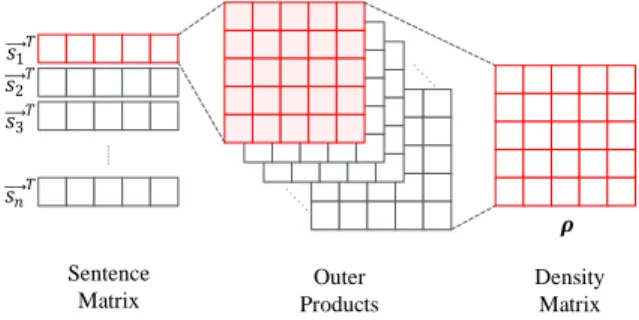
Sentence Matrix Density Matrix Outer Products 𝝆 𝑠1 𝑇 𝑠2 𝑇 𝑠3 𝑇 𝑠𝑛 𝑇
Figure 1: Single Sentence Representation
which represent the queryqand documentd, respectively. The original MLE estimation uses a so-called RρR algo-rithm, which is an Expectation-Maximization (EM) iterative algorithm and does not have an analytical solution. After the estimation of density matrices, the ranking is based on the negative Von-Neumann (VN) Divergence between ρq and ρd (i.e.,−4V N(ρq||ρd) = tr(ρqlogρd)). It turns out that
the original QLM cannot be directly integrated into an end-to-end mechanism. This motivates us to consider a Neural Network architecture.
Neural Network based Quantum-like
Language Model
In this section, we will describe our model in the context of a typical Question Answering task, namely answer se-lection, which aims to find accurate answers from a set of pre-selected candidate answers based on a question-answer similarity matching process. Note that the proposed model is general and can also be applied to other NLP and IR tasks that involve similarity matching and ranking.
Specifically, we introduce our model in three steps. First-ly, we design an embedding based density matrix represen-tation for single sentences to model the intra-sentence se-mantic information carried by a question/answer. Then, we introduce a joint representation to model the inter-sentence similarities between a question and an answer. Finally, the question and answer are matched according to similarity features/patterns obtained from the joint representation. All these parts are integrated into a neural network structure.
Embedding based Density Matrix for Single
Sentence Representation
Formally, word embeddings are encoded in an embedding matrixE ∈ R|V|×d, where|V|is the length of the
vocab-ulary andd is the dimension of the word embeddings. D-ifferent from the one-hot representation, word embeddings are obtained from the whole corpus or certain external large corpora, and thus contain global semantic information. As shown in Figure 1, theithword in a sentence is represented
by a vector −→si ∈ E. Such a distributed representation for
each word can naturally serve as an observed state for a sen-tence. To obtain a unit state vector, we normalize each word
embedding vector (−→si ∈E) as follows: |sii= − →s i ||−→si||2 (2)
Then, a sentence (e.g., question or answer) can correspond to a mixed state represented by a density matrix. According to the definition of density matrix, we can derive it as
ρ=X i piSi= X i pi|siihsi| (3) whereP
ipi = 1, and ρis symmetric, positive
semidefi-nite and of trace 1.Si is a semantic subspace spanned by
the embedding-based state vector |sii. Each outer product
|siihsi|can be regarded as a partial Positive Operator-Valued
Measurement (partial POVM) (Blacoe 2014), which is more general than the Projector-based Measurement in the origi-nal QLM. In addition, compared with the projectorsΠi in
QLM,Sicarries more semantic information due to the
em-bedding based state vectors|siias against the one-hot
vec-tors|eiithat formsΠi.
In Eq. 3,pi(Pipi = 1) is the corresponding probability
of the state|siiwith respect to theithwordsiin a given
sen-tence. In practice, the values ofpi reflect the weights of the
words in different positions of the sentence, and can be con-sidered as a parameter automatically adjusted in the training process of the network.
To our best knowledge, current QA systems often direct-ly align the embedding vector for each word, but without considering the mixture of the semantic subspaces spanned by the embedding vectors. With such a mixture space, we will show that some useful similarity features/patterns will be derived in our neural network based architecture. We can also interpret the density matrix in Eq. 3 from the perspec-tive of covariance matrix. The density matrix to some extent reflects the covariance of different embedding dimensions for a sentence. In other words, it represents how scattered the words (in the sentence) will be in the embedded space.
Joint Representation for Question Answer Pair
Instead of separately modeling/projecting a text into one di-mensional vector and then computing a distance-based score between a pair of text fragments, two dimensional match-ing model which uses a joint representation (a matrix or multi-dimension tensor) have proven more effective (Hu et al. 2014; Wan et al. 2016). Based on the density matrices for a question and an answer, we can build a joint representation for modeling the interaction between two density matrices by their multiplication:
Mqa=ρqρa (4)
whereρq andρa are the density matrix representation for
the questionqand the answera, respectively.
In order to analyze the property of this joint representa-tion, we can first decompose the density matrix of the query through spectral decomposition:
ρq =
X
i
λi|riihri| (5)
where λi is an eigenvalue and |rii is the corresponding
eigenvector. The eigenvector can be interpreted as a laten-t semanlaten-tic basis, and laten-the eigenvalue can refleclaten-t how scalaten-t- scat-tered the words are in the corresponding basis. Similar-ly, the answer density matrix ρa can be decomposed into ρa =Pjλj|rjihrj|. Then the joint representation between ρq andρacan be written as:
ρqρa= X i,j λiλj|riihri|rjihrj| =X i,j λiλjhri|rji|riihrj| (6)
In Eq. 6, the more similar two bases are, the bigger the
hri|rji(representing the inner product and the Cosine
simi-larity between|riiandhrj|) is. Sincehri|rji= tr(|riihrj|),
we have tr(ρqρa) = X i,j λiλjhri|rji 2 (7)
which is the sum of Cosine similarities of between the laten-t semanlaten-tic dimensions. In laten-this way, laten-the joinlaten-t represenlaten-talaten-tion can retain the distribution of similar bases and ignore the dis-similar ones. More generally,tr(ρqρa)is a generalization of
inner product from vectors to matrices, which is called trace inner product (Balkır 2014). Thus, the joint representation matrix Mqa encodes the similarity information across the
question and the answer.
Learning to Match Density Matrices
Based on the above ideas, we propose two Neural Network based Quantum-like Language Models (NNQLM) to match the question-answer pairs.
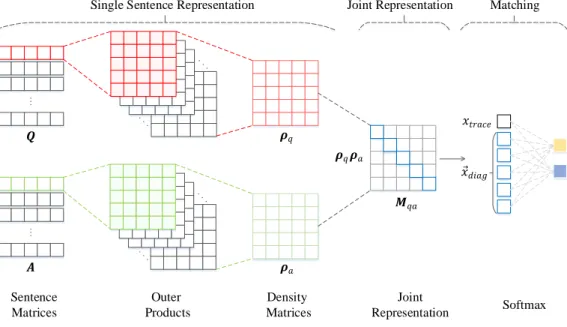
NNQLM-I As shown in Figure 2, the first architecture is designed to allow a direct and intuitive comparison with the original QLM. In QLM, the similarity between a ques-tion and an answer is obtained by the negative VN diver-gence. However, because of thelogoperation for the matrix, the negative VN divergence is hard to be integrated into an end-to-end approach. In this paper, we adopt the trace inner product. Formally, the trace inner product between two den-sity matricesρq andρa (for a questionqand an answera,
respectively) can be formulated as:
S(ρq,ρa) = tr(ρqρa) (8)
Trace inner product has been used to calculate the similari-ty between words or sentences (Blacoe, Kashefi, and Lapata 2013; Blacoe 2014) and has been proven to be an approx-imation of the negative VN divergence (Sordoni, Bengio, and Nie 2014). As aforementioned, it can be rewritten as
xtrace= tr(ρqρa) = Pi,jλiλjhri|rji2, which can be
un-derstood as the semantic overlaps used to compute the sim-ilarity between the density matrices of the question and the answer. In addition, the diagonal elements (forming~xdiag)
ofMqaare also adopted to enrich the feature representation,
since different diagonal elements may have different degrees of importance for similarity measurement. Then, the feature representation can be denoted as:
~
Sentence Matrices Outer Products Density Matrices Joint Representation Softmax
Single Sentence Representation Joint Representation Matching
𝑥𝑡𝑟𝑎𝑐𝑒 𝑥 𝑑𝑖𝑎𝑔 𝑴𝑞𝑎 𝝆𝑞𝝆𝑎 𝝆𝑎 𝝆𝑞 𝑸 𝑨
Figure 2: NNQLM-I. The first three layers are to obtain the single sentence representation, the fourth layer is to obtain the joint representation of a QA pair, and the softmax layer is to match the QA pair.
Sentence Matrices Outer Products Density Matrices Joint Representation Softmax row-pooling col-pooling connect Pooling Convolution
Single Sentence Representation Joint Representation Matching
𝑴𝑞𝑎 𝝆𝑞𝝆𝑎 𝝆𝑎 𝝆𝑞 𝑸 𝑨 𝑺1 𝑺2 𝑺𝑐
Figure 3: NNQLM-II. The single sentence representation and the joint representation are the same as those in NNQLM-I, and the rest layers are to match the QA pair by the similarity patterns learned by 2D-CNN.
A fully-connected layer and a softmax activation are adopt-ed. The outputs of the softmax layer are the probabilities of positive and negative labels of an answer. The probability of the positive label is used as the similarity score for rank-ing. The back propagation is trained with the negative cross entropy loss:
L=−
N
X
i
[yilogh(~xf eat) + (1−yi) log(1−h(~xf eat))]
(10) whereh(~xf eat)is the output from softmax. In this way, we
extend the original QLM to an end-to-end method.
NNQLM-II In this architecture, we will adopt a “two-dimensional” (2D) convolution (Hu et al. 2014) to learn rel-atively more abstract representations, which are different from the intuitive features (e.g., trace inner product xtrace
which is a similarity measure) in NNQLM-I. We think the 2D convolution is more suitable for the joint representa-tion Mqa, asMqa is not a simple concatenation of word
embedding vectors. For the simple concatenation represen-tation, the convolution kernels slide only along each sin-gle dimension, so that the corresponding convolution can be considered as “one-dimensional” (1D) convolution (Hu et al. 2014), which is actually used in many CNN-based QA models (Severyn and Moschitti 2015; Yu et al. 2014; Kim 2014).
The second architecture, namely NNQLM-II, is shown in Figure 3. Recall that in the first architecture, only the diag-onal values and the trace value of the joint representation
Mqa are involved in the training process (see Figure 2). In
NNQLM-II, we use 2D convolution kernels to scan all the local parts (including the diagonal elements in the first archi-tecture) of the joint representation and extract/filter as many similarity patterns as possible inMqa.
Suppose the number of filters is c. Theith convolution
operation is formulated as:
Ci=δ(Mqa∗Wi+bi) (11)
where1 6i 6 c,δis the non-linear activation function, * denotes the 2D convolution,Wi andbiare the weight and
the bias respectively for theithconvolution kernel, andC i
is the feature map. After the convolution layer obtains the feature maps, we then use row-wise and column-wise max-pooling to generate vectors~riq ∈Rd−k+1and~ria∈R
d−k+1,
respectively, with the formulations as follows:
~rqi = (qj:j= 1,2, . . . , d−k+ 1) qj= max 1≤m≤d−k+1(Ci(j,m)) (12) ~rai = (aj:j= 1,2, . . . , d−k+ 1) aj= max 1≤m≤d−k+1(Ci(m,j)) (13)
We concatenate these vectors as follow:
~ xf eat= [~rq1;~r a 1;. . .;~r q i;~r a i;. . .;~r q c;~r a c] (14)
where16i6c. The above convolution operation aims to extract useful similarity patterns and each convolution ker-nel corresponds to a feature. We can adjust the parameters of the kernels when the model is being trained.
Related Work
Now, we present a brief review of the related work, including the recent quantum-inspired work in Information Retrieval (IR) and Natural Language Processing (NLP), and some rep-resentative work in Question Answering.
Quantum-inspired Models for IR and NLP
van Rijsbergen (2004) argued that quantum theory can u-nify the logical, geometric, and probabilistic IR models by its mathematical formalism. After this pioneering work, a range of quantum-inspired methods have been develope-d (Zuccon andevelope-d Azzopardevelope-di 2010; Piwowarski et al. 2010; Zhang et al. 2016), based on the analogy between IR rank-ing and quantum phenomena (e.g., double-slit experiment). Quantum theory has been also used for semantic represen-tation in combination with Dependency Parsing Tree (Bla-coe, Kashefi, and Lapata 2013), where state vectors repre-sent word meanings and density matrices reprerepre-sent the un-certainty of word meanings.
Sordoni, Nie, and Bengio (2013) successfully applied quantum probability in Language Modeling (LM) and pro-posed a Quantum Language Model (QLM), for which the estimation of the density matrix is crucial. It is proven that the density matrix is a more general representation for texts, by looking at vector space model and language model in the quantum formalism (Sordoni and Nie 2013). Using the idea of quantum entropy minimization in QLM, Sordoni, Bengio, and Nie (2014) proposed to learn latent concept embeddings for query expansion. By devising a similarity function in the latent concept space, the query representation will get closer to the relevant document terms, thus benefiting the likeli-hood of selecting good expansion terms. Indeed, this work inspires us to develop QLM towards a supervised approach and estimating density matrix analytically. Compared with this work, our proposed model targets different application task, and uses different approaches to density matrix estima-tion and learning architectures.
More recently, a session-based adaptive QLM was pro-posed to model the evolution of density matrix and capture the dynamic information need in search sessions (Li et al. 2015; 2016). The concept of quantum entanglement has al-so been integrated into the quantum language model (Xie et al. 2015). Practically, the so-called pure high-order term association patterns (as a reflection of entanglement) are se-lected as the compound terms for the input of density matrix estimation. The above variants of QLM keeps the main ar-chitecture of QLM. In other words, they still carry out the representation, estimation and ranking processes sequential-ly, without a joint optimization strategy. Thus their potential to improve the retrieval effectiveness is limited.
Answer Selection
In this paper, we apply the proposed end-to-end QLM in the answer selection task. The aim of answer selection is to find correct answer sentences from pre-selected answer candi-dates given a question. In the answer selection task, end-to-end methods represent the current state of the art.
Yu et al. (2014) used CNN to capture bigram informa-tion in the quesinforma-tion/answer. Severyn and Moschitti (2015)
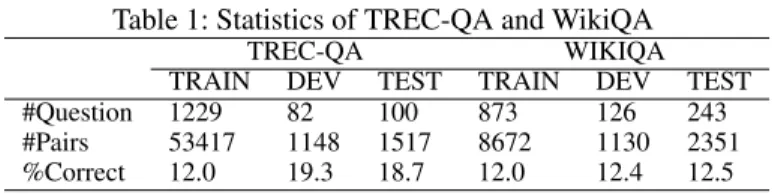
Table 1: Statistics of TREC-QA and WikiQA
TREC-QA WIKIQA TRAIN DEV TEST TRAIN DEV TEST #Question 1229 82 100 873 126 243 #Pairs 53417 1148 1517 8672 1130 2351 %Correct 12.0 19.3 18.7 12.0 12.4 12.5
further developed this idea and capture n-gram of high-er ordhigh-er dependency. Qiu and Huang (2015) also eled n-gram information in a single sentence and mod-el the interactions between sentences with a tensor lay-er. Later, more effective components are added to the C-NN model, such as attention mechanism (Yin et al. 2015; dos Santos et al. 2016) and Noise-Contrastive Estimation (NCE) (Rao, He, and Lin 2016). Long-Short Term Mem-ory (LSTM) has also been utilized (Wang and Nyberg 2015; Tay et al. 2017).
Our work is the first attempt to introduce Quantum Lan-guage Model (QLM) in the answer selection task. We will show that the density matrix representation has a great po-tential to effectively encode the mixture of semantic sub-spaces and reflect how scattered the words of a sentence are in the embedded space. To our best knowledge, such repre-sentation for sentences and a further joint reprerepre-sentation for two sentences, are different from those representations used in the aforementioned end-to-end QA approaches. In addi-tion, different from existing QLM based models, we design a new method to obtain density matrices and propose an end-to-end model to integrate the density matrix representation and the similarity matching into neural network structures.
Experiment
Datasets and Evaluation Metrics
Extensive experiments are conducted on the TREC-QA and WikiQA datasets. TREC-QA is a standard benchmarking dataset used in the Text REtrieval Conference (TREC)’s QA track (8-13) (Wang, Smith, and Mitamura 2007). WikiQA (Yang, Yih, and Meek 2015) is an open domain question-answering dataset released by Microsoft Research, and we use it for the subtask assuming there is at least one correct answer for each question. The basic statistics of the dataset-s are predataset-sented in Table 1. The evaluation metricdataset-s we udataset-se are mean average precision (MAP) and mean reciprocal rank (MRR), which are commonly used in previous works for the same task with the same datasets.
Methods for Comparison and Parameter Settings
The methods for comparison are as follows. QLM is the o-riginal quantum language model while QLMT replaces
non-negative VN divergence with trace inner product as the rank-ing function. NNQLM-I and NNQLM-II are our proposed end-to-end QLMs.
For QLM, we initializeρ0by a diagonal matrix, in which
the diagonal elements are Term Frequency (TF) values of the corresponding words. The initial matrices are normal-ized with a unit trace. The size of sliding window is 5.
For NNQLMs, the hyper parameters are listed in Table 2. The parameters that need to be trained are the position weightspiin density matrices (see Eq. 3), the weights of the
softmax layer, and the parameters for the convolution layer. The word embeddings are trained by word2vec (Mikolov et al. 2013) on English Wikimedia1. The dimensionality is 50, and the Out-of-Vocabulary words are randomly initialized by a uniform distribution in the range of (-0.25, 0.25). In NNQLM-I, the embeddings are updated during training. For NNQLM-II, we keep the embeddings static, which is found in our pilot experiments to outperform dynamically updating the embeddings.
Results
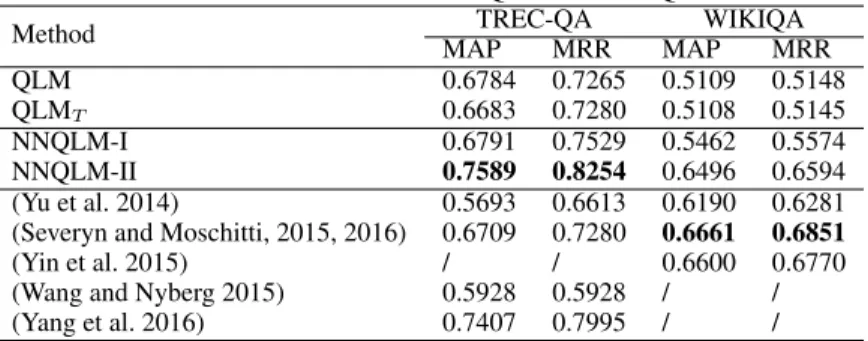
A series of experiments are carried out for a systematic eval-uation. Table 3 summarizes the experiment results.
In the first group, we compare QLM with QLMT. On both
TREC-QA and WIKIQA, QLM achieves similar results to QLMT. This is consistent with our previous explanation that
the trace inner product is an approximation of negative VN divergence. Thus, it is reasonable to use it as a similarity measure in our first architecture (NNQLM-I) based on the joint representation.
In the second group, we compare two NNQLMs with QLM. NNQLM-I can outperform QLM, which shows the effectiveness of our new definition of the density matrix together with the simple training algorithm. Recall that in NNQLM-I, only the diagonal and trace values of the joint representation are involved in the training process.
NNQLM-II, which uses 2D convolution neural network (2D-CNN for short), largely outperforms NNQLM-I. It ver-ifies our earlier analysis that the 2D-CNN is able to learn richer similarity features than those learned from the first ar-chitecture. It also implies that the joint representation of den-sity matrices has a great potential as a kind of representation for learning effective inter-sentence similarity information.
As we can see from Table 3, NNQLM-II can significant-ly improve the original QLM on both datasets (by 11.87% MAP and 13.61% MRR on TREC-QA, and by 27.15% MAP and 28.09% on WIKIQA). The significant test is performed using the Wilcoxon signed-rank test with p<0.05.
In the third group, we compare NNQLM-II with the ex-isting neural network based approaches (Yu et al. 2014; Severyn and Moschitti 2015; Yin et al. 2015; Wang and Ny-berg 2015; Yang et al. 2016)2. On TREC-QA,
NNQLM-1
https://dumps.wikimedia.org/
2
The WIKIQA results of the methods proposed in (Yu et al. 2014) and (Yin et al. 2015) are extracted from (Yang, Yih, and Meek 2015) and (dos Santos et al. 2016), respectively, excluding handcrafted features.
Table 2: The Hyper Parameters of NNQLM
Method TREC-QA WIKIQA NNQLM-I NNQLM-II NNQLM-I NNQLM-II learning rate 0.01 0.01 0.08 0.02 batchsize 100 100 100 140 filter number / 65 / 150 filter size / 40 / 40
Table 3: Results on TREC-QA and WIKIQA
Method TREC-QA WIKIQA MAP MRR MAP MRR QLM 0.6784 0.7265 0.5109 0.5148 QLMT 0.6683 0.7280 0.5108 0.5145 NNQLM-I 0.6791 0.7529 0.5462 0.5574 NNQLM-II 0.7589 0.8254 0.6496 0.6594 (Yu et al. 2014) 0.5693 0.6613 0.6190 0.6281 (Severyn and Moschitti, 2015, 2016) 0.6709 0.7280 0.6661 0.6851
(Yin et al. 2015) / / 0.6600 0.6770 (Wang and Nyberg 2015) 0.5928 0.5928 / / (Yang et al. 2016) 0.7407 0.7995 / /
II achieves thebestperformance over the comparative ap-proaches. Note that NNQLM-II outperforms a strong base-line (Yang et al. 2016) by 2.46% MAP and 3.24% MRR. On WikiQA, NNQLM-II has outperformed a baseline method proposed (Yu et al. 2014), for which its WikiQA results are reported in (Yang, Yih, and Meek 2015).
Discussions
NNQLM-II has not yet outperformed the other two baselines on WikiQA. The possible reason is that although 2D-CNN can learn useful similarity patterns for the QA task, there can be other useful features (e.g, the structure in a sentence) that could influence the performance. In fact, We can add some other features and get improvements on WikiQA. In our future work, we will improve the network structure of NNQLM-II for a better model.
In addition, we would like to further explain the mech-anism of our model in comparison with the existing QA models. The difference of our proposed model stems from the density matrix representation. Such a matrix can repre-sent the mixture of the semantic subspaces, and the join-t represenjoin-tajoin-tion of quesjoin-tion and answer majoin-trices can encode similarity patterns. By using the 2D-CNN, we can extract useful similarity patterns and obtain a good performance on the answer selection task. On the other hand, most existing neural network based QA models concatenates word embed-ding vectors. Based on such concatenation, the 1D convo-lution neural networks (1D-CNN for short) can be directly performed. We have carried out the above experiments for a comparison. In the future, we will systematically analyze and evaluate the above two different mechanisms in-depth.
Conclusions and Future Work
In this paper, we have proposed an Neural-Network based Quantum-like Language Models (namely NNQLM), which substantially extend the original Quantum Language
Mod-el (QLM) to an end-to-end mechanism, with application to the Question Answering (QA) task. To the best of our knowledge, this is the first time for the QLM to be extend-ed with neural network architectures and for the quantum or quantum-like models to applied to QA. We have designed a new density matrix based on word embeddings, and such a density matrix for a single sentence, together with the joint representation for sentence pairs, can be integrated into the neural network architectures for an effective joint training.
Systematic experiments on TREC QA and WikiQA have demonstrated the applicability and effectiveness of QLM and NNQLMs. Our proposed NNQLM-II achieves a signif-icant improvement over QLM on both datasets, and outper-forms a strong baseline (Yang et al. 2016) by 2.46% (MAP) and 3.24% (MRR) on TREC-QA.
A straightforward future research direction is to explore other neural networks for NNQLM. Our models can also be applied to other tasks, especially for short text pair matching tasks. In addition, for those QA pairs that are not selected by the similarity matching, e.g., in a casual inference case, we can encode an additional component (e.g., an inference function) in the quantum-like models. It is also interesting to explore the capability of NNQLMs using density matrices for the representation learning task.
Acknowledgements
This work is supported in part by the Chinese National Pro-gram on Key Basic Research Project (973 ProPro-gram, grant No. 2014CB744604), Natural Science Foundation of Chi-na (grant No. U1636203, 61772363, 61402324), Tianjin Natural Science Foundation (grant No. 15JCQNJC41700), and European Union’ Horizon 2020 research and innovation programe under the Marie Skłodowska-Curie grant agree-ment No. 721321.
References
Balkır, E. 2014. Using density matrices in a compositional distributional model of meaning. Ph.D. Dissertation, Mas-ters thesis, University of Oxford.
Bengio, Y.; Ducharme, R.; Vincent, P.; and Janvin, C. 2003. A neural probabilistic language model. Journal of Machine Learning Research3:1137–1155.
Blacoe, W.; Kashefi, E.; and Lapata, M. 2013. A quantum-theoretic approach to distributional semantics. InProc. of HLT-NAACL, 847–857.
Blacoe, W. 2014. Semantic composition inspired by quan-tum measurement. InProc. of QI, 41–53. Springer.
Bruza, P. D.; Wang, Z.; and Busemeyer, J. R. 2015. Quantum cognition: a new theoretical approach to psychology.Trends in Cognitive Sciences19(7):383 – 393.
dos Santos, C. N.; Tan, M.; Xiang, B.; and Zhou, B. 2016. Attentive pooling networks.CoRR, abs/1602.03609. Gleason, A. M. 1957. Measures on the closed subspaces of a hilbert space. Journal of mathematics and mechanics
6(6):885–893.
Hu, B.; Lu, Z.; Li, H.; and Chen, Q. 2014. Convolutional neural network architectures for matching natural language sentences. InProc. of NIPS, 2042–2050.
Kim, Y. 2014. Convolutional neural networks for sentence classification.arXiv preprint arXiv:1408.5882.
Li, Q.; Li, J.; Zhang, P.; and Song, D. 2015. Modeling multi-query retrieval tasks using density matrix transformation. In
Proc. of SIGIR, 871–874. ACM.
Li, J.; Zhang, P.; Song, D.; and Hou, Y. 2016. An adaptive contextual quantum language model. Physica A: Statistical Mechanics and its Applications456:51–67.
Manning, C. D.; Raghavan, P.; and Sch¨utze, H. 2008. In-troduction to Information Retrieval. New York, NY, USA: Cambridge University Press.
Mikolov, T.; Sutskever, I.; Chen, K.; Corrado, G. S.; and Dean, J. 2013. Distributed representations of words and phrases and their compositionality. InProc. of NIPS, 3111– 3119.
Piwowarski, B.; Frommholz, I.; Lalmas, M.; and van Rijs-bergen, K. 2010. What can quantum theory bring to infor-mation retrieval. InProc. of CIKM, 59–68.
Qiu, X., and Huang, X. 2015. Convolutional neural tensor network architecture for community-based question answer-ing. InProc. of IJCAI, 1305–1311.
Rao, J.; He, H.; and Lin, J. 2016. Noise-contrastive esti-mation for answer selection with deep neural networks. In
Proc. of CIKM, 1913–1916. ACM.
Severyn, A., and Moschitti, A. 2015. Learning to rank short text pairs with convolutional deep neural networks. InProc. of SIGIR, 373–382. ACM.
Severyn, A., and Moschitti, A. 2016. Modeling relation-al information in question-answer pairs with convolutionrelation-al neural networks. arXiv preprint arXiv:1604.01178.
Sordoni, A., and Nie, J.-Y. 2013. Looking at vector space and language models for ir using density matrices. InProc. of QI, 147–159. Springer.
Sordoni, A.; Bengio, Y.; and Nie, J.-Y. 2014. Learning con-cept embeddings for query expansion by quantum entropy minimization. InProc. of AAAI, volume 14, 1586–1592. Sordoni, A.; Nie, J.-Y.; and Bengio, Y. 2013. Modeling term dependencies with quantum language models for ir. InProc. of SIGIR, 653–662. ACM.
Tay, Y.; Phan, M. C.; Tuan, L. A.; and Hui, S. C. 2017. Learning to rank question answer pairs with holographic d-ual lstm architecture. InProc. of SIGIR, 695–704. ACM. Van Rijsbergen, C. J. 2004. The geometry of information retrieval. Cambridge University Press.
Von Neumann, J. 1955. Mathematical foundations of quan-tum mechanics. Number 2. Princeton university press. Wan, S.; Lan, Y.; Guo, J.; Xu, J.; Pang, L.; and Cheng, X. 2016. A deep architecture for semantic matching with mul-tiple positional sentence representations. InProc. of AAAI, 2835–2841.
Wang, D., and Nyberg, E. 2015. A long short-term memory model for answer sentence selection in question answering. InProc. of ACL, 707–712.
Wang, B.; Zhang, P.; Li, J.; Song, D.; Hou, Y.; and Shang, Z. 2016. Exploration of quantum interference in document relevance judgement discrepancy. Entropy18(4):144. Wang, M.; Smith, N. A.; and Mitamura, T. 2007. What is the jeopardy model? a quasi-synchronous grammar for qa. InProc. of EMNLP-CoNLL, volume 7, 22–32.
Xie, M.; Hou, Y.; Zhang, P.; Li, J.; Li, W.; and Song, D. 2015. Modeling quantum entanglements in quantum lan-guage models. InProc. of IJCAI. AAAI Press.
Yang, L.; Ai, Q.; Guo, J.; and Croft, W. B. 2016. anm-m: Ranking short answer texts with attention-based neural matching model. InProc. of CIKM, 287–296. ACM. Yang, Y.; Yih, W.-t.; and Meek, C. 2015. Wikiqa: A chal-lenge dataset for open-domain question answering. InProc. of EMNLP, 2013–2018. Citeseer.
Yin, W.; Sch¨utze, H.; Xiang, B.; and Zhou, B. 2015. Abcnn: Attention-based convolutional neural network for modeling sentence pairs. arXiv preprint arXiv:1512.05193.
Yu, L.; Hermann, K. M.; Blunsom, P.; and Pulman, S. 2014. Deep learning for answer sentence selection. arXiv preprint arXiv:1412.1632.
Zhai, C. 2008.Statistical Language Models for Information Retrieval. Synthesis Lectures on Human Language Tech-nologies. Morgan & Claypool Publishers.
Zhang, P.; Li, J.; Wang, B.; Zhao, X.; Song, D.; Hou, Y.; and Melucci, M. 2016. A quantum query expansion approach for session search. Entropy18(4):146.
Zuccon, G., and Azzopardi, L. 2010. Using the quantum probability ranking principle to rank interdependent docu-ments. InProc. of ECIR, 357–369.